Determinants and Systems of Linear Equations
What to remember
- A determinant is a single number attached to a square matrix. For order 2 it is $ad - bc$; for order 3 you expand along any row or column using minors and cofactors, and every choice gives the same number.
- Row and column operations are your main tool: swapping two rows flips the sign, adding a multiple of one row to another changes nothing, and a common factor of a row comes outside. Two equal or proportional rows make the value zero.
- $A \cdot \operatorname{adj}A = |A| I$, so $A^{-1} = \dfrac{\operatorname{adj}A}{|A|}$, and $|\operatorname{adj}A| = |A|^{n-1}$ for an $n \times n$ matrix.
- For $AX = B$ with $|A| \ne 0$ there is exactly one solution, $X = A^{-1}B$, which is the same thing as Cramer's rule $x_i = \dfrac{D_i}{D}$.
- When $|A| = 0$ the system has either no solution or infinitely many; decide by row reduction. A homogeneous system $AX = O$ always has $X = O$, and has other solutions exactly when $|A| = 0$.
1. Determinants of order 2 and 3
Take a square array of numbers. Its determinant is written with straight bars instead of brackets, and it is defined only for a square array.
For order 2:
Multiply along the main diagonal, subtract the product along the other diagonal. That is the whole rule.
For order 3 we need two small ideas.
- The minor $M_{ij}$ of the entry $a_{ij}$ is the determinant you get after deleting row $i$ and column $j$. It is a determinant of order 2 here.
- The cofactor is the minor with a sign attached: $C_{ij} = (-1)^{i+j} M_{ij}$.
The sign $(-1)^{i+j}$ is plus when $i + j$ is even and minus when it is odd, so the signs sit on the matrix like a chessboard, with plus at the top-left corner.
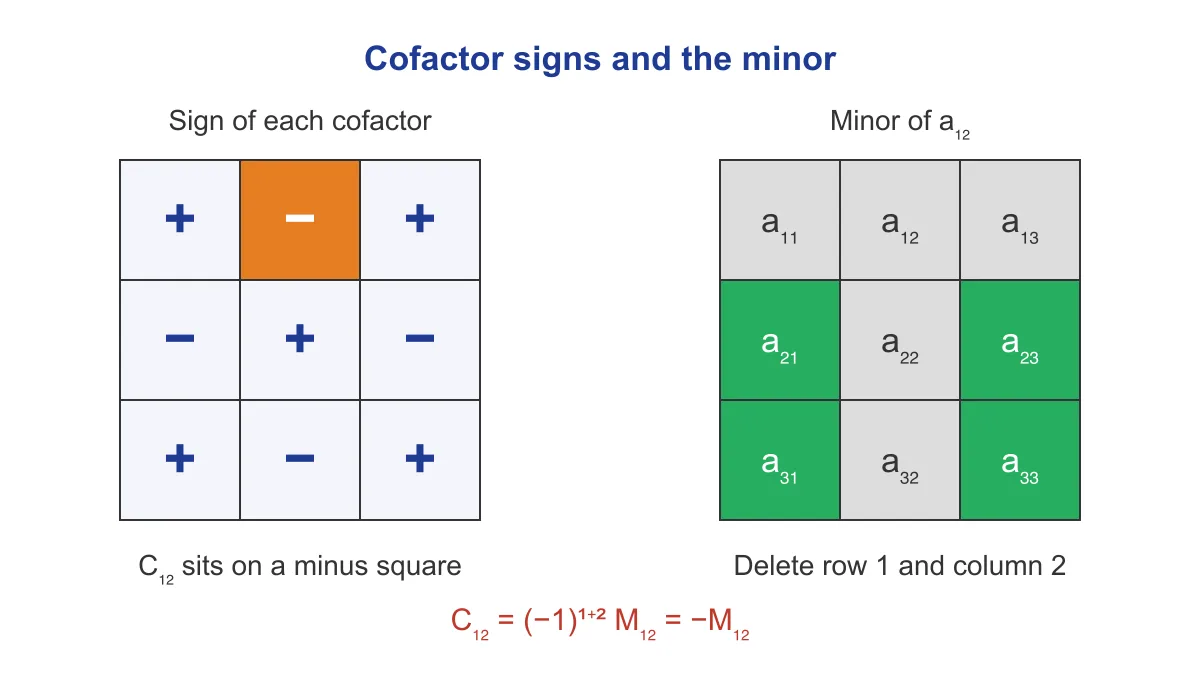
Figure 2.1: The sign chessboard and the minor of the entry in row 1, column 2
Expansion along a row or column. The determinant equals the sum, over one chosen row (or column), of each entry times its own cofactor. Along the first row of a $3 \times 3$ matrix:
Written out, this is $a_{11}(a_{22}a_{33} - a_{23}a_{32}) - a_{12}(a_{21}a_{33} - a_{23}a_{31}) + a_{13}(a_{21}a_{32} - a_{22}a_{31})$. The middle term carries the minus sign because $C_{12}$ sits on a minus square.
Any row or any column gives the same value, so choose the one with the most zeros. A zero entry removes its whole term.
There is one more fact worth owning now. If you multiply the entries of one row by the cofactors of a different row and add, the result is zero. For example $a_{11}C_{21} + a_{12}C_{22} + a_{13}C_{23} = 0$. The reason is simple: that sum is the expansion of a determinant in which two rows are identical, and such a determinant is zero (see the properties below).
Example 1: Evaluate $\begin{vmatrix} 2 & 1 & 3 \\ 0 & 4 & -1 \\ 5 & 2 & 1 \end{vmatrix}$.
Expand along the first row.
Term 1: $2\,(4 \cdot 1 - (-1)(2)) = 2(4 + 2) = 12$.
Term 2: $-1\,(0 \cdot 1 - (-1)(5)) = -(5) = -5$.
Term 3: $3\,(0 \cdot 2 - 4 \cdot 5) = 3(-20) = -60$.
Sum: $12 - 5 - 60 = -53$.
Answer: $-53$. Check by expanding along the first column: $2(6) - 0 + 5(-1 - 12) = 12 - 65 = -53$. The two routes agree, which is how you catch a sign slip.
Memory trick: "Plus on the corner, then flip-flop." Start with + at the top-left and alternate across and down: + − + / − + − / + − +.
Use it every time you pick a cofactor sign; never compute $(-1)^{i+j}$ in your head under pressure, just look at the chessboard.
2. Properties of determinants
These properties are the reason determinants are manageable. Learn each with its reason, because JEE questions are built on them. Below, "row" can be replaced by "column" everywhere, since the first property says the two are interchangeable.
- Transpose. $|A^T| = |A|$. Rows and columns play the same role.
- Swap. Interchanging two rows (or two columns) changes the sign of the determinant. You can check it for order 2: swapping rows of $ad - bc$ gives $cb - da$, which is the negative.
- Equal rows. If two rows are identical, the determinant is $0$. Swapping them changes the sign, yet the determinant is unchanged, so $D = -D$ and $D = 0$.
- Scalar factor. If every entry of one row is multiplied by $k$, the determinant is multiplied by $k$. Equivalently a common factor of one row can be taken outside. Consequence for the whole matrix: $|kA| = k^n |A|$ for order $n$, because all $n$ rows each give a factor $k$.
- Zero and proportional rows. A row of zeros, or two rows that are multiples of each other, gives $0$ (use property 4, then property 3).
- Splitting. If each entry of one row is a sum of two terms, the determinant splits into the sum of two determinants, the other rows staying as they are. Note that this works one row at a time; in general $|A + B| \ne |A| + |B|$.
- Add a multiple. Replacing $R_i$ by $R_i + kR_j$ (with $j \ne i$) leaves the value unchanged. This follows from splitting plus proportional rows.
- Product. $|AB| = |A|\,|B|$ for square matrices of the same order. Hence $|A^m| = |A|^m$.
- Triangular matrices. If all entries below (or above) the main diagonal are zero, the determinant is the product of the diagonal entries.
- Skew-symmetric of odd order. If $A^T = -A$ and $n$ is odd, then $|A| = |A^T| = |-A| = (-1)^n |A| = -|A|$, so $|A| = 0$.
| Operation on the matrix | Effect on the determinant |
|---|---|
| Swap two rows or columns | Multiply by $-1$ |
| Multiply one row by $k$ | Multiply by $k$ |
| Multiply the whole $n \times n$ matrix by $k$ | Multiply by $k^n$ |
| Add $k$ times one row to another | No change |
| Take the transpose | No change |
| Take a product $AB$ | $\vert A\vert\,\vert B\vert$ |
3. Evaluating and factorising with properties
For a numerical determinant, the aim is to create zeros. Pick a row or column with a convenient entry (a $1$ is ideal), clear the rest of its column with property 7, then expand along it so that only one small determinant remains.
For a determinant full of letters, the aim is different: you want to find factors. Two methods do most of the work.
- Factor theorem for determinants. If putting $x = a$ makes two rows identical, then $(x - a)$ is a factor. Count degrees to know how many factors you can expect, and fix the constant by comparing one term or one special value.
- Row/column operations that expose a common factor. For instance, adding all columns into the first column often produces a column of identical entries, and that common entry can be pulled out.
Example 2: Show that $\begin{vmatrix} 1 & 1 & 1 \\ a & b & c \\ a^2 & b^2 & c^2 \end{vmatrix} = (a-b)(b-c)(c-a)$.
Apply $C_2 \to C_2 - C_1$ and $C_3 \to C_3 - C_1$. The first row becomes $1, 0, 0$.
The determinant is $\begin{vmatrix} b-a & c-a \\ b^2-a^2 & c^2-a^2 \end{vmatrix}$ after expanding along row 1.
Take $(b-a)$ from the first column and $(c-a)$ from the second: $(b-a)(c-a)\begin{vmatrix} 1 & 1 \\ b+a & c+a \end{vmatrix}$.
The remaining $2 \times 2$ determinant is $(c+a) - (b+a) = c - b$.
So the value is $(b-a)(c-a)(c-b)$. Flip all three factors: $(-1)^3(a-b)(a-c)(b-c)$, and $(a-c) = -(c-a)$ gives $(a-b)(b-c)(c-a)$.
Answer: $(a-b)(b-c)(c-a)$. Notice that the determinant vanishes whenever any two of $a, b, c$ are equal, which is why it has exactly these three factors.
Example 3: Factorise $\begin{vmatrix} a+b & b+c & c+a \\ b+c & c+a & a+b \\ c+a & a+b & b+c \end{vmatrix}$.
Add $C_2$ and $C_3$ into $C_1$: every entry of the new $C_1$ is $2(a+b+c)$. Take it out.
$2(a+b+c)\begin{vmatrix} 1 & b+c & c+a \\ 1 & c+a & a+b \\ 1 & a+b & b+c \end{vmatrix}$.
Apply $R_2 \to R_2 - R_1$ and $R_3 \to R_3 - R_1$. Row 2 becomes $0,\ a-b,\ b-c$; row 3 becomes $0,\ a-c,\ b-a$.
Expand along column 1: $\begin{vmatrix} a-b & b-c \\ a-c & b-a \end{vmatrix} = (a-b)(b-a) - (b-c)(a-c)$.
That equals $-(a^2 + b^2 + c^2 - ab - bc - ca)$.
Total: $-2(a+b+c)(a^2 + b^2 + c^2 - ab - bc - ca) = -2(a^3 + b^3 + c^3 - 3abc)$.
Answer: $-2(a^3 + b^3 + c^3 - 3abc)$. Test with $a = 1, b = c = 0$: the matrix has determinant $-2$, which matches.
A cousin of this determinant is the "circulant" $\begin{vmatrix} a & b & c \\ b & c & a \\ c & a & b \end{vmatrix} = 3abc - a^3 - b^3 - c^3$. You get it by the same column trick.
4. Area of a triangle
For vertices $(x_1, y_1)$, $(x_2, y_2)$, $(x_3, y_3)$:
The outer bars mean absolute value, because an area cannot be negative. The inside determinant can be negative, depending on whether you list the vertices clockwise or anticlockwise.
Three consequences you will use constantly:
- The three points are collinear exactly when the determinant is $0$ (a triangle of zero area).
- The line through $(x_1, y_1)$ and $(x_2, y_2)$ has equation $\begin{vmatrix} x & y & 1 \\ x_1 & y_1 & 1 \\ x_2 & y_2 & 1 \end{vmatrix} = 0$, since any point $(x, y)$ on it makes the triangle degenerate.
- When the area is given and one coordinate is unknown, remember that the absolute value produces two cases, $+$ and $-$.
Example 4: Find the area of the triangle with vertices $(1, 1)$, $(5, 2)$ and $(3, 6)$.
$\Delta = \frac{1}{2}\left\vert 1(2 - 6) + 5(6 - 1) + 3(1 - 2) \right\vert$.
Inside: $-4 + 25 - 3 = 18$.
$\Delta = \frac{1}{2} \times 18 = 9$ square units.
Answer: $9$. Why this works: expanding the determinant along its last column gives $x_1(y_2 - y_3) + x_2(y_3 - y_1) + x_3(y_1 - y_2)$, the familiar coordinate formula.
5. Adjoint and inverse
Let $A$ be a square matrix. Form its cofactor matrix by replacing every entry $a_{ij}$ with its cofactor $C_{ij}$. The adjoint (or adjugate) of $A$, written $\operatorname{adj}A$, is the transpose of the cofactor matrix. So the cofactor of $a_{ij}$ lands at position $(j, i)$ of $\operatorname{adj}A$.
For order 2 there is a shortcut:
Memory trick: "Swap the diagonal, negate the rest, and say nothing more!" For a $2 \times 2$ matrix, exchange $a$ and $d$, and change the signs of $b$ and $c$.
Use it for every $2 \times 2$ inverse: do this, then divide by $ad - bc$.
The key identity. Multiply $A$ by $\operatorname{adj}A$. The entry in position $(i, i)$ is a row of $A$ times its own cofactors, which is $|A|$. The entry in position $(i, j)$ with $i \ne j$ is a row times the cofactors of another row, which is $0$ (the fact from section 1). Therefore
Inverse. If $|A| \ne 0$ (the matrix is called non-singular), divide by $|A|$:
A matrix with $|A| = 0$ is singular and has no inverse. In that case the identity reads $A \cdot \operatorname{adj}A = O$.
Properties (for $n \times n$ matrices; the inverses need the matrices to be non-singular):
| Result | Condition |
|---|---|
| $\vert\operatorname{adj}A\vert = \vert A\vert^{n-1}$ | any square $A$, $n \ge 2$ |
| $\operatorname{adj}(\operatorname{adj}A) = \vert A\vert^{n-2} A$ | $n \ge 2$ |
| $\vert\operatorname{adj}(\operatorname{adj}A)\vert = \vert A\vert^{(n-1)^2}$ | $n \ge 2$ |
| $\operatorname{adj}(kA) = k^{n-1}\operatorname{adj}A$ | any scalar $k$ |
| $\operatorname{adj}(AB) = \operatorname{adj}B \cdot \operatorname{adj}A$ | same order |
| $(AB)^{-1} = B^{-1}A^{-1}$ | both invertible |
| $\vert A^{-1}\vert = \dfrac{1}{\vert A\vert}$ | $\vert A\vert \ne 0$ |
| $(A^T)^{-1} = (A^{-1})^T$ | $\vert A\vert \ne 0$ |
Why $|\operatorname{adj}A| = |A|^{n-1}$? Take determinants of $A \cdot \operatorname{adj}A = |A| I$. The left side is $|A|\,|\operatorname{adj}A|$ and the right side is $|A|^n$, because $|A|$ is a scalar multiplying an $n \times n$ identity. If $|A| \ne 0$, divide by it. If $|A| = 0$ then $A\operatorname{adj}A = O$, and $\operatorname{adj}A$ turns out to be singular as well, so both sides are zero.
Applying the formula twice gives $|\operatorname{adj}(\operatorname{adj}A)| = (|A|^{n-1})^{n-1} = |A|^{(n-1)^2}$. For $n = 3$ that is $|A|^4$.
Example 5: Find the inverse of $A = \begin{bmatrix} 2 & 1 & 0 \\ 1 & 1 & 1 \\ 0 & 1 & 3 \end{bmatrix}$ and use it to solve $AX = \begin{bmatrix} 4 \\ 4 \\ 5 \end{bmatrix}$.
$|A| = 2(3 - 1) - 1(3 - 0) + 0 = 4 - 3 = 1$.
Cofactors: $C_{11} = 2$, $C_{12} = -3$, $C_{13} = 1$, $C_{21} = -3$, $C_{22} = 6$, $C_{23} = -2$, $C_{31} = 1$, $C_{32} = -2$, $C_{33} = 1$.
Transposing (the matrix happens to be symmetric): $\operatorname{adj}A = \begin{bmatrix} 2 & -3 & 1 \\ -3 & 6 & -2 \\ 1 & -2 & 1 \end{bmatrix}$.
Since $|A| = 1$, $A^{-1} = \operatorname{adj}A$.
Check one entry of $A \cdot \operatorname{adj}A$: row 1 of $A$ with column 1 of the adjoint is $4 - 3 + 0 = 1$.
$X = A^{-1}B$: first entry $8 - 12 + 5 = 1$; second $-12 + 24 - 10 = 2$; third $4 - 8 + 5 = 1$.
Answer: $x = 1,\ y = 2,\ z = 1$. Back-substitute: $2(1) + 2 = 4$, $1 + 2 + 1 = 4$, $2 + 3 = 5$. All three match.
6. Solving linear systems: matrix method and Cramer's rule
A system of three equations in three unknowns,
is the single matrix equation $AX = B$, where $A$ is the coefficient matrix, $X = [x\ y\ z]^T$ and $B = [d_1\ d_2\ d_3]^T$.
Matrix method. If $|A| \ne 0$, multiply on the left by $A^{-1}$ (left, because matrix multiplication is not commutative):
This gives one and only one solution, because $A^{-1}$ is unique.
Cramer's rule. Let $D = |A|$. Let $D_x$ be the determinant obtained from $D$ by replacing the $x$-column with the column of constants, and similarly $D_y$, $D_z$. When $D \ne 0$:
The two methods are the same thing in different clothes, because multiplying $\operatorname{adj}A$ by $B$ produces exactly these replaced-column determinants. Cramer's rule is faster when you want just one unknown. The matrix method is better when the same $A$ is used with many right-hand sides.
Memory trick: "Swap in the constants, divide by D." To get $x$, the constants replace the $x$-column; the denominator never changes.
Use it on paper: write $D$ first, copy it three times, and overwrite one column each time.
For two unknowns the rule is the same with $2 \times 2$ determinants: for $a_1x + b_1y = c_1$ and $a_2x + b_2y = c_2$, $D = a_1b_2 - a_2b_1$, $D_x = c_1b_2 - c_2b_1$, $D_y = a_1c_2 - a_2c_1$.
Example 6: A stationery shop sells pens, notebooks and files. One pen, one notebook and one file cost Rs 40. Two pens, one notebook and three files cost Rs 75. One pen, three notebooks and two files cost Rs 95. Find the price of a file.
Let the prices be $p, q, r$. The system is $p + q + r = 40$, $2p + q + 3r = 75$, $p + 3q + 2r = 95$.
$D = \begin{vmatrix} 1 & 1 & 1 \\ 2 & 1 & 3 \\ 1 & 3 & 2 \end{vmatrix} = 1(2 - 9) - 1(4 - 3) + 1(6 - 1) = -7 - 1 + 5 = -3$.
$D \ne 0$, so the solution is unique. Replace the third column:
$D_r = \begin{vmatrix} 1 & 1 & 40 \\ 2 & 1 & 75 \\ 1 & 3 & 95 \end{vmatrix} = 1(95 - 225) - 1(190 - 75) + 40(6 - 1) = -130 - 115 + 200 = -45$.
$r = \dfrac{-45}{-3} = 15$.
Answer: a file costs Rs 15. Check by finishing: $p + q = 25$ and $2p + q = 30$ give $p = 5$, $q = 20$; the third equation gives $5 + 60 + 30 = 95$. Correct.
7. Consistency: unique, infinite or no solution
A system is consistent if it has at least one solution and inconsistent if it has none. A linear system can only behave in three ways: exactly one solution, infinitely many, or none. It can never have exactly two.
For two unknowns, think of lines in the plane. Each equation is a line, and a solution is a point on both.
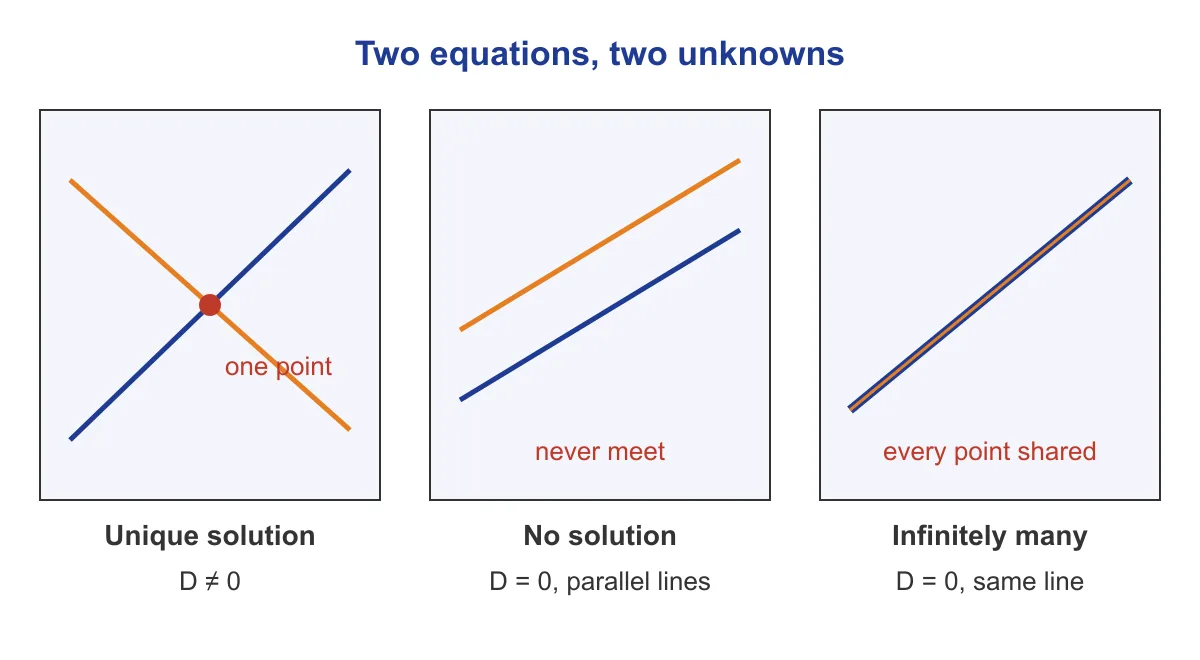
Figure 2.2: The three possible outcomes for two equations in two unknowns
In terms of the coefficients, for $a_1x + b_1y = c_1$ and $a_2x + b_2y = c_2$:
| Condition | Meaning | Solutions |
|---|---|---|
| $\dfrac{a_1}{a_2} \ne \dfrac{b_1}{b_2}$ | lines cross | exactly one |
| $\dfrac{a_1}{a_2} = \dfrac{b_1}{b_2} \ne \dfrac{c_1}{c_2}$ | lines parallel | none |
| $\dfrac{a_1}{a_2} = \dfrac{b_1}{b_2} = \dfrac{c_1}{c_2}$ | same line | infinitely many |
For three unknowns each equation is a plane, and the same trichotomy holds. The working rule for $AX = B$ with a square $A$:
- If $D \ne 0$, there is a unique solution.
- If $D = 0$ and at least one of $D_x, D_y, D_z$ is non-zero, there is no solution. (A solution would force every replaced-column determinant to vanish.)
- If $D = 0$ and all of $D_x, D_y, D_z$ are zero, Cramer's rule cannot decide. Row-reduce the augmented matrix $[A \mid B]$. A row of the form $0\ 0\ 0 \mid c$ with $c \ne 0$ means no solution; otherwise there are infinitely many, and you write the solution with a parameter.
There is a quick test for the inconsistent case with the adjoint: if $|A| = 0$ and $(\operatorname{adj}A)B \ne O$, the system is inconsistent. The reverse is not safe. When $(\operatorname{adj}A)B = O$ the system may still be inconsistent, so finish with row reduction.
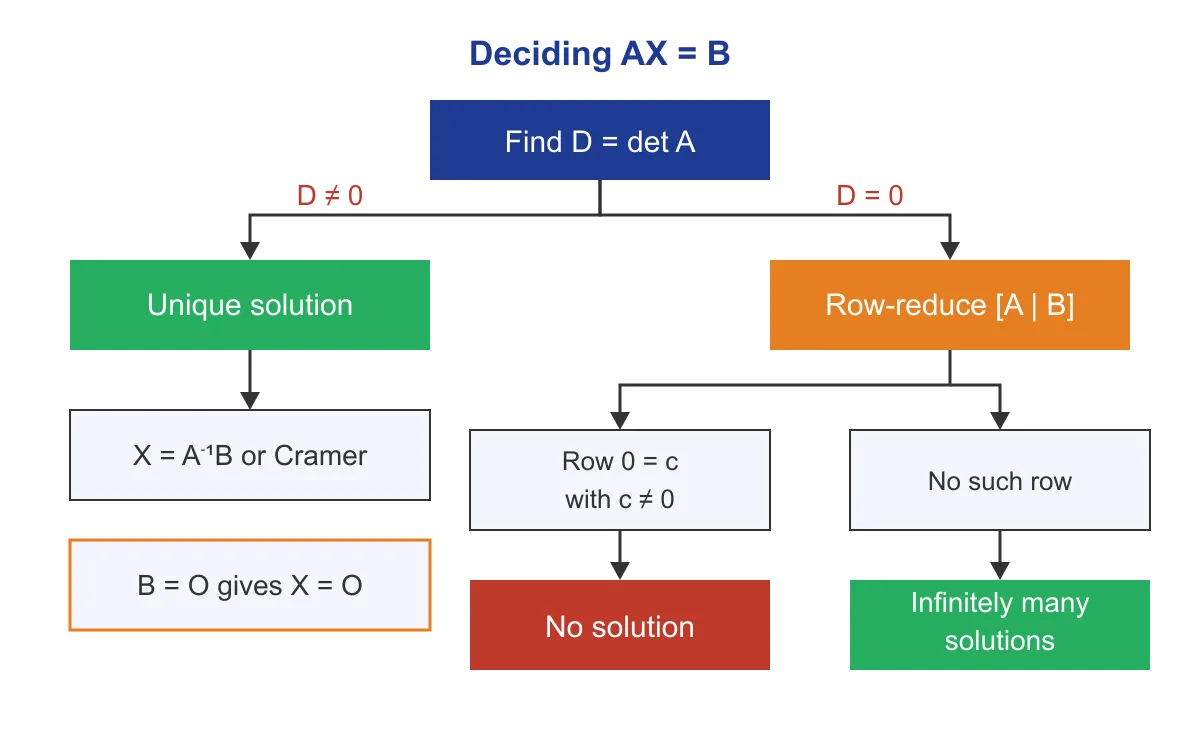
Figure 2.3: How to decide the nature of the solution of AX = B
Example 7: For the system $x + y + z = 3$, $x + 2y + 3z = 6$, $x + 3y + kz = m$, find the values of $k$ and $m$ for which it has (i) a unique solution, (ii) no solution, (iii) infinitely many solutions.
$D = \begin{vmatrix} 1 & 1 & 1 \\ 1 & 2 & 3 \\ 1 & 3 & k \end{vmatrix} = 1(2k - 9) - 1(k - 3) + 1(3 - 2) = k - 5$.
(i) $k \ne 5$ gives $D \ne 0$: unique solution, whatever $m$ is.
For $k = 5$ the third row is $2R_2 - R_1$ on the left side: $2(1, 2, 3) - (1, 1, 1) = (1, 3, 5)$. So the third equation is consistent only if $m = 2(6) - 3 = 9$.
(ii) $k = 5$ and $m \ne 9$: the third equation contradicts the first two, no solution.
(iii) $k = 5$ and $m = 9$: the third equation is redundant. Put $z = t$. From $R_2 - R_1$: $y + 2z = 3$, so $y = 3 - 2t$; then $x = 3 - y - z = t$. Solutions: $(t,\ 3 - 2t,\ t)$.
Answer: unique if $k \ne 5$; none if $k = 5,\ m \ne 9$; infinitely many if $k = 5,\ m = 9$. What to notice: you need both numbers to be special for the infinite case, but only one for the "none" case to begin.
Homogeneous systems
A system $AX = O$ (all constants zero) is homogeneous. It is never inconsistent, because $x = y = z = 0$, the trivial solution, always works. So there are only two outcomes:
- $|A| \ne 0$: only the trivial solution.
- $|A| = 0$: infinitely many solutions, including non-trivial ones.
So to find the parameter value for which a homogeneous square system has a non-trivial solution, put $|A| = 0$ and solve. A homogeneous system with fewer equations than unknowns always has a non-trivial solution, since its coefficient matrix cannot be invertible.
Take $kx + y + z = 0$, $x + ky + z = 0$, $x + y + kz = 0$. The determinant equals $(k + 2)(k - 1)^2$ by adding all columns into the first and removing the factor $k + 2$. So non-trivial solutions exist for $k = 1$ or $k = -2$, and for any other $k$ only $x = y = z = 0$.
Common traps
- Using $|kA| = k|A|$ → use $|kA| = k^n|A|$; the factor $k$ comes out once per row.
- Forgetting the sign of the cofactor and expanding with all plus signs → write the chessboard signs next to the matrix before you start.
- Taking the cofactor matrix as the adjoint → transpose it; the cofactor of $a_{ij}$ goes to position $(j, i)$.
- Writing $|A + B| = |A| + |B|$ → this is false; only the row-wise splitting of property 6 is allowed.
- Using $R_1 \to 2R_1 + R_2$ as if it were harmless → replacing a row by a multiple of itself changes the determinant by that multiple; only $R_i \to R_i + kR_j$ is free.
- Writing $|\operatorname{adj}A| = |A|^n$ → the power is $n - 1$, and for $n = 3$ it is $|A|^2$.
- Multiplying by $A^{-1}$ on the right in $AX = B$ → multiply on the left and get $X = A^{-1}B$.
- Concluding "no solution" just because $D = 0$ → $D = 0$ allows infinitely many solutions as well; check $D_x, D_y, D_z$ and row-reduce.
- Believing $(\operatorname{adj}A)B = O$ proves consistency → three identical-looking planes with different constants give $\operatorname{adj}A = O$ yet no solution; finish by row reduction.
- Dropping the absolute value in the area formula, or the second case when the area is given → area is the positive value, and an unknown coordinate usually has two answers.
Quick revision
- $\begin{vmatrix} a & b \\ c & d \end{vmatrix} = ad - bc$; cofactor $C_{ij} = (-1)^{i+j}M_{ij}$.
- Expansion along any row or column gives $|A|$; a row times another row's cofactors gives $0$.
- $|A^T| = |A|$; swapping two rows gives a factor $-1$; two equal or proportional rows give $0$.
- $R_i \to R_i + kR_j$ leaves the determinant unchanged.
- $|kA| = k^n|A|$ and $|AB| = |A|\,|B|$.
- A triangular matrix has determinant equal to the product of its diagonal entries.
- A skew-symmetric matrix of odd order has determinant $0$.
- Area of a triangle $= \frac{1}{2}\vert\det\vert$ of the coordinate array with a column of ones; collinear when it is $0$.
- $\operatorname{adj}A$ is the transpose of the cofactor matrix, and $A \cdot \operatorname{adj}A = |A|I$.
- $A^{-1} = \dfrac{\operatorname{adj}A}{|A|}$ exists only when $|A| \ne 0$; $|A^{-1}| = \dfrac{1}{|A|}$.
- $|\operatorname{adj}A| = |A|^{n-1}$, $\operatorname{adj}(\operatorname{adj}A) = |A|^{n-2}A$, $(AB)^{-1} = B^{-1}A^{-1}$, $\operatorname{adj}(AB) = \operatorname{adj}B\,\operatorname{adj}A$.
- $AX = B$ with $D \ne 0$: unique solution $X = A^{-1}B$, $x_i = D_i/D$.
- $D = 0$: no solution or infinitely many; decide by row reduction.
- Homogeneous $AX = O$: non-trivial solutions exist exactly when $|A| = 0$.
Practice questions
The value of $\begin{vmatrix} 2 & 3 \\ 4 & 5 \end{vmatrix}$ is
- $-22$
- $22$
- $-2$
- $2$
Answer
C. $-2$
$2\cdot5-3\cdot4=10-12=-2$. Check: swapping the rows gives $12-10=2$, the negative.
In the matrix $\begin{bmatrix} 1 & 2 & 3 \\ 4 & 5 & 6 \\ 7 & 8 & 10 \end{bmatrix}$, the cofactor of the entry $6$ is
- $6$
- $14$
- $-14$
- $-6$
Answer
A. $6$
Delete row 2 and column 3: minor $=1\cdot8-2\cdot7=-6$. Sign $(-1)^{2+3}=-1$, so cofactor $=+6$.
If $A$ is a $3\times3$ matrix with $\vert A\vert=4$, then $\vert 2A\vert$ equals
- $32$
- $64$
- $16$
- $8$
Answer
A. $32$
$\vert 2A\vert=2^3\vert A\vert=8\cdot4=32$; each of the three rows gives a factor $2$.
If $A$ is a $3\times3$ matrix with $\vert A\vert=5$, then $\vert\operatorname{adj}A\vert$ equals
- $5$
- $25$
- $125$
- $10$
Answer
B. $25$
$\vert\operatorname{adj}A\vert=\vert A\vert^{n-1}=5^2=25$. Check: $A\cdot\operatorname{adj}A=5I$ gives $5\vert\operatorname{adj}A\vert=5^3$.
If $A$ is a $3\times3$ matrix with $\vert A\vert=-2$, then $\vert\operatorname{adj}(\operatorname{adj}A)\vert$ equals
- $-4$
- $4$
- $16$
- $-16$
Answer
C. $16$
$\vert\operatorname{adj}A\vert=(-2)^2=4$; then $\vert\operatorname{adj}(\operatorname{adj}A)\vert=4^2=16$. Same as $\vert A\vert^{(n-1)^2}=(-2)^4$.
The determinant $\begin{vmatrix} 1 & 1 & 1 \\ a & b & c \\ a^2 & b^2 & c^2 \end{vmatrix}$ is equal to
- $-(a-b)(b-c)(c-a)$
- $(a-b)(b-c)(c-a)$
- $(a+b)(b+c)(c+a)$
- $abc(a-b)(b-c)(c-a)$
Answer
B. $(a-b)(b-c)(c-a)$
Subtract column 1 from columns 2 and 3 and expand: $(b-a)(c-a)(c-b)$, which equals $(a-b)(b-c)(c-a)$. Test $a=0,b=1,c=2$: the determinant is $1(4-2)=2$, and $(0-1)(1-2)(2-0)=2$.
The points $(1,1)$, $(2,3)$ and $(k,5)$ are collinear. Then $k$ equals
- $3$
- $6$
- $2$
- $-3$
Answer
A. $3$
Collinear means $\begin{vmatrix} 1 & 1 & 1 \\ 2 & 3 & 1 \\ k & 5 & 1 \end{vmatrix}=6-2k=0$, so $k=3$. Slope check: slope of the first two points is $2$, and $(1,1)$ to $(3,5)$ also has slope $2$.
The inverse of $\begin{bmatrix} 2 & 5 \\ 1 & 3 \end{bmatrix}$ is
- $\begin{bmatrix} -3 & 5 \\ 1 & -2 \end{bmatrix}$
- $\begin{bmatrix} 2 & -5 \\ -1 & 3 \end{bmatrix}$
- $\begin{bmatrix} 3 & 5 \\ 1 & 2 \end{bmatrix}$
- $\begin{bmatrix} 3 & -5 \\ -1 & 2 \end{bmatrix}$
Answer
D. $\begin{bmatrix} 3 & -5 \\ -1 & 2 \end{bmatrix}$
Determinant $=6-5=1$. Swap the diagonal and negate the other two entries. Multiplying back: first row times first column of the answer is $6-5=1$.
If $A$ and $B$ are invertible matrices of the same order, then $\operatorname{adj}(AB)$ equals
- $\operatorname{adj}B\cdot\operatorname{adj}A$
- $\operatorname{adj}A+\operatorname{adj}B$
- $\operatorname{adj}A\cdot\operatorname{adj}B$
- $\vert A\vert\,\vert B\vert\, I$
Answer
A. $\operatorname{adj}B\cdot\operatorname{adj}A$
$(AB)^{-1}=B^{-1}A^{-1}$ and $\operatorname{adj}M=\vert M\vert M^{-1}$, so $\operatorname{adj}(AB)=\vert A\vert\vert B\vert B^{-1}A^{-1}=\operatorname{adj}B\cdot\operatorname{adj}A$.
The system $x+2y=3$, $2x+4y=6$ has
- no solution
- infinitely many solutions
- exactly two solutions
- a unique solution
Answer
B. infinitely many solutions
The second equation is twice the first, so the lines coincide: $\frac{1}{2}=\frac{2}{4}=\frac{3}{6}$. Infinitely many solutions.
If $A$ is a $3\times3$ matrix with $A^T=-A$, then $\vert A\vert$ equals
- a value that cannot be found from the given information
- $-1$
- $1$
- $0$
Answer
D. $0$
$\vert A\vert=\vert A^T\vert=\vert -A\vert=(-1)^3\vert A\vert=-\vert A\vert$, so $\vert A\vert=0$.
A square matrix $A$ satisfies $A^2-4A+I=O$. Then $A^{-1}$ equals
- $A-4I$
- $A+4I$
- $4I-A$
- $4A-I$
Answer
C. $4I-A$
Rewrite as $A(4I-A)=I$. Multiplying on the other side also gives $(4I-A)A=I$. So $A^{-1}=4I-A$. Note $\vert A\vert\ne0$ follows because $A(4I-A)=I$.
The value of $\begin{vmatrix} a & b & c \\ b & c & a \\ c & a & b \end{vmatrix}$ is
- $3abc-a^3-b^3-c^3$
- $a^3+b^3+c^3+3abc$
- $a^3+b^3+c^3-3abc$
- $abc-a^3-b^3-c^3$
Answer
A. $3abc-a^3-b^3-c^3$
Expanding: $a(cb-a^2)-b(b^2-ac)+c(ab-c^2)=3abc-a^3-b^3-c^3$. Test $a=1,b=c=0$: matrix has determinant $-1$; the formula gives $-1$.
For a $3\times3$ matrix $A=[a_{ij}]$ with cofactors $C_{ij}$, the value of $a_{11}C_{21}+a_{12}C_{22}+a_{13}C_{23}$ is
- $\vert A\vert$
- $0$
- $1$
- $-\vert A\vert$
Answer
B. $0$
Row 1 entries multiplied by row 2 cofactors form the expansion of a determinant with rows 1 and 2 equal, which is $0$.
The value of $\begin{vmatrix} 3 & -2 \\ 4 & 1 \end{vmatrix}$ is
- $-5$
- $-11$
- $11$
- $5$
Answer
C. $11$
$3\cdot1-(-2)(4)=3+8=11$. The common slip is $3-8=-5$.
The area, in square units, of the triangle with vertices $(1,2)$, $(4,6)$ and $(7,2)$ is
- $18$
- $6$
- $24$
- $12$
Answer
D. $12$
$\frac{1}{2}\vert 1(6-2)+4(2-2)+7(2-6)\vert=\frac{1}{2}\vert 4-28\vert=12$. Check: base from $(1,2)$ to $(7,2)$ is $6$, height $4$, area $\frac{1}{2}\cdot6\cdot4=12$.
The value of $\begin{vmatrix} 1 & 2 & 3 \\ 4 & 5 & 6 \\ 7 & 8 & 10 \end{vmatrix}$ is
- $-3$
- $-11$
- $15$
- $3$
Answer
A. $-3$
$1(50-48)-2(40-42)+3(32-35)=2+4-9=-3$. Check by column 1: $1(50-48)-4(20-24)+7(12-15)=2+16-21=-3$.
The homogeneous system $x+2y+3z=0$, $2x+3y+4z=0$, $3x+5y+kz=0$ has a non-trivial solution. The value of $k$ is
- $-7$
- $9$
- $7$
- $5$
Answer
C. $7$
Need the determinant to vanish. Row 3 equals row 1 plus row 2 only if $k=3+4=7$. Expansion gives determinant $7-k$, zero at $k=7$.
If $A$ is a $3\times3$ matrix with $\vert A\vert=3$, then $\vert 3\operatorname{adj}A\vert$ equals
- $27$
- $243$
- $729$
- $81$
Answer
B. $243$
$\vert\operatorname{adj}A\vert=3^2=9$. Then $\vert 3\operatorname{adj}A\vert=3^3\cdot9=243$.
If $A$ is a $3\times3$ matrix with $\vert A\vert=2$, then $\vert\operatorname{adj}(2A)\vert$ equals
- $128$
- $16$
- $64$
- $256$
Answer
D. $256$
$\vert 2A\vert=2^3\cdot2=16$, and $\vert\operatorname{adj}(2A)\vert=\vert 2A\vert^2=256$. Check: $\operatorname{adj}(2A)=4\operatorname{adj}A$, so determinant $=4^3\cdot\vert\operatorname{adj}A\vert=64\cdot4=256$.
By Cramer's rule, the value of $y$ in the system $2x+3y=8$, $x-y=-1$ is
- $1$
- $3$
- $2$
- $-2$
Answer
C. $2$
$D=2(-1)-3(1)=-5$; $D_y=2(-1)-8(1)=-10$; $y=2$. Back-check: $x=y-1=1$ and $2+6=8$.
For the system $x+y+z=6$, $x-y+z=2$, $2x+y-z=1$, the value of $x^2+y^2+z^2$ is
- $14$
- $36$
- $12$
- $6$
Answer
A. $14$
Adding the first two: $x+z=4$ and $y=2$. Third equation with $y=2$: $2x+2-z=1$, so $2x-z=-1$. With $x+z=4$: $x=1$, $z=3$. Sum of squares $=1+4+9=14$.
The system $x+y+z=6$, $x+2y+3z=10$, $x+2y+\lambda z=\mu$ has infinitely many solutions. The value of $\lambda+\mu$ is
- $10$
- $16$
- $7$
- $13$
Answer
D. $13$
$D=\lambda-3$ must be $0$, so $\lambda=3$. Then the third equation equals the second, so $\mu=10$. $\lambda+\mu=13$.
The value of $\begin{vmatrix} 2 & -1 & 3 \\ 0 & 4 & 1 \\ 5 & 2 & -2 \end{vmatrix}$ is
- $85$
- $-85$
- $-35$
- $-75$
Answer
B. $-85$
$2(-8-2)+1(0-5)+3(0-20)=-20-5-60=-85$. Check by column 1: $2(-10)+5(-1-12)=-20-65=-85$.
The triangle with vertices $(-2,0)$, $(0,4)$ and $(k,0)$ has area $4$ square units. The sum of all possible values of $k$ is
- $-4$
- $-2$
- $4$
- $0$
Answer
A. $-4$
Area $=\frac{1}{2}\vert-8-4k\vert=\vert 2k+4\vert=4$, so $2k+4=\pm4$, giving $k=0$ or $k=-4$. Sum $=-4$. Base-height check: base $\vert k+2\vert$, height $4$.
For $A=\begin{bmatrix} 1 & 2 & 0 \\ 0 & 1 & 3 \\ 2 & 0 & 1 \end{bmatrix}$, the sum of all nine entries of $\operatorname{adj}A$ is
- $13$
- $12$
- $14$
- $10$
Answer
B. $12$
Cofactors row-wise: $(1,6,-2)$, $(-2,1,4)$, $(6,-3,1)$. Their sum is $5+3+4=12$. Transposing does not change the sum. Check: $A\cdot\operatorname{adj}A$ has diagonal entry $13=\vert A\vert$.
Given below are two statements: Statement I: If two rows of a determinant are identical, its value is $0$. Statement II: Interchanging two rows of a determinant changes its sign.
- Both Statement I and Statement II are correct
- Both Statement I and Statement II are incorrect
- Statement I is correct but Statement II is incorrect
- Statement I is incorrect but Statement II is correct
Answer
A. Both Statement I and Statement II are correct
Identical rows: swapping them gives $D=-D$, so $D=0$. Both statements are standard and true.
Given below are two statements: Statement I: For a $3\times3$ matrix $A$, $\vert kA\vert=k\vert A\vert$. Statement II: For a square matrix $A$, $\vert A^T\vert=\vert A\vert$.
- Both Statement I and Statement II are correct
- Both Statement I and Statement II are incorrect
- Statement I is correct but Statement II is incorrect
- Statement I is incorrect but Statement II is correct
Answer
D. Statement I is incorrect but Statement II is correct
I is false because $\vert kA\vert=k^3\vert A\vert$. II is true: rows and columns can be interchanged.
Given below are two statements: Statement I: A system of three linear equations in three unknowns whose coefficient determinant is $0$ never has a solution. Statement II: A homogeneous system $AX=O$ with $\vert A\vert\ne0$ has infinitely many solutions.
- Both Statement I and Statement II are correct
- Both Statement I and Statement II are incorrect
- Statement I is correct but Statement II is incorrect
- Statement I is incorrect but Statement II is correct
Answer
B. Both Statement I and Statement II are incorrect
I is false: $x+y+z=0$ repeated three times has $D=0$ and infinitely many solutions. II is false: $\vert A\vert\ne0$ gives only $X=O$.
Given below are two statements: Statement I: For an invertible $3\times3$ matrix $A$, $\vert\operatorname{adj}A\vert=\vert A\vert^2$. Statement II: For an invertible matrix $A$, $\vert A^{-1}\vert=\vert A\vert$.
- Both Statement I and Statement II are correct
- Both Statement I and Statement II are incorrect
- Statement I is correct but Statement II is incorrect
- Statement I is incorrect but Statement II is correct
Answer
C. Statement I is correct but Statement II is incorrect
I is true as $\vert A\vert^{n-1}$ with $n=3$. II is false: $\vert A^{-1}\vert=\frac{1}{\vert A\vert}$, which equals $\vert A\vert$ only when $\vert A\vert=\pm1$.
Given below are two statements: Statement I: For square matrices $A$ and $B$ of the same order, $\vert A+B\vert=\vert A\vert+\vert B\vert$. Statement II: If every entry of one row of a determinant is multiplied by $k$, the determinant gets multiplied by $k$.
- Both Statement I and Statement II are correct
- Both Statement I and Statement II are incorrect
- Statement I is correct but Statement II is incorrect
- Statement I is incorrect but Statement II is correct
Answer
D. Statement I is incorrect but Statement II is correct
I is false: take $A=B=I_2$, then $\vert A+B\vert=4$ but $\vert A\vert+\vert B\vert=2$. II is the scalar-factor property and is true.
Assertion (A): The determinant $\begin{vmatrix} 1 & 2 & 3 \\ 4 & 5 & 6 \\ 7 & 8 & 9 \end{vmatrix}$ equals $0$. Reason (R): The rows satisfy $R_1-2R_2+R_3=0$, so one row is a combination of the others.
- Both A and R are true and R is the correct explanation of A
- Both A and R are true but R is not the correct explanation of A
- A is true but R is false
- A is false but R is true
Answer
A. Both A and R are true and R is the correct explanation of A
$(1-8+7,\,2-10+8,\,3-12+9)=(0,0,0)$, so A is true. Replace $R_3$ by $R_1-2R_2+R_3$ (a row operation that does not change the value): it gives a zero row, so R explains A.
Assertion (A): The system $x+y=2$, $2x+2y=5$ has no solution. Reason (R): The determinant of its coefficient matrix is $0$.
- Both A and R are true and R is the correct explanation of A
- Both A and R are true but R is not the correct explanation of A
- A is true but R is false
- A is false but R is true
Answer
B. Both A and R are true but R is not the correct explanation of A
Coefficient ratios $\frac{1}{2}=\frac{1}{2}\ne\frac{2}{5}$, so A is true. R is true, but $D=0$ alone also allows infinitely many solutions, so R does not explain A.
Assertion (A): The determinant of a $3\times3$ skew-symmetric matrix is $0$. Reason (R): For every square matrix $A$ of order $n$, $\vert -A\vert=\vert A\vert$.
- Both A and R are true and R is the correct explanation of A
- Both A and R are true but R is not the correct explanation of A
- A is true but R is false
- A is false but R is true
Answer
C. A is true but R is false
A is true since $\vert A\vert=\vert -A\vert=-\vert A\vert$ for $n=3$. R is false: $\vert -A\vert=(-1)^n\vert A\vert$, equal to $\vert A\vert$ only for even $n$.
Match List I with List II. List I: a. $\begin{vmatrix} 1 & 2 \\ 3 & 4 \end{vmatrix}$ b. $\begin{vmatrix} 2 & 0 \\ 0 & 3 \end{vmatrix}$ c. $\begin{vmatrix} 1 & 2 \\ 2 & 4 \end{vmatrix}$ d. $\begin{vmatrix} 0 & 1 \\ 1 & 0 \end{vmatrix}$ List II: i. $0$ ii. $-1$ iii. $6$ iv. $-2$
- a-i, b-ii, c-iii, d-iv
- a-iii, b-iv, c-i, d-ii
- a-iv, b-iii, c-ii, d-i
- a-iv, b-iii, c-i, d-ii
Answer
D. a-iv, b-iii, c-i, d-ii
a: $4-6=-2$. b: $6$. c: $4-4=0$. d: $0-1=-1$. So a-iv, b-iii, c-i, d-ii.
Let $A$ be a $3\times3$ matrix with $\vert A\vert=2$. Match List I with List II. List I: a. $\vert\operatorname{adj}A\vert$ b. $\vert A^{-1}\vert$ c. $\vert 3A\vert$ d. $\vert\operatorname{adj}(\operatorname{adj}A)\vert$ List II: i. $\frac{1}{2}$ ii. $4$ iii. $16$ iv. $54$
- a-iii, b-ii, c-iv, d-i
- a-ii, b-i, c-iii, d-iv
- a-ii, b-i, c-iv, d-iii
- a-i, b-ii, c-iv, d-iii
Answer
C. a-ii, b-i, c-iv, d-iii
For a $3\times3$ matrix with $\vert A\vert=2$: a: $2^2=4$. b: $\frac{1}{2}$. c: $27\cdot2=54$. d: $2^4=16$.
Match List I with List II. List I: a. $x+y=2,\ x-y=0$ b. $x+y=2,\ 2x+2y=4$ c. $x+y=2,\ x+y=3$ d. $x+y=0,\ x-y=0$ List II: i. infinitely many solutions ii. no solution iii. the single solution $x=1,\ y=1$ iv. the single solution $x=0,\ y=0$
- a-iii, b-i, c-ii, d-iv
- a-iii, b-ii, c-i, d-iv
- a-i, b-iii, c-iv, d-ii
- a-iv, b-i, c-ii, d-iii
Answer
A. a-iii, b-i, c-ii, d-iv
a: adding gives $x=1$, $y=1$. b: second is twice the first, infinitely many. c: parallel lines, none. d: adding gives $x=0$, then $y=0$.
The equation $\begin{vmatrix} 1 & 1 & 1 \\ x & 2 & 3 \\ x^2 & 4 & 9 \end{vmatrix}=0$ has two roots. The sum of the squares of the roots is
- $6$
- $5$
- $13$
- $25$
Answer
C. $13$
The determinant is zero when column 1 equals column 2 or column 3, so $x=2$ or $x=3$ (degree 2 gives no more). Sum of squares $=4+9=13$. Check by expansion: $1(18-12)-1(9x-3x^2)+1(4x-2x^2)=x^2-5x+6$, roots $2,3$.
The system $x+y+z=-3$, $x+2y+3z=\lambda$, $x+3y+5z=\lambda^2$ is consistent for certain real values of $\lambda$. The product of all such values is
- $-2$
- $2$
- $3$
- $-3$
Answer
D. $-3$
Here $D=0$ and $R_3=2R_2-R_1$ on the left, so the right side must satisfy $\lambda^2=2\lambda+3$. Then $\lambda^2-2\lambda-3=0$, roots $3$ and $-1$, product $-3$. Test $\lambda=-1$: take $z=t$, then $y=2-2t$, $x=t-5$; the third equation gives $t-5+6-6t+5t=1=\lambda^2$. Consistent.
A shop's bills are: 2 pens, 1 notebook and 1 file cost Rs 24; 1 pen, 2 notebooks and 1 file cost Rs 30; 1 pen, 1 notebook and 2 files cost Rs 26. The cost of 3 pens, 1 notebook and 2 files, in Rs, is
- $44$
- $34$
- $20$
- $38$
Answer
B. $34$
Adding the three bills: $4(p+q+r)=80$, so $p+q+r=20$. Then $p=24-20=4$, $q=30-20=10$, $r=26-20=6$. Cost $=12+10+12=34$. Cramer check: $D=4$, $D_p=16$, so $p=4$.