L'Hospital's Rule, Intermediate Value Property and Mean Value Theorems
What to remember
- L'Hospital's rule works only on $\frac{0}{0}$ or $\frac{\infty}{\infty}$. If the ratio is not one of these, differentiating top and bottom gives a wrong answer. Every other indeterminate form must first be converted to one of these two.
- The rule says $\lim \frac{f}{g} = \lim \frac{f'}{g'}$ provided the second limit exists (or is $\pm\infty$). It is not the quotient rule.
- Intermediate value property: a continuous function on $[a,b]$ takes every value between $f(a)$ and $f(b)$. The most common use is $f(a)f(b)<0 \Rightarrow$ a root lies in $(a,b)$.
- Rolle needs three things (continuous on $[a,b]$, differentiable on $(a,b)$, $f(a)=f(b)$) and gives $f'(c)=0$. Lagrange drops the third condition and gives $f'(c)=\frac{f(b)-f(a)}{b-a}$.
- Zero derivative on an interval means constant. Bounded derivative means bounded change, which is how $\vert\sin a-\sin b\vert \le \vert a-b\vert$ is proved.
1. Why we need a rule for limits like 0/0
Take $\lim_{x\to 0}\frac{\sin x}{x}$. Both parts go to $0$, so substituting gives $\frac{0}{0}$, which has no value by itself. The limit could be anything: $\frac{2x}{x}\to 2$, $\frac{x^2}{x}\to 0$, $\frac{x}{x^3}$ blows up, and all three are of the form $\frac{0}{0}$ at $x=0$. The form only tells you that the answer depends on how fast each part shrinks.
Near a point $a$ where $f(a)=g(a)=0$, a differentiable function behaves like its tangent line: $f(x)\approx f'(a)(x-a)$ and $g(x)\approx g'(a)(x-a)$. The ratio then becomes $\frac{f'(a)(x-a)}{g'(a)(x-a)} = \frac{f'(a)}{g'(a)}$. That is the whole idea behind the rule: compare the speeds at which the two parts leave zero.
2. L'Hospital's rule
Statement. Let $f$ and $g$ be differentiable near $a$ (except possibly at $a$ itself), with $g'(x)\ne 0$ near $a$. Suppose that either
- $f(x)\to 0$ and $g(x)\to 0$ as $x\to a$, or
- $f(x)\to\pm\infty$ and $g(x)\to\pm\infty$ as $x\to a$.
Then
whenever the right side exists, either as a finite number or as $+\infty$ or $-\infty$. The same holds for $x\to a^+$, $x\to a^-$, $x\to\infty$ and $x\to-\infty$.
A short justification for 0/0. If $f(a)=g(a)=0$ and both are continuous at $a$, apply the Cauchy form of the mean value idea (the ratio of increments equals a ratio of derivatives at some inner point): $\frac{f(x)}{g(x)}=\frac{f(x)-f(a)}{g(x)-g(a)}=\frac{f'(\xi)}{g'(\xi)}$ for some $\xi$ between $a$ and $x$. As $x\to a$, $\xi\to a$ too, so the ratio tends to $\lim\frac{f'}{g'}$.
Using the rule
Check the form first. Write down "$\frac{0}{0}$" or "$\frac{\infty}{\infty}$" beside the limit before you differentiate. Then differentiate the numerator and the denominator separately. After one step, test again: if the new ratio is still $\frac{0}{0}$ or $\frac{\infty}{\infty}$, repeat.
Example 1: Find $\lim_{x\to 0}\dfrac{e^x-1-x}{x^2}$.
Put $x=0$: numerator $1-1-0=0$, denominator $0$. Form is $\frac{0}{0}$.
Differentiate: $\dfrac{e^x-1}{2x}$. At $x=0$ this is again $\frac{0}{0}$.
Differentiate again: $\dfrac{e^x}{2}\to\dfrac{1}{2}$.
Answer: $\dfrac12$.
Why this works: each differentiation lowers the power of $x$ in the denominator by one; we stop when the denominator is no longer zero at $x=0$.
Example 2: Find $\lim_{x\to\infty}\dfrac{x^2}{e^x}$.
Form: $\frac{\infty}{\infty}$. Differentiate: $\dfrac{2x}{e^x}$, still $\frac{\infty}{\infty}$.
Differentiate again: $\dfrac{2}{e^x}\to 0$.
Answer: $0$.
Notice: the exponential beats every power of $x$. The same argument gives $\frac{x^n}{e^x}\to 0$ for every fixed $n$.
When the rule must not be used
Three situations catch students every year.
- **The form is not $\frac00$ or $\frac\infty\infty$.** For example $\lim_{x\to 0}\frac{1+\cos x}{x+2}=\frac{2}{2}=1$. Differentiating would give $\frac{-\sin x}{1}\to 0$, which is wrong.
- **The limit of $\frac{f'}{g'}$ does not exist, but the original limit does.** Take $\lim_{x\to\infty}\frac{x+\sin x}{x}$. It is $\frac{\infty}{\infty}$, and the true value is $1+\frac{\sin x}{x}\to 1$ since $\vert\sin x\vert\le 1$. The ratio of derivatives is $1+\cos x$, which keeps oscillating and has no limit. The rule says nothing when $\lim\frac{f'}{g'}$ fails to exist; you must find another way.
- Going in circles. $\lim_{x\to\infty}\frac{e^x+e^{-x}}{e^x-e^{-x}}$ flips between two forms forever on differentiation. Divide top and bottom by $e^x$ instead; the limit is $1$.
Also, the rule is a tool for finding limits, not a way to prove the standard limits it was built from. Do not prove $\lim\frac{\sin x}{x}=1$ by this rule, since the derivative of $\sin x$ was found using that very limit.
3. The other indeterminate forms
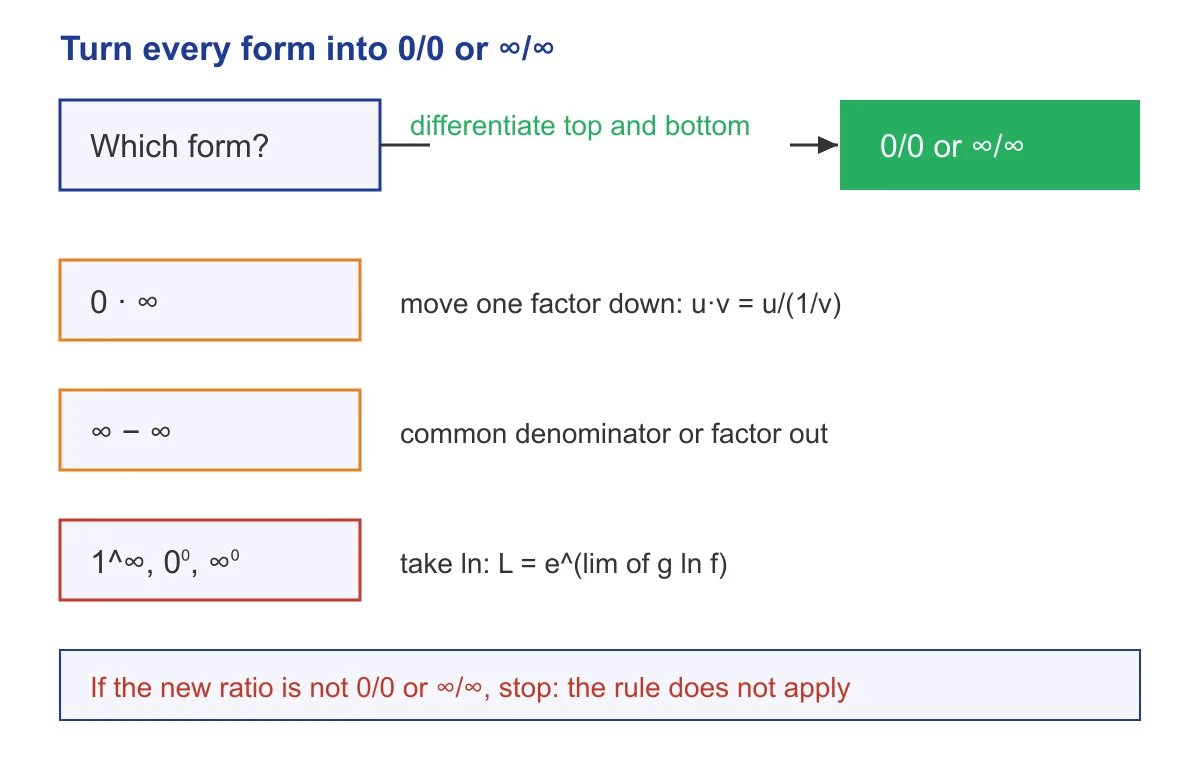
*Figure 2.1: Convert every indeterminate form into $\frac{0}{0}$ or $\frac{\infty}{\infty}$, then differentiate*
| Form | What to do | Typical rewrite |
|---|---|---|
| $0\cdot\infty$ | Put one factor in the denominator | $u v = \dfrac{u}{1/v}$ |
| $\infty-\infty$ | Common denominator, or factor out the dominant term | $\dfrac1x-\dfrac1{\sin x}=\dfrac{\sin x-x}{x\sin x}$ |
| $1^\infty$ | Take $\ln$ | $L=e^{\lim g\ln f}$ |
| $0^0$ | Take $\ln$ | $x^x=e^{x\ln x}$ |
| $\infty^0$ | Take $\ln$ | $x^{1/x}=e^{\ln x / x}$ |
Powers. For $y=f(x)^{g(x)}$ in one of the three exponent forms, write $\ln y = g(x)\ln f(x)$. This becomes a $0\cdot\infty$ product. Convert to a fraction, find $\lim\ln y = L$, and then $\lim y = e^{L}$. Never forget the last step; many wrong answers stop at $L$.
Example 3: Find $\lim_{x\to 0^+} x\ln x$ and then $\lim_{x\to 0^+}x^x$.
$x\ln x$ is $0\cdot(-\infty)$. Write it as $\dfrac{\ln x}{1/x}$, which is $\frac{-\infty}{\infty}$.
Differentiate: $\dfrac{1/x}{-1/x^2}=-x\to 0$. So $\lim x\ln x = 0$.
For $x^x$: $\ln(x^x)=x\ln x\to 0$, hence $x^x\to e^0=1$.
Answer: $0$ and $1$.
Notice: we put $\ln x$ on top because its derivative $\frac1x$ is simpler than the derivative of $\frac1x$ would be if we had flipped the other way. Choose the arrangement whose derivative is easier.
Example 4: Find $\lim_{x\to 0}\dfrac{\sin x - x\cos x}{x^3}$ and $\lim_{x\to 0}\left(\dfrac1x-\dfrac1{\sin x}\right)$.
First limit: $\frac00$. Numerator derivative: $\cos x-\cos x+x\sin x=x\sin x$. So we get $\dfrac{x\sin x}{3x^2}=\dfrac{\sin x}{3x}\to\dfrac13$.
Second limit: $\infty-\infty$. Combine: $\dfrac{\sin x-x}{x\sin x}$, which is $\frac00$. Differentiate: $\dfrac{\cos x-1}{\sin x+x\cos x}$, again $\frac00$. Differentiate: $\dfrac{-\sin x}{2\cos x - x\sin x}\to\dfrac{0}{2}=0$.
Answer: $\dfrac13$ and $0$.
Notice: when the derivative simplifies like $x\sin x$ above, simplify before the next test. It saves one round.
Memory trick: "Zero over zero, infinity over infinity, only these two get the L'Hospital key; the rest must change their clothes first."
Use it as a gate: say it before every differentiation.
Two standard limits you should be able to derive
- $\lim_{x\to\infty}\left(1+\dfrac{a}{x}\right)^{bx}=e^{ab}$. Take $\ln$: $bx\ln\left(1+\frac ax\right)$. With $t=\frac1x$ this is $\frac{b\ln(1+at)}{t}$, which is $\frac00$; differentiate to get $\frac{b a}{1+at}\to ab$.
- $\lim_{x\to 0}(\cos x)^{1/x^2}$: $\ln$ of it is $\frac{\ln\cos x}{x^2}$; differentiate to get $\frac{-\tan x}{2x}\to-\frac12$. So the limit is $e^{-1/2}$.
Finding unknown constants
Often a limit is given as finite and you must find a constant. The idea: if the denominator tends to $0$ and the limit is finite, the numerator must tend to $0$ too. That gives one equation. Apply the rule, and repeat the argument at the next stage.
Example 5: Find $a$ so that $\lim_{x\to0}\dfrac{\sin 2x + a\sin x}{x^3}$ is finite, and find the limit.
Denominator $\to0$, so the numerator must $\to0$: it already does, for every $a$. Differentiate: $\dfrac{2\cos 2x+a\cos x}{3x^2}$. Denominator $\to0$ again, so need $2+a=0$, i.e. $a=-2$.
Differentiate: $\dfrac{-4\sin 2x-a\sin x}{6x}$ with $a=-2$ gives $\dfrac{-4\sin2x+2\sin x}{6x}$, still $\frac00$.
Differentiate: $\dfrac{-8\cos 2x+2\cos x}{6}\to\dfrac{-8+2}{6}=-1$.
Answer: $a=-2$, limit $=-1$.
Check by series: $\sin2x-2\sin x=(2x-\frac{8x^3}{6})-(2x-\frac{2x^3}{6})=-x^3$, so the ratio is $-1$.
4. Continuity of composite functions
If $g$ is continuous at $a$ and $f$ is continuous at $g(a)$, then $f\circ g$ is continuous at $a$. Both links are needed, and the second link is at the point $g(a)$, not at $a$.
The converse is false. The composition can be continuous even when one of the pieces is not. Let $f(x)=\operatorname{sgn}(x)$ (which equals $1$ for $x>0$, $0$ at $0$, $-1$ for $x<0$) and $g(x)=0$ for all $x$. Then $f$ is discontinuous at $0$, but $f(g(x))=0$ everywhere, a perfectly continuous function.
On the other side, two continuous-looking pieces can fail only if one of them is discontinuous at the right point. Take $f(x)=\frac{1}{x-1}$ and $g(x)=x^2$. Then $f(g(x))=\frac{1}{x^2-1}$ is discontinuous exactly where $g(x)=1$, that is at $x=\pm1$, because $f$ is discontinuous at the value $1$ that $g$ reaches there.
Method. List the points where the inner function is discontinuous. Then list the points where $g(x)$ equals a discontinuity of $f$. The union is the set of possible trouble points; check each one directly, since a trouble point can sometimes be cancelled (as in the $\operatorname{sgn}$ example).
5. The intermediate value property
Statement. If $f$ is continuous on $[a,b]$ and $k$ is any number between $f(a)$ and $f(b)$, then there is at least one $c\in(a,b)$ with $f(c)=k$. In particular, if $f(a)$ and $f(b)$ have opposite signs, $f(c)=0$ for some $c$ in $(a,b)$.
Continuity cannot be dropped. $f(x)=\frac1x$ on $[-1,1]$ has $f(-1)=-1<0<1=f(1)$, but never equals $0$, because it is not continuous at $x=0$.
Using it to locate roots.
- Define $f(x)=\text{LHS}-\text{RHS}$ so the equation becomes $f(x)=0$.
- Check that $f$ is continuous on the interval (polynomials, $e^x$, $\sin x$ are).
- Find two points where the signs differ.
- Conclude a root exists in between.
Same-sign values prove nothing: $f(a)f(b)>0$ does not mean there is no root, because the graph might cross twice in between.
Counting roots. IVP shows a root exists; to show it is unique, combine with the derivative. If $f'(x)>0$ throughout (or $<0$ throughout), then $f$ is strictly monotonic and crosses zero at most once. The more advanced version uses Rolle: if $f$ had two roots, $f'$ would vanish between them. So if $f'$ has no real zero, $f$ has at most one real root.
Example 6: Show that $x^3-6x+2=0$ has exactly three real roots.
Let $f(x)=x^3-6x+2$. Then $f'(x)=3x^2-6=0$ at $x=\pm\sqrt2$.
$f(-\sqrt2)=-2\sqrt2+6\sqrt2+2=2+4\sqrt2>0$. $f(\sqrt2)=2\sqrt2-6\sqrt2+2=2-4\sqrt2<0$.
Also $f(-3)=-27+18+2=-7<0$ and $f(3)=27-18+2=11>0$.
Sign pattern at $-3,-\sqrt2,\sqrt2,3$: $-,+,-,+$. IVP gives a root in each of the three gaps.
A cubic has at most three roots, so there are exactly three.
Notice: the turning points ($f'=0$) are where the sign can change direction, so test the function there.
6. Rolle's theorem
Statement. Let $f$ be
- continuous on $[a,b]$,
- differentiable on $(a,b)$,
- such that $f(a)=f(b)$.
Then there is at least one $c\in(a,b)$ with $f'(c)=0$.
Why it is true. A continuous function on $[a,b]$ reaches a largest and a smallest value. If both are at the endpoints, then since $f(a)=f(b)$ the function is constant and $f'=0$ everywhere. Otherwise one of them is reached at an inner point, and at an inner maximum or minimum of a differentiable function the tangent must be horizontal.
Why each hypothesis matters.
| Failing hypothesis | Example | What goes wrong |
|---|---|---|
| Not continuous on $[a,b]$ | $f(x)=x$ on $[0,1)$ with $f(1)=0$ | Slope is $1$ everywhere inside |
| Not differentiable inside | $f(x)=\vert x\vert$ on $[-1,1]$ | Sharp corner at $0$, no tangent there |
| $f(a)\ne f(b)$ | $f(x)=x$ on $[0,1]$ | Slope is $1$ everywhere |
In the first row $f(0)=f(1)=0$, yet the function jumps at the right end, so $f'(x)=1$ never vanishes.
Verification. To verify Rolle for a given function: check the three hypotheses, then solve $f'(c)=0$ and keep only the solutions inside the open interval $(a,b)$.
Example 7: Verify Rolle's theorem for $f(x)=x^3-3x^2$ on $[0,3]$ and find $c$.
$f$ is a polynomial, so continuous and differentiable everywhere.
$f(0)=0$ and $f(3)=27-27=0$, so $f(0)=f(3)$.
$f'(x)=3x^2-6x=3x(x-2)=0$ gives $x=0$ or $x=2$. Only $x=2$ lies in $(0,3)$.
Answer: $c=2$.
Notice: $x=0$ is a solution of $f'=0$ but it is an endpoint, and the theorem promises $c$ strictly inside.
A consequence. Between two consecutive real roots of a differentiable function there is at least one root of its derivative. Equivalently, if $f'(x)=0$ has no real solution, then $f(x)=0$ has at most one real root.
7. Lagrange's mean value theorem
Statement. Let $f$ be continuous on $[a,b]$ and differentiable on $(a,b)$. Then there is $c\in(a,b)$ with
Geometry. The right side is the slope of the chord joining $(a,f(a))$ and $(b,f(b))$. The theorem says that somewhere between the two points the tangent is parallel to this chord. Rolle is the special case where the chord is horizontal.
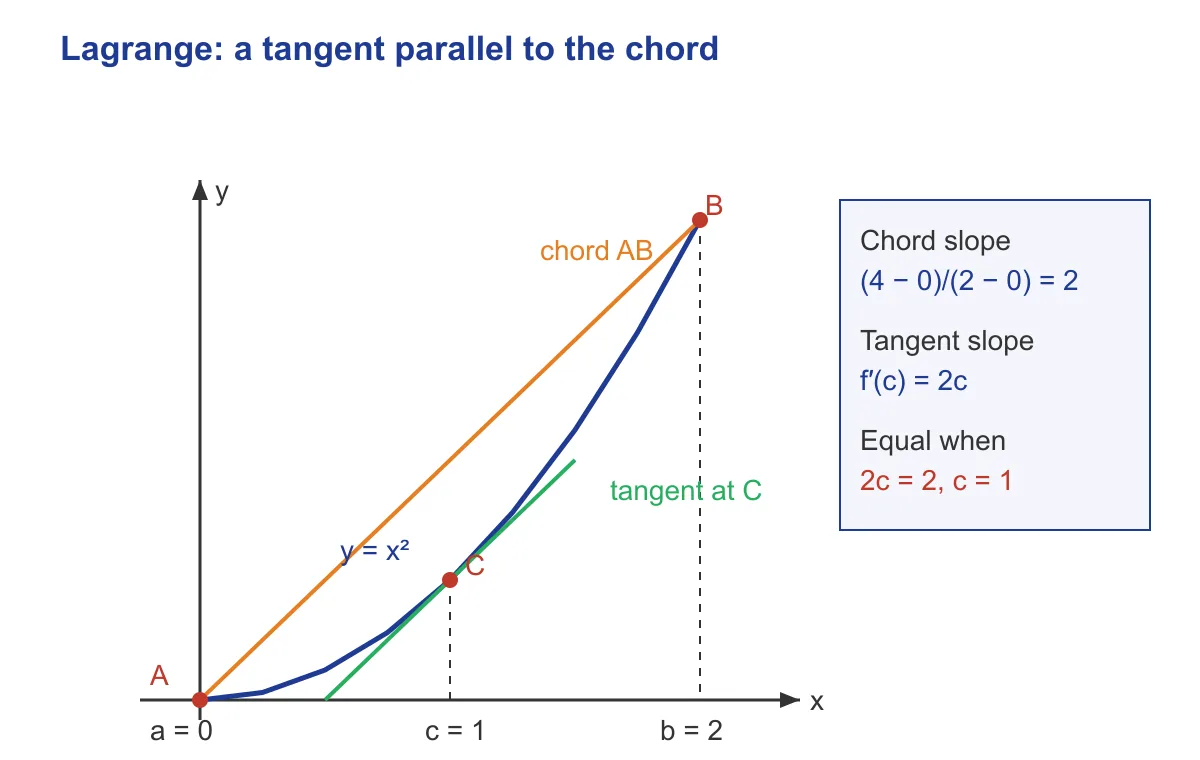
*Figure 2.2: The tangent at $c$ is parallel to the chord $AB$*
Why it follows from Rolle. Subtract the chord from the curve. Define $h(x)=f(x)-f(a)-\frac{f(b)-f(a)}{b-a}(x-a)$. Then $h(a)=0$ and $h(b)=0$, $h$ is continuous and differentiable as required, so Rolle gives $h'(c)=0$, which is $f'(c)=\frac{f(b)-f(a)}{b-a}$.
**Finding $c$.** Compute the chord slope, set it equal to $f'(c)$, solve, and accept only the roots inside $(a,b)$.
Example 8: Find the point promised by Lagrange's theorem for $f(x)=x^2+2x$ on $[1,4]$.
$f(1)=3$ and $f(4)=16+8=24$. Chord slope $=\dfrac{24-3}{4-1}=7$.
$f'(x)=2x+2$. Set $2c+2=7$, so $c=\dfrac52$.
$\dfrac52$ lies in $(1,4)$, so it is acceptable.
Answer: $c=2.5$.
Notice: for a quadratic, $c$ is always the midpoint of the interval. Use that to check your arithmetic.
Example 9: Does Lagrange's theorem apply to $f(x)=\dfrac1x$ on $[-1,1]$?
$f$ is not defined at $0$, so it is not continuous on $[-1,1]$.
Chord slope would be $\dfrac{1-(-1)}{2}=1$, but $f'(x)=-\dfrac1{x^2}<0$ everywhere it exists, so no $c$ satisfies $f'(c)=1$.
Answer: the theorem does not apply, and indeed its conclusion fails.
Notice: a failed hypothesis does not always kill the conclusion, but here it does.
Memory trick: "Rolle is flat, Lagrange is slanted: Rolle's chord lies level, Lagrange's chord leans, the tangent leans with it."
Use it to remember which theorem has the extra condition $f(a)=f(b)$: only the flat one.
8. Consequences of the mean value theorem
Zero derivative. If $f'(x)=0$ for all $x$ in an interval, then $f$ is constant there. Proof: for any $x_1<x_2$ in the interval, $f(x_2)-f(x_1)=f'(c)(x_2-x_1)=0$. Note the word interval: on $[0,1]\cup[2,3]$ the function could take different constants on the two pieces.
Equal derivatives. If $f'=g'$ on an interval, then $f-g$ is constant there.
Monotonic functions. If $f'(x)>0$ on an interval, $f$ is strictly increasing: $f(x_2)-f(x_1)=f'(c)(x_2-x_1)>0$.
Bounded slope. If $\vert f'(x)\vert\le M$ on an interval, then $\vert f(x_2)-f(x_1)\vert\le M\vert x_2-x_1\vert$. The function cannot change faster than $M$ times the horizontal distance.
For $f(x)=\sin x$, $f'(x)=\cos x$ and $\vert\cos x\vert\le 1$, so
Similarly $\vert\cos a-\cos b\vert\le\vert a-b\vert$.
Example 10: A differentiable function has $f(1)=2$ and $\vert f'(x)\vert\le 3$ for all $x$. How large can $f(4)$ be?
Lagrange on $[1,4]$: $f(4)-f(1)=f'(c)\cdot 3$ for some $c$.
Since $f'(c)\le 3$, we get $f(4)-2\le 9$, so $f(4)\le 11$.
Answer: at most $11$.
Why this works: the bound on the slope turns directly into a bound on the rise over three units of $x$.
9. Derivatives of implicit functions up to order two
When $y$ is tied to $x$ by an equation such as $x^2+y^2=25$ rather than $y=\dots$, differentiate every term with respect to $x$, treating $y$ as a function of $x$. Each $y$ term brings a factor $\frac{dy}{dx}$ by the chain rule, so $\frac{d}{dx}(y^2)=2yy'$, and a product like $xy$ needs the product rule: $y+xy'$.
First derivative. Collect the $y'$ terms on one side and solve.
Second derivative. Differentiate the expression for $y'$ again (quotient rule if needed), and then replace every $y'$ by its value. An alternative is to differentiate the first-stage equation once more directly, without solving for $y'$ first. That is often shorter.
| Step | For $x^2+y^2=25$ |
|---|---|
| Differentiate | $2x+2yy'=0$ |
| First derivative | $y'=-\dfrac{x}{y}$ |
| Differentiate $y'$ | $y''=-\dfrac{y-xy'}{y^2}$ |
| Substitute $y'$ | $y''=-\dfrac{y^2+x^2}{y^3}=-\dfrac{25}{y^3}$ |
At the point $(3,4)$ this gives $y'=-\frac34$ and $y''=-\frac{25}{64}$.
Example 11: For $x^2+xy+y^2=3$, find $y'$ and $y''$ at $(1,1)$.
Differentiate: $2x+y+xy'+2yy'=0$. At $(1,1)$: $2+1+y'+2y'=0$, so $y'=-1$.
Differentiate the equation again: $2+y'+y'+xy''+2(y')^2+2yy''=0$.
At $(1,1)$ with $y'=-1$: $2-1-1+y''+2+2y''=0$, that is $2+3y''=0$.
Answer: $y'=-1$, $y''=-\dfrac23$.
Notice: when you differentiate the second time, the term $2yy'$ becomes $2(y')^2+2yy''$. Missing the $(y')^2$ is the usual slip.
Common traps
- Using L'Hospital on a limit that is not $\frac00$ or $\frac\infty\infty$ → check the form by substitution first, and write it down.
- Differentiating the fraction as a quotient (using the quotient rule on $\frac fg$) → differentiate numerator and denominator separately.
- Stopping at $L=\lim\ln y$ for a power form → the required limit is $e^{L}$.
- Treating "the limit of $\frac{f'}{g'}$ does not exist" as "the original limit does not exist" → the rule is silent here, so try algebra or series.
- Writing $0\cdot\infty$ as $0$ or $\infty-\infty$ as $0$ without work → these are indeterminate; convert to a fraction.
- Concluding "no root" from $f(a)f(b)>0$ → same signs prove nothing; the graph could cross twice.
- Applying the intermediate value property to a function that jumps over the axis → check continuity on the whole closed interval first.
- Accepting an endpoint as $c$ in Rolle or Lagrange → $c$ must lie in the open interval $(a,b)$.
- Saying $f'=0$ on $(a,b)\cup(c,d)$ makes $f$ constant → constancy needs a single interval.
- Forgetting the chain factor $y'$ in implicit differentiation, or the term $(y')^2$ in the second derivative → write $y$ as $y(x)$ while differentiating.
Quick revision
- L'Hospital applies only to $\frac00$ and $\frac\infty\infty$, and requires $\lim\frac{f'}{g'}$ to exist or be infinite.
- Repeat the rule as long as the form stays $\frac00$ or $\frac\infty\infty$.
- $0\cdot\infty$: $uv=\frac{u}{1/v}$. $\infty-\infty$: common denominator.
- $1^\infty$, $0^0$, $\infty^0$: take $\ln$, find $L$, answer $e^L$.
- $\lim_{x\to\infty}\left(1+\frac ax\right)^{bx}=e^{ab}$ and $\lim_{x\to0}(\cos x)^{1/x^2}=e^{-1/2}$.
- Standard values: $\frac{e^x-1-x}{x^2}\to\frac12$, $\frac{\sin x-x}{x^3}\to-\frac16$, $\frac{\tan x-x}{x^3}\to\frac13$, $x\ln x\to0$ as $x\to0^+$.
- $f\circ g$ is continuous at $a$ if $g$ is continuous at $a$ and $f$ is continuous at $g(a)$.
- Intermediate value property: continuous on $[a,b]$ takes every value between $f(a)$ and $f(b)$.
- $f(a)f(b)<0$ with $f$ continuous gives a root in $(a,b)$; same signs prove nothing.
- Rolle: continuous on $[a,b]$, differentiable on $(a,b)$, $f(a)=f(b)$ gives $f'(c)=0$.
- Lagrange: $f'(c)=\frac{f(b)-f(a)}{b-a}$ with the same first two hypotheses.
- $f'=0$ on an interval means $f$ is constant; $f'>0$ means strictly increasing.
- $\vert\sin a-\sin b\vert\le\vert a-b\vert$ because $\vert\cos c\vert\le1$.
- Implicit differentiation: each $y$ brings a factor $y'$; for $y''$ remember the $(y')^2$ term.
Practice questions
Find $\lim_{x\to 0}\frac{e^x-1-x}{x^2}$.
- $2$
- $0$
- $\frac12$
- $1$
Answer
C. $\frac12$
The form is $\frac00$. Differentiate: $\frac{e^x-1}{2x}$, still $\frac00$. Again: $\frac{e^x}{2}\to\frac12$. Series check: $e^x-1-x\approx\frac{x^2}{2}$.
Find $\lim_{x\to 0}\frac{\sin x-x}{x^3}$.
- $-\frac16$
- $\frac13$
- $\frac16$
- $-\frac13$
Answer
A. $-\frac16$
$\frac00$. Differentiate: $\frac{\cos x-1}{3x^2}$, then $\frac{-\sin x}{6x}\to-\frac16$. Series: $\sin x-x\approx-\frac{x^3}{6}$.
Find $\lim_{x\to 0^+}x\ln x$.
- $-\infty$
- $-1$
- $1$
- $0$
Answer
D. $0$
Write as $\frac{\ln x}{1/x}$, form $\frac{-\infty}{\infty}$. Differentiate: $\frac{1/x}{-1/x^2}=-x\to0$.
Find $\lim_{x\to 0}\left(\frac1x-\frac1{\sin x}\right)$.
- $-\frac16$
- $0$
- $1$
- $\infty$
Answer
B. $0$
Combine: $\frac{\sin x-x}{x\sin x}$, form $\frac00$. Differentiate: $\frac{\cos x-1}{\sin x+x\cos x}$, still $\frac00$. Again: $\frac{-\sin x}{2\cos x-x\sin x}\to\frac02=0$. Check: numerator $\approx-\frac{x^3}{6}$, denominator $\approx x^2$, ratio $\to0$.
Find $\lim_{x\to\infty}\left(1+\frac3x\right)^{2x}$.
- $e^{6}$
- $e^{3}$
- $e^{3/2}$
- $e^{2/3}$
Answer
A. $e^{6}$
Form $1^\infty$. $\ln$ of the expression is $2x\ln(1+\frac3x)$. With $t=\frac1x$: $\frac{2\ln(1+3t)}{t}\to\frac{6}{1}=6$ by L'Hospital. The limit is $e^6$.
Which of these functions does Rolle's theorem NOT apply to on $[-1,1]$?
- $x^2$
- $\vert x\vert$
- $x^3-x$
- $\cos x$
Answer
B. $\vert x\vert$
All four have $f(-1)=f(1)$ and are continuous. $x^2$, $\cos x$ and $x^3-x$ are differentiable on $(-1,1)$, but $\vert x\vert$ has a corner at $0$.
For $f(x)=x^3$ on $[0,2]$, the value of $c$ given by Lagrange's mean value theorem is
- $\frac{\sqrt3}{2}$
- $\frac{4}{3}$
- $1$
- $\frac{2}{\sqrt3}$
Answer
D. $\frac{2}{\sqrt3}$
Chord slope $=\frac{8-0}{2}=4$. $f'(c)=3c^2=4$ gives $c=\frac{2}{\sqrt3}\approx1.15$, inside $(0,2)$. Option $\frac43$ is $c^2$, not $c$.
The intermediate value property guarantees a root of $x^3+x-1=0$ in which interval?
- $(-1,0)$
- $(1,2)$
- $(0,1)$
- $(2,3)$
Answer
C. $(0,1)$
$f(x)=x^3+x-1$: $f(-1)=-3$, $f(0)=-1$, $f(1)=1$, $f(2)=9$. The sign changes only between $0$ and $1$.
A function has $f'(x)=0$ for every real $x$ and $f(3)=7$. Then $f(-100)$ equals
- $-100$
- $7$
- $-7$
- $0$
Answer
B. $7$
Zero derivative on the whole line means $f$ is constant, so $f(-100)=f(3)=7$.
For the curve $x^2+y^2=25$, the value of $\frac{dy}{dx}$ at $(3,4)$ is
- $-\frac43$
- $\frac43$
- $-\frac34$
- $\frac34$
Answer
C. $-\frac34$
$2x+2yy'=0$, so $y'=-\frac xy=-\frac34$.
For the curve $x^2+y^2=25$, the value of $\frac{d^2y}{dx^2}$ at $(3,4)$ is
- $-\frac{7}{64}$
- $-\frac{25}{16}$
- $\frac{25}{64}$
- $-\frac{25}{64}$
Answer
D. $-\frac{25}{64}$
$y'=-\frac xy$. $y''=-\frac{y-xy'}{y^2}=-\frac{y^2+x^2}{y^3}=-\frac{25}{y^3}$. At $y=4$: $-\frac{25}{64}$.
Find $\lim_{x\to 0}\frac{\tan x-x}{x^3}$.
- $\frac13$
- $1$
- $\frac16$
- $\frac12$
Answer
A. $\frac13$
$\frac00$. Differentiate: $\frac{\sec^2x-1}{3x^2}=\frac{\tan^2x}{3x^2}\to\frac13$.
Find $\lim_{x\to\infty}\frac{x^2}{e^x}$.
- $2$
- $1$
- $\infty$
- $0$
Answer
D. $0$
$\frac\infty\infty$. Differentiate twice: $\frac{2x}{e^x}$, then $\frac{2}{e^x}\to0$.
Lagrange's mean value theorem on $[a,b]$ is guaranteed when $f$ is
- continuous on $[a,b]$ and differentiable on $(a,b)$
- differentiable on $(a,b)$ only
- continuous on $(a,b)$ only
- differentiable on $(a,b)$ with $f(a)=f(b)$ only
Answer
A. continuous on $[a,b]$ and differentiable on $(a,b)$
Both continuity on the closed interval and differentiability on the open interval are required. The other options leave out continuity at an end point.
Find $\lim_{x\to 0}\frac{e^x-e^{-x}-2x}{x-\sin x}$.
- $1$
- $6$
- $2$
- $3$
Answer
C. $2$
$\frac00$. Differentiate: $\frac{e^x+e^{-x}-2}{1-\cos x}$, still $\frac00$. Again: $\frac{e^x-e^{-x}}{\sin x}$, again $\frac00$. Again: $\frac{e^x+e^{-x}}{\cos x}\to2$. Series: numerator $\approx\frac{x^3}{3}$, denominator $\approx\frac{x^3}{6}$.
Find $\lim_{x\to 0}\frac{\sin3x-3\sin x}{x^3}$.
- $-3$
- $-4$
- $-9$
- $4$
Answer
B. $-4$
Series: $\sin3x-3\sin x=(3x-\frac{27x^3}{6})-(3x-\frac{3x^3}{6})=-4x^3$. L'Hospital thrice gives $\frac{-27\cos3x+3\cos x}{6}=\frac{-24}{6}=-4$.
Rolle's theorem is applied to $f(x)=x^3-3x^2$ on $[0,3]$. The value of $c$ in $(0,3)$ with $f'(c)=0$ is
- $1.5$
- $3$
- $2$
- $1$
Answer
C. $2$
$f(0)=0=f(3)$. $f'(x)=3x(x-2)=0$ at $x=0,2$. Only $x=2$ is inside $(0,3)$.
For $f(x)=x^2+2x$ on $[1,4]$, the point $c$ given by Lagrange's theorem is
- $2.5$
- $3$
- $3.5$
- $2$
Answer
A. $2.5$
Chord slope $=\frac{24-3}{3}=7$. $f'(c)=2c+2=7$ gives $c=2.5$.
The curve $x^2y+xy^2=6$ passes through $(1,2)$. The value of $\frac{dy}{dx}$ there is
- $1.6$
- $-0.8$
- $-2$
- $-1.6$
Answer
D. $-1.6$
Differentiate: $2xy+x^2y'+y^2+2xyy'=0$. At $(1,2)$: $4+y'+4+4y'=0$, so $y'=-\frac85=-1.6$.
On the parabola $y^2=4x$, at the point $(1,2)$, the value of $\frac{d^2y}{dx^2}$ is
- $0.5$
- $-0.5$
- $-1$
- $1$
Answer
B. $-0.5$
$2yy'=4$, so $y'=\frac2y=1$. Then $y''=-\frac{2y'}{y^2}=-\frac{2}{4}=-0.5$.
The number of real roots of $x^5+x^3+x+1=0$ is
- $5$
- $0$
- $1$
- $3$
Answer
C. $1$
$f'(x)=5x^4+3x^2+1>0$, so $f$ is strictly increasing and has at most one root. $f(-1)=-2<0<f(0)=1$ gives one.
Find $\lim_{x\to1}\left(\frac{x}{x-1}-\frac1{\ln x}\right)$.
- $-0.5$
- $2$
- $1$
- $0.5$
Answer
D. $0.5$
Put $x=1+h$: $\frac{(1+h)\ln(1+h)-h}{h\ln(1+h)}$. Numerator $\approx\frac{h^2}{2}$, denominator $\approx h^2$, so the limit is $0.5$. Check with $h=0.01$: the expression is about $0.5$.
The limit $\lim_{x\to0}\frac{\sin2x+a\sin x}{x^3}$ is finite for exactly one value of $a$. That value is
- $-2$
- $2$
- $-1$
- $1$
Answer
A. $-2$
Numerator is $(2+a)x-\frac{(8+a)x^3}{6}+\dots$. The $x$ term must vanish, so $a=-2$ (then the limit is $-1$).
A differentiable function has $f(1)=2$ and $\vert f'(x)\vert\le3$ for all $x$. The largest possible value of $f(4)$ is
- $5$
- $11$
- $14$
- $9$
Answer
B. $11$
Lagrange: $f(4)-f(1)=3f'(c)\le9$. So $f(4)\le11$, attained by $f(x)=3x-1$.
The number of points where $\frac{1}{x^2-1}$, written as $f(g(x))$ with $f(t)=\frac1{t-1}$ and $g(x)=x^2$, is discontinuous is
- $2$
- $3$
- $0$
- $1$
Answer
A. $2$
$f\circ g$ is undefined where $x^2=1$, that is $x=1$ and $x=-1$. Two points.
Find $\lim_{x\to 0}\frac{1-\cos4x}{x\tan x}$.
- $16$
- $8$
- $4$
- $2$
Answer
B. $8$
$1-\cos4x=2\sin^22x$. Ratio $=\frac{2\sin^22x}{x\tan x}\approx\frac{2\cdot4x^2}{x^2}=8$. L'Hospital twice agrees: $\frac{4\sin4x}{\tan x+x\sec^2x}$, then $\frac{16\cos4x}{2\sec^2x+\dots}\to\frac{16}{2}=8$.
Given below are two statements: Statement I: Rolle's theorem is applicable to $f(x)=\vert x\vert$ on $[-1,1]$. Statement II: $\vert x\vert$ is differentiable on $(-1,1)$.
- Both Statement I and Statement II are correct
- Both Statement I and Statement II are incorrect
- Statement I is correct but Statement II is incorrect
- Statement I is incorrect but Statement II is correct
Answer
B. Both Statement I and Statement II are incorrect
$\vert x\vert$ has a corner at $0$, so it is not differentiable on $(-1,1)$. Rolle's theorem does not apply; both statements are incorrect.
Given below are two statements: Statement I: $\lim_{x\to\infty}\frac{x+\sin x}{x}=1$. Statement II: Applying L'Hospital's rule to this limit gives a ratio of derivatives whose limit exists and equals $1$.
- Both Statement I and Statement II are correct
- Both Statement I and Statement II are incorrect
- Statement I is correct but Statement II is incorrect
- Statement I is incorrect but Statement II is correct
Answer
C. Statement I is correct but Statement II is incorrect
$\frac{x+\sin x}{x}=1+\frac{\sin x}{x}\to1$. The derivative ratio is $1+\cos x$, which oscillates between $0$ and $2$ and has no limit.
Given below are two statements: Statement I: $\vert\sin a-\sin b\vert\le\vert a-b\vert$ for all real $a,b$. Statement II: By Lagrange's theorem, $\sin a-\sin b=(a-b)\cos c$ for some $c$ between $a$ and $b$, and $\vert\cos c\vert\le1$.
- Both Statement I and Statement II are correct
- Both Statement I and Statement II are incorrect
- Statement I is correct but Statement II is incorrect
- Statement I is incorrect but Statement II is correct
Answer
A. Both Statement I and Statement II are correct
Both are correct, and II is exactly the proof of I.
Given below are two statements: Statement I: If $f$ is continuous on $[a,b]$ and $f(a)f(b)<0$, then $f(x)=0$ has a root in $(a,b)$. Statement II: $f(x)=x^2-2$ has a root in $(1,2)$.
- Both Statement I and Statement II are correct
- Both Statement I and Statement II are incorrect
- Statement I is correct but Statement II is incorrect
- Statement I is incorrect but Statement II is correct
Answer
A. Both Statement I and Statement II are correct
I is the intermediate value property. For II: $f(1)=-1$, $f(2)=2$, so a root lies in $(1,2)$ (it is $\sqrt2$).
Given below are two statements: Statement I: If $f(g(x))$ is continuous at $x=a$, then $f$ must be continuous at $g(a)$. Statement II: With $f(x)=\operatorname{sgn}(x)$ and $g(x)=0$ for all $x$, the function $f(g(x))$ is continuous at $0$ although $f$ is discontinuous at $g(0)$.
- Both Statement I and Statement II are correct
- Both Statement I and Statement II are incorrect
- Statement I is correct but Statement II is incorrect
- Statement I is incorrect but Statement II is correct
Answer
D. Statement I is incorrect but Statement II is correct
II is a valid counterexample: $f(g(x))=0$ for all $x$. So I is false.
Assertion (A): $\lim_{x\to0^+}x^x=1$. Reason (R): $\ln(x^x)=x\ln x\to0$ as $x\to0^+$.
- Both A and R are true and R is the correct explanation of A
- Both A and R are true but R is not the correct explanation of A
- A is true but R is false
- A is false but R is true
Answer
A. Both A and R are true and R is the correct explanation of A
$x\ln x\to0$ (shown by L'Hospital on $\frac{\ln x}{1/x}$), so $x^x=e^{x\ln x}\to e^0=1$. R explains A.
Assertion (A): $\lim_{x\to0}\frac{\sin x}{x}=1$. Reason (R): Both $\sin x$ and $x$ tend to $0$ as $x\to0$.
- Both A and R are true and R is the correct explanation of A
- Both A and R are true but R is not the correct explanation of A
- A is true but R is false
- A is false but R is true
Answer
B. Both A and R are true but R is not the correct explanation of A
A is true. R is true, but two parts tending to $0$ does not fix the value of the ratio ($\frac{2x}{x}\to2$, $\frac{x^2}{x}\to0$), so R does not explain A.
Assertion (A): If $f'(x)=0$ for all $x$ in $[0,1]\cup[2,3]$, then $f$ is constant on $[0,1]\cup[2,3]$. Reason (R): If $f'(x)=0$ on an interval, $f$ is constant on that interval.
- Both A and R are true and R is the correct explanation of A
- Both A and R are true but R is not the correct explanation of A
- A is true but R is false
- A is false but R is true
Answer
D. A is false but R is true
R is true (Lagrange's theorem). A is false: $f=0$ on $[0,1]$ and $f=1$ on $[2,3]$ has zero derivative everywhere but is not constant on the union.
Match List I with List II. List I: a. $\lim_{x\to0}\frac{\sin x-x}{x^3}$ b. $\lim_{x\to0}\frac{\tan x-x}{x^3}$ c. $\lim_{x\to0}\frac{1-\cos x}{x^2}$ d. $\lim_{x\to0}\frac{x\cos x-\sin x}{x^3}$ List II: i. $\frac12$ ii. $-\frac16$ iii. $\frac13$ iv. $-\frac13$
- a-ii, b-iii, c-iv, d-i
- a-iii, b-ii, c-i, d-iv
- a-ii, b-iii, c-i, d-iv
- a-i, b-iii, c-ii, d-iv
Answer
C. a-ii, b-iii, c-i, d-iv
a: $-\frac16$. b: $\frac13$. c: $\frac12$. d: numerator $\approx(x-\frac{x^3}{2})-(x-\frac{x^3}{6})=-\frac{x^3}{3}$, so $-\frac13$.
Match List I (function and interval) with List II (the point $c$ from Lagrange's theorem). List I: a. $x^2$ on $[0,2]$ b. $x^3$ on $[0,3]$ c. $\sqrt x$ on $[1,4]$ d. $\frac1x$ on $[1,4]$ List II: i. $2$ ii. $1$ iii. $\sqrt3$ iv. $\frac94$
- a-i, b-iii, c-iv, d-ii
- a-ii, b-iii, c-i, d-iv
- a-ii, b-iv, c-iii, d-i
- a-ii, b-iii, c-iv, d-i
Answer
D. a-ii, b-iii, c-iv, d-i
a: $2c=2$, $c=1$. b: slope $=9$, $3c^2=9$, $c=\sqrt3$. c: slope $\frac13$, $\frac1{2\sqrt c}=\frac13$, $c=\frac94$. d: slope $-\frac14$, $-\frac1{c^2}=-\frac14$, $c=2$.
Match List I with List II. List I: a. $\lim_{x\to0^+}x\ln x$ b. $\lim_{x\to0^+}x^x$ c. $\lim_{x\to0}(1+2x)^{1/x}$ d. $\lim_{x\to0}(\cos x)^{1/x^2}$ List II: i. $1$ ii. $0$ iii. $e^2$ iv. $e^{-1/2}$
- a-i, b-ii, c-iii, d-iv
- a-ii, b-i, c-iv, d-iii
- a-ii, b-i, c-iii, d-iv
- a-ii, b-iii, c-i, d-iv
Answer
C. a-ii, b-i, c-iii, d-iv
a: $0$. b: $e^{x\ln x}\to e^0=1$. c: $\ln$ is $\frac{\ln(1+2x)}{x}\to2$, so $e^2$. d: $\ln$ is $\frac{\ln\cos x}{x^2}\to-\frac12$, so $e^{-1/2}$.
If $\lim_{x\to0}\frac{a\sin x-\sin2x}{\tan x-x}$ exists and is finite, its value is
- $1$
- $6$
- $\frac13$
- $3$
Answer
D. $3$
Numerator $=(a-2)x+\frac{(8-a)x^3}{6}+\dots$, so $a=2$ and numerator $\approx x^3$. Denominator $\approx\frac{x^3}{3}$. Limit $=3$.
The number of real roots of $x^3-6x+2=0$ is
- $0$
- $3$
- $1$
- $2$
Answer
B. $3$
$f'=3x^2-6$ vanishes at $\pm\sqrt2$. $f(-3)=-7$, $f(-\sqrt2)=2+4\sqrt2>0$, $f(\sqrt2)=2-4\sqrt2<0$, $f(3)=11$. Signs $-,+,-,+$ give three roots (the maximum for a cubic).
For the curve $x^2+xy+y^2=3$, the value of $\frac{d^2y}{dx^2}$ at $(1,1)$ is
- $-2$
- $\frac23$
- $-\frac23$
- $-\frac13$
Answer
C. $-\frac23$
First: $2x+y+xy'+2yy'=0$ gives $y'=-1$ at $(1,1)$. Second: $2+2y'+x y''+2(y')^2+2yy''=0$, so $2-2+2+3y''=0$ and $y''=-\frac23$.