Scalar and Vector Triple Products
What to remember
- The scalar triple product $[\vec a\ \vec b\ \vec c]=\vec a\cdot(\vec b\times\vec c)$ is a number: the signed volume of the parallelepiped on $\vec a,\vec b,\vec c$. In components it is the $3\times3$ determinant of the three rows.
- Cyclic shifts keep it, a swap of any two vectors flips the sign, and it is $0$ when two vectors are equal or parallel.
- $[\vec a\ \vec b\ \vec c]=0$ is exactly the condition for three vectors to be coplanar. Four points $A,B,C,D$ are coplanar when $[\vec{AB}\ \vec{AC}\ \vec{AD}]=0$.
- The vector triple product is $\vec a\times(\vec b\times\vec c)=(\vec a\cdot\vec c)\vec b-(\vec a\cdot\vec b)\vec c$. It lies in the plane of $\vec b$ and $\vec c$, and the product is not associative.
- Shortest distance between skew lines $\vec r=\vec p+\lambda\vec u$ and $\vec r=\vec q+\mu\vec v$ is $\dfrac{\vert(\vec q-\vec p)\cdot(\vec u\times\vec v)\vert}{\vert\vec u\times\vec v\vert}$.
The scalar triple product
You already know two products of vectors. The dot product gives a number, the cross product gives a vector. Combine them in the only way that makes sense: cross two vectors first, then dot the result with the third.
The bracket on the left is the usual shorthand. The other order, $(\vec a\cdot\vec b)\times\vec c$, is meaningless, because $\vec a\cdot\vec b$ is a number and you cannot cross a number with a vector. So the expression $\vec a\cdot\vec b\times\vec c$ can only mean the first one, and the brackets are often dropped.
Determinant form
Take $\vec a=a_1\hat i+a_2\hat j+a_3\hat k$ and likewise for $\vec b,\vec c$. The cross product $\vec b\times\vec c$ has components $(b_2c_3-b_3c_2,\ b_3c_1-b_1c_3,\ b_1c_2-b_2c_1)$. Dotting with $\vec a$ gives
and this is the expansion of
Rows are in the order $\vec a,\vec b,\vec c$. Every property of the triple product below can be read off the properties of a determinant: swapping two rows changes the sign, two equal rows give zero, a common factor in one row comes out.
Example 1: Find $[\vec a\ \vec b\ \vec c]$ for $\vec a=(1,2,3)$, $\vec b=(2,-1,1)$, $\vec c=(0,1,4)$.
Write the determinant with rows $a,b,c$ and expand along the first row.
$\begin{vmatrix}1&2&3\\2&-1&1\\0&1&4\end{vmatrix}=1\,[(-1)(4)-(1)(1)]-2\,[(2)(4)-(1)(0)]+3\,[(2)(1)-(-1)(0)]$
$=1(-5)-2(8)+3(2)=-5-16+6=-15$.
Answer: $-15$. The sign is negative, so $\vec a,\vec b,\vec c$ form a left-handed set; the volume of the parallelepiped is $15$.
Geometric meaning
Draw $\vec b$ and $\vec c$ from one corner. They span a parallelogram, and $\vert\vec b\times\vec c\vert$ is its area. The vector $\vec b\times\vec c$ stands perpendicular to that base. Now $\vec a\cdot(\vec b\times\vec c)=\vert\vec b\times\vec c\vert\,(\vert\vec a\vert\cos\phi)$, where $\phi$ is the angle between $\vec a$ and the perpendicular to the base. But $\vert\vec a\vert\cos\phi$ is exactly the height $h$ of the tip of $\vec a$ above the base plane.
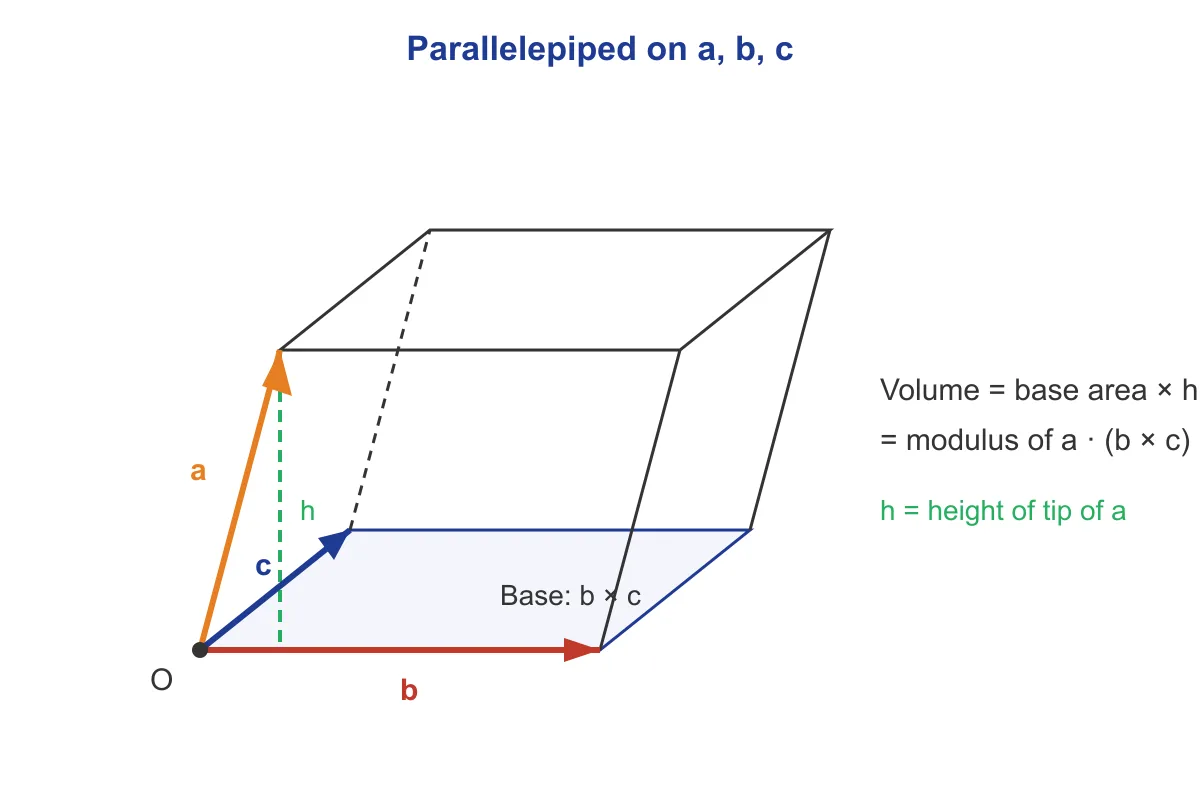
Figure 5.1: The parallelepiped on three vectors, with base area and height
So $\vert[\vec a\ \vec b\ \vec c]\vert=(\text{base area})\times(\text{height})$, the volume of the parallelepiped. The sign says whether $\vec a$ lies on the same side of the base as $\vec b\times\vec c$ (positive) or the opposite side (negative).
Three edges meeting at a vertex of a tetrahedron are the three edges of the parallelepiped with that vertex. A tetrahedron fills one sixth of that box, so
- volume of parallelepiped $=\vert[\vec a\ \vec b\ \vec c]\vert$,
- volume of tetrahedron $=\tfrac16\vert[\vec a\ \vec b\ \vec c]\vert$,
- volume of a triangular prism on the same three edges $=\tfrac12\vert[\vec a\ \vec b\ \vec c]\vert$.
For a tetrahedron $ABCD$, use the edges from one vertex: $\vec{AB},\vec{AC},\vec{AD}$.
Example 2: Find the volume of the tetrahedron with vertices $A(1,1,1)$, $B(3,1,1)$, $C(1,4,1)$, $D(2,2,6)$.
$\vec{AB}=(2,0,0)$, $\vec{AC}=(0,3,0)$, $\vec{AD}=(1,1,5)$.
$[\vec{AB}\ \vec{AC}\ \vec{AD}]=\begin{vmatrix}2&0&0\\0&3&0\\1&1&5\end{vmatrix}=2\cdot3\cdot5=30$ (triangular matrix, so the product of the diagonal).
Volume $=\tfrac16\cdot30=5$ cubic units.
Answer: $5$. Do not forget the factor $\tfrac16$; the determinant alone is the box, not the pyramid.
Properties
Let $[\vec a\ \vec b\ \vec c]=V$.
| Operation | Result | Reason |
|---|---|---|
| Cyclic shift $[\vec b\ \vec c\ \vec a]$ or $[\vec c\ \vec a\ \vec b]$ | $V$ | two row swaps |
| Swap two vectors, e.g. $[\vec b\ \vec a\ \vec c]$ | $-V$ | one row swap |
| Reverse order $[\vec c\ \vec b\ \vec a]$ | $-V$ | one swap (first and last) |
| Two vectors equal, $[\vec a\ \vec a\ \vec c]$ | $0$ | equal rows |
| Scalar $k$ in one slot, $[k\vec a\ \vec b\ \vec c]$ | $kV$ | row factor |
| Split, $[\vec a+\vec d\ \vec b\ \vec c]$ | $V+[\vec d\ \vec b\ \vec c]$ | linearity in each row |
| Dot and cross exchanged | $\vec a\cdot(\vec b\times\vec c)=(\vec a\times\vec b)\cdot\vec c$ | cyclic shift |
Also $[\hat i\ \hat j\ \hat k]=1$, the volume of the unit cube. Vectors in a right-handed set have a positive triple product when taken in the order of the set.
Memory trick: "Cycle keeps, swap flips." Three people in a ring can rotate seats and nothing changes; two people swapping seats mirror the box.
Use it: reduce any permutation of $a,b,c$ by counting swaps; even number gives $+V$, odd gives $-V$.
Example 3: If $[\vec a\ \vec b\ \vec c]=V$, show that $[\vec a+\vec b\ \ \vec b+\vec c\ \ \vec c+\vec a]=2V$.
Expand the first slot: $[\vec a\ \ \vec b+\vec c\ \ \vec c+\vec a]+[\vec b\ \ \vec b+\vec c\ \ \vec c+\vec a]$.
First term: $[\vec a\ \vec b\ \vec c]+[\vec a\ \vec b\ \vec a]+[\vec a\ \vec c\ \vec c]+[\vec a\ \vec c\ \vec a]=V+0+0+0=V$.
Second term: $[\vec b\ \vec b\ \vec c]+[\vec b\ \vec b\ \vec a]+[\vec b\ \vec c\ \vec c]+[\vec b\ \vec c\ \vec a]$; the first three repeat a vector and vanish, and $[\vec b\ \vec c\ \vec a]=V$ survives.
Total $=V+V=2V$.
Answer: $2V$. Whenever a slot repeats a vector that is already present, the term is zero; this kills most of the eight expansion terms. The coefficient check agrees: the rows $(1,1,0),(0,1,1),(1,0,1)$ have determinant $2$.
Reading the sign
The sign of the triple product tells you about handedness. Hold your right hand so that the fingers curl from $\vec b$ towards $\vec c$; the thumb then points along $\vec b\times\vec c$. If $\vec a$ points to the same side as your thumb, the product is positive, and $\vec a,\vec b,\vec c$ form a right-handed set, like the axes $x,y,z$. If $\vec a$ points to the other side, the product is negative.
This is why a swap flips the sign. Exchanging $\vec b$ and $\vec c$ reverses the direction of $\vec b\times\vec c$, so the thumb now points the opposite way, while $\vec a$ has not moved. A cyclic shift only changes which vector you call first; the box, and the side on which the third vector sits, is the same.
A useful consequence: when a problem asks for a volume, find the determinant by any convenient expansion and write the modulus at the end. The sign never matters for the volume, but it does matter when you are told to compare two triples or to prove an identity.
Coplanarity
Three vectors are coplanar when, placed at one point, they lie in one plane. Then the box on them is flat and has no volume. The converse also holds.
This covers every degenerate case automatically: if two vectors are parallel, or one is the zero vector, the determinant is zero and the three are indeed coplanar. When $[\vec a\ \vec b\ \vec c]\ne0$ the vectors are called non-coplanar, and then any vector in space can be written in exactly one way as $x\vec a+y\vec b+z\vec c$.
Equivalent statements of coplanarity: one of the vectors is a linear combination of the other two, or there are numbers $\alpha,\beta,\gamma$, not all zero, with $\alpha\vec a+\beta\vec b+\gamma\vec c=\vec0$.
Four points. Points $A,B,C,D$ lie in one plane exactly when the three edges $\vec{AB},\vec{AC},\vec{AD}$ from $A$ are coplanar:
With position vectors, this is $[\vec b-\vec a\ \ \vec c-\vec a\ \ \vec d-\vec a]=0$. A common slip is to write $[\vec a\ \vec b\ \vec c]=0$ for the points; that only says the plane through the three points passes through the origin.
Example 4: Find $\lambda$ so that $\vec a=(2,-1,1)$, $\vec b=(1,2,-3)$, $\vec c=(3,\lambda,5)$ are coplanar.
Set the determinant to zero.
$\begin{vmatrix}2&-1&1\\1&2&-3\\3&\lambda&5\end{vmatrix}=2(10+3\lambda)-(-1)(5+9)+1(\lambda-6)$
$=20+6\lambda+14+\lambda-6=7\lambda+28$.
$7\lambda+28=0\Rightarrow\lambda=-4$.
Check: with $\lambda=-4$, is $\vec c=p\vec a+q\vec b$? $2p+q=3$, $-p+2q=-4$ give $p=2,q=-1$; third component $2(1)+(-1)(-3)=5$. Yes.
Answer: $\lambda=-4$. Substituting back into a vector relation is a quick independent check.
Writing a vector in terms of three non-coplanar ones uses triple products. If $\vec p=x\vec a+y\vec b+z\vec c$, dot both sides with $\vec b\times\vec c$; the terms with $\vec b$ and $\vec c$ vanish (repeated vector), so $[\vec p\ \vec b\ \vec c]=x[\vec a\ \vec b\ \vec c]$:
This is Cramer's rule in vector clothing: replace one slot by $\vec p$.
The vector triple product
The vector $\vec a\times(\vec b\times\vec c)$ is the cross product of $\vec a$ with a vector that is already a cross product. The result is a vector, and there is a clean formula.
Why this is true. The vector $\vec b\times\vec c$ is perpendicular to the plane of $\vec b$ and $\vec c$. Then $\vec a\times(\vec b\times\vec c)$ is perpendicular to $\vec b\times\vec c$, so it lies in the plane of $\vec b$ and $\vec c$. Write it as $\lambda\vec b+\mu\vec c$. It is also perpendicular to $\vec a$, so $\lambda(\vec a\cdot\vec b)+\mu(\vec a\cdot\vec c)=0$. This forces $\lambda=k(\vec a\cdot\vec c)$ and $\mu=-k(\vec a\cdot\vec b)$ for one common number $k$. Test with $\vec a=\hat i$, $\vec b=\hat i$, $\vec c=\hat j$: $\vec b\times\vec c=\hat k$, $\hat i\times\hat k=-\hat j$, and the formula gives $0\cdot\hat i-1\cdot\hat j=-\hat j$. So $k=1$. (The factor $k$ cannot depend on the vectors, since both sides are linear in each of them.)
Memory trick: "BAC minus CAB": $\vec a\times(\vec b\times\vec c)=\vec b(\vec a\cdot\vec c)-\vec c(\vec a\cdot\vec b)$. Say "back cab" aloud.
Use it: the vector outside goes in the dots; the middle vector of the bracket comes first with a plus sign.
For the other grouping, use the sign change of the cross product: $(\vec a\times\vec b)\times\vec c=-\vec c\times(\vec a\times\vec b)=-[(\vec c\cdot\vec b)\vec a-(\vec c\cdot\vec a)\vec b]$, so
Now compare the two results.
| Product | Result | Lies in the plane of |
|---|---|---|
| $\vec a\times(\vec b\times\vec c)$ | $(\vec a\cdot\vec c)\vec b-(\vec a\cdot\vec b)\vec c$ | $\vec b$ and $\vec c$ |
| $(\vec a\times\vec b)\times\vec c$ | $(\vec a\cdot\vec c)\vec b-(\vec b\cdot\vec c)\vec a$ | $\vec a$ and $\vec b$ |
The two planes differ, so the two vectors are generally different: the cross product is not associative. They agree only when $(\vec a\cdot\vec b)\vec c=(\vec b\cdot\vec c)\vec a$. That happens if $\vec a\parallel\vec c$, or if $\vec b$ is perpendicular to both $\vec a$ and $\vec c$.
Other facts that follow at once:
- $\vec a\times(\vec b\times\vec c)+\vec b\times(\vec c\times\vec a)+\vec c\times(\vec a\times\vec b)=\vec0$. Expand all three; each of the six dot-product terms appears once with each sign.
- If $\vec a$ is perpendicular to both $\vec b$ and $\vec c$, the result is $\vec0$ (both dot products are $0$).
- For a unit vector $\hat n$: $\hat n\times(\vec v\times\hat n)=\vec v-(\vec v\cdot\hat n)\hat n$, the part of $\vec v$ perpendicular to $\hat n$.
Example 5: For $\vec a=(1,1,0)$, $\vec b=(2,0,-1)$, $\vec c=(1,3,2)$, find $\vec a\times(\vec b\times\vec c)$ and check with the formula.
Direct: $\vec b\times\vec c=(0\cdot2-(-1)\cdot3,\ (-1)\cdot1-2\cdot2,\ 2\cdot3-0\cdot1)=(3,-5,6)$.
$\vec a\times(3,-5,6)=(1\cdot6-0\cdot(-5),\ 0\cdot3-1\cdot6,\ 1\cdot(-5)-1\cdot3)=(6,-6,-8)$.
Formula: $\vec a\cdot\vec c=1+3+0=4$, $\vec a\cdot\vec b=2+0+0=2$.
$4\vec b-2\vec c=(8,0,-4)-(2,6,4)=(6,-6,-8)$. Same.
Answer: $(6,-6,-8)$. The formula needs only dot products, which is why it is far quicker than two cross products.
Example 6: For $\vec a=4\hat i+3\hat j+7\hat k$, $\vec b=\hat i$, $\vec c=2\hat j$, find $\vert\vec a\times(\vec b\times\vec c)\vert$ and compare with $\vert(\vec a\times\vec b)\times\vec c\vert$.
$\vec a\cdot\vec c=6$, $\vec a\cdot\vec b=4$, $\vec b\cdot\vec c=0$.
$\vec a\times(\vec b\times\vec c)=6\hat i-4(2\hat j)=6\hat i-8\hat j$, magnitude $10$.
$(\vec a\times\vec b)\times\vec c=6\hat i-0\cdot\vec a=6\hat i$, magnitude $6$.
Answer: $10$ and $6$.
Since $10\ne6$, the two groupings really differ; non-associativity is not a technicality.
A word on why the vector triple product matters in practice. Whenever a problem hands you a double cross product, the temptation is to compute two cross products in components. That works, but it takes six multiplications per component and invites slips. Back-cab needs only two dot products and two scalar multiples. In a proof, where the vectors have no components at all, it is the only route. Use it first, and go to components only to check.
Shortest distance between two lines
Two lines in space are either parallel, intersecting, or skew (neither parallel nor meeting). Let the lines be
Skew lines. The vector $\vec n=\vec u\times\vec v$ is perpendicular to both directions, so the segment of shortest length joining the lines is along $\vec n$. Take any point $P$ on the first line and $Q$ on the second. The shortest distance is the length of the projection of $\vec{PQ}$ on $\vec n$:
The numerator is the volume of the box on $\vec{PQ},\vec u,\vec v$; the denominator is the area of its base. Volume over base area is the height, and that height is the gap between the lines.
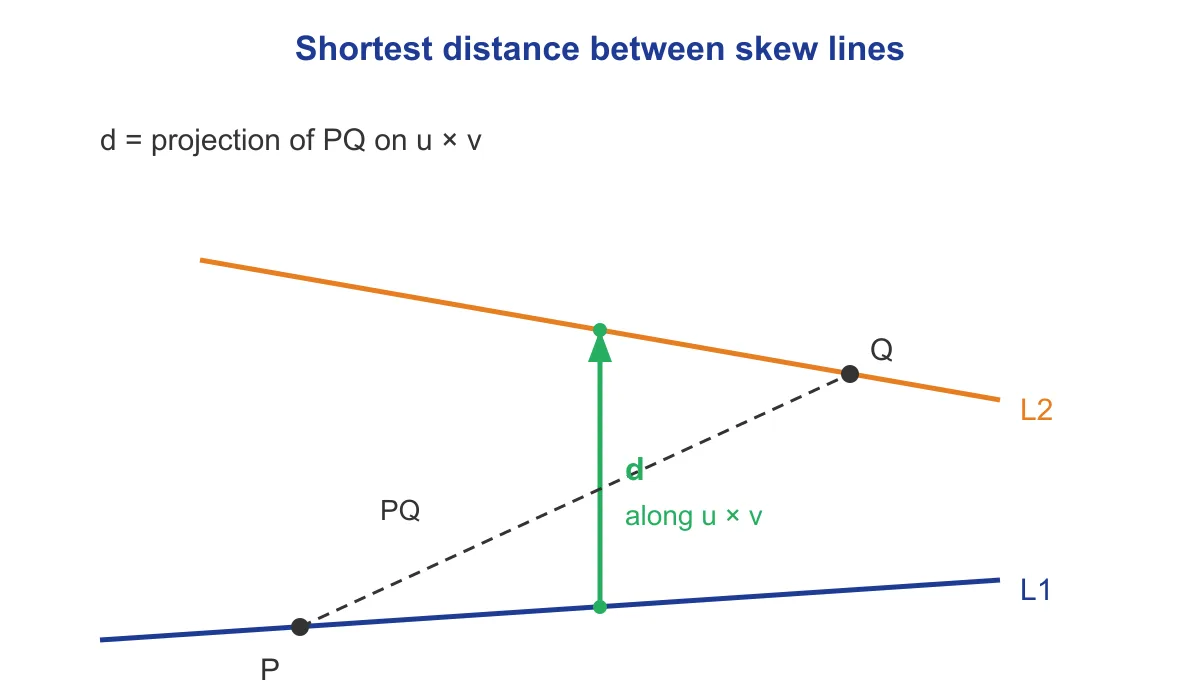
*Figure 5.2: Shortest distance between skew lines as a projection on $\vec u\times\vec v$*
Intersecting lines. The distance is $0$, so $[\vec q-\vec p\ \ \vec u\ \ \vec v]=0$ with $\vec u\times\vec v\ne\vec0$. The condition says the lines are coplanar. If $\vec u\times\vec v=\vec0$ the lines are parallel and the formula above is useless.
Parallel lines. With $\vec u\parallel\vec v$ the distance is
Example 7: Find the shortest distance between $\vec r=\lambda\hat i$ and $\vec r=(2\hat i+5\hat j+10\hat k)+\mu(3\hat j+4\hat k)$.
$\vec p=\vec0$, $\vec u=(1,0,0)$; $\vec q=(2,5,10)$, $\vec v=(0,3,4)$.
$\vec u\times\vec v=(0\cdot4-0\cdot3,\ 0\cdot0-1\cdot4,\ 1\cdot3-0)=(0,-4,3)$, magnitude $5$.
$(\vec q-\vec p)\cdot(\vec u\times\vec v)=0-20+30=10$.
$d=10/5=2$.
Answer: $2$. Cross-check by geometry: the first line is the $x$-axis, so only the $y$ and $z$ parts of the second line matter. Its closest approach to the axis in the $yz$-plane is the distance from the origin to the line through $(5,10)$ with direction $(3,4)$: $\vert5\cdot4-10\cdot3\vert/5=2$.
Solving vector equations
Two equation types turn up in problems.
**Type 1: $\vec a\times\vec x=\vec b$ together with $\vec a\cdot\vec x=c$.** A cross product equation alone does not fix $\vec x$, since you may add any multiple of $\vec a$. Solvability needs $\vec a\cdot\vec b=0$, because $\vec a\times\vec x$ is perpendicular to $\vec a$. Cross both sides with $\vec a$ from the left:
so
Example 8: Solve $\vec a\times\vec x=\vec b$, $\vec a\cdot\vec x=3$, for $\vec a=(1,2,2)$ and $\vec b=(2,1,-2)$.
First $\vec a\cdot\vec b=2+2-4=0$, so a solution exists. Also $\vert\vec a\vert^2=9$.
$\vec a\times\vec b=(2(-2)-2(1),\ 2(2)-1(-2),\ 1(1)-2(2))=(-6,6,-3)$.
$\vec x=\dfrac{3(1,2,2)-(-6,6,-3)}{9}=\dfrac{(9,0,9)}{9}=(1,0,1)$.
Check: $\vec a\cdot\vec x=1+2=3$. $\vec a\times\vec x=(2\cdot1-2\cdot0,\ 2\cdot1-1\cdot1,\ 1\cdot0-2\cdot1)=(2,1,-2)=\vec b$. Both hold.
Answer: $\vec x=\hat i+\hat k$. Always substitute back; a sign error in $\vec a\times\vec b$ is easy to make.
Type 2: a vector in terms of three non-coplanar vectors. Use the formulas for $x,y,z$ given under coplanarity. Another common situation is a relation such as $\vec x\cdot\vec a=\alpha,\ \vec x\cdot\vec b=\beta,\ \vec x\cdot\vec c=\gamma$ for non-coplanar $\vec a,\vec b,\vec c$. Write $\vec x=p\vec b\times\vec c+q\vec c\times\vec a+r\vec a\times\vec b$ and dot with $\vec a$ to get $p=\alpha/[\vec a\ \vec b\ \vec c]$, and similarly for $q$ and $r$.
Example 9: Express $\vec p=(5,3,4)$ as $x\vec a+y\vec b+z\vec c$ with $\vec a=(1,1,0)$, $\vec b=(0,1,1)$, $\vec c=(1,0,1)$.
$[\vec a\ \vec b\ \vec c]=\begin{vmatrix}1&1&0\\0&1&1\\1&0&1\end{vmatrix}=1(1)-1(0-1)+0=2$.
$[\vec p\ \vec b\ \vec c]=\begin{vmatrix}5&3&4\\0&1&1\\1&0&1\end{vmatrix}=5(1)-3(0-1)+4(0-1)=4$, so $x=2$.
$[\vec a\ \vec p\ \vec c]=\begin{vmatrix}1&1&0\\5&3&4\\1&0&1\end{vmatrix}=1(3)-1(5-4)=2$, so $y=1$.
$[\vec a\ \vec b\ \vec p]=\begin{vmatrix}1&1&0\\0&1&1\\5&3&4\end{vmatrix}=1(4-3)-1(0-5)=6$, so $z=3$.
Check by components: $2(1,1,0)+1(0,1,1)+3(1,0,1)=(5,3,4)$.
Answer: $x=2$, $y=1$, $z=3$. The three determinants share the same bottom line, only the slot for $\vec p$ moves.
Choosing the method
| Task | Tool |
|---|---|
| Volume of box or tetrahedron | $\vert[\vec a\ \vec b\ \vec c]\vert$ and $\tfrac16\vert[\vec a\ \vec b\ \vec c]\vert$ |
| Are 3 vectors / 4 points coplanar | determinant $=0$ with edges from one point |
| Simplify a double cross product | back-cab rule, then dot products |
| Distance between skew lines | project $\vec{PQ}$ on $\vec u\times\vec v$ |
| Lines meet or not | $[\vec q-\vec p\ \vec u\ \vec v]=0$ |
| $\vec a\times\vec x=\vec b$ | cross with $\vec a$, use back-cab |
| Components along non-coplanar set | ratios of triple products |
Common traps
- Writing $(\vec a\cdot\vec b)\times\vec c$ → remember a dot product is a number; the scalar triple product is $\vec a\cdot(\vec b\times\vec c)$.
- Taking tetrahedron volume as $\vert[\vec a\ \vec b\ \vec c]\vert$ → divide by $6$ for the tetrahedron, not for the box.
- Using $[\vec a\ \vec b\ \vec c]=0$ for four points → subtract one point from the others first: $[\vec{AB}\ \vec{AC}\ \vec{AD}]=0$.
- Treating a negative triple product as an error → the sign only records handedness; take the modulus for volume.
- Assuming $\vec a\times(\vec b\times\vec c)=(\vec a\times\vec b)\times\vec c$ → they differ unless $(\vec a\cdot\vec b)\vec c=(\vec b\cdot\vec c)\vec a$.
- Writing the vector triple product as $(\vec a\cdot\vec b)\vec c-(\vec a\cdot\vec c)\vec b$ → the sign flipped; use back-cab: $(\vec a\cdot\vec c)\vec b-(\vec a\cdot\vec b)\vec c$.
- Forgetting that $\vec a\times(\vec b\times\vec c)$ lies in the plane of $\vec b,\vec c$ → use this to say instantly that it is perpendicular to $\vec a$ and to $\vec b\times\vec c$.
- Using the skew-line distance formula when $\vec u\times\vec v=\vec0$ → the lines are parallel; use $\vert(\vec q-\vec p)\times\vec u\vert/\vert\vec u\vert$.
- Dropping the modulus in the distance formula → distance is never negative; put $\vert\ \vert$ on the numerator.
- Solving $\vec a\times\vec x=\vec b$ for $\vec x$ uniquely without a second condition → $\vec x+t\vec a$ is also a solution; a dot condition is needed.
Quick revision
- $[\vec a\ \vec b\ \vec c]=\vec a\cdot(\vec b\times\vec c)=(\vec a\times\vec b)\cdot\vec c$ = determinant of the three rows.
- $[\vec a\ \vec b\ \vec c]=[\vec b\ \vec c\ \vec a]=[\vec c\ \vec a\ \vec b]=-[\vec b\ \vec a\ \vec c]$.
- $[\vec a\ \vec a\ \vec c]=0$; $[k\vec a\ \vec b\ \vec c]=k[\vec a\ \vec b\ \vec c]$; $[\hat i\ \hat j\ \hat k]=1$.
- Parallelepiped volume $=\vert[\vec a\ \vec b\ \vec c]\vert$; tetrahedron volume $=\tfrac16\vert[\vec a\ \vec b\ \vec c]\vert$.
- Three vectors coplanar $\iff[\vec a\ \vec b\ \vec c]=0$.
- Four points coplanar $\iff[\vec{AB}\ \vec{AC}\ \vec{AD}]=0$.
- $[\vec a+\vec b\ \ \vec b+\vec c\ \ \vec c+\vec a]=2[\vec a\ \vec b\ \vec c]$; $[\vec a-\vec b\ \ \vec b-\vec c\ \ \vec c-\vec a]=0$.
- $\vec a\times(\vec b\times\vec c)=(\vec a\cdot\vec c)\vec b-(\vec a\cdot\vec b)\vec c$.
- $(\vec a\times\vec b)\times\vec c=(\vec a\cdot\vec c)\vec b-(\vec b\cdot\vec c)\vec a$.
- The vector triple product is not associative; the first lies in the plane of $\vec b,\vec c$, the second in the plane of $\vec a,\vec b$.
- Skew lines: $d=\vert(\vec q-\vec p)\cdot(\vec u\times\vec v)\vert/\vert\vec u\times\vec v\vert$.
- Lines intersect $\iff[\vec q-\vec p\ \vec u\ \vec v]=0$ and $\vec u\times\vec v\ne\vec0$.
- Parallel lines: $d=\vert(\vec q-\vec p)\times\vec u\vert/\vert\vec u\vert$.
- $\vec a\times\vec x=\vec b$, $\vec a\cdot\vec x=c$ gives $\vec x=(c\vec a-\vec a\times\vec b)/\vert\vec a\vert^2$, needing $\vec a\cdot\vec b=0$.
Practice questions
Find the value of $\hat i\cdot(\hat j\times\hat k)+\hat j\cdot(\hat k\times\hat i)+\hat k\cdot(\hat i\times\hat j)$.
- $3$
- $-3$
- $1$
- $0$
Answer
A. $3$
Each term is $[\hat i\ \hat j\ \hat k]$ or a cyclic shift of it, so each equals $1$; the sum is $3$.
Which of the following is equal to $[\vec a\ \vec b\ \vec c]$?
- $[\vec a\ \vec c\ \vec b]$
- $[\vec b\ \vec a\ \vec c]$
- $[\vec b\ \vec c\ \vec a]$
- $[\vec c\ \vec b\ \vec a]$
Answer
C. $[\vec b\ \vec c\ \vec a]$
$[\vec b\ \vec c\ \vec a]$ is a cyclic shift, so it is equal. The other three each need one swap, so each is $-[\vec a\ \vec b\ \vec c]$.
The vector $\vec a\times(\vec b\times\vec c)$ always lies in the plane of
- $\vec a$ and $\vec c$
- $\vec b$ and $\vec c$
- $\vec a$ and $\vec b\times\vec c$
- $\vec a$ and $\vec b$
Answer
B. $\vec b$ and $\vec c$
The result equals $(\vec a\cdot\vec c)\vec b-(\vec a\cdot\vec b)\vec c$, a combination of $\vec b$ and $\vec c$ only.
The expression $(\vec a\times\vec b)\times\vec c$ is equal to
- $(\vec b\cdot\vec c)\vec a-(\vec a\cdot\vec c)\vec b$
- $(\vec a\cdot\vec c)\vec b-(\vec a\cdot\vec b)\vec c$
- $(\vec a\cdot\vec b)\vec c-(\vec b\cdot\vec c)\vec a$
- $(\vec a\cdot\vec c)\vec b-(\vec b\cdot\vec c)\vec a$
Answer
D. $(\vec a\cdot\vec c)\vec b-(\vec b\cdot\vec c)\vec a$
$(\vec a\times\vec b)\times\vec c=-\vec c\times(\vec a\times\vec b)=-[(\vec c\cdot\vec b)\vec a-(\vec c\cdot\vec a)\vec b]=(\vec a\cdot\vec c)\vec b-(\vec b\cdot\vec c)\vec a$.
The scalar triple product $[\vec a\ \vec b\ \vec c]$ of three non-zero vectors is certainly zero when
- all three are unit vectors
- no two of the vectors are collinear
- the three are mutually perpendicular
- two of the vectors are parallel
Answer
D. two of the vectors are parallel
Two parallel vectors give two proportional rows in the determinant, so it is $0$. Mutually perpendicular non-zero vectors give a non-zero volume; unit vectors can do the same.
For vectors $\vec a,\vec b,\vec c$, the relation $\vec a\times(\vec b\times\vec c)=(\vec a\times\vec b)\times\vec c$ holds if and only if
- $\vec a\parallel\vec c$, or $\vec b$ is perpendicular to both $\vec a$ and $\vec c$
- $\vec a\parallel\vec b$
- $\vec b\parallel\vec c$
- $\vec a,\vec b,\vec c$ are coplanar
Answer
A. $\vec a\parallel\vec c$, or $\vec b$ is perpendicular to both $\vec a$ and $\vec c$
Equality means $(\vec a\cdot\vec b)\vec c=(\vec b\cdot\vec c)\vec a$. If $\vec a,\vec c$ are not parallel this needs $\vec a\cdot\vec b=0=\vec b\cdot\vec c$; if $\vec c=k\vec a$ it holds for every $\vec b$.
Points with position vectors $\vec a,\vec b,\vec c,\vec d$ are coplanar if and only if
- $(\vec a\times\vec b)\cdot(\vec c\times\vec d)=0$
- $[\vec b-\vec a\ \ \vec c-\vec a\ \ \vec d-\vec a]=0$
- $\vec a+\vec b+\vec c+\vec d=\vec 0$
- $[\vec a\ \vec b\ \vec c]=0$
Answer
B. $[\vec b-\vec a\ \ \vec c-\vec a\ \ \vec d-\vec a]=0$
Coplanarity of the points means the three edges from one point are coplanar, which is the first condition. $[\vec a\ \vec b\ \vec c]=0$ only says the plane through $a,b,c$ contains the origin.
The shortest distance between the lines $\vec r=\vec p+\lambda\vec u$ and $\vec r=\vec q+\mu\vec v$ (skew) is
- $\dfrac{\vert(\vec q-\vec p)\times(\vec u\times\vec v)\vert}{\vert\vec u\times\vec v\vert}$
- $\dfrac{\vert(\vec q-\vec p)\cdot(\vec u\times\vec v)\vert}{\vert\vec u\vert\,\vert\vec v\vert}$
- $\dfrac{\vert(\vec q-\vec p)\cdot(\vec u\times\vec v)\vert}{\vert\vec u\times\vec v\vert}$
- $\vert(\vec q-\vec p)\cdot(\vec u+\vec v)\vert$
Answer
C. $\dfrac{\vert(\vec q-\vec p)\cdot(\vec u\times\vec v)\vert}{\vert\vec u\times\vec v\vert}$
The gap is the projection of $\vec{PQ}=\vec q-\vec p$ on the common normal $\vec u\times\vec v$; dividing by $\vert\vec u\vert\vert\vec v\vert$ instead would omit the factor $\sin\theta$.
For any three vectors, $\vec a\times(\vec b\times\vec c)+\vec b\times(\vec c\times\vec a)+\vec c\times(\vec a\times\vec b)$ equals
- $\vec 0$
- $3\,\vec a\times(\vec b\times\vec c)$
- $[\vec a\ \vec b\ \vec c]$
- $\vec a+\vec b+\vec c$
Answer
A. $\vec 0$
Expand: $(\vec a\cdot\vec c)\vec b-(\vec a\cdot\vec b)\vec c+(\vec b\cdot\vec a)\vec c-(\vec b\cdot\vec c)\vec a+(\vec c\cdot\vec b)\vec a-(\vec c\cdot\vec a)\vec b=\vec0$.
For unit vectors $\vec a$ and $\vec b$, $\vec a\times(\vec a\times\vec b)$ equals
- $(\vec a\cdot\vec b)\vec b-\vec a$
- $\vec a-(\vec a\cdot\vec b)\vec b$
- $(\vec a\cdot\vec b)\vec a-\vec b$
- $\vec b-(\vec a\cdot\vec b)\vec a$
Answer
C. $(\vec a\cdot\vec b)\vec a-\vec b$
Back-cab: $\vec a\times(\vec a\times\vec b)=(\vec a\cdot\vec b)\vec a-(\vec a\cdot\vec a)\vec b=(\vec a\cdot\vec b)\vec a-\vec b$.
If $\vec a$ is perpendicular to both $\vec b$ and $\vec c$, then $\vec a\times(\vec b\times\vec c)$ equals
- $\vert\vec a\vert^{2}\,(\vec b\times\vec c)$
- $\vec b-\vec c$
- $\vec b\times\vec c$
- $\vec 0$
Answer
D. $\vec 0$
$\vec a\cdot\vec b=\vec a\cdot\vec c=0$, so both terms of the back-cab expansion vanish. Also $\vec b\times\vec c\parallel\vec a$ here.
The volume of the tetrahedron with three edges $\vec a,\vec b,\vec c$ meeting at a vertex is
- $\tfrac13\vert[\vec a\ \vec b\ \vec c]\vert$
- $\tfrac16\vert[\vec a\ \vec b\ \vec c]\vert$
- $\tfrac12\vert[\vec a\ \vec b\ \vec c]\vert$
- $\vert[\vec a\ \vec b\ \vec c]\vert$
Answer
B. $\tfrac16\vert[\vec a\ \vec b\ \vec c]\vert$
The tetrahedron is one sixth of the parallelepiped on the same three edges.
Lines $\vec r=\vec p+\lambda\vec u$ and $\vec r=\vec q+\mu\vec v$ intersect in exactly one point if and only if
- $[\vec q-\vec p\ \ \vec u\ \ \vec v]=0$ and $\vec u\times\vec v\ne\vec 0$
- $[\vec q-\vec p\ \ \vec u\ \ \vec v]=0$ only
- $(\vec q-\vec p)\cdot\vec u=0$ and $(\vec q-\vec p)\cdot\vec v=0$
- $\vec u\times\vec v\ne\vec 0$ only
Answer
A. $[\vec q-\vec p\ \ \vec u\ \ \vec v]=0$ and $\vec u\times\vec v\ne\vec 0$
Zero triple product means the lines are coplanar; non-parallel directions then force a single meeting point. Coplanarity alone also allows parallel lines.
For any three vectors $\vec a,\vec b,\vec c$, the vectors $\vec a-\vec b,\ \vec b-\vec c,\ \vec c-\vec a$ are
- always non-coplanar
- always coplanar
- coplanar only when $\vec a,\vec b,\vec c$ are coplanar
- mutually perpendicular
Answer
B. always coplanar
Their sum is $\vec 0$, so one is a combination of the other two: the determinant of coefficients $(1,-1,0),(0,1,-1),(-1,0,1)$ is $0$.
Evaluate $[\vec a\ \vec b\ \vec c]$ for $\vec a=(1,2,3)$, $\vec b=(2,-1,1)$, $\vec c=(0,1,4)$.
- $15$
- $-5$
- $-15$
- $-17$
Answer
C. $-15$
Determinant: $1(-4-1)-2(8-0)+3(2-0)=-5-16+6=-15$.
Find the volume of the parallelepiped with edges $\hat i+\hat j$, $\hat j+\hat k$ and $\hat k+\hat i$ (cubic units).
- $3$
- $4$
- $1$
- $2$
Answer
D. $2$
$\begin{vmatrix}1&1&0\\0&1&1\\1&0&1\end{vmatrix}=1(1)-1(0-1)=2$. Row-expansion check along the third row: $1(1-0)+0+1(1-0)=2$.
Find the volume of the tetrahedron with vertices $A(1,1,1)$, $B(3,1,1)$, $C(1,4,1)$ and $D(2,2,6)$ (cubic units).
- $5$
- $10$
- $15$
- $30$
Answer
A. $5$
$\vec{AB}=(2,0,0)$, $\vec{AC}=(0,3,0)$, $\vec{AD}=(1,1,5)$. The determinant is $30$; the volume is $30/6=5$.
Find $\lambda$ so that $(1,2,-1)$, $(2,\lambda,3)$ and $(0,1,2)$ are coplanar vectors.
- $-6.5$
- $6.5$
- $7$
- $5.5$
Answer
B. $6.5$
$1(2\lambda-3)-2(4-0)+(-1)(2-0)=2\lambda-13=0$, so $\lambda=6.5$. Check: $(1,2,-1)=0.5(2,6.5,3)-1.25(0,1,2)$ holds in all three slots.
If $[\vec a\ \vec b\ \vec c]=-4$, find $[\vec a+\vec b\ \ \vec b+\vec c\ \ \vec c+\vec a]$.
- $-4$
- $8$
- $-8$
- $0$
Answer
C. $-8$
The expression equals $2[\vec a\ \vec b\ \vec c]=2(-4)=-8$ (coefficient determinant of rows $(1,1,0),(0,1,1),(1,0,1)$ is $2$).
For $\vec a=4\hat i+3\hat j+7\hat k$, $\vec b=\hat i$, $\vec c=2\hat j$, find $\vert\vec a\times(\vec b\times\vec c)\vert$.
- $14$
- $8$
- $6$
- $10$
Answer
D. $10$
$\vec a\cdot\vec c=6$, $\vec a\cdot\vec b=4$: $6\vec b-4\vec c=(6,-8,0)$, magnitude $10$. Direct: $\vec b\times\vec c=2\hat k$, $\vec a\times2\hat k=(6,-8,0)$.
Find the shortest distance between $\vec r=\lambda\hat i$ and $\vec r=2\hat i+5\hat j+10\hat k+\mu(3\hat j+4\hat k)$.
- $3$
- $2$
- $5$
- $10$
Answer
B. $2$
$\vec u\times\vec v=(0,-4,3)$, magnitude $5$; $(\vec q-\vec p)\cdot(\vec u\times\vec v)=-20+30=10$; $d=10/5=2$. Cross-check: viewed along the $x$-axis the first line is the origin and the second is the line through $(5,10)$ with direction $(3,4)$, at distance $\vert5\cdot4-10\cdot3\vert/5=2$.
Find the volume of the parallelepiped with edges $(2,0,0)$, $(1,3,0)$ and $(5,-2,4)$ (cubic units).
- $12$
- $4$
- $30$
- $24$
Answer
D. $24$
Triangular determinant: $2\cdot3\cdot4=24$.
If $[\vec a\ \vec b\ \vec c]=5$, find $[2\vec a-\vec b\ \ \vec b+3\vec c\ \ \vec a+\vec c]$.
- $-5$
- $-10$
- $5$
- $-1$
Answer
A. $-5$
The coefficient rows $(2,-1,0),(0,1,3),(1,0,1)$ have determinant $2(1)+1(0-3)=-1$. So the value is $-1\times5=-5$.
Given $\vec a=\hat i+2\hat j+2\hat k$, the vector $\vec x$ satisfies $\vec a\times\vec x=2\hat i+2\hat j-3\hat k$ and $\vec a\cdot\vec x=8$. Find $\vert\vec x\vert$.
- $2$
- $4$
- $3$
- $9$
Answer
C. $3$
$\vert\vec a\vert^2=9$, $\vec b=(2,2,-3)$, $\vec a\times\vec b=(-10,7,-2)$. $\vec x=(8\vec a-\vec a\times\vec b)/9=(18,9,18)/9=(2,1,2)$; $\vert\vec x\vert=3$. Check: $\vec a\cdot\vec x=2+2+4=8$.
Find $m$ so that the points $A(1,0,-1)$, $B(2,2,1)$, $C(0,3,2)$ and $D(3,m,0)$ are coplanar.
- $1$
- $2$
- $5$
- $-1$
Answer
A. $1$
$\vec{AB}=(1,2,2)$, $\vec{AC}=(-1,3,3)$, $\vec{AD}=(2,m,1)$. Determinant $=1(3-3m)-2(-1-6)+2(-m-6)=5-5m=0$, so $m=1$.
Given $\vec a=(1,2,3)$, $\vec b=(-1,1,2)$, $\vec c=(4,2,1)$, find the $x$-component of $(\vec a\times\vec b)\times\vec c$.
- $-9$
- $22$
- $11$
- $-11$
Answer
D. $-11$
$\vec a\cdot\vec c=11$, $\vec b\cdot\vec c=0$. $(\vec a\times\vec b)\times\vec c=11\vec b-0=(-11,11,22)$. Direct: $\vec a\times\vec b=(1,-5,3)$, cross with $\vec c$ gives $(-11,11,22)$.
Given below are two statements: Statement I: $[\vec a\ \vec b\ \vec c]=[\vec b\ \vec c\ \vec a]$. Statement II: $[\vec a\ \vec b\ \vec c]=-[\vec b\ \vec a\ \vec c]$.
- Both Statement I and Statement II are correct
- Both Statement I and Statement II are incorrect
- Statement I is correct but Statement II is incorrect
- Statement I is incorrect but Statement II is correct
Answer
A. Both Statement I and Statement II are correct
Statement I is a cyclic shift (two swaps). Statement II is one swap. Both are correct.
Given below are two statements: Statement I: $\vec a\times(\vec b\times\vec c)$ always lies in the plane of $\vec b$ and $\vec c$. Statement II: $\vec a\times(\vec b\times\vec c)=(\vec a\times\vec b)\times\vec c$ for all vectors.
- Both Statement I and Statement II are correct
- Both Statement I and Statement II are incorrect
- Statement I is correct but Statement II is incorrect
- Statement I is incorrect but Statement II is correct
Answer
C. Statement I is correct but Statement II is incorrect
Statement I follows from back-cab. Statement II is false: take $\vec a=\vec b=\hat i$, $\vec c=\hat j$; the left side is $\hat i\times\hat k=-\hat j$, the right side is $\vec 0\times\hat j=\vec 0$.
Given below are two statements: Statement I: If $[\vec a\ \vec b\ \vec c]=0$ then two of the three vectors must be parallel. Statement II: $[\vec a\ \vec b\ \vec c]=[\vec a\ \vec c\ \vec b]$.
- Both Statement I and Statement II are correct
- Both Statement I and Statement II are incorrect
- Statement I is correct but Statement II is incorrect
- Statement I is incorrect but Statement II is correct
Answer
B. Both Statement I and Statement II are incorrect
Statement I fails: $(1,0,0),(0,1,0),(1,1,0)$ are coplanar with no two parallel. Statement II fails: swapping two vectors changes the sign, so the two are negatives.
Given below are two statements: Statement I: The volume of the tetrahedron with edges $\vec a,\vec b,\vec c$ from a vertex is $\tfrac13\vert[\vec a\ \vec b\ \vec c]\vert$. Statement II: The volume of a tetrahedron is one third of base area times height.
- Both Statement I and Statement II are correct
- Both Statement I and Statement II are incorrect
- Statement I is correct but Statement II is incorrect
- Statement I is incorrect but Statement II is correct
Answer
D. Statement I is incorrect but Statement II is correct
The tetrahedron volume is $\tfrac16\vert[\vec a\ \vec b\ \vec c]\vert$ (base area is $\tfrac12\vert\vec b\times\vec c\vert$, so $\tfrac13\cdot\tfrac12\cdot\text{box}$). Statement I is incorrect, Statement II is correct.
Given below are two statements: Statement I: If $\vec a,\vec b,\vec c$ are coplanar, then $\vec a+\vec b,\ \vec b+\vec c,\ \vec c+\vec a$ are coplanar. Statement II: $[\vec a+\vec b\ \ \vec b+\vec c\ \ \vec c+\vec a]=2[\vec a\ \vec b\ \vec c]$.
- Both Statement I and Statement II are correct
- Both Statement I and Statement II are incorrect
- Statement I is correct but Statement II is incorrect
- Statement I is incorrect but Statement II is correct
Answer
A. Both Statement I and Statement II are correct
Statement II is the identity; with $[\vec a\ \vec b\ \vec c]=0$ the new triple product is $0$, which gives Statement I.
Assertion (A): $\vec a\times(\vec b\times\vec c)$ is perpendicular to $\vec a$. Reason (R): The cross product of two vectors is perpendicular to both of them.
- Both A and R are true and R is the correct explanation of A
- Both A and R are true but R is not the correct explanation of A
- A is true but R is false
- A is false but R is true
Answer
A. Both A and R are true and R is the correct explanation of A
$\vec a\times\vec w$ is perpendicular to $\vec a$ for any $\vec w$; here $\vec w=\vec b\times\vec c$. R is the reason.
Assertion (A): The vector triple product is associative, that is $\vec a\times(\vec b\times\vec c)=(\vec a\times\vec b)\times\vec c$ in general. Reason (R): $(\vec a\times\vec b)\times\vec c$ lies in the plane of $\vec a$ and $\vec b$.
- Both A and R are true and R is the correct explanation of A
- Both A and R are true but R is not the correct explanation of A
- A is true but R is false
- A is false but R is true
Answer
D. A is false but R is true
A is false (e.g. $\vec a=\vec b=\hat i$, $\vec c=\hat j$ gives $-\hat j$ and $\vec 0$). R is true: the result is $(\vec a\cdot\vec c)\vec b-(\vec b\cdot\vec c)\vec a$.
Assertion (A): $[\vec a\ \vec b\ \vec c]=0$ whenever $\vec a=\vec b$. Reason (R): The scalar triple product of three vectors equals the area of the parallelogram formed by them.
- Both A and R are true and R is the correct explanation of A
- Both A and R are true but R is not the correct explanation of A
- A is true but R is false
- A is false but R is true
Answer
C. A is true but R is false
A is true (two equal rows). R is false: the triple product is the signed volume of the parallelepiped, not an area.
Match List I with List II. List I: a. $[\vec a\ \vec b\ \vec a]$ b. $[\vec b\ \vec a\ \vec c]$ when $[\vec a\ \vec b\ \vec c]=4$ c. $[\vec c\ \vec a\ \vec b]$ when $[\vec a\ \vec b\ \vec c]=4$ d. $[2\vec a\ \vec b\ \vec c]$ when $[\vec a\ \vec b\ \vec c]=4$. List II: i. $8$ ii. $0$ iii. $-4$ iv. $4$
- a-ii, b-iv, c-iii, d-i
- a-ii, b-iii, c-iv, d-i
- a-iii, b-ii, c-iv, d-i
- a-iv, b-iii, c-ii, d-i
Answer
B. a-ii, b-iii, c-iv, d-i
a: repeated vector gives $0$. b: one swap gives $-4$. c: cyclic shift keeps $4$. d: factor $2$ gives $8$.
Match List I with List II. List I: a. Volume of box on $\hat i,\hat j,\hat k$ b. Volume of tetrahedron on $\hat i,\hat j,\hat k$ c. Volume of box on $2\hat i,3\hat j,4\hat k$ d. Volume of tetrahedron on $2\hat i,3\hat j,4\hat k$. List II: i. $\tfrac16$ ii. $1$ iii. $4$ iv. $24$
- a-ii, b-i, c-iii, d-iv
- a-i, b-ii, c-iv, d-iii
- a-ii, b-i, c-iv, d-iii
- a-ii, b-iii, c-iv, d-i
Answer
C. a-ii, b-i, c-iv, d-iii
a: $1$. b: $\tfrac16$. c: $2\cdot3\cdot4=24$. d: $24/6=4$.
Match List I with List II. List I: a. $\vec a\times(\vec b\times\vec c)$ b. $(\vec a\times\vec b)\times\vec c$ c. $\vec a\cdot(\vec b\times\vec c)$ d. $\vec a\times(\vec b\times\vec a)$. List II: i. $(\vec a\cdot\vec c)\vec b-(\vec b\cdot\vec c)\vec a$ ii. $(\vec a\cdot\vec c)\vec b-(\vec a\cdot\vec b)\vec c$ iii. $[\vec a\ \vec b\ \vec c]$ iv. $\vert\vec a\vert^{2}\vec b-(\vec a\cdot\vec b)\vec a$
- a-ii, b-iii, c-i, d-iv
- a-ii, b-i, c-iii, d-iv
- a-i, b-ii, c-iii, d-iv
- a-ii, b-i, c-iv, d-iii
Answer
B. a-ii, b-i, c-iii, d-iv
a is back-cab (ii). b is (i). c is the triple product (iii). d: $(\vec a\cdot\vec a)\vec b-(\vec a\cdot\vec b)\vec a$ (iv).
A tetrahedron has vertices $A(1,0,0)$, $B(0,2,0)$, $C(0,0,2)$ and $D(1,1,1)$. The height of $D$ above the plane $ABC$ is
- $\dfrac{4}{\sqrt6}$
- $\dfrac{\sqrt6}{3}$
- $\dfrac{1}{\sqrt6}$
- $\dfrac{2}{3}$
Answer
B. $\dfrac{\sqrt6}{3}$
$\vec{AB}\times\vec{AC}=(4,2,2)$, magnitude $2\sqrt6$; $[\vec{AB}\ \vec{AC}\ \vec{AD}]=(4,2,2)\cdot(0,1,1)=4$. Height $=4/(2\sqrt6)=\sqrt6/3$. Check: plane $2x+y+z=2$, distance of $(1,1,1)$ is $2/\sqrt6$.
The lines $\vec r=(1,2,3)+s(1,-1,1)$ and $\vec r=(2,3,m)+t(0,1,2)$ intersect. Then $m$ equals
- $10$
- $4$
- $8$
- $6$
Answer
C. $8$
$[\vec q-\vec p\ \vec u\ \vec v]$ with $\vec q-\vec p=(1,1,m-3)$: $1(-2-1)-1(2-0)+(m-3)(1)=m-8=0$. Check: $s=1$, $t=-2$ from the first two coordinates; third: $3+1=m-4$, so $m=8$.
If $(5,3,4)=x(1,1,0)+y(0,1,1)+z(1,0,1)$, then $z$ equals
- $4$
- $2$
- $6$
- $3$
Answer
D. $3$
$[\vec a\ \vec b\ \vec c]=2$ and $[\vec a\ \vec b\ \vec p]=6$, so $z=3$. Check by solving: $x+z=5$, $x+y=3$, $y+z=4$ give $x+y+z=6$, so $z=6-3=3$.