Logarithms and Their Properties
What to remember
- $\log_a N = x$ means exactly $a^x = N$. A logarithm is an exponent, nothing more. It exists only when $a>0$, $a\ne 1$ and $N>0$.
- The three laws turn products into sums, quotients into differences and powers into multipliers. They hold only when every logarithm in them is defined.
- Change of base: $\log_a N = \dfrac{\log_c N}{\log_c a}$. It is the tool that makes a mixed-base expression collapse.
- $\log_a x$ rises with $x$ when $a>1$ and falls when $0<a<1$. Every inequality is solved by asking which of the two cases you are in.
- A number $N \ge 1$ has $\lfloor \log_{10} N \rfloor + 1$ digits. Always finish a logarithmic equation by checking the roots against the domain.
1. What a logarithm is
You already know that $2^3 = 8$. Reverse the question: "to what power must 2 be raised to give 8?" The answer, 3, is called the logarithm of 8 to the base 2, written $\log_2 8 = 3$.
Here $a$ is the base, $N$ is the argument (the number whose logarithm is taken) and $x$ is the logarithm. The two forms say the same thing, and you should move between them without thinking. Whenever a logarithm looks stubborn, write it in power form.
Why are there conditions on $a$ and $N$?
- Base positive: if $a$ were negative, $a^x$ would be real only for some $x$ (for example $(-2)^{1/2}$ is not real), so $\log_a N$ could not be defined for every $N>0$.
- Base not 1: $1^x = 1$ for every $x$. The equation $1^x = 5$ has no solution and $1^x = 1$ has infinitely many, so "the" logarithm to base 1 makes no sense.
- Argument positive: a positive base raised to any real power stays positive. So $a^x = N$ is impossible for $N \le 0$.
So the full statement is: $\log_a N$ is defined when $a>0$, $a \ne 1$, $N>0$. These three conditions are what "domain" means in every problem below. When the base or argument contains $x$, each condition becomes an inequality on $x$.
Two values are free of any base: $\log_a 1 = 0$ (because $a^0 = 1$) and $\log_a a = 1$ (because $a^1 = a$). Two identities follow straight from the definition:
The first says "raise $a$ to the power that gives $N$, and you get $N$". The second says the logarithm undoes the exponent. They are the reason a logarithm is called the inverse of exponentiation.
Example 1: Evaluate $\log_8 32 - \log_{1/3} 9$.
Write each in power form.
$\log_8 32$: $8 = 2^3$ and $32 = 2^5$, so $8^x = 32$ means $2^{3x} = 2^5$, giving $x = \frac{5}{3}$.
$\log_{1/3} 9$: $9 = 3^2 = \left(\frac13\right)^{-2}$, so the value is $-2$.
Difference: $\frac53 - (-2) = \frac53 + 2 = \frac{11}{3}$.
Answer: $\frac{11}{3}$. Notice that a base below 1 gave a negative logarithm for a number above 1.
Memory trick: "A log is a power in disguise." When stuck, ask "base to what power?" and write $a^x = N$. Use it before touching any law.
2. The laws of logarithms
Let $a>0$, $a\ne1$, and let $M, N$ be positive. Then:
| Law | Statement | Reason in one line |
|---|---|---|
| Product | $\log_a (MN) = \log_a M + \log_a N$ | $a^p a^q = a^{p+q}$ |
| Quotient | $\log_a \frac{M}{N} = \log_a M - \log_a N$ | $a^p / a^q = a^{p-q}$ |
| Power | $\log_a M^k = k \log_a M$ | $(a^p)^k = a^{pk}$ |
| Root | $\log_a \sqrt[k]{M} = \frac{1}{k}\log_a M$ | power law with $\frac1k$ |
| Base power | $\log_{a^m} M = \frac{1}{m}\log_a M$ | see the next section |
Here is the proof of the product law, because it shows the pattern for the others. Put $\log_a M = p$ and $\log_a N = q$, so $M = a^p$ and $N = a^q$. Then $MN = a^{p+q}$, which says $\log_a(MN) = p+q$. The quotient and power laws are the same argument with the matching index law.
The condition that $M$ and $N$ are positive is not decoration. Consider $\log_{10}[(-4)(-25)]$. The product is 100, so this equals 2. But $\log_{10}(-4)$ and $\log_{10}(-25)$ do not exist, so the sum on the right of the product law is meaningless. The law is an identity only where both sides exist.
The power law has a trap of the same kind. For $x \ne 0$,
and not $2\log_a x$, because $x$ may be negative while $x^2$ is always positive. If you replace $\log_a x^2$ by $2\log_a x$ in an equation, you silently throw away every negative root, and you must go back and check them.
Memory trick: "Times becomes Plus, Divide becomes Minus, Power comes Down!" Say it as you write each law, and add "and only for positives".
Using the laws to compress and expand
Expanding: $\log_a \dfrac{x^2 \sqrt{y}}{z^3} = 2\log_a x + \frac12 \log_a y - 3\log_a z$. Compressing is the reverse and is how you get a single logarithm on each side of an equation.
A useful consequence is $\log_a b \cdot \log_b a = 1$ and, more generally, a chain of the form $\log_p q \cdot \log_q r \cdot \log_r s = \log_p s$. The inner bases cancel in pairs, exactly like fractions.
3. Change of base, common and natural logarithms
Suppose you know logarithms to base $c$ and need one to base $a$. Let $\log_a N = x$, so $N = a^x$. Take $\log_c$ of both sides: $\log_c N = x \log_c a$. Hence
Two special cases are used constantly:
- Taking $c = N$ gives $\log_a N = \dfrac{1}{\log_N a}$.
- Applying the formula to $\log_{a^m} N^k$ gives $\dfrac{k}{m}\log_a N$.
The second is how $\log_{4} 32 = \frac{5}{2}$ is found in one line: $\log_{2^2} 2^5 = \frac52$.
Two bases get their own names.
- Common logarithm: base 10, written $\log_{10} N$ (many books write only $\log N$). It is the base for counting digits.
- Natural logarithm: base $e \approx 2.718$, written $\ln N$. It appears in calculus because $\frac{d}{dx}\ln x = \frac1x$.
Between them, $\ln N = \ln 10 \cdot \log_{10} N \approx 2.303\,\log_{10} N$. When a problem says only "$\log$" with no base, read the base from the context of that problem; here it will always be stated.
Example 2: If $\log_2 3 = p$, find $\log_{18} 12$ in terms of $p$.
Change everything to base 2.
$\log_{18}12 = \dfrac{\log_2 12}{\log_2 18}$.
$12 = 2^2\cdot 3$, so $\log_2 12 = 2 + p$.
$18 = 2\cdot 3^2$, so $\log_2 18 = 1 + 2p$.
Answer: $\dfrac{2+p}{1+2p}$.
Check with $p \approx 1.585$: $\frac{3.585}{4.170} \approx 0.860$, and $\ln 12 / \ln 18 \approx 0.860$. Factorise into primes, then count the exponents of the base you know.
Memory trick: "Flip the log and you flip the answer." $\log_a b$ and $\log_b a$ are reciprocals. Use it to clear a fraction whose terms are logarithms with swapped bases.
4. Graphs of $a^x$ and $\log_a x$
Because $y = a^x$ and $y = \log_a x$ undo each other, their graphs are mirror images in the line $y = x$. Every point $(p, q)$ on one has the partner $(q, p)$ on the other.
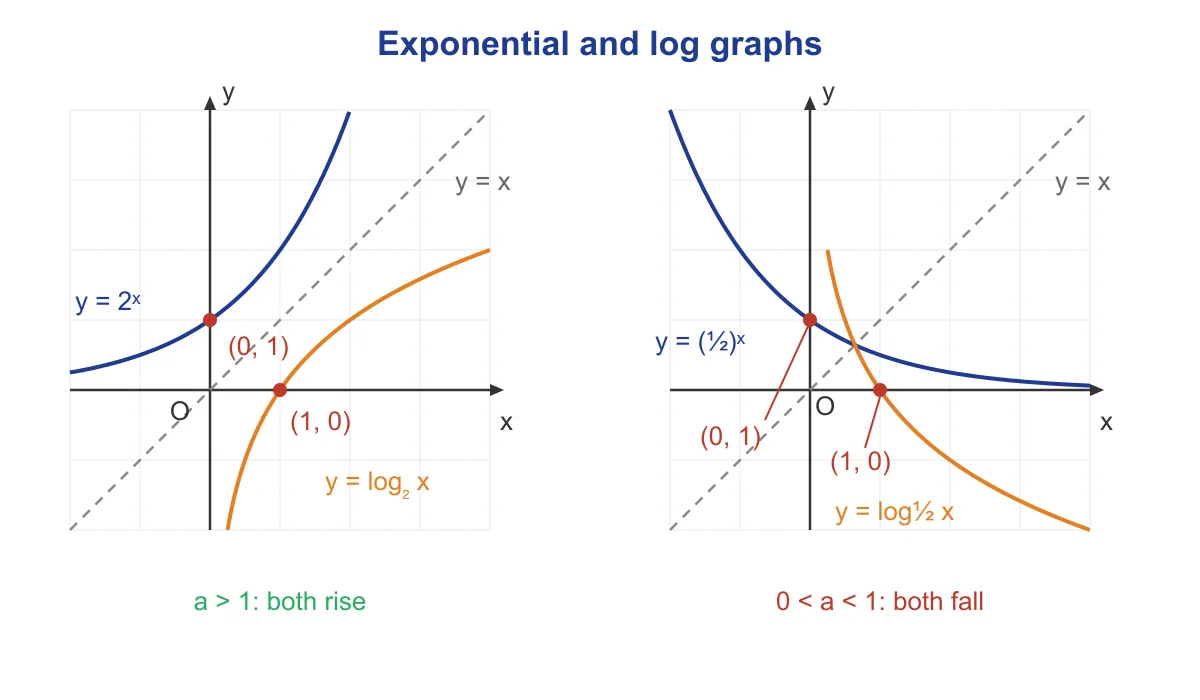
Figure 1.1: Exponential and logarithmic graphs for a greater than 1 (left) and for a between 0 and 1 (right)
Read these facts off the picture and learn them as a set.
| Feature | $y=a^x$ | $y=\log_a x$ |
|---|---|---|
| Domain | all real $x$ | $x>0$ |
| Range | $y>0$ | all real $y$ |
| Fixed point | passes through $(0,1)$ | passes through $(1,0)$ |
| Asymptote | the $x$-axis | the $y$-axis |
| For $a>1$ | increasing | increasing |
| For $0<a<1$ | decreasing | decreasing |
The logarithm graph never touches the $y$-axis, which is the picture behind "the argument must be positive". For $a>1$ the logarithm is negative on $(0,1)$ and positive beyond 1. For $0<a<1$ the signs swap: positive on $(0,1)$, negative beyond 1.
The whole of the inequality work in section 6 rests on one fact from this figure.
- If $a>1$, bigger $x$ gives bigger $\log_a x$, so $\log_a x_1 < \log_a x_2 \iff x_1 < x_2$.
- If $0<a<1$, bigger $x$ gives smaller $\log_a x$, so $\log_a x_1 < \log_a x_2 \iff x_1 > x_2$.
The same holds for exponents: $a^{x_1} < a^{x_2}$ means $x_1<x_2$ when $a>1$ and $x_1>x_2$ when $0<a<1$.
A useful link between the two bases: $\log_{1/a} x = -\log_a x$, so the right-hand curve in the figure is the left-hand curve reflected in the $x$-axis.
5. Solving logarithmic and exponential equations
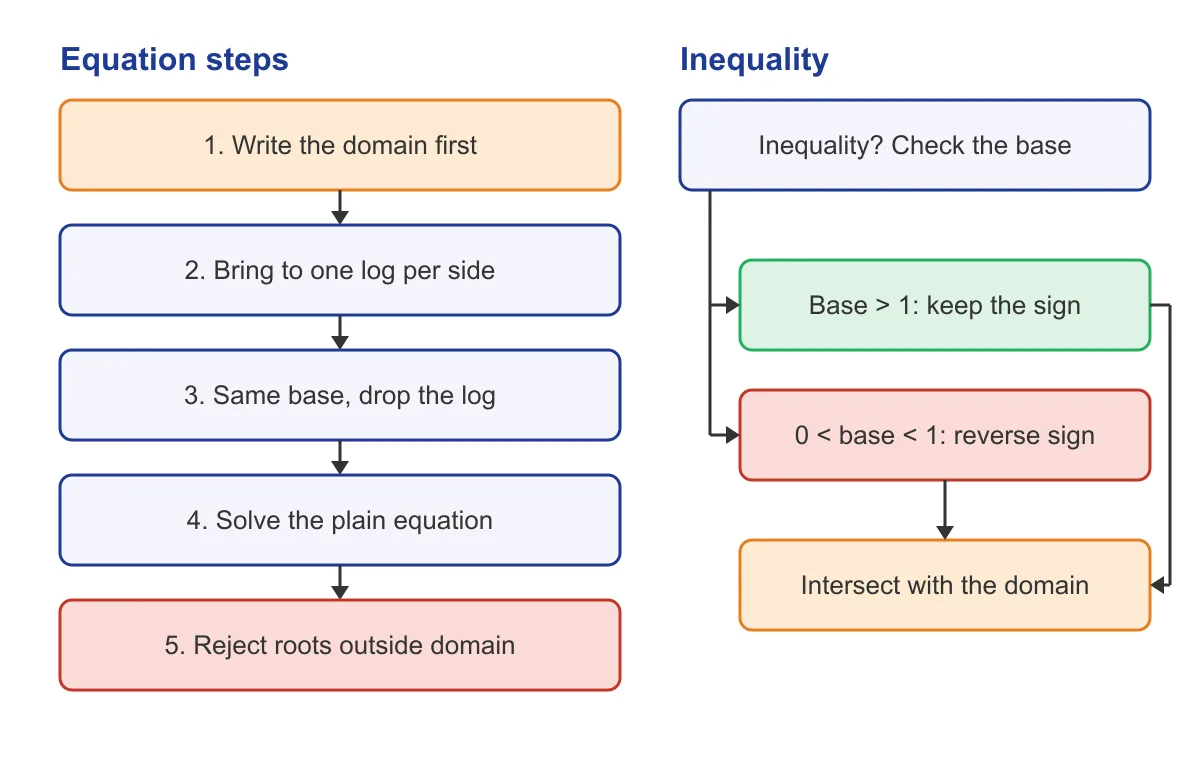
Figure 1.2: The routine for logarithmic equations (left) and inequalities (right)
The order in the left column of Figure 1.2 matters. Write the domain first, because after you have transformed the equation the original restrictions are no longer visible.
Type 1: equal logs. If $\log_a f(x) = \log_a g(x)$ then $f(x) = g(x)$, provided $f(x)>0$ and $g(x)>0$ (the same base on both sides, base valid).
Type 2: log equals a number. $\log_a f(x) = c$ means $f(x) = a^c$. This automatically makes $f(x)>0$, but any other logarithm in the equation still needs its own check.
Type 3: hidden quadratic. Put $t = \log_a x$ (or $t = a^x$) and solve for $t$. For $t = a^x$, only $t>0$ is acceptable.
Type 4: variable in base and exponent. Take $\log_{10}$ of both sides and substitute $t = \log_{10} x$.
Example 3: Solve $\log_2(x+1) + \log_2(x-3) = 5$.
Domain: $x+1>0$ and $x-3>0$, so $x>3$.
Combine: $\log_2[(x+1)(x-3)] = 5$, so $(x+1)(x-3) = 2^5 = 32$.
Expand: $x^2 - 2x - 3 = 32$, so $x^2 - 2x - 35 = 0$, so $(x-7)(x+5) = 0$.
Roots: $x = 7$ or $x = -5$. Only $7$ is greater than 3.
Check: $\log_2 8 + \log_2 4 = 3 + 2 = 5$.
Answer: $x = 7$. The root $-5$ is a product of two negatives; it is exactly the root the combined form let in by accident.
Example 4: Solve $25^x - 6\cdot 5^x + 5 = 0$.
Write $25^x = (5^x)^2$ and put $t = 5^x$, with $t>0$.
Equation: $t^2 - 6t + 5 = 0$, so $(t-1)(t-5) = 0$.
Both $t = 1$ and $t = 5$ are positive.
$5^x = 1$ gives $x = 0$. $5^x = 5$ gives $x = 1$.
Answer: $x = 0$ or $x = 1$. Had a root such as $t=-2$ appeared, it would be rejected because $5^x$ is never negative.
Example 5: Solve $x^{\log_{10} x} = \dfrac{1000}{x^2}$.
Domain: $x>0$.
Take $\log_{10}$ of both sides: $(\log_{10} x)^2 = 3 - 2\log_{10} x$.
Put $t = \log_{10} x$: $t^2 + 2t - 3 = 0$, so $(t+3)(t-1) = 0$.
$t = 1$ gives $x = 10$. $t = -3$ gives $x = \frac{1}{1000}$.
Check $x = 10$: left side $10^1 = 10$, right side $1000/100 = 10$.
Answer: $x = 10$ or $x = 0.001$. Logs turn a power tower into a quadratic.
When the base itself is a variable, add the conditions $x>0$ and $x\ne1$ to the domain before anything else. An equation such as $\log_x(x+6) = 2$ gives $x^2 = x+6$, so $x = 3$ or $x = -2$, and the base condition kills $-2$.
6. Logarithmic inequalities
Because $\log_a$ is monotonic (Figure 1.1), an inequality between two logarithms can be turned into an inequality between their arguments. The direction depends on the base.
| Base | $\log_a f(x) > \log_a g(x)$ becomes | $\log_a f(x) > c$ becomes |
|---|---|---|
| $a>1$ | $f(x) > g(x) > 0$ | $f(x) > a^c$ |
| $0<a<1$ | $0 < f(x) < g(x)$ | $0 < f(x) < a^c$ |
In the second column for $0<a<1$, note that the positivity condition is part of the answer, and it sits on the smaller side. For a base above 1, $f(x)>a^c$ already forces $f(x)>0$ when $a^c>0$, which is always true.
Steps. (1) Write the domain. (2) Decide whether the base is above or below 1. (3) Drop the logarithm, reversing the sign if the base is below 1. (4) Solve and intersect with the domain.
Example 6: Solve $\log_{1/3}(2x-1) \ge -2$.
Domain: $2x - 1 > 0$, so $x > \frac12$.
The base $\frac13$ is below 1, so dropping the log reverses the sign.
$-2 = \log_{1/3}\left(\frac13\right)^{-2} = \log_{1/3} 9$, so the inequality is $\log_{1/3}(2x-1) \ge \log_{1/3} 9$.
Reverse: $2x - 1 \le 9$, so $x \le 5$.
Combine with the domain: $\frac12 < x \le 5$.
Check at $x=5$: $\log_{1/3} 9 = -2$, equality holds. At $x=1$: $\log_{1/3}1 = 0 \ge -2$.
Answer: $\left(\frac12, 5\right]$. The sign flip and the domain together give both ends of the interval.
Memory trick: "Base below one, the slide runs downhill: flip the sign!" Say it every time the base is a fraction.
When the base contains $x$, split into two cases and solve each separately. For $\log_x(x+2) < 2$:
- Case $x>1$: the sign stays, $0 < x+2 < x^2$. This gives $x^2 - x - 2 > 0$, so $x>2$ (or $x<-1$, which fails $x>1$). Result: $x>2$.
- Case $0<x<1$: the sign reverses, $x+2 > x^2 > 0$. This gives $x^2 - x - 2 < 0$, so $-1<x<2$, and with $0<x<1$ we keep $0<x<1$.
The union is $(0,1)\cup(2,\infty)$. The value $x=1$ is excluded because it is not a legal base.
7. Digits of large numbers; characteristic and mantissa
Every positive number can be written $N = m \times 10^k$ with $1 \le m < 10$ and $k$ an integer. Taking $\log_{10}$:
The integer part $k$ is the characteristic. The fractional part $\log_{10} m$ is the mantissa, always in $[0,1)$.
- If $N \ge 1$ and $N$ has $n$ digits, then $10^{n-1} \le N < 10^n$, so the characteristic is $n-1$. Number of digits = characteristic + 1.
- If $0<N<1$ and there are $z$ zeros between the decimal point and the first non-zero digit, the characteristic is $-(z+1)$. For example $0.0372 = 3.72\times10^{-2}$ has characteristic $-2$.
- The mantissa depends only on the sequence of digits, not on the position of the decimal point. So $\log_{10}372$, $\log_{10}3.72$ and $\log_{10}0.0372$ all have the same mantissa.
For negative characteristics, keep the mantissa positive. Write $\log_{10}0.0372 = -2 + 0.5705$, which is $-1.4295$ as an ordinary decimal. Do not call the characteristic $-1$ because the decimal looks like $-1.4$.
| Number | Written as | Characteristic | Mantissa |
|---|---|---|---|
| 4560 | $4.56\times10^{3}$ | 3 | $\log_{10}4.56$ |
| 0.0372 | $3.72\times10^{-2}$ | $-2$ | $\log_{10}3.72$ |
| 5 | $5\times10^{0}$ | 0 | $\log_{10}5$ |
Memory trick: "Digits equal characteristic plus one!" For small decimals, "zeros after the point equal the characteristic's size minus one". Use these two to finish digit-counting problems in a line.
Example 7: How many digits does $7^{25}$ have? Take $\log_{10}7 = 0.8451$.
$\log_{10}7^{25} = 25 \times 0.8451 = 21.1275$.
Characteristic is 21, so the number of digits is $21 + 1 = 22$.
Answer: 22 digits. Never round 21.1275 to 21 and stop; the +1 is part of the rule.
Example 8: With $\log_{10}2 = 0.3010$, find the characteristic and mantissa of $\log_{10}0.0016$.
$0.0016 = 1.6 \times 10^{-3}$.
$\log_{10}1.6 = \log_{10}16 - 1 = 4(0.3010) - 1 = 0.2040$.
So $\log_{10}0.0016 = -3 + 0.2040$.
Answer: characteristic $-3$, mantissa $0.2040$. Two zeros after the point give characteristic $-3$, because the first non-zero digit sits in the third place.
A trick for products of powers: to count digits in $4^{25}\cdot 5^{30}$, rewrite it as $2^{50}\cdot 5^{30} = 2^{20}\cdot 10^{30}$. Then $2^{20} = 1048576$ has 7 digits, and multiplying by $10^{30}$ adds 30 zeros, giving 37 digits. Look for pairs $2\cdot5=10$ before reaching for a table.
Common traps
- Using $\log_a(M+N) = \log_a M + \log_a N$ → there is no law for a sum; only products turn into sums.
- Splitting $\frac{\log_a M}{\log_a N}$ as $\log_a M - \log_a N$ → the quotient of two logarithms is $\log_N M$ (change of base), not a difference.
- Writing $\log_a x^2 = 2\log_a x$ for all $x$ → true only for $x>0$; in general it is $2\log_a\vert x\vert$.
- Keeping every root of the algebraic equation → substitute each root back into the original logarithms and drop any that makes an argument zero or negative.
- Forgetting $a\ne1$ for a variable base → add $x>0$, $x\ne1$ before solving.
- Keeping the inequality sign when the base is between 0 and 1 → reverse it when you drop the logarithm.
- Reversing the sign for a base above 1 → drop the log without reversing for $a>1$, and always intersect with the domain $f(x)>0$.
- Accepting $t = a^x$ with $t\le0$ in an exponential quadratic → reject it, since $a^x>0$ for every real $x$.
- Reading the characteristic of $\log_{10}0.0372 = -1.4295$ as $-1$ → the characteristic is the integer in $-2 + 0.5705$, that is $-2$.
- Giving $\lfloor\log_{10}N\rfloor$ as the digit count → add 1; $\log_{10}2^{50} = 15.05$ means 16 digits.
Quick revision
- $\log_a N = x \iff a^x = N$, with $a>0$, $a\ne1$, $N>0$.
- $\log_a 1 = 0$, $\log_a a = 1$, $a^{\log_a N} = N$.
- $\log_a(MN) = \log_a M + \log_a N$ and $\log_a\frac MN = \log_a M - \log_a N$, for $M,N>0$.
- $\log_a M^k = k\log_a M$; for even powers use $\log_a x^{2k} = 2k\log_a\vert x\vert$.
- $\log_{a^m} M^k = \frac km\log_a M$.
- $\log_a N = \frac{\log_c N}{\log_c a}$ and $\log_a b = \frac{1}{\log_b a}$.
- $\log_p q\cdot\log_q r\cdot\log_r s = \log_p s$.
- $\log_{1/a}x = -\log_a x$; $\ln N \approx 2.303\log_{10}N$.
- $y=a^x$ and $y=\log_a x$ are mirror images in $y=x$; they pass through $(0,1)$ and $(1,0)$.
- For $a>1$ both functions increase; for $0<a<1$ both decrease.
- Solve a logarithmic equation: write the domain, reduce, solve, reject extraneous roots.
- $\log_a f > \log_a g$: for $a>1$ gives $f>g>0$; for $0<a<1$ gives $0<f<g$.
- Exponential quadratic: put $t=a^x$ with $t>0$.
- Digits of $N\ge1$ equal $\lfloor\log_{10}N\rfloor + 1$; mantissa always lies in $[0,1)$.
- For $0<N<1$ with $z$ zeros after the decimal point, the characteristic is $-(z+1)$.
Practice questions
The value of $\log_4 32$ is
- $3$
- $2$
- $\frac{5}{2}$
- $8$
Answer
C. $\frac{5}{2}$
$\log_4 32=\log_{2^2}2^5=\frac52$. Check: $4^{5/2}=2^5=32$.
The domain of $f(x)=\log_{(x-1)}(3-x)$ is
- $(-\infty,3)$
- $(1,3)$
- $(2,3)$
- $(1,2)\cup(2,3)$
Answer
D. $(1,2)\cup(2,3)$
Base: $x-1>0$ and $x-1\ne1$ give $x>1$, $x\ne2$. Argument: $3-x>0$ gives $x<3$. Together $(1,2)\cup(2,3)$.
The value of $\log_3 5\cdot\log_5 81$ is
- $4$
- $5$
- $9$
- $3$
Answer
A. $4$
The base 5 cancels: $\log_3 5\cdot\log_5 81=\log_3 81=4$ since $3^4=81$.
Given $\log_{10}2=0.3010$, the number of digits in $2^{50}$ is
- $14$
- $16$
- $15$
- $17$
Answer
B. $16$
$\log_{10}2^{50}=50\times0.3010=15.05$. Characteristic 15, so digits $=15+1=16$. Check: $2^{50}\approx1.126\times10^{15}$, which has 16 digits.
The solution set of $\log_2 x+\log_2(x-2)=3$ is
- $x=-2$ only
- $x=4$ only
- $x=4$ and $x=-2$
- no solution
Answer
B. $x=4$ only
Domain $x>2$. Then $x(x-2)=8$, so $x^2-2x-8=0$, so $x=4$ or $x=-2$. Only $4$ is in the domain. Check: $\log_2 4+\log_2 2=2+1=3$.
The solution set of $\log_{0.5}(x-1)>1$ is
- $(-\infty,\,1.5)$
- $(1.5,\,\infty)$
- $(1,\,2)$
- $(1,\,1.5)$
Answer
D. $(1,\,1.5)$
Base $0.5<1$ reverses the sign. $1=\log_{0.5}0.5$, so $0<x-1<0.5$, i.e. $1<x<1.5$. Test $x=1.25$: $\log_{0.5}0.25=2>1$.
The value of $2^{\log_4 9}$ is
- $81$
- $\frac{9}{2}$
- $3$
- $9$
Answer
C. $3$
$\log_4 9=\frac12\log_2 9=\log_2 3$, so $2^{\log_2 3}=3$. Check: $4^{\log_4 9}=9$ and $2^{\log_4 9}=\sqrt{9}=3$.
If $\log_a x=3$ and $\log_a y=2$, then $\log_a\left(x^2\sqrt{y}\right)$ equals
- $7$
- $6$
- $5$
- $8$
Answer
A. $7$
$\log_a(x^2\sqrt y)=2\log_a x+\frac12\log_a y=6+1=7$. Check with $a=2$: $x=8$, $y=4$, $x^2\sqrt y=128=2^7$.
For which values of the base $a$ is $\log_a 5<\log_a 3$?
- $0<a<1$
- $a>1$
- $a>0$ and $a\ne1$
- $a<1$
Answer
A. $0<a<1$
$5>3$ but $\log_a 5<\log_a 3$, so the function is decreasing. That is the case $0<a<1$. Test $a=\frac12$: $\log_{1/2}5\approx-2.32<-1.58\approx\log_{1/2}3$.
The characteristic of $\log_{10}0.0372$ is
- $-1$
- $-2$
- $1$
- $2$
Answer
B. $-2$
$0.0372=3.72\times10^{-2}$, so $\log_{10}0.0372=-2+\log_{10}3.72=-2+0.5705$. The characteristic is the integer part when the mantissa is kept positive, so $-2$.
The real solution of $4^x-3\cdot2^x-4=0$ is
- $x=4$
- $x=2$ and $x=-1$
- $x=2$
- $x=-1$
Answer
C. $x=2$
Put $t=2^x>0$: $t^2-3t-4=0$, so $(t-4)(t+1)=0$. Reject $t=-1$. $2^x=4$ gives $x=2$. Check: $16-12-4=0$.
The solution set of $\log_2(x-1)<3$ is
- $(1,\,7)$
- $(-\infty,\,9)$
- $(0,\,9)$
- $(1,\,9)$
Answer
D. $(1,\,9)$
Base 2 keeps the sign: $0<x-1<2^3=8$, so $1<x<9$. The condition $x-1>0$ gives the lower end.
If $\log_2 3=p$, then $\log_{24}54$ equals
- $\frac{1+3p}{3+p}$
- $\frac{1+p}{3+p}$
- $\frac{1+3p}{3p}$
- $\frac{3+p}{1+3p}$
Answer
A. $\frac{1+3p}{3+p}$
$54=2\cdot3^3$ so $\log_2 54=1+3p$. $24=2^3\cdot3$ so $\log_2 24=3+p$. Ratio $\frac{1+3p}{3+p}$. Check $p\approx1.585$: $\frac{5.755}{4.585}\approx1.255=\ln54/\ln24$.
The domain of $f(x)=\log_2\left(\log_{1/2}(x-1)\right)$ is
- $(0,\,2)$
- $(1,\,2)$
- $(1,\,\infty)$
- $(2,\,\infty)$
Answer
B. $(1,\,2)$
Outer log needs $\log_{1/2}(x-1)>0$. Base below 1 reverses: $0<x-1<1$, so $1<x<2$. Test $x=1.5$: $\log_{1/2}0.5=1$, $\log_2 1=0$ defined.
The value of $\log_3 81-\log_2\frac18$ is
- $4$
- $1$
- $7$
- $12$
Answer
C. $7$
$\log_3 81=4$ and $\log_2\frac18=-3$, so $4-(-3)=7$.
The value of $\log_{10}25+\log_{10}4$ is
- $4$
- $29$
- $100$
- $2$
Answer
D. $2$
$\log_{10}(25\times4)=\log_{10}100=2$.
Given $\log_{10}3=0.4771$, the number of digits in $3^{40}$ is
- $40$
- $19$
- $21$
- $20$
Answer
D. $20$
$40\times0.4771=19.084$. Characteristic 19, digits $=19+1=20$.
Given $\log_{10}2=0.3010$, the number of zeros immediately after the decimal point in $\left(\frac12\right)^{20}$ is
- $5$
- $7$
- $6$
- $8$
Answer
C. $6$
$\log_{10}2^{-20}=-6.02=-7+0.98$. Characteristic $-7=-(z+1)$, so $z=6$. Check: $2^{20}=1048576$, and $1/1048576\approx0.000000954$ has 6 zeros.
The sum of all real solutions of $\log_2 x+4\log_x 2=5$ is
- $18$
- $32$
- $17$
- $5$
Answer
A. $18$
Let $t=\log_2 x$: $t+\frac4t=5$, so $t^2-5t+4=0$, $t=1$ or $4$. So $x=2$ or $16$ (both $>0$, $\ne1$). Sum $18$.
The solution of $\log_4(x+3)-\log_4(x-3)=\frac12$ is $x=$
- $3$
- $9$
- $15$
- $5$
Answer
B. $9$
Domain $x>3$. $\log_4\frac{x+3}{x-3}=\frac12$ gives $\frac{x+3}{x-3}=4^{1/2}=2$, so $x+3=2x-6$, $x=9$. Check: $\log_4 12-\log_4 6=\log_4 2=\frac12$.
The sum of all real solutions of $9^x-12\cdot3^x+27=0$ is
- $3$
- $9$
- $2$
- $12$
Answer
A. $3$
With $t=3^x$: $t^2-12t+27=0$, $t=3$ or $9$. So $x=1$ or $2$. Sum $3$. Check $x=2$: $81-108+27=0$.
The product of all real solutions of $x^{\log_{10}x}=1000x^2$ is
- $10$
- $1000$
- $100$
- $3$
Answer
C. $100$
Take $\log_{10}$: $t^2=3+2t$ with $t=\log_{10}x$, so $t=3$ or $-1$. $x=1000$ or $0.1$. Product $100$. Check $x=0.1$: $0.1^{-1}=10$ and $1000(0.01)=10$.
The sum of all integers $x$ satisfying $\log_{1/2}(x^2-5x+6)\ge-1$ is
- $10$
- $5$
- $6$
- $3$
Answer
B. $5$
Base below 1: $0<x^2-5x+6\le2$. First gives $x<2$ or $x>3$. Second gives $x^2-5x+4\le0$, i.e. $1\le x\le4$. Solution $[1,2)\cup(3,4]$. Integers $1$ and $4$, sum $5$. Both give argument $2$ and $\log_{1/2}2=-1$.
The value of $\log_2 3\cdot\log_3 4\cdot\log_4 5\cdot\log_5 8$ is
- $8$
- $2$
- $4$
- $3$
Answer
D. $3$
Inner bases cancel in pairs: the product is $\log_2 8=3$.
The value of $\dfrac{1}{\log_2 30}+\dfrac{1}{\log_3 30}+\dfrac{1}{\log_5 30}$ is
- $10$
- $30$
- $0$
- $1$
Answer
D. $1$
Each term is $\log_{30}$ of its base: $\log_{30}2+\log_{30}3+\log_{30}5=\log_{30}30=1$.
Given $\log_{10}2=0.3010$, the number of digits in $4^{25}\cdot5^{30}$ is
- $37$
- $36$
- $38$
- $50$
Answer
A. $37$
$4^{25}\cdot5^{30}=2^{50}\cdot5^{30}=2^{20}\cdot10^{30}$. $2^{20}=1048576$ has 7 digits, and $10^{30}$ adds 30. Total $37$. By logs: $20(0.3010)+30=36.02$, characteristic 36, digits 37.
Given below are two statements: Statement I: $\log_{10}[(-4)(-25)]=2$. Statement II: $\log_{10}(-4)+\log_{10}(-25)$ is defined and equals $2$.
- Both Statement I and Statement II are correct
- Both Statement I and Statement II are incorrect
- Statement I is correct but Statement II is incorrect
- Statement I is incorrect but Statement II is correct
Answer
C. Statement I is correct but Statement II is incorrect
The product is $100$ and $\log_{10}100=2$, so I is correct. The logarithm of a negative number is undefined, so II is incorrect.
Given below are two statements: Statement I: $\log_2 x^2=2\log_2 x$ for every real $x\ne0$. Statement II: $\log_2 x^2=2\log_2\vert x\vert$ for every real $x\ne0$.
- Both Statement I and Statement II are correct
- Both Statement I and Statement II are incorrect
- Statement I is correct but Statement II is incorrect
- Statement I is incorrect but Statement II is correct
Answer
D. Statement I is incorrect but Statement II is correct
For $x=-2$, $\log_2 4=2$ but $\log_2(-2)$ is undefined, so I is incorrect. For $x\ne0$, $x^2=\vert x\vert^2$ and $\vert x\vert>0$, so II is correct.
Given below are two statements: Statement I: If $0<a<1$ and $\log_a x<\log_a y$ then $x>y$. Statement II: If $0<a<1$ then $\log_a x>0$ whenever $x>1$.
- Both Statement I and Statement II are correct
- Both Statement I and Statement II are incorrect
- Statement I is correct but Statement II is incorrect
- Statement I is incorrect but Statement II is correct
Answer
C. Statement I is correct but Statement II is incorrect
$\log_a$ is decreasing for $0<a<1$, so I is correct. For $0<a<1$ and $x>1$, $\log_a x<0$ (for example $\log_{1/2}8=-3$), so II is incorrect.
Given below are two statements: Statement I: $\log_{10}0.5>0$. Statement II: $\log_{1/2}8=3$.
- Both Statement I and Statement II are correct
- Both Statement I and Statement II are incorrect
- Statement I is correct but Statement II is incorrect
- Statement I is incorrect but Statement II is correct
Answer
B. Both Statement I and Statement II are incorrect
$0.5<1$ with base $10>1$ gives a negative value ($\approx-0.301$), so I is incorrect. $\left(\frac12\right)^{-3}=8$, so $\log_{1/2}8=-3$ and II is incorrect.
Given below are two statements: Statement I: $\log_2 3\cdot\log_3 2=1$. Statement II: $\log_a b\cdot\log_b a=1$ for all $a,b>0$ with $a\ne1$, $b\ne1$.
- Both Statement I and Statement II are correct
- Both Statement I and Statement II are incorrect
- Statement I is correct but Statement II is incorrect
- Statement I is incorrect but Statement II is correct
Answer
A. Both Statement I and Statement II are correct
By change of base $\log_a b=\frac{1}{\log_b a}$, so II is correct, and I is the case $a=2$, $b=3$.
Assertion (A): The equation $\log_3 x+\log_3(x-8)=2$ has exactly one solution. Reason (R): A root of a logarithmic equation is rejected if it makes any argument of a logarithm zero or negative.
- Both A and R are true and R is the correct explanation of A
- Both A and R are true but R is not the correct explanation of A
- A is true but R is false
- A is false but R is true
Answer
A. Both A and R are true and R is the correct explanation of A
Domain $x>8$. $x(x-8)=9$ gives $x^2-8x-9=0$, so $x=9$ or $-1$. Only $9$ is in the domain, so A is true. R is the reason $-1$ is thrown out.
Assertion (A): $\log_2 8>\log_2 5$. Reason (R): The graph of $y=2^x$ passes through the point $(0,1)$.
- Both A and R are true and R is the correct explanation of A
- Both A and R are true but R is not the correct explanation of A
- A is true but R is false
- A is false but R is true
Answer
B. Both A and R are true but R is not the correct explanation of A
$\log_2 8=3>\log_2 5$ since $\log_2$ increases; A is true. R is also true, but it says nothing about comparing two logarithms, so it does not explain A.
Assertion (A): $\log_{10}(-100)=2$. Reason (R): $10^2=100$ and $(-10)^2=100$.
- Both A and R are true and R is the correct explanation of A
- Both A and R are true but R is not the correct explanation of A
- A is true but R is false
- A is false but R is true
Answer
D. A is false but R is true
$\log_{10}$ of a negative number is undefined, so A is false. R is a true arithmetic statement.
Match List I with List II. List I: a. $\log_2 8$ b. $\log_{1/2}8$ c. $\log_8 2$ d. $\log_8\frac12$ List II: i. $-3$ ii. $3$ iii. $\frac13$ iv. $-\frac13$
- a-i, b-ii, c-iv, d-iii
- a-ii, b-i, c-iii, d-iv
- a-ii, b-i, c-iv, d-iii
- a-iii, b-iv, c-ii, d-i
Answer
B. a-ii, b-i, c-iii, d-iv
a: $2^3=8$ gives $3$ (ii). b: $(\frac12)^{-3}=8$ gives $-3$ (i). c: $8^{1/3}=2$ gives $\frac13$ (iii). d: $8^{-1/3}=\frac12$ gives $-\frac13$ (iv).
Match each equation in List I with its number of real solutions in List II. List I: a. $\log_2 x=\log_2(x-1)$ b. $\log_2 x^2=2$ c. $\log_2 x=3$ d. $\log_3 x^2=2\log_3 x$ List II: i. no real solution ii. exactly one iii. exactly two iv. infinitely many
- a-iv, b-iii, c-ii, d-i
- a-i, b-ii, c-iii, d-iv
- a-i, b-iii, c-ii, d-iv
- a-ii, b-iii, c-i, d-iv
Answer
C. a-i, b-iii, c-ii, d-iv
a: $x=x-1$ is impossible, none (i). b: $x^2=4$ gives $x=\pm2$, both valid, two (iii). c: $x=8$, one (ii). d: holds for every $x>0$, infinitely many (iv).
Given $\log_{10}2=0.3010$ and $\log_{10}3=0.4771$, match each number in List I with its number of digits in List II. List I: a. $2^{10}$ b. $3^{20}$ c. $6^{10}$ d. $12^5$ List II: i. $4$ ii. $6$ iii. $8$ iv. $10$
- a-ii, b-iv, c-iii, d-i
- a-i, b-iv, c-ii, d-iii
- a-i, b-iii, c-iv, d-ii
- a-i, b-iv, c-iii, d-ii
Answer
D. a-i, b-iv, c-iii, d-ii
a: $3.01$, so 4 digits. b: $20(0.4771)=9.542$, so 10. c: $10(0.7781)=7.781$, so 8. d: $5(1.0791)=5.3955$, so 6. Check: $12^5=248832$ has 6 digits.
If $\log_{10}2=a$ and $\log_{10}3=b$, then $\log_5 12$ equals
- $\frac{2a+b}{a}$
- $\frac{2a+b}{1-a}$
- $\frac{a+2b}{1-a}$
- $\frac{2a+b}{1+a}$
Answer
B. $\frac{2a+b}{1-a}$
$\log_5 12=\frac{\log_{10}12}{\log_{10}5}$. $\log_{10}12=2a+b$. $\log_{10}5=\log_{10}\frac{10}{2}=1-a$. Check $a=0.301$, $b=0.477$: $\frac{1.079}{0.699}=1.544=\ln12/\ln5$.
A culture has 500 bacteria at time 0 and the count doubles every 3 hours. Taking $\log_{10}2=0.3010$, the smallest whole number of hours after which the count exceeds $10^6$ is
- $32$
- $30$
- $33$
- $36$
Answer
C. $33$
Need $500\cdot2^{t/3}>10^6$, so $2^{t/3}>2000$. $\frac t3>\frac{\log_{10}2000}{\log_{10}2}=\frac{3.3010}{0.3010}\approx10.967$, so $t>32.9$. Check: $t=32$ gives $2^{10.67}\approx1625<2000$; $t=33$ gives $2^{11}=2048>2000$. Answer $33$.
The solution set of $\log_x(x+2)<2$ is
- $(0,1)\cup(2,\infty)$
- $(2,\infty)$
- $(0,2)$
- $(-2,1)\cup(2,\infty)$
Answer
A. $(0,1)\cup(2,\infty)$
Base $x>0$, $x\ne1$. Case $x>1$: $0<x+2<x^2$ gives $x>2$. Case $0<x<1$: sign reverses, $x+2>x^2$ gives $-1<x<2$, so $0<x<1$. Union $(0,1)\cup(2,\infty)$. Test $x=0.5$: $\log_{0.5}2.5<0<2$; $x=1.5$: $\log_{1.5}3.5\approx3.1>2$.