Definite Integral as the Limit of a Sum
What to remember
- A definite integral is the limit of Riemann sums: cut $[a,b]$ into $n$ equal strips of width $h=\frac{b-a}{n}$, add $h\,f(\text{point in each strip})$, and let $n\to\infty$.
- First principles for a continuous $f$ on $[a,b]$: $\int_a^b f(x)\,dx=\lim_{n\to\infty} h\sum_{r=1}^{n} f(a+rh)$. You need the sums of $r$, $r^2$, $r^3$ and of a geometric series.
- To turn a sum into an integral, write each term as $\frac{1}{n}f\!\left(\frac{r}{n}\right)$. Then $\frac{r}{n}\to x$, $\frac{1}{n}\to dx$, and $\Sigma\to\int$.
- The limits come from where $\frac{r}{n}$ starts and ends: lowest value of $\frac{r}{n}$ gives the lower limit, highest value of $\frac{r}{n}$ gives the upper limit. If $r$ runs to $2n$, the upper limit is $2$, not $1$.
- A decreasing positive $f$ traps a sum between two integrals: $\int_{m+1}^{k+1} f\,dx<\sum_{r=m+1}^{k} f(r)<\int_{m}^{k} f\,dx$. Increasing $f$ reverses the two bounds.
1. From strips to a sum
Take a continuous function $f$ with $f(x)\ge 0$ on $[a,b]$. The area under the curve is what we want. We cannot find it directly, so we trap it with rectangles. Divide $[a,b]$ into $n$ strips of equal width
The dividing points are $a,\ a+h,\ a+2h,\ \dots,\ a+nh=b$. On the $r$-th strip, stand a rectangle of height $f(a+rh)$ (the height at the right end of the strip). Its area is $h\,f(a+rh)$. The total of all $n$ rectangles is a Riemann sum:
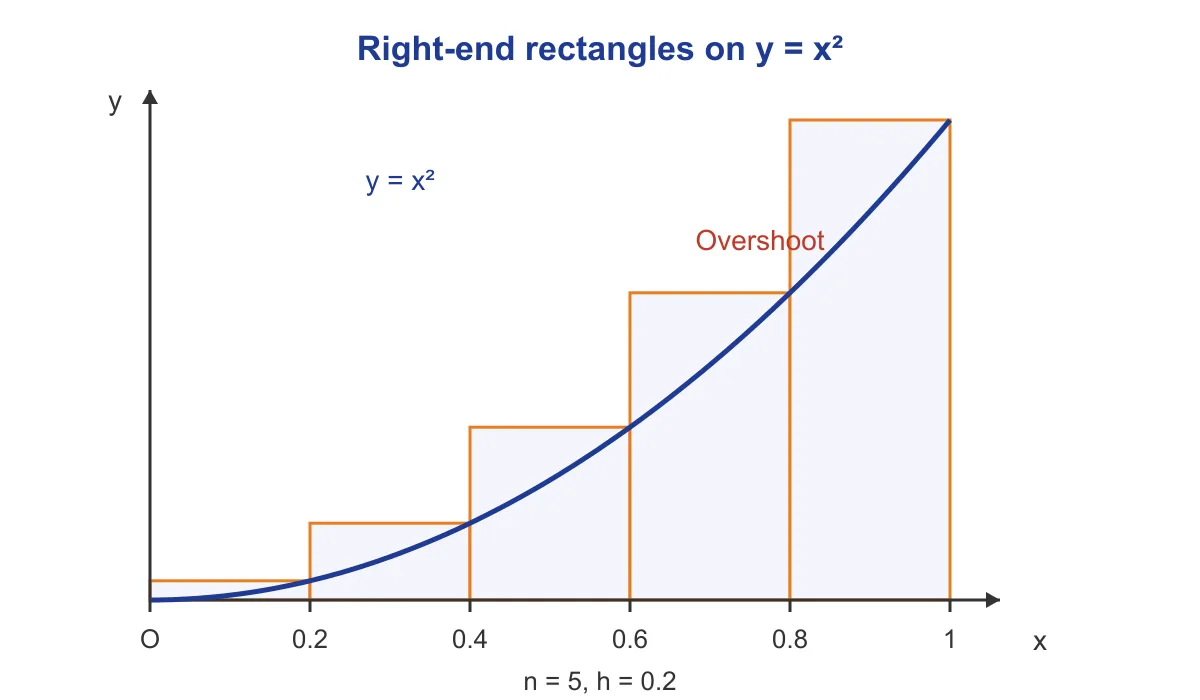
Figure 3.1: Five right-end rectangles on y = x². The overshoot shrinks as n grows.
In the figure the function is increasing, so right-end rectangles overshoot. Left-end rectangles, using height $f(a+(r-1)h)$, would undershoot. As $n$ grows the strips get thin, the gap between the two kinds shrinks to nothing, and both sums approach the same number. That number is the definite integral. For a continuous function this is a theorem, not a hope: it works for every continuous $f$, positive or not (where $f$ is negative the strip counts as negative area).
So the definition we use is
Using the left end instead gives $\sum_{r=0}^{n-1}$, and the limit is identical. The difference between the two sums is only $h\,(f(b)-f(a))$, which goes to $0$.
2. Evaluating from first principles
You need four standard sums. They are all provable by induction, and you should know them cold.
| Sum | Value |
|---|---|
| $\sum_{r=1}^{n} 1$ | $n$ |
| $\sum_{r=1}^{n} r$ | $\frac{n(n+1)}{2}$ |
| $\sum_{r=1}^{n} r^2$ | $\frac{n(n+1)(2n+1)}{6}$ |
| $\sum_{r=1}^{n} r^3$ | $\left[\frac{n(n+1)}{2}\right]^2$ |
| $\sum_{r=1}^{n} a\rho^{\,r-1}$ | $a\,\frac{\rho^{\,n}-1}{\rho-1}$ for $\rho\ne 1$ |
Two limits finish the job. When you divide by powers of $n$, terms like $\frac{1}{n}$ and $\frac{1}{n^2}$ vanish. For exponentials you also need $\lim_{t\to 0}\frac{e^t-1}{t}=1$.
The routine is always the same: find $h$, write $f(a+rh)$, expand, apply the sum formulas, simplify, take the limit.
Example 1: Find $\int_0^3 (2x+1)\,dx$ from first principles.
Here $a=0$, $b=3$, so $h=\frac{3}{n}$ and $f(rh)=2\cdot\frac{3r}{n}+1=\frac{6r}{n}+1$.
$S_n=\frac{3}{n}\sum_{r=1}^{n}\left(\frac{6r}{n}+1\right)=\frac{3}{n}\left[\frac{6}{n}\cdot\frac{n(n+1)}{2}+n\right]$
The bracket is $3(n+1)+n=4n+3$.
$S_n=\frac{3(4n+3)}{n}=12+\frac{9}{n}\to 12$.
Check with the area of a trapezoid: heights $1$ and $7$, width $3$, area $\frac{(1+7)}{2}\cdot 3=12$.
Why it works: the linear part makes one sum of $r$, and the constant makes a sum of ones. The $\frac{9}{n}$ is the overshoot and it dies.
Example 2: Find $\int_1^2 x^2\,dx$ from first principles.
$a=1$, $b=2$, $h=\frac{1}{n}$. $f(1+rh)=\left(1+\frac{r}{n}\right)^2=1+\frac{2r}{n}+\frac{r^2}{n^2}$.
$S_n=\frac{1}{n}\left[n+\frac{2}{n}\cdot\frac{n(n+1)}{2}+\frac{1}{n^2}\cdot\frac{n(n+1)(2n+1)}{6}\right]$
$=1+\frac{n+1}{n}+\frac{(n+1)(2n+1)}{6n^2}$
As $n\to\infty$: $1+1+\frac{2}{6}=\frac{7}{3}$.
Check: $\frac{2^3-1^3}{3}=\frac{7}{3}$.
Why it works: when $a\ne 0$ the point is $a+rh$, not $rh$. Forgetting the $1+$ here would give $\frac{1}{3}$, the integral over $[0,1]$.
Example 3: Find $\int_0^1 e^x\,dx$ from first principles.
$h=\frac{1}{n}$, $f(rh)=e^{r/n}$. The terms $e^{1/n},e^{2/n},\dots,e^{n/n}$ form a geometric series with first term $e^{1/n}$ and ratio $e^{1/n}$.
$\sum_{r=1}^{n}e^{r/n}=e^{1/n}\cdot\frac{e-1}{e^{1/n}-1}$.
$S_n=\frac{1}{n}\cdot e^{1/n}\cdot\frac{e-1}{e^{1/n}-1}=(e-1)\,e^{1/n}\cdot\frac{1/n}{e^{1/n}-1}$.
Put $t=\frac{1}{n}\to 0$: $e^{t}\to 1$ and $\frac{t}{e^t-1}\to 1$. So $S_n\to e-1$.
Why it works: exponentials are the one case where the sum is geometric, so the closed form comes from the ratio, not from $\Sigma r$.
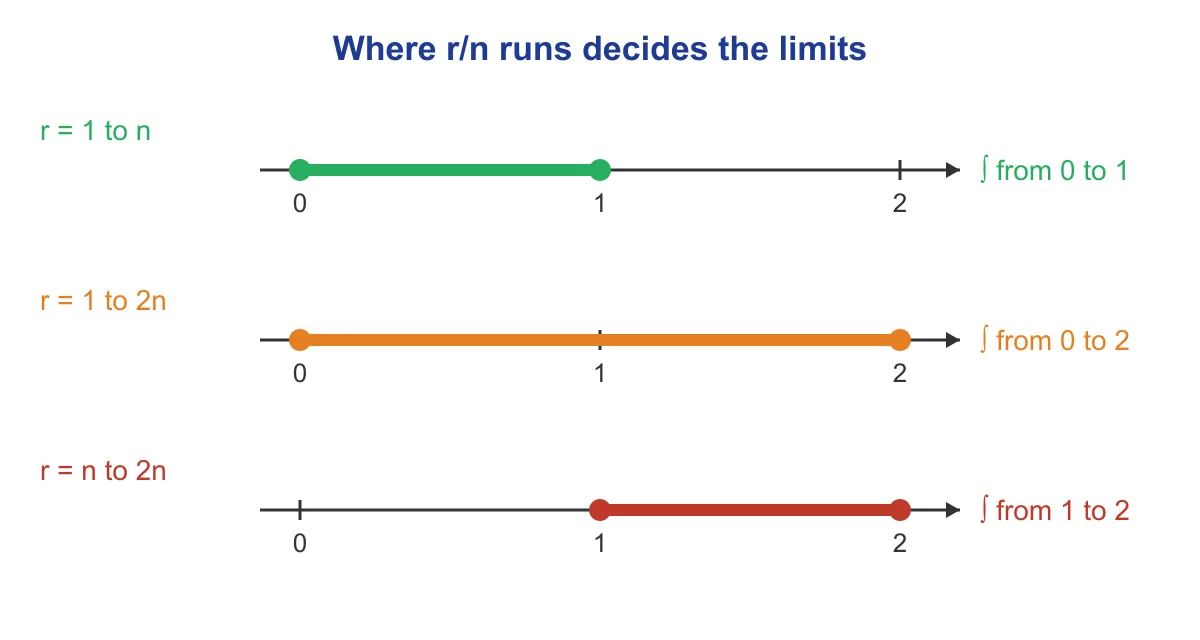
Figure 3.2: The values taken by x = r/n decide the limits of integration.
Why the sum formulas matter, and a shortcut
Look again at Example 2. Every first-principles problem for a polynomial ends the same way: each power of $r$ brings a matching power of $\frac{1}{n}$, and only the leading term of each sum survives. That is why $\sum r\approx\frac{n^2}{2}$, $\sum r^2\approx\frac{n^3}{3}$ and $\sum r^3\approx\frac{n^4}{4}$ are enough for the limit. The lower terms, such as the $n$ in $n(n+1)$, are only there to make the formula exact at finite $n$.
So in a polynomial problem you can keep just the leading term of each sum and still get the right limit. You must still keep every term of $f$, because each one contributes. Use the full formulas when the question asks for the sum at a finite $n$, or when you need to show the steps.
Example 4: Evaluate $\int_0^2(x^2+3x)\,dx$ from first principles.
$h=\frac{2}{n}$, $f(rh)=\frac{4r^2}{n^2}+\frac{6r}{n}$.
$S_n=\frac{2}{n}\left[\frac{4}{n^2}\cdot\frac{n(n+1)(2n+1)}{6}+\frac{6}{n}\cdot\frac{n(n+1)}{2}\right]$
$=\frac{8}{n^3}\cdot\frac{n(n+1)(2n+1)}{6}+\frac{12}{n^2}\cdot\frac{n(n+1)}{2}$
$=\frac{4(n+1)(2n+1)}{3n^2}+\frac{6(n+1)}{n}\to\frac{8}{3}+6=\frac{26}{3}$.
Check: $\frac{2^3}{3}+\frac{3\cdot2^2}{2}=\frac83+6=\frac{26}{3}$.
Why it works: the width $h=\frac2n$ is outside the bracket, so it multiplies both pieces, and each piece gets its own power of $\frac1n$.
3. Reading a limit of a sum as an integral
First principles is slow. The reverse direction is fast: you are handed a sum and asked for its limit. You then recognise the sum as a Riemann sum.
The key idea. Take the standard pattern
This is Section 1 with $a=0$, $b=1$, $h=\frac{1}{n}$. Here $x=\frac{r}{n}$ is the right end of the $r$-th strip of $[0,1]$.
The method has four steps.
- Pull out one factor $\frac{1}{n}$. It will become $dx$.
- Rewrite everything else in terms of $\frac{r}{n}$ only. Divide numerator and denominator by the same power of $n$ until $r$ and $n$ appear only as $\frac{r}{n}$.
- Replace $\frac{r}{n}$ by $x$.
- Find the limits from the lowest and highest value of $\frac{r}{n}$ as $n\to\infty$.
Memory trick: "One over n is dx, r over n is x, sigma is S." Say it aloud, three beats.
Use it as a checklist: if you cannot find a lone $\frac{1}{n}$, you have not finished step 2.
Example 5: Evaluate $\lim_{n\to\infty}\sum_{r=1}^{n}\frac{n}{n^2+r^2}$.
Divide top and bottom by $n^2$: $\frac{n}{n^2+r^2}=\frac{1/n}{1+(r/n)^2}=\frac{1}{n}\cdot\frac{1}{1+(r/n)^2}$.
So the sum is $\frac{1}{n}\sum_{r=1}^{n} f\!\left(\frac{r}{n}\right)$ with $f(x)=\frac{1}{1+x^2}$.
Limits: $\frac{r}{n}$ goes from $\frac{1}{n}\to 0$ to $\frac{n}{n}=1$.
$\int_0^1\frac{dx}{1+x^2}=\tan^{-1}1-\tan^{-1}0=\frac{\pi}{4}$.
Why it works: the denominator $n^2+r^2$ is $n^2$ times $1+(r/n)^2$, which is the shape that gives the inverse tangent.
Sums with a different shape of term are common, so here is a table of conversions you will meet again and again.
| Sum (all with $r=1$ to $n$) | Rewritten | Integral |
|---|---|---|
| $\sum \frac{1}{n+r}$ | $\frac{1}{n}\sum\frac{1}{1+r/n}$ | $\int_0^1\frac{dx}{1+x}=\ln 2$ |
| $\sum \frac{r}{n^2+r^2}$ | $\frac{1}{n}\sum\frac{r/n}{1+(r/n)^2}$ | $\int_0^1\frac{x\,dx}{1+x^2}=\frac{1}{2}\ln 2$ |
| $\sum \frac{1}{\sqrt{n^2+nr}}$ | $\frac{1}{n}\sum\frac{1}{\sqrt{1+r/n}}$ | $\int_0^1(1+x)^{-1/2}dx=2(\sqrt2-1)$ |
| $\frac{1^p+2^p+\dots+n^p}{n^{p+1}}$ | $\frac{1}{n}\sum\left(\frac{r}{n}\right)^p$ | $\int_0^1 x^p\,dx=\frac{1}{p+1}$ |
| $\frac{1}{n}\sum\sin\frac{r\pi}{n}$ | already in form | $\int_0^1\sin\pi x\,dx=\frac{2}{\pi}$ |
Memory trick: "Power sums are one over p plus one."
Whenever you see $\frac{1^p+2^p+\cdots+n^p}{n^{p+1}}$, write $\frac{1}{p+1}$ at once and skip all the work.
4. Choosing the limits: 2n, 3n, r = 0, and other starts
The factor $\frac{1}{n}$ and the variable $x=\frac{r}{n}$ are fixed. Only the range of $r$ changes, and it decides the limits. Look at the first and last value of $r$:
| Range of $r$ | $\frac{r}{n}$ goes from … to … | Limits |
|---|---|---|
| $1$ to $n$ | $\frac{1}{n}\to0$ to $1$ | $0$ to $1$ |
| $0$ to $n-1$ | $0$ to $\frac{n-1}{n}\to1$ | $0$ to $1$ |
| $1$ to $2n$ | $\to0$ to $2$ | $0$ to $2$ |
| $1$ to $3n$ | $\to0$ to $3$ | $0$ to $3$ |
| $n$ to $2n$ | $1$ to $2$ | $1$ to $2$ |
| $n+1$ to $3n$ | $\to1$ to $3$ | $1$ to $3$ |
| $1$ to $\frac{n}{2}$ | $\to0$ to $\frac12$ | $0$ to $\frac12$ |
Starting at $r=0$ or ending at $n-1$ instead of $n$ changes the sum by a single term of size $\frac{1}{n}f(\cdot)$, so it changes nothing in the limit. Ending at $2n$ is a different matter: it adds $n$ more terms, and that is a different integral.
Example 6: Evaluate $\lim_{n\to\infty}\left[\frac{1}{n+1}+\frac{1}{n+2}+\cdots+\frac{1}{3n}\right]$.
The general term is $\frac{1}{n+r}$ with $r$ from $1$ to $2n$ (the last term $3n=n+2n$).
$\frac{1}{n+r}=\frac{1}{n}\cdot\frac{1}{1+r/n}$, so $f(x)=\frac{1}{1+x}$.
Limits: $\frac{r}{n}$ from $0$ to $\frac{2n}{n}=2$.
$\int_0^2\frac{dx}{1+x}=\ln 3-\ln 1=\ln 3$.
Why it works: the last denominator is $3n$, which is $n+2n$. Reading the top value of $r$ off the last denominator, and not off the first, is the whole trick.
Memory trick: "Last r over n is the top."
Before integrating, write the last value of $r$ and divide by $n$. That is your upper limit, every time.
5. When the function is hidden: products and algebra
Some limits are not sums at first sight. A product becomes a sum when you take a logarithm. If $P_n=\prod_{r=1}^{n}a_r$, then $\ln P_n=\sum_{r=1}^{n}\ln a_r$. Find the limit of the sum, then exponentiate. This is legitimate because $e^{x}$ is continuous.
Example 7: Evaluate $\lim_{n\to\infty}\frac{1}{n}\Big[(n+1)(n+2)\cdots(2n)\Big]^{1/n}$.
Each factor $n+r=n\left(1+\frac{r}{n}\right)$, and there are $n$ factors, so the product is $n^n\prod_{r=1}^{n}\left(1+\frac{r}{n}\right)$.
Raising to the power $\frac{1}{n}$ gives $n\cdot\left[\prod\left(1+\frac{r}{n}\right)\right]^{1/n}$. The $\frac{1}{n}$ outside cancels the $n$.
So the limit is $L=\lim\left[\prod_{r=1}^{n}\left(1+\frac{r}{n}\right)\right]^{1/n}$.
$\ln L=\lim\frac{1}{n}\sum_{r=1}^{n}\ln\left(1+\frac{r}{n}\right)=\int_0^1\ln(1+x)\,dx$.
By parts: $\int\ln(1+x)\,dx=(1+x)\ln(1+x)-x$. From $0$ to $1$: $2\ln2-1$.
$L=e^{2\ln 2-1}=\frac{4}{e}$.
Why it works: counting the factors (here $n$ of them) tells you how many $n$'s to pull out. Miscounting by one is harmless in the limit, but miscounting by a whole $n$ shifts the limits.
When the term has $r$ inside a root or a power, divide inside until only $\frac{r}{n}$ remains. If after dividing a stray $n$ is left over, the sum either diverges or tends to $0$, and no integral is involved. For instance $\frac{1}{n^2}\sum_{r=1}^{n} r^2\to\infty$ because the sum is about $\frac{n^3}{3}$.
Example 8: Evaluate $\lim_{n\to\infty}\sum_{r=1}^{n}\frac{r}{n^2+r^2}$ and say how it differs from the sum with $n$ on top.
$\frac{r}{n^2+r^2}=\frac{1}{n}\cdot\frac{r/n}{1+(r/n)^2}$, so $f(x)=\frac{x}{1+x^2}$ on $[0,1]$.
$\int_0^1\frac{x}{1+x^2}dx=\frac{1}{2}\ln(1+x^2)\Big|_0^1=\frac{1}{2}\ln2$.
Why it works: an extra $r$ on top turns $f$ from $\frac{1}{1+x^2}$ into $\frac{x}{1+x^2}$, so the antiderivative changes from an inverse tangent to a logarithm.
6. A quick test for the right answer
Before you trust a limit, test it with a small $n$ and a rough picture. For $\sum_{r=1}^{n}\frac{1}{n+r}$ the value at $n=1$ is $\frac12$, at $n=2$ it is $\frac13+\frac14=0.583$, and the numbers climb towards $0.693=\ln2$. If your answer had come out as $1$ or $\ln 3=1.0986$, the early values would already tell you something is off, because the sum with $n$ terms each at most $\frac{1}{n+1}$ cannot exceed $1$.
Another useful check is the size of the interval. A sum of $n$ terms, each about $\frac{1}{n}f$, is roughly the width of the interval times the average height of $f$. For $\frac{1}{n}\sum_{r=1}^{n}\sqrt{r/n}$ the interval is $[0,1]$ and $\sqrt x$ lies between $0$ and $1$, so the answer must be between $0$ and $1$. The value $\frac23$ passes. A result such as $\frac32$ cannot be right.
Last, watch for divergence. When you divide a term by powers of $n$ and find that more than one $\frac{1}{n}$ is needed to make the sum a Riemann sum, the sum tends to $0$. When one $\frac1n$ is missing, the limit is infinite. A quick sign: $\sum_{r=1}^{n}\frac{r}{n^2}$ has $n$ terms of size up to $\frac1n$ and settles to $\frac12$, while $\sum_{r=1}^{n}\frac{r}{n}$ has $n$ terms of size up to $1$ and grows like $\frac n2$.
7. Bounding sums with integrals
Sometimes the sum has no neat limit, or you only want to know how big it is. The integral then gives bounds.
Let $f$ be positive and decreasing on $[m,k+1]$. On the strip from $r-1$ to $r$ the curve is at least $f(r)$, so $f(r)\le\int_{r-1}^{r}f\,dx$. On the strip from $r$ to $r+1$ the curve is at most $f(r)$, so $f(r)\ge\int_{r}^{r+1}f\,dx$. Adding over $r$:
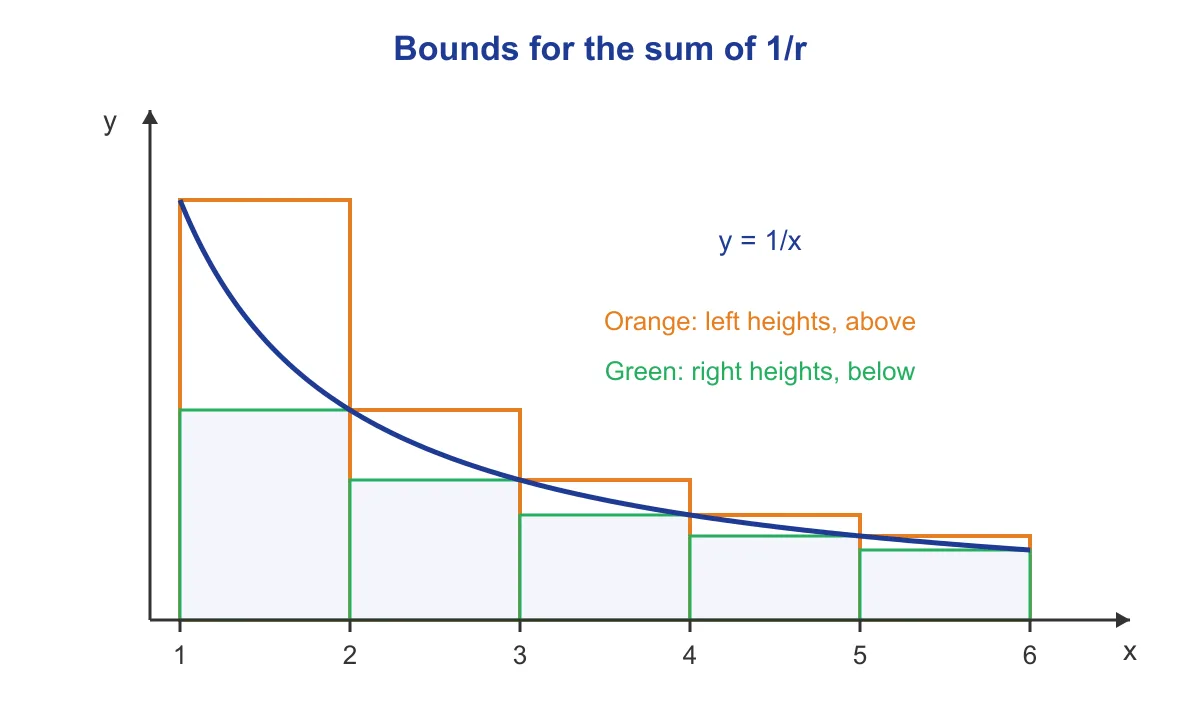
Figure 3.3: For a decreasing function, left-end rectangles overshoot and right-end rectangles undershoot.
For an increasing function the inequalities flip: the sum from $r=m$ to $k$ lies between $\int_{m-1}^{k}f\,dx$ and $\int_{m}^{k+1}f\,dx$.
Example 9: Show that for every $n\ge1$, $\ln(n+1)<1+\frac12+\cdots+\frac1n<1+\ln n$.
$f(x)=\frac1x$ is positive and decreasing. Use the lower bound with $m=1$, $k=n$: $\sum_{r=1}^{n}\frac1r>\int_1^{n+1}\frac{dx}{x}=\ln(n+1)$.
For the upper bound drop the first term, $\sum_{r=2}^{n}\frac1r<\int_1^{n}\frac{dx}{x}=\ln n$, then add the $1$ back.
So $\ln(n+1)<H_n<1+\ln n$, where $H_n$ stands for the sum.
Check with $n=3$: $H_3=1.833$, $\ln4=1.386$, $1+\ln3=2.099$. True.
Why it works: rectangles of width $1$ and height $f(r)$ have area $f(r)$, so a sum is an area, and the curve sits above or below the rectangles.
The same idea pins down the integer part of a long sum. For $\sum_{r=1}^{n}\frac{1}{r^{1/2}}$ the bounds are $2\sqrt{n+1}-2$ and $2\sqrt n-1$, and for a large $n$ these two numbers are often less than one apart.
Example 10: Find the integer part of $T=\sum_{r=1}^{400}\frac{1}{\sqrt r}$.
Lower bound: $T>\int_1^{401}x^{-1/2}dx=2\sqrt{401}-2$. Now $\sqrt{401}=20.025$, so $T>38.05$.
Upper bound: $T<1+\int_1^{400}x^{-1/2}dx=1+(2\cdot20-2)=39$.
So $38.05<T<39$ and the integer part is $38$.
Why it works: the two bounds sit in the same unit interval, which is exactly when the method gives an integer part.
Common traps
- Writing the limits as $0$ to $1$ for every sum → read the last value of $r$ and divide by $n$; if $r$ runs to $2n$ the upper limit is $2$.
- Forgetting the lower limit shift when $r$ starts at $n$ (or $n+1$) → the lower limit is $\frac{n}{n}=1$, not $0$.
- Using $f(rh)$ when $a\ne0$ in first principles → use $f(a+rh)$ with $h=\frac{b-a}{n}$.
- Leaving a factor of $n$ stranded, like $\frac{1}{n^2}\sum r$ treated as $\frac1n\sum f(r/n)$ → check that exactly one $\frac{1}{n}$ stands outside; if a $\frac1n$ is missing, the sum gets multiplied by $n$ and tends to infinity.
- Dropping the width $h$ in the Riemann sum and taking only $\sum f(a+rh)$ → the sum must carry $h$, since $h$ becomes $dx$.
- Believing $\sum_{r=0}^{n-1}$ and $\sum_{r=1}^{n}$ give different limits → they differ by one term of size $\frac1n$ and agree in the limit.
- Replacing $\sum_{r=1}^{n}\frac{1}{n+r}$ by $\int_1^{2}\frac{dx}{x}$ without dividing by $n$ first, or by $\int_0^{1}\frac{dx}{x}$ → divide by $n$ first to get $\frac{1}{n}\cdot\frac{1}{1+r/n}$, so $f(x)=\frac{1}{1+x}$ and the limits are $0$ to $1$.
- Multiplying a product limit without a logarithm → take $\ln$ first, convert the sum, then exponentiate at the end.
- Using $\int_1^n$ for a sum from $r=1$ to $n$ without checking the direction → for decreasing $f$, the left-end rectangles overshoot, so the sum starting at $f(1)$ is above $\int_1^{n+1}$ and below $f(1)+\int_1^n$.
- Using $\sum r^2=\frac{n(n+1)(2n+1)}{6}$ and forgetting the $6$ when simplifying → the leading term is $\frac{n^3}{3}$.
Quick revision
- $\int_a^b f\,dx=\lim_{n\to\infty} h\sum_{r=1}^{n}f(a+rh)$ with $h=\frac{b-a}{n}$.
- The left-end sum ($r=0$ to $n-1$) and right-end sum ($r=1$ to $n$) have the same limit.
- $\sum r=\frac{n(n+1)}{2}$, $\sum r^2=\frac{n(n+1)(2n+1)}{6}$, $\sum r^3=\left[\frac{n(n+1)}{2}\right]^2$.
- Geometric sum: $a\frac{\rho^n-1}{\rho-1}$; with $e^{1/n}$ use $\lim\frac{e^t-1}{t}=1$.
- $\lim\frac1n\sum_{r=1}^{n}f\!\left(\frac rn\right)=\int_0^1f(x)\,dx$.
- Replace $\frac1n\to dx$, $\frac rn\to x$, $\sum\to\int$.
- Limits are $\lim\frac{r_{\text{first}}}{n}$ and $\lim\frac{r_{\text{last}}}{n}$.
- If $r$ goes to $2n$ or $3n$, the integral goes to $2$ or $3$.
- If $r$ starts at $n$ or $n+1$, the lower limit is $1$.
- $\frac{1^p+2^p+\cdots+n^p}{n^{p+1}}\to\frac{1}{p+1}$.
- $\sum_{r=1}^{n}\frac{1}{n+r}\to\ln2$ and $\sum_{r=1}^{n}\frac{n}{n^2+r^2}\to\frac\pi4$.
- For products, take $\ln$, convert to an integral, then exponentiate.
- Decreasing positive $f$: $\int_m^{k+1}f\le\sum_{r=m}^{k}f(r)\le f(m)+\int_m^kf$.
- $\ln(n+1)<1+\frac12+\cdots+\frac1n<1+\ln n$.
Practice questions
Find $\lim_{n\to\infty}\frac{1}{n}\sum_{r=1}^{n}\frac{r}{n}$.
- $\frac{1}{2}$
- $1$
- $\frac{1}{4}$
- $0$
Answer
A. $\frac{1}{2}$
The sum is a Riemann sum of $f(x)=x$ on $[0,1]$, so the limit is $\int_0^1 x\,dx=\frac12$. Check: $\sum r=\frac{n(n+1)}{2}$, so the expression is $\frac{n+1}{2n}\to\frac12$.
Find $\lim_{n\to\infty}\sum_{r=1}^{n}\frac{n}{n^2+r^2}$.
- $1$
- $\frac{\pi}{4}$
- $\frac{\pi}{2}$
- $\ln 2$
Answer
B. $\frac{\pi}{4}$
$\frac{n}{n^2+r^2}=\frac1n\cdot\frac{1}{1+(r/n)^2}$, so the limit is $\int_0^1\frac{dx}{1+x^2}=\tan^{-1}1=\frac{\pi}{4}$.
Find $\lim_{n\to\infty}\frac{1}{n}\sum_{r=0}^{n-1}e^{r/n}$.
- $e+1$
- $e$
- $\frac{e}{2}$
- $e-1$
Answer
D. $e-1$
Left-end sum of $e^x$ on $[0,1]$: the limit is $\int_0^1 e^x\,dx=e-1$. Check: geometric sum gives $\frac1n\cdot\frac{e-1}{e^{1/n}-1}\to e-1$.
Find $\lim_{n\to\infty}\sum_{r=1}^{n}\frac{1}{n+r}$.
- $1$
- $\ln 3$
- $\ln 2$
- $\frac12$
Answer
C. $\ln 2$
$\frac{1}{n+r}=\frac1n\cdot\frac{1}{1+r/n}$, limits $0$ to $1$: $\int_0^1\frac{dx}{1+x}=\ln2$. Check: $n=1$ gives $0.5$, $n=2$ gives $0.583$, rising towards $0.693$.
Find $\lim_{n\to\infty}\sum_{r=1}^{2n}\frac{n}{n^2+r^2}$.
- $\frac{\pi}{4}$
- $\frac{\pi}{2}$
- $\tan^{-1}2$
- $\tan^{-1}\frac12$
Answer
C. $\tan^{-1}2$
The term is $\frac1n\cdot\frac{1}{1+(r/n)^2}$ and $\frac rn$ runs up to $2$. The limit is $\int_0^2\frac{dx}{1+x^2}=\tan^{-1}2$, not the $\frac\pi4$ of the $0$ to $1$ range.
Find $\lim_{n\to\infty}\frac{1}{n}\sum_{r=1}^{n}\sqrt{\frac{r}{n}}$.
- $\frac{2}{3}$
- $\frac32$
- $1$
- $\frac12$
Answer
A. $\frac{2}{3}$
$\int_0^1\sqrt{x}\,dx=\frac{x^{3/2}}{3/2}\Big|_0^1=\frac23$. Also equals $\frac{1}{p+1}$ with $p=\frac12$ would give $\frac23$.
Find $\lim_{n\to\infty}\frac{1^4+2^4+3^4+\cdots+n^4}{n^5}$.
- $1$
- $\frac14$
- $\frac16$
- $\frac15$
Answer
D. $\frac15$
Write it as $\frac1n\sum\left(\frac rn\right)^4\to\int_0^1x^4\,dx=\frac15$.
Find $\lim_{n\to\infty}\frac{1}{n}\left[\sin\frac{\pi}{n}+\sin\frac{2\pi}{n}+\cdots+\sin\frac{(n-1)\pi}{n}\right]$.
- $2$
- $\frac{2}{\pi}$
- $\frac{1}{\pi}$
- $\frac{\pi}{2}$
Answer
B. $\frac{2}{\pi}$
The sum is $\frac1n\sum f\left(\frac rn\right)$ with $f(x)=\sin\pi x$ (the missing $r=n$ term is $0$). Limit $=\int_0^1\sin\pi x\,dx=\frac{-\cos\pi x}{\pi}\Big|_0^1=\frac2\pi$.
Find $\lim_{n\to\infty}\sum_{r=1}^{n}\frac{r}{n^2+r^2}$.
- $\ln 2$
- $\frac14\ln 2$
- $\frac{\pi}{4}$
- $\frac12\ln 2$
Answer
D. $\frac12\ln 2$
$\frac{r}{n^2+r^2}=\frac1n\cdot\frac{r/n}{1+(r/n)^2}$. $\int_0^1\frac{x}{1+x^2}dx=\frac12\ln(1+x^2)\Big|_0^1=\frac12\ln2$.
Find $\lim_{n\to\infty}\sum_{r=1}^{n}\frac{1}{\sqrt{n^2+nr}}$.
- $2(\sqrt2-1)$
- $\sqrt2-1$
- $2(\sqrt2+1)$
- $2\sqrt2$
Answer
A. $2(\sqrt2-1)$
$\frac{1}{\sqrt{n^2+nr}}=\frac1n\cdot\frac{1}{\sqrt{1+r/n}}$. $\int_0^1(1+x)^{-1/2}dx=2\sqrt{1+x}\Big|_0^1=2(\sqrt2-1)$.
Using the limit of $\frac{2}{n}\sum_{r=1}^{n}\left(\frac{2r}{n}\right)^2$ as $n\to\infty$, the value of $\int_0^2x^2\,dx$ is
- $8$
- $\frac43$
- $\frac{8}{3}$
- $\frac{16}{3}$
Answer
C. $\frac{8}{3}$
$\frac{8}{n^3}\sum r^2=\frac{8}{n^3}\cdot\frac{n(n+1)(2n+1)}{6}\to\frac{8\cdot2}{6}=\frac83$. Check: $\frac{2^3}{3}=\frac83$.
Find $\lim_{n\to\infty}\frac{1}{n}\sum_{r=n}^{2n-1}\frac{r}{n}$.
- $2$
- $\frac32$
- $3$
- $\frac12$
Answer
B. $\frac32$
$\frac rn$ runs from $1$ to nearly $2$, so the limit is $\int_1^2x\,dx=\frac{4-1}{2}=\frac32$. Exact: $\frac1{n^2}\sum_{r=n}^{2n-1}r=\frac{1}{n^2}\cdot\frac{n(3n-1)}{2}\to\frac32$.
Which of the following holds for every integer $n\ge1$?
- $1+\frac12+\cdots+\frac1n<\ln(n+1)$
- $1+\frac12+\cdots+\frac1n<\ln n$ for $n\ge2$
- $1+\frac12+\cdots+\frac1n>\ln(n+1)$
- $1+\frac12+\cdots+\frac1n>1+\ln n$
Answer
C. $1+\frac12+\cdots+\frac1n>\ln(n+1)$
For decreasing $\frac1x$, $\sum_{r=1}^{n}\frac1r>\int_1^{n+1}\frac{dx}{x}=\ln(n+1)$. Test $n=2$: $1.5>1.0986$; the other options fail there ($1.5<\ln2$ false, $1.5>1+\ln2=1.69$ false, $1.5<\ln3$ false).
Find $\lim_{n\to\infty}\frac{\pi}{2n}\sum_{r=1}^{n}\cos\frac{r\pi}{2n}$.
- $\frac2\pi$
- $\frac12$
- $\frac{\pi}{2}$
- $1$
Answer
D. $1$
Put $x=\frac{r\pi}{2n}$ with width $\frac{\pi}{2n}$; $x$ runs from $0$ to $\frac\pi2$. The limit is $\int_0^{\pi/2}\cos x\,dx=1$. Check: $\frac{\pi}{2}\cdot\int_0^1\cos\frac{\pi x}{2}dx=\frac\pi2\cdot\frac2\pi=1$.
Find $\lim_{n\to\infty}\frac{6}{n^3}\sum_{r=1}^{n}r^2$.
- $2$
- $1$
- $3$
- $6$
Answer
A. $2$
$\sum r^2=\frac{n(n+1)(2n+1)}{6}$, so the expression is $\frac{(n+1)(2n+1)}{n^2}\to2$. Also $6\int_0^1x^2dx=2$.
Let $h=\frac3n$. Find $\lim_{n\to\infty}h\sum_{r=1}^{n}\left[(rh)^2+1\right]$.
- $9$
- $12$
- $15$
- $10$
Answer
B. $12$
This is $\int_0^3(x^2+1)dx=9+3=12$. Check: $h\sum 1=3$ and $h^3\sum r^2\to\frac{27}{3}=9$.
Find $\lim_{n\to\infty}\frac{4}{n}\sum_{r=1}^{n}\left(1+\frac{2r}{n}\right)$.
- $12$
- $8$
- $6$
- $4$
Answer
B. $8$
$4\int_0^1(1+2x)dx=4[x+x^2]_0^1=8$. Check: $\frac4n\left[n+\frac{n+1}{1}\right]=4+\frac{4(n+1)}{n}\to8$.
Find $\lim_{n\to\infty}\frac{1}{n^2}\sum_{r=1}^{3n}r$.
- $4.5$
- $6$
- $9$
- $3$
Answer
A. $4.5$
$\sum_{r=1}^{3n}r=\frac{3n(3n+1)}{2}$; dividing by $n^2$ gives $\to\frac92$. As an integral: $\int_0^3x\,dx=\frac92$.
Find $\lim_{n\to\infty}\frac{12}{n^4}\sum_{r=1}^{n}r^3$.
- $12$
- $1$
- $3$
- $4$
Answer
C. $3$
$\sum r^3\approx\frac{n^4}{4}$, so the limit is $\frac{12}{4}=3$. Also $12\int_0^1x^3dx=3$.
Find $\lim_{n\to\infty}\frac{1}{n^2}\sum_{r=n+1}^{3n}r$.
- $4.5$
- $5$
- $2$
- $4$
Answer
D. $4$
$\frac rn$ runs from $1$ to $3$: $\int_1^3x\,dx=\frac{9-1}{2}=4$. Check: $\frac92-\frac12=4$ (sum to $3n$ minus sum to $n$).
Find $\lim_{n\to\infty}\sum_{r=1}^{n}\frac{n^2}{(n+r)^3}$.
- $0.375$
- $0.125$
- $0.75$
- $0.25$
Answer
A. $0.375$
$\frac{n^2}{(n+r)^3}=\frac1n\cdot\frac{1}{(1+r/n)^3}$. $\int_0^1(1+x)^{-3}dx=\frac12\left(1-\frac14\right)=\frac38=0.375$.
Find $\lim_{n\to\infty}\frac{1}{n}\sum_{r=0}^{n}5\left(\frac{r}{n}\right)^4$.
- $0.2$
- $4$
- $1$
- $5$
Answer
C. $1$
The extra terms at the ends change the sum by $O(\frac1n)$. Limit $=5\int_0^1x^4dx=5\cdot\frac15=1$.
Find $\lim_{n\to\infty}\frac{9}{n\sqrt n}\left(\sqrt1+\sqrt2+\cdots+\sqrt n\right)$.
- $4.5$
- $6$
- $3$
- $9$
Answer
B. $6$
$\frac{1}{n\sqrt n}\sum\sqrt r=\frac1n\sum\sqrt{r/n}\to\frac23$. Multiply by $9$: $6$.
Using integral bounds on $\sum_{r=1}^{10000}\frac{1}{\sqrt r}$, which lies between $2\sqrt{10001}-2$ and $2\cdot100-1$, find the integer part of the sum.
- $199$
- $197$
- $200$
- $198$
Answer
D. $198$
$2\sqrt{10001}-2\approx198.01$ and the upper bound is $199$ (strict). So the sum is in $(198.01,\,199)$ and its integer part is $198$.
Using $h=\frac3n$ and $f(x)=3x-2$, find $\lim_{n\to\infty}h\sum_{r=1}^{n}f(1+rh)$.
- $15$
- $16.5$
- $22.5$
- $13.5$
Answer
B. $16.5$
This is $\int_1^4(3x-2)dx=\left[\frac{3x^2}{2}-2x\right]_1^4=(24-8)-(1.5-2)=16.5$. Check: $f(1+rh)=1+3rh$, so $h\cdot n+3h^2\sum r\to3+\frac{27}{2}=16.5$.
If $\lim_{n\to\infty}\frac{1}{n}\sum_{r=1}^{n}\left(\frac{r}{n}\right)^{a}=\frac16$ for a positive integer $a$, find $a$.
- $5$
- $6$
- $7$
- $4$
Answer
A. $5$
The limit is $\int_0^1x^a\,dx=\frac{1}{a+1}$. Setting $\frac{1}{a+1}=\frac16$ gives $a=5$.
Given below are two statements: Statement I: For a continuous $f$, $\lim_{n\to\infty}\frac1n\sum_{r=1}^{2n}f\left(\frac rn\right)=\int_0^1f(x)\,dx$. Statement II: For a continuous $f$, $\lim_{n\to\infty}\frac1n\sum_{r=1}^{n}f\left(\frac rn\right)=\int_0^1f(x)\,dx$.
- Both Statement I and Statement II are correct
- Both Statement I and Statement II are incorrect
- Statement I is correct but Statement II is incorrect
- Statement I is incorrect but Statement II is correct
Answer
D. Statement I is incorrect but Statement II is correct
Statement II is the standard form. In Statement I, $\frac rn$ runs to $2$, so the integral is over $[0,2]$. Statement I is wrong.
Given below are two statements: Statement I: For a continuous $f$ on $[0,1]$, the left-end and right-end Riemann sums with $n$ strips have the same limit as $n\to\infty$. Statement II: For $f(x)=x$ on $[0,1]$ with $n=4$, the left-end sum equals the right-end sum.
- Both Statement I and Statement II are correct
- Both Statement I and Statement II are incorrect
- Statement I is correct but Statement II is incorrect
- Statement I is incorrect but Statement II is correct
Answer
C. Statement I is correct but Statement II is incorrect
Statement I is true (they differ by $\frac{f(1)-f(0)}{n}$). For $f(x)=x$, $n=4$: left sum $=\frac14\left(0+\frac14+\frac12+\frac34\right)=\frac38$ and right sum $=\frac58$, so Statement II is false.
Given below are two statements: Statement I: $\lim_{n\to\infty}\frac1n\sum_{r=1}^{n}\frac rn=\frac12$. Statement II: $\lim_{n\to\infty}\frac1n\sum_{r=1}^{n}\left(\frac rn\right)^2=\frac13$.
- Both Statement I and Statement II are correct
- Both Statement I and Statement II are incorrect
- Statement I is correct but Statement II is incorrect
- Statement I is incorrect but Statement II is correct
Answer
A. Both Statement I and Statement II are correct
Statement I: $\int_0^1x\,dx=\frac12$. Statement II: $\int_0^1x^2dx=\frac13$. Both are correct.
Given below are two statements: Statement I: $\lim_{n\to\infty}\sum_{r=1}^{n}\frac{1}{n+r}=1$. Statement II: $\lim_{n\to\infty}\frac1n\sum_{r=0}^{n-1}e^{r/n}=e$.
- Both Statement I and Statement II are correct
- Both Statement I and Statement II are incorrect
- Statement I is correct but Statement II is incorrect
- Statement I is incorrect but Statement II is correct
Answer
B. Both Statement I and Statement II are incorrect
Statement I: the limit is $\int_0^1\frac{dx}{1+x}=\ln2$, not $1$. Statement II: the limit is $\int_0^1e^xdx=e-1$, not $e$. Both are incorrect.
Given below are two statements: Statement I: $\lim_{n\to\infty}\sum_{r=1}^{3n}\frac{1}{n+r}=\ln3$. Statement II: $\lim_{n\to\infty}\sum_{r=1}^{2n}\frac{1}{n+r}=\ln3$.
- Both Statement I and Statement II are correct
- Both Statement I and Statement II are incorrect
- Statement I is correct but Statement II is incorrect
- Statement I is incorrect but Statement II is correct
Answer
D. Statement I is incorrect but Statement II is correct
With $r$ up to $3n$, $\frac rn$ runs to $3$: $\int_0^3\frac{dx}{1+x}=\ln4$, so Statement I is false. With $r$ up to $2n$: $\int_0^2\frac{dx}{1+x}=\ln3$, so Statement II is true.
Assertion (A): $\lim_{n\to\infty}\frac1n\sum_{r=1}^{n}f\left(\frac rn\right)=\int_0^1f(x)\,dx$ for a continuous $f$. Reason (R): The sum is a Riemann sum of $f$ on $[0,1]$ with $n$ equal strips of width $\frac1n$, and such sums tend to the definite integral.
- Both A and R are true and R is the correct explanation of A
- Both A and R are true but R is not the correct explanation of A
- A is true but R is false
- A is false but R is true
Answer
A. Both A and R are true and R is the correct explanation of A
Both true, and R is exactly why A holds.
Assertion (A): $\lim_{n\to\infty}\frac1n\sum_{r=1}^{n}\ln\left(1+\frac rn\right)=2\ln2-1$. Reason (R): For a continuous $f$, the limits of $\frac1n\sum_{r=0}^{n-1}f\left(\frac rn\right)$ and $\frac1n\sum_{r=1}^{n}f\left(\frac rn\right)$ are different.
- Both A and R are true and R is the correct explanation of A
- Both A and R are true but R is not the correct explanation of A
- A is true but R is false
- A is false but R is true
Answer
C. A is true but R is false
A: $\int_0^1\ln(1+x)dx=[(1+x)\ln(1+x)-x]_0^1=2\ln2-1$, true. R: the two sums differ by $\frac{f(1)-f(0)}{n}\to0$, so their limits agree and R is false.
Assertion (A): $\lim_{n\to\infty}\frac1n\sum_{r=1}^{2n}\frac rn=\frac12$. Reason (R): In $\frac1n\sum_{r=1}^{2n}f\left(\frac rn\right)$, the variable $\frac rn$ runs from $0$ to $2$, so the integral is over $[0,2]$.
- Both A and R are true and R is the correct explanation of A
- Both A and R are true but R is not the correct explanation of A
- A is true but R is false
- A is false but R is true
Answer
D. A is false but R is true
R is true. By R, A equals $\int_0^2x\,dx=2$, not $\frac12$, so A is false.
Match List I with List II. List I: a. $\lim_{n\to\infty}\frac1n\sum_{r=1}^{n}\frac rn$ b. $\lim_{n\to\infty}\sum_{r=1}^{n}\frac{n}{n^2+r^2}$ c. $\lim_{n\to\infty}\sum_{r=1}^{n}\frac{1}{n+r}$ d. $\lim_{n\to\infty}\frac1n\sum_{r=1}^{n}\left(\frac rn\right)^2$ List II: i. $\frac13$ ii. $\frac12$ iii. $\frac\pi4$ iv. $\ln2$
- a-ii, b-iv, c-iii, d-i
- a-iii, b-ii, c-i, d-iv
- a-i, b-iii, c-iv, d-ii
- a-ii, b-iii, c-iv, d-i
Answer
D. a-ii, b-iii, c-iv, d-i
a: $\int_0^1x\,dx=\frac12$ (ii). b: $\int_0^1\frac{dx}{1+x^2}=\frac\pi4$ (iii). c: $\int_0^1\frac{dx}{1+x}=\ln2$ (iv). d: $\int_0^1x^2dx=\frac13$ (i).
Match List I with List II. List I: a. $\lim_{n\to\infty}\frac1{n^2}\sum_{r=1}^{n}r$ b. $\lim_{n\to\infty}\frac1{n^2}\sum_{r=n+1}^{2n}r$ c. $\lim_{n\to\infty}\frac1{n^2}\sum_{r=1}^{2n}r$ d. $\lim_{n\to\infty}\frac1{n^2}\sum_{r=1}^{3n}r$ List II: i. $2$ ii. $\frac92$ iii. $\frac12$ iv. $\frac32$
- a-iii, b-iv, c-ii, d-i
- a-iii, b-iv, c-i, d-ii
- a-iv, b-iii, c-i, d-ii
- a-i, b-ii, c-iii, d-iv
Answer
B. a-iii, b-iv, c-i, d-ii
a: $\int_0^1x\,dx=\frac12$ (iii). b: $\int_1^2x\,dx=\frac32$ (iv). c: $\int_0^2x\,dx=2$ (i). d: $\int_0^3x\,dx=\frac92$ (ii).
Match List I with List II. List I: a. $\lim_{n\to\infty}\sum_{r=1}^{n}\frac1{n+r}$ b. $\lim_{n\to\infty}\sum_{r=1}^{n}\frac{r}{n^2+r^2}$ c. $\lim_{n\to\infty}\sum_{r=1}^{2n}\frac1{n+r}$ d. $\lim_{n\to\infty}\sum_{r=1}^{n}\frac{n}{n^2+r^2}$ List II: i. $\int_0^1\frac{dx}{1+x}$ ii. $\int_0^2\frac{dx}{1+x}$ iii. $\int_0^1\frac{x\,dx}{1+x^2}$ iv. $\int_0^1\frac{dx}{1+x^2}$
- a-iii, b-i, c-iv, d-ii
- a-i, b-iv, c-ii, d-iii
- a-i, b-iii, c-ii, d-iv
- a-ii, b-iii, c-i, d-iv
Answer
C. a-i, b-iii, c-ii, d-iv
a: $\frac1n\cdot\frac{1}{1+r/n}$, $0$ to $1$ (i). b: $\frac1n\cdot\frac{r/n}{1+(r/n)^2}$ (iii). c: same as a but $\frac rn$ to $2$ (ii). d: $\frac1n\cdot\frac1{1+(r/n)^2}$ (iv).
Evaluate $\lim_{n\to\infty}\frac{1}{n^2}\Big[(n+1)(n+2)\cdots(3n)\Big]^{1/n}$.
- $\frac{9}{e^2}$
- $\frac{27}{e^2}$
- $\frac{27}{e}$
- $\frac{3}{e^2}$
Answer
B. $\frac{27}{e^2}$
The product has $2n$ factors $n\left(1+\frac rn\right)$, $r=1$ to $2n$, so the expression is $\left[\prod\left(1+\frac rn\right)\right]^{1/n}$ (the $n^{2n}$ cancels $n^2$ after the power $\frac1n$). $\ln L=\int_0^2\ln(1+x)dx=[(1+x)\ln(1+x)-x]_0^2=3\ln3-2$. $L=\frac{27}{e^2}$.
Evaluate $\lim_{n\to\infty}\prod_{r=1}^{n}\left(1+\frac{r^2}{n^2}\right)^{1/n}$.
- $2e^{2-\pi/2}$
- $2e^{\pi/2}$
- $e^{\pi/2-2}$
- $2e^{\pi/2-2}$
Answer
D. $2e^{\pi/2-2}$
$\ln L=\int_0^1\ln(1+x^2)dx$. By parts: $x\ln(1+x^2)-\int\frac{2x^2}{1+x^2}dx=x\ln(1+x^2)-2x+2\tan^{-1}x$. From $0$ to $1$: $\ln2-2+\frac\pi2$. So $L=2e^{\pi/2-2}$.
Evaluate $\lim_{n\to\infty}\sum_{r=1}^{n}\frac{r^2}{r^3+n^3}$.
- $\frac{\ln2}{3}$
- $\ln2$
- $\frac{\ln3}{3}$
- $\frac{\ln2}{2}$
Answer
A. $\frac{\ln2}{3}$
$\frac{r^2}{r^3+n^3}=\frac1n\cdot\frac{(r/n)^2}{1+(r/n)^3}$. $\int_0^1\frac{x^2}{1+x^3}dx=\frac13\ln(1+x^3)\Big|_0^1=\frac{\ln2}{3}$.