Families of Lines and Circles, and Locus Problems
What to remember
- A locus is the path of a point that obeys a rule. Call the moving point $(h, k)$, turn the rule into an equation in $h$ and $k$, remove any extra parameter, then write $x, y$ in place of $h, k$.
- Every line $L_1 + \lambda L_2 = 0$ passes through the meeting point of $L_1 = 0$ and $L_2 = 0$. One extra condition fixes $\lambda$.
- For circles $S_1 = 0$ and $S_2 = 0$ (both written with $x^2 + y^2$ having coefficient 1), $S_1 + \lambda S_2 = 0$ is a circle through their common points for every $\lambda \ne -1$. For a circle and a line, $S + \lambda L = 0$ does the same job.
- The radical axis of two circles is $S_1 - S_2 = 0$. It is a straight line perpendicular to the line of centres. When the circles cut in two points, it is their common chord.
- Every point of the radical axis has equal tangent lengths to the two circles.
Finding a locus: the method
A locus problem gives you a rule in words: "a point moves so that its distance from $A$ is twice its distance from $B$", or "the midpoint of a chord that passes through a fixed point". You turn the words into algebra in four steps.
- Name the moving point $P(h, k)$. Do not use $x, y$ yet; that avoids confusing the point with the fixed objects.
- Write the rule as an equation. Distances, slopes, midpoints, section formulas and perpendicularity cover almost every case.
- If the rule brings in a second moving quantity (a slope $m$, an angle $\theta$, a point on a given curve), that is a parameter. Remove it between the equations you have.
- Replace $h, k$ by $x, y$. State what curve it is.
Two habits save marks. First, check for points that the algebra includes but the geometry forbids (a chord of zero length, a vertical line when you divided by a slope). Second, when the parameter is an angle, aim for $\cos^2\theta + \sin^2\theta = 1$; when it is a slope, aim to solve for $m$ from one equation and put it in the other.
Memory trick: "Name it, say it, squeeze it, rename it." Name $P(h,k)$, say the rule in algebra, squeeze out the parameter, rename to $x, y$. Say it before you start any locus problem.
Distance rules
If $A$ and $B$ are fixed and $P$ moves with $PA = k \cdot PB$, the result depends on $k$.
| Rule | Locus |
|---|---|
| $PA = PB$ | perpendicular bisector of $AB$ (a line) |
| $PA = k \cdot PB$, $k \ne 1$, $k > 0$ | a circle (it separates $A$ from $B$) |
| $PA^2 + PB^2 = c$ constant | a circle centred at the midpoint of $AB$ (if $c$ is large enough) |
| $PA^2 - PB^2 = c$ constant | a straight line perpendicular to $AB$ |
The last row is worth remembering: the $x^2 + y^2$ terms cancel, so no circle can appear.
Example 1: Find the locus of a point $P$ such that $PA = 2\,PB$, where $A = (0,0)$ and $B = (9,0)$.
Let $P = (h,k)$. Then $PA^2 = 4\,PB^2$.
$h^2 + k^2 = 4\left[(h-9)^2 + k^2\right]$
$h^2 + k^2 = 4h^2 - 72h + 324 + 4k^2$
$0 = 3h^2 + 3k^2 - 72h + 324$, so $h^2 + k^2 - 24h + 108 = 0$.
Locus: $x^2 + y^2 - 24x + 108 = 0$. Complete the square: $(x-12)^2 + y^2 = 144 - 108 = 36$.
So it is a circle with centre $(12, 0)$ and radius $6$.
Why this works: squaring the ratio removes the roots, and equal coefficients of $h^2$ and $k^2$ after expanding tell you a circle is coming. Check: the point $(6,0)$ has $PA = 6$, $PB = 3$, so it lies on the locus, and $(6-12)^2 = 36$ agrees.
Midpoints, feet of perpendiculars, dividing points
These three families come up again and again. In each one the moving point is built from a parameter point that sits on a known curve.
Midpoint of a chord. Take a circle $x^2 + y^2 = r^2$ with centre $O$. If $M$ is the midpoint of a chord, then $OM$ is perpendicular to the chord. So if the chord passes through a fixed point $A$ and $M = (h,k)$, then $OM \perp AM$, which gives $h(h - a) + k(k - b) = 0$ for $A = (a,b)$. The locus is a circle on $OA$ as diameter.
For a parabola or any other curve, use the other route: put two end-points $(x_1,y_1)$, $(x_2,y_2)$ on the curve, write the midpoint, and eliminate.
Example 2: A chord of $x^2 + y^2 = 16$ is drawn from the fixed point $A(4,0)$ on the circle to a variable point $Q$ on it. Find the locus of the midpoint of $AQ$.
Take $Q = (4\cos\theta, 4\sin\theta)$. The midpoint is
$h = \dfrac{4 + 4\cos\theta}{2} = 2 + 2\cos\theta$, $\quad k = \dfrac{4\sin\theta}{2} = 2\sin\theta$.
So $h - 2 = 2\cos\theta$ and $k = 2\sin\theta$.
Square and add: $(h-2)^2 + k^2 = 4$.
Locus: $(x-2)^2 + y^2 = 4$, a circle with centre $(2,0)$ and radius $2$.
Why this works: the midpoint of $A$ and a point on a circle of radius 4 moves on a circle half as big, centred at the midpoint of $A$ and the centre $O$. The perpendicular method gives $h(h-4) + k^2 = 0$, which is the same circle.
Foot of a perpendicular. If the foot $F = (h,k)$ is dropped from a fixed point $A$ onto a line, then $AF \perp$ the line, and $F$ lies on the line. Those two facts are two equations; the line's parameter (usually its slope) goes out between them.
Example 3: Lines pass through $A(1,0)$ with variable slope $m$. Find the locus of the foot of the perpendicular from the origin to such a line.
The line is $y = m(x-1)$. Let the foot be $F(h,k)$.
$F$ is on the line: $k = m(h-1)$. ... (1)
$OF \perp$ line: slope of $OF$ is $k/h$, so $\dfrac{k}{h}\cdot m = -1$, giving $m = -\dfrac{h}{k}$. ... (2)
Put (2) in (1): $k = -\dfrac{h}{k}(h-1)$, so $k^2 = -h^2 + h$.
Locus: $x^2 + y^2 - x = 0$.
It is a circle on $OA$ as diameter. Why this works: $\angle OFA = 90^\circ$ for every position of $F$, and a point that sees a segment at a right angle lies on the circle with that segment as diameter. Treat $m = \infty$ (the line $x = 1$, foot $(1,0)$) and $m = 0$ (foot $(0,0)$) as points already on the circle.
A point dividing a chord. If $P$ divides $AQ$ in the ratio $p : q$ (from $A$), then $P = \dfrac{q\,A + p\,Q}{p+q}$. When $Q$ runs on a curve, $P$ runs on a scaled copy of that curve.
Example 4: $A = (6,0)$ and $Q$ moves on $x^2 + y^2 = 9$. The point $P$ divides $AQ$ internally so that $AP : PQ = 1 : 2$. Find the locus of $P$.
$P = \dfrac{2A + 1\cdot Q}{3}$. With $Q = (3\cos\theta, 3\sin\theta)$:
$h = \dfrac{12 + 3\cos\theta}{3} = 4 + \cos\theta$, $\quad k = \sin\theta$.
$(h-4)^2 + k^2 = 1$.
Locus: $(x-4)^2 + y^2 = 1$.
Notice which point gets the larger weight: the point nearer $P$ gets the weight of the other part, so $A$ gets 2 and $Q$ gets 1 here. Reversing the ratio would put the centre at $(2,0)$ instead.
Family of lines through the meeting point of two lines
Take two lines $L_1 = a_1x + b_1y + c_1 = 0$ and $L_2 = a_2x + b_2y + c_2 = 0$ that meet at $P$. Then
is a line for each real $\lambda$ (it is linear in $x$ and $y$), and it passes through $P$, because at $P$ both $L_1$ and $L_2$ are zero. Conversely, every line through $P$ other than $L_2$ is of this form. $L_2$ itself needs $\lambda \to \infty$; if you must include it, write $\mu L_1 + \lambda L_2 = 0$.
The method never needs the coordinates of $P$, which is why it is quick. Choose $\lambda$ using one extra condition on the line:
| Extra condition | What to do |
|---|---|
| passes through $(x_0, y_0)$ | substitute $(x_0, y_0)$; solve for $\lambda$ |
| parallel to the $x$-axis | put the coefficient of $x$ equal to 0 |
| parallel to the $y$-axis | put the coefficient of $y$ equal to 0 |
| parallel or perpendicular to a given line | match or multiply slopes |
| equal intercepts | coefficient of $x$ = coefficient of $y$ (and not both intercepts 0) |
| at a given distance from a point | use the distance formula, solve for $\lambda$ |
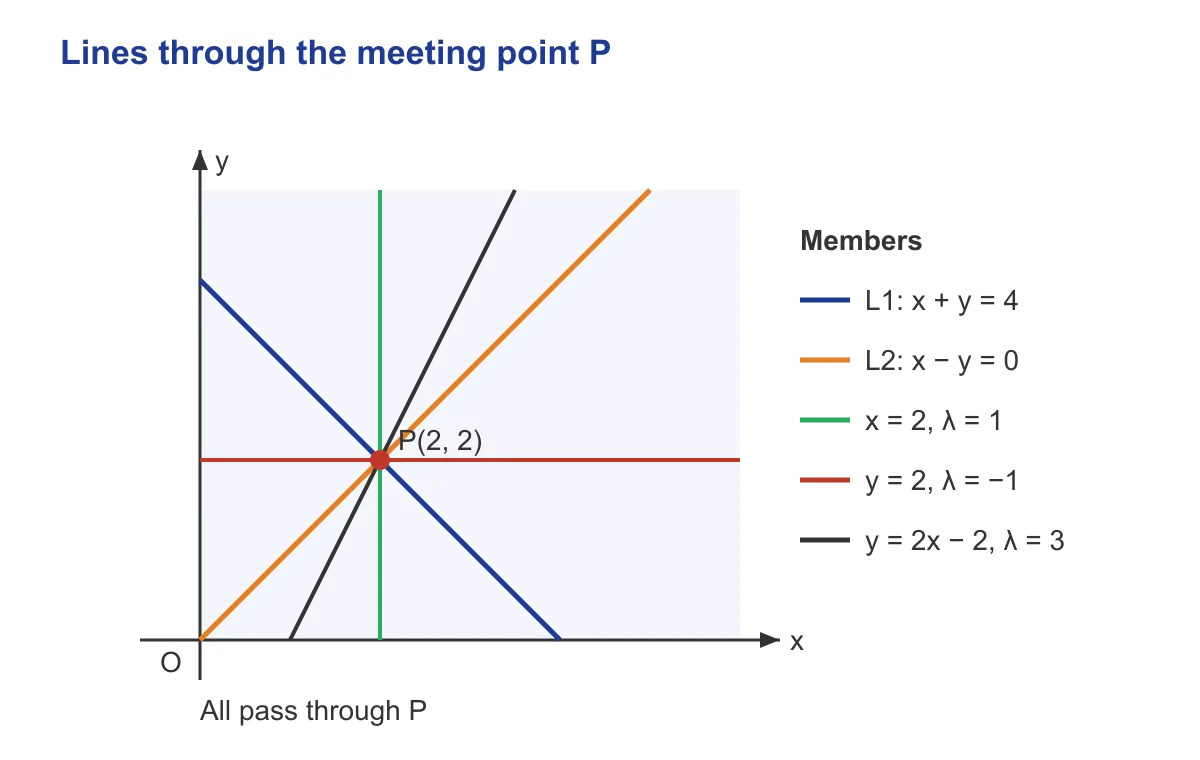
*Figure 4.1: Lines through P(2, 2) from the family $(x+y-4) + \lambda(x-y) = 0$*
Example 5: Find the line through the intersection of $x + 2y - 5 = 0$ and $3x - y - 1 = 0$ that has equal non-zero intercepts on the axes.
Write $(x + 2y - 5) + \lambda(3x - y - 1) = 0$, that is
$(1 + 3\lambda)x + (2 - \lambda)y - (5 + \lambda) = 0$.
Intercepts: $x$-intercept $= \dfrac{5+\lambda}{1+3\lambda}$, $y$-intercept $= \dfrac{5+\lambda}{2-\lambda}$.
Equal and non-zero: $1 + 3\lambda = 2 - \lambda$ with $5 + \lambda \ne 0$, so $\lambda = \tfrac14$.
Line: $\tfrac74 x + \tfrac74 y = \tfrac{21}{4}$, that is $x + y = 3$.
Check: the lines meet at $(1,2)$ (put $y = 3x - 1$ in the first line: $7x = 7$). And $1 + 2 = 3$, so the member passes through it.
What to notice: $\lambda = -5$ gives $y = 2x$, which has both intercepts equal to 0. That is why the question said "non-zero".
A hidden fixed point
Sometimes the family is not given as two lines. Take $ax + by + c = 0$ where $a, b, c$ obey a linear relation, say $3a - 2b + c = 0$. Read the relation as "the line gives zero at $x = 3,\ y = -2$". Hence every such line passes through the fixed point $(3, -2)$. This is the same idea in disguise: the lines are a family of the form $L_1 + \lambda L_2$ through one point.
Memory trick: "Same point, new slope: add a lambda, the meeting point stays." Whatever $\lambda$ you add, the point where $L_1$ and $L_2$ cross does not move.
Family of circles
Write each circle as $S = x^2 + y^2 + 2gx + 2fy + c = 0$, with coefficient 1 on $x^2 + y^2$. This standard form matters for everything below.
Circle through the intersection of two circles. If $S_1 = 0$ and $S_2 = 0$ meet at two points, the equation
is a circle through both points. A common point makes $S_1$ and $S_2$ zero, so it makes $S_1 + \lambda S_2$ zero. The $x^2 + y^2$ coefficient is $1 + \lambda$, so for $\lambda \ne -1$ divide by it and the result is a circle again.
Circle through the intersection of a circle and a line. For a circle $S = 0$ and a line $L = 0$,
is a circle for every real $\lambda$, and it passes through both points where the line cuts the circle. Here the $x^2 + y^2$ coefficient stays 1, so no value of $\lambda$ is excluded.
To pick the member you want, use one condition:
- passes through a given point: substitute the point;
- has a given centre-line or centre on a given line: write the centre of $S_1 + \lambda S_2$ and put it on the line;
- is the smallest possible: the common chord must be a diameter, so the centre lies on the chord;
- touches a given line or another circle: use distance from centre equal to radius.
Example 6: Find the circle through the points where $x^2 + y^2 = 9$ meets the line $x + y = 3$, and through the point $(1,1)$.
Write $S + \lambda L = x^2 + y^2 - 9 + \lambda(x + y - 3) = 0$.
Substitute $(1,1)$: $1 + 1 - 9 + \lambda(1 + 1 - 3) = 0$, so $-7 - \lambda = 0$ and $\lambda = -7$.
Circle: $x^2 + y^2 - 7x - 7y + 12 = 0$.
Check: the line meets the circle at $(3,0)$ and $(0,3)$. At $(3,0)$: $9 - 21 + 12 = 0$. At $(0,3)$: $9 - 21 + 12 = 0$. At $(1,1)$: $2 - 14 + 12 = 0$. All three lie on it.
What to notice: you never solved for the two intersection points. The family did that work.
Radical axis and common chord
For two circles $S_1 = 0$ and $S_2 = 0$, the radical axis is
Both circles have $x^2 + y^2$ with coefficient 1, so the subtraction kills the quadratic terms and leaves a linear equation. Three facts:
- It is a straight line, perpendicular to the line joining the centres.
- If the circles intersect at two points, it is the common chord line (those points satisfy both equations, hence the difference).
- A point $P$ is on it exactly when the tangent lengths from $P$ to the two circles are equal. The square of the tangent length from $(x_1, y_1)$ to $S = 0$ is $S(x_1, y_1)$, so equal tangent lengths means $S_1(x_1,y_1) = S_2(x_1,y_1)$.
If two circles touch, the radical axis is the common tangent at the point of contact. For two circles with no real common point, the line still exists; it just does not cut either circle. Concentric circles have no radical axis (the difference is a nonzero constant).
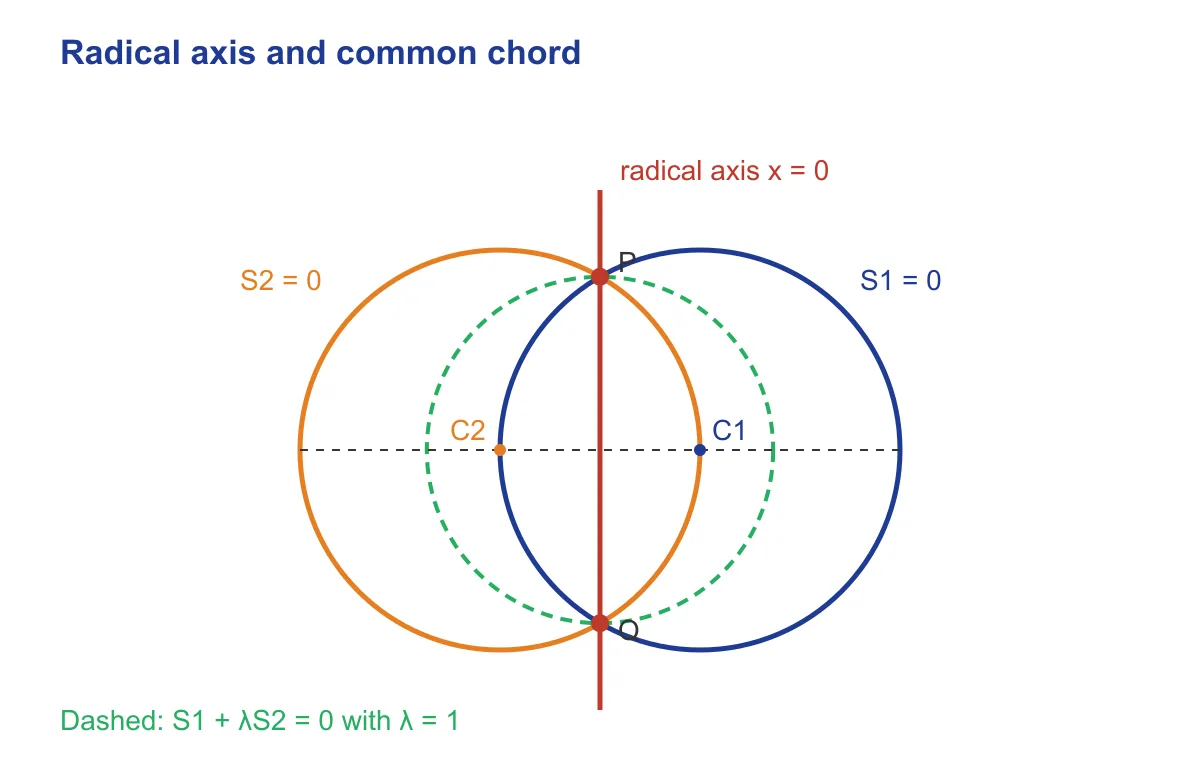
*Figure 4.2: Common chord PQ is the radical axis; the dashed circle is $S_1 + S_2 = 0$*
Length of the common chord. Find the radical axis, then the distance $d$ from the centre of one circle to it. The chord length is $2\sqrt{r^2 - d^2}$ using that circle's radius $r$.
| Quantity | Formula |
|---|---|
| Radical axis | $S_1 - S_2 = 0$ |
| Circle through common points | $S_1 + \lambda S_2 = 0$, $\lambda \ne -1$ |
| Chord length | $2\sqrt{r^2 - d^2}$ |
| Tangent length from $(x_1,y_1)$ | $\sqrt{S(x_1, y_1)}$ (if $S(x_1,y_1) \ge 0$) |
| Smallest circle through the common points | common chord as diameter |
Memory trick: "Minus makes the line, plus makes the circle." $S_1 - S_2$ is the chord; $S_1 + \lambda S_2$ is a circle through its ends. Say it when you see two circle equations side by side.
Example 7: Find the length of the common chord of $S_1: x^2 + y^2 - 2x - 4y - 4 = 0$ and $S_2: x^2 + y^2 - 8x - 12y + 36 = 0$.
Radical axis: $S_1 - S_2 = 6x + 8y - 40 = 0$, so $3x + 4y = 20$.
$S_1$ has centre $(1,2)$ and $r^2 = 1 + 4 + 4 = 9$, so $r = 3$.
Distance from $(1,2)$ to $3x + 4y - 20 = 0$: $d = \dfrac{\vert 3 + 8 - 20 \vert}{5} = \dfrac{9}{5}$.
Half-chord: $\sqrt{9 - \tfrac{81}{25}} = \sqrt{\tfrac{144}{25}} = \tfrac{12}{5}$.
Chord length $= \tfrac{24}{5} = 4.8$.
Check with the second circle: centre $(4,6)$, $r^2 = 16 + 36 - 36 = 16$, $r = 4$. The centres are 5 apart, and $3^2 + 4^2 = 5^2$, so the radii and the line of centres form a right triangle with legs 3 and 4. Half the chord is the altitude to the hypotenuse, $\tfrac{3 \cdot 4}{5} = \tfrac{12}{5}$. It agrees.
Choosing a method
When a problem names a moving point, a family or a pair of circles, ask which of these you are looking at before writing anything.
| You see | Use |
|---|---|
| A point obeying a distance, angle or ratio rule | direct locus with $(h,k)$ |
| A midpoint, foot or dividing point built from a point on a known curve | parameter point, then eliminate |
| A midpoint of a chord of a circle through a fixed point | $OM \perp AM$ (circle on a diameter) |
| A line through the meeting point of two lines | $L_1 + \lambda L_2 = 0$ |
| Lines $ax + by + c = 0$ with a relation among $a, b, c$ | read the fixed point from the relation |
| A circle through the intersection of two circles | $S_1 + \lambda S_2 = 0$ |
| A circle through a circle and a line | $S + \lambda L = 0$ |
| Common chord, equal tangent lengths | $S_1 - S_2 = 0$ |
Common traps
- Using $S_1 + \lambda S_2 = 0$ when the circles are not both in the form with $x^2 + y^2$ coefficient 1 → first divide each equation so the coefficient is 1; otherwise $S_1 - S_2$ will not cancel the square terms.
- Believing $S_1 + \lambda S_2 = 0$ is a circle for every $\lambda$ → at $\lambda = -1$ it is the line $S_1 - S_2 = 0$.
- Expecting $L_1 + \lambda L_2 = 0$ to produce $L_2$ → it never does for real $\lambda$; use $\mu L_1 + \lambda L_2 = 0$ if $L_2$ is allowed.
- Leaving $h, k$ in the final answer → rename them $x, y$ and say what curve it is.
- Dividing by a slope or by $k$ and losing the vertical line or the case $k = 0$ → check those cases separately.
- Dropping the "non-zero" in an equal-intercepts condition → a line through the origin has both intercepts 0; decide whether the question allows it.
- Taking $PA = k\,PB$ with $k \ne 1$ as a straight line → it is a circle; only $k = 1$ gives a line.
- Reversing the ratio in the section formula → the point nearer the dividing point gets the weight of the far part: for $AP : PQ = p : q$, $P = \dfrac{qA + pQ}{p+q}$.
- Treating the radical axis as parallel to the line of centres → it is perpendicular to it.
- Computing the chord length as $2d$ or $\sqrt{r^2 - d^2}$ → it is twice the half-chord, $2\sqrt{r^2 - d^2}$.
Quick revision
- Locus: name $P(h,k)$, write the rule, eliminate the parameter, rename to $x, y$.
- $PA = PB$ gives a line; $PA = k\,PB$ with $k \ne 1$ gives a circle.
- $PA^2 + PB^2 = c$ is a circle centred at the midpoint of $AB$; $PA^2 - PB^2 = c$ is a line.
- Midpoint of a chord of a circle through a fixed point $A$: circle on $OA$ as diameter ($OM \perp AM$).
- Foot of the perpendicular from $O$ to lines through $A$: circle on $OA$ as diameter.
- $AP : PQ = p : q$ means $P = \dfrac{qA + pQ}{p + q}$.
- $L_1 + \lambda L_2 = 0$: all lines through the meeting point of $L_1, L_2$, except $L_2$.
- A relation $\alpha a + \beta b + c = 0$ among the coefficients of $ax + by + c = 0$ means the fixed point $(\alpha, \beta)$.
- $S_1 + \lambda S_2 = 0$ ($\lambda \ne -1$): a circle through the common points of $S_1$ and $S_2$.
- $S + \lambda L = 0$: a circle through the points where $L$ meets $S$, for every real $\lambda$.
- Radical axis: $S_1 - S_2 = 0$, perpendicular to the line of centres.
- On the radical axis, tangent lengths to the two circles are equal.
- Common chord length: $2\sqrt{r^2 - d^2}$, with $d$ the distance from a centre to the radical axis.
- Smallest circle through the intersection of a circle and a line: choose $\lambda$ so the centre lies on the line.
Practice questions
The locus of a point that is equidistant from $A(1,2)$ and $B(3,4)$ is the line
- $x - y + 1 = 0$
- $x - y = 5$
- $x + y = 7$
- $x + y = 5$
Answer
D. $x + y = 5$
$(x-1)^2+(y-2)^2=(x-3)^2+(y-4)^2 \Rightarrow -2x-4y+5 = -6x-8y+25 \Rightarrow 4x+4y=20$, so $x+y=5$. Midpoint $(2,3)$ satisfies it.
A point moves so that its distance from the $x$-axis is twice its distance from the $y$-axis. Its locus is
- $y = 2x$ only
- $y = x/2$ or $y = -x/2$
- $y = 2x$ or $y = -2x$
- $y^2 = 2x^2$
Answer
C. $y = 2x$ or $y = -2x$
Distances are $\vert y\vert$ and $\vert x\vert$. $\vert y\vert = 2\vert x\vert \Rightarrow y^2 = 4x^2 \Rightarrow y = \pm 2x$.
The locus of the midpoints of chords of the circle $x^2 + y^2 = 4$ that pass through the point $(1,1)$ is
- $x^2 + y^2 - x - y = 0$
- $x^2 + y^2 - 2x - 2y = 0$
- $x^2 + y^2 + x + y = 0$
- $x^2 + y^2 - x - y = 2$
Answer
A. $x^2 + y^2 - x - y = 0$
Midpoint $M(h,k)$: $OM \perp AM$ with $A(1,1)$, so $h(h-1)+k(k-1)=0$, i.e. $x^2+y^2-x-y=0$. The point $(1,1)$ itself and $O$ satisfy it.
The member of the family $(2x + y - 5) + \lambda(x - y - 1) = 0$ that passes through the origin is
- $x + 2y = 0$
- $x - 2y = 0$
- $2x + y = 0$
- $2x - y = 0$
Answer
B. $x - 2y = 0$
At the origin: $-5 - \lambda = 0$, so $\lambda = -5$. Line: $2x+y-5-5x+5y+5 = -3x+6y=0$, i.e. $x-2y=0$. It passes through the meeting point $(2,1)$.
The radical axis of $x^2 + y^2 + 4x - 2y + 1 = 0$ and $x^2 + y^2 - 2x + 4y - 3 = 0$ is
- $3x - 3y - 1 = 0$
- $3x + 3y + 2 = 0$
- $x - y + 4 = 0$
- $3x - 3y + 2 = 0$
Answer
D. $3x - 3y + 2 = 0$
Subtract: $(4x+2x) + (-2y-4y) + (1+3) = 6x - 6y + 4 = 0$, so $3x - 3y + 2 = 0$.
All lines $ax + by + c = 0$ for which $3a - 2b + c = 0$ pass through the fixed point
- $(-3, 2)$
- $(3, -2)$
- $(3, 2)$
- $(2, -3)$
Answer
B. $(3, -2)$
At $(x,y)=(3,-2)$ the line gives $3a - 2b + c = 0$, which holds for every such line.
The circle that has the common chord of $x^2 + y^2 = 9$ and $x + y = 3$ as a diameter is
- $x^2 + y^2 - 6x - 6y + 9 = 0$
- $x^2 + y^2 - 3x - 3y - 9 = 0$
- $x^2 + y^2 - 3x - 3y = 0$
- $x^2 + y^2 + 3x + 3y - 18 = 0$
Answer
C. $x^2 + y^2 - 3x - 3y = 0$
$x^2+y^2-9+\lambda(x+y-3)=0$ has centre $(-\lambda/2,-\lambda/2)$. On $x+y=3$: $-\lambda=3$, $\lambda=-3$. Circle: $x^2+y^2-3x-3y=0$. Check $(3,0)$: $9-9=0$.
The set of points from which the tangents to two given circles have equal lengths is
- a line perpendicular to the line of centres
- a line parallel to the line of centres
- the line of centres
- a circle through the common points of the circles
Answer
A. a line perpendicular to the line of centres
Equal tangent lengths means $S_1 = S_2$ at the point, i.e. $S_1 - S_2 = 0$, the radical axis, which is perpendicular to the line of centres.
For the circles $x^2 + y^2 - 4 = 0$ and $x^2 + y^2 - 2x - 4 = 0$, the equation $S_1 + \lambda S_2 = 0$ does not represent a circle when $\lambda$ equals
- $1$
- $0$
- $-2$
- $-1$
Answer
D. $-1$
The coefficient of $x^2+y^2$ is $1+\lambda$. At $\lambda=-1$ it vanishes and the equation becomes the line $2x=0$.
Lines through the origin have variable slope. The locus of the foot of the perpendicular from $(0,3)$ to such a line is
- $x^2 + y^2 - 3x = 0$
- $x^2 + y^2 + 3y = 0$
- $x^2 + y^2 - 3y = 0$
- $x^2 + y^2 = 9$
Answer
C. $x^2 + y^2 - 3y = 0$
Foot $F(h,k)$: $\angle OFA = 90^\circ$ with $A(0,3)$, so $FO \cdot FA=0$: $h\cdot h + k(k-3)=0$, i.e. $x^2+y^2-3y=0$.
The locus of the midpoint of the segment joining the origin to a variable point on the line $x + y = 2$ is
- $x + y = 4$
- $x + y = 1$
- $x + y = 2$
- $2x + 2y = 1$
Answer
B. $x + y = 1$
Point $(t, 2-t)$; midpoint $(t/2, 1 - t/2)$, so $h + k = 1$.
The locus of a point whose distance from $(1,0)$ equals its distance from the line $x = -1$ is
- $y^2 = 4x$
- $y^2 = 2x$
- $y^2 = -4x$
- $x^2 = 4y$
Answer
A. $y^2 = 4x$
$(x-1)^2 + y^2 = (x+1)^2 \Rightarrow y^2 = 4x$.
A point moves so that the sum of the squares of its distances from $(3,0)$ and $(-3,0)$ is $26$. Its locus is
- $x^2 + y^2 = 4$
- $x^2 + y^2 = 13$
- $x^2 + y^2 = 17$
- $x^2 + y^2 = 8$
Answer
A. $x^2 + y^2 = 4$
$(x-3)^2+y^2+(x+3)^2+y^2 = 2x^2+2y^2+18 = 26$, so $x^2+y^2 = 4$.
The line of the family $(x + 2y - 3) + \lambda(2x + y - 3) = 0$ that is perpendicular to the line $y = x$ is
- $x + y = 1$
- $x - y = 0$
- $x + y = 2$
- $2x + y = 3$
Answer
C. $x + y = 2$
Family: $(1+2\lambda)x+(2+\lambda)y-3(1+\lambda)=0$. Perpendicular to $y=x$ means the normal is along $(1,1)$: $1+2\lambda=2+\lambda$, $\lambda=1$. Line: $3x+3y=6$, $x+y=2$ (through $(1,1)$).
A point $P$ moves so that $PA = 2\,PB$, where $A = (0,0)$ and $B = (9,0)$. The radius of its locus is
- $12$
- $36$
- $9$
- $6$
Answer
D. $6$
$x^2+y^2=4[(x-9)^2+y^2] \Rightarrow x^2+y^2-24x+108=0$. $r^2 = 144-108 = 36$, so $r=6$.
The common chord of $x^2 + y^2 = 25$ and $x^2 + y^2 - 12x + 11 = 0$ has length
- $10$
- $8$
- $6$
- $4$
Answer
B. $8$
Subtract: $12x - 36 = 0$, $x = 3$. Half-chord $=\sqrt{25 - 9} = 4$. Length $= 8$. Check: both centres are $3$ from the line, since centres are $(0,0)$ and $(6,0)$.
The distance of the radical axis of $x^2 + y^2 + 6x + 8y = 0$ and $x^2 + y^2 - 4 = 0$ from the origin is
- $0.4$
- $0.8$
- $4$
- $0.04$
Answer
A. $0.4$
Subtract: $6x + 8y + 4 = 0$. Distance $= 4/\sqrt{36+64} = 4/10 = 0.4$.
The line $(x + y - 4) + \lambda(x - y) = 0$ passes through $(5,1)$ for $\lambda$ equal to
- $-2$
- $0.5$
- $-0.5$
- $2$
Answer
C. $-0.5$
At $(5,1)$: $2 + 4\lambda = 0$, $\lambda = -0.5$. Check: line becomes $x+3y=8$, which holds for $(5,1)$ and for $(2,2)$.
For $S_1: x^2 + y^2 - 2x - 6 = 0$ and $S_2: x^2 + y^2 + 2y - 3 = 0$, the circle $S_1 + \lambda S_2 = 0$ passes through the origin when $\lambda$ equals
- $2$
- $-2$
- $-0.5$
- $0.5$
Answer
B. $-2$
At $(0,0)$: $-6 + \lambda(-3) = 0$, so $\lambda=-2$. Circle: $x^2+y^2+2x+4y=0$.
The circle through the points where $x^2 + y^2 = 4$ meets $x + y = 2$ and through $(3,3)$ has centre with $x$-coordinate
- $3$
- $3.5$
- $-1.75$
- $1.75$
Answer
D. $1.75$
$x^2+y^2-4+\lambda(x+y-2)=0$ at $(3,3)$: $14 + 4\lambda = 0$, $\lambda=-3.5$. Circle: $x^2+y^2-3.5x-3.5y+3=0$; centre $(1.75,1.75)$. Check $(2,0)$: $4-7+3=0$.
Chords of length $6$ are drawn in the circle $x^2 + y^2 = 25$. Their midpoints lie on a circle of radius
- $3$
- $4$
- $5$
- $8$
Answer
B. $4$
Distance of the midpoint from the centre $=\sqrt{25-9}=4$ for every such chord, so the locus is $x^2+y^2=16$.
$A = (9,0)$ and $Q$ moves on $x^2 + y^2 = 36$. The point $P$ divides $AQ$ with $AP : PQ = 1 : 2$. The $x$-coordinate of the centre of the locus of $P$ is
- $9$
- $3$
- $4.5$
- $6$
Answer
D. $6$
$P = (2A + Q)/3$. Centre $= 2A/3 = (6,0)$, radius $2$. Reversing the ratio would give centre $3$.
Lines pass through $A(10,0)$ with variable slope. The locus of the foot of the perpendicular from the origin to them is a circle of radius
- $10$
- $2.5$
- $5$
- $7.5$
Answer
C. $5$
$\angle OFA = 90^\circ$, so the locus is the circle on $OA$ as diameter; $OA = 10$, so $r=5$.
Let $L_1: x + y - 7 = 0$ and $L_2: x - y + 1 = 0$. Among all lines $L_1 + \lambda L_2 = 0$, the greatest distance from the origin to such a line is
- $5$
- $7$
- $3$
- $4$
Answer
A. $5$
$L_1,L_2$ meet at $P(3,4)$. Every member passes through $P$, so distance $\le OP = 5$, reached by the line perpendicular to $OP$: $3x+4y=25$.
The radical axis of $x^2 + y^2 = 4$ and $x^2 + y^2 - 6x - 8y + 20 = 0$ cuts the axes. The area of the triangle it forms with the axes is
- $3$
- $6$
- $24$
- $12$
Answer
B. $6$
Subtract: $6x+8y-24=0$, i.e. $3x+4y=12$. Intercepts $4$ and $3$; area $=\tfrac12\cdot4\cdot3=6$.
$A = (0,0)$, $B = (4,0)$ and $PA = 3\,PB$. The radius of the locus of $P$ is
- $3$
- $2.25$
- $1.5$
- $4.5$
Answer
C. $1.5$
$x^2+y^2=9[(x-4)^2+y^2] \Rightarrow x^2+y^2-9x+18=0$. Centre $(4.5,0)$, $r^2=20.25-18=2.25$, $r=1.5$.
Given below are two statements: Statement I: The locus of the midpoint of chords of $x^2 + y^2 = a^2$ that pass through a fixed point $A$ inside it (other than the centre) is a circle. Statement II: This circle passes through the centre of the given circle.
- Both Statement I and Statement II are correct
- Both Statement I and Statement II are incorrect
- Statement I is correct but Statement II is incorrect
- Statement I is incorrect but Statement II is correct
Answer
A. Both Statement I and Statement II are correct
Midpoint $M$ obeys $OM \perp AM$, so $M$ lies on the circle with $OA$ as diameter. That circle passes through $O$ (the chord along $OA$ has midpoint $O$). Both correct.
Given below are two statements: Statement I: For every real $\lambda$, $S_1 + \lambda S_2 = 0$ represents a circle. Statement II: For two circles meeting at two points, $S_1 - S_2 = 0$ is the line of their common chord.
- Both Statement I and Statement II are correct
- Both Statement I and Statement II are incorrect
- Statement I is correct but Statement II is incorrect
- Statement I is incorrect but Statement II is correct
Answer
D. Statement I is incorrect but Statement II is correct
At $\lambda=-1$ the $x^2+y^2$ terms cancel, giving a line, so I is wrong. II is the standard radical-axis result.
Given below are two statements: Statement I: The family $L_1 + \lambda L_2 = 0$ contains $L_2$ for some real $\lambda$. Statement II: When $L_1$ and $L_2$ intersect, every member of this family is parallel to $L_1$.
- Both Statement I and Statement II are correct
- Both Statement I and Statement II are incorrect
- Statement I is correct but Statement II is incorrect
- Statement I is incorrect but Statement II is correct
Answer
B. Both Statement I and Statement II are incorrect
$L_2$ appears only as $\lambda\to\infty$, so I is wrong. Members pass through the meeting point with varying slopes, so II is wrong.
Given below are two statements: Statement I: The radical axis of two non-concentric circles is perpendicular to the line joining their centres. Statement II: The radical axis of two circles always passes through the midpoint of the segment joining their centres.
- Both Statement I and Statement II are correct
- Both Statement I and Statement II are incorrect
- Statement I is correct but Statement II is incorrect
- Statement I is incorrect but Statement II is correct
Answer
C. Statement I is correct but Statement II is incorrect
I is true. II holds only for equal radii. Counter-example: $x^2+y^2-4=0$ and $x^2+y^2-4x+3=0$ (centres $(0,0)$, $(2,0)$) give the axis $4x-7=0$, i.e. $x=1.75$, which misses the midpoint $(1,0)$.
Given below are two statements: Statement I: For fixed points $A$ and $B$, the locus of $P$ with $PA^2 + PB^2$ constant (and large enough) is a circle centred at the midpoint of $AB$. Statement II: For fixed points $A$ and $B$, the locus of $P$ with $PA^2 - PB^2$ constant is a circle.
- Both Statement I and Statement II are correct
- Both Statement I and Statement II are incorrect
- Statement I is correct but Statement II is incorrect
- Statement I is incorrect but Statement II is correct
Answer
C. Statement I is correct but Statement II is incorrect
$PA^2+PB^2 = 2PM^2 + AB^2/2$ ($M$ the midpoint), so I is true. $PA^2-PB^2$ is linear in $x,y$, giving a straight line, so II is false.
Assertion (A): The locus of the midpoints of chords of $x^2 + y^2 = 9$ drawn through $(3,0)$ is a circle. Reason (R): For such a midpoint $M$ the angle $OMA$ is a right angle, where $O$ is the origin and $A=(3,0)$.
- Both A and R are true and R is the correct explanation of A
- Both A and R are true but R is not the correct explanation of A
- A is true but R is false
- A is false but R is true
Answer
A. Both A and R are true and R is the correct explanation of A
$OM$ is perpendicular to the chord, which passes through $A$, so $\angle OMA = 90^\circ$ and $M$ lies on the circle with diameter $OA$: $x^2+y^2-3x=0$. R explains A.
Assertion (A): The radical axis of $x^2 + y^2 = 4$ and $x^2 + y^2 - 4x = 0$ is $x = 1$. Reason (R): The line of centres of these two circles is the $x$-axis.
- Both A and R are true and R is the correct explanation of A
- Both A and R are true but R is not the correct explanation of A
- A is true but R is false
- A is false but R is true
Answer
B. Both A and R are true but R is not the correct explanation of A
Subtract: $4x - 4 = 0$, so $x=1$; A is true. The centres $(0,0)$ and $(2,0)$ do lie on the $x$-axis, so R is true. But the axis comes from subtraction, not from where the centres lie.
Assertion (A): The locus of a point $P$ with $PA = 2\,PB$ ($A \ne B$) is a circle. Reason (R): The locus of a point $P$ with $PA = PB$ is also a circle.
- Both A and R are true and R is the correct explanation of A
- Both A and R are true but R is not the correct explanation of A
- A is true but R is false
- A is false but R is true
Answer
C. A is true but R is false
With ratio $2\neq1$ the $x^2+y^2$ terms stay, giving a circle; A is true. With $PA=PB$ they cancel and the locus is the perpendicular bisector, a line; R is false.
Match List I with List II. List I: a. Midpoint of segment from the origin to a point on $x + y = 2$. b. Points equidistant from $(0,0)$ and $(2,0)$. c. Points for which the sum of squares of distances from $(1,0)$ and $(-1,0)$ is $6$. d. Foot of the perpendicular from the origin to lines through $(2,0)$. List II: i. $x^2 + y^2 = 2$. ii. $x^2 + y^2 - 2x = 0$. iii. $x + y = 1$. iv. $x = 1$.
- a-iv, b-iii, c-i, d-ii
- a-iii, b-iv, c-ii, d-i
- a-i, b-iv, c-iii, d-ii
- a-iii, b-iv, c-i, d-ii
Answer
D. a-iii, b-iv, c-i, d-ii
a: $x+y=1$ (iii). b: $x^2=(x-2)^2+0$ gives $x=1$ (iv). c: $2x^2+2y^2+2=6$ gives $x^2+y^2=2$ (i). d: $h(h-2)+k^2=0$ (ii).
Match List I with List II. List I (pairs of circles): a. $x^2+y^2=4$ and $x^2+y^2-4x=0$. b. $x^2+y^2=4$ and $x^2+y^2-4y=0$. c. $x^2+y^2=4$ and $x^2+y^2-2x-2y=0$. d. $x^2+y^2=4$ and $x^2+y^2+2x+2y=0$. List II (radical axes): i. $x+y=-2$. ii. $x=1$. iii. $y=1$. iv. $x+y=2$.
- a-ii, b-iii, c-iv, d-i
- a-ii, b-iii, c-i, d-iv
- a-iii, b-ii, c-iv, d-i
- a-iv, b-iii, c-ii, d-i
Answer
A. a-ii, b-iii, c-iv, d-i
a: $4x-4=0$, $x=1$. b: $4y-4=0$, $y=1$. c: $2x+2y-4=0$, $x+y=2$. d: $-2x-2y-4=0$, $x+y=-2$.
Match List I with List II. List I (members of $(x+y-2)+\lambda(x-y)=0$): a. $\lambda = 1$. b. $\lambda = -1$. c. $\lambda = 0$. d. $\lambda = 3$. List II: i. $2x - y = 1$. ii. $y = 1$. iii. $x = 1$. iv. $x + y = 2$.
- a-iv, b-ii, c-iii, d-i
- a-ii, b-iii, c-iv, d-i
- a-iii, b-ii, c-i, d-iv
- a-iii, b-ii, c-iv, d-i
Answer
D. a-iii, b-ii, c-iv, d-i
$\lambda=1$: $2x-2=0$, $x=1$. $\lambda=-1$: $2y-2=0$, $y=1$. $\lambda=0$: $x+y=2$. $\lambda=3$: $4x-2y-2=0$, $2x-y=1$.
A point $P$ moves so that the length of the tangent from $P$ to $x^2 + y^2 = 4$ equals its distance from the line $x = 3$. The locus of $P$ is
- $y^2 + 6x = 13$
- $y^2 - 6x = 13$
- $y^2 + 6x = 5$
- $x^2 + 6y = 13$
Answer
A. $y^2 + 6x = 13$
Tangent length$^2$ $= x^2+y^2-4$; distance$^2$ $=(x-3)^2$. So $x^2+y^2-4 = x^2-6x+9$, giving $y^2+6x=13$.
The circle that has the common chord of $x^2 + y^2 = 16$ and $x^2 + y^2 - 8x = 0$ as a diameter is
- $x^2 + y^2 - 8x - 16 = 0$
- $x^2 + y^2 - 4x + 8 = 0$
- $x^2 + y^2 - 4x - 16 = 0$
- $x^2 + y^2 - 4x - 8 = 0$
Answer
D. $x^2 + y^2 - 4x - 8 = 0$
Radical axis: $8x-16=0$, $x=2$. $S_1+\lambda S_2$ has centre $(4\lambda/(1+\lambda),0)$; set $=2$: $\lambda=1$. Circle: $2x^2+2y^2-8x-16=0$, i.e. $x^2+y^2-4x-8=0$. Check: common points $(2,\pm\sqrt{12})$ give $4+12-8-8=0$.
A variable line through $(1,2)$ meets the $x$-axis at $A$ and the $y$-axis at $B$. The locus of the midpoint of $AB$ is
- $x + 2y = xy$
- $2x + y = 2xy$
- $2x + y = xy$
- $x + 2y = 2xy$
Answer
B. $2x + y = 2xy$
Intercepts $a,b$: $1/a + 2/b = 1$. Midpoint $(h,k)=(a/2,b/2)$, so $a=2h$, $b=2k$: $\frac{1}{2h}+\frac{1}{k}=1$, so $k+2h=2hk$: $2x+y=2xy$. Test: $m=1$ gives $(-0.5,0.5)$ and both sides equal $-0.5$.