Solid State
What to remember
- A crystalline solid has long-range order, a sharp melting point and direction-dependent properties. An amorphous solid has only short-range order and softens over a range of temperature.
- Atoms per cell: simple cubic 1, body-centred cubic (bcc) 2, face-centred cubic (fcc) 4. Corner atom counts 1/8, edge atom 1/4, face atom 1/2, body atom 1.
- Packing efficiency: simple cubic 52.4%, bcc 68%, fcc and hcp 74%. Coordination numbers: 6, 8, 12 and 12.
- For N close-packed atoms there are N octahedral voids and 2N tetrahedral voids. Their radius ratios are 0.414 and 0.225.
- Density of a crystal: $\rho = \dfrac{Z M}{N_A a^3}$. Schottky defect lowers the density; Frenkel defect leaves it unchanged.
Kinds of solids
A solid keeps its shape because its particles (atoms, ions or molecules) are locked in position and can only vibrate about those positions. How the particles are arranged decides almost everything else.
In a crystalline solid the particles repeat in a regular pattern that continues over thousands of particles. This is long-range order. Rock salt, quartz, diamond, copper and sugar are crystalline. Such solids have a sharp melting point, they cleave along flat faces when struck, and they are anisotropic: a property such as electrical resistance or refractive index can have different values along different directions in the same crystal.
In an amorphous solid the order stops after a few particles (short-range order). Window glass, rubber, many plastics and tar are of this kind. They have no sharp melting point, they break into curved, irregular pieces, and they are isotropic, meaning a property has the same value in every direction. Glass is often called a supercooled liquid because its particles are frozen in a disordered, liquid-like arrangement and it very slowly flows.
Crystalline solids are further grouped by the force that holds the particles together.
| Class | Particles | Binding force | Typical properties | Examples |
|---|---|---|---|---|
| Ionic | Cations and anions | Electrostatic attraction | Hard, brittle, high melting point; insulator when solid, conducts when molten or dissolved | NaCl, MgO, CsCl |
| Covalent (network) | Atoms | Covalent bonds through the whole crystal | Very hard (diamond) or soft (graphite), very high melting point, usually insulators | Diamond, SiC, quartz (SiO₂) |
| Molecular | Molecules | Dispersion, dipole forces or hydrogen bonds | Soft, low melting point, insulators | Dry ice (CO₂), I₂, ice (H₂O) |
| Metallic | Metal cations in a sea of electrons | Metallic bond | Malleable, ductile, lustrous, conduct as solids | Cu, Fe, Na |
Two cases deserve a sentence each. Graphite is a covalent solid built of flat layers; each carbon uses three electrons for bonding and the fourth moves along the layer, so graphite conducts along its layers and feels slippery because the layers are held only weakly. Ice is molecular, but its molecules are held by hydrogen bonds, which raises its melting point well above that of dry ice.
Memory trick: "Ions break, atoms bake, molecules flake, metals shake." Ionic solids are brittle; covalent network solids need a furnace to melt; molecular solids are soft and flaky; metals conduct by shaking electrons loose.
Use it to match a solid with its class when a question lists only physical properties.
Lattice, unit cell and crystal systems
Replace every particle in a crystal by a point. The three-dimensional array of points is the crystal lattice, and each point is a lattice point. The smallest block that, repeated in three directions without gaps, builds the whole lattice is the unit cell. It is described by three edge lengths a, b, c and three angles: α between b and c, β between a and c, γ between a and b.
A primitive cell has lattice points only at the corners. A centred cell has extra points: at the body centre (body-centred), at the centre of every face (face-centred), or at the centres of one pair of opposite faces (end-centred).
The edge lengths and angles split all crystals into seven systems.
| System | Edges | Angles | Example |
|---|---|---|---|
| Cubic | a = b = c | α = β = γ = 90° | NaCl, Cu |
| Tetragonal | a = b ≠ c | α = β = γ = 90° | SnO₂, white tin |
| Orthorhombic | a ≠ b ≠ c | α = β = γ = 90° | Rhombic sulphur |
| Hexagonal | a = b ≠ c | α = β = 90°, γ = 120° | Graphite, ZnO |
| Rhombohedral (trigonal) | a = b = c | α = β = γ ≠ 90° | Calcite, HgS |
| Monoclinic | a ≠ b ≠ c | α = γ = 90°, β ≠ 90° | Monoclinic sulphur |
| Triclinic | a ≠ b ≠ c | α ≠ β ≠ γ ≠ 90° | K₂Cr₂O₇, CuSO₄·5H₂O |
Only the cubic system has all three of its common cells: simple, body-centred and face-centred. The other systems have some or none of the centred types.
Memory trick: "Cubic Teachers Order Hot Rice, Mostly Tasty." The first letters give Cubic, Tetragonal, Orthorhombic, Hexagonal, Rhombohedral, Monoclinic, Triclinic, which runs from the most symmetric system to the least.
Use it to recall the order; then fill the edge and angle conditions by asking what is lost at each step.
Counting atoms in a unit cell
An atom sitting at a corner is shared by 8 cells, so one cell owns 1/8 of it. An atom on a face is shared by 2 cells (1/2), an atom on an edge by 4 cells (1/4), and an atom inside the cell belongs wholly to it.
Here $n_c, n_f, n_e, n_b$ are the numbers of corner, face, edge and body atoms. For simple cubic Z = 8 × 1/8 = 1. For bcc Z = 1 + 1 = 2. For fcc Z = 1 + 6 × 1/2 = 4.
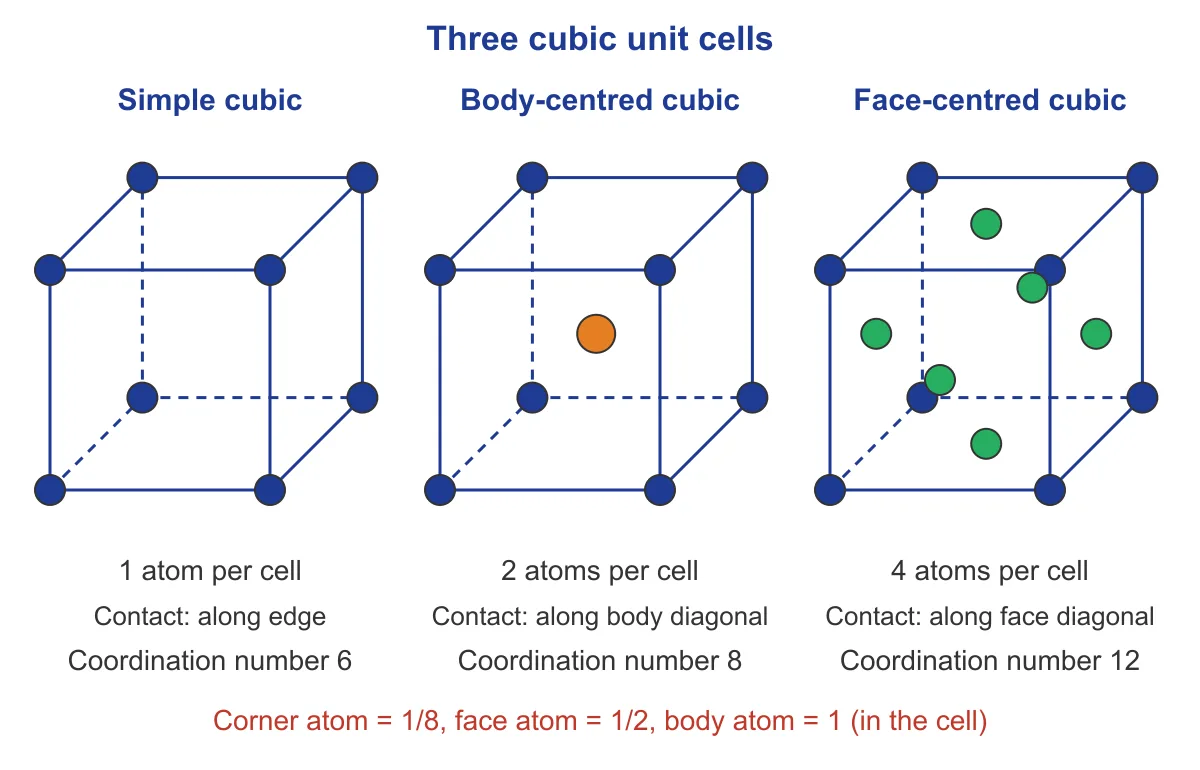
Figure 2.1: Simple cubic, bcc and fcc cells, with atoms per cell and coordination number
Close packing
Atoms are treated as hard spheres of equal size. The aim is to pack them so that as little space as possible is wasted.
One dimension. Spheres in a row touch their two neighbours. Coordination number is 2.
Two dimensions. There are two ways to build a layer. In square close packing, rows lie directly above each other, so each sphere touches 4 neighbours. In hexagonal close packing, each row sits in the dips of the row below, so each sphere touches 6 neighbours and the layer is denser. Real close-packed structures are built from hexagonal layers.
Three dimensions. Stack the hexagonal layers. Call the first layer A. Its dips are of two kinds, drawn in two colours in the figure. Put the second layer (B) over one kind of dip.
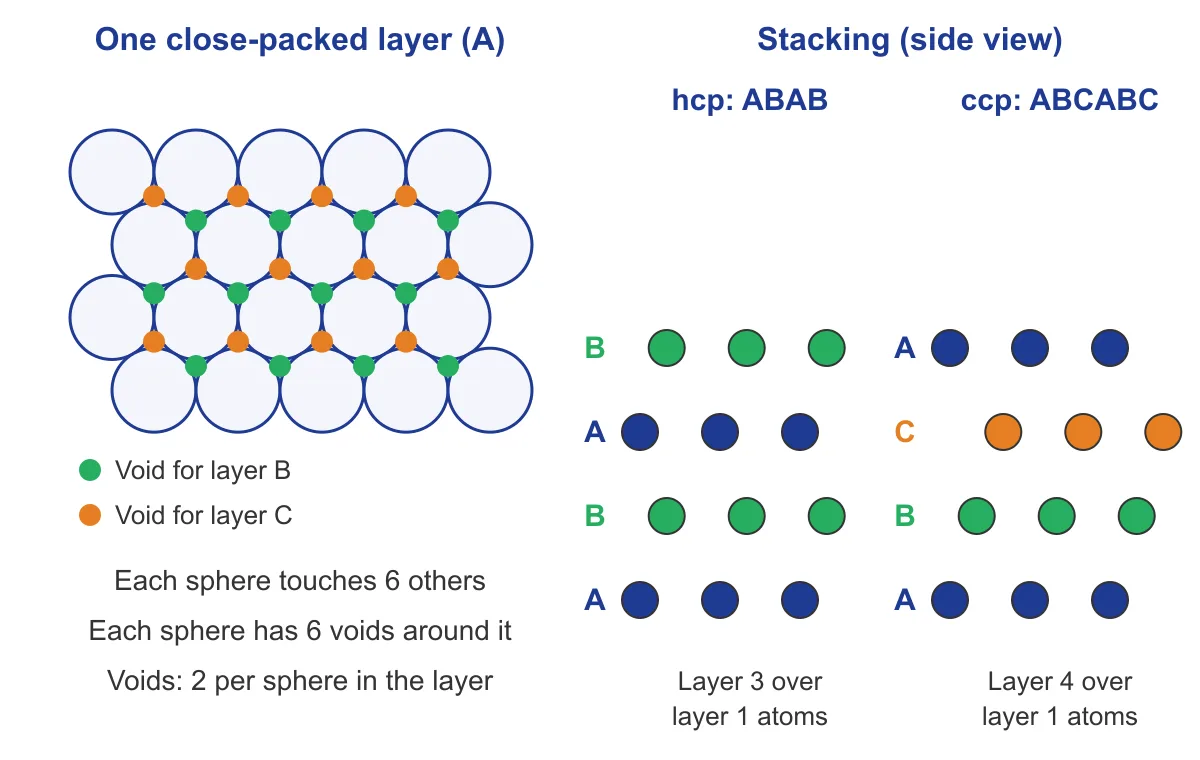
Figure 2.2: A close-packed layer with its two kinds of dips, and the hcp and ccp stacking sequences
For the third layer there is a choice.
- Place it directly over layer A, over the spheres of the first layer. The sequence ABAB… is hexagonal close packing (hcp). Magnesium and zinc crystallise this way.
- Place it over the other kind of dip, the one layer B left uncovered. The third layer is then different from A and B, and the sequence is ABCABC…. This is cubic close packing (ccp), whose unit cell is fcc. Copper, silver, gold and aluminium crystallise this way.
In both, each sphere touches 6 in its own layer, 3 above and 3 below, so the coordination number is 12 and the packing efficiency is 74%. The fcc cell hides the layers: they lie perpendicular to the body diagonal of the cube.
Stacking square layers directly one over another gives the simple cubic arrangement (CN 6). Stacking square layers with each layer in the dips of the one below gives bcc (CN 8). These are less efficient than the two close-packed ones.
Voids in close packing
Even in the densest packing, spheres leave gaps. There are two kinds.
- Tetrahedral void: the gap in the middle of 4 touching spheres, three in one layer and one in the next. It is surrounded by 4 spheres.
- Octahedral void: the gap in the middle of 6 spheres, three in one layer and three in the layer above, the upper triangle pointing the other way. It is surrounded by 6 spheres.
Take N spheres in a close-packed array. Counting the gaps between two adjacent layers shows that each sphere is matched with one octahedral void and two tetrahedral voids, so:
In one fcc cell (N = 4) there are 4 octahedral and 8 tetrahedral voids. The 8 tetrahedral voids lie inside the cell at the points (1/4, 1/4, 1/4) and the seven positions like it. The octahedral voids are at the body centre (1 void) and at the centre of each of the 12 edges (12 × 1/4 = 3 voids), giving 4.
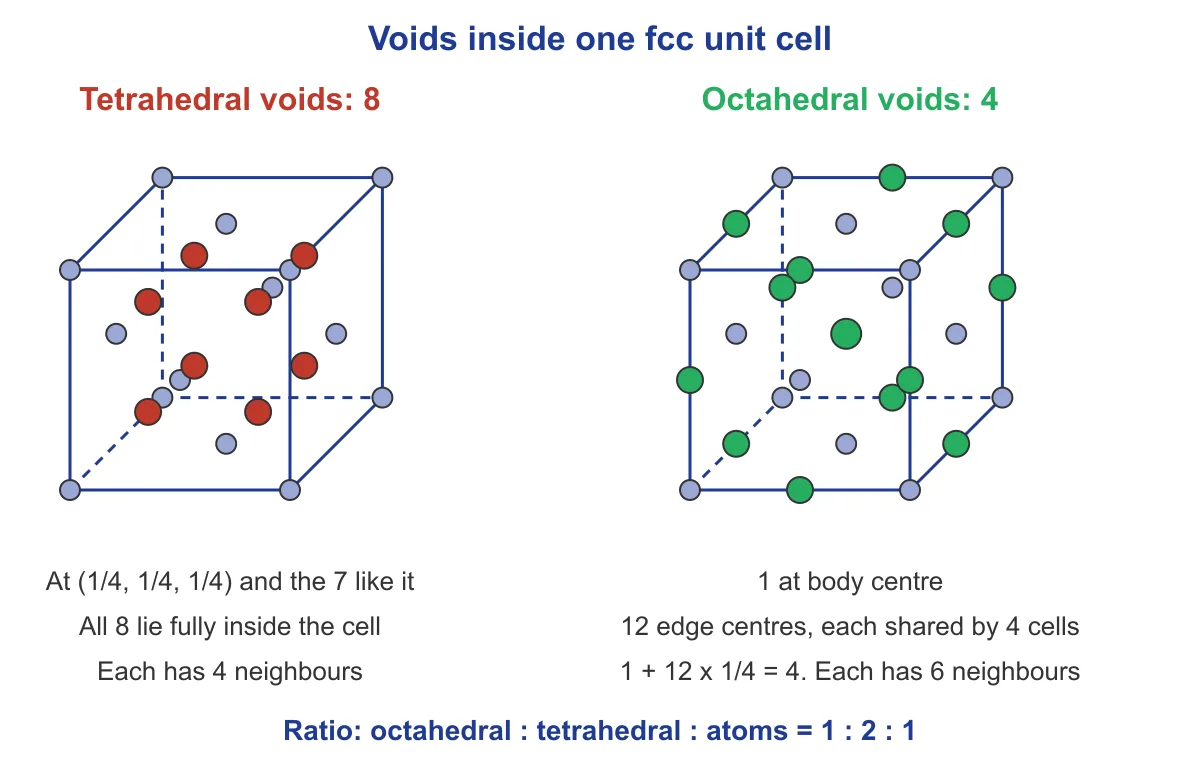
Figure 2.3: Tetrahedral voids (8 per fcc cell) and octahedral voids (4 per fcc cell)
How big is a void? Let R be the radius of the spheres forming the lattice and r the radius of the largest sphere that fits in the void without pushing the lattice apart.
For the octahedral void, look at one face of the fcc cell. The edge a equals $2\sqrt{2}\,R$ (shown in the next section). Along the edge, two corner spheres and the void between them lie in a line: $a = 2R + 2r$. So $2\sqrt{2}R = 2R + 2r$ and
For the tetrahedral void, the four spheres sit at alternate corners of a cube of edge $b$, so $b\sqrt{2} = 2R$. The centre of the cube is at distance $\frac{\sqrt{3}}{2}b$ from each corner, so $R + r = \frac{\sqrt{3}}{2}b = \sqrt{\frac{3}{2}}\,R$ and
Compounds with small ions fill voids of the lattice made by the large ions. If the unit cell has the large ions in ccp and the small ions occupy a fraction of a type of void, the formula follows from counting.
Packing efficiency, density and neighbours
Packing efficiency is the fraction of the cell volume actually occupied by the spheres:
The relation between the edge a and the radius r depends on where the atoms touch.
| Cell | Z | Atoms touch along | Relation | Packing efficiency | Coordination number |
|---|---|---|---|---|---|
| Simple cubic | 1 | Edge | $a = 2r$ | $\dfrac{\pi}{6} = 52.4\%$ | 6 |
| bcc | 2 | Body diagonal | $\sqrt{3}\,a = 4r$ | $\dfrac{\sqrt{3}\pi}{8} = 68\%$ | 8 |
| fcc (ccp) | 4 | Face diagonal | $\sqrt{2}\,a = 4r$ | $\dfrac{\pi}{3\sqrt{2}} = 74\%$ | 12 |
| hcp | 6 per hexagonal cell | Within layer | 74% | 12 |
Derivation for fcc: on a face, the diagonal has length $\sqrt{2}a$ and carries one whole sphere plus two half-spheres, which is 4r. So $a = 4r/\sqrt{2} = 2\sqrt{2}\,r$. Then
The empty space is 26% for fcc and hcp, 32% for bcc and 47.6% for simple cubic.
Nearest neighbours. The nearest-neighbour distance is $2r$ in every one of these cells. In terms of the edge it is a for simple cubic, $\frac{\sqrt{3}}{2}a$ for bcc and $\frac{a}{\sqrt{2}}$ for fcc.
Density. The cell contains Z atoms of molar mass M. The mass of one cell is $ZM/N_A$ and the volume is $a^3$:
Use M in g mol⁻¹ and a in cm (1 pm = 10⁻¹⁰ cm) to get ρ in g cm⁻³. For a compound, Z is the number of formula units per cell and M is the formula mass.
Example 1: Find the number of atoms in a cubic cell where atom X is at each corner and atom Y is at the centre of each face. Write the formula.
X: 8 corners × 1/8 = 1.
Y: 6 faces × 1/2 = 3.
Ratio X : Y = 1 : 3, so the formula is XY₃.
Notice that the corner atoms are all alike, so the cell count is a simple weighted sum.
Example 2: Copper is fcc with edge a = 361 pm and molar mass 63.5 g mol⁻¹. Find its density.
Z = 4. a = 361 × 10⁻¹⁰ cm = 3.61 × 10⁻⁸ cm.
a³ = 47.05 × 10⁻²⁴ cm³ = 4.705 × 10⁻²³ cm³.
$N_A a^3 = 6.022 \times 10^{23} \times 4.705 \times 10^{-23} = 28.33$.
ρ = 4 × 63.5 / 28.33 = 8.97 g cm⁻³.
The unit conversion is the only place marks are lost: always change pm to cm before cubing.
Example 3: An element is bcc with density 7.87 g cm⁻³ and molar mass 56 g mol⁻¹. Find the edge length and the atomic radius.
Z = 2. $a^3 = \dfrac{ZM}{\rho N_A} = \dfrac{2 \times 56}{7.87 \times 6.022 \times 10^{23}} = 2.363 \times 10^{-23}$ cm³.
a = 2.87 × 10⁻⁸ cm = 287 pm.
In bcc the atoms touch along the body diagonal, so $r = \dfrac{\sqrt{3}}{4}a = 0.433 \times 287 = 124$ pm.
Density gives the edge, and the contact line gives the radius. Two separate steps.
Ionic solids: radius ratio and common structures
In an ionic crystal the cations and anions touch each other, and the bigger anions usually form the lattice with the smaller cations in the voids. How many anions can surround a cation depends on the radius ratio $r_+/r_-$. A cation cannot be so small that anions around it touch each other while it rattles loose, and the structure is stable only when the cation touches all its neighbours.
| Radius ratio $r_+/r_-$ | Coordination number | Shape around the cation | Void type | Example |
|---|---|---|---|---|
| 0.155 to 0.225 | 3 | Trigonal planar | Triangular | B₂O₃ |
| 0.225 to 0.414 | 4 | Tetrahedral | Tetrahedral | ZnS |
| 0.414 to 0.732 | 6 | Octahedral | Octahedral | NaCl |
| 0.732 to 1.0 | 8 | Cubic | Cubic | CsCl |
The limits come from the geometry shown earlier: 0.225 and 0.414 are the void-to-sphere ratios for tetrahedral and octahedral voids, and 0.732 is $\sqrt{3} - 1$, the ratio for the cubic hole at the centre of a simple cubic arrangement of anions.
Three structures to know:
- Rock salt (NaCl). Cl⁻ forms an fcc lattice; Na⁺ fills all 4 octahedral voids. Z = 4 formula units per cell, coordination 6 : 6. Along the edge, Na⁺ and Cl⁻ touch: $a = 2(r_+ + r_-)$.
- Caesium chloride (CsCl). Cl⁻ sits at the 8 corners, Cs⁺ at the body centre. Z = 1, coordination 8 : 8. They touch along the body diagonal: $\sqrt{3}\,a = 2(r_+ + r_-)$.
- Zinc blende (ZnS). S²⁻ in fcc, Zn²⁺ in half of the 8 tetrahedral voids (4 of 8). Z = 4, coordination 4 : 4.
Example 4: In a crystal Y ions form ccp, and X ions occupy two-thirds of the octahedral voids. Find the formula.
Take 4 Y ions in the cell. Octahedral voids = 4.
X ions = 2/3 × 4 = 8/3.
Y : X = 4 : 8/3 = 12 : 8 = 3 : 2.
The formula is Y₃X₂.
Start from the count of the lattice ions; the void count follows from it, never the other way round.
Example 5: Cs⁺ has radius 169 pm and Cl⁻ has 181 pm. Predict the coordination number and the edge of the cubic cell.
$r_+/r_- = 169/181 = 0.934$, which is in the range 0.732 to 1.0, so coordination 8 and CsCl type.
Contact along the body diagonal: $\sqrt{3}\,a = 2(169 + 181) = 700$ pm.
$a = 700/\sqrt{3} = 404$ pm.
The cell is not fcc here, so the face-diagonal relation must not be used.
Example 6: What is the radius of the largest sphere that fits in the octahedral void of an fcc crystal of atoms of radius 200 pm?
For an octahedral void $r/R = 0.414$.
$r = 0.414 \times 200 = 82.8$ pm.
A larger ion would force the lattice atoms apart, so this is a maximum.
Point defects (elementary level)
A real crystal is never perfect. A point defect is a fault at or around a single lattice point.
Schottky defect. A cation and an anion are both missing from their sites, leaving a pair of vacancies. The number of positive and negative charges lost is equal, so the crystal stays neutral. The crystal has the same volume with fewer ions, so its density decreases. This is common in ionic solids with a high coordination number where the two ions are of similar size: NaCl, KCl, CsCl, AgBr.
Frenkel defect. An ion, usually the smaller cation, leaves its lattice site and sits in an interstitial hole nearby. It is a vacancy and an interstitial at once. No ion leaves the crystal, so the density stays the same. It is seen where the cation is much smaller than the anion and the coordination number is low: ZnS, AgCl, AgBr. AgBr shows both Schottky and Frenkel defects.
Impurity defect. A foreign ion enters the lattice. When SrCl₂ is added to NaCl, each Sr²⁺ takes the place of an Na⁺. Charge balance needs two Na⁺, so one Na⁺ site is left empty. The crystal now has a cation vacancy for every Sr²⁺ added.
| Defect | What happens | Density | Typical crystal |
|---|---|---|---|
| Schottky | Equal numbers of cations and anions missing | Decreases | NaCl, KCl, CsCl |
| Frenkel | Ion moves into an interstitial site | Unchanged | ZnS, AgCl |
| Impurity | Foreign ion of different charge replaces host ion | Depends on the ions | NaCl with SrCl₂ |
Memory trick: "Schottky Sheds, Frenkel Flits." Schottky sheds ions out of the crystal, so mass goes; Frenkel flits the ion to another spot, so nothing is lost.
Use it to decide the density change at once.
Example 7: NaCl is doped with 10⁻³ mol per cent of SrCl₂. How many cation vacancies are there per mole of NaCl?
10⁻³ mol per cent means 10⁻³ mol SrCl₂ in 100 mol of NaCl, which is 10⁻⁵ mol per mole of NaCl.
Each Sr²⁺ creates one cation vacancy, so vacancies = 10⁻⁵ × 6.022 × 10²³ = 6.022 × 10¹⁸ per mole.
The key is the one-to-one link between Sr²⁺ and a vacancy.
Common traps
- Counting corner atoms as whole atoms → give each corner 1/8, each face 1/2, each edge 1/4.
- Using $a = 2r$ for bcc or fcc → use $a = 4r/\sqrt{3}$ for bcc and $a = 4r/\sqrt{2}$ for fcc; $a = 2r$ is only for simple cubic.
- Putting a in pm into the density formula → convert to cm (1 pm = 10⁻¹⁰ cm) before cubing.
- Saying hcp is less efficient than ccp → both are 74% and have coordination number 12; they differ only in stacking.
- Remembering the octahedral and tetrahedral counts the wrong way round → octahedral = N, tetrahedral = 2N.
- Calling the tetrahedral void bigger because it has more of them → octahedral is bigger (0.414R against 0.225R).
- Taking CsCl as bcc → it is two interlocking simple cubic lattices; the cell has Z = 1 and the contact is along the body diagonal.
- Saying Frenkel defect lowers density → no ion leaves the crystal, so density is unchanged; only Schottky lowers it.
- Using the radius-ratio table as an exact law → it predicts the likely coordination number; the boundaries are limits, not sharp cut-offs.
- Calling graphite an insulator because it is covalent → it conducts along its layers.
Quick revision
- Crystalline: long-range order, sharp melting point, anisotropic. Amorphous: short-range order, no sharp melting point, isotropic.
- Four classes: ionic, covalent network, molecular, metallic.
- Seven systems: cubic, tetragonal, orthorhombic, hexagonal, rhombohedral, monoclinic, triclinic.
- Hexagonal: a = b ≠ c, γ = 120°. Rhombohedral: a = b = c, angles equal and not 90°. Monoclinic: only β ≠ 90°.
- Z = 1 (simple cubic), 2 (bcc), 4 (fcc), 6 (hcp hexagonal cell).
- Contact lines: edge (simple cubic), body diagonal (bcc), face diagonal (fcc).
- $a = 2r$, $a = \dfrac{4r}{\sqrt{3}}$, $a = \dfrac{4r}{\sqrt{2}}$ for simple cubic, bcc and fcc.
- Packing efficiency: 52.4%, 68%, 74%. Coordination: 6, 8, 12.
- hcp is ABAB; ccp is ABCABC with an fcc cell.
- N spheres give N octahedral and 2N tetrahedral voids; per fcc cell 4 and 8.
- Void radius ratios r/R: tetrahedral 0.225, octahedral 0.414.
- Radius ratio ranges 0.225, 0.414, 0.732 mark CN 4, 6, 8.
- $\rho = \dfrac{Z M}{N_A a^3}$ with a in cm.
- NaCl: Z = 4, $a = 2(r_+ + r_-)$. CsCl: Z = 1, $\sqrt{3}\,a = 2(r_+ + r_-)$.
- Schottky lowers density; Frenkel keeps it; impurity of higher-charge cation creates cation vacancies.
Practice questions
A crystal has edges a = b ≠ c and angles α = β = 90°, γ = 120°. Its crystal system is
- Tetragonal
- Rhombohedral
- Monoclinic
- Hexagonal
Answer
D. Hexagonal
Two equal edges, one different, and one angle of 120° with the other two at 90° is the hexagonal condition. Tetragonal has all angles 90°; rhombohedral has all edges equal.
Which of the following is an amorphous solid?
- Window glass
- Copper
- Diamond
- Rock salt
Answer
A. Window glass
Glass has only short-range order and no sharp melting point. The other three are crystalline.
The coordination number of an atom in a hexagonal close-packed structure is
- 6
- 8
- 12
- 4
Answer
C. 12
Each sphere touches 6 in its own layer, 3 in the layer above and 3 in the layer below: 6 + 3 + 3 = 12.
The packing efficiency of a cubic close-packed (ccp) structure is the same as that of
- Simple cubic packing
- Hexagonal close packing
- Square close packing in two dimensions
- Body-centred cubic packing
Answer
B. Hexagonal close packing
ccp and hcp both fill 74% of space and both have coordination number 12.
A crystal shows different values of electrical resistance when measured along different directions. This property is called
- Polymorphism
- Isotropy
- Anisotropy
- Allotropy
Answer
C. Anisotropy
Direction-dependent properties are anisotropic, a feature of crystalline solids. Isotropy means the same value in all directions.
Solid carbon dioxide (dry ice) is classified as
- A non-polar molecular solid
- An ionic solid
- A metallic solid
- A covalent network solid
Answer
A. A non-polar molecular solid
CO₂ is a non-polar molecule; the molecules are held in the crystal by weak dispersion forces.
Which defect lowers the density of an ionic crystal?
- Replacement of a cation by another cation of the same size and charge
- Shift of an ion to an interstitial site
- Frenkel defect
- Schottky defect
Answer
D. Schottky defect
In a Schottky defect ions leave the crystal while the volume stays the same, so mass per unit volume falls. Frenkel (and interstitial shift) loses no ion; same-charge substitution changes only the mass slightly, not through missing ions.
Frenkel defect is expected in
- NaCl
- AgCl
- CsCl
- KCl
Answer
B. AgCl
Frenkel defect occurs when the cation is much smaller than the anion and the coordination number is low, as with Ag⁺ in AgCl. NaCl, KCl and CsCl show Schottky defects.
A close-packed crystal has N atoms. The number of tetrahedral voids is
- N
- 2N
- N/2
- 4N
Answer
B. 2N
Each atom is associated with two tetrahedral voids and one octahedral void.
A cation of radius 0.52 times that of the surrounding anions is most likely to have a coordination number of
- 3
- 4
- 6
- 8
Answer
C. 6
0.52 lies between 0.414 and 0.732, the octahedral range, so the coordination number is 6.
For atoms of radius r in a body-centred cubic crystal, the edge length a is given by
- $a = \dfrac{4r}{\sqrt{3}}$
- $a = \dfrac{\sqrt{3}\,r}{4}$
- $a = 2r$
- $a = \dfrac{4r}{\sqrt{2}}$
Answer
A. $a = \dfrac{4r}{\sqrt{3}}$
Atoms touch along the body diagonal, which has length $\sqrt{3}\,a$ and equals 4r. So $a = 4r/\sqrt{3}$.
In a face-centred cubic unit cell the octahedral voids are located at
- The corners and the face centres
- The body centre and the centres of the edges
- The face centres only
- Points at one-quarter of each body diagonal
Answer
B. The body centre and the centres of the edges
One void is at the body centre and 12 are at edge centres, each shared by 4 cells: 1 + 3 = 4. The quarter points on the body diagonals are tetrahedral voids.
In the ABCABC… stacking of close-packed layers, the spheres of the third layer lie directly over
- The spheres of layer A
- The spheres of layer B
- The tetrahedral voids between layers A and B
- The octahedral voids between layers A and B
Answer
D. The octahedral voids between layers A and B
In ABA (hcp) the third layer sits over the spheres of layer A, i.e. over tetrahedral voids of the A-B pair. In ABC it sits over the other kind of dip, which is the octahedral void of the A-B pair.
Which statement about the CsCl crystal is incorrect?
- Each Cs⁺ ion is surrounded by 8 Cl⁻ ions
- Cs⁺ and Cl⁻ touch along the body diagonal of the cell
- Cl⁻ ions form a face-centred cubic lattice
- The unit cell contains one formula unit
Answer
C. Cl⁻ ions form a face-centred cubic lattice
In CsCl the Cl⁻ ions occupy only the 8 corners (a simple cubic arrangement) with Cs⁺ at the centre. An fcc lattice of Cl⁻ is the rock-salt arrangement.
The effective number of atoms in one hexagonal close-packed unit cell (the hexagonal prism) is
- 2
- 4
- 6
- 12
Answer
C. 6
Hexagonal prism: 12 corner atoms × 1/6 + 2 face-centre atoms × 1/2 + 3 inside atoms = 2 + 1 + 3 = 6.
A cubic unit cell has one atom at each of the 8 corners and one atom at the centre of each of the 12 edges. The number of atoms per cell is
- 4
- 7
- 13
- 2
Answer
A. 4
Corners 8 × 1/8 = 1; edges 12 × 1/4 = 3; total 4. Counting edges as 1/2 would give 7.
Aluminium is fcc with edge 405 pm and molar mass 27 g mol⁻¹. Its density in g cm⁻³ is (N_A = 6.022 × 10²³ mol⁻¹)
- 10.8
- 5.4
- 1.35
- 2.7
Answer
D. 2.7
Z = 4. a³ = (4.05 × 10⁻⁸)³ = 6.64 × 10⁻²³ cm³. ρ = 4 × 27 / (6.022 × 10²³ × 6.64 × 10⁻²³) = 108/40.0 = 2.7. Check: Z = 2 would give half of this.
For atoms of radius r in an fcc crystal with edge length a, the value of $(a/r)^2$ is
- 2
- 4
- 8
- 16
Answer
C. 8
Contact along the face diagonal: $\sqrt{2}\,a = 4r$, so $a/r = 2\sqrt{2}$ and $(a/r)^2 = 8$. Back-check: bcc would give 16/3.
The packing efficiency of a simple cubic arrangement, in per cent to one decimal place, is
- 74.0
- 68.0
- 47.6
- 52.4
Answer
D. 52.4
Z = 1, a = 2r: $\dfrac{\frac{4}{3}\pi r^3}{8r^3} = \dfrac{\pi}{6} = 0.5236$, i.e. 52.4%. 47.6% is the empty space.
A ccp lattice is made of 0.5 mol of atoms. The amount of tetrahedral voids, in mol, is
- 0.25
- 0.5
- 1
- 2
Answer
C. 1
Tetrahedral voids = 2 × number of atoms = 2 × 0.5 mol = 1 mol.
CsCl has a cubic cell of edge 412 pm and one formula unit per cell. Its molar mass is 168.4 g mol⁻¹. The density in g cm⁻³ is (N_A = 6.022 × 10²³ mol⁻¹)
- 4.0
- 8.0
- 0.5
- 2.0
Answer
A. 4.0
a³ = (4.12 × 10⁻⁸)³ = 6.99 × 10⁻²³ cm³. ρ = 168.4 / (6.022 × 10²³ × 6.99 × 10⁻²³) = 168.4/42.1 = 4.0. Using Z = 2 would give 8.0.
A crystal of the rock-salt type has a cubic cell of edge 500 pm. The sum of the cation and anion radii, in pm, is
- 433
- 250
- 500
- 125
Answer
B. 250
In the rock-salt cell the ions touch along the edge: a = 2(r₊ + r₋), so r₊ + r₋ = 500/2 = 250 pm. The value 433 comes from using the CsCl body-diagonal relation wrongly.
NaCl is doped with 10⁻³ mol per cent of SrCl₂. The number of cation vacancies per mole of NaCl, in units of 10¹⁸, is (N_A = 6.022 × 10²³ mol⁻¹)
- 0.6022
- 3.011
- 60.22
- 6.022
Answer
D. 6.022
10⁻³ mol per cent = 10⁻⁵ mol of SrCl₂ per mol NaCl. Each Sr²⁺ gives one vacancy: 10⁻⁵ × 6.022 × 10²³ = 6.022 × 10¹⁸.
Atoms A form a ccp lattice. Atoms B occupy all the tetrahedral voids and atoms C occupy all the octahedral voids. If the formula is written A_xB_yC_z in the smallest whole numbers, the value of x + y + z is
- 4
- 8
- 12
- 16
Answer
A. 4
Per 4 A atoms: 8 tetrahedral voids give 8 B and 4 octahedral voids give 4 C. A₄B₈C₄ reduces to AB₂C, so 1 + 2 + 1 = 4.
Spheres of radius 100 pm form an fcc lattice. The radius, in pm, of the largest sphere that fits in an octahedral void without disturbing the lattice is
- 20.7
- 41.4
- 73.2
- 22.5
Answer
B. 41.4
For an octahedral void $r/R = \sqrt{2} - 1 = 0.414$, so r = 41.4 pm. The values 22.5 and 73.2 belong to the tetrahedral and cubic holes.
A metal is fcc with edge 409 pm and density 10.5 g cm⁻³. Its molar mass in g mol⁻¹, to the nearest whole number, is (N_A = 6.022 × 10²³ mol⁻¹)
- 216
- 108
- 54
- 432
Answer
B. 108
M = ρ N_A a³ / Z. a³ = (4.09 × 10⁻⁸)³ = 6.84 × 10⁻²³ cm³. M = 10.5 × 6.022 × 10²³ × 6.84 × 10⁻²³ / 4 = 432.5/4 = 108.
Given below are two statements: Statement I: Crystalline solids have a sharp melting point. Statement II: Amorphous solids have long-range order of particles.
- Both Statement I and Statement II are correct
- Both Statement I and Statement II are incorrect
- Statement I is correct but Statement II is incorrect
- Statement I is incorrect but Statement II is correct
Answer
C. Statement I is correct but Statement II is incorrect
Statement I is correct. Statement II is wrong: amorphous solids have only short-range order.
Given below are two statements: Statement I: Frenkel defect decreases the density of a crystal. Statement II: Schottky defect is more likely in a crystal in which cation and anion are of similar size and the coordination number is high.
- Both Statement I and Statement II are correct
- Both Statement I and Statement II are incorrect
- Statement I is correct but Statement II is incorrect
- Statement I is incorrect but Statement II is correct
Answer
D. Statement I is incorrect but Statement II is correct
Frenkel defect moves an ion within the crystal, so density is unchanged; Statement I is wrong. Statement II is the usual condition for Schottky defect.
Given below are two statements: Statement I: In a ccp lattice the number of tetrahedral voids is double the number of octahedral voids. Statement II: In an hcp lattice the number of octahedral voids equals the number of atoms.
- Both Statement I and Statement II are correct
- Both Statement I and Statement II are incorrect
- Statement I is correct but Statement II is incorrect
- Statement I is incorrect but Statement II is correct
Answer
A. Both Statement I and Statement II are correct
Both lattices have N octahedral and 2N tetrahedral voids for N atoms.
Given below are two statements: Statement I: In a body-centred cubic cell, atoms touch each other along the face diagonal. Statement II: In a face-centred cubic cell, atoms touch each other along the body diagonal.
- Both Statement I and Statement II are correct
- Both Statement I and Statement II are incorrect
- Statement I is correct but Statement II is incorrect
- Statement I is incorrect but Statement II is correct
Answer
B. Both Statement I and Statement II are incorrect
bcc atoms touch along the body diagonal and fcc atoms along the face diagonal, so both statements have the lines swapped.
Given below are two statements: Statement I: Solid sodium chloride conducts electricity because it contains ions. Statement II: Molten sodium chloride conducts electricity because its ions are free to move.
- Both Statement I and Statement II are correct
- Both Statement I and Statement II are incorrect
- Statement I is correct but Statement II is incorrect
- Statement I is incorrect but Statement II is correct
Answer
D. Statement I is incorrect but Statement II is correct
In the solid the ions are fixed in the lattice, so it does not conduct; Statement I is wrong. Statement II is correct.
Assertion (A): Hexagonal close packing and cubic close packing have the same packing efficiency. Reason (R): In both, each sphere is surrounded by 12 others, in layers that are close packed.
- Both A and R are true and R is the correct explanation of A
- Both A and R are true but R is not the correct explanation of A
- A is true but R is false
- A is false but R is true
Answer
A. Both A and R are true and R is the correct explanation of A
Both arrangements fill 74% of space because each sphere has 12 neighbours in close-packed layers; only the stacking order differs.
Assertion (A): In CsCl each ion is surrounded by 8 ions of opposite charge. Reason (R): CsCl has a body-centred cubic lattice made of identical particles.
- Both A and R are true and R is the correct explanation of A
- Both A and R are true but R is not the correct explanation of A
- A is true but R is false
- A is false but R is true
Answer
C. A is true but R is false
A is true: coordination number 8 : 8. R is false: the corner and centre particles are different ions, so the lattice is simple cubic with a two-ion basis, not bcc.
Assertion (A): A ccp lattice has twice as many octahedral voids as atoms. Reason (R): Each octahedral void is surrounded by six spheres.
- Both A and R are true and R is the correct explanation of A
- Both A and R are true but R is not the correct explanation of A
- A is true but R is false
- A is false but R is true
Answer
D. A is false but R is true
A is false: octahedral voids equal the number of atoms; it is the tetrahedral voids that are twice as many. R is true.
Match List I with List II. List I: a. Simple cubic cell b. Body-centred cubic cell c. Face-centred cubic cell d. Hexagonal close-packed cell (hexagonal prism) List II: i. 1 atom per cell ii. 2 atoms per cell iii. 4 atoms per cell iv. 6 atoms per cell
- a-iv, b-iii, c-ii, d-i
- a-i, b-ii, c-iii, d-iv
- a-ii, b-i, c-iii, d-iv
- a-i, b-iii, c-ii, d-iv
Answer
B. a-i, b-ii, c-iii, d-iv
Simple cubic 8 × 1/8 = 1; bcc 1 + 1 = 2; fcc 1 + 3 = 4; hcp prism 6.
Match List I with List II. List I: a. Radius ratio 0.155 to 0.225 b. Radius ratio 0.225 to 0.414 c. Radius ratio 0.414 to 0.732 d. Radius ratio 0.732 to 1.0 List II: i. Octahedral, coordination number 6 ii. Cubic, coordination number 8 iii. Tetrahedral, coordination number 4 iv. Trigonal planar, coordination number 3
- a-iv, b-iii, c-i, d-ii
- a-iv, b-iii, c-ii, d-i
- a-i, b-ii, c-iii, d-iv
- a-iii, b-iv, c-i, d-ii
Answer
A. a-iv, b-iii, c-i, d-ii
Ranges rise in coordination number 3, 4, 6, 8 with increasing ratio, so a-iv, b-iii, c-i, d-ii.
Match List I with List II. List I: a. Diamond b. Ice c. Silver d. Sodium chloride List II: i. Metallic solid ii. Covalent network solid iii. Ionic solid iv. Hydrogen-bonded molecular solid
- a-iv, b-ii, c-i, d-iii
- a-ii, b-iv, c-i, d-iii
- a-ii, b-iv, c-iii, d-i
- a-ii, b-i, c-iv, d-iii
Answer
B. a-ii, b-iv, c-i, d-iii
Diamond is a covalent network solid; ice is a hydrogen-bonded molecular solid; silver is metallic; sodium chloride is ionic.
Atoms X form a ccp lattice. Atoms Y occupy one-quarter of the tetrahedral voids and atoms Z occupy one-half of the octahedral voids. The formula of the compound is
- X₂YZ
- XYZ
- XY₂Z₂
- XYZ₂
Answer
A. X₂YZ
For 4 X atoms: tetrahedral voids 8, so Y = 8/4 = 2; octahedral voids 4, so Z = 4/2 = 2. X₄Y₂Z₂ reduces to X₂YZ.
A metal crystallises in a body-centred cubic lattice. Its density is 7.87 g cm⁻³ and its molar mass is 56 g mol⁻¹. The atomic radius in pm is closest to (N_A = 6.022 × 10²³ mol⁻¹)
- 287
- 143
- 124
- 101
Answer
C. 124
Z = 2: a³ = 2 × 56 / (7.87 × 6.022 × 10²³) = 2.36 × 10⁻²³ cm³, so a = 287 pm. In bcc r = √3 a / 4 = 0.433 × 287 = 124 pm. 287 is the edge, 143 is a/2, and 101 would come from the fcc relation.
An ionic compound AB has M = 74.5 g mol⁻¹, r(A⁺) = 95 pm and r(B⁻) = 181 pm. Using the radius-ratio rule to choose the structure, with the ions touching along the cell edge or body diagonal as that structure requires, the density in g cm⁻³ is closest to (N_A = 6.022 × 10²³ mol⁻¹)
- 5.88
- 3.82
- 1.47
- 2.94
Answer
D. 2.94
Ratio 95/181 = 0.525, in 0.414–0.732, so coordination 6, rock-salt type, Z = 4. a = 2(95 + 181) = 552 pm. a³ = 1.682 × 10⁻²² cm³. ρ = 4 × 74.5 / (6.022 × 10²³ × 1.682 × 10⁻²²) = 298/101.3 = 2.94. The value 3.82 comes from using the CsCl structure.