Compounds of p-Block Elements
What to remember
- Boron is electron-deficient: BF₃ and AlCl₃ are Lewis acids, B₂H₆ has two three-centre two-electron (3c–2e) bridge bonds, and B(OH)₃ is a weak monobasic Lewis acid, not a proton donor.
- Carbon forms strong pπ–pπ multiple bonds, so CO₂ is a gas. Silicon does not, so SiO₂ is a network of SiO₄ tetrahedra, and silicates, silicones and zeolites are built from the same unit.
- The basicity of a phosphorus oxoacid equals the number of P–OH groups. P–H bonds never ionise and make the acid reducing.
- Industrial routes: Haber (N₂ + 3H₂ ⇌ 2NH₃, Fe), Ostwald (NH₃ → NO → NO₂ → HNO₃, Pt–Rh), contact (SO₂ → SO₃ over V₂O₅, absorbed in H₂SO₄ to give oleum).
- Xenon fluorides come from direct fluorination; VSEPR gives XeF₂ linear, XeF₄ square planar, XeF₆ distorted octahedral, XeO₃ pyramidal, XeOF₄ square pyramidal.
Group 13: boron and aluminium
Reactivity
Boron is inert to cold acids and alkalis. Hot concentrated oxidising acids and molten alkali attack it: B + 3HNO₃ → H₃BO₃ + 3NO₂; 2B + 6NaOH → 2Na₃BO₃ + 3H₂ (fused).
Aluminium is a reducing metal under a thin Al₂O₃ film. Dilute HCl dissolves it with H₂, concentrated HNO₃ makes it passive, and it dissolves in alkali: 2Al + 2NaOH + 6H₂O → 2Na[Al(OH)₄] + 3H₂. Both burn in halogens to give trihalides, 2E + 3X₂ → 2EX₃. Down the group the +1 state becomes more stable (inert-pair effect).
Borax and boric acid
Borax is Na₂B₄O₇·10H₂O, better written Na₂[B₄O₅(OH)₄]·8H₂O. It is made from boric acid, 4H₃BO₃ + Na₂CO₃ → Na₂B₄O₇ + CO₂ + 6H₂O. Its solution is alkaline: Na₂B₄O₇ + 7H₂O → 2NaOH + 4H₃BO₃. On heating it loses water and melts to a glass of NaBO₂ and B₂O₃, which dissolves metal oxides as coloured metaborates. This is the borax bead test: Cu²⁺ blue, Co²⁺ deep blue, Cr³⁺ green, Mn²⁺ violet, Ni²⁺ brown. Borax is used as a flux and in glass and enamel.
H₃BO₃ is made by Na₂B₄O₇ + 2HCl + 5H₂O → 2NaCl + 4H₃BO₃. Its flaky crystals hold planar B(OH)₃ units in hydrogen-bonded layers. It does not release H⁺; it takes OH⁻ from water:
B(OH)₃ + 2H₂O ⇌ [B(OH)₄]⁻ + H₃O⁺
It is therefore a weak monobasic Lewis acid. Glycerol or mannitol binds the borate and strengthens the acid, so it can be titrated with NaOH. On heating: H₃BO₃ → HBO₂ → H₂B₄O₇ → B₂O₃. With ethanol and concentrated H₂SO₄ it gives B(OC₂H₅)₃, which burns with a green-edged flame.
Diborane
Preparation: 4BF₃ + 3LiAlH₄ → 2B₂H₆ + 3LiF + 3AlF₃. B₂H₆ has only 12 valence electrons, too few for eight ordinary bonds.
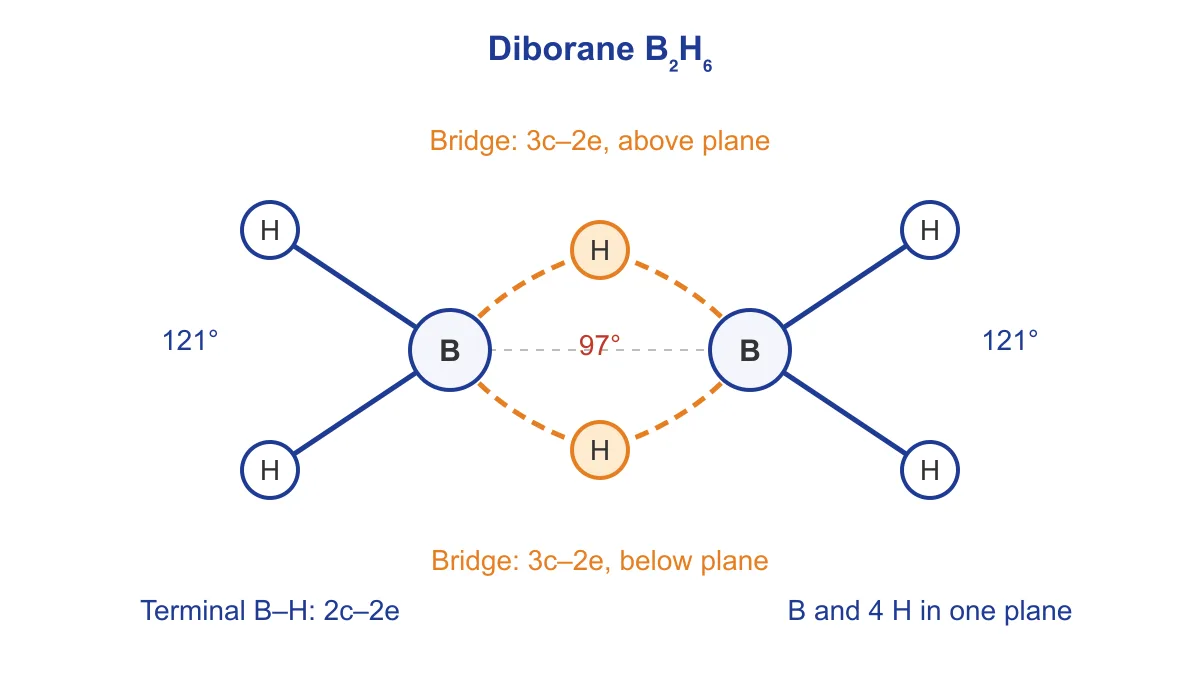
Figure 5.1: Diborane. Four terminal 2c–2e B–H bonds and two bridge 3c–2e B–H–B bonds.
- Each B is sp³. The four terminal B–H bonds (8 electrons) are normal, and the two B and four terminal H lie in one plane.
- The two bridging H lie above and below that plane. Each bridge is a banana bond: 2 electrons hold three atoms (4 electrons for two bridges).
- Terminal H–B–H is about 121°, bridge B–H–B about 97°.
Reactions: B₂H₆ + 6H₂O → 2H₃BO₃ + 6H₂; B₂H₆ + 3O₂ → B₂O₃ + 3H₂O. With NH₃ it cleaves unsymmetrically, B₂H₆ + 2NH₃ → [BH₂(NH₃)₂]⁺[BH₄]⁻.
Memory trick: "Terminal two-two, bridge three-two." Terminal bonds are 2c–2e, bridge bonds 3c–2e. Use it to count the electrons in B₂H₆.
BF₃, AlCl₃ and alums
BF₃ is a planar gas (B₂O₃ + 3CaF₂ + 3H₂SO₄ → 2BF₃ + 3CaSO₄ + 3H₂O). Boron has an empty 2p orbital, so BF₃ + NH₃ → F₃B←NH₃. Hydrolysis: 4BF₃ + 3H₂O → H₃BO₃ + 3H[BF₄]. The Lewis acidity order is BF₃ < BCl₃ < BBr₃, because fluorine donates a lone pair back into boron's empty 2p orbital most effectively (pπ–pπ back bonding).
AlCl₃ is made dry, 2Al + 3Cl₂ → 2AlCl₃. Heating AlCl₃·6H₂O fails, because it hydrolyses to Al₂O₃ and HCl. In the vapour it is the dimer Al₂Cl₆: each Al is sp³ with two bridging Cl that donate lone pairs, so every atom has an octet. In water it gives [Al(H₂O)₆]³⁺ and Cl⁻. It is a Friedel–Crafts catalyst.
Alums are double salts, M⁺M³⁺(SO₄)₂·12H₂O, for example potash alum K₂SO₄·Al₂(SO₄)₃·24H₂O (M³⁺ = Al, Cr, Fe; M⁺ = K, Na, NH₄). In water they give the separate ions K⁺, Al³⁺ and SO₄²⁻. Uses: purifying water (Al³⁺ coagulates clay), mordant in dyeing, tanning.
Group 14: carbon and silicon
Allotropes of carbon
| Form | Hybridisation | Structure | Key properties |
|---|---|---|---|
| Diamond | sp³ | Each C bonded to 4 C; C–C 154 pm | Hardest, insulator |
| Graphite | sp² | Hexagonal layers, 335 pm apart | Soft, conducts along layers |
| Fullerene C₆₀ | sp² | 20 hexagons, 12 pentagons | Dissolves in benzene |
In graphite the fourth electron of each carbon is delocalised, so it conducts. The layers are held only by weak van der Waals forces, so they slide.
CO and CO₂
CO forms by HCOOH + conc. H₂SO₄ → CO + H₂O (dehydration), or as water gas, C + H₂O → CO + H₂. It is colourless, neutral and very poisonous, since it binds haemoglobin more strongly than O₂ does. It is a reducing agent (Fe₂O₃ + 3CO → 2Fe + 3CO₂) and forms COCl₂ and Ni(CO)₄. The structure is :C≡O:.
CO₂ comes from CaCO₃ + 2HCl → CaCl₂ + CO₂ + H₂O. It is linear, non-polar and acidic. Lime water turns milky, and clears with excess gas as Ca(HCO₃)₂ forms. Burning Mg continues in it: 2Mg + CO₂ → 2MgO + C.
SiO₂, silicones, silicates, zeolites
In SiO₂ each Si sits in a tetrahedron of 4 O and each O is shared by two Si. Silicon prefers four Si–O single bonds to double bonds, so quartz is a high-melting solid while CO₂ is a gas. Only HF attacks it among acids: SiO₂ + 4HF → SiF₄ + 2H₂O. Hot NaOH gives silicate, and coke at high temperature gives carborundum, SiO₂ + 3C → SiC + 2CO.
Silicones are polymers of –[O–Si(CH₃)₂]–. 2CH₃Cl + Si → (CH₃)₂SiCl₂ (Cu, 570 K); hydrolysis gives (CH₃)₂Si(OH)₂, which condenses into chains. (CH₃)₃SiCl stops chains and CH₃SiCl₃ cross-links them. They resist water and heat and insulate well.
Silicates are built from SiO₄⁴⁻. They differ in how many corners each tetrahedron shares.
| Type | Shared corners per Si | Anion | Example |
|---|---|---|---|
| Ortho | 0 | SiO₄⁴⁻ | Zircon |
| Pyro | 1 | Si₂O₇⁶⁻ | Thortveitite |
| Cyclic | 2 | Si₃O₉⁶⁻, Si₆O₁₈¹²⁻ | Beryl |
| Single chain | 2 | (SiO₃)ₙ²ⁿ⁻ | Spodumene |
| Double chain | 2 and 3 | (Si₄O₁₁)ₙ⁶ⁿ⁻ | Asbestos |
| Sheet | 3 | (Si₂O₅)ₙ²ⁿ⁻ | Talc, mica |
| 3D | 4 | SiO₂ | Quartz |
If each tetrahedron shares $s$ corners, each Si owns $4 - \frac{s}{2}$ oxygen atoms and carries charge $-(4 - s)$. That gives any formula quickly.
Memory trick: "Zero, one, two, two, two-and-a-half, three, four." Shared corners from ortho to 3D. Oxygen per Si falls 4, 3.5, 3, 3, 2.75, 2.5, 2 in step.
Zeolites are three-dimensional aluminosilicates where some Si⁴⁺ are replaced by Al³⁺. Each replacement leaves one negative charge, balanced by exchangeable Na⁺, K⁺ or Ca²⁺ in channels. Uses: water softening, molecular sieves, and the shape-selective catalyst ZSM-5, which converts methanol to gasoline-range hydrocarbons.
Group 15: nitrogen and phosphorus
Allotropes of phosphorus
- White: P₄ tetrahedra with 60° angles, so very reactive. It glows in the dark, ignites near 303 K, dissolves in CS₂, is poisonous and is kept under water.
- Red: P₄ units linked into chains, made by heating white P at 570 K without air. Insoluble in CS₂, non-poisonous, ignites near 540 K.
- Black: layered, formed by heating white P under pressure. It is the most stable form and conducts.
Nitrogen and ammonia
N₂ is made from NH₄Cl + NaNO₂, or (very pure) from Ba(N₃)₂. The N≡N bond (945 kJ mol⁻¹) makes it inert; hot, it gives nitrides (6Li + N₂ → 2Li₃N) and calcium cyanamide (CaC₂ + N₂ → CaCN₂ + C).
NH₃ is pyramidal with a lone pair, and boils high because of hydrogen bonding. Lab preparation: 2NH₄Cl + Ca(OH)₂ → 2NH₃ + CaCl₂ + 2H₂O, dried over CaO, never over CaCl₂, H₂SO₄ or P₄O₁₀. It complexes metal ions: Cu²⁺ + 4NH₃ → [Cu(NH₃)₄]²⁺ (deep blue).
Haber process: N₂ + 3H₂ ⇌ 2NH₃, ΔH = −92 kJ. High pressure (about 200 bar) favours fewer moles. Low temperature favours the exothermic forward reaction but is slow, so about 700 K with iron (promoters K₂O, Al₂O₃) is the compromise.
Nitric acid and oxides of nitrogen
Ostwald process:
- 4NH₃ + 5O₂ → 4NO + 6H₂O over Pt–Rh gauze, about 500 K, 9 bar
- 2NO + O₂ → 2NO₂
- 3NO₂ + H₂O → 2HNO₃ + NO, with NO recycled to step 2
Overall, each NH₃ gives one HNO₃. The product is about 68% acid.
The product with metals depends on concentration:
- Cu, concentrated: Cu + 4HNO₃ → Cu(NO₃)₂ + 2NO₂ + 2H₂O
- Cu, dilute: 3Cu + 8HNO₃ → 3Cu(NO₃)₂ + 2NO + 4H₂O
- Zn, dilute: 4Zn + 10HNO₃ → 4Zn(NO₃)₂ + N₂O + 5H₂O; very dilute gives NH₄NO₃
- Fe, Al, Cr turn passive in the concentrated acid; Au and Pt dissolve only in aqua regia
Non-metals go to their highest oxoacids with NO₂: C → CO₂, S → H₂SO₄, P₄ → H₃PO₄.
| Oxide | N state | Nature | Notes |
|---|---|---|---|
| N₂O | +1 | Neutral | Laughing gas, linear |
| NO | +2 | Neutral | Colourless, paramagnetic |
| N₂O₃ | +3 | Acidic | Blue solid below 250 K |
| NO₂ | +4 | Acidic | Brown, bent, dimerises to N₂O₄ |
| N₂O₄ | +4 | Acidic | Colourless, diamagnetic |
| N₂O₅ | +5 | Acidic | Anhydride of HNO₃; solid [NO₂]⁺[NO₃]⁻ |
PH₃, PCl₃, PCl₅
PH₃ forms from P₄ + 3NaOH + 3H₂O → PH₃ + 3NaH₂PO₂, or Ca₃P₂ + 6H₂O → 3Ca(OH)₂ + 2PH₃. It smells of rotten fish, is poisonous, and is a much weaker base than NH₃ (H–P–H 93.5°, H–N–H 107°). Impure PH₃ ignites in air.
PCl₃ forms from P₄ + 6Cl₂ → 4PCl₃. It is pyramidal and hydrolyses fully: PCl₃ + 3H₂O → H₃PO₃ + 3HCl. It turns –OH into –Cl: 3CH₃COOH + PCl₃ → 3CH₃COCl + H₃PO₃.
PCl₅ forms from excess Cl₂ (PCl₃ + Cl₂ ⇌ PCl₅). The gas is trigonal bipyramidal (sp³d) with longer axial bonds (219 pm) than equatorial (204 pm), since each axial bond has three neighbours at 90° and each equatorial bond only two. The solid is [PCl₄]⁺[PCl₆]⁻. Hydrolysis: PCl₅ + H₂O → POCl₃ + 2HCl; POCl₃ + 3H₂O → H₃PO₄ + 3HCl.
Oxoacids of phosphorus
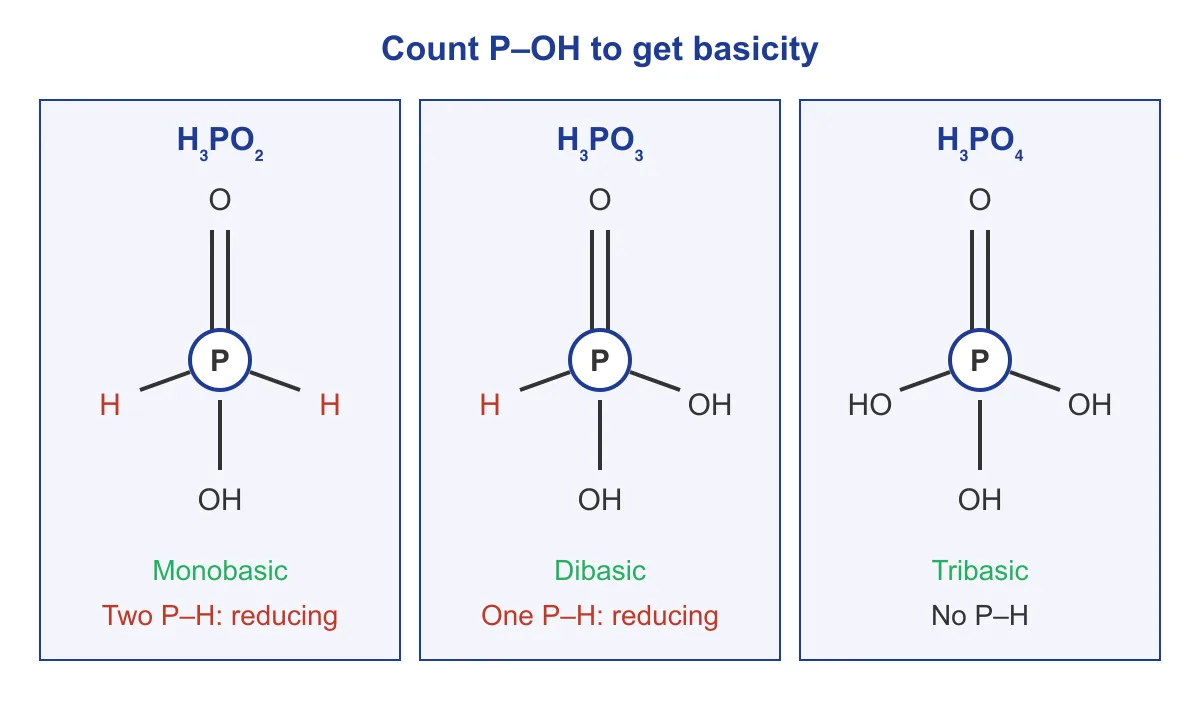
Figure 5.2: H₃PO₂, H₃PO₃ and H₃PO₄. Count the P–OH groups to get basicity.
| Acid | Formula | P state | P–OH | P–H | Basicity |
|---|---|---|---|---|---|
| Hypophosphorous | H₃PO₂ | +1 | 1 | 2 | 1 |
| Phosphorous | H₃PO₃ | +3 | 2 | 1 | 2 |
| Hypophosphoric | H₄P₂O₆ | +4 | 4 | 0 | 4 |
| Orthophosphoric | H₃PO₄ | +5 | 3 | 0 | 3 |
| Pyrophosphoric | H₄P₂O₇ | +5 | 4 | 0 | 4 |
H₃PO₂ and H₃PO₃ are reducing because of P–H. H₄P₂O₆ has a P–P bond and H₄P₂O₇ a P–O–P bridge. Heating H₃PO₃ disproportionates it: 4H₃PO₃ → 3H₃PO₄ + PH₃.
Memory trick: "Only O–H gives H." Hydrogen on oxygen ionises, hydrogen on phosphorus does not. Count OH for basicity, count P–H for reducing power.
Group 16: oxygen and sulphur
Oxides and oxygen
Acidic oxides come from non-metals (SO₂, CO₂, P₄O₁₀), basic from active metals (Na₂O, CaO), amphoteric ones are Al₂O₃, ZnO, BeO, and neutral ones CO, NO, N₂O, H₂O. Peroxides hold O₂²⁻ (Na₂O₂); superoxides hold O₂⁻ (KO₂, paramagnetic).
O₂ is made by 2KClO₃ → 2KCl + 3O₂ (MnO₂) or by distilling liquid air. It is paramagnetic, with two unpaired electrons in π* orbitals.
Ozone
3O₂ → 2O₃ in a silent electric discharge, ΔH = +285 kJ for 2 mol O₃. It is a pale blue, bent (117°), diamagnetic gas and a strong oxidiser:
- PbS + 4O₃ → PbSO₄ + 4O₂
- 2KI + H₂O + O₃ → 2KOH + I₂ + O₂ (blue on starch–iodide paper; I₂ can be titrated with thiosulphate)
- 2Ag + O₃ → Ag₂O + O₂; mercury loses its meniscus (tailing)
- NO + O₃ → NO₂ + O₂, one route of ozone-layer loss
Sulphur and sulphur dioxide
Sulphur forms puckered S₈ rings. Rhombic sulphur (α) is stable below 369 K and monoclinic (β) above it. Both dissolve in CS₂.
SO₂ comes from burning sulphur, roasting pyrites (4FeS₂ + 11O₂ → 2Fe₂O₃ + 8SO₂) or Na₂SO₃ + 2HCl → 2NaCl + SO₂ + H₂O. It is bent (about 119°), acidic, and very soluble. It is a reducing agent: it decolourises MnO₄⁻ (5SO₂ + 2MnO₄⁻ + 2H₂O → 5SO₄²⁻ + 4H⁺ + 2Mn²⁺) and turns Cr₂O₇²⁻ green. Its bleaching is by reduction and is temporary. Against H₂S it oxidises: 2H₂S + SO₂ → 3S + 2H₂O.
Sulphuric acid and oxoacids of sulphur
Contact process:
- S + O₂ → SO₂, then purify the gas
- 2SO₂ + O₂ ⇌ 2SO₃, ΔH = −196 kJ, V₂O₅, about 720 K, 2 bar
- SO₃ + H₂SO₄ → H₂S₂O₇ (oleum), then H₂S₂O₇ + H₂O → 2H₂SO₄
SO₃ is not passed into water directly, since that forms a mist.
H₂SO₄ is tetrahedral at S, with two S=O and two S–OH. The concentrated acid dehydrates (chars sugar) and oxidises: Cu + 2H₂SO₄ → CuSO₄ + SO₂ + 2H₂O. It is dibasic (NaHSO₄, Na₂SO₄), displaces volatile acids (NaCl + H₂SO₄ → NaHSO₄ + HCl), but oxidises HBr and HI.
| Acid | Formula | S state | Feature |
|---|---|---|---|
| Sulphurous | H₂SO₃ | +4 | One S=O |
| Thiosulphuric | H₂S₂O₃ | +2 (average) | S–S bond |
| Dithionous | H₂S₂O₄ | +3 | S–S bond |
| Dithionic | H₂S₂O₆ | +5 | S–S bond |
| Pyrosulphuric | H₂S₂O₇ | +6 | S–O–S bridge |
| Peroxomonosulphuric | H₂SO₅ | +6 | One O–O |
| Peroxodisulphuric | H₂S₂O₈ | +6 | O–O joining two SO₃H |
In peroxy acids the O–O oxygens are −1, so sulphur is still +6.
Group 17: chlorine and its compounds
Chlorine and hydrogen chloride
Cl₂ is made from MnO₂ + 4HCl → MnCl₂ + Cl₂ + 2H₂O, by the Deacon process (4HCl + O₂ → 2Cl₂ + 2H₂O, CuCl₂, 720 K), or by electrolysing brine. It bleaches moist colours permanently: Cl₂ + H₂O → HCl + HOCl, and HOCl → HCl + [O]. It disproportionates in alkali: cold dilute NaOH gives NaCl + NaOCl; hot concentrated gives 3Cl₂ + 6NaOH → 5NaCl + NaClO₃ + 3H₂O. Excess NH₃ gives N₂ and NH₄Cl; excess Cl₂ gives NCl₃.
HCl is made by NaCl + H₂SO₄ → NaHSO₄ + HCl (below 420 K). A 3 : 1 mixture of HCl and HNO₃ is aqua regia; it dissolves gold because Cl⁻ complexes the metal ion.
Interhalogen compounds
Two halogens combine as XX′, XX′₃, XX′₅ or XX′₇, with the larger atom X at the centre.
| Type | Examples | Central atom | Shape |
|---|---|---|---|
| XX′ | ClF, ICl | none | Linear |
| XX′₃ | ClF₃, BrF₃ | sp³d, 2 lone pairs | T-shaped |
| XX′₅ | BrF₅, IF₅ | sp³d², 1 lone pair | Square pyramidal |
| XX′₇ | IF₇ | sp³d³, 0 lone pairs | Pentagonal bipyramidal |
They are more reactive than the parent halogens (except F₂) because X–X′ is weaker than X–X. They are covalent and diamagnetic. Hydrolysis gives a halide and an oxohalide: ICl + H₂O → HCl + HOI; BrF₅ + 3H₂O → HBrO₃ + 5HF; IF₇ + 6H₂O → H₅IO₆ + 7HF.
Oxoacids of halogens
For chlorine: HOCl (+1), HClO₂ (+3), HClO₃ (+5), HClO₄ (+7). Acid strength rises with oxidation number, because more terminal oxygens spread the anion's charge: HOCl < HClO₂ < HClO₃ < HClO₄. Down the group, HOCl > HOBr > HOI. The anions ClO⁻, ClO₂⁻, ClO₃⁻, ClO₄⁻ are linear, bent, pyramidal and tetrahedral. Fluorine forms only the unstable HOF. Hypochlorite disproportionates on heating: 3ClO⁻ → ClO₃⁻ + 2Cl⁻.
Bleaching powder
Cl₂ over dry slaked lime gives CaOCl₂, a mixed salt Ca(OCl)Cl: Ca(OH)₂ + Cl₂ → CaOCl₂ + H₂O. Dilute acid releases chlorine, CaOCl₂ + H₂SO₄ → CaSO₄ + Cl₂ + H₂O, and this "available chlorine" measures its strength. Uses: bleaching cotton, disinfecting water, oxidising agent. It weakens on storage as CO₂ in air acts on it.
Group 18: xenon compounds
Helium fills balloons and cools magnets, neon lights signs, argon fills bulbs and shields welding, xenon is used in lamps and radon in radiotherapy.
Xenon reacts with F₂ and the ratio and pressure set the product:
- Xe + F₂ → XeF₂ (excess Xe, 670 K, 1 bar)
- Xe + 2F₂ → XeF₄ (1 : 5, 870 K, 7 bar)
- Xe + 3F₂ → XeF₆ (1 : 20, 570 K, 60–70 bar)
Hydrolysis: 2XeF₂ + 2H₂O → 2Xe + 4HF + O₂; 6XeF₄ + 12H₂O → 4Xe + 2XeO₃ + 24HF + 3O₂; XeF₆ + 3H₂O → XeO₃ + 6HF; partial: XeF₆ + H₂O → XeOF₄ + 2HF.
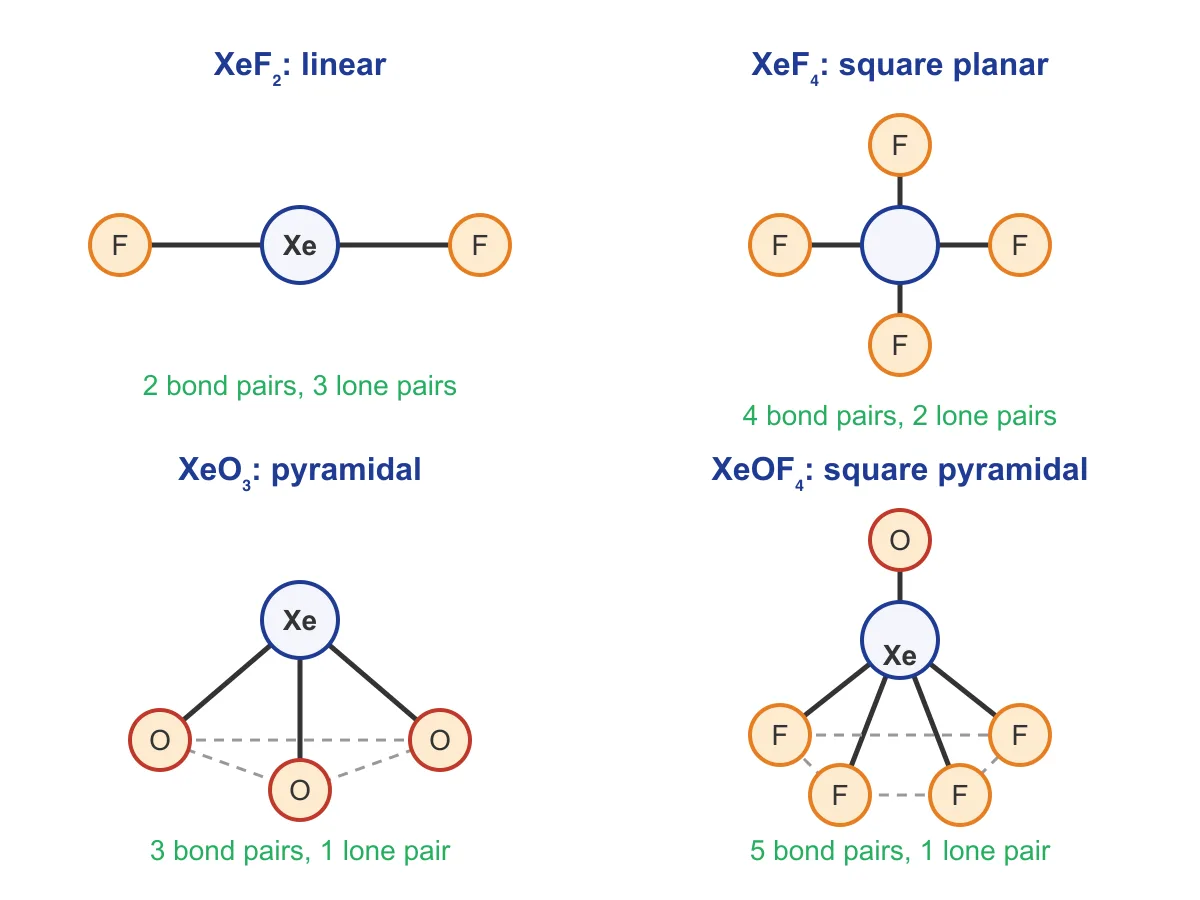
Figure 5.3: Shapes from VSEPR. Lone pairs take the positions that leave the atoms in the shape named.
To find a shape, give each F or O atom one bond pair and treat the rest of xenon's 8 valence electrons as lone pairs, then place them where repulsion is least.
| Species | Bond pairs | Lone pairs | Hybridisation | Shape |
|---|---|---|---|---|
| XeF₂ | 2 | 3 | sp³d | Linear |
| XeF₄ | 4 | 2 | sp³d² | Square planar |
| XeF₆ | 6 | 1 | sp³d³ | Distorted octahedral |
| XeO₃ | 3 | 1 | sp³ | Pyramidal |
| XeO₄ | 4 | 0 | sp³ | Tetrahedral |
| XeOF₄ | 5 | 1 | sp³d² | Square pyramidal |
The lone pairs of XeF₂ sit in the equatorial plane of a trigonal bipyramid, and those of XeF₄ sit above and below the square.
Memory trick: "Two-three, four-two, six-one." Bond pairs and lone pairs of XeF₂, XeF₄, XeF₆ are 2 and 3, 4 and 2, 6 and 1, and the total is always 5, 6, 7 pairs. Use it to rebuild a shape in ten seconds.
Anomalous behaviour of B, C, N, O, F
The first element of each group differs from the rest because of small size, high electronegativity, high ionisation enthalpy and no d orbitals.
- Maximum covalency 4: NCl₃ exists but NCl₅ does not, though PCl₅ does; OF₆ is absent while SF₆ exists; boron gives [BF₄]⁻ but aluminium gives [AlF₆]³⁻.
- pπ–pπ multiple bonds are common for C, N and O (C=O, N≡N, O=O); Si and P prefer single bonds in networks and P₄.
- Hydrogen bonding in NH₃, H₂O and HF lifts their boiling points far above PH₃, H₂S and HCl.
- Weak N–N, O–O and F–F single bonds, because lone pairs on small adjacent atoms repel. This is why F–F (159 kJ mol⁻¹) is weaker than Cl–Cl (243 kJ mol⁻¹) and catenation is strong for C but weak for N and O.
Element by element: boron is a non-metal with only covalent compounds, and it resembles silicon diagonally. Carbon catenates and makes gaseous CO₂, against solid SiO₂. Nitrogen is a diatomic gas with oxidation states −3 to +5, but cannot expand its octet. Oxygen is mostly −2 and exceeds covalency 2 only by a dative bond (H₃O⁺). Fluorine shows only −1 and 0 and is the strongest oxidising agent; HF is a weak acid in water and forms HF₂⁻ in KHF₂.
Worked examples
Example 1: How many moles of NaOH neutralise 0.4 mol of H₃PO₃ and 0.4 mol of H₃PO₂ together?
H₃PO₃ has 2 P–OH, so it is dibasic; H₃PO₂ has 1 P–OH, so it is monobasic.
NaOH = 2 × 0.4 + 1 × 0.4 = 1.2 mol.
Answer: 1.2 mol. Basicity is the count of P–OH, not of H in the formula.
Example 2: Find the mass of HNO₃ from 170 kg of NH₃ by the Ostwald process at 80% overall yield.
Overall each NH₃ gives one HNO₃, since NO is recycled.
NH₃ = 170 000 ÷ 17 = 10 000 mol, so HNO₃ at 100% = 10 000 × 63 g = 630 kg.
At 80%: 630 × 0.8 = 504 kg.
Answer: 504 kg. Recycling makes the ratio 1 : 1.
Example 3: A sheet silicate has every SiO₄ tetrahedron sharing 3 corners. Give the anion unit and its charge, and the formula of the neutral mineral with Mg²⁺.
Oxygen per Si = 4 − 3/2 = 2.5, so the unit is Si₂O₅.
Charge per Si = −(4 − 3) = −1, so −2 per Si₂O₅.
One Mg²⁺ balances it: MgSi₂O₅.
Answer: Si₂O₅²⁻ and MgSi₂O₅. The charge formula avoids drawing the structure.
Example 4: 224 mL (STP) of ozonised oxygen goes into excess KI. The iodine liberated needs 20 mL of 0.1 M sodium thiosulphate. Find the volume percentage of O₃.
O₃ + 2KI + H₂O → 2KOH + I₂ + O₂, so 1 mol O₃ gives 1 mol I₂.
I₂ + 2S₂O₃²⁻ → 2I⁻ + S₄O₆²⁻, so 1 mol I₂ needs 2 mol thiosulphate.
Thiosulphate = 2 mmol, I₂ = 1 mmol, O₃ = 1 mmol; total gas = 224 ÷ 22 400 mol = 10 mmol.
O₃ = 1/10 = 10%.
Answer: 10%. Chain the ratios 1 : 1 and 1 : 2.
Example 5: In 6XeF₄ + 12H₂O → 4Xe + 2XeO₃ + 24HF + 3O₂, how many moles of O₂ form from 2 mol XeF₄, and what are the shape and hybridisation of the xenon oxide?
6 mol XeF₄ give 3 mol O₂, so 2 mol give 1 mol O₂.
XeO₃ has 3 bond pairs and 1 lone pair: 4 pairs, sp³, pyramidal.
Answer: 1 mol; pyramidal, sp³. Count pairs from the formula.
Example 6: A bleaching powder sample gives 35.5% of its mass as chlorine with excess acid. Taking CaOCl₂ (M = 127) as the only active compound, find the purity.
One mol CaOCl₂ gives one mol Cl₂, so pure CaOCl₂ gives $\frac{71}{127} \times 100 = 55.9\%$.
Purity = $\frac{35.5}{55.9} \times 100 = 63.5\%$.
Answer: about 63.5%. Compare observed with theoretical yield.
Common traps
- Counting every H in the formula as acidic → count only P–OH; H₃PO₃ is dibasic.
- Drying NH₃ with concentrated H₂SO₄ or CaCl₂ → use CaO.
- Calling boric acid tribasic → it is monobasic: B(OH)₃ + H₂O ⇌ [B(OH)₄]⁻ + H⁺.
- Heating AlCl₃·6H₂O to get anhydrous AlCl₃ → it hydrolyses; make it from Al and dry Cl₂.
- Calling BF₃ the strongest boron Lewis acid → BBr₃ is stronger; back bonding weakens BF₃.
- Treating the diborane bridge as a two-electron bond between two atoms → it is a 3c–2e bond.
- Calling NO brown → NO is colourless, NO₂ is brown.
- Same product for Cu with dilute and concentrated HNO₃ → dilute gives NO, concentrated gives NO₂.
- Saying SO₂ bleaches permanently → it reduces the dye and air restores the colour.
- Drawing the lone pairs of XeF₄ in the plane → they sit above and below the square.
Quick revision
- B reacts with hot concentrated HNO₃ to give H₃BO₃; Al dissolves in NaOH as [Al(OH)₄]⁻ and is passive in concentrated HNO₃.
- Borax is Na₂[B₄O₅(OH)₄]·8H₂O; it hydrolyses to NaOH and H₃BO₃ and gives coloured beads.
- B(OH)₃ is a monobasic Lewis acid; B₂H₆ has 4 terminal 2c–2e and 2 bridge 3c–2e bonds.
- Lewis acidity: BF₃ < BCl₃ < BBr₃; AlCl₃ is Al₂Cl₆ in vapour; potash alum is K₂SO₄·Al₂(SO₄)₃·24H₂O.
- Diamond sp³ insulator; graphite sp² conductor; C₆₀ has 20 hexagons and 12 pentagons.
- CO is neutral and reducing; CO₂ is linear and acidic; SiO₂ is a network that reacts with HF.
- Silicone unit –[O–Si(CH₃)₂]–; silicate charge per Si is −(4 − s); zeolites are aluminosilicates with exchangeable cations.
- White P (P₄) is the most reactive, black the most stable.
- Haber: Fe, 200 bar, 700 K; Ostwald: Pt–Rh, NO → NO₂ → HNO₃; contact: V₂O₅, 720 K, oleum.
- Neutral oxides: N₂O, NO, CO; N₂O₅ is the anhydride of HNO₃; NO₂ is brown, N₂O₄ colourless.
- PCl₅ is a trigonal bipyramid in the gas and [PCl₄]⁺[PCl₆]⁻ in the solid.
- Basicity: H₃PO₂ 1, H₃PO₃ 2, H₃PO₄ 3, H₄P₂O₇ 4; P–H means reducing.
- Interhalogens: XX′ linear, XX′₃ T-shaped, XX′₅ square pyramidal, XX′₇ pentagonal bipyramidal; HOCl < HClO₂ < HClO₃ < HClO₄ in acid strength.
- XeF₂ linear, XeF₄ square planar, XeF₆ distorted octahedral, XeO₃ pyramidal, XeOF₄ square pyramidal.
Practice questions
Which oxoacid of phosphorus is monobasic?
- H₃PO₂
- H₃PO₄
- H₃PO₃
- H₄P₂O₇
Answer
A. H₃PO₂
H₃PO₂ has one P–OH group and two P–H bonds; only the O–H hydrogen ionises. H₃PO₃ is dibasic, H₃PO₄ tribasic, H₄P₂O₇ tetrabasic.
Which of the following has delocalised π electrons and conducts electricity?
- Diamond
- Graphite
- Dry ice
- Quartz
Answer
B. Graphite
Each carbon in graphite uses three electrons in σ bonds; the fourth is delocalised over the layer. The others have no free electrons.
The catalyst used for the oxidation of SO₂ to SO₃ in the contact process is
- Nickel
- Finely divided iron
- Vanadium pentoxide
- Platinum–rhodium gauze
Answer
C. Vanadium pentoxide
V₂O₅ at about 720 K. Iron belongs to the Haber process and Pt–Rh to the Ostwald process.
Gaseous ammonia can be dried by passing it over
- Anhydrous CaCl₂
- Concentrated H₂SO₄
- P₄O₁₀
- Quicklime (CaO)
Answer
D. Quicklime (CaO)
NH₃ is basic. It reacts with H₂SO₄ and P₄O₁₀ (acidic) and forms CaCl₂·8NH₃ with CaCl₂. CaO is basic and does not react.
The main gaseous product when copper reacts with dilute nitric acid is
- NO
- NH₃
- NO₂
- N₂O
Answer
A. NO
3Cu + 8HNO₃ → 3Cu(NO₃)₂ + 2NO + 4H₂O. NO₂ is formed with concentrated acid.
The shape of ClF₃ is
- Linear
- T-shaped
- Trigonal planar
- Trigonal pyramidal
Answer
B. T-shaped
Cl has 3 bond pairs and 2 lone pairs: sp³d. The lone pairs occupy two equatorial positions of the trigonal bipyramid, leaving a T shape.
Complete hydrolysis of XeF₆ gives
- XeO₂ and HF
- Xe and O₂
- XeO₃ and HF
- XeO₄ and HF
Answer
C. XeO₃ and HF
XeF₆ + 3H₂O → XeO₃ + 6HF. No change in oxidation state occurs (Xe stays +6), which rules out Xe and O₂.
The correct order of increasing acid strength of the oxoacids of chlorine is
- HClO₂ < HClO < HClO₃ < HClO₄
- HClO < HClO₃ < HClO₂ < HClO₄
- HClO₄ < HClO₃ < HClO₂ < HClO
- HClO < HClO₂ < HClO₃ < HClO₄
Answer
D. HClO < HClO₂ < HClO₃ < HClO₄
More terminal oxygen atoms spread the negative charge of the anion, so strength rises with oxidation number from +1 to +7.
The anion of a silicate in which each SiO₄ tetrahedron shares three corners (sheet structure) is
- (Si₂O₅)ₙ²ⁿ⁻
- (Si₄O₁₁)ₙ⁶ⁿ⁻
- (SiO₃)ₙ²ⁿ⁻
- Si₂O₇⁶⁻
Answer
A. (Si₂O₅)ₙ²ⁿ⁻
Three shared corners: oxygen per Si = 4 − 3/2 = 2.5, so Si₂O₅, charge −(4 − 3) = −1 per Si.
In the solid state PCl₅ exists as
- [PCl₃]⁺[PCl₇]⁻
- [PCl₄]⁺[PCl₆]⁻
- [PCl₆]⁺[PCl₄]⁻
- Trigonal bipyramidal molecules
Answer
B. [PCl₄]⁺[PCl₆]⁻
The solid is [PCl₄]⁺ (tetrahedral) and [PCl₆]⁻ (octahedral). Trigonal bipyramids are found in the gas and liquid.
Which oxide of nitrogen is colourless and paramagnetic?
- NO₂
- N₂O₄
- N₂O
- NO
Answer
D. NO
NO has 11 valence electrons, one unpaired. N₂O is diamagnetic, NO₂ is paramagnetic but brown, N₂O₄ is diamagnetic.
Which of the following acids contains an O–O bond?
- H₂S₂O₆
- H₂S₂O₇
- H₂S₂O₈
- H₂S₂O₃
Answer
C. H₂S₂O₈
H₂S₂O₈ is HO₃S–O–O–SO₃H. H₂S₂O₇ has S–O–S, and H₂S₂O₆ and H₂S₂O₃ have S–S bonds.
Solid dinitrogen pentoxide consists of
- [NO]⁺[NO₃]⁻
- N₂O₅ molecules with an N–N bond
- [NO]⁺[NO₂]⁻
- [NO₂]⁺[NO₃]⁻
Answer
D. [NO₂]⁺[NO₃]⁻
In the solid, N₂O₅ is ionic: linear [NO₂]⁺ with planar [NO₃]⁻. Only the gas holds O₂N–O–NO₂ molecules, and these have no N–N bond.
Which of the following has the same shape as XeF₄?
- XeO₄
- ICl₄⁻
- BF₄⁻
- SF₄
Answer
B. ICl₄⁻
ICl₄⁻ has 4 bond pairs and 2 lone pairs on I, so it is square planar like XeF₄. SF₄ is see-saw; BF₄⁻ and XeO₄ are tetrahedral.
The basicity of pyrophosphoric acid, H₄P₂O₇, is
- 2
- 3
- 4
- 6
Answer
C. 4
Each P carries two OH groups (P=O, P–O–P bridge, two OH). Four P–OH groups give basicity 4.
The mass of HNO₃, in kg, obtainable from 17 kg of NH₃ by the Ostwald process with complete conversion and NO recycled is (H = 1, N = 14, O = 16)
- 63
- 126
- 31.5
- 17
Answer
A. 63
Overall NH₃ → HNO₃ in 1 : 1 ratio. 17 kg = 1 kmol, so HNO₃ = 1 kmol × 63 = 63 kg.
The number of three-centre two-electron bonds in one molecule of diborane is
- 1
- 2
- 3
- 4
Answer
B. 2
The two bridging B–H–B bonds are 3c–2e. The four terminal B–H bonds are ordinary 2c–2e bonds.
The total number of lone pairs on the xenon atoms in one molecule each of XeF₂, XeF₄ and XeF₆ is
- 3
- 4
- 5
- 6
Answer
D. 6
XeF₂ has 3, XeF₄ has 2 and XeF₆ has 1. Total = 6.
The number of moles of NaOH needed to neutralise completely a mixture of 1 mol each of H₃PO₂, H₃PO₃ and H₃PO₄ is
- 6
- 5
- 4
- 9
Answer
A. 6
Basicities are 1, 2 and 3. Moles of NaOH = 1 + 2 + 3 = 6. Counting all three H in each formula gives the trap value 9.
The oxidation state of sulphur in peroxodisulphuric acid, H₂S₂O₈, is
- 8
- 7
- 6
- 4
Answer
C. 6
The two peroxide oxygen atoms are −1, the other six are −2: 2 + 2x + 2(−1) + 6(−2) = 0 gives x = +6.
The magnitude of the charge on the cyclic silicate anion Si₆O₁₈ is
- 6
- 12
- 18
- 4
Answer
B. 12
Six Si give +24 and eighteen O give −36. Net charge = −12, magnitude 12.
For N₂ + 3H₂ → 2NH₃, ΔH = −92 kJ. The heat released, in kJ, when 8.5 g of NH₃ is formed is (N = 14, H = 1)
- 46
- 92
- 11.5
- 23
Answer
D. 23
8.5 g is 0.5 mol of NH₃. The equation gives 92 kJ for 2 mol, so 0.5 mol gives 92 × 0.5/2 = 23 kJ.
The volume, in litres at STP, of O₂ obtained when 4.8 g of ozone decomposes completely is (O = 16, molar volume 22.4 L)
- 4.48
- 2.24
- 3.36
- 1.12
Answer
C. 3.36
4.8 g O₃ = 0.1 mol. 2O₃ → 3O₂, so O₂ = 0.15 mol, volume = 0.15 × 22.4 = 3.36 L.
In the contact process the mass of H₂SO₄ in grams that can be obtained from 32 g of sulphur with complete conversion is (S = 32, H₂SO₄ = 98)
- 98
- 49
- 64
- 196
Answer
A. 98
S → SO₂ → SO₃ → H₂SO₄ in 1 : 1 ratio. 32 g S is 1 mol, so 1 mol H₂SO₄ = 98 g.
The volume, in litres at STP, of Cl₂ liberated when 12.7 g of CaOCl₂ is treated with excess dilute H₂SO₄ is (Ca = 40, O = 16, Cl = 35.5, molar volume 22.4 L)
- 4.48
- 2.24
- 1.12
- 0.224
Answer
B. 2.24
M of CaOCl₂ = 127, so 12.7 g = 0.1 mol. CaOCl₂ + H₂SO₄ → CaSO₄ + Cl₂ + H₂O gives 0.1 mol Cl₂ = 2.24 L.
The volume, in mL, of 0.1 M NaOH needed to neutralise 20 mL of 0.1 M orthoboric acid in the presence of glycerol is
- 40
- 60
- 10
- 20
Answer
D. 20
B(OH)₃ is monobasic, so mol NaOH = mol acid. Same molarity gives the same volume, 20 mL. Treating it as tribasic gives the wrong 60.
Given below are two statements: Statement I: BF₃ is a weaker Lewis acid than BCl₃. Statement II: Back donation of lone pairs from fluorine into the empty 2p orbital of boron is more effective than from chlorine.
- Both Statement I and Statement II are correct
- Both Statement I and Statement II are incorrect
- Statement I is correct but Statement II is incorrect
- Statement I is incorrect but Statement II is correct
Answer
A. Both Statement I and Statement II are correct
Both true: 2p–2p overlap in B–F is better than 2p–3p in B–Cl, so BF₃ is less electron-deficient. Statement II explains I.
Given below are two statements: Statement I: Aluminium dissolves in aqueous sodium hydroxide with the evolution of hydrogen. Statement II: Aluminium is readily attacked by concentrated nitric acid.
- Both Statement I and Statement II are correct
- Both Statement I and Statement II are incorrect
- Statement I is correct but Statement II is incorrect
- Statement I is incorrect but Statement II is correct
Answer
C. Statement I is correct but Statement II is incorrect
I is true: 2Al + 2NaOH + 6H₂O → 2Na[Al(OH)₄] + 3H₂. II is false: concentrated HNO₃ makes Al passive.
Given below are two statements: Statement I: All three hydrogen atoms of H₃PO₃ can be replaced by sodium. Statement II: H₃PO₃ contains one P–H bond.
- Both Statement I and Statement II are correct
- Both Statement I and Statement II are incorrect
- Statement I is correct but Statement II is incorrect
- Statement I is incorrect but Statement II is correct
Answer
D. Statement I is incorrect but Statement II is correct
H₃PO₃ is H–P(=O)(OH)₂. The P–H hydrogen is not acidic, so it is dibasic. I is wrong and II is right.
Given below are two statements: Statement I: Bleaching by SO₂ is permanent. Statement II: SO₂ bleaches by oxidising the dye.
- Both Statement I and Statement II are correct
- Both Statement I and Statement II are incorrect
- Statement I is correct but Statement II is incorrect
- Statement I is incorrect but Statement II is correct
Answer
B. Both Statement I and Statement II are incorrect
SO₂ bleaches by reduction and the colour returns in air as the product is re-oxidised. Both statements are wrong.
Given below are two statements: Statement I: XeF₄ is a square planar molecule. Statement II: The two lone pairs of xenon in XeF₄ lie adjacent to each other, on the same side of the molecule.
- Both Statement I and Statement II are correct
- Both Statement I and Statement II are incorrect
- Statement I is correct but Statement II is incorrect
- Statement I is incorrect but Statement II is correct
Answer
C. Statement I is correct but Statement II is incorrect
I is true. The two lone pairs sit opposite each other, above and below the plane, to minimise repulsion; II is false.
Assertion (A): Boric acid is a weak monobasic acid although its formula is H₃BO₃. Reason (R): It does not release H⁺ itself; it accepts OH⁻ from water to form [B(OH)₄]⁻.
- Both A and R are true and R is the correct explanation of A
- Both A and R are true but R is not the correct explanation of A
- A is true but R is false
- A is false but R is true
Answer
A. Both A and R are true and R is the correct explanation of A
Boron has an empty orbital, so B(OH)₃ acts as a Lewis acid. This explains why only one H⁺ appears per molecule.
Assertion (A): SiO₂ is a high-melting solid whereas CO₂ is a gas. Reason (R): Silicon forms stable pπ–pπ double bonds with oxygen, as carbon does.
- Both A and R are true and R is the correct explanation of A
- Both A and R are true but R is not the correct explanation of A
- A is true but R is false
- A is false but R is true
Answer
C. A is true but R is false
A is true: SiO₂ is a giant network. R is false: Si prefers four Si–O single bonds, and the double-bonded Si=O is not stable.
Assertion (A): XeF₂ is a bent molecule. Reason (R): In XeF₂ the three lone pairs lie in the equatorial plane of a trigonal bipyramid.
- Both A and R are true and R is the correct explanation of A
- Both A and R are true but R is not the correct explanation of A
- A is true but R is false
- A is false but R is true
Answer
D. A is false but R is true
XeF₂ is linear, since the three equatorial lone pairs push the two F to the axial positions. A is false and R is true.
Match List I with List II. List I: a. N₂O b. N₂O₅ c. NO d. N₂O₃ List II: i. Colourless paramagnetic gas ii. Anhydride of HNO₃ iii. Neutral gas used as a mild anaesthetic iv. Blue solid stable only at low temperature
- a-iii, b-ii, c-i, d-iv
- a-iii, b-iv, c-i, d-ii
- a-ii, b-iii, c-iv, d-i
- a-i, b-ii, c-iii, d-iv
Answer
A. a-iii, b-ii, c-i, d-iv
N₂O is laughing gas (iii); N₂O₅ gives HNO₃ with water (ii); NO has an odd electron (i); N₂O₃ is blue and stable only below 250 K (iv).
Match List I with List II. List I: a. XeF₄ b. XeO₃ c. XeOF₄ d. XeF₂ List II: i. Square pyramidal ii. Linear iii. Pyramidal iv. Square planar
- a-i, b-iii, c-iv, d-ii
- a-iv, b-iii, c-i, d-ii
- a-ii, b-iii, c-i, d-iv
- a-iv, b-i, c-iii, d-ii
Answer
B. a-iv, b-iii, c-i, d-ii
XeF₄ square planar, XeO₃ pyramidal (3 bp + 1 lp), XeOF₄ square pyramidal (5 bp + 1 lp), XeF₂ linear.
Match List I with List II. List I: a. Haber process b. Ostwald process c. Contact process d. Deacon process List II: i. Pt–Rh gauze ii. V₂O₅ iii. CuCl₂ iv. Iron with K₂O and Al₂O₃ promoters
- a-iv, b-ii, c-i, d-iii
- a-i, b-iv, c-ii, d-iii
- a-iii, b-i, c-ii, d-iv
- a-iv, b-i, c-ii, d-iii
Answer
D. a-iv, b-i, c-ii, d-iii
Haber uses promoted iron, Ostwald uses Pt–Rh gauze, contact uses V₂O₅, and the Deacon process (HCl + O₂ → Cl₂) uses CuCl₂.
0.1 mol of PCl₅ is hydrolysed completely by excess water and the resulting acids are neutralised with NaOH. The moles of NaOH required are
- 1.0
- 0.6
- 0.8
- 0.5
Answer
C. 0.8
PCl₅ + 4H₂O → H₃PO₄ + 5HCl. 0.1 mol gives 0.1 mol H₃PO₄ (3 H⁺, 0.3 mol) and 0.5 mol HCl. NaOH = 0.3 + 0.5 = 0.8 mol.
A zeolite has the sodium form framework Al₁₂Si₁₂O₄₈ per unit cell, balanced only by Na⁺. Hard water replaces all Na⁺ by Ca²⁺. The number of Ca²⁺ ions taken up per unit cell is
- 12
- 6
- 3
- 24
Answer
B. 6
Charge on framework: 12(+3) + 12(+4) + 48(−2) = −12, so 12 Na⁺ are present. Each Ca²⁺ replaces two Na⁺, so 6 Ca²⁺.
6.35 g of copper reacts with excess dilute nitric acid. The volume of NO evolved at STP is about (Cu = 63.5, molar volume 22.4 L)
- 1.49 L
- 0.75 L
- 2.24 L
- 4.48 L
Answer
A. 1.49 L
3Cu + 8HNO₃ → 3Cu(NO₃)₂ + 2NO + 4H₂O. Cu = 0.1 mol, NO = 0.1 × 2/3 = 0.0667 mol, volume = 0.0667 × 22.4 = 1.49 L. 4.48 L would be NO₂ from concentrated acid.