States of Matter: Gases and Liquids
What to remember
- Ideal gas equation: $PV = nRT$, with $R = 0.0821$ L atm K⁻¹ mol⁻¹ $= 8.314$ J K⁻¹ mol⁻¹. Temperature must always be in kelvin. Density follows as $d = \dfrac{PM}{RT}$.
- Dalton: the partial pressure of a gas is $p_i = x_i P$. Graham: at the same $P$ and $T$, the rate of effusion or diffusion goes as $\dfrac{1}{\sqrt{M}}$.
- Kinetic theory gives $PV = \tfrac{1}{3} mN\,\overline{u^2}$ and an average kinetic energy of $\tfrac{3}{2}RT$ per mole, the same for every gas at the same temperature. The three speeds are in the ratio $u_{mp} : u_{avg} : u_{rms} = 1 : 1.128 : 1.224$.
- A real gas is described by $Z = \dfrac{PV}{nRT}$ and by the van der Waals equation $\left(P + \dfrac{an^2}{V^2}\right)(V - nb) = nRT$. The constant $a$ measures attraction between molecules; $b$ is the excluded volume, four times the real volume of the molecules in one mole.
- In a liquid, stronger intermolecular forces mean lower vapour pressure, higher boiling point, higher surface tension and higher viscosity. Raising the temperature raises vapour pressure and lowers surface tension and (for liquids) viscosity.
The gas laws and the ideal gas equation
A gas has four measurable properties: pressure $P$, volume $V$, temperature $T$ and amount $n$. Four simple laws tie them together, each holding two of the four fixed.
- Boyle's law. For a fixed amount at constant temperature, $PV$ is constant, so $P_1V_1 = P_2V_2$.
- Charles's law. For a fixed amount at constant pressure, $V \propto T$, so $\dfrac{V_1}{T_1} = \dfrac{V_2}{T_2}$. Measured in degrees Celsius, volume changes by $\dfrac{1}{273.15}$ of its value at 0 °C for each degree, so $V_t = V_0\left(1 + \dfrac{t}{273.15}\right)$.
- Gay-Lussac's law. For a fixed amount at constant volume, $P \propto T$.
- Avogadro's law. At the same temperature and pressure, equal volumes of all gases hold the same number of molecules, so $V \propto n$.
Put them together and you get one equation, $PV = nRT$. The value of $R$ depends on the units.
| Pressure unit | Volume unit | Value of $R$ |
|---|---|---|
| atm | L | 0.0821 L atm K⁻¹ mol⁻¹ |
| Pa | m³ | 8.314 J K⁻¹ mol⁻¹ |
| bar | L | 0.0831 L bar K⁻¹ mol⁻¹ |
| mm Hg (torr) | L | 62.4 L torr K⁻¹ mol⁻¹ |
At 273.15 K and 1 atm one mole of an ideal gas occupies 22.4 L. At 273.15 K and 1 bar it occupies 22.7 L.
The absolute scale of temperature
Extend the Charles's law line of volume against Celsius temperature backwards and it meets the axis at −273.15 °C, where the volume would be zero. No real gas gets there, since every gas liquefies first, but it suggests a natural zero. Taking it as zero gives the Kelvin scale: $T = t + 273.15$. On this scale $V \propto T$ and $P \propto T$ are exact statements for an ideal gas.
Density and molar mass
Write $n = \dfrac{w}{M}$ in $PV = nRT$ and you get $PM = \dfrac{w}{V}RT = dRT$. So
At the same $T$ and $P$, density is proportional to molar mass. This line is used to find molar masses from measured densities.
Example 1: Find the density of SO₂ at 2 atm and 27 °C. (S = 32, O = 16.)
Step 1: $T = 27 + 273 = 300$ K and $M = 64$ g mol⁻¹.
Step 2: $d = \dfrac{PM}{RT} = \dfrac{2 \times 64}{0.0821 \times 300} = \dfrac{128}{24.63}$.
Step 3: $d = 5.20$ g L⁻¹.
Why this works: you never need the amount of gas, only the molar mass and the conditions.
Memory trick: "Please Make Dinner, Right Tonight." That is $PM = dRT$.
Dalton's law of partial pressures
When gases that do not react are placed in one container, each behaves as if it were alone. The total pressure is the sum of the pressures each would exert on its own:
The partial pressure of a gas in a mixture is $p_i = x_i P_{total}$, where $x_i = \dfrac{n_i}{n_{total}}$ is its mole fraction. This follows directly from $p_i V = n_i RT$ and $P V = n_{total} RT$ for the same $V$ and $T$.
Two uses come up repeatedly. First, when a gas is collected over water, the total pressure inside is the pressure of the gas plus the vapour pressure of water at that temperature (called aqueous tension). The pressure of the dry gas is therefore $P_{dry} = P_{total} - p_{water}$. Second, when you join two vessels of different gases at the same temperature, each gas expands into the combined volume, so $p_i' = \dfrac{p_i V_i}{V_{total}}$.
The law is valid only for gases that do not react with each other. A mixture of NH₃ and HCl does not obey it, because the two gases combine to form solid NH₄Cl.
Example 2: A 2 L vessel holds N₂ at 3 atm and a 3 L vessel holds O₂ at 2 atm, both at the same temperature. The two are joined by a tube. Find the final partial pressures and the total.
Step 1: Combined volume is 5 L.
Step 2: N₂: $p = \dfrac{3 \times 2}{5} = 1.2$ atm. O₂: $p = \dfrac{2 \times 3}{5} = 1.2$ atm.
Step 3: Total $= 1.2 + 1.2 = 2.4$ atm.
Why this works: temperature is unchanged, so only the volume available to each gas changes.
Graham's law of diffusion and effusion
Diffusion is the spreading of one gas through another. Effusion is the escape of a gas through a very small hole into a vacuum. Graham found that, at the same temperature and pressure, the rate is inversely proportional to the square root of the density, which is the same as the square root of the molar mass:
The reason is in the kinetic theory below: at the same $T$ the average kinetic energy is equal, so the lighter molecules are faster, and rate goes with molecular speed.
For equal volumes of gas, time taken is inversely proportional to rate, so $\dfrac{t_1}{t_2} = \sqrt{\dfrac{M_1}{M_2}}$. If the pressures differ, $r \propto \dfrac{P}{\sqrt{M}}$; out of a mixture, each gas effuses at a rate proportional to its partial pressure over $\sqrt{M}$.
Example 3: An unknown gas takes three times as long as helium to effuse through the same hole under the same conditions. Find its molar mass. (He = 4.)
Step 1: $\dfrac{t_X}{t_{He}} = 3 = \sqrt{\dfrac{M_X}{4}}$.
Step 2: Square both sides: $9 = \dfrac{M_X}{4}$.
Step 3: $M_X = 36$ g mol⁻¹.
Why this works: a gas that takes three times as long moves at one-third the rate, so its molar mass is nine times bigger. Forgetting the square gives 12, the commonest slip.
Kinetic theory of gases
The ideal gas laws are explained by a simple model.
- A gas consists of a very large number of identical molecules in constant, random motion.
- The molecules are so small, and so far apart, that their own volume is negligible compared with the volume of the container.
- There are no attractive or repulsive forces between molecules, except during collisions.
- Collisions between molecules, and with the walls, are perfectly elastic, so no kinetic energy is lost.
- Between collisions molecules move in straight lines. The pressure comes from their collisions with the walls.
- The average kinetic energy of the molecules is proportional to the absolute temperature, and does not depend on the kind of gas.
The kinetic gas equation
Take $N$ molecules, each of mass $m$, in a container of volume $V$. A molecule hitting a wall head-on reverses its velocity component, passing a momentum $2mu_x$ to the wall. Add up the impacts over all molecules and one second, and use the fact that motion is equally likely in all three directions, so $\overline{u_x^2} = \tfrac{1}{3}\overline{u^2}$. The result is
Here $\overline{u^2}$ is the mean of the squares of the speeds. Its square root is the root mean square speed $u_{rms}$. For one mole, $N = N_A$ and $mN_A = M$, so $PV = \tfrac{1}{3} M u_{rms}^2$.
Compare this with $PV = RT$ for one mole and you get $u_{rms}^2 = \dfrac{3RT}{M}$. The average translational kinetic energy of one mole is then $\tfrac{1}{2} M u_{rms}^2 = \tfrac{3}{2}RT$, and of one molecule $\tfrac{3}{2}kT$, where $k = R/N_A$. Neither depends on the identity of the gas.
Three kinds of speed
Molecules in a gas do not all move at the same speed. Collisions keep reshuffling them, giving a spread described by the Maxwell distribution: a few very slow, a few very fast, most near a middle value. Three speeds describe it:
| Speed | Meaning | Expression | Value relative to $u_{mp}$ |
|---|---|---|---|
| Most probable, $u_{mp}$ | speed at the peak of the curve | $\sqrt{\dfrac{2RT}{M}}$ | 1 |
| Average, $u_{avg}$ | arithmetic mean of the speeds | $\sqrt{\dfrac{8RT}{\pi M}}$ | 1.128 |
| Root mean square, $u_{rms}$ | square root of the mean of squares | $\sqrt{\dfrac{3RT}{M}}$ | 1.224 |
In these formulae $M$ must be in kg mol⁻¹ when $R = 8.314$ J K⁻¹ mol⁻¹, otherwise the answer is not in m s⁻¹. Also $u_{mp} < u_{avg} < u_{rms}$ always, because squaring gives more weight to the fast molecules.
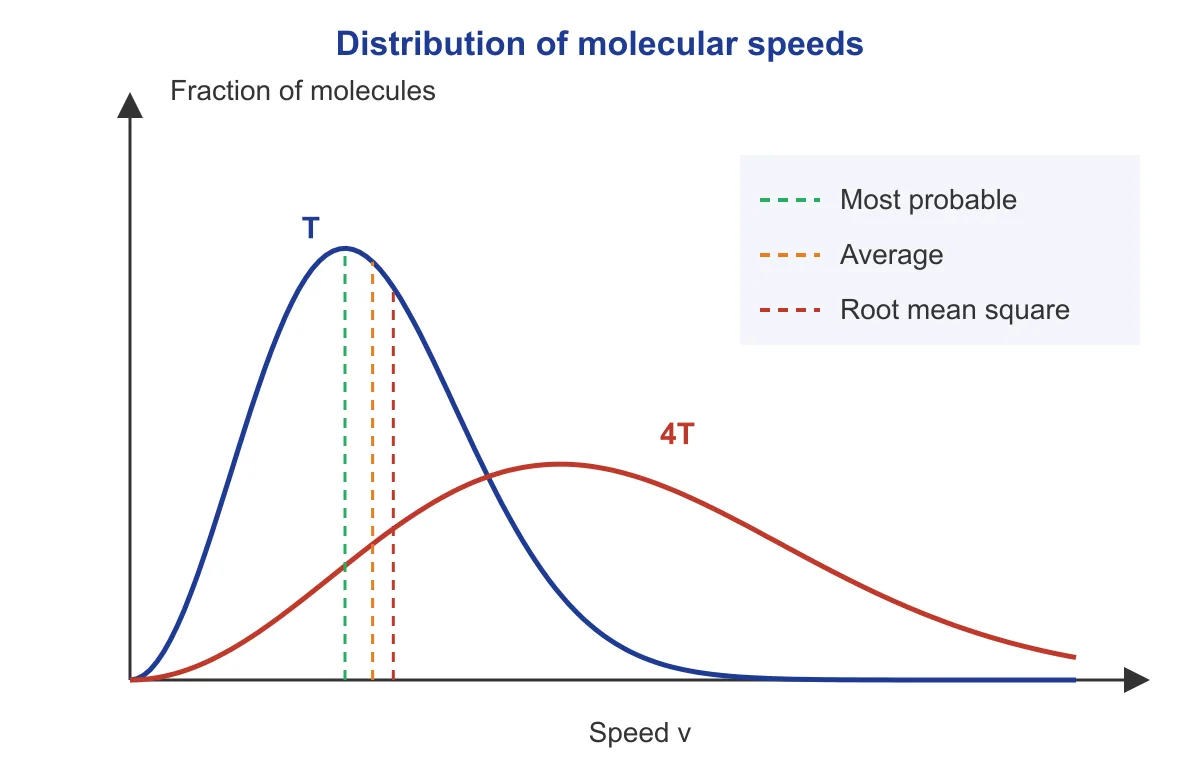
Figure 1.1: Distribution of molecular speeds. On heating, the peak moves right, drops and the curve flattens, yet the area under it (the total number of molecules) stays the same.
At the same temperature a lighter gas has a larger $u_{mp}$, so its curve is shifted right and is flatter.
Example 4: (a) Find $u_{rms}$, $u_{avg}$ and $u_{mp}$ for O₂ at 300 K. (b) At what temperature would H₂ have the same $u_{rms}$ as O₂ at 300 K?
Step 1: $M = 0.032$ kg mol⁻¹. $u_{rms} = \sqrt{\dfrac{3 \times 8.314 \times 300}{0.032}} = \sqrt{2.338 \times 10^5} \approx 484$ m s⁻¹.
Step 2: Use the ratios: $u_{avg} = 0.921\,u_{rms} \approx 445$ m s⁻¹ and $u_{mp} = 0.816\,u_{rms} \approx 395$ m s⁻¹.
Step 3: Same $u_{rms}$ means $\dfrac{T}{M}$ is the same: $\dfrac{T_{H_2}}{2} = \dfrac{300}{32}$, so $T_{H_2} = 18.75$ K.
Why this works: only the ratio $T/M$ matters. A light gas needs to be very cold to move as slowly as a heavy gas at room temperature.
Memory trick: "Most Average Rooms" for $u_{mp} < u_{avg} < u_{rms}$, with 1 : 1.13 : 1.22, or $\sqrt{2} : \sqrt{8/\pi} : \sqrt{3}$ (the numbers under the root are 2, 2.55, 3). Say it, and the order and the formulae stay together.
Deviation from ideal behaviour
Real gases follow $PV = nRT$ well only at low pressure and high temperature. To see how and why they fail, define the compressibility factor
For an ideal gas $Z = 1$ at all pressures. If $Z < 1$ the gas is more compressible than an ideal gas, because attractive forces help to pull molecules together. If $Z > 1$ the gas is less compressible, because the finite size of molecules resists squeezing.
The usual $Z$ against $P$ curve at fixed temperature: for gases with appreciable attraction (CO₂, NH₃, CH₄ at ordinary temperatures) it dips below 1, reaches a minimum, then rises through 1 to higher values. H₂ and He, with very weak attractions, show $Z > 1$ from the start. At very high pressure all gases have $Z > 1$ because molecules are nearly touching and repulsion wins.
Real gases come close to ideal at low pressure and high temperature, where molecules are far apart and fast.
The van der Waals equation
Two corrections to $PV = nRT$ account for the two assumptions that fail.
- Volume correction. Molecules have size, so the free space in which they can move is $V - nb$, not $V$. The constant $b$ is called the excluded volume per mole. It is about four times the actual volume of the molecules in one mole, because two spheres cannot come closer than the sum of their radii.
- Pressure correction. A molecule inside the gas is pulled equally in all directions. A molecule about to hit the wall is pulled back by the others behind it, so it hits with less force. The measured pressure is lower than the ideal one by an amount that depends on how many molecules are in the surface layer and how many pull back, and both are proportional to the concentration $\dfrac{n}{V}$. The correction is therefore $\dfrac{an^2}{V^2}$.
Together:
so that $P = \dfrac{nRT}{V - nb} - \dfrac{an^2}{V^2}$.
The units follow from the equation: $a$ is in atm L² mol⁻² (or Pa m⁶ mol⁻²) and $b$ is in L mol⁻¹ (or m³ mol⁻¹). A large $a$ means strong attraction, hence a gas that is easy to liquefy. NH₃ and CO₂ have large $a$; He and H₂ have very small $a$.
The equation also explains the $Z$ curve. For one mole, write $Z = \dfrac{V}{V - b} - \dfrac{a}{RTV}$. When $V$ is large compared with $b$, expand to get $Z \approx 1 + \dfrac{b - a/RT}{V}$, and replacing $V$ by $RT/P$ for a rough estimate,
At low pressure and moderate temperature the $a/RT$ term wins and $Z < 1$. At very high pressure $V$ shrinks toward $b$ and the equation reduces to $Z \approx 1 + \dfrac{bP}{RT}$, which is above 1 and rises in a straight line with $P$. At high enough temperature, $\dfrac{a}{RT}$ becomes smaller than $b$ and $Z$ stays above 1 even at low pressure; that is why H₂ behaves so at room temperature.
| Condition | Dominant effect | $Z$ | Pressure compared with ideal |
|---|---|---|---|
| Low $P$, low $T$ | attraction ($a$) | below 1 | lower |
| Very high $P$ | molecular size ($b$) | above 1 | higher |
| Low $P$, high $T$ | neither | near 1 | nearly equal |
Example 5: Find the pressure of 2 mol of CO₂ in a 5 L vessel at 300 K using the van der Waals equation, with $a = 3.6$ atm L² mol⁻² and $b = 0.043$ L mol⁻¹. Compare with the ideal value.
Step 1: Free volume $V - nb = 5 - 2(0.043) = 4.914$ L.
Step 2: $\dfrac{nRT}{V - nb} = \dfrac{2 \times 0.0821 \times 300}{4.914} = \dfrac{49.26}{4.914} = 10.02$ atm.
Step 3: $\dfrac{an^2}{V^2} = \dfrac{3.6 \times 4}{25} = 0.576$ atm.
Step 4: $P = 10.02 - 0.576 = 9.45$ atm.
Step 5: Ideal pressure is $\dfrac{49.26}{5} = 9.85$ atm.
Why this works: attraction lowers the pressure by 0.58 atm, while the excluded volume raises it by about 0.17 atm. The net result is lower than ideal, so $Z < 1$ here.
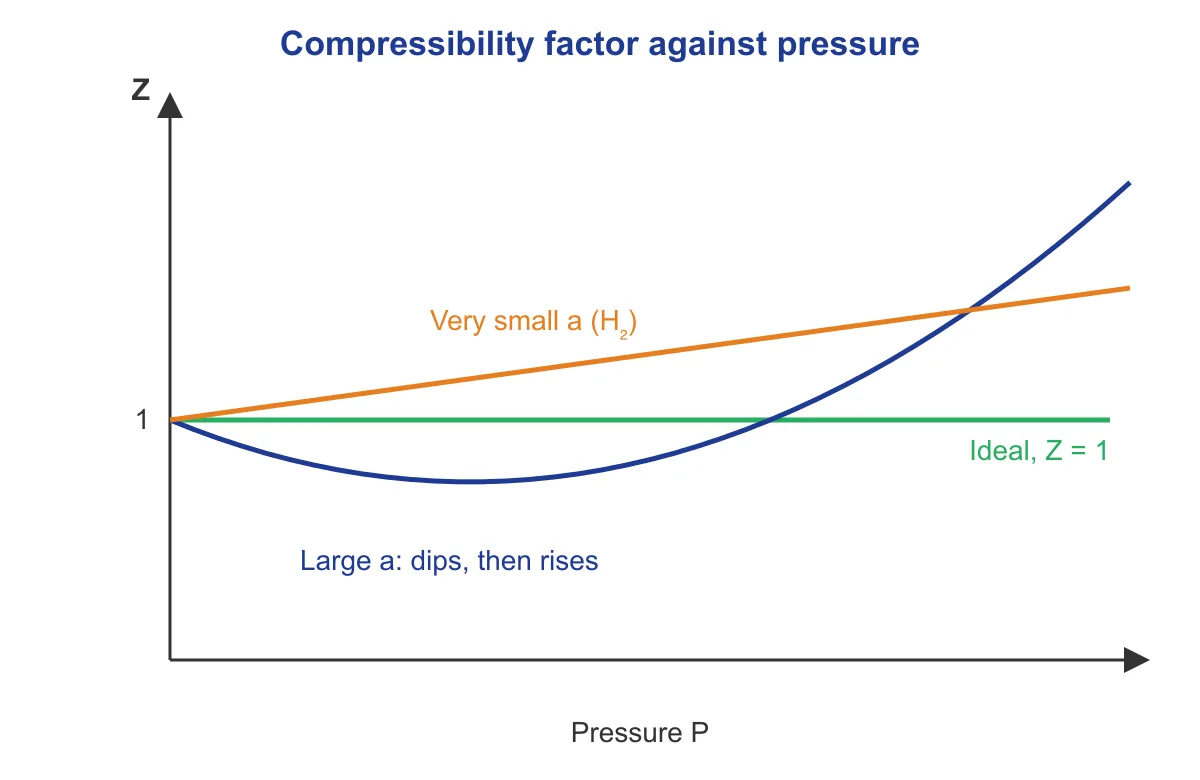
Figure 1.2: Z against pressure at ordinary temperature. The ideal gas is a flat line at 1. A gas with large a dips below 1 and then rises. A gas with tiny a, such as H₂, rises at once.
Intermolecular interactions
The molecules of a real gas, and of every liquid and solid, attract one another. The attractions are called van der Waals forces when they are weak and are of the types below.
| Interaction | Between | Energy depends on distance as | Typical strength |
|---|---|---|---|
| Ion-ion (ionic bond) | two ions | $\dfrac{1}{r}$ | very strong |
| Ion-dipole | an ion and a polar molecule | $\dfrac{1}{r^2}$ | strong |
| Dipole-dipole (fixed) | two polar molecules held in place | $\dfrac{1}{r^3}$ | medium |
| Dipole-dipole (rotating) | two freely rotating polar molecules | $\dfrac{1}{r^6}$ | medium |
| Dipole-induced dipole | polar molecule and non-polar one | $\dfrac{1}{r^6}$ | weak |
| London dispersion | any two molecules, even non-polar | $\dfrac{1}{r^6}$ | weak, grows with size |
| Hydrogen bond | H on N, O or F and a lone pair on N, O or F | short range, directional | stronger than other van der Waals forces |
London (dispersion) forces arise because the electron cloud of a molecule is not static. At any moment it is a little lop-sided, giving a tiny temporary dipole that induces an opposite dipole in the neighbour. They exist in every substance, and they get larger when the molecule has more electrons and is more easily distorted (more polarisable). This is why the boiling points of the noble gases rise down the group: He −269 °C, Ne −246 °C, Ar −186 °C.
All the weak attractions fall off with distance as $\dfrac{1}{r^6}$, so they matter only when molecules are close. But when molecules come too close, their electron clouds overlap and they repel strongly, with energy rising as roughly $\dfrac{1}{r^{12}}$. The sum of the two gives the curve in Figure 1.3, with a minimum at the distance molecules prefer to sit.
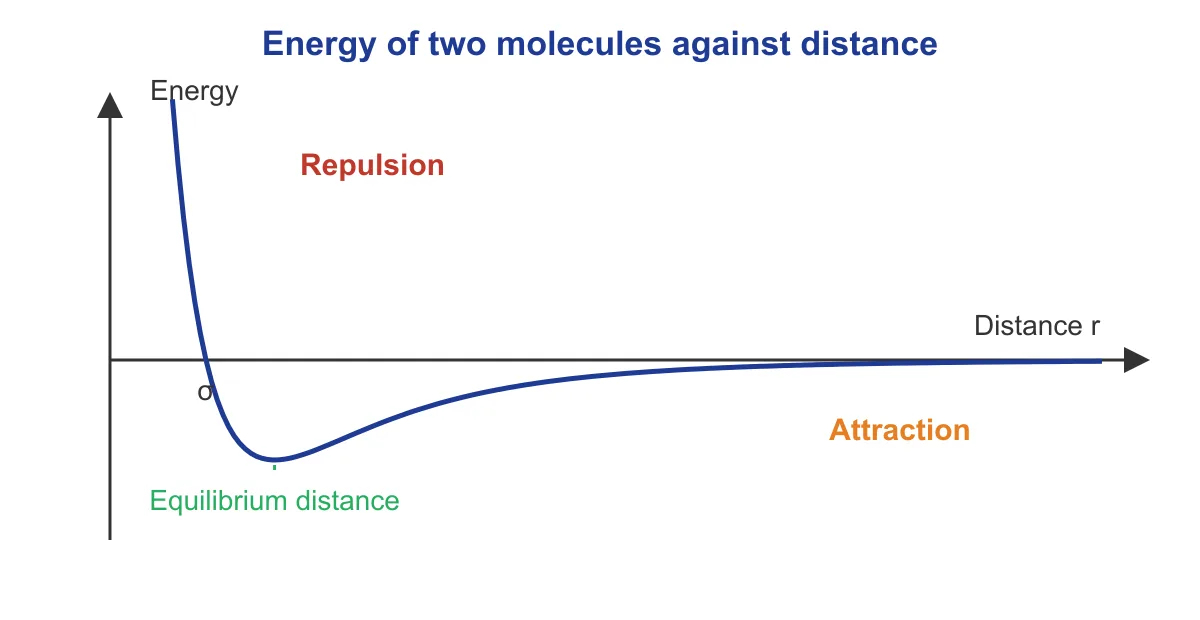
Figure 1.3: Energy of two molecules against separation. The energy crosses zero at a distance σ, is lowest at the equilibrium separation, and rises toward zero from below at large distance.
The deeper the well, the higher the boiling point and heat of vaporisation, the lower the vapour pressure, and, in a gas, the larger the van der Waals $a$.
Hydrogen bonding explains why ethanol (78 °C) is much less volatile than its isomer dimethyl ether (−24 °C).
Memory trick: "Ion-ion one, ion-dipole two, fixed dipole three, everything else six." These are the powers of $\dfrac{1}{r}$ for energy. Use it to rank which interaction dies out faster when you move molecules apart.
Liquids
In a liquid, molecules are close and attract each other, yet they still move about and slide past one another. Three properties follow from this balance.
Vapour pressure
Molecules at the surface of a liquid with enough energy escape into the gas above. Molecules in the vapour also strike the surface and return. When the two rates are equal, the liquid and its vapour are in dynamic equilibrium and the pressure of the vapour is the vapour pressure at that temperature.
- It depends on the liquid and on the temperature only. It does not depend on the amount of liquid or the surface area, as long as some liquid remains.
- It rises sharply with temperature, because more molecules can escape.
- A liquid with stronger intermolecular forces has a lower vapour pressure at the same temperature. At 25 °C ether has a high vapour pressure; water has a low one; glycerol has a very low one.
- A liquid boils when its vapour pressure equals the external pressure. At 1 atm that temperature is the normal boiling point. On a high mountain the external pressure is low, so water boils below 100 °C, and in a pressure cooker the pressure is raised, so it boils above 100 °C.
Surface tension
A molecule inside a liquid is pulled equally in all directions. A molecule at the surface is pulled inwards, because there are none above it. So the surface behaves like a stretched skin and tries to be as small as possible. The surface tension $\gamma$ is the force acting along a line of unit length in the surface, in N m⁻¹, or equivalently the energy needed to create unit area of new surface, in J m⁻².
- It is larger for liquids with strong intermolecular forces: water (about 0.072 N m⁻¹ at 25 °C) and mercury (about 0.47 N m⁻¹) are high, organic liquids such as ethanol are low.
- It falls as temperature rises, and becomes zero at the critical temperature, where liquid and vapour become indistinguishable.
- It makes small drops and bubbles spherical, since a sphere has the least surface area for a given volume.
Surface tension also explains capillary action. In a narrow tube of radius $r$, a liquid that wets the wall (water on clean glass) rises, because adhesion between the liquid and the wall is stronger than cohesion within the liquid; one that does not wet the wall (mercury on glass) is pushed down. For a liquid of density $\rho$ and contact angle $\theta$,
The height is greater in narrower tubes and for a larger surface tension.
Viscosity
When one layer of liquid flows past another, there is a friction between layers that opposes the flow. The force needed to keep a layer of area $A$ moving at a speed gradient $\dfrac{dv}{dx}$ is $F = \eta A\dfrac{dv}{dx}$, where $\eta$ is the coefficient of viscosity. Its SI unit is Pa s (equal to kg m⁻¹ s⁻¹). The older unit is the poise, and 1 poise $= 0.1$ Pa s.
- Liquids with strong intermolecular forces, or with large or long molecules that tangle, are more viscous. Glycerol, which has three hydrogen-bonding –OH groups, is far more viscous than water.
- The viscosity of a liquid falls as temperature rises, because molecules gain energy to overcome attraction. This is why hot oil flows more freely than cold oil.
- Gases behave the other way round: their viscosity rises with temperature, because faster molecules carry momentum between layers more effectively.
| Property | Effect of stronger intermolecular forces | Effect of higher temperature (liquid) |
|---|---|---|
| Vapour pressure | decreases | increases |
| Boiling point | increases | not applicable |
| Surface tension | increases | decreases |
| Viscosity | increases | decreases |
Example 7: Water has surface tension 0.07 N m⁻¹, density 1000 kg m⁻³ and wets glass completely. Find the rise in a capillary of radius 0.5 mm. Take $g = 10$ m s⁻².
Step 1: Complete wetting means $\theta = 0$ and $\cos\theta = 1$.
Step 2: $h = \dfrac{2 \times 0.07}{(0.5 \times 10^{-3}) \times 1000 \times 10} = \dfrac{0.14}{5} = 0.028$ m.
Step 3: $h = 2.8$ cm.
Why this works: the radius must go into the formula in metres. If you use 0.5 instead of $0.5 \times 10^{-3}$ the answer is off by a factor of a thousand.
Common traps
- Putting temperature in °C into $PV = nRT$ → always convert to kelvin first.
- Using $R = 0.0821$ with pressure in Pa or volume in m³ → match units: Pa and m³ go with 8.314.
- Using 22.4 L mol⁻¹ at any temperature → it holds only at 273.15 K and 1 atm; otherwise use $PV = nRT$.
- Writing Graham's law as $\dfrac{r_1}{r_2} = \dfrac{M_2}{M_1}$ → there is a square root: $\sqrt{M_2/M_1}$.
- Putting $M$ in g mol⁻¹ into $\sqrt{3RT/M}$ with $R = 8.314$ → use kg mol⁻¹ to get m s⁻¹.
- Saying the three speeds are equal, or that $u_{avg}$ is the largest → the order is $u_{mp} < u_{avg} < u_{rms}$.
- Believing a lighter gas has a higher average kinetic energy at the same temperature → average kinetic energy is $\tfrac{3}{2}RT$ for all gases; only the speed differs.
- Mixing up the van der Waals constants → $a$ corrects for attraction (pressure term), $b$ corrects for molecular size (volume term).
- Taking $b$ as the actual volume of the molecules → $b$ is four times that volume.
- Thinking vapour pressure grows with more liquid or a wider surface → it depends only on the liquid and the temperature.
Quick revision
- $PV = nRT$; $R = 0.0821$ L atm K⁻¹ mol⁻¹ $= 8.314$ J K⁻¹ mol⁻¹; molar volume 22.4 L at 273.15 K and 1 atm.
- Boyle: $PV$ constant. Charles: $V/T$ constant. Gay-Lussac: $P/T$ constant. Avogadro: $V/n$ constant.
- $d = \dfrac{PM}{RT}$, so density is proportional to $M$ at fixed $P$ and $T$.
- Dalton: $p_i = x_iP$; gas over water: $P_{dry} = P_{total} - p_{water}$.
- Graham: $\dfrac{r_1}{r_2} = \sqrt{\dfrac{M_2}{M_1}}$ and $\dfrac{t_1}{t_2} = \sqrt{\dfrac{M_1}{M_2}}$ for equal volumes.
- Kinetic equation: $PV = \tfrac{1}{3} mN\,\overline{u^2}$.
- Kinetic energy per mole $= \tfrac{3}{2}RT$, per molecule $= \tfrac{3}{2}kT$; the same for all gases at one temperature.
- $u_{rms} = \sqrt{3RT/M}$, $u_{avg} = \sqrt{8RT/\pi M}$, $u_{mp} = \sqrt{2RT/M}$; ratio 1.224 : 1.128 : 1.
- $Z = \dfrac{PV}{nRT}$; $Z < 1$ means attraction dominates, $Z > 1$ means size dominates.
- van der Waals: $\left(P + \dfrac{an^2}{V^2}\right)(V - nb) = nRT$; $a$ in atm L² mol⁻², $b$ in L mol⁻¹.
- At high pressure $Z \approx 1 + \dfrac{bP}{RT}$; at low pressure $Z \approx 1 + \dfrac{1}{RT}\left(b - \dfrac{a}{RT}\right)P$.
- Energy of interactions: ion-ion $\dfrac{1}{r}$, ion-dipole $\dfrac{1}{r^2}$, fixed dipole-dipole $\dfrac{1}{r^3}$, London and rotating dipole forces $\dfrac{1}{r^6}$.
- Vapour pressure depends only on liquid and temperature; a liquid boils when its vapour pressure equals the external pressure.
- Surface tension and liquid viscosity both fall with temperature and rise with stronger intermolecular forces; gas viscosity rises with temperature.
Practice questions
The absolute zero of temperature, expressed on the Celsius scale, is
- 0 °C
- −373.15 °C
- −273.15 °C
- −100 °C
Answer
C. −273.15 °C
Extrapolating the volume of an ideal gas to zero gives T = 0 K, and T = t + 273.15, so t = −273.15 °C.
Equal volumes of H₂ and CH₄ are taken at the same temperature and pressure. They contain the same
- Number of atoms
- Mass
- Density
- Number of molecules
Answer
D. Number of molecules
Avogadro's law: equal volumes at equal T and P hold equal numbers of molecules. Atoms differ (2 per H₂, 5 per CH₄) and so do mass and density.
Which of the following mixtures of gases does not obey Dalton's law of partial pressures?
- N₂ and O₂
- NH₃ and HCl
- H₂ and He
- CH₄ and Ar
Answer
B. NH₃ and HCl
Dalton's law needs gases that do not react. NH₃ and HCl combine to form solid NH₄Cl, so the pressure falls below the sum of partial pressures.
At the same temperature and pressure, which of these gases effuses most slowly?
- NH₃
- He
- CH₄
- H₂
Answer
A. NH₃
Rate goes as 1/√M. Molar masses are 17, 2, 4 and 16, so the largest M, that of NH₃, gives the slowest rate.
For a sample of an ideal gas at one temperature, the correct order of the three molecular speeds is
- Average < most probable < root mean square
- Root mean square < average < most probable
- Most probable < average < root mean square
- Most probable < root mean square < average
Answer
C. Most probable < average < root mean square
The ratio is √2 : √(8/π) : √3, which is 1.414 : 1.596 : 1.732, so u_mp < u_avg < u_rms.
At 300 K, the average translational kinetic energy per molecule of H₂ compared with that per molecule of O₂ is
- Four times larger
- Sixteen times larger
- Four times smaller
- The same
Answer
D. The same
Average kinetic energy is (3/2)kT, independent of the gas. Only the speeds differ.
A real gas shows Z < 1 at moderate pressure and ordinary temperature mainly because
- Collisions between molecules are inelastic
- Attraction between molecules makes it easier to compress than an ideal gas
- The molecules have a finite volume
- The molecules move faster than an ideal gas would allow
Answer
B. Attraction between molecules makes it easier to compress than an ideal gas
Attractions pull the molecules together, so the volume is smaller than the ideal volume and Z = V/V_ideal falls below 1. Finite molecular size acts the other way and gives Z > 1.
The van der Waals constant a has the units
- atm L² mol⁻²
- atm L mol⁻¹
- atm L⁻² mol²
- L mol⁻¹
Answer
A. atm L² mol⁻²
The term a n²/V² has the units of pressure, so a = atm × L² / mol² = atm L² mol⁻².
Among H₂, CH₄, CO₂ and NH₃, the van der Waals constant a is largest for
- CO₂
- NH₃
- CH₄
- H₂
Answer
B. NH₃
NH₃ has hydrogen bonding and a permanent dipole, so its attractions are strongest. Typical values of a in atm L² mol⁻² are about 4.2 (NH₃), 3.6 (CO₂), 2.3 (CH₄) and 0.24 (H₂).
The potential energy of attraction between two non-polar molecules due to London dispersion forces varies with their separation r as
- r⁻³
- r⁻²
- r⁻¹
- r⁻⁶
Answer
D. r⁻⁶
Dispersion energy falls off as 1/r⁶. The powers 1, 2 and 3 belong to ion-ion, ion-dipole and fixed dipole-dipole energies.
Which of these liquids has the highest surface tension at 25 °C?
- Water
- Ethanol
- Benzene
- Diethyl ether
Answer
A. Water
Water has strong hydrogen bonding and a surface tension of about 0.072 N m⁻¹. The other three are 0.017 to 0.028 N m⁻¹.
When the temperature is raised, the viscosity of a liquid and the viscosity of a gas respectively
- Increase and increase
- Decrease and decrease
- Decrease and increase
- Increase and decrease
Answer
C. Decrease and increase
In a liquid, higher energy helps molecules overcome attraction, so η falls. In a gas, faster molecules transfer more momentum between layers, so η rises.
A liquid is kept in a closed container at a fixed temperature, and some liquid is always present. Its vapour pressure does not depend on
- The temperature
- The amount of liquid present
- The strength of the intermolecular forces
- The nature of the liquid
Answer
B. The amount of liquid present
Vapour pressure is fixed by the liquid and the temperature. Using more or less liquid does not change it.
For one mole of a van der Waals gas at very high pressure, Z is
- Greater than 1 and rising roughly in proportion to P
- Less than 1 and falling as P rises
- Less than 1 and rising as P rises
- Equal to 1 at every pressure
Answer
A. Greater than 1 and rising roughly in proportion to P
At very high P the free volume V − b is small and P(V − b) ≈ RT, so PV ≈ RT + bP and Z ≈ 1 + bP/RT, which is above 1 and linear in P.
What volume, in litres, is occupied by 4.4 g of CO₂ at 273.15 K and 1 atm? (C = 12, O = 16; molar volume of an ideal gas under these conditions is 22.4 L)
- 1.12
- 4.48
- 0.224
- 2.24
Answer
D. 2.24
n = 4.4/44 = 0.1 mol. V = 0.1 × 22.4 = 2.24 L.
A gas occupies 300 mL at 27 °C. At constant pressure it is heated until its volume doubles. What is the final temperature in °C?
- 600
- 54
- 327
- 154
Answer
C. 327
V ∝ T in kelvin. T₂ = 2 × 300 = 600 K, which is 600 − 273 = 327 °C. Doubling the Celsius value (54 °C) is the usual slip.
A gas has density 1.25 g L⁻¹ at 273.15 K and 1 atm. Taking the molar volume as 22.4 L, what is its molar mass in g mol⁻¹?
- 28
- 56
- 44.8
- 14
Answer
A. 28
M = d × V_m = 1.25 × 22.4 = 28 g mol⁻¹. Check by d = PM/RT: 1 × 28/(0.0821 × 273.15) = 1.249.
A mixture contains 4 g of H₂, 32 g of O₂ and 28 g of N₂ at a total pressure of 8 atm. What is the partial pressure of O₂ in atm? (H = 1, N = 14, O = 16)
- 2
- 4
- 1
- 0.5
Answer
A. 2
Moles: H₂ 2, O₂ 1, N₂ 1, total 4. x(O₂) = 1/4, so p = 8/4 = 2 atm. (4 atm is the partial pressure of H₂.)
A gas Y effuses four times as fast as SO₂ under the same conditions. What is the molar mass of Y in g mol⁻¹? (S = 32, O = 16)
- 4
- 16
- 8
- 256
Answer
A. 4
r_Y/r_SO₂ = 4 = √(64/M_Y). So 16 = 64/M_Y and M_Y = 4 g mol⁻¹. Forgetting the square gives 16.
The root mean square speed of a gas at 27 °C is 400 m s⁻¹. At what temperature, in kelvin, will it be 800 m s⁻¹?
- 900
- 327
- 600
- 1200
Answer
D. 1200
u_rms ∝ √T. Doubling the speed needs four times T: 4 × 300 K = 1200 K.
What is the total translational kinetic energy, in joules, of 2 mol of an ideal gas at 300 K? (R = 8.314 J K⁻¹ mol⁻¹)
- 3741.3
- 7482.6
- 4988.4
- 14965.2
Answer
B. 7482.6
KE = (3/2)nRT = 1.5 × 2 × 8.314 × 300 = 7482.6 J.
One mole of a van der Waals gas is kept in 0.6 L at 250 K. Take R = 0.08 L atm K⁻¹ mol⁻¹, a = 3.6 atm L² mol⁻² and b = 0.1 L mol⁻¹. What is the pressure in atm?
- 50
- 25
- 30
- 40
Answer
C. 30
P = RT/(V − b) − a/V² = 20/0.5 − 3.6/0.36 = 40 − 10 = 30 atm. Adding the a term gives 50; leaving it out gives 40.
One mole of a gas at 250 K and 50 atm occupies 0.3 L. Taking R = 0.08 L atm K⁻¹ mol⁻¹, what is its compressibility factor Z?
- 1.5
- 0.3
- 1.33
- 0.75
Answer
D. 0.75
Z = PV/nRT = (50 × 0.3)/(1 × 0.08 × 250) = 15/20 = 0.75. The value 1.33 is its inverse.
For a certain gas the van der Waals constant b is 0.048 L mol⁻¹. What is the actual volume, in cm³, of the molecules in one mole of the gas?
- 12
- 48
- 3
- 192
Answer
A. 12
b is four times the actual molecular volume per mole. b = 48 cm³ mol⁻¹, so the molecules occupy 48/4 = 12 cm³.
Water of surface tension 0.07 N m⁻¹ and density 1000 kg m⁻³ wets glass completely. What is its rise, in cm, in a capillary of radius 0.5 mm? (g = 10 m s⁻²)
- 0.28
- 5.6
- 2.8
- 1.4
Answer
C. 2.8
h = 2γ/(rρg) = 2 × 0.07/(0.5 × 10⁻³ × 1000 × 10) = 0.14/5 = 0.028 m = 2.8 cm.
The viscosity of water at 25 °C is 0.89 centipoise. What is this in Pa s? (1 poise = 0.1 Pa s; 1 centipoise = 0.01 poise)
- 0.000089
- 0.00089
- 0.089
- 0.0089
Answer
B. 0.00089
0.89 cP = 0.89 × 0.01 poise = 0.0089 poise = 0.0089 × 0.1 Pa s = 0.00089 Pa s.
Given below are two statements: Statement I: At constant pressure, the volume of a fixed amount of an ideal gas is directly proportional to its temperature in °C. Statement II: Extrapolating the volume of an ideal gas against Celsius temperature gives zero volume at −273.15 °C.
- Both Statement I and Statement II are correct
- Both Statement I and Statement II are incorrect
- Statement I is correct but Statement II is incorrect
- Statement I is incorrect but Statement II is correct
Answer
D. Statement I is incorrect but Statement II is correct
I is wrong: V ∝ T only in kelvin, and V at 0 °C is not zero. II is correct: it is the extrapolation that defines absolute zero.
Given below are two statements: Statement I: In a mixture of non-reacting ideal gases, each gas exerts the pressure it would exert if it alone filled the container. Statement II: The partial pressure of a gas in such a mixture is proportional to its mole fraction.
- Both Statement I and Statement II are correct
- Both Statement I and Statement II are incorrect
- Statement I is correct but Statement II is incorrect
- Statement I is incorrect but Statement II is correct
Answer
A. Both Statement I and Statement II are correct
Both are Dalton's law: p_i = x_i P_total follows from p_i V = n_i RT.
Given below are two statements: Statement I: At the same temperature, all ideal gases have the same average translational kinetic energy per mole. Statement II: At the same temperature, all ideal gases have the same root mean square speed.
- Both Statement I and Statement II are correct
- Both Statement I and Statement II are incorrect
- Statement I is correct but Statement II is incorrect
- Statement I is incorrect but Statement II is correct
Answer
C. Statement I is correct but Statement II is incorrect
Average KE per mole is (3/2)RT for all gases, so I is correct. u_rms = √(3RT/M) depends on M, so II is incorrect.
Given below are two statements: Statement I: In the van der Waals equation, the constant a corrects for the volume of the molecules and the constant b corrects for the attractions between molecules. Statement II: At very high pressure, a real gas has a compressibility factor greater than 1.
- Both Statement I and Statement II are correct
- Both Statement I and Statement II are incorrect
- Statement I is correct but Statement II is incorrect
- Statement I is incorrect but Statement II is correct
Answer
D. Statement I is incorrect but Statement II is correct
The roles are reversed in I: a corrects pressure for attraction, b corrects volume for molecular size. II is correct since Z ≈ 1 + bP/RT.
Given below are two statements: Statement I: The surface tension of a liquid increases as its temperature rises. Statement II: The viscosity of a gas decreases as its temperature rises.
- Both Statement I and Statement II are correct
- Both Statement I and Statement II are incorrect
- Statement I is correct but Statement II is incorrect
- Statement I is incorrect but Statement II is correct
Answer
B. Both Statement I and Statement II are incorrect
Surface tension falls with temperature, and gas viscosity rises with temperature. Both statements are incorrect.
Assertion (A): Real gases behave nearly ideally at low pressure and high temperature. Reason (R): Under these conditions the molecules are far apart and fast, so attractions and molecular volume have little effect.
- Both A and R are true and R is the correct explanation of A
- Both A and R are true but R is not the correct explanation of A
- A is true but R is false
- A is false but R is true
Answer
A. Both A and R are true and R is the correct explanation of A
At low P the gas is dilute and at high T the kinetic energy swamps attraction. The reason states exactly what makes the ideal assumptions valid.
Assertion (A): At the same temperature and pressure, helium effuses faster than methane. Reason (R): Helium atoms have a higher average kinetic energy than methane molecules at the same temperature.
- Both A and R are true and R is the correct explanation of A
- Both A and R are true but R is not the correct explanation of A
- A is true but R is false
- A is false but R is true
Answer
C. A is true but R is false
A is true: rate ∝ 1/√M. R is false: at one temperature the average kinetic energy is the same for all gases. Helium is faster because it is lighter.
Assertion (A): The van der Waals constant b equals the actual volume of the molecules in one mole of a gas. Reason (R): The excluded volume per mole is four times the actual volume of the molecules.
- Both A and R are true and R is the correct explanation of A
- Both A and R are true but R is not the correct explanation of A
- A is true but R is false
- A is false but R is true
Answer
D. A is false but R is true
R is true: b is the excluded volume, four times the real molecular volume per mole. So A is false, since b is not equal to the real volume.
Match List I with List II. List I: a. Most probable speed b. Average speed c. Root mean square speed d. Kinetic energy of one mole of gas. List II: i. $\sqrt{\dfrac{8RT}{\pi M}}$ ii. $\sqrt{\dfrac{3RT}{M}}$ iii. $\sqrt{\dfrac{2RT}{M}}$ iv. $\dfrac{3}{2}RT$
- a-i, b-iii, c-ii, d-iv
- a-iii, b-i, c-ii, d-iv
- a-iii, b-ii, c-i, d-iv
- a-ii, b-i, c-iii, d-iv
Answer
B. a-iii, b-i, c-ii, d-iv
u_mp = √(2RT/M), u_avg = √(8RT/πM), u_rms = √(3RT/M), and (3/2)RT is the translational kinetic energy per mole.
Match List I with List II. List I: a. Boyle's law b. Charles's law c. Gay-Lussac's law d. Avogadro's law. List II: i. V/T is constant at fixed n and P ii. P/T is constant at fixed n and V iii. V/n is constant at fixed T and P iv. PV is constant at fixed n and T
- a-iv, b-i, c-iii, d-ii
- a-iv, b-i, c-ii, d-iii
- a-iv, b-ii, c-i, d-iii
- a-i, b-iv, c-ii, d-iii
Answer
B. a-iv, b-i, c-ii, d-iii
Boyle: PV constant. Charles: V/T constant. Gay-Lussac: P/T constant. Avogadro: V/n constant.
Match List I with List II. List I: a. Surface tension b. Coefficient of viscosity c. van der Waals constant a d. van der Waals constant b. List II: i. Pa s ii. N m⁻¹ iii. L mol⁻¹ iv. atm L² mol⁻²
- a-iv, b-i, c-ii, d-iii
- a-ii, b-i, c-iii, d-iv
- a-ii, b-i, c-iv, d-iii
- a-i, b-ii, c-iv, d-iii
Answer
C. a-ii, b-i, c-iv, d-iii
Surface tension is force per length (N m⁻¹), viscosity is Pa s, a is atm L² mol⁻² and b is a volume per mole (L mol⁻¹).
Vessel 1 of volume 2 L holds N₂ at 4 atm and vessel 2 of volume 3 L holds He at 1 atm, at the same temperature. The vessels are joined by a thin tube. What is the final total pressure?
- 5 atm
- 2.5 atm
- 11 atm
- 2.2 atm
Answer
D. 2.2 atm
Moles are proportional to PV: N₂ 8 units, He 3 units. Total 11 units in 5 L gives P = 11/5 = 2.2 atm. (N₂ 1.6 atm + He 0.6 atm.)
A closed vessel contains 32 g of H₂ and 32 g of O₂ at the same temperature. A pinhole is made, and gas escapes into a vacuum. What is the initial ratio of the number of H₂ molecules to the number of O₂ molecules escaping per second? (H = 1, O = 16)
- 64
- 16
- 4
- 256
Answer
A. 64
Moles: H₂ 16, O₂ 1. Rate of molecules ∝ n/√M, so the ratio = (16/√2)/(1/√32) = 16 × √16 = 16 × 4 = 64.
A 10 L cylinder holds a gas at 80 atm and 250 K, where its compressibility factor is 0.8. How many moles are in the cylinder? (R = 0.08 L atm K⁻¹ mol⁻¹)
- 40
- 50
- 62.5
- 32
Answer
B. 50
PV = ZnRT, so n = PV/(ZRT) = (80 × 10)/(0.8 × 0.08 × 250) = 800/16 = 50 mol. The ideal value would be 40 mol.