Isolation of Metals (Metallurgy)
What to remember
- A metal is extracted in three stages: concentrate the ore, convert it to the oxide and reduce it, then refine the crude metal. The chemistry of each stage is chosen to suit the ore, not the other way round.
- Sulphide ores are concentrated by froth flotation and then roasted; carbonates and hydrated oxides are calcined. Both steps give the oxide.
- An oxide can be reduced by carbon only when ΔG for the coupled reaction is negative, and ΔG = ΔH − TΔS decides this. In an Ellingham-type plot, a metal whose line lies lower reduces any oxide whose line lies above it.
- Aluminium is too reactive for carbon reduction, so Al₂O₃ dissolved in molten cryolite is electrolysed (Hall–Héroult). Silver and gold are leached out as cyanide complexes and displaced by zinc.
- Refining matches the method to the impurity: distillation, liquation, electrolysis, zone refining, and the Mond and van Arkel vapour-phase methods.
Occurrence: ore, mineral, gangue
Every ore is a mineral, but only a few minerals are ores. A mineral is any naturally occurring compound of the metal. An ore is a mineral from which the metal can be extracted profitably. Clay contains aluminium, yet we do not extract aluminium from clay because it costs far too much; bauxite, rich in Al₂O₃, is the ore. The earthy impurities mixed with an ore (sand, clay, rocky matter) are called gangue.
Reactive metals such as Na, K, Mg and Ca occur as chlorides, carbonates or sulphates, because they have combined with whatever was around for millions of years. Gold and, in small amounts, silver and copper are found native, as free metals. Most other metals sit between these two groups as oxides, sulphides or carbonates.
| Metal | Ore (formula) | Class |
|---|---|---|
| Iron | Haematite Fe₂O₃, magnetite Fe₃O₄, siderite FeCO₃ | oxide, carbonate |
| Copper | Copper pyrites CuFeS₂, copper glance Cu₂S, cuprite Cu₂O, malachite CuCO₃·Cu(OH)₂ | sulphide, oxide, carbonate |
| Zinc | Zinc blende ZnS, calamine ZnCO₃, zincite ZnO | sulphide, carbonate, oxide |
| Aluminium | Bauxite Al₂O₃·xH₂O (cryolite Na₃AlF₆ is a mineral, used as a flux) | hydrated oxide |
| Silver | Argentite Ag₂S, horn silver AgCl | sulphide, halide |
| Tin | Cassiterite (tin stone) SnO₂ | oxide |
| Lead | Galena PbS | sulphide |
Concentration of the ore
Concentration (dressing) removes gangue before chemistry begins. The method depends on a physical or chemical difference between ore and gangue.
- Hydraulic washing uses density. Crushed ore is washed with a stream of water; the lighter gangue is carried off and the heavy ore settles. It suits dense oxide ores such as haematite and tin stone.
- Magnetic separation is used when either the ore or the gangue is attracted by a magnet. Powdered ore falls on a belt moving over a magnetic roller; the magnetic part drops nearer the roller. Tin stone is non-magnetic but the wolframite that accompanies it is magnetic, so the two are parted this way.
- Froth flotation is for sulphide ores. The finely ground ore is stirred with water, pine oil (the frother) and a collector such as sodium ethyl xanthate. The collector makes the sulphide particles water-repelling, so air bubbles carry them up as a froth, while the wetted gangue sinks. A depressant can hold back one sulphide: NaCN stops ZnS from entering the froth, so PbS can be floated away from ZnS in a lead–zinc mixture.
- Leaching dissolves the ore in a reagent that leaves the gangue behind. Bauxite and the noble metals are the two cases you must know.
Memory trick: "Sulphide floats, silicate sinks." The oil likes the sulphide; the water likes the sand. Use it to say instantly which ores go to the flotation tank.
Leaching bauxite (Baeyer's method)
Powdered bauxite is heated with concentrated NaOH at 473–523 K under about 35 bar. Alumina dissolves as sodium aluminate; Fe₂O₃ and TiO₂ do not, and they form the "red mud" residue.
Al₂O₃·xH₂O + 2NaOH + 3H₂O → 2Na[Al(OH)₄] + xH₂O
The filtered solution is neutralised by passing CO₂, and a little fresh Al(OH)₃ is added as seed:
2Na[Al(OH)₄] + CO₂ → Al₂O₃·xH₂O↓ + 2NaHCO₃
The precipitate is filtered and heated to about 1470 K to give pure Al₂O₃.
From concentrated ore to crude metal
Most metals are easier to reduce from an oxide than from a sulphide or carbonate. So the concentrated ore is first converted to the oxide.
Calcination is heating the ore strongly in a limited supply of air or none at all, below its melting point. It drives off water and CO₂ from hydrated oxides and carbonates.
ZnCO₃ → ZnO + CO₂ Fe₂O₃·xH₂O → Fe₂O₃ + xH₂O
Roasting is heating in excess air, again below the melting point. It oxidises sulphides to oxides and burns off sulphur as SO₂, and it also drives off arsenic and antimony as volatile oxides.
2ZnS + 3O₂ → 2ZnO + 2SO₂ 2PbS + 3O₂ → 2PbO + 2SO₂ 2Cu₂S + 3O₂ → 2Cu₂O + 2SO₂
The SO₂ is not wasted; it goes to a sulphuric acid plant.
| Calcination | Roasting | |
|---|---|---|
| Air supply | none or limited | excess |
| Typical ores | carbonates, hydrated oxides | sulphides |
| What leaves | CO₂, H₂O | SO₂ (and As₂O₃, Sb₂O₃) |
| Example | ZnCO₃ → ZnO | 2ZnS → 2ZnO |
Example 1: 250 g of ZnCO₃ (molar mass 125 g mol⁻¹) is calcined. Find the mass of ZnO (81 g mol⁻¹) and of CO₂ formed.
Rough work: moles of ZnCO₃ = 250 / 125 = 2 mol.
ZnCO₃ → ZnO + CO₂, so 2 mol gives 2 mol ZnO and 2 mol CO₂.
ZnO = 2 × 81 = 162 g. CO₂ = 2 × 44 = 88 g. Check: 162 + 88 = 250 g, mass conserved.
Answer: 162 g ZnO and 88 g CO₂. Mass balance is the quickest check on any extraction problem.
Thermodynamics of reduction
Heating the oxide with a reducing agent works only if the reaction is feasible. The test is the Gibbs energy change:
and for a reaction at equilibrium with constant $K$,
A negative $\Delta G$ means the reaction can go. If $\Delta H$ and $\Delta S$ are both positive, $\Delta G$ turns negative only above a temperature $T = \Delta H / \Delta S$. If $\Delta H$ is negative and $\Delta S$ positive, the reaction goes at all temperatures. These formulas assume $\Delta H$ and $\Delta S$ stay roughly constant over the range, which holds well away from a melting or boiling point.
Example 2: A hypothetical oxide reduction MO + C → M + CO has ΔH = +190 kJ mol⁻¹ and ΔS = +0.19 kJ K⁻¹ mol⁻¹. Find the lowest temperature at which it is spontaneous.
Rough work: ΔG = ΔH − TΔS < 0 gives T > ΔH / ΔS.
T > 190 / 0.19 = 1000 K.
Answer: above 1000 K. A reaction that makes gas from solids has large positive ΔS, so heat helps it.
Example 3: At 300 K, ΔG° of a reaction is −30 kJ mol⁻¹. Find K.
Rough work: ln K = −ΔG° / RT = 30000 / (8.314 × 300) = 12.03.
K = e¹²·⁰³ ≈ 1.7 × 10⁵.
Answer: about 1.7 × 10⁵. The reaction runs essentially to completion; a larger negative ΔG° means a much larger K.
The Ellingham-type diagram, in words
Imagine a graph of ΔG° for forming oxides (written for one mole of O₂, so that lines can be compared fairly) against temperature. Since ΔG° = ΔH − TΔS, each line is nearly straight with slope −ΔS.
- When a metal burns to its oxide, a mole of gas disappears. ΔS is negative, the slope is positive, and the line climbs with temperature. Most oxide lines therefore rise to the right.
- For 2C + O₂ → 2CO, one mole of gas becomes two. ΔS is positive, so this line falls with temperature. It crosses the lines of many metal oxides. For C + O₂ → CO₂ the number of gas moles does not change, so that line is almost flat.
- A kink appears in a line at a melting or boiling point of the metal or oxide, because ΔS changes there.
- The lower a line lies, the more negative ΔG° and the more stable the oxide.
The reading rule is the whole point: a reducing agent whose line lies below the line of an oxide can reduce that oxide, because the difference of the two ΔG° values is negative. Above the temperature where the carbon line crosses the metal's line, carbon wins.
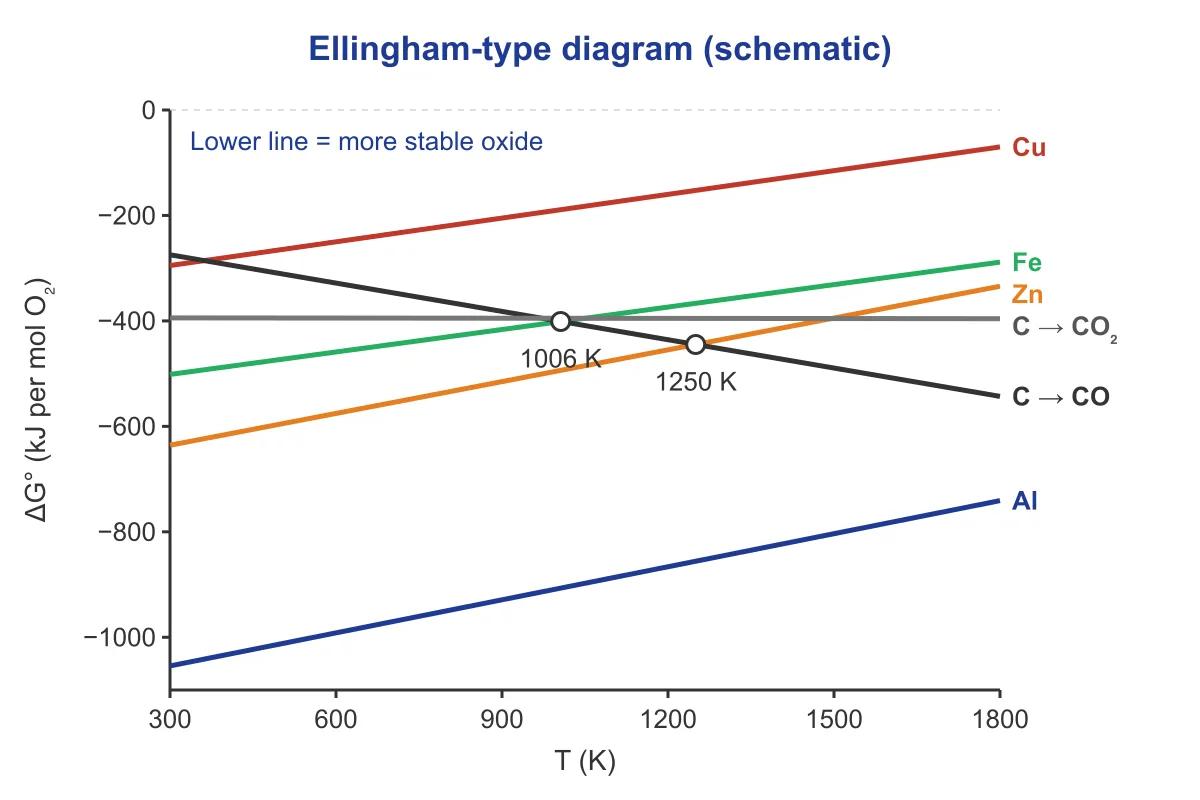
Figure 6.1: Oxide-formation lines (straight-line approximation); carbon reduces FeO above about 1006 K and ZnO above about 1250 K
Memory trick: "Lower line wins." Whatever metal or carbon sits lower on the plot takes the oxygen from the one above. Use it to decide, in one glance, whether carbon can reduce an oxide at a given temperature.
For the three metals in your syllabus:
- Iron. The C → CO line crosses the Fe–FeO line near 1000 K, so carbon (acting as CO) reduces iron oxides in the hot part of the blast furnace. Oxide lines for Fe₂O₃ and Fe₃O₄ lie higher still, so they are reduced first and more easily.
- Copper. The Cu₂O line lies high on the diagram, above the carbon line even at modest temperatures, so oxide of copper is easily reduced. For sulphide ores the roasting stage matters: ΔG° of formation of most metal sulphides is less negative than that of CS₂, so carbon cannot reduce a sulphide, but it reduces the oxide.
- Zinc. The ZnO line crosses the carbon line only near 1250 K, which is above the boiling point of zinc (1180 K). Zinc therefore leaves as vapour and is condensed.
- Aluminium. The Al₂O₃ line lies below the carbon line until about 2300 K, so carbon is useless at furnace temperatures. A reactive metal does the job in thermite-type reductions (Al reducing Cr₂O₃, for instance), and for Al itself we turn to electrolysis.
Example 4: Two reactions, per mole of O₂: 2Zn + O₂ → 2ZnO has ΔG° = −696 + 0.201 T kJ; 2C + O₂ → 2CO has ΔG° = −221 − 0.179 T kJ. Find the temperature above which ZnO + C → Zn + CO is feasible.
Rough work: ZnO + C → Zn + CO equals half of (CO equation) minus half of (ZnO equation).
ΔG = ½[(−221 − 0.179T) − (−696 + 0.201T)] = ½[475 − 0.380T] kJ.
Set ΔG = 0: T = 475 / 0.380 = 1250 K.
Answer: above 1250 K. Subtracting one line from another is exactly what "which line is lower" means.
Iron: the blast furnace
The charge is calcined haematite, coke and limestone, dropped in at the top while a blast of hot air enters near the bottom through the tuyeres. Temperature rises as the charge descends.
Near the bottom, coke burns to CO₂, which meets more hot coke and becomes carbon monoxide:
C + O₂ → CO₂ CO₂ + C → 2CO
The CO rises and does the reducing. In the cooler upper part (500–800 K) and then lower down:
3Fe₂O₃ + CO → 2Fe₃O₄ + CO₂ Fe₃O₄ + CO → 3FeO + CO₂ FeO + CO → Fe + CO₂
Limestone decomposes, and the lime formed combines with silica gangue to make a fusible slag:
CaCO₃ → CaO + CO₂ CaO + SiO₂ → CaSiO₃
Molten iron (pig iron, about 4% carbon) and molten slag collect at the bottom; the slag is lighter and floats, so each can be tapped separately. Slag also forms a layer that protects the iron from the blast. A flux is a substance added to turn the gangue into slag, and an acidic gangue like SiO₂ needs a basic flux such as CaO.
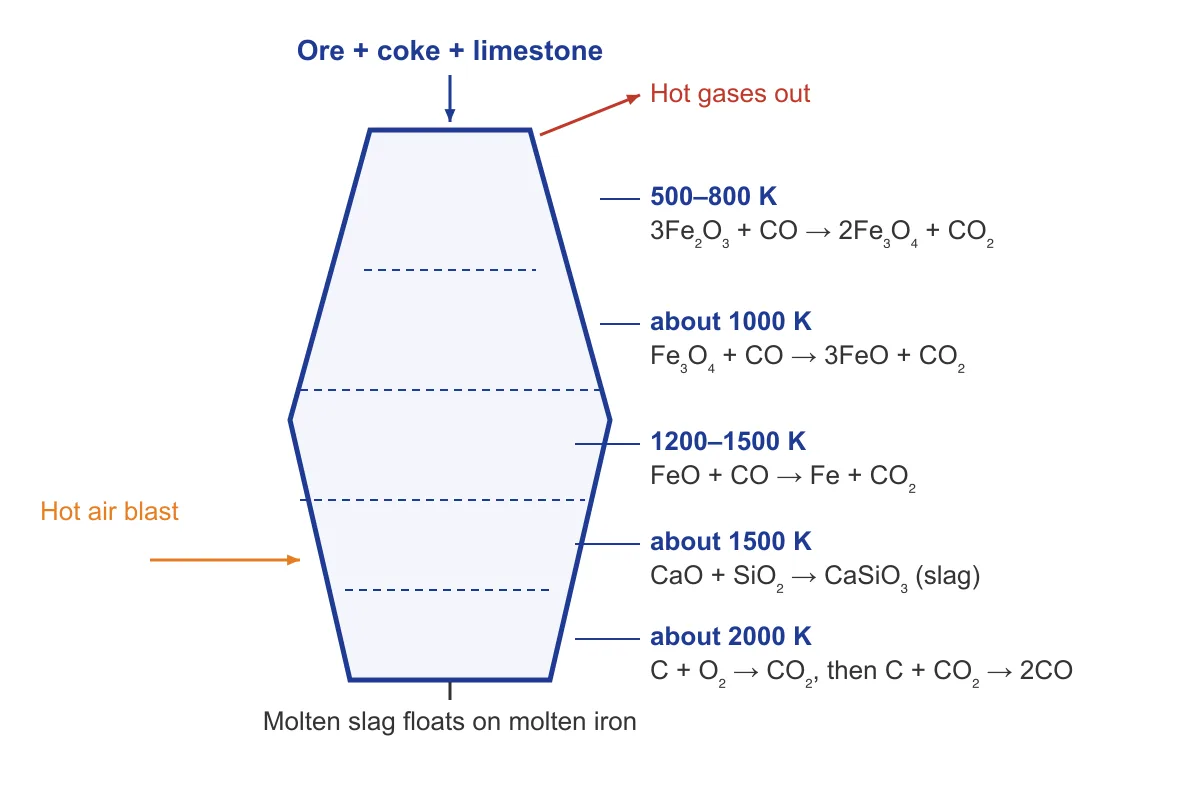
Figure 6.2: Temperature zones and reactions in the blast furnace
Example 5: 5 kg of an iron ore contains 64% Fe₂O₃ (160 g mol⁻¹), the rest being gangue. Find the mass of iron obtainable (Fe = 56).
Rough work: Fe₂O₃ = 0.64 × 5000 = 3200 g. Moles = 3200 / 160 = 20 mol.
Each Fe₂O₃ holds 2 Fe, so Fe = 40 mol.
Mass = 40 × 56 = 2240 g.
Answer: 2.24 kg. Count the metal atoms in the oxide formula; the CO and the furnace steps never enter the arithmetic.
Copper
Copper pyrites CuFeS₂ is concentrated by froth flotation. The concentrate is partly roasted so that iron sulphide turns to oxide, then smelted with silica in a reverberatory furnace. The iron oxide leaves as slag:
FeO + SiO₂ → FeSiO₃
What remains is matte, a molten mixture mainly of Cu₂S with a little FeS. Matte goes to the Bessemer converter, where air and silica are blown in. Any FeS is turned to FeO and slagged off, and part of the Cu₂S is oxidised, after which the oxide reacts with remaining sulphide in a self-reduction (no carbon needed):
2Cu₂S + 3O₂ → 2Cu₂O + 2SO₂ 2Cu₂O + Cu₂S → 6Cu + SO₂
The solid copper that cools is covered with blisters where SO₂ escaped; it is called blister copper (about 98% Cu).
Example 6: 795 g of Cu₂S (159 g mol⁻¹) is converted completely to copper by the two steps above. Find the mass of copper and the moles of O₂ used (Cu = 63.5).
Rough work: add the two steps after balancing: 3Cu₂S + 3O₂ → 6Cu + 3SO₂, which is Cu₂S + O₂ → 2Cu + SO₂.
Moles of Cu₂S = 795 / 159 = 5 mol, so Cu = 10 mol = 635 g and O₂ = 5 mol.
Answer: 635 g Cu and 5 mol O₂. Adding steps to a net equation removes the intermediate Cu₂O and makes the ratio obvious.
Zinc
Zinc blende is concentrated by flotation and roasted to ZnO. The oxide is mixed with powdered coke and heated near 1673 K in a fireclay retort. The zinc formed distils over as vapour and is condensed as the metal (spelter), with some dust:
ZnO + C → Zn + CO
Aluminium: Hall–Héroult electrolysis
Carbon cannot reduce Al₂O₃ (see the lowest line in Figure 6.1), so aluminium is won by electrolysis. Pure alumina melts near 2323 K and, once molten, conducts poorly. It is therefore dissolved in molten cryolite Na₃AlF₆, with a little fluorspar CaF₂. This brings the melting point of the mixture down to about 1140 K and raises its conductivity.
The cell is a steel tank lined with carbon, which acts as the cathode. Graphite rods dipping into the melt are the anodes. The cell runs at about 4–5 V with very large currents.
- Cathode: Al³⁺ + 3e⁻ → Al(l). Liquid aluminium is denser than the melt, sinks, and is tapped.
- Anode: C + O²⁻ → CO + 2e⁻ and C + 2O²⁻ → CO₂ + 4e⁻. The anodes are slowly burnt away and are replaced regularly.
- Overall: 2Al₂O₃ + 3C → 4Al + 3CO₂.
Three faradays of charge deposit one mole of aluminium (27 g). That is why aluminium is expensive in electricity, and why plants sit near cheap power.
Example 7: A cell passes 50 000 A for one hour. Find the mass of aluminium formed, assuming all current deposits aluminium (F = 96 500 C mol⁻¹).
Rough work: Q = 50 000 × 3600 = 1.8 × 10⁸ C.
Moles of electrons = 1.8 × 10⁸ / 96 500 ≈ 1865.
Al³⁺ + 3e⁻ → Al, so moles Al = 1865 / 3 ≈ 622. Mass = 622 × 27 ≈ 16 800 g.
Answer: about 16.8 kg. Charge to moles of electrons, then divide by the charge on the ion.
Memory trick: "Cryolite cuts the cost." It lowers the melting point and lifts conductivity, so less heat and power are wasted. Say it whenever you are asked why alumina is not electrolysed by itself.
Silver and gold: the cyanide process
Silver (from argentite Ag₂S) and gold occur in small grains. Crushed ore is leached with dilute NaCN solution while air is bubbled through. Oxygen from the air is needed to oxidise the metal, which then dissolves as a soluble cyanide complex.
4Ag + 8NaCN + 2H₂O + O₂ → 4Na[Ag(CN)₂] + 4NaOH
For gold the equation is the same with Au in place of Ag. Zinc dust then displaces the noble metal, because zinc is more electropositive:
2Na[Ag(CN)₂] + Zn → Na₂[Zn(CN)₄] + 2Ag
The precipitated silver (or gold) is filtered, washed and later refined.
Memory trick: "Cyanide dissolves, zinc displaces." Two verbs, two steps. Use it to write the process in the right order.
Refining the crude metal
| Method | Principle | Metals |
|---|---|---|
| Distillation | metal has lower boiling point than impurities | Zn, Cd, Hg |
| Liquation | metal melts easily and runs off a sloping hearth, leaving infusible impurities | Sn, Pb, Bi |
| Electrolytic | impure metal as anode, pure metal as cathode | Cu, Ag, Al, Zn |
| Zone refining | impurities are more soluble in the melt than in the solid | Ge, Si, Ga, B |
| Mond process | volatile carbonyl formed, then decomposed | Ni |
| van Arkel process | volatile iodide formed, then decomposed on hot wire | Zr, Ti |
Electrolytic refining of copper
The anode is a thick slab of blister copper, the cathode a thin sheet of pure copper, and the electrolyte is acidified CuSO₄ solution.
- Anode: Cu → Cu²⁺ + 2e⁻
- Cathode: Cu²⁺ + 2e⁻ → Cu
Impurities less active than copper (Ag, Au, Pt) do not dissolve and drop as anode mud. More active impurities (Fe, Zn) go into solution and stay there because their ions are harder to discharge than Cu²⁺. The cell works at low voltage, since copper is both dissolved and deposited.
Zone refining
A circular heater is moved slowly along a rod of the metal. A narrow molten zone travels with it. Impurities prefer the melt, so they are swept to one end, and that end is cut off. Repeated passes give extremely pure Ge and Si for semiconductors.
Mond process
Impure nickel is warmed with CO at 330–350 K; volatile tetracarbonylnickel forms and leaves the impurities behind. At 450–470 K it decomposes to give very pure nickel and CO, which is reused.
Ni + 4CO → Ni(CO)₄ Ni(CO)₄ → Ni + 4CO
van Arkel process
Crude zirconium (or titanium) is heated with iodine at about 870 K in an evacuated vessel to give ZrI₄ vapour. This touches a tungsten filament at about 2075 K, decomposes, and deposits pure zirconium on the filament. Iodine goes back to react with more crude metal.
Zr + 2I₂ → ZrI₄ ZrI₄ → Zr + 2I₂
Oxygen and nitrogen, which make Zr brittle, are removed this way.
Memory trick: "Mond for Ni, van Arkel for Zr, Zone for Ge." Three metals, three names, one carbonyl and one iodide. Use it when a question gives the metal and asks for the method.
Uses of Al, Cu, Zn and Fe
- Aluminium: light and a good conductor, so it goes into overhead cables (with a steel core for strength), aircraft parts, cooking vessels and foil. It makes thermite mixtures and alloys such as duralumin.
- Copper: electrical wiring, because its conductivity is second only to silver. Alloys include brass (Cu–Zn) and bronze (Cu–Sn), used for utensils, coins and fittings.
- Zinc: coating iron against rusting (galvanising), dry-cell cases, and brass.
- Iron: the base of steel and cast iron, used in bridges, rails, machinery and tools. Alloyed with other metals it gives stainless and special steels.
Common traps
- Calling any mineral an ore → an ore must allow profitable extraction; bauxite is the aluminium ore, ordinary clay is not.
- Roasting a carbonate or calcining a sulphide → calcination is for carbonates and hydrated oxides in limited air; roasting is for sulphides in excess air.
- Saying coke reduces haematite in the upper furnace → CO reduces the oxides there; coke supplies the CO.
- Forgetting the unit of ΔS (J versus kJ) in ΔG = ΔH − TΔS → convert so both are in kJ, or both in J, before finding T.
- Thinking a rising Ellingham line is a mistake for C → CO → ΔS is positive for that reaction, so the line falls; the others rise.
- Saying cryolite is an ore of aluminium → cryolite is the flux that lowers the melting point; bauxite is the ore.
- Using carbon to extract aluminium → carbon cannot reduce Al₂O₃ at usable temperatures; electrolyse the melt.
- Writing the cyanide step without oxygen → the metal is oxidised to the complex ion by dissolved O₂; zinc is the reducer in the second step only.
- Putting pure copper at the anode in refining → impure copper is the anode and pure copper the cathode.
- Mixing up Mond and van Arkel → Mond uses CO and gives a carbonyl of nickel; van Arkel uses I₂ and gives an iodide of Zr or Ti.
Quick revision
- Ore: profitable source of metal; gangue: unwanted material mixed with it.
- Hydraulic washing (density), magnetic separation, froth flotation (sulphides), leaching (bauxite, Ag, Au).
- NaCN depresses ZnS but not PbS during flotation.
- Calcination: limited air, carbonates and hydrated oxides; roasting: excess air, sulphides.
- ΔG = ΔH − TΔS; ΔG° = −RT ln K; spontaneous when ΔG < 0.
- In an oxide plot, a lower line reduces an oxide on a higher line.
- C → CO line slopes down because gas moles increase.
- Blast furnace: CO is the reducing agent; CaO + SiO₂ → CaSiO₃ slag.
- Copper: matte (Cu₂S + FeS) → Bessemer converter → self-reduction → blister copper.
- Zinc: ZnO + C near 1673 K, zinc distils as vapour.
- Aluminium: Al₂O₃ in cryolite with CaF₂, carbon cathode, graphite anodes consumed as CO and CO₂.
- 3 F deposit 1 mol (27 g) of Al; Cu²⁺ needs 2 F per mole.
- Cyanide process: Ag or Au dissolves as [M(CN)₂]⁻ in air with NaCN, then Zn displaces it.
- Refining: Zn by distillation, Sn by liquation, Cu by electrolysis, Ge and Si by zone refining, Ni by Mond, Zr by van Arkel.
Practice questions
The chief ore from which aluminium is extracted is
- Siderite
- Cuprite
- Bauxite
- Calamine
Answer
C. Bauxite
Bauxite, Al₂O₃·xH₂O, is the commercial ore. Calamine is zinc carbonate, cuprite is Cu₂O and siderite is FeCO₃.
Froth flotation is mainly used to concentrate
- Cassiterite, SnO₂
- Galena, PbS
- Bauxite, Al₂O₃·xH₂O
- Haematite, Fe₂O₃
Answer
B. Galena, PbS
The method works for sulphide ores, whose particles are wetted by oil and not by water. The other three are oxides.
Roasting of zinc blende in excess air mainly gives
- ZnO and SO₂
- ZnCO₃ and SO₃
- Zn and SO₂
- Zn and S
Answer
A. ZnO and SO₂
2ZnS + 3O₂ → 2ZnO + 2SO₂. Roasting oxidises the sulphide; the metal is not set free at this stage.
Which ore is converted to its oxide by calcination and not by roasting?
- Zinc blende, ZnS
- Galena, PbS
- Copper glance, Cu₂S
- Calamine, ZnCO₃
Answer
D. Calamine, ZnCO₃
Calcination removes CO₂ or water from carbonates and hydrated oxides. The other three are sulphides and are roasted.
In a blast furnace the main reducing agent that converts iron oxides to iron in the upper and middle region is
- Solid carbon
- Carbon monoxide
- Silicon dioxide
- Calcium oxide
Answer
B. Carbon monoxide
Coke burns to CO₂ and then CO₂ + C → 2CO. The gas CO rises and reduces Fe₂O₃, Fe₃O₄ and FeO. CaO and SiO₂ form the slag.
The purpose of adding limestone to the charge of a blast furnace is to
- Form a fusible slag with silica
- Remove the carbon from pig iron
- Reduce Fe₂O₃ to Fe
- Supply the heat for the furnace
Answer
A. Form a fusible slag with silica
CaCO₃ → CaO + CO₂, and CaO + SiO₂ → CaSiO₃, a molten slag that floats on the iron.
On a plot of ΔG° against T for oxide formation, the line for 2C + O₂ → 2CO slopes downward because
- ΔH becomes more negative with temperature
- CO₂ decomposes at high temperature
- Carbon melts at a low temperature
- Gas moles increase, so ΔS is positive
Answer
D. Gas moles increase, so ΔS is positive
Slope = −ΔS. One mole of gas becomes two moles, so ΔS is positive and the slope is negative.
In the Hall–Héroult process, cryolite is added to alumina mainly to
- Reduce Al³⁺ to Al
- Oxidise the carbon anode
- Lower the melting point and raise the conductivity of the melt
- Remove iron impurities from alumina
Answer
C. Lower the melting point and raise the conductivity of the melt
Pure Al₂O₃ melts near 2323 K and conducts poorly. With Na₃AlF₆ and CaF₂ the melt works near 1140 K and conducts well.
Nickel is refined by converting it to a volatile compound and then decomposing it. This is the
- Zone refining
- van Arkel process
- Liquation
- Mond process
Answer
D. Mond process
Ni reacts with CO near 330–350 K to give Ni(CO)₄, which decomposes at 450–470 K to pure nickel.
Zone refining is based on the fact that impurities are
- More soluble in the molten metal than in the solid metal
- Magnetic while the metal is not
- More soluble in the solid metal than in the melt
- Always more volatile than the metal
Answer
A. More soluble in the molten metal than in the solid metal
The moving molten zone carries impurities to one end of the rod. That end is cut off.
The anode mud collected in the electrolytic refining of copper mainly contains
- Fe and Zn
- Zn and Pb
- Ag and Au
- Cu₂O and sulphur
Answer
C. Ag and Au
Metals less active than copper do not dissolve at the anode and settle as mud. Fe and Zn dissolve and stay in solution.
Bauxite containing Fe₂O₃ is digested with hot concentrated NaOH under pressure. The solid left undissolved is mainly
- Al₂O₃
- Fe₂O₃ (red mud)
- SiO₂
- Na₃AlF₆
Answer
B. Fe₂O₃ (red mud)
Al₂O₃ dissolves as Na[Al(OH)₄]. Iron(III) oxide does not react with alkali and remains as red mud.
In the cyanide process, zinc is added to the leach solution of silver to
- Make silver cyanide precipitate
- Oxidise silver to Ag⁺
- Act as a frother
- Displace silver from [Ag(CN)₂]⁻ because Zn is more electropositive
Answer
D. Displace silver from [Ag(CN)₂]⁻ because Zn is more electropositive
2[Ag(CN)₂]⁻ + Zn → [Zn(CN)₄]²⁻ + 2Ag. Zinc is the reducing agent here.
In the van Arkel method for pure zirconium, the volatile compound of the crude metal that is decomposed on a hot tungsten filament is
- ZrI₄
- Zr(CO)₄
- ZrO₂
- ZrS₂
Answer
A. ZrI₄
Crude Zr is heated with I₂ near 870 K to give ZrI₄ vapour, which breaks down on a filament near 2075 K.
The mass of iron obtained from 1 kg of pure Fe₂O₃ (Fe = 56, O = 16) is ___ g
- 1400
- 700
- 350
- 560
Answer
B. 700
Fe₂O₃ = 160 g mol⁻¹ holds 112 g Fe. So 1000 g gives 1000 × 112 / 160 = 700 g.
A reaction has ΔH = +360 kJ mol⁻¹ and ΔS = +0.30 kJ K⁻¹ mol⁻¹. It becomes spontaneous above a temperature (in K) of
- 120
- 1.2
- 1200
- 2400
Answer
C. 1200
T = ΔH / ΔS = 360 / 0.30 = 1200 K. Using 300 J K⁻¹ without converting would give the wrong value 1.2.
The mass of aluminium (in g) obtainable from 1000 g of bauxite ore containing 51% Al₂O₃ (Al = 27, O = 16), on complete extraction, is
- 510
- 270
- 135
- 540
Answer
B. 270
Al₂O₃ = 510 g = 5 mol. Each mole gives 2 mol Al, so 10 mol × 27 = 270 g.
A current of 9650 A passes through a Hall–Héroult cell for 600 s with full current efficiency. The mass of aluminium formed (in g; F = 96 500 C mol⁻¹, Al = 27) is
- 180
- 1620
- 810
- 540
Answer
D. 540
Q = 9650 × 600 = 5.79 × 10⁶ C = 60 mol e⁻. Al³⁺ takes 3e⁻, so 20 mol Al = 540 g.
In electrolytic refining of copper, a charge of 9650 C is passed. The mass of copper deposited at the cathode (in g; Cu = 63.5, F = 96 500 C mol⁻¹) is
- 1.5875
- 6.35
- 3.175
- 9.525
Answer
C. 3.175
9650 / 96 500 = 0.1 mol e⁻. Cu²⁺ + 2e⁻ → Cu gives 0.05 mol, which is 0.05 × 63.5 = 3.175 g.
The moles of carbon monoxide needed to convert 2 mol of Fe₃O₄ completely to Fe by Fe₃O₄ + 4CO → 3Fe + 4CO₂ is
- 4
- 8
- 6
- 16
Answer
B. 8
Each mole of Fe₃O₄ needs 4 mol CO, so 2 mol needs 8 mol.
The mass of SO₂ (in g) formed on roasting 194 g of ZnS (Zn = 65, S = 32, O = 16) by 2ZnS + 3O₂ → 2ZnO + 2SO₂ is
- 128
- 64
- 256
- 97
Answer
A. 128
ZnS = 97 g mol⁻¹, so 194 g is 2 mol. 2 mol ZnS gives 2 mol SO₂ = 2 × 64 = 128 g.
In a blast furnace the silica present is slagged as CaSiO₃ by CaO from limestone. The mass of CaCO₃ (in g) needed for 6 g of SiO₂ (Si = 28, Ca = 40, C = 12) is
- 10
- 5
- 6
- 20
Answer
A. 10
6 g SiO₂ = 0.1 mol. CaO + SiO₂ → CaSiO₃ needs 0.1 mol CaO, from 0.1 mol CaCO₃ = 10 g.
For a reaction with equilibrium constant K = 10⁴ at 300 K, the magnitude of ΔG° in kJ mol⁻¹ (R = 8.314 J K⁻¹ mol⁻¹, use 2.303) is
- 45.96
- 11.49
- 22.98
- 9.98
Answer
C. 22.98
ΔG° = −2.303 RT log K = −2.303 × 8.314 × 300 × 4 = −22 977 J, so the magnitude is 22.98 kJ.
Silver is recovered from Na[Ag(CN)₂] by zinc dust. The mass of zinc (in g; Zn = 65, Ag = 108) needed to precipitate 2.16 g of silver is
- 1.3
- 0.325
- 0.065
- 0.65
Answer
D. 0.65
2.16 g Ag = 0.02 mol. 2Na[Ag(CN)₂] + Zn → 2Ag + Na₂[Zn(CN)₄], so Zn = 0.01 mol = 0.65 g.
For 2Zn + O₂ → 2ZnO, ΔG° = −696 + 0.201T kJ, and for 2C + O₂ → 2CO, ΔG° = −221 − 0.179T kJ. The minimum temperature (in K) at which ZnO + C → Zn + CO is feasible is
- 1590
- 625
- 2500
- 1250
Answer
D. 1250
ΔG = ½[(−221 − 0.179T) − (−696 + 0.201T)] = ½(475 − 0.380T). Zero at T = 475 / 0.380 = 1250 K.
Nickel of mass 5.9 g (Ni = 59) is converted completely to Ni(CO)₄ in the Mond process. The volume of CO at STP consumed (in L; molar volume 22.4 L) is
- 2.24
- 4.48
- 8.96
- 22.4
Answer
C. 8.96
5.9 g = 0.1 mol Ni. Ni + 4CO → Ni(CO)₄ needs 0.4 mol CO, and 0.4 × 22.4 = 8.96 L.
Given below are two statements: Statement I: In froth flotation, the frother is a substance that makes the sulphide particles water-repelling. Statement II: NaCN prevents ZnS from forming a froth, so PbS can be separated from ZnS.
- Both Statement I and Statement II are correct
- Both Statement I and Statement II are incorrect
- Statement I is correct but Statement II is incorrect
- Statement I is incorrect but Statement II is correct
Answer
D. Statement I is incorrect but Statement II is correct
Water-repelling is the job of the collector (such as xanthate); the frother (pine oil) stabilises the froth, so I is incorrect. II is correct.
Given below are two statements: Statement I: Roasting is carried out in the absence of air. Statement II: Calcination is carried out in excess air.
- Both Statement I and Statement II are correct
- Both Statement I and Statement II are incorrect
- Statement I is correct but Statement II is incorrect
- Statement I is incorrect but Statement II is correct
Answer
B. Both Statement I and Statement II are incorrect
Roasting uses excess air and calcination uses limited or no air, so both statements are incorrect.
Given below are two statements: Statement I: In electrolytic refining of copper, the anode is a slab of pure copper. Statement II: Silver and gold impurities collect as anode mud.
- Both Statement I and Statement II are correct
- Both Statement I and Statement II are incorrect
- Statement I is correct but Statement II is incorrect
- Statement I is incorrect but Statement II is correct
Answer
D. Statement I is incorrect but Statement II is correct
The anode is impure (blister) copper and the cathode is pure copper, so I is incorrect. Ag and Au do not dissolve and fall as mud, so II is correct.
Given below are two statements: Statement I: In the Hall–Héroult cell the carbon anode is slowly consumed. Statement II: Oxygen set free at the anode reacts with carbon to give CO and CO₂.
- Both Statement I and Statement II are correct
- Both Statement I and Statement II are incorrect
- Statement I is correct but Statement II is incorrect
- Statement I is incorrect but Statement II is correct
Answer
A. Both Statement I and Statement II are correct
O²⁻ is oxidised at the graphite anode and the oxygen burns the carbon to CO and CO₂, so the anodes wear away and are replaced. Both are correct.
Given below are two statements: Statement I: Zone refining is used to obtain germanium of very high purity. Statement II: In zone refining, impurities are more soluble in the solid metal than in the melt.
- Both Statement I and Statement II are correct
- Both Statement I and Statement II are incorrect
- Statement I is correct but Statement II is incorrect
- Statement I is incorrect but Statement II is correct
Answer
C. Statement I is correct but Statement II is incorrect
Ge for semiconductors is zone refined, so I is correct. Impurities prefer the melt and travel with the molten zone, so II is incorrect.
Assertion (A): Zinc is obtained by heating ZnO with carbon above about 1250 K. Reason (R): Above that temperature the C → CO line lies below the ZnO formation line, so ΔG of the coupled reaction is negative.
- Both A and R are true and R is the correct explanation of A
- Both A and R are true but R is not the correct explanation of A
- A is true but R is false
- A is false but R is true
Answer
A. Both A and R are true and R is the correct explanation of A
The lines cross at about 1250 K. Beyond it ΔG for ZnO + C → Zn + CO is negative, which explains the assertion.
Assertion (A): Copper is refined by electrolysis. Reason (R): Copper is a good conductor of electricity.
- Both A and R are true and R is the correct explanation of A
- Both A and R are true but R is not the correct explanation of A
- A is true but R is false
- A is false but R is true
Answer
B. Both A and R are true but R is not the correct explanation of A
A is true; the process removes impurities by selective dissolution and deposition. R is true but the electrolytic method works because of the electrode potentials of impurities, not because copper conducts.
Assertion (A): Tin stone can be separated from wolframite by magnetic separation. Reason (R): Cassiterite is magnetic and wolframite is non-magnetic.
- Both A and R are true and R is the correct explanation of A
- Both A and R are true but R is not the correct explanation of A
- A is true but R is false
- A is false but R is true
Answer
C. A is true but R is false
Wolframite is attracted by a magnet and cassiterite (SnO₂) is not. A is true; R states the reverse and is false.
Match List I with List II. List I: a. Nickel b. Zirconium c. Germanium d. Zinc List II: i. Mond process ii. van Arkel process iii. Zone refining iv. Distillation
- a-i, b-ii, c-iii, d-iv
- a-i, b-ii, c-iv, d-iii
- a-iii, b-ii, c-i, d-iv
- a-ii, b-i, c-iii, d-iv
Answer
A. a-i, b-ii, c-iii, d-iv
Ni by the carbonyl (Mond) route, Zr by the iodide (van Arkel) route, Ge by zone refining and low-boiling Zn by distillation.
Match List I with List II. List I: a. Malachite b. Calamine c. Cassiterite d. Cuprite List II: i. ZnCO₃ ii. SnO₂ iii. CuCO₃·Cu(OH)₂ iv. Cu₂O
- a-iii, b-ii, c-i, d-iv
- a-iii, b-i, c-ii, d-iv
- a-i, b-iii, c-ii, d-iv
- a-iv, b-i, c-ii, d-iii
Answer
B. a-iii, b-i, c-ii, d-iv
Malachite is basic copper carbonate, calamine is ZnCO₃, cassiterite is SnO₂ and cuprite is Cu₂O.
Match List I with List II. List I: a. Hydraulic washing b. Froth flotation c. Leaching d. Liquation List II: i. Bauxite treated with hot concentrated NaOH ii. Molten metal runs down a sloping hearth iii. Heavy ore is separated from light gangue by a water stream iv. Pine oil and air bubbles lift sulphide particles
- a-i, b-iv, c-iii, d-ii
- a-iii, b-iv, c-i, d-ii
- a-iii, b-iv, c-ii, d-i
- a-iv, b-iii, c-i, d-ii
Answer
B. a-iii, b-iv, c-i, d-ii
Hydraulic washing uses density (iii), flotation uses oil and bubbles (iv), bauxite is leached with NaOH (i) and liquation uses a sloping hearth (ii).
A blast furnace charge contains 320 g of Fe₂O₃ and 60 g of SiO₂ (Fe = 56, Si = 28, Ca = 40, C = 12). Assuming complete reduction of the iron oxide and conversion of all silica to CaSiO₃ using CaCO₃, the masses of iron and of CaCO₃ needed are respectively
- 448 g and 100 g
- 224 g and 60 g
- 112 g and 200 g
- 224 g and 100 g
Answer
D. 224 g and 100 g
Fe: 320 / 160 = 2 mol Fe₂O₃ gives 4 mol = 224 g. Silica: 60 g = 1 mol, needing 1 mol CaO from 1 mol CaCO₃ = 100 g.
Three moles of Cu₂S are processed in a Bessemer converter: two moles are oxidised by 2Cu₂S + 3O₂ → 2Cu₂O + 2SO₂, then 2Cu₂O + Cu₂S → 6Cu + SO₂ uses the remaining mole. The moles of O₂ consumed, SO₂ released in total, and Cu formed are respectively
- 3, 3 and 3
- 4.5, 3 and 6
- 3, 3 and 6
- 3, 2 and 6
Answer
C. 3, 3 and 6
Step 1 uses 3 mol O₂ and releases 2 mol SO₂. Step 2 releases 1 mol SO₂ and gives 6 mol Cu (2 mol Cu₂O gives 4 Cu and 1 Cu₂S gives 2 Cu). Total: O₂ = 3, SO₂ = 3, Cu = 6.
For 2Fe + O₂ → 2FeO, ΔH = −544 kJ and ΔS = −0.142 kJ K⁻¹. For 2C + O₂ → 2CO, ΔH = −221 kJ and ΔS = +0.179 kJ K⁻¹. The temperature above which FeO + C → Fe + CO becomes spontaneous is about
- 1006 K
- 503 K
- 1850 K
- 2012 K
Answer
A. 1006 K
For 2FeO + 2C → 2Fe + 2CO: ΔH = −221 + 544 = +323 kJ and ΔS = 0.179 + 0.142 = +0.321 kJ K⁻¹. T = 323 / 0.321 ≈ 1006 K.