Surface Chemistry
What to remember
- Adsorption is a surface effect: molecules stick to the surface of a solid, they do not enter it. Physisorption (weak van der Waals forces, ΔH about 20–40 kJ mol⁻¹, falls as temperature rises) and chemisorption (bond formation, ΔH about 80–240 kJ mol⁻¹, needs activation energy, specific) are the two kinds.
- Freundlich isotherm: $x/m = kp^{1/n}$, with $1/n$ between 0 and 1. The log form $\log(x/m) = \log k + \frac{1}{n}\log p$ is a straight line whose slope is $1/n$ and whose intercept is $\log k$.
- Heterogeneous catalysis works because reactants are adsorbed on the catalyst surface, react there, and the products leave. The catalyst lowers the activation energy and leaves ΔH and the equilibrium position untouched.
- A colloid has particles of about 1 nm to 1000 nm. Smaller than that is a true solution, larger is a suspension. Tyndall effect, Brownian motion, charge on the particles, electrophoresis and coagulation are the properties to know.
- Hardy–Schulze rule: the ion that coagulates a sol is the one with charge opposite to the sol, and the higher its charge, the smaller the amount needed. Emulsions are liquid-in-liquid colloids, and soap molecules gather into micelles above a certain concentration.
Adsorption: what it is and how it differs from absorption
Charcoal in a jar of ammonia makes the pressure fall; a sponge in water also makes water vanish. They look alike but differ. In adsorption the substance collects only on the surface, so its concentration at the surface is higher than in the bulk. In absorption the substance is spread uniformly through the whole body of the solid or liquid. Anhydrous calcium chloride absorbs water vapour; silica gel adsorbs it. When both happen together, the word sorption is used.
Some words you must use correctly:
- Adsorbent: the material whose surface holds the other substance (charcoal, silica gel, finely divided nickel).
- Adsorbate: the substance that sticks (ammonia, hydrogen, a dye).
- Desorption: the reverse, removal of the adsorbate from the surface.
Why does adsorption happen? An atom deep inside a solid is pulled equally from all sides by its neighbours. An atom on the surface has neighbours only on one side, so it has unbalanced, residual forces. A gas molecule that lands there reduces that imbalance, and the surface energy falls. So the process is spontaneous: ΔG is negative. The gas molecule loses freedom of movement, so ΔS is negative. For ΔG = ΔH − TΔS to be negative with a negative ΔS, ΔH must be negative. Adsorption is always exothermic. That one line settles most questions on the effect of temperature.
Physisorption and chemisorption
The forces holding the adsorbate decide the type. If they are only van der Waals attractions, it is physical adsorption. If a chemical bond forms (often a covalent one), it is chemical adsorption. Hydrogen on nickel is chemisorption: H₂ breaks into atoms bound to nickel. Nitrogen on iron is physisorption at low temperature, but chemisorption at high temperature.
| Property | Physisorption | Chemisorption |
|---|---|---|
| Force | van der Waals | Chemical bond |
| Enthalpy of adsorption | Low, about 20–40 kJ mol⁻¹ | High, about 80–240 kJ mol⁻¹ |
| Specificity | Not specific; any gas on any solid | Highly specific; only where a bond can form |
| Reversibility | Reversible | Usually irreversible |
| Effect of temperature | Decreases as T rises | Rises first (activation energy), then falls |
| Activation energy | Not needed | Often needed |
| Layers | Multilayer possible | Monolayer only |
| Effect of pressure | Rises with pressure | Rises with pressure, then levels off |
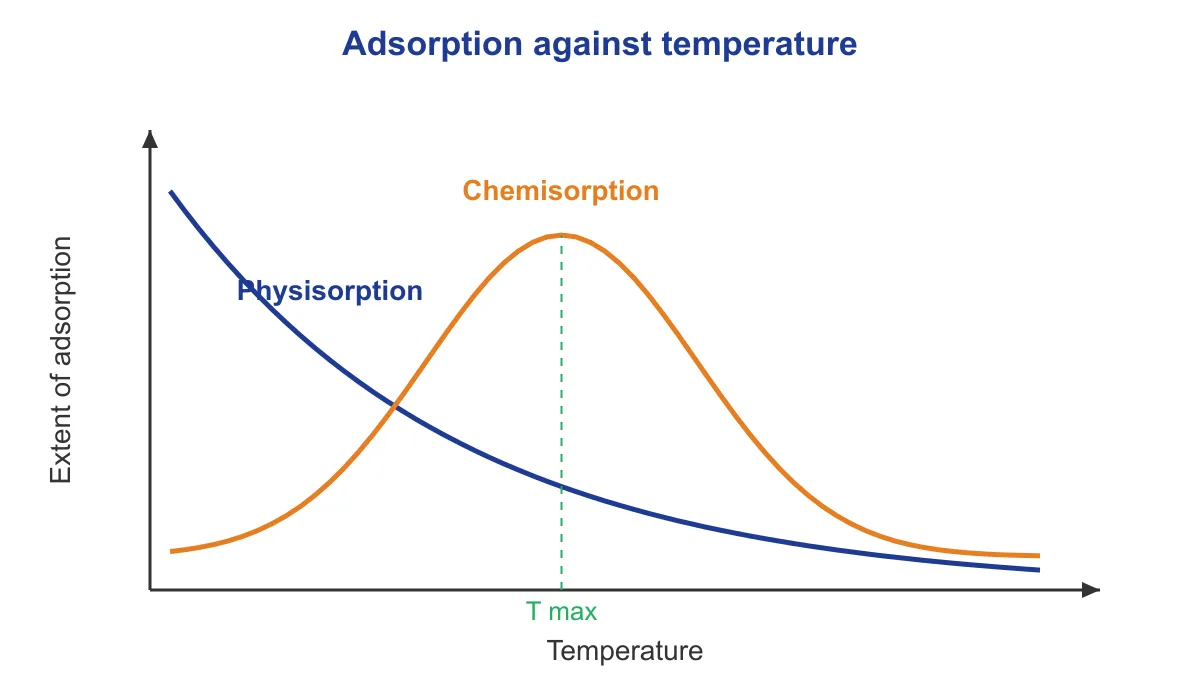
Figure 3.1: Extent of adsorption against temperature for physisorption and chemisorption
The physisorption curve only falls, because heat shakes off weakly held molecules. The chemisorption curve first climbs, because heat helps cross the activation barrier, and then falls since adsorption is exothermic.
Memory trick: Physical = Poor bonds = Plenty of layers = Cool temperature. Chemical = Cling by a bond = single layer = Hot start.
Use it to decide quickly which type a statement describes: poor, layered, reversible, low ΔH go together.
Factors that affect the adsorption of a gas on a solid
- Nature of the gas. Gases that liquefy easily (higher critical temperature) have stronger van der Waals forces and are adsorbed more. On charcoal the order is SO₂ > NH₃ > CO₂ > N₂ > H₂. Hydrogen is adsorbed hardly at all by physisorption.
- Nature of the solid. Surface area decides the amount. The same mass of adsorbent adsorbs more when it is finely divided or porous. Activated charcoal, silica gel and alumina gel have enormous internal surface.
- Surface area. For a given mass, more surface means more adsorption. Activation (heating the charcoal in steam, which clears the pores) raises the area.
- Temperature. Since adsorption is exothermic, by Le Chatelier's principle a rise in temperature lowers the extent of adsorption at equilibrium. For chemisorption the early rise caused by activation energy is the exception.
- Pressure. At fixed temperature, the extent of adsorption increases with pressure, quickly at first and then more slowly, until the surface is full and adsorption becomes nearly independent of pressure.
The plot of extent of adsorption against pressure at a fixed temperature is the adsorption isotherm. The next section gives it a formula.
Freundlich adsorption isotherm
Let $x$ be the mass of gas adsorbed on a mass $m$ of adsorbent at pressure $p$. The ratio $x/m$ is the amount adsorbed per unit mass. The empirical Freundlich relation, at a fixed temperature, is
where $k$ and $n$ are constants that depend on the adsorbent, the gas and the temperature, and $n > 1$ so that $1/n$ lies between 0 and 1. Taking logarithms:
Plot $\log(x/m)$ on the y-axis against $\log p$ on the x-axis. You get a straight line with slope $1/n$ and an intercept $\log k$ on the y-axis. That is how $k$ and $n$ are found from experiment.
The shape of the curve depends on $1/n$:
| Pressure region | Form | Meaning |
|---|---|---|
| Low pressure | $x/m \propto p$ (limit $1/n \to 1$) | Adsorption grows in direct proportion to pressure |
| Moderate pressure | $x/m \propto p^{1/n}$, fractional power | Growth slows down |
| High pressure | $x/m \propto p^{0}$ (limit $1/n \to 0$) | Surface is saturated; no further change |
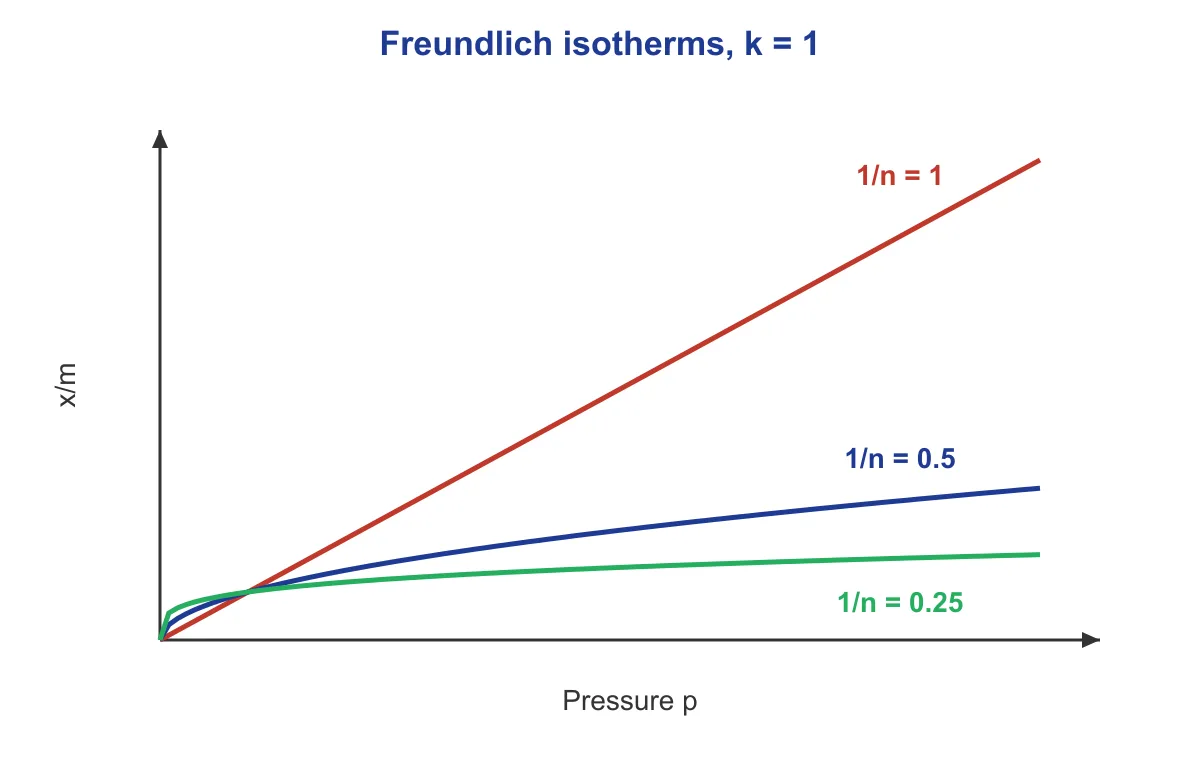
Figure 3.2: Freundlich isotherms for three values of 1/n, with k = 1
The relation is empirical and fails near saturation at very high pressure. The constant $k$ changes with temperature.
Example 1: At 300 K, a certain charcoal follows $x/m = kp^{1/n}$ with $k = 2$ and $n = 2$ (x/m in g per g, p in atm). Find $x/m$ at p = 16 atm.
Step 1: $1/n = 0.5$, so $x/m = 2 \times 16^{0.5}$.
Step 2: $16^{0.5} = 4$, so $x/m = 8$ g per g.
Why this works: a fractional power means quadrupling the pressure only doubles the uptake. Check: at p = 4, uptake would be 4, so going 4 → 16 doubled it.
Example 2: A gas is adsorbed at fixed temperature. At p = 1 atm, x/m = 3 g per g. At p = 4 atm, x/m = 6 g per g. Find $n$, $k$, and $x/m$ at p = 9 atm.
Step 1: Divide the two equations: $\frac{6}{3} = 4^{1/n}$, so $4^{1/n} = 2$.
Step 2: $4^{1/n} = 2$ gives $1/n = 0.5$, so $n = 2$.
Step 3: At p = 1, $3 = k \times 1$, so $k = 3$.
Step 4: At p = 9, $x/m = 3 \times 9^{0.5} = 9$ g per g.
Why this works: with two data points, dividing removes $k$ and leaves only the exponent.
Example 3: A log–log plot of adsorption data is a straight line. It passes through (log p = 0, log(x/m) = 0.6) and has slope 0.25. Find $k$ and the value of $x/m$ at p = 10⁴ atm.
Step 1: At log p = 0, the intercept equals $\log k = 0.6$, so $k = 10^{0.6} \approx 4$.
Step 2: Slope $1/n = 0.25$.
Step 3: At p = 10⁴, $\log p = 4$, so $\log(x/m) = 0.6 + 0.25 \times 4 = 1.6$.
Step 4: $x/m = 10^{1.6} \approx 40$.
Why this works: the intercept at log p = 0 gives log k directly.
Adsorption and heterogeneous catalysis
A catalyst changes the rate of a reaction by giving it a path of lower activation energy. When the catalyst is in a different phase from the reactants it is a heterogeneous catalyst. A solid catalyst with gaseous reactants is the standard case: iron in the Haber process, platinum in the oxidation of ammonia, finely divided nickel in the hydrogenation of oils.
Adsorption is the key to the working. The steps on the surface are:
- Reactant molecules diffuse to the surface and are adsorbed (often chemisorbed, which weakens their bonds).
- Adsorbed molecules, held close together, react at the active centres.
- The product molecules are desorbed and leave, freeing the centres for fresh reactant.
Three consequences follow. The catalyst does not alter ΔH or the equilibrium constant, only the speed at which equilibrium is reached. Finely divided solids work better because more surface is available. A substance that sits on the active centres and will not leave (a catalyst poison, such as arsenic compounds on platinum) stops the reaction.
Colloids: three kinds of mixture
Salt, starch paste and fine sand in three glasses of water give a true solution, a colloid and a suspension. The difference is mostly particle size.
| Property | True solution | Colloid | Suspension |
|---|---|---|---|
| Particle size | below 1 nm | 1 nm to 1000 nm | above 1000 nm |
| Visible to the eye | No | No (needs an ultramicroscope) | Yes |
| Passes through filter paper | Yes | Yes | No |
| Passes through a parchment membrane | Yes | No | No |
| Settles on standing | No | No | Yes |
| Tyndall effect | No | Yes | Weak, turbid |
| Example | Salt in water | Starch in water | Sand in water |
A colloid is a heterogeneous system of two phases: the dispersed phase (the colloidal particles) and the dispersion medium in which they are spread. In a sol of gold in water, gold is the dispersed phase and water is the medium.
Classification by physical state
Each of the two phases can be solid, liquid or gas, which gives the common types.
| Dispersed phase | Medium | Name | Example |
|---|---|---|---|
| Solid | Liquid | Sol | Paint, gold sol |
| Liquid | Liquid | Emulsion | Milk |
| Gas | Liquid | Foam | Whipped cream, soap lather |
| Liquid | Gas | Aerosol | Fog, mist |
| Solid | Gas | Aerosol | Smoke |
| Liquid | Solid | Gel | Cheese, jelly |
| Solid | Solid | Solid sol | Ruby glass |
Classification by interaction of the particles with the medium
- Lyophilic (solvent-loving) sols: the particles have a strong affinity for the medium. Gelatin, starch, gum, proteins in water. They are formed by direct mixing, are stable, and are reversible: if the dispersion medium is evaporated and the residue is mixed with water again, the sol re-forms.
- Lyophobic (solvent-hating) sols: little affinity for the medium. Metals and sulphides such as gold, As₂S₃ and Fe(OH)₃ in water. They are not formed by simple mixing, are stable only because of the charge on the particles, and are irreversible: once coagulated they do not return on adding water.
Classification by the type of particle
- Multimolecular colloids: very many atoms or small molecules (diameter below 1 nm each) clump into a particle held by van der Waals forces. Gold sol, sulphur sol (about 10³ S₈ molecules per particle).
- Macromolecular colloids: the dispersed particle is itself a giant molecule: starch, cellulose, proteins, rubber, synthetic polymers.
- Associated colloids (micelles): substances that behave as normal electrolytes at low concentration but form aggregates above a certain concentration. Soaps and detergents.
Preparation of colloidal sols
Lyophilic sols are made by shaking the substance with the medium. Lyophobic sols need a special method that gives particles of colloidal size, by growth from small particles or by breaking up large ones.
Chemical methods
A chemical reaction produces an insoluble product in very low concentration, so it stays as tiny particles.
- Double decomposition: As₂O₃ + 3H₂S → As₂S₃ (sol) + 3H₂O
- Oxidation: 2H₂S + SO₂ → 3S (sol) + 2H₂O
- Reduction: 2AuCl₃ + 3HCHO + 3H₂O → 2Au (sol) + 3HCOOH + 6HCl
- Hydrolysis: FeCl₃ + 3H₂O → Fe(OH)₃ (sol) + 3HCl, when a few drops of FeCl₃ go into boiling water
Bredig's arc method
An electric arc is struck between two metal electrodes (gold, silver, platinum) dipped in water kept cold with ice. The intense heat vaporises the metal, and the vapour condenses at once in the cold water into colloidal particles.
Peptisation
A freshly prepared precipitate is changed into a colloidal sol by shaking it with a small amount of an electrolyte. The electrolyte is the peptising agent. Its ions are adsorbed on the precipitate particles, give them a common charge, and the repulsion breaks the clumps into particles of colloidal size. A precipitate of Fe(OH)₃ turns into a reddish-brown sol when a little FeCl₃ solution is added: Fe³⁺ ions are adsorbed and the particles become positive. Peptisation is the opposite of coagulation.
Purification of colloids by dialysis
A sol made by a chemical method contains dissolved ions and small molecules (for example HCl in the Fe(OH)₃ sol above). These can destabilise it. Dialysis removes them. The impure sol is placed in a bag made of a membrane such as parchment or cellophane, which lets ions and small molecules through but not the colloidal particles. The bag is suspended in flowing water. The small ions diffuse out and are carried away, and the sol inside becomes pure. The process is slow.
Example 4: A cube of side 1 cm is cut into small cubes of side 10 nm. By what factor does the total surface area grow?
Step 1: Original surface = $6a^2$ with $a = 10^{-2}$ m, that is $6 \times 10^{-4}$ m².
Step 2: Number of small cubes = $(a/b)^3$, with $b = 10^{-8}$ m, so the number is $(10^6)^3 = 10^{18}$.
Step 3: Total new surface = $10^{18} \times 6b^2 = 10^{18} \times 6 \times 10^{-16} = 600$ m².
Step 4: Ratio = $600 / (6 \times 10^{-4}) = 10^6$.
Why this works: the area grows by the factor $a/b$ when a cube is divided into smaller cubes. Colloidal dispersions have a huge surface per gram, which is why they adsorb so strongly and why surface charge matters to them.
General properties of colloids
Tyndall effect
When a strong beam of light passes through a colloidal sol in a dark room, the path of the beam is lit up as a visible cone. This scattering is the Tyndall effect. It needs two conditions: the particle diameter is not much smaller than the wavelength of visible light, and the refractive index of the dispersed phase differs a lot from that of the medium. Lyophobic sols show it clearly, lyophilic sols weakly, and true solutions not at all.
Brownian motion
Colloidal particles move in constant, random zigzag paths. The cause is the unequal bombardment of a particle by the molecules of the dispersion medium on its different sides. The motion is faster for smaller particles and at higher temperature, and it helps to prevent settling.
Charge on colloidal particles
Particles in a given sol carry the same kind of charge, and this keeps them apart. The charge arises mostly from the preferential adsorption of ions from the medium.
| Positively charged sols | Negatively charged sols |
|---|---|
| Fe(OH)₃, Al(OH)₃ (hydrated metal oxides) | As₂S₃, other metal sulphides |
| Haemoglobin | Gold, silver, platinum, copper sols |
| Methylene blue (basic dye) | Starch, gum, gelatin at neutral conditions |
| Eosin (acidic dye), clay |
In the sol, the layer of adsorbed ions of one sign is firmly held on the particle, and a diffuse layer of the opposite ions surrounds it. If KI is added to AgNO₃ solution a little at a time until Ag⁺ is in excess, the AgI particles adsorb Ag⁺ and the sol is positive. If AgNO₃ is added to KI until I⁻ is in excess, the AgI particles adsorb I⁻ and the sol is negative. The rule is that the particle adsorbs the ion common to its own lattice that is in excess.
Electrophoresis
Place a sol in a U-tube with two electrodes and apply a potential. The particles move to one electrode. A positive sol such as Fe(OH)₃ travels toward the cathode, a negative sol such as As₂S₃ toward the anode. This movement of colloidal particles under an electric field is electrophoresis, and it is the proof that the particles are charged.
Coagulation and the Hardy–Schulze rule
Coagulation (flocculation) is the settling of colloidal particles as a precipitate. It can be done by adding an electrolyte, by electrophoresis, by boiling, or by mixing two sols of opposite charge. Adding an electrolyte is the standard case. The ions of the electrolyte whose charge is opposite to that of the sol are attracted to the particles, neutralise the charge, and the particles then clump and settle.
The Hardy–Schulze rule: the greater the charge on the coagulating ion, the greater its power to coagulate.
- For a negative sol such as As₂S₃: Al³⁺ > Ba²⁺ > Na⁺ (the coagulating power rises with the cation charge).
- For a positive sol such as Fe(OH)₃: [Fe(CN)₆]⁴⁻ > PO₄³⁻ > SO₄²⁻ > Cl⁻.
The flocculation value is the smallest concentration of an electrolyte, in millimoles per litre, that will coagulate a sol in a fixed short time (two hours is the usual convention). It is the opposite of power: the smaller the flocculation value, the greater the coagulating power. So for As₂S₃ the flocculation values follow Al³⁺ < Ba²⁺ < Na⁺, with typical magnitudes of around 0.1, 1 and 100 mmol L⁻¹.
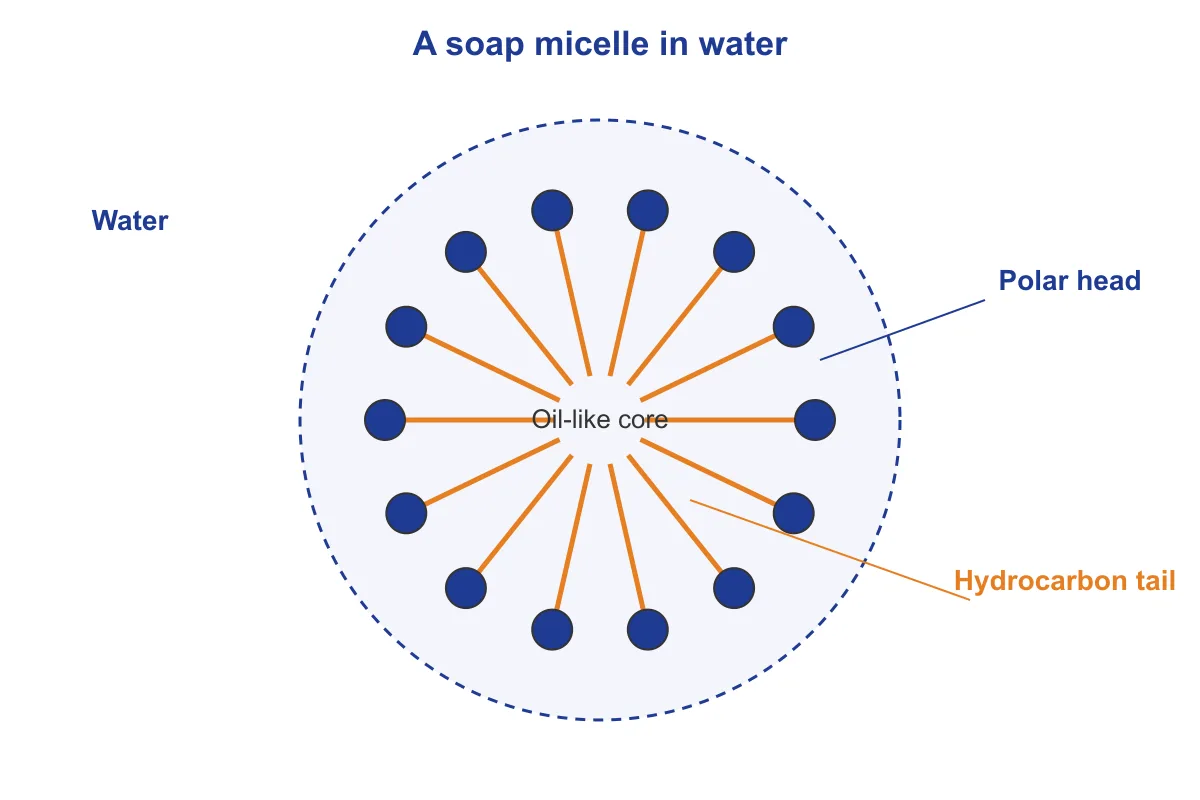
Figure 3.3: A soap micelle, with water-loving heads outside and hydrocarbon tails gathered inside
Example 5: 100 mL of 0.10 M AgNO₃ is mixed with 60 mL of 0.10 M KI. Predict the charge on the AgI sol. Which of NaCl, Na₂SO₄ and Na₃PO₄ will coagulate it at the lowest concentration?
Step 1: Moles of Ag⁺ = $100 \times 0.10 = 10$ mmol. Moles of I⁻ = $60 \times 0.10 = 6$ mmol.
Step 2: 6 mmol AgI forms. Ag⁺ left over = 4 mmol, so Ag⁺ is in excess.
Step 3: The AgI particles adsorb Ag⁺, so the sol is positively charged.
Step 4: A positive sol is coagulated by anions, and a higher charge is more powerful: PO₄³⁻ beats SO₄²⁻ beats Cl⁻. So Na₃PO₄ works at the lowest concentration.
Why this works: decide the excess ion first, since that fixes the charge. Then only the anion counts; the sodium is a spectator.
Memory trick: "Opposite attracts, higher hits harder": the coagulating ion is opposite to the sol, and the greater its charge, the smaller the dose.
Use it for every Hardy–Schulze question: look at the sol's sign, flip it, then rank by charge.
Emulsions, surfactants and micelles
An emulsion is a colloidal dispersion of one liquid in another liquid that does not mix with it. The two types are:
- Oil in water (O/W): tiny oil droplets in water. Milk, vanishing cream.
- Water in oil (W/O): tiny water droplets in oil. Butter, cold cream, cod-liver oil.
Oil and water shaken together separate. An emulsifying agent (soap, gelatin, gum, proteins), forms a protective film around the droplets and keeps the emulsion stable.
Surfactants (surface-active agents) are molecules with a water-loving polar head and an oil-loving hydrocarbon tail. They collect at the surface of water and lower its surface tension. Soap (sodium stearate, C₁₇H₃₅COONa) and detergents (sodium dodecyl sulphate, CH₃(CH₂)₁₁OSO₃Na) are examples.
In dilute solution a surfactant behaves as an ordinary strong electrolyte. Above a certain concentration, the critical micelle concentration (CMC), the molecules cluster into micelles, each of around 100 molecules, with the tails inward and the heads outward in contact with water. Micelles form only above a minimum temperature called the Kraft temperature. A micelle explains how soap cleans: a greasy drop is held inside the hydrocarbon core of the micelle, and the polar heads on the outside let it be carried away in water. For soap, CMC is of the order of 10⁻³ mol L⁻¹.
Common traps
- Calling adsorption "the same as absorption" → absorption is through the whole bulk; adsorption is only on the surface.
- Saying adsorption is endothermic because heat is "taken in" to stick → it is exothermic, so adsorption falls as temperature rises (physisorption).
- Applying the same temperature trend to chemisorption → chemisorption first rises with temperature (activation energy) and then falls.
- Taking the Freundlich slope as $n$ → the slope of $\log(x/m)$ against $\log p$ is $1/n$, and the intercept is $\log k$.
- Reading the intercept at p = 0 → the intercept is at $\log p = 0$, which means p = 1.
- Writing $1/n > 1$ → $n$ is greater than 1 in the usual form, so $1/n$ lies between 0 and 1.
- Taking a high flocculation value as high power → smaller flocculation value means stronger coagulating power.
- Using the wrong ion for coagulation → a negative sol is coagulated by cations, a positive sol by anions, and only the opposite-charge ion counts.
- Putting soap in the multimolecular class → soap and detergents are associated colloids that form micelles above the CMC.
Quick revision
- Adsorption is a surface phenomenon; absorption is a bulk phenomenon.
- Adsorption is exothermic, ΔH < 0, and ΔS < 0, so ΔG < 0.
- Physisorption: van der Waals, ΔH about 20–40 kJ mol⁻¹, reversible, multilayer, falls with temperature.
- Chemisorption: chemical bond, ΔH about 80–240 kJ mol⁻¹, irreversible, monolayer, specific, rises then falls with temperature.
- Easily liquefied gases are adsorbed more strongly: SO₂ > NH₃ > CO₂ > N₂ > H₂ on charcoal.
- Freundlich: $x/m = kp^{1/n}$ with $1/n$ from 0 to 1.
- Log form: $\log(x/m) = \log k + \frac{1}{n}\log p$; slope is $1/n$, intercept is $\log k$.
- Low pressure: uptake is proportional to p; high pressure: it is independent of p.
- Heterogeneous catalysis: adsorb, react, desorb. A catalyst does not shift equilibrium or change ΔH.
- Colloid size is 1 nm to 1000 nm; true solution is smaller, suspension is larger.
- Lyophilic sols are reversible and self-stabilised; lyophobic sols are irreversible and need charge.
- Methods: chemical reaction, Bredig's arc, peptisation; dialysis purifies a sol.
- Tyndall effect and Brownian motion are shown by sols; electrophoresis shows that the particles carry charge.
- Hardy–Schulze: coagulating power rises with the charge of the ion opposite to the sol; smaller flocculation value means more power.
- Emulsions are O/W or W/O; soap forms micelles above the CMC and above the Kraft temperature.
Practice questions
For the spontaneous adsorption of a gas on a solid surface at constant temperature, the signs of ΔH and ΔS of the process are respectively
- Negative and negative
- Negative and positive
- Positive and negative
- Positive and positive
Answer
A. Negative and negative
The gas loses freedom of movement on the surface, so ΔS < 0. ΔG = ΔH − TΔS must be negative, and with ΔS negative this needs ΔH < 0. Adsorption is exothermic.
Which of the following is a feature of chemisorption but not of physisorption?
- Its enthalpy is about 20 kJ mol⁻¹
- It is reversible
- It is highly specific to the gas and the surface
- It can form multilayers
Answer
C. It is highly specific to the gas and the surface
Chemisorption needs a bond to form, so only particular gas–surface pairs show it. The other three describe physisorption.
Among H₂, N₂, O₂ and NH₃, the gas adsorbed to the greatest extent on activated charcoal at the same temperature and pressure is
- O₂
- NH₃
- N₂
- H₂
Answer
B. NH₃
The more easily a gas liquefies (higher critical temperature), the stronger its van der Waals attraction to the surface. NH₃ liquefies most easily of the four.
A graph of log(x/m) against log p for a gas on charcoal is a straight line. Its slope equals
- k
- n
- log k
- 1/n
Answer
D. 1/n
From log(x/m) = log k + (1/n) log p, the coefficient of log p is 1/n; the intercept is log k.
Which of the following sols is positively charged?
- Fe(OH)₃ sol
- Gold sol
- Clay sol
- As₂S₃ sol
Answer
A. Fe(OH)₃ sol
Hydrated metal oxides such as Fe(OH)₃ adsorb their own cations and carry positive charge. Sulphide, metal and clay sols are negative.
The purpose of dialysis in preparing a colloidal sol is to
- Convert the sol into a gel
- Increase the size of the particles
- Remove dissolved ions and small molecules from the sol
- Coagulate the sol
Answer
C. Remove dissolved ions and small molecules from the sol
The parchment or cellophane membrane lets small ions through but holds back colloidal particles, so the sol is purified.
A freshly formed precipitate of Fe(OH)₃ is converted into a stable reddish-brown sol by shaking it with a small amount of
- Concentrated NaCl solution
- Hot distilled water alone
- Sodium sulphate solution
- Dilute FeCl₃ solution
Answer
D. Dilute FeCl₃ solution
Fe³⁺ ions are adsorbed on the precipitate particles (peptisation). Their common positive charge breaks the clumps into colloidal particles. Added electrolytes of opposite-charge ions would coagulate instead.
For the coagulation of a negatively charged As₂S₃ sol, the electrolyte with the lowest flocculation value among those below is
- NaCl
- AlCl₃
- BaCl₂
- KCl
Answer
B. AlCl₃
The cation does the coagulating, and a higher charge needs a smaller concentration. Al³⁺ has the highest charge, so AlCl₃ has the lowest flocculation value.
Which of the following sols, once coagulated, cannot be brought back simply by adding the dispersion medium again?
- Gum sol
- Starch sol
- As₂S₃ sol
- Gelatin sol
Answer
C. As₂S₃ sol
As₂S₃ is lyophobic and irreversible. Gelatin, starch and gum are lyophilic and re-form on adding water.
The Tyndall effect is observed most clearly when the dispersed particles
- Are of molecular size and fully dissolved
- Are much smaller than the wavelength of light and have nearly the same refractive index as the medium
- Are larger than 1 mm in diameter
- Have a diameter not much smaller than the wavelength of light and a refractive index very different from the medium
Answer
D. Have a diameter not much smaller than the wavelength of light and a refractive index very different from the medium
Scattering needs particles comparable to the wavelength and a large contrast in refractive index between the two phases.
Butter is best described as
- A water-in-oil emulsion
- A solid sol
- An oil-in-water emulsion
- A gas-in-liquid foam
Answer
A. A water-in-oil emulsion
Butter has fine water droplets dispersed in fat, so it is a water-in-oil emulsion.
In a micelle formed by sodium stearate in water above the critical micelle concentration
- The hydrocarbon tails point inward and the COO⁻ heads face the water
- The COO⁻ heads point inward and the tails face the water
- The molecules lie in one layer with tails and heads mixed
- Only the Na⁺ ions are held inside the core
Answer
A. The hydrocarbon tails point inward and the COO⁻ heads face the water
The nonpolar tails avoid water and cluster in the core; the ionic heads stay in contact with water on the outside.
Which statement about a solid catalyst in a gas-phase reaction is correct?
- It makes ΔG of the reaction more negative
- It lowers the activation energy and leaves ΔH of the reaction unchanged
- It shifts the equilibrium toward products
- It increases the equilibrium constant of the reaction
Answer
B. It lowers the activation energy and leaves ΔH of the reaction unchanged
A catalyst gives an alternative path with a lower activation energy. ΔH, ΔG and the equilibrium constant depend only on initial and final states.
The flocculation values of sodium salts needed to coagulate a positively charged Fe(OH)₃ sol follow the order
- NaCl = Na₂SO₄ = Na₃PO₄
- Na₃PO₄ > Na₂SO₄ > NaCl
- NaCl > Na₂SO₄ > Na₃PO₄
- Na₂SO₄ > NaCl > Na₃PO₄
Answer
C. NaCl > Na₂SO₄ > Na₃PO₄
Anions coagulate a positive sol, and a higher charge gives a lower flocculation value. Cl⁻ (charge 1) needs the largest amount, PO₄³⁻ (charge 3) the smallest.
A gas follows x/m = kp^{1/n} on a solid with k = 3 (x/m in g per g, p in atm) and 1/n = 0.5. The value of x/m at p = 4 atm is
- 1.5
- 6
- 12
- 9
Answer
B. 6
x/m = 3 × 4^0.5 = 3 × 2 = 6 g per g. Check: p = 1 would give 3, and four times the pressure only doubles it.
The slope of a plot of log(x/m) against log p is 0.4. The value of n in the Freundlich equation is
- 0.4
- 2.5
- 4
- 0.25
Answer
B. 2.5
The slope is 1/n = 0.4, so n = 1/0.4 = 2.5.
A gas has x/m = 5 at p = 1 atm and x/m = 10 at p = 8 atm, with the same units and at fixed temperature. In x/m = kp^{1/n}, the value of n is
- 3
- 2
- 4
- 0.33
Answer
A. 3
Divide: 10/5 = 8^{1/n}, so 8^{1/n} = 2. Since 8 = 2³, 1/n = 1/3 and n = 3. Check: k = 5 and 5 × 8^{1/3} = 10.
A solid has Freundlich constants k = 5 mg per g at p = 1 atm and 1/n = 0.5. The mass of gas adsorbed, in mg, by 4 g of the solid at 9 atm is
- 15
- 20
- 180
- 60
Answer
D. 60
x/m = 5 × 9^0.5 = 15 mg per g. For 4 g: x = 4 × 15 = 60 mg. Wrong routes: 180 uses 9 instead of its root, 20 forgets p.
A log–log Freundlich plot has intercept 1 on the log(x/m) axis and slope 0.5. In the same units, x/m at p = 100 atm is
- 1000
- 10
- 100
- 20
Answer
C. 100
log k = 1 so k = 10. Then x/m = 10 × 100^0.5 = 10 × 10 = 100. Check by log: 1 + 0.5 × 2 = 2, and 10² = 100.
A cube of side 1 cm is divided into cubes of side 1 μm. The total surface area of all the small cubes, in m², is
- 6 × 10⁻⁴
- 0.06
- 60
- 6
Answer
D. 6
Number of cubes = (10⁻²/10⁻⁶)³ = 10¹². Each has area 6 × 10⁻¹² m², so total = 6 m². Check: area × (a/b) = 6 × 10⁻⁴ × 10⁴ = 6 m².
A volume of 0.5 mL of 1.0 M NaCl is just enough to coagulate 10 mL of a sol in a fixed time. Taking the flocculation value as millimoles of electrolyte per litre of the original sol, its value in mmol L⁻¹ is
- 50
- 0.5
- 5
- 500
Answer
A. 50
Moles of NaCl = 0.5 mL × 1.0 M = 0.5 mmol. Per litre of sol: 0.5 mmol / 0.010 L = 50 mmol L⁻¹.
For adsorption of a gas, ΔH = −40 kJ mol⁻¹ and ΔS = −100 J K⁻¹ mol⁻¹. Adsorption becomes non-spontaneous above a temperature, in K, of
- 250
- 400
- 4000
- 40
Answer
B. 400
ΔG = ΔH − TΔS = 0 gives T = ΔH/ΔS = (−40000)/(−100) = 400 K. Above 400 K, ΔG is positive. Wrong routes: 40 forgets J to kJ, 250 inverts the ratio.
A 50 mL portion of 0.2 M AgNO₃ is mixed with 30 mL of 0.2 M KI, forming an AgI sol. The amount of Ag⁺ left unreacted, in mmol, is
- 4
- 6
- 10
- 16
Answer
A. 4
Ag⁺ = 50 × 0.2 = 10 mmol; I⁻ = 30 × 0.2 = 6 mmol. They react 1 : 1, so 6 mmol AgI forms and 10 − 6 = 4 mmol Ag⁺ remains. This excess makes the sol positive.
One litre of a soap solution contains 0.011 mol of soap and has a critical micelle concentration of 1 × 10⁻³ mol L⁻¹. Assume that all soap above the CMC is present as micelles, each made of 100 ions. The amount of micelles, in mol, is
- 1 × 10⁻³
- 1 × 10⁻⁵
- 1.1 × 10⁻⁴
- 1 × 10⁻⁴
Answer
D. 1 × 10⁻⁴
Soap in micelles = 0.011 − 0.001 = 0.010 mol. Micelles = 0.010/100 = 1 × 10⁻⁴ mol. The distractor 1.1 × 10⁻⁴ forgets to subtract the CMC part.
The flocculation values of NaCl and AlCl₃ for a negative As₂S₃ sol are 52 mmol L⁻¹ and 0.1 mmol L⁻¹. The coagulating power of Al³⁺ compared with Na⁺ is larger by a factor of
- 52
- 5200
- 520
- 26
Answer
C. 520
Power is inversely proportional to the flocculation value: 52 / 0.1 = 520.
In a Freundlich plot, log(x/m) is 1.5 when log p = 1 and 2.5 when log p = 3. The value of k is
- 10
- 1
- 100
- 3.2
Answer
A. 10
Slope = (2.5 − 1.5)/(3 − 1) = 0.5. Intercept at log p = 0: 1.5 − 0.5 × 1 = 1.0, so k = 10¹ = 10. Check: log p = 3 gives 1 + 1.5 = 2.5.
Given below are two statements: Statement I: Adsorption of a gas on a solid is always accompanied by a release of heat. Statement II: Physisorption increases when the temperature of the system is raised.
- Both Statement I and Statement II are correct
- Both Statement I and Statement II are incorrect
- Statement I is correct but Statement II is incorrect
- Statement I is incorrect but Statement II is correct
Answer
C. Statement I is correct but Statement II is incorrect
Statement I is correct since ΔH < 0. Statement II is wrong: physisorption falls with temperature because weak bonds are broken by heat.
Given below are two statements: Statement I: Brownian motion is faster for larger colloidal particles than for smaller ones. Statement II: True solutions show the Tyndall effect clearly.
- Both Statement I and Statement II are correct
- Both Statement I and Statement II are incorrect
- Statement I is correct but Statement II is incorrect
- Statement I is incorrect but Statement II is correct
Answer
B. Both Statement I and Statement II are incorrect
Smaller particles are knocked about more easily, so I is wrong. True solutions have molecular-size particles that scatter very little light, so II is wrong.
Given below are two statements: Statement I: Soap forms micelles in water above a certain concentration. Statement II: Micelles are classed as associated colloids.
- Both Statement I and Statement II are correct
- Both Statement I and Statement II are incorrect
- Statement I is correct but Statement II is incorrect
- Statement I is incorrect but Statement II is correct
Answer
A. Both Statement I and Statement II are correct
Both are true: soap molecules cluster into micelles above the critical micelle concentration, and such colloids are called associated colloids.
Given below are two statements: Statement I: A negative sol such as As₂S₃ is coagulated by cations, and more strongly as the charge on the cation rises. Statement II: The flocculation value of Na⁺ for As₂S₃ is smaller than that of Al³⁺.
- Both Statement I and Statement II are correct
- Both Statement I and Statement II are incorrect
- Statement I is correct but Statement II is incorrect
- Statement I is incorrect but Statement II is correct
Answer
C. Statement I is correct but Statement II is incorrect
I is the Hardy–Schulze rule. II is reversed: Na⁺ has the lower power, so it needs the larger concentration and has the larger flocculation value.
Given below are two statements: Statement I: Chemisorption can build up several layers on a surface. Statement II: Chemisorption is highly specific.
- Both Statement I and Statement II are correct
- Both Statement I and Statement II are incorrect
- Statement I is correct but Statement II is incorrect
- Statement I is incorrect but Statement II is correct
Answer
D. Statement I is incorrect but Statement II is correct
Chemisorption involves bond formation, so it stops at a single layer: I is wrong. It happens only where a bond can form: II is correct.
Assertion (A): Physisorption of a gas on a solid is irreversible. Reason (R): Weak van der Waals forces hold the gas molecules on the surface.
- Both A and R are true and R is the correct explanation of A
- Both A and R are true but R is not the correct explanation of A
- A is true but R is false
- A is false but R is true
Answer
D. A is false but R is true
Weak forces mean the molecules can leave when pressure falls or temperature rises, so physisorption is reversible. A is false; R is true.
Assertion (A): Lyophilic sols are more stable than lyophobic sols. Reason (R): The stability of lyophilic sols comes only from the charge on the particles.
- Both A and R are true and R is the correct explanation of A
- Both A and R are true but R is not the correct explanation of A
- A is true but R is false
- A is false but R is true
Answer
C. A is true but R is false
Lyophilic sols are stable because of a solvent layer around the particles, not only charge. A is true; R is false.
Assertion (A): Tyndall effect is not seen in a true solution. Reason (R): Colloidal particles show Brownian motion.
- Both A and R are true and R is the correct explanation of A
- Both A and R are true but R is not the correct explanation of A
- A is true but R is false
- A is false but R is true
Answer
B. Both A and R are true but R is not the correct explanation of A
Both statements are true, but Brownian motion is not why a true solution fails to scatter light; that is due to the very small particle size.
Match List I with List II. List I: a. Bredig's arc method b. Peptisation c. Dialysis d. Hardy–Schulze rule List II: i. Removal of ions through a membrane ii. Metal vapour condensing in cold water iii. Precipitate converted into sol by an electrolyte iv. Coagulating power rises with ion charge
- a-ii, b-i, c-iii, d-iv
- a-ii, b-iii, c-i, d-iv
- a-i, b-iii, c-ii, d-iv
- a-iii, b-ii, c-i, d-iv
Answer
B. a-ii, b-iii, c-i, d-iv
The arc vaporises metal under water (ii). Peptisation uses an electrolyte on a precipitate (iii). Dialysis removes ions (i). Hardy–Schulze concerns ion charge (iv).
Match List I with List II. List I: a. Fog b. Milk c. Cheese d. Smoke List II: i. Solid dispersed in gas ii. Liquid dispersed in liquid iii. Liquid dispersed in gas iv. Liquid dispersed in solid
- a-ii, b-iii, c-i, d-iv
- a-i, b-ii, c-iv, d-iii
- a-iii, b-iv, c-ii, d-i
- a-iii, b-ii, c-iv, d-i
Answer
D. a-iii, b-ii, c-iv, d-i
Fog is liquid in gas, milk is liquid in liquid, cheese is liquid in solid (a gel), smoke is solid in gas.
Match List I with List II. List I: a. Fe(OH)₃ sol b. As₂S₃ sol c. Starch in water d. Soap above CMC List II: i. Negatively charged lyophobic sol ii. Macromolecular colloid iii. Positively charged lyophobic sol iv. Associated colloid
- a-i, b-iii, c-ii, d-iv
- a-iii, b-i, c-ii, d-iv
- a-iii, b-i, c-iv, d-ii
- a-ii, b-i, c-iii, d-iv
Answer
B. a-iii, b-i, c-ii, d-iv
Fe(OH)₃ is positive (iii), As₂S₃ negative (i), starch is a giant molecule (ii), and soap micelles are associated colloids (iv).
A gas follows x/m = kp^{1/n} on a solid with k = 4 mg per g and 1/n = 0.5 (p in atm). A 2 g sample of the solid is exposed first to 4 atm and then to 16 atm at the same temperature. The extra mass of gas adsorbed, in mg, on raising the pressure is
- 16
- 8
- 32
- 24
Answer
A. 16
At 4 atm: x = 2 × 4 × 2 = 16 mg. At 16 atm: x = 2 × 4 × 4 = 32 mg. Extra = 32 − 16 = 16 mg. Wrong routes: 32 is the final total, 8 uses a single gram.
A 40 mL portion of 0.1 M KI is mixed with 25 mL of 0.1 M AgNO₃ to form an AgI sol. Which entry gives the charge on the sol and the electrolyte, among NaCl, MgCl₂ and AlCl₃ at equal concentration, that coagulates it most effectively?
- Positive; MgCl₂
- Negative; NaCl
- Positive; AlCl₃
- Negative; AlCl₃
Answer
D. Negative; AlCl₃
I⁻ = 4 mmol, Ag⁺ = 2.5 mmol, so 1.5 mmol I⁻ is left. AgI adsorbs I⁻ and the sol is negative. Cations coagulate it, and Al³⁺ has the highest charge.
In a U-tube, a colloidal sol is found to move toward the anode when a potential is applied. Which description fits it?
- A negative sol such as As₂S₃, which is coagulated most effectively by Cl⁻ among Cl⁻, SO₄²⁻ and PO₄³⁻
- A positive sol such as Fe(OH)₃, which is coagulated most effectively by Al³⁺ among Na⁺, Mg²⁺ and Al³⁺
- A negative sol such as As₂S₃, which is coagulated most effectively by Al³⁺ among Na⁺, Mg²⁺ and Al³⁺
- A positive sol such as Fe(OH)₃, which is coagulated most effectively by Na⁺ among Na⁺, Mg²⁺ and Al³⁺
Answer
C. A negative sol such as As₂S₃, which is coagulated most effectively by Al³⁺ among Na⁺, Mg²⁺ and Al³⁺
Movement to the anode means the particles are negative. A negative sol is coagulated by cations, and the highest charge, Al³⁺, is most effective.