Hydrogen and s-Block Elements
What to remember
- Hydrogen forms three kinds of hydride: ionic (s-block, contains H⁻), covalent (p-block, electron-deficient, electron-precise or electron-rich) and interstitial or metallic (d-block, non-stoichiometric). Groups 7, 8 and 9 form no hydride.
- Hydrogen peroxide is an open-book molecule with oxygen in the −1 state. It oxidises in acid and in base and also reduces strong oxidants. Volume strength = 11.2 × molarity.
- Down the s-block, ionisation enthalpy falls and reactivity rises, but Li is the strongest reducing agent in water because of its huge hydration enthalpy. Li gives oxide, Na gives peroxide, K, Rb and Cs give superoxide.
- Solubility of group 2 sulphates falls down the group; solubility of group 2 hydroxides rises. Thermal stability of carbonates and nitrates rises down both groups, and Li behaves like Mg, Be like Al.
- Solvay process: NaCl + NH₃ + CO₂ + H₂O → NaHCO₃ + NH₄Cl, then heating NaHCO₃ gives Na₂CO₃. Plaster of Paris is CaSO₄·½H₂O, made at 393 K from gypsum.
Hydrogen: position, isotopes, preparation and properties
Hydrogen has the configuration 1s¹. That one electron makes it look like an alkali metal, since it forms H⁺ and has an ns¹ outer shell. But hydrogen is a gas made of H₂ molecules, its ionisation enthalpy (1312 kJ mol⁻¹) is far above that of Li, and H⁺ never exists free in water; it is H₃O⁺. One electron short of helium, hydrogen also resembles a halogen: it forms H₂, and it takes up an electron to give H⁻ with reactive metals. Neither home fits properly, so hydrogen is placed above the table or at the top of group 1 as a special case.
There are three isotopes. Protium (¹H) is 99.98% of natural hydrogen and has no neutron. Deuterium (²H or D) has one neutron and is about 0.0156% abundant. Tritium (³H or T) has two neutrons, is radioactive and emits β⁻ particles, with a half-life of about 12.3 years.
Preparation in the laboratory uses a metal that sits above hydrogen in the activity series:
- Zn + H₂SO₄(dilute) → ZnSO₄ + H₂
- Zn + 2NaOH → Na₂ZnO₂ + H₂ (zinc is amphoteric, so alkali also works)
Industrially, hydrogen comes from hydrocarbons and coal:
- CH₄ + H₂O → CO + 3H₂ over nickel at about 1270 K (steam reforming)
- C + H₂O → CO + H₂ (water gas, or syngas, from red-hot coke)
- CO + H₂O → CO₂ + H₂ over an iron(III) oxide–chromium oxide catalyst at about 673 K (water–gas shift); the CO₂ is removed by scrubbing with sodium arsenite solution or by alkaline washing.
- Electrolysis of acidified water.
Hydrogen is colourless, odourless, almost insoluble in water, and the lightest gas. The H–H bond (435.9 kJ mol⁻¹) is strong, so at room temperature the gas is unreactive and needs heat, a catalyst or a spark.
- With O₂: 2H₂ + O₂ → 2H₂O, strongly exothermic, explosive in mixtures.
- With N₂: N₂ + 3H₂ ⇌ 2NH₃ (iron catalyst, 200 atm, about 700 K, the Haber process).
- It also reduces CuO to Cu, and with nickel it hydrogenates vegetable oil to fat.
Hydrogen is also a fuel. H₂(g) + ½O₂(g) → H₂O(l) releases 286 kJ per mole, about 143 kJ per gram, nearly three times the figure for petrol, and the only product is water. The difficulties are practical: the gas is bulky, leaks easily and is mostly made from fossil fuel today. Storage as compressed gas, as liquid at 20 K or inside metal hydrides, and fuel cells that give electricity directly, are the routes being tried.
Example 1: Zinc of mass 3.27 g is treated with excess hot NaOH solution. What volume of H₂ forms at STP (22.4 L mol⁻¹)? Zn = 65.4.
Equation: Zn + 2NaOH → Na₂ZnO₂ + H₂.
Moles of Zn = 3.27 / 65.4 = 0.05.
The ratio is 1 : 1, so moles of H₂ = 0.05.
Volume = 0.05 × 22.4 = 1.12 L.
Answer: 1.12 L. NaOH is in excess, so zinc decides the amount; the ratio between Zn and H₂ is the same in acid.
Hydrides
A hydride is a compound of hydrogen with another element. How it is built depends on where the element sits.
| Type | Elements | Nature of hydrogen | Examples | Key properties |
|---|---|---|---|---|
| Ionic (saline) | Groups 1 and 2 (BeH₂ and MgH₂ are largely covalent) | H⁻ ion | NaH, CaH₂ | White crystalline solids, high melting, conduct when molten (H₂ at the anode), react with water to give H₂ |
| Covalent (molecular) | p-block, groups 13 to 17 | Shared pair | B₂H₆, CH₄, NH₃, H₂O, HF | Volatile gases or liquids; some are hydrogen bonded |
| Interstitial (metallic) | d-block and f-block | H atoms in voids | TiH₁.₇, PdH₀.₆, ZrH₁.₉ | Non-stoichiometric, conduct, hard, lose hydrogen on heating |
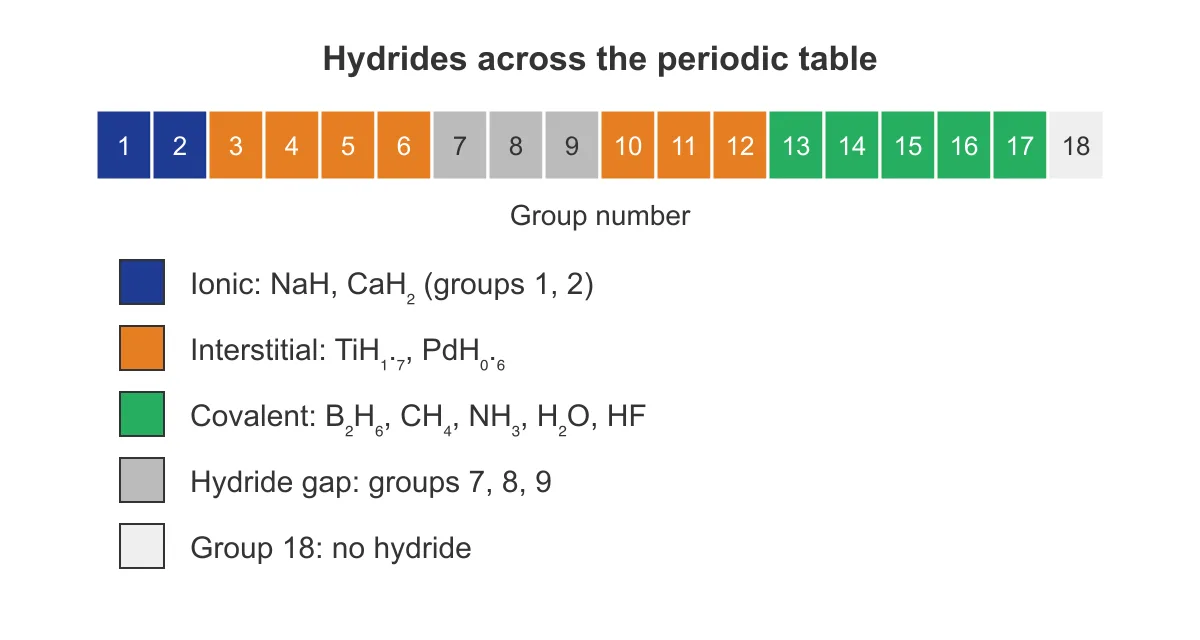
Figure 4.1: Where each kind of hydride occurs
Ionic hydrides are made by heating the metal in hydrogen. The ion H⁻ is a very strong base and reducing agent, so NaH + H₂O → NaOH + H₂ is violent, and the hydride must be kept away from moisture. Electrolysis of molten LiH or CaH₂ gives hydrogen at the anode, which is the proof that the hydrogen is present as H⁻.
Covalent hydrides are sorted by electron count.
- Electron-deficient: not enough electrons to give every bond a pair. B₂H₆ and (AlH₃)ₙ are the standard cases; B₂H₆ has two bridging three-centre two-electron bonds.
- Electron-precise: exactly enough, as in CH₄, SiH₄ and GeH₄.
- Electron-rich: extra electrons that appear as lone pairs on the central atom, as in NH₃ (one lone pair), H₂O (two) and HF (three). These form hydrogen bonds, which is why the boiling points of NH₃, H₂O and HF are anomalously high.
Interstitial hydrides are non-stoichiometric because H atoms sit in the voids of the metal lattice and occupancy varies. Palladium absorbs up to about 900 times its own volume of hydrogen. Groups 7, 8 and 9 form no hydride at all (the hydride gap).
Memory trick: Ionic on the left, covalent on the right, interstitial in the middle. Say it as "Left salty, right sharing, middle soaks it up!"
Use it to place a hydride from its metal alone: Ca is on the left, so CaH₂ is ionic; Pd is in the middle, so it soaks hydrogen.
Water, hard water and heavy water
Water has a bent shape, H–O–H angle 104.5° (less than 109.5° because of two lone pairs). The molecule is polar and hydrogen bonded, which accounts for its high melting point, high boiling point, high heat of vaporisation and density maximum at 277 K (4 °C). Ice is less dense than water because each molecule is held in an open cage by four hydrogen bonds.
Chemically water is amphoteric. It protonates a base (NH₃ + H₂O ⇌ NH₄⁺ + OH⁻) and donates a proton to an acid (H₂O + HCl → H₃O⁺ + Cl⁻). It can be reduced by active metals and oxidised by fluorine:
- 2Na + 2H₂O → 2NaOH + H₂
- 2F₂ + 2H₂O → 4HF + O₂
Hard water does not lather with soap because Ca²⁺ and Mg²⁺ form insoluble scum with the stearate. Soft water lathers freely.
- Temporary hardness is due to Ca(HCO₃)₂ and Mg(HCO₃)₂. It goes when the water is boiled: Ca(HCO₃)₂ → CaCO₃ + H₂O + CO₂. Clark's method adds the exact amount of lime: Ca(HCO₃)₂ + Ca(OH)₂ → 2CaCO₃ + 2H₂O. For magnesium hydrogencarbonate, two lime units are needed: Mg(HCO₃)₂ + 2Ca(OH)₂ → 2CaCO₃ + Mg(OH)₂ + 2H₂O.
- Permanent hardness is due to chlorides and sulphates of calcium and magnesium. Boiling does not remove it. Washing soda removes it: CaCl₂ + Na₂CO₃ → CaCO₃ + 2NaCl.
- Calgon (sodium hexametaphosphate, Na₆P₆O₁₈) does not precipitate anything; it ties up Ca²⁺ and Mg²⁺ in a soluble complex anion, [Na₄P₆O₁₈]²⁻. Ion-exchange resins and zeolite replace Ca²⁺ and Mg²⁺ with Na⁺ and remove both kinds of hardness.
Example 2: A 1000 L tank holds water containing 81 g of Ca(HCO₃)₂. What mass of Ca(OH)₂ is needed for Clark's method? Ca(HCO₃)₂ = 162, Ca(OH)₂ = 74.
Moles of Ca(HCO₃)₂ = 81 / 162 = 0.5.
The ratio is 1 : 1, so Ca(OH)₂ needed = 0.5 mol.
Mass = 0.5 × 74 = 37 g.
Answer: 37 g. Do not add more than this, since extra lime makes the water hard again with Ca²⁺ from the lime itself.
Heavy water, D₂O, is made by repeated electrolysis of ordinary water, because H₂O decomposes faster and the liquid left behind becomes richer in D₂O. It melts at 276.8 K and boils at 374.6 K, both above the values for H₂O, and its maximum density is near 284 K. It is a neutron moderator in nuclear reactors and a tracer in studying reaction mechanisms. Its reactions mirror those of water, with D in place of H:
- CaC₂ + 2D₂O → C₂D₂ + Ca(OD)₂
- SO₃ + D₂O → D₂SO₄
Each D₂O molecule carries 10 neutrons: one in each deuterium nucleus and eight in oxygen. Its molar mass is 20 g mol⁻¹.
Hydrogen peroxide
Preparation. In the laboratory, a cold dilute acid acts on a peroxide:
- BaO₂·8H₂O + H₂SO₄ → BaSO₄ + H₂O₂ + 8H₂O
- Na₂O₂ + H₂SO₄ (cold, dilute) → Na₂SO₄ + H₂O₂
The insoluble BaSO₄ is filtered off. The industrial route autoxidises 2-ethylanthraquinol (from 2-ethylanthraquinone and H₂) with air, which gives H₂O₂ and regenerates the quinone. A second route electrolyses sulphuric acid at high concentration to make peroxodisulphuric acid, H₂S₂O₈, and then hydrolyses it: 2HSO₄⁻ → HO₃SOOSO₃H + 2H⁺ + 2e⁻, then H₂S₂O₈ + 2H₂O → 2H₂SO₄ + H₂O₂.
Structure. The molecule is non-planar, shaped like a half-open book with the O–O bond along the spine and an O–H bond in each page. In the gas phase the dihedral angle is 111.5°, in the solid 90.2°. The O–O distance is about 148 pm, O–H about 95 pm, and the H–O–O angle about 94.8°. Two H–O–O planes that are not coplanar come from lone-pair repulsion across the O–O bond.
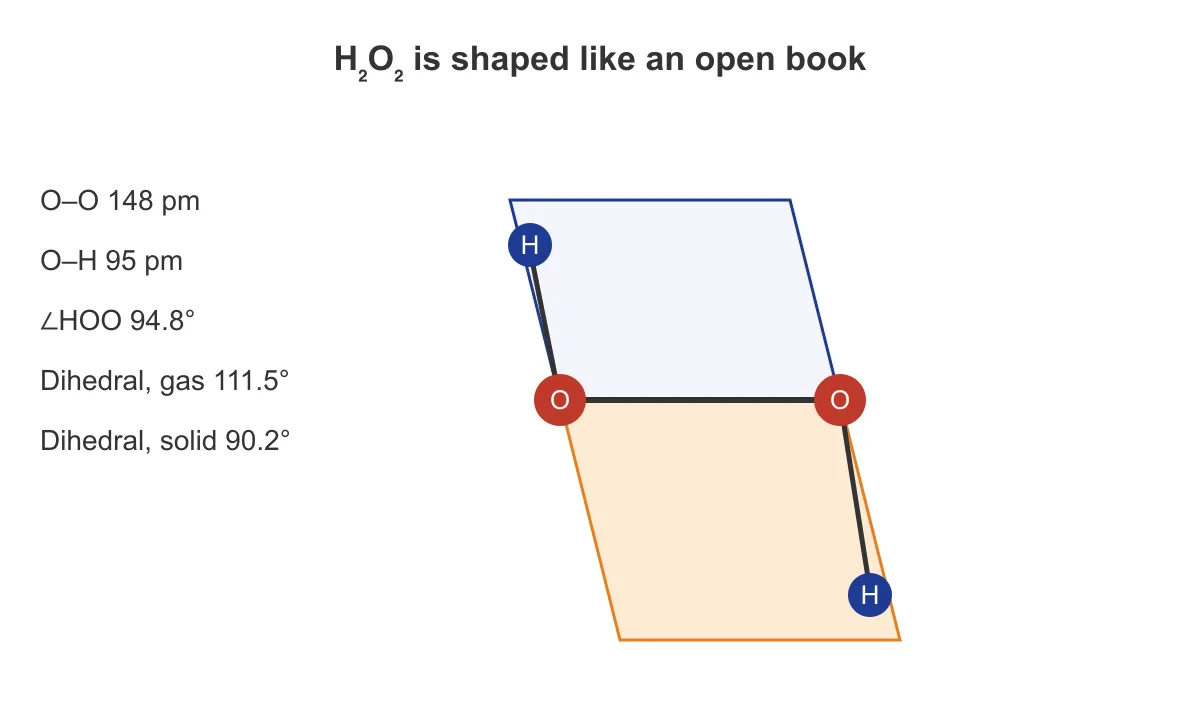
Figure 4.2: Open-book structure of hydrogen peroxide
Properties. Pure H₂O₂ is a pale blue, syrupy liquid, miscible with water in all proportions. It is thermodynamically unstable: 2H₂O₂ → 2H₂O + O₂, which is speeded by light, traces of alkali from glass, and metal ions. It is stored in plastic or wax-lined bottles, in the dark, with a stabiliser such as urea.
Because oxygen is at −1, which lies between −2 and 0, the molecule can go either way.
As an oxidant (H₂O₂ → H₂O in acid, or → OH⁻ in base):
- 2Fe²⁺ + 2H⁺ + H₂O₂ → 2Fe³⁺ + 2H₂O (acidic)
- PbS + 4H₂O₂ → PbSO₄ + 4H₂O (blackened paintings are restored this way)
- Mn²⁺ + 2OH⁻ + H₂O₂ → MnO₂ + 2H₂O (basic)
As a reductant (H₂O₂ → O₂):
- 2MnO₄⁻ + 6H⁺ + 5H₂O₂ → 2Mn²⁺ + 8H₂O + 5O₂ (acidic; the purple colour disappears)
- Ag₂O + H₂O₂ → 2Ag + H₂O + O₂
Uses include bleaching, antiseptics and rocket propellants.
Strength. A "10 volume" sample gives 10 mL of O₂ at STP per mL of solution on decomposition. Since 1 mol H₂O₂ gives ½ mol O₂ = 11.2 L,
and the mass of H₂O₂ per litre is 34 × M grams. So 10 volume is 0.893 M, about 30.4 g L⁻¹ or roughly 3% w/v.
Example 3: A 6.8% (w/v) solution of H₂O₂ is available. Find its molarity and volume strength. H₂O₂ = 34.
6.8% w/v means 6.8 g in 100 mL, so 68 g in 1 L.
Molarity = 68 / 34 = 2 M.
Volume strength = 11.2 × 2 = 22.4.
Check by direct route: 1 L has 2 mol, which gives 1 mol O₂ = 22.4 L per litre, so 22.4 volume.
Answer: 2 M, 22.4 volume. Keep the factor 11.2 and not 22.4, since two moles of H₂O₂ are needed for one mole of O₂.
The s-block: electronic structure, trends and reactivity
Alkali metals (Li, Na, K, Rb, Cs, Fr) have outer configuration ns¹; alkaline earth metals (Be, Mg, Ca, Sr, Ba, Ra) have ns². Both groups lose their s electrons to form M⁺ and M²⁺, and in nearly all compounds show only that one oxidation state.
Going down either group, radius rises while ionisation enthalpy and electronegativity fall. Group 2 metals are smaller, harder and denser than their group 1 neighbours and have higher melting points, since two electrons join in the metallic bond.
Hydration enthalpy is largest for the smallest ion, so Li⁺ is the most heavily hydrated.
Flame colours come from electrons excited by the flame and falling back.
| Element | Li | Na | K | Rb | Cs | Ca | Sr | Ba |
|---|---|---|---|---|---|---|---|---|
| Flame | Crimson red | Golden yellow | Violet | Red-violet | Blue | Brick red | Crimson | Apple green |
Be and Mg give no colour because flame energy cannot excite their tightly held electrons.
Memory trick: "Little Ned Kicked Rare Cats; Brick, Crimson, Apple" gives Li crimson, Na golden, K violet, Rb red-violet, Cs blue, then Ca brick, Sr crimson, Ba apple green.
Use it as a checklist for any flame-test question.
Reaction with air. The alkali metals tarnish at once. The product depends on the size of the cation, since a large cation stabilises a large anion.
| Metal | Main product on burning in air | Anion |
|---|---|---|
| Li | Li₂O (and some Li₃N) | O²⁻ |
| Na | Na₂O₂ | O₂²⁻ |
| K, Rb, Cs | KO₂, RbO₂, CsO₂ | O₂⁻ |
In group 2, the metals give MO, along with a little M₃N₂ when burned in air. Be and Mg are protected by a surface oxide film, and Mg burns brilliantly only when strongly heated.
Reaction with water. The alkali metals give MOH and H₂: 2M + 2H₂O → 2MOH + H₂. Reactivity rises from Li to Cs, with K and heavier metals catching fire. Be does not react with water or steam, Mg reacts with steam, and Ca, Sr and Ba react with cold water.
Dihydrogen, halogens, acids. Heated with H₂ they form MH (group 1) and MH₂ (Ca, Sr, Ba). With halogens they form ionic MX, except covalent BeCl₂. All release H₂ from dilute acids; Be is made passive by concentrated nitric acid.
Reducing nature. In water, E° (M⁺/M) is −3.05 V for Li, −2.71 V for Na and −2.93 V for K. Li is therefore the strongest reducing agent in aqueous solution, even though it has the highest ionisation enthalpy in the group. The reason is the large hydration enthalpy of the small Li⁺ ion, which more than pays for the loss of the electron.In the gas phase the order is reversed, with Cs the strongest reductant. Li reacts more slowly with water than Na or K; that is a matter of rate, not energy.
Solutions in liquid ammonia. Alkali and also Ca, Sr and Ba dissolve in liquid ammonia to give deep blue solutions that conduct electricity: M + (x + y)NH₃ → [M(NH₃)ₓ]⁺ + [e(NH₃)ᵧ]⁻. The blue colour arises from the ammoniated electron, which absorbs in the red region. These dilute solutions are paramagnetic, because of the free electron, and strongly reducing. At high concentration the colour turns bronze and the solution becomes diamagnetic with metallic conductivity, because electrons pair or cluster. On standing the solution slowly gives hydrogen and amide: 2M + 2NH₃ → 2MNH₂ + H₂.
Example 4: A sample of 7.1 g of potassium superoxide, KO₂, is used to absorb CO₂ in a breathing mask. How much O₂ is released at STP? KO₂ = 71.
Equation: 4KO₂ + 2CO₂ → 2K₂CO₃ + 3O₂.
Moles of KO₂ = 7.1 / 71 = 0.1.
Moles of O₂ = 0.1 × 3/4 = 0.075.
Volume = 0.075 × 22.4 = 1.68 L.
Answer: 1.68 L. The mask removes CO₂ and gives O₂ in the same step, which is why superoxide is used there.
Oxides, hydroxides, halides and salts of oxoacids
Oxides and hydroxides. Oxides of the s-block metals are basic and the basicity rises down the group. They react with water: M₂O + H₂O → 2MOH and MO + H₂O → M(OH)₂. BeO and Be(OH)₂ are amphoteric, dissolving in both acid and alkali: Be(OH)₂ + 2OH⁻ → [Be(OH)₄]²⁻. Peroxides give H₂O₂ with acid; superoxides give H₂O₂ and O₂. Na₂O₂ is diamagnetic (O₂²⁻ has all electrons paired), while KO₂ is paramagnetic and yellow, because O₂⁻ has one unpaired electron. Water on KO₂ gives 4KO₂ + 2H₂O → 4KOH + 3O₂.
All alkali hydroxides are strong bases and soluble, LiOH being the weakest. Group 2 hydroxide solubility rises down the group: Mg(OH)₂ is slightly soluble, Ba(OH)₂ well soluble.
Halides. Alkali halides are ionic, colourless and soluble in water, except LiF, which is sparingly soluble because its lattice enthalpy is very high. LiCl, LiBr and LiI dissolve in ethanol and pyridine because the small Li⁺ polarises the halide and gives partial covalent character. BeCl₂ is covalent, soluble in organic solvents, and is hydrolysed by water. In the solid it is a chain polymer with each Be joined to four Cl atoms through two bridging chlorines; in the vapour near 1200 K it is a linear monomer, and at lower temperature it is a dimer.
Salts of oxoacids.
| Salt | Trend and reasoning |
|---|---|
| Carbonates | All group 1 carbonates are stable to heat except Li₂CO₃ → Li₂O + CO₂. Group 2 carbonates decompose on heating, MCO₃ → MO + CO₂, and the temperature needed rises down the group. |
| Sulphates | Group 2 solubility falls down the group: BeSO₄ and MgSO₄ are soluble, CaSO₄ is sparingly soluble, BaSO₄ is insoluble. The sulphate ion is large, so lattice enthalpy hardly changes while hydration enthalpy of M²⁺ falls steeply. |
| Hydroxides | Solubility rises down the group because for a small anion, lattice enthalpy falls faster than hydration enthalpy as the cation grows. |
| Nitrates | NaNO₃ → NaNO₂ + ½O₂, but LiNO₃, and all group 2 nitrates, give oxide, NO₂ and O₂, e.g. 4LiNO₃ → 2Li₂O + 4NO₂ + O₂. |
| Hydrogencarbonates | Solid MHCO₃ exists for Na, K, Rb and Cs; group 2 and Li hydrogencarbonates exist only in solution. |
Larger cations polarise the carbonate ion less, so the carbonate resists breaking up. That is why stability rises down both groups.
Anomalous behaviour of lithium and beryllium
The first member of each group differs from the rest because of its small size, its high charge-to-size ratio and, for Be, the absence of d orbitals, which caps its covalency at four.
Lithium resembles magnesium (a diagonal relationship). Li is harder and has a higher melting point than the rest of group 1.
- It reacts with N₂ to give Li₃N, as Mg does Mg₃N₂.
- Its carbonate, nitrate and hydroxide decompose on heating to the oxide.
- Its hydrogencarbonate does not exist as a solid.
- LiCl is soluble in ethanol and deliquescent, crystallising as LiCl·2H₂O; Mg chloride behaves the same way.
- LiF, Li₂CO₃ and Li₃PO₄ are sparingly soluble, as are the Mg compounds.
Beryllium resembles aluminium.
- Both Be and Al are made passive by concentrated nitric acid.
- Both dissolve in alkali: Be + 2NaOH + 2H₂O → Na₂[Be(OH)₄] + H₂.
- BeO and Be(OH)₂, like Al₂O₃ and Al(OH)₃, are amphoteric.
- The chlorides are covalent Lewis acids with a chain or dimer structure, fume in moist air and are hydrolysed.
- The carbides give methane with water: Be₂C + 4H₂O → 2Be(OH)₂ + CH₄, and Al₄C₃ does the same.
Compounds of sodium and calcium
Sodium carbonate, Na₂CO₃. Made by the Solvay process. Ammonia and CO₂ pass into cold brine, and NaHCO₃, the least soluble salt present, separates:
NaCl + NH₃ + CO₂ + H₂O → NaHCO₃ + NH₄Cl
NaHCO₃ is filtered and heated: 2NaHCO₃ → Na₂CO₃ + H₂O + CO₂. The CO₂ is recycled and topped up from limestone, CaCO₃ → CaO + CO₂. The quicklime is slaked to Ca(OH)₂, which frees ammonia from the by-product: 2NH₄Cl + Ca(OH)₂ → 2NH₃ + CaCl₂ + 2H₂O. Net reaction: CaCO₃ + 2NaCl → Na₂CO₃ + CaCl₂, with CaCl₂ the only waste. The method fails for K₂CO₃ because KHCO₃ is too soluble to precipitate.
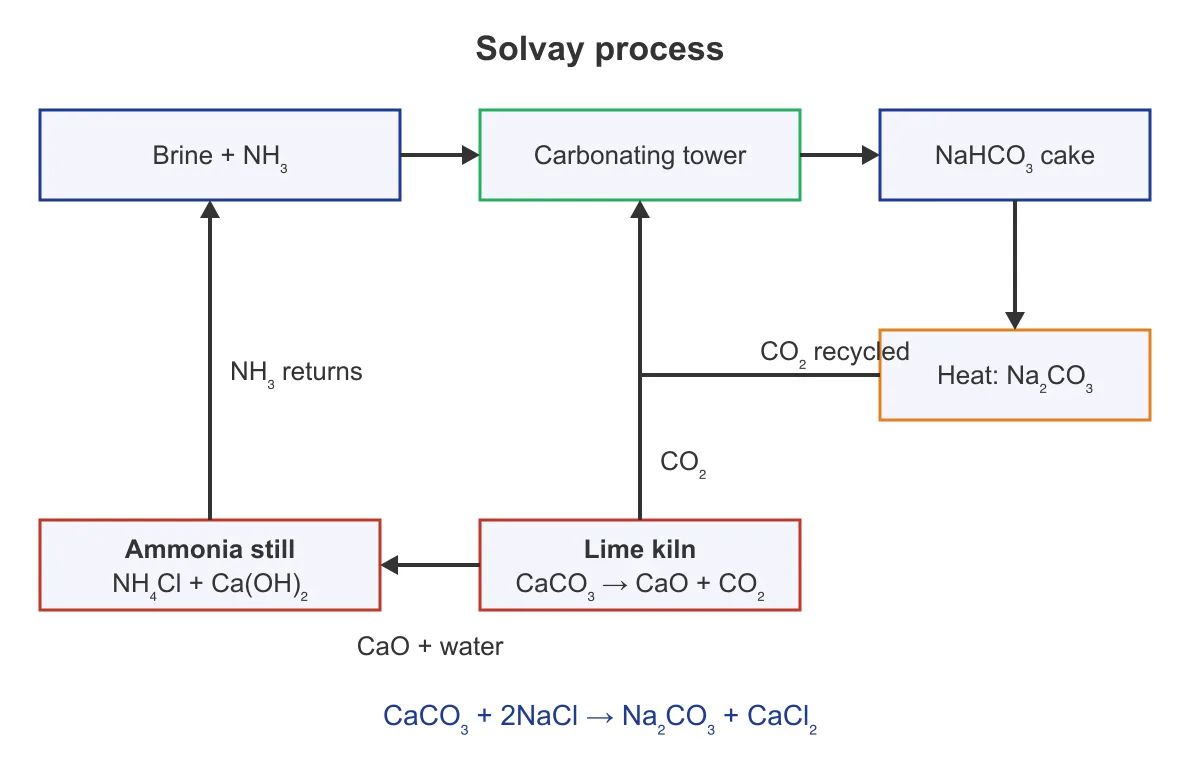
Figure 4.3: Flow chart of the Solvay process
Washing soda is Na₂CO₃·10H₂O; heating gives anhydrous soda ash. A solution is basic by hydrolysis: CO₃²⁻ + H₂O ⇌ HCO₃⁻ + OH⁻. It is used in glass, soap, paper and water softening.
Sodium chloride, NaCl. Obtained by evaporating sea water or mined as rock salt. Crude salt is damp because of CaCl₂ and MgCl₂. Passing HCl gas into a saturated solution crystallises pure NaCl by the common-ion effect. It is the raw material for Na₂CO₃, NaOH and Cl₂.
Sodium hydroxide, NaOH. Made by the chlor-alkali process: 2NaCl + 2H₂O → 2NaOH + Cl₂ + H₂. In the mercury cell (Castner–Kellner) sodium forms at a mercury cathode as amalgam, which then reacts with water. NaOH is deliquescent, takes up CO₂ from air, dissolves Zn and Al, and with chlorine gives NaOCl and NaCl in the cold, or NaClO₃ and NaCl when hot. Uses: soap, paper, dyes.
Sodium hydrogencarbonate, NaHCO₃. Made by passing CO₂ through Na₂CO₃ solution. It is mildly alkaline, an antacid, and the active part of baking powder and soda-acid fire extinguishers. Above about 373 K it loses CO₂ and water.
Calcium oxide, CaO. Quicklime comes from heating limestone at 1070–1270 K with the CO₂ drawn off so that the equilibrium moves forward. It reacts with water to give slaked lime with release of heat, with SiO₂ to give CaSiO₃ slag, and with coke in an electric furnace to give CaC₂. Uses: cement, steel making, drying ammonia.
Calcium hydroxide, Ca(OH)₂. Lime water is the clear solution and milk of lime the suspension. Lime water turns milky with CO₂ (insoluble CaCO₃) and clears with excess CO₂ (soluble Ca(HCO₃)₂). Its solubility decreases as temperature rises, since dissolving is exothermic. With chlorine it gives bleaching powder; mixed with sand it makes mortar, which sets by absorbing CO₂.
Calcium carbonate, CaCO₃. Occurs as limestone, marble and chalk. Made by passing CO₂ into lime water or by mixing Na₂CO₃ and CaCl₂ solutions. It decomposes on heating and is used in cement, toothpaste and as a flux.
Plaster of Paris, CaSO₄·½H₂O. Gypsum, CaSO₄·2H₂O, heated to 393 K loses one and a half of its water molecules: 2CaSO₄·2H₂O → 2(CaSO₄·½H₂O) + 3H₂O. Above about 473 K the product is anhydrous CaSO₄, dead burnt plaster, which does not set. Plaster mixed with water sets to a hard mass of gypsum, expanding a little, so it fills a mould fully: CaSO₄·½H₂O + 1½H₂O → CaSO₄·2H₂O. Uses: casts for fractures, statues, ceilings, dentistry.
Example 5: How much water is taken up when 145 g of plaster of Paris sets, and what mass of gypsum results? Ca = 40, S = 32.
Molar mass of CaSO₄·½H₂O = 136 + 9 = 145 g, so 145 g is 1 mol.
Setting adds 1.5 mol water: 1.5 × 18 = 27 g.
Gypsum mass = 145 + 27 = 172 g, which equals the molar mass of CaSO₄·2H₂O (136 + 36).
Answer: 27 g water, 172 g gypsum. The two answers check each other.
Common traps
- Placing hydrogen in group 1 only → it is a non-metal with features of both group 1 and group 17.
- Saying electrolysis of molten NaH gives H₂ at the cathode → it comes at the anode, since the hydrogen is H⁻.
- Taking the hydride of every metal as ionic → only groups 1 and 2 (apart from Be and Mg) are ionic; d-block hydrides are interstitial and non-stoichiometric.
- Using 22.4 as the factor in volume strength → one mole of H₂O₂ gives half a mole of O₂, so the factor is 11.2.
- Calling H₂O₂ only an oxidant → in the presence of MnO₄⁻, O₃, Ag₂O or HOCl it is the reducing agent.
- Saying Li is the strongest reductant because it has the lowest ionisation enthalpy → it has the highest in group 1, and the reductant strength in water comes from hydration enthalpy.
- Writing Na₂O as the product of burning sodium in air → it is mainly Na₂O₂; K gives KO₂.
- Expecting Li₂CO₃ to be as stable as Na₂CO₃ → Li₂CO₃ decomposes because small Li⁺ distorts carbonate.
- Treating sulphates and hydroxides of group 2 alike → sulphate solubility falls and hydroxide solubility rises down the group.
Quick revision
- H₂ from Zn: with dilute H₂SO₄ or with NaOH (Na₂ZnO₂); from CH₄ + H₂O at 1270 K over Ni.
- B₂H₆ is electron-deficient; CH₄ is electron-precise; NH₃, H₂O, HF are electron-rich.
- Temporary hardness: Ca/Mg hydrogencarbonates; remove by boiling or Clark's lime. Permanent hardness: chlorides and sulphates; remove by washing soda, Calgon or ion exchange.
- H₂O₂ is open-book shaped, dihedral 111.5° in gas and 90.2° in solid, oxygen at −1.
- Volume strength of H₂O₂ = 11.2 × molarity; 10 volume is 0.893 M.
- Flame colours: Li crimson, Na golden yellow, K violet, Rb red-violet, Cs blue, Ca brick red, Sr crimson, Ba apple green.
- Burning in air: Li gives Li₂O, Na gives Na₂O₂, K, Rb, Cs give MO₂.
- Dilute alkali-metal solutions in liquid NH₃ are blue and paramagnetic; concentrated ones are bronze and diamagnetic.
- Group 2: sulphate solubility falls and hydroxide solubility rises down the group; carbonate stability rises.
- Li behaves like Mg and Be like Al; BeCl₂ is a covalent chain polymer in the solid state.
- Solvay: NaCl + NH₃ + CO₂ + H₂O → NaHCO₃ + NH₄Cl; 2NaHCO₃ → Na₂CO₃ + H₂O + CO₂.
- Plaster of Paris is CaSO₄·½H₂O, made from gypsum at 393 K; dead burnt plaster is anhydrous CaSO₄.
Practice questions
Molten calcium hydride is electrolysed. Hydrogen gas is liberated at the
- cathode
- anode
- both electrodes equally
- neither electrode
Answer
B. anode
CaH₂ contains H⁻ ions. During electrolysis anions move to the anode, where H⁻ loses an electron: 2H⁻ → H₂ + 2e⁻.
Which of the following hydrides is electron-deficient?
- NH₃
- CH₄
- H₂O
- B₂H₆
Answer
D. B₂H₆
B₂H₆ has too few electrons to give a two-centre bond to every B–H and B–B link, so it uses two bridging three-centre bonds. NH₃ and H₂O are electron-rich and CH₄ is electron-precise.
Permanent hardness of water, caused by CaSO₄ and MgCl₂, can be removed by
- treating with Calgon
- adding the exact amount of lime (Clark's method)
- passing CO₂ through the water
- boiling the water
Answer
A. treating with Calgon
Boiling and Clark's lime act only on hydrogencarbonates. Calgon binds Ca²⁺ and Mg²⁺ as a soluble complex and so handles sulphates and chlorides as well.
On burning in excess air, which of these metals gives mainly a superoxide, MO₂?
- Li
- Na
- K
- Mg
Answer
C. K
Large cations stabilise large anions. Li gives Li₂O, Na gives Na₂O₂, Mg gives MgO, and K gives KO₂.
Which carbonate gives the oxide and CO₂ on strong heating in a laboratory burner?
- Na₂CO₃
- K₂CO₃
- Cs₂CO₃
- Li₂CO₃
Answer
D. Li₂CO₃
The small Li⁺ polarises CO₃²⁻ strongly and Li₂O has a high lattice enthalpy, so Li₂CO₃ decomposes: Li₂CO₃ → Li₂O + CO₂. The other carbonates are stable at that temperature.
The deep blue colour of a dilute solution of sodium in liquid ammonia is due to
- ammoniated electrons
- the amide ion NH₂⁻
- Na₂ clusters
- Na⁺ ions
Answer
A. ammoniated electrons
Sodium dissolves to give Na⁺ and a free electron surrounded by ammonia molecules. The ammoniated electron absorbs in the red region, so the solution looks blue and is paramagnetic.
In solid hydrogen peroxide the dihedral angle between the two H–O–O planes is
- 94.8°
- 104.5°
- 90.2°
- 111.5°
Answer
C. 90.2°
The open-book angle is 111.5° in the gas phase and falls to 90.2° in the crystal because of hydrogen bonding. 94.8° is the H–O–O bond angle.
Heating gypsum at 393 K gives
- anhydrous CaSO₄
- CaSO₄·½H₂O
- CaSO₄·H₂O
- CaO
Answer
B. CaSO₄·½H₂O
Gypsum, CaSO₄·2H₂O, loses one and a half water molecules at 393 K to give plaster of Paris. Anhydrous CaSO₄ (dead burnt plaster) forms only above about 473 K.
In the solid state, beryllium chloride has the structure of
- a planar dimer with six-coordinate Be
- discrete linear BeCl₂ molecules
- a chain polymer with chlorine bridges and four-coordinate Be
- a three-dimensional ionic lattice like NaCl
Answer
C. a chain polymer with chlorine bridges and four-coordinate Be
Be has no d orbitals and is small, so BeCl₂ is covalent. Each Be is joined tetrahedrally to four Cl atoms, two of which bridge to the next Be along the chain. The linear monomer exists only in vapour at very high temperature.
Among the sulphates of group 2, the one most soluble in water is
- BaSO₄
- CaSO₄
- SrSO₄
- BeSO₄
Answer
D. BeSO₄
The sulphate ion is large, so lattice enthalpy changes little down the group while the hydration enthalpy of M²⁺ falls steeply. Solubility therefore falls from Be to Ba.
PdH₀.₆ is best described as
- an interstitial hydride
- an ionic hydride containing H⁻
- an electron-deficient covalent hydride
- an electron-rich covalent hydride
Answer
A. an interstitial hydride
Palladium is a d-block metal. Hydrogen atoms occupy voids in its lattice and the composition is non-stoichiometric (0.6), so it is interstitial, not ionic or molecular.
Potassium carbonate cannot be made by the Solvay process because
- NH₃ does not react with KCl solution
- KHCO₃ is too soluble in water to separate from the solution
- K₂CO₃ decomposes at room temperature
- KCl is insoluble in water
Answer
B. KHCO₃ is too soluble in water to separate from the solution
The Solvay process works because NaHCO₃ is the least soluble salt in the mixture and crystallises out. KHCO₃ remains dissolved, so no solid separates.
Lime water is treated with CO₂ until the milkiness first formed disappears. The clear solution contains
- CaCO₃
- Ca(OH)₂
- CaO
- Ca(HCO₃)₂
Answer
D. Ca(HCO₃)₂
CO₂ first gives insoluble CaCO₃ (milky). Excess CO₂ with water converts it into soluble calcium hydrogencarbonate: CaCO₃ + CO₂ + H₂O → Ca(HCO₃)₂.
Which hydroxide dissolves in excess aqueous NaOH?
- Be(OH)₂
- Ca(OH)₂
- Ba(OH)₂
- Mg(OH)₂
Answer
A. Be(OH)₂
Be(OH)₂ is amphoteric, like Al(OH)₃, and forms [Be(OH)₄]²⁻. The other group 2 hydroxides are basic only.
A solution of hydrogen peroxide contains 3.4 g of H₂O₂ in 100 mL. Its volume strength is (H₂O₂ = 34; volume of gas at STP)
- 2.8
- 11.2
- 5.6
- 22.4
Answer
B. 11.2
3.4 g per 100 mL is 34 g L⁻¹ = 1 M. Volume strength = 11.2 × 1 = 11.2. Check: 1 L holds 1 mol, giving ½ mol O₂ = 11.2 L per litre.
Zinc of mass 13.08 g reacts with excess NaOH solution (Zn + 2NaOH → Na₂ZnO₂ + H₂). The volume of H₂ at STP, in litres, is (Zn = 65.4; molar volume 22.4 L)
- 1.12
- 2.24
- 4.48
- 8.96
Answer
C. 4.48
Moles of Zn = 13.08 / 65.4 = 0.2. Ratio 1 : 1 gives 0.2 mol H₂. Volume = 0.2 × 22.4 = 4.48 L.
A tank of 1000 L contains 14.6 g of Mg(HCO₃)₂. By Clark's method (Mg(HCO₃)₂ + 2Ca(OH)₂ → 2CaCO₃ + Mg(OH)₂ + 2H₂O), the mass of Ca(OH)₂ required, in grams, is (Mg(HCO₃)₂ = 146; Ca(OH)₂ = 74)
- 29.6
- 10.0
- 7.4
- 14.8
Answer
D. 14.8
Moles of Mg(HCO₃)₂ = 14.6 / 146 = 0.1. Two moles of lime per mole: 0.2 mol × 74 = 14.8 g. Using only one lime unit would give the trap value 7.4.
A sample of 8.4 g of NaHCO₃ is heated until it stops losing mass (2NaHCO₃ → Na₂CO₃ + H₂O + CO₂). The loss in mass, in grams, is (NaHCO₃ = 84)
- 1.55
- 4.2
- 3.1
- 6.2
Answer
C. 3.1
8.4 g = 0.1 mol NaHCO₃, which gives 0.05 mol each of H₂O and CO₂. Loss = 0.05 × (18 + 44) = 3.1 g. Check: 168 g loses 62 g, so 8.4 g loses 3.1 g.
The number of unpaired electrons in the superoxide ion O₂⁻ is
- 0
- 2
- 1
- 3
Answer
C. 1
O₂⁻ has 17 electrons. Filling the molecular orbitals gives π*2p with three electrons in two orbitals, so one is unpaired. This is why KO₂ is paramagnetic.
A sample of 14.2 g of KO₂ reacts with water (4KO₂ + 2H₂O → 4KOH + 3O₂). The volume of O₂ at STP, in litres, is (KO₂ = 71; molar volume 22.4 L)
- 6.72
- 3.36
- 4.48
- 2.24
Answer
B. 3.36
Moles of KO₂ = 14.2 / 71 = 0.2. Moles of O₂ = 0.2 × ¾ = 0.15. Volume = 0.15 × 22.4 = 3.36 L.
In CuSO₄·5H₂O the number of water molecules that are not coordinated to Cu²⁺ is
- 4
- 5
- 2
- 1
Answer
D. 1
Four water molecules are coordinated to Cu²⁺. The fifth is held by hydrogen bonds to sulphate and water, and is the last to be lost on heating.
Gypsum is heated to 393 K to give 14.5 g of plaster of Paris. The mass of gypsum used, in grams, is (CaSO₄·½H₂O = 145; CaSO₄·2H₂O = 172)
- 17.2
- 29.0
- 14.5
- 8.6
Answer
A. 17.2
Moles of plaster = 14.5 / 145 = 0.1. One mole of gypsum gives one mole of plaster, so 0.1 × 172 = 17.2 g. Check: mass lost is 2.7 g of water, 14.5 + 2.7 = 17.2.
A plant makes 21.2 kg of Na₂CO₃ by the net Solvay reaction CaCO₃ + 2NaCl → Na₂CO₃ + CaCl₂ with no loss. The mass of NaCl consumed, in kg, is (Na₂CO₃ = 106; NaCl = 58.5)
- 23.4
- 46.8
- 5.85
- 11.7
Answer
A. 23.4
Moles of Na₂CO₃ = 21.2 / 106 = 0.2 kmol. NaCl needed = 2 × 0.2 = 0.4 kmol = 0.4 × 58.5 = 23.4 kg.
Hydrogen burns as H₂(g) + ½O₂(g) → H₂O(l), with ΔH = −286 kJ per mole of H₂. The heat released on burning 4 g of H₂, in kJ, is
- 143
- 572
- 286
- 1144
Answer
B. 572
4 g of H₂ is 2 mol. Heat = 2 × 286 = 572 kJ.
The number of moles of neutrons in 40 g of heavy water, D₂O, is (D = 2 g mol⁻¹ with one neutron per nucleus; O = 16 with eight neutrons)
- 10
- 20
- 16
- 40
Answer
B. 20
Molar mass of D₂O = 20, so 40 g is 2 mol. Neutrons per molecule = 1 + 1 + 8 = 10. Total = 2 × 10 = 20 mol.
Cold dilute H₂SO₄ is added to 0.1 mol of Na₂O₂. The mass of H₂O₂ formed, in grams, is (H₂O₂ = 34)
- 1.7
- 6.8
- 34
- 3.4
Answer
D. 3.4
Na₂O₂ + H₂SO₄ → Na₂SO₄ + H₂O₂ is 1 : 1, so 0.1 mol H₂O₂ forms. Mass = 0.1 × 34 = 3.4 g.
Given below are two statements: Statement I: Li₂CO₃ decomposes at a lower temperature than Na₂CO₃. Statement II: Li⁺ is larger than Na⁺ and therefore polarises the carbonate ion less.
- Both Statement I and Statement II are correct
- Both Statement I and Statement II are incorrect
- Statement I is correct but Statement II is incorrect
- Statement I is incorrect but Statement II is correct
Answer
C. Statement I is correct but Statement II is incorrect
Statement I is true: Li₂CO₃ decomposes to Li₂O and CO₂. Statement II is false: Li⁺ is smaller, so it polarises CO₃²⁻ more, which is the reason for the decomposition.
Given below are two statements: Statement I: Mg(OH)₂ is more soluble in water than Ba(OH)₂. Statement II: The solubility of the hydroxides of group 2 increases down the group.
- Both Statement I and Statement II are correct
- Both Statement I and Statement II are incorrect
- Statement I is correct but Statement II is incorrect
- Statement I is incorrect but Statement II is correct
Answer
D. Statement I is incorrect but Statement II is correct
Solubility of group 2 hydroxides rises from Be to Ba, so Ba(OH)₂ is more soluble than Mg(OH)₂. Statement I is false and Statement II is true.
Given below are two statements: Statement I: Be(OH)₂ dissolves in excess NaOH solution. Statement II: BeCl₂ is a predominantly ionic solid.
- Both Statement I and Statement II are correct
- Both Statement I and Statement II are incorrect
- Statement I is correct but Statement II is incorrect
- Statement I is incorrect but Statement II is correct
Answer
C. Statement I is correct but Statement II is incorrect
Be(OH)₂ is amphoteric and forms [Be(OH)₄]²⁻, so Statement I is true. BeCl₂ is covalent with a chain structure, so Statement II is false.
Given below are two statements: Statement I: BeCl₂ is soluble in organic solvents. Statement II: BeCl₂ in the solid state is a chain polymer.
- Both Statement I and Statement II are correct
- Both Statement I and Statement II are incorrect
- Statement I is correct but Statement II is incorrect
- Statement I is incorrect but Statement II is correct
Answer
A. Both Statement I and Statement II are correct
Both are true. BeCl₂ is covalent, which explains its solubility in organic solvents, and each Be is joined to four Cl atoms through bridging chlorines along a chain.
Given below are two statements: Statement I: Sodium peroxide, Na₂O₂, is paramagnetic. Statement II: Potassium superoxide, KO₂, is diamagnetic.
- Both Statement I and Statement II are correct
- Both Statement I and Statement II are incorrect
- Statement I is correct but Statement II is incorrect
- Statement I is incorrect but Statement II is correct
Answer
B. Both Statement I and Statement II are incorrect
The peroxide ion O₂²⁻ has all electrons paired, so Na₂O₂ is diamagnetic. The superoxide ion O₂⁻ has one unpaired electron, so KO₂ is paramagnetic. Both statements are false.
Assertion (A): LiCl dissolves in ethanol, while NaCl is practically insoluble in it. Reason (R): Li⁺ has high polarising power, so LiCl has considerable covalent character.
- Both A and R are true and R is the correct explanation of A
- Both A and R are true but R is not the correct explanation of A
- A is true but R is false
- A is false but R is true
Answer
A. Both A and R are true and R is the correct explanation of A
Small Li⁺ polarises Cl⁻, giving covalent character, and covalent halides dissolve in organic solvents. R explains A.
Assertion (A): Calgon softens hard water. Reason (R): Calgon precipitates Ca²⁺ and Mg²⁺ ions as insoluble phosphates.
- Both A and R are true and R is the correct explanation of A
- Both A and R are true but R is not the correct explanation of A
- A is true but R is false
- A is false but R is true
Answer
C. A is true but R is false
Calgon (sodium hexametaphosphate) does soften water, but it does so by forming a soluble complex anion, [Na₄P₆O₁₈]²⁻, with Ca²⁺ and Mg²⁺; nothing precipitates. A is true and R is false.
Assertion (A): Sodium burns in excess air to give mainly the normal oxide, Na₂O. Reason (R): A large cation stabilises a large anion such as peroxide or superoxide.
- Both A and R are true and R is the correct explanation of A
- Both A and R are true but R is not the correct explanation of A
- A is true but R is false
- A is false but R is true
Answer
D. A is false but R is true
Sodium burns to give mainly Na₂O₂, so A is false. R is a true statement of the size effect and is the reason K gives KO₂.
Match List I with List II. List I: a. Washing soda b. Baking soda c. Quicklime d. Gypsum List II: i. CaSO₄·2H₂O ii. Na₂CO₃·10H₂O iii. CaO iv. NaHCO₃
- a-ii, b-iv, c-iii, d-i
- a-iii, b-iv, c-ii, d-i
- a-ii, b-iv, c-i, d-iii
- a-iv, b-ii, c-iii, d-i
Answer
A. a-ii, b-iv, c-iii, d-i
Washing soda is Na₂CO₃·10H₂O (ii), baking soda is NaHCO₃ (iv), quicklime is CaO (iii) and gypsum is CaSO₄·2H₂O (i).
Match List I with List II. List I: a. Li b. K c. Ca d. Ba List II: i. Violet ii. Crimson red iii. Brick red iv. Apple green
- a-i, b-ii, c-iii, d-iv
- a-ii, b-i, c-iii, d-iv
- a-iii, b-i, c-ii, d-iv
- a-ii, b-i, c-iv, d-iii
Answer
B. a-ii, b-i, c-iii, d-iv
Li gives crimson red, K violet, Ca brick red, Ba apple green: a-ii, b-i, c-iii, d-iv.
Match List I with List II. List I: a. NaH b. B₂H₆ c. PdH₀.₆ d. NH₃ List II: i. Interstitial hydride ii. Ionic hydride iii. Electron-deficient hydride iv. Electron-rich hydride
- a-iii, b-ii, c-i, d-iv
- a-ii, b-iv, c-i, d-iii
- a-i, b-iii, c-ii, d-iv
- a-ii, b-iii, c-i, d-iv
Answer
D. a-ii, b-iii, c-i, d-iv
NaH is ionic (ii), B₂H₆ is electron-deficient (iii), PdH₀.₆ is interstitial (i) and NH₃, with one lone pair, is electron-rich (iv).
In an acidic titration, 25.0 mL of a hydrogen peroxide solution needs 20.0 mL of 0.50 M KMnO₄ for complete reaction (2MnO₄⁻ + 6H⁺ + 5H₂O₂ → 2Mn²⁺ + 8H₂O + 5O₂). The volume strength of the H₂O₂ solution is
- 11.2 volume
- 28 volume
- 22.4 volume
- 5.6 volume
Answer
A. 11.2 volume
MnO₄⁻ = 20 × 0.5 = 10 mmol. H₂O₂ = 10 × 5/2 = 25 mmol in 25 mL, so 1 M. Volume strength = 11.2 × 1 = 11.2. Check: 1 M gives ½ mol O₂ = 11.2 L per litre.
Limestone of 90% purity (CaCO₃), weighing 1000 kg, is used in a Solvay plant. All CO₂ and NH₃ are recycled and the conversion is complete. The maximum mass of Na₂CO₃ obtainable is (CaCO₃ = 100; Na₂CO₃ = 106)
- 1908 kg
- 1060 kg
- 954 kg
- 477 kg
Answer
C. 954 kg
Net reaction: CaCO₃ + 2NaCl → Na₂CO₃ + CaCl₂, one mole each. CaCO₃ = 900 kg = 9 kmol. Na₂CO₃ = 9 × 106 = 954 kg. The 1060 kg trap ignores the 10% impurity.
A 4.2 g mixture of Na₂CO₃ and NaHCO₃ is heated to constant mass and loses 0.62 g. The percentage of NaHCO₃ in the mixture is (NaHCO₃ = 84; Na₂CO₃ = 106)
- 60%
- 40%
- 14.8%
- 20%
Answer
B. 40%
Only NaHCO₃ loses mass: 168 g gives a loss of 62 g. NaHCO₃ = 0.62 × 168 / 62 = 1.68 g. Percentage = 1.68 / 4.2 × 100 = 40%. The 14.8% trap is the mass loss divided by the mixture.