Doppler Effect and Beats
What to remember
- Beat frequency is $\vert f_1 - f_2 \vert$. It comes from two nearly equal frequencies adding up; loading a fork lowers its frequency, filing raises it.
- The speed of sound in a gas is $v = \sqrt{\gamma P/\rho} = \sqrt{\gamma R T/M}$. It depends on temperature and gas, not on pressure at fixed temperature, and not on frequency.
- Doppler formula in still air: $f' = f\,\dfrac{v - v_O}{v - v_S}$, with both velocities measured along the direction from source S to observer O, positive towards O.
- Only the component of velocity along the line joining source and observer matters. A source moving at right angles to that line gives no shift at that instant.
- A reflecting wall acts twice: first as an observer, then as a source. When the wall moves, both steps carry a shift (double Doppler).
Sound waves and the speed of sound in a gas
Sound in air is a longitudinal wave: layers of air are squeezed (compression) and then stretched (rarefaction), and the pattern travels while each layer only oscillates about its place. A harmonic sound wave travelling along $+x$ is written
where $y$ is the displacement of an air layer along the direction of travel, $\omega = 2\pi f$ and $k = 2\pi/\lambda$. The wave speed is $v = f\lambda = \omega/k$.
The medium decides $v$, not the source. Once a wave is in the air, its speed is fixed by the air. The source decides only the frequency. This one sentence explains most of the Doppler effect, so keep it in front of you.
For an ideal gas the speed is
Here $\gamma$ is the ratio of specific heats, $P$ the pressure, $\rho$ the density, $T$ the absolute temperature and $M$ the molar mass. The second form follows from the first because $P/\rho = RT/M$ for an ideal gas. Three consequences are used all the time.
- At a fixed temperature, changing the pressure changes $\rho$ in the same proportion, so $v$ stays the same. Compressing air isothermally does not speed up sound.
- $v \propto \sqrt{T}$ for a given gas, with $T$ in kelvin. Doubling $T$ multiplies $v$ by $\sqrt{2}$, not by 2.
- At the same temperature a lighter gas carries sound faster. For two gases with the same $\gamma$, $v \propto 1/\sqrt{M}$.
In air near room temperature, $v \approx 340$ m s⁻¹. A handy working rule is $v \approx 331 + 0.6\,t$ m s⁻¹ with $t$ in degrees Celsius. Unless a problem states another value, this chapter takes $v = 340$ m s⁻¹.
Example 1: The speed of sound in air at 27 °C is 340 m s⁻¹. Find it at 327 °C.
Convert to kelvin: $T_1 = 300$ K, $T_2 = 600$ K.
$v \propto \sqrt{T}$, so $\dfrac{v_2}{v_1} = \sqrt{\dfrac{600}{300}} = \sqrt{2}$.
$v_2 = 340 \times 1.414 \approx 481$ m s⁻¹.
Answer: about 481 m s⁻¹. Notice that the temperature doubled in kelvin, but the speed rose only by a factor $\sqrt{2}$; using Celsius numbers (27 and 327) would have given a wrong factor.
Beats
Sound two tuning forks whose frequencies are very close, say 256 Hz and 260 Hz, and you hear a note that swells and fades, swells and fades, four times every second. Those swellings are beats.
Why it happens
Take two waves of equal amplitude $A$ arriving at your ear:
Their sum is
Read this as a fast oscillation at the average frequency $\tfrac12 (f_1 + f_2)$ whose amplitude $2A\cos(\pi\,\Delta f\, t)$ itself rises and falls slowly. The loudness follows the size of the amplitude, and the amplitude reaches a maximum whenever the cosine is $+1$ or $-1$. That happens twice per cosine cycle, and the cosine has frequency $\tfrac12\vert f_1 - f_2\vert$, so the loudness peaks
Think of two runners on a track, one slightly faster. The faster one gains a lap on the other at a steady rate; the gap between their speeds, not the sum, sets how often they meet. Beats work the same way: the waves line up (loud) and then oppose each other (soft) at a rate set by the difference.
Points to hold on to:
- Beats are heard clearly only when the two frequencies differ by a few hertz. If the difference is large, the ear hears two separate notes.
- If the amplitudes are unequal, $A_1$ and $A_2$, the loudness never drops to zero. The beat frequency is still $\vert f_1 - f_2\vert$, and
- The time between two successive maxima is $1/\vert f_1 - f_2\vert$.
Finding an unknown frequency: loading and filing
A fork of unknown frequency $x$ is sounded with a standard fork of known frequency $f_0$ and gives $b$ beats per second. Then $x = f_0 + b$ or $x = f_0 - b$. To decide which, change $x$ a little and watch what the beats do.
- Loading (wax on the prongs) makes the prongs heavier, so the fork vibrates slower and $x$ decreases.
- Filing the prongs makes them lighter, so $x$ increases.
| Action on unknown fork | Beats increase | Beats decrease |
|---|---|---|
| Loading ($x$ falls) | $x$ was below $f_0$, now further away: $x = f_0 - b$ | $x$ was above $f_0$, now nearer: $x = f_0 + b$ |
| Filing ($x$ rises) | $x$ was above $f_0$, now further away: $x = f_0 + b$ | $x$ was below $f_0$, now nearer: $x = f_0 - b$ |
Memory trick: "Wax Weighs, Weakens, Warns lower; File Flies Faster." Wax lowers the pitch, a file raises it. Use it first, then ask: did the gap to the standard fork grow or shrink?
Example 2: A fork gives 4 beats per second with a 256 Hz standard. After loading the unknown fork, the beats become 6 per second. Find its frequency.
Possible values: $x = 256 \pm 4 = 252$ Hz or $260$ Hz.
Loading lowers $x$. If $x$ were 260, it would move towards 256 and the beats would fall below 4. They rose to 6, so $x$ moved away from 256, which means $x$ is below 256.
$x = 252$ Hz. Check: loaded to 250 Hz, the beats are $256 - 250 = 6$.
Always test the other candidate; it is the quickest way to catch a sign slip.
Doppler effect in sound
You have heard an ambulance siren drop in pitch as it passes. The siren did not change; the frequency you receive did. That change in received frequency, caused by motion of the source, the observer or both, is the Doppler effect.
We assume the air is at rest. Every speed below is relative to the air, and $v$ is the speed of sound in it.
Source moving, observer at rest
A source of frequency $f$ emits one wave every $1/f$ seconds. In that time the first wave travels $v/f$. If the source moves towards the observer with speed $u_S$, it covers $u_S/f$ in the same interval, so each new wave starts closer to the one before it. The spacing of the waves in the air ahead of the source is
Because the observer is at rest, waves reach the observer at speed $v$, so the observed frequency is
For a source moving away, the wave spacing behind it is $(v + u_S)/f$, and $f' = f\,v/(v + u_S)$.
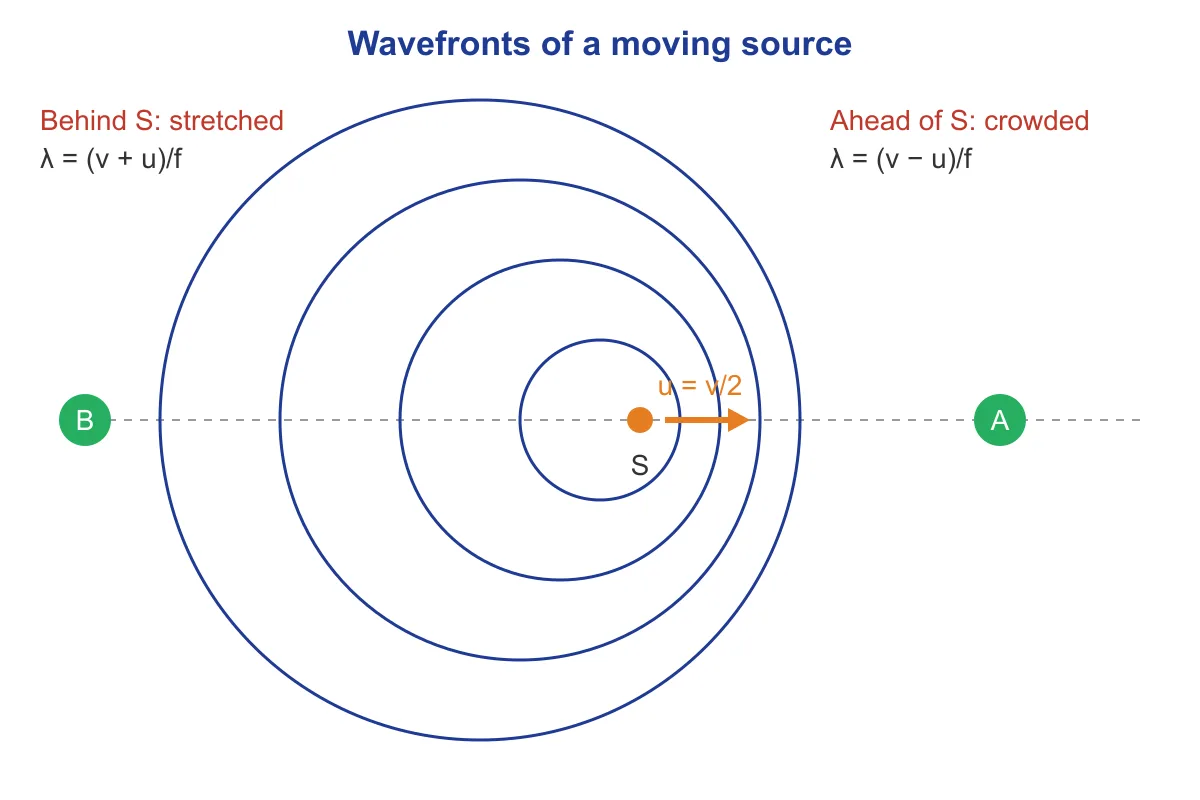
Figure 1.1: Source moving to the right at half the speed of sound; wavefronts bunch up ahead and spread out behind
The circles in the figure are wavefronts emitted at equal time gaps from the source's positions at those instants. Ahead of the source they crowd together; behind it they are stretched. Observer A at the front meets wavefronts more often than observer B at the back.
Observer moving, source at rest
Now the waves have the usual spacing $\lambda = v/f$ in the air; the observer's motion does not change that. What changes is how fast the observer meets them. If the observer moves towards the source at $u_O$, the waves approach at a relative speed $v + u_O$, so
For an observer moving away, $f' = f\,(v - u_O)/v$.
Compare the two cases. In the first, the source's motion changes the wavelength in the air, while the speed of the waves through the air is still $v$. In the second, the wavelength in the air is unchanged, and the speed relative to the observer changes. The two formulae look alike but come from different causes, and the denominators differ.
General formula and sign convention
Take the direction from the source S to the observer O as positive. Let $v_S$ and $v_O$ be the velocities of S and O along this direction, each carrying its own sign. Then
Why the minus signs? An observer moving towards the source moves in the negative direction, so $v_O$ is negative and $v - v_O$ becomes $v + u_O$, as found above. A source moving towards the observer moves in the positive direction, so $v_S$ is positive and the denominator shrinks.
| Situation | Velocity signs | $f'$ |
|---|---|---|
| Source towards observer (O at rest) | $v_S = +u_S$ | $f\,\dfrac{v}{v - u_S}$ |
| Source away from observer (O at rest) | $v_S = -u_S$ | $f\,\dfrac{v}{v + u_S}$ |
| Observer towards source (S at rest) | $v_O = -u_O$ | $f\,\dfrac{v + u_O}{v}$ |
| Observer away from source (S at rest) | $v_O = +u_O$ | $f\,\dfrac{v - u_O}{v}$ |
| Moving towards each other | $v_S = +u_S,\ v_O = -u_O$ | $f\,\dfrac{v + u_O}{v - u_S}$ |
| Both moving the same way with same speed | $v_S = v_O$ | $f$ (no shift) |
Memory trick: "Observer on top, Source at the bottom; Towards means Top gets Plus, Bottom gets Minus." The observer's term is in the numerator, the source's term in the denominator. Towards: numerator $+$, denominator $-$, so the pitch rises. Away swaps both signs.
Example 3: A source of 640 Hz moves at 20 m s⁻¹ towards an observer who moves at 17 m s⁻¹ towards the source. Take $v = 340$ m s⁻¹, and the air is still.
Both move towards each other, so use $f' = f\,(v + u_O)/(v - u_S)$.
$f' = 640 \times \dfrac{340 + 17}{340 - 20} = 640 \times \dfrac{357}{320}$.
$640/320 = 2$, so $f' = 2 \times 357 = 714$ Hz.
The answer is 714 Hz. Notice that each motion adds its own raise; neither can be ignored just because the other is present.
Example 4: A source of 600 Hz chases an observer on a straight road, both moving the same way. The source moves at 40 m s⁻¹ and the observer at 20 m s⁻¹. Take $v = 340$ m s⁻¹.
The source is behind the observer, so the direction from S to O is the direction of motion. Both velocities are positive: $v_S = +40$, $v_O = +20$.
$f' = 600 \times \dfrac{340 - 20}{340 - 40} = 600 \times \dfrac{320}{300} = 640$ Hz.
Answer: 640 Hz. The source gains on the observer, so the pitch rises, but less than if the observer stood still ($600 \times 340/300 = 680$ Hz). Moving away at 20 m s⁻¹ takes some of the rise back.
Source moving at an angle
Suppose the source moves with speed $u$, and at the instant it emits a wave, its velocity makes an angle $\theta$ with the line from the source to the observer. Waves that reach the observer travel along that line, so the only part of the source's velocity that matters is its component on that line:
and for a stationary observer
The angle is measured at the time of emission, not at the time of reception. The sideways component $u\sin\theta$ does nothing to the frequency. If $\theta = 90^\circ$, then $f' = f$ for that wave. If the source moves directly towards the observer, $\theta = 0$ and we recover the earlier formula.
Example 5: A source of 620 Hz moves at 50 m s⁻¹. At the instant of emission, its velocity makes an angle of 53° with the line to a stationary observer, the source approaching. Take $v = 340$ m s⁻¹ and $\cos 53^\circ = 0.6$.
Component along the line: $50 \times 0.6 = 30$ m s⁻¹.
$f' = 620 \times \dfrac{340}{340 - 30} = 620 \times \dfrac{340}{310} = 2 \times 340 = 680$ Hz.
The answer is 680 Hz. Only the component along the line enters; using the full 50 m s⁻¹ would give about 727 Hz, which is too high.
A source passing the observer
Take an observer standing near a straight track, far from the source's start. A train with a whistle of frequency $f$ moves at speed $u$ along the track. While it comes closer, almost all of its velocity points along the line of sight, so
After it has passed and moves away,
In between, the angle $\theta$ changes from about $0^\circ$ to about $180^\circ$, and the pitch slides down. When the observer is very near the track, the slide is quick; when far away, it is gentler. Either way the received pitch goes from higher than $f$ to lower than $f$, and the whole drop is
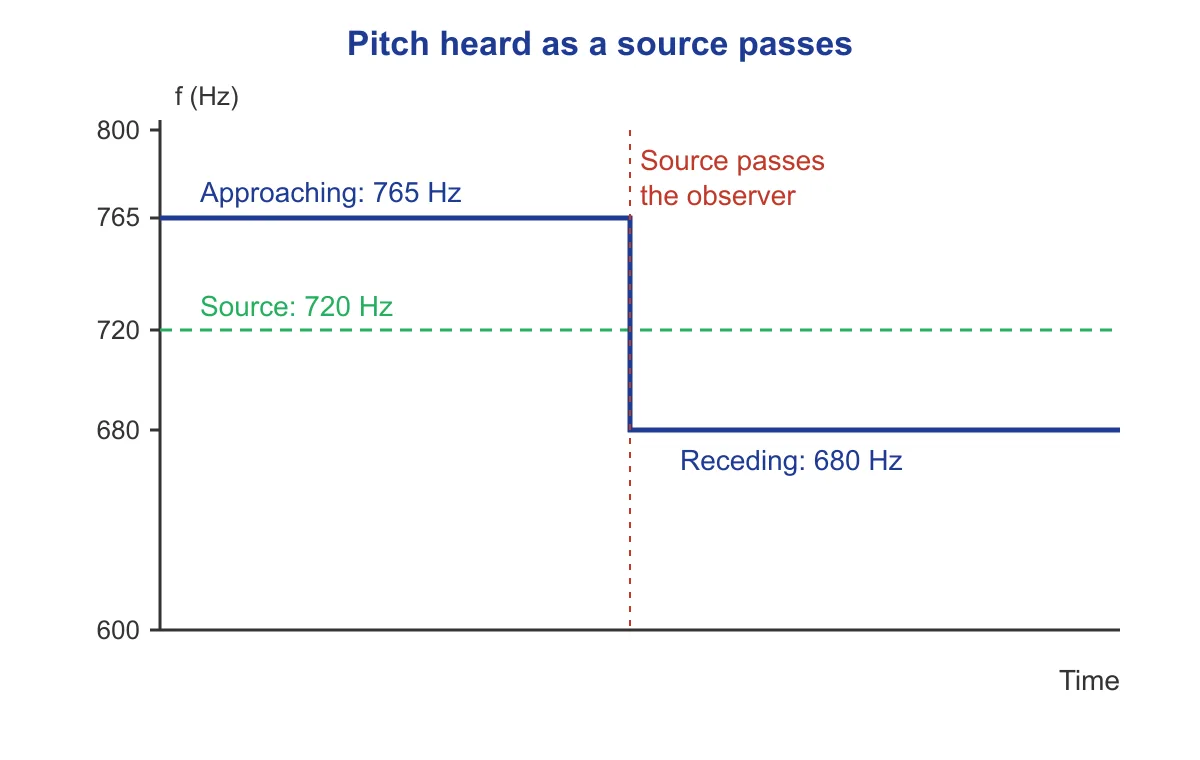
Figure 1.2: Frequency heard as a source of 720 Hz passes an observer close to the track at 20 m s⁻¹
Example 6: A source of frequency 1440 Hz passes a stationary observer at a steady 20 m s⁻¹ along a straight line. Take $v = 340$ m s⁻¹. Find the drop in frequency heard.
Approaching: $1440 \times \dfrac{340}{320} = 1530$ Hz.
Receding: $1440 \times \dfrac{340}{360} = 1360$ Hz.
Drop $= 1530 - 1360 = 170$ Hz.
Check by the formula: $\dfrac{2 \times 1440 \times 20 \times 340}{340^2 - 400} = \dfrac{19\,584\,000}{115\,200} = 170$.
The true 1440 Hz lies between the two heard values; notice the drop is nearly 12% of the source frequency even at 20 m s⁻¹.
Reflection from a moving wall
When sound meets a wall, the wall takes in the waves and sends them back. The process has two steps, and each step is a normal Doppler problem.
- The wall is the observer. It receives frequency $f_1$ from the real source.
- The wall is now a source of frequency $f_1$ and the real observer is the observer. The frequency heard is $f_2$.
If the wall stands still, $f_1 = f$, and the echo has the same frequency as the source (when the source and observer are also at rest). If the wall moves, the double shift appears.
Take a stationary source of frequency $f$ and a wall coming towards it at speed $u$. The wall, as an observer moving towards the source, receives
The wall, as a source moving towards the (stationary) listener, emits to the listener
For a wall receding at speed $u$, replace $u$ by $-u$:
A listener at the source's position hears the direct sound at $f$ and the echo at $f_2$, so the beat frequency is $f_2 - f$.
Example 7: A stationary source of 570 Hz is near a large wall that moves towards it at 17 m s⁻¹. Find the echo's frequency and the beats heard by a listener standing beside the source. Take $v = 340$ m s⁻¹.
Wall as observer moving towards the source: $f_1 = 570 \times \dfrac{340 + 17}{340} = 570 \times \dfrac{357}{340}$.
Wall as source moving towards the listener: $f_2 = f_1 \times \dfrac{340}{340 - 17} = 570 \times \dfrac{357}{323}$.
$\dfrac{357}{323} = \dfrac{21}{19}$, so $f_2 = 570 \times \dfrac{21}{19} = 30 \times 21 = 630$ Hz.
Beats: $630 - 570 = 60$ per second.
The answer is 630 Hz and 60 beats per second. A reflected wave from an approaching wall behaves exactly like a wave sent by a source of frequency $f$ moving towards you at $2u$ in the limit $u \ll v$, which is a handy check.
The result for the three cases is worth keeping in a table: an approaching wall gives a higher echo, a receding wall a lower echo, and a wall at rest no change.
| Wall | Echo frequency (source and listener at rest) |
|---|---|
| At rest | $f$ |
| Approaching at $u$ | $f\,\dfrac{v + u}{v - u}$ |
| Receding at $u$ | $f\,\dfrac{v - u}{v + u}$ |
If the source or the listener also moves, apply the general formula twice and keep the sign convention each time: for each step, positive is from the current source to the current observer.
Limits of the formulae
- The air is at rest. A steady wind needs a different treatment and is not part of this chapter.
- The source speed must be below $v$. As $u_S$ approaches $v$, the formula $v/(v - u_S)$ grows without bound, which only tells you that the waves pile up. At or above the speed of sound the waves cannot run ahead of the source at all, and a different pattern of wavefronts forms.
- The formulae give the frequency of waves at the instant they are emitted and received. If the speeds change quickly, treat each wave separately.
Common traps
- Using $v + u_S$ in the denominator for a source moving towards the observer → source towards the observer means $v - u_S$; the denominator shrinks and the pitch rises.
- Putting the observer's speed in the denominator → observer terms go on top, source terms go at the bottom.
- Believing the speed of sound changes because the source moves → the air sets the wave speed; only the wavelength changes.
- Believing the wavelength changes when the observer moves → it does not; the observer simply meets the waves faster or slower.
- Using the whole speed of a source moving at an angle → take only $u\cos\theta$ along the line from source to observer at the time of emission.
- Forgetting the second step for a moving wall → the wall is first an observer and then a source; apply the formula twice.
- Taking beat frequency as the sum or the average → it is the difference $\vert f_1 - f_2\vert$.
- Reversing loading and filing → wax lowers the frequency, filing raises it.
- Using Celsius in $v \propto \sqrt{T}$ → convert to kelvin first.
- Expecting equal speeds in the same direction to shift the frequency → when source and observer have the same velocity in still air, $f' = f$.
Quick revision
- Sound in air is longitudinal; $v = f\lambda$, and the medium fixes $v$.
- $v = \sqrt{\gamma P/\rho} = \sqrt{\gamma R T/M}$; $v \propto \sqrt{T}$; unchanged by pressure at fixed $T$.
- $v \approx 340$ m s⁻¹ in air near room temperature.
- Beat frequency $= \vert f_1 - f_2\vert$; beats are heard clearly for a difference of a few hertz.
- Beats from unequal amplitudes: $I_{\max}/I_{\min} = \big((A_1 + A_2)/(A_1 - A_2)\big)^2$.
- Loading lowers a fork's frequency, filing raises it.
- General Doppler formula: $f' = f\,(v - v_O)/(v - v_S)$, velocities positive from S to O.
- Source towards a stationary observer: $f' = f v/(v - u)$; away: $f v/(v + u)$.
- Observer towards a stationary source: $f' = f(v + u)/v$; away: $f(v - u)/v$.
- Source and observer with equal velocities in still air: no shift.
- Angled source: replace $u$ by $u\cos\theta$, with $\theta$ measured at emission.
- Source passing by: higher pitch on approach, lower pitch on recession.
- Wall approaching at $u$: echo $f(v + u)/(v - u)$; receding: $f(v - u)/(v + u)$.
- The formulae need $u_S < v$ and air at rest.
Practice questions
Two sound waves of frequencies 200 Hz and 206 Hz reach a point together. What is the time between two successive maxima of loudness at that point?
- $\frac{1}{6}$ s
- $\frac{1}{406}$ s
- $\frac{1}{12}$ s
- $\frac{1}{203}$ s
Answer
A. $\frac{1}{6}$ s
Beat frequency = 206 - 200 = 6 per second, so maxima are 1/6 s apart. 1/203 s would be the period of the average frequency, not of the loudness.
Two tuning forks of frequencies 512 Hz and 505 Hz are sounded together. How many beats are heard per second?
- 3
- 5
- 7
- 10
Answer
C. 7
Beat frequency = |512 - 505| = 7 per second.
At a fixed temperature the pressure of a sample of air is doubled by compressing it slowly. The speed of sound in it will
- become $\sqrt{2}$ times
- become half
- double
- remain unchanged
Answer
D. remain unchanged
$v=\sqrt{\gamma P/\rho}$. At fixed T, density is proportional to P, so P/ρ does not change and v stays the same.
A source of frequency 400 Hz moves at 20 m s⁻¹ straight towards a stationary observer. Taking the speed of sound as 340 m s⁻¹ in still air, the frequency heard is (in Hz)
- 423.5
- 425
- 378
- 420
Answer
B. 425
$f'=400\times\frac{340}{340-20}=400\times\frac{340}{320}=425$ Hz. 378 is the receding value; 423.5 uses the observer formula wrongly.
A stationary source of frequency $f$ is heard by an observer moving away from it at speed $u$. If $v$ is the speed of sound in still air, the frequency heard is
- $f\,\frac{v+u}{v}$
- $f\,\frac{v}{v-u}$
- $f\,\frac{v-u}{v}$
- $f\,\frac{v}{v+u}$
Answer
C. $f\,\frac{v-u}{v}$
The wave spacing is unchanged; the observer meets waves at relative speed v - u, so f' = f(v-u)/v.
Given below are two statements: Statement I: Loading the prongs of a tuning fork with wax raises its frequency. Statement II: Filing the prongs of a tuning fork raises its frequency.
- Both Statement I and Statement II are correct
- Both Statement I and Statement II are incorrect
- Statement I is correct but Statement II is incorrect
- Statement I is incorrect but Statement II is correct
Answer
D. Statement I is incorrect but Statement II is correct
Wax adds mass, so the fork vibrates slower and its frequency falls: Statement I is wrong. Filing removes mass and raises the frequency: Statement II is right.
An observer walks at 34 m s⁻¹ straight towards a stationary source of frequency 500 Hz. Taking the speed of sound as 340 m s⁻¹, the frequency heard is (in Hz)
- 510
- 550
- 555.6
- 450
Answer
B. 550
$f'=500\times\frac{340+34}{340}=500\times\frac{374}{340}=550$ Hz. 555.6 would come from treating the source as moving; 450 is the receding case.
A source and an observer both move with the same velocity in the same direction through still air. The frequency heard compared with the source frequency $f$ is
- equal to $f$
- zero
- higher than $f$
- lower than $f$
Answer
A. equal to $f$
Taking positive from S to O, v_S = v_O, so f' = f(v - v_O)/(v - v_S) = f.
A source of frequency 600 Hz moves away from a stationary observer at 30 m s⁻¹. Taking the speed of sound as 330 m s⁻¹, the frequency heard is (in Hz)
- 654.5
- 660
- 550
- 545.5
Answer
C. 550
$f'=600\times\frac{330}{330+30}=600\times\frac{330}{360}=550$ Hz. 660 is the approaching case; 545.5 and 654.5 come from putting speeds in the wrong places.
Match List I with List II. List I: a. Source moving towards a stationary observer at speed $u$ b. Source moving away from a stationary observer at speed $u$ c. Observer moving towards a stationary source at speed $u$ d. Observer moving away from a stationary source at speed $u$ List II: i. $f\,\frac{v-u}{v}$ ii. $f\,\frac{v}{v+u}$ iii. $f\,\frac{v+u}{v}$ iv. $f\,\frac{v}{v-u}$
- a-iv, b-ii, c-i, d-iii
- a-ii, b-iv, c-i, d-iii
- a-iii, b-i, c-iv, d-ii
- a-iv, b-ii, c-iii, d-i
Answer
D. a-iv, b-ii, c-iii, d-i
Source terms go in the denominator: towards gives v-u (iv), away gives v+u (ii). Observer terms go in the numerator: towards gives v+u (iii), away gives v-u (i).
A stationary observer hears the frequency of a source rise without limit as the source speed $u$ approaches the speed of sound $v$ in the formula $f'=f\,v/(v-u)$. As $u\to v$ the formula gives a frequency that
- approaches $f$
- grows without limit
- approaches zero
- approaches $2f$
Answer
B. grows without limit
The denominator v - u tends to zero, so f' grows without limit. This signals that the formula cannot be used for u close to or above v.
A source of frequency 640 Hz moves at 20 m s⁻¹ towards an observer, who moves at 17 m s⁻¹ towards the source, in still air. Taking the speed of sound as 340 m s⁻¹, the frequency heard is (in Hz)
- 714
- 672
- 680
- 646
Answer
A. 714
$f'=640\times\frac{340+17}{340-20}=640\times\frac{357}{320}=714$ Hz. 672 ignores the source motion; 680 ignores the observer motion.
Given below are two statements: Statement I: When a source moves towards a stationary observer, the wavelength of the wave in the air ahead of the source decreases. Statement II: The speed of the wave through the air also increases by the speed of the source.
- Both Statement I and Statement II are correct
- Both Statement I and Statement II are incorrect
- Statement I is correct but Statement II is incorrect
- Statement I is incorrect but Statement II is correct
Answer
C. Statement I is correct but Statement II is incorrect
Ahead of the source the wavelength is (v - u)/f, shorter than v/f: Statement I is right. The wave speed in still air is fixed by the air, so Statement II is wrong.
At the instant a wave is emitted, the velocity of a moving source is exactly perpendicular to the line joining the source and a stationary observer. The frequency of that wave as received, compared with the source frequency $f$, is
- zero
- equal to $f$
- greater than $f$
- less than $f$
Answer
B. equal to $f$
The component of the source velocity along the line of sight is u cos 90° = 0, so f' = f.
A source of frequency 640 Hz is at rest near a wall that moves towards it at 20 m s⁻¹. A listener beside the source hears the direct sound and the echo together. Taking the speed of sound as 340 m s⁻¹, the number of beats per second is
- 80
- 160
- 720
- 40
Answer
A. 80
Echo frequency $=640\times\frac{340+20}{340-20}=640\times\frac{360}{320}=720$ Hz. Beats = 720 - 640 = 80 per second.
Assertion (A): Sound travels faster in air on a hot day than on a cold day. Reason (R): The speed of sound in an ideal gas is proportional to the square root of its absolute temperature.
- Both A and R are true and R is the correct explanation of A
- Both A and R are true but R is not the correct explanation of A
- A is true but R is false
- A is false but R is true
Answer
A. Both A and R are true and R is the correct explanation of A
$v=\sqrt{\gamma RT/M}$ rises with T, which is exactly what R states and why A is true.
A tuning fork of unknown frequency gives 5 beats per second with a standard fork of 300 Hz. On filing the unknown fork, the beats per second fall to 3. The frequency of the unknown fork is (in Hz)
- 303
- 305
- 297
- 295
Answer
D. 295
Candidates: 295 or 305. Filing raises the frequency. From 305 it would give more than 5 beats; from 295 it moves to 297, giving 3 beats. So 295 Hz.
A source of frequency 720 Hz passes a stationary observer close to a straight track at a steady 20 m s⁻¹. Taking the speed of sound as 340 m s⁻¹, the fall in frequency heard between approach and recession is (in Hz)
- 45
- 765
- 40
- 85
Answer
D. 85
Approach: 720×340/320 = 765 Hz. Recession: 720×340/360 = 680 Hz. Fall = 765 - 680 = 85 Hz.
Given below are two statements: Statement I: If a source and an observer move with the same velocity in still air, the frequency heard equals the source frequency. Statement II: In still air, no Doppler shift occurs whenever the relative velocity between the source and the observer is zero.
- Both Statement I and Statement II are correct
- Both Statement I and Statement II are incorrect
- Statement I is correct but Statement II is incorrect
- Statement I is incorrect but Statement II is correct
Answer
A. Both Statement I and Statement II are correct
With v_S = v_O the factor (v - v_O)/(v - v_S) equals 1. Zero relative velocity means equal velocities, so both statements hold.
A source of frequency 500 Hz moves towards a stationary observer at 34 m s⁻¹. Taking the speed of sound as 340 m s⁻¹, the wavelength of the wave in the air ahead of the source is
- 0.748 m
- 0.500 m
- 0.612 m
- 0.680 m
Answer
C. 0.612 m
$\lambda'=\frac{v-u}{f}=\frac{340-34}{500}=0.612$ m. 0.680 m is v/f, the wavelength for a source at rest.
The speed of sound in air at 300 K is 340 m s⁻¹. At what temperature (in K) will the speed be 680 m s⁻¹?
- 2400
- 1200
- 600
- 900
Answer
B. 1200
$v\propto\sqrt{T}$, so doubling v needs 4 times T: 4×300 = 1200 K.
A stationary source of frequency $f$ is observed by a person moving towards it at speed $u$. Which statement is correct?
- The wavelength in air decreases and the wave speed relative to the person is unchanged
- The wavelength in air is unchanged and the wave speed relative to the ground increases
- The wavelength in air is unchanged and the wave speed relative to the person is $v+u$
- Both the wavelength in air and the wave speed relative to the person are unchanged
Answer
C. The wavelength in air is unchanged and the wave speed relative to the person is $v+u$
The source is at rest, so the wavelength in air stays v/f. The person meets the waves at relative speed v + u, which raises the frequency heard.
Match List I with List II (take the speed of sound as 340 m s⁻¹ in still air). List I: a. 400 Hz source approaching a stationary observer at 20 m s⁻¹ b. 360 Hz source receding from a stationary observer at 20 m s⁻¹ c. Observer approaching a stationary 340 Hz source at 20 m s⁻¹ d. Observer receding from a stationary 340 Hz source at 20 m s⁻¹ List II: i. 340 Hz ii. 360 Hz iii. 320 Hz iv. 425 Hz
- a-iv, b-i, c-iii, d-ii
- a-iv, b-i, c-ii, d-iii
- a-ii, b-iii, c-iv, d-i
- a-i, b-iv, c-iii, d-ii
Answer
B. a-iv, b-i, c-ii, d-iii
a: 400×340/320 = 425. b: 360×340/360 = 340. c: 340×360/340 = 360. d: 340×320/340 = 320.
A source of frequency 640 Hz moves at 40 m s⁻¹ and, at the instant of emission, its velocity makes 60° with the line towards a stationary observer, the source approaching. Taking the speed of sound as 340 m s⁻¹, the frequency heard is (in Hz)
- 725
- 640
- 713
- 680
Answer
D. 680
Component along the line = 40 cos 60° = 20 m s⁻¹. f' = 640×340/(340 - 20) = 680 Hz. 725 uses the full 40 m s⁻¹.
The ratio of the speed of sound in hydrogen to that in oxygen at the same temperature is (treat both as ideal diatomic gases with molar masses 2 g and 32 g)
- 2
- 16
- $\frac{1}{4}$
- 4
Answer
D. 4
With equal γ, $v\propto 1/\sqrt{M}$, so ratio = $\sqrt{32/2}=\sqrt{16}=4$.
Assertion (A): An observer moving towards a stationary source hears a higher frequency than the source frequency. Reason (R): The wavelength of the wave in the air decreases when the observer moves towards the source.
- Both A and R are true and R is the correct explanation of A
- Both A and R are true but R is not the correct explanation of A
- A is true but R is false
- A is false but R is true
Answer
C. A is true but R is false
A is true because the observer meets waves faster. R is false: the wavelength in the air depends only on the source and the air, not on the observer's motion.
A tuning fork of unknown frequency gives 4 beats per second with a 256 Hz fork. After loading the unknown fork, the beats become 6 per second. The unknown frequency is (in Hz)
- 252
- 248
- 262
- 260
Answer
A. 252
Candidates 252 or 260. Loading lowers the frequency. 260 would move nearer 256 and the beats would fall. Beats rose, so it is 252 Hz; loaded to 250 Hz the beats are 6.
Given below are two statements: Statement I: At fixed temperature, the speed of sound in an ideal gas depends on its pressure. Statement II: If the absolute temperature of air is doubled, the speed of sound in it also doubles.
- Both Statement I and Statement II are correct
- Both Statement I and Statement II are incorrect
- Statement I is correct but Statement II is incorrect
- Statement I is incorrect but Statement II is correct
Answer
B. Both Statement I and Statement II are incorrect
At fixed T, P/ρ is constant so v does not depend on P. Also v is proportional to √T, so doubling T multiplies v by √2. Both are wrong.
A stationary source emits frequency $f$. A wall moves away from it at speed $u$, and a listener stands beside the source. If $v$ is the speed of sound in still air, the echo frequency heard is
- $f\,\frac{v+u}{v-u}$
- $f\,\frac{v-u}{v+u}$
- $f\,\frac{v-u}{v}$
- $f\,\frac{v}{v+u}$
Answer
B. $f\,\frac{v-u}{v+u}$
Wall as receding observer: f(v-u)/v. Wall as receding source: multiply by v/(v+u). Echo = f(v-u)/(v+u).
Match List I with List II. List I: a. Air heated from 300 K to 1200 K b. Hydrogen compared with oxygen at the same temperature c. Air compressed slowly at constant temperature to twice the pressure d. Air cooled from 400 K to 100 K List II: i. Speed of sound doubles ii. Speed of sound unchanged iii. Speed of sound 4 times as large iv. Speed of sound halves
- a-iii, b-i, c-iv, d-ii
- a-i, b-iii, c-iv, d-ii
- a-i, b-iii, c-ii, d-iv
- a-ii, b-iii, c-i, d-iv
Answer
C. a-i, b-iii, c-ii, d-iv
a: √4 = 2 (i). b: √(32/2) = 4 (iii). c: P/ρ unchanged (ii). d: √(1/4) = 1/2 (iv).
A bat flying at 20 m s⁻¹ straight towards a flat wall emits a call of 40 kHz. Taking the speed of sound as 340 m s⁻¹ in still air, the frequency (in kHz) of the echo heard by the bat is
- 45
- 42.5
- 35.6
- 47.5
Answer
A. 45
Wall hears 40×340/(340-20) = 42.5 kHz. The bat, moving towards the wall, hears 42.5×(340+20)/340 = 45 kHz.
A source and an observer move towards each other, each at speed $u$ relative to still air. If $v$ is the speed of sound, the frequency heard is
- $f\,\frac{v+2u}{v}$
- $f\,\frac{v-u}{v+u}$
- $f\,\frac{v}{v-u}$
- $f\,\frac{v+u}{v-u}$
Answer
D. $f\,\frac{v+u}{v-u}$
Source towards: denominator v - u. Observer towards: numerator v + u. So f' = f(v+u)/(v-u).
Given below are two statements: Statement I: The beat frequency of two forks of 300 Hz and 308 Hz is 304 per second. Statement II: A source whose velocity is perpendicular to the line to a stationary observer at the instant of emission produces the largest Doppler shift.
- Both Statement I and Statement II are correct
- Both Statement I and Statement II are incorrect
- Statement I is correct but Statement II is incorrect
- Statement I is incorrect but Statement II is correct
Answer
B. Both Statement I and Statement II are incorrect
Beat frequency is the difference, 8 per second, so I is wrong. A perpendicular velocity has no component along the line of sight, so the shift is zero; II is wrong.
A source moving directly towards a stationary observer is heard at a frequency 25% higher than its own frequency. Taking the speed of sound as 340 m s⁻¹, the speed of the source is (in m s⁻¹)
- 272
- 34
- 85
- 68
Answer
D. 68
$\frac{v}{v-u}=1.25\Rightarrow v-u=272\Rightarrow u=68$ m s⁻¹. 272 is v - u, and 85 comes from using the observer formula.
Two sound sources of amplitudes $A$ and $3A$ have nearly equal frequencies. At a point where they overlap, the ratio of the maximum to the minimum intensity is
- 2
- 9
- 16
- 4
Answer
D. 4
$\frac{I_{\max}}{I_{\min}}=\left(\frac{A+3A}{3A-A}\right)^2=\left(\frac{4}{2}\right)^2=4$.
Assertion (A): A stationary listener hears a lower frequency from a passing siren after it has passed than before. Reason (R): The speed of sound in air is the same for sounds of all frequencies.
- Both A and R are true and R is the correct explanation of A
- Both A and R are true but R is not the correct explanation of A
- A is true but R is false
- A is false but R is true
Answer
B. Both A and R are true but R is not the correct explanation of A
A is true because approach gives f v/(v-u) and recession f v/(v+u). R is also true, but the shift comes from the motion of the source, not from the independence of speed on frequency.
Two sound waves are $y_1=A\sin 600\pi t$ and $y_2=A\sin 610\pi t$ (t in seconds). The beat frequency in Hz is
- 305
- 2.5
- 5
- 10
Answer
C. 5
Frequencies: 600π/2π = 300 Hz and 610π/2π = 305 Hz. Beats = 5 per second.
A stationary source of 680 Hz stands in front of a wall at rest. A man in a car moves at 20 m s⁻¹ directly away from the source and towards the wall, so the sound reaches him both directly and as an echo. Taking the speed of sound as 340 m s⁻¹, the beats per second he hears is
- 80
- 20
- 160
- 40
Answer
A. 80
Direct: 680×(340-20)/340 = 640 Hz. Echo: the wall (at rest) sends 680 Hz; he approaches it, so hears 680×(340+20)/340 = 720 Hz. Beats = 720 - 640 = 80.
A source of 900 Hz moves along a straight line at 50 m s⁻¹. At an instant of emission its distance to a stationary observer is 5 m, the line joining them making an angle with the velocity whose cosine is 0.8, and the source is approaching. Taking the speed of sound as 340 m s⁻¹, the frequency heard is approximately (in Hz)
- 805
- 987
- 1020
- 1055
Answer
C. 1020
Component along the line = 50×0.8 = 40 m s⁻¹. f' = 900×340/(340 - 40) = 900×340/300 = 1020 Hz. 1055 uses the full 50; 987 uses the sine component, 30.
A fork F of 320 Hz is carried at 20 m s⁻¹ straight towards a stationary listener. A second fork G of unknown frequency stays at rest next to the listener. They produce 4 beats per second. When G is loaded with wax, the beats per second decrease. Taking the speed of sound as 340 m s⁻¹, the frequency of G is (in Hz)
- 344
- 336
- 324
- 316
Answer
A. 344
F is heard at 320×340/(340-20) = 340 Hz. G is 340 ± 4. Loading lowers G; beats fall only if G is above 340, so G = 344 Hz.