Damped and Forced Oscillations, and Resonance
What to remember
- A damping force $F = -bv$ opposes velocity. For light damping the amplitude falls as $A_0 e^{-bt/2m}$ and the energy falls as $e^{-bt/m}$, twice as fast in the exponent.
- Damped angular frequency: $\omega' = \sqrt{k/m - b^2/4m^2}$. It is always a little smaller than $\omega_0 = \sqrt{k/m}$. Oscillation exists only while $b < 2\sqrt{km}$.
- After the transient dies, a driven oscillator moves at the driver's frequency, never its own, with amplitude $A = F_0/\sqrt{m^2(\omega_0^2-\omega^2)^2 + b^2\omega^2}$.
- Resonance: at $\omega = \omega_0$ the velocity is in phase with the force, the power absorbed is greatest, and the displacement amplitude is $F_0/(b\omega_0)$. Less damping gives a taller, narrower peak.
- For compound systems, reduce to one effective $k$ (springs) or one effective $I$ and $d$ (physical pendulum), then use the standard formulae.
Free, damped and driven: three different situations
A free oscillation is the one you met first: a mass $m$ on a spring $k$, nothing else acting. The equation is $m\ddot{x} = -kx$, the motion is $x = A\cos(\omega_0 t + \phi)$ with $\omega_0 = \sqrt{k/m}$, and the amplitude never changes. This is an idealisation. A real pendulum stops, a real tuning fork fades.
The fading comes from friction with the air or the liquid around the body, or from internal friction in the spring. For slow motion this resistance is very nearly proportional to the speed:
$b$ is the damping constant. Its unit is kg s⁻¹, which you can confirm from $F/v$. The minus sign says the force always points against the velocity. Add it to the spring force and Newton's second law gives
If somebody now pushes the system with a periodic force $F_0\cos\omega t$, the right-hand side becomes $F_0\cos\omega t$ instead of zero. That is a forced (driven) oscillation. So we have three cases: nothing but the spring, spring plus friction, spring plus friction plus a driver. Each has its own behaviour, and mixing them up is the commonest source of lost marks in this chapter.
Damped oscillations
Light damping: the decaying cosine
Try $x = A_0 e^{-\gamma t}\cos(\omega' t + \phi)$ in the equation above. Matching terms gives two results:
So the motion is a cosine whose amplitude is multiplied by $e^{-bt/2m}$. The curve touches the two envelope lines $\pm A_0 e^{-bt/2m}$ close to (not exactly at) its peaks.
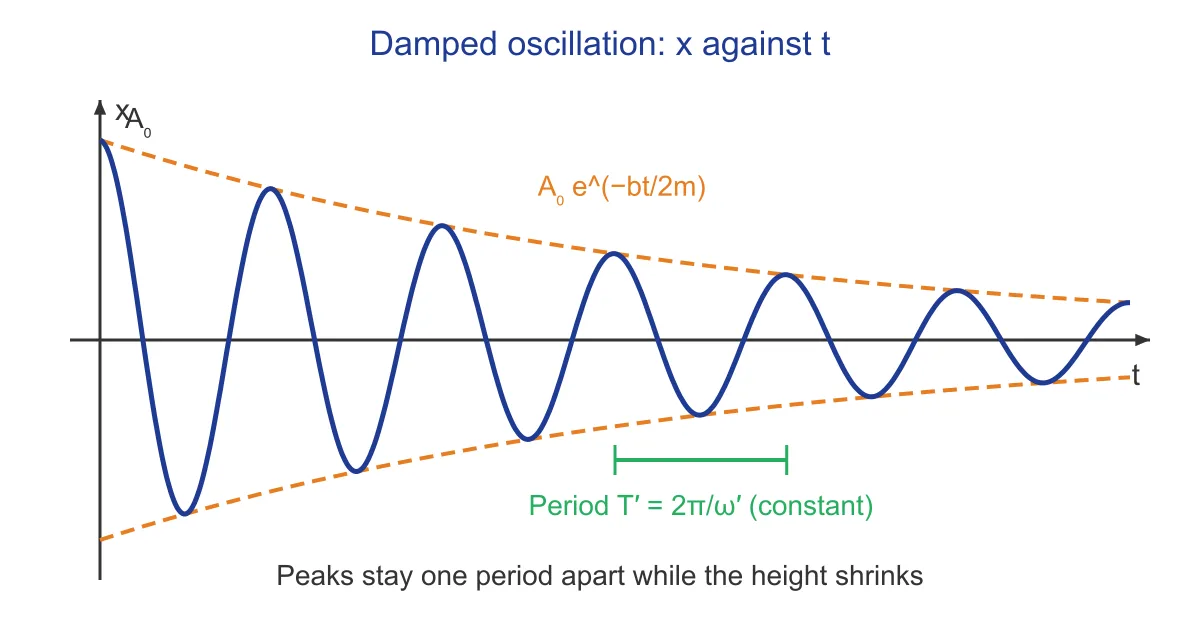
Figure 2.1: Underdamped motion. The period is constant, the amplitude decays exponentially.
Three facts to read off the picture and the formula:
- The time between successive maxima is constant, $T' = 2\pi/\omega'$. Damping does not make the oscillation irregular.
- $T'$ is longer than $T_0 = 2\pi/\omega_0$, because $\omega' < \omega_0$. For very light damping the difference is tiny and often ignored.
- In every cycle the amplitude is multiplied by the same factor $e^{-\gamma T'}$. The decay is geometric, which is why it is exponential in time.
The time for the amplitude to fall to $1/e$ of its starting value is $2m/b$. To fall to half it is $\frac{2m}{b}\ln 2$, with $\ln 2 = 0.693$.
Example 1: A body of mass 0.3 kg oscillates with damping constant $b = 0.12$ kg s⁻¹. How long does the amplitude take to halve?
Amplitude $= A_0 e^{-bt/2m}$. Set it equal to $A_0/2$.
$e^{-bt/2m} = 1/2$, so $bt/2m = \ln 2$.
$t = \dfrac{2m\ln 2}{b} = \dfrac{2 \times 0.3 \times 0.693}{0.12}$
$t = 5 \times 0.693 = 3.47$ s.
Why this works: halving time depends only on $m/b$, not on the starting amplitude. Every 3.47 s the amplitude halves again.
Example 2: A block of mass 1 kg on a spring of constant 169 N m⁻¹ moves with $b = 10$ kg s⁻¹. Find $\omega_0$, $\omega'$ and check that the motion oscillates.
$\omega_0 = \sqrt{169/1} = 13$ rad s⁻¹.
$b^2/4m^2 = 100/4 = 25$.
$\omega' = \sqrt{169 - 25} = \sqrt{144} = 12$ rad s⁻¹.
Check: $2\sqrt{km} = 2 \times 13 = 26 > 10$, so it is underdamped.
Why this works: subtract inside the root, not outside. $13 - 5 = 8$ would be the wrong answer.
Energy decay
The mechanical energy is $E = \frac{1}{2}kA^2$ with $A$ the instantaneous amplitude. Squaring the amplitude doubles the exponent:
The energy lost is not wasted in the books: it is converted to heat in the surrounding medium. The rate of loss at any instant is the power of the damping force, $P = bv^2$. Averaged over a cycle for light damping, the mean loss is $\frac{1}{2}b\omega^2 A^2$, which is $\frac{b}{m}$ times the stored energy. That equals $-\frac{dE}{dt}$, consistent with the exponential above.
The fraction of energy lost per cycle follows at once. In one period $T \approx 2\pi/\omega_0$ the exponent changes by $bT/m$, so for light damping
Here $Q = m\omega_0/b$ is the quality factor. A large $Q$ means a system that rings for many cycles: a good tuning fork has $Q$ in the thousands, a car shock absorber has $Q$ close to one.
Example 3: An oscillator has $Q = 200$. What fraction of its energy is lost in one cycle, and about how many cycles pass before the energy falls to $1/e$?
Fraction per cycle $= 2\pi/Q = 6.28/200 = 0.0314$, about 3.1 percent.
Energy falls to $1/e$ when $bt/m = 1$, i.e. $t = m/b$. In cycles: $t/T = \dfrac{m}{b}\cdot\dfrac{\omega_0}{2\pi} = \dfrac{Q}{2\pi}$.
$= 200/6.28 = 31.8$ cycles.
Why this works: $Q/2\pi$ is the number of cycles for the energy to drop by a factor $e$. Remember it as the inverse of the loss fraction.
Beyond light damping
Increase $b$ and $\omega'$ shrinks. When $b = 2\sqrt{km}$ the term under the root is zero: $\omega' = 0$ and there is no oscillation at all. This is critical damping. The body, pulled aside and released, returns to equilibrium in the shortest time without crossing it. Pointer instruments and door closers are built close to this condition.
For $b > 2\sqrt{km}$ the system is overdamped. It creeps back, more slowly than in the critical case, again without oscillating.
| Case | Condition | Motion after release from rest |
|---|---|---|
| Undamped | $b = 0$ | Endless oscillation, constant amplitude |
| Underdamped | $b < 2\sqrt{km}$ | Oscillates, amplitude decays exponentially |
| Critically damped | $b = 2\sqrt{km}$ | Fastest return, no oscillation |
| Overdamped | $b > 2\sqrt{km}$ | Slow return, no oscillation |
Memory trick: "Under rings, critical settles, over crawls."
Use it to recall the three regimes and that only the first one oscillates.
Forced oscillations and resonance
Steady state
Now let a periodic force $F_0\cos\omega t$ act on the damped system. At first the motion is a mixture: the system's own decaying motion (the transient) plus a response to the driver. The transient dies as $e^{-bt/2m}$. What remains is the steady state:
The steady state has the driver's frequency $\omega$, not $\omega_0$ and not $\omega'$. The amplitude and the phase lag are
You do not need to derive these, but you should be able to read them. The first term under the root is the "stiffness mismatch": it vanishes when $\omega = \omega_0$. The second is the damping term; without it the amplitude would become infinite at $\omega_0$.
Amplitude against driving frequency
Three limits cover the whole curve.
- $\omega \ll \omega_0$: the driver is slow, the spring simply follows it. $A \approx F_0/k$ (the static stretch). Displacement is almost in phase with the force.
- $\omega = \omega_0$: the first term vanishes and $A = F_0/(b\omega_0)$. Displacement lags the force by $\pi/2$, which means velocity is in phase with force. The force pushes in the direction of motion all the time, so the energy input per cycle is the greatest possible.
- $\omega \gg \omega_0$: the mass cannot keep up. $A \approx F_0/(m\omega^2)$, falling as $1/\omega^2$. Displacement is nearly opposite to the force, a lag approaching $\pi$.
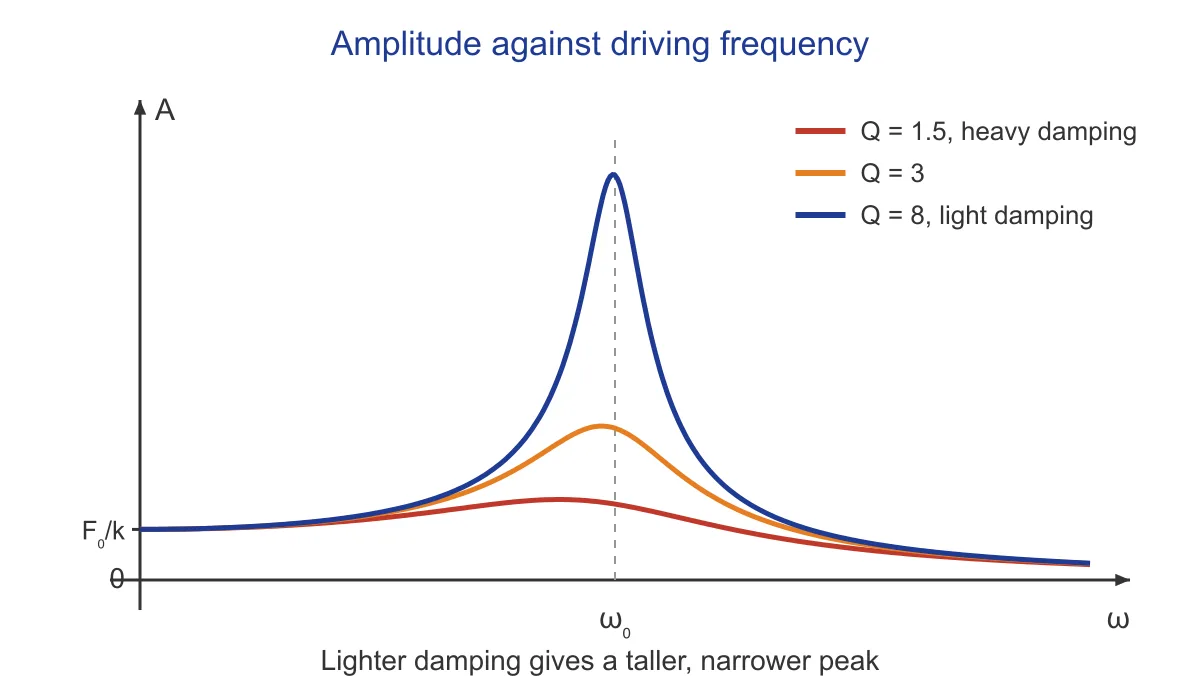
*Figure 2.2: Resonance curves. Less damping means a taller and sharper peak that sits closer to $\omega_0$.*
The peak of the displacement amplitude is not exactly at $\omega_0$. Minimising the quantity under the root shows it sits at
a little below $\omega_0$, and only if $b^2 < 2km$. Beyond that the curve falls steadily from $F_0/k$ and shows no peak. By contrast, the velocity amplitude $\omega A$ and the mean power absorbed both peak exactly at $\omega = \omega_0$, whatever the damping.
| Quantity | Peaks at | Value at peak |
|---|---|---|
| Displacement amplitude | $\sqrt{\omega_0^2 - b^2/2m^2}$ | slightly above $F_0/(b\omega_0)$ |
| Velocity amplitude | $\omega_0$ exactly | $F_0/b$ |
| Mean power absorbed | $\omega_0$ exactly | $F_0^2/2b$ |
The mean power drawn from the driver is $\frac{1}{2}F_0 v_0\cos(\text{phase})$, and at $\omega_0$ the velocity amplitude is $F_0/b$, giving $F_0^2/2b$. In steady state all of it goes into the damping.
Sharpness
Take the two frequencies on either side of $\omega_0$ at which the power falls to half its maximum. The gap between them, the width of the resonance, is for light damping
So the same number $Q$ measures both how slowly a free oscillation dies and how sharp the resonance is. A system with large $Q$ responds strongly to a narrow band and ignores the rest. Halving $b$ doubles the peak height $F_0/(b\omega_0)$ and halves the width.
Memory trick: "Weak friction, tall and thin; strong friction, short and fat."
Use it to sketch any resonance curve in two seconds.
Example 4: A mass 0.2 kg on a spring of 20 N m⁻¹ has $b = 0.4$ kg s⁻¹. A force $0.8\cos\omega t$ newton acts. Find the steady amplitude at $\omega = 0$ (static), $\omega = 10$ rad s⁻¹ and $\omega = 20$ rad s⁻¹.
$\omega_0 = \sqrt{20/0.2} = 10$ rad s⁻¹.
At $\omega \to 0$: $A = F_0/k = 0.8/20 = 0.04$ m.
At $\omega = 10 = \omega_0$: $A = F_0/(b\omega_0) = 0.8/(0.4 \times 10) = 0.2$ m.
At $\omega = 20$: $m(\omega_0^2 - \omega^2) = 0.2(100 - 400) = -60$; $b\omega = 8$.
$A = 0.8/\sqrt{3600 + 64} = 0.8/60.5 = 0.0132$ m.
Why this works: resonance gives five times the static stretch; driving at double the natural frequency gives a third of it. The curve is a hill, not a line.
Example 5: For $m = 1$ kg, $k = 400$ N m⁻¹, $b = 10$ kg s⁻¹, at what driving frequency is the displacement amplitude greatest, and what is the frequency of maximum power?
$\omega_0 = 20$ rad s⁻¹. $b^2/2m^2 = 100/2 = 50$.
$\omega_r = \sqrt{400 - 50} = \sqrt{350} = 18.7$ rad s⁻¹ for displacement.
Maximum power is at $\omega_0 = 20$ rad s⁻¹ exactly.
Why this works: the two peaks are different frequencies once damping is not negligible. Read the question for "displacement" or "power".
Where you meet resonance
A child on a swing is pushed at the swing's own rhythm, each small push adding to the motion. Soldiers are told to break step on a bridge because their marching frequency, matching a natural frequency of the bridge, could build a dangerous amplitude. A radio is tuned by changing the natural frequency of its circuit until it equals the station's frequency; the sharp peak (large $Q$) is what lets one station be picked out from many. Air columns and strings in musical instruments, and the body of a guitar, respond strongly near their natural frequencies, which is how a small vibration is made loud. In machines the same effect is a nuisance: a loose panel buzzes at one engine speed only.
Compound systems: reducing to one oscillator
Damped or driven, the natural frequency $\omega_0$ comes from the mass and an effective stiffness. So a quick revision of how to find it.
Springs
- Springs side by side acting on the same block (parallel): constants add, $k = k_1 + k_2$. A block between two springs, one on each side, behaves this way too, because a displacement stretches one and compresses the other, and both push back the same way.
- Springs end to end (series): extensions add, so $\dfrac{1}{k} = \dfrac{1}{k_1} + \dfrac{1}{k_2}$, i.e. $k = \dfrac{k_1k_2}{k_1+k_2}$, smaller than either.
Example 6: A 2 kg block hangs from springs of 30 N m⁻¹ and 60 N m⁻¹ joined end to end. Find the period.
Series: $k = \dfrac{30 \times 60}{90} = 20$ N m⁻¹.
$\omega = \sqrt{20/2} = \sqrt{10}$ rad s⁻¹.
$T = 2\pi/\sqrt{10} = 6.283/3.162 = 1.99$ s.
Why this works: the weaker spring stretches more, so it dominates; the answer 20 is below 30, as a series value must be.
Physical (compound) pendulum
A rigid body of mass $m$, swinging about a fixed horizontal axis at a distance $d$ from its centre of mass, with moment of inertia $I$ about that axis. For a small angle $\theta$ the restoring torque is $-mgd\sin\theta \approx -mgd\,\theta$. Then $I\ddot\theta = -mgd\,\theta$, so
The mass cancels once $I$ is written out, so only the shape and the position of the axis matter. A simple pendulum is the special case $I = ml^2$, $d = l$. The "equivalent simple pendulum length" is $I/md$.
| System | $I$ about axis | $d$ | $T$ |
|---|---|---|---|
| Simple pendulum, length $l$ | $ml^2$ | $l$ | $2\pi\sqrt{l/g}$ |
| Uniform rod, length $L$, axis at one end | $mL^2/3$ | $L/2$ | $2\pi\sqrt{2L/3g}$ |
| Ring, radius $R$, axis on the rim | $2mR^2$ | $R$ | $2\pi\sqrt{2R/g}$ |
| Uniform disc, radius $R$, axis on the rim | $3mR^2/2$ | $R$ | $2\pi\sqrt{3R/2g}$ |
Example 7: A thin ring of radius 0.5 m hangs on a nail through its rim and swings in its own plane. Find the period, with $g = 10$ m s⁻².
About the nail: $I = I_{cm} + md^2 = mR^2 + mR^2 = 2mR^2$, and $d = R$.
$T = 2\pi\sqrt{\dfrac{2mR^2}{mgR}} = 2\pi\sqrt{2R/g}$.
$= 2\pi\sqrt{1/10} = 6.283 \times 0.3162 = 1.99$ s.
Why this works: a ring swings like a simple pendulum of length $2R$, its diameter. Write $I$ about the axis first, always, with the parallel-axis step.
Memory trick: "Shift the axis, add m d squared."
Say it every time you see a pivot that is not at the centre.
For torsional oscillation (a body hanging on a wire, restoring torque $-C\theta$) the same logic gives $T = 2\pi\sqrt{I/C}$.
Damping and driving carry over unchanged. An angular system with damping torque $-b_\theta\dot\theta$ has $\gamma = b_\theta/2I$, and the amplitude decays as $e^{-b_\theta t/2I}$. Replace $m$ by $I$, $k$ by the torque constant, $F_0$ by the torque amplitude.
Common traps
- Writing $\omega' = \sqrt{k/m} - b/2m$ → subtract under the root: $\omega' = \sqrt{k/m - b^2/4m^2}$.
- Using $e^{-bt/m}$ for the amplitude → the amplitude has $2m$ in the denominator; $e^{-bt/m}$ is the energy.
- Saying the steady-state frequency is the natural frequency → it is the driver's frequency, always.
- Taking the displacement peak to be exactly at $\omega_0$ → with damping it is at $\sqrt{\omega_0^2 - b^2/2m^2}$; only velocity and power peak at $\omega_0$.
- Treating the resonance peak height as $F_0/k$ → at $\omega_0$ it is $F_0/(b\omega_0)$; $F_0/k$ is the $\omega \to 0$ value.
- Reading "displacement lags by $\pi/2$ at resonance" as velocity lags → velocity is in phase with the force at $\omega_0$.
- Adding spring constants for springs in series → series adds the reciprocals; parallel adds the constants.
- Using $I_{cm}$ in the physical pendulum formula → use $I$ about the pivot, $I_{cm} + md^2$.
- Calling the damped period equal to $2\pi\sqrt{m/k}$ → it is $2\pi/\omega'$, slightly longer.
- Expecting an overdamped system to oscillate once → it does not; it returns without crossing equilibrium when released from rest.
Quick revision
- Damping force: $F = -bv$; unit of $b$ is kg s⁻¹.
- Equation: $m\ddot{x} + b\dot{x} + kx = 0$ (free), $= F_0\cos\omega t$ (driven).
- Underdamped solution: $x = A_0e^{-bt/2m}\cos(\omega't + \phi)$.
- $\omega' = \sqrt{k/m - b^2/4m^2} < \omega_0$; period constant but slightly longer.
- Critical damping at $b = 2\sqrt{km}$; overdamped above it; no oscillation in either.
- Amplitude falls to $1/e$ in $2m/b$; energy in $m/b$.
- Energy $E = E_0e^{-bt/m}$; instantaneous loss rate $bv^2$.
- Quality factor $Q = m\omega_0/b$; energy lost per cycle $\approx 2\pi/Q$.
- Steady state has the driver's frequency; the transient decays as $e^{-bt/2m}$.
- $A = F_0/\sqrt{m^2(\omega_0^2-\omega^2)^2 + b^2\omega^2}$.
- Low $\omega$: $A \approx F_0/k$; resonance: $A = F_0/(b\omega_0)$; high $\omega$: $A \approx F_0/m\omega^2$.
- At resonance the force is in phase with velocity; displacement lags by $\pi/2$.
- Velocity amplitude and mean power peak at $\omega_0$; displacement peaks at $\sqrt{\omega_0^2 - b^2/2m^2}$.
- Half-power width $\Delta\omega \approx b/m = \omega_0/Q$; less damping, taller and sharper.
- Springs: series $k_1k_2/(k_1+k_2)$, parallel $k_1+k_2$; physical pendulum $T = 2\pi\sqrt{I/mgd}$.
Practice questions
The damping force on a body is written as $F = -bv$. What is the SI unit of the constant $b$?
- kg m⁻¹ s⁻¹
- kg m s⁻¹
- kg s⁻¹
- kg s⁻²
Answer
C. kg s⁻¹
$b = F/v$, so the unit is N/(m s⁻¹) = kg m s⁻² / (m s⁻¹) = kg s⁻¹.
A mass $m$ on a spring of constant $k$ moves with damping force $-bv$, with $b < 2\sqrt{km}$. Its angular frequency of oscillation is
- $\sqrt{\frac{k}{m}-\frac{b^2}{4m^2}}$
- $\sqrt{\frac{k}{m}+\frac{b^2}{4m^2}}$
- $\sqrt{\frac{k}{m}}-\frac{b}{2m}$
- $\sqrt{\frac{k}{m}-\frac{b^2}{m^2}}$
Answer
A. $\sqrt{\frac{k}{m}-\frac{b^2}{4m^2}}$
Substituting $x = A_0e^{-bt/2m}\cos(\omega' t+\phi)$ into $m\ddot x+b\dot x+kx=0$ gives $\omega'^2 = k/m - b^2/4m^2$.
A lightly damped oscillator has mass $m$ and damping force $-bv$. The time in which its amplitude falls to $1/e$ of the starting value is
- $\frac{b}{2m}$
- $\frac{2m}{b}$
- $\frac{4m}{b}$
- $\frac{m}{b}$
Answer
B. $\frac{2m}{b}$
Amplitude $= A_0e^{-bt/2m}$. Setting the exponent equal to $-1$ gives $t = 2m/b$. ($m/b$ is the time for the energy.)
A damped oscillator is driven by a force of angular frequency $\omega$. After the transient has died out, the displacement oscillates with angular frequency
- $\omega_0 + \omega$
- its damped frequency $\omega'$
- its natural frequency $\omega_0$
- $\omega$
Answer
D. $\omega$
The steady state always follows the driver; $\omega_0$ and $\omega'$ belong to the transient, which has decayed.
A lightly damped oscillator is driven exactly at its natural frequency. The displacement, compared with the driving force, is
- behind by $\frac{\pi}{2}$
- in phase
- opposite in phase
- ahead by $\frac{\pi}{2}$
Answer
A. behind by $\frac{\pi}{2}$
At $\omega=\omega_0$, $\tan\delta = b\omega/m(\omega_0^2-\omega^2)\to\infty$, so $\delta=\pi/2$: displacement lags, velocity is in phase with the force.
A driven damped oscillator with natural frequency $\omega_0$ is driven at $\omega \gg \omega_0$. Its steady amplitude is approximately proportional to
- $\frac{1}{\omega}$
- $\omega$
- $\omega^0$ (independent of $\omega$)
- $\frac{1}{\omega^2}$
Answer
D. $\frac{1}{\omega^2}$
For large $\omega$ the term $m^2\omega^4$ dominates the root, so $A \approx F_0/m\omega^2$.
The damping constant of a driven oscillator is increased while everything else is kept the same. The resonance curve of amplitude against driving frequency then
- becomes taller and broader
- becomes lower and broader, and its peak moves to a lower frequency
- becomes lower and narrower
- keeps its height and shifts to a lower frequency
Answer
B. becomes lower and broader, and its peak moves to a lower frequency
Peak height $F_0/(b\omega_0)$ falls, width $\approx b/m$ grows, and $\omega_r=\sqrt{\omega_0^2-b^2/2m^2}$ decreases.
A block is held by two springs of constants $k$ and $2k$ joined end to end. The effective spring constant is
- $\frac{3k}{2}$
- $\frac{k}{3}$
- $\frac{2k}{3}$
- $3k$
Answer
C. $\frac{2k}{3}$
Series: $1/k_{eff} = 1/k + 1/2k = 3/2k$, so $k_{eff} = 2k/3$.
A uniform thin rod of length $L$ is pivoted at one end and swings through a small angle in a vertical plane. Its time period is
- $2\pi\sqrt{\frac{3L}{2g}}$
- $2\pi\sqrt{\frac{2L}{3g}}$
- $2\pi\sqrt{\frac{L}{3g}}$
- $2\pi\sqrt{\frac{L}{g}}$
Answer
B. $2\pi\sqrt{\frac{2L}{3g}}$
$I = mL^2/3$, $d = L/2$: $T = 2\pi\sqrt{(mL^2/3)/(mgL/2)} = 2\pi\sqrt{2L/3g}$.
A body moves with damping force $-bv$ and instantaneous speed $v$. The rate at which the damping force converts energy into heat is
- $bv^2$
- $bv$
- $\frac{1}{2}bv^2$
- $b^2v$
Answer
A. $bv^2$
Power $= F\cdot v$ in magnitude $= (bv)(v) = bv^2$.
A damped oscillator is driven by a force of fixed amplitude $F_0$ and varying frequency. The amplitude of the velocity is greatest at
- $\omega = \sqrt{\omega_0^2 - b^2/2m^2}$
- $\omega = \omega'$, the damped frequency
- a frequency that moves lower as $b$ increases
- $\omega = \omega_0$ for every value of damping
Answer
D. $\omega = \omega_0$ for every value of damping
Velocity amplitude is $\omega A = F_0/\sqrt{m^2(\omega_0^2-\omega^2)^2/\omega^2 + b^2}$, largest when the first term vanishes, i.e. $\omega=\omega_0$.
A mass $m$ on a spring of constant $k$ moves in a medium with damping constant $b$. The driving frequency at which the displacement amplitude is a maximum is
- $\sqrt{\omega_0^2 - \frac{b^2}{m^2}}$
- $\omega_0$
- $\sqrt{\omega_0^2 - \frac{b^2}{2m^2}}$
- $\sqrt{\omega_0^2 - \frac{b^2}{4m^2}}$
Answer
C. $\sqrt{\omega_0^2 - \frac{b^2}{2m^2}}$
Minimise $(\omega_0^2-\omega^2)^2 + b^2\omega^2/m^2$: derivative in $\omega^2$ gives $\omega^2 = \omega_0^2 - b^2/2m^2$.
A block of mass $m$ lies on a smooth horizontal table between two identical springs of constant $k$, one fixed to each side, both at natural length. Its angular frequency of oscillation along the line of the springs is
- $\sqrt{\frac{4k}{m}}$
- $\sqrt{\frac{k}{m}}$
- $\sqrt{\frac{2k}{m}}$
- $\sqrt{\frac{k}{2m}}$
Answer
C. $\sqrt{\frac{2k}{m}}$
A displacement $x$ stretches one spring and compresses the other; the net restoring force is $2kx$, so $\omega^2 = 2k/m$.
An overdamped block is pulled aside and released from rest. It
- oscillates about equilibrium with decreasing amplitude
- reaches equilibrium faster than with critical damping
- oscillates once and then stops
- returns towards equilibrium without oscillating, more slowly than with critical damping
Answer
D. returns towards equilibrium without oscillating, more slowly than with critical damping
Overdamped motion is a sum of two decaying exponentials; no oscillation, and the slower exponential makes it slower than the critical case.
A body of mass 0.5 kg oscillates with damping constant 0.1 kg s⁻¹. Taking $\ln 2 = 0.693$, the time in seconds for its amplitude to fall to half is
- 6.93
- 10.0
- 13.9
- 3.47
Answer
A. 6.93
$t = (2m/b)\ln 2 = (2\times0.5/0.1)\times0.693 = 10\times0.693 = 6.93$ s. Check: $e^{-0.1\times6.93/1} = e^{-0.693}=0.5$.
The amplitude of a lightly damped oscillator halves every 6 s. Its energy is 64 mJ at $t=0$. The energy, in mJ, at $t = 12$ s is
- 16
- 4
- 8
- 32
Answer
B. 4
In 12 s the amplitude halves twice, so it is $1/4$; energy goes as amplitude squared, so $64/16 = 4$ mJ.
A mass of 2 kg is on a spring of constant 200 N m⁻¹ with damping constant 24 kg s⁻¹. The angular frequency of its oscillation, in rad s⁻¹, is
- 8
- 10
- 6
- 4
Answer
A. 8
$\omega_0^2 = 100$; $b^2/4m^2 = 576/16 = 36$; $\omega' = \sqrt{64} = 8$.
A mass of 0.4 kg is on a spring of constant 10 N m⁻¹. The damping constant, in kg s⁻¹, for critical damping is
- 2
- 8
- 4
- 16
Answer
C. 4
$b = 2\sqrt{km} = 2\sqrt{10\times0.4} = 2\times2 = 4$. Check: then $b^2/4m^2 = 16/0.64 = 25 = k/m$, so $\omega'=0$.
A force of amplitude 5 N drives an oscillator of natural angular frequency 20 rad s⁻¹ and damping constant 2.5 kg s⁻¹ at exactly the natural frequency. The steady amplitude, in metres, is
- 0.1
- 2
- 0.05
- 0.2
Answer
A. 0.1
$A = F_0/(b\omega_0) = 5/(2.5\times20) = 0.1$ m.
An oscillator has mass 0.1 kg, natural angular frequency 20 rad s⁻¹ and damping constant 0.02 kg s⁻¹. Its quality factor $Q = m\omega_0/b$ is
- 5
- 50
- 200
- 100
Answer
D. 100
$Q = 0.1\times20/0.02 = 2/0.02 = 100$.
A driver of force amplitude 4 N acts at resonance on an oscillator with damping constant 0.8 kg s⁻¹. The mean power, in watts, absorbed in steady state is
- 40
- 10
- 20
- 5
Answer
B. 10
$P = F_0^2/2b = 16/1.6 = 10$ W. Check: $v_0 = F_0/b = 5$ m s⁻¹, $P = \frac12 bv_0^2 = \frac12\times0.8\times25 = 10$.
A spring of constant 300 N m⁻¹ carries a mass and is driven by a force of amplitude 9 N at half its natural frequency. Neglect damping. The steady amplitude, in cm, is
- 3
- 6
- 4
- 2.4
Answer
C. 4
$F_0/k = 3$ cm. $A = F_0/(k(1 - \omega^2/\omega_0^2)) = 3/(1-0.25) = 4$ cm.
A 2 kg block is attached to springs of 300 N m⁻¹ and 600 N m⁻¹ joined end to end. Its angular frequency of small oscillation, in rad s⁻¹, is
- 12.2
- 17.3
- 15
- 10
Answer
D. 10
Series: $k = 300\times600/900 = 200$; $\omega = \sqrt{200/2} = 10$. (15 comes from adding the constants.)
A uniform rod of length 0.6 m is pivoted at one end and swings in a vertical plane through small angles. With $g = 10$ m s⁻², its angular frequency, in rad s⁻¹, is
- 4.08
- 5
- 5.77
- 10
Answer
B. 5
$\omega^2 = 3g/2L = 30/1.2 = 25$, so $\omega = 5$. (10 results from using $I$ about the centre.)
The amplitude of a lightly damped oscillator falls by 1 percent in each cycle. To the nearest whole percent, the fraction of its energy lost per cycle is
- 1
- 2
- 4
- 10
Answer
B. 2
Energy goes as amplitude squared: $0.99^2 = 0.9801$, a loss of 1.99 percent, so 2 percent.
A mass of 0.25 kg oscillates with damping constant 0.5 kg s⁻¹ and is driven near resonance. The half-power width of the resonance, $\Delta\omega = b/m$, in rad s⁻¹ is
- 1
- 4
- 2
- 0.5
Answer
C. 2
$\Delta\omega = 0.5/0.25 = 2$ rad s⁻¹. (1 would use $b/2m$.)
Given below are two statements: Statement I: The time period of a lightly damped oscillator is slightly longer than that of the same oscillator without damping. Statement II: The amplitude of such an oscillator decays exponentially with time.
- Both Statement I and Statement II are correct
- Both Statement I and Statement II are incorrect
- Statement I is correct but Statement II is incorrect
- Statement I is incorrect but Statement II is correct
Answer
A. Both Statement I and Statement II are correct
$\omega' = \sqrt{\omega_0^2 - b^2/4m^2} < \omega_0$ so $T' > T_0$, and the amplitude is $A_0e^{-bt/2m}$. Both correct.
Given below are two statements: Statement I: In the steady state, a driven damped oscillator vibrates with its own natural frequency. Statement II: The transient part of the motion dies out with time.
- Both Statement I and Statement II are correct
- Both Statement I and Statement II are incorrect
- Statement I is correct but Statement II is incorrect
- Statement I is incorrect but Statement II is correct
Answer
D. Statement I is incorrect but Statement II is correct
Steady state is at the driving frequency, so I is wrong; the transient decays as $e^{-bt/2m}$, so II is right.
Given below are two statements: Statement I: Reducing the damping makes the resonance peak taller and narrower. Statement II: At resonance the displacement amplitude does not depend on the damping constant.
- Both Statement I and Statement II are correct
- Both Statement I and Statement II are incorrect
- Statement I is correct but Statement II is incorrect
- Statement I is incorrect but Statement II is correct
Answer
C. Statement I is correct but Statement II is incorrect
Peak $F_0/(b\omega_0)$ rises as $b$ falls and width $b/m$ shrinks, so I is correct; but the peak depends on $b$, so II is incorrect.
Given below are two statements: Statement I: Two springs of constants $k_1$ and $k_2$ in parallel have an effective constant smaller than either. Statement II: Two springs in series have an effective constant larger than either.
- Both Statement I and Statement II are correct
- Both Statement I and Statement II are incorrect
- Statement I is correct but Statement II is incorrect
- Statement I is incorrect but Statement II is correct
Answer
B. Both Statement I and Statement II are incorrect
Parallel gives $k_1+k_2$, larger than either; series gives $k_1k_2/(k_1+k_2)$, smaller than either. Both are incorrect.
Given below are two statements: Statement I: A uniform rod pivoted at one end has a shorter period than a simple pendulum whose length equals the rod's length. Statement II: The rod's period equals that of a simple pendulum of length $\frac{3L}{2}$.
- Both Statement I and Statement II are correct
- Both Statement I and Statement II are incorrect
- Statement I is correct but Statement II is incorrect
- Statement I is incorrect but Statement II is correct
Answer
C. Statement I is correct but Statement II is incorrect
Rod: $T = 2\pi\sqrt{2L/3g}$, equivalent length $2L/3 < L$, so I is correct. II uses $3L/2$ instead of $2L/3$, so it is incorrect.
Assertion (A): Soldiers are told to break step while crossing a bridge. Reason (R): The marching frequency may match a natural frequency of the bridge and build up a large amplitude.
- Both A and R are true and R is the correct explanation of A
- Both A and R are true but R is not the correct explanation of A
- A is true but R is false
- A is false but R is true
Answer
A. Both A and R are true and R is the correct explanation of A
Resonance of a driven system explains the practice; both statements are true and R is the explanation.
Assertion (A): The amplitude of a lightly damped free oscillator decreases exponentially with time. Reason (R): The damping force has constant magnitude, independent of velocity.
- Both A and R are true and R is the correct explanation of A
- Both A and R are true but R is not the correct explanation of A
- A is true but R is false
- A is false but R is true
Answer
C. A is true but R is false
A is true ($A_0e^{-bt/2m}$). The damping force is $-bv$, proportional to velocity, so R is false.
Assertion (A): A critically damped oscillator crosses its equilibrium position many times. Reason (R): The damping force opposes the velocity and changes mechanical energy into heat.
- Both A and R are true and R is the correct explanation of A
- Both A and R are true but R is not the correct explanation of A
- A is true but R is false
- A is false but R is true
Answer
D. A is false but R is true
Critically damped motion does not oscillate, so A is false. R is a true statement of what damping does.
Match List I with List II. List I: a. $b < 2\sqrt{km}$ b. $b = 2\sqrt{km}$ c. $b > 2\sqrt{km}$ d. $b = 0$ List II: i. fastest return to equilibrium with no oscillation ii. oscillation of constant amplitude iii. oscillation with exponentially decaying amplitude iv. slow return without oscillation
- a-iii, b-iv, c-i, d-ii
- a-i, b-iii, c-iv, d-ii
- a-ii, b-i, c-iv, d-iii
- a-iii, b-i, c-iv, d-ii
Answer
D. a-iii, b-i, c-iv, d-ii
Under: decaying oscillation (iii). Critical: fastest return (i). Over: slow creep (iv). No damping: constant amplitude (ii).
Match List I with List II. List I: a. Driving frequency far below $\omega_0$ b. Driving at $\omega_0$, light damping, phase of displacement c. Driving frequency far above $\omega_0$ d. Driving at $\omega_0$, power absorbed List II: i. lags the force by $\frac{\pi}{2}$ ii. amplitude close to $F_0/k$ iii. amplitude close to $F_0/m\omega^2$ iv. maximum
- a-iii, b-i, c-ii, d-iv
- a-ii, b-i, c-iii, d-iv
- a-ii, b-i, c-iv, d-iii
- a-i, b-ii, c-iii, d-iv
Answer
B. a-ii, b-i, c-iii, d-iv
Low $\omega$: $A\approx F_0/k$ (ii). At $\omega_0$ the displacement lags by $\pi/2$ (i). High $\omega$: $A\approx F_0/m\omega^2$ (iii). Power is greatest at $\omega_0$ (iv).
Match List I with List II. List I: a. Mass between two springs $k$ each, one on each side b. Mass on two springs $k$ each joined end to end c. Mass pushed by springs $k$ and $3k$ side by side d. Uniform rod of length $L$ pivoted at one end List II: i. $\omega^2 = \frac{3g}{2L}$ ii. $\omega^2 = \frac{4k}{m}$ iii. $\omega^2 = \frac{k}{2m}$ iv. $\omega^2 = \frac{2k}{m}$
- a-iv, b-iii, c-ii, d-i
- a-iv, b-ii, c-iii, d-i
- a-i, b-iii, c-ii, d-iv
- a-iii, b-iv, c-i, d-ii
Answer
A. a-iv, b-iii, c-ii, d-i
a: parallel, $2k/m$ (iv). b: series, $k/2$, so $k/2m$ (iii). c: parallel, $4k/m$ (ii). d: $3g/2L$ (i).
A block of mass 2 kg on a spring of constant 50 N m⁻¹ moves in a medium with damping constant 12 kg s⁻¹. Its oscillation envelope has amplitude 0.2 m at $t=0$. Taking the energy as $\frac{1}{2}k$ times the envelope amplitude squared and $e^{-2} = 0.135$, the energy in joules at $t = \frac{1}{3}$ s is
- 0.135
- 0.865
- 0.018
- 0.368
Answer
A. 0.135
$E_0 = \frac12\times50\times0.04 = 1$ J. $b/m = 6$, so $E = e^{-6t}$; at $t = 1/3$, $E = e^{-2} = 0.135$ J. (0.865 is the energy lost.)
A mass of 0.5 kg on a spring of 50 N m⁻¹ has damping constant 1 kg s⁻¹. It is driven by a force of amplitude 2 N at its natural frequency. The mean power dissipated in steady state, in watts, is
- 4
- 1
- 2
- 8
Answer
C. 2
$\omega_0 = 10$; $A = F_0/(b\omega_0) = 0.2$ m; $v_0 = \omega_0A = 2$ m s⁻¹; $P = \frac12 bv_0^2 = 2$ W. Check: $F_0^2/2b = 4/2 = 2$.
A uniform thin rod of length $L$ is pivoted on a horizontal axis at a distance $\frac{L}{4}$ from its centre and swings through small angles. Its time period is
- $2\pi\sqrt{\frac{7L}{48g}}$
- $2\pi\sqrt{\frac{L}{12g}}$
- $2\pi\sqrt{\frac{2L}{3g}}$
- $2\pi\sqrt{\frac{7L}{12g}}$
Answer
D. $2\pi\sqrt{\frac{7L}{12g}}$
$I = \frac{mL^2}{12} + m\frac{L^2}{16} = \frac{7mL^2}{48}$, $d = L/4$. $T = 2\pi\sqrt{I/mgd} = 2\pi\sqrt{7L/12g}$.