X-rays and Moseley's Law
What to remember
- X-rays are produced when fast electrons hit a metal target. The tube voltage $V$ sets the electron energy $eV$; the filament current sets how many electrons arrive each second.
- The continuous spectrum has a sharp short-wavelength limit $\lambda_{min} = hc/eV$. It depends only on $V$, never on the target or the current.
- Characteristic lines (Kα, Kβ, Lα, ...) come from an outer electron dropping into a vacancy in an inner shell. Their wavelengths are fixed by the target element.
- Moseley's law for the Kα line: $\sqrt{f} = a(Z - b)$ with $b \approx 1$ and $a = \sqrt{3Rc/4} \approx 5 \times 10^7$ Hz$^{1/2}$. Frequency grows as $(Z-1)^2$.
- Moseley's measurements fixed the atomic number as the true ordering of elements, and exposed the gaps in the periodic table.
1. How X-rays are produced
X-rays are electromagnetic waves with wavelengths of roughly $0.01$ nm to $10$ nm, that is about $0.1$ Å to $100$ Å. They are made whenever fast electrons are stopped suddenly by matter. The standard laboratory source is the Coolidge tube.
The tube is a sealed glass bulb pumped to a very high vacuum. Inside are two electrodes.
- The cathode is a tungsten filament, heated white hot by a low-voltage supply. Hot metal throws off electrons (thermionic emission). A small metal cup around the filament focuses them into a narrow beam.
- The anode, also called the target, is a block of a heavy metal with a high melting point (tungsten, molybdenum, copper). Its face is tilted so that the X-rays leave sideways through the glass.
A high voltage, tens of kilovolts, is applied between anode and cathode. The electrons are pulled across the gap and strike the target. An electron that falls through a potential difference $V$ gains kinetic energy
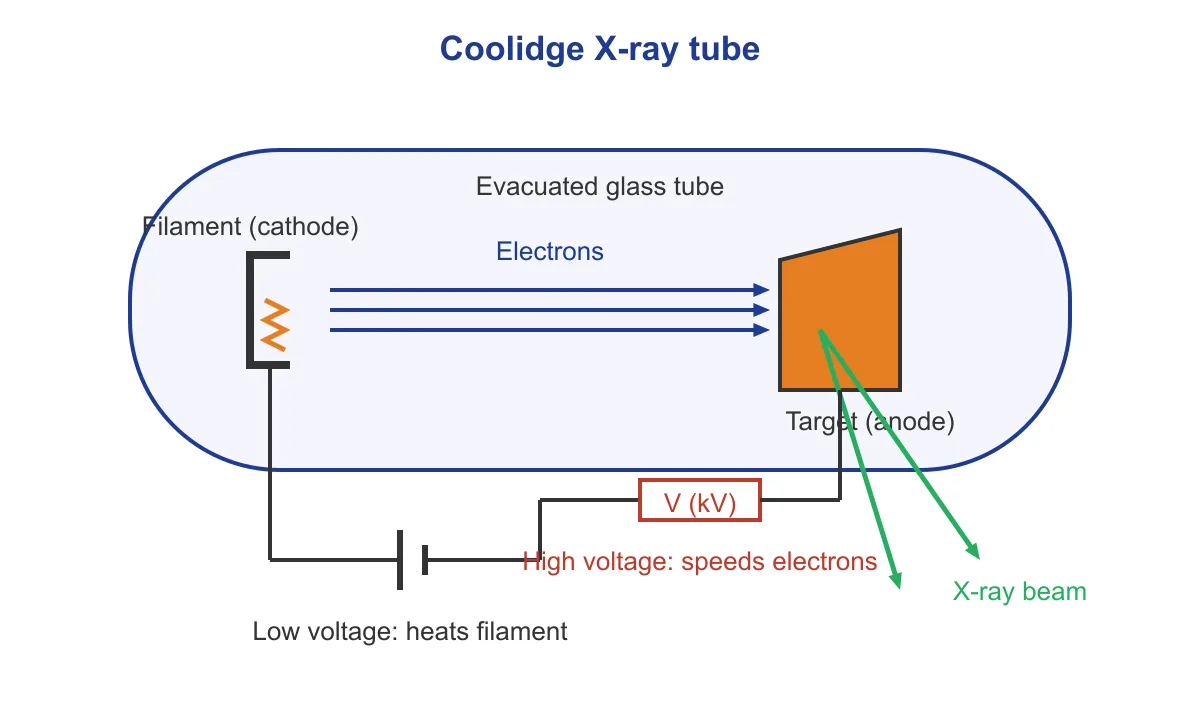
Figure 5.1: Coolidge tube with its two circuits
Two separate circuits give two separate controls, and the exam likes to test this.
| Control | What it changes | What it does not change |
|---|---|---|
| Filament current (heating) | Number of electrons per second, so tube current $i$ | Energy of each electron |
| Tube voltage $V$ | Energy $eV$ of each electron | Number of electrons per second |
Why the vacuum? If gas were present, the electrons would collide with gas molecules before reaching the target, and the gas would ionise and carry stray current. Why a heavy target? Heavier nuclei produce more X-rays per electron, and the metal must survive the heat. Only about 1% of the electron beam power turns into X-rays. The other 99% heats the target, so it is cooled by flowing water or oil, or by a rotating anode.
2. Continuous X-rays and the cut-off wavelength
When an electron enters the strong electric field near a nucleus of the target, it is decelerated. A decelerated charge radiates. The radiation emitted this way is called bremsstrahlung (braking radiation). Different electrons lose different amounts of energy: one might lose a little in many small steps, another might lose a lot in one close encounter. So the photons have all sorts of energies, and the spectrum is continuous.
There is, however, a hard ceiling. A single photon cannot carry away more energy than the whole kinetic energy of the electron, $eV$. The most energetic photon appears when one electron gives up all its energy to one photon:
Using $h = 6.63 \times 10^{-34}$ J s, $c = 3 \times 10^8$ m s$^{-1}$, $e = 1.6 \times 10^{-19}$ C, the product $hc/e \approx 1.24 \times 10^{-6}$ V m. This gives the working form:
The same fact in energy language: $hc \approx 12400$ eV Å. We will use this number throughout.
Things to hold on to:
- $\lambda_{min}$ depends only on $V$. Doubling $V$ halves it.
- It does not depend on the target element and does not depend on the tube current.
- This limit is sharp. No wavelength shorter than $\lambda_{min}$ exists in the spectrum. It is also called the Duane–Hunt limit.
- The photons are not all of one colour. Below $\lambda_{min}$ nothing; above it, intensity rises steeply and then falls slowly towards long wavelengths.
The quantum nature of light is visible here. A classical wave theory would predict no minimum wavelength; the existence of $\lambda_{min}$ is the photoelectric effect run backwards, with the electron energy converted into a photon.
Example 1: An X-ray tube works at 31 kV. Find the shortest wavelength emitted and the highest photon energy.
Step 1: $V = 31000$ V.
Step 2: $\lambda_{min} = 12400 / 31000 = 0.40$ Å.
Step 3: Highest photon energy equals $eV = 31$ keV. Check: $12400 / 0.40 = 31000$ eV, same.
Answer: $0.40$ Å and $31$ keV.
Why this works: one electron gives all its energy to one photon, so the photon energy in eV equals the tube voltage in volts.
3. Characteristic X-rays
Now increase the voltage on a given target. At first you see only the smooth continuous hump. Beyond a certain voltage, sharp narrow peaks suddenly stand out on top of the hump. These are the characteristic X-rays. "Characteristic" because their wavelengths belong to the target element like a fingerprint.
How they arise:
- A fast electron strikes an atom of the target and knocks out an electron from an inner shell, say the K shell ($n = 1$). This needs energy at least equal to the binding energy of that K electron. So the line appears only when $eV$ exceeds that value.
- The atom now has a vacancy in the K shell, an unstable state.
- An electron from a higher shell falls in. The energy difference leaves as one X-ray photon, $hf = E_{higher} - E_{lower}$.
- The vacancy now sits in the outer shell and is filled by another jump, so a cascade of lines can follow.
Naming of the lines:
| Line | Jump | Photon energy |
|---|---|---|
| Kα | $n = 2 \to n = 1$ (L to K) | smaller of the K lines |
| Kβ | $n = 3 \to n = 1$ (M to K) | larger than Kα |
| Lα | $n = 3 \to n = 2$ (M to L) | much smaller than K lines |
The letter names the shell where the vacancy was filled; the Greek letter says how far the electron fell (α for the nearest shell, β for the next one up). The Kβ photon is more energetic than Kα, so its wavelength is shorter. The L series has far lower energies than the K series because the L shell is less tightly bound.
Because the inner shells of an atom are deep inside and are shielded from the outside, these lines hardly care whether the element is pure, in a compound, or in an alloy. Their wavelengths are set by the nuclear charge. This is the root of Moseley's law, which comes next. Outer-shell transitions, in contrast, give visible and ultraviolet light.
Memory trick: "K is the king, kicked out first; α is Almost there (n=2→1), β is Beyond (n=3→1)!"
Use it to recall that K-lines end in the first shell, and the Greek letter tells how far the electron fell.
4. Bohr model for X-ray energies
For a hydrogen-like atom (one electron around a nucleus of charge $Ze$), the Bohr model gives the energy of level $n$:
The wavelength of a jump from $n_2$ to $n_1$ follows from
and the energy of the photon is $13.6\,Z^2\left(\frac{1}{n_1^2} - \frac{1}{n_2^2}\right)$ eV. The model is exact only for one-electron ions. The K shell of a many-electron atom is a close cousin of this situation, because the electron in it feels mostly the nucleus.
Apply it to the Kα jump, $n = 2 \to 1$. If the nucleus were seen undisguised, the photon energy would be $13.6\,Z^2 \times \tfrac{3}{4} = 10.2\,Z^2$ eV. But when a Kα photon is emitted, one electron still sits in the K shell. It sits between the nucleus and the electron that is jumping, so it screens one unit of nuclear charge. The jumping electron therefore moves in an effective charge $(Z - 1)e$. Replacing $Z$ with $Z - 1$:
Taking the square root of the frequency form $f = \frac{3Rc}{4}(Z-1)^2$ gives the law in the next section.
Example 2: Find the energy and wavelength of the Kα photon from copper, $Z = 29$. Use $hc = 12400$ eV Å and 13.6 eV for the hydrogen ground state.
Step 1: Effective charge squared: $(Z-1)^2 = 28^2 = 784$.
Step 2: $E = 10.2 \times 784 = 7997$ eV, about $8.0$ keV.
Step 3: $\lambda = 12400 / 7997 = 1.55$ Å.
Check: this is the typical X-ray wavelength of a copper target, comparable to the spacing of atoms in crystals.
Answer: about $8.0$ keV and $1.55$ Å.
Why this works: the Bohr formula with $Z$ replaced by $(Z-1)$ already contains the shielding by the second K electron.
Example 3: A hydrogen-like ion of iron has $Z = 26$ and only one electron. Find the energy of its $n=2 \to 1$ photon, and compare it with the Kα photon of ordinary iron.
Step 1: Hydrogen-like iron has no second K electron, so use the full charge: $E = 10.2 \times 26^2 = 10.2 \times 676 = 6895$ eV.
Step 2: Ordinary iron has the shielding electron: $E = 10.2 \times 25^2 = 10.2 \times 625 = 6375$ eV.
Step 3: Difference $= 6895 - 6375 = 520$ eV, so the bare ion's photon is about 8% more energetic.
Answer: $6.90$ keV against $6.38$ keV.
Why this works: the whole difference is the one unit of screening, which is exactly what the "$-1$" in Moseley's law stands for.
5. Moseley's law
Moseley measured the Kα frequencies of many elements and plotted $\sqrt{f}$ against the atomic number $Z$. The points fell on a straight line. The law is
with $a$ and $b$ constants for a given spectral line.
- For the Kα line, $b \approx 1$ and $a = \sqrt{3Rc/4}$. With $R = 1.097 \times 10^7$ m$^{-1}$ and $c = 3 \times 10^8$ m s$^{-1}$, $Rc = 3.29 \times 10^{15}$ Hz and so $a \approx 5 \times 10^7$ Hz$^{1/2}$.
- For the Lα line, the jump is $3 \to 2$, so $a = \sqrt{5Rc/36}$, which is smaller, and $b \approx 7.4$ because many more electrons now shield the nucleus.
- The law holds for each series separately. The slope is the same for every element on the same series, as the Bohr model predicts.
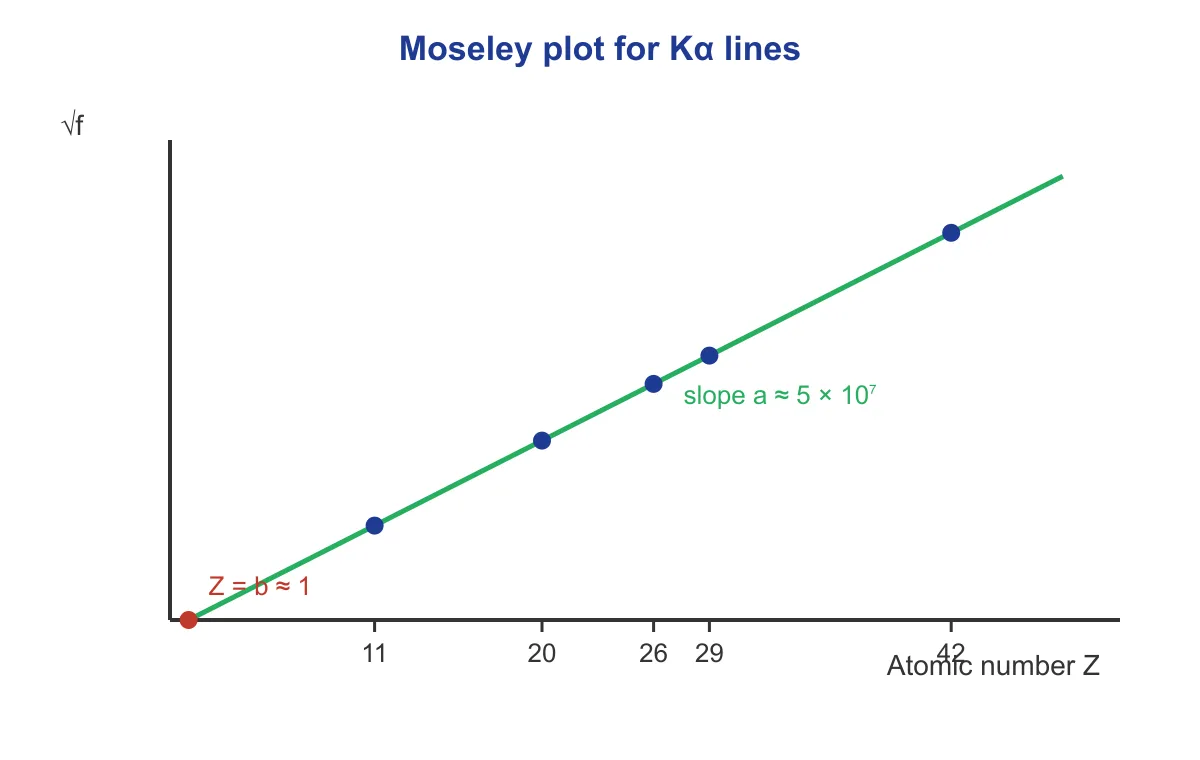
Figure 5.2: Moseley plot, a straight line with intercept near Z = 1
Reading the graph: the line cuts the $Z$ axis at $Z = b$. If you extend it back it does not go through the origin, because of the screening. Two quick consequences are worth remembering. First, for the Kα line, $f \propto (Z-1)^2$, so the ratio of two frequencies is $\left(\frac{Z_1 - 1}{Z_2 - 1}\right)^2$. Second, wavelength goes the opposite way: $\lambda \propto 1/(Z-1)^2$, so heavier targets give shorter characteristic wavelengths.
| Quantity | Kα, $b \approx 1$ | Lα, $b \approx 7.4$ |
|---|---|---|
| Jump | $2 \to 1$ | $3 \to 2$ |
| $a^2$ | $\frac{3Rc}{4}$ | $\frac{5Rc}{36}$ |
| Photon energy | $10.2\,(Z-1)^2$ eV | $1.89\,(Z-7.4)^2$ eV |
Example 4: The Kα frequency of an element with $Z = 21$ is four times lower than that of an unknown element. Find $Z$ of the unknown.
Step 1: Frequency ratio $= 4$, so the ratio of $\sqrt{f}$ is $2$.
Step 2: $\sqrt{f} \propto (Z - 1)$, so $\frac{Z - 1}{21 - 1} = 2$.
Step 3: $Z - 1 = 40$, so $Z = 41$.
Answer: $Z = 41$.
Why this works: take the square root first, then the straight line turns the question into simple proportion in $Z-1$. A common slip is to use $Z$ instead of $Z-1$, which gives 42.
Memory trick: "Root of frequency walks in a line; start at one, not at zero!"
Use it to recall that $\sqrt{f}$ is linear in $Z$ and that Kα has $b = 1$.
6. Moseley's law and the periodic table
Before Moseley, elements were arranged by atomic mass. This worked for most elements but failed for a few pairs. Argon is heavier than potassium, cobalt is heavier than nickel, tellurium is heavier than iodine, yet chemistry needs them in the opposite order. Moseley's plot sorted this out at once: the Kα lines came in the order the chemistry demanded, and the order was that of a whole number. This whole number is the atomic number, the charge on the nucleus in units of $e$.
What the law gave us:
- It showed that the proper basis of the periodic table is the atomic number $Z$, not the mass.
- It gave a direct experimental method to find $Z$ of an unknown element: measure the Kα wavelength of the target, compute $\sqrt{f}$ and read $Z$ off the line.
- It showed gaps in the sequence. Elements with $Z = 43, 61, 72$ and $75$ were missing at that time, and were found later at the predicted places.
- It confirmed that the nuclear charge is what controls inner-shell energies, which supports the Bohr model.
Reasoning that the picture is not just a number game: the characteristic lines depend on the deep, shielded electrons. Chemical bonding changes outer electrons only. That is why the same Kα wavelength turns up in the element alone and in any compound containing it, and why X-ray analysis can identify elements without destroying the sample.
Example 5: In a lab, two metals give Kα lines. The $\sqrt{f}$ values are $1.5 \times 10^9$ Hz$^{1/2}$ for $Z = 31$ and $2.5 \times 10^9$ Hz$^{1/2}$ for $Z = 51$. Find $a$ and $b$ from these two points, and then $Z$ for an element with $\sqrt{f} = 3.0 \times 10^9$.
Step 1: Subtract the two equations: $a(51 - 31) = 2.5 \times 10^9 - 1.5 \times 10^9 = 10^9$, so $a = 5 \times 10^7$.
Step 2: $1.5 \times 10^9 = 5 \times 10^7\,(31 - b)$, so $31 - b = 30$ and $b = 1$.
Step 3: For $3.0 \times 10^9$: $Z - 1 = 60$, so $Z = 61$.
Answer: $a = 5 \times 10^7$, $b = 1$, $Z = 61$.
Why this works: two points fix a straight line. The numbers match the Bohr value of $a$ and the $b = 1$ expected for Kα, a good sign that the data are consistent.
7. Intensity against wavelength: effect of voltage and current
Plot the intensity of X-rays emitted against wavelength. You see a continuous curve starting at $\lambda_{min}$, rising to a maximum at a wavelength a little above $\lambda_{min}$ (about twice $\lambda_{min}$ in a simple model, as drawn here) and then falling slowly. If the voltage is above the threshold for the K series, the narrow Kα and Kβ peaks stand up on this curve.
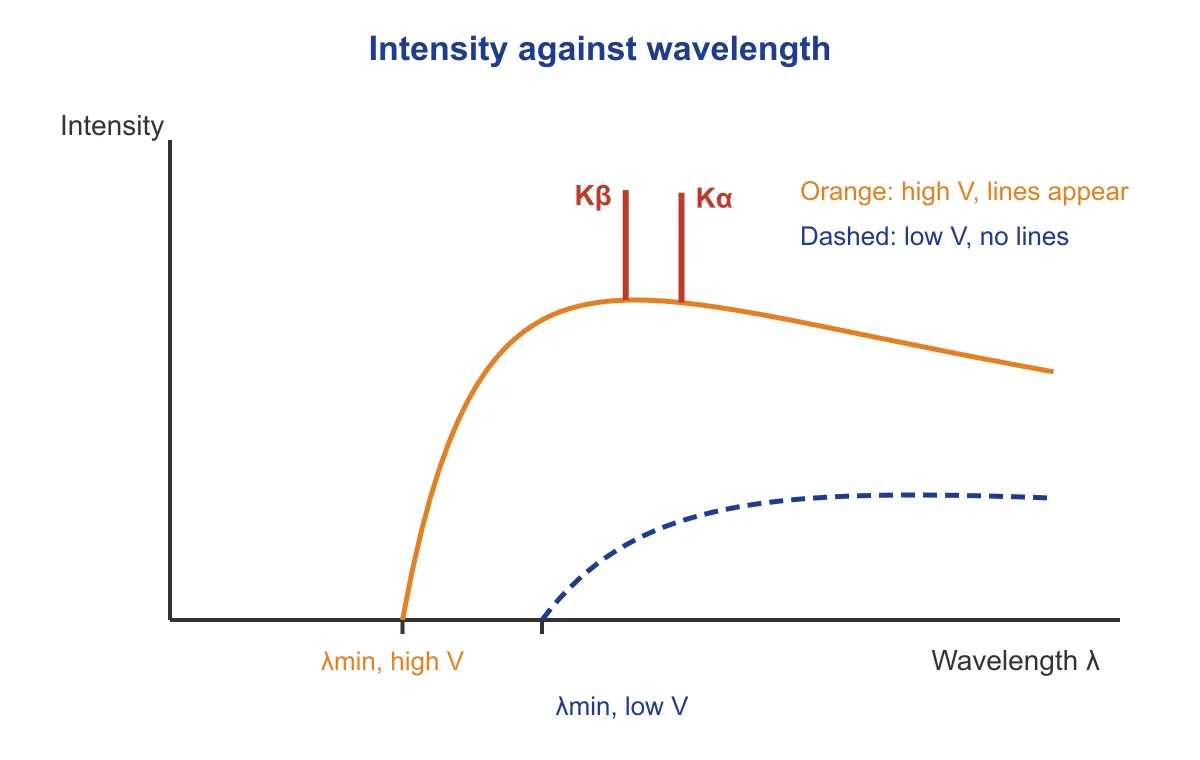
Figure 5.3: Spectrum for two tube voltages
Now see what each change does.
| Change | Cut-off $\lambda_{min}$ | Continuous intensity | Characteristic lines |
|---|---|---|---|
| Raise $V$ | Shifts to shorter wavelength | Rises everywhere (roughly $\propto V^2$ in total) | Same wavelengths; appear only above threshold; stronger as $V$ grows |
| Raise filament current (more $i$) | No change | Rises at every wavelength (total $\propto i$) | Same wavelengths, stronger |
| Change target to higher $Z$ | No change | Rises (total grows with $Z$) | Move to shorter wavelength |
Notice what never happens: the Kα and Kβ wavelengths do not slide when the voltage changes. Only the continuous background and its edge move. The position of a line is a property of the element; the position of the edge is a property of the tube.
Keep two ideas apart. Hardness (penetrating power) depends on the photon energy, so on $V$. Intensity (how many photons) depends on the tube current $i$. A beam can be intense but soft, or faint but hard.
Example 6: A tube runs at 40 kV with a current of 25 mA. Find (a) the number of electrons striking the target each second, (b) the beam power, and (c) the power wasted as heat if 1% of the beam power comes out as X-rays.
Step 1: $N = i/e = 25 \times 10^{-3} / 1.6 \times 10^{-19} = 1.56 \times 10^{17}$ per second.
Step 2: Power $= iV = 25 \times 10^{-3} \times 40000 = 1000$ W.
Step 3: X-rays carry $1\%$, that is $10$ W. Heat $= 1000 - 10 = 990$ W.
Answer: $1.56 \times 10^{17}$ electrons per second; $1000$ W; $990$ W of heat.
Why this works: current is charge per second, and each electron carries the full $eV$. This heat load is the reason real targets are cooled.
8. Properties and uses of X-rays
Properties:
- They are electromagnetic waves and travel at the speed of light in vacuum. They are not deflected by electric or magnetic fields, because they carry no charge.
- They show reflection, refraction and diffraction. Their wavelength of an ångström or so is about the spacing of atoms in a crystal, which is why a crystal acts as a diffraction grating for them.
- They affect photographic plates, make some materials fluoresce, and eject photoelectrons from metals.
- They ionise gases, which is how detectors such as Geiger tubes sense them.
- They pass through matter. Absorption grows quickly with the atomic number of the absorber and with its thickness, and shrinks as photon energy goes up. Dense bone and metal block them; soft flesh lets them through.
- They are harmful to living tissue in large doses, because they ionise molecules in cells.
Short wavelength, high-energy X-rays (high $V$) are called hard; long wavelength, low-energy ones are called soft.
Uses:
- Medical imaging: bones and teeth, lung and dental pictures, with the denser parts casting shadows on the film.
- Treatment: high-energy beams to destroy cancerous cells.
- Finding the arrangement of atoms in crystals by diffraction.
- Looking for hidden cracks and flaws in metal castings and welds.
- Luggage scanning at airports.
- Identifying elements in a sample using their characteristic lines, with Moseley's law as the basis.
Common traps
- Saying $\lambda_{min}$ depends on the target metal → it depends only on the tube voltage, $\lambda_{min} = hc/eV$.
- Believing a higher filament current shortens $\lambda_{min}$ → current changes only the intensity, not the cut-off.
- Using $Z$ instead of $Z - 1$ in Kα problems → write $(Z - 1)$ every time; the second K electron screens one unit.
- Forgetting to take the square root first in Moseley problems → the law is linear in $\sqrt{f}$, not in $f$.
- Expecting characteristic lines to appear for any voltage → they need $eV$ above the binding energy of the inner shell involved.
- Thinking Kα and Kβ shift when the voltage rises → their wavelengths are fixed by the element; only their strength changes.
- Mixing up Kα and Kβ → Kα is $2 \to 1$ (smaller energy, longer wavelength); Kβ is $3 \to 1$.
- Treating X-ray production as a nuclear process → it involves the electrons of the atom; nuclei only provide the electric field.
- Writing 12.4 with volts instead of kilovolts → $\lambda_{min} = 12400/V$ Å with $V$ in volts, $12.4/V$ Å with $V$ in kV.
- Believing X-rays can be bent by a magnet → they are neutral waves and go straight.
Quick revision
- X-rays: electromagnetic waves of about $0.1$ Å to $100$ Å; made by stopping fast electrons.
- Coolidge tube: heated filament gives electrons; high voltage gives them energy $eV$; heavy target stops them.
- Filament current controls the number of electrons; tube voltage controls their energy.
- Only about 1% of the beam power becomes X-rays; the rest is heat.
- Continuous X-rays are bremsstrahlung, from electrons slowed in the field of nuclei.
- $\lambda_{min} = hc/eV = 12400/V$ Å ($V$ in volts), independent of target and current.
- Characteristic X-rays come from an electron falling into an inner-shell vacancy.
- Kα is $n = 2 \to 1$; Kβ is $n = 3 \to 1$ and has higher energy; Lα is $3 \to 2$.
- Bohr energy: $E_n = -13.6\,Z^2/n^2$ eV.
- Kα photon energy: $10.2\,(Z-1)^2$ eV.
- Moseley's law: $\sqrt{f} = a(Z - b)$; Kα has $b \approx 1$ and $a \approx 5 \times 10^7$ Hz$^{1/2}$.
- $\sqrt{f}$ against $Z$ is a straight line meeting the $Z$ axis at $Z = b$.
- Moseley's law proved atomic number, not atomic mass, orders the periodic table, and showed gaps.
- Higher $V$ shortens $\lambda_{min}$ and raises intensity; higher current raises intensity only; line wavelengths stay put.
- X-rays are not deflected by fields, ionise gases, diffract from crystals and are absorbed more by dense matter.
Practice questions
In a Coolidge tube, which change alters the number of electrons striking the target each second without changing the energy of each electron?
- Changing the filament heating current
- Changing the accelerating voltage
- Changing the target metal
- Changing the voltage and the target together
Answer
A. Changing the filament heating current
Heating current controls thermionic emission, hence electrons per second. Voltage sets energy eV of each electron.
The minimum wavelength present in the continuous X-ray spectrum of a tube depends on
- the tube voltage only
- the target element only
- the filament current only
- both the target element and the tube current
Answer
A. the tube voltage only
λmin = hc/eV, so only V enters.
Characteristic X-rays are emitted when
- a nucleus decays and gives out a photon
- an outer-shell electron falls into a vacancy in an inner shell
- an incident electron is slowed down by the field of a nucleus
- an electron jumps from an inner shell to an outer shell
Answer
B. an outer-shell electron falls into a vacancy in an inner shell
A vacancy in an inner shell is filled from outside; the energy difference leaves as a photon.
For the Kα lines of different elements, a graph of the square root of frequency against atomic number is
- a parabola with its vertex at the origin
- a straight line of negative slope
- a straight line through the origin
- a straight line cutting the Z axis near Z = 1
Answer
D. a straight line cutting the Z axis near Z = 1
√f = a(Z − b) with b ≈ 1: straight line, positive slope, intercept on Z axis near 1.
Compared with the Kα line of the same target, the Kβ line has
- lower photon energy and shorter wavelength
- higher photon energy and longer wavelength
- higher photon energy and shorter wavelength
- the same energy but a different intensity
Answer
C. higher photon energy and shorter wavelength
Kβ is the 3→1 jump, bigger energy gap than 2→1, so higher energy and shorter wavelength.
The tube voltage of an X-ray tube is doubled, with the target and current unchanged. The cut-off wavelength
- becomes one-fourth
- doubles
- stays the same
- becomes half
Answer
D. becomes half
λmin ∝ 1/V.
Two tubes, one with a copper target and one with a tungsten target, work at the same voltage. Which quantity is the same for both?
- The number of characteristic lines emitted
- The energy of the Kβ photon
- The wavelength of the Kα line
- The cut-off wavelength
Answer
D. The cut-off wavelength
λmin = hc/eV has no target dependence; characteristic lines differ with Z.
Which conclusion followed directly from Moseley's work on X-ray lines?
- All elements emit the same Kα frequency
- The nucleus consists of protons and neutrons
- The atomic number, not the atomic mass, fixes the order of elements in the periodic table
- Electrons move in circular orbits of fixed radius
Answer
C. The atomic number, not the atomic mass, fixes the order of elements in the periodic table
Kα lines followed a whole-number sequence Z, which fixed the ordering.
X-rays are not deflected by a magnetic field because
- they carry no electric charge
- their speed is very large
- they are produced in a vacuum
- their wavelength is very short
Answer
A. they carry no electric charge
Magnetic force acts on moving charge; X-ray photons are neutral.
A molybdenum target is used at 30 kV and then at 45 kV. In both cases the K lines are present. The wavelength of the Kα line
- becomes one and a half times its first value
- becomes two-thirds of its first value
- does not change
- becomes half
Answer
C. does not change
Kα depends only on the target's energy levels; voltage changes only intensity.
Compared with the Kα line of an element, its Lα line has
- larger photon energy and longer wavelength
- the same photon energy but weaker intensity
- smaller photon energy and shorter wavelength
- smaller photon energy and longer wavelength
Answer
D. smaller photon energy and longer wavelength
Lα is the 3→2 jump in a less tightly bound region; energy is far less.
A crystal is used to study X-ray wavelengths because
- a crystal makes X-rays visible to the eye
- a crystal absorbs all wavelengths equally
- the spacing of atoms in a crystal is about the same size as the X-ray wavelength
- X-rays are charged and are bent by crystal fields
Answer
C. the spacing of atoms in a crystal is about the same size as the X-ray wavelength
Diffraction needs spacing comparable to the wavelength; both are about 1 Å.
In Moseley's law for the Kα line, the constant b is close to 1 mainly because
- the remaining K electron screens one unit of nuclear charge from the jumping electron
- the L shell has one electron fewer than expected
- the nucleus has one proton less than the atomic number
- the photon carries one unit of angular momentum
Answer
A. the remaining K electron screens one unit of nuclear charge from the jumping electron
The jumping electron sees charge (Z − 1)e.
As the tube voltage is raised, the K series lines of a target first appear at a certain voltage. The reason is that
- the filament emits electrons only above that voltage
- the continuous spectrum has no photons above that voltage
- the electrons must have enough energy to remove a K electron from an atom
- the target melts below that voltage
Answer
C. the electrons must have enough energy to remove a K electron from an atom
Characteristic emission needs a K vacancy, which needs eV above the K binding energy.
A tube works at 31 kV. Taking hc = 12400 eV Å, the cut-off wavelength in Å is
- 0.2
- 0.8
- 4.0
- 0.4
Answer
D. 0.4
λmin = 12400/31000 = 0.4 Å. Check: photon energy 12400/0.4 = 31000 eV.
The shortest wavelength emitted by a tube is 0.5 Å. Taking hc = 12400 eV Å, the tube voltage in kV is
- 6.2
- 24.8
- 49.6
- 12.4
Answer
B. 24.8
V = 12400/0.5 = 24800 V = 24.8 kV. Halving to 12.4 would be a slip of factor 2.
For a hydrogen atom the ground-state energy is −13.6 eV. Using Moseley's law with b = 1, the Kα photon energy of an element with Z = 21 in keV is
- 5.44
- 3.68
- 4.50
- 4.08
Answer
D. 4.08
E = 13.6 × (3/4) × 20² = 10.2 × 400 = 4080 eV = 4.08 keV. Using Z gives 4.50; dropping 3/4 gives 5.44.
The Kα frequency of an element with Z = 51 divided by the Kα frequency of an element with Z = 26 is
- 2
- 3.85
- 4
- 8
Answer
C. 4
f ∝ (Z−1)²: (50/25)² = 4. Using Z gives (51/26)² = 3.85.
The Kα wavelength of the element with Z = 27 is 1.8 Å. Using Moseley's law with b = 1, the atomic number of the element whose Kα wavelength is 0.2 Å is
- 78
- 79
- 81
- 53
Answer
B. 79
λ ∝ 1/(Z−1)²: (Z−1)²/26² = 1.8/0.2 = 9, so Z − 1 = 78 and Z = 79.
The Kα frequency of an element is nine times that of the element with Z = 11. Using Moseley's law with b = 1, its atomic number is
- 31
- 33
- 91
- 30
Answer
A. 31
√f ratio = 3, so (Z−1)/(11−1) = 3, Z − 1 = 30, Z = 31.
An X-ray tube carries a current of 20 mA. Taking e = 1.6 × 10⁻¹⁹ C, the number of electrons striking the target per second, in units of 10¹⁷, is
- 12.5
- 0.125
- 2.5
- 1.25
Answer
D. 1.25
N = i/e = 20×10⁻³ / 1.6×10⁻¹⁹ = 1.25 × 10¹⁷ per second.
A tube works at 100 kV and 10 mA. Only 1% of the beam power comes out as X-rays and the rest is heat. The heating power in W is
- 1000
- 10
- 990
- 99
Answer
C. 990
Beam power = 10⁵ × 10⁻² = 1000 W. Heat = 0.99 × 1000 = 990 W.
A hydrogen-like ion Ne⁹⁺ (Z = 10) has one electron. Taking 13.6 eV for hydrogen, the energy in eV of its n = 2 to n = 1 photon is
- 340
- 1020
- 826
- 1360
Answer
B. 1020
E = 13.6 × 10² × (1 − 1/4) = 1360 × 0.75 = 1020 eV. The value 826 comes from using Z − 1, which applies only when a second K electron is present.
The voltage of a tube is raised from 25 kV to 50 kV. Taking hc = 12400 eV Å, the decrease in the cut-off wavelength in Å is
- 0.248
- 0.124
- 0.496
- 0.744
Answer
A. 0.248
λ1 = 12400/25000 = 0.496 Å, λ2 = 12400/50000 = 0.248 Å. Decrease = 0.248 Å.
Taking hc = 12400 eV Å and 13.6 eV for hydrogen, the Kα wavelength of copper (Z = 29) with b = 1, in Å to two decimals, is
- 4.65
- 1.16
- 1.55
- 1.45
Answer
C. 1.55
E = 10.2 × 28² = 7997 eV. λ = 12400/7997 = 1.55 Å. Using Z gives 1.45; dropping 3/4 gives 1.16.
A beam of Kα photons of energy 8.0 keV each carries a power of 0.64 mW. Taking e = 1.6 × 10⁻¹⁹ C, the number of photons per second, in units of 10¹¹, is
- 5
- 50
- 0.5
- 8
Answer
A. 5
Photon energy = 8000 × 1.6×10⁻¹⁹ = 1.28×10⁻¹⁵ J. N = 0.64×10⁻³ / 1.28×10⁻¹⁵ = 5 × 10¹¹.
Given below are two statements: Statement I: The cut-off wavelength of the continuous X-ray spectrum depends on the target metal. Statement II: The wavelengths of characteristic X-ray lines depend on the target metal.
- Both Statement I and Statement II are correct
- Both Statement I and Statement II are incorrect
- Statement I is correct but Statement II is incorrect
- Statement I is incorrect but Statement II is correct
Answer
D. Statement I is incorrect but Statement II is correct
I is false: λmin = hc/eV. II is true: lines come from the target's energy levels.
Given below are two statements: Statement I: Increasing the filament current raises the intensity at every wavelength of the continuous spectrum without changing the cut-off wavelength. Statement II: Increasing the tube voltage moves the Kα line to a shorter wavelength.
- Both Statement I and Statement II are correct
- Both Statement I and Statement II are incorrect
- Statement I is correct but Statement II is incorrect
- Statement I is incorrect but Statement II is correct
Answer
C. Statement I is correct but Statement II is incorrect
I is true since only the electron count changes. II is false: Kα is fixed by the target.
Given below are two statements: Statement I: A graph of the square root of Kα frequency against Z is a straight line for different elements. Statement II: Moseley's law shows that the nuclear charge, not the atomic mass, fixes the place of an element in the periodic table.
- Both Statement I and Statement II are correct
- Both Statement I and Statement II are incorrect
- Statement I is correct but Statement II is incorrect
- Statement I is incorrect but Statement II is correct
Answer
A. Both Statement I and Statement II are correct
Both follow from √f = a(Z − b).
Given below are two statements: Statement I: Characteristic X-ray lines appear at any tube voltage above zero. Statement II: The continuous X-ray spectrum is produced by electron transitions between atomic shells.
- Both Statement I and Statement II are correct
- Both Statement I and Statement II are incorrect
- Statement I is correct but Statement II is incorrect
- Statement I is incorrect but Statement II is correct
Answer
B. Both Statement I and Statement II are incorrect
Lines need eV above the binding energy of an inner shell. The continuous part comes from deceleration of electrons, not shell jumps.
Given below are two statements: Statement I: The Lα line of an element has a longer wavelength than its Kα line. Statement II: The L series is emitted when electrons fall into the K shell.
- Both Statement I and Statement II are correct
- Both Statement I and Statement II are incorrect
- Statement I is correct but Statement II is incorrect
- Statement I is incorrect but Statement II is correct
Answer
C. Statement I is correct but Statement II is incorrect
I is true: L-line energy is smaller. II is false: L lines end in the L shell, K lines end in the K shell.
Assertion (A): The continuous X-ray spectrum has a sharp minimum wavelength. Reason (R): One electron can give at most its whole kinetic energy eV to a single photon.
- Both A and R are true and R is the correct explanation of A
- Both A and R are true but R is not the correct explanation of A
- A is true but R is false
- A is false but R is true
Answer
A. Both A and R are true and R is the correct explanation of A
The most energetic photon has hf = eV, which fixes λmin.
Assertion (A): The wavelengths of the characteristic lines of a target do not change when the tube voltage is raised above the threshold. Reason (R): The minimum wavelength of the continuous spectrum becomes shorter as the tube voltage rises.
- Both A and R are true and R is the correct explanation of A
- Both A and R are true but R is not the correct explanation of A
- A is true but R is false
- A is false but R is true
Answer
B. Both A and R are true but R is not the correct explanation of A
Both true, but the lines are fixed by atomic energy levels, not by the cut-off.
Assertion (A): Moseley's law arranges the elements in order of atomic number. Reason (R): The Kα frequency is directly proportional to the atomic number Z.
- Both A and R are true and R is the correct explanation of A
- Both A and R are true but R is not the correct explanation of A
- A is true but R is false
- A is false but R is true
Answer
C. A is true but R is false
A is true. R is false: √f, not f, is linear in Z (f ∝ (Z−1)²).
Match List I with List II. List I: a. Filament b. Target c. High vacuum d. Cut-off wavelength List II: i. Fixed by the tube voltage ii. Source of electrons by heating iii. Stops the electrons and gives X-rays iv. Lets electrons reach the target without gas collisions
- a-i, b-ii, c-iii, d-iv
- a-ii, b-i, c-iv, d-iii
- a-iii, b-ii, c-i, d-iv
- a-ii, b-iii, c-iv, d-i
Answer
D. a-ii, b-iii, c-iv, d-i
Filament emits electrons by heating; target stops them; vacuum prevents collisions with gas; λmin = hc/eV is set by V.
Match List I with List II. List I: a. Kα b. Kβ c. Lα d. Continuous X-rays List II: i. Jump from n = 3 to n = 1 ii. Jump from n = 2 to n = 1 iii. Jump from n = 3 to n = 2 iv. Deceleration of electrons near nuclei
- a-ii, b-i, c-iv, d-iii
- a-i, b-ii, c-iii, d-iv
- a-iii, b-i, c-ii, d-iv
- a-ii, b-i, c-iii, d-iv
Answer
D. a-ii, b-i, c-iii, d-iv
K-lines end in n = 1, with α the nearest shell; Lα ends in n = 2; the continuous part is bremsstrahlung.
Match List I with List II. List I: a. Tube voltage doubled b. Plot of √f against Z for Kα c. Z − 1 of the target made three times d. Filament current doubled at fixed voltage List II: i. Kα frequency becomes nine times ii. Cut-off wavelength halves iii. Straight line meeting the Z axis near 1 iv. Intensity doubles with the cut-off unchanged
- a-iii, b-ii, c-i, d-iv
- a-ii, b-iii, c-i, d-iv
- a-ii, b-i, c-iii, d-iv
- a-ii, b-iii, c-iv, d-i
Answer
B. a-ii, b-iii, c-i, d-iv
λmin ∝ 1/V; Moseley line has b ≈ 1; f ∝ (Z−1)² gives 9; intensity ∝ current.
Electrons accelerated through 40 kV strike a copper target (Z = 29). Take hc = 12400 eV Å, 13.6 eV for hydrogen, and b = 1. The ratio of the Kα wavelength to the cut-off wavelength is
- about 3.8
- about 0.2
- about 4.7
- about 5.0
Answer
D. about 5.0
λmin = 12400/40000 = 0.31 Å. Kα energy = 10.2 × 784 = 7997 eV, λ = 1.55 Å. Ratio = 1.55/0.31 = 5.0. The value 3.8 drops the factor 3/4; 4.7 uses Z in place of Z − 1.
For one spectral line, √f = a(Z − b). An element with Z = 21 gives √f = 1.0 × 10⁹ Hz^½ and an element with Z = 41 gives 2.0 × 10⁹ Hz^½. The atomic number of the element with √f = 3.5 × 10⁹ Hz^½ is
- 71
- 72
- 70
- 69
Answer
A. 71
a = (2.0−1.0)×10⁹/20 = 5×10⁷. Then 1.0×10⁹ = 5×10⁷(21 − b) gives b = 1. For 3.5×10⁹: Z − 1 = 70, Z = 71.
Electrons accelerated through 25 kV strike different targets. Treat the Kα photon energy as 10.2 (Z − 1)² eV. The largest atomic number whose Kα photon energy does not exceed the electron energy is
- 51
- 50
- 45
- 49
Answer
B. 50
Need 10.2 (Z−1)² ≤ 25000, so (Z−1)² ≤ 2451 and Z − 1 ≤ 49.5. Largest integer Z − 1 = 49, Z = 50. Check: Z = 50 gives 24490 eV; Z = 51 gives 25500 eV.