Heat Transfer and Black-Body Radiation
What to remember
- Steady conduction along a lagged rod: $H = \dfrac{kA(T_1 - T_2)}{L}$. Write it as $H = \Delta T / R$ with thermal resistance $R = \dfrac{L}{kA}$, and treat it exactly like Ohm's law: $H$ is current, $\Delta T$ is voltage.
- Series rods carry the same $H$ and their resistances add; parallel rods share the same $\Delta T$ and their currents add.
- Kirchhoff's law: at one temperature and one wavelength, $e/a$ is the same for every body and equals the emissive power of a black body. A good absorber is a good emitter.
- Stefan–Boltzmann: $P = \varepsilon\sigma A T^4$, and the net power against surroundings at $T_0$ is $\varepsilon\sigma A(T^4 - T_0^4)$, with $T$ in kelvin. Wien: $\lambda_m T = b$.
- Newton's law of cooling, $\dfrac{dT}{dt} = -k(T - T_0)$, gives an exponential fall of the excess temperature $T - T_0$; it holds only for a small excess.
1. Conduction in one dimension
Hold one end of a steel spoon in tea and the handle warms up after a while. Energy has moved along the metal without the metal itself moving. That is conduction: vibrating atoms and free electrons pass energy to their neighbours, hot region to cold region.
Take a straight rod of length $L$ and uniform cross-section $A$. Its curved surface is covered with insulation (we say it is lagged), so heat can enter or leave only at the two ends. The ends are held at $T_1 > T_2$.
At first some heat is absorbed by the rod and its temperature changes everywhere. After some time the temperature at every point stops changing. This is the steady state. Now nothing is being stored, so the heat crossing any cross-section each second is the same at every section. Call it the heat current $H$ (in watts). In steady state the temperature falls uniformly along the rod, so
Here $k$ is the thermal conductivity of the material, in W m⁻¹ K⁻¹. Copper has a large $k$ (about 400), glass a small one (about 1), still air a very small one (about 0.025). The general form, valid even when the temperature gradient is not uniform, is
The minus sign says heat flows toward falling temperature. If the steady state has not been reached, part of $H$ goes into warming the rod and the two ends carry different currents, so the formula above does not apply.
Thermal resistance
Rewrite the result as $H = \dfrac{T_1 - T_2}{L/(kA)}$ and define
Then $H = \Delta T / R$. Compare $I = V/R$ in a circuit: temperature difference plays the part of potential difference, heat current the part of electric current, and $R$ the part of electrical resistance. A long, thin rod of poor conductor has large $R$. If the area changes along the rod, $R = \int \dfrac{dx}{kA(x)}$, because thin slices of the rod are in series.
Series and parallel
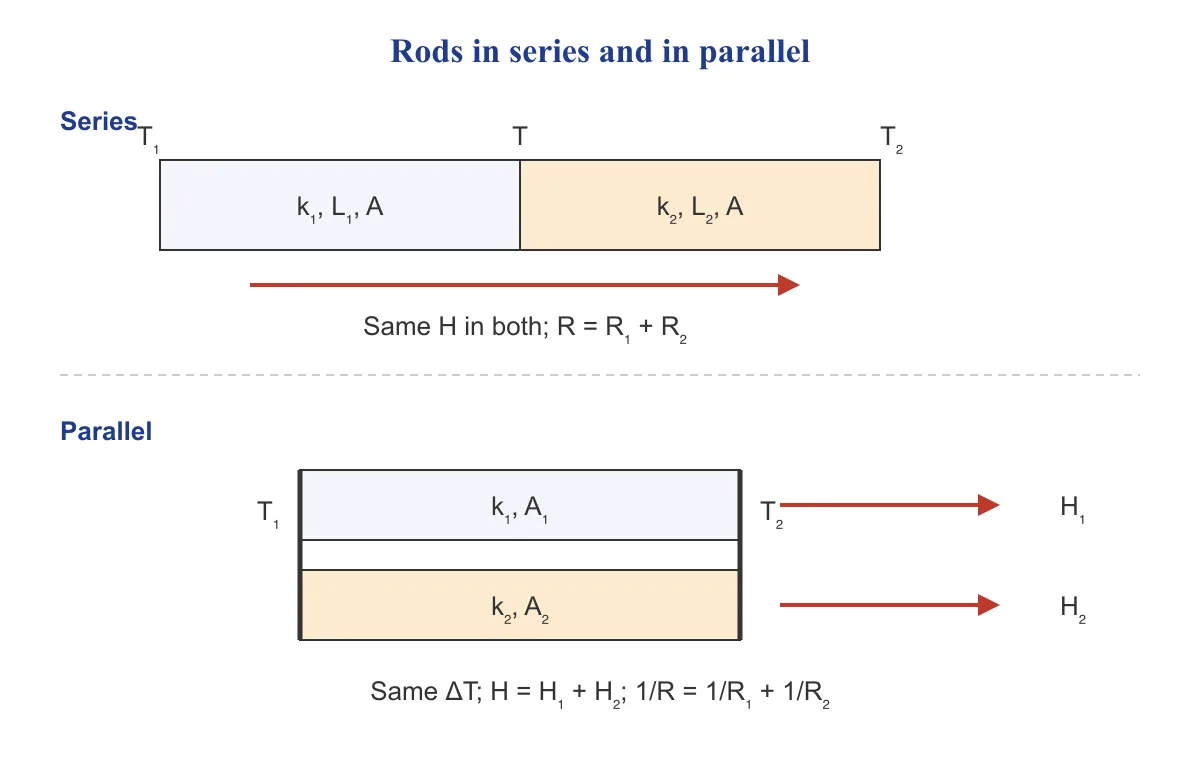
Figure 6.1: Rods in series share one heat current; rods in parallel share one temperature difference
Rods joined end to end are in series. In steady state the same $H$ passes through each, because no heat is stored at the junction. The temperature drops add up to the total, and each drop is $H$ times that rod's resistance:
The bigger resistance takes the bigger share of the drop. If both rods have the same area $A$, the junction temperature $T$ follows from equal currents:
Notice that the junction temperature is a weighted mean, pulled toward the end that is joined to the better conductor (the smaller resistance). For the whole series combination the effective conductivity is $k_{eff} = \dfrac{L_1 + L_2}{L_1/k_1 + L_2/k_2}$.
Rods side by side with both ends common are in parallel. Each has the same $\Delta T$ and the currents add:
For equal lengths and different areas, $k_{eff} = \dfrac{k_1 A_1 + k_2 A_2}{A_1 + A_2}$. Larger conductance (smaller $R$) carries more current.
| Feature | Series | Parallel |
|---|---|---|
| Heat current | Same in every rod | Splits; currents add |
| Temperature difference | Splits; drops add | Same across every rod |
| Equivalent resistance | $R_1 + R_2$ | $\dfrac{R_1 R_2}{R_1 + R_2}$ |
| Larger resistance rod | Larger drop | Smaller current |
Memory trick: "Series shares the drop, parallel shares the flow."
Heat is current and temperature difference is voltage, so every circuit rule you know carries over. Draw the rods as resistors before writing any equation.
Example 1: A rod of length 0.50 m and cross-section $2.0\times10^{-4}$ m² has $k = 200$ W m⁻¹ K⁻¹. One end is at 100 °C, the other in melting ice at 0 °C. Find the heat current and the mass of ice melted in one hour. (Latent heat of ice $3.36\times10^5$ J kg⁻¹; the side is lagged.)
Step 1: $R = \dfrac{L}{kA} = \dfrac{0.50}{200 \times 2.0\times10^{-4}} = 12.5$ K W⁻¹.
Step 2: $H = \dfrac{\Delta T}{R} = \dfrac{100}{12.5} = 8.0$ W.
Step 3: heat in 3600 s is $8.0 \times 3600 = 28800$ J, so $m = \dfrac{28800}{3.36\times10^5} = 0.0857$ kg, about 86 g.
Answer: 8.0 W; about 86 g of ice.
Why this works: ice at 0 °C holds the cold end at exactly 0 °C, so the steady state is reached and the whole current goes into melting.
Example 2: A copper rod ($k = 400$, length 0.20 m) is joined end to end with a steel rod ($k = 50$, length 0.10 m). Both have the same area $1.0\times10^{-4}$ m². The free end of copper is at 100 °C and the free end of steel is at 0 °C. Find the junction temperature and the heat current.
Step 1: $R_{Cu} = \dfrac{0.20}{400 \times 10^{-4}} = 5.0$ K W⁻¹ and $R_{St} = \dfrac{0.10}{50 \times 10^{-4}} = 20$ K W⁻¹.
Step 2: $R = 25$ K W⁻¹, so $H = 100/25 = 4.0$ W.
Step 3: drop across copper $= 4.0 \times 5.0 = 20$ K, so the junction is at $100 - 20 = 80$ °C.
Answer: junction at 80 °C, $H = 4.0$ W.
Why this works: steel resists four times as much as copper, so it takes four fifths of the drop; the junction sits close to the hot end.
Example 3: Three rods of the same material and same cross-section meet at a junction J. Rod P (length $L$) joins J to a bath at 90 °C. Rods Q and S (each of length $3L$) join J to baths at 10 °C each. Find the temperature of J.
Step 1: take $R_P = R_0$ (resistance goes with length). Then $R_Q = R_S = 3R_0$.
Step 2: Q and S are in parallel: $R_{QS} = \dfrac{3R_0}{2} = 1.5R_0$.
Step 3: P is in series with that, total $2.5R_0$, and the drop across P is $80 \times \dfrac{R_0}{2.5R_0} = 32$ K.
Step 4: $T_J = 90 - 32 = 58$ °C. Check: drop across the pair is $80 \times 1.5/2.5 = 48$ K, and $58 - 48 = 10$ °C.
Answer: 58 °C.
Why this works: only the ratio of resistances matters for the division of the drop, so you do not need $k$ or $A$ at all.
2. Convection (elementary)
In a fluid, heat is often carried by the fluid itself. A heated layer of water expands, becomes lighter and rises; cooler water sinks to replace it. This circulation is convection. It needs a fluid that can flow, so it cannot occur in a solid or in vacuum.
When the flow starts by itself because of density differences (a heater placed at the bottom of a pot, a sea breeze), it is natural convection. When a fan or pump pushes the fluid, it is forced convection. For the surface of a hot body in air the loss is often written $H = hA(T - T_0)$, where $h$ is a heat-transfer coefficient that depends on the shape and on how fast the air moves. You will not need more than this in Advanced problems; its important consequence is Newton's law of cooling in Section 5.
3. Thermal radiation
Sunlight reaches us across empty space, so there is a third way of transferring heat that needs no medium. Every body at a temperature above absolute zero emits electromagnetic waves, and also absorbs waves falling on it. This is thermal radiation.
Two properties describe a surface:
- Absorptive power $a$: the fraction of the radiation falling on the surface that it absorbs. The rest is reflected or transmitted, so $a + r + t = 1$.
- Emissive power $e$: the total energy emitted per second per unit area of the surface, over all wavelengths.
A black body absorbs all radiation that falls on it, at every wavelength, so $a = 1$. A real example is a small hole in a closed hollow box whose inside is blackened: light entering through the hole is reflected around inside until it is absorbed, and almost none comes out. Lamp soot is a good approximation to a black body; polished silver is a poor one.
Kirchhoff's law
Put a black body and a polished metal plate, both at the same temperature, inside a closed enclosure at that temperature. Everything stays at that temperature, so each body must emit exactly as much as it absorbs. Let the radiation falling on each unit area per second be $I$. The black body absorbs all of it, so its emission $E$ equals $I$. The plate absorbs only the fraction $a$, so its emission is $e = aI$. Dividing,
The law holds wavelength by wavelength too. So $e = aE$: a surface that absorbs well emits well, and a surface that reflects well emits poorly. The ratio $\varepsilon = e/E$ is the emissivity, and $\varepsilon = a$ for a given wavelength and temperature. This is why a tea flask is silvered: the shiny inner walls neither absorb nor emit much radiation.
4. Stefan–Boltzmann law and Wien's law
Total power
A black body at absolute temperature $T$ radiates, per unit area per second,
with $\sigma = 5.67\times10^{-8}$ W m⁻² K⁻⁴. A real surface radiates $P = \varepsilon\sigma A T^4$ with $0 < \varepsilon < 1$. Temperature must be in kelvin.
A body at temperature $T$ in surroundings at $T_0$ does not stop radiating. It keeps emitting $\varepsilon\sigma A T^4$ and keeps absorbing $\varepsilon\sigma A T_0^4$ from the surroundings (absorptivity equals emissivity). The net power lost is
When $T = T_0$ the net power is zero, though both processes are still going on. This is thermal equilibrium: a balance of two flows, not a stop.
Example 4: A blackened metal sphere of radius 1.0 cm is at 1000 K in a large room at 300 K. Find the net power it loses by radiation. Take $\sigma = 5.67\times10^{-8}$ W m⁻² K⁻⁴.
Step 1: area $A = 4\pi r^2 = 4\pi(10^{-2})^2 = 1.257\times10^{-3}$ m².
Step 2: $T^4 = 10^{12}$ and $T_0^4 = 8.1\times10^{9}$, so $T^4 - T_0^4 = 9.92\times10^{11}$ K⁴.
Step 3: $P = 5.67\times10^{-8} \times 1.257\times10^{-3} \times 9.92\times10^{11} \approx 70.7$ W.
Answer: about 71 W.
Why this works: the room's own radiation is a correction of under one per cent here, because $T_0^4$ is tiny against $T^4$.
Wien's displacement law
A glowing iron bar shifts from dull red to orange to white as it heats up. The reason is that the wavelength at which a hot body radiates most strongly moves toward shorter values. For a black body
where $\lambda_m$ is the wavelength of the peak of the emission per unit wavelength. Double the temperature and $\lambda_m$ halves.
The shape of the spectrum
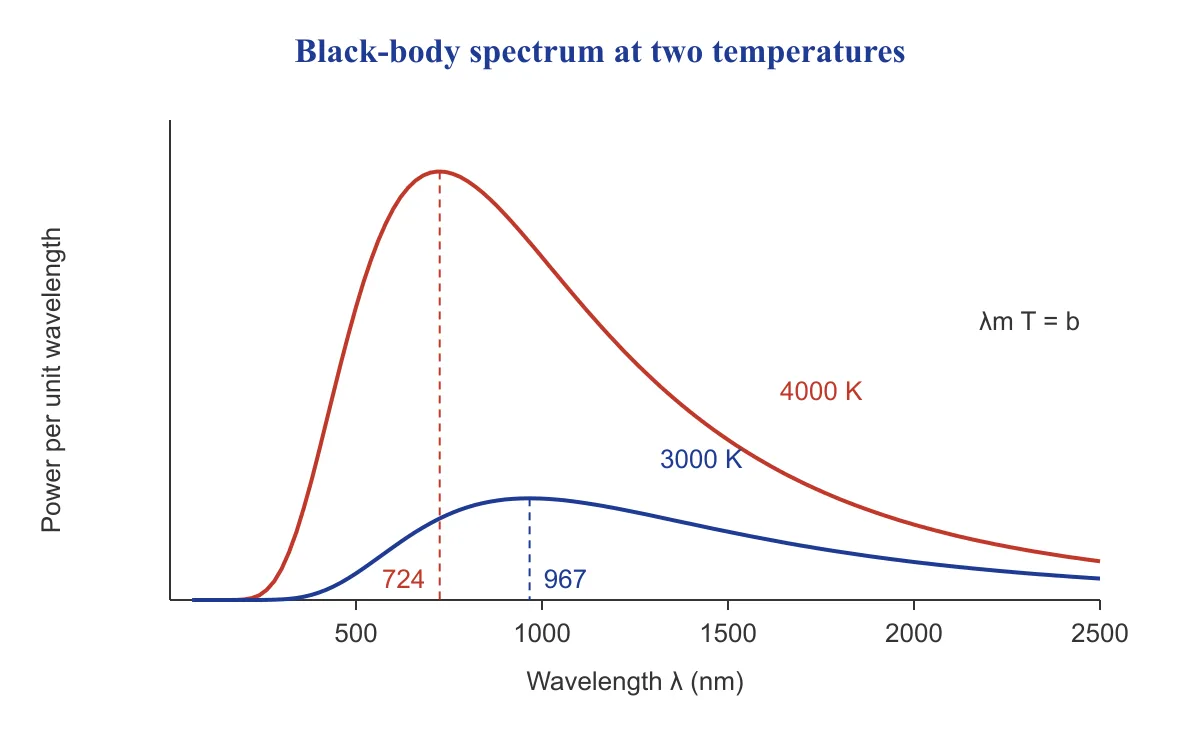
Figure 6.2: Black-body spectra; the peak moves to shorter wavelength and the area grows as the temperature rises
Read the graph in words. Each curve starts from zero at very short wavelength, climbs steeply to a single maximum at $\lambda_m$, and then falls away slowly, with a long tail toward long wavelengths. Raising the temperature does three things:
- The whole curve rises, so the hotter curve lies above the cooler one at every wavelength; the curves never cross.
- The peak moves to a shorter wavelength, as $\lambda_m \propto 1/T$.
- The area under the curve, which is the total emitted power per unit area, grows as $T^4$.
A filament at 3000 K peaks at about 970 nm, in the infrared, so most of its output is not light. The visible band (roughly 400 to 700 nm) sits on the rising side of its curve. That is why filament bulbs look yellowish and waste most of their power as heat.
| Quantity | Law | Changes when $T$ is doubled |
|---|---|---|
| Total power from a surface | $P \propto T^4$ | Becomes 16 times |
| Peak wavelength | $\lambda_m \propto 1/T$ | Becomes one half |
| Area under the spectrum | $\propto T^4$ | Becomes 16 times |
| Net power against $T_0$ | $\propto T^4 - T_0^4$ | Not a simple factor |
Memory trick: "Double the heat, sixteen times the glow; hot is short, cool is long!"
The first half is the fourth-power law; the second half is Wien. Say it before any radiation question to pick the right law.
Example 5: Star A has its spectrum peaking at 580 nm. Star B peaks at 290 nm and has half the radius of A. Find the temperature of A and the ratio of the powers radiated by B and A. (Treat both as black bodies.)
Step 1: $T_A = \dfrac{b}{\lambda_m} = \dfrac{2.9\times10^{-3}}{5.8\times10^{-7}} = 5000$ K.
Step 2: $\lambda_B$ is half of $\lambda_A$, so $T_B = 2T_A = 10000$ K.
Step 3: $P \propto R^2 T^4$, so $\dfrac{P_B}{P_A} = \left(\dfrac{1}{2}\right)^2 \times 2^4 = \dfrac{16}{4} = 4$.
Answer: $T_A = 5000$ K; B radiates 4 times as much power.
Why this works: power depends on both surface area (radius squared) and the fourth power of $T$; the smaller star wins because the temperature factor beats the area factor.
5. Newton's law of cooling
A cup of tea loses heat quickly while it is very hot and slowly once it is lukewarm. Newton's observation is that the rate of loss is proportional to the excess of the body's temperature over its surroundings:
Here $k$ depends on the surface area, the surface nature, the mass and the specific heat of the body; for a body of mass $m$ and specific heat $c$ it has the form $k = \dfrac{hA}{mc}$. The law works for small excess temperatures (a few tens of kelvin) and for losses mainly by forced convection. It also follows from radiation when the excess is small. Write $T = T_0 + \Delta T$. Then
which is proportional to $T - T_0$. For large excess the fourth-power law takes over and Newton's law fails.
The exponential form
Separate the variables and integrate from the initial temperature $T_i$:
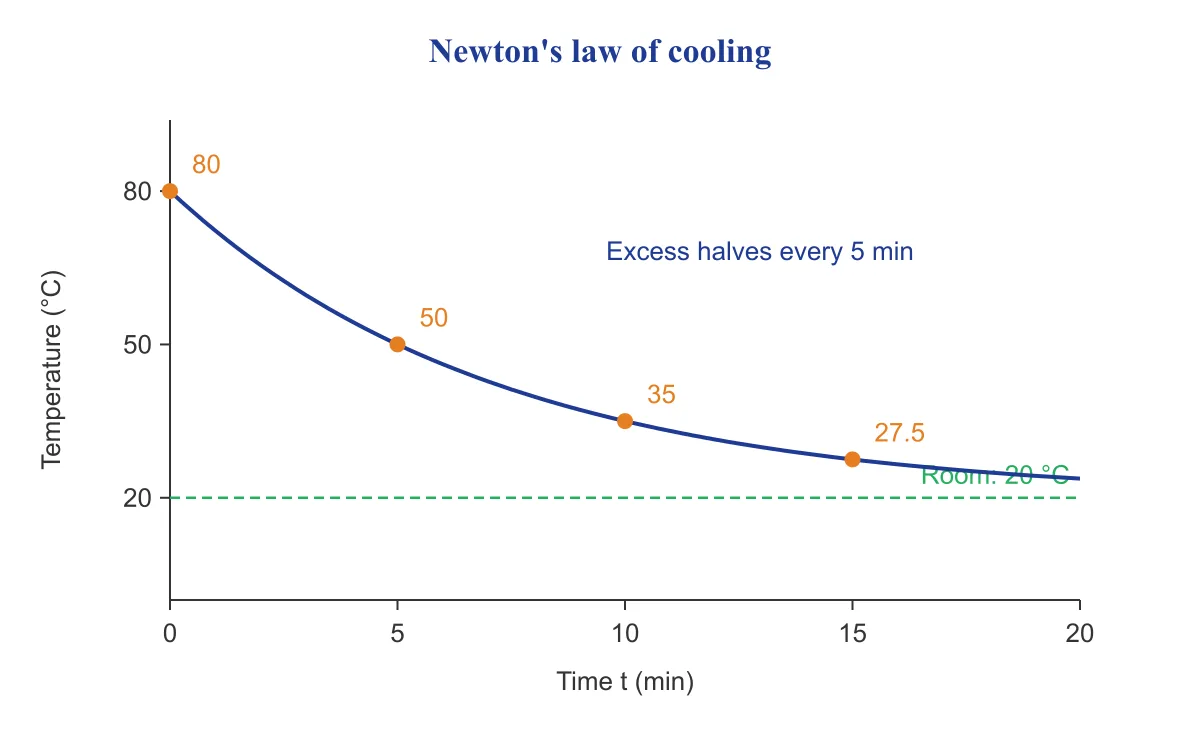
Figure 6.3: The excess temperature halves in equal intervals of time
Three facts come from this:
- The excess temperature falls by the same factor in equal times. If it halves in 5 min, it halves again in the next 5 min.
- The body approaches $T_0$ but takes infinite time to reach it.
- A graph of $\ln(T - T_0)$ against $t$ is a straight line of slope $-k$. The time for the excess to fall from $\Delta T_1$ to $\Delta T_2$ is $t = \dfrac{1}{k}\ln\dfrac{\Delta T_1}{\Delta T_2}$.
The average-temperature method
If the temperature falls only a little in the interval, use the average. A body falling from $T_1$ to $T_2$ in time $t$ satisfies
Use it to compare two short intervals without taking logarithms. It is an approximation, and it gets poorer when the fall is large compared with the excess.
Example 6: A cup of tea at 80 °C cools to 50 °C in 5 min in a room at 20 °C. Find its temperature after another 5 min, and the time from the start to reach 27.5 °C.
Step 1: the excess is 60 K at the start and 30 K after 5 min, so it halves in 5 min.
Step 2: after the next 5 min the excess is 15 K, so $T = 20 + 15 = 35$ °C.
Step 3: 27.5 °C is an excess of 7.5 K, and $60 \to 7.5$ is three halvings ($60/8 = 7.5$), so $t = 3 \times 5 = 15$ min.
Answer: 35 °C; 15 min.
Why this works: with an exponential law you count halvings of the excess, not of the temperature itself.
Example 7: Water cools from 70 °C to 60 °C in 4 min in a room at 30 °C. Using the average-temperature method, find the time for it to cool from 60 °C to 50 °C.
Step 1: first interval: $\dfrac{10}{4} = k\,(65 - 30)$, so $2.5 = 35k$ and $k = \dfrac{1}{14}$ min⁻¹.
Step 2: second interval, with mean temperature 55 °C: $\dfrac{10}{t} = \dfrac{1}{14}(55 - 30) = \dfrac{25}{14}$.
Step 3: $t = \dfrac{140}{25} = 5.6$ min.
Answer: 5.6 min.
Why this works: the exact exponential law gives 5.64 min, so for a small fall the average method is accurate to about one per cent.
6. The Sun: solar constant and surface temperature
The solar constant $S$ is the solar energy arriving per second on a unit area, held square to the rays, at the Earth's mean distance, above the atmosphere. Its value is about $1.4\times10^3$ W m⁻².
Let the Sun (radius $R_s$) radiate as a black body at temperature $T_s$. Its total power is $4\pi R_s^2 \sigma T_s^4$. That power spreads over a sphere of radius $d$ (the Earth–Sun distance), so
Example 8: Take $S = 1400$ W m⁻², $d = 1.5\times10^{11}$ m and $R_s = 7.0\times10^{8}$ m. Find $T_s$ and then the Sun's $\lambda_m$. Then estimate the equilibrium temperature of a black, airless Earth.
Step 1: $d/R_s = 214.3$, and $(d/R_s)^2 = 4.59\times10^4$.
Step 2: $T_s^4 = \dfrac{1400 \times 4.59\times10^4}{5.67\times10^{-8}} = 1.134\times10^{15}$ K⁴, so $T_s \approx 5800$ K.
Step 3: $\lambda_m = \dfrac{2.9\times10^{-3}}{5800} = 5.0\times10^{-7}$ m = 500 nm, which is in the green part of the visible band.
Step 4: the Earth (radius $r$) absorbs $S\pi r^2$ and radiates $4\pi r^2\sigma T^4$. Setting them equal, $T^4 = \dfrac{S}{4\sigma} = 6.17\times10^9$ K⁴, so $T \approx 280$ K.
Answer: $T_s \approx 5800$ K, $\lambda_m \approx 500$ nm, $T_{Earth} \approx 280$ K.
Why this works: the disc $\pi r^2$ catches the beam while the whole sphere $4\pi r^2$ radiates, which gives the factor 4.
Common traps
- Using °C in $T^4$ → convert to kelvin before any radiation formula.
- Thinking a body at the room temperature has stopped radiating → it still emits, and absorbs the same amount, so only the net is zero.
- Adding resistances of parallel rods → add conductances $1/R$, then invert.
- Giving each series rod its own heat current → the current is common in steady state; the temperature drops differ.
- Dropping the area when the rods differ in cross-section → $R = L/(kA)$ needs both $L$ and $A$.
- Using $P = \sigma A T^4$ for a non-black body → include $\varepsilon$, and use the net form when surroundings are at $T_0$.
- Writing $(T - T_0)^4$ for the net radiated power → it is $T^4 - T_0^4$.
- Saying the peak of a hotter body's spectrum shifts to longer wavelength → $\lambda_m T$ is constant, so it moves to shorter wavelength.
- Applying Newton's law to a body at 1000 K in a cold room → the law needs a small excess; use the fourth-power law there.
- Halving the temperature itself in each time step of Newton cooling → it is the excess over the surroundings that halves.
Quick revision
- Steady conduction: $H = kA\,\Delta T / L$; $k$ is in W m⁻¹ K⁻¹.
- Thermal resistance $R = L/(kA)$ in K W⁻¹; $H = \Delta T / R$.
- Series: same $H$, $R = R_1 + R_2$, drops in ratio of resistances.
- Parallel: same $\Delta T$, $H = H_1 + H_2$, $1/R = 1/R_1 + 1/R_2$.
- Junction temperature is a weighted mean, weights $k/L$ for equal areas.
- Convection needs a fluid that flows; it is absent in solids and vacuum.
- A black body has $a = 1$; Kirchhoff: $e/a = E$ for all bodies, so $e = aE$ and $\varepsilon = a$.
- Stefan–Boltzmann: $P = \varepsilon\sigma A T^4$, with $\sigma = 5.67\times10^{-8}$ W m⁻² K⁻⁴.
- Net radiated power: $\varepsilon\sigma A(T^4 - T_0^4)$.
- Wien: $\lambda_m T = 2.9\times10^{-3}$ m K.
- Black-body curve: one peak, long tail at long wavelength, the area grows as $T^4$, the curves of different $T$ never cross.
- Newton: $dT/dt = -k(T - T_0)$ for small excess; $T = T_0 + (T_i - T_0)e^{-kt}$.
- Excess temperature falls by equal factors in equal times; $t = \dfrac{1}{k}\ln\dfrac{\Delta T_1}{\Delta T_2}$.
- Solar constant $S = \sigma T_s^4 (R_s/d)^2 \approx 1.4\times10^3$ W m⁻²; this gives $T_s \approx 5800$ K.
Practice questions
The thermal resistance $L/(kA)$ of a rod is measured in
- J K⁻¹
- W m⁻¹ K⁻¹
- K W⁻¹
- W K⁻¹
Answer
C. K W⁻¹
$R = \Delta T / H$, so its unit is kelvin per watt. W m⁻¹ K⁻¹ is the unit of $k$.
Two rods of the same material and cross-section, of lengths $L$ and $2L$, are joined end to end and their free ends are held at different temperatures. In steady state, what fraction of the total temperature difference falls across the longer rod?
- $\frac{1}{3}$
- $\frac{2}{3}$
- $\frac{1}{2}$
- $\frac{3}{4}$
Answer
B. $\frac{2}{3}$
Resistances are in the ratio 1 : 2, so the drops share the total in that ratio. The longer rod takes $2/3$.
A rod carries heat current $H$ when its ends are held at a given pair of temperatures. Two such identical rods are connected in parallel between the same two temperatures. The total heat current is
- $2H$
- $H$
- $4H$
- $H/2$
Answer
A. $2H$
Each rod still has the full temperature difference, so each carries $H$ and the currents add to $2H$.
Kirchhoff's law of radiation states that, at a given temperature and wavelength, the ratio of emissive power to absorptive power
- is larger for polished metals than for lamp-black
- is equal to 1 for every body
- is proportional to the mass of the body
- is the same for all bodies and equals the emissive power of a black body
Answer
D. is the same for all bodies and equals the emissive power of a black body
A perfect absorber has $a = 1$, so the common ratio $e/a$ equals its emissive power $E$. Polished metals have small $e$ and small $a$.
The temperature of a black body is raised from 300 K to 600 K. The total power it radiates becomes
- 4 times
- 8 times
- 2 times
- 16 times
Answer
D. 16 times
$P \propto T^4$, and $2^4 = 16$.
As the temperature of a black body is raised, the peak of its emission spectrum (power per unit wavelength)
- moves to a shorter wavelength and keeps the same height
- moves to a shorter wavelength and becomes higher
- stays at the same wavelength and becomes higher
- moves to a longer wavelength and becomes higher
Answer
B. moves to a shorter wavelength and becomes higher
By Wien's law $\lambda_m \propto 1/T$, so the peak moves to shorter wavelength; the hotter curve lies above the cooler one everywhere, so it is higher.
Newton's law of cooling is a good approximation when
- the body is at a very high temperature and radiates like a black body
- the surroundings are at absolute zero
- the excess temperature of the body over its surroundings is small
- the body is cooling in vacuum
Answer
C. the excess temperature of the body over its surroundings is small
The law follows from the radiation formula only when the excess $T - T_0$ is small, $T^4 - T_0^4 \approx 4T_0^3 \Delta T$, and it fits convection losses with a small excess.
For a body cooling by Newton's law, with surroundings at $T_0$, a graph of $\ln(T - T_0)$ against time is
- a straight line with negative slope
- a parabola
- a straight line with positive slope
- a decaying exponential curve
Answer
A. a straight line with negative slope
$T - T_0 = (T_i - T_0)e^{-kt}$ gives $\ln(T - T_0) = \ln(T_i - T_0) - kt$, a straight line of slope $-k$.
A body of emissivity $\varepsilon$ and surface area $A$ at temperature $T$ is in surroundings at temperature $T_0$. The net power it radiates is
- $\varepsilon\sigma A (T - T_0)^4$
- $\varepsilon\sigma A\, T^4$
- $\varepsilon\sigma A (T^4 - T_0^4)$
- $\varepsilon\sigma A (T^2 - T_0^2)^2$
Answer
C. $\varepsilon\sigma A (T^4 - T_0^4)$
It emits $\varepsilon\sigma A T^4$ and absorbs $\varepsilon\sigma A T_0^4$; the net is the difference. The other forms mix the powers wrongly.
A lagged rod is held with its ends at 100 °C and 0 °C. Its conductivity $k$ is not constant but increases steadily from the hot end to the cold end. In the steady state the temperature at the mid-point of the rod is
- above 50 °C
- below 50 °C
- cannot be compared with 50 °C without the values of $k$
- exactly 50 °C
Answer
B. below 50 °C
The hot half has the smaller $k$, hence the larger resistance, so it takes more than half of the 100 K drop. The mid-point is below 50 °C.
A body is kept for a long time inside a closed enclosure whose walls are at the same temperature as the body. Which statement is correct?
- The body emits and absorbs radiation at equal rates
- The body neither emits nor absorbs radiation
- The body emits radiation but absorbs none
- The body absorbs radiation but emits none
Answer
A. The body emits and absorbs radiation at equal rates
Equilibrium is a balance of two flows. Both emission and absorption continue, and the net exchange is zero.
Heat transfer by convection requires
- a fluid in which bulk motion can occur
- a vacuum between the two bodies
- only that the two solids touch each other
- only the presence of electromagnetic waves
Answer
A. a fluid in which bulk motion can occur
Convection is carried by moving fluid, so it needs a fluid; it is absent in vacuum and in solids.
Two identical metal spheres at the same high temperature are placed in a cool room. One is coated with lamp-black and the other is polished. Initially
- the lamp-black sphere cools faster because it has the larger emissivity
- the polished sphere cools faster because it reflects more
- both cool at the same rate because they are at the same temperature
- the polished sphere cools faster because it absorbs more
Answer
A. the lamp-black sphere cools faster because it has the larger emissivity
A good absorber is a good emitter ($\varepsilon = a$), so the blackened sphere radiates more power at the same temperature.
A rod of length $L$ has cross-section $A(x) = A_0(1 + x/L)$ at distance $x$ from one end, so its area doubles from end to end. Its conductivity is $k$. The thermal resistance of the lagged rod is
- $\frac{2L}{3kA_0}$
- $\frac{L}{2kA_0}$
- $\frac{L}{kA_0}$
- $\frac{L\ln 2}{kA_0}$
Answer
D. $\frac{L\ln 2}{kA_0}$
Thin slices are in series: $R = \int_0^L \frac{dx}{kA_0(1 + x/L)} = \frac{L}{kA_0}\ln 2$. The mean-area guess $2L/(3kA_0)$ is not exact.
A lagged rod of length 0.50 m and cross-section $4.0\times10^{-4}$ m² has $k = 100$ W m⁻¹ K⁻¹. Its ends are held at 100 °C and 20 °C. In steady state, the heat current (in W) is
- 1.6
- 3.2
- 12.8
- 6.4
Answer
D. 6.4
$H = \frac{kA\Delta T}{L} = \frac{100 \times 4\times10^{-4} \times 80}{0.5} = 6.4$ W.
A black body of area $1.0\times10^{-3}$ m² is at 1000 K. Taking $\sigma = 5.67\times10^{-8}$ W m⁻² K⁻⁴, the power it radiates (in W) is
- 5.67
- 14.2
- 56.7
- 567
Answer
C. 56.7
$P = \sigma A T^4 = 5.67\times10^{-8} \times 10^{-3} \times 10^{12} = 56.7$ W.
The spectrum of a black body peaks at 0.50 μm. Using $b = 2.9\times10^{-3}$ m K, its temperature (in K) is
- 11600
- 5800
- 2900
- 1450
Answer
B. 5800
$T = b/\lambda_m = \frac{2.9\times10^{-3}}{5.0\times10^{-7}} = 5800$ K.
A copper rod ($k = 300$ W m⁻¹ K⁻¹, length 0.30 m) is joined end to end with an iron rod ($k = 100$ W m⁻¹ K⁻¹, length 0.30 m) of the same cross-section. The free end of the copper rod is at 120 °C and the free end of the iron rod is at 20 °C. In steady state, the temperature of the junction (in °C) is
- 70
- 45
- 75
- 95
Answer
D. 95
$R \propto L/k$: copper $10^{-3}$, iron $3\times10^{-3}$. Copper takes $\frac{1}{4}$ of the 100 K drop, which is 25 K, so the junction is at $120 - 25 = 95$ °C.
Two lagged rods of length 0.40 m and cross-section $2.0\times10^{-4}$ m² each, with $k_1 = 200$ and $k_2 = 50$ W m⁻¹ K⁻¹, join the same two points kept at 100 °C and 0 °C. The total heat current (in W) is
- 6.25
- 10
- 12.5
- 25
Answer
C. 12.5
Parallel currents add: $H = \frac{(k_1 + k_2)A\Delta T}{L} = \frac{250 \times 2\times10^{-4} \times 100}{0.4} = 12.5$ W. The first rod alone gives 10 W.
A body in a room at 30 °C cools from 90 °C to 60 °C in 10 min, following Newton's law. Its temperature (in °C) after a further 10 min is
- 50
- 45
- 40
- 30
Answer
B. 45
The excess falls 60 K to 30 K, so it halves in 10 min. After another 10 min the excess is 15 K, so $T = 45$ °C.
A body at 600 K sits in surroundings at 300 K. The ratio of the net power it loses to the power it would radiate if the surroundings were at 0 K is
- 0.9375
- 0.5
- 0.0625
- 0.75
Answer
A. 0.9375
Ratio $= 1 - (300/600)^4 = 1 - \frac{1}{16} = 0.9375$.
An airless black planet in sunlight has an equilibrium temperature of 280 K at the Earth's distance from the Sun. A similar planet at 4 times that distance is in equilibrium at a temperature (in K) of
- 35
- 140
- 70
- 198
Answer
B. 140
Intensity falls as $1/d^2$, so it is $1/16$ as large, and $T \propto S^{1/4}$. $T = 280 \times (1/16)^{1/4} = 140$ K.
A flat panel of area 2.0 m² faces the Sun squarely, where the solar intensity is 1400 W m⁻². It absorbs 70% of the incident energy. The absorbed power (in W) is
- 2800
- 980
- 1400
- 1960
Answer
D. 1960
$P = 0.70 \times 1400 \times 2.0 = 1960$ W.
A body at 100 °C in a room at 20 °C cools to 60 °C in 6 min by Newton's law. The time (in min) from the start for it to reach 30 °C is
- 12
- 24
- 18
- 15
Answer
C. 18
The excess is 80 K at the start and 40 K after 6 min, so it halves every 6 min. 30 °C has excess 10 K, which is $80/8$, three halvings: $3 \times 6 = 18$ min.
Rods P, Q and S are of the same material and cross-section. P has length $L$, and Q and S have length $3L$ each. P joins a bath at 90 °C to a junction, and Q and S each join that junction to baths at 10 °C. In steady state, the temperature of the junction (in °C) is
- 50
- 79
- 58
- 70
Answer
C. 58
Take $R_P = R_0$. Q and S in parallel give $1.5R_0$. Total $2.5R_0$; the drop across P is $80 \times 0.4 = 32$ K, so $T = 90 - 32 = 58$ °C. Forgetting the parallel halving gives 70.
Black star A has its spectrum peaking at 400 nm; black star B peaks at 800 nm. The radius of B is 6 times that of A. The ratio of the total power radiated by B to that by A is
- 0.44
- 2.25
- 9
- 36
Answer
B. 2.25
$T_B/T_A = \lambda_A/\lambda_B = \frac{1}{2}$. $\frac{P_B}{P_A} = 6^2 \times \left(\frac{1}{2}\right)^4 = \frac{36}{16} = 2.25$.
Given below are two statements: Statement I: In steady state, two rods joined end to end carry equal temperature drops. Statement II: In steady state, two rods joined end to end carry the same heat current.
- Both Statement I and Statement II are correct
- Both Statement I and Statement II are incorrect
- Statement I is correct but Statement II is incorrect
- Statement I is incorrect but Statement II is correct
Answer
D. Statement I is incorrect but Statement II is correct
The heat current is common, but the drops are $H R_1$ and $H R_2$, which differ unless the resistances are equal. I is false, II is true.
Given below are two statements: Statement I: A surface that absorbs radiation well also emits radiation well at the same temperature. Statement II: At a given temperature, the ratio of emissive power to absorptive power is the same for all surfaces.
- Both Statement I and Statement II are correct
- Both Statement I and Statement II are incorrect
- Statement I is correct but Statement II is incorrect
- Statement I is incorrect but Statement II is correct
Answer
A. Both Statement I and Statement II are correct
Both are statements of Kirchhoff's law: $e = aE$ with the same $E$ for all bodies.
Given below are two statements: Statement I: When the temperature of a black body is raised, the wavelength of maximum emission decreases. Statement II: The area under its spectrum curve is proportional to $T^2$.
- Both Statement I and Statement II are correct
- Both Statement I and Statement II are incorrect
- Statement I is correct but Statement II is incorrect
- Statement I is incorrect but Statement II is correct
Answer
C. Statement I is correct but Statement II is incorrect
I is true by $\lambda_m T = b$. The area is the total power per unit area, which goes as $T^4$, so II is false.
Given below are two statements: Statement I: A body cooling by Newton's law reaches the temperature of its surroundings after a finite time. Statement II: The excess temperature of such a body falls linearly with time.
- Both Statement I and Statement II are correct
- Both Statement I and Statement II are incorrect
- Statement I is correct but Statement II is incorrect
- Statement I is incorrect but Statement II is correct
Answer
B. Both Statement I and Statement II are incorrect
The excess falls as $e^{-kt}$, so it reaches zero only as $t \to \infty$ and the fall is not linear. Both are false.
Given below are two statements: Statement I: The net power radiated by a body in surroundings depends on both its own temperature and the temperature of the surroundings. Statement II: A body at the same temperature as its surroundings stops radiating.
- Both Statement I and Statement II are correct
- Both Statement I and Statement II are incorrect
- Statement I is correct but Statement II is incorrect
- Statement I is incorrect but Statement II is correct
Answer
C. Statement I is correct but Statement II is incorrect
$P_{net} \propto T^4 - T_0^4$ so I is true. At $T = T_0$ emission and absorption continue and only the net is zero, so II is false.
Assertion (A): The inner walls of a vacuum flask are silvered. Reason (R): A silvered surface has low absorptive power and low emissive power, so little heat crosses by radiation.
- Both A and R are true and R is the correct explanation of A
- Both A and R are true but R is not the correct explanation of A
- A is true but R is false
- A is false but R is true
Answer
A. Both A and R are true and R is the correct explanation of A
Good reflectors absorb and emit poorly (Kirchhoff), so radiative exchange across the evacuated gap is cut down. R explains A.
Assertion (A): The surface temperature of a star can be estimated from the wavelength at which its spectrum peaks. Reason (R): The total power radiated by a black body is proportional to the fourth power of its temperature.
- Both A and R are true and R is the correct explanation of A
- Both A and R are true but R is not the correct explanation of A
- A is true but R is false
- A is false but R is true
Answer
B. Both A and R are true but R is not the correct explanation of A
A is true by Wien's law. R is also true but concerns total power, not the peak wavelength, so it does not explain A.
Assertion (A): As a black body is heated, the wavelength at which it radiates most strongly moves toward the red end. Reason (R): $\lambda_m T$ is a constant for a black body.
- Both A and R are true and R is the correct explanation of A
- Both A and R are true but R is not the correct explanation of A
- A is true but R is false
- A is false but R is true
Answer
D. A is false but R is true
R is true, and it implies that $\lambda_m$ decreases as $T$ rises, so the peak moves toward the blue end. A is false.
Match List I with List II. List I: a. Thermal conductivity b. Thermal resistance c. Stefan's constant d. Wien's constant List II: i. K W⁻¹ ii. W m⁻² K⁻⁴ iii. W m⁻¹ K⁻¹ iv. m K
- a-iii, b-i, c-ii, d-iv
- a-i, b-iii, c-ii, d-iv
- a-ii, b-iii, c-i, d-iv
- a-iii, b-i, c-iv, d-ii
Answer
A. a-iii, b-i, c-ii, d-iv
$k$: W m⁻¹ K⁻¹; $R$: K W⁻¹; $\sigma$: W m⁻² K⁻⁴; $b$: m K.
Match List I with List II. List I: a. Kirchhoff's law b. Stefan–Boltzmann law c. Wien's displacement law d. Newton's law of cooling List II: i. $E = \sigma T^4$ ii. $\lambda_m T = $ constant iii. $e/a$ is the same for all bodies iv. rate of fall of temperature is proportional to excess temperature
- a-iii, b-i, c-iv, d-ii
- a-i, b-iii, c-ii, d-iv
- a-iii, b-ii, c-i, d-iv
- a-iii, b-i, c-ii, d-iv
Answer
D. a-iii, b-i, c-ii, d-iv
Each law pairs with its statement: Kirchhoff with iii, Stefan with i, Wien with ii, Newton with iv.
Match List I with List II. List I: a. Temperature of a black body is doubled; its radiated power b. Temperature of a black body is tripled; its $\lambda_m$ c. Temperature of a black body is halved; its radiated power d. Temperature of a black body is multiplied by 1.5; its $\lambda_m$ List II: i. becomes $\frac{1}{16}$ times ii. becomes 16 times iii. becomes $\frac{1}{3}$ times iv. becomes $\frac{2}{3}$ times
- a-ii, b-iii, c-iv, d-i
- a-ii, b-iii, c-i, d-iv
- a-ii, b-iv, c-i, d-iii
- a-i, b-iii, c-ii, d-iv
Answer
B. a-ii, b-iii, c-i, d-iv
$P \propto T^4$: doubling gives 16, halving gives $1/16$. $\lambda_m \propto 1/T$: tripling gives $1/3$, a factor 1.5 gives $2/3$.
A cold-room wall has two layers of equal area. The outer layer is brick (conductivity 0.80 W m⁻¹ K⁻¹, thickness 0.20 m); the inner layer is insulation (0.050 W m⁻¹ K⁻¹, thickness 0.10 m). The outer face is at 40 °C and the inner face at −5 °C. In steady state, the temperature of the interface between the layers is
- 35 °C
- 17.5 °C
- 5 °C
- 38 °C
Answer
A. 35 °C
Per unit area: $R_{brick} = 0.20/0.80 = 0.25$, $R_{ins} = 0.10/0.050 = 2.0$, total 2.25. Current per m² is $45/2.25 = 20$ W. Drop across brick $= 20 \times 0.25 = 5$ K, so the interface is at $40 - 5 = 35$ °C.
A heater of 84 W keeps 2.0 kg of water (specific heat 4200 J kg⁻¹ K⁻¹) at a steady 50 °C in a room at 20 °C. The heater is switched off. Assume Newton's law and $\ln 2 = 0.693$. The time for the water to cool from 50 °C to 35 °C is about
- 69 min
- 17 min
- 50 min
- 35 min
Answer
D. 35 min
At steady state loss $= 84 = K \times 30$, so $K = 2.8$ W K⁻¹. Then $k = K/(mc) = 2.8/8400 = \frac{1}{3000}$ s⁻¹. Excess falls 30 K to 15 K, a halving: $t = 3000 \ln 2 = 2079$ s $\approx 35$ min.
The Sun has radius $7.0\times10^8$ m and surface temperature 5800 K, and the Earth–Sun distance is $1.5\times10^{11}$ m. Treating the Sun as a black body ($\sigma = 5.67\times10^{-8}$ W m⁻² K⁻⁴), the solar constant at the Earth is about
- $5.6\times10^{3}$ W m⁻²
- $6.4\times10^{7}$ W m⁻²
- $1.4\times10^{3}$ W m⁻²
- $3.5\times10^{2}$ W m⁻²
Answer
C. $1.4\times10^{3}$ W m⁻²
$S = \sigma T^4 (R/d)^2$. $\sigma T^4 = 5.67\times10^{-8} \times 1.132\times10^{15} = 6.42\times10^{7}$ W m⁻² and $(R/d)^2 = 2.18\times10^{-5}$, so $S \approx 1.4\times10^3$ W m⁻². The value $6.4\times10^7$ is the surface flux.