Radioactivity and the Law of Radioactive Decay
What to remember
- Decay is random for one nucleus but predictable for a crowd: every nucleus has the same chance $\lambda$ per second of going, so $\frac{dN}{dt} = -\lambda N$ and $N = N_0 e^{-\lambda t}$.
- Half-life $T = \frac{0.693}{\lambda}$ and mean life $\tau = \frac{1}{\lambda} = 1.44\,T$. After $n$ half-lives the fraction left is $\left(\frac{1}{2}\right)^n$.
- Activity $R = \lambda N$ falls with the same exponential law as $N$. Its SI unit is the becquerel (one decay per second).
- α decay: $A$ down by 4, $Z$ down by 2. β⁻ decay: $A$ same, $Z$ up by 1. γ emission: no change in $A$ or $Z$.
- Energy released (Q value) is the rest-mass drop times $c^2$, with 1 u worth 931.5 MeV. A decay or reaction can happen only if $Q > 0$.
The nucleus in brief
A nucleus is made of protons and neutrons, together called nucleons. Write $^{A}_{Z}X$: $Z$ is the number of protons, $A$ the number of nucleons, so the neutron number is $N = A - Z$. Isotopes share $Z$, isobars share $A$, isotones share $N$.
Nuclear size follows a simple rule: the radius is $R = R_0 A^{1/3}$ with $R_0 \approx 1.2$ fm ($1\ \text{fm} = 10^{-15}$ m). The volume is then proportional to $A$, and the mass is also proportional to $A$, so the density is the same for every nucleus, about $2.3 \times 10^{17}$ kg m⁻³. A teaspoon of such matter would weigh hundreds of millions of tonnes.
A nucleus weighs less than its separate nucleons. The difference is the mass defect, and the energy equivalent is the binding energy:
Binding energy per nucleon, $B/A$, rises steeply for light nuclei, peaks near $A \approx 56$ (iron region, about 8.7 MeV per nucleon), and then falls slowly to about 7.6 MeV for uranium. This shape is the reason energy comes out when heavy nuclei split and when light nuclei join: either way the product sits higher on the curve, which means more tightly bound.
Alpha, beta and gamma radiation
Certain nuclei are unstable and change by themselves, with no help from temperature, pressure or chemical bonding. They throw out one of three things.
| Property | α particle | β⁻ particle | γ ray |
|---|---|---|---|
| What it is | Helium nucleus, 2 protons + 2 neutrons | Fast electron | Photon of high energy |
| Charge | +2e | −e | 0 |
| Deflection in fields | Small, towards the negative plate | Large, towards the positive plate | None |
| Ionising power | Strongest | Medium | Weakest |
| Penetration | Stopped by paper or a few cm of air | Stopped by a few mm of aluminium | Needs thick lead to cut down |
| Energy | Fixed lines, a few MeV | Continuous spread up to a maximum | Fixed lines, keV to MeV |
Two points deserve a closer look.
First, the β⁻ electron does not exist inside the nucleus beforehand. A neutron changes into a proton, and an electron and an antineutrino are created and thrown out: $n \to p + e^- + \bar{\nu}$. The antineutrino carries off a share of the energy, and that share varies from event to event. This is why the β energy is a continuous spread, while α energies are sharp lines. In β⁺ decay a proton becomes a neutron and a positron plus a neutrino are emitted.
Second, γ rays come after another decay. The daughter nucleus is often left in an excited state and gets rid of the extra energy by emitting a photon. The nucleus keeps the same $A$ and $Z$.
Changes in $A$ and $Z$
| Decay | Change in $A$ | Change in $Z$ | Change in $N$ |
|---|---|---|---|
| α | −4 | −2 | −2 |
| β⁻ | 0 | +1 | −1 |
| β⁺ | 0 | −1 | +1 |
| γ | 0 | 0 | 0 |
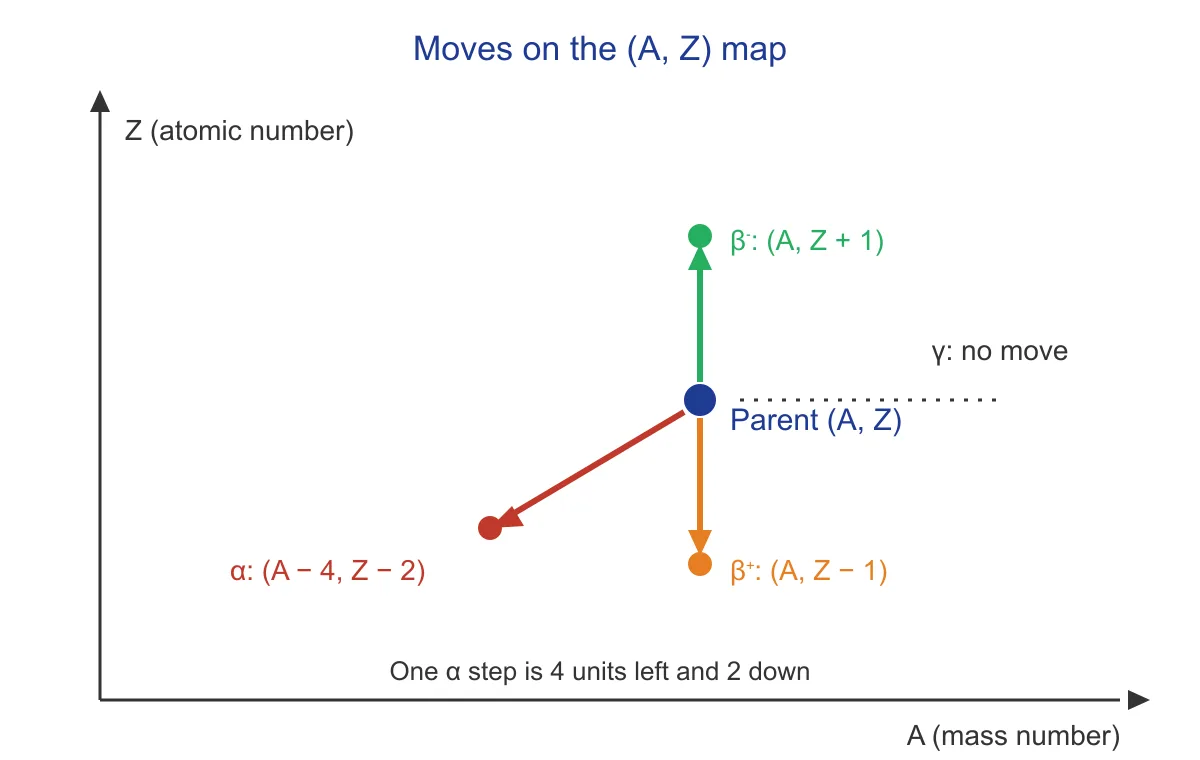
Figure 4.1: How each decay moves a nucleus on the (A, Z) map
To find how many α and β⁻ particles a long chain emits, solve for α from the change in $A$ alone, because β does not alter $A$. Then use $Z$ to find β.
Example 1: A uranium nucleus $^{238}_{92}\text{U}$ ends as $^{206}_{82}\text{Pb}$ after a series of α and β⁻ decays. Find how many of each are emitted.
Fall in mass number: $238 - 206 = 32$.
Each α removes 4, so number of α $= \frac{32}{4} = 8$.
Eight α particles lower $Z$ by $16$: $92 - 16 = 76$.
Lead has $Z = 82$, so $Z$ must go up by $6$. Each β⁻ adds 1, so number of β⁻ $= 6$.
Check: $Z = 92 - 2(8) + 6 = 82$. Correct.
Answer: 8 α and 6 β⁻. Why this works: β does not touch $A$, so $A$ counts only α; then $Z$ is left to count β.
Memory trick: "Alpha loses four-two, beta gains one." Alpha takes away 4 from $A$ and 2 from $Z$; β⁻ keeps $A$ and adds 1 to $Z$. Say it first, then fill in the numbers in any chain question.
The law of radioactive decay
Take a large number $N$ of identical radioactive nuclei. In a short time $dt$, each has the same small chance $\lambda\,dt$ of decaying, whatever its age and whatever the others are doing. The number that decay is therefore proportional to the number present:
The minus sign says $N$ is falling. The constant $\lambda$ is the decay constant, in s⁻¹. It is the fraction of the present nuclei that decay per unit time, for a short enough interval. Separate the variables and integrate from $N_0$ at $t = 0$:
This is valid for a sample of a single nuclide that decays by itself, with no fresh supply of the same nuclide. The value of $\lambda$ is fixed for a nuclide and cannot be changed by heating, pressure, or chemical combination.
Activity
Activity $R$ is the number of decays per second in the sample:
The unit is the becquerel (Bq) = 1 decay per second. An older unit, the curie (Ci), equals $3.7 \times 10^{10}$ Bq. Activity depends on $\lambda$ as well as on $N$: for equal numbers of nuclei, the shorter-lived sample is the more active. Note the trap hiding here. Activity is a rate, not a count. A million nuclei of a long-lived nuclide can be far less active than a thousand of a short-lived one.
Because $R \propto N$, taking logarithms gives $\ln R = \ln R_0 - \lambda t$, a straight line whose slope is $-\lambda$. This is how $\lambda$ is read from experimental data.
Half-life and mean life
The half-life $T$ is the time for $N$ (or the activity) to fall to half. Put $N = \frac{N_0}{2}$ in the law:
The mean life $\tau$ is the average lifetime of the nuclei. The number decaying between $t$ and $t + dt$ is $\lambda N\,dt$, and each of those lived for time $t$, so
Together: $\tau = \frac{1}{\lambda} = \frac{T}{0.693} = 1.44\,T$. In time $\tau$, $N$ falls to $\frac{N_0}{e}$, about 37 percent of the start, so about 63 percent have decayed. In time $T$, exactly 50 percent have decayed.
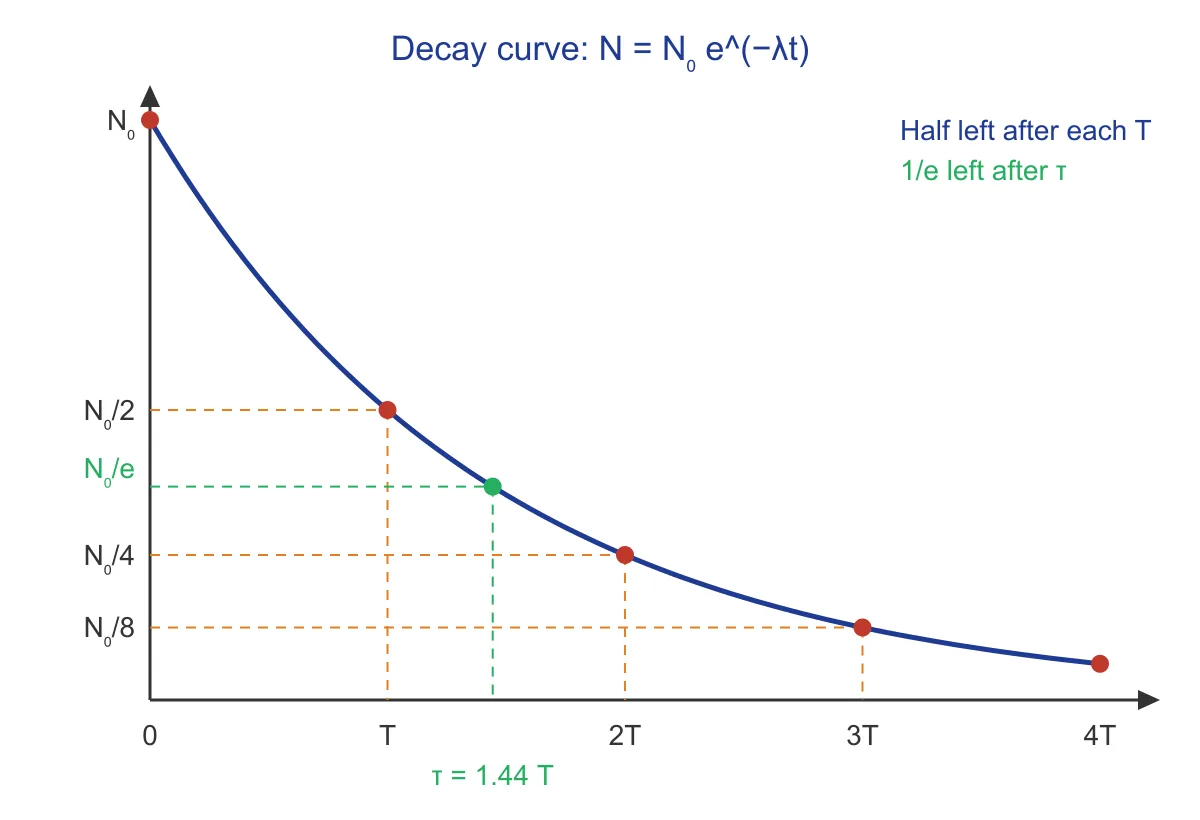
Figure 4.2: Exponential decay with half-lives and the mean life marked
| Quantity | Symbol | Relation | Unit |
|---|---|---|---|
| Decay constant | $\lambda$ | $\frac{0.693}{T} = \frac{1}{\tau}$ | s⁻¹ |
| Half-life | $T$ | $\frac{0.693}{\lambda} = 0.693\,\tau$ | s |
| Mean life | $\tau$ | $\frac{1}{\lambda} = 1.44\,T$ | s |
| Activity | $R$ | $\lambda N$ | Bq |
Counting half-lives
After a time $t$, the number of half-lives is $n = \frac{t}{T}$ and
For whole $n$ you can halve repeatedly in your head. For non-integer $n$, use the exponential form. Halving applies to what is left at the start of each interval, so two half-lives leave one quarter, not none.
Example 2: A sample of 640 mg of a radioactive isotope has a half-life of 6 hours. What mass is left after 1 day, and how much has decayed?
$t = 24$ h and $T = 6$ h, so $n = 4$.
Left $= 640 \times \left(\frac{1}{2}\right)^4 = \frac{640}{16} = 40$ mg.
Decayed $= 640 - 40 = 600$ mg.
Answer: 40 mg left, 600 mg decayed. Notice that the mass of the sample can be used in place of $N$, because the two are proportional.
Example 3: A sample has an activity of 5000 Bq. After 36 minutes the activity is 1250 Bq. Find the half-life, the decay constant and the mean life.
$\frac{R}{R_0} = \frac{1250}{5000} = \frac{1}{4} = \left(\frac{1}{2}\right)^2$, so 2 half-lives in 36 min.
$T = 18$ min $= 1080$ s.
$\lambda = \frac{0.693}{1080} = 6.4 \times 10^{-4}$ s⁻¹.
$\tau = \frac{1}{\lambda} = 1.44 \times 18 = 26$ min (about).
Answer: $T = 18$ min, $\lambda \approx 6.4 \times 10^{-4}$ s⁻¹, $\tau \approx 26$ min. Find the ratio first; if it is a power of 2 you get $n$ with no logarithm at all.
Memory trick: "Half, quarter, eighth, sixteenth: one, two, three, four." Every half-life puts one more 2 under the fraction left. For the fraction decayed, flip it: $1 - \frac{1}{2^n}$, so three half-lives decay seven eighths.
Non-integer half-lives and the exponential
When $\frac{t}{T}$ is not a whole number, use $N = N_0 e^{-\lambda t}$ with $\lambda = \frac{0.693}{T}$. For example, the time for 90 percent of a sample to decay needs $\frac{N}{N_0} = 0.1$, so $e^{-\lambda t} = 0.1$, giving $t = \frac{\ln 10}{\lambda} = 3.32\,T$. Keep $\ln 10 = 2.303$ and $\ln 2 = 0.693$ ready.
Example 4: Find the activity of 1.00 g of radium-226 (half-life 1600 years). Take $N_A = 6.022 \times 10^{23}$ mol⁻¹, one year $= 3.16 \times 10^7$ s.
Number of nuclei: $N = \frac{6.022 \times 10^{23}}{226} = 2.66 \times 10^{21}$.
$T = 1600 \times 3.16 \times 10^7 = 5.06 \times 10^{10}$ s.
$\lambda = \frac{0.693}{5.06 \times 10^{10}} = 1.37 \times 10^{-11}$ s⁻¹.
$R = \lambda N = 1.37 \times 10^{-11} \times 2.66 \times 10^{21} = 3.6 \times 10^{10}$ Bq.
Answer: about $3.6 \times 10^{10}$ Bq, close to 1 curie. This is how the curie came about. Always convert half-life to seconds before using $R = \lambda N$ to get Bq.
Two decay routes at once
Some nuclei can decay in two ways, for example by α and by β⁻, with decay constants $\lambda_1$ and $\lambda_2$. Each nucleus has both chances at once, so the chances add: the total decay constant is $\lambda = \lambda_1 + \lambda_2$. In terms of half-lives, $\frac{1}{T} = \frac{1}{T_1} + \frac{1}{T_2}$, hence $T = \frac{T_1 T_2}{T_1 + T_2}$. The effective half-life is shorter than either.
Successive decay at a basic level
Suppose $A \to B \to C$, with $C$ stable. Nuclei of $B$ are made at the rate $\lambda_A N_A$ and lost at the rate $\lambda_B N_B$:
At the start $N_B = 0$, so it grows. As $N_B$ builds up, its loss rate rises until it catches the production rate. At that moment $\frac{dN_B}{dt} = 0$ and the amount of $B$ stops changing:
When the parent lives very much longer than the daughter ($T_A \gg T_B$), $N_A$ hardly changes over many half-lives of $B$, and this balance holds for a long time. It is called secular equilibrium. In it the activities of parent and daughter are equal, while the numbers of nuclei are not: the shorter-lived one is present in smaller number.
The simplest version of the idea is a single decay to a stable product: nuclei decayed $= N_0 - N = N_0(1 - e^{-\lambda t})$, and this is also the number of stable daughter nuclei present, if none were there at the start. The ratio of daughter to parent at time $t$ is $\frac{N_0 - N}{N} = e^{\lambda t} - 1$, which is how old rocks are dated.
Example 5: A rock contains a radioactive nuclide X (half-life 40 million years) and its stable daughter Y. Today there are 3 atoms of Y for every 1 atom of X. The rock had only X when it formed. How old is it?
Atoms of X now $= 1$ part; Y $= 3$ parts; total originally $= 4$ parts.
Fraction of X left $= \frac{1}{4} = \left(\frac{1}{2}\right)^2$, so 2 half-lives.
Age $= 2 \times 40 = 80$ million years.
Answer: 80 million years. Y atoms came out of X, so original X = X now + Y now; this step is where mistakes happen.
Energy released: binding energy, Q value, fission and fusion
Einstein's relation turns a mass drop into energy, and it is convenient to remember that
The Q value of any decay or reaction is
If $Q > 0$ the process can go by itself and the energy appears as kinetic energy of the products (and photons). If $Q < 0$ the process needs that much energy supplied.
A note on masses: tables give atomic masses (nucleus plus electrons). For α decay and β⁻ decay the electron counts balance out, so $Q = [M(\text{parent}) - M(\text{daughter}) - M(\text{He})]\,c^2$ for α and $Q = [M(\text{parent}) - M(\text{daughter})]\,c^2$ for β⁻ when atomic masses are used. For β⁺ decay, two electron masses are left over and you subtract $2 m_e$ ($2 \times 0.511$ MeV) as well.
Sharing the energy in α decay
A parent at rest splits into a daughter nucleus and an α particle. Momentum is conserved, so the two have equal and opposite momenta of magnitude $p$. With kinetic energy $K = \frac{p^2}{2m}$, the lighter fragment gets the larger share, in inverse ratio to the masses:
This uses non-relativistic momentum and is valid because the speeds are far below $c$. The α particle carries almost all of $Q$.
Example 6: A nucleus of mass number 226 at rest emits an α particle, and the Q value is 4.87 MeV. Find the kinetic energies of the α particle and the daughter nucleus.
$K_\alpha = Q \times \frac{A - 4}{A} = 4.87 \times \frac{222}{226}$.
$\frac{222}{226} = 0.9823$, so $K_\alpha = 4.78$ MeV.
$K_D = 4.87 - 4.78 = 0.09$ MeV.
Check: $\frac{K_\alpha}{K_D} = \frac{222}{4} = 55.5$, and $\frac{4.784}{0.086} \approx 55.5$ before rounding.
Answer: α gets 4.78 MeV, daughter 0.09 MeV. The lighter fragment gets the larger share; do not use $\frac{4}{226}$ for the α share.
Fission and fusion
In fission, a heavy nucleus such as $^{235}\text{U}$ splits into two middle-weight fragments after absorbing a neutron, and gives out 2 or 3 neutrons. Binding energy per nucleon rises from about 7.6 MeV to about 8.5 MeV, so the energy released per fission is about
In fusion, two light nuclei join to make a heavier one, and they must be brought very close against their electric repulsion, which needs extremely high temperatures. Two typical results to remember are D + T → ⁴He + n with $Q = 17.6$ MeV, and the net conversion of four protons into one ⁴He with $Q \approx 26.7$ MeV.
| Fission | Fusion | |
|---|---|---|
| Process | Heavy nucleus splits | Light nuclei join |
| Where on $B/A$ curve | Start on the right of the peak | Start on the left of the peak |
| Typical Q | About 200 MeV per nucleus | 17.6 MeV (D + T) |
| Energy per unit mass | Less | More |
| Needs | Slow neutrons to start | Very high temperature |
Memory trick: "Heavy splits, light joins, both climb to iron." Split a heavy nucleus or join light ones and the product sits closer to the peak of the curve. Say it to decide the sign of Q without a calculation.
Example 7: Two deuterons join to form ⁴He. The binding energy per nucleon is 1.1 MeV for deuterium and 7.1 MeV for ⁴He. Find the energy released.
Total binding energy of ⁴He $= 4 \times 7.1 = 28.4$ MeV.
Total for two deuterons $= 2 \times (2 \times 1.1) = 4.4$ MeV.
$Q = 28.4 - 4.4 = 24.0$ MeV.
Answer: about 24 MeV released. Energy released equals the gain in total binding energy, products minus reactants, and not the gain per nucleon.
Common traps
- Using $T = \frac{1}{\lambda}$ → the half-life is $\frac{0.693}{\lambda}$; $\frac{1}{\lambda}$ is the mean life.
- Thinking the sample is gone after two half-lives → one quarter remains; it takes about 3.3 half-lives to lose 90 percent.
- Confusing activity with number of nuclei → activity is $\lambda N$; compare activities by $\lambda N$, not by $N$.
- Counting β⁻ emitted by looking at $A$ → $A$ fixes only the α count; find β from the change in $Z$ after the α effect.
- Writing the daughter of β⁻ with $Z - 1$ → β⁻ raises $Z$ by 1; β⁺ lowers it.
- Taking the electron in β⁻ decay as an orbital electron or as one already inside → it is made when a neutron turns into a proton.
- Forgetting that the daughter in α decay also recoils → use momentum conservation and give the α the share $\frac{A - 4}{A}$ of $Q$.
- Using the mass of the sample directly as the number of nuclei → divide by molar mass first: $N = \frac{m}{M} N_A$.
- Using atomic mass tables for β⁺ without the $2 m_e$ correction → subtract $2 \times 0.511$ MeV from the naive $Q$.
- Calling the energy per nucleon the energy released → multiply by the number of nucleons and subtract the reactants' total.
Quick revision
- $\frac{dN}{dt} = -\lambda N$, $N = N_0 e^{-\lambda t}$.
- Activity $R = \lambda N = R_0 e^{-\lambda t}$; unit becquerel; 1 Ci $= 3.7 \times 10^{10}$ Bq.
- $T = \frac{0.693}{\lambda}$, $\tau = \frac{1}{\lambda}$, $\tau = 1.44\,T$.
- $N = N_0 \left(\frac{1}{2}\right)^{t/T}$; after one mean life $N = \frac{N_0}{e}$.
- Parallel decays: $\lambda = \lambda_1 + \lambda_2$, $T = \frac{T_1 T_2}{T_1 + T_2}$.
- α: $A$ − 4, $Z$ − 2. β⁻: $Z$ + 1. β⁺: $Z$ − 1. γ: no change.
- β⁻ comes from $n \to p + e^- + \bar{\nu}$; its energy has a continuous spread, α and γ have fixed lines.
- Nuclear radius $R = R_0 A^{1/3}$, $R_0 \approx 1.2$ fm; nuclear density is the same for all nuclei.
- Binding energy $B = \Delta m \, c^2$; 1 u = 931.5 MeV.
- $Q = (\sum m_{\text{before}} - \sum m_{\text{after}})\,c^2$; decay goes only if $Q > 0$.
- α decay at rest: $K_\alpha = Q \frac{A - 4}{A}$.
- Secular equilibrium: $\lambda_A N_A = \lambda_B N_B$, so activities are equal and $\frac{N_B}{N_A} = \frac{T_B}{T_A}$.
- Fission of a heavy nucleus gives about 200 MeV; D + T fusion gives 17.6 MeV.
- Decay constant does not change with heat, pressure or chemical form.
Practice questions
Which of the following radiations is not deflected by either an electric field or a magnetic field?
- β⁻ particles
- α particles
- β⁺ particles
- γ rays
Answer
D. γ rays
γ rays are photons with no charge, so neither field exerts a force; α, β⁻ and β⁺ are all charged.
A nucleus $^{238}_{92}\text{U}$ emits one α particle. The daughter nucleus has mass number and atomic number respectively
- 234 and 90
- 234 and 91
- 238 and 93
- 236 and 90
Answer
A. 234 and 90
α removes 4 from A and 2 from Z: 238 - 4 = 234, 92 - 2 = 90.
In β⁻ decay of a nucleus, the mass number $A$ and the atomic number $Z$ of the nucleus change as
- $A$ decreases by 1, $Z$ increases by 1
- $A$ unchanged, $Z$ increases by 1
- $A$ decreases by 4, $Z$ decreases by 2
- $A$ unchanged, $Z$ decreases by 1
Answer
B. $A$ unchanged, $Z$ increases by 1
A neutron turns into a proton and an electron leaves: nucleon count is the same, proton count goes up by 1.
Nuclide X has a decay constant twice that of nuclide Y. The ratio of half-life of X to half-life of Y is
- 2
- $\frac{1}{4}$
- $\frac{1}{\sqrt{2}}$
- $\frac{1}{2}$
Answer
D. $\frac{1}{2}$
$T = \frac{0.693}{\lambda}$, so $\frac{T_X}{T_Y} = \frac{\lambda_Y}{\lambda_X} = \frac{1}{2}$.
The ratio of mean life to half-life of a radioactive nuclide is
- $\frac{1}{0.693}$
- 0.693
- 2
- $\frac{1}{2}$
Answer
A. $\frac{1}{0.693}$
$\tau = \frac{1}{\lambda}$ and $T = \frac{0.693}{\lambda}$, so $\frac{\tau}{T} = \frac{1}{0.693} = 1.44$.
A radioactive sample of a single nuclide is observed for a time equal to its mean life $\tau$. The fraction of the original nuclei still undecayed is
- $\frac{1}{2}$
- $\frac{1}{e^2}$
- $\frac{1}{e}$
- $1 - \frac{1}{e}$
Answer
C. $\frac{1}{e}$
$N = N_0 e^{-\lambda \tau} = N_0 e^{-1}$, since $\tau = \frac{1}{\lambda}$.
For a sample of one radioactive nuclide, a graph of $\ln R$ (natural log of activity) against time $t$ is a straight line. Its slope is
- $-\frac{1}{\lambda}$
- $\lambda$
- $-\lambda$
- $-0.693\,\lambda$
Answer
C. $-\lambda$
$R = R_0 e^{-\lambda t}$ gives $\ln R = \ln R_0 - \lambda t$; slope is $-\lambda$.
Considering the nuclear density of nuclei with different mass numbers $A$, which is correct?
- It increases as $A^{1/3}$
- It is nearly the same for all nuclei
- It increases in proportion to $A$
- It decreases as $A^{-1/3}$
Answer
B. It is nearly the same for all nuclei
Mass is proportional to $A$ and volume ($\frac{4}{3}\pi R^3$ with $R \propto A^{1/3}$) is also proportional to $A$, so density does not depend on $A$.
A parent nuclide A with a very long half-life decays to a daughter B of much shorter half-life. After a long time, in secular equilibrium, which is true?
- The mass of B equals the mass of A
- The half-life of B becomes equal to that of A
- The activity of B equals the activity of A
- The number of B nuclei equals the number of A nuclei
Answer
C. The activity of B equals the activity of A
At balance, $\lambda_A N_A = \lambda_B N_B$, which is equality of activities; the numbers differ in the ratio $\frac{T_B}{T_A}$.
The SI unit of activity of a radioactive source, equal to one disintegration per second, is called the
- becquerel
- curie
- rutherford-second
- roentgen per hour
Answer
A. becquerel
One decay per second is 1 becquerel; the curie is much larger.
A nucleus at rest undergoes α decay. Which statement about the kinetic energies of the two products is correct?
- The daughter has the larger kinetic energy because it has more momentum
- Both have equal kinetic energy because momenta are equal
- The α particle has the larger kinetic energy, in the inverse ratio of the masses
- The α particle has the larger kinetic energy because it has the larger momentum
Answer
C. The α particle has the larger kinetic energy, in the inverse ratio of the masses
Momenta are equal in size; $K = \frac{p^2}{2m}$ so the lighter α gets the larger $K$, with $\frac{K_\alpha}{K_D} = \frac{m_D}{m_\alpha}$.
The β⁻ particles emitted from a pure sample of one nuclide have a continuous range of energies, whereas α particles from one nuclide have fixed energies. The reason is that in β⁻ decay
- the electron loses energy inside the nucleus before leaving
- the daughter nucleus has a continuous range of masses
- the electron is made of many smaller particles
- a third particle, the antineutrino, shares the energy in varying amounts
Answer
D. a third particle, the antineutrino, shares the energy in varying amounts
The decay is a three-body process: the antineutrino takes a variable share, so the electron energy runs from zero up to a maximum.
The decay constant of a radioactive nuclide
- decreases as the sample becomes older
- does not change when the sample is heated or chemically combined
- increases with temperature
- is proportional to the number of nuclei present
Answer
B. does not change when the sample is heated or chemically combined
$\lambda$ is a property of the nucleus alone; it is not affected by outside conditions, age or sample size.
A nucleus decays by two independent routes with half-lives $T_1$ and $T_2$. Its effective half-life $T$ is
- $\sqrt{T_1 T_2}$
- $\frac{T_1 + T_2}{2}$
- $T_1 + T_2$
- $\frac{T_1 T_2}{T_1 + T_2}$
Answer
D. $\frac{T_1 T_2}{T_1 + T_2}$
$\lambda = \lambda_1 + \lambda_2$ so $\frac{1}{T} = \frac{1}{T_1} + \frac{1}{T_2}$.
A sample contains 80 g of a radioactive isotope of half-life 5 days. The mass in grams left undecayed after 20 days is
- 10
- 5
- 20
- 2.5
Answer
B. 5
$n = \frac{20}{5} = 4$; $80 \times \frac{1}{16} = 5$ g.
Taking $R_0 = 1.2$ fm, the radius, in fm, of a nucleus of mass number 64 is
- 4.8
- 2.4
- 9.6
- 76.8
Answer
A. 4.8
$R = 1.2 \times 64^{1/3} = 1.2 \times 4 = 4.8$ fm.
In the series of decays that turns $^{238}_{92}\text{U}$ into $^{206}_{82}\text{Pb}$, the number of β⁻ particles emitted is
- 4
- 8
- 10
- 6
Answer
D. 6
α count $= \frac{32}{4} = 8$; $Z$ after α: $92 - 16 = 76$; to reach 82 need 6 β⁻.
A nuclide has decay constant $0.0231\ \text{min}^{-1}$. Using $\ln 2 = 0.693$, its half-life in minutes is
- 15
- 30
- 43.3
- 60
Answer
B. 30
$T = \frac{0.693}{0.0231} = 30$ min.
A radioactive nuclide has half-life 15 minutes. The time in minutes taken for 87.5 percent of a sample to decay is
- 75
- 30
- 45
- 60
Answer
C. 45
87.5 percent decayed leaves $\frac{1}{8}$, i.e. 3 half-lives: $3 \times 15 = 45$ min.
A nuclide has half-life 6.93 days. Using $\ln 2 = 0.693$, its mean life in days is
- 10
- 4.8
- 20
- 6.93
Answer
A. 10
$\tau = \frac{T}{0.693} = \frac{6.93}{0.693} = 10$ days.
A source has activity 4000 Bq at one moment and 500 Bq exactly 6 hours later. Its half-life in hours is
- 1.5
- 2
- 3
- 0.75
Answer
B. 2
$\frac{4000}{500} = 8 = 2^3$, so 3 half-lives in 6 h; $T = 2$ h.
Take atomic masses $M(^{222}\text{Rn}) = 222.0176$ u, $M(^{218}\text{Po}) = 218.0090$ u, $M(^{4}\text{He}) = 4.0026$ u and 1 u = 931.5 MeV. The Q value in MeV for α decay of radon-222 to polonium-218 is
- 2.80
- 11.2
- 5.59
- 55.9
Answer
C. 5.59
Mass drop $= 222.0176 - 218.0090 - 4.0026 = 0.0060$ u; $Q = 0.0060 \times 931.5 = 5.59$ MeV.
A nucleus of mass number 204 at rest emits an α particle in a decay with Q value 5.1 MeV. The kinetic energy of the α particle in MeV is
- 5.0
- 5.1
- 0.1
- 2.55
Answer
A. 5.0
$K_\alpha = Q \frac{A - 4}{A} = 5.1 \times \frac{200}{204} = 5.0$ MeV.
A sample has $6.0 \times 10^{20}$ radioactive nuclei with half-life 693 s. Using $\ln 2 = 0.693$, its activity, in units of $10^{17}$ Bq, is
- 0.6
- 4.16
- 60
- 6
Answer
D. 6
$\lambda = \frac{0.693}{693} = 10^{-3}$ s⁻¹; $R = \lambda N = 6 \times 10^{17}$ Bq.
A reactor releases 200 MeV per fission and delivers 64 MW of power from fission alone. Taking 1 MeV = $1.6 \times 10^{-13}$ J, the number of fissions per second, in units of $10^{18}$, is
- 4
- 2
- 1
- 0.5
Answer
B. 2
Energy per fission $= 200 \times 1.6 \times 10^{-13} = 3.2 \times 10^{-11}$ J; rate $= \frac{64 \times 10^6}{3.2 \times 10^{-11}} = 2 \times 10^{18}$ s⁻¹.
In an α decay a nucleus at rest releases Q = 4.8 MeV, and the α particle gets 4.7 MeV. The mass number of the parent nucleus (an integer) is
- 196
- 200
- 192
- 204
Answer
C. 192
$K_\alpha = Q\frac{A - 4}{A}$: $4.7 \times A = 4.8(A - 4)$ gives $0.1A = 19.2$, so $A = 192$.
Given below are two statements: Statement I: For a given radioactive nuclide, the mean life is longer than the half-life. Statement II: The mean life is the time in which half of the nuclei decay.
- Both Statement I and Statement II are correct
- Both Statement I and Statement II are incorrect
- Statement I is correct but Statement II is incorrect
- Statement I is incorrect but Statement II is correct
Answer
C. Statement I is correct but Statement II is incorrect
$\tau = 1.44\,T$ so I is correct; II describes the half-life, not the mean life.
Given below are two statements: Statement I: γ emission changes neither the mass number nor the atomic number of the nucleus. Statement II: γ rays are deflected by a magnetic field.
- Both Statement I and Statement II are correct
- Both Statement I and Statement II are incorrect
- Statement I is correct but Statement II is incorrect
- Statement I is incorrect but Statement II is correct
Answer
C. Statement I is correct but Statement II is incorrect
I is correct (photon emission only). II is wrong: γ rays carry no charge.
Given below are two statements: Statement I: The half-life of a sample becomes shorter when it is heated. Statement II: Each nucleus has the same chance per unit time of decaying, independent of the others.
- Both Statement I and Statement II are correct
- Both Statement I and Statement II are incorrect
- Statement I is correct but Statement II is incorrect
- Statement I is incorrect but Statement II is correct
Answer
D. Statement I is incorrect but Statement II is correct
I is wrong: $\lambda$ does not depend on temperature. II is the statistical basis of the law.
Given below are two statements: Statement I: One curie is equal to $3.7 \times 10^{7}$ Bq. Statement II: The activity of a sample is the number of nuclei present in it.
- Both Statement I and Statement II are correct
- Both Statement I and Statement II are incorrect
- Statement I is correct but Statement II is incorrect
- Statement I is incorrect but Statement II is correct
Answer
B. Both Statement I and Statement II are incorrect
1 Ci $= 3.7 \times 10^{10}$ Bq, and activity is $\lambda N$, a rate, so both are incorrect.
Given below are two statements: Statement I: The activity of a sample falls by the same fraction in every equal interval of time. Statement II: A graph of $\ln R$ against $t$ for a single nuclide is a straight line.
- Both Statement I and Statement II are correct
- Both Statement I and Statement II are incorrect
- Statement I is correct but Statement II is incorrect
- Statement I is incorrect but Statement II is correct
Answer
A. Both Statement I and Statement II are correct
$R = R_0 e^{-\lambda t}$ gives a constant fraction $e^{-\lambda \Delta t}$ per interval and a straight $\ln R$ line; both correct.
Assertion (A): The density of nuclear matter is nearly the same in all nuclei. Reason (R): The radius of a nucleus is proportional to $A^{1/3}$, where $A$ is the mass number.
- Both A and R are true and R is the correct explanation of A
- Both A and R are true but R is not the correct explanation of A
- A is true but R is false
- A is false but R is true
Answer
A. Both A and R are true and R is the correct explanation of A
Volume $\propto R^3 \propto A$ and mass $\propto A$, so density is constant; R explains A.
Assertion (A): A source of half-life 1 hour will have completely decayed after 2 hours. Reason (R): Half-life is the time in which half of the existing nuclei decay.
- Both A and R are true and R is the correct explanation of A
- Both A and R are true but R is not the correct explanation of A
- A is true but R is false
- A is false but R is true
Answer
D. A is false but R is true
After 2 hours, one quarter is left, so A is false. R is the definition and is true.
Assertion (A): The kinetic energies of β⁻ particles from a pure nuclide form a continuous spread. Reason (R): A β⁻ particle is an electron.
- Both A and R are true and R is the correct explanation of A
- Both A and R are true but R is not the correct explanation of A
- A is true but R is false
- A is false but R is true
Answer
B. Both A and R are true but R is not the correct explanation of A
A is true (antineutrino shares energy). R is true but does not cause the continuous spread.
Match List I with List II. List I: a. α decay b. β⁻ decay c. γ emission d. β⁺ decay List II: i. No change in $A$ or $Z$ ii. $A$ decreases by 4 and $Z$ by 2 iii. $A$ unchanged and $Z$ increases by 1 iv. $A$ unchanged and $Z$ decreases by 1
- a-iii, b-ii, c-i, d-iv
- a-ii, b-iii, c-iv, d-i
- a-i, b-iv, c-ii, d-iii
- a-ii, b-iii, c-i, d-iv
Answer
D. a-ii, b-iii, c-i, d-iv
α: A - 4, Z - 2 (ii); β⁻: Z + 1 (iii); γ: no change (i); β⁺: Z - 1 (iv).
Match List I with List II. List I: a. Mean life b. Half-life c. Activity d. Decay constant List II: i. $\frac{0.693}{\lambda}$ ii. $\lambda N$ iii. $\frac{1}{\lambda}$ iv. Fraction of nuclei decaying per unit time
- a-iii, b-i, c-ii, d-iv
- a-i, b-iii, c-ii, d-iv
- a-iii, b-i, c-iv, d-ii
- a-iv, b-iii, c-i, d-ii
Answer
A. a-iii, b-i, c-ii, d-iv
Mean life $\frac{1}{\lambda}$ (iii); half-life $\frac{0.693}{\lambda}$ (i); activity $\lambda N$ (ii); $\lambda$ is the fraction per unit time (iv).
Match List I with List II. List I: a. Fission of one $^{235}$U nucleus b. D + T fusion to ⁴He + n c. α decay of a heavy nucleus d. Four protons turning into one ⁴He List II: i. 17.6 MeV ii. About 200 MeV iii. A few MeV iv. 26.7 MeV
- a-iii, b-i, c-ii, d-iv
- a-ii, b-i, c-iv, d-iii
- a-i, b-ii, c-iii, d-iv
- a-ii, b-i, c-iii, d-iv
Answer
D. a-ii, b-i, c-iii, d-iv
Fission about 200 MeV; D + T gives 17.6 MeV; α decay about 5 MeV; 4p to He-4 gives 26.7 MeV.
Two samples A and B contain equal numbers of nuclei at $t = 0$. Their half-lives are 2 h and 4 h respectively. After how many hours will their activities be equal?
- 2
- 4
- 6
- 8
Answer
B. 4
$R_A = \frac{0.693}{2} N_0 2^{-t/2}$ and $R_B = \frac{0.693}{4} N_0 2^{-t/4}$. Equal when $2 \cdot 2^{-t/2} = 2^{-t/4}$, i.e. $1 - \frac{t}{2} = -\frac{t}{4}$, so $t = 4$ h. Check at 4 h: $R_A \propto \frac{1}{2}\cdot\frac{1}{4}$, $R_B \propto \frac{1}{4}\cdot\frac{1}{2}$, equal.
A mineral has a radioactive nuclide X of half-life 10 years that decays to a stable nuclide Y. It formed with X only. Today the ratio of the number of Y atoms to X atoms is 7 : 1. The age of the mineral in years is
- 20
- 10
- 30
- 70
Answer
C. 30
X now = 1 part, Y = 7 parts, original = 8 parts; fraction left $\frac{1}{8}$ means 3 half-lives, $3 \times 10 = 30$ years.
Nuclide A (half-life 1000 years) decays to nuclide B (half-life 10 years), which decays further. A very long time after the sample was prepared with pure A, the ratio $\frac{N_B}{N_A}$ is nearly
- 100
- 0.1
- 1
- 0.01
Answer
D. 0.01
Secular equilibrium: $\frac{N_B}{N_A} = \frac{T_B}{T_A} = \frac{10}{1000} = 0.01$; check via equal activities $\lambda_A N_A = \lambda_B N_B$.