The Language of Inequality
Why this chapter comes first
Open almost any bank prelims reasoning section and you will find a small block of inequality questions, usually three to five of them, sometimes set as one statement with two conclusions, sometimes as a coded version where @ or # stands in for the real signs. IBPS and SBI PO and Clerk prelims, RRB PO and Clerk, LIC assistant papers and the reasoning part of SSC and RRB NTPC all use the idea in some form. Each question carries one mark, and most bank exams take away a fraction of a mark for a wrong answer.
These are the cheapest marks in the paper. A prepared student clears each one in 30 to 40 seconds. An unprepared student loses them in two ways: by misreading a sign, or by believing that two letters are connected when they are not. Both mistakes come from not knowing the language well enough, and that is all this chapter teaches. Later chapters add conclusions, codes and either–or pairs, but every one of them stands on the rules below.
The six symbols and what each one allows
An inequality sign compares two quantities. Think of each letter as a hidden number. The sign does not tell you the number; it only tells you which values are allowed and which are ruled out.
| Symbol | Read aloud as | Allows | Rules out |
|---|---|---|---|
| A > B | A is greater than B | A bigger than B | A = B, A smaller than B |
| A < B | A is less than B | A smaller than B | A = B, A bigger than B |
| A ≥ B | A is greater than or equal to B | A bigger, or A = B | A smaller than B |
| A ≤ B | A is less than or equal to B | A smaller, or A = B | A bigger than B |
| A = B | A is equal to B | A and B the same | any difference |
| A ≠ B | A is not equal to B | A bigger, or A smaller | A = B |
Notice the pattern in the "Allows" column. The strict signs > and < allow exactly one situation. The soft signs ≥ and ≤ allow two. The sign ≠ also allows two, but in opposite directions, which is why it almost never helps you connect letters (more on that below).
Exam setters also use words for the same signs, so learn both forms now:
- "not less than" means ≥ (A is either bigger or equal)
- "not greater than" means ≤
- "neither greater nor less than" means =
- "at least" means ≥, "at most" means ≤
Memory trick: The open mouth of > and < always eats the bigger number. If the mouth faces A, A is bigger. The extra line under ≥ and ≤ is a "safety net" that also lets the two sides be equal.
Strict and soft: which says more
A > B tells you more than A ≥ B, because it removes one more possibility (equality). We call > the stronger sign. This matters for conclusions:
- If you know A > B, then A ≥ B is also true. The stronger fact contains the weaker one.
- If you know only A ≥ B, then A > B is not definitely true, because A and B might be equal.
- A = B is stronger still in its own way: it means A ≥ B and A ≤ B are both true.
So whenever a question asks for the relation between two letters, find the strongest sign you can prove. Anything weaker in the same direction will also be true.
Reading a chain in both directions
Exam statements are written as chains: A > B ≤ C = D. A chain is just several comparisons glued together, each sign joining only its two neighbours. A > B ≤ C means two separate facts:
- A > B
- B ≤ C
Nothing in that chain directly compares A and C. Whether they can be compared is the whole question, and we come to it in the next section.
You must be equally comfortable reading the chain from the right. Read right to left, the same chain says "C is greater than or equal to B, and B is less than A". To rewrite a chain in reverse, do two things together: reverse the order of the letters, and flip every sign.
| Original sign | Flipped sign |
|---|---|
| > | < |
| < | > |
| ≥ | ≤ |
| ≤ | ≥ |
| = | = |
| ≠ | ≠ |
Example 1: Rewrite P ≥ Q < R = S > T from right to left.
Letters in reverse order: T, S, R, Q, P.
Last sign > between S and T becomes T < S.
= between R and S stays: S = R.
< between Q and R becomes R > Q.
≥ between P and Q becomes Q ≤ P.
Answer: T < S = R > Q ≤ P.
Why: flipping the letters and the signs together describes the same numbers, just read from the other end.
A common slip is to reverse the letters and forget the signs, producing T > S = R < Q ≥ P, which says the exact opposite of the original. Exam options are often built from this slip, so check one sign before you mark.
Related and not related: what "definitely true" means
Two letters in a chain are related when the chain forces one of them to be bigger, smaller or equal in every possible case. They are not related when the chain allows more than one ordering.
That is the meaning of "definitely true" in every inequality question. A conclusion is definitely true only if it holds for every set of numbers that fits the statement. If you can find even one set of numbers that fits the statement but breaks the conclusion, the conclusion does not follow.
You can always test this by putting in numbers. Take A > B ≤ C and ask about A and C.
- A = 5, B = 2, C = 9 fits the chain. Here A < C.
- A = 5, B = 2, C = 3 also fits. Here A > C.
- A = 5, B = 2, C = 5 fits too. Here A = C.
Three valid cases, three different answers, so A and C are not related. No conclusion comparing A and C (A > C, A < C, A ≥ C, A ≤ C or A = C) can be definitely true.
Number-testing is safe but slow. The rest of this chapter turns it into a rule you can apply in a few seconds.
Why same-direction signs carry through
Picture a number line, small values on the left and big values on the right. A > B means A sits to the right of B.
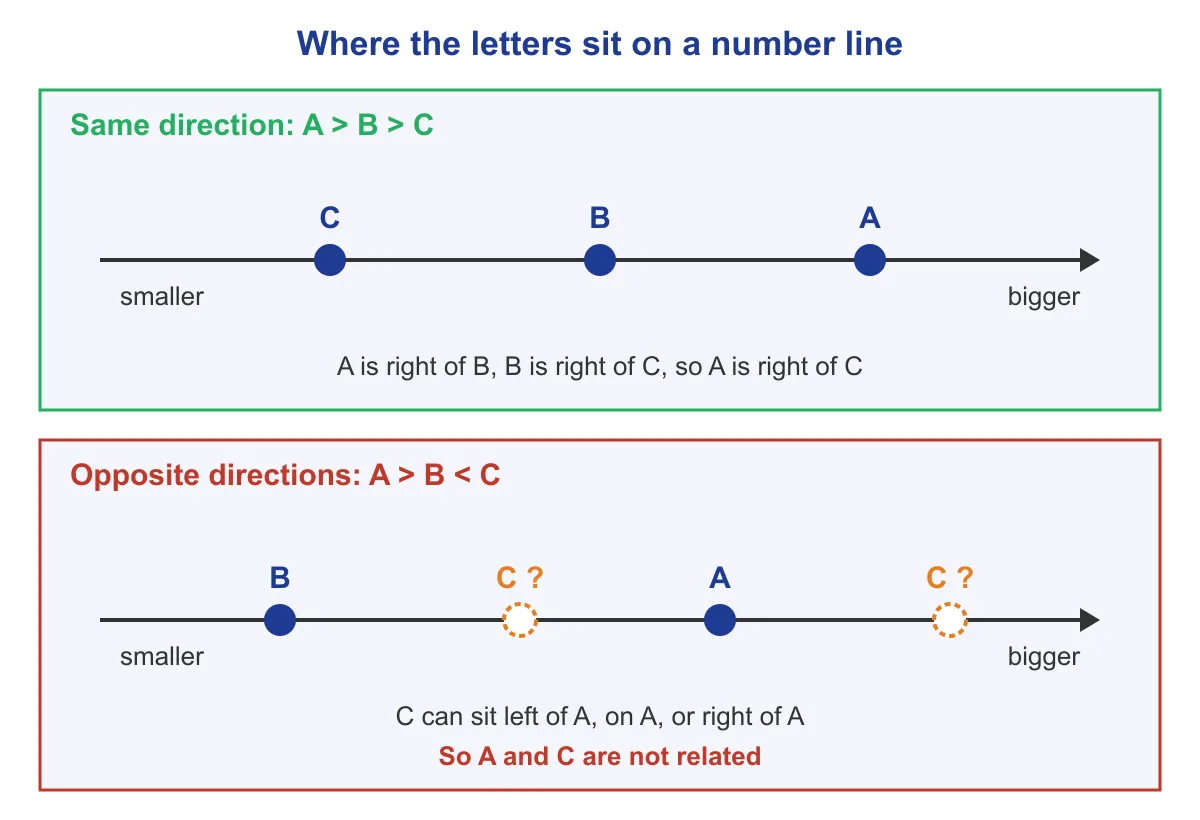
In the top line, A > B > C. A is right of B, and B is right of C, so A must be right of C. There is no other way to draw it. The two signs point the same way, and the conclusion A > C is forced.
In the bottom line, A > B < C. A is right of B, and C is also right of B. But nothing says which of A and C is further right. C could stop before A, sit exactly on A, or go past it. The signs point in opposite directions, so both A and C are simply "bigger than B", and that tells you nothing about each other.
Real life works the same way. In a class test, Riya scored more than Mohit, and Mohit scored more than Kabir. Riya beat Kabir; no doubt about it. Now change it: Riya scored more than Mohit, and Kabir also scored more than Mohit. Who scored more between Riya and Kabir? You cannot tell. Both beat the same person, which is the "opposite signs" case.
Memory trick: "Same way, goes all the way; opposite way, no way." If every sign between two letters points the same way, the relation travels from one end to the other. One sign facing the other way and the link is broken.
The equal sign is transparent
An = sign does not have a direction. It says the two letters are the same number, so you can look straight through it. In A > B = C, B and C are the same value, so A > B is the same as A > C. In A ≥ B = C = D > E, the two equal signs vanish and you are left with A ≥ D > E, which gives A > E.
Memory trick: Treat = as a glass window in the chain. Look through it as if it were not there, then read the signs on either side.
The ≠ sign is different. A ≠ B ≠ C does not connect A and C at all: A and C could even be equal (A = 4, B = 7, C = 4). The only time ≠ helps is when it sits next to an = sign: A = B ≠ C gives A ≠ C, because A is the same number as B. In bank papers ≠ is rare; when it appears, treat it with suspicion.
The combination table
Every inequality question, however long the chain, comes down to joining signs two at a time. Suppose you have A ? B and B ? C. The table below gives the result for A ? C.
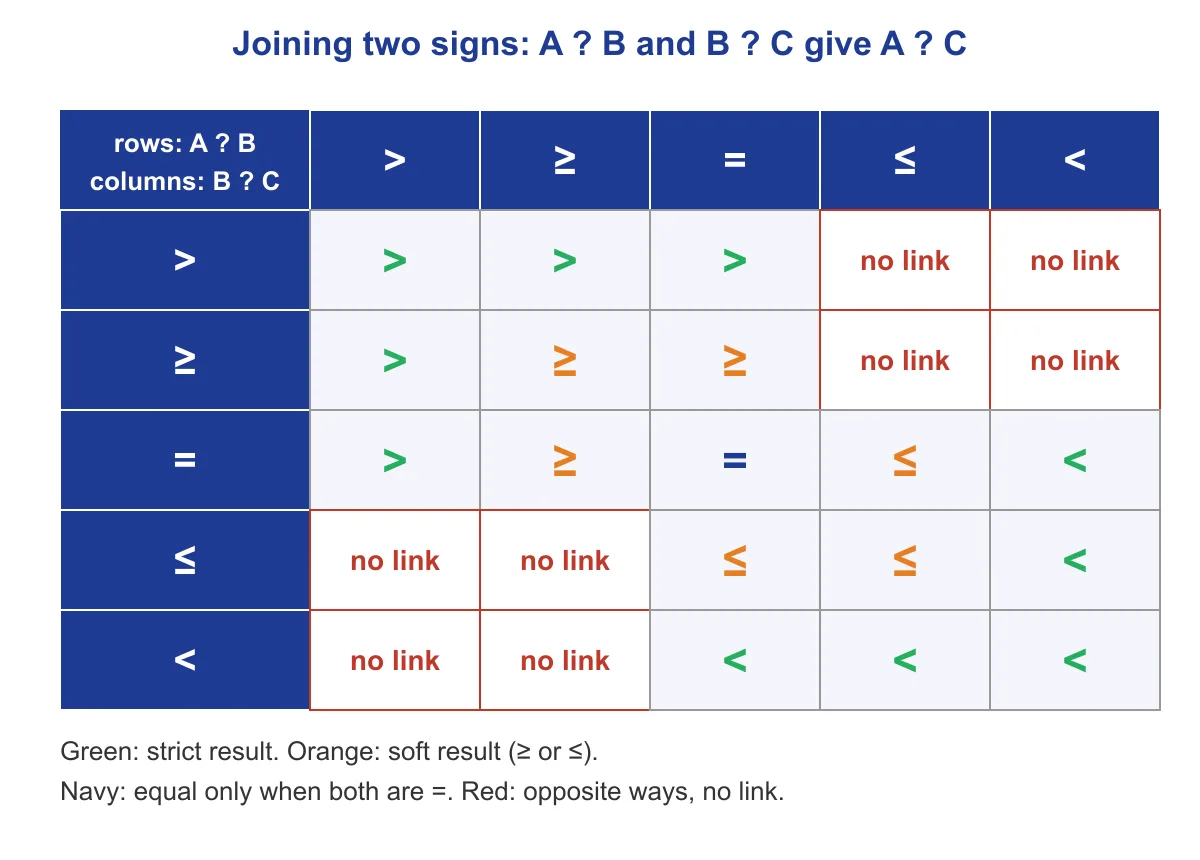
The same results written as a table you can copy into your notebook:
| A ? B | B ? C | A ? C | Reason |
|---|---|---|---|
| > | > | > | same way, strict |
| > | ≥ | > | same way, one strict sign |
| ≥ | > | > | same way, one strict sign |
| > | = | > | = is transparent |
| ≥ | ≥ | ≥ | same way, no strict sign |
| ≥ | = | ≥ | = is transparent |
| = | = | = | only equals on the path |
| < | ≤ | < | same way, one strict sign |
| ≤ | ≤ | ≤ | same way, no strict sign |
| = | < | < | = is transparent |
| > | < | no link | opposite directions |
| > | ≤ | no link | opposite directions |
| ≥ | < | no link | opposite directions |
| ≥ | ≤ | no link | opposite directions |
Look at the first rows and you will see three rules hiding in the table. They are the only three you need.
- Direction: if the signs on the path point opposite ways, the letters are not related. Stop.
- Strictness: if the direction is the same and at least one sign is strict (> or <), the result is strict.
- Equality: the result is = only when every sign on the path is =. If the signs are a mix of ≥ and = (or ≤ and =), the result is ≥ (or ≤).
Why does one strict sign make the whole result strict? Take A ≥ B > C. The ≥ lets A equal B at most, and B is definitely above C, so A is at least as high as B, which is already above C. A can never come down to C. That is A > C. The soft sign cannot cancel a strict one; it can only add the possibility of equality to its own link.
Why does ≥ with ≤ break? Take A ≥ B ≤ C. With B = 1, A could be 6 and C could be 2 (A > C), or A could be 2 and C could be 6 (A < C). The equality part of each sign changes nothing; the directions are still opposite.
Example 2: In the chain M ≤ N < O = P, find the relation between M and P.
Path from M to P: ≤, <, =.
Direction: ≤ and < both say "left smaller"; = has no direction. Same way.
Strictness: there is a < on the path, so the result is strict.
Answer: M < P.
Why: M is at most N, N is below O, and O is P, so M stays below P in every case.
Example 3: In the chain D > E ≥ F ≤ G > H, is D related to G?
Path from D to G: >, ≥, ≤.
> and ≥ say "left bigger"; ≤ says "left smaller". Opposite directions at F.
Answer: D and G are not related.
Why: D and G are both at least F, so either could be the larger one (try D = 9, E = 5, F = 5, G = 20, and then G = 6).
Reading longer chains: find the path, then check it
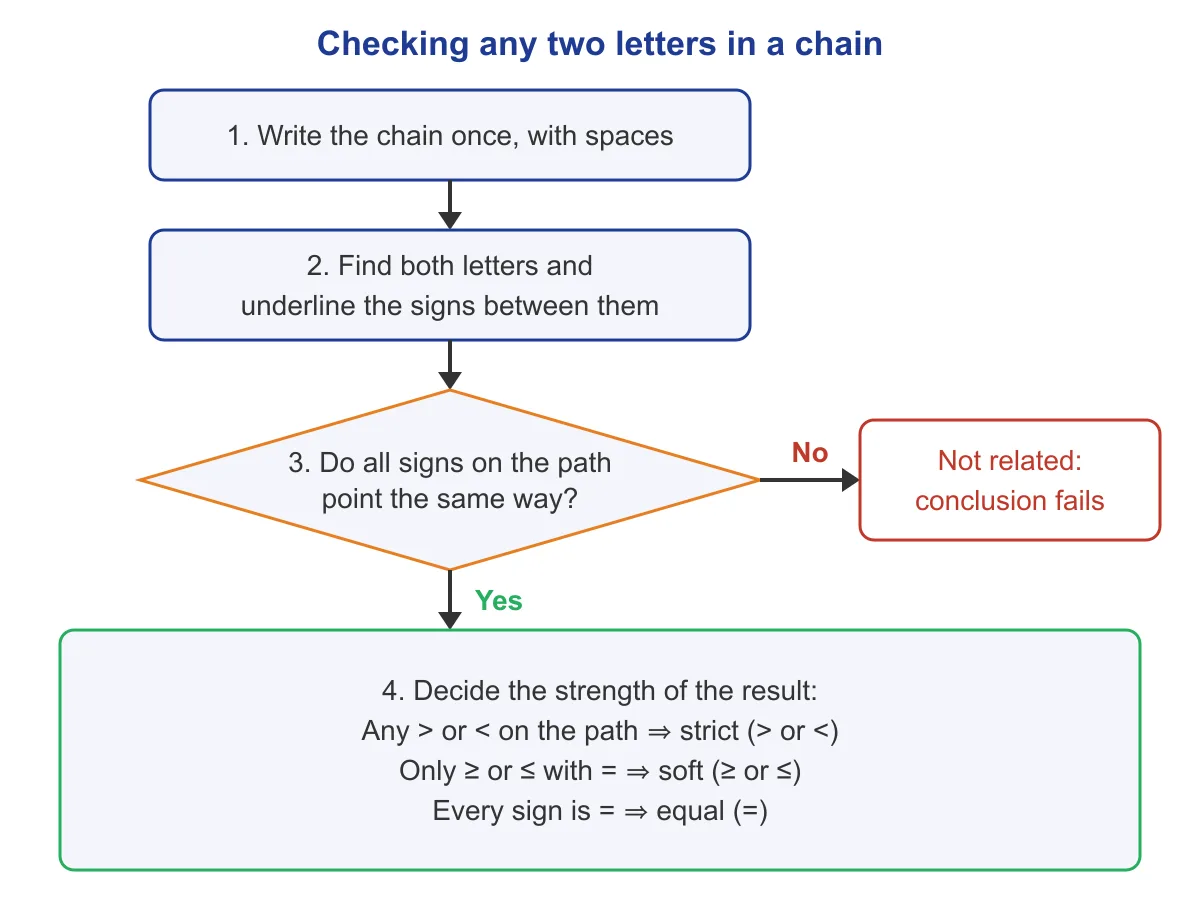
In an exam chain of five or six letters, you only ever look at the signs between the two letters asked about. Signs outside that stretch do not matter.
Example 4: Statement: J ≥ K = L > M ≤ N < O. Find the relations for (i) J and M, (ii) K and O, (iii) L and N, (iv) M and O.
(i) J to M: ≥, =, >. All "left bigger", one strict sign. J > M.
(ii) K to O: =, >, ≤, <. The > says left bigger; the ≤ and < say left smaller. Opposite. Not related.
(iii) L to N: >, ≤. Opposite. Not related.
(iv) M to O: ≤, <. Same way, one strict. M < O, which you may also write O > M.
Why: only the stretch between the two letters is checked; the rest of the chain is ignored.
Example 5: Statement: S = T ≥ U = V. Which of these is definitely true: S > V, S ≥ V, S = V?
Path S to V: =, ≥, =. Same way. No strict sign. Not all signs are =.
Strongest result: S ≥ V.
S > V fails because S, T, U, V could all be 4. S = V fails because T could be 6 and U be 2.
Answer: only S ≥ V.
Why: a soft sign on the path allows equality and a gap, so neither > nor = is forced.
In the exam you only need the path rule. Keep number-testing for practice, until you trust the rule.
Notation habits for rough work
Small habits in the margin of your question paper save more time than any shortcut.
- Write the chain once, in one line, with spaces. "A ≥ B = C > D" is easier to scan than "A≥B=C>D". You will look at it three or four times.
- Underline the path. When checking A and D, draw a line under the stretch from A to D only. Your eye stops reading signs that do not matter.
- Circle any opposite sign. The moment you see a sign facing the other way on the path, circle it and write "NL" (no link) next to the conclusion. Do not keep reading.
- Mark the strongest result, not every result. Write "A > D" once; you already know A ≥ D follows.
- Reverse conclusions, not the chain. If the chain reads left-bigger and a conclusion says "D < A", rewrite the conclusion as "A > D" to match the chain. Flipping one short conclusion is faster than rewriting a long chain.
- Keep ≥ and > visibly different. In a hurry many students write ≥ so that the lower line disappears. Make the underline long and clear.
- Never write a letter twice in the chain without checking. If a statement repeats a letter (A > B ≥ C, C = A), it gives extra information. Chapter 5 deals with this in detail; for now just notice it.
Common traps
- Reversing the letters of a chain but not the signs → flip every sign when you reverse the order.
- Treating A > B < C as "A > C" because both signs are "greater-looking" → check direction at the shared letter; here they face opposite ways, so no link.
- Thinking ≥ and ≤ together give equality (A ≥ B ≤ C ⇒ A = C) → they point opposite ways, so A and C are not related at all.
- Writing A ≥ C for A ≥ B > C → one strict sign on the path makes the result strict: A > C.
- Accepting A > C from A ≥ B ≥ C → no strict sign on the path, so only A ≥ C is definite.
- Accepting A = C from A ≥ B = C → equality needs every sign on the path to be =.
- Reading signs outside the path between the two letters → only the stretch between them counts.
- Deciding A ≠ B ≠ C gives A ≠ C → A and C could be equal; ≠ only carries through an = sign.
- Rejecting a weaker conclusion that is true (A ≥ C when the path gives A > C) → a stronger result always includes the weaker one in the same direction.
Quick revision
- Six symbols: >, <, ≥, ≤, =, ≠. Strict signs allow one case; ≥ and ≤ allow two.
- "Not less than" = ≥; "not greater than" = ≤; "at least" = ≥; "at most" = ≤.
- A chain links only neighbouring letters; any other pair must be worked out.
- To reverse a chain, reverse the letters and flip every sign; = and ≠ stay as they are.
- "Definitely true" means true for every set of numbers that fits the statement.
- Two letters are related only if every sign on the path between them points the same way.
- One opposite sign on the path breaks the link: the letters are not related.
- Same direction with at least one > or < on the path gives a strict result.
- Same direction with only ≥/≤ and = gives ≥ or ≤.
- The result is = only when every sign on the path is =.
- The = sign is transparent: look through it.
- A > B also makes A ≥ B true; A ≥ B does not make A > B true.
- ≠ links nothing except through an = sign (A = B ≠ C gives A ≠ C).
- Only the stretch of chain between the two letters matters.
Once these rules feel automatic, move to Chapter 2, where the same checks are applied to the two-conclusion questions you will meet in the exam, then try the Inequality practice set on pareeksha.in to time yourself.
Check yourself
The statement 'P ≤ Q' rules out which of the following?
- P > Q
- P < Q
- P = Q
- Q is 3 more than P
Answer
A. P > Q
P ≤ Q allows P smaller than Q or equal to Q. The only case it removes is P being greater than Q.
Which of the following is the chain 'M > N ≥ O < P' rewritten from right to left?
- P < O ≥ N > M
- P > O ≥ N < M
- P > O ≤ N < M
- P > O ≤ N > M
Answer
C. P > O ≤ N < M
Reverse the letters and flip every sign: O < P becomes P > O, N ≥ O becomes O ≤ N, M > N becomes N < M. So P > O ≤ N < M.
If A > B > C, which of the following is definitely FALSE?
- A > C
- A ≥ C
- C < A
- C ≥ A
Answer
D. C ≥ A
Both signs point the same way and are strict, so A > C. Hence A ≥ C and C < A are true, and C ≥ A is false.
In the chain 'A = B > C', which sign gives the strongest definite relation in 'A ? C'?
- >
- ≥
- =
- No definite relation
Answer
A. >
= is transparent, so A = B > C reduces to A > C. A ≥ C is also true but weaker; > is the strongest.
Which pair of signs, used as 'A ? B' and 'B ? C', leaves A and C NOT related?
- ≥ and ≤
- > and ≥
- ≤ and <
- = and <
Answer
A. ≥ and ≤
≥ says A is not below B; ≤ says B is not above C, i.e. C is not below B. Both A and C are at least B, so either may be larger. The other pairs all point the same way.
If K ≤ L = M, which of the following is definitely true?
- K < M
- K ≤ M
- K = M
- K > M
Answer
B. K ≤ M
Path K to M: ≤, =. Same direction, no strict sign, not all =. So only K ≤ M is definite; K could equal M or be smaller.
The statement 'X ≠ Y' allows which of the following?
- Only X > Y
- X > Y or X < Y, but not X = Y
- Only X < Y
- Only X = Y
Answer
B. X > Y or X < Y, but not X = Y
≠ rules out only equality. X may be greater or smaller than Y.
In the chain 'A ≥ B = C > D ≤ E', which pair of elements is NOT related?
- A and D
- B and D
- A and C
- C and E
Answer
D. C and E
C to E: >, ≤ point opposite ways, so no link. A to D: ≥, =, > gives A > D; B to D: =, > gives B > D; A to C: ≥, = gives A ≥ C.
In the chain 'P < Q ≤ R = S', which is the strongest definite relation between P and S?
- P ≤ S
- P < S
- P = S
- Cannot be determined
Answer
B. P < S
Path P to S: <, ≤, =. Same direction with one strict sign, so P < S. P ≤ S is true but weaker.
Statement: G > H ≥ I = J < K Conclusions: I. G > J II. H > K
- if only conclusion I follows
- if only conclusion II follows
- if either conclusion I or II follows
- if neither conclusion I nor II follows
- if both conclusions I and II follow
Answer
A. if only conclusion I follows
I: G > H ≥ I = J, same direction with one strict sign, so G > J follows. II: H ≥ I = J < K has ≥ and < facing opposite ways, so H and K are not related.
Statement: R ≤ S < T ≤ U = V Conclusions: I. V > R II. U ≥ S
- if only conclusion I follows
- if only conclusion II follows
- if either conclusion I or II follows
- if neither conclusion I nor II follows
- if both conclusions I and II follow
Answer
E. if both conclusions I and II follow
I: R ≤ S < T ≤ U = V gives R < V, i.e. V > R. II: S < T ≤ U gives S < U, so U > S and hence U ≥ S is true. Both follow.
Statement: W = X ≥ Y > Z Conclusions: I. W > Y II. X > Z
- if only conclusion I follows
- if only conclusion II follows
- if either conclusion I or II follows
- if neither conclusion I nor II follows
- if both conclusions I and II follow
Answer
B. if only conclusion II follows
I: W = X ≥ Y gives only W ≥ Y; W and Y may be equal, so W > Y is not definite. II: X ≥ Y > Z, same direction with a strict sign, gives X > Z.
Statement: B < C > D ≥ E ≤ F Conclusions: I. C ≥ F II. B < E
- if only conclusion I follows
- if only conclusion II follows
- if either conclusion I or II follows
- if neither conclusion I nor II follows
- if both conclusions I and II follow
Answer
D. if neither conclusion I nor II follows
I: C > D ≥ E ≤ F breaks at ≤ (opposite direction), so no relation. II: B < C > D breaks at once. The two conclusions compare different pairs, so either-or cannot apply. Neither follows.
Ravi is taller than Sunil, and Sunil is shorter than Tarun. Which of the following is definitely true?
- Ravi is taller than Tarun
- Tarun is taller than Ravi
- Ravi and Tarun are of the same height
- The relation between Ravi and Tarun cannot be determined
Answer
D. The relation between Ravi and Tarun cannot be determined
Ravi > Sunil < Tarun. Both are taller than Sunil, so the signs face opposite ways and Ravi and Tarun are not related.
If A ≥ B > C, which of the following is POSSIBLE?
- A = C
- A < C
- A = B
- C > B
Answer
C. A = B
≥ allows A to equal B. But A ≥ B > C forces A > C, so A = C and A < C are impossible, and B > C rules out C > B.
Which of the following chains makes 'M > Q' definitely true?
- M ≥ N = P > Q
- M > N < P > Q
- M ≥ N ≥ P ≥ Q
- M = N ≤ P > Q
Answer
A. M ≥ N = P > Q
M ≥ N = P > Q: same direction with a strict sign, so M > Q. Options B and D break at an opposite sign; option C gives only M ≥ Q.
Statement: P ≥ Q > R ≤ S = T ≥ U Conclusions: I. T > R II. Q ≥ U
- if only conclusion I follows
- if only conclusion II follows
- if either conclusion I or II follows
- if neither conclusion I nor II follows
- if both conclusions I and II follow
Answer
D. if neither conclusion I nor II follows
I: R ≤ S = T gives T ≥ R only; T may equal R, so T > R is not definite. II: Q > R ≤ S breaks at the opposite sign, so Q and U are not related. Different pairs, so not either-or. Neither follows.
If A ≤ B ≤ C and C ≤ A, which of the following is definitely true?
- A < C
- A = B = C
- B > A
- No definite relation between A and B
Answer
B. A = B = C
A ≤ B ≤ C gives A ≤ C; with C ≤ A, A must equal C. Then A ≤ B ≤ A forces B = A. So A = B = C.
Which set of values is consistent with 'X > Y ≤ Z'?
- X = 5, Y = 6, Z = 7
- X = 3, Y = 3, Z = 4
- X = 2, Y = 1, Z = 9
- X = 8, Y = 4, Z = 3
Answer
C. X = 2, Y = 1, Z = 9
2 > 1 and 1 ≤ 9 both hold. Option A fails X > Y (5 < 6), option B fails X > Y (3 = 3), option D fails Y ≤ Z (4 > 3).
In the chain 'J > K ≥ L = M ≤ N < O', how many of the following are definitely true? J > M; K ≥ M; O > M; N > L
- 1
- 2
- 3
- 4
Answer
C. 3
J > K ≥ L = M gives J > M (true). K ≥ L = M gives K ≥ M (true). M ≤ N < O gives O > M (true). L = M ≤ N gives only N ≥ L, so N > L is not definite. Three are true.