Either–Or (Complementary Pair) Conclusions
Why this option exists at all
Every direct inequality question in bank prelims ends with the same five choices: only I follows, only II follows, either I or II follows, neither follows, both follow. Four of them are easy to understand. The third one, "either I or II follows", is the option most students mark wrongly, in both directions. Some mark it whenever two conclusions look like opposites. Others never mark it because they are not sure when it applies.
In a typical IBPS or SBI prelims paper you will see around three to five inequality questions, and on most days at least one of them is built around this option. So it is worth learning the rule exactly, once, and then applying it like a checklist.
Here is the plain meaning. "Either I or II follows" says: I cannot tell you which one is true, but I can promise you that one of them must be true. The statement does not fix the relation between the two elements. Yet the two conclusions, taken together, leave no room for any other possibility. Whatever the real values are, exactly one of the two conclusions will turn out to be correct.
Think of a cricket match where all you know is that India did not lose. You cannot say India won, and you cannot say it was a draw. But you can say with full confidence: either India won or the match was drawn. One of the two must be true. That is the spirit of either–or: two outcomes that never happen together and between them leave nothing out.
The full set of possibilities between two elements
Before you can judge whether two conclusions "cover everything", you need to know what "everything" is. Between any two elements A and B, there are only three possible relations:
- A > B (A is bigger)
- A = B (they are equal)
- A < B (A is smaller)
Every other sign is a combination of these three. A ≥ B means "case 1 or case 2". A ≤ B means "case 2 or case 3". So when the statement leaves A and B unrelated, all three cases are open. When the statement gives A ≥ B, only cases 1 and 2 are open. When it gives A > B, only case 1 is open, and the matter is settled.
A complementary pair is two conclusions about the same two elements such that:
- they share no case (they cannot both be true together), and
- between them they include every case the statement still allows.
That is the whole idea. Everything else in this chapter is that idea applied carefully.
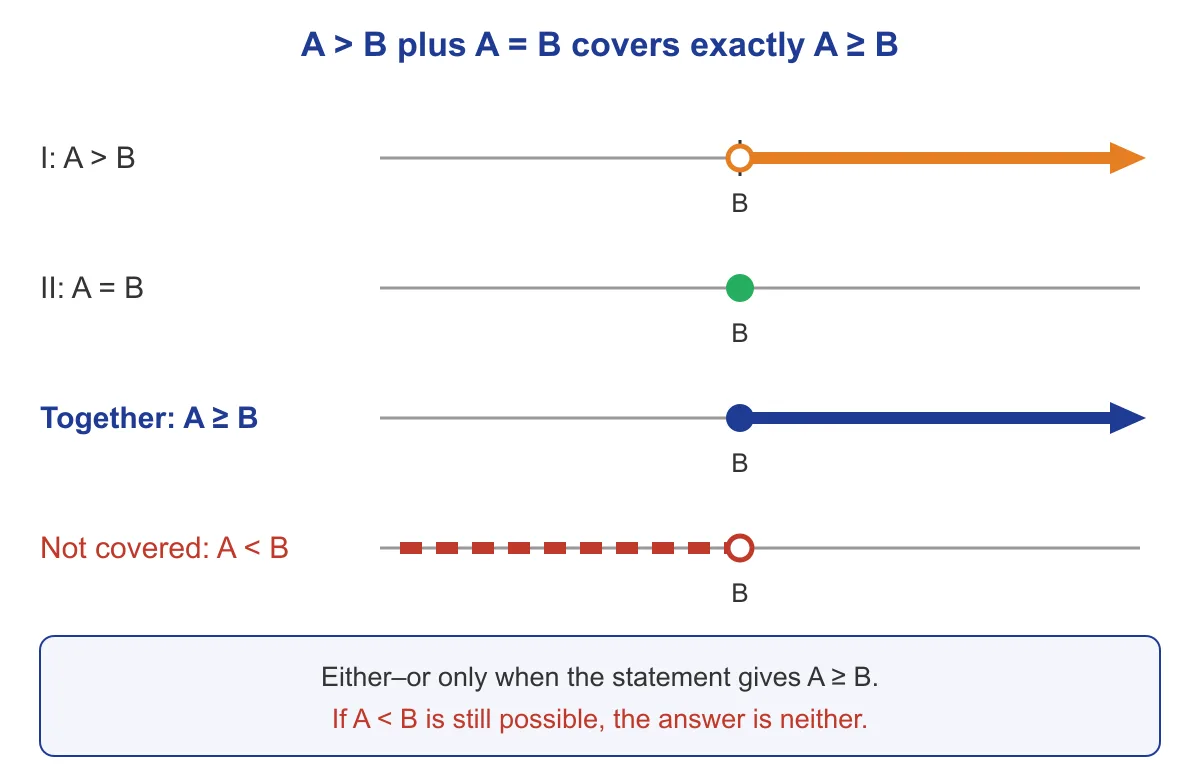
The valid complementary pairs
There are two families of valid pairs. Learn both; the exam uses both.
Family 1: splitting a soft sign
If the statement gives A ≥ B, the truth is either A > B or A = B, and you cannot tell which. So the pair "I: A > B, II: A = B" fits perfectly: neither follows alone, they never overlap, and together they make exactly A ≥ B. The same works on the other side: if the statement gives A ≤ B, the pair "A < B and A = B" is complementary.
The catch: this family only covers half the number line. A > B with A = B covers the right half and the point; it never covers A < B. So it is complementary only when the statement itself rules out A < B, that is, when the path between A and B gives A ≥ B. If the statement gives A ≤ B, or leaves A and B unrelated, the left half is still open and the pair is incomplete.
Family 2: a sign and its exact opposite
The other family is a conclusion together with its exact negation:
- A > B together with A ≤ B
- A < B together with A ≥ B
These two pairs cover all three cases every time, whatever the statement says. A > B takes case 1; A ≤ B takes cases 2 and 3. No overlap, nothing left out. So if neither conclusion follows on its own, "either" is the answer, whether the elements are linked by a soft sign or not linked at all.
Memory trick: "Flip the arrow, toggle the bar." The opposite of > is ≤ (arrow flipped, bar added). The opposite of ≥ is < (arrow flipped, bar removed). Use it to test any pair from Family 2 in one glance.
| Pair of conclusions | Cases covered | When it is a valid either–or pair |
|---|---|---|
| A > B and A = B | A > B, A = B | Only when the statement gives A ≥ B |
| A < B and A = B | A < B, A = B | Only when the statement gives A ≤ B |
| A > B and A ≤ B | all three | Whenever neither follows alone |
| A < B and A ≥ B | all three | Whenever neither follows alone |
Reading conclusions written the other way round
Examiners love to write one conclusion back to front. "I: P > Q, II: Q ≥ P" looks like two unrelated ideas. Rewrite II from P's side: Q ≥ P is the same as P ≤ Q. Now the pair is P > Q and P ≤ Q, which is Family 2. Always rewrite both conclusions so that the same element sits on the left before you compare signs.
The three-yes test
You do not need to think about families in the exam hall. Run three questions, in this order, and stop at the first "no".
- NO-NO: Does I fail to follow, and does II also fail to follow? If either one follows definitely, the answer is "only I", "only II" or "both". Either–or is dead.
- SAME PAIR: Are both conclusions about the same two elements? A > C and B = C talk about different pairs; that is never either–or.
- FULL COVER: Rewritten with the same element on the left, do the two signs share no case and between them cover every case the statement still allows? If yes, either follows. If no, neither follows.
Memory trick: "Either–Or needs three yeses: NO-NO, SAME PAIR, FULL COVER." Say it under your breath as you tick the three checks. One "no" anywhere and the answer is not either.
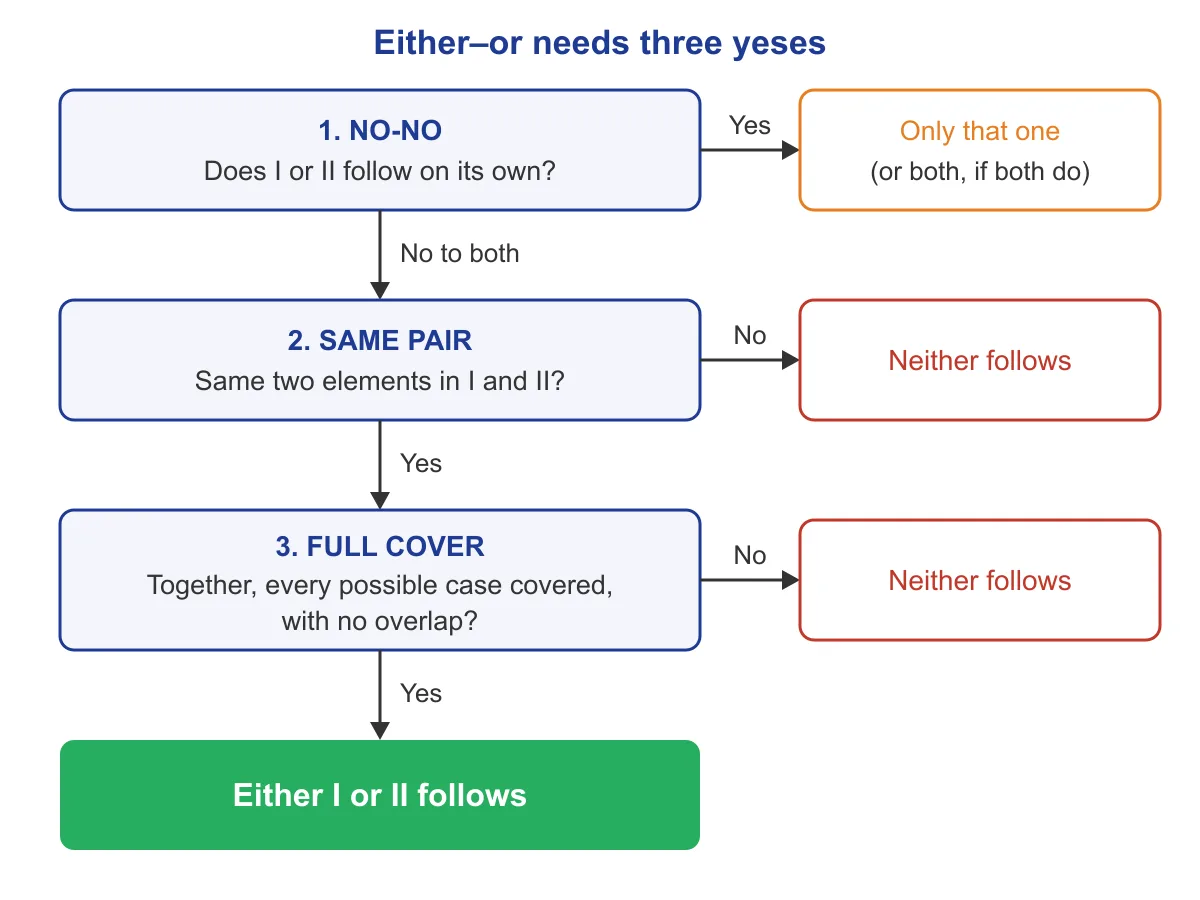
The order matters. Students who start with "do these look like opposites?" skip step 1 and mark either–or when one conclusion actually follows. That is the single biggest source of lost marks in this question type.
Pairs that look complementary but are not
Most wrong answers come from pairs that feel like opposites. Check each one against the three cases.
| Pair (same two elements) | What goes wrong | Correct answer if neither follows alone |
|---|---|---|
| A > B and A < B | The case A = B is left out | Neither |
| A ≥ B and A ≤ B | Both are true when A = B, so they overlap | Neither (exam convention) |
| A > B and A ≥ B | Overlap, and A < B left out | Neither |
| A > B and A = B, statement gives A ≤ B or no relation | A < B is still possible and not covered | Neither |
| A > B and C ≤ B | Different pairs of elements | Neither |
The first row is the classic trap. "Greater" and "smaller" sound like opposites in everyday speech, but in this topic "equal" is a separate, third case. If the elements are unrelated, A could equal B, and then both conclusions are false. An either–or answer would be promising something the statement cannot guarantee.
The second row deserves a word. A ≥ B and A ≤ B do cover all three cases, but when A = B both are true at once. In the exam pattern, either–or is reserved for pairs where exactly one is true, so the standard key treats this pair as not complementary. Mark "neither" unless one of them follows on its own.
The fourth row catches students who memorised "> and = make either" without the condition. Suppose the path gives A ≤ B. Then A > B is definitely false, A = B is only possible, and A < B, which is very much possible, belongs to neither conclusion. The pair fails FULL COVER.
When one conclusion follows, and when nothing is related
Two situations come up again and again around this option.
One member of a pair follows. Take the statement A > B and the conclusions "I: A > B, II: A ≤ B". The pair is perfectly complementary, but I is definitely true. When one conclusion is definite, its partner is definitely false, and the right answer is "only I follows". Either–or means you do not know which; here you do know.
The two elements are not related at all. This happens when the path between them has signs facing opposite ways, as in A > B < C. Nothing can be said about A and C. Both conclusions fail individually, so you move to the rest of the test. If the pair is from Family 2 (like A > C with A ≤ C), it covers all three cases, and the answer is either. If the pair is A > C with A < C, or A > C with A = C, some case is missing and the answer is neither.
In short, unrelated elements are the natural home of Family 2 pairs, and a soft sign (≥ or ≤) on the path is the natural home of Family 1 pairs.
Worked examples
Example 1: Statement: M ≥ N = O > P. Conclusions: I. M > O II. M = O
Path M to O: M ≥ N = O. Signs ≥ and =, both "not smaller" in direction, no strict sign. So M ≥ O.
I (M > O): not definite, M could equal O. II (M = O): not definite, M could be bigger.
Same pair (M, O). > and = together make ≥, which is exactly what the statement allows.
Answer: either I or II follows. Why: a Family 1 pair on a ≥ path.
Example 2: Statement: K < L ≤ M = N ≥ J. Conclusions: I. N > L II. L = N
Path L to N: L ≤ M = N, so L ≤ N, which is N ≥ L read from N's side.
I (N > L): not definite. II (L = N, same as N = L): not definite.
Same pair. With N on the left: N > L and N = L, together N ≥ L. Full cover.
Answer: either I or II follows. Why: rewrite both from N's side and the Family 1 pair appears.
Example 3: Statement: A > B < C ≥ D. Conclusions: I. A > C II. A ≤ C
Path A to C: A > B < C. The signs face opposite ways, so A and C are not related.
I: not definite. II: not definite.
Same pair. > and ≤ are exact opposites: all three cases covered, no overlap.
Answer: either I or II follows. Why: unrelated elements plus a Family 2 pair.
Example 4: Statement: R ≥ S > T ≥ U. Conclusions: I. R > U II. R ≤ U
Path R to U: ≥, >, ≥ all point the same way, with one strict sign, so R > U.
I follows definitely. II is then definitely false.
Answer: only I follows. Why: NO-NO fails at step 1, so either–or is not even considered.
Example 5: Statement: E > F ≤ G > H. Conclusions: I. E > G II. E < G
Path E to G: E > F ≤ G. Opposite directions, so E and G are unrelated.
I and II both not definite. Same pair.
The pair > and < leaves out E = G. If E = G, both conclusions are false.
Answer: neither I nor II follows. Why: the pair fails FULL COVER.
Example 6: Statement: G ≥ H > I ≤ J. Conclusions: I. G = H II. J > I
I: G ≥ H, so G = H is not definite. II: I ≤ J, so J > I is not definite.
I is about (G, H); II is about (I, J). Different pairs.
Answer: neither I nor II follows. Why: fails SAME PAIR; both could be false together (G > H and J = I).
Example 7: Statement: T < U ≥ V = W. Conclusions: I. T ≥ W II. W > T
Path T to W: T < U ≥ V. Opposite directions, unrelated.
Rewrite II with T on the left: W > T is T < W.
Pair is T ≥ W and T < W: flip the arrow, toggle the bar, exact opposites.
Answer: either I or II follows. Why: the reversed conclusion hid a Family 2 pair.
Example 8: Statement: P ≤ Q = R < S. Conclusions: I. P > R II. P = R
Path P to R: P ≤ Q = R, so P ≤ R.
I (P > R): definitely false. II (P = R): possible, not definite.
Same pair, but > and = cover only P ≥ R. The statement allows P < R, which neither conclusion covers.
Answer: neither I nor II follows. Why: a Family 1 pair needs a ≥ path, and this path is ≤.
Example 9: Statement: C ≤ D ≥ E. Conclusions: I. C ≥ E II. C ≤ E
Path C to E: C ≤ D ≥ E. Opposite directions, unrelated. Neither follows alone. Same pair.
But if C = E, both conclusions would be true together: the pair overlaps.
Answer: neither I nor II follows. Why: the exam pattern needs pairs that cannot both be true.
Example 10: Statement: H = J ≥ K > L. Conclusions: I. L < J II. L ≥ H
I: path L to J is L < K ≤ J, so L < J. Follows.
II: path L to H is L < K ≤ J = H, so L < H. L ≥ H is definitely false.
The pair (L < J, L ≥ H) looks like Family 2 and, since H = J, it really is about one comparison. But I follows.
Answer: only I follows. Why: step 1 decides it before any either–or thinking.
Once these ten patterns feel routine, try the Inequalities practice set on Pareeksha and time yourself: an either–or question should take no longer than a plain direct one, about 30 to 40 seconds.
Common traps
- Marking either because the two signs "look opposite" (> and <) → check whether = is covered; with > and < it never is.
- Checking FULL COVER before checking whether one conclusion follows → always run NO-NO first; a definite conclusion means "only that one".
- Comparing signs without rewriting a reversed conclusion (Q ≥ P next to P > Q) → put the same element on the left in both, then compare.
- Using "> with =" as either–or when the elements are unrelated → that pair needs a ≥ path; without it, A < B is uncovered and the answer is neither.
- Using "< with =" when the path gives ≥ → the pair is on the wrong side; mark neither (or only one, if one follows).
- Treating ≥ and ≤ as a complementary pair → they overlap at =; the standard answer is neither.
- Pairing conclusions about different elements (A > B with C = B) → either–or needs the same two letters in both conclusions.
- Forgetting that a complementary pair can still have a definite member → if the statement gives A > B, the pair (A > B, A ≤ B) gives "only I".
Quick revision
- Between two elements there are exactly three cases: >, = and <.
- Either–or means one of the two conclusions must be true, but the statement cannot tell you which.
- The three-yes test: NO-NO (neither follows alone), SAME PAIR, FULL COVER.
- Run the test in that order and stop at the first "no".
- Family 1: > with = is either–or only when the path gives ≥.
- Family 1: < with = is either–or only when the path gives ≤.
- Family 2: > with ≤, and < with ≥, are exact opposites and cover every case.
- Exact opposite of a sign: flip the arrow, toggle the bar.
- > with < is never complementary; it misses =.
- ≥ with ≤ is not treated as complementary; both are true when the elements are equal.
- If one conclusion of a complementary pair follows, the answer is "only that one".
- Unrelated elements (opposite signs on the path) are where Family 2 pairs give either.
- Rewrite reversed conclusions (Q ≥ P → P ≤ Q) before comparing signs.
- Different pairs of elements can never give either–or.
Check yourself
Nothing is known about how P and Q compare. Which pair of conclusions forms a valid either–or (complementary) pair?
- P > Q and P < Q
- P ≥ Q and P > Q
- P > Q and P ≤ Q
- P = Q and P ≥ Q
Answer
C. P > Q and P ≤ Q
P > Q takes the case 'bigger'; P ≤ Q takes 'equal' and 'smaller'. No overlap and all three cases covered. P > Q with P < Q misses P = Q; the other two pairs overlap.
A statement leaves A and B unrelated. The conclusions are I. A > B and II. A < B. Why is 'either I or II follows' wrong?
- The conclusions are about different elements
- Together they leave out the case A = B
- Both conclusions follow definitely
- Conclusion I follows on its own
Answer
B. Together they leave out the case A = B
Between A and B there are three cases: >, =, <. The pair covers only > and <; if A = B both are false, so neither follows.
Statement: M ≥ N > O. Conclusions: I. M > N II. M = N. Give answer:
- if only conclusion I follows
- if only conclusion II follows
- if either conclusion I or II follows
- if neither conclusion I nor II follows
- if both conclusions I and II follow
Answer
C. if either conclusion I or II follows
M ≥ N is given directly, so neither M > N nor M = N is definite. Same pair, and > with = together make exactly M ≥ N: either follows.
Statement: D < E ≤ F = G. Conclusions: I. D < G II. D ≥ G. Give answer:
- if only conclusion I follows
- if only conclusion II follows
- if either conclusion I or II follows
- if neither conclusion I nor II follows
- if both conclusions I and II follow
Answer
A. if only conclusion I follows
D < E ≤ F = G: all signs face the same way with one strict sign, so D < G. I follows, and II (its opposite) is definitely false: only I.
Statement: H > I < J. Conclusions: I. H > J II. H < J. Give answer:
- if only conclusion I follows
- if only conclusion II follows
- if either conclusion I or II follows
- if neither conclusion I nor II follows
- if both conclusions I and II follow
Answer
D. if neither conclusion I nor II follows
H > I < J: opposite directions, so H and J are unrelated. Neither follows alone, and > with < leaves out H = J, so the pair is not complementary: neither.
Statement: R ≤ S = T ≤ U. Conclusions: I. U > R II. U = R. Give answer:
- if only conclusion I follows
- if only conclusion II follows
- if either conclusion I or II follows
- if neither conclusion I nor II follows
- if both conclusions I and II follow
Answer
C. if either conclusion I or II follows
R ≤ S = T ≤ U gives R ≤ U, i.e. U ≥ R. U > R and U = R are each only possible, and together they make exactly U ≥ R: either follows.
Statement: K > L ≥ M = N < O. Conclusions: I. K > N II. O > M. Give answer:
- if only conclusion I follows
- if only conclusion II follows
- if either conclusion I or II follows
- if neither conclusion I nor II follows
- if both conclusions I and II follow
Answer
E. if both conclusions I and II follow
K > L ≥ M = N gives K > N (same direction, strict sign present). M = N < O gives M < O, i.e. O > M. Both follow.
Statement: V > W ≥ X = Y. Conclusions: I. W > Y II. V > Y. Give answer:
- if only conclusion I follows
- if only conclusion II follows
- if either conclusion I or II follows
- if neither conclusion I nor II follows
- if both conclusions I and II follow
Answer
B. if only conclusion II follows
W ≥ X = Y gives only W ≥ Y, so W > Y is not definite. V > W ≥ X = Y gives V > Y. Only II follows.
Statement: A ≥ B = C > D ≤ E. Conclusions: I. A > D II. C ≥ D. Give answer:
- if only conclusion I follows
- if only conclusion II follows
- if either conclusion I or II follows
- if neither conclusion I nor II follows
- if both conclusions I and II follow
Answer
E. if both conclusions I and II follow
A ≥ B = C > D gives A > D. C > D is given, and C > D makes C ≥ D true as well. Both follow.
Statement: P ≥ Q > R ≤ S. Conclusions: I. P = Q II. S > R. Give answer:
- if only conclusion I follows
- if only conclusion II follows
- if either conclusion I or II follows
- if neither conclusion I nor II follows
- if both conclusions I and II follow
Answer
D. if neither conclusion I nor II follows
P ≥ Q makes P = Q only possible; R ≤ S makes S > R only possible. The conclusions are about different pairs (P, Q) and (R, S), so they cannot be either–or: neither.
Statement: F ≤ G = H < J. Conclusions: I. F > H II. F = H. Give answer:
- if only conclusion I follows
- if only conclusion II follows
- if either conclusion I or II follows
- if neither conclusion I nor II follows
- if both conclusions I and II follow
Answer
D. if neither conclusion I nor II follows
F ≤ G = H gives F ≤ H. I is definitely false; II is only possible. The pair > and = covers only F ≥ H, but F < H is still possible, so it is not complementary here: neither.
Statement: L = M ≥ N > O. Conclusions: I. O ≥ L II. L > O. Give answer:
- if only conclusion I follows
- if only conclusion II follows
- if either conclusion I or II follows
- if neither conclusion I nor II follows
- if both conclusions I and II follow
Answer
B. if only conclusion II follows
L = M ≥ N > O gives L > O, so II follows and I (O ≥ L, i.e. L ≤ O) is definitely false. The pair looks complementary, but one member is definite: only II.
Statement: S ≥ T < U = V ≥ W. Conclusions: I. V > S II. S ≥ V. Give answer:
- if only conclusion I follows
- if only conclusion II follows
- if either conclusion I or II follows
- if neither conclusion I nor II follows
- if both conclusions I and II follow
Answer
C. if either conclusion I or II follows
S ≥ T < U: opposite directions, so S and V are unrelated. Rewrite I as S < V. S < V and S ≥ V are exact opposites covering every case, and neither follows alone: either.
Statement: B ≤ C ≥ D = E > F. Conclusions: I. F < C II. B > F. Give answer:
- if only conclusion I follows
- if only conclusion II follows
- if either conclusion I or II follows
- if neither conclusion I nor II follows
- if both conclusions I and II follow
Answer
A. if only conclusion I follows
C ≥ D = E > F gives C > F, i.e. F < C: I follows. B ≤ C ≥ D has opposite directions, so B and F are unrelated and II is not definite. Only I.
Statement: X < Y ≤ Z = K ≥ R. Conclusions: I. Y = K II. K > X. Give answer:
- if only conclusion I follows
- if only conclusion II follows
- if either conclusion I or II follows
- if neither conclusion I nor II follows
- if both conclusions I and II follow
Answer
B. if only conclusion II follows
Y ≤ Z = K gives Y ≤ K, so Y = K is not definite. X < Y ≤ Z = K gives X < K, i.e. K > X. Only II follows.
Statement: G ≥ H < I = J. Conclusions: I. G > J II. G ≤ J. Give answer:
- if only conclusion I follows
- if only conclusion II follows
- if either conclusion I or II follows
- if neither conclusion I nor II follows
- if both conclusions I and II follow
Answer
C. if either conclusion I or II follows
G ≥ H < I: opposite directions, so G and J are unrelated. G > J and G ≤ J are exact opposites (flip the arrow, add the bar) covering all cases, and neither follows alone: either.
For the answer 'either conclusion I or II follows', which of the following is NOT a required condition?
- At least one of the two conclusions must follow on its own
- Both conclusions must be about the same two elements
- Neither conclusion should follow on its own
- Together the two conclusions must cover every possible case without overlap
Answer
A. At least one of the two conclusions must follow on its own
Either–or needs: neither follows alone, same two elements, and full cover without overlap. If one conclusion follows on its own, the answer is 'only that one', not either.
A statement gives A ≥ B and nothing more about A and B. Which pair of conclusions gives the answer 'either I or II follows'?
- A > B and A < B
- A ≥ B and A = B
- A < B and A = B
- A > B and A = B
Answer
D. A > B and A = B
A ≥ B means A > B or A = B, and neither is definite; together they cover exactly A ≥ B. In option B, A ≥ B itself follows; options A and C include A < B, which is false here and leave a case uncovered.
Statement: N ≥ O = P > Q < R. Conclusions: I. Q < N II. R ≤ N. Give answer:
- if only conclusion I follows
- if only conclusion II follows
- if either conclusion I or II follows
- if neither conclusion I nor II follows
- if both conclusions I and II follow
Answer
A. if only conclusion I follows
N ≥ O = P > Q gives N > Q, i.e. Q < N: I follows. N > Q < R has opposite directions, so N and R are unrelated and II is not definite. Only I.
Statement: T ≥ U > V = W ≤ X. Conclusions: I. T > W II. X ≥ V. Give answer:
- if only conclusion I follows
- if only conclusion II follows
- if either conclusion I or II follows
- if neither conclusion I nor II follows
- if both conclusions I and II follow
Answer
E. if both conclusions I and II follow
T ≥ U > V = W gives T > W (strict sign on the path). V = W ≤ X gives V ≤ X, i.e. X ≥ V. Both follow.