Exam Strategy and Full Practice
You now know every rule this topic needs. This last chapter is about using those rules under a clock. In an IBPS or SBI prelims reasoning section, an inequality set is usually the cheapest marks on the paper: three to five questions that a prepared student can finish in about three minutes. The same set, attempted carelessly, also produces the most negative marking, because every option looks "almost right". So the aim here is speed with zero guessing.
Time budget, order of attack and when to skip
Plan for 30 to 40 seconds per inequality question. That is not a target you hit by rushing; you hit it by doing the same four checks in the same order every time, so there is nothing to decide while the clock runs.
How the 30–40 seconds splits for a normal two-conclusion question:
- 5–10 seconds: read the statement and write it as one chain in rough work (join statements at the shared letter).
- 10 seconds each: check conclusion I, then conclusion II, by tracing the path between the two letters.
- 5 seconds: if neither follows, run the either-or test; then mark.
Coded questions get a one-time cost. When five questions share one key, spend about 20 seconds writing the key once at the top of your rough sheet (@ = >, # = < and so on). After that, each coded question costs the same as a direct one. Students who decode the key fresh in every question lose a full minute over the set.
The order of attack inside a section:
- Do direct-inequality questions first. They take the least time and settle your rhythm.
- Then the coded set, after writing the key once.
- Then missing-sign and "which expression makes it true" questions. These have five options to test, so they take the longest, about 40–50 seconds.
- Skip any question that crosses 60 seconds. Mark it for review and move on; one stuck question should not cost you two easy puzzles elsewhere.
When to skip outright: if you cannot write the statement as a chain (three statements that share no common letter, or a code you cannot pin down), leave it for the end. In practice this is rare in prelims, which is why inequality should be one of the first topics you open.
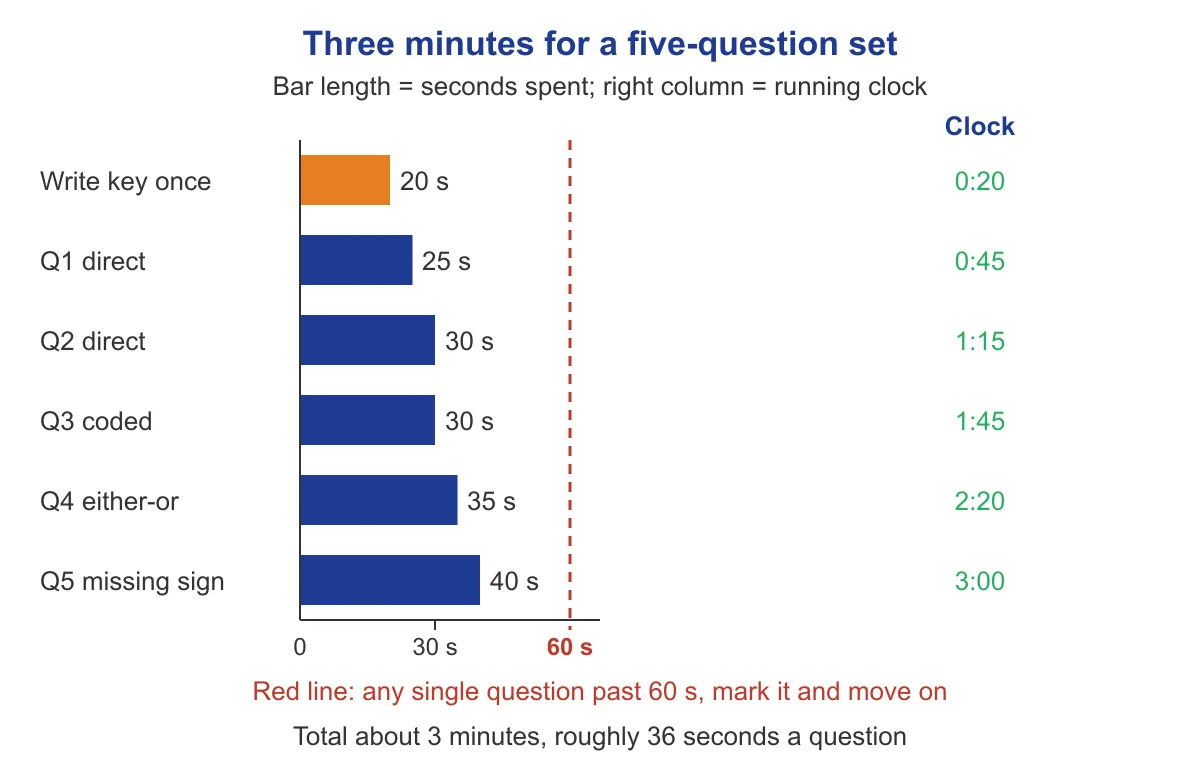
Memory trick: "Thirty-forty, sixty-skip." Thirty to forty seconds is a normal question; if the stopwatch in your head reaches sixty, mark it and leave.
The one-page solve sheet
Everything from the first five chapters fits on one page. Read this table slowly once, then use Figure 6.1 as the version you keep in your head.
| Step | What you do | Rule to apply |
|---|---|---|
| 1. Decode | If the question uses a code, rewrite the statement and the conclusions with real signs | "Not" flips and adds the equal: not greater than → ≤, not less than → ≥; "neither greater nor equal" → <; "neither smaller nor greater" → = |
| 2. Path | Write all statements as one chain, joined at the shared letter (the hinge); find the path between the two letters in the conclusion | Read left to right or right to left; reversing a chain reverses every sign |
| 3. Direction | Check every sign on the path | All signs must point the same way (= counts as transparent); one opposite sign breaks the link |
| 4. Strength | Work out the relation you actually have | Any > on the path makes it strict (>); all = gives =; otherwise ≥ |
| 5. Compare | Match your relation with the conclusion's sign | > supports > (and ≠); ≥ supports only ≥; = supports =, ≥ and ≤ |
| 6. Either-or | Only if neither conclusion follows alone | Same two letters in both; together they cover every case (> with ≤, < with ≥, = with ≠, or > and = when the relation is ≥) |
Missing-sign and conditional questions use the same steps run backwards: you know the conclusion you want, so you test each option's chain for direction and strength. Eliminate options fast by looking for one wrong-way sign; that kills the option without any further work.
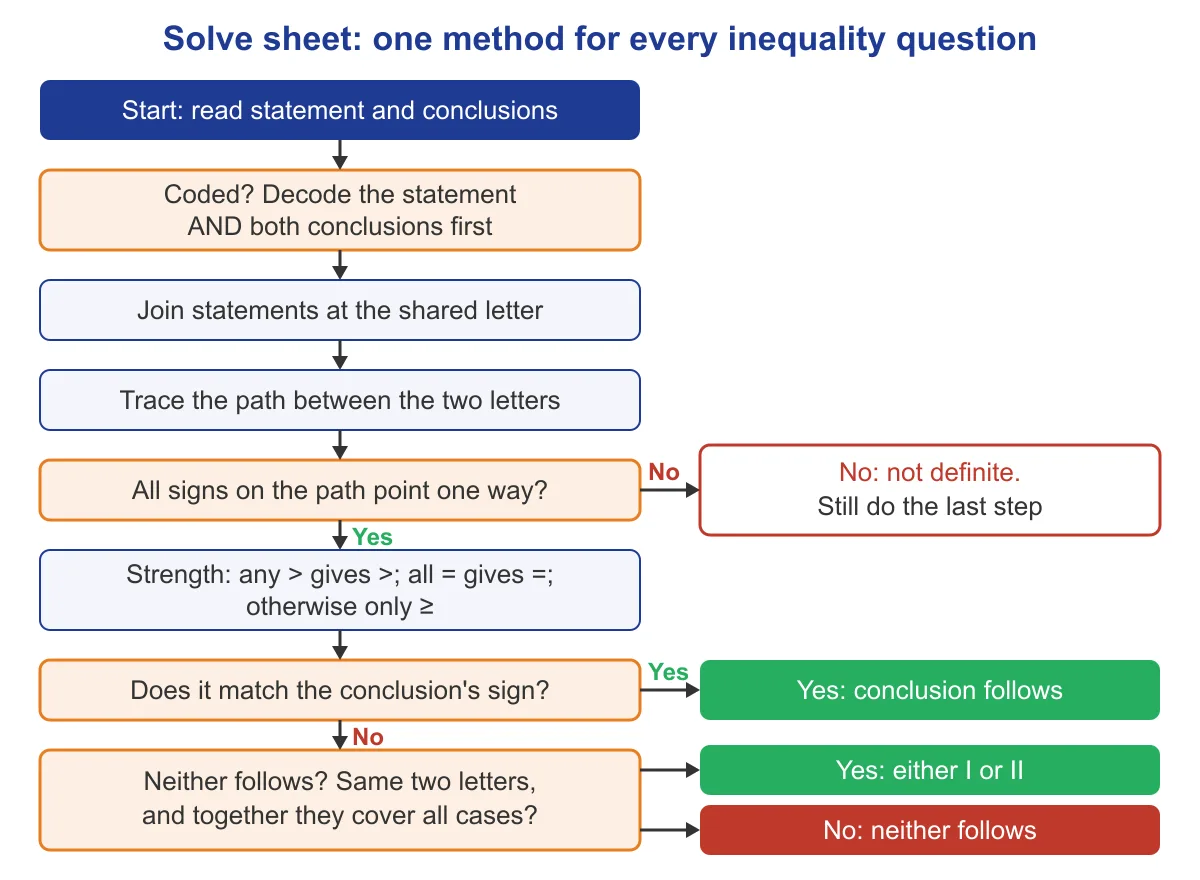
Memory trick: D-P-S-E, "Decode, Path, Strength, Either-or". Say it as "Do Proper Steps Every time". The order matters: never test either-or before you have checked strength, and never trace a path before decoding.
Four worked examples at exam speed
Example 1: Statement: U ≥ V > W = X ≤ Y. Conclusions: I. U > X II. Y > W
Path U to X: U ≥ V > W = X. Signs ≥, >, = all point the same way. One > is present, so U > X. Conclusion I follows.
Path Y to W: read the chain from the right, Y ≥ X = W. Same direction, no strict sign, so Y ≥ W.
Conclusion II says Y > W, which is stronger than Y ≥ W. It does not follow.
Either-or check: the two conclusions use different pairs (U, X and Y, W), so no.
Answer: only conclusion I follows. Why: a strict conclusion needs at least one > on its path.
Example 2: Key: 'A # B' means A is not smaller than B; 'A @ B' means A is neither greater than nor equal to B; 'A $ B' means A is neither greater than nor smaller than B; 'A & B' means A is neither smaller than nor equal to B. Statement: M # N $ O, P @ O. Conclusions: I. M & O II. M $ O
Decode the key once: # is ≥, @ is <, $ is =, & is >.
Statement: M ≥ N = O, P < O. Conclusions: I. M > O II. M = O.
Path M to O: M ≥ N = O gives M ≥ O. Neither M > O nor M = O is certain by itself.
Same two letters, and > together with = covers every case of ≥.
Answer: either I or II follows. Why: the statement allows both, and nothing else.
Example 3: Which signs should replace the question marks, in order, so that 'D < A' is definitely true? A ? B ? C ≥ D. Options: (i) >, ≥ (ii) ≥, = (iii) >, < (iv) =, ≤
Rewrite the target as A > D, so every sign must point the ">" way and at least one must be strict.
(iii) has < and (iv) has ≤: wrong direction, out at once.
(ii) gives A ≥ B = C ≥ D, so only A ≥ D. Not strict, out.
(i) gives A > B ≥ C ≥ D, so A > D.
Answer: option (i). Why: it is the only option with same-direction signs and a strict sign.
Example 4: Statements: R > S, T ≥ S, U = T. Conclusions: I. R > U II. R ≤ U
Join at the hinge S: R > S ≤ T = U.
Path R to U has > and then ≤: opposite directions, so no relation. Neither conclusion follows alone.
Either-or test: same letters R and U. R > U and R ≤ U together cover greater, equal and smaller.
Answer: either I or II follows. Why: either-or does not need a path; it needs a complementary pair with neither proven.
Common traps: the ten costliest mistakes
Almost every wrong answer in an inequality mock comes from one of these ten. Read the "why" column carefully, because the fix only sticks once you see why the mistake felt correct.
| Mistake | Why it happens | Fix |
|---|---|---|
| Decoding the statement but reading conclusions with the code symbols | You relax after the statement looks "done" | Decode both lines before any reasoning; write the decoded conclusions under the chain |
| Linking across an opposite sign (A > B < C, so A > C) | The eye jumps from A to C without checking the middle | Put your pen on each sign of the path; one wrong-way sign ends it |
| Saying A > C from A ≥ B ≥ C | The ≥ signs "look" strong | No > on the path means only ≥; a strict conclusion fails |
| Rejecting A ≥ C when the path gives A = C | ≥ seems to need a "greater" part | = satisfies ≥ and ≤; it follows |
| Marking either-or when one conclusion already follows | Seeing a > / = pair triggers a reflex | Test each conclusion alone first; either-or is only for "neither follows" |
| Marking either-or for a pair like A > B and A < B | The two look like opposites | They miss A = B; the pair must cover every case |
| Marking either-or for two different pairs (A > B, C > D) | Both "do not follow", so the student pairs them | Either-or needs the same two letters in both conclusions |
| Reading a chain backwards without flipping signs | You rewrite the letters but copy the signs | Reversing A > B ≥ C gives C ≤ B < A; every sign turns |
| Missing a hinge letter that appears in two statements | The second statement is written in reverse order | Underline any letter that repeats; that is where the chains join |
| Spending 90 seconds on one missing-sign question | Testing every option fully, left to right | Kill options on the first wrong-way sign; check strength only for survivors |
A few more exam-day traps that do not fit the table:
- Changing an answer at the end "because it feels too easy" → keep it unless you can name the rule you broke.
- Copying the statement into rough work in a different order and losing a sign → copy it exactly as printed, then rearrange.
- Treating ≠ as a direction sign → ≠ joins nothing; any path through ≠ is broken.
- Assuming each coded set uses the same key as the last one → read every key fresh; exams reuse symbols with new meanings.
- Answering "both follow" when one conclusion is merely "not false" → "follows" means definitely true for every arrangement.
- Leaving inequality for the end of the section → do it first; it is the fastest scoring block you have.
Two timed practice sets
Set a stopwatch for 6 minutes per set (36 seconds a question). Write answers on paper, then check the table at the end of this chapter. For conclusion questions, use these options:
- (A) Only conclusion I follows
- (B) Only conclusion II follows
- (C) Either conclusion I or II follows
- (D) Neither conclusion I nor II follows
- (E) Both conclusions I and II follow
Practice Set A
- Statement: P > Q ≥ R = S < T. Conclusions: I. P > S II. T > R
- Statement: A ≥ B > C ≤ D = E. Conclusions: I. A > E II. C ≤ E
- Statements: G ≥ H = I < J, K ≥ I. Conclusions: I. G > I II. G = I
- Statements: W > X ≥ Y, Z < Y, V ≤ Z. Conclusions: I. W > V II. X < V
For questions 5 and 6: 'A @ B' means A > B; 'A # B' means A < B; 'A $ B' means A ≥ B; 'A % B' means A ≤ B; 'A & B' means A = B.
- Statements: D $ E & F # G, H @ F. Conclusions: I. D @ F II. G @ F
- Statements: R % S @ T & U, V $ U. Conclusions: I. V @ T II. V & T
- Which signs should replace the question marks, in order, so that 'A > E' is definitely true? A ? B ≥ C ? D = E. (A) >, > (B) ≥, ≥ (C) <, > (D) >, ≤ (E) =, ≥
- Which expression makes 'M > Q' definitely true? (A) M ≥ N = O ≥ P ≥ Q (B) M > N ≥ O < P = Q (C) Q < P = O ≤ N < M (D) M = N ≤ O > P > Q (E) Q ≤ P < O = N ≥ M
- Statements: A > B, B ≥ C, D ≤ C, E = D. Conclusions: I. A > E II. B ≥ E
- Statements: P ≥ Q < R ≤ S, T > R. Conclusions: I. P > T II. S ≥ T
Practice Set B
For questions 1 to 3: 'A * B' means A is neither smaller than nor equal to B; 'A # B' means A is not greater than B; 'A @ B' means A is neither greater than nor smaller than B; 'A $ B' means A is not smaller than B; 'A % B' means A is neither greater than nor equal to B.
- Statements: H $ J * K @ L, M # K. Conclusions: I. H * M II. L $ M
- Statements: T % U # V, W @ V, X * W. Conclusions: I. W * U II. W @ U
- Statements: A # B % C, D $ C, E @ A. Conclusions: I. D * E II. B * E
- Statements: F ≥ G, G > H, I ≤ H, J = I, K > G. Conclusions: I. F > K II. F > J
- In which expression is 'R < V' definitely false? (A) R > S ≥ T = U < V (B) V ≤ U = T < S ≤ R (C) R ≥ S = T ≤ U ≥ V (D) V > U ≥ T = S ≥ R (E) R = S ≤ T ≥ U = V
- Which signs should replace the question marks, in order, so that both 'L > O' and 'N ≤ P' are definitely true? L ? M ≥ N ? O ? P. (A) >, =, ≤ (B) ≥, =, ≤ (C) >, >, ≤ (D) >, =, ≥ (E) =, ≥, <
- Which expression makes 'Y ≥ U' definitely true? (A) Y ≥ W < X ≥ U (B) U ≥ X = W ≤ Y (C) U = X ≥ W ≥ Y (D) Y ≥ W = X ≥ U (E) Y = W ≤ X ≥ U
- Statements: Q > R ≥ S, T ≥ S, U < T. Conclusions: I. Q > T II. Q ≤ T
For question 9: 'A @ B' means A ≤ B; 'A # B' means A = B; 'A $ B' means A > B; 'A % B' means A ≥ B; 'A & B' means A < B.
- Statements: P % Q # R & S, T @ R. Conclusions: I. P % T II. S $ T
- Statements: D ≤ E < F = G, H > F, I ≥ G. Conclusions: I. D > H II. H ≥ I
Self-review after a mock
Your score tells you how many you got wrong; it does not tell you why. Spend five minutes after every mock sorting each wrong or skipped inequality question into one of five boxes. After three or four mocks, one box will be clearly fuller than the rest, and that is the only thing you need to drill that week.
| Error type | What it looks like on your rough sheet | Drill that fixes it |
|---|---|---|
| D: Decoding | Conclusions solved with the wrong sign; key misread ("not less than" taken as <) | Write ten verbal phrases and their symbols from memory daily for a week |
| P: Path | Linked through an opposite sign; missed a hinge letter; reversed a chain without flipping signs | Before marking, trace each path with the pen and say each sign aloud |
| S: Strength | Took ≥ ≥ as >, or rejected ≥ when the path gave = | Write the derived relation (>, ≥, =) beside each conclusion before comparing |
| E: Either-or | Marked either when one followed, or for pairs that miss a case or use different letters | Run the three-question test: neither alone? same letters? all cases covered? |
| T: Time and reading | Right method, wrong letter marked; ran out of time; skipped a question you could solve | Practise timed sets of ten at 36 seconds a question; mark answers only after checking the option letter |
Two habits make this review honest. First, re-solve each wrong question from scratch without looking at your old work, then compare. Second, count the questions you got right by luck (you guessed between two options): put those in a box too, because next time the luck may go the other way.
Memory trick: "Dear Prakash, Study Every Time." The first letters D, P, S, E, T are your five review boxes: Decoding, Path, Strength, Either-or, Time.
When both practice sets go through without a single error in under six minutes each, move on to a full sectional on the site: the reasoning practice sets for IBPS PO, SBI Clerk and RRB exams put inequality next to puzzles and syllogism, which is exactly how you will meet it on exam day.
Quick revision
- Budget 30–40 seconds per inequality question; skip and mark anything that crosses 60 seconds.
- In a coded set, write the key once at the top; decode the statement and the conclusions.
- Attack order: direct first, then coded, then missing-sign and conditional questions.
- Join statements at the shared letter (the hinge) to make one chain.
- Two letters are related only if every sign on the path points the same way; = is transparent.
- Any > (or <) on the path makes the relation strict; all = gives =; otherwise ≥ (or ≤).
- A ≥ path never proves a > conclusion; an = path proves =, ≥ and ≤.
- Reversing a chain reverses every sign: A > B ≥ C becomes C ≤ B < A.
- ≠ breaks a path; it never links two letters.
- Either-or needs all three: neither follows alone, same two letters, and together they cover every case.
- Valid either-or pairs: > with ≤, < with ≥, = with ≠, and > with = when the path gives ≥.
- Either-or can be the answer even when the two letters have no path between them.
- Missing-sign questions: kill an option at its first wrong-way sign, then check strength.
- "Definitely false" means the opposite relation is definitely true.
- After each mock, sort errors into Decoding, Path, Strength, Either-or and Time, and drill the fullest box.
Answers to the practice sets
Set A
| Q | Answer | Reason |
|---|---|---|
| 1 | E | P > Q ≥ R = S gives P > S; T > S = R gives T > R |
| 2 | B | A ≥ B > C ≤ D breaks at C, so A > E fails; C ≤ D = E gives C ≤ E |
| 3 | C | G ≥ H = I gives G ≥ I; > and = together cover it, same letters |
| 4 | A | W > X ≥ Y > Z ≥ V gives W > V; X > V, so X < V is false |
| 5 | B | D ≥ E = F < G, H > F; D ≥ F only, so D > F fails; G > F follows |
| 6 | C | R ≤ S > T = U, V ≥ U; V ≥ U = T gives V ≥ T, so V > T or V = T |
| 7 | A | A > B ≥ C > D = E gives A > E; (B) and (E) give only A ≥ E; (C) and (D) break direction |
| 8 | C | Read backwards: M > N ≥ O = P > Q; the others break or give only M ≥ Q |
| 9 | E | A > B ≥ C ≥ D = E gives A > E and B ≥ E |
| 10 | D | P ≥ Q < R breaks P to T; S ≥ R < T breaks S to T; different pairs, so not either-or |
Set B
| Q | Answer | Reason |
|---|---|---|
| 1 | E | H ≥ J > K = L, M ≤ K; H > M (one > on path) and L = K ≥ M gives L ≥ M |
| 2 | C | T < U ≤ V = W, X > W; W ≥ U, so W > U or W = U |
| 3 | A | E = A ≤ B < C ≤ D gives D > E; B ≥ E only, so B > E fails |
| 4 | B | F ≥ G > H ≥ I = J gives F > J; F ≥ G < K breaks F to K |
| 5 | B | Reversed: R ≥ S > T = U ≥ V, so R > V and R < V is definitely false |
| 6 | A | L > M ≥ N = O gives L > O; N = O ≤ P gives N ≤ P; the others fail one of the two |
| 7 | D | Y ≥ W = X ≥ U gives Y ≥ U; the others break direction or point the other way |
| 8 | C | Q > R ≥ S ≤ T breaks; no relation, but Q > T and Q ≤ T cover every case |
| 9 | E | P ≥ Q = R < S, T ≤ R; P ≥ T and S > R ≥ T gives S > T |
| 10 | D | D ≤ E < F < H gives D < H, so D > H is false; H > F = G ≤ I breaks |
Check yourself
Statements: K > L ≥ M, N < M. Conclusions: I. K > N II. L > N
- Only conclusion I follows
- Only conclusion II follows
- Either conclusion I or II follows
- Neither conclusion I nor II follows
- Both conclusions I and II follow
Answer
E. Both conclusions I and II follow
Chain K > L ≥ M > N. K to N has > signs, so K > N; L ≥ M > N gives L > N. Both follow.
Statement: R ≥ S = T > U ≤ V. Conclusions: I. R > U II. S > V
- Only conclusion I follows
- Only conclusion II follows
- Either conclusion I or II follows
- Neither conclusion I nor II follows
- Both conclusions I and II follow
Answer
A. Only conclusion I follows
R ≥ S = T > U: same direction with one >, so R > U. S = T > U ≤ V changes direction at U, so S and V are not related.
Statement: B < C ≤ D = E > F. Conclusions: I. B < F II. C ≤ E
- Only conclusion I follows
- Only conclusion II follows
- Either conclusion I or II follows
- Neither conclusion I nor II follows
- Both conclusions I and II follow
Answer
B. Only conclusion II follows
B < C ≤ D = E > F turns at E, so B and F are not related. C ≤ D = E gives C ≤ E, so II follows.
Statement: H ≥ I = J ≥ K. Conclusions: I. H > K II. H = K
- Only conclusion I follows
- Only conclusion II follows
- Either conclusion I or II follows
- Neither conclusion I nor II follows
- Both conclusions I and II follow
Answer
C. Either conclusion I or II follows
H ≥ I = J ≥ K gives only H ≥ K, so neither alone is certain. Same two letters, and > with = covers ≥, so either I or II follows.
Statement: P > Q < R ≥ S. Conclusions: I. P > S II. Q > S
- Only conclusion I follows
- Only conclusion II follows
- Either conclusion I or II follows
- Neither conclusion I nor II follows
- Both conclusions I and II follow
Answer
D. Neither conclusion I nor II follows
P > Q < R breaks the path from P to S. Q < R ≥ S also changes direction, so Q and S are not related. Pairs differ, so not either-or.
Statements: M ≥ N, O > N, P ≤ M, Q = O. Conclusions: I. Q > N II. P ≤ N
- Only conclusion I follows
- Only conclusion II follows
- Either conclusion I or II follows
- Neither conclusion I nor II follows
- Both conclusions I and II follow
Answer
A. Only conclusion I follows
Q = O > N gives Q > N. P ≤ M ≥ N changes direction at M, so P and N are not related.
Statements: A > B ≥ C, D ≥ C. Conclusions: I. A > D II. D ≥ A
- Only conclusion I follows
- Only conclusion II follows
- Either conclusion I or II follows
- Neither conclusion I nor II follows
- Both conclusions I and II follow
Answer
C. Either conclusion I or II follows
Joined: A > B ≥ C ≤ D, which breaks, so neither follows. A > D and D ≥ A use the same letters and together cover every case, so either I or II.
Statement: E ≥ F > G = H. Conclusions: I. E > H II. E = H
- Only conclusion I follows
- Only conclusion II follows
- Either conclusion I or II follows
- Neither conclusion I nor II follows
- Both conclusions I and II follow
Answer
A. Only conclusion I follows
E ≥ F > G = H has one >, so E > H follows and E = H is false. Either-or is ruled out because conclusion I already follows.
Statement: J ≤ K ≥ L. Conclusions: I. J > L II. J < L
- Only conclusion I follows
- Only conclusion II follows
- Either conclusion I or II follows
- Neither conclusion I nor II follows
- Both conclusions I and II follow
Answer
D. Neither conclusion I nor II follows
J ≤ K ≥ L changes direction, so J and L are not related. J > L and J < L leave out J = L, so they are not complementary: neither follows.
In the following question, 'A @ B' means A > B; 'A # B' means A < B; 'A $ B' means A ≥ B; 'A % B' means A ≤ B; 'A & B' means A = B. Statements: S $ T & U @ V, W % V. Conclusions: I. S @ W II. W # T
- Only conclusion I follows
- Only conclusion II follows
- Either conclusion I or II follows
- Neither conclusion I nor II follows
- Both conclusions I and II follow
Answer
E. Both conclusions I and II follow
Decoded: S ≥ T = U > V, W ≤ V, i.e. S ≥ T = U > V ≥ W. S > W follows (one > on the path); W < T follows since T = U > V ≥ W.
In the following question, 'A @ B' means A is not smaller than B; 'A # B' means A is neither smaller than nor equal to B; 'A $ B' means A is neither greater than nor smaller than B; 'A % B' means A is neither greater than nor equal to B; 'A & B' means A is not greater than B. Statements: F % G & H, I $ H, J # I. Conclusions: I. G # I II. F % J
- Only conclusion I follows
- Only conclusion II follows
- Either conclusion I or II follows
- Neither conclusion I nor II follows
- Both conclusions I and II follow
Answer
B. Only conclusion II follows
Decoded: F < G ≤ H, I = H, J > I, i.e. F < G ≤ H = I < J. G > I is false (G ≤ I). F < G ≤ H = I < J gives F < J, so only II.
Statements: T > U, V ≥ U, W < V, X = T. Conclusions: I. X > W II. V > T
- Only conclusion I follows
- Only conclusion II follows
- Either conclusion I or II follows
- Neither conclusion I nor II follows
- Both conclusions I and II follow
Answer
D. Neither conclusion I nor II follows
Joined: X = T > U ≤ V > W. X to W turns at U, so no relation. V ≥ U < T also turns, so V and T are not related. Different pairs: neither.
In the following question, 'A @ B' means A ≥ B; 'A # B' means A > B; 'A $ B' means A = B; 'A % B' means A < B; 'A & B' means A ≤ B. Statements: K @ L $ M, N & M, O # K. Conclusions: I. K # N II. K $ N
- Only conclusion I follows
- Only conclusion II follows
- Either conclusion I or II follows
- Neither conclusion I nor II follows
- Both conclusions I and II follow
Answer
C. Either conclusion I or II follows
Decoded: K ≥ L = M, N ≤ M, O > K, i.e. O > K ≥ L = M ≥ N. So K ≥ N only: neither K > N nor K = N alone, but together they cover it: either I or II.
Statement: G = H ≥ I < J ≤ K. Conclusions: I. G > K II. K > I
- Only conclusion I follows
- Only conclusion II follows
- Either conclusion I or II follows
- Neither conclusion I nor II follows
- Both conclusions I and II follow
Answer
B. Only conclusion II follows
G = H ≥ I < J turns at I, so G and K are not related. K ≥ J > I gives K > I, so II follows.
Statements: A ≤ B, B < C, C = D, E ≥ D. Conclusions: I. E > A II. D > B
- Only conclusion I follows
- Only conclusion II follows
- Either conclusion I or II follows
- Neither conclusion I nor II follows
- Both conclusions I and II follow
Answer
E. Both conclusions I and II follow
Joined: A ≤ B < C = D ≤ E. E to A has one strict sign, so E > A. D = C > B gives D > B. Both follow.
Statements: L > M ≤ N = O, P < O. Conclusions: I. L > P II. M ≤ P
- Only conclusion I follows
- Only conclusion II follows
- Either conclusion I or II follows
- Neither conclusion I nor II follows
- Both conclusions I and II follow
Answer
D. Neither conclusion I nor II follows
Joined: L > M ≤ N = O > P. L to P turns at M; M ≤ N = O > P turns at O. Neither follows, and the pairs differ.
Statements: V < W, X ≥ W, Y = X, Z > Y. Conclusions: I. V ≥ Z II. Z > V
- Only conclusion I follows
- Only conclusion II follows
- Either conclusion I or II follows
- Neither conclusion I nor II follows
- Both conclusions I and II follow
Answer
B. Only conclusion II follows
Joined: V < W ≤ X = Y < Z, so V < Z. V ≥ Z is false; Z > V follows.
Statement: A < B = C ≥ D > E ≤ F. Conclusions: I. C > E II. A > D
- Only conclusion I follows
- Only conclusion II follows
- Either conclusion I or II follows
- Neither conclusion I nor II follows
- Both conclusions I and II follow
Answer
A. Only conclusion I follows
C ≥ D > E: same direction with one >, so C > E. A < B = C ≥ D changes direction at C, so A and D are not related.
In the following question, 'A @ B' means A is not smaller than B; 'A # B' means A is neither smaller than nor equal to B; 'A $ B' means A is neither greater than nor smaller than B; 'A % B' means A is neither greater than nor equal to B; 'A & B' means A is not greater than B. Statements: R # S @ T $ U, V & U. Conclusions: I. R # V II. S @ V
- Only conclusion I follows
- Only conclusion II follows
- Either conclusion I or II follows
- Neither conclusion I nor II follows
- Both conclusions I and II follow
Answer
E. Both conclusions I and II follow
Decoded: R > S ≥ T = U, V ≤ U, i.e. R > S ≥ T = U ≥ V. R > V follows (one >). S ≥ T = U ≥ V has no strict sign, giving exactly S ≥ V, which is what II states.
Statements: W ≤ X = Y, Z ≥ Y. Conclusions: I. Z > W II. Z = W
- Only conclusion I follows
- Only conclusion II follows
- Either conclusion I or II follows
- Neither conclusion I nor II follows
- Both conclusions I and II follow
Answer
C. Either conclusion I or II follows
Joined: W ≤ X = Y ≤ Z, so Z ≥ W only. Neither alone is certain; same letters, and > with = covers ≥: either I or II.
Which signs should replace the question marks, in order, so that 'P > T' is definitely true? P ? Q ≥ R ? S = T
- ≥, ≥
- >, ≤
- <, >
- =, >
Answer
D. =, >
P = Q ≥ R > S = T: all one direction with one >, so P > T. (A) gives only P ≥ T; (B) breaks at R ≤ S; (C) breaks at P < Q.
In which of the following expressions is 'A ≤ E' definitely true?
- A ≤ B = C ≤ D = E
- A < B ≥ C = D ≤ E
- E ≤ D = C ≤ B = A
- A = B ≤ C > D ≥ E
Answer
A. A ≤ B = C ≤ D = E
A ≤ B = C ≤ D = E: all signs point the same way, so A ≤ E. (B) and (D) change direction; (C) gives A ≥ E.
In a prelims reasoning section, a sensible time budget for one inequality question with two conclusions is about:
- 10 seconds
- 30–40 seconds
- 90 seconds
- 2 minutes
Answer
B. 30–40 seconds
Inequality is the fastest block in the section: about 30–40 seconds per question, with anything past 60 seconds marked and skipped.
If the signs on the path between two elements are ≥, = and > (all pointing the same way), the definite relation between the two end elements is:
- ≥
- =
- >
- No relation
Answer
C. >
All signs point the same way, so the elements are related; any > on the path makes the relation strict.
Conclusions I: X > Y and II: X < Y are given, and the statement gives no relation between X and Y. The correct answer is:
- Either I or II follows
- Neither follows, because X = Y is still possible
- Both follow
- Only I follows
Answer
B. Neither follows, because X = Y is still possible
Either-or needs the pair to cover every case. X > Y and X < Y leave out X = Y, so the answer is neither.
While reviewing a mock, you find that in a coded question you read the code correctly in the statement but, in the conclusions, took '@' to mean '>' when the key said '@' means '<'. Which error type is this?
- Decoding error
- Path error
- Strength error
- Either-or error
Answer
A. Decoding error
The method was right but a symbol was converted wrongly; that is a decoding error, fixed by decoding both statement and conclusions before reasoning.
Which signs should replace the question marks, in order, so that both 'J > M' and 'L ≤ N' are definitely true? J ? K ≥ L ? M ? N
- ≥, =, ≤
- >, ≥, ≤
- >, =, ≤
- >, =, ≥
Answer
C. >, =, ≤
J > K ≥ L = M gives J > M, and L = M ≤ N gives L ≤ N. (A) gives only J ≥ M; (B) breaks L ≥ M ≤ N; (D) gives L ≥ N.
In which of the following expressions is 'G < K' definitely false?
- G > H ≤ I = J > K
- K > J ≥ I = H ≥ G
- G = H ≥ I < J ≥ K
- G ≥ H = I ≥ J > K
Answer
D. G ≥ H = I ≥ J > K
'G < K' is definitely false only if G ≥ K is certain. In (D), G ≥ H = I ≥ J > K gives G > K. (A) and (C) break the path; (B) gives G < K, which is true.
Two statements are given: P ≥ Q and Q ≥ P. What definitely follows?
- P > Q
- P = Q
- P < Q
- P and Q cannot be compared
Answer
B. P = Q
P ≥ Q rules out P < Q, and Q ≥ P rules out P > Q. The only case left is P = Q.
For the conclusions I: A > B and II: A = B, which relation in the statement makes 'Either I or II follows' the correct answer?
- A > B
- A ≤ B
- A ≥ B
- A and B unrelated
Answer
C. A ≥ B
A ≥ B means A > B or A = B, and neither alone is certain, so either I or II. With A > B only I follows; with A ≤ B or no relation, A < B stays possible.