Coded Inequality
What a coded question looks like
A coded inequality is a direct inequality wearing a disguise. The examiner takes a normal chain such as A > B ≥ C = D, replaces each real sign with a symbol or a word, and gives you a key that says which symbol means which sign. Nothing else changes. Once you take the disguise off, you solve it exactly the way you solved direct inequalities in the earlier chapters.
A typical set opens with a key like this:
- 'P @ Q' means 'P is greater than Q'
- 'P # Q' means 'P is smaller than Q'
- 'P $ Q' means 'P is either greater than or equal to Q'
- 'P % Q' means 'P is either smaller than or equal to Q'
- 'P & Q' means 'P is equal to Q'
Then come five questions. Each has a statement such as "A @ B, B $ C, C & D" and two conclusions such as "I. A @ D" and "II. B % D". You choose one of five answers:
- if only conclusion I follows
- if only conclusion II follows
- if either conclusion I or II follows
- if neither conclusion I nor II follows
- if both conclusions I and II follow
The symbols change from paper to paper. Today @ may mean >, next month it may mean ≤. Some papers use @, #, $, %, &; others use ©, ★, δ, or even words. Never carry a meaning over from a previous set. Coded sets were very common in IBPS and SBI prelims a few years ago and still appear in RRB, LIC and bank mains papers, usually as a block of five questions, so one wrong decoding can cost you five marks in one go.
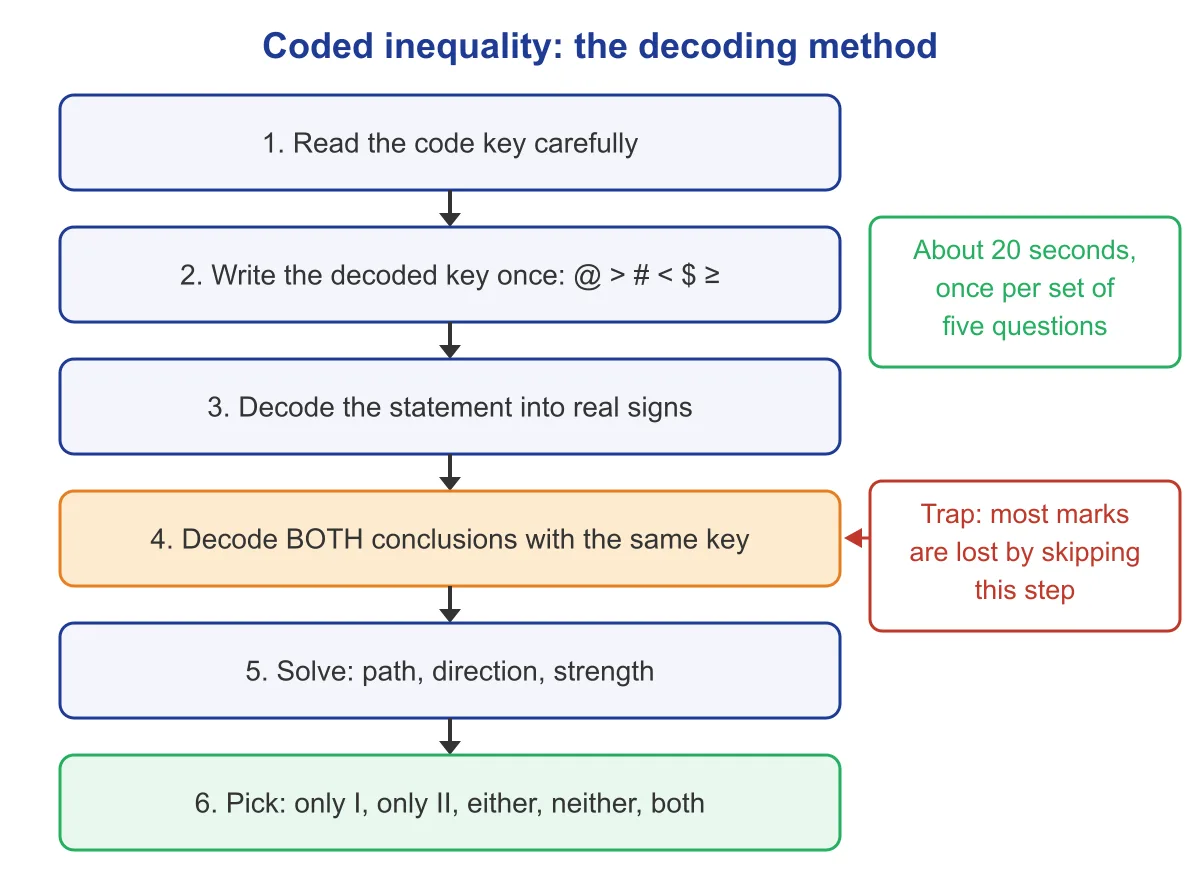
The four-step decoding method
The method has four steps, and the order matters.
- Write the decoded key once, in one line, at the top of your rough sheet.
- Decode the statement: rewrite it with real signs.
- Decode both conclusions with the same key.
- Solve as a direct inequality: find the path between the two letters, check that every sign points the same way, and decide the strength (>, ≥ or =).
Step 3 is where most marks are lost. Students rewrite the statement neatly, feel the job is done, and then read the conclusion "A @ D" with whatever meaning @ seems to have. The conclusion is coded too. It must go through the same key.
Why the method works
A code is only a renaming. If @ means >, then "A @ B" and "A > B" are the same fact written two ways. Decoding changes nothing about which letters are linked and in which direction, so every rule of direct inequality carries over unchanged. The only new skill is reading the key without error.
The rough-work key table
Do not re-read the key for every question. Read it once, carefully, and write a compact line such as:
@ > # < $ ≥ % ≤ & =
That line takes about ten seconds to write. It saves you from going back to a long verbal key five times, which is where the time drains away in an exam hall. Some students prefer a small table; either works.
| Code | Meaning given in the key | Real sign |
|---|---|---|
| @ | P is greater than Q | > |
| # | P is smaller than Q | < |
| $ | P is either greater than or equal to Q | ≥ |
| % | P is either smaller than or equal to Q | ≤ |
| & | P is equal to Q | = |
Once the line is written, cover the key with your hand or scroll past it. Work only from your line.
Example 1: Key: @ >, # <, $ ≥, % ≤, & =. Statement: A @ B $ C & D. Conclusions: I. A @ D II. B % D
Decode statement: A > B ≥ C = D
Decode I: A @ D ⇒ A > D. Path A → B → C → D has >, ≥, =. All point the same way and one is strict, so A > D. True.
Decode II: B % D ⇒ B ≤ D. Path B → C → D gives B ≥ D. That is the opposite direction, so B ≤ D is not definite. False.
Answer: only conclusion I follows.
Why: after decoding it is an ordinary chain; the strict sign > on the A–D path makes A > D certain.
Example 2: Key: 'A @ B' means A ≥ B, 'A # B' means A > B, 'A $ B' means A = B, 'A % B' means A < B, 'A & B' means A ≤ B. Statement: M # N $ O & P. Conclusions: I. M @ O II. P % N
Key line: @ ≥ # > $ = % < & ≤
Decode statement: M > N = O ≤ P
Decode I: M @ O ⇒ M ≥ O. Path M → N → O gives M > O. If M > O is true, M ≥ O is also true. True.
Decode II: P % N ⇒ P < N. Path N → O → P gives N ≤ P, that is P ≥ N. P < N is the opposite. False.
Answer: only conclusion I follows.
Why: a student who remembers @ as > from Example 1 would read I as M > O and still get it right here by luck, but would fail the moment the conclusion needs the exact sign. The key changed, so @ changed.
Verbal codes and reverse-meaning codes
Harder sets do not give you the sign directly. They describe it in words, often with "not" or "neither … nor". This is where students who rush lose the most marks.
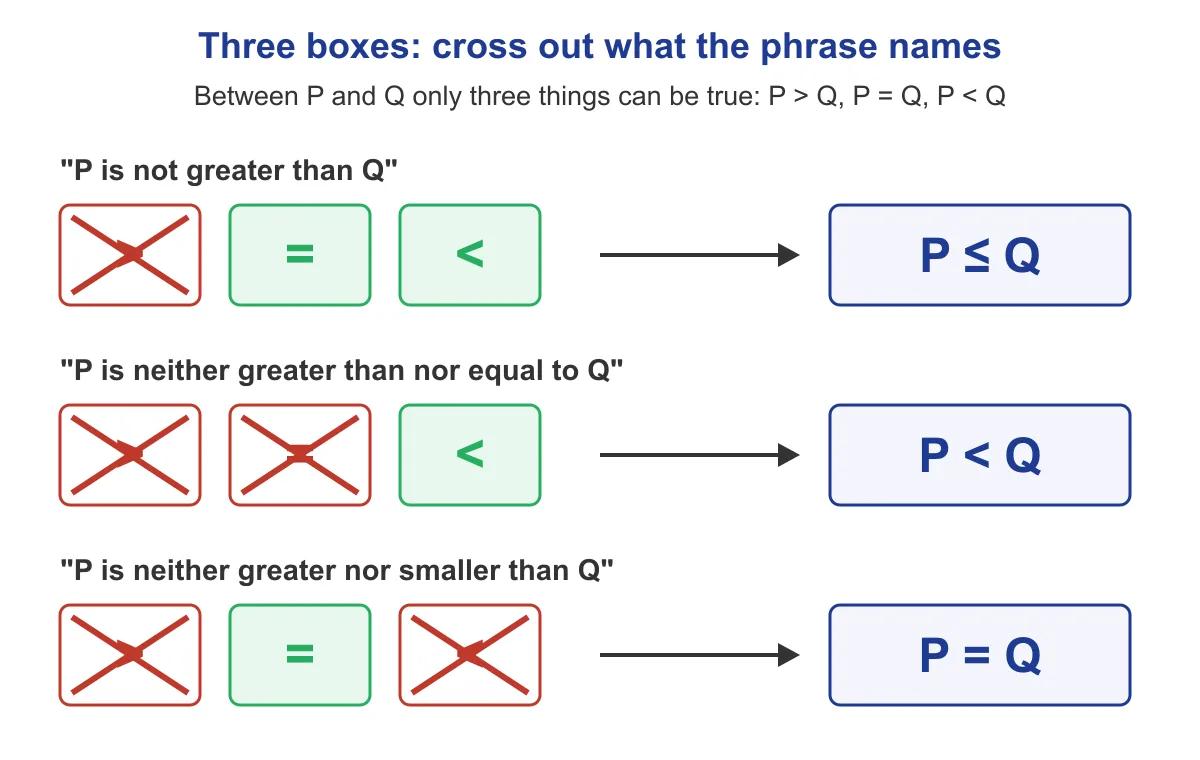
The three-box idea
Between any two numbers P and Q there are only three possibilities: P > Q, P = Q, or P < Q. Every verbal phrase either picks one of these boxes or removes some of them. Whatever is left is your sign.
- "P is not greater than Q" removes the > box. Left: = and <. So P ≤ Q.
- "P is not smaller than Q" removes the < box. Left: > and =. So P ≥ Q.
- "P is neither greater than nor equal to Q" removes > and =. Left: <. So P < Q.
- "P is neither smaller than nor equal to Q" removes < and =. Left: >. So P > Q.
- "P is neither greater nor smaller than Q" removes > and <. Left: =. So P = Q.
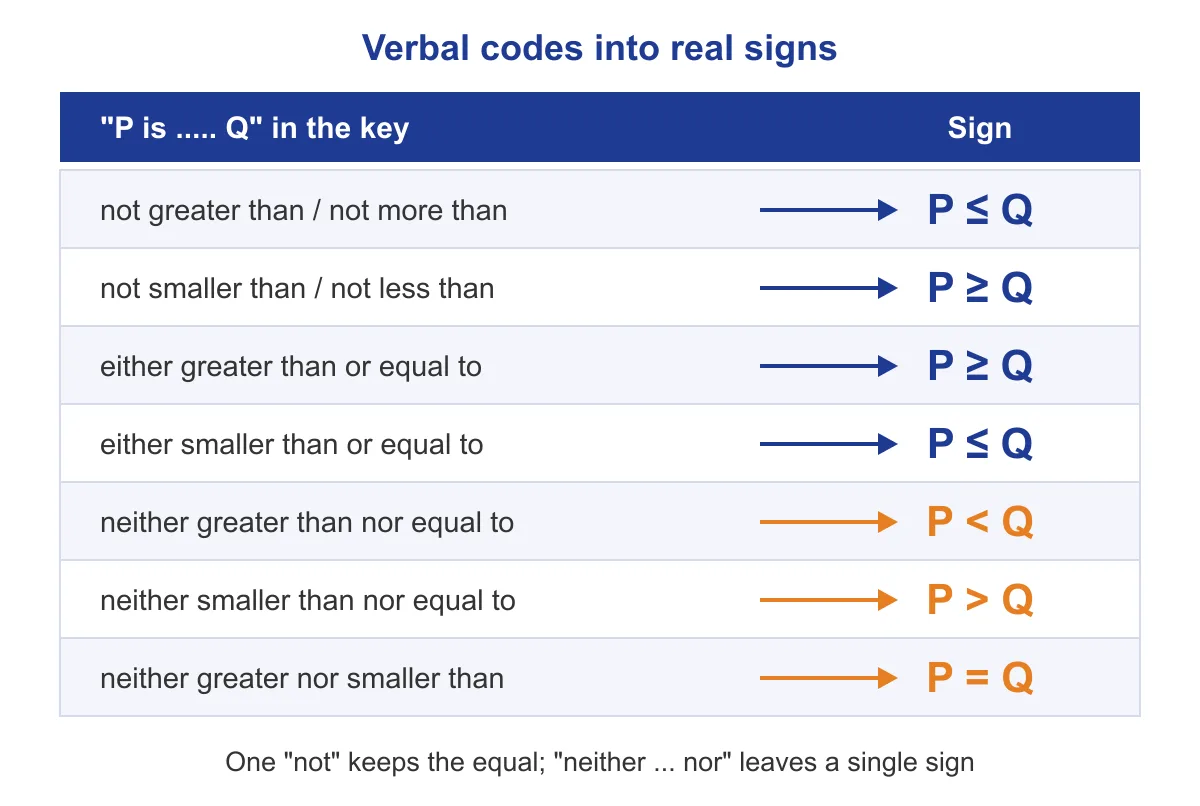
Memory trick: "NOT flips and adds the equal." Not greater than ⇒ ≤ (the > flips to < and picks up the equal). Not less than ⇒ ≥. Say it once whenever you see a single "not".
Memory trick: "Neither–nor knocks out two; the one that's left is you." A neither–nor phrase always names two of the three boxes, so the answer is the single box it did not name, and it never carries an equal sign unless the leftover box is = itself.
The full conversion list is worth learning cold. Exams use small variations in wording ("less" for "smaller", "more" for "greater"), but the meaning is the same.
| Phrase in the key | Real sign | What it allows |
|---|---|---|
| P is greater than Q | P > Q | only > |
| P is smaller (less) than Q | P < Q | only < |
| P is equal to Q | P = Q | only = |
| P is either greater than or equal to Q | P ≥ Q | > or = |
| P is either smaller than or equal to Q | P ≤ Q | < or = |
| P is not greater (not more) than Q | P ≤ Q | < or = |
| P is not smaller (not less) than Q | P ≥ Q | > or = |
| P is neither greater than nor equal to Q | P < Q | only < |
| P is neither smaller than nor equal to Q | P > Q | only > |
| P is neither greater nor smaller than Q | P = Q | only = |
Look closely at the pairs that sound alike. "Not greater than" gives ≤, but "neither greater than nor equal to" gives strict <. One extra word ("equal") removes the equal sign. That single difference decides many answers, because ≤ only lets you conclude ≤, while < lets you conclude both < and ≤.
Reverse-meaning codes
A "reverse-meaning" code is one where the phrase seems to point one way but the sign points the other. "P @ Q means P is not smaller than Q" sounds like it is about "smaller", yet the sign is ≥. Read the full phrase, apply the three-box idea, and write the sign. Do not stop at the first adjective.
A second kind of reversal swaps the letters. The key may say "'P * Q' means 'Q is smaller than P'". Here Q comes first in the description. Rewrite it with P first: Q < P is the same as P > Q, so * means >. Always convert the definition into the form "P (sign) Q" before writing your key line; otherwise every decoded statement will point the wrong way.
Example 3: Key: 'P © Q' means P is not smaller than Q; 'P ★ Q' means P is not greater than Q; 'P δ Q' means P is neither smaller than nor equal to Q; 'P @ Q' means P is neither greater than nor equal to Q; 'P # Q' means P is neither greater nor smaller than Q. Statement: R δ S, S © T, T # U. Conclusions: I. U @ R II. T ★ S
Key line using three boxes: © ≥ ★ ≤ δ > @ < # =
Decode statement: R > S, S ≥ T, T = U ⇒ R > S ≥ T = U
Decode I: U @ R ⇒ U < R. Path R → S → T → U gives R > U, which is U < R. True.
Decode II: T ★ S ⇒ T ≤ S. Statement has S ≥ T, which is T ≤ S. True.
Answer: both conclusions follow.
Why: once each phrase is reduced to its box, the chain is ordinary and both conclusions sit on a same-direction path.
Example 4: Key: 'P * Q' means Q is smaller than P; 'P © Q' means Q is not smaller than P; 'P ★ Q' means P is neither greater nor smaller than Q. Statement: A * B ★ C © D. Conclusions: I. D * B II. A * C
Convert to P-first: Q < P ⇒ P > Q, so * is >. Q ≥ P ⇒ P ≤ Q, so © is ≤. ★ is =.
Key line: * > © ≤ ★ =
Decode statement: A > B = C ≤ D
Decode I: D * B ⇒ D > B. Path B → C → D gives B ≤ D, so D ≥ B. D > B is not certain because B, C and D could all be equal. False.
Decode II: A * C ⇒ A > C. Path A → B → C gives >, =, so A > C. True.
Answer: only conclusion II follows.
Why: the letter swap in the key turned "smaller" into >; missing that swap flips every answer.
When decoding meets either–or
Coded questions use the same 5-option list, so either–or cases appear here too. The test does not change: neither conclusion follows alone, both talk about the same two letters, and together they cover every possibility.
Example 5: Key: @ >, # <, $ ≥, % ≤, & =. Statement: J $ K & L @ M. Conclusions: I. J @ L II. J & L
Decode statement: J ≥ K = L > M
Decode I: J > L. Decode II: J = L.
Path J → K → L gives J ≥ L. So J > L is not certain, and J = L is not certain.
Same pair (J, L); > and = together make ≥, which is exactly what the statement gives.
Answer: either conclusion I or II follows.
Why: the decoded conclusions form a complementary pair that fills the ≥ relation.
A full five-question set
This is how a set appears in a bank prelims paper. Time yourself: aim for under three minutes for all five, including the time spent decoding the key.
Directions: In the following questions, 'A % B' means 'A is not greater than B'; 'A @ B' means 'A is neither smaller than nor equal to B'; 'A $ B' means 'A is neither greater nor smaller than B'; 'A # B' means 'A is not smaller than B'; 'A & B' means 'A is neither greater than nor equal to B'. Use the five options listed at the start of this chapter.
First, the key line. Work through each phrase with the three boxes once:
| Code | Phrase | Boxes removed | Sign |
|---|---|---|---|
| % | not greater than | > | ≤ |
| @ | neither smaller than nor equal to | <, = | > |
| $ | neither greater nor smaller than | >, < | = |
| # | not smaller than | < | ≥ |
| & | neither greater than nor equal to | >, = | < |
Rough sheet line: % ≤ @ > $ = # ≥ & <
That took perhaps 20 seconds. Every question below now takes 20 to 30 seconds.
Example 6: Statement: F @ G # H $ K. Conclusions: I. K & F II. G @ K
Decode: F > G ≥ H = K
I: K & F ⇒ K < F. Path F → G → H → K gives F > K, i.e. K < F. True.
II: G @ K ⇒ G > K. Path G → H → K gives ≥, = ⇒ G ≥ K only. Not certain. False.
Answer: only conclusion I follows.
Why: II needs a strict sign on the G–K path and there is none.
Example 7: Statement: P % Q & R, R $ S. Conclusions: I. Q & S II. P % R
Decode: P ≤ Q < R = S
I: Q < S. Path Q → R → S gives <, = ⇒ Q < S. True.
II: P ≤ R. Path P → Q → R gives ≤, < ⇒ P < R, and P < R makes P ≤ R true. True.
Answer: both conclusions follow.
Why: a strict result always satisfies the weaker sign in the same direction.
Example 8: Statement: W # X @ Y, Z % Y. Conclusions: I. Z $ W II. Y & W
Decode: W ≥ X > Y and Z ≤ Y. Join at Y: W ≥ X > Y ≥ Z
I: Z = W. Path gives W > Z, so equality is impossible. False.
II: Y < W. Path W → X → Y gives W > Y. True.
Answer: only conclusion II follows.
Why: the second statement is rewritten as Y ≥ Z so it hangs off the end of the first chain.
Example 9: Statement: B & C % D @ E. Conclusions: I. B % E II. E @ C
Decode: B < C ≤ D > E
I: B ≤ E. Path B → C → D → E has <, ≤, then >. Direction breaks at D. No relation. False.
II: E > C. Path C → D → E has ≤ then >. Breaks at D. False.
Different pairs (B, E) and (E, C), so either–or is not possible.
Answer: neither conclusion follows.
Why: D is larger than both sides, so C and E cannot be compared.
Example 10: Statement: L $ M # N & O. Conclusions: I. M @ N II. M $ N
Decode: L = M ≥ N < O
I: M > N. II: M = N. Statement gives M ≥ N, so neither is certain on its own.
Same pair (M, N); > and = together make ≥.
Answer: either conclusion I or II follows.
Why: complementary pair on the same two letters.
The five answers came out as only I, both, only II, neither, either. Real sets often spread their answers like this, but never use the spread to guess; examiners repeat answers freely.
Time-saving habits for a set
- Decode the key once, before reading question 1. Never decode question by question.
- Write the decoded statement directly under the coded one, then write each decoded conclusion beside its number. Your eye should never return to the coded form.
- Use the same rough-sheet layout every time so that you stop thinking about layout.
- If two codes look alike (# and ≠, or & and %), circle them on your key line.
Common traps
- Decoding the statement but reading the conclusion as if the symbol had its "natural" meaning ⇒ decode both conclusions with the key line, every time.
- Carrying a key from the previous set or the previous mock ⇒ write a fresh key line for each set; treat every symbol as unknown.
- Reading "not greater than" as < ⇒ a single "not" removes only one box, so it is ≤.
- Reading "neither greater than nor equal to" as ≤ ⇒ two boxes are removed, so it is strict <.
- Missing a letter swap in the key ("'P * Q' means Q is smaller than P") ⇒ rewrite every definition with P first before writing the sign.
- Treating "neither greater nor smaller than" as ≠ ⇒ removing > and < leaves only =.
- Marking "either–or" whenever both conclusions fail ⇒ check same pair and full cover; different pairs give "neither".
- Rejecting a ≥ conclusion when the chain gives > ⇒ a strict result in the same direction always satisfies the soft sign.
- Joining two statements without turning one around ⇒ write Z ≤ Y as Y ≥ Z so the shared letter links the chain in one direction.
Quick revision
- A coded inequality is a direct inequality with renamed signs; the rules do not change.
- Method: key line → decode statement → decode conclusions → path, direction, strength.
- Write the decoded key once per set, in one line, and work only from that line.
- Decode the conclusions with the same key; this is the step most often skipped.
- Three boxes exist between two numbers: >, =, <. A phrase removes boxes; what is left is the sign.
- Not greater than ⇒ ≤. Not smaller than ⇒ ≥.
- Neither greater than nor equal to ⇒ <. Neither smaller than nor equal to ⇒ >.
- Neither greater nor smaller than ⇒ =.
- Either greater than or equal to ⇒ ≥; either smaller than or equal to ⇒ ≤.
- If the key describes Q first, rewrite with P first before choosing the sign.
- A strict result (>) also makes the soft conclusion (≥) true in the same direction.
- Either–or needs: neither follows alone, same two letters, and the pair covers all cases.
- Codes change every paper; never trust memory from an earlier set.
- Target for a five-question coded set: about three minutes including decoding.
After this chapter, take the coded-inequality practice set in the Reasoning section of the Pareeksha practice zone, then a full bank prelims mock to test the method under time pressure.
Check yourself
In a coded inequality question, 'P # Q' means 'P is not smaller than Q'. Which real sign does # stand for?
- >
- ≥
- ≤
- <
Answer
B. ≥
'Not smaller' removes only the < possibility, leaving > or =, so # means ≥.
In a coded inequality question, 'P © Q' means 'P is neither greater than nor equal to Q'. Which real sign does © stand for?
- ≤
- >
- <
- =
Answer
C. <
Of the three possibilities (>, =, <), the phrase rules out > and =, leaving only <.
In a coded inequality question, 'A ★ B' means 'A is neither greater nor smaller than B'. Which of the following is the decoded form of 'A ★ B'?
- A ≠ B
- A ≥ B
- A ≤ B
- A = B
Answer
D. A = B
Ruling out both > and < leaves only equality, so A ★ B means A = B.
In a coded inequality question, 'X * Y' means 'Y is not greater than X'. Which of the following correctly decodes 'X * Y'?
- X ≥ Y
- X ≤ Y
- X > Y
- Y ≥ X
Answer
A. X ≥ Y
'Y is not greater than X' means Y ≤ X; written with X first this is X ≥ Y.
In the following question, 'P @ Q' means 'P is neither smaller than nor equal to Q'; 'P # Q' means 'P is neither greater than nor equal to Q'; 'P $ Q' means 'P is not smaller than Q'; 'P % Q' means 'P is not greater than Q'; 'P & Q' means 'P is neither greater nor smaller than Q'. Statement: D @ E & F $ G Conclusions: I. D @ G II. E # G
- if only conclusion I follows
- if only conclusion II follows
- if either conclusion I or II follows
- if neither conclusion I nor II follows
- if both conclusions I and II follow
Answer
A. if only conclusion I follows
Key: @ >, # <, $ ≥, % ≤, & =. Statement: D > E = F ≥ G. I: D > G true (path >, =, ≥ with a strict sign). II: E < G false, since E = F ≥ G gives E ≥ G.
In the following question, 'P @ Q' means 'P is neither smaller than nor equal to Q'; 'P # Q' means 'P is neither greater than nor equal to Q'; 'P $ Q' means 'P is not smaller than Q'; 'P % Q' means 'P is not greater than Q'; 'P & Q' means 'P is neither greater nor smaller than Q'. Statement: H % J # K & L Conclusions: I. L @ J II. H # L
- if only conclusion I follows
- if only conclusion II follows
- if either conclusion I or II follows
- if neither conclusion I nor II follows
- if both conclusions I and II follow
Answer
E. if both conclusions I and II follow
Key: @ >, # <, $ ≥, % ≤, & =. Statement: H ≤ J < K = L. I: L > J true (J < K = L). II: H < L true (H ≤ J < K = L has a strict sign).
In the following question, 'P * Q' means 'P is either smaller than or equal to Q'; 'P @ Q' means 'P is equal to Q'; 'P # Q' means 'P is greater than Q'; 'P $ Q' means 'P is either greater than or equal to Q'; 'P % Q' means 'P is smaller than Q'. Statement: M # N $ O @ P Conclusions: I. N # P II. P * N
- if only conclusion I follows
- if only conclusion II follows
- if either conclusion I or II follows
- if neither conclusion I nor II follows
- if both conclusions I and II follow
Answer
B. if only conclusion II follows
Key: * ≤, @ =, # >, $ ≥, % <. Statement: M > N ≥ O = P. I: N > P not certain, because N ≥ O = P allows N = P. II: P ≤ N true, since N ≥ P.
In the following question, 'P * Q' means 'P is either smaller than or equal to Q'; 'P @ Q' means 'P is equal to Q'; 'P # Q' means 'P is greater than Q'; 'P $ Q' means 'P is either greater than or equal to Q'; 'P % Q' means 'P is smaller than Q'. Statement: R % S * T, U # T Conclusions: I. R % U II. S @ U
- if only conclusion I follows
- if only conclusion II follows
- if either conclusion I or II follows
- if neither conclusion I nor II follows
- if both conclusions I and II follow
Answer
A. if only conclusion I follows
Key: * ≤, @ =, # >, $ ≥, % <. Statements: R < S ≤ T and U > T, so R < S ≤ T < U. I: R < U true. II: S = U false, because S < U.
In the following question, 'P @ Q' means 'P is neither smaller than nor equal to Q'; 'P # Q' means 'P is neither greater than nor equal to Q'; 'P $ Q' means 'P is not smaller than Q'; 'P % Q' means 'P is not greater than Q'; 'P & Q' means 'P is neither greater nor smaller than Q'. Statement: A $ B % C # D Conclusions: I. A % C II. B # D
- if only conclusion I follows
- if only conclusion II follows
- if either conclusion I or II follows
- if neither conclusion I nor II follows
- if both conclusions I and II follow
Answer
B. if only conclusion II follows
Key: @ >, # <, $ ≥, % ≤, & =. Statement: A ≥ B ≤ C < D. I: A ≤ C cannot be fixed; the path A–B–C changes direction at B. II: B < D true (B ≤ C < D).
In the following question, 'P @ Q' means 'P is neither smaller than nor equal to Q'; 'P # Q' means 'P is neither greater than nor equal to Q'; 'P $ Q' means 'P is not smaller than Q'; 'P % Q' means 'P is not greater than Q'; 'P & Q' means 'P is neither greater nor smaller than Q'. Statement: P & Q $ R, R @ S Conclusions: I. Q @ S II. P $ R
- if only conclusion I follows
- if only conclusion II follows
- if either conclusion I or II follows
- if neither conclusion I nor II follows
- if both conclusions I and II follow
Answer
E. if both conclusions I and II follow
Key: @ >, # <, $ ≥, % ≤, & =. Statements: P = Q ≥ R > S. I: Q > S true (≥ then >). II: P ≥ R true (P = Q ≥ R).
In the following question, 'P @ Q' means 'P is neither smaller than nor equal to Q'; 'P # Q' means 'P is neither greater than nor equal to Q'; 'P $ Q' means 'P is not smaller than Q'; 'P % Q' means 'P is not greater than Q'; 'P & Q' means 'P is neither greater nor smaller than Q'. Statement: E $ F & G # H Conclusions: I. E @ G II. E & G
- if only conclusion I follows
- if only conclusion II follows
- if either conclusion I or II follows
- if neither conclusion I nor II follows
- if both conclusions I and II follow
Answer
C. if either conclusion I or II follows
Key: @ >, # <, $ ≥, % ≤, & =. Statement: E ≥ F = G < H, so E ≥ G. I (E > G) and II (E = G) are each uncertain, but they concern the same pair and together make E ≥ G, so either follows.
In the following question, 'P * Q' means 'P is either smaller than or equal to Q'; 'P @ Q' means 'P is equal to Q'; 'P # Q' means 'P is greater than Q'; 'P $ Q' means 'P is either greater than or equal to Q'; 'P % Q' means 'P is smaller than Q'. Statement: J $ K % L, M * L Conclusions: I. J % L II. K # M
- if only conclusion I follows
- if only conclusion II follows
- if either conclusion I or II follows
- if neither conclusion I nor II follows
- if both conclusions I and II follow
Answer
D. if neither conclusion I nor II follows
Key: * ≤, @ =, # >, $ ≥, % <. Statements: J ≥ K < L ≥ M. I: J < L unknown (path breaks at K). II: K > M unknown (path breaks at L). Different pairs, so no either-or.
In the following question, 'P @ Q' means 'Q is greater than P'; 'P # Q' means 'Q is not greater than P'; 'P $ Q' means 'P is neither greater nor smaller than Q'; 'P % Q' means 'P is neither smaller than nor equal to Q'; 'P & Q' means 'Q is not smaller than P'. Statement: W % X # Y $ Z Conclusions: I. Z @ W II. X & Z
- if only conclusion I follows
- if only conclusion II follows
- if either conclusion I or II follows
- if neither conclusion I nor II follows
- if both conclusions I and II follow
Answer
A. if only conclusion I follows
Key with P first: @ <, # ≥, $ =, % >, & ≤. Statement: W > X ≥ Y = Z. I: Z < W true. II: X ≤ Z not certain, since the chain gives X ≥ Z.
In the following question, 'P @ Q' means 'Q is greater than P'; 'P # Q' means 'Q is not greater than P'; 'P $ Q' means 'P is neither greater nor smaller than Q'; 'P % Q' means 'P is neither smaller than nor equal to Q'; 'P & Q' means 'Q is not smaller than P'. Statement: B & C $ D @ E Conclusions: I. B $ D II. E % C
- if only conclusion I follows
- if only conclusion II follows
- if either conclusion I or II follows
- if neither conclusion I nor II follows
- if both conclusions I and II follow
Answer
B. if only conclusion II follows
Key with P first: @ <, # ≥, $ =, % >, & ≤. Statement: B ≤ C = D < E. I: B = D not certain (B ≤ D only). II: E > C true (C = D < E). I and II involve different pairs.
In the following question, 'P @ Q' means 'Q is greater than P'; 'P # Q' means 'Q is not greater than P'; 'P $ Q' means 'P is neither greater nor smaller than Q'; 'P % Q' means 'P is neither smaller than nor equal to Q'; 'P & Q' means 'Q is not smaller than P'. Statement: F # G $ H % J Conclusions: I. F $ H II. H @ F
- if only conclusion I follows
- if only conclusion II follows
- if either conclusion I or II follows
- if neither conclusion I nor II follows
- if both conclusions I and II follow
Answer
C. if either conclusion I or II follows
Key with P first: @ <, # ≥, $ =, % >, & ≤. Statement: F ≥ G = H > J, so F ≥ H. I: F = H uncertain. II: H < F, i.e. F > H, uncertain. Same pair, = and > together make ≥, so either follows.
In the following question, 'P @ Q' means 'P is neither smaller than nor equal to Q'; 'P # Q' means 'P is neither greater than nor equal to Q'; 'P $ Q' means 'P is not smaller than Q'; 'P % Q' means 'P is not greater than Q'; 'P & Q' means 'P is neither greater nor smaller than Q'. Statement: K @ L, M % L, M $ N, O & N Conclusions: I. K @ O II. L $ N
- if only conclusion I follows
- if only conclusion II follows
- if either conclusion I or II follows
- if neither conclusion I nor II follows
- if both conclusions I and II follow
Answer
E. if both conclusions I and II follow
Key: @ >, # <, $ ≥, % ≤, & =. Joined chain: K > L ≥ M ≥ N = O. I: K > O true (strict sign at K–L). II: L ≥ N true (L ≥ M ≥ N).
In the following question, 'P * Q' means 'P is either smaller than or equal to Q'; 'P @ Q' means 'P is equal to Q'; 'P # Q' means 'P is greater than Q'; 'P $ Q' means 'P is either greater than or equal to Q'; 'P % Q' means 'P is smaller than Q'. Statement: T @ U * V % W Conclusions: I. W # T II. U % W
- if only conclusion I follows
- if only conclusion II follows
- if either conclusion I or II follows
- if neither conclusion I nor II follows
- if both conclusions I and II follow
Answer
E. if both conclusions I and II follow
Key: * ≤, @ =, # >, $ ≥, % <. Statement: T = U ≤ V < W. I: W > T true (T = U ≤ V < W). II: U < W true (U ≤ V < W).
In the following question, 'P * Q' means 'P is either smaller than or equal to Q'; 'P @ Q' means 'P is equal to Q'; 'P # Q' means 'P is greater than Q'; 'P $ Q' means 'P is either greater than or equal to Q'; 'P % Q' means 'P is smaller than Q'. Statement: X $ Y # Z * Q Conclusions: I. X # Q II. Q $ Y
- if only conclusion I follows
- if only conclusion II follows
- if either conclusion I or II follows
- if neither conclusion I nor II follows
- if both conclusions I and II follow
Answer
D. if neither conclusion I nor II follows
Key: * ≤, @ =, # >, $ ≥, % <. Statement: X ≥ Y > Z ≤ Q. I: X > Q unknown and II: Q ≥ Y unknown, because the path changes direction at Z. Different pairs, so no either-or.
In the following question, 'P @ Q' means 'P is neither smaller than nor equal to Q'; 'P # Q' means 'P is neither greater than nor equal to Q'; 'P $ Q' means 'P is not smaller than Q'; 'P % Q' means 'P is not greater than Q'; 'P & Q' means 'P is neither greater nor smaller than Q'. Statement: G # H, J $ H, J % K, L @ K Conclusions: I. H # K II. K & H
- if only conclusion I follows
- if only conclusion II follows
- if either conclusion I or II follows
- if neither conclusion I nor II follows
- if both conclusions I and II follow
Answer
C. if either conclusion I or II follows
Key: @ >, # <, $ ≥, % ≤, & =. Joined chain: G < H ≤ J ≤ K < L, so H ≤ K. I: H < K uncertain. II: K = H uncertain. Same pair; < and = together make ≤, so either follows.
In the following question, 'P @ Q' means 'Q is greater than P'; 'P # Q' means 'Q is not greater than P'; 'P $ Q' means 'P is neither greater nor smaller than Q'; 'P % Q' means 'P is neither smaller than nor equal to Q'; 'P & Q' means 'Q is not smaller than P'. Statement: P @ Q & R, S % R, S # T Conclusions: I. T @ P II. Q $ T
- if only conclusion I follows
- if only conclusion II follows
- if either conclusion I or II follows
- if neither conclusion I nor II follows
- if both conclusions I and II follow
Answer
D. if neither conclusion I nor II follows
Key with P first: @ <, # ≥, $ =, % >, & ≤. Joined chain: P < Q ≤ R < S ≥ T. I: T < P unknown and II: Q = T unknown, because the path to T reverses at S. Different pairs, so no either-or.