Multiple Statements, Missing Signs and Conditional Questions
Up to now every question gave you one neat chain. Real papers are less polite. In IBPS PO and SBI PO prelims you will often see the statement split into two or three pieces, or the chain printed with question marks where the signs should be, or a question that turns the usual format around and asks which expression would make a given conclusion true. Bank mains papers go one step further and ask which conclusion is definitely false.
None of these needs a new rule. Every one of them comes back to the path check you already know: find the two elements, walk the path between them, and make sure every sign on that path points the same way. What changes is the setting, and this chapter trains you for each setting one at a time.
Joining separate statements into one chain
Suppose the question reads: "Statements: A > B, B ≥ C, D < C." Three separate facts. You cannot compare A and D until you put them on one line.
The trick is to look for an element that appears in two statements. That shared element is the hinge. Write the first statement, then attach the next one at the hinge, turning it around if needed so that it reads in the same direction.
- A > B is the starting piece.
- B ≥ C shares B. It already starts with B, so attach it: A > B ≥ C.
- D < C shares C. Read it from the C end: C > D. Attach: A > B ≥ C > D.
Turning a statement around is always safe as long as you flip the sign with it. D < C and C > D say exactly the same thing. Likewise P ≤ Q is Q ≥ P, and R = S is S = R.
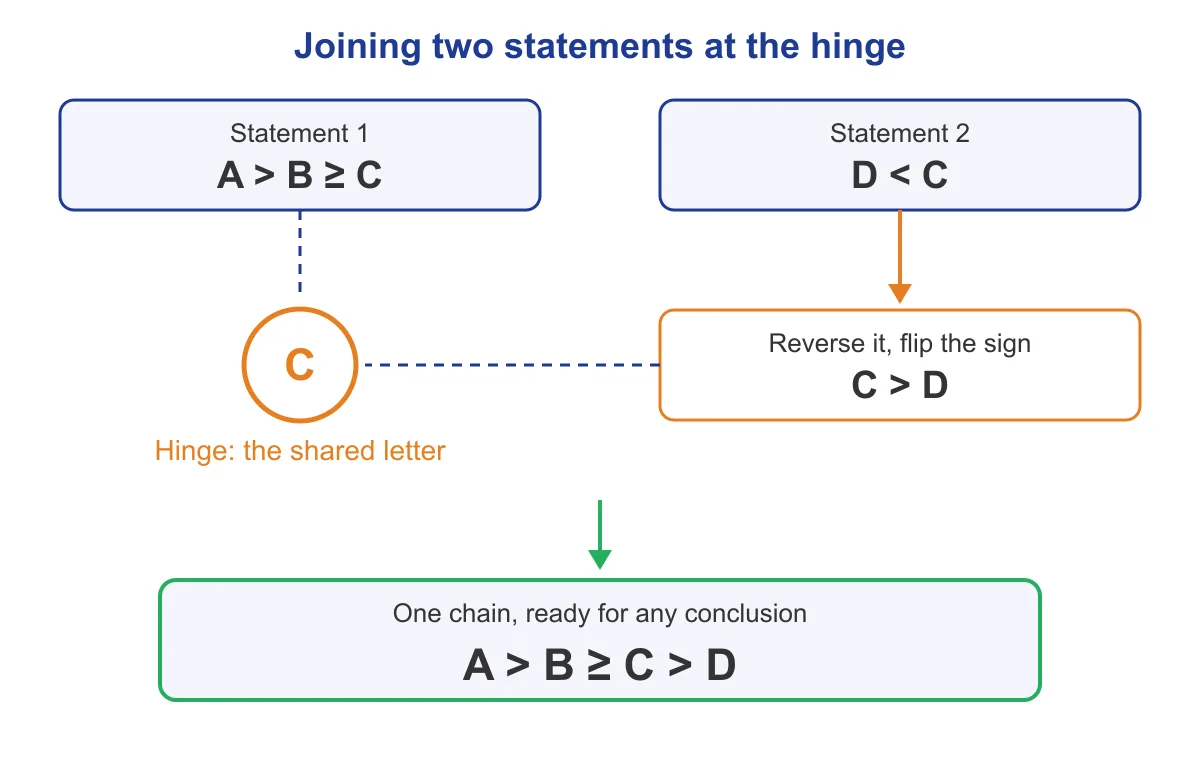
Memory trick: "Find the hinge, then swing both chains to one line." Circle the letter that appears twice, then rewrite the other piece so it starts or ends at that circle.
Once the chain is on one line, every question is ordinary direct inequality. In the chain above, A > D is true (signs >, ≥, > all face the same way and at least one is strict). B > D is also true, because B ≥ C > D contains a strict sign.
Example 1: Statements: P ≥ Q, R < Q, R = S, T > S. Conclusions: I. P > S II. T > Q
Hinge Q joins the first two: P ≥ Q, and R < Q reversed is Q > R. Chain so far: P ≥ Q > R.
Hinge R joins the third: R = S. Chain: P ≥ Q > R = S.
Hinge S joins the fourth: T > S, read from S as S < T. Chain: P ≥ Q > R = S < T.
I: P ≥ Q > R = S, all facing one way, one strict sign ⇒ P > S. Follows.
II: from T back to Q the path is T > S = R < Q. The last sign turns round ⇒ no relation.
Answer: only I follows. Why: the hinge chain broke at S, so anything on the T side cannot be compared with anything on the P side.
Where the hinge sits
The hinge can be at the end of one piece and the start of the next (A > B, B > C), or in the middle of a longer piece. When it sits in the middle, the new element simply branches off from it. For example, with M > N > O and N ≥ K, you get two branches from N: N > O and N ≥ K. O and K are both "below" N but nothing tells you how O and K compare. Write the branch as a small fork in rough work rather than forcing it onto the line.
When statements cannot be joined
Two cases stop you.
- No shared element. A > B and C < D have no letter in common. Nothing about A can be said in terms of C or D. Any conclusion linking the two groups fails.
- Shared element, but the signs meet head-on. A > B and C > B do share B, but written in one line they become A > B < C. From A to C the signs turn, so A and C are not related.
| Situation | Example | Can A and the far element be compared? |
|---|---|---|
| Hinge found, signs face one way | A > B, B ≥ C ⇒ A > B ≥ C | Yes: A > C |
| Hinge found, signs turn at hinge | A > B, C > B ⇒ A > B < C | No |
| Hinge is an equal sign | A ≥ B, B = C ⇒ A ≥ B = C | Yes: A ≥ C |
| No common element | A > B, C < D | No |
| Hinge in the middle, two branches | M > N > O, N ≥ K | O and K: No; M and K: Yes (M > K) |
In a three-statement question it is common for two statements to join cleanly and the third to hang off a different element. Do not assume all the letters belong to one chain.
Example 2: Statements: D > E, F ≤ G, H = E. Conclusions: I. F > D II. H ≥ D
Join: D > E and H = E share E ⇒ D > E = H.
F ≤ G shares nothing with D, E or H. It stands alone.
I: F has no link with D. Does not follow.
II: D > E = H gives D > H, so H < D. "H ≥ D" is actually false here. Does not follow.
Answer: neither follows. Why: a conclusion can fail because there is no link or because the link points the other way; both count as "does not follow".
Which expression makes the conclusion definitely true
Here the conclusion is fixed and you get four or five complete expressions. The question asks: "Which of the following expressions will be true if P > T is definitely true?" In plain words: in which option does P > T follow for certain?
Method, for each option:
- Find both letters. If one is missing, the option is out.
- If the option is written from T to P (right to left), read it backwards with every sign flipped.
- Walk the path. Any sign facing the wrong way: out.
- If the target is strict (> or <), there must be at least one strict sign on the path. All ≥ and = gives only ≥: out.
Example 3: Which expression makes "P > T" definitely true?
(a) P ≥ Q > R ≤ S = T (b) T < S = R ≤ Q < P (c) P = Q ≥ R ≥ S ≥ T (d) T ≤ S < R = Q ≥ P
(a) Path P ≥ Q > R ≤ S. The ≤ turns round. Out.
(b) Written from T. Reverse it: P > Q ≥ R = S > T. All one way, strict signs present ⇒ P > T. Keep.
(c) P = Q ≥ R ≥ S ≥ T gives only P ≥ T. P could equal T. Out.
(d) Reverse: P ≤ Q = R > S ≥ T. First sign faces left, later ones face right. Out.
Answer: (b). Why: only (b) has an unbroken path with at least one strict sign.
Examiners love option (b)'s style. A reversed expression looks wrong at first glance because it starts with T. Train yourself to flip it rather than reject it.
There is a tighter version of this question: "Which expression makes M ≥ Q true but M > Q not definitely true?" Now you need a path with every sign ≥ or =, and no strict sign at all. Here the strict-sign rule works in reverse: any strict sign on the path disqualifies the option.
Missing-sign questions
The printed expression has gaps: "A ? B ? C ? D. Which signs should replace the question marks (in the same order from left to right) so that A > D is definitely true?" Each option is a set of signs.
The fast way is to eliminate, not to build.
- Direction rule first. The conclusion A > D means every sign on the path from A to D must face the "greater" way: > , ≥ or =. Scan each option for a < or ≤. If one appears on the path, cross the option out. This alone usually kills two options.
- Strength rule second. Among the survivors, the target is strict. So at least one sign must be >. An option made only of ≥ and = gives A ≥ D, which is not enough.
- Fixed signs count. If some signs are already printed (for example "P ? Q ≥ R ? S ? T"), include them when you walk the path.
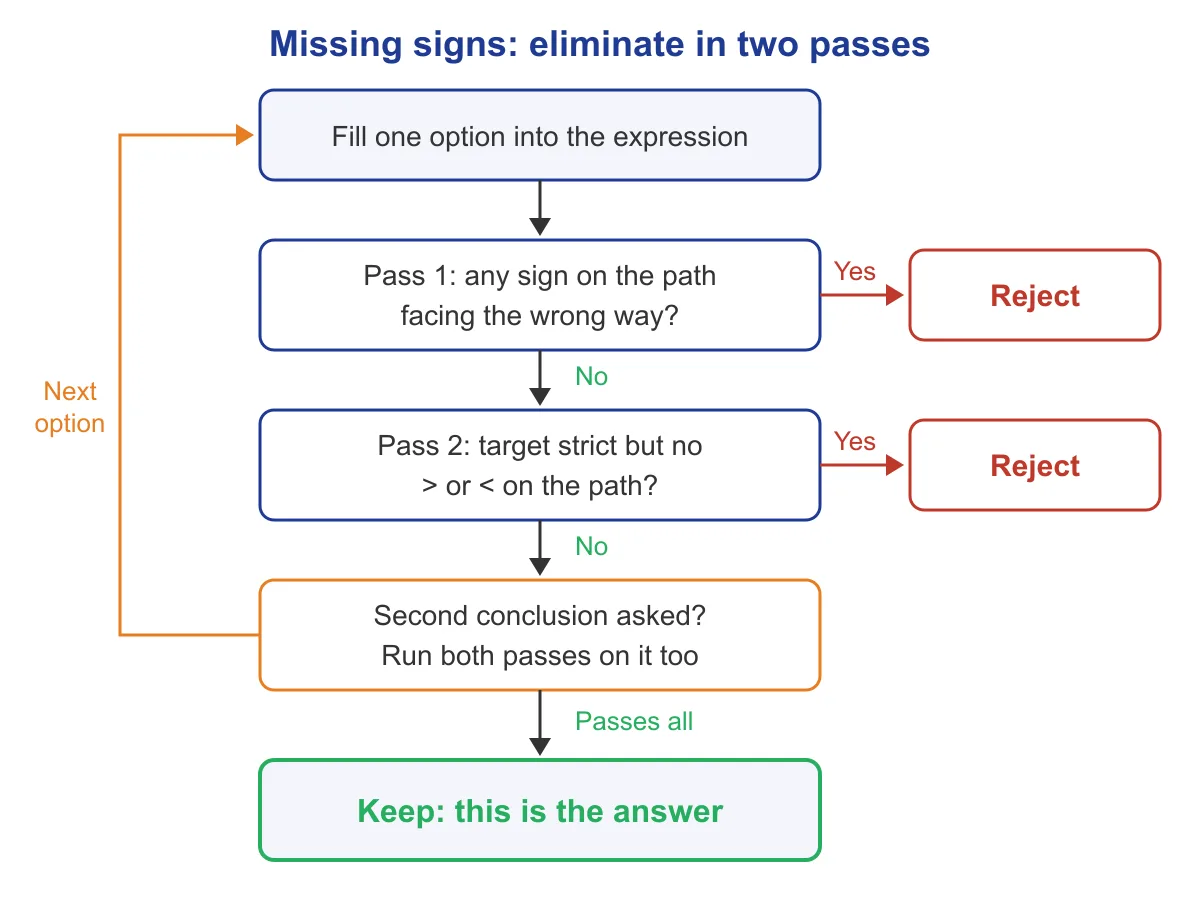
Example 4: A ? B ? C ? D. Which signs make A > D definitely true?
(a) >, ≥, = (b) ≥, ≥, = (c) >, <, = (d) =, ≤, <
Direction pass: (c) has < and (d) has ≤ and <. Both out.
Strength pass: (b) is A ≥ B ≥ C = D, only ≥ and =. Gives A ≥ D. Out.
(a): A > B ≥ C = D. One way, one strict sign ⇒ A > D.
Answer: (a). Why: it is the only option that passes both the direction and the strength check.
Example 5: P ? Q ≥ R ? S ? T. Which signs make both P > T and Q ≥ S definitely true?
(a) ≥, =, ≥ (b) >, ≤, > (c) >, =, ≥ (d) =, >, <
Fill each in.
(a) P ≥ Q ≥ R = S ≥ T: no strict sign between P and T ⇒ only P ≥ T. Out.
(b) P > Q ≥ R ≤ S > T: the ≤ after R turns the path. Out.
(d) P = Q ≥ R > S < T: the final < turns the path from P to T. Out.
(c) P > Q ≥ R = S ≥ T: P > T holds. Q ≥ R = S gives Q ≥ S. Both hold.
Answer: (c). Why: the printed ≥ between Q and R is part of both paths, so it had to be checked each time.
When two conclusions are asked, test the harder one first. A strict conclusion over a long path eliminates the most options, and you may not need to check the second at all.
Memory trick: "Wrong way out, weak way out." First throw away any option with a sign facing the wrong way, then throw away any option too weak (no strict sign) for a strict conclusion.
Filling elements into blanks
Sometimes the signs are fixed and the letters are missing: "Which of the following should be placed in the blanks (in the same order from left to right) so that S > P is definitely true? __ ≥ __ > __ = __". Options are sets of letters.
Treat each option as a ready-made expression and run the path check. Two things to watch:
- The conclusion may come out reversed. If an option gives P > S, then S > P is false, not true.
- The two letters may land next to each other with only a ≥ between them, giving only ≥.
Example 6: __ ≥ __ > __ = __. Which order makes S > P definitely true?
(a) P, Q, R, S (b) S, R, Q, P (c) Q, P, S, R (d) S, P, R, Q
(a) P ≥ Q > R = S ⇒ P > S. That is the opposite of what we need. Out.
(b) S ≥ R > Q = P ⇒ S > P. Keep.
(c) Q ≥ P > S = R ⇒ P > S. Opposite again. Out.
(d) S ≥ P, they are neighbours with ≥ only. S > P not certain. Out.
Answer: (b). Why: the bigger letter must sit to the left of a path that contains the strict sign.
A related question asks which expression has the same meaning as a given one. Reverse the given expression yourself, flipping every sign, and compare. "A ≥ B > C = D" reversed is "D = C < B ≤ A". An option such as "D ≤ C < B ≤ A" looks close but changes = into ≤, so it says less than the original.
Negated conclusions and "definitely false"
Some conclusions are written in the negative: "A ≥ B is not true". Convert it before you test it. Saying A ≥ B is not true is the same as saying A < B. So the conclusion follows only if A < B is definitely true.
Every sign has an exact opposite. Together, a sign and its opposite cover every possibility with no overlap.
| Sign | Exact opposite (its negation) | "X is not true" means |
|---|---|---|
| A > B | A ≤ B | "A > B is not true" = A ≤ B |
| A < B | A ≥ B | "A < B is not true" = A ≥ B |
| A ≥ B | A < B | "A ≥ B is not true" = A < B |
| A ≤ B | A > B | "A ≤ B is not true" = A > B |
| A = B | A ≠ B (A > B or A < B) | "A = B is not true" = A ≠ B |
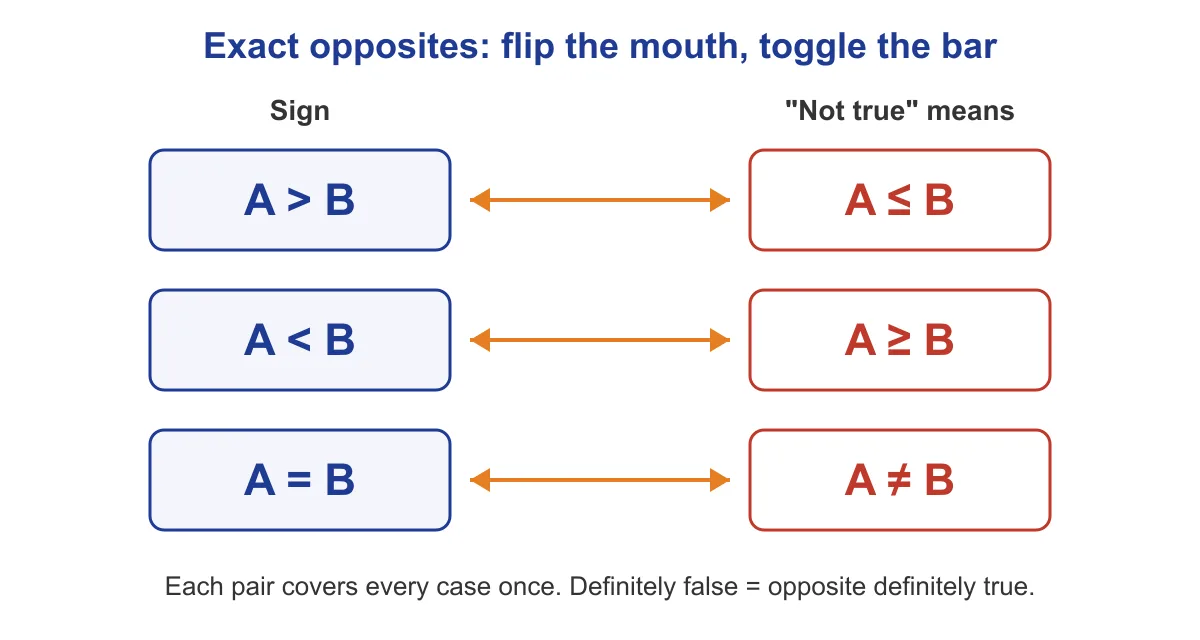
Memory trick: "Flip the mouth, toggle the bar." To negate a sign, turn the open side the other way and add the equal bar if it was missing, or remove it if it was there: > becomes ≤, ≥ becomes <.
A conclusion is definitely false when its opposite is definitely true. If the chain gives A > B, then A ≤ B is definitely false, A = B is definitely false and A < B is definitely false. But if the chain gives only A ≥ B, then A < B is definitely false while A > B and A = B are merely possible, not false. And if A and B are not related at all, nothing about them is definitely false.
| Chain gives | Definitely true | Definitely false | Only possible |
|---|---|---|---|
| A > B | A > B, A ≥ B, A ≠ B | A < B, A ≤ B, A = B | none |
| A ≥ B | A ≥ B | A < B | A > B, A = B |
| A = B | A = B, A ≥ B, A ≤ B | A > B, A < B, A ≠ B | none |
| no relation | none | none | every sign |
Example 7: Statements: X < Y, Y ≤ Z, W = Z. Conclusions: I. "X ≥ Z" is not true II. "Y > W" is not true
Join: X < Y ≤ Z = W.
I means X < Z. Path X < Y ≤ Z, one way, strict sign ⇒ X < Z. Follows.
II means Y ≤ W. Path Y ≤ Z = W ⇒ Y ≤ W. Follows.
Answer: both follow. Why: once each negation is rewritten as a plain sign, it is ordinary path checking.
Example 8: Statements: A ≥ B, C < B, D = C, E > D. Which is definitely false?
(a) A > E (b) B ≤ D (c) E ≥ C (d) A = B
Join: A ≥ B > C = D < E.
(a) A to E: A ≥ B > C = D < E, turns at D. Not related, so not definitely false.
(b) B > C = D ⇒ B > D. So B ≤ D is definitely false. Keep.
(c) E > D = C ⇒ E > C, so E ≥ C is true, not false.
(d) A ≥ B allows A = B. Possible, not false.
Answer: (b). Why: a statement is definitely false only when the chain proves its opposite.
Bank-mains style: everything at once
Mains papers stack these ideas. A typical item gives a skeleton with gaps and asks for a condition that is definitely false.
Example 9: A ? B ? C ? D ? E. Which signs make "B ≥ E" definitely false?
(a) >, <, =, ≤ (b) <, ≤, =, ≤ (c) =, <, >, < (d) >, >, =, <
Convert the target: "B ≥ E definitely false" means "B < E definitely true". Only the path from B to E matters, so the first sign is irrelevant.
(a) B < C = D ≤ E: one way, strict sign ⇒ B < E. Keep.
(b) B ≤ C = D ≤ E gives only B ≤ E. B could equal E, so B ≥ E is not definitely false. Out.
(c) B < C > D: turns. Out.
(d) B > C = D < E: turns. Out.
Answer: (a). Why: negate first, then it becomes a plain missing-sign question.
Example 10: E ? F ? G ? H ? I. Which signs make both "H > E" and "G ≤ I" definitely true?
(a) <, ≥, <, ≥ (b) <, =, ≤, ≥ (c) =, <, =, > (d) ≤, =, <, ≤
Test H > E (read as E < H):
(a) E < F ≥ G: turns. Out.
(b) E < F = G ≤ H ⇒ E < H. Holds.
(c) E = F < G = H ⇒ E < H. Holds.
(d) E ≤ F = G < H ⇒ E < H. Holds.
Test G ≤ I on the three survivors:
(b) G ≤ H ≥ I: turns. Out.
(c) G = H > I ⇒ G > I. G ≤ I is false. Out.
(d) G < H ≤ I ⇒ G < I, which includes G ≤ I. Holds.
Answer: (d). Why: a strict result (G < I) also satisfies the weaker conclusion G ≤ I.
Common traps
- Rejecting an option because it is written from the far end (T ... P) → reverse it, flipping every sign, and then test.
- Reversing a statement but forgetting to flip the sign (writing D < C as C < D) → the letters swap and the sign turns with them.
- Assuming all letters in a multi-statement question sit on one chain → join only through a real shared element; leave the rest as separate pieces.
- Linking two elements through a hinge where the signs meet head-on (A > B < C) → no relation; the hinge does not rescue a turned path.
- Accepting an all-≥ path for a strict conclusion → you need at least one > (or <) on the path.
- In missing-sign questions, ignoring the signs already printed → the fixed signs are part of the path and can break it.
- Calling "A > B" definitely false when the chain gives A ≥ B → it is only possible; the definitely false one is A < B.
- Treating "not related" as "definitely false" → with no relation, every conclusion is merely possible.
- Negating > as < → the opposite of > is ≤; the equal case must be included.
- Checking only the keyed-looking option → test every option; two options sometimes look right until the strength check.
Quick revision
- Separate statements join only through a shared letter, the hinge.
- Reverse a statement by swapping the letters and turning the sign: D < C is C > D.
- At the hinge, if the signs meet head-on the elements on either side are not related.
- With no shared element, nothing links the two groups.
- "Which expression makes X true": read each option, reversing it if needed, and keep the one with an unbroken path of the right strength.
- Missing signs: first reject any option with a wrong-facing sign, then reject any too weak for a strict target.
- Printed signs in a skeleton are part of every path that crosses them.
- Two conclusions in one question: test the stricter one first to eliminate faster.
- Blank-letter questions: watch for options that give the conclusion in reverse.
- Negations: not > is ≤, not < is ≥, not ≥ is <, not ≤ is >, not = is ≠.
- "X is not true" follows only if the negated sign is definitely true.
- Definitely false = the opposite is definitely true.
- If the chain gives only ≥, the only definitely false sign is <.
- Unrelated elements: no conclusion about them is definitely true or definitely false.
After this chapter, try the multiple-statement and missing-sign practice set in the Inequality section on pareeksha.in, then a full reasoning sectional to see these mixed with direct and coded questions.
Check yourself
Statements: A > B, B ≥ C, C = D. Which of the following is definitely true?
- B > D
- A = C
- A > D
- D > B
Answer
C. A > D
Joined chain: A > B ≥ C = D. A to D: >, ≥, = all face one way with one strict sign ⇒ A > D. B to D gives only B ≥ D; A > C, so A = C is false; D ≤ B, so D > B is false.
Statements: P ≥ Q, R > Q, S = R. Conclusions: I. S > Q II. P > R
- If only conclusion I follows
- If only conclusion II follows
- If either conclusion I or II follows
- If neither conclusion I nor II follows
- If both conclusions I and II follow
Answer
A. If only conclusion I follows
Chain: P ≥ Q < R = S. I: S = R > Q ⇒ S > Q, follows. II: P ≥ Q < R, the sign turns at Q, so P and R are not related.
Statements: K < L, M ≥ L, N ≤ K. Conclusions: I. M > N II. N < L
- If only conclusion I follows
- If only conclusion II follows
- If either conclusion I or II follows
- If neither conclusion I nor II follows
- If both conclusions I and II follow
Answer
E. If both conclusions I and II follow
Chain: N ≤ K < L ≤ M. I: N ≤ K < L ≤ M has a strict sign ⇒ M > N. II: N ≤ K < L ⇒ N < L. Both follow.
Statements: D > E, F ≤ G, H = E. Conclusions: I. F > D II. H ≥ D
- If only conclusion I follows
- If only conclusion II follows
- If either conclusion I or II follows
- If neither conclusion I nor II follows
- If both conclusions I and II follow
Answer
D. If neither conclusion I nor II follows
D > E = H joins through E; F ≤ G shares no element, so F and D are not related (I fails). D > E = H ⇒ D > H, so H ≥ D is false (II fails). The pair is about different elements, so no either-or.
Statements: J ≥ K, K = L, M ≤ L. Conclusions: I. J > M II. J = M
- If only conclusion I follows
- If only conclusion II follows
- If either conclusion I or II follows
- If neither conclusion I nor II follows
- If both conclusions I and II follow
Answer
C. If either conclusion I or II follows
Chain: J ≥ K = L ≥ M ⇒ J ≥ M only. Neither J > M nor J = M is certain, but they are about the same pair and together cover J ≥ M, so either I or II follows.
Which of the following expressions makes 'P > T' definitely true?
- P ≥ Q > R ≤ S = T
- T < S = R ≤ Q < P
- P = Q ≥ R ≥ S ≥ T
- T ≤ S < R = Q ≥ P
Answer
B. T < S = R ≤ Q < P
Reverse B: P > Q ≥ R = S > T, unbroken with strict signs ⇒ P > T. A turns at R (≤); C gives only P ≥ T; D reversed is P ≤ Q = R > S ≥ T, which turns.
In which of the following expressions is 'M ≥ Q' definitely true but 'M > Q' NOT definitely true?
- M > N ≥ O = P ≥ Q
- Q ≤ P < O = N ≤ M
- M ≥ N ≤ O = P ≥ Q
- M ≥ N = O ≥ P = Q
Answer
D. M ≥ N = O ≥ P = Q
D: path M ≥ N = O ≥ P = Q has no strict sign ⇒ M ≥ Q only. A has > ⇒ M > Q is definitely true; B reversed is M ≥ N = O > P ≥ Q ⇒ M > Q true; C turns at N, so M ≥ Q is not true.
Which of the following sets of signs, placed in order from left to right in 'A ? B ? C ? D', makes 'A > D' definitely true?
- >, ≥, =
- ≥, ≥, =
- >, <, =
- =, ≤, <
Answer
A. >, ≥, =
A > B ≥ C = D: one way with one strict sign ⇒ A > D. Option B gives only A ≥ D; option C turns at B (<); option D gives A < D.
Which of the following sets of signs, placed in order from left to right in 'P ? Q ≥ R ? S ? T', makes both 'P > T' and 'Q ≥ S' definitely true?
- ≥, =, ≥
- >, ≤, >
- >, =, ≥
- =, >, <
Answer
C. >, =, ≥
C: P > Q ≥ R = S ≥ T ⇒ P > T, and Q ≥ R = S ⇒ Q ≥ S. A: P ≥ Q ≥ R = S ≥ T gives only P ≥ T. B: R ≤ S turns the path. D: S < T turns the path from P to T.
Which of the following sets of signs, placed in order from left to right in 'E ? F ? G ? H ? I', makes both 'H > E' and 'G ≤ I' definitely true?
- <, ≥, <, ≥
- <, =, ≤, ≥
- =, <, =, >
- ≤, =, <, ≤
Answer
D. ≤, =, <, ≤
D: E ≤ F = G < H ⇒ E < H; G < H ≤ I ⇒ G < I, so G ≤ I holds. A: E < F ≥ G turns. B: G ≤ H ≥ I turns. C: G = H > I ⇒ G > I, so G ≤ I is false.
Which of the following should be placed in the blanks respectively (from left to right) in '__ ≥ __ > __ = __' so that 'S > P' is definitely true?
- P, Q, R, S
- S, R, Q, P
- Q, P, S, R
- S, P, R, Q
Answer
B. S, R, Q, P
B: S ≥ R > Q = P ⇒ S > P. A: P ≥ Q > R = S gives P > S (the reverse). C: Q ≥ P > S = R gives P > S. D: S ≥ P are neighbours with ≥, so only S ≥ P.
Which of the following expressions has exactly the same meaning as 'A ≥ B > C = D'?
- D = C > B ≥ A
- D ≤ C < B ≤ A
- D = C < B < A
- D = C < B ≤ A
Answer
D. D = C < B ≤ A
Reverse each sign: A ≥ B becomes B ≤ A, B > C becomes C < B, C = D becomes D = C ⇒ D = C < B ≤ A. Option B weakens = to ≤; option C makes ≥ strict; option A has the signs facing the wrong way.
Statements: X < Y, Y ≤ Z, W = Z. Conclusions: I. 'X ≥ Z' is not true II. 'Y > W' is not true
- If only conclusion I follows
- If only conclusion II follows
- If either conclusion I or II follows
- If neither conclusion I nor II follows
- If both conclusions I and II follow
Answer
E. If both conclusions I and II follow
Chain: X < Y ≤ Z = W. I means X < Z: X < Y ≤ Z ⇒ X < Z, follows. II means Y ≤ W: Y ≤ Z = W ⇒ Y ≤ W, follows.
Statement: P > Q ≥ R = S. Which of the following is definitely false?
- Q > S
- R < P
- P ≤ S
- Q = S
Answer
C. P ≤ S
P > Q ≥ R = S ⇒ P > S, so P ≤ S is definitely false. Q ≥ S means Q > S and Q = S are each possible, not false; R < P is true.
Statements: A ≥ B, C < B, D = C, E > D. Which of the following is definitely false?
- A > E
- B ≤ D
- E ≥ C
- A = B
Answer
B. B ≤ D
Chain: A ≥ B > C = D < E. B > C = D ⇒ B > D, so B ≤ D is definitely false. A and E are not related (turn at D), so A > E is only possible; E > D = C makes E ≥ C true; A = B is possible.
Statements: M ≥ N, O > N, P ≤ M, Q = O. Conclusions: I. M < Q II. N < Q
- If only conclusion I follows
- If only conclusion II follows
- If either conclusion I or II follows
- If neither conclusion I nor II follows
- If both conclusions I and II follow
Answer
B. If only conclusion II follows
Chain: P ≤ M ≥ N < O = Q. I: M ≥ N < O turns at N, so M and Q are not related. II: N < O = Q ⇒ N < Q, follows.
Which of the following sets of signs, placed in order from left to right in 'A ? B ? C ? D ? E', makes 'B ≥ E' definitely false?
- >, <, =, ≤
- <, ≤, =, ≤
- =, <, >, <
- >, >, =, <
Answer
A. >, <, =, ≤
B ≥ E is definitely false only if B < E is definitely true. A: B < C = D ≤ E ⇒ B < E. B: B ≤ C = D ≤ E gives only B ≤ E (B = E possible). C turns at C (<, >); D turns at D (>, <).
Statements: R ≤ S, T = S, U ≤ R. Conclusions: I. T > U II. U = T
- If only conclusion I follows
- If only conclusion II follows
- If either conclusion I or II follows
- If neither conclusion I nor II follows
- If both conclusions I and II follow
Answer
C. If either conclusion I or II follows
Chain: U ≤ R ≤ S = T ⇒ T ≥ U only. T > U and U = T are each uncertain, but they concern the same pair and together cover T ≥ U, so either I or II follows.
Statements: F > G, G ≥ H, I ≤ H, J = I, K < J. Conclusions: I. F > J II. G > I
- If only conclusion I follows
- If only conclusion II follows
- If either conclusion I or II follows
- If neither conclusion I nor II follows
- If both conclusions I and II follow
Answer
A. If only conclusion I follows
Chain: F > G ≥ H ≥ I = J > K. I: F > G ≥ H ≥ I = J has a strict sign ⇒ F > J, follows. II: G ≥ H ≥ I has no strict sign ⇒ only G ≥ I, so G > I does not follow (and no either-or partner).
Which of the following expressions makes both 'P ≥ R' and 'S < Q' definitely true?
- S ≤ R = Q ≤ P
- P ≥ S > R = Q
- R ≤ Q ≥ P > S
- P ≥ Q > R ≥ S
Answer
D. P ≥ Q > R ≥ S
D: P ≥ Q > R ⇒ P > R, which satisfies P ≥ R; Q > R ≥ S ⇒ Q > S, i.e. S < Q. A gives only S ≤ Q. B gives S > Q, so S < Q is false. C: R ≤ Q ≥ P turns, so P and R are not related.