Direct Inequality: One Chain, Two Conclusions
What the question looks like
Direct inequality is the plainest form of the topic and the one you will meet most often. In IBPS and SBI prelims a set of three to five such questions usually sits in the reasoning section, and a well-prepared candidate clears each one in under 40 seconds. The format barely changes from paper to paper, which is exactly why it is worth learning properly once.
Every question has three parts:
- A statement: one chain of letters joined by signs, such as P > Q ≥ R = S < T. Sometimes the statement is split into two or three short pieces, for example "P > Q ≥ R; R = S < T".
- Two conclusions, labelled I and II. Each conclusion compares exactly two letters, such as "I: P > R" and "II: Q ≥ T".
- Five fixed options, which are the same in almost every bank exam.
| Option | Meaning | When you mark it |
|---|---|---|
| A | Only conclusion I follows | I is definitely true, II is not |
| B | Only conclusion II follows | II is definitely true, I is not |
| C | Either conclusion I or II follows | Neither is definite alone, but between them they cover every possibility for the same pair |
| D | Neither conclusion I nor II follows | Neither is definite, and they do not form an either–or pair |
| E | Both conclusions I and II follow | Both are definitely true |
The word that decides everything is "follows". A conclusion follows only if it is definitely true for every set of values that obeys the statement. If even one allowed arrangement makes it false, it does not follow. "Possibly true" earns nothing.
Option C needs one line of explanation now, because it changes how you mark D. If the statement only tells you A ≥ B, then "A > B" does not follow and "A = B" does not follow, yet one of the two must be true. That pair gets option C. Chapter 3 treats this fully. In this chapter, whenever both conclusions fail, take two seconds to check whether they are about the same two letters and together make up the full ≥ or ≤ case. If not, the answer is D.
The four-step method
You need one routine and you need it to run the same way every time. Here it is.
- Locate the two letters named in the conclusion inside the statement.
- Read the path: write down every sign that sits between them, in order, reading from the first letter of the conclusion towards the second.
- Check direction: every sign on that path must point the same way. Signs that open towards the left (>, ≥) all point one way; signs that open towards the right (<, ≤) point the other way. The = sign has no direction and never breaks a path. One sign facing the other way means the two letters are not related, and the conclusion fails.
- Decide the strength of the relation you have just derived, then compare it with what the conclusion claims.
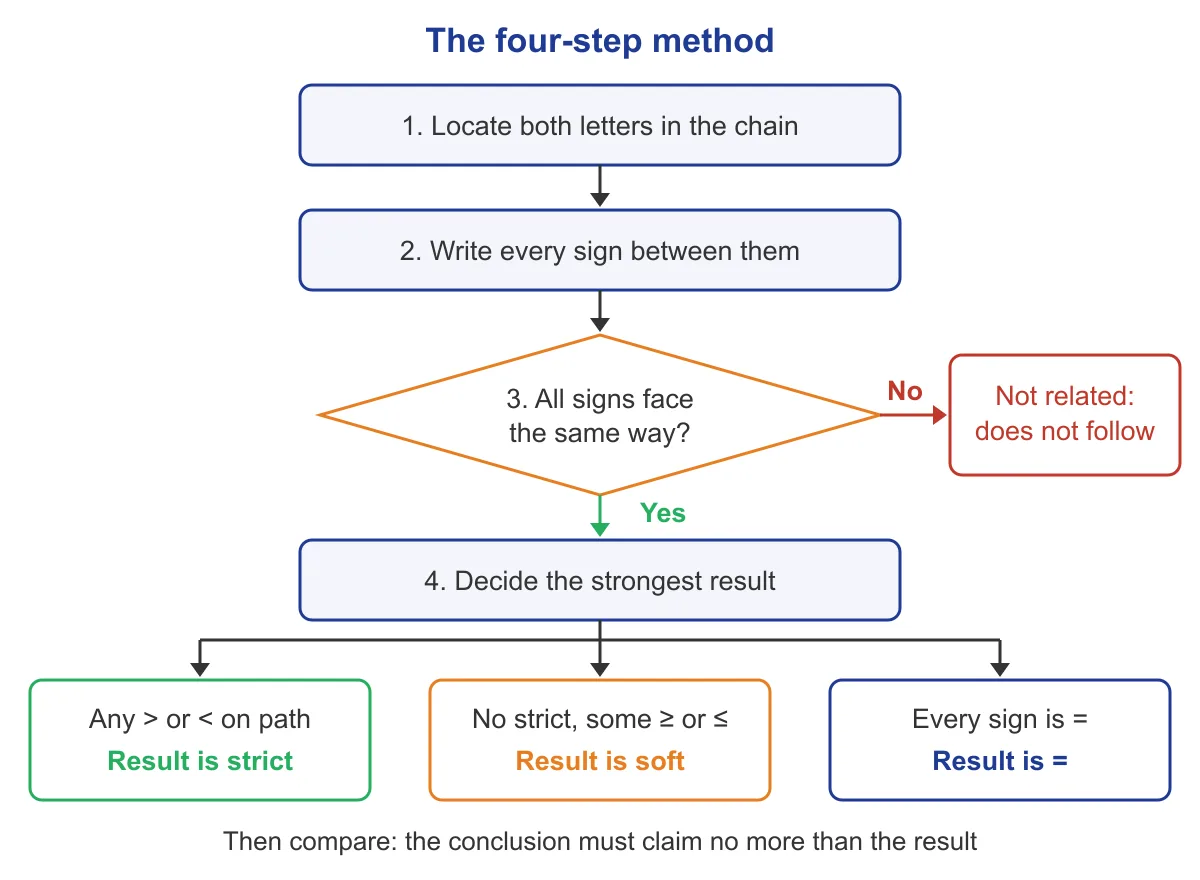
Step 4 is where most marks are lost, so it gets its own section below. Steps 1 to 3 become automatic within a day of practice.
Example 1: Statement: A > B ≥ C = D. Conclusions: I. A > D II. B > D
Conclusion I: path from A to D is >, ≥, =.
Direction: > and ≥ face the same way, = is neutral, so A and D are related.
Strength: there is a strict > on the path, so the result is A > D. Conclusion I follows.
Conclusion II: path from B to D is ≥, =. Same way, so related.
Strength: no strict sign, so the result is only B ≥ D. "B > D" claims more than we know, so II does not follow.
Answer: only I follows (option A). Why: a ≥ path cannot prove a strict >.
Step 3 in detail: walking the path
Think of the statement as a row of planks laid across a river. You are walking from one letter to the other. Each sign is a plank, and a plank can face forwards or backwards. You can cross only if every plank you step on faces the same way. An = plank is flat and lets you through in either direction.
Why does one backward sign break the link? Take P > Q < R. All you know is that Q is smaller than both P and R. P could be 10 and R could be 12, or P could be 10 and R could be 5, or both could be 8. P and R can stand in any order, so nothing about them is definite. The same reasoning holds for P ≥ Q ≤ R, P > Q ≤ R and every other mix of opposite signs.
When signs face the same way, the inequality carries along: if P > Q and Q > R, then P is above Q, which is above R, so P is above R. An = sign only says two letters sit at the same spot, so it neither helps nor hurts the direction.
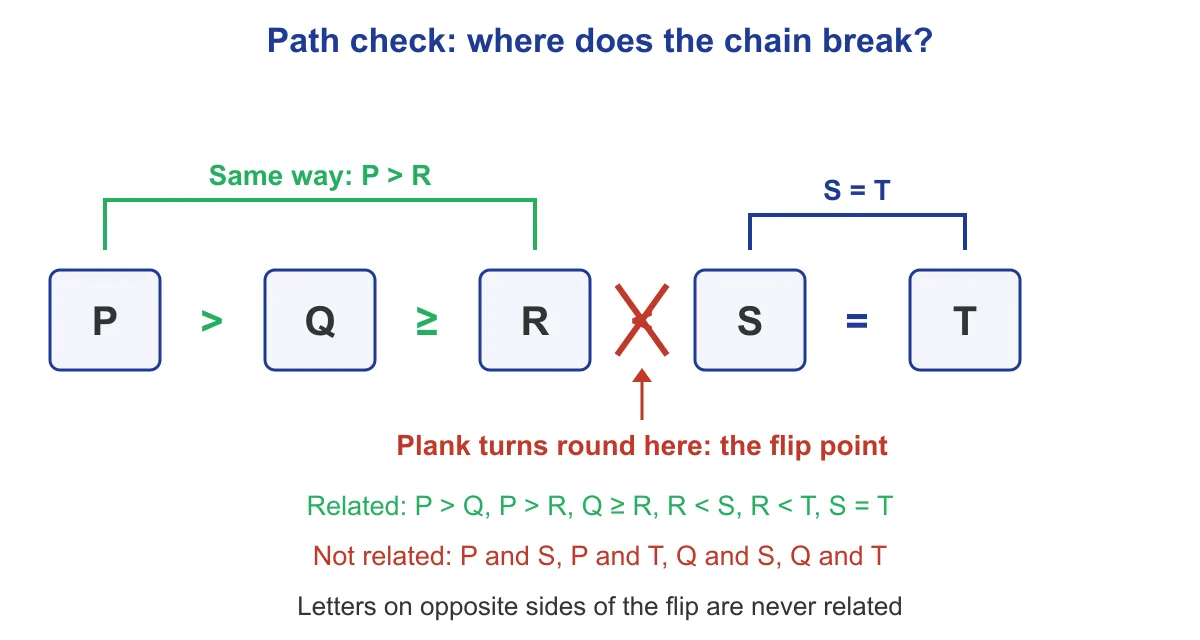
Memory trick: "Walk the bridge, every plank must face the same way." When you read the path, picture yourself stepping across; one plank turned round and you fall in.
A useful habit: as soon as you read a statement, mark every point where the direction flips. In P > Q ≥ R < S = T the flip is at R. Any conclusion whose letters sit on opposite sides of that flip is dead before you even look at its sign. Letters on the same side need the full check.
Example 2: Statement: M > N ≥ O < P ≤ Q. Conclusions: I. M > O II. N < Q
Flip point: the direction changes at O (≥ then <).
Conclusion I: M and O are on the same side. Path M > N ≥ O, both face the same way, strict sign present, so M > O. Follows.
Conclusion II: N is left of the flip, Q is right of it. Path N ≥ O < P ≤ Q has a turned plank. Not related. Does not follow.
Answer: only I follows. Why: the two letters in II sit on opposite sides of the flip.
Deciding the strength
Once you know two letters are related, you have to say how strongly. There are only three outcomes from a valid path.
- Strict (> or <): at least one sign on the path is strict. One strict plank anywhere makes the whole result strict, even if every other sign is ≥ or =.
- Soft (≥ or ≤): no strict sign on the path, but at least one ≥ or ≤.
- Equal (=): every sign on the path is =.
Now compare your derived result with the conclusion. Here is the rule that settles almost every question:
| Derived from the statement | Conclusion ">" | Conclusion "≥" | Conclusion "=" |
|---|---|---|---|
| A > B | Follows | Follows | Does not follow |
| A ≥ B | Does not follow | Follows | Does not follow |
| A = B | Does not follow | Follows | Follows |
Read the middle row slowly. When you derive A ≥ B, you know A is "greater or equal". It might be greater, it might be equal. So "A > B" is not definite and "A = B" is not definite. Only "A ≥ B" (or the same thing written as B ≤ A) follows.
The top row works the other way. If A is definitely greater than B, then it is certainly true that A is greater than or equal to B. A conclusion with ≥ is a weaker claim, and a weaker claim is always covered by a stronger fact. Students lose marks here by thinking "the statement says >, the conclusion says ≥, they don't match, so it doesn't follow". It does follow.
The bottom row: if A = B, then A ≥ B is true and so is A ≤ B. But A > B is false.
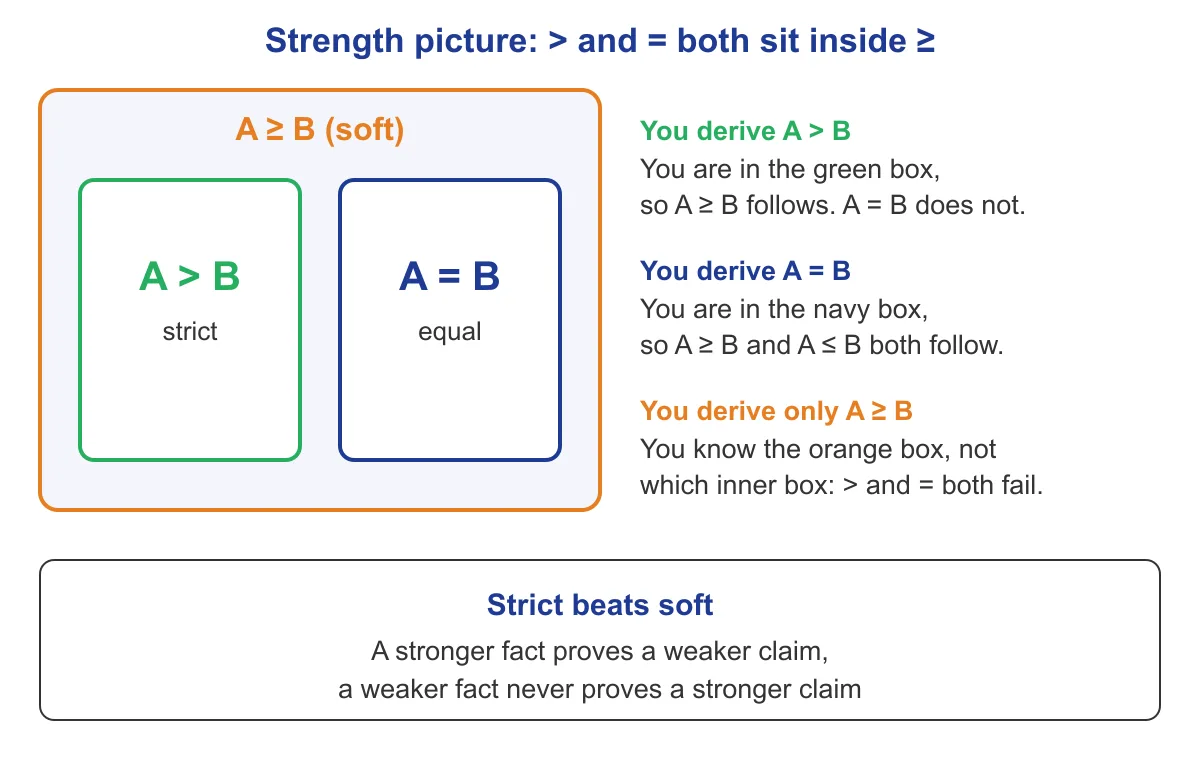
Memory trick: "Strict beats soft." A strict result proves the soft conclusion too; a soft result never proves the strict one. Say it as you reach step 4.
Example 3: Statement: H = J = K ≥ L. Conclusions: I. H = K II. H = L
Conclusion I: path H = J = K, every sign is =, so H = K. Follows.
Conclusion II: path H = J = K ≥ L. All face the same way (= is neutral, ≥ sets the direction). No strict sign, not all =, so the result is H ≥ L. "H = L" is not definite.
Answer: only I follows. Why: one ≥ on the path is enough to spoil an = conclusion.
Example 4: Statement: T ≥ U > V = W ≤ X. Conclusions: I. U > W II. V ≤ X
Conclusion I: path U > V = W. Same way, strict sign present, so U > W. Follows.
Conclusion II: path V = W ≤ X. Same way, no strict sign, so V ≤ X. The conclusion asks for exactly ≤. Follows.
Answer: both follow (option E). Why: each conclusion claims no more than its path gives.
Where the letters sit in the chain
The position of the two letters changes how much you have to read, not the rule.
Letters far apart. The path is long, so check it plank by plank. A single opposite sign in the middle of a long chain is the commonest trap in the exam, because the eye sees a lot of > signs and jumps to a verdict. Count every sign.
Letters in the middle. If both letters are inside the chain, ignore everything outside them. In A < B ≥ C > D ≤ E, a conclusion about B and D only uses ≥ and >, which point the same way, so B > D, even though the chain as a whole has flips on both sides.
Letters at the ends. If a conclusion uses the first and last letters, the whole chain is the path. Chains written to look "nearly all one way" with a single turned sign are set exactly for this.
A letter that appears twice. When the statement comes in pieces, the shared letter is the joint. "E > F ≥ G; H ≤ F < J" contains F twice. Rewrite each piece around F: from the second piece, F ≥ H and F < J. Now the facts about F are: E > F, F ≥ G, F ≥ H, J > F. Every comparison through F must still pass the direction check. E and H are related through F (E > F ≥ H), but G and H are not (G ≤ F ≥ H faces two ways).
Example 5: Statements: E > F ≥ G; H ≤ F < J. Conclusions: I. E > H II. G ≥ H
Joint letter: F. From the second statement, H ≤ F means F ≥ H.
Conclusion I: E > F ≥ H, same way, strict sign present, so E > H. Follows.
Conclusion II: G and H both connect to F as "F ≥ G" and "F ≥ H". Path from G to H is G ≤ F ≥ H, which turns round at F. Not related.
Answer: only I follows. Why: two letters that are both below a shared letter tell you nothing about each other.
Here is a quick sheet you can use while practising the position cases:
| Situation | What to do | Typical trap |
|---|---|---|
| Letters far apart | Read every sign on the path | Missing one opposite sign in the middle |
| Letters in the middle | Use only the signs between them | Getting distracted by flips outside the path |
| Letters at the ends | Whole chain is the path | Assuming "mostly >" means ">" |
| Shared letter in two statements | Rewrite both pieces around it, then join | Joining two letters that are both above or both below the shared letter |
| Conclusion written in reverse | Flip it to match the statement's direction | Flipping the letters but not the sign |
Conclusions written in reverse
Examiners often write the conclusion backwards: the statement reads A > B > C, and the conclusion says "C < A". These are the same fact. A < sign is just a > read from the other end.
The safe habit is to rewrite the conclusion so its letters appear in the same order as in the statement. To reverse, swap the two letters and turn the sign round:
- C < A becomes A > C
- R ≤ P becomes P ≥ R
- K = M stays K = M (only the letters swap)
Turning only the letters, and not the sign, produces the opposite claim and a wrong answer. Write the flipped version in rough work; it takes two seconds and saves the question.
Memory trick: "Swap the letters, swing the mouth." The open side of the sign always faces the bigger letter, so when the letters change sides, the mouth swings with them.
Example 6: Statement: P ≤ Q = R < S. Conclusions: I. S > P II. R ≥ P
Conclusion I: rewrite in statement order: S > P becomes P < S. Path P ≤ Q = R < S. Same way, strict sign present, so P < S. Follows.
Conclusion II: R ≥ P becomes P ≤ R. Path P ≤ Q = R. Same way, no strict sign, so P ≤ R. Follows.
Answer: both follow. Why: once flipped, each conclusion matches its path exactly or claims less.
Harder cases
The last two examples are of the kind that appear at the end of a set, where the paper tries to tempt you into a quick wrong answer.
Example 7: Statement: R < S ≤ T = U ≥ V > W. Conclusions: I. S > W II. R < V
Flip point: the direction changes at U (≤, = then ≥).
Conclusion I: path from S to W is S ≤ T = U ≥ V > W. The ≤ and the ≥ face opposite ways. Not related.
Conclusion II: path R < S ≤ T = U ≥ V. Again ≤ and ≥ face opposite ways. Not related.
Either–or check: the conclusions involve different pairs (S, W and R, V), so they cannot be an either–or pair.
Answer: neither follows (option D). Why: plenty of strict signs, but every path crosses the flip at U.
Example 8: Statement: A ≥ B = C ≥ D. Conclusions: I. A > D II. A = D
Conclusion I: path A ≥ B = C ≥ D. Same way, no strict sign, so A ≥ D. "A > D" does not follow.
Conclusion II: not all signs are =, so "A = D" does not follow.
Either–or check: same pair (A and D). A ≥ D means A is either greater than or equal to D, and the two conclusions name exactly those two cases. One of them must be true.
Answer: either I or II follows (option C). Why: a derived ≥ splits into > or =, and the conclusions cover both halves.
Notice the difference between Examples 7 and 8. Both have two failing conclusions. In 7 the letters are unrelated, and the conclusions are about different pairs: answer D. In 8 the letters are related by a soft sign, and the conclusions are the two halves of it: answer C.
Common traps
- Seeing many > signs and marking "follows" without reading each one → check every plank between the two letters; one opposite sign kills the link.
- Treating ≥ in the statement as if it were > → a soft path gives only a soft result; "A > B" needs a strict sign somewhere on the path.
- Rejecting a ≥ conclusion because the statement gave > → strict beats soft; A > B makes A ≥ B true.
- Accepting "A = B" when the path has one ≥ → = follows only if every single sign on the path is =.
- Reversing a conclusion by swapping letters but keeping the sign → swap the letters and turn the sign; C < A is A > C, not A < C.
- Reading signs outside the two letters → only the path between them matters; flips beyond either end are irrelevant.
- Joining two letters that are both smaller (or both larger) than a shared letter → G ≤ F ≥ H gives no relation between G and H.
- Marking D the moment both conclusions fail → first check whether they are the same pair and together form the ≥ or ≤ case; if so the answer is C.
- Forgetting that = is neutral → an = sign never breaks a path and never makes it strict; read straight through it.
Quick revision
- A conclusion follows only if it is definitely true for every arrangement the statement allows.
- Five options: only I, only II, either, neither, both.
- Method: locate the letters, read the path, check direction, decide strength.
- Two letters are related only if every sign between them faces the same way.
- = is neutral: it never breaks a path and never makes it strict.
- Any strict sign on a valid path makes the result strict.
- No strict sign but at least one ≥ (or ≤) gives a soft result.
- The result is = only when every sign on the path is =.
- Derived > proves both > and ≥; it never proves =.
- Derived ≥ proves only ≥; > and = are both uncertain.
- Derived = proves =, ≥ and ≤.
- Mark the flip point in the chain; letters on opposite sides are never related.
- Reverse a conclusion by swapping the letters and turning the sign.
- Two letters both above, or both below, a shared letter are not related.
- After this chapter, take a reasoning inequality practice set on pareeksha.in and aim for 40 seconds a question.
Check yourself
Statement: P > Q ≥ R = S Conclusions: I. P > S II. Q ≥ S Which of the following is correct?
- Only conclusion I follows
- Only conclusion II follows
- Either conclusion I or II follows
- Neither conclusion I nor II follows
- Both conclusions I and II follow
Answer
E. Both conclusions I and II follow
I: P > Q ≥ R = S has a strict sign, so P > S follows. II: Q ≥ R = S gives Q ≥ S, follows.
Statement: A ≥ B > C ≤ D Conclusions: I. A > C II. B > D Which of the following is correct?
- Only conclusion I follows
- Only conclusion II follows
- Either conclusion I or II follows
- Neither conclusion I nor II follows
- Both conclusions I and II follow
Answer
A. Only conclusion I follows
I: A ≥ B > C, same direction with a strict sign, so A > C follows. II: B > C ≤ D turns round at C, so B and D are not related.
Statement: M = N ≥ O ≥ P Conclusions: I. M > P II. N ≥ P Which of the following is correct?
- Only conclusion I follows
- Only conclusion II follows
- Either conclusion I or II follows
- Neither conclusion I nor II follows
- Both conclusions I and II follow
Answer
B. Only conclusion II follows
I: M = N ≥ O ≥ P has no strict sign, so only M ≥ P; M > P does not follow. II: N ≥ O ≥ P gives N ≥ P, follows.
Statement: K < L ≤ M < N Conclusions: I. N > K II. M > L Which of the following is correct?
- Only conclusion I follows
- Only conclusion II follows
- Either conclusion I or II follows
- Neither conclusion I nor II follows
- Both conclusions I and II follow
Answer
A. Only conclusion I follows
I: N > K is K < N; K < L ≤ M < N gives K < N, follows. II: L ≤ M gives only M ≥ L, so M > L does not follow.
Statement: F ≥ G = H > J Conclusions: I. J < F II. H ≤ F Which of the following is correct?
- Only conclusion I follows
- Only conclusion II follows
- Either conclusion I or II follows
- Neither conclusion I nor II follows
- Both conclusions I and II follow
Answer
E. Both conclusions I and II follow
I: J < F is F > J; F ≥ G = H > J has a strict sign, so F > J follows. II: H ≤ F is F ≥ H; F ≥ G = H gives exactly that, follows.
If the statement P > Q = R ≥ S is true, which of the following is definitely true?
- P > S
- Q > S
- R = P
- S ≥ P
Answer
A. P > S
P > Q = R ≥ S has a strict sign, so P > S. Q = R ≥ S gives only Q ≥ S; P > Q = R makes R = P and S ≥ P false.
The conclusion 'H < D' states exactly the same relation as which of the following?
- D < H
- D > H
- H ≥ D
- D ≤ H
Answer
B. D > H
To reverse a relation, swap the letters and turn the sign: H < D becomes D > H. The other three either keep the wrong sign or allow equality.
Statement: T ≤ U = V < W ≥ X Conclusions: I. T ≥ W II. X ≤ W Which of the following is correct?
- Only conclusion I follows
- Only conclusion II follows
- Either conclusion I or II follows
- Neither conclusion I nor II follows
- Both conclusions I and II follow
Answer
B. Only conclusion II follows
I: T ≤ U = V < W gives T < W, so T ≥ W is false and does not follow. II: W ≥ X read in reverse is X ≤ W, follows.
Statement: D > E ≥ F; F = G < H Conclusions: I. D > G II. E ≥ H Which of the following is correct?
- Only conclusion I follows
- Only conclusion II follows
- Either conclusion I or II follows
- Neither conclusion I nor II follows
- Both conclusions I and II follow
Answer
A. Only conclusion I follows
Join at F: D > E ≥ F = G < H. I: D > E ≥ F = G has a strict sign, so D > G follows. II: E ≥ F = G < H turns round at G, so E and H are not related.
Statement: R ≥ S ≥ T = U ≥ V Conclusions: I. R > V II. R = V Which of the following is correct?
- Only conclusion I follows
- Only conclusion II follows
- Either conclusion I or II follows
- Neither conclusion I nor II follows
- Both conclusions I and II follow
Answer
C. Either conclusion I or II follows
R ≥ S ≥ T = U ≥ V has no strict sign and is not all =, so R ≥ V. Neither R > V nor R = V is definite, but they are the same pair and together make up R ≥ V, so either I or II follows.
Statement: B < C ≤ D = E > F Conclusions: I. E > C II. B < D Which of the following is correct?
- Only conclusion I follows
- Only conclusion II follows
- Either conclusion I or II follows
- Neither conclusion I nor II follows
- Both conclusions I and II follow
Answer
B. Only conclusion II follows
I: C ≤ D = E gives only E ≥ C, so E > C does not follow. II: B < C ≤ D has a strict sign, so B < D follows.
Statement: W > X ≥ Y; Y ≤ Z; Z = Q Conclusions: I. W > Z II. X ≥ Q Which of the following is correct?
- Only conclusion I follows
- Only conclusion II follows
- Either conclusion I or II follows
- Neither conclusion I nor II follows
- Both conclusions I and II follow
Answer
D. Neither conclusion I nor II follows
Join: W > X ≥ Y ≤ Z = Q. Both paths (W to Z and X to Q) turn round at Y, so neither relation is definite. The conclusions are about different pairs, so they cannot be an either-or pair.
Statement: G = H ≥ I > J ≤ K Conclusions: I. H > J II. G ≥ I Which of the following is correct?
- Only conclusion I follows
- Only conclusion II follows
- Either conclusion I or II follows
- Neither conclusion I nor II follows
- Both conclusions I and II follow
Answer
E. Both conclusions I and II follow
I: H ≥ I > J, same direction with a strict sign, so H > J follows. II: G = H ≥ I gives G ≥ I, follows.
Statement: P ≥ Q > R; S < Q ≤ T Conclusions: I. T > R II. P > S Which of the following is correct?
- Only conclusion I follows
- Only conclusion II follows
- Either conclusion I or II follows
- Neither conclusion I nor II follows
- Both conclusions I and II follow
Answer
E. Both conclusions I and II follow
Q is shared. I: T ≥ Q > R gives T > R, follows. II: P ≥ Q and Q > S give P ≥ Q > S, so P > S follows.
In the statement P < Q ≤ R = S > T, which pair of elements has no definite relationship?
- P and S
- Q and S
- R and T
- P and T
Answer
D. P and T
P < Q ≤ R = S keeps one direction, so P < S and Q ≤ S; R = S > T gives R > T. From P to T the path is <, ≤, =, > and turns round at S, so P and T are not related.
If M ≥ N ≥ O = P is true, which of the following does NOT definitely follow?
- M ≥ O
- P ≤ N
- M > P
- O ≤ M
Answer
C. M > P
The path M ≥ N ≥ O = P has no strict sign, so only M ≥ P is certain; M > P is not definite. M ≥ O, P ≤ N and O ≤ M all follow.
Statement: J = K ≥ L = M ≥ N Conclusions: I. J > N II. K = M Which of the following is correct?
- Only conclusion I follows
- Only conclusion II follows
- Either conclusion I or II follows
- Neither conclusion I nor II follows
- Both conclusions I and II follow
Answer
D. Neither conclusion I nor II follows
I: J = K ≥ L = M ≥ N has no strict sign, so only J ≥ N. II: K ≥ L = M gives only K ≥ M, not K = M. Different pairs, so no either-or.
Statement: U > V ≥ W; X ≤ W < Y; Z ≥ Y Conclusions: I. U ≥ Z II. X < Z Which of the following is correct?
- Only conclusion I follows
- Only conclusion II follows
- Either conclusion I or II follows
- Neither conclusion I nor II follows
- Both conclusions I and II follow
Answer
B. Only conclusion II follows
I: U > V ≥ W < Y ≤ Z turns round at W, so U and Z are not related. II: X ≤ W < Y ≤ Z has a strict sign, so X < Z follows.
Statement: A ≤ B = C ≤ D; D < E Conclusions: I. D > A II. D = A Which of the following is correct?
- Only conclusion I follows
- Only conclusion II follows
- Either conclusion I or II follows
- Neither conclusion I nor II follows
- Both conclusions I and II follow
Answer
C. Either conclusion I or II follows
Reverse both to A < D and A = D. Path A ≤ B = C ≤ D gives only A ≤ D, so neither is definite alone. Same pair, and A < D or A = D together make A ≤ D, so either I or II follows.
Statement: M > N < O ≥ P; P = Q > R Conclusions: I. Q < M II. R < N Which of the following is correct?
- Only conclusion I follows
- Only conclusion II follows
- Either conclusion I or II follows
- Neither conclusion I nor II follows
- Both conclusions I and II follow
Answer
D. Neither conclusion I nor II follows
I: path M > N < O ≥ P = Q turns round at N, so M and Q are not related. II: path N < O ≥ P = Q > R turns round at O, not related. Different pairs, so neither follows.