
The Mental Ability Test is the picture-based part of the Jawahar Navodaya Vidyalaya Selection Test (JNVST) for Class 6. Its questions use figures and diagrams rather than reading, and the section it sits in is the first one used to break ties.
The pattern changed for JNVST-2027 (admission to Class 6 for 2027-28, test on 28 November 2026). Mental Ability now has 20 questions in five parts, shared with a new Environmental Studies (EVS) part. The previous pattern, used up to JNVST-2026, gave Mental Ability a full hour on its own. All exam figures are from the official NVS prospectus for the cycle named; check the current one before each new cycle.
JNVST Class 6 paper pattern (JNVST-2027)
| Section | Questions | Marks | Time |
|---|---|---|---|
| Mental Ability Test + Environmental Studies | 20 + 20 | 25 + 25 | 60 minutes together |
| Arithmetic Test | 20 | 25 | 30 minutes |
| Language Test | 20 | 25 | 30 minutes |
| Total | 80 | 100 | 2 hours (11:30 AM to 1:30 PM) |
Other rules in the JNVST-2027 prospectus:
- Every question has four options and one correct answer. Each correct answer earns 1.25 marks, and there is no negative marking.
- All three sections are in one booklet. Answers go on an OMR sheet in blue or black ball-point pen, not pencil. Struck-out, erased or whited-out answers are not evaluated.
- The two hours run without a break, with a bell every 30 minutes. Children may adjust time between sections. Divyang candidates get 40 minutes extra.
- A child must reach the minimum in every section: 14 marks in Mental Ability and EVS together, 7 in Arithmetic and 7 in Language. Since each answer is worth 1.25 marks, 14 marks means at least 12 correct answers across the 20 Mental Ability and 20 EVS questions.
- If two candidates have the same total, the one with more marks in Mental Ability and EVS is preferred first.
- The booklet comes in the language chosen in the application form, and that choice cannot be changed later.
What changed from the previous pattern (JNVST-2026)
| JNVST-2026 | JNVST-2027 | |
|---|---|---|
| Mental Ability questions | 40 (50 marks) | 20 (25 marks) |
| Time | 60 minutes for Mental Ability alone | 60 minutes for Mental Ability and EVS together |
| Question kinds | 10 parts, 4 questions each | 5 parts |
| EVS | Not in the paper | 20 questions (25 marks) |
Also read: Data Interpretation and Mental Ability for APPSC Group-II and AP Police
The five Mental Ability parts in JNVST-2027
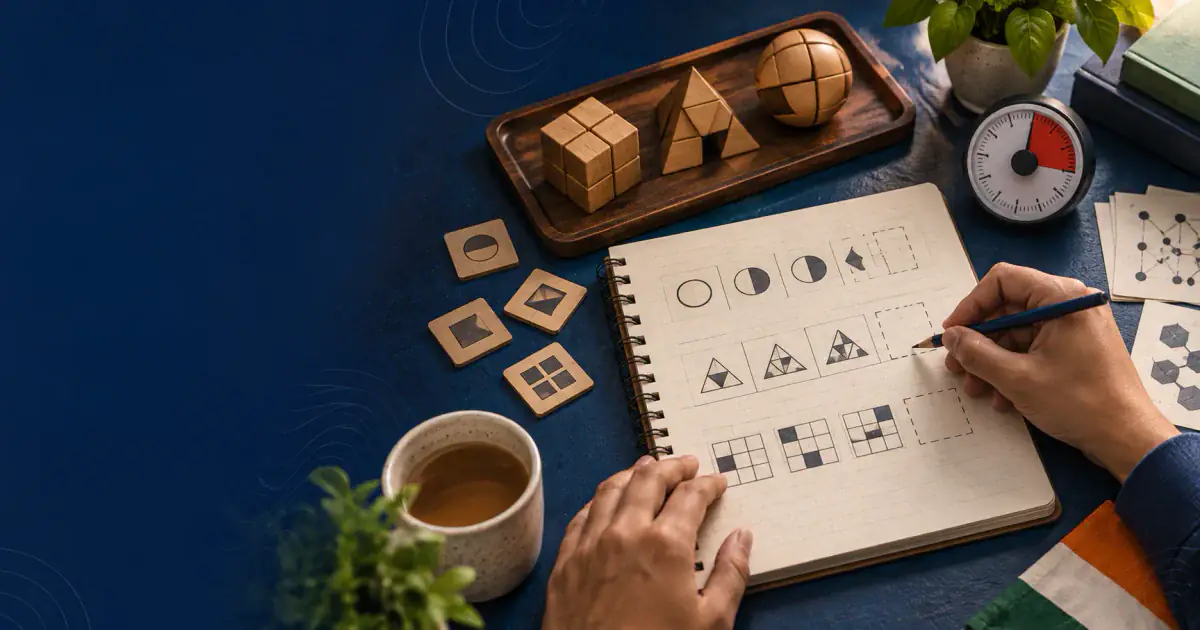
The 2027 prospectus describes the section as non-verbal, based on figures and diagrams only, in five parts of four questions each. The examples below are our own, described in words.
1. Pattern completion
A design has one piece missing. You choose the option that fits the gap without turning it. For 2027 the prospectus says this part also includes alphabetical and number patterns.
Example. A square is divided into four equal smaller squares. The top-left has a black circle, the top-right a white triangle and the bottom-left a white triangle. The bottom-right is empty. Options: (A) white triangle, (B) black circle, (C) black triangle, (D) white circle.
Answer: (B). The design looks the same after a half turn, so diagonally opposite quarters match; every row and column then holds one black circle and one white triangle.
Number version. A 3 × 3 grid has the rows 2, 4, 6 / 3, 6, 9 / 4, 8, ?. Each row is a number, twice it and three times it, so the missing number is 12.
How to solve: find the line of symmetry or the row rule first, then look at the options.
2. Figure series completion
Three figures are in a series and you choose the fourth.
Example. Figure 1: a square with a dot in its top-left corner and one short line inside. Figure 2: the dot in the top-right corner, two lines. Figure 3: the dot in the bottom-right corner, three lines.
Answer: the dot in the bottom-left corner with four lines. The dot moves one corner clockwise each step and one line is added each time.
How to solve: follow one part of the figure at a time, then combine the rules.
3. Geometrical figure completion
One part of a triangle, square or circle is shown. You pick the piece that completes it.
Example. A square has its top-right corner cut away by a straight line running from the middle of the top side to the middle of the right side. Options: (A) a right-angled triangle whose two shorter sides are each half the side of the square, (B) a right-angled triangle whose shorter sides are each as long as a full side, (C) a semicircle, (D) a small square.
Answer: (A). The gap is a triangle with a right angle at the corner and two sides of half a side each.
How to solve: measure the gap's edges against the options; the right piece matches both length and angle.
4. Mirror and water imaging
You pick the exact reflection of a figure in a mirror held along a line marked XY. If XY is vertical (beside the figure), left and right swap. If XY is horizontal (below the figure, like water), top and bottom swap.
Example. A flag has its pole on the left and the cloth at the top, pointing right. The mirror line XY is vertical, to the right of the flag.
Answer: the pole on the right, the cloth still at the top, pointing left. With XY below instead, the pole stays on the left and the cloth points right but hangs at the bottom.
How to solve: check where XY is drawn first. Clock and letter mirror shortcuts are in our non-verbal reasoning tricks.
5. Embedded figure
A simple shape is shown, and you choose the larger figure that hides it at the same size and angle.
Example. The shape: a right-angled triangle twice as wide as it is tall, with the right angle at the bottom-left. Options: (A) a circle with one diameter, (B) a rectangle of the same width and height as the triangle, with a diagonal from top-left to bottom-right, (C) a square with a plus sign through its centre, (D) a circle inside a square.
Answer: (B). The diagonal splits the rectangle into two right-angled triangles, and the lower one has its right angle at the bottom-left. The other figures have no straight-sided triangle.
How to solve: find the shape's most unusual corner, then search for that corner in each option.
Older papers
Past papers from the previous pattern also include kinds that are not in the 2027 list, such as odd-man out, figure matching, figure analogy, punched hole patterns and space visualisation. They train the same habit of looking closely, so they are fine for extra practice, but give most of the time to the five current parts. Our non-verbal reasoning post covers paper folding, rotation and dice.
Pareeksha's JNVST practice papers
Our five JNVST Mental Ability practice papers follow the JNVST-2027 Mental Ability pattern. Each paper has 20 figure questions: four from each of the five official parts (pattern completion, figure series completion, geometrical figure completion, mirror and water images, and embedded figures). Each right answer earns 1.25 marks, so a paper is marked out of 25, with no negative marking. Each paper is timed at 30 minutes, which matches the half of the combined 60-minute section we suggest spending on Mental Ability.
The papers cover the Mental Ability part only, not EVS, Arithmetic or Language. They are free to take, starting with JNVST Mental Ability Test 1. The marks, the score in each part and every answer explained appear after sign-in and a small one-time payment for that paper.
A practice plan for a 10–11-year-old, with a parent
If the test is only days away, do not start new topics. Do one timed set of 20 picture questions with EVS questions after it, practise darkening OMR circles neatly with a ball-point pen, and keep the child rested.
For a later cycle, check the new prospectus first, because the pattern can change. In our experience, six weeks of short daily sessions works better than long weekend ones.
| Weeks | What to do | Time per day |
|---|---|---|
| 1–2 | One question kind per day, untimed. The child explains each answer aloud. | 20 minutes |
| 3–4 | Mixed sets of 20 figure questions in 30 minutes, such as one practice paper every other day, which leaves the other half of the 60-minute section for EVS (our suggestion, not an NVS rule) | 30 minutes |
| 5–6 | Full mock papers in 2 hours with all sections, on a printed OMR-style sheet | 2 hours, twice a week |
How a parent can help:
- Use real objects. Fold and punch paper, hold a small mirror beside a drawing, cut a paper square to see geometrical completion.
- Ask "how did you know?" A child who can say the rule will find it again under time pressure.
- Keep a mistakes notebook. Write the question kind and the reason, such as "flipped instead of turned".
Common mistakes
- Turning the piece in pattern completion. The prospectus asks for the piece that fits without changing direction.
- Mixing up mirror and water images. Check where the line XY is drawn before choosing.
- Following only one change in a series. Many series change position and number together.
- Accepting a hidden shape of the wrong size or angle in embedded figures.
- Leaving blanks or stalling. All questions carry equal marks and there is no negative marking: mark a best guess and move on.
- Erasing on the OMR sheet. Changed or erased answers are not evaluated, so decide first, then darken once.
For how picture puzzles relate to IQ tests more broadly, see types of IQ test questions. Families also preparing for the Sainik School entrance can read our AISSEE Intelligence section guide.
Frequently asked questions
How many questions are in the JNVST Mental Ability Test?
In JNVST-2027 there are 20 Mental Ability questions worth 25 marks, four from each of five parts. They share one 60-minute section with 20 EVS questions.
Is there negative marking in JNVST?
No. The JNVST-2027 prospectus says no negative marking will be done, and each correct answer earns 1.25 marks. A child should answer every question.
What are the minimum marks in the Mental Ability section?
For JNVST-2027, a child needs at least 14 marks in Mental Ability and EVS together, plus 7 in Arithmetic and 7 in Language. Fourteen marks means at least 12 correct answers in that section.
How much time should a child spend on Mental Ability?
The prospectus gives 60 minutes for Mental Ability and EVS together and lets children adjust their time. We suggest about 30 minutes for the 20 figure questions, leaving the rest for EVS, and practising at that pace beforehand.
Is the JNVST Mental Ability Test an IQ test?
No. It is a section of a school admission test, marked by right answers. It uses picture puzzles similar to those in IQ tests, but it does not give an IQ score.

Comments (0)
No comments yet. Be the first to share your thoughts.