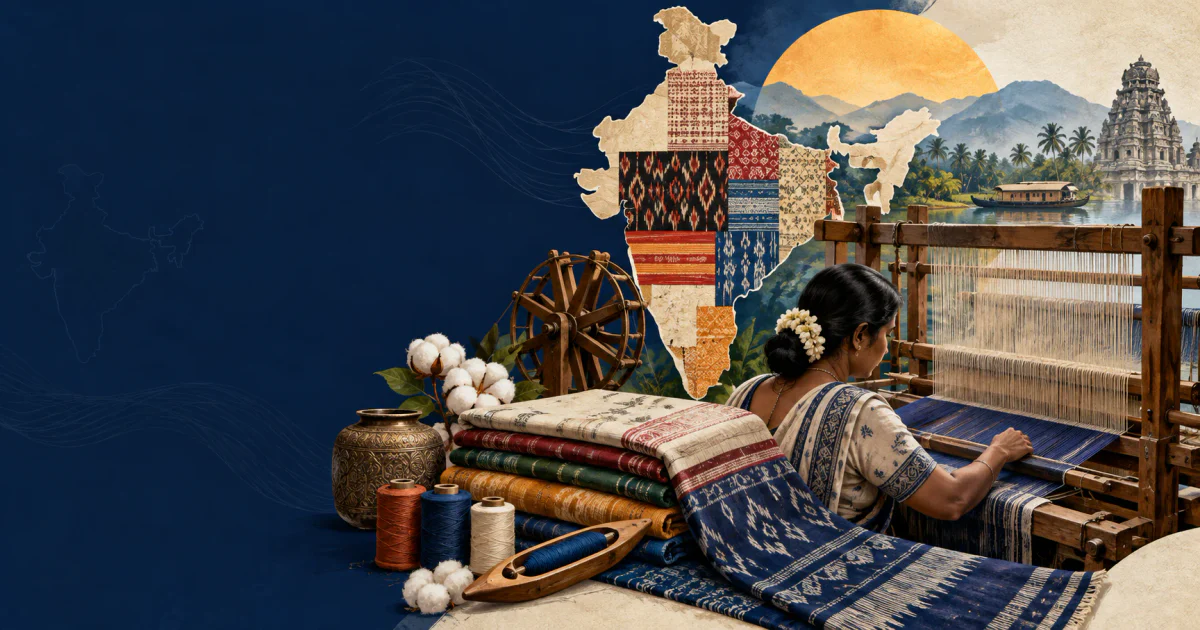
Every 7 August, India observes National Handloom Day, one of the recurring "important days" that shows up across SSC, RRB and state-exam General Awareness papers. This year, 2026, is the 12th edition since the day was instituted. Here is what the date marks, the numbers worth remembering, and the current government schemes tied to the sector.
Quick Answer
National Handloom Day is observed on 7 August every year, commemorating the Swadeshi Movement launched on 7 August 1905 at Calcutta Town Hall. The observance was instituted by the Government of India in 2015, with the first celebration held on 7 August 2015 in Chennai. 2026 marks the 12th National Handloom Day. It is coordinated by the Ministry of Textiles.
Key Facts
| Item | Detail |
|---|---|
| Observed on | 7 August (every year) |
| 2026 edition | 12th National Handloom Day |
| Instituted | 2015, by the Government of India |
| First celebrated | 7 August 2015, Chennai |
| Marks | Anniversary of the Swadeshi Movement (7 August 1905, Calcutta Town Hall) |
| Nodal ministry | Ministry of Textiles |
Why 7 August: The Swadeshi Movement Link
The date was chosen deliberately. On 7 August 1905, at a public meeting in Calcutta Town Hall, Indian leaders launched the Swadeshi Movement in response to the British decision to partition Bengal. The movement called for a boycott of British goods and a return to indigenous production — handloom weaving was central to that effort, since it let ordinary households produce cloth without relying on British mills. Naming the 2015 observance after this date ties the modern handloom sector to that history of self-reliance.
2026: What Was Announced
- The Ministry of Textiles held the central celebration with live weaving demonstrations, including Kani weaving.
- 22 awards were conferred: 3 Sant Kabir Awards and 19 National Handloom Awards, recognising master weavers.
- Four commemorative postage stamps on handloom themes were released.
- Two publications were launched: Earth, Root, Thread and the Handloom Award Book 2025.
- The Prime Minister used his address to encourage citizens to post "Get Ready With Me" (GRWM) style videos featuring handloom garments, to popularise India's weaving diversity on social media.
The Sector in Numbers (for GA/GK)
| Metric | Figure |
|---|---|
| Handloom weavers & allied workers | Over 35 lakh (35.22 lakh) |
| Share of women workers | About 70–72% |
| Number of handlooms | 28.20 lakh, nearly 90% in rural areas |
| Handloom exports (2025-26) | Approx. ₹1,330.96 crore |
| Export reach | 125+ countries; India holds the largest global share of handloom textile exports |
| GI-registered handloom products | 106 |
| Handloom Mark registrations issued | Over 29,400 |
Figures are drawn from Ministry of Textiles data cited around National Handloom Day 2026 events; always cross-check exact numbers against the ministry's official release if quoting them in a written exam answer, since census figures are periodically revised.
GI-Tagged Handloom Products to Remember
- Banarasi silk — Varanasi, Uttar Pradesh
- Kanjeevaram silk — Tamil Nadu
- Pochampally Ikat — Telangana / Andhra Pradesh
- Chanderi and Maheshwari — Madhya Pradesh
- Sambalpuri Ikat — Odisha
- Baluchari — West Bengal
- Phulkari — Punjab
- Bandhani and Ajrakh — Gujarat / Rajasthan
Exam questions frequently pair a handloom product with its state of origin — this is the single most common Handloom Day question format.
Government Schemes for Weavers
- National Handloom Development Programme (NHDP) — cluster-based support for weaver groups.
- India Handloom Brand — quality certification mark for genuine handloom products, launched in 2015 alongside the first Handloom Day.
- Weaver MUDRA Scheme — concessional credit for weavers.
- Raw Material Supply Scheme — subsidised yarn supply.
- Handloom Weavers Comprehensive Welfare Scheme — insurance and welfare cover.
- e-Pehchan portal (launched January 2025) — digital identity cards for weavers.
- Market linkage through GeM, Amazon Karigar and Flipkart Samarth, plus the E-Dhaga mobile app.
Likely Exam Questions
- Date and year National Handloom Day was instituted, and where it was first celebrated (2015, Chennai).
- The historical event it commemorates (Swadeshi Movement, 7 August 1905, Calcutta Town Hall).
- Matching a GI-tagged handloom product to its state.
- The nodal ministry (Ministry of Textiles) and flagship schemes (NHDP, India Handloom Brand, Weaver MUDRA).
- Current edition number for the year being asked about (12th in 2026).
Important-days questions reward precision on the anchor facts — date, origin year, founding event and nodal body — more than on the yearly statistics, which change each cycle. Fix those four points first, then layer in the current year's numbers closer to your exam date.

Comments (0)
No comments yet. Be the first to share your thoughts.