Combine reading with arithmetic
Integrated DI items ask you to read a chart and then perform percentage, ratio, average or difference calculations. Separate those steps. First write the exact chart values and units. Next translate the question into an expression. Finally calculate and compare with options. If the chart shows 120 and 180 across two categories, their combined total is 300, average 150, difference 60 and ratio 2:3. These answers are all derived from the same two values but answer different questions.
Pareto and funnel displays
A Pareto chart orders categories by size and may show a cumulative-percentage line. Read the bar scale and the cumulative scale separately. The cumulative percentage after the third category refers to the first three categories together, not only the third. A funnel chart records stages; the number leaving one stage and entering the next may be lower. A conversion rate from stage A to B is B/A, while a drop-off rate is (A−B)/A. State which denominator the question uses.
Final mixed-set routine
Before calculating, ask four questions: Which visual element? Which unit? Which base? Which output form? Estimate first, then compute. When options are far apart, approximation can save time; when close, use exact arithmetic. A graph can present realistic-looking labels while all values are synthetic practice data, so rely only on the supplied chart. Revisit every missed item by re-reading its scale and reconstructing the calculation independently of the written explanation.
Cumulative totals are running sums
Suppose ranked categories have values 90, 70, 60, 50 and 30. Their cumulative totals are 90, 160, 220, 270 and 300. The contribution of categories 3 and 4 together is 270−160=110. The third category alone is 220−160=60. Subtracting two cumulative entries can isolate a block of categories; the endpoints determine exactly which rows are included. Read the cumulative column as a running total, not a second independent dataset.
The first three categories contribute 220/300≈73.3% of the grand total. If a target is “at least 70%”, three categories suffice; two categories contribute 160/300≈53.3%. In a ranked table, the category names are labels after sorting, so the first row always has the largest displayed value. If equal values occur, the ranking order among ties may be arbitrary, but their sum and cumulative totals remain exact.
When a funnel interpretation is warranted
A true funnel follows the same group through stages. If 300 apply, 240 appear and 180 qualify, the attendance conversion is 240/300=80% and the qualification conversion among those appearing is 180/240=75%. The end-to-end conversion is 180/300=60%, which also equals 0.80×0.75. A ranked category table is not a funnel: its rows are separate categories rather than stages of one cohort. The practice set uses ranked tables with explicit cumulative figures; the lesson distinguishes the two displays so a candidate does not transfer a funnel denominator to a ranking question.
Integrated answer check
Read the requested rows and their unit, write the expression, then inspect whether the result is plausible against the grand total. A cumulative total cannot fall as non-negative categories are added. The last cumulative entry must equal the grand total. A subtotal of a few categories cannot exceed that grand total. If a key seems to violate one of these conditions, revisit the column or row used before changing an arithmetic step. This three-part check makes a dense integrated display manageable under a time limit.
Practice — 50 questions
Attempt every item before reading the answers. Use the chart or caselet printed with the question.
1. What is the cumulative total after the first three ranked categories?
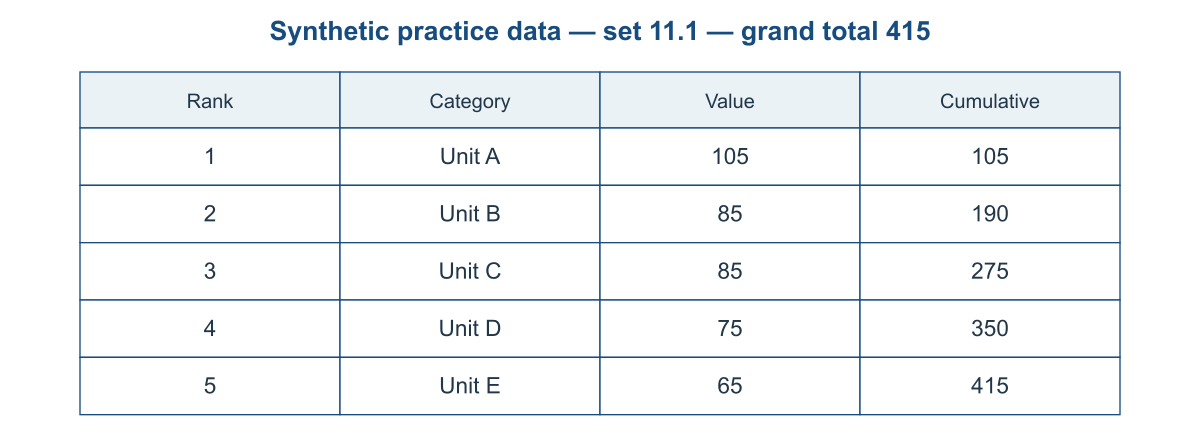
A. 285 B. 275 C. 270 D. 280
2. What is the difference between the largest and smallest ranked values?
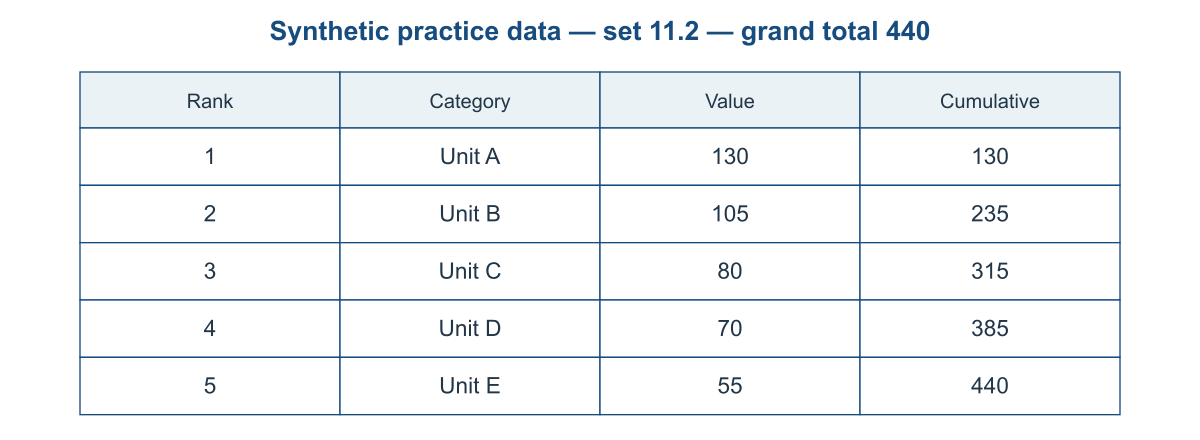
A. 75 B. 80 C. 85 D. 70
3. What is the grand total of all five ranked categories?
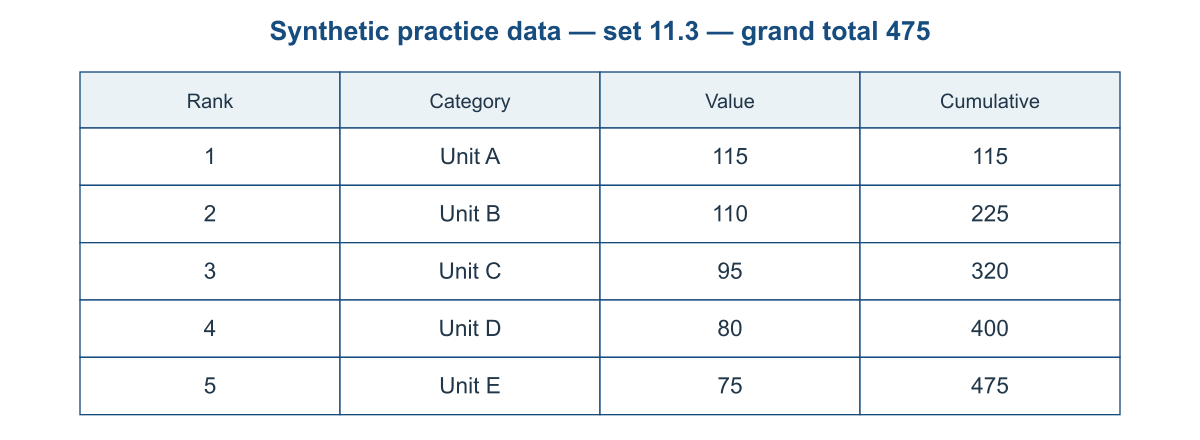
A. 480 B. 470 C. 485 D. 475
4. How much do the third and fourth categories contribute together?
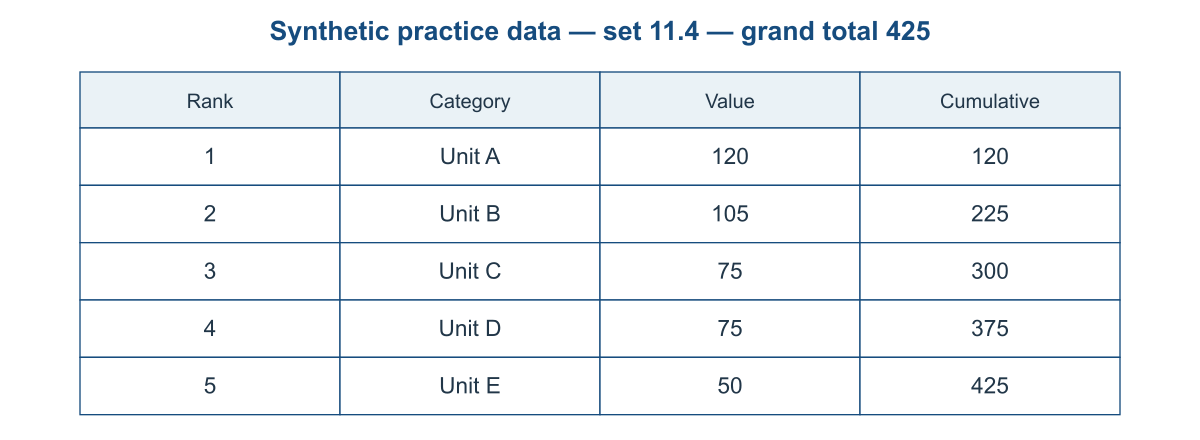
A. 155 B. 150 C. 160 D. 145
5. What is the fifth ranked category value?
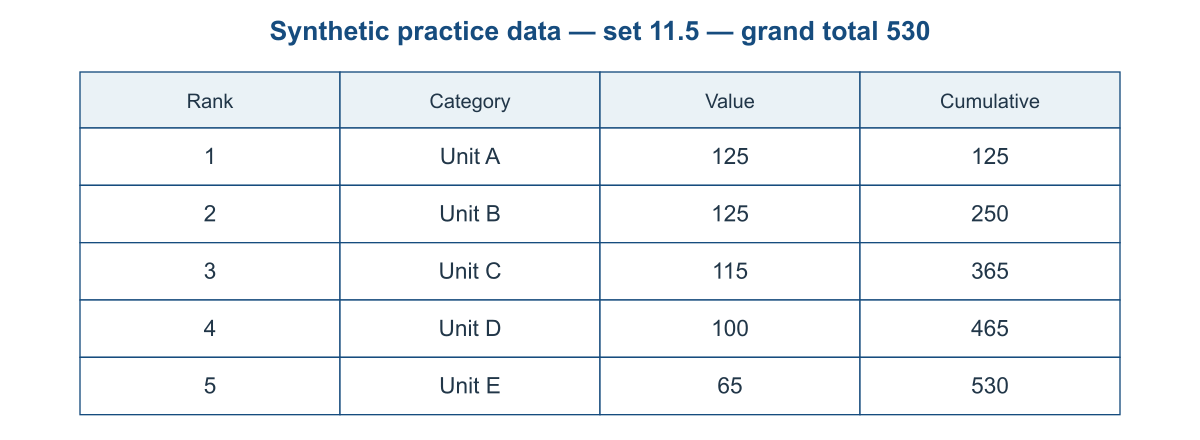
A. 75 B. 70 C. 65 D. 60
6. What is the cumulative total after the first three ranked categories?
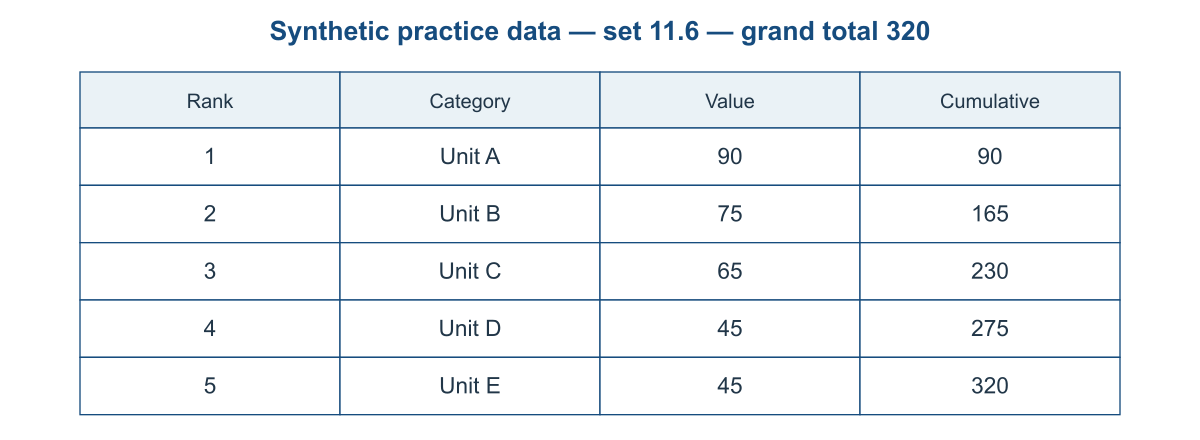
A. 230 B. 225 C. 235 D. 240
7. What is the difference between the largest and smallest ranked values?
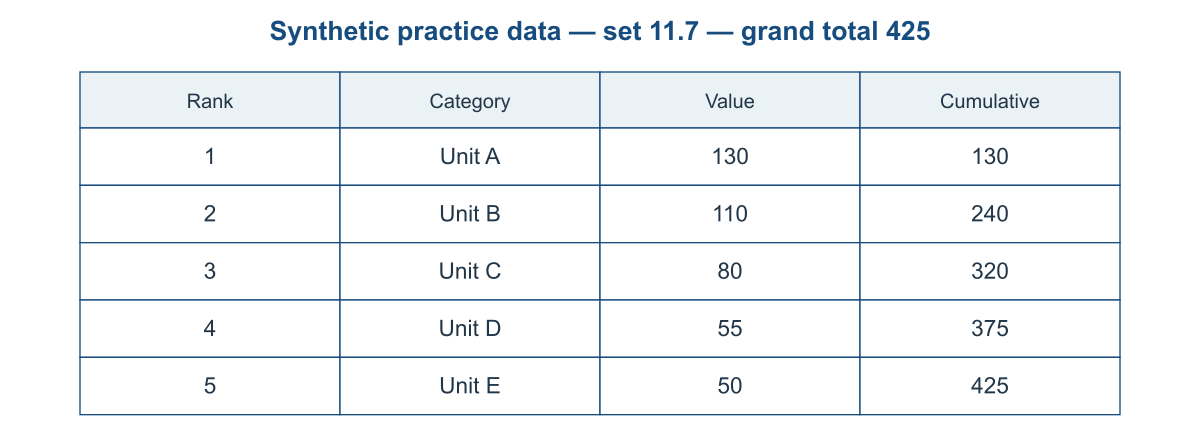
A. 85 B. 90 C. 75 D. 80
8. What is the grand total of all five ranked categories?
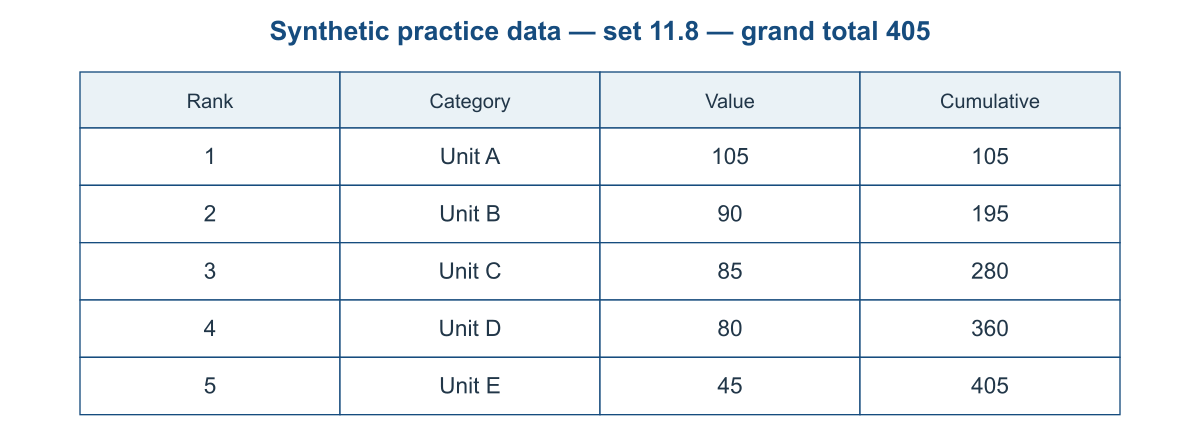
A. 400 B. 405 C. 410 D. 415
9. How much do the third and fourth categories contribute together?
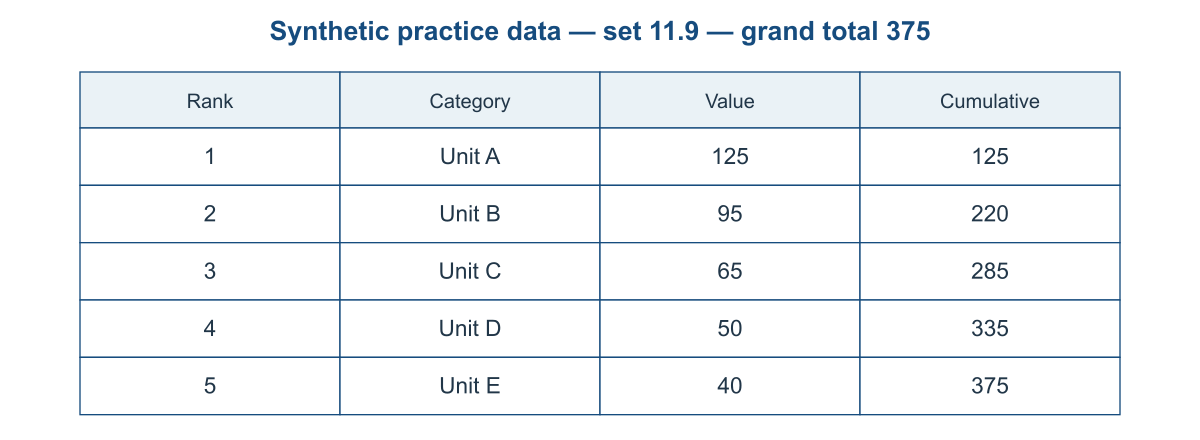
A. 115 B. 125 C. 120 D. 110
10. What is the fifth ranked category value?
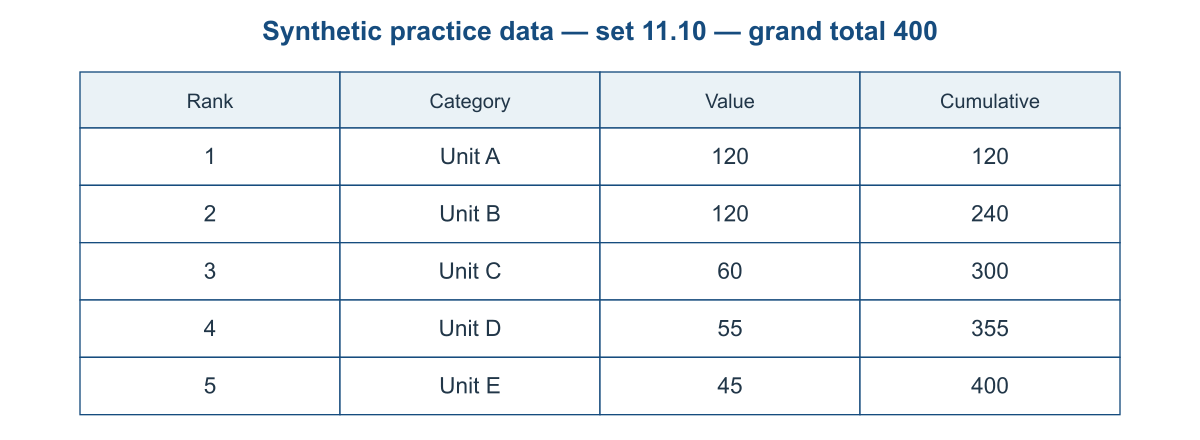
A. 45 B. 55 C. 50 D. 40
11. What is the cumulative total after the first three ranked categories?
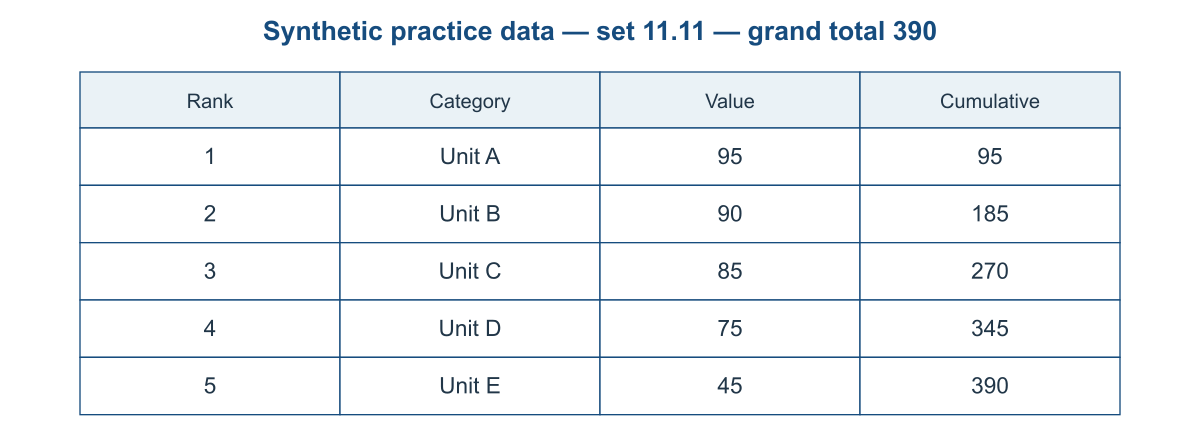
A. 280 B. 265 C. 275 D. 270
12. What is the difference between the largest and smallest ranked values?
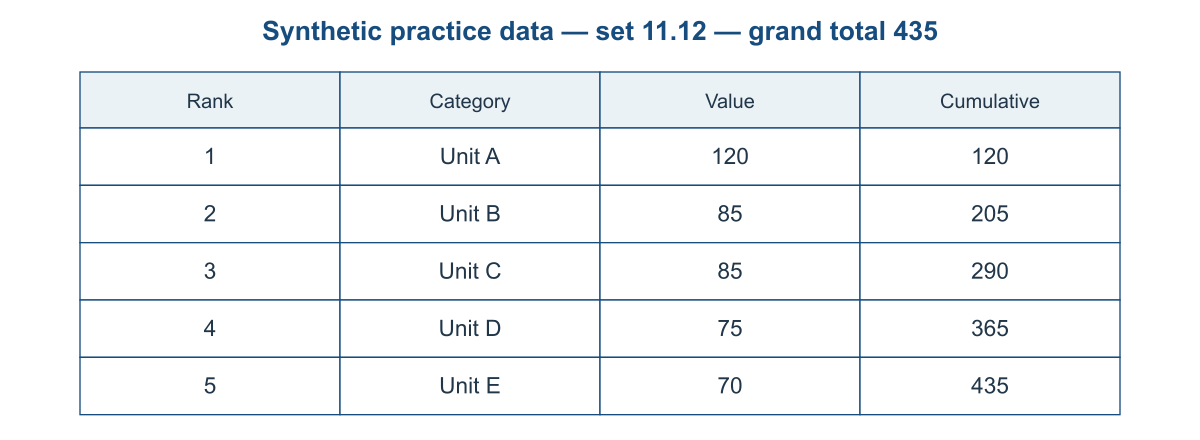
A. 45 B. 60 C. 50 D. 55
13. What is the grand total of all five ranked categories?
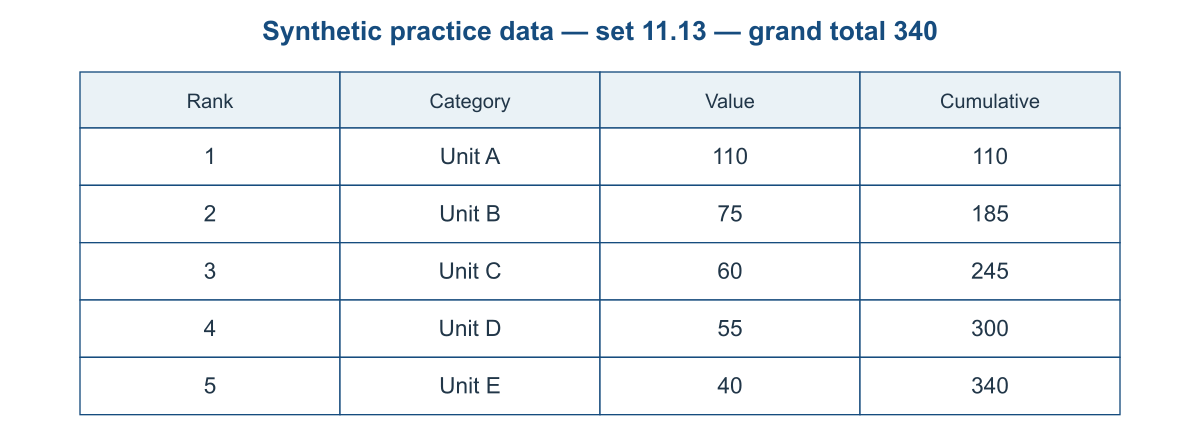
A. 340 B. 350 C. 345 D. 335
14. How much do the third and fourth categories contribute together?
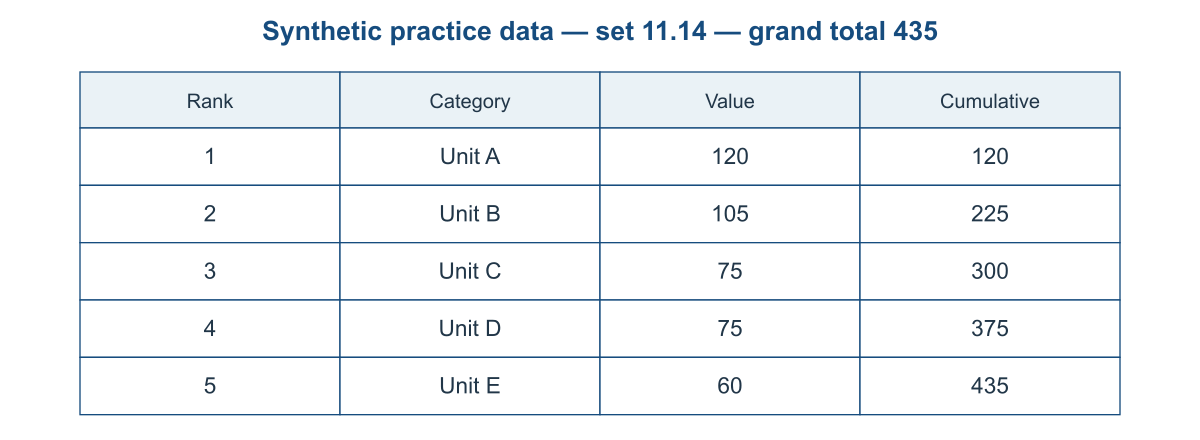
A. 150 B. 145 C. 160 D. 155
15. What is the fifth ranked category value?
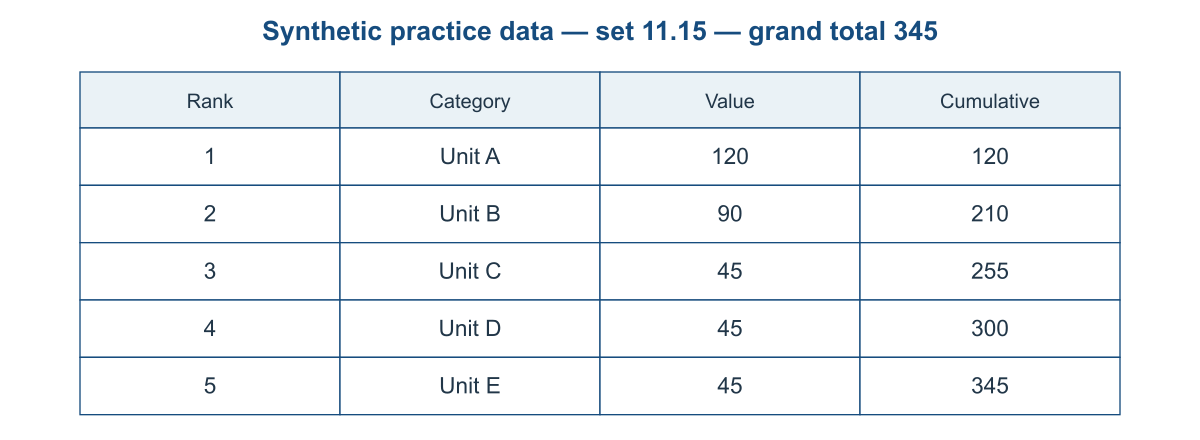
A. 55 B. 45 C. 50 D. 40
16. What is the cumulative total after the first three ranked categories?
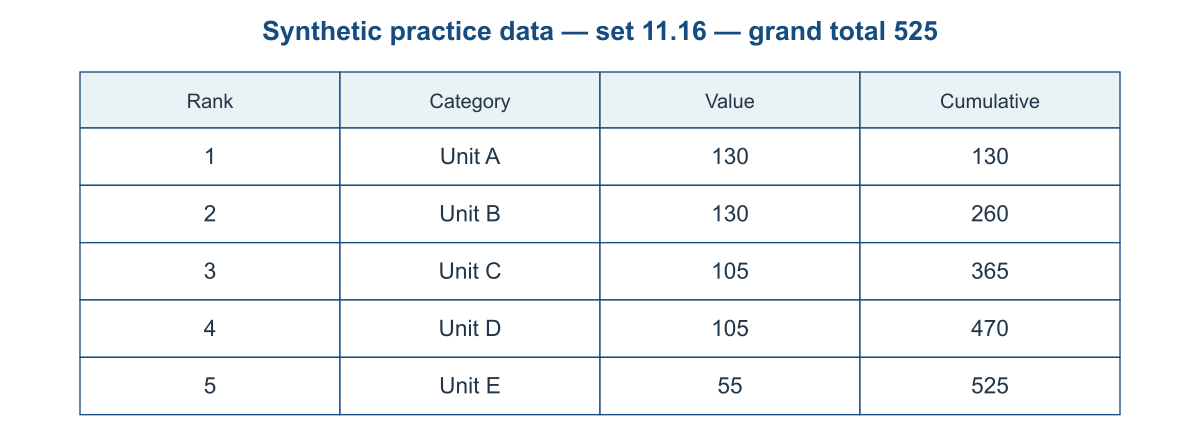
A. 370 B. 360 C. 375 D. 365
17. What is the difference between the largest and smallest ranked values?
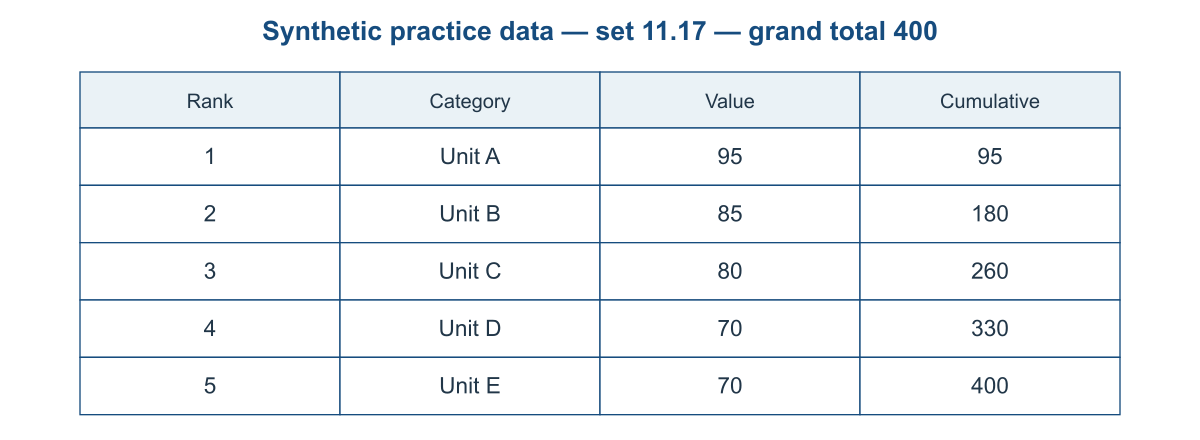
A. 20 B. 25 C. 35 D. 30
18. What is the grand total of all five ranked categories?
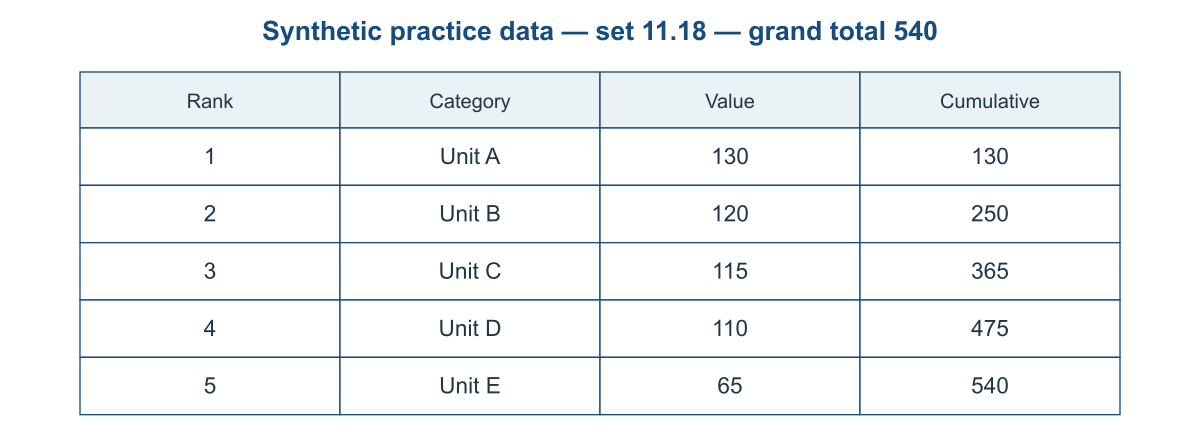
A. 535 B. 550 C. 545 D. 540
19. How much do the third and fourth categories contribute together?
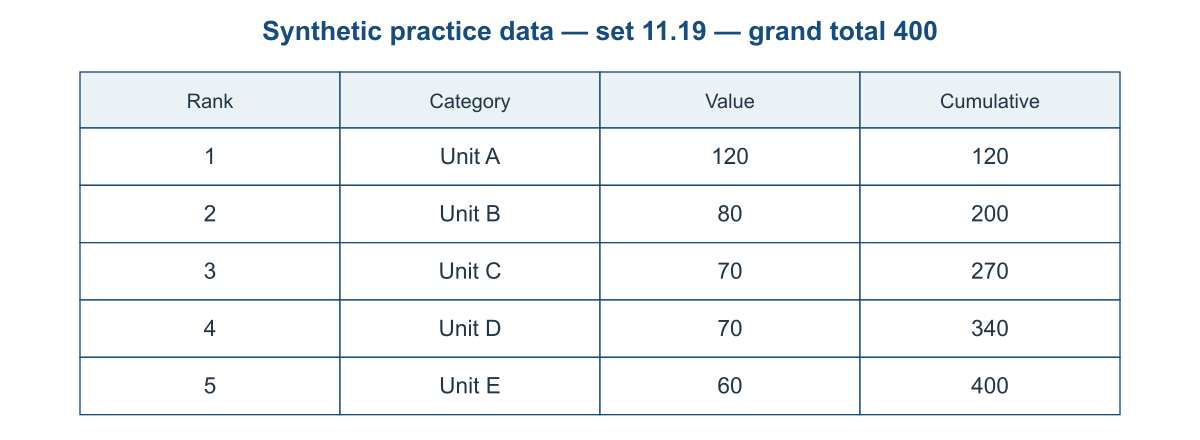
A. 140 B. 135 C. 150 D. 145
20. What is the fifth ranked category value?
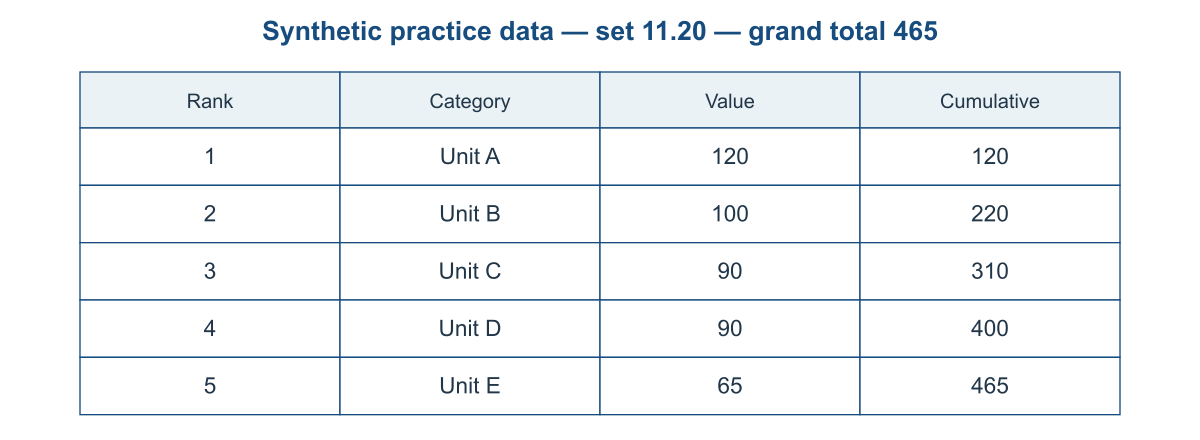
A. 75 B. 60 C. 65 D. 70
21. What is the cumulative total after the first three ranked categories?
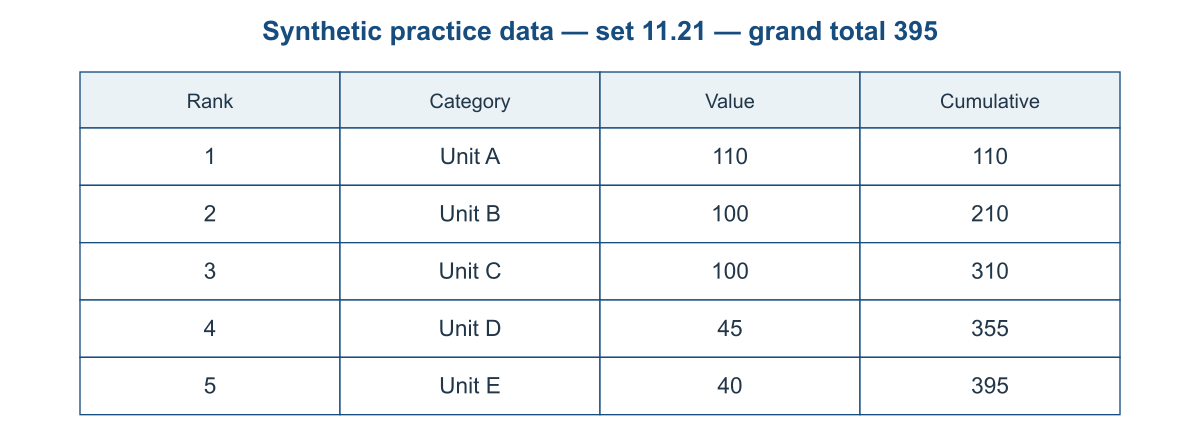
A. 305 B. 320 C. 315 D. 310
22. What is the difference between the largest and smallest ranked values?
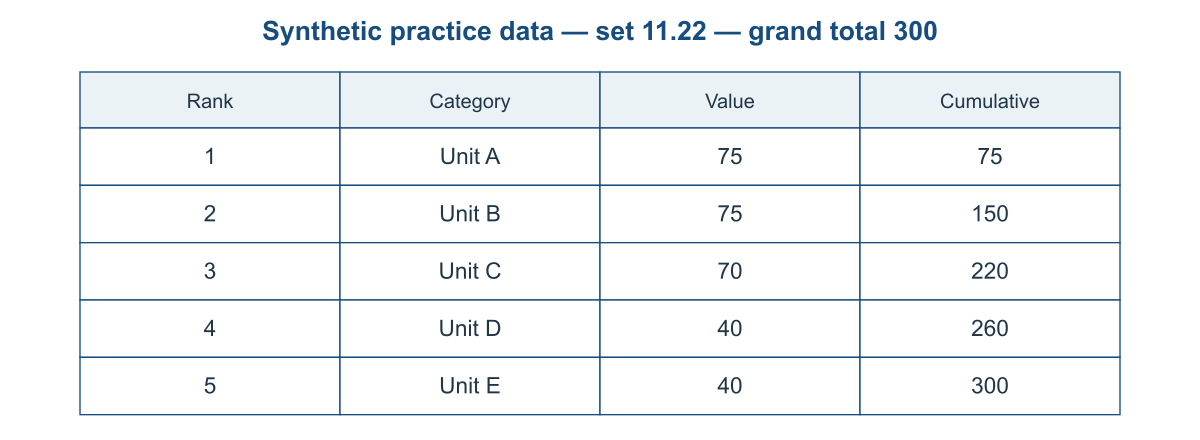
A. 30 B. 45 C. 40 D. 35
23. What is the grand total of all five ranked categories?
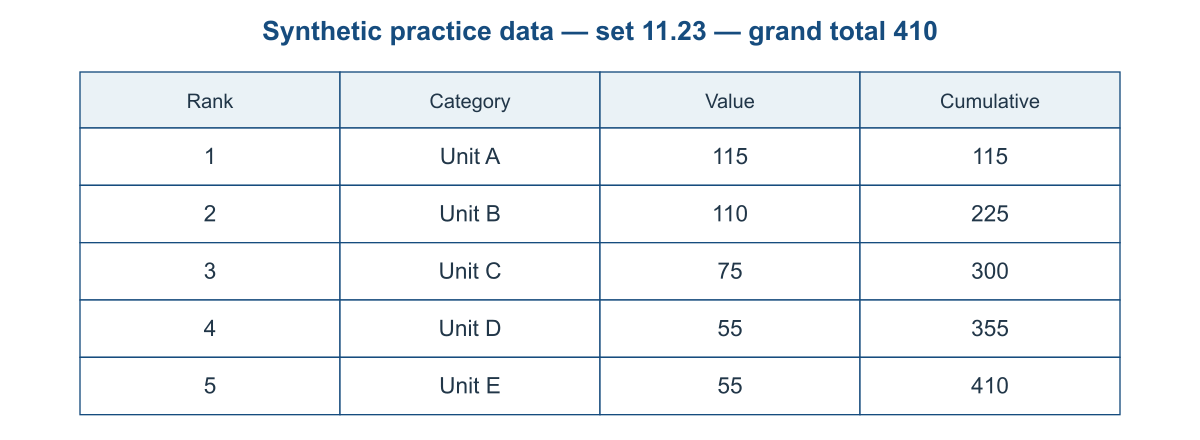
A. 405 B. 410 C. 415 D. 420
24. How much do the third and fourth categories contribute together?
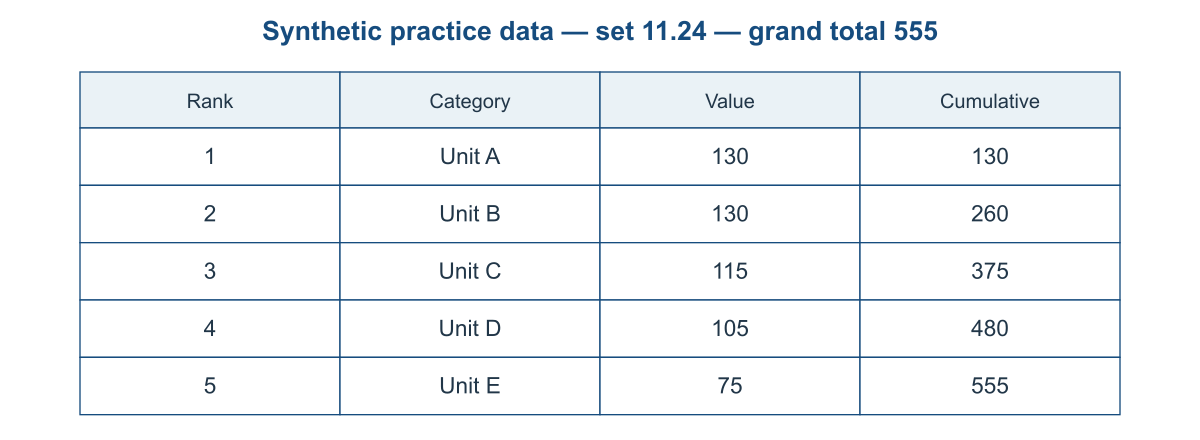
A. 230 B. 220 C. 225 D. 215
25. What is the fifth ranked category value?
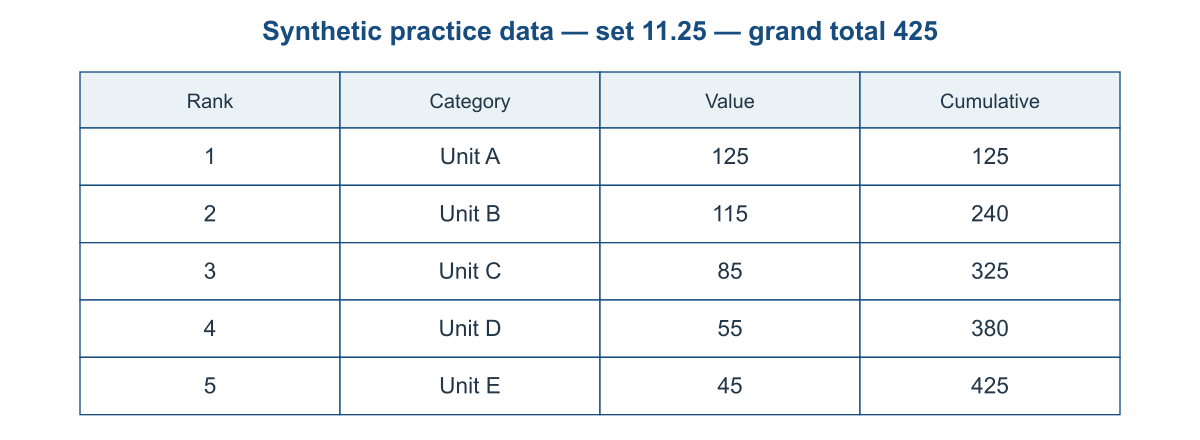
A. 45 B. 55 C. 50 D. 40
26. What is the cumulative total after the first three ranked categories?
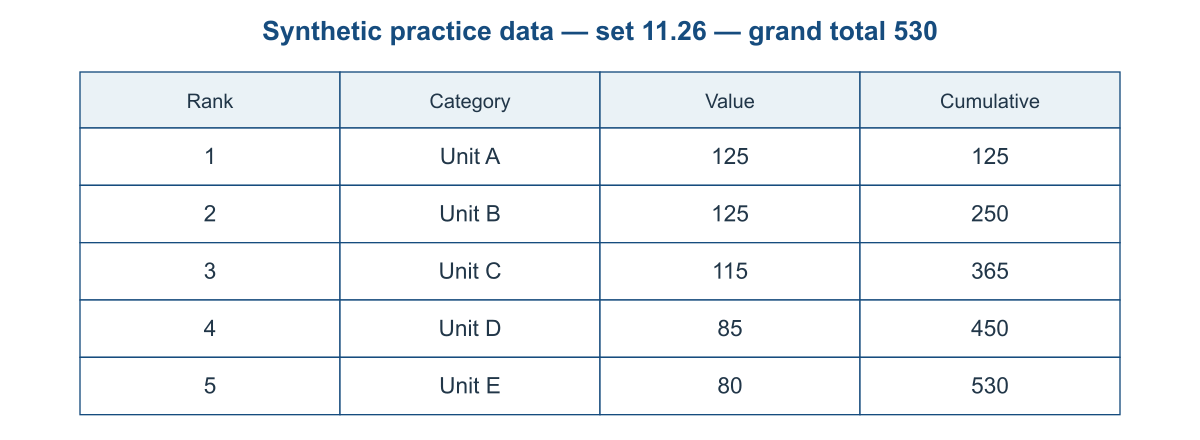
A. 375 B. 360 C. 365 D. 370
27. What is the difference between the largest and smallest ranked values?
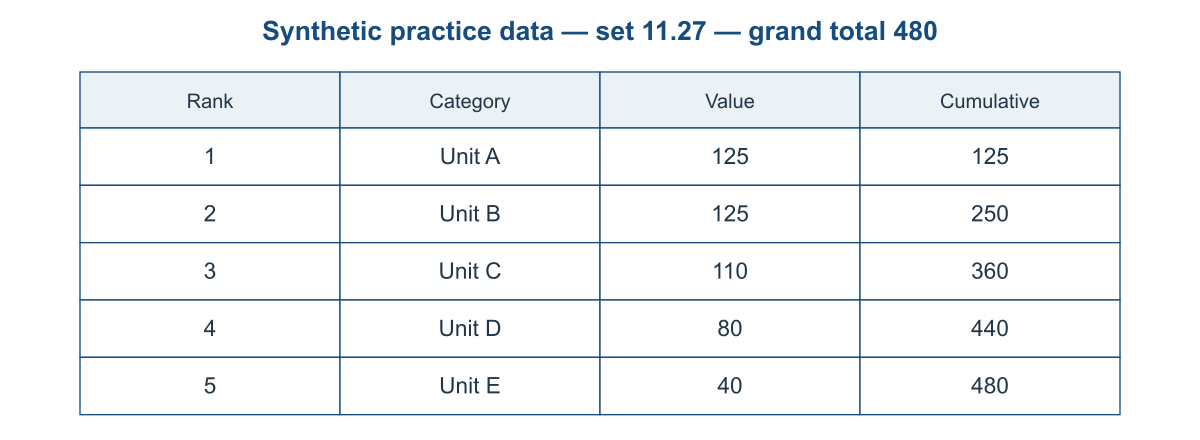
A. 90 B. 80 C. 85 D. 95
28. What is the grand total of all five ranked categories?
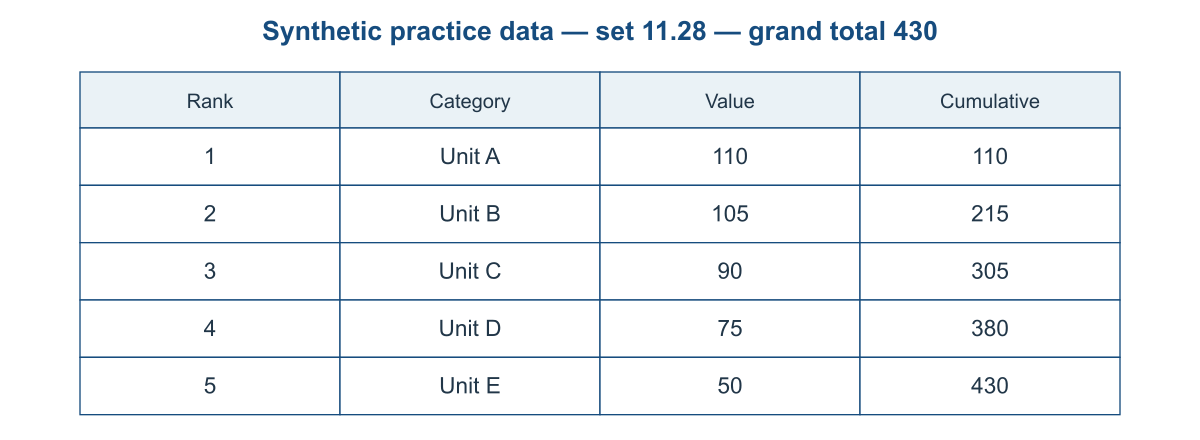
A. 430 B. 440 C. 435 D. 425
29. How much do the third and fourth categories contribute together?
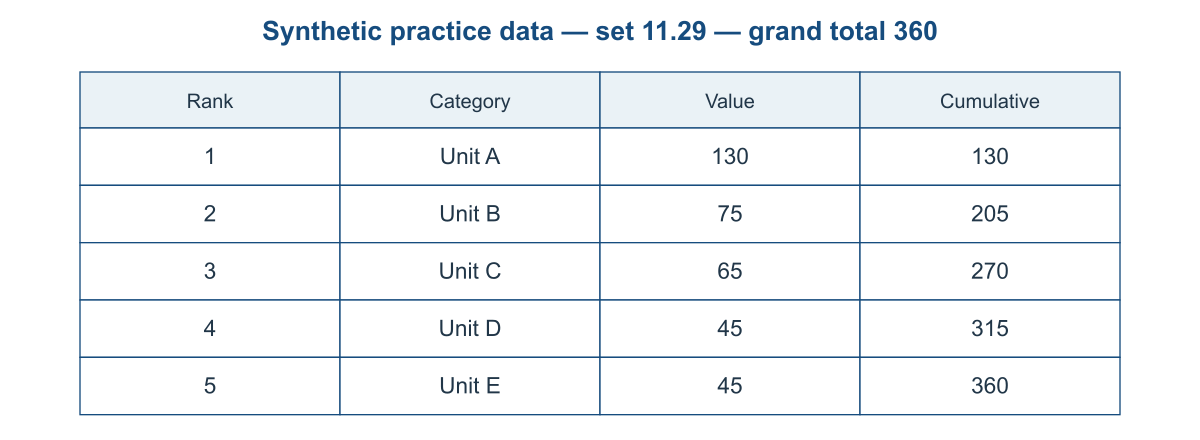
A. 110 B. 115 C. 120 D. 105
30. What is the fifth ranked category value?
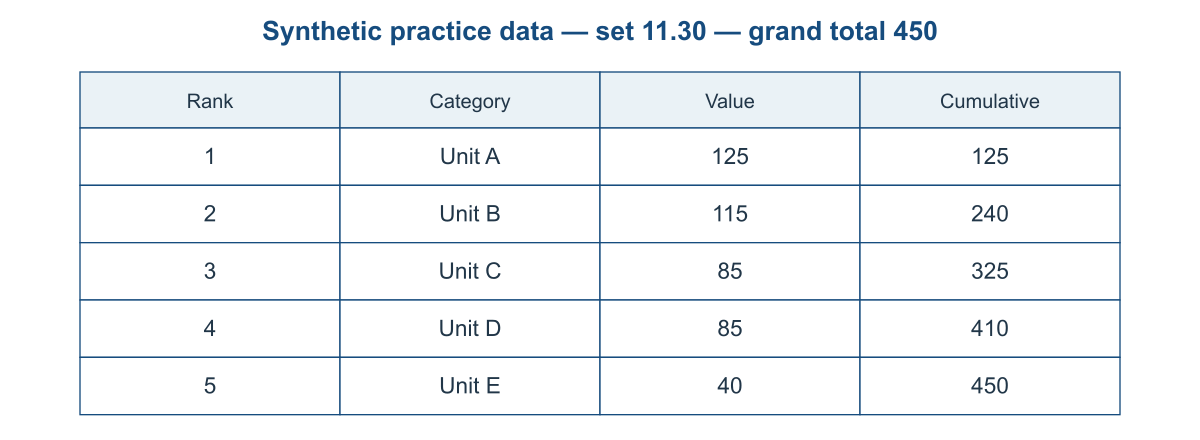
A. 35 B. 40 C. 50 D. 45
31. What is the cumulative total after the first three ranked categories?
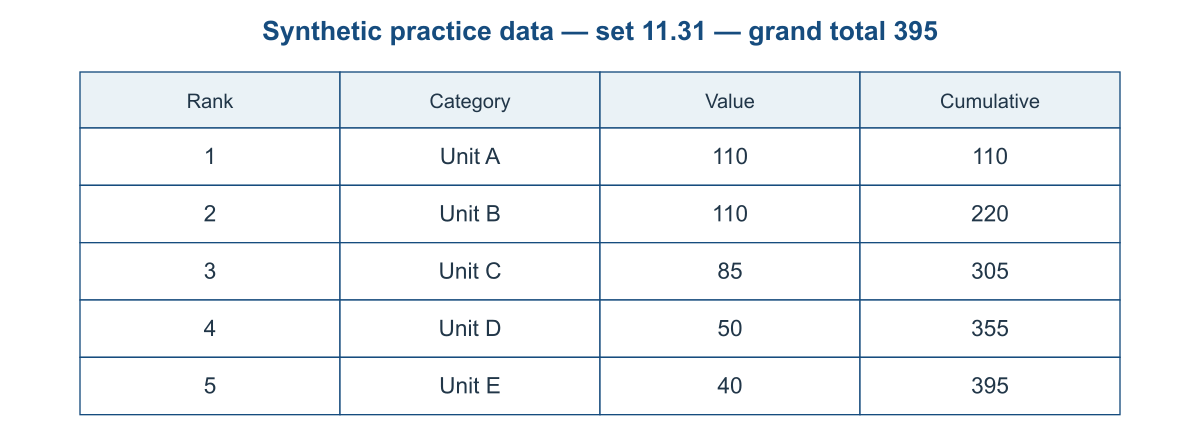
A. 305 B. 300 C. 315 D. 310
32. What is the difference between the largest and smallest ranked values?
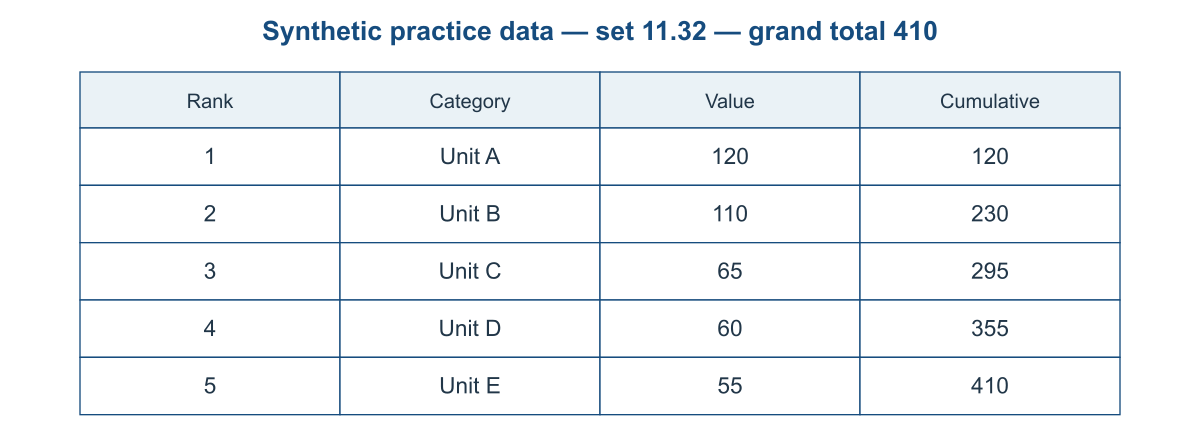
A. 75 B. 65 C. 60 D. 70
33. What is the grand total of all five ranked categories?
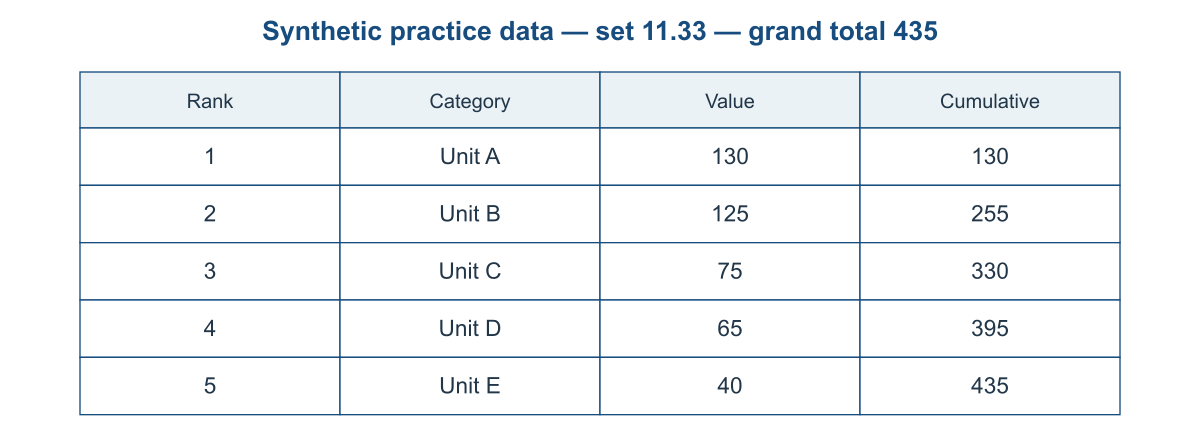
A. 445 B. 435 C. 440 D. 430
34. How much do the third and fourth categories contribute together?
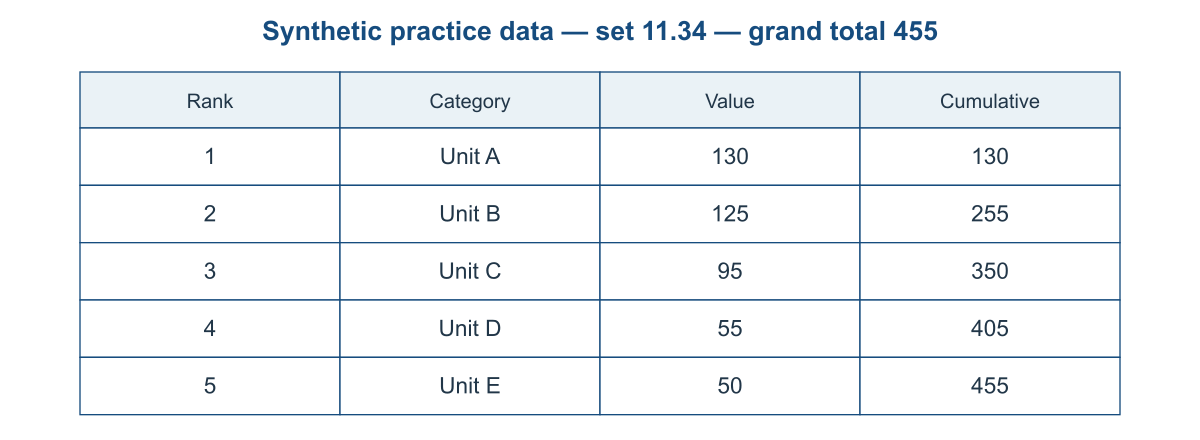
A. 155 B. 160 C. 145 D. 150
35. What is the fifth ranked category value?
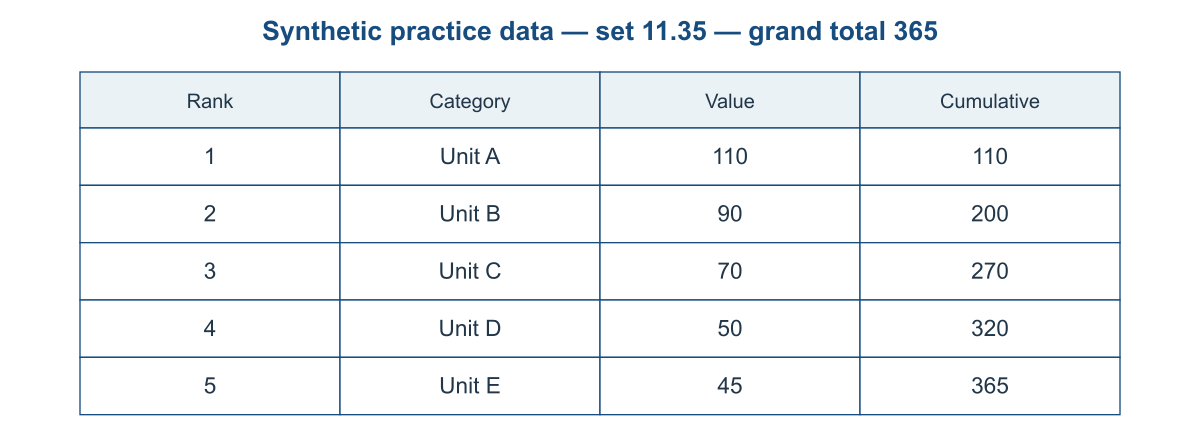
A. 45 B. 50 C. 40 D. 55
36. What is the cumulative total after the first three ranked categories?
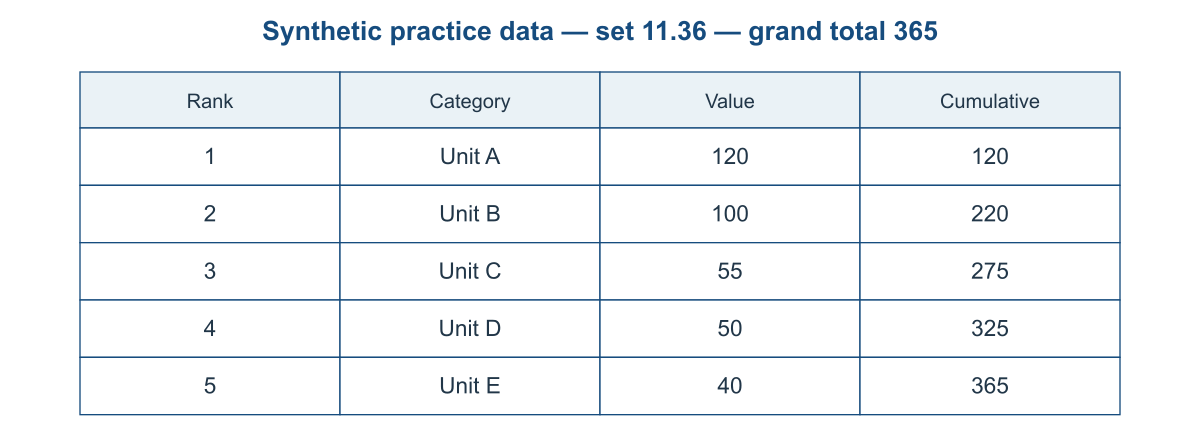
A. 280 B. 275 C. 285 D. 270
37. What is the difference between the largest and smallest ranked values?
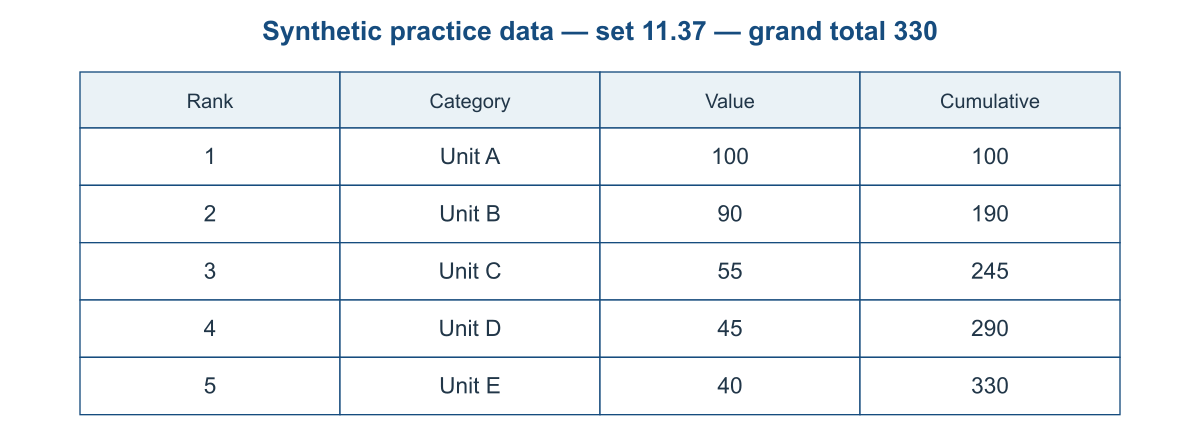
A. 65 B. 60 C. 55 D. 70
38. What is the grand total of all five ranked categories?
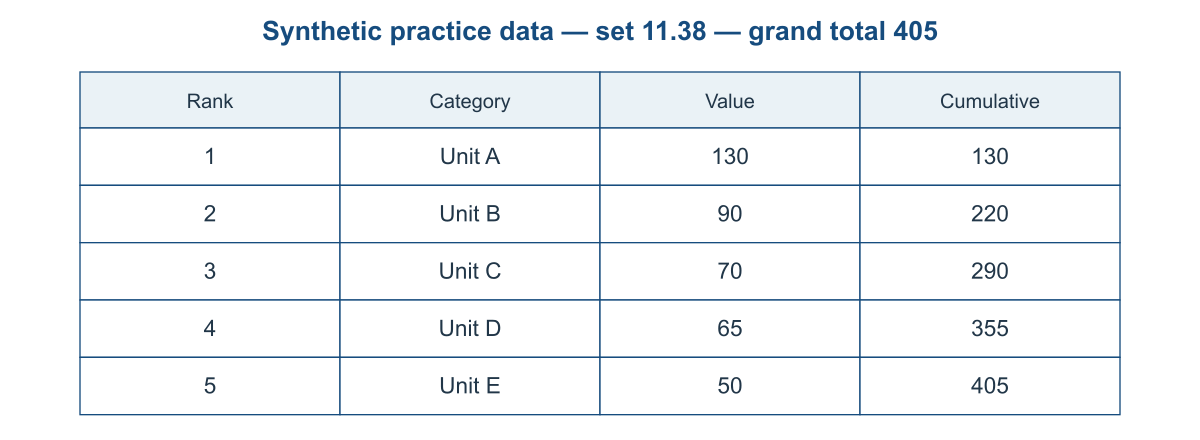
A. 400 B. 415 C. 410 D. 405
39. How much do the third and fourth categories contribute together?
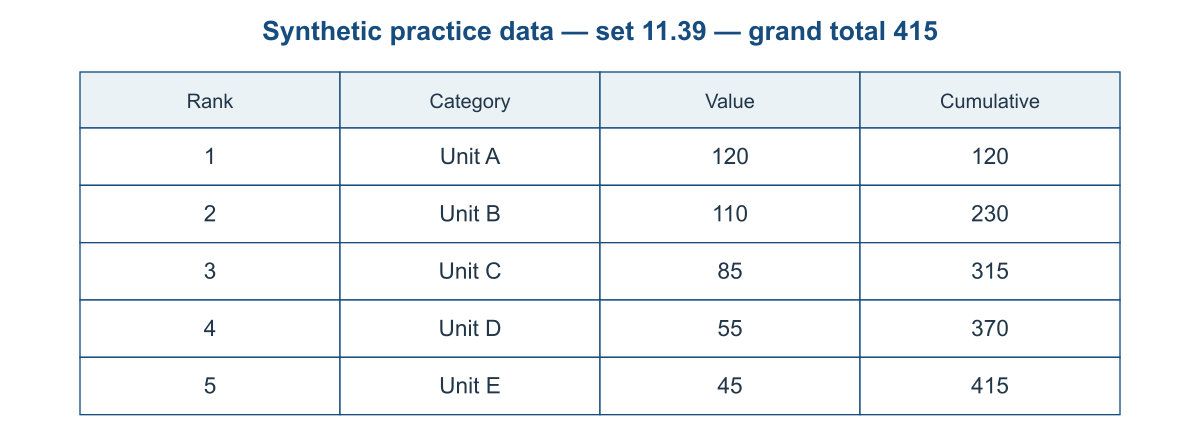
A. 145 B. 150 C. 135 D. 140
40. What is the fifth ranked category value?
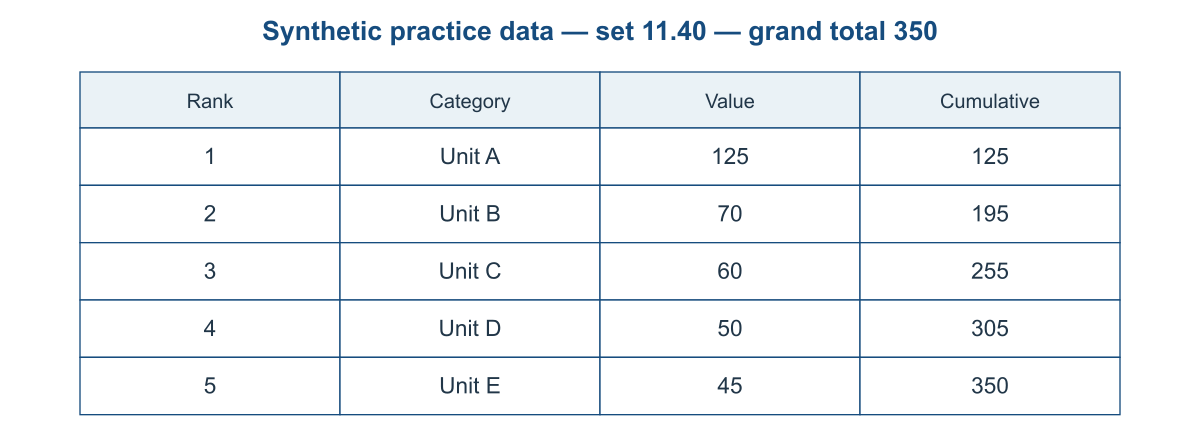
A. 50 B. 40 C. 55 D. 45
41. What is the cumulative total after the first three ranked categories?
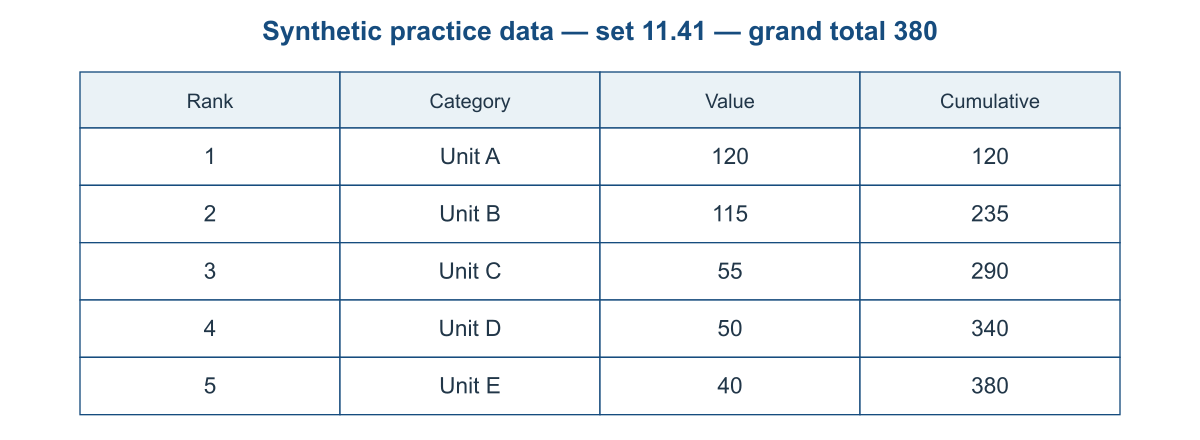
A. 300 B. 290 C. 295 D. 285
42. What is the difference between the largest and smallest ranked values?
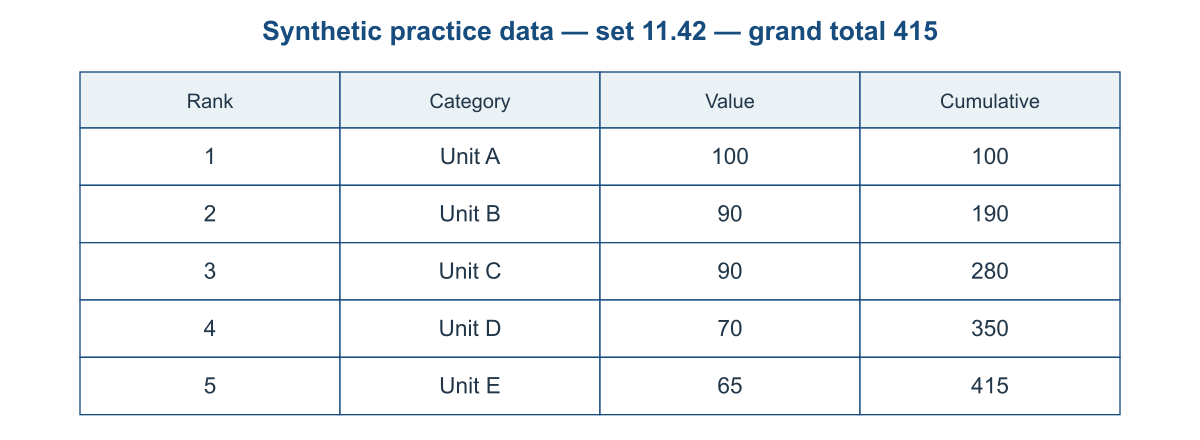
A. 45 B. 35 C. 40 D. 30
43. What is the grand total of all five ranked categories?
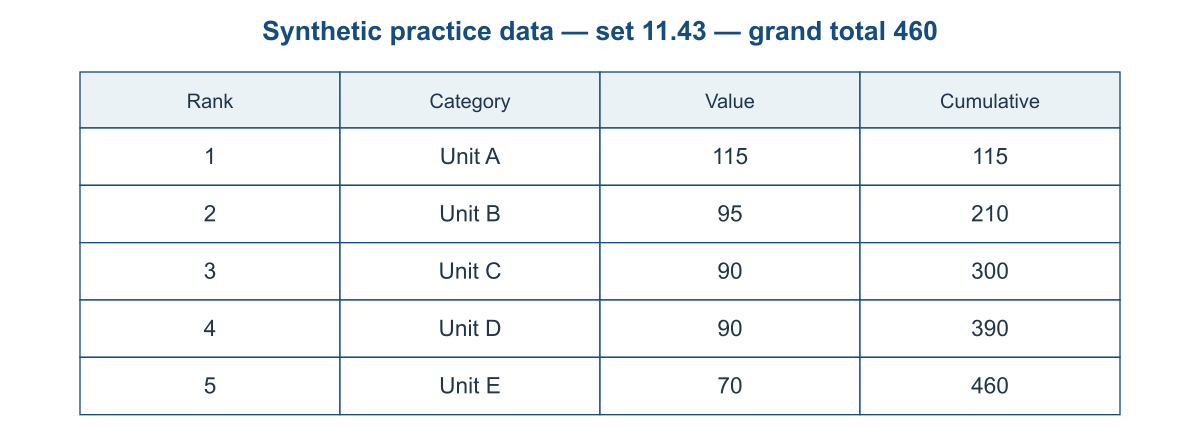
A. 470 B. 455 C. 465 D. 460
44. How much do the third and fourth categories contribute together?
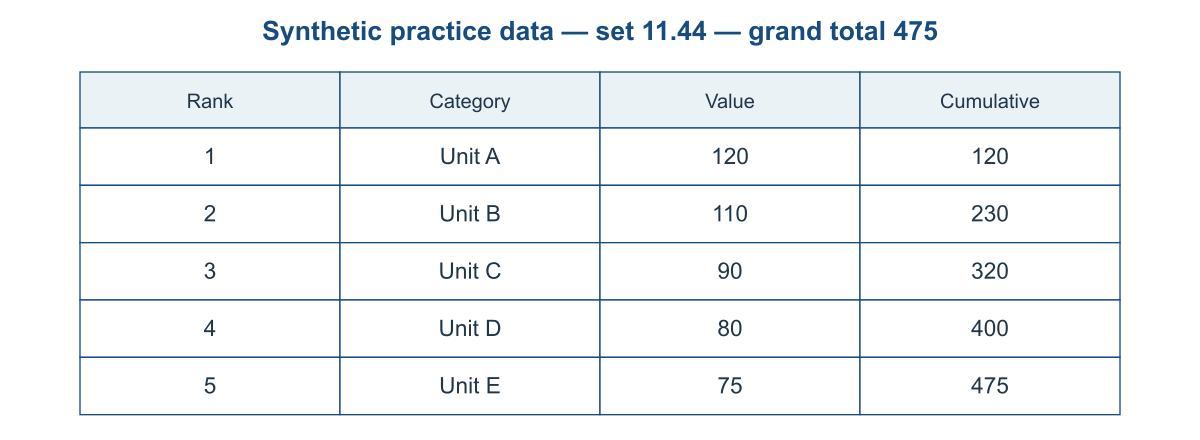
A. 165 B. 175 C. 170 D. 180
45. What is the fifth ranked category value?
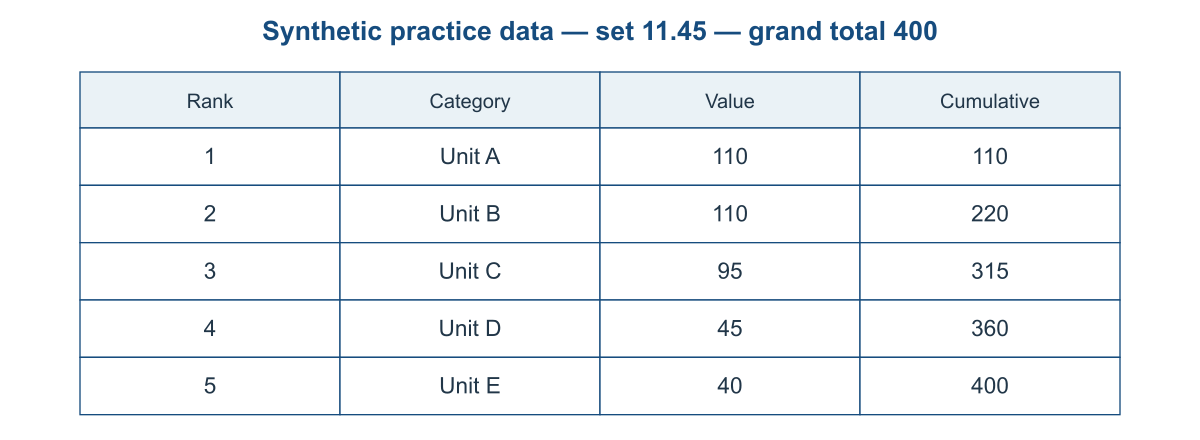
A. 40 B. 45 C. 50 D. 35
46. What is the cumulative total after the first three ranked categories?
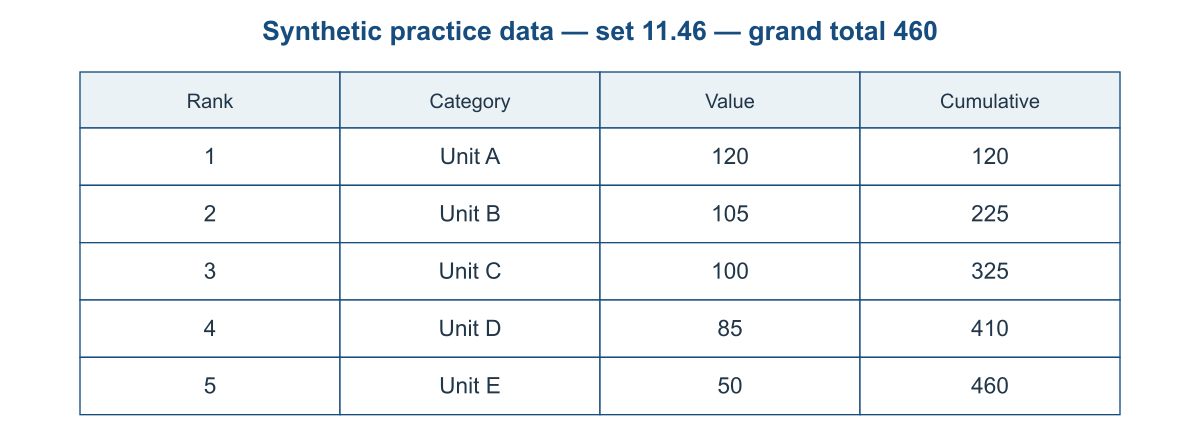
A. 325 B. 335 C. 320 D. 330
47. What is the difference between the largest and smallest ranked values?
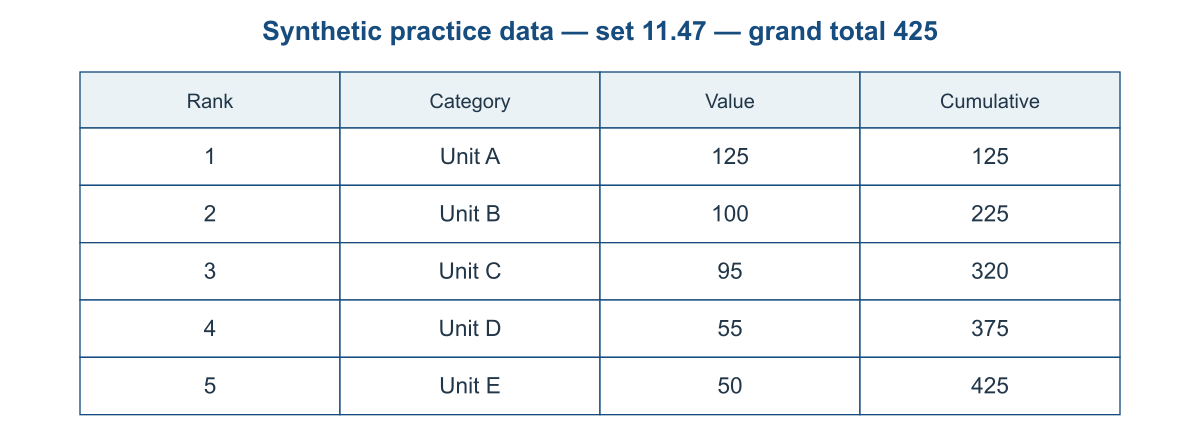
A. 80 B. 75 C. 85 D. 70
48. What is the grand total of all five ranked categories?
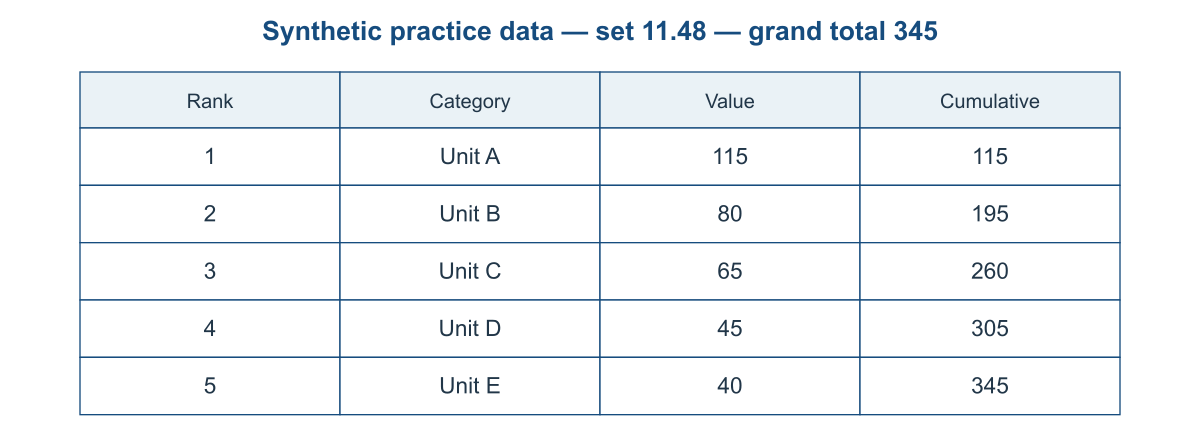
A. 355 B. 350 C. 345 D. 340
49. How much do the third and fourth categories contribute together?
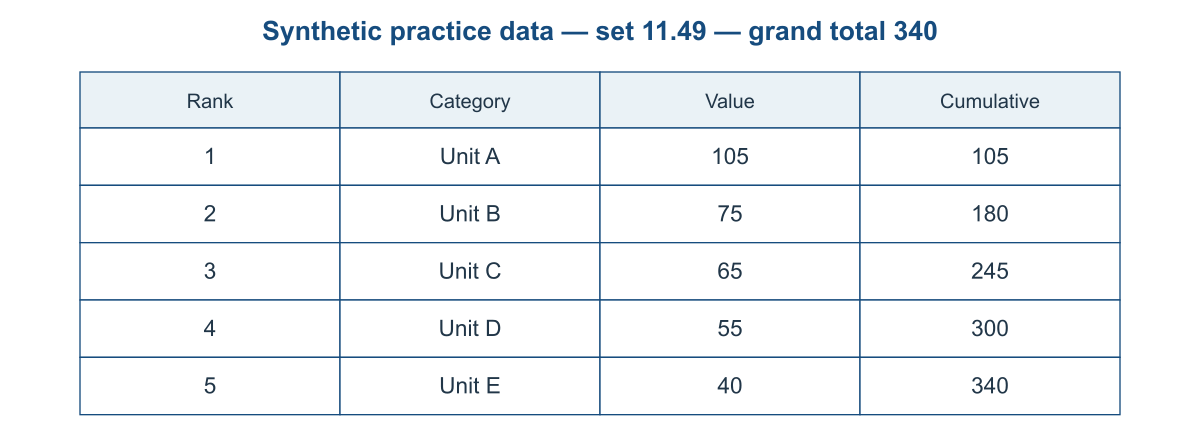
A. 115 B. 120 C. 125 D. 130
50. What is the fifth ranked category value?
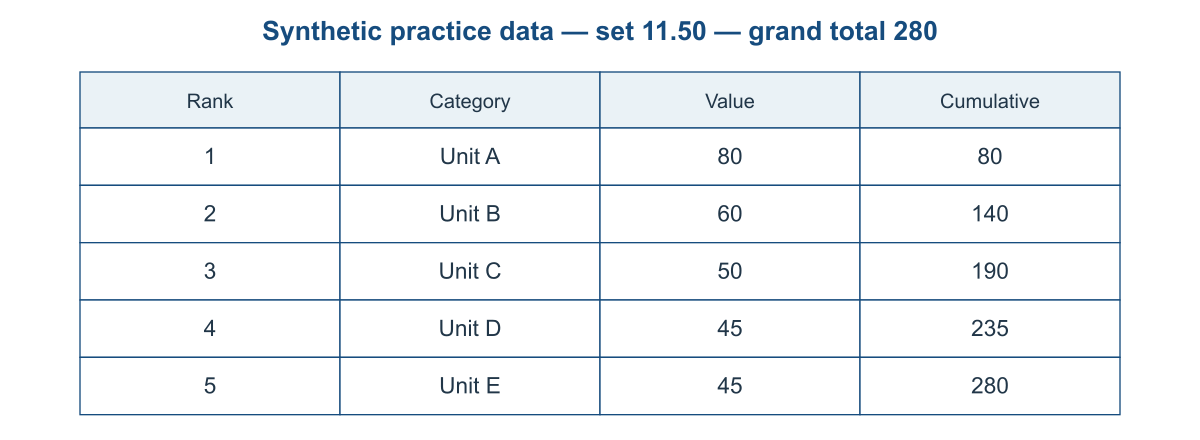
A. 40 B. 45 C. 50 D. 55
Answers and explanations
Check the value and the unit before comparing your working with the calculation.
1. B. Add the first three ranked values [105, 85, 85] = 275.
APDI26-11-01 | arithmetic-embedded-di | Easy
2. A. Largest 130 minus smallest 55 = 75.
APDI26-11-02 | arithmetic-embedded-di | Easy
3. D. Add all five values [115, 110, 95, 80, 75]; grand total 475.
APDI26-11-03 | arithmetic-embedded-di | Easy
4. B. Cumulative after fourth 375 minus cumulative after second 225 = 150.
APDI26-11-04 | arithmetic-embedded-di | Easy
5. C. Read the fifth row of the ranked table: 65.
APDI26-11-05 | arithmetic-embedded-di | Easy
6. A. Add the first three ranked values [90, 75, 65] = 230.
APDI26-11-06 | arithmetic-embedded-di | Easy
7. D. Largest 130 minus smallest 50 = 80.
APDI26-11-07 | arithmetic-embedded-di | Easy
8. B. Add all five values [105, 90, 85, 80, 45]; grand total 405.
APDI26-11-08 | arithmetic-embedded-di | Easy
9. A. Cumulative after fourth 335 minus cumulative after second 220 = 115.
APDI26-11-09 | arithmetic-embedded-di | Medium
10. A. Read the fifth row of the ranked table: 45.
APDI26-11-10 | arithmetic-embedded-di | Medium
11. D. Add the first three ranked values [95, 90, 85] = 270.
APDI26-11-11 | arithmetic-embedded-di | Medium
12. C. Largest 120 minus smallest 70 = 50.
APDI26-11-12 | arithmetic-embedded-di | Medium
13. A. Add all five values [110, 75, 60, 55, 40]; grand total 340.
APDI26-11-13 | arithmetic-embedded-di | Medium
14. A. Cumulative after fourth 375 minus cumulative after second 225 = 150.
APDI26-11-14 | arithmetic-embedded-di | Medium
15. B. Read the fifth row of the ranked table: 45.
APDI26-11-15 | arithmetic-embedded-di | Medium
16. D. Add the first three ranked values [130, 130, 105] = 365.
APDI26-11-16 | arithmetic-embedded-di | Medium
17. B. Largest 95 minus smallest 70 = 25.
APDI26-11-17 | arithmetic-embedded-di | Medium
18. D. Add all five values [130, 120, 115, 110, 65]; grand total 540.
APDI26-11-18 | arithmetic-embedded-di | Medium
19. A. Cumulative after fourth 340 minus cumulative after second 200 = 140.
APDI26-11-19 | arithmetic-embedded-di | Medium
20. C. Read the fifth row of the ranked table: 65.
APDI26-11-20 | arithmetic-embedded-di | Medium
21. D. Add the first three ranked values [110, 100, 100] = 310.
APDI26-11-21 | arithmetic-embedded-di | Medium
22. D. Largest 75 minus smallest 40 = 35.
APDI26-11-22 | arithmetic-embedded-di | Difficult
23. B. Add all five values [115, 110, 75, 55, 55]; grand total 410.
APDI26-11-23 | arithmetic-embedded-di | Difficult
24. B. Cumulative after fourth 480 minus cumulative after second 260 = 220.
APDI26-11-24 | arithmetic-embedded-di | Difficult
25. A. Read the fifth row of the ranked table: 45.
APDI26-11-25 | arithmetic-embedded-di | Difficult
26. C. Add the first three ranked values [125, 125, 115] = 365.
APDI26-11-26 | pareto-funnel | Easy
27. C. Largest 125 minus smallest 40 = 85.
APDI26-11-27 | pareto-funnel | Easy
28. A. Add all five values [110, 105, 90, 75, 50]; grand total 430.
APDI26-11-28 | pareto-funnel | Easy
29. A. Cumulative after fourth 315 minus cumulative after second 205 = 110.
APDI26-11-29 | pareto-funnel | Easy
30. B. Read the fifth row of the ranked table: 40.
APDI26-11-30 | pareto-funnel | Easy
31. A. Add the first three ranked values [110, 110, 85] = 305.
APDI26-11-31 | pareto-funnel | Easy
32. B. Largest 120 minus smallest 55 = 65.
APDI26-11-32 | pareto-funnel | Easy
33. B. Add all five values [130, 125, 75, 65, 40]; grand total 435.
APDI26-11-33 | pareto-funnel | Easy
34. D. Cumulative after fourth 405 minus cumulative after second 255 = 150.
APDI26-11-34 | pareto-funnel | Medium
35. A. Read the fifth row of the ranked table: 45.
APDI26-11-35 | pareto-funnel | Medium
36. B. Add the first three ranked values [120, 100, 55] = 275.
APDI26-11-36 | pareto-funnel | Medium
37. B. Largest 100 minus smallest 40 = 60.
APDI26-11-37 | pareto-funnel | Medium
38. D. Add all five values [130, 90, 70, 65, 50]; grand total 405.
APDI26-11-38 | pareto-funnel | Medium
39. D. Cumulative after fourth 370 minus cumulative after second 230 = 140.
APDI26-11-39 | pareto-funnel | Medium
40. D. Read the fifth row of the ranked table: 45.
APDI26-11-40 | pareto-funnel | Medium
41. B. Add the first three ranked values [120, 115, 55] = 290.
APDI26-11-41 | pareto-funnel | Medium
42. B. Largest 100 minus smallest 65 = 35.
APDI26-11-42 | pareto-funnel | Medium
43. D. Add all five values [115, 95, 90, 90, 70]; grand total 460.
APDI26-11-43 | pareto-funnel | Medium
44. C. Cumulative after fourth 400 minus cumulative after second 230 = 170.
APDI26-11-44 | pareto-funnel | Medium
45. A. Read the fifth row of the ranked table: 40.
APDI26-11-45 | pareto-funnel | Medium
46. A. Add the first three ranked values [120, 105, 100] = 325.
APDI26-11-46 | pareto-funnel | Medium
47. B. Largest 125 minus smallest 50 = 75.
APDI26-11-47 | pareto-funnel | Difficult
48. C. Add all five values [115, 80, 65, 45, 40]; grand total 345.
APDI26-11-48 | pareto-funnel | Difficult
49. B. Cumulative after fourth 300 minus cumulative after second 180 = 120.
APDI26-11-49 | pareto-funnel | Difficult
50. B. Read the fifth row of the ranked table: 45.
APDI26-11-50 | pareto-funnel | Difficult