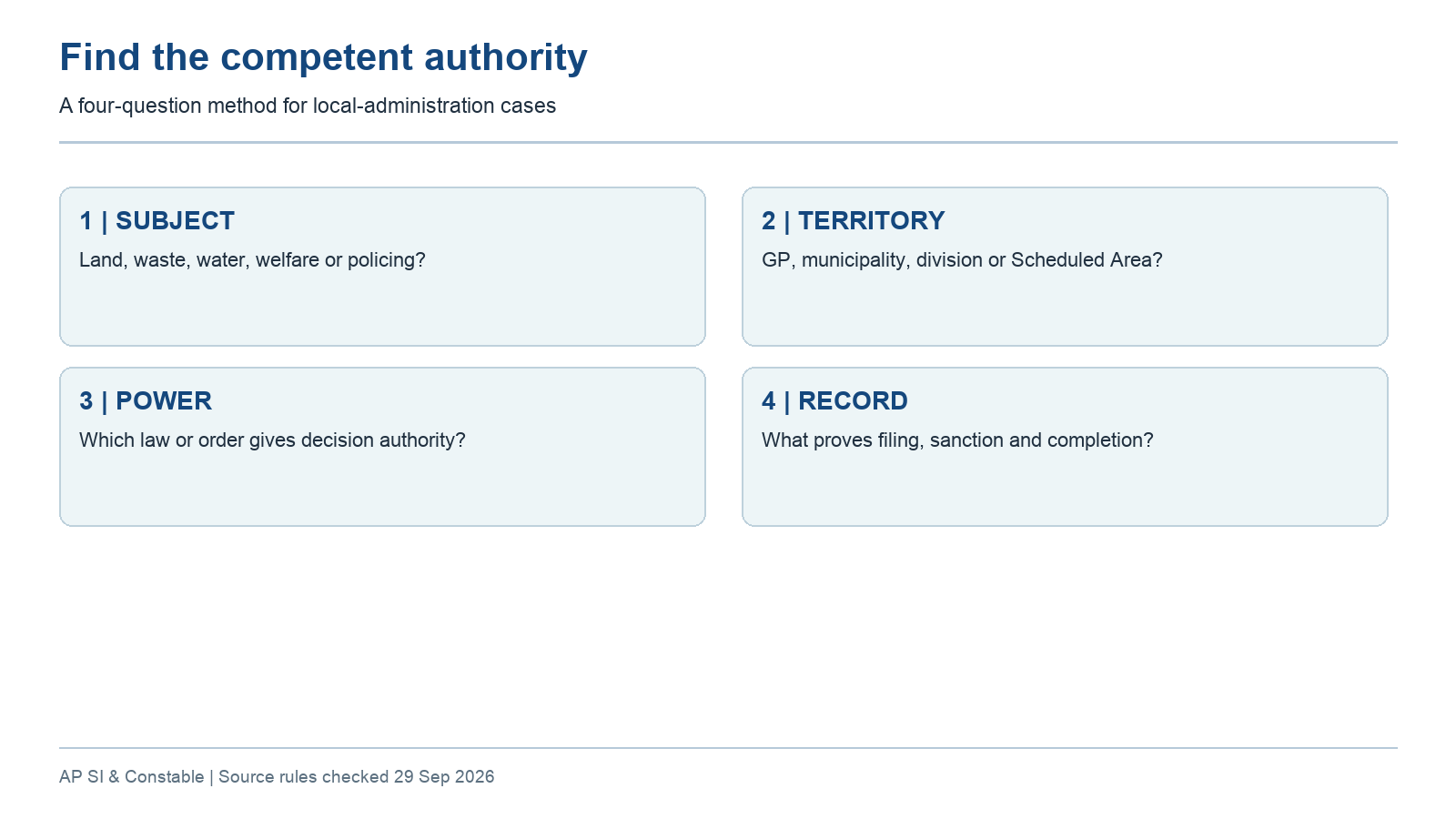
Classify a local problem by subject, territory, power and record. Subject asks whether it is land, policing, water, waste, welfare or planning. Territory asks whether the address is in a rural GP, urban local body, revenue mandal or special Scheduled Area. Power asks which law or order authorises the decision. Record asks what document would prove that the step occurred. This four-question method works for both objective exams and real complaints.
Example: a rural household reports a dry tap. The location points to a village, but the asset register reveals whether GP or rural water agency maintains it. The scheme order identifies the repair channel; a complaint number, inspection and water test show whether it was fixed. Example: a disputed municipal tax bill needs the assessment and applicable rate resolution, not a police report. Example: an excluded pensioner needs a scheme-specific eligibility and payment record. A neat organisational chart cannot replace that evidence. Use the accompanying district map for orientation and the two workflow plates for recall.
Worked example: To route a new complaint, ask four questions in order: What happened? Where? Which law or service governs it? Which office holds the decisive record? A blocked city drain points toward the municipality; a rural panchayat resolution belongs to the village institution; a land mutation follows revenue law; an offence goes to police. If two issues coexist, open separate tracks rather than forcing one office to decide both.
Active recall: Apply subject, territory, power and record to a blocked urban drain and a rural land-record error. Which office receives each first?
Route a local problem correctly
Subject, territory, power and record form an exam-safe decision path.
Read this visual
Classify the subject, locate the territory, identify the statute or scheme and find the decisive record. A case may split into separate civil, local-service and police tracks. This route prevents a familiar office name from replacing the correct jurisdiction.
Current district geometry: APSDMA. Legal structure: official Constitution, India Code and AP administrative sources.