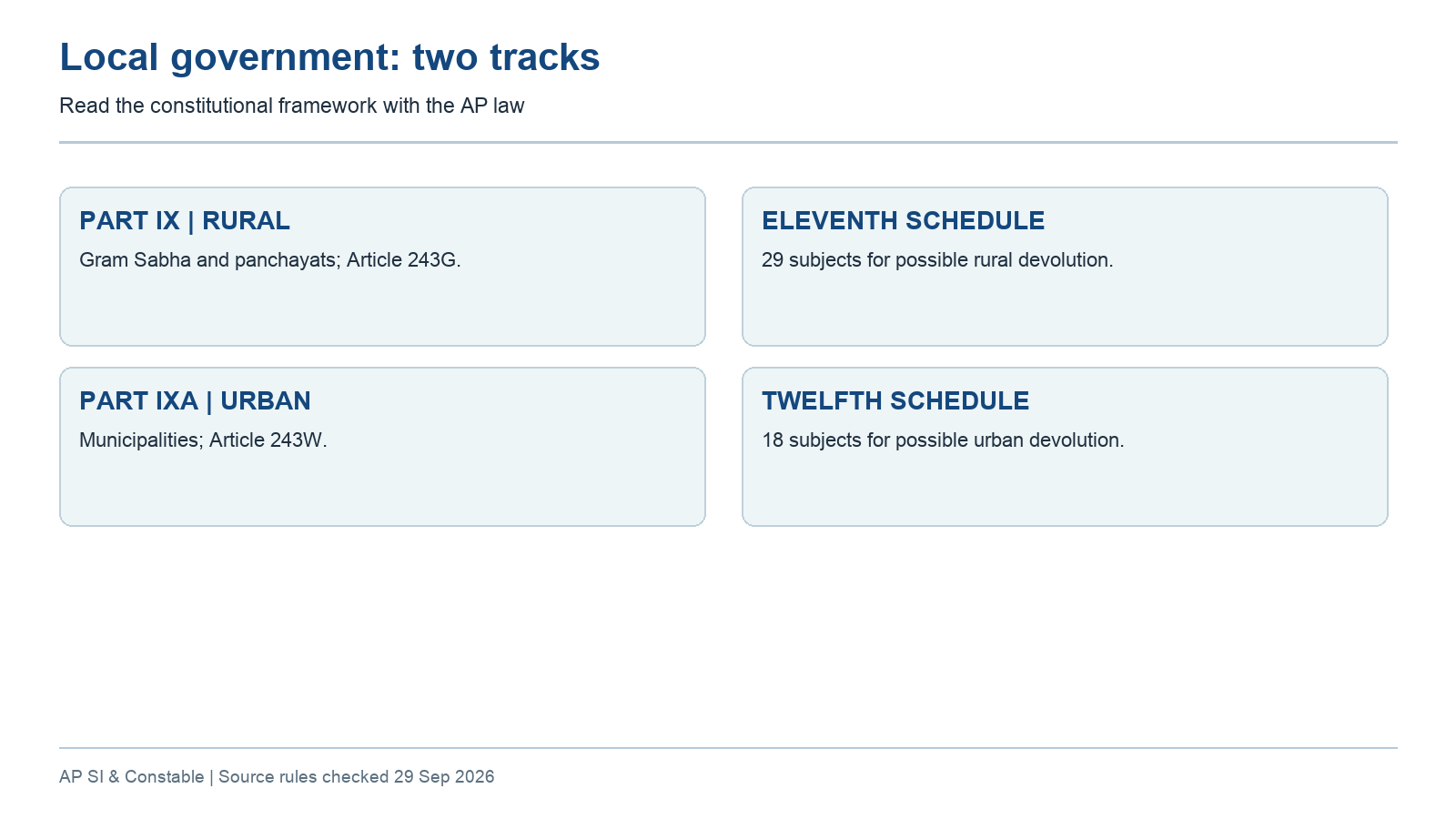
The Constitution (Seventy-third Amendment) Act, 1992, inserted Part IX and the Eleventh Schedule for panchayats. The Constitution (Seventy-fourth Amendment) Act, 1992, inserted Part IXA and the Twelfth Schedule for municipalities. The two reforms share elections, reservations, five-year tenure, finance commissions and local planning themes, but the bodies and subject lists differ. Part IX begins at Article 243; Part IXA begins at Article 243P. Learn the article families by purpose rather than as an unconnected string of numbers.
Part IX provides for a Gram Sabha, three levels of panchayats subject to constitutional exceptions, reservation, duration, State Finance Commission and State Election Commission. Part IXA distinguishes Nagar Panchayat, Municipal Council and Municipal Corporation and covers wards, reservations and municipal finance. The amendments brought a constitutional floor; Andhra Pradesh statutes specify bodies, procedures and powers. If a question asks whether the AP Panchayat Raj Act governs municipal corporations, inspect its extent clause: it expressly excludes them.
Worked example: A question presents Gram Sabha, municipality, State Finance Commission and district Collector. Sort by constitutional family before answering: Gram Sabha and rural panchayats belong to Part IX; municipalities to Part IXA; finance commissions support local fiscal review; the Collector is district executive administration. The 73rd and 74th Amendments set a framework, while AP laws fill in procedures. This sorting is safer than memorising amendment numbers alone.
Active recall: Pair Part IX with the Eleventh Schedule, and Part IXA with the Twelfth. State one common feature and one institutional difference.
Two constitutional local-government systems
Part IX and Part IXA connect constitutional rules with AP institutions.
Read this visual
Part IX and Part IXA supply constitutional frameworks for different elected local bodies. They do not turn state executive offices into panchayats or municipalities. Use AP statutes and orders to find the precise powers exercised in a case.
Current district geometry: APSDMA. Legal structure: official Constitution, India Code and AP administrative sources.