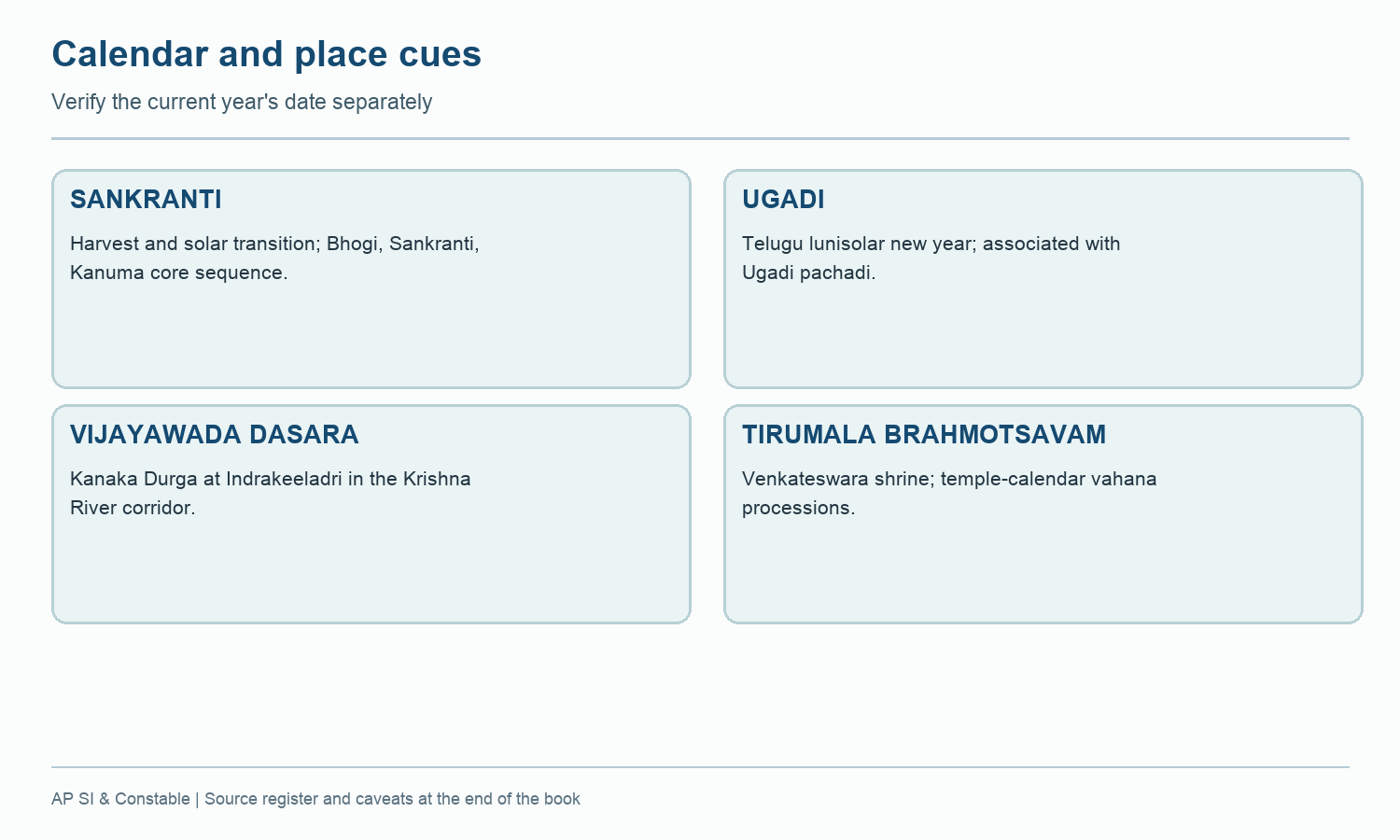
Sankranti is a harvest-season festival of great importance in AP. District festival pages describe the sequence of Bhogi, Makara Sankranti and Kanuma, with local variations in celebration. Bhogi marks a transition, Sankranti the solar-calendar turning, and Kanuma is linked in many communities with cattle and rural livelihood. Rangoli or *muggu*, decorated homes, food and family visits express the social side of the season. The precise Gregorian date varies by year and local calendar practice; do not memorise one old date as permanent.
In an exam, distinguish the festival's seasonal logic from a temple's annual *Brahmotsavam*. Sankranti is a broad harvest and solar festival, not an event confined to one shrine. A photograph of a courtyard pattern may support identification but does not prove the image was taken in AP; use the caption and festival context. Local observances may extend beyond three named days, so “three-day core sequence” is safer than “every village has exactly three days.”
Worked example: Sankranti spans Bhogi, Makara Sankranti and Kanuma observances in many AP homes, with local variation. A question may test sequence rather than a single date. Use the solar-season cue and festival order, then check a calendar for a specific year's holiday notice. Household food, harvest imagery and cattle observance are related but not identical activities.
Active recall: Put Bhogi, Makara Sankranti and Kanuma in order. Why does a fixed January date need annual checking?
AP festival calendar cues
Calendar system and location are stronger clues than a fixed Gregorian date.
Read this visual
Festival calendar diagrams organise Bhogi, Sankranti and Kanuma by sequence; use an annual official calendar for exact Gregorian dates.
Current district geometry: APSDMA. Cultural and GI details: credited public-body and registry sources.