A geographical indication links a product's recognised qualities, reputation or other characteristic to a place under a formal registration. IP India's public search records the AP craft names cited in this book, including Kondapalli Bommallu, Etikoppaka Toys, the two Kalamkari styles and Uppada Jamdani Sarees. It does not follow that every visually similar item is produced by an authorised maker. The registration is a legal and geographic fact; workmanship and authenticity require product-level evidence.
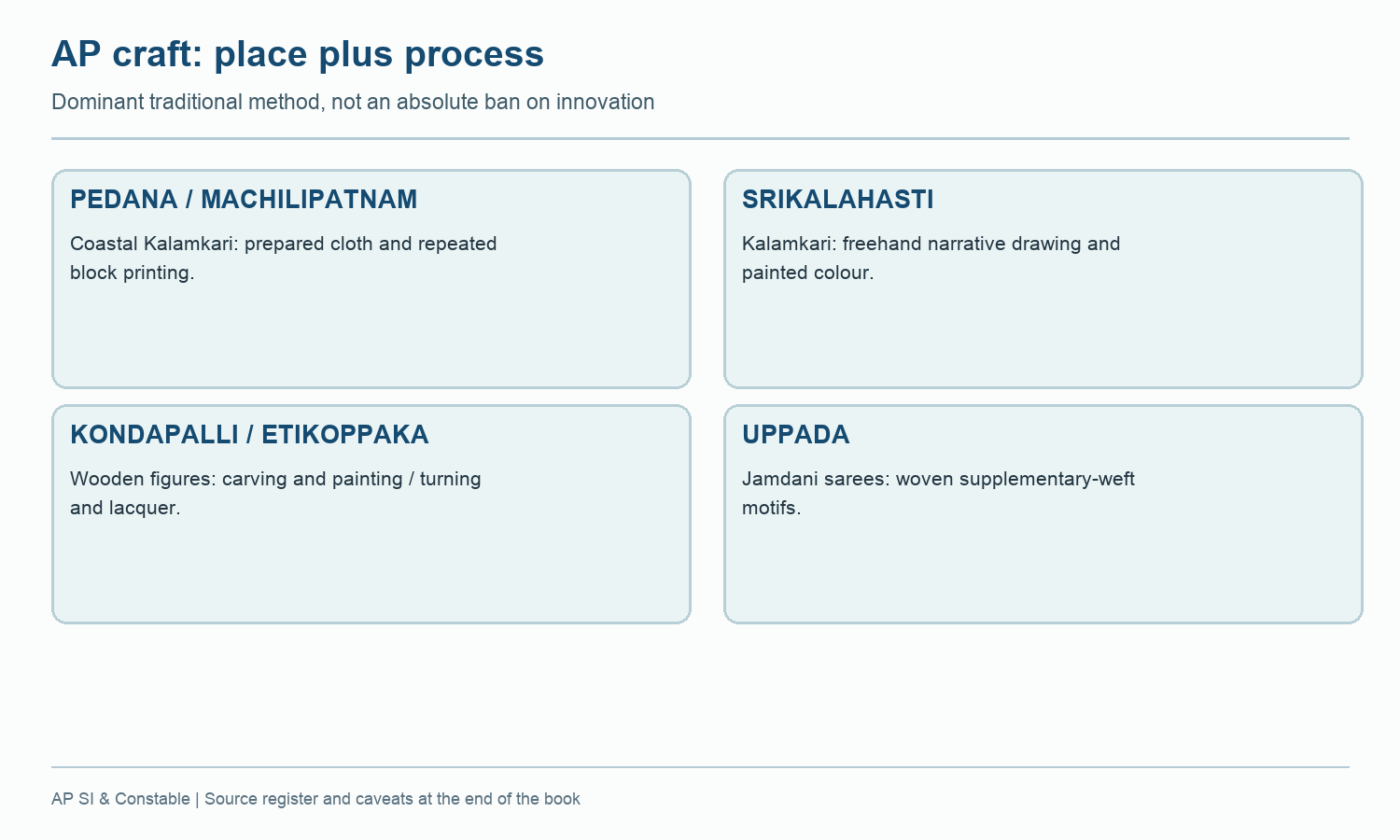
Compare processes before memorising labels. Carving and painting describe Kondapalli; turning and lacquering describe Etikoppaka; block printing describes the Machilipatnam/Pedana Kalamkari line; freehand drawing describes Srikalahasti; supplementary-weft weaving describes Uppada. Real workshops can adapt, so these are exam-level dominant traditions rather than absolute laws. A district ODOP listing identifies a promoted product; a GI registry entry establishes registration; a tourist photograph only shows that an object was displayed. Keep those evidence types separate.
Worked example: A GI entry identifies a registered product name and applicant under a legal process. It does not mean every similar-looking item is authentic, and a promotion brochure is not the registry. For a claim, check the exact registered name, product category and status on IP India. Use the book's images for recognition practice, not certification of any pictured item's origin.
Active recall: Name five AP craft–process pairs. Which document should you check when an MCQ specifically asks for a GI?
Craft process comparison
Pair place with dominant method; a contemporary maker can adapt methods.
Read this visual
A GI registration is a legal record for a named product. The image helps compare processes but does not authenticate a pictured item.
Current district geometry: APSDMA. Cultural and GI details: credited public-body and registry sources.