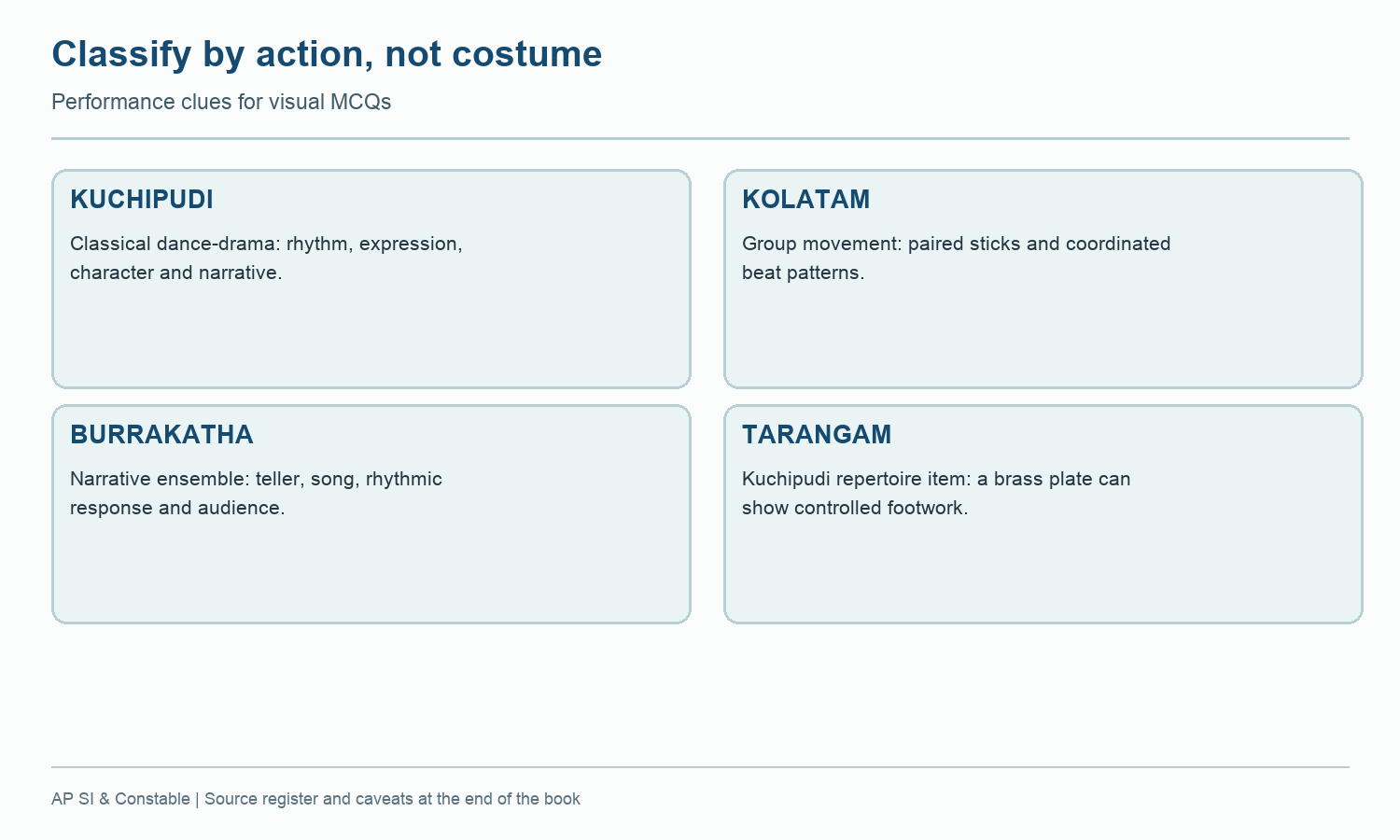
Tarangam is a recognised item in Kuchipudi repertoire, associated with the Krishna-lila-tarangini tradition of Narayana Tirtha. A widely described display involves rhythmic dancing on the rim of a brass plate, sometimes with a vessel balanced above. The point is controlled balance and intricate footwork; it is not the definition of all Kuchipudi. Many Kuchipudi performances do not include a brass-plate item, and a photographed dancer on a plate does not alone tell you the full choreography.
The CCRT booklet describes this display within the form's development, including later solo practice. In an MCQ, “Tarangam—Kuchipudi” is a useful pair, while “every Kuchipudi artist must dance on a plate” is false. Keep the source of the musical text separate from Siddhendra Yogi's Bhama Kalapam. Both sit in the broad Kuchipudi ecosystem but involve different works and associations. If a question asks which object is used, answer brass plate; if it asks whether the object is an instrument, answer no.
Worked example: A dancer balances on a brass plate during a Tarangam presentation. The plate is an exam-friendly visual cue, but the performance also uses rhythm and narrative. If a photo lacks a plate, it does not automatically cease to be Kuchipudi. Treat the prop as a strong cue for a particular item, not a universal definition of every recital.
Active recall: What is Tarangam paired with? How does the brass plate function in the performance?
Performance identification
Objects and actions distinguish dance, group rhythm and narrative theatre.
Read this visual
The illustration highlights a Kuchipudi performance cue. A single pose or prop cannot define every recital; use technique and historical context as well.
Current district geometry: APSDMA. Cultural and GI details: credited public-body and registry sources.