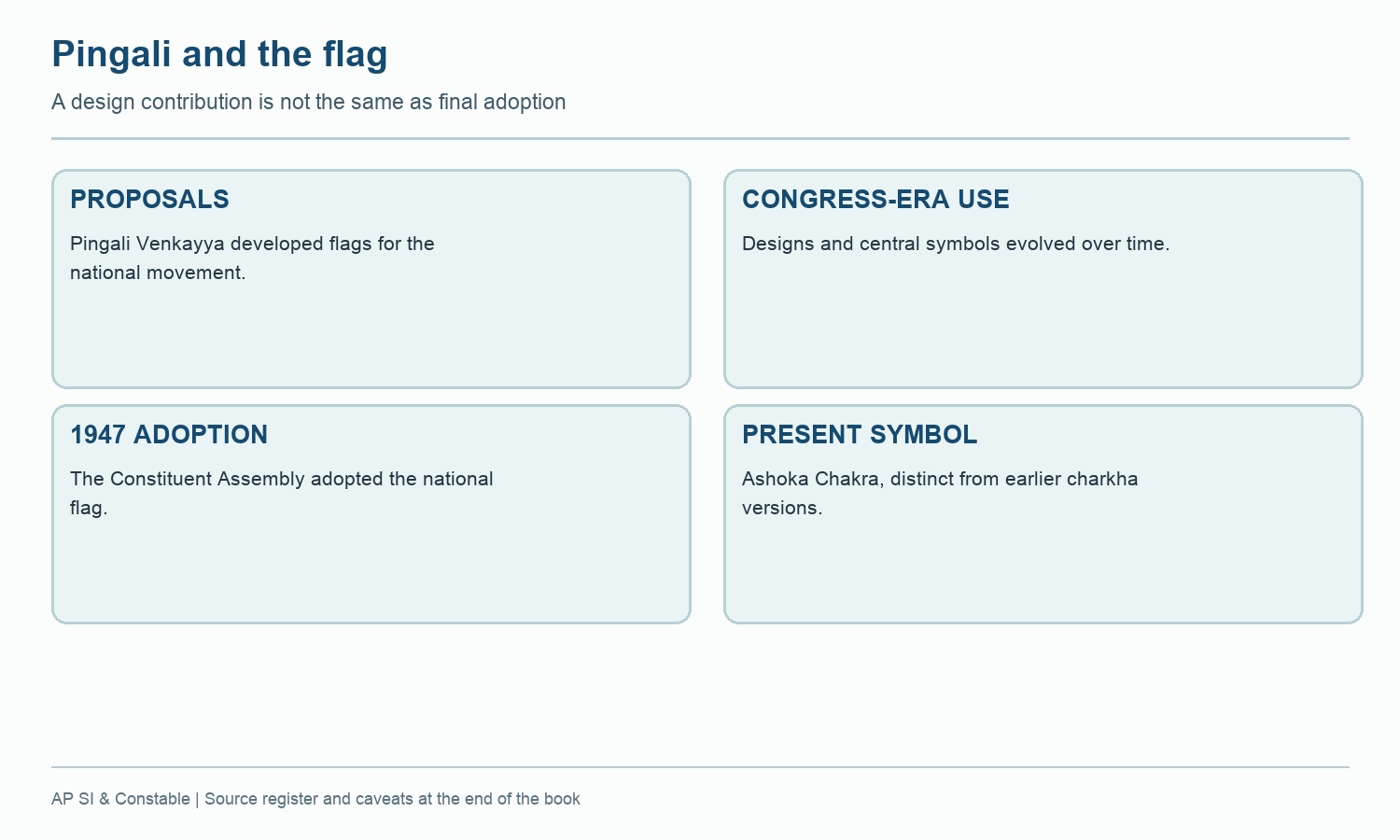
The flag-design story has at least three stages: proposals during the freedom movement, Congress use of evolving flags, and adoption of the national flag in 1947. Pingali Venkayya's design effort belongs prominently in the first two stages. The present flag's Ashoka Chakra distinguishes it from earlier spinning-wheel designs. An exam may ask for the designer's association, the emblem on the current flag or the adopting body; each has a different answer.
The Ministry of Culture pages on Venkayya summarise the progression but also contain simplified popular wording. Avoid treating any early flag as visually identical to today's national flag. A line illustration in this book should show the concept of changing central symbols without presenting a reconstructed historic flag as a certified original. The high-value pair remains Pingali Venkayya—flag design, followed by the correction that the final constitutional adoption was collective and later.
Worked example: A question shows the present tricolour with the Ashoka Chakra and asks for its adoption. Use the 1947 Constituent Assembly decision, not the date of an earlier flag proposal by Pingali Venkayya. The final flag and its precursors belong to a design history. Treat a sketch of a precursor as a different document from the legal national symbol.
Active recall: Name one visual difference between an earlier charkha flag and the present national flag. Which institution adopted the latter?
Flag design and adoption
Venkayya's proposals were precursors; the present flag's emblem and adoption came later.
Read this visual
Pingali Venkayya contributed flag proposals; the present flag was adopted by the Constituent Assembly in 1947. Design evolution and official adoption are different events.
Current district geometry: APSDMA. Biographical and literary claims: credited official and public-body sources.