Gidugu Venkata Ramamurthy is associated with the movement for *vyavaharika bhasha*, Telugu intelligible in ordinary use, against an exclusive reliance on highly formal *grandhika* style. An AP government university newsletter describes him as a language scholar and notes Telugu Language Day observance on his birth anniversary. Vizianagaram district has also commemorated his work. The exam clue is language reform, not a particular flag or armed rebellion.
Do not confuse the method with Gurajada's drama. Gurajada used conversational speech in literature; Gidugu made a broader argument about language in education and public communication. They are complementary figures but have different named works and roles. A precise date question should be checked against the current official observance notice, although the historical person's role is stable. Social change also has language consequences: a register intelligible to more speakers can widen access to education and government information.
Worked example: Gidugu Venkata Ramamurthy is associated with advocacy of spoken Telugu in writing and education. A question may confuse the spoken-language movement with Gurajada's colloquial dramatic style. The two intersect in linguistic reform but refer to different people and activities. Build a comparison row for campaign versus literary work instead of collapsing both under 'modern Telugu'.
Active recall: Define *vyavaharika* and *grandhika* in plain English. Which person is associated with the former's advocacy?
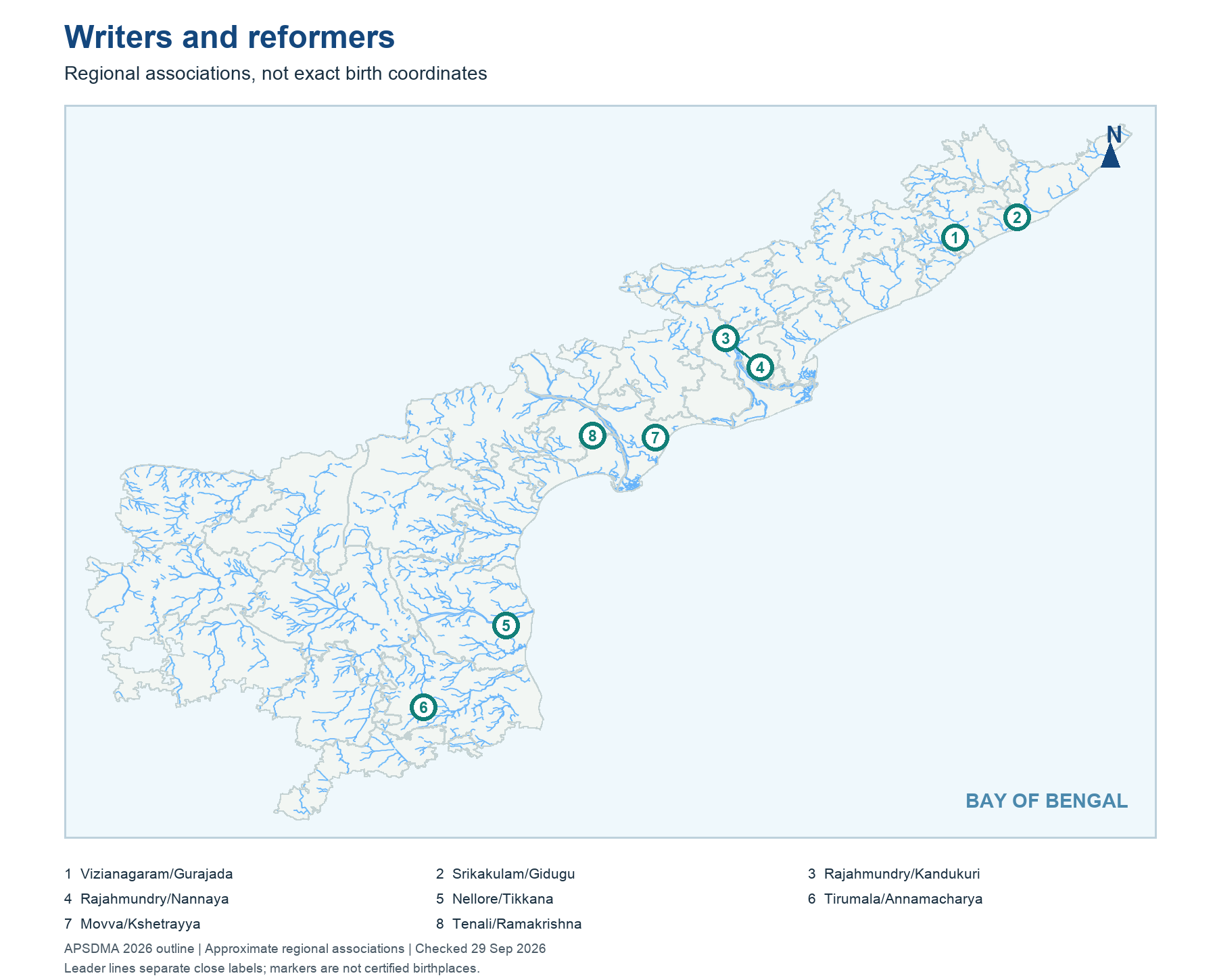
Writers and reformers locator
Regional associations and commemorations are not exact birth coordinates.
Read this visual
The writers-and-reformers map uses regional association markers. A modern district polygon does not prove the person's birth village or historical jurisdiction.
Current district geometry: APSDMA. Biographical and literary claims: credited official and public-body sources.