The most efficient revision table has three columns: person, named work or event, and role. Pingali—flag-design proposals—nationalist designer; Duggirala—Chirala-Perala—organiser; Alluri—Rampa—revolutionary; Prakasam—Simon protest and 1953 ministry—nationalist and head of government. For literary figures: Gurajada—*Kanyasulkam*—dramatist; Sri Sri—*Mahaprasthanam*—modern poet; Jashuva—*Gabbilam*—poet; Nannaya/Tikkana/Errana—Telugu Mahabharata tradition.
One person may need more than one row. Durgabai's Constituent Assembly work and Salt Satyagraha activity are distinct; Sriramulu's temple-entry efforts and linguistic-state fast are distinct; Ghantasala's singing and freedom-era episode are distinct. A match-the-pairs MCQ often offers true names with the wrong works. Check the work type before choosing, then verify place and period. This guards against answering merely from familiarity. The visual table in the book deliberately shows both a primary pair and a secondary role.
Worked example: Build a four-column matching grid: person, role, named work or movement, and time. Put Alluri with Rampa, Gurajada with Kanyasulkam, Gidugu with spoken-language advocacy and Nannaya with the Telugu Mahabharata sequence. Then add distractors from similar periods. If the work and honorific point to different people, the answer is a deliberate cross-match trap.
Active recall: Write ten correct person–work/event pairs in 90 seconds. Which three have a documented second role?
Person, work and role
Named works and movements give stronger clues than generic labels.
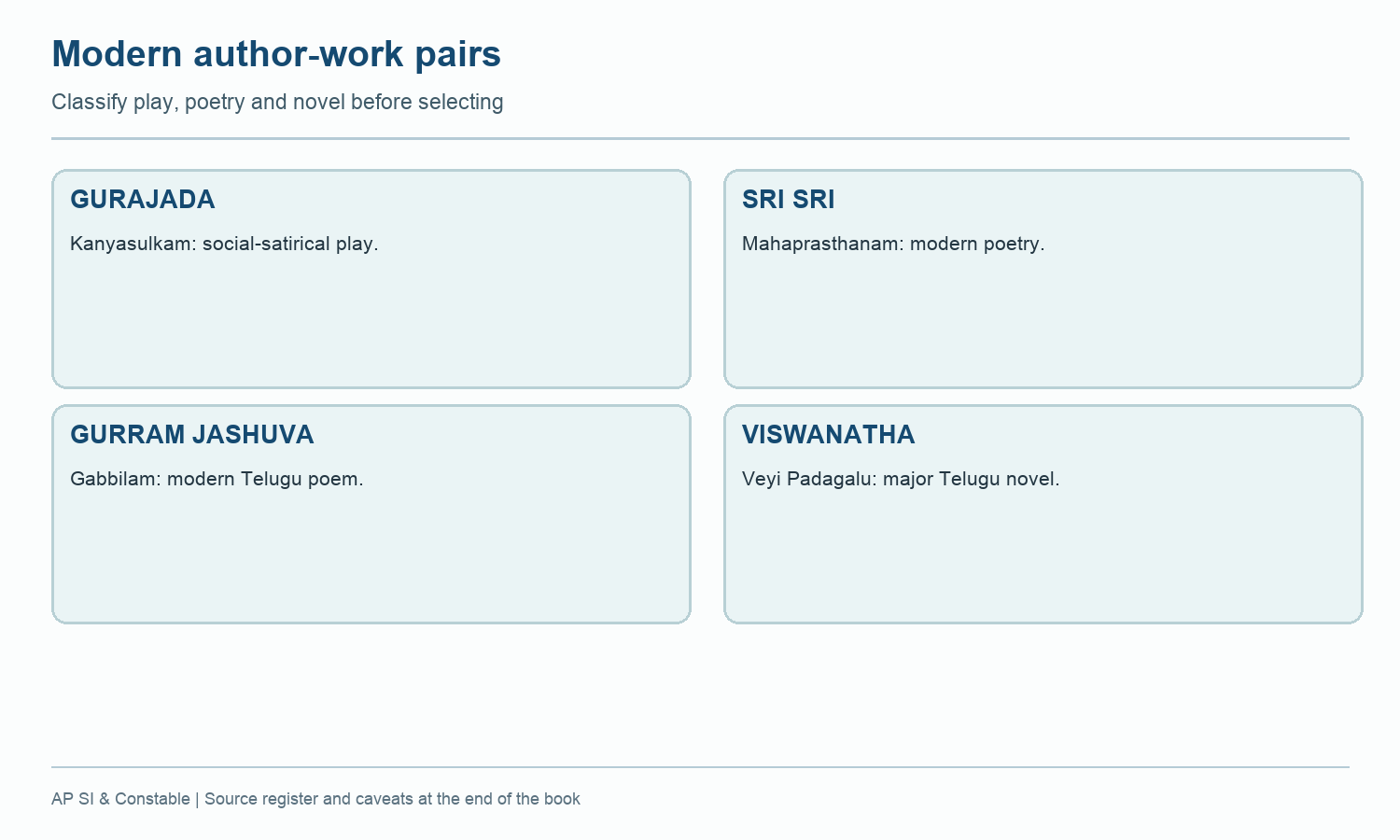
Read this visual
Match person to a named work or movement before using a broad role label. A memorial name or award is a separate evidence type.
Current district geometry: APSDMA. Biographical and literary claims: credited official and public-body sources.