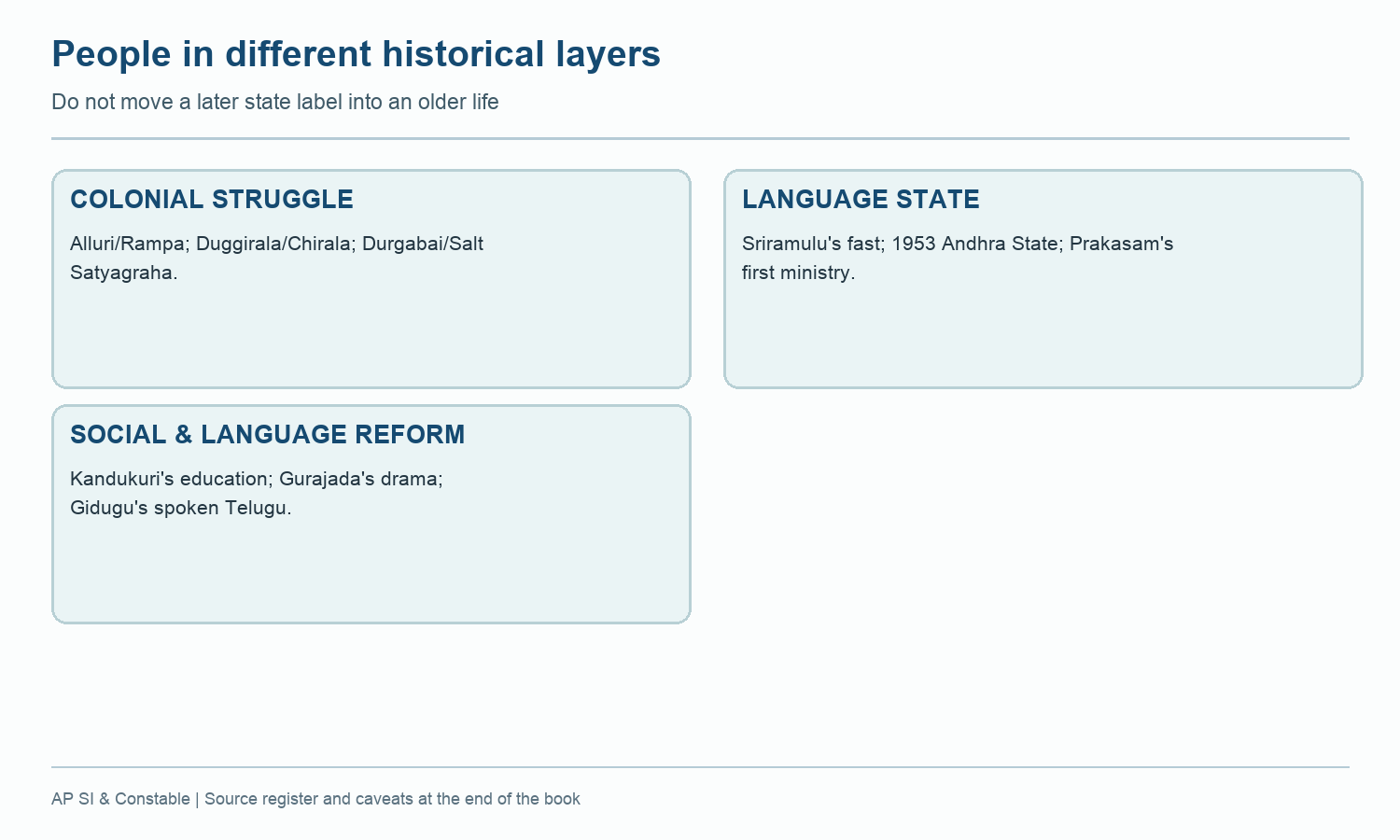
The book's figures belong to overlapping historical layers. Alluri's Rampa rebellion and Duggirala's Chirala-Perala action concern colonial rule. Potti Sriramulu's later fast for a Telugu-speaking Andhra State belongs to the post-independence linguistic-state story, though he also took part in the freedom struggle. Gurajada, Kandukuri and Gidugu addressed language and social issues that intersected with political awakening without being reducible to one protest march. A poet can be a reformer; a freedom fighter can also be a journalist.
Three dates organise the distinction: 1947 independence, 1953 formation of Andhra State, and 1956 formation of Andhra Pradesh. A 2014 or 2026 administrative change is yet another layer. A question calling Tanguturi Prakasam the first Chief Minister of Andhra State does not mean he headed the post-1956 government at its formation. Read whether the noun is “Andhra State,” “Andhra Pradesh” or “undivided AP.” Do not turn a memorial district name into a date of the person's action.
Worked example: Build three timelines side by side: anti-colonial struggle, linguistic-state formation and Telugu literary reform. They overlap, but the goals and institutions differ. A writer could support nationalism without being the first chief minister, and a statehood activist could also be a social reformer. Identify which role the question actually names before selecting a person.
Active recall: Put independence, Andhra State and Andhra Pradesh formation in order. Where does the Rampa rebellion fit?
Three historical layers
Colonial freedom, linguistic-state formation and literary/social reform overlap but differ.
Read this visual
Anti-colonial struggle, state formation and reform overlap in biography but have separate timelines and institutions. Read the question's requested role.
Current district geometry: APSDMA. Biographical and literary claims: credited official and public-body sources.