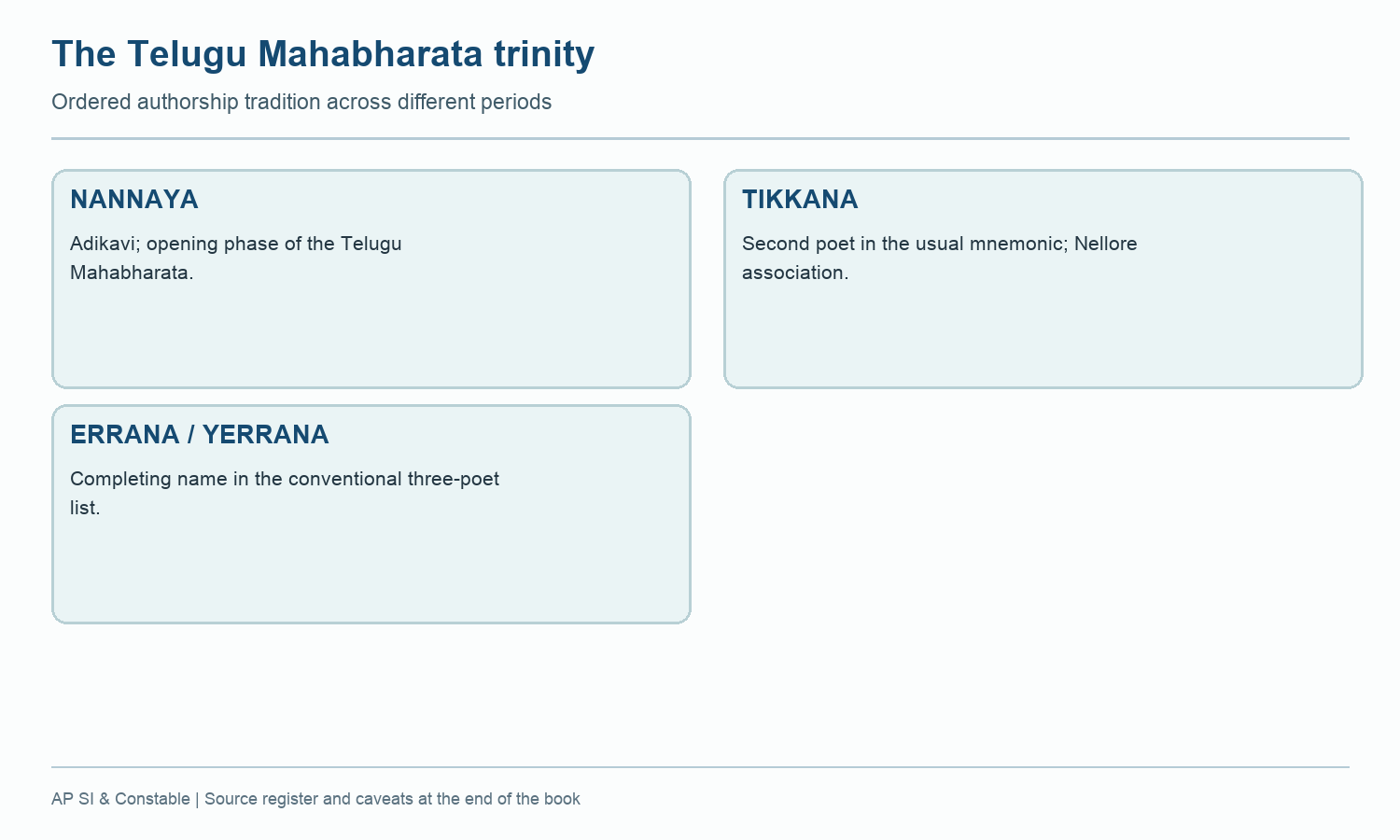
Errana, also written Yerrana, completes the conventional Telugu Mahabharata poet-trinity list with Nannaya and Tikkana. Spellings vary in Roman script because Telugu sounds can be transliterated differently. An MCQ asking for the missing third name may include a modern poet or devotional composer as a distractor; the answer comes from the shared epic project, not the broad fact that all wrote Telugu.
The trinity is a teaching device, not a claim that the three poets worked together in one room or century. Their contributions belong to different historical contexts. Learn an ordered chain and one regional cue: Nannaya with the Godavari/Rajahmundry tradition, Tikkana with Nellore, Errana as the completing name. The strongest source for a precise canto or book attribution would be an academic edition of the Telugu Mahabharata; this book avoids testing an unverified granular claim. A timeline visual marks separation rather than pretending simultaneous authorship.
Worked example: Errana completes the familiar Kavi Trayam memory aid with Nannaya and Tikkana. The trio is a sequence of literary contribution, not three contemporaries writing in one room. In an MCQ, reject an option that assigns all work to a single author. State what the mnemonic helps recall and what details need a fuller literary source.
Active recall: Recite the trinity in order. Why is the word “team” misleading if taken literally?
Telugu Mahabharata poet trinity
The order is a historical literary memory aid, not a simultaneous team.
Read this visual
Nannaya, Tikkana and Errana form a sequence of Telugu Mahabharata contribution across periods, not one simultaneous writing team.
Current district geometry: APSDMA. Biographical and literary claims: credited official and public-body sources.