Chandragiri Fort is a historical fort and palace complex in the Tirupati district region. The district's heritage-tourism page links it with Vijayanagara history and describes the Raja Mahal as a museum. A fort is a defended political landscape, while a palace is a residential or administrative building within that broader setting. The museum exhibits material to visitors today; it is not the same thing as the medieval court that once used the site.
The name Chandragiri should not be confused with Nagarjunakonda just because both are southern heritage destinations, nor with the nearby Tirumala shrine. A photograph of walls and towers may help classify a fort, but exact dynastic attribution needs the district or archaeological source. Keep historical sequence modest: association with the Vijayanagara period is well supported; detailed claims about every ruler's residence can be more contested. On a map, place Chandragiri near Tirupati, then identify which nearby site is a hill temple rather than a fort.
Worked example: Chandragiri Fort and the Raja Mahal museum belong to a fortified and courtly heritage context. A museum display is not identical to the structure in which it sits. If an image shows walls and bastions, classify fort; if it shows an artefact, classify the object separately. Current ticketing and opening hours require the operating authority's dated notice.
Active recall: What are the fort, palace and museum roles at Chandragiri? Which nearby site is a Venkateswara shrine?
Southern heritage comparisons
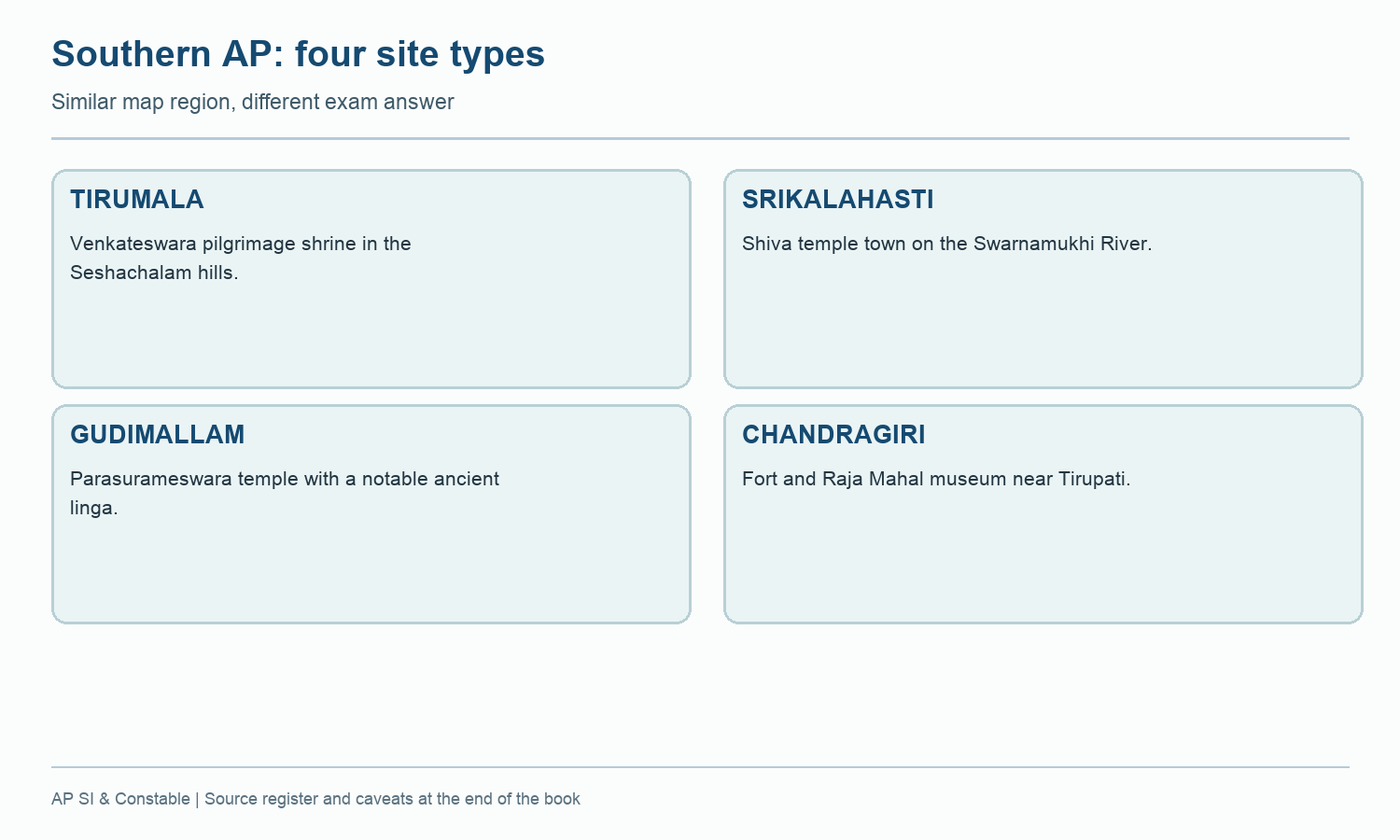
Tirumala, Srikalahasti, Gudimallam and Chandragiri have different site types.
Read this visual
Tirumala, Srikalahasti, Gudimallam and Chandragiri share a broad southern region but differ in shrine and fort identity.
Current district geometry: APSDMA. Site status and access: credited tourism, archaeology, UNESCO and forest sources.