ASI's centrally protected monument list is a legal inventory of archaeological sites and structures under central protection. A UNESCO tentative-list entry is a proposed future nomination pathway, while a UNESCO World Heritage inscription is a separate completed status. A wildlife sanctuary is notified under environmental law and managed for habitat; it is not an archaeological designation. A GI describes a geographically linked product, not a temple or cave. These terms often appear together in AP heritage publicity but must be kept in separate columns.
Lepakshi is the clearest status test: UNESCO lists it tentatively, and Sri Sathya Sai district explains its temple and Nandi. Amaravati's ruined stupa appears in ASI's protected list. Coringa is a mangrove sanctuary. Kondapalli Bommallu is a GI craft, even though Kondapalli also has a fort. One town can participate in several regimes, but the legal object in each is different. For current status claims, use the administering body's present record, not a school guide's undated line.
Worked example: ASI protection, state protection, UNESCO tentative listing and a wildlife sanctuary are administered through different legal systems. A temple may be active and architecturally important without a UNESCO status; a wetland may have ecological protection rather than ASI protection. Identify the authority that can prove the exact claim and avoid treating all logos on a brochure as equal designations.
Active recall: Match ASI, UNESCO tentative list, wildlife sanctuary and GI to one AP example each.
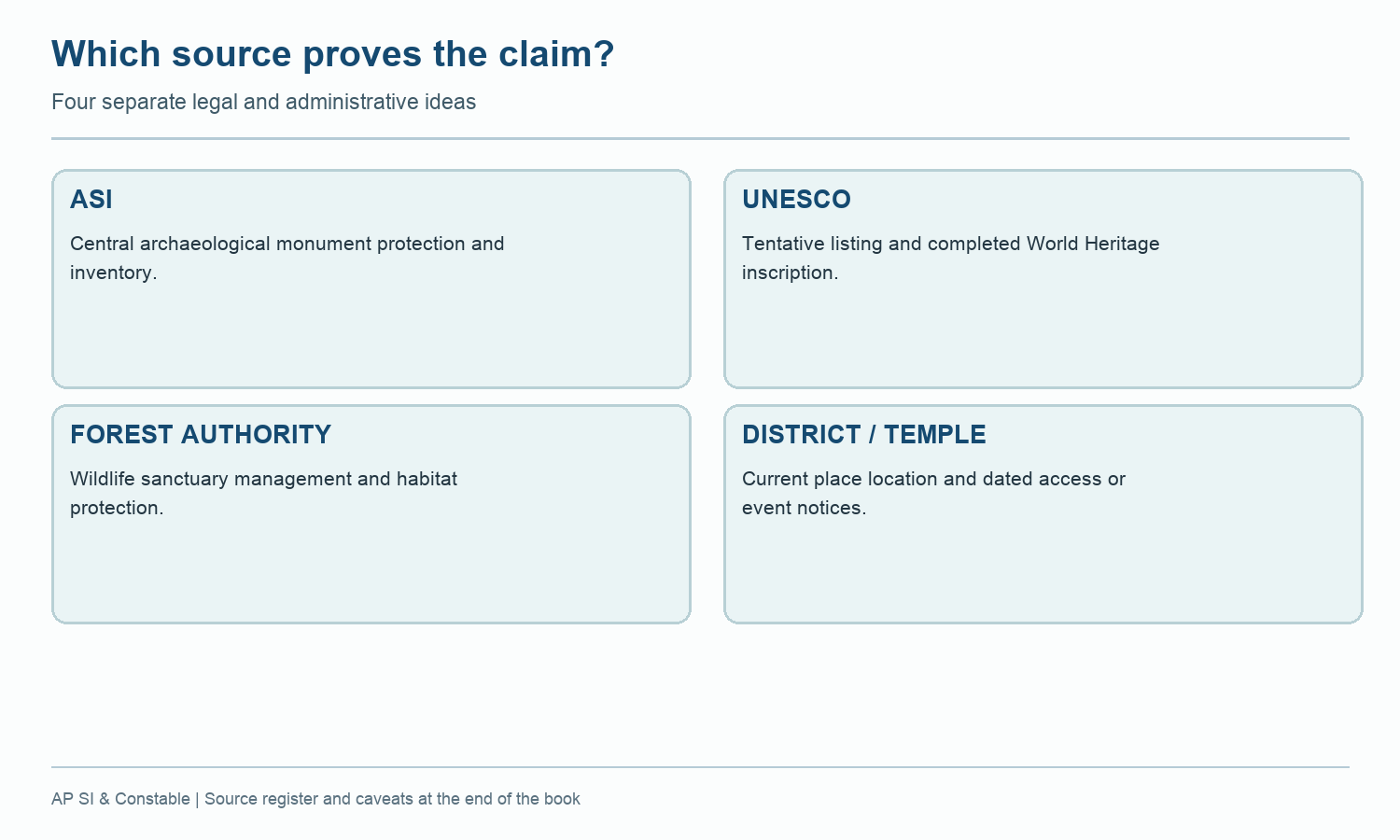
Which authority proves which claim?
Use the administering record for legal status and current notices for access.
Read this visual
Use ASI or state archaeology for monument protection, UNESCO for listing, forest authorities for nature status and operators for current access.
Current district geometry: APSDMA. Site status and access: credited tourism, archaeology, UNESCO and forest sources.