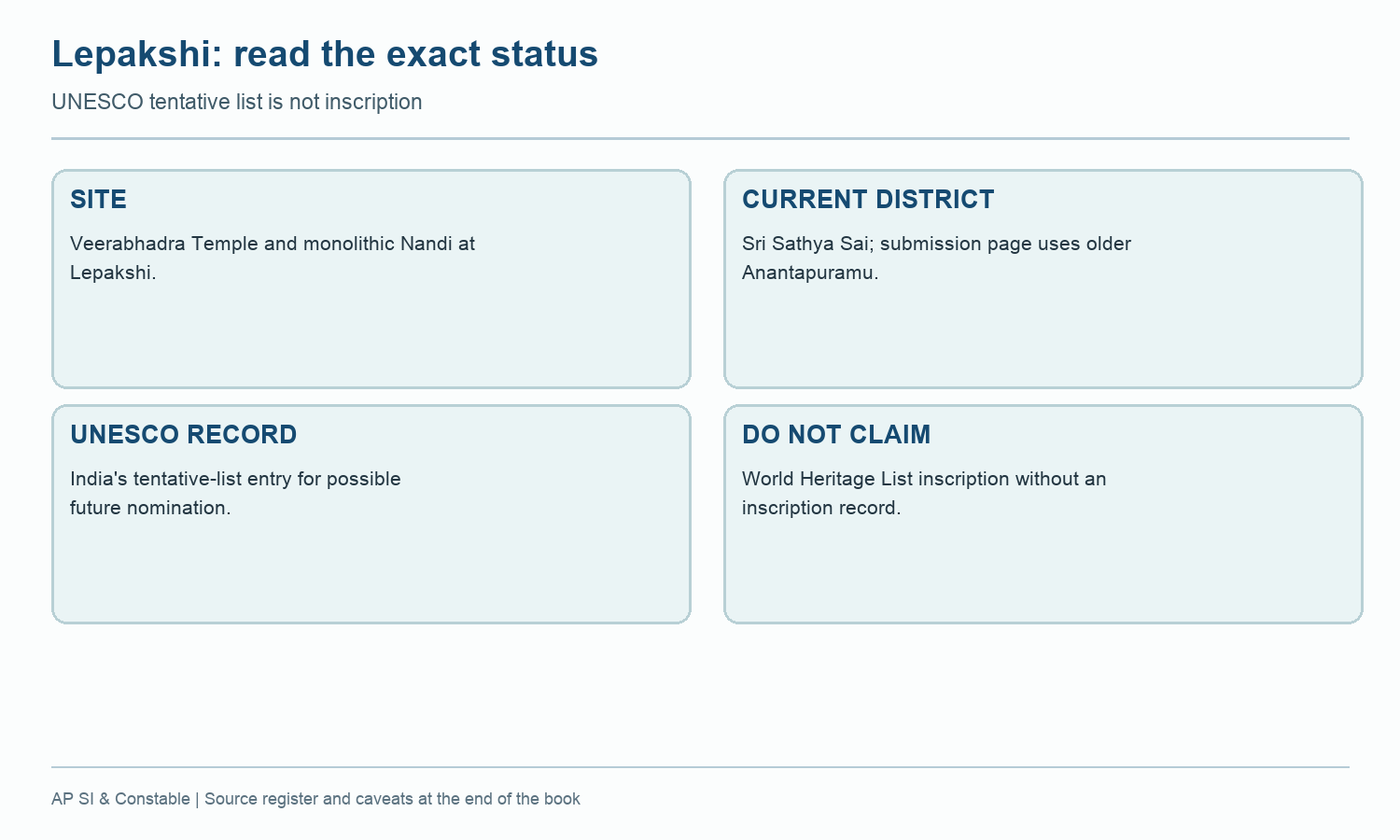
UNESCO's World Heritage Centre has a page for “Sri Veerabhadra Temple and Monolithic Bull (Nandi), Lepakshi” on India's tentative list. A tentative list is an inventory of properties a country may consider for nomination. It is **not** inscription on the World Heritage List. This distinction is an exam favourite because promotional summaries sometimes shorten “tentative World Heritage listing” to the inaccurate “UNESCO World Heritage Site.” The official page, not a tourist poster, governs the status claim.
The tentative-list page uses Anantapuramu district, reflecting the administrative label in the submitted documentation; the current district portal places Lepakshi in Sri Sathya Sai. Both can be understood when their dates are recorded. The site remains important regardless of inscription status: temple architecture, wall paintings, sculpture and Nandi are real heritage features. Do not let a status correction be mistaken for a denial of artistic value. In a timed MCQ, underline “tentative” or “inscribed” before selecting an answer.
Worked example: A promotional post says Lepakshi is a UNESCO World Heritage Site. Check the World Heritage Centre record: the Veerabhadra Temple and Nandi are on India's tentative list. Tentative submission is a step toward a possible nomination, not inscription. For the exam, write the status exactly; a seemingly small missing word changes the truth of the claim.
Active recall: Explain tentative listing versus inscription in one sentence. Which district should a current-location question use?
Heritage status comparison
Tentative listing is distinct from World Heritage inscription.
Read this visual
The UNESCO tentative-list record for Lepakshi documents possible nomination, not World Heritage inscription. Read the exact status word.
Current district geometry: APSDMA. Site status and access: credited tourism, archaeology, UNESCO and forest sources.