Archaeology, Inscriptions and Coins
What to remember
- Kalamalla inscription (Kadapa district, 575 CE) is the earliest Telugu inscription; Amaravati Stupa was brought to notice by Colin Mackenzie in 1797.
- Nanaghat = Naganika; Nasik Prasasti = Gautami Balasri; Hathigumpha = Kharavela; Girnar = Rudradaman.
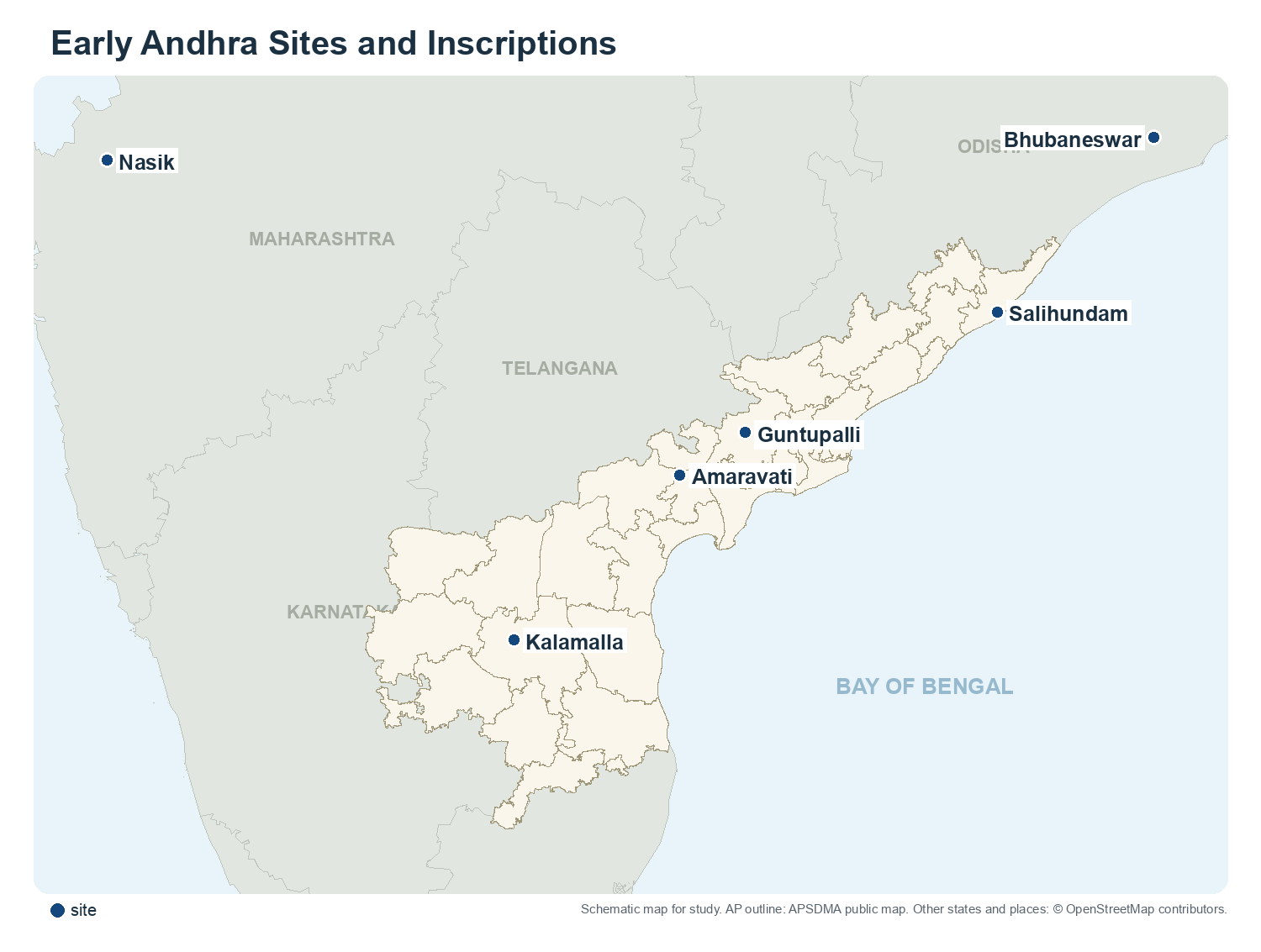
- Salihundam (Srikakulam) and Guntupalli (Eluru) are Buddhist sites of Andhra.
Why these sources matter
History of early Andhra is rebuilt from three kinds of evidence. Archaeology gives sites, stupas and objects found in the ground. Epigraphy is the study of inscriptions, which give names, events and dates. Numismatics is the study of coins, which show trade, metals and rulers. Exams ask "who wrote it", "where is it" and "which language", so learn each inscription as a small set of three facts: author, place, language.
Buddhist sites of Andhra
Andhra has many Buddhist places. Learn the place and the district together.
| Site | Location | Link |
|---|---|---|
| Amaravati Stupa | Palnadu district (Amaravathi mandal) | Buddhism; Krishna valley art school |
| Salihundam | Srikakulam district | Buddhism |
| Guntupalli | Eluru district | Buddhism |
- The Amaravati Stupa is the best-known Buddhist monument of Andhra. It was discovered by Colin Mackenzie in 1797.
- Amaravati gave its name to a famous school of sculpture. This is called the Amaravati school of art and it belongs to the Krishna valley.
- Salihundam is a Buddhist site in Srikakulam. Do not confuse it with Amaravati, which is in Palnadu district (formerly Guntur district).
- Guntupalli is a Buddhist site in Eluru district, known for its rock-cut remains.
Important inscriptions
An inscription is writing cut on stone, rock, pillar or metal. The table lists those found for this chapter.
| Inscription | Author or issuer | Place | Language |
|---|---|---|---|
| Nanaghat inscription | Naganika | Nanaghat, Maharashtra (Pune district) | Prakrit |
| Nasik Prasasti | Gautami Balasri | Nasik | Prakrit |
| Hathigumpha inscription | Kharavela | near Bhubaneswar | Prakrit |
| Girnar inscription | Rudradaman | Junagadh, Gujarat | Sanskrit |
| Myakadoni inscription | not fixed here | Kurnool district | not fixed here |
| Kalamalla inscription | not fixed here | Kadapa district | Telugu |
- Nanaghat was issued by Naganika, a Satavahana queen. It is in Maharashtra, not in Andhra.
- Nasik Prasasti was written by Gautami Balasri, mother of a Satavahana king. A *prasasti* is a praise-record in a king's honour.
- Hathigumpha belongs to Kharavela of Kalinga. The word means "elephant cave".
- Girnar records the work of Rudradaman, a Shaka ruler. It is in Sanskrit, an early use of the language in inscriptions.
- Myakadoni is in Kurnool district.
- The Kalamalla inscription, 575 CE, in Kadapa district, is the earliest inscription in the Telugu language. The Kadamba dynasty of Banavasi is mentioned in the same chapter as a neighbouring power; Banavasi was its capital.
Famous inscriptions of India (general)
Exams often mix Andhra and all-India inscriptions. Keep these separate.
| Inscription | Author | Subject |
|---|---|---|
| Allahabad Pillar Inscription | Harishena | conquests of Samudragupta |
| Aihole Inscription | Ravikirti | victories of Pulakeshin II |
| Mandasor Inscription | Vatsabhatti | Gupta-age record |
| Uttaramerur Inscriptions | local records | village self-government under the Cholas |
- Harishena wrote the Allahabad Pillar Inscription.
- Ravikirti wrote the Aihole Inscription.
- Vatsabhatti wrote the Mandasor Inscription. All three are Sanskrit writers.
- Uttaramerur is important for the study of Chola village self-government.
Coins and their metals
Coins show the economy of an age. Chinnaganjam gave ship-type coins of Yajna Sri Satakarni. A ship on a coin points to sea trade.
| Coin | Metal |
|---|---|
| Tanka | silver |
| Rupiya | silver |
| Mohur | gold |
| Jital | copper |
| Dam | copper |
- The *Lakshanadhyaksha* was the official who dealt with coinage and the mint.
Archaeologists and firsts
| Work | Person |
|---|---|
| First excavator of Harappa | Daya Ram Sahni |
| First excavator of Mohenjo-daro | R. D. Banerji |
| First to decipher Ashokan Brahmi inscriptions | James Prinsep |
| First excavator of Lothal | S. R. Rao |
- Excavation at Lothal began in 1955.
- James Prinsep's reading of Brahmi opened the way to read Ashoka's edicts.
Exam traps
- Nanaghat is in Maharashtra, not in Andhra, although it is a Satavahana record.
- Naganika wrote Nanaghat; Gautami Balasri wrote Nasik. Do not swap them.
- Hathigumpha is Prakrit (Kharavela); Girnar is Sanskrit (Rudradaman).
- Kalamalla is 575, in Kadapa; Amaravati's discovery is 1797, by Mackenzie.
- Salihundam is in Srikakulam; Guntupalli is in Eluru; Myakadoni is in Kurnool.
- Harishena (Allahabad), Ravikirti (Aihole) and Vatsabhatti (Mandasor) are often mixed.
- Tanka and Rupiya are silver; Mohur is gold; Jital and Dam are copper.
- Harappa was first excavated by Sahni, Mohenjo-daro by Banerji. Do not reverse them.
One-liners
- 1. The earliest Telugu inscription is the Kalamalla inscription.
- 2. It dates to 575 CE and is in Kadapa district.
- 3. Colin Mackenzie discovered the Amaravati Stupa in 1797.
- 4. Naganika issued the Nanaghat inscription.
- 5. Gautami Balasri is the author of the Nasik Prasasti.
- 6. Kharavela is linked with the Hathigumpha inscription.
- 7. Rudradaman is linked with the Girnar inscription in Sanskrit.
- 8. Ship-type coins of Yajna Sri Satakarni come from Chinnaganjam.
- 9. James Prinsep deciphered Ashokan Brahmi.
- 10. Excavation at Lothal began in 1955 under S. R. Rao.
Background and context
Written books about ancient Andhra are few and late. Most of what we know comes from objects and writing that survived in the ground, on rocks and on pillars. Historians use three kinds of evidence.
- 1. Archaeology studies sites, buildings, tools and art that people left behind. A stupa, a monastery or a broken sculpture is a clue.
- 2. Epigraphy studies writing cut on stone, rock, pillars and metal plates. An inscription can give the name of a king, a date, a gift or a battle. It was often made at the time of the event, so it is more trusted than a story written centuries later.
- 3. Numismatics studies coins. A coin shows the ruler's name, the metal, the symbol and the places where traders carried it.
The three work together. A coin may give a king's name, an inscription may give his queen, and a ruined stupa may show what art his family paid for. For this reason, one site is rarely enough. Historians compare many.
Interest in these remains began in the colonial period. Surveyors and officers of the East India Company noticed mounds, pillars and carved stones, and then the Archaeological Survey of India (ASI) began to record them. James Prinsep's reading of Brahmi made the edicts of Ashoka readable.
A simple rule helps in exams. Do not learn an inscription only by name. Learn four things together: who issued it, where it is, in which language it is written, and what it tells us.
Why dates in this chapter are careful
Ancient records seldom carry a year that we can read today. Scholars therefore use the shape of the letters, the style of the carving and the names of rulers to place a record. This method is called palaeography when it deals with letter shapes. It gives a range, not a single year. You will see this in the Hathigumpha record, which is placed anywhere from the 2nd century BCE to the 1st century CE, and in Kalamalla, which is given as about 575 CE. Exams usually pick the common figure. When a question says "about" or "c.", it expects the common figure.
Another point is the place where a record was found. A record may be found far from the kingdom that made it. The Satavahana family is known partly from Nanaghat and Nasik in the west. So the place of finding is not always the place of the ruler's home. Read each question for what is asked: the issuer, the findspot or the subject.
Reading a site: the Amaravati Stupa
The best-known Buddhist monument of Andhra is the stupa at Amaravati, in the Krishna valley. Today the village lies in Palnadu district. A stupa is a large dome of earth and brick that holds sacred relics or marks a holy place.
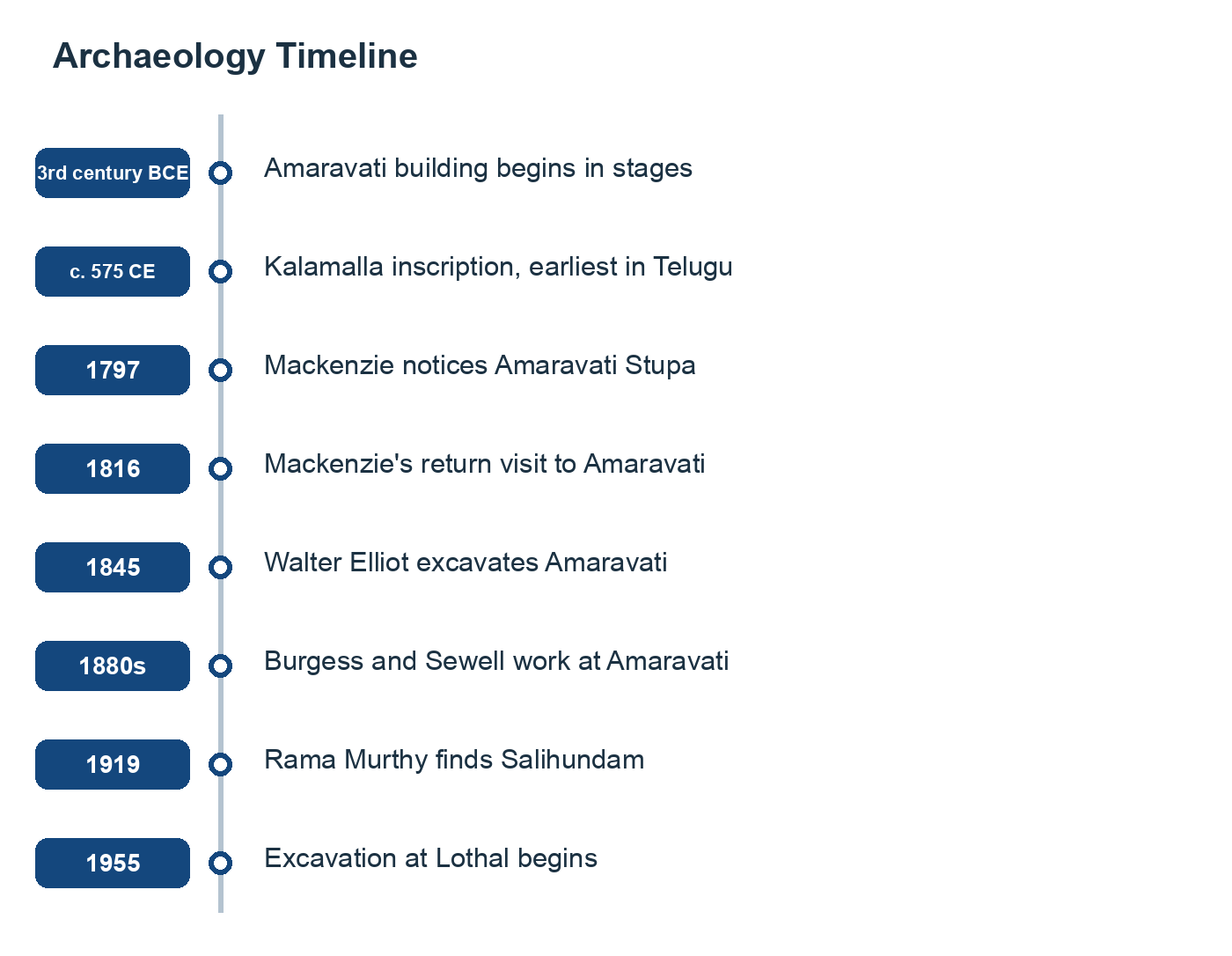
Amaravati was not built at one time. It grew in stages, probably from the 3rd century BCE until about 250 CE. At its height the dome was about 50 metres across at the base and perhaps about 30 metres high. The repeated rebuilding shows that people kept giving money and labour for centuries. Rich patrons paid for the carved railings and panels. These included local rulers before the Satavahanas, then the Satavahanas themselves, and later the Ikshvakus of Andhra. After this long period of building, the site stayed a Buddhist centre for many more centuries, until about the 13th century.
Discovery. Before any survey, villagers were using the mound as a quarry for building stone. Colin Mackenzie, a surveyor of the Company, noticed it in 1797. His return visit in 1816 produced plans and drawings that are still valuable, since he saw more of the monument than anyone later. Sir Walter Elliot dug there in 1845 and shipped many carved slabs to Madras. James Burgess and Robert Sewell worked at the site for the ASI in the 1880s. The sculptures finally ended up divided among three museums: the Government Museum at Chennai, the British Museum in London and the Amaravati Archaeological Museum. Many pieces were damaged when they were removed and stored.
Art. Art historians count the Amaravati style as one of three great schools of early Indian sculpture. The others are Mathura and Gandhara. Amaravati art is known for tall, slender and graceful figures and for crowded scenes that tell the life of the Buddha and his earlier births. The reliefs are among the finest narrative carvings of ancient India. The style flourished from about the 2nd century BCE to the end of the 3rd century CE, which matches the Satavahana period.
Other Buddhist places of Andhra
Salihundam. Gidugu Venkata Rama Murthy is credited with finding this site in 1919. It lies on a hill above the south bank of the Vamsadhara river, in Srikakulam district, a short distance from the coast near Kalingapatnam. The area belonged to ancient Kalinga, and a sea route linked it to lands in the east. The remains run from about the 2nd century to the 12th century, so the site shows how the religion changed over many centuries and several branches. Diggers found four stupas, relic caskets, shrines and figures such as Marichi and Tara, which point to the later, tantric forms of Buddhism. The name is often explained as meaning a rice market, but this is a popular meaning and not a settled one.
Guntupalli. This is a Buddhist site in the Eluru area, where the remains include rock-cut work. It shows that Buddhism was not limited to the Krishna valley.
Do not mix these sites. Amaravati is in the Krishna valley and the Palnadu region. Salihundam is in the north-east, in Srikakulam. Guntupalli is near Eluru.
Inscriptions: reading the Satavahana world from outside Andhra
Many of the records on the Satavahanas were found outside modern Andhra Pradesh. This is a common trap. The Satavahanas ruled a large area, and their records lie in the Deccan and in the west.
Nanaghat (Naneghat). The record here was issued by Queen Naganika (also spelt Nayanika), understood to be the wife of a Satakarni king. She had it cut in a cave beside a mountain pass in the Western Ghats of Maharashtra, in Pune district. Its text lists Vedic sacrifices and the cattle, elephants, horses and coins given for them, and it opens with prayers to several gods, among them Samkarshana and Vasudeva, so Vaishnava ideas were already known. Scholars also prize it for some of the earliest Brahmi number signs, ancestors of the later Indian numerals. The long Brahmi writing runs along the side walls. The back wall once carried eight life-size relief figures of royal persons, each named above. The figures are gone, but the names help us see the early Satavahana family. The record is dated about the 1st or 2nd century BCE.
Nasik Prasasti. This record is at Nasik in Maharashtra. It was composed by Gautami Balasri, the mother of a Satavahana king. A *prasasti* is a long praise of a king. Learn this as "the mother's record".
Hathigumpha. Kharavela, king of Kalinga, of the Mahameghavahana line, is the maker of this record, and it is among the earliest to follow the style of a *prasasti*. Hathigumpha means "Elephant Cave", and the cave lies in the Udayagiri hills near Bhubaneswar in Odisha. The text is 17 lines of Prakrit in Brahmi script. It follows his life year by year: wars, water works, gifts to Jain monks and Brahmins, and festivals. One line names a Satakarni, thought to be a Satavahana king, and says Kharavela sent his army west without fear of him. Dating is argued. Scholars place the record between the 2nd century BCE and the 1st century CE, and many choose the middle of the 1st century BCE.
Girnar. The rock at Girnar near Junagadh in Gujarat records the works of Rudradaman, a Shaka ruler of the western region. It is in Sanskrit. It is important because it shows Sanskrit being used in royal writing at a time when most records were in Prakrit.
| Record | Issued by | Where | Language |
|---|---|---|---|
| Nanaghat | Queen Naganika | Pune district, Maharashtra | Prakrit (Brahmi script) |
| Nasik Prasasti | Gautami Balasri | Nasik, Maharashtra | Prakrit |
| Hathigumpha | Kharavela | near Bhubaneswar, Odisha | Prakrit |
| Girnar | Rudradaman | near Junagadh, Gujarat | Sanskrit |
The Nanaghat record is in Prakrit, written in Brahmi script, like the Nasik record. Learn the author, the place and the language.
Telugu comes onto stone: Kalamalla
For a long time Telugu words appeared as names of places and persons inside records that were written in Sanskrit or Prakrit. A full record in Telugu is a different thing. The earliest one found so far is the Kalamalla inscription, dated about 575 CE.
The pillar stands broken in the courtyard of the Chennakesava temple at Kalamalla, near Yerraguntla in YSR Kadapa district (the old Kamalapuram taluk), and the writing is cut on two of its faces. Because of the break, some words are lost. The ruler named is Erikal Muttu Raju Dhananjaya, a king of the Renati Cholas (also called Telugu Cholas), whose chiefs held Renadu, the Kadapa area. The content is a gift connected with a man named Revanakalu of Chirumburu. No date is written in it. Scholars say about 575 CE, since the letter shapes resemble those of a 6th-century stone record at Siragunda, and this is why books say "c. 575 CE" and not an exact year. Dhananjaya is thought to be the father of Mahendravikrama, who appears in later copper plate grants. His successors, such as Punyakumara, also bear the title *Erikal Muttu Raju*.
The Kalamalla record is important because it shows that Telugu was being used for royal and public business by the 6th century. The script of that time was shared with Kannada, and Telugu was only starting to take its own form. Earlier Pallava records contain some Telugu words, but they are not whole Telugu texts. The Kadamba kings of Banavasi, whose records are also linked with this period in other chapters, ruled the neighbouring Kannada country.
Records of India outside Andhra, often mixed in questions
These are used as extra items in matching questions.
| Record | Writer | Subject |
|---|---|---|
| Allahabad Pillar | Harishena | Conquests of Samudragupta |
| Aihole | Ravikirti | Victories of Pulakeshin II |
| Mandasor | Vatsabhatti | A record of the Gupta age |
| Uttaramerur | Local records | Village self-government under the Cholas |
Coins and money
Coins show the economy. A ship on a coin shows sea trade. At Chinnaganjam, ship-type coins of Yajna Sri Satakarni were found. The official called the *Lakshanadhyaksha* looked after coinage and the mint in the later lists of officers.
| Coin | Metal |
|---|---|
| Tanka | Silver |
| Rupiya | Silver |
| Mohur | Gold |
| Jital | Copper |
| Dam | Copper |
These names come from later periods and are not Satavahana coins. Keep them as a metals list.
Archaeologists and their firsts
| Work | Person |
|---|---|
| First excavator of Harappa | Daya Ram Sahni |
| First excavator of Mohenjo-daro | R. D. Banerji |
| First to read Ashokan Brahmi | James Prinsep |
| First excavator of Lothal (from 1955) | S. R. Rao |
Decline, legacy and sites to know
Amaravati's loss shows how heritage is damaged. Local people used the stones for lime and buildings long before the survey arrived. The Company then moved the best panels away. Today the slabs are spread across the world, and only a few remain in Andhra. This is why museums in Amaravati and Chennai are visited by students of Andhra art.
Salihundam lost its monks when Buddhism declined in the coastal area, but its mounds survived because they stood on a quiet hill. The records of Nanaghat and Nasik survive on rock, which is a strong material. Pillars like Kalamalla are weaker, and have broken. That is why the surviving record is partial.
For Andhra the main sites to know are Amaravati, Salihundam, Guntupalli and Kalamalla. For the wider Satavahana story, know the western records at Nanaghat and Nasik, and the northern one at Hathigumpha.
How examiners use this chapter
- Author and place pairs. Naganika is Nanaghat, Gautami Balasri is Nasik, Kharavela is Hathigumpha, Rudradaman is Girnar. Wrong options swap them.
- Language. Hathigumpha and Nasik are Prakrit, Girnar is Sanskrit, Kalamalla is Telugu.
- Earliest Telugu inscription. Kalamalla, c. 575 CE, Renati Chola king Dhananjaya, Kadapa region.
- Amaravati discovery. Colin Mackenzie, 1797. Do not give the name of Elliot or Burgess for the first notice.
- Buddhist site and district. Salihundam in Srikakulam, Guntupalli near Eluru, Amaravati in Palnadu.
- Not in Andhra. Nanaghat is in Maharashtra, Hathigumpha in Odisha, Girnar in Gujarat.
- Metals of coins. Mohur is gold, Tanka and Rupiya are silver, Jital and Dam are copper.
- First excavators. Daya Ram Sahni for Harappa, R. D. Banerji for Mohenjo-daro, S. R. Rao for Lothal, James Prinsep for reading Brahmi.
Worked cases
Case: Which of these inscriptions is NOT matched with its correct author? (A) Nanaghat - Naganika (B) Nasik Prasasti - Gautami Balasri (C) Hathigumpha - Rudradaman (D) Girnar - Rudradaman
Reasoning:
- 1. Notice that Rudradaman appears twice, in options C and D. One inscription cannot have two authors in this style of question, so one of them is wrong.
- 2. Girnar is the inscription of Rudradaman, and it is in Sanskrit.
- 3. Hathigumpha means "elephant cave" and it is linked with Kharavela, near Bhubaneswar.
- 4. So option C is the wrong pair. Options A, B and D are correct.
Takeaway: When one name repeats in the options, check which of the two places really belongs to that name.
Case: A question gives three clues: "a Satavahana record", "issued by a queen", "found in Maharashtra". Which inscription is it?
Reasoning:
- 1. Nanaghat and Nasik are both Satavahana-linked records, so use the author to separate them.
- 2. Nasik Prasasti was written by Gautami Balasri, the mother of a Satavahana king. Naganika issued the Nanaghat inscription.
- 3. The clue "issued by a queen" fits Naganika, who issued the Nanaghat inscription. Gautami Balasri is described as a king's mother, so she fits Nasik.
- 4. Nanaghat is in Maharashtra (Pune district), not in Andhra. The place clue agrees with the author clue.
- 5. Answer: Nanaghat inscription.
Takeaway: Pair each inscription with one name only, and do not swap the two Satavahana women.
Case: Place these in order from earliest to latest by the date of the event: Kalamalla inscription, discovery of the Amaravati Stupa, start of excavation at Lothal.
Reasoning:
- 1. Kalamalla inscription is dated 575 CE. It is the oldest by far.
- 2. Colin Mackenzie found the Amaravati Stupa in 1797.
- 3. Excavation at Lothal began in 1955.
- 4. Order: Kalamalla (575), Amaravati discovery (1797), Lothal (1955).
Takeaway: For date-ordering questions, write the three years in a row and sort them. Do not try to guess from the type of event.
Case: Odd one out: Tanka, Rupiya, Mohur, Jital.
Reasoning:
- 1. Tanka is a silver coin.
- 2. Rupiya is a silver coin.
- 3. Jital is a copper coin.
- 4. Mohur is a gold coin. It is the only one that is gold, so it is the odd one out by metal.
- 5. If the question had listed Dam, it would sit with Jital, because Dam is also copper.
- 6. Many students pick Jital because it sounds unusual. Check the metal before choosing.
Takeaway: Odd-one-out questions often depend on a single shared property. Find the property first, then find the item that breaks it.
Compare and contrast
| Inscription | Author or ruler | Language | Where it is |
|---|---|---|---|
| Nasik Prasasti | Gautami Balasri | Prakrit | Nasik |
| Hathigumpha | Kharavela | Prakrit | Near Bhubaneswar |
| Girnar | Rudradaman | Sanskrit | Junagadh |
| Kalamalla | Earliest Telugu inscription (575 CE) | Telugu | Kadapa district |
Use this table for the "which language" question. Only two are Prakrit, one is Sanskrit and one is Telugu.
| Pair | First item | Second item |
|---|---|---|
| Harappa and Mohenjo-daro | Harappa: Daya Ram Sahni | Mohenjo-daro: R. D. Banerji |
| Reading and digging | James Prinsep first deciphered Ashokan Brahmi | S. R. Rao first excavated Lothal |
| Allahabad and Aihole | Allahabad: Harishena, about Samudragupta | Aihole: Ravikirti, about Pulakeshin II |
| Amaravati and Salihundam | Amaravati: Mackenzie found it in 1797 | Salihundam: Buddhist site in Srikakulam |
Also note that Hathigumpha (Kharavela) and Girnar (Rudradaman) are both famous, but they are in different languages and different regions. Kharavela belongs to Kalinga and Rudradaman was a Shaka ruler.
Memory tip: the first excavator of each Indus site is a different person. Do not reverse them.
Sequence and timeline
| Order | Event | Year |
|---|---|---|
| 1 | Kalamalla inscription, earliest in Telugu | 575 CE |
| 2 | Colin Mackenzie brings the Amaravati Stupa to notice | 1797 |
| 3 | Excavation at Lothal begins | 1955 |
A second ordered chain is about the Buddhist sites of Andhra: Amaravati Stupa (best known, Krishna valley art school), Salihundam (Srikakulam) and Guntupalli (Eluru). Learn them from the big one to the small ones.
Other steps in a logical order, without years: Brahmi script is read by James Prinsep, and this makes Ashokan edicts readable. Ship-type coins of Yajna Sri Satakarni from Chinnaganjam then show sea trade. The Lakshanadhyaksha is the official linked with coinage and the mint.
More one-liners
- 1. The Kadamba dynasty had its capital at Banavasi.
- 2. Nanaghat is in Pune district of Maharashtra.
- 3. Myakadoni inscription is in Kurnool district.
- 4. Guntupalli is in Eluru district and is a Buddhist site.
- 5. Hampi was inscribed as a UNESCO World Heritage Site in 1986.
- 6. Khajuraho Temples were inscribed as a UNESCO World Heritage Site in 1986.
- 7. Sanchi Stupa was inscribed as a UNESCO World Heritage Site in 1989.
- 8. Konark Sun Temple was inscribed in 1984, the same year as Mahabalipuram Monuments.
- 9. Taj Mahal, Ajanta Caves, Ellora Caves and Agra Fort were all inscribed in 1983.
- 10. Qutub Minar and Humayun's Tomb were inscribed in 1993.
- 11. Red Fort was inscribed in 2007.
- 12. Uttaramerur inscriptions give information on village self-government under the Cholas.
- 13. The Mandasor Inscription was written by Vatsabhatti.
- 14. The Aihole Inscription tells of the victories of Pulakeshin II.
- 15. The Allahabad Pillar Inscription tells of the conquests of Samudragupta.
Practice questions
Consider the following pairs (Event – Year): (i) Salt Satyagraha in Andhra – 1930 (ii) Charter Act ending Company trade monopoly in India – 1813 (iii) Inscription of Konark Sun Temple as a UNESCO World Heritage Site – 1984 Which of the pairs are correctly matched?
- Only (i)
- All of (i), (ii) and (iii)
- Only (ii)
- Only (ii) and (iii)
Answer
B. All of (i), (ii) and (iii)
ఈ క్రింది జతలను పరిశీలించండి (సంఘటన – సంవత్సరం): (i) ఆంధ్రలో ఉప్పు సత్యాగ్రహం – 1930 (ii) కంపెనీ వాణిజ్య గుత్తాధిపత్యం రద్దు చేసిన చార్టర్ చట్టం – 1813 (iii) కోణార్క్ సూర్య దేవాలయానికి యునెస్కో ప్రపంచ వారసత్వ గుర్తింపు – 1984 సరిగ్గా జతపరచబడినవి ఏవి?
- (i) మాత్రమే
- (i), (ii), (iii) అన్నీ
- (ii) మాత్రమే
- (ii), (iii) మాత్రమే
In which inscription was the earliest Telugu word noted?
- Nasik inscription
- Nanaghat inscription
- Hathigumpha inscription
- Amaravati inscription
Answer
D. Amaravati inscription
The word 'Nagabu'.
తొలి తెలుగు పదం ఏ శాసనంలో గుర్తించబడింది?
- నాసిక్ శాసనం
- నానాఘాట్ శాసనం
- హాథిగుంఫ శాసనం
- అమరావతి శాసనం
In which inscription is Samudragupta's southern campaign recorded?
- Hathigumpha inscription
- Aihole inscription
- Junagadh inscription
- Allahabad pillar inscription
Answer
D. Allahabad pillar inscription
It is in the Allahabad inscription.
సముద్రగుప్తుని దక్షిణ దండయాత్ర ఏ శాసనంలో ఉంది?
- హథిగుంఫ శాసనం
- ఐహోలే శాసనం
- జునాగఢ్ శాసనం
- అలహాబాద్ శాసనం
The Nasik cave inscription that praises the victories of Gautamiputra Satakarni was issued by:
- Gautami Balasri, his mother
- Nayanika
- Prabhavatigupta
- Didda
Answer
A. Gautami Balasri, his mother
His mother Gautami Balasri had the prasasti engraved at Nasik, describing him as destroyer of Sakas, Yavanas and Pahlavas.
గౌతమీపుత్ర శాతకర్ణి విజయాలను కీర్తించే నాసిక్ గుహ శాసనాన్ని వేయించినవారు ఎవరు?
- గౌతమీ బాలశ్రీ (ఆయన తల్లి)
- నాయనిక
- ప్రభావతీగుప్త
- దిద్దా
In which district or place is Myakadoni inscription located?
- Palnadu district
- Eluru
- Nandyal
- Kurnool district
Answer
D. Kurnool district
మ్యాకదోని శాసనం ఏ జిల్లా/ప్రాంతంలో ఉంది?
- పల్నాడు జిల్లా
- ఏలూరు
- నంద్యాల
- కర్నూలు జిల్లా
Ship-type coins of Yajna Sri Satakarni is associated with which of the following?
- Sanskrit language
- Kondur Village
- Adilabad
- Chinnaganjam
Answer
D. Chinnaganjam
యజ్ఞశ్రీ శాతకర్ణి నౌకా నాణేలు ఈ క్రింది వాటిలో దేనితో ముడిపడి ఉంది?
- సంస్కృత భాష
- కొండూరు గ్రామం
- ఆదిలాబాద్
- చినగంజాం
Consider the following pairs (Event – Year): (i) Cession of the Ceded Districts to the British – 1800 (ii) Enactment of Forest Rights Act – 2006 (iii) Inscription of Khajuraho Temples as a UNESCO World Heritage Site – 1986 Which of the pairs are correctly matched?
- Only (i) and (ii)
- All of (i), (ii) and (iii)
- Only (i)
- None of them
Answer
B. All of (i), (ii) and (iii)
ఈ క్రింది జతలను పరిశీలించండి (సంఘటన – సంవత్సరం): (i) దత్త మండలాలను బ్రిటిష్ వారికి అప్పగించడం – 1800 (ii) అటవీ హక్కుల చట్టం అమలు – 2006 (iii) ఖజురహో ఆలయాలకు యునెస్కో ప్రపంచ వారసత్వ గుర్తింపు – 1986 సరిగ్గా జతపరచబడినవి ఏవి?
- (i), (ii) మాత్రమే
- (i), (ii), (iii) అన్నీ
- (i) మాత్రమే
- ఏదీ కాదు
Arrange the following in chronological order (earliest first): (i) Establishment of the Aravidu dynasty (ii) Kalamalla inscription in Telugu (iii) Rampa Rebellion (iv) Completion of the Dowleswaram Anicut
- (ii), (iii), (i), (iv)
- (iv), (i), (ii), (iii)
- (ii), (i), (iv), (iii)
- (iii), (i), (iv), (ii)
Answer
C. (ii), (i), (iv), (iii)
ఈ క్రింది వాటిని కాలక్రమానుసారం (పూర్వం నుండి తరువాతి వరకు) అమర్చండి: (i) ఆరవీటి వంశ స్థాపన (ii) కలమళ్ల శాసనం (iii) రంపా తిరుగుబాటు (iv) ధవళేశ్వరం ఆనకట్ట పూర్తి
- (ii), (iii), (i), (iv)
- (iv), (i), (ii), (iii)
- (ii), (i), (iv), (iii)
- (iii), (i), (iv), (ii)
Consider the following pairs (Event – Year): (i) Founding of Vijayanagara Empire – 1336 (ii) Inscription of Khajuraho Temples as a UNESCO World Heritage Site – 2006 (iii) Booker Prize to Kiran Desai for The Inheritance of Loss – 1986 Which of the pairs are correctly matched?
- Only (ii) and (iii)
- Only (i)
- Only (iii)
- Only (ii)
Answer
B. Only (i)
ఈ క్రింది జతలను పరిశీలించండి (సంఘటన – సంవత్సరం): (i) విజయనగర సామ్రాజ్య స్థాపన – 1336 (ii) ఖజురహో ఆలయాలకు యునెస్కో ప్రపంచ వారసత్వ గుర్తింపు – 2006 (iii) ది ఇన్హెరిటెన్స్ ఆఫ్ లాస్కు కిరణ్ దేశాయ్కి బుకర్ బహుమతి – 1986 సరిగ్గా జతపరచబడినవి ఏవి?
- (ii), (iii) మాత్రమే
- (i) మాత్రమే
- (iii) మాత్రమే
- (ii) మాత్రమే
Who composed the Allahabad Pillar inscription describing Samudragupta's southern expedition?
- Harishena
- Banabhatta
- Kalidasa
- Ravikirti
Answer
A. Harishena
Harishena, a court poet and minister, composed the prashasti.
సముద్రగుప్తుని దక్షిణ దండయాత్రను వర్ణించే అలహాబాద్ స్తంభ శాసనాన్ని రచించినది ఎవరు?
- హరిషేణుడు
- బాణభట్టు
- కాళిదాసు
- రవికీర్తి
Karnam Malleswari hails from which district of Andhra Pradesh?
- Kurnool
- Srikakulam
- Guntur
- Chittoor
Answer
B. Srikakulam
She was born in Voosavanipeta near Amudalavalasa in Srikakulam.
కర్ణం మల్లేశ్వరి ఆంధ్రప్రదేశ్లోని ఏ జిల్లాకు చెందినవారు?
- కర్నూలు
- శ్రీకాకుళం
- గుంటూరు
- చిత్తూరు
The Kalamalla inscription, generally cited as the earliest Telugu inscription, was issued by:
- Kubja Vishnuvardhana
- Madhavavarman of the Vishnukundins
- Erikal Muttu Raju Dhananjaya of the Renati Cholas
- Gautamiputra Satakarni
Answer
C. Erikal Muttu Raju Dhananjaya of the Renati Cholas
It dates to about the sixth century in the Kadapa region.
సాధారణంగా తొలి తెలుగు శాసనంగా పేర్కొనే కలమళ్ల శాసనాన్ని వేయించినవారు:
- కుబ్జ విష్ణువర్ధనుడు
- విష్ణుకుండిని మాధవవర్మ
- రేనాటి చోళుడు ఎరికల్ ముత్తురాజు ధనంజయుడు
- గౌతమీపుత్ర శాతకర్ణి
Who issued the Nanaghat inscription?
- Kharavela
- Rudradaman
- Gautami Balasri
- Nayanika (Nagarika)
Answer
D. Nayanika (Nagarika)
Nayanika (Naganika).
నానాఘాట్ శాసనం వేయించినవారు ఎవరు?
- ఖారవేలుడు
- రుద్రదాముడు
- గౌతమి బాలశ్రీ
- నాగానిక
Which is the first Sanskrit inscription in India?
- Junagadh inscription
- Erragudi inscription
- Nasik inscription
- Nanaghat inscription
Answer
A. Junagadh inscription
Junagadh.
దేశంలో మొదటి సంస్కృత శాసనం ఏది?
- జునాగఢ్ శాసనం
- ఎర్రగుడి శాసనం
- నాసిక్ శాసనం
- నానాఘాట్ శాసనం
In which caves were Krishna's Prakrit inscriptions found?
- Ajanta caves
- Nasik caves
- Ellora caves
- Undavalli caves
Answer
B. Nasik caves
Nasik caves is correct per the page.
కృష్ణుని ఏ గుహలలో ప్రాకృత భాషా శాసనాలు బయటపడ్డాయి?
- అజంతా గుహలు
- నాసిక్ గుహలు
- ఎల్లోరా గుహలు
- ఉండవల్లి గుహలు
Which inscription did Gautami Balasri issue in his reign?
- Junagadh inscription
- Amaravati inscription
- Karle inscription
- Nasik inscription
Answer
D. Nasik inscription
Nasik inscription is correct per the page.
వాశిష్ఠీపుత్ర పులోమావి కాలంలో గౌతమి బాలశ్రీ వేయించిన శాసనం ఏది?
- జునాఘడ్ శాసనం
- అమరావతి శాసనం
- కార్లే శాసనం
- నాసిక్ శాసనం
Which is the first Sanskrit inscription?
- Junagadh inscription
- Nasik inscription
- Amaravati inscription
- Karle inscription
Answer
A. Junagadh inscription
Junagadh inscription is correct per the page.
మొదటి సంస్కృత శాసనం ఏది?
- జునాఘడ్ శాసనం
- నాసిక్ శాసనం
- అమరావతి శాసనం
- కార్లే శాసనం
First Telugu sentence is in which inscription?
- Kalamalla
- Chikkulla copper plate of Vikramendravarma
- Amaravati
- Hala's
Answer
B. Chikkulla copper plate of Vikramendravarma
Vijaya Rajya Samvatsara.
మొదటి తెలుగు వాక్యం ఏ శాసనంలో ఉంది?
- కలమళ్ళ శాసనం
- విక్రమేంద్ర వర్మ చిక్కుళ్ళ తామ్ర శాసనం
- అమరావతి
- హాలుని
Arrange the following in chronological order (earliest first): (i) Keladi Nayak dynasty (ii) Guntur district (iii) Majlis-e-Ittehadul Muslimeen (iv) French Settlement at Pondicherry
- (i), (iv), (ii), (iii)
- (ii), (iii), (iv), (i)
- (ii), (iv), (i), (iii)
- (iii), (i), (iv), (ii)
Answer
A. (i), (iv), (ii), (iii)
ఈ క్రింది వాటిని కాలక్రమానుసారం (పూర్వం నుండి తరువాతి వరకు) అమర్చండి: (i) కేళడి నాయక వంశం (ii) గుంటూరు జిల్లా (iii) మజ్లిస్-ఎ-ఇత్తెహాదుల్ ముస్లిమీన్ (iv) పాండిచ్చేరిలో ఫ్రెంచ్ స్థావరం
- (i), (iv), (ii), (iii)
- (ii), (iii), (iv), (i)
- (ii), (iv), (i), (iii)
- (iii), (i), (iv), (ii)
According to the Junagadh (Girnar) inscription, Rudradaman I twice defeated a Satavahana king but did not destroy him because of:
- Payment of heavy tribute
- Pressure from the Kushanas
- Intervention of the Cholas
- A close matrimonial relationship
Answer
D. A close matrimonial relationship
The inscription says the Satavahana king was spared because of the nearness of their family relationship.
జునాగఢ్ (గిర్నార్) శాసనం ప్రకారం, మొదటి రుద్రదామన్ ఒక శాతవాహన రాజును రెండుసార్లు ఓడించినా అతనిని నాశనం చేయకపోవడానికి కారణం ఏమిటి?
- భారీ కప్పం చెల్లించడం
- కుషాణుల ఒత్తిడి
- చోళుల జోక్యం
- సన్నిహిత వైవాహిక సంబంధం
Gudimallam in Andhra is celebrated for
- The earliest Buddhist stupa of the region
- An ancient Shiva linga with a standing figure of Shiva carved on its shaft
- A group of rock-cut Jain caves
- A Mahayana monastery complex
Answer
B. An ancient Shiva linga with a standing figure of Shiva carved on its shaft
The Gudimallam linga is one of the earliest known Shaiva icons, with the deity sculpted on the front of the shaft.
ఆంధ్రలోని గుడిమల్లం దేనికి ప్రసిద్ధి?
- ఈ ప్రాంతంలోని మొట్టమొదటి బౌద్ధ స్తూపం
- లింగంపై నిలబడిన శివుని రూపం చెక్కిన ప్రాచీన శివలింగం
- జైన గుహల సమూహం
- మహాయాన విహార సముదాయం
Which 1850 Act of the Government of India first allowed the creation of municipalities in towns?
- Madras Local Boards Act of 1884
- Andhra Pradesh Municipalities Act
- India Act XXVI of 1850
- District Road Cess Act
Answer
C. India Act XXVI of 1850
పట్టణాలలో పురపాలక సంఘాల ఏర్పాటుకు మొదటిసారిగా అనుమతించిన భారత ప్రభుత్వ 1850 నాటి చట్టం ఏది?
- 1884 మద్రాసు స్థానిక బోర్డుల చట్టం
- ఆంధ్రప్రదేశ్ మున్సిపాలిటీల చట్టం
- 1850 నాటి ఇండియా చట్టం XXVI
- జిల్లా రహదారి సెస్ చట్టం
Which dynasty ruled Andhra after the decline of the Mauryas, with coins of Vasishthiputra Pulumayi found in East Godavari?
- Koppula
- Mayana Nawabs
- Satavahana
- Telugu Cholas
Answer
C. Satavahana
మౌర్యుల పతనం తర్వాత ఆంధ్రను పాలించిన, వాసిష్ఠీపుత్ర పులుమావి నాణేలు తూర్పు గోదావరిలో లభించిన రాజవంశం ఏది?
- కొప్పుల
- మయన నవాబులు
- శాతవాహన
- తెలుగు చోళులు
Which of the following is located in the Palnadu district area?
- Etikoppaka
- Amaravati Stupa
- Srikurmam Temple
- Podili
Answer
B. Amaravati Stupa
ఈ క్రింది వాటిలో ఏది పల్నాడు జిల్లా ప్రాంతంలో ఉంది?
- ఏటికొప్పాక
- అమరావతి స్తూపం
- శ్రీకూర్మం ఆలయం
- పొదిలి
In which district or place is Lepakshi Temple located?
- Manipur
- Maharashtra
- Assam
- Andhra Pradesh
Answer
D. Andhra Pradesh
లేపాక్షి ఆలయం ఏ జిల్లా/ప్రాంతంలో ఉంది?
- మణిపూర్
- మహారాష్ట్ర
- అస్సాం
- ఆంధ్రప్రదేశ్
Which of the following is NOT correctly paired with Kurnool district (Place – Location)?
- Jaggayyapeta
- Mantralayam Temple
- Kurnool
- Myakadoni inscription
Answer
A. Jaggayyapeta
ఈ క్రింది వాటిలో ఏది 'కర్నూలు జిల్లా' అనే అంశానికి సరిగ్గా జతకాదు? (ప్రదేశం – ఉన్న చోటు)
- జగ్గయ్యపేట
- మంత్రాలయం
- కర్నూలు
- మ్యాకదోని శాసనం
Consider the following pairs (Place – Location): (i) Vijayapuri – Palnadu district (ii) Ellora Caves – Bihar (iii) Tomb of Sher Shah – Maharashtra Which of the pairs are correctly matched?
- Only (iii)
- None of them
- Only (i)
- All of (i), (ii) and (iii)
Answer
C. Only (i)
ఈ క్రింది జతలను పరిశీలించండి (ప్రదేశం – ఉన్న చోటు): (i) విజయపురి – పల్నాడు జిల్లా (ii) ఎల్లోరా గుహలు – బీహార్ (iii) షేర్ షా సమాధి – మహారాష్ట్ర సరిగ్గా జతపరచబడినవి ఏవి?
- (iii) మాత్రమే
- ఏదీ కాదు
- (i) మాత్రమే
- (i), (ii), (iii) అన్నీ
In which year did this event take place: Discovery of Amaravati Stupa by Colin Mackenzie?
- 1799
- 1797
- 1800
- 1794
Answer
B. 1797
ఈ సంఘటన ఏ సంవత్సరంలో జరిగింది: కాలిన్ మెకంజీ అమరావతి స్తూప ఆవిష్కరణ?
- 1799
- 1797
- 1800
- 1794
Consider the following pairs (Event – Year): (i) Cession of the Ceded Districts by the Nizam – 1800 (ii) Inscription of Taj Mahal as a UNESCO World Heritage Site – 1983 (iii) Fall of Vatapi to Pallava Narasimhavarman I – 642 Which of the pairs are correctly matched?
- Only (ii)
- All of (i), (ii) and (iii)
- Only (ii) and (iii)
- Only (i) and (ii)
Answer
B. All of (i), (ii) and (iii)
ఈ క్రింది జతలను పరిశీలించండి (సంఘటన – సంవత్సరం): (i) నిజాం సీడెడ్ జిల్లాల అప్పగింత – 1800 (ii) తాజ్ మహల్కు యునెస్కో ప్రపంచ వారసత్వ గుర్తింపు – 1983 (iii) పల్లవ నరసింహవర్మ చేతిలో వాతాపి పతనం – 642 సరిగ్గా జతపరచబడినవి ఏవి?
- (ii) మాత్రమే
- (i), (ii), (iii) అన్నీ
- (ii), (iii) మాత్రమే
- (i), (ii) మాత్రమే
Arrange the following in chronological order (earliest first): (i) Fall of Kakatiya king Prataparudra II to the Delhi Sultanate (ii) Vasco da Gama reaches Calicut (iii) Palnadu Forest Satyagraha (iv) Andhra Pradesh Reorganisation Act enforcement
- (ii), (iv), (i), (iii)
- (i), (ii), (iii), (iv)
- (ii), (i), (iv), (iii)
- (iv), (ii), (i), (iii)
Answer
B. (i), (ii), (iii), (iv)
ఈ క్రింది వాటిని కాలక్రమానుసారం (పూర్వం నుండి తరువాతి వరకు) అమర్చండి: (i) కాకతీయ ప్రతాపరుద్రుడు II ఢిల్లీ సుల్తానుల చేతిలో పతనం (ii) వాస్కో డ గామా కాలికట్ చేరిక (iii) పల్నాడు అటవీ సత్యాగ్రహం (iv) ఆంధ్రప్రదేశ్ పునర్విభజన చట్టం అమలు
- (ii), (iv), (i), (iii)
- (i), (ii), (iii), (iv)
- (ii), (i), (iv), (iii)
- (iv), (ii), (i), (iii)
Consider the following pairs (Work – Author): (i) Qutb Mushtari – Mulla Wajhi (ii) Nasik Prasasti – Gautami Balasri (iii) Sabha Parvam of Andhra Mahabharatam – Nannaya Which of the pairs are correctly matched?
- All of (i), (ii) and (iii)
- Only (i)
- Only (iii)
- Only (ii)
Answer
A. All of (i), (ii) and (iii)
ఈ క్రింది జతలను పరిశీలించండి (రచన – రచయిత): (i) కుతుబ్ ముష్తరి – ములా వజ్హీ (ii) నాసిక్ ప్రశస్తి – గౌతమీ బాలశ్రీ (iii) ఆంధ్ర మహాభారతంలోని సభాపర్వం – నన్నయ సరిగ్గా జతపరచబడినవి ఏవి?
- (i), (ii), (iii) అన్నీ
- (i) మాత్రమే
- (iii) మాత్రమే
- (ii) మాత్రమే
Consider the following pairs (Event – Year): (i) Ban on the Hyderabad State Congress – 1831 (ii) Discovery of electromagnetic induction – 1938 (iii) Inscription of Agra Fort as a UNESCO World Heritage Site – 1983 Which of the pairs are correctly matched?
- Only (i)
- None of them
- Only (iii)
- Only (ii)
Answer
C. Only (iii)
ఈ క్రింది జతలను పరిశీలించండి (సంఘటన – సంవత్సరం): (i) హైదరాబాద్ స్టేట్ కాంగ్రెస్ నిషేధం – 1831 (ii) విద్యుదయస్కాంత ప్రేరణ ఆవిష్కరణ – 1938 (iii) ఆగ్రా కోటకు యునెస్కో ప్రపంచ వారసత్వ గుర్తింపు – 1983 సరిగ్గా జతపరచబడినవి ఏవి?
- (i) మాత్రమే
- ఏదీ కాదు
- (iii) మాత్రమే
- (ii) మాత్రమే
Arrange the following in chronological order (earliest first): (i) Formation of Prakasam district (ii) Fall of the Kakatiya dynasty (iii) Mughal annexation of Ahmadnagar (iv) First Andhra Conference at Bapatla
- (i), (iv), (ii), (iii)
- (iv), (i), (iii), (ii)
- (i), (iii), (iv), (ii)
- (ii), (iii), (iv), (i)
Answer
D. (ii), (iii), (iv), (i)
ఈ క్రింది వాటిని కాలక్రమానుసారం (పూర్వం నుండి తరువాతి వరకు) అమర్చండి: (i) ప్రకాశం జిల్లా ఏర్పాటు (ii) కాకతీయ వంశ పతనం (iii) అహ్మద్నగర్ను మొఘలులు కలుపుకోవడం (iv) బాపట్లలో మొదటి ఆంధ్ర మహాసభ
- (i), (iv), (ii), (iii)
- (iv), (i), (iii), (ii)
- (i), (iii), (iv), (ii)
- (ii), (iii), (iv), (i)
Arrange the following in chronological order (earliest first): (i) Guntur district (ii) Salar Jung Museum (iii) Fazl Ali Commission (iv) Andhra Mahasabha
- (ii), (iii), (iv), (i)
- (i), (ii), (iv), (iii)
- (i), (iv), (ii), (iii)
- (iii), (i), (iv), (ii)
Answer
C. (i), (iv), (ii), (iii)
ఈ క్రింది వాటిని కాలక్రమానుసారం (పూర్వం నుండి తరువాతి వరకు) అమర్చండి: (i) గుంటూరు జిల్లా (ii) సాలార్ జంగ్ మ్యూజియం (iii) ఫజల్ అలీ కమిషన్ (iv) ఆంధ్ర మహాసభ
- (ii), (iii), (iv), (i)
- (i), (ii), (iv), (iii)
- (i), (iv), (ii), (iii)
- (iii), (i), (iv), (ii)
Which of the following Ashokan edict sites lies in Andhra Pradesh?
- Yerragudi
- Girnar
- Kalsi
- Dhauli
Answer
A. Yerragudi
Yerragudi in Kurnool region has Ashokan rock edicts, while the others are in Gujarat, Uttarakhand and Odisha.
ఈ క్రింది అశోకుని శాసన స్థలాలలో ఆంధ్రప్రదేశ్లో ఉన్నది ఏది?
- యర్రగుడి
- గిర్నార్
- కల్సి
- ధౌలి
The Aihole inscription of Ravikirti refers to Pulakeshin II capturing which fortress in the Godavari region?
- Vengi
- Pishtapura
- Kandarapura
- Dhanyakataka
Answer
B. Pishtapura
Pishtapura (modern Pithapuram) is mentioned as taken by Pulakeshin II.
గోదావరి ప్రాంతంలోని ఏ కోటను రెండవ పులకేశి స్వాధీనం చేసుకున్నాడని రవికీర్తి రచించిన ఐహోళె శాసనం పేర్కొంటుంది?
- వేంగి
- పిష్టపురం
- కందరపురం
- ధాన్యకటకం
Who deciphered the Brahmi script in 1837?
- Colin Mackenzie
- James Prinsep
- Robert Caldwell
- William Jones
Answer
B. James Prinsep
James Prinsep's decipherment opened the way to reading Ashokan and Andhra inscriptions.
1837లో బ్రాహ్మీ లిపిని చదివి వివరించినది ఎవరు?
- కాలిన్ మెకంజీ
- జేమ్స్ ప్రిన్సెప్
- రాబర్ట్ కాల్డ్వెల్
- విలియం జోన్స్
Which British surveyor first brought the Amaravati stupa to notice in 1797?
- Colin Mackenzie
- Robert Sewell
- Alexander Cunningham
- Arthur Cotton
Answer
A. Colin Mackenzie
Mackenzie visited the mound in 1797 and documented it.
1797లో అమరావతి స్తూపాన్ని మొదట వెలుగులోకి తెచ్చిన బ్రిటిష్ సర్వేయర్ ఎవరు?
- కోలిన్ మెకంజీ
- రాబర్ట్ సెవెల్
- అలెగ్జాండర్ కన్నింగ్హామ్
- ఆర్థర్ కాటన్
The inscriptions of the Satavahanas were mostly written in which language and script?
- Pali in Kharosthi
- Telugu in Telugu-Kannada
- Sanskrit in Grantha
- Prakrit in Brahmi
Answer
D. Prakrit in Brahmi
Prakrit in Brahmi was the court idiom of their records.
శాతవాహనుల శాసనాలు ఎక్కువగా ఏ భాష, లిపిలో ఉన్నాయి?
- ఖరోష్ఠి లిపిలో పాళీ
- తెలుగు-కన్నడ లిపిలో తెలుగు
- గ్రంథ లిపిలో సంస్కృతం
- బ్రాహ్మీ లిపిలో ప్రాకృతం
Arrange in chronological order: (1) Mayidavolu plates of Sivaskandavarman (2) Allahabad pillar inscription naming Hastivarman (3) Kalamalla inscription (4) Hiuen Tsang's visit to Andhra
- 1-2-4-3
- 1-2-3-4
- 2-1-3-4
- 1-3-2-4
Answer
B. 1-2-3-4
Early fourth century, mid fourth century, sixth century, then about 640 CE.
కాలక్రమంలో అమర్చండి: (1) శివస్కందవర్మ మైదవోలు శాసనం (2) హస్తివర్మను పేర్కొన్న అలహాబాద్ స్తంభ శాసనం (3) కలమళ్ల శాసనం (4) హ్యూయెన్ త్సాంగ్ ఆంధ్ర సందర్శన
- 1-2-4-3
- 1-2-3-4
- 2-1-3-4
- 1-3-2-4
The Kondaveedu fort, captured by Krishnadevaraya in 1515, lies in which present district of Andhra Pradesh?
- Kurnool
- Nellore
- Anantapur
- Guntur
Answer
D. Guntur
Kondaveedu fort is in Guntur district.
1515లో శ్రీకృష్ణదేవరాయలు జయించిన కొండవీడు కోట ప్రస్తుత ఆంధ్రప్రదేశ్లోని ఏ జిల్లాలో ఉంది?
- కర్నూలు
- నెల్లూరు
- అనంతపురం
- గుంటూరు
In which year was the Group of Monuments at Hampi inscribed as a UNESCO World Heritage Site?
- 2004
- 1976
- 1986
- 1996
Answer
C. 1986
Hampi was listed by UNESCO in 1986.
హంపి స్మారక చిహ్నాల సమూహం ఏ సంవత్సరంలో యునెస్కో ప్రపంచ వారసత్వ ప్రదేశంగా గుర్తింపు పొందింది?
- 2004
- 1976
- 1986
- 1996
The Penugonda fort lies in which present district of Andhra Pradesh?
- Kurnool
- Sri Sathya Sai
- Guntur
- Nellore
Answer
B. Sri Sathya Sai
Penukonda is in Sri Sathya Sai district.
పెనుగొండ కోట ప్రస్తుత ఆంధ్రప్రదేశ్లోని ఏ జిల్లాలో ఉంది?
- కర్నూలు
- శ్రీ సత్యసాయి
- గుంటూరు
- నెల్లూరు
In what script and language are the cave inscriptions?
- Kharoshthi, Pali
- Brahmi script, Prakrit
- Devanagari, Sanskrit
- Telugu script and language
Answer
B. Brahmi script, Prakrit
Brahmi and Prakrit.
గుహాలయ శాసనాలు ఏ లిపి, భాషలో ఉన్నాయి?
- ఖరోష్ఠి, పాళీ
- బ్రహ్మీ లిపి, ప్రాకృతం
- దేవనాగరి, సంస్కృతం
- తెలుగు లిపి, తెలుగు
In which district is the Erragudi inscription?
- Kurnool
- Kadapa
- Anantapur
- Guntur
Answer
A. Kurnool
Kurnool.
ఎర్రగుడి శాసనం ఏ జిల్లాలో ఉంది?
- కర్నూలు
- కడప
- అనంతపురం
- గుంటూరు
Practice set 2
In which language is the Nanaghat inscription?
- Sanskrit
- Prakrit
- Telugu
- Pali
Answer
B. Prakrit
Prakrit.
నానాఘాట్ శాసనం ఏ భాషలో ఉంది?
- సంస్కృతం
- ప్రాకృతం
- తెలుగు
- పాళీ
Where was the Amaravati inscription carved?
- On a slab
- On copper plate
- In a cave
- On a pillar of the stupa railing
Answer
D. On a pillar of the stupa railing
On the railing pillar of the stupa.
అమరావతి శాసనం ఎక్కడ చెక్కబడింది?
- రాతి పలకపై
- రాగి రేకుపై
- గుహలో
- స్తూపం ప్రాకారపు స్తంభంపై
Which inscription was issued by Nayanika?
- Hathigumpha inscription
- Nasik inscription
- Nanaghat inscription
- Junagadh inscription
Answer
C. Nanaghat inscription
Nanaghat inscription is correct per the page.
నాగనిక వేయించిన శాసనం ఏది?
- హాథీగుంఫా శాసనం
- నాసిక్ శాసనం
- నానాఘాట్ శాసనం
- జునాఘడ్ శాసనం
Which is the oldest chaitya in Andhra Pradesh?
- Karle
- Guntupalli
- Nasik
- Amaravati
Answer
B. Guntupalli
Guntupalli is correct per the page.
ఆంధ్రప్రదేశ్ లోని అతి ప్రాచీనమైన చైత్యం ఏది?
- కార్లే
- గుంటుపల్లి
- నాసిక్
- అమరావతి
Andhra sculptors' work is considered the zenith in which sculptures?
- Hampi
- Ajanta
- Sanchi gateway
- Ellora
Answer
C. Sanchi gateway
Sanchi gateway is correct per the page.
శిల్పంలో ఆంధ్ర శిల్పులు ఏ శిల్పాలతో పరాకాష్ఠగా భావిస్తారు?
- హంపి
- అజంతా
- సాంచి స్తూప తోరణం
- ఎలోరా
Who discovered the Amaravati stupa in 1797?
- Alexander Cunningham
- Colonel Colin Mackenzie
- Robert Sewell
- James Fergusson
Answer
B. Colonel Colin Mackenzie
Mackenzie discovered it in 1797.
1797లో అమరావతి స్తూపాన్ని కనుగొన్నదెవరు?
- అలెగ్జాండర్ కన్నింగ్హామ్
- కల్నల్ మెకంజీ
- రాబర్ట్ సెవెల్
- జేమ్స్ ఫెర్గూసన్
Where was the Kalamalla inscription found?
- Nandyal, Kurnool district
- Tirupati, Chittoor district
- Kavali, Nellore district
- Erraguditipadu, Kadapa district
Answer
D. Erraguditipadu, Kadapa district
Found at Erraguditipadu in Kadapa district.
కళమళ్ళ శాసనం ఎక్కడ లభించింది?
- కర్నూలు జిల్లా నంద్యాల
- చిత్తూరు జిల్లా తిరుపతి
- నెల్లూరు జిల్లా కావలి
- కడప జిల్లా ఎర్రగుడిపాడు
First Telugu inscription?
- Kalamalla inscription
- Chikkulla
- Amaravati
- Bhattiprolu
Answer
A. Kalamalla inscription
Kalamalla.
తెలుగులో మొదటి శాసనం?
- కలమళ్ళ శాసనం
- చిక్కుళ్ళ శాసనం
- అమరావతి
- భట్టిప్రోలు
Arrange the following in chronological order (earliest first): (i) Hitakarini Samaj (ii) Andhra Mahasabha (iii) Andhra Mahila Sabha (iv) West Godavari district
- (i), (iv), (ii), (iii)
- (iii), (ii), (iv), (i)
- (ii), (i), (iii), (iv)
- (iv), (ii), (iii), (i)
Answer
A. (i), (iv), (ii), (iii)
ఈ క్రింది వాటిని కాలక్రమానుసారం (పూర్వం నుండి తరువాతి వరకు) అమర్చండి: (i) హితకారిణీ సమాజం (ii) ఆంధ్ర మహాసభ (iii) ఆంధ్ర మహిళా సభ (iv) పశ్చిమ గోదావరి జిల్లా
- (i), (iv), (ii), (iii)
- (iii), (ii), (iv), (i)
- (ii), (i), (iii), (iv)
- (iv), (ii), (iii), (i)
Arrange the following in chronological order (earliest first): (i) Vizianagaram district (ii) Thanjavur Nayak dynasty (iii) Hyderabad city (iv) East Godavari district
- (iv), (i), (ii), (iii)
- (ii), (iii), (iv), (i)
- (i), (ii), (iv), (iii)
- (i), (ii), (iii), (iv)
Answer
B. (ii), (iii), (iv), (i)
ఈ క్రింది వాటిని కాలక్రమానుసారం (పూర్వం నుండి తరువాతి వరకు) అమర్చండి: (i) విజయనగరం జిల్లా (ii) తంజావూరు నాయక వంశం (iii) హైదరాబాద్ నగరం (iv) తూర్పు గోదావరి జిల్లా
- (iv), (i), (ii), (iii)
- (ii), (iii), (iv), (i)
- (i), (ii), (iv), (iii)
- (i), (ii), (iii), (iv)
Arrange the following in chronological order (earliest first): (i) Hitakarini Samajam (ii) Suryavamsi Gajapati dynasty (iii) Andhra Prabha (iv) Madras Native Association
- (iii), (i), (iv), (ii)
- (ii), (i), (iv), (iii)
- (ii), (iv), (i), (iii)
- (iii), (ii), (iv), (i)
Answer
C. (ii), (iv), (i), (iii)
ఈ క్రింది వాటిని కాలక్రమానుసారం (పూర్వం నుండి తరువాతి వరకు) అమర్చండి: (i) హితకారిణి సమాజం (ii) సూర్యవంశ గజపతి వంశం (iii) ఆంధ్ర ప్రభ (iv) మద్రాసు నేటివ్ అసోసియేషన్
- (iii), (i), (iv), (ii)
- (ii), (i), (iv), (iii)
- (ii), (iv), (i), (iii)
- (iii), (ii), (iv), (i)
Arrange the following in chronological order (earliest first): (i) West Godavari district (ii) Kadapa district (iii) Eenadu (iv) Reddi kingdom
- (iv), (ii), (i), (iii)
- (ii), (iv), (i), (iii)
- (ii), (i), (iii), (iv)
- (iii), (ii), (iv), (i)
Answer
A. (iv), (ii), (i), (iii)
ఈ క్రింది వాటిని కాలక్రమానుసారం (పూర్వం నుండి తరువాతి వరకు) అమర్చండి: (i) పశ్చిమ గోదావరి జిల్లా (ii) కడప జిల్లా (iii) ఈనాడు (iv) రెడ్డి రాజ్యం
- (iv), (ii), (i), (iii)
- (ii), (iv), (i), (iii)
- (ii), (i), (iii), (iv)
- (iii), (ii), (iv), (i)
Consider the statements about Gidugu: (i) He read the inscriptions at the Mukhalingam temples and wrote on the Ganga dynasty. (ii) His Savara grammar was written in Telugu. Which of the statements is/are correct?
- Both (i) and (ii)
- Neither (i) nor (ii)
- Only (i)
- Only (ii)
Answer
C. Only (i)
He studied the inscriptions and wrote on the Gangas, but his Savara grammar (1931) was in English.
గిడుగు గురించి కింది ప్రకటనలను పరిశీలించండి: (i) ఆయన ముఖలింగ ఆలయాల శాసనాలను చదివి గాంగ వంశం గురించి రాశారు. (ii) ఆయన సవర వ్యాకరణం తెలుగులో రాయబడింది. ఏ ప్రకటన/ప్రకటనలు సరైనవి?
- (i), (ii) రెండూ
- (i), (ii) రెండూ కావు
- (i) మాత్రమే
- (ii) మాత్రమే
Along with Rajasthan, which state was among the first to launch the Panchayati Raj system in 1959?
- Uttar Pradesh
- Gujarat
- Andhra Pradesh
- Haryana
Answer
C. Andhra Pradesh
Rajasthan started the system at Nagaur on 2 October 1959 and Andhra Pradesh followed soon after.
1959లో రాజస్థాన్తో పాటు పంచాయతీరాజ్ వ్యవస్థను మొదట ప్రారంభించిన రాష్ట్రాలలో ఒకటి ఏది?
- ఉత్తరప్రదేశ్
- గుజరాత్
- ఆంధ్రప్రదేశ్
- హర్యానా
Which dynasty is mentioned for the first time in the Magallu inscription?
- Reddis
- Velanati Cholas
- Kakatiyas
- Musunuri Nayakas
Answer
C. Kakatiyas
The Magallu record is the earliest to mention the Kakatiyas.
మాగల్లు శాసనంలో తొలిసారిగా ప్రస్తావించబడిన రాజవంశం ఏది?
- రెడ్డి రాజులు
- వెలనాటి చోడులు
- కాకతీయులు
- ముసునూరి నాయకులు
The Palnadu war (c. 1182 CE), a famous episode of Andhra history, is associated with which region?
- Palnadu in the Guntur area
- Rayalaseema
- Kalinga
- Telangana
Answer
A. Palnadu in the Guntur area
The battle took place in the Palnadu tract of the Guntur region.
ఆంధ్ర చరిత్రలో ప్రసిద్ధమైన పల్నాటి యుద్ధం (సుమారు క్రీ.శ. 1182) ఏ ప్రాంతంతో ముడిపడి ఉంది?
- గుంటూరు ప్రాంతంలోని పల్నాడు
- రాయలసీమ
- కళింగ
- తెలంగాణ
In which year were Zilla Parishads and Panchayat Samithis first established in Andhra Pradesh under the Panchayati Raj scheme?
- 1960
- 1961
- 1958
- 1959
Answer
D. 1959
పంచాయతీరాజ్ పథకం కింద ఆంధ్రప్రదేశ్లో జిల్లా పరిషత్తులు మరియు పంచాయతీ సమితులు మొదటిసారిగా ఏ సంవత్సరంలో ఏర్పాటు చేయబడ్డాయి?
- 1960
- 1961
- 1958
- 1959
Which local dynasty ruled much of coastal Andhra from the 11th to 13th centuries and left the Pithapuram pillar inscription of Prithvisvara?
- Vishnukundin
- Velanati Chola
- Qutb Shahi
- Eastern Ganga
Answer
B. Velanati Chola
11 నుండి 13వ శతాబ్దాల వరకు తీరాంధ్రలో చాలా భాగాన్ని పాలించి, పృథ్వీశ్వరుని పిఠాపురం స్తంభ శాసనాన్ని వదిలిన స్థానిక రాజవంశం ఏది?
- విష్ణుకుండిన
- వెలనాటి చోళ
- కుతుబ్ షాహీ
- తూర్పు గంగ
Which local dynasty ruled much of East Godavari from the twelfth century and was connected with the Pithapuram pillar inscription of Prithvisvara?
- Reddis of Kondavidu
- Haihayas of Kona
- Satavahanas
- Velanati Cholas
Answer
D. Velanati Cholas
పన్నెండవ శతాబ్దం నుండి తూర్పు గోదావరిలో చాలా భాగాన్ని పాలించిన, పృథ్వీశ్వరుని పిఠాపురం స్తంభ శాసనంతో సంబంధం ఉన్న స్థానిక వంశం ఏది?
- కొండవీటి రెడ్లు
- కోన హైహయులు
- శాతవాహనులు
- వెలనాటి చోళులు
Under which 1961 Act is income-tax administered by the Central Government?
- Minimum Wages Act
- Income-Tax Act
- Central Sales Tax Act
- Andhra Pradesh General Sales Tax Act
Answer
B. Income-Tax Act
కేంద్ర ప్రభుత్వం ఆదాయపు పన్నును ఏ 1961 చట్టం కింద నిర్వహిస్తుంది?
- కనీస వేతనాల చట్టం
- ఆదాయపు పన్ను చట్టం
- కేంద్ర అమ్మకపు పన్ను చట్టం
- ఆంధ్రప్రదేశ్ సాధారణ అమ్మకపు పన్ను చట్టం
Which body was set up in Andhra Pradesh in 1961 in place of the 'X' Branch to ensure direct responsibility to the Government?
- Madras District Police Act
- Anti-Corruption Bureau
- Civic Guards
- Sibbandi Corps
Answer
B. Anti-Corruption Bureau
ప్రభుత్వానికి ప్రత్యక్ష బాధ్యత ఉండేలా చూడడానికి 1961లో ఆంధ్రప్రదేశ్లో 'ఎక్స్' బ్రాంచ్ స్థానంలో ఏర్పాటైన సంస్థ ఏది?
- మద్రాసు జిల్లా పోలీసు చట్టం
- అవినీతి నిరోధక బ్యూరో
- పౌర రక్షక దళాలు
- సిబ్బంది దళం
Which 1950 Act made the formation of panchayats compulsory for villages with a population of 500 or more?
- Madras Village Panchayat Act of 1950
- Madras District Municipalities Act
- Andhra Pradesh Gram Panchayats Act
- Panchayat Samithi
Answer
A. Madras Village Panchayat Act of 1950
500 లేదా అంతకంటే ఎక్కువ జనాభా ఉన్న గ్రామాలకు పంచాయతీల ఏర్పాటును తప్పనిసరి చేసిన 1950 చట్టం ఏది?
- 1950 నాటి మద్రాసు గ్రామ పంచాయతీ చట్టం
- మద్రాసు జిల్లా మున్సిపాలిటీల చట్టం
- ఆంధ్రప్రదేశ్ గ్రామ పంచాయతీల చట్టం
- మండల సమితి
In which year did this event take place: Kalamalla inscription, the earliest Telugu inscription?
- 575
- 576
- 574
- 572
Answer
A. 575
ఈ సంఘటన ఏ సంవత్సరంలో జరిగింది: కలమళ్ల శాసనం?
- 575
- 576
- 574
- 572
Which body, consisting of all voters in a Panchayat's electoral roll, was created by the Andhra Pradesh Gram Panchayats Act of 1964?
- Gram Sabha
- District Road Cess Act
- Madras Towns Improvement Act
- Madras Village Panchayat Act of 1950
Answer
A. Gram Sabha
1964 నాటి ఆంధ్రప్రదేశ్ గ్రామ పంచాయతీల చట్టం ద్వారా సృష్టించబడిన, పంచాయతీ ఓటర్ల జాబితాలోని ఓటర్లందరితో కూడిన సంస్థ ఏది?
- గ్రామసభ
- జిల్లా రోడ్ సెస్ చట్టం
- మద్రాసు పట్టణాల అభివృద్ధి చట్టం
- 1950 నాటి మద్రాసు గ్రామ పంచాయతీ చట్టం
Kurnool was the capital of which of the following?
- Bombay Presidency
- Andhra State
- Shunga dynasty
- Andhra Pradesh in 1956
Answer
B. Andhra State
కర్నూలు ఈ క్రింది వాటిలో దేనికి రాజధాని?
- బొంబాయి ప్రెసిడెన్సీ
- ఆంధ్ర రాష్ట్రం
- శుంగ వంశం
- 1956లో ఆంధ్రప్రదేశ్
To which of the following does Nasik Prasasti belong?
- Paisachi
- Prakrit
- Pali
- Sanskrit
Answer
B. Prakrit
నాసిక్ ప్రశస్తి ఈ క్రింది వాటిలో దేనికి చెందినది?
- పైశాచి
- ప్రాకృతం
- పాళీ
- సంస్కృతం
Who wrote Nasik Prasasti?
- Gautami Balasri
- Nandi Timmana
- Kalidasa
- Nandikeshwara
Answer
A. Gautami Balasri
నాసిక్ ప్రశస్తి రచయిత ఎవరు?
- గౌతమీ బాలశ్రీ
- నంది తిమ్మన
- కాళిదాసు
- నందికేశ్వరుడు
Which of the following works was written by Gautami Balasri?
- Vasucharitra
- Tarikh-i-Firozshahi
- Gita Ratnavali
- Nasik Prasasti
Answer
D. Nasik Prasasti
గౌతమీ బాలశ్రీ రచించిన రచన ఏది?
- వసుచరిత్ర
- తారీఖ్-ఇ-ఫిరోజ్షాహి
- గీత రత్నావళి
- నాసిక్ ప్రశస్తి
Consider the following pairs (Work – Author): (i) Nasik Prasasti – Gautami Balasri (ii) Ramadhanya Charite – Kanakadasa (iii) Lilavati Parinaya – Kutuhala Which of the pairs are correctly matched?
- Only (i)
- Only (i) and (iii)
- Only (ii)
- All of (i), (ii) and (iii)
Answer
D. All of (i), (ii) and (iii)
ఈ క్రింది జతలను పరిశీలించండి (రచన – రచయిత): (i) నాసిక్ ప్రశస్తి – గౌతమీ బాలశ్రీ (ii) రామధాన్య చరిత్రే – కనకదాసు (iii) లీలావతీ పరిణయం – కుతూహలుడు సరిగ్గా జతపరచబడినవి ఏవి?
- (i) మాత్రమే
- (i), (iii) మాత్రమే
- (ii) మాత్రమే
- (i), (ii), (iii) అన్నీ
Consider the following pairs (Work – Author): (i) Nasik Prasasti – Gautami Balasri (ii) Aryabhatiya – Aryabhata (iii) Kadambari – Banabhatta Which of the pairs are correctly matched?
- Only (ii) and (iii)
- Only (i)
- All of (i), (ii) and (iii)
- Only (i) and (iii)
Answer
C. All of (i), (ii) and (iii)
ఈ క్రింది జతలను పరిశీలించండి (రచన – రచయిత): (i) నాసిక్ ప్రశస్తి – గౌతమీ బాలశ్రీ (ii) ఆర్యభటీయం – ఆర్యభటుడు (iii) కాదంబరి – బాణభట్టు సరిగ్గా జతపరచబడినవి ఏవి?
- (ii), (iii) మాత్రమే
- (i) మాత్రమే
- (i), (ii), (iii) అన్నీ
- (i), (iii) మాత్రమే
Consider the following pairs (Work – Author): (i) Nasik Prasasti – Gautami Balasri (ii) Vikramorvasiyam – Kalidasa (iii) Manucharitra – Allasani Peddana Which of the pairs are correctly matched?
- All of (i), (ii) and (iii)
- Only (iii)
- Only (i) and (iii)
- Only (ii) and (iii)
Answer
A. All of (i), (ii) and (iii)
ఈ క్రింది జతలను పరిశీలించండి (రచన – రచయిత): (i) నాసిక్ ప్రశస్తి – గౌతమీ బాలశ్రీ (ii) విక్రమోర్వశీయం – కాళిదాసు (iii) మనుచరిత్ర – అల్లసాని పెద్దన సరిగ్గా జతపరచబడినవి ఏవి?
- (i), (ii), (iii) అన్నీ
- (iii) మాత్రమే
- (i), (iii) మాత్రమే
- (ii), (iii) మాత్రమే
In which district or place is Salihundam located?
- Alluri Sitharama Raju district
- Srikakulam district
- Anantapur district
- Eluru
Answer
B. Srikakulam district
సాలిహుండం ఏ జిల్లా/ప్రాంతంలో ఉంది?
- అల్లూరి సీతారామరాజు జిల్లా
- శ్రీకాకుళం జిల్లా
- అనంతపురం జిల్లా
- ఏలూరు
Which of the following is located in the Srikakulam district area?
- Dharanikota
- Salihundam
- Eluru
- Araku Valley
Answer
B. Salihundam
ఈ క్రింది వాటిలో ఏది శ్రీకాకుళం జిల్లా ప్రాంతంలో ఉంది?
- ధరణికోట
- సాలిహుండం
- ఏలూరు
- అరకు లోయ
In which district or place is Amaravati Stupa located?
- Nellore district
- Palnadu district
- Anantapur
- Kakinada district
Answer
B. Palnadu district
అమరావతి స్తూపం ఏ జిల్లా/ప్రాంతంలో ఉంది?
- నెల్లూరు జిల్లా
- పల్నాడు జిల్లా
- అనంతపురం
- కాకినాడ జిల్లా
In which district or place is Nanaghat inscription located?
- Krishna
- Pune district
- Anantapur
- Eluru
Answer
B. Pune district
నానేఘాట్ శాసనం ఏ జిల్లా/ప్రాంతంలో ఉంది?
- కృష్ణా
- పుణె జిల్లా
- అనంతపురం
- ఏలూరు
In which district or place is Vengi located?
- West Godavari
- Srikakulam district
- Palnadu district
- Eluru district
Answer
D. Eluru district
వేంగి ఏ జిల్లా/ప్రాంతంలో ఉంది?
- పశ్చిమ గోదావరి
- శ్రీకాకుళం జిల్లా
- పల్నాడు జిల్లా
- ఏలూరు జిల్లా
In which district or place is Nanaghat located?
- Kerala
- Odisha
- Himachal Pradesh
- Maharashtra
Answer
D. Maharashtra
నానేఘాట్ ఏ జిల్లా/ప్రాంతంలో ఉంది?
- కేరళ
- ఒడిశా
- హిమాచల్ ప్రదేశ్
- మహారాష్ట్ర
In which district or place is Karla Caves located?
- Himachal Pradesh
- Punjab
- Karnataka
- Maharashtra
Answer
D. Maharashtra
కార్లా గుహలు ఏ జిల్లా/ప్రాంతంలో ఉంది?
- హిమాచల్ ప్రదేశ్
- పంజాబ్
- కర్ణాటక
- మహారాష్ట్ర
In which district or place is Kanheri Caves located?
- Tripura
- Madhya Pradesh
- West Bengal
- Maharashtra
Answer
D. Maharashtra
కన్హేరి గుహలు ఏ జిల్లా/ప్రాంతంలో ఉంది?
- త్రిపుర
- మధ్యప్రదేశ్
- పశ్చిమ బెంగాల్
- మహారాష్ట్ర
In which district or place is Bhatkal located?
- Tamil Nadu
- Andhra Pradesh
- Maharashtra
- Karnataka
Answer
D. Karnataka
భత్కల్ ఏ జిల్లా/ప్రాంతంలో ఉంది?
- తమిళనాడు
- ఆంధ్రప్రదేశ్
- మహారాష్ట్ర
- కర్ణాటక
In which district or place is Penukonda Fort located?
- Manipur
- Andhra Pradesh
- Chhattisgarh
- Gujarat
Answer
B. Andhra Pradesh
పెనుకొండ కోట ఏ జిల్లా/ప్రాంతంలో ఉంది?
- మణిపూర్
- ఆంధ్రప్రదేశ్
- ఛత్తీస్గఢ్
- గుజరాత్
In which district or place is Lepakshi located?
- Andhra Pradesh
- Andaman and Nicobar Islands
- Gujarat
- Tamil Nadu
Answer
A. Andhra Pradesh
లేపాక్షి ఏ జిల్లా/ప్రాంతంలో ఉంది?
- ఆంధ్రప్రదేశ్
- అండమాన్ నికోబార్ దీవులు
- గుజరాత్
- తమిళనాడు
In which district or place is Tadipatri located?
- Himachal Pradesh
- Gujarat
- Jharkhand
- Andhra Pradesh
Answer
D. Andhra Pradesh
తాడిపత్రి ఏ జిల్లా/ప్రాంతంలో ఉంది?
- హిమాచల్ ప్రదేశ్
- గుజరాత్
- ఝార్ఖండ్
- ఆంధ్రప్రదేశ్
In which district or place is Srikalahasti located?
- Gujarat
- Andhra Pradesh
- Tripura
- Bihar
Answer
B. Andhra Pradesh
శ్రీకాళహస్తి ఏ జిల్లా/ప్రాంతంలో ఉంది?
- గుజరాత్
- ఆంధ్రప్రదేశ్
- త్రిపుర
- బీహార్
Consider the following pairs (Place – Location): (i) Vijayapuri – Madhya Pradesh (ii) Bapatla – Coastal Andhra (iii) Pachmarhi Biosphere Reserve – Palnadu district Which of the pairs are correctly matched?
- Only (ii)
- Only (i) and (iii)
- None of them
- Only (iii)
Answer
A. Only (ii)
ఈ క్రింది జతలను పరిశీలించండి (ప్రదేశం – ఉన్న చోటు): (i) విజయపురి – మధ్యప్రదేశ్ (ii) బాపట్ల – కోస్తా ఆంధ్ర (iii) పచ్మఢీ జీవావరణ రిజర్వ్ – పల్నాడు జిల్లా సరిగ్గా జతపరచబడినవి ఏవి?
- (ii) మాత్రమే
- (i), (iii) మాత్రమే
- ఏదీ కాదు
- (iii) మాత్రమే