Reddis, Recherla Velamas, Musunuris, Gajapatis and Nayakas
> What to remember
> - After the fall of the Kakatiyas (1323), many small Telugu kingdoms rose: Musunuris (Warangal, 1336), Reddis (1325), Recherla Velamas, and later the Gajapatis (1435) and the Nayakas.
> - Telugu poetry grew strongly in this age: Srinatha, Errana, Potana, Tikkana and Nannaya are the names to know, with their works and titles.
> - Founders and capitals are the favourite questions: Prolaya Vema Reddy (Addanki), Singama Nayaka (Rachakonda), Prolaya Nayaka (Warangal), Kapilendra (Cuttack).
1. The political background
The Kakatiya king Prataparudra II fell to the Delhi Sultanate in 1323. This broke the unity of the Telugu country. Local chiefs then built their own kingdoms. Some were Telugu chiefs who fought the Sultanate. Others came from outside, like the Gajapatis of Odisha, who spread south into coastal Andhra.
Three groups matter in this chapter:
- The Reddis of coastal and central Andhra.
- The Musunuri Nayakas and Recherla Velamas of the Telangana region.
- The Gajapatis of Odisha, and the Nayakas of the far south.
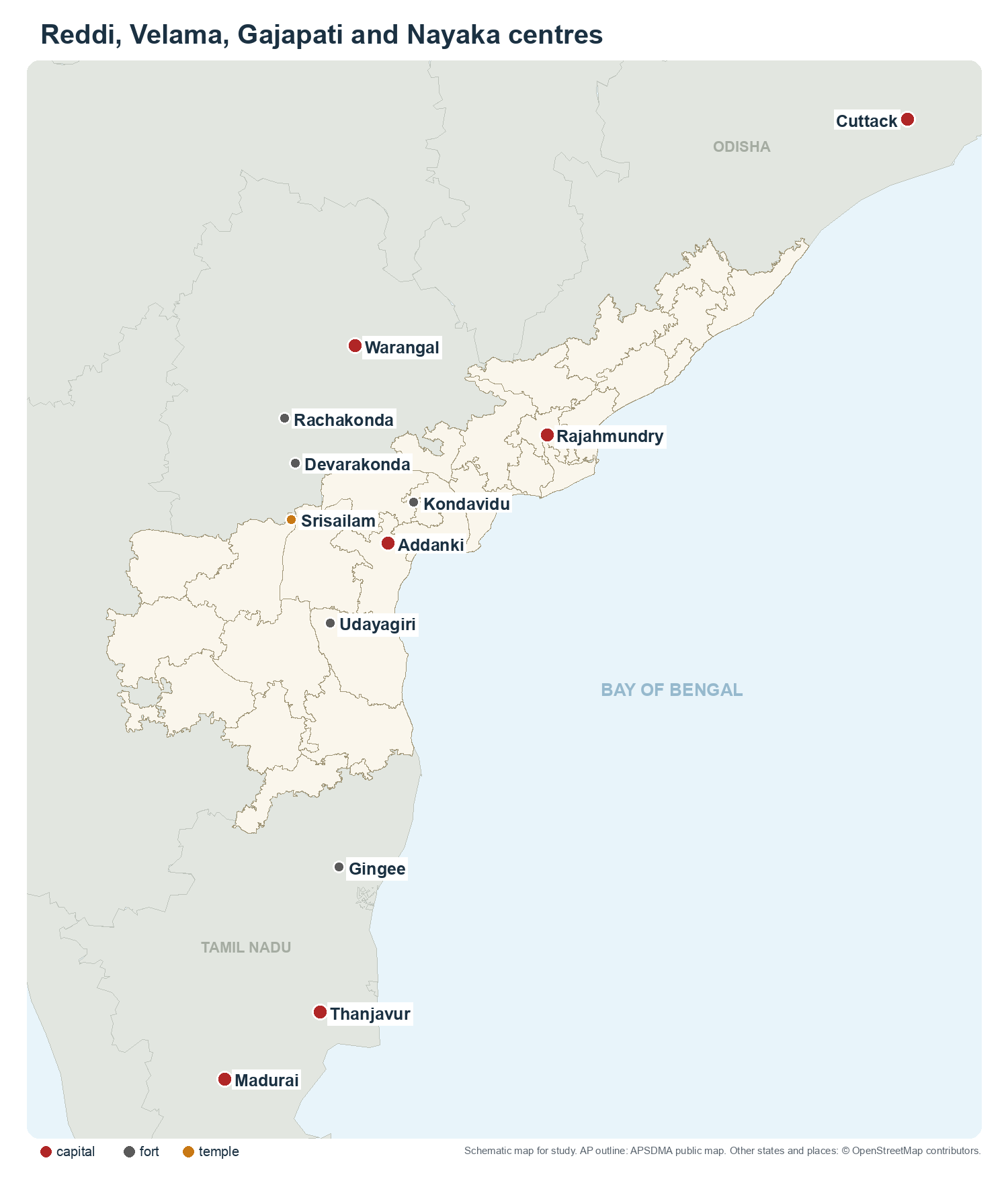
The Musunuris freed Warangal in 1336. Krishnadevaraya of Vijayanagara later captured Udayagiri (1514) and Kondavidu (1515). These two dates are linked to the end of Gajapati power in Andhra.
2. The Reddi kingdom (1325)
The Reddi kingdom was established in 1325. Its first king was Prolaya Vema Reddy. He is also credited as the builder of Kondavidu Fort (Palnadu district since 2022) and Kondapalli Fort (NTR district).
| Feature | Detail |
|---|---|
| Founder | Prolaya Vema Reddy |
| First capital | Addanki (Prakasam district) |
| Second capital | Kondavidu (Palnadu district) |
| Third centre (branch line, from c. 1395) | Rajahmundry (East Godavari district) |
Order of early kings. Prolaya Vema Reddy was followed by Anavota Reddy. Anavota was followed by Anavema Reddy. Anavema was followed by Kumaragiri Reddy. Other Reddi rulers are Kataya Vema Reddy, Peda Komati Vema Reddy and Racha Vema Reddy. Peda Komati Vema Reddy was followed by Racha Vema Reddy.
Kumaragiri Reddy had the title Vasantaraya. The work *Vasantarajiyam* is linked to him.
Rajahmundry is also linked to Nannaya, the first poet of Telugu literature.
3. Recherla Velamas and Musunuri Nayakas
| Dynasty | Founder | Capital(s) | Notable names |
|---|---|---|---|
| Recherla Velama | Recherla Singama Nayaka | Rachakonda; later Devarakonda | Anapota Nayaka, Sarvajna Singabhupala |
| Musunuri Nayaka | Musunuri Prolaya Nayaka | Warangal | Musunuri Kapaya Nayaka |
- Rachakonda Fort is in Telangana. Devarakonda Fort is in Nalgonda district.
- Sarvajna Singabhupala wrote *Rasarnavasudhakaram*. It deals with the theory of rasa and drama (natya).
- Musunuri Prolaya Nayaka was the first Musunuri Nayaka king. The Musunuris freed Warangal in 1336, after the Kakatiya collapse of 1323.
- Warangal Fort is in Warangal district. It is linked in this list with the Kakatiyas.
4. The Gajapatis of Odisha
The Suryavamsi Gajapati dynasty began in 1435. Its capital was Cuttack. Kapilendra Gajapati was the first Gajapati king of Odisha.
| Order | King |
|---|---|
| 1 | Kapilendra Gajapati (founder) |
| 2 | Purushottama Deva |
| 3 | Prataparudra Deva |
The Jagannath Temple at Puri is in the Gajapati homeland. Its deity is Jagannath. Krishnadevaraya took Udayagiri (Nellore district) in 1514 and Kondavidu in 1515. Those wars pushed the Gajapatis out of the Telugu coast.
5. The Nayakas of the south
After the Vijayanagara period, governors called Nayakas became independent in Tamil and Karnataka regions. Four houses are.
| Dynasty | Founder | Capital | Established |
|---|---|---|---|
| Madurai Nayak | Viswanatha Nayaka | Madurai | 1529 |
| Thanjavur Nayak | Sevappa Nayaka | Thanjavur | 1532 |
| Keladi Nayak | Chaudappa Nayaka | Ikkeri (Shivamogga district) | 1499 |
| Gingee Nayak | Tubaki Krishnappa Nayaka | Gingee (Villupuram district) | not given |
Madurai. Viswanatha Nayaka was the first Nayaka king of Madurai. His successor was Kumara Krishnappa Nayaka. Later Madurai rulers include Thirumala Nayaka and Rani Mangammal. Thirumala Nayaka built the Thirumalai Nayak Mahal and the Pudu Mandapam at Madurai. The gopurams of the Meenakshi Temple (deity Meenakshi) are credited to the Madurai Nayaks.
Thanjavur. Sevappa Nayaka was the first Nayaka king of Thanjavur. The line runs Sevappa, Achyutappa, Raghunatha Nayaka, Vijayaraghava Nayaka. The Saraswathi Mahal Library is at Thanjavur. The poet Ramabhadramba wrote *Raghunathabhyudayam*, which deals with the rule of Raghunatha Nayaka.
6. Telugu literature of the age
This was a golden period for Telugu poetry. Learn the author, the work, and the subject together.
| Poet | Title | Works |
|---|---|---|
| Nannaya | Adikavi | Andhra Mahabharatam (Kurukshetra war) |
| Tikkana | Ubhaya Kavi Mitrudu | Nirvachanottara Ramayanam (Uttara Kanda of the Ramayana) |
| Errana | Prabandha Parameswara | Harivamsam (life of Krishna), Nrisimha Puranam |
| Srinatha | Kavi Sarvabhauma | Kasikhandam, Bhimakhandam, Sringara Naishadham, Haravilasam, Palnati Veera Charitra |
| Potana | Sahaja Pandita | Andhra Maha Bhagavatam (avatars of Vishnu), Veerabhadra Vijayam, Bhogini Dandakam |
| Vemana | Yogi Vemana | Vemana Satakam |
Subjects of the works.
- *Kasikhandam* is the sthalapurana (local sacred history) of Kasi.
- *Bhimakhandam* is the sthalapurana of Draksharamam.
- *Palnati Veera Charitra* deals with the heroes of the Palnadu war.
- *Sringara Naishadham* tells the story of Nala and Damayanti.
- *Veerabhadra Vijayam* deals with the Daksha Yajna.
- *Bhogini Dandakam* deals with the courtesan Bhogini.
7. Temples and places to link
| Temple | Deity | District or place |
|---|---|---|
| Srisailam | Mallikarjuna | Nandyal district |
| Draksharamam | Bhimeswara | Dr. B.R. Ambedkar Konaseema district |
| Ahobilam | Narasimha | Andhra Pradesh |
| Tirumala | Venkateswara | Tirupati area |
| Simhachalam | Varaha Lakshmi Narasimha | Visakhapatnam area |
| Bhadrachalam | Rama | Telangana |
| Lepakshi | Veerabhadra | Sri Sathya Sai district |
| Ramappa | Ramalingeswara | Telangana |
Forts to place on the map: Udayagiri (Nellore), Chandragiri (Tirupati), Gooty (Anantapur), Penukonda (Sri Sathya Sai), Gandikota (Kadapa).
Exam traps
- 1. Addanki, Kondavidu, Rajahmundry are the three Reddi capitals. Do not give Rachakonda to the Reddis. Rachakonda belongs to the Recherla Velamas.
- 2. Reddi 1325, Gajapati 1435, Madurai Nayak 1529, Thanjavur Nayak 1532, Keladi 1499. Keep these five dates separate.
- 3. Musunuri 1336 is the freeing of Warangal. 1323 is the fall of Prataparudra II. They are different events.
- 4. Srinatha is Kavi Sarvabhauma. Errana is Prabandha Parameswara. Tikkana is Ubhaya Kavi Mitrudu. Do not swap titles.
- 5. Srinatha wrote *Kasikhandam* and *Bhimakhandam*. Potana wrote *Andhra Maha Bhagavatam*.
- 6. Kumaragiri Reddy is Vasantaraya. Vemana is Yogi Vemana.
- 7. Gajapati capital Cuttack is in Odisha. Kapilendra is the first Gajapati king of Odisha, not of Andhra.
- 8. Madurai and Thanjavur Nayakas have different founders: Viswanatha and Sevappa.
One-liners
- 1. The Reddi kingdom was founded in 1325 by Prolaya Vema Reddy.
- 2. Kondavidu Fort is in Palnadu district; Kondapalli Fort is in NTR district.
- 3. Recherla Singama Nayaka founded the Recherla Velama dynasty at Rachakonda.
- 4. Musunuri Kapaya Nayaka liberated Warangal in 1336.
- 5. Kapilendra Gajapati founded the Suryavamsi Gajapati dynasty in 1435.
- 6. Krishnadevaraya captured Udayagiri in 1514 and Kondavidu in 1515.
- 7. Nannaya is the Adikavi and the first poet of Telugu literature.
- 8. Sarvajna Singabhupala wrote *Rasarnavasudhakaram*.
- 9. Thirumala Nayaka built the Thirumalai Nayak Mahal and Pudu Mandapam at Madurai.
- 10. Ramabhadramba wrote *Raghunathabhyudayam* on Raghunatha Nayaka of Thanjavur.
Background and context
When the Kakatiya capital fell in 1323, the Telugu country lost its single centre. For about two centuries after that, no one house ruled all of it. Instead, a number of regional powers rose and fell. Some were local war leaders who had grown strong under the Kakatiyas. Some came from outside, such as the kings of Odisha. Some began as governors of a far larger empire and later became kings in their own right.
Three forces shaped this age. The first was the pressure of the Delhi Sultanate and, later, the Deccan Sultanates. The second was the rise of Vijayanagara in the south, which became the great Hindu power of the age. The third was the energy of Telugu writing, which found rich patrons in the new courts. The Musunuri Nayaks, who freed Warangal in 1336, are told in the previous chapter. Here we study them only in comparison with the other houses.
Offices and holders
This chapter is a list of houses, so it is easier to study each one by a fixed set of questions: who founded it, where was its capital, what was its main work, and how did it end.
The Reddis of Addanki and Kondavidu.
Prolaya Vema Reddy began this kingdom about 1325, and it lasted into the middle of the next century; one scholarly account gives 1325 to 1448. Its heartland was coastal and central Andhra. Addanki was the first capital, and Anavota Reddy is credited with shifting it to the hill fort of Kondavidu. From about 1395 a related branch of the family ruled a third centre, Rajahmundry.
The main names are given in the table. Dates are those found in the sources; where sources differ, a range is shown.
| King | Remark |
|---|---|
| Prolaya Vema Reddy | Founder, c. 1325; title Apratima-Bhudana-Parasurama; repaired Srisailam temple |
| Anavota Reddy | Strengthened the kingdom; Kondavidu becomes the centre |
| Anavema Reddy | Ruled c. 1364-1386 |
| Kumaragiri Reddy | Ruled c. 1386-1402; title Vasantaraya; expanded northward as far as Simhachalam |
| Kataya Vema Reddy | Ruled c. 1395-1414; linked with the Rajahmundry branch |
| Peda Komati Vema Reddy and Racha Vema Reddy | Later kings of Kondavidu |
| Veera Bhadra Reddy | Last ruler, c. 1423-1448 |
Prolaya Vema Reddy is also credited with building or improving Kondavidu Fort, and Kondapalli Fort is linked with the Reddis too.
The Recherla Velamas. Their founder was Recherla Singama Nayaka. The family had served the Kakatiyas, and the Recherla chief Rudra of the Kakatiya age built Ramappa. After the Musunuris, the Recherla chiefs became the strong power in the Telangana area, with Rachakonda as their main capital and Devarakonda as a second. One Musunuri leader, Kapaya Nayaka, is reported to have been killed by the Recherla chiefs in 1368, and this opened the way to their rule. Names to know are Anapota Nayaka and Sarvajna Singabhupala. Singabhupala was a king and also a writer. His book Rasarnavasudhakaram is on rasa and drama.
The Musunuri Nayaks. The founder, Prolaya Nayaka, started the movement. Kapaya Nayaka freed Warangal in 1336, and from then Warangal was their capital (Prolaya had worked from Rekapalle). They ended in 1368, as the previous chapter explains. To avoid mistakes, remember the two "Prolaya" names: Prolaya Vema Reddy (Reddi) and Prolaya Nayaka (Musunuri). The Recherla founder is Singama Nayaka, a different name.
The Gajapatis of Odisha. The Suryavamsi Gajapati line began about 1435, though one source gives 1434. Its founder was Kapilendra, and its capital was Cuttack. Kapilendra is the first Gajapati king of Odisha, not of Andhra. The kings in order are Kapilendra, Purushottama Deva and Prataparudra Deva. The dynasty ended in the 1540s. Its homeland held the great temple of Jagannath at Puri, which the kings enlarged.
The Nayakas of the south. After the great defeat of Vijayanagara in 1565, its governors in the south, most already in office for decades, became fully independent kings. The main houses, with the dates and capitals commonly given, are:
| House | Founder | Capital | Date given |
|---|---|---|---|
| Madurai Nayaks | Viswanatha Nayaka | Madurai | c. 1529 |
| Thanjavur Nayaks | Sevappa Nayaka | Thanjavur | 1532 |
| Keladi Nayaks | Chaudappa Nayaka | Keladi, later Ikkeri | 1499 |
| Gingee Nayaks | Tubaki Krishnappa Nayaka | Gingee | not fixed |
Learn the Keladi and Thanjavur years as fixed exam dates, and the Madurai year as c. 1529.
Political history
The Reddi age. After the fall of Warangal, the coast had no ruler strong enough to hold the Telugu country. Prolaya Vema Reddy filled this gap. He built his power on service to local people. He gave land, repaired temples and made trade safe. His kingdom grew along the coast, and the port of Motupalli kept bringing money in. Taxes were set at about one-sixth of the farm produce, and the law followed the old Sanskrit rule books.
The kingdom was strong in the days of Anavema and Kumaragiri, when the Reddis pushed north towards Simhachalam. But in the late 1300s it also began to split into branches. A branch at Rajahmundry became a second court. Conflicts between the branches made the whole family weaker.
Vijayanagara and the Reddis. Vijayanagara was growing in the south during these years. It took Kondavidu in 1424 from the Reddi king, according to one account. The branch at Rajahmundry stayed free for a few more years. It was taken about 1449 by the Gajapatis. So the Reddi house ended in two stages: the main line under Vijayanagara, then the Rajahmundry line under the Gajapatis.
The Gajapati push. From Odisha, Kapilendra and his son Hamvira moved south in the 1450s and 1460s. They took the Reddi kingdom of Rajahmundry and the Vijayanagara province of Kondavidu. One gazetteer says that a Gajapati king after Kapilendra took many hill forts from Cuttack down to Udayagiri, held Addanki and Kondavidu, and kept control of the coast for decades. Kapilendra's death is placed in 1467 by one account and 1470 by another. After that, his sons fought over the throne, and Purushottama came out as the strongest. Prataparudra Deva, the third king, ruled when Vijayanagara returned in strength.
Krishnadevaraya's counter-attack. The great Vijayanagara king Krishnadevaraya marched north and took Udayagiri in 1514 and Kondavidu in 1515. He then invaded Rajahmundry, and a peace followed in which marriage ties were used to settle the border. These dates close Gajapati power in the Telugu country. The Gajapati rule in Odisha itself ended in 1541.
The southern Nayakas. The Nayaka governor was a feature of Vijayanagara government. A commander received a district to rule and was bound to supply soldiers and a share of revenue. When Vijayanagara was broken at Talikota in 1565 by the Deccan sultans, many such governors became kings. The Madurai house began as governors of Vijayanagara and dates itself to about 1529. Thanjavur, Gingee and Keladi followed similar paths. Many of these rulers were Telugu-speaking families who governed in Tamil or Kannada lands.
Administration and economy
Reddi government. The Reddi king had large tracts of land and fort-based chiefs under him. The one-sixth share of farm produce was the main tax. The state also gained from ports on the coast. Motupalli carried both goods and people. Temples such as Srisailam, repaired by the founder, were also centres of wealth and learning.
Fort systems. Hill forts were the heart of the age. Kondavidu, Kondapalli, Rachakonda, Devarakonda, Udayagiri, Chandragiri, Gooty, Penukonda and Gandikota are the fort names the exam lists. A fort controlled the roads, held grain and treasure, and acted as a base for the army. Whoever held the fort held the area. This is why the wars of this age were often wars to take a fort, such as Krishnadevaraya's attack on Udayagiri and Kondavidu.
Nayaka local government. Madurai Nayak power in the south rested on palayams, many small estates held by hereditary chiefs in return for military service and tribute. That gave the Nayaks a strong army, yet it also made the local chiefs hard to control. The Madurai kings were builders too. They repaired and extended the Meenakshi temple, and Thirumala Nayaka, the best-known king, added the Thirumalai Nayak Mahal (about 1636) and the Pudu Mandapam. At the end of the 1600s Rani Mangammal ruled as regent for her young grandson. The dynasty ended in 1736. The Thanjavur house gave the Saraswathi Mahal Library its early base.
Society, religion and culture
Telugu poetry. This was a golden age for Telugu writing. The Reddi kings and their ministers gave poets money and honour, and the poets in turn wrote works that are still read. Srinatha worked at the court of the Reddi kings, in the post of head of learning at the court of Peda Komati Vema Reddy and later in the court of Veera Bhadra Reddy, according to a temple study. Errana also belongs to the same Reddi world.
| Poet | Title | Main works |
|---|---|---|
| Nannaya | Adikavi | Andhra Mahabharatam (the first part) |
| Tikkana | Ubhaya Kavi Mitrudu | Nirvachanottara Ramayanam |
| Errana | Prabandha Parameswara | Harivamsam, Nrisimha Puranam |
| Srinatha | Kavi Sarvabhauma | Kasikhandam, Bhimakhandam, Sringara Naishadham, Haravilasam, Palnati Veera Charitra |
| Potana | Sahaja Pandita | Andhra Maha Bhagavatam, Veerabhadra Vijayam, Bhogini Dandakam |
| Vemana | Yogi Vemana | Vemana Satakam |
The subject of a work helps you remember the writer. Kasikhandam and Bhimakhandam are place-histories of Kasi and Draksharamam. Sringara Naishadham is the story of Nala and Damayanti. Palnati Veera Charitra is about the heroes of the Palnadu war. Andhra Maha Bhagavatam tells of the avatars of Vishnu. Veerabhadra Vijayam deals with the Daksha sacrifice. Harivamsam is about Krishna. Raghunathabhyudayam, by the woman poet Ramabhadramba, tells of Raghunatha Nayaka of Thanjavur. Nannaya is linked with Rajahmundry, and Kumaragiri Reddy's title Vasantaraya is linked with the work Vasantarajiyam. Vemana's short verses are known to the common reader.
Religion. All these courts were patrons of temples. The Reddis improved Srisailam. The Gajapatis looked after Jagannath at Puri and followed the Vaishnava tradition. The Madurai Nayaks rebuilt the Meenakshi temple with wide courtyards, pillared halls and tall gateway towers.
Shared learning. Poets in Telugu, Tamil and Sanskrit all gained support from the Nayaka houses, and the Telugu language went with the rulers far into the south.
Decline, legacy and sites to know
The Reddis fell to Vijayanagara and the Gajapatis. The Gajapatis fell to Vijayanagara and to Golconda. The southern Nayaks lasted longer, but each was finally taken over by stronger powers. What remained was a landscape of forts, temples and books.
| Place | What to remember |
|---|---|
| Addanki | First Reddi capital |
| Kondavidu | Reddi hill fort; taken in 1515 by Krishnadevaraya |
| Rajahmundry | Third Reddi centre; linked with Nannaya |
| Rachakonda and Devarakonda | Recherla Velama forts |
| Cuttack | Gajapati capital |
| Udayagiri | Taken by Krishnadevaraya in 1514 |
| Simhachalam | Temple deity Varaha Lakshmi Narasimha; honoured in Srinatha's day |
| Srisailam | Mallikarjuna temple; Reddi repairs |
| Madurai | Meenakshi temple; Thirumalai Nayak Mahal; Pudu Mandapam |
| Thanjavur | Saraswathi Mahal Library; Brihadeeswara Temple |
| Ikkeri | Keladi Nayak capital |
| Gingee | Seat of the Gingee Nayaks |
How examiners use this chapter
- Founders and capitals. Reddi: Prolaya Vema Reddy at Addanki, then Kondavidu, with a branch court at Rajahmundry. Recherla Velama: Singama Nayaka at Rachakonda. Musunuri: Prolaya Nayaka as founder, Warangal as capital from 1336. Gajapati: Kapilendra at Cuttack. Rachakonda is never a Reddi capital.
- Date line. 1323 fall of Warangal; 1325 Reddi; 1336 Musunuri; 1435 Gajapati; 1499 Keladi; 1514 and 1515 Udayagiri and Kondavidu; 1529 Madurai; 1532 Thanjavur. Match each date to its dynasty.
- Southern founders. Viswanatha at Madurai, Sevappa at Thanjavur, Chaudappa at Ikkeri, Tubaki Krishnappa at Gingee.
- Titles. Srinatha is Kavi Sarvabhauma, Errana is Prabandha Parameswara, Tikkana is Ubhaya Kavi Mitrudu, Potana is Sahaja Pandita, Kumaragiri is Vasantaraya.
- Authors and works. Kasikhandam and Bhimakhandam go to Srinatha; Andhra Maha Bhagavatam to Potana; Rasarnavasudhakaram to Singabhupala; Raghunathabhyudayam to Ramabhadramba.
- Madurai links. Thirumala Nayaka, the Mahal, the Pudu Mandapam and Rani Mangammal all belong to the Madurai house.
- Wrong-dynasty traps. Kapilendra founded the Gajapati line of Odisha; he did not found an Andhra house. Krishnadevaraya belongs to Vijayanagara and not to the Reddis or Nayaks.
Worked cases
Case 1: Match the dynasty with its founder. (A) Madurai Nayak (B) Thanjavur Nayak (C) Keladi Nayak (D) Recherla Velama. Founders: 1 Sevappa Nayaka, 2 Chaudappa Nayaka, 3 Viswanatha Nayaka, 4 Recherla Singama Nayaka.
Reasoning:
- 1. Singama Nayaka founded the Recherla Velama dynasty, with capital Rachakonda. So D matches 4.
- 2. Viswanatha Nayaka was the first Nayaka king of Madurai. So A matches 3.
- 3. Sevappa Nayaka was the first Nayaka king of Thanjavur. So B matches 1.
- 4. Chaudappa Nayaka is left for Keladi, whose capital was Ikkeri. So C matches 2.
Takeaway: Several founders carry the title "Nayaka". Tie each one to a capital to keep them apart.
Case 2: Arrange by year of founding: Thanjavur Nayak, Reddi kingdom, Keladi Nayak, Suryavamsi Gajapati, Madurai Nayak.
Reasoning:
- 1. The Reddi kingdom began in 1325.
- 2. The Suryavamsi Gajapati dynasty began in 1435.
- 3. Keladi Nayak rule began in 1499.
- 4. Madurai Nayak rule began in 1529 and Thanjavur Nayak rule in 1532.
Takeaway: Order is Reddi, Gajapati, Keladi, Madurai, Thanjavur. Learn the five dates as one rising line.
Case 3: "Which one is NOT a capital of the Reddi kings?" (1) Addanki (2) Kondavidu (3) Rajahmundry (4) Rachakonda.
Reasoning:
- 1. Addanki was the first Reddi capital.
- 2. Kondavidu was the second.
- 3. Rajahmundry was the third.
- 4. Rachakonda belongs to the Recherla Velamas, a different dynasty.
Takeaway: If a place belongs to a rival dynasty, it is the wrong option.
Case 4: Match the poet with the work. (A) Srinatha (B) Potana (C) Errana (D) Ramabhadramba. Works: 1 Harivamsam, 2 Raghunathabhyudayam, 3 Bhimakhandam, 4 Andhra Maha Bhagavatam.
Reasoning:
- 1. Bhimakhandam is the sthalapurana of Draksharamam. Srinatha wrote it. So A matches 3.
- 2. Andhra Maha Bhagavatam deals with the avatars of Vishnu. Potana wrote it. So B matches 4.
- 3. Harivamsam deals with the life of Krishna. Errana wrote it. So C matches 1.
- 4. Raghunathabhyudayam deals with the rule of Raghunatha Nayaka. Ramabhadramba wrote it. So D matches 2.
Takeaway: The subject of a work often tells you the author.
Compare and contrast
| Look-alike pair | Detail A | Detail B |
|---|---|---|
| Madurai and Thanjavur Nayaks | Founder Viswanatha Nayaka; capital Madurai; 1529 | Founder Sevappa Nayaka; capital Thanjavur; 1532 |
| Keladi and Gingee Nayaks | Founder Chaudappa Nayaka; capital Ikkeri; 1499 | Founder Tubaki Krishnappa Nayaka; capital Gingee |
| Recherla Velamas and Musunuris | Founder Singama Nayaka; Rachakonda, later Devarakonda | Founder Prolaya Nayaka; Warangal |
| Fall of Kakatiyas and Musunuri success | 1323: Prataparudra II falls to Delhi | 1336: Warangal freed |
| Poet | Title |
|---|---|
| Nannaya | Adikavi |
| Tikkana | Ubhaya Kavi Mitrudu |
| Errana | Prabandha Parameswara |
| Srinatha | Kavi Sarvabhauma |
| Potana | Sahaja Pandita |
| Vemana | Yogi Vemana |
| Kumaragiri Reddy | Vasantaraya |
Memory tip for these pairs. Many names here end in "Nayaka" and many start with "Prolaya". Slow down and read the full name. Prolaya Vema Reddy is the Reddi founder. Musunuri Prolaya Nayaka is the Musunuri founder. Recherla Singama Nayaka is the Recherla Velama founder. Link each founder with his capital: Addanki, Warangal and Rachakonda. For the south, link Madurai with Viswanatha, Thanjavur with Sevappa, Ikkeri with Chaudappa and Gingee with Tubaki Krishnappa. Poet titles are easier if you say them aloud with the poet name three times.
Sequence and timeline
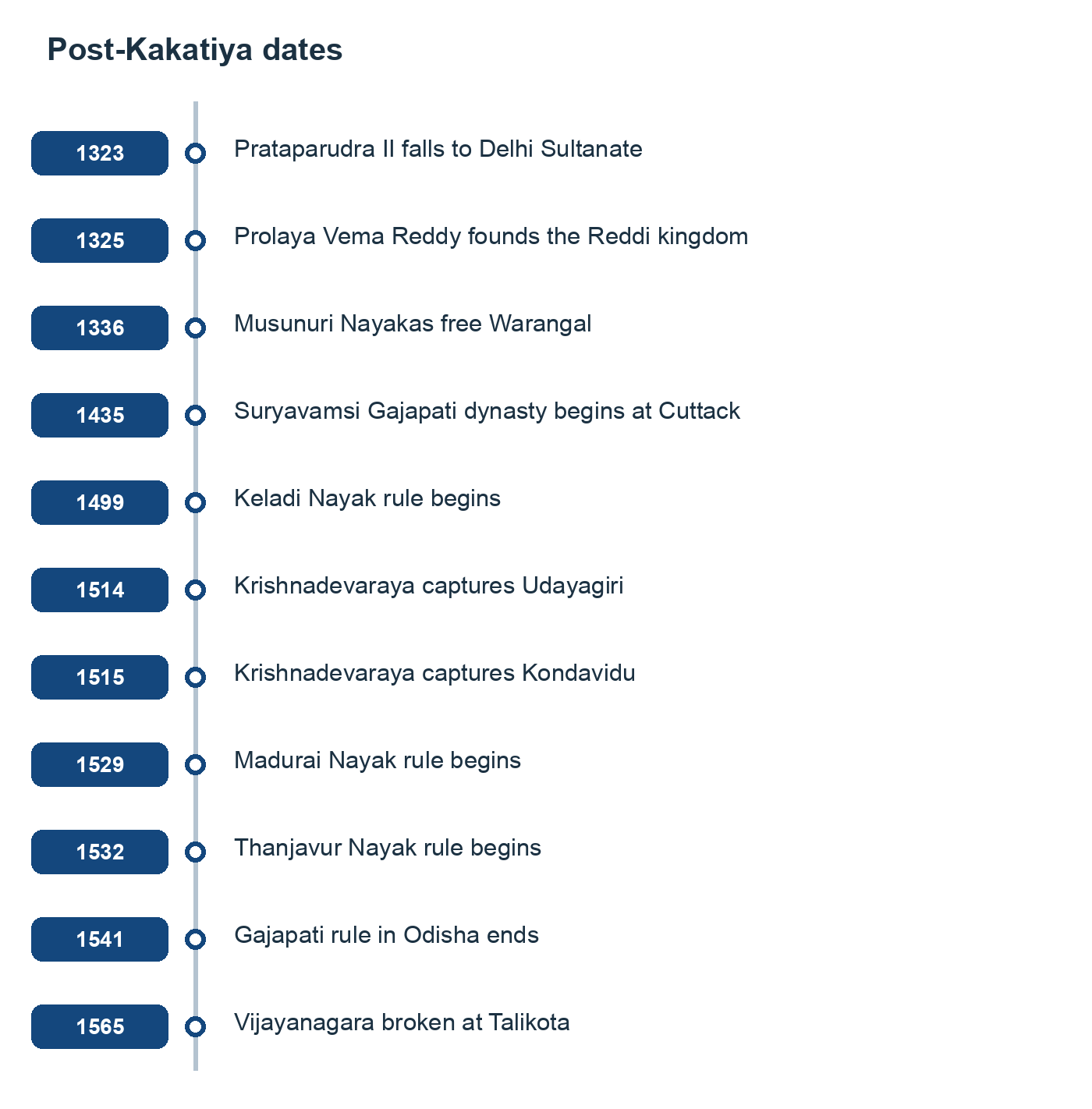
| Year | Event |
|---|---|
| 1323 | Prataparudra II falls to the Delhi Sultanate |
| 1325 | Reddi kingdom established by Prolaya Vema Reddy |
| 1336 | Musunuri Nayakas free Warangal |
| 1435 | Suryavamsi Gajapati dynasty begins at Cuttack |
| 1499 | Keladi Nayak rule begins |
| 1514 | Krishnadevaraya captures Udayagiri |
| 1515 | Krishnadevaraya captures Kondavidu |
| 1529 | Madurai Nayak rule begins |
| 1532 | Thanjavur Nayak rule begins |
Order of Gajapati kings: Kapilendra, Purushottama Deva, Prataparudra Deva.
Order of Thanjavur Nayakas: Sevappa, Achyutappa, Raghunatha, Vijayaraghava.
How to use this timeline in the exam. Group the dates in three bands. The first band is 1323 to 1336, the years of the Kakatiya fall, the Reddi start and the Musunuri success. The second band is 1435 to 1499, with the Gajapatis and Keladi. The third band is 1514 to 1532, with the capture of Udayagiri and Kondavidu and the start of the Madurai and Thanjavur Nayaks.
Also keep the three Reddi capitals in order: Addanki, Kondavidu, Rajahmundry. The early Reddi kings run as Prolaya Vema Reddy, Anavota Reddy, Anavema Reddy and Kumaragiri Reddy. If a question asks who founded the Reddi kingdom, the answer is the first name in this list.
More one-liners
- 1. Kanaka Durga Temple has the deity Kanaka Durga.
- 2. Annavaram Temple has the deity Satyanarayana.
- 3. Kalahasti Temple has the deity Kalahastiswara.
- 4. Mahanandi Temple has the deity Mahanandeeswara.
- 5. Brihadeeswara Temple has the deity Shiva.
- 6. Rani Mangammal belonged to the Madurai Nayak dynasty.
- 7. Anapota Nayaka belonged to the Recherla Velama dynasty.
- 8. Kataya Vema Reddy belonged to the Reddi dynasty.
Practice questions
Palnati Veera Charitra deals with which of the following?
- Daksha Yajna
- Uttara Kanda of Ramayana
- Palnadu war heroes
- Avatars of Vishnu
Answer
C. Palnadu war heroes
పల్నాటి వీర చరిత్ర దేనికి సంబంధించినది?
- దక్షయజ్ఞం
- రామాయణంలోని ఉత్తరకాండ
- పల్నాడు యుద్ధ వీరులు
- విష్ణు అవతారాలు
Nirvachanottara Ramayanam deals with which of the following?
- Story of Nala and Damayanti
- Courtesan Bhogini
- Sthalapurana of Draksharamam
- Uttara Kanda of Ramayana
Answer
D. Uttara Kanda of Ramayana
నిర్వచనోత్తర రామాయణం దేనికి సంబంధించినది?
- నల దమయంతుల కథ
- భోగిని
- ద్రాక్షారామ స్థల పురాణం
- రామాయణంలోని ఉత్తరకాండ
Sringara Naishadham deals with which of the following?
- Sthalapurana of Draksharamam
- Uttara Kanda of Ramayana
- Avatars of Vishnu
- Story of Nala and Damayanti
Answer
D. Story of Nala and Damayanti
శృంగార నైషధం దేనికి సంబంధించినది?
- ద్రాక్షారామ స్థల పురాణం
- రామాయణంలోని ఉత్తరకాండ
- విష్ణు అవతారాలు
- నల దమయంతుల కథ
Which provision deals with Palnadu war heroes?
- Palnati Veera Charitra
- Sringara Naishadham
- Bhimakhandam
- Veerabhadra Vijayam
Answer
A. Palnati Veera Charitra
పల్నాడు యుద్ధ వీరులు గురించి తెలిపే నిబంధన ఏది?
- పల్నాటి వీర చరిత్ర
- శృంగార నైషధం
- భీమఖండం
- వీరభద్ర విజయం
Which provision deals with Avatars of Vishnu?
- Andhra Maha Bhagavatam
- Palnati Veera Charitra
- Harivamsam
- Veerabhadra Vijayam
Answer
A. Andhra Maha Bhagavatam
విష్ణు అవతారాలు గురించి తెలిపే నిబంధన ఏది?
- ఆంధ్ర మహాభాగవతం
- పల్నాటి వీర చరిత్ర
- హరివంశం
- వీరభద్ర విజయం
Andhra Mahabharatam deals with which of the following?
- Palnadu war heroes
- Uttara Kanda of Ramayana
- Rasa and Natya theory
- Kurukshetra war
Answer
D. Kurukshetra war
ఆంధ్ర మహాభారతం దేనికి సంబంధించినది?
- పల్నాడు యుద్ధ వీరులు
- రామాయణంలోని ఉత్తరకాండ
- రస నాట్య శాస్త్రం
- కురుక్షేత్ర యుద్ధం
The flight of steps (sopanas) to the Srisailam temple was built by Anavema Reddy of which dynasty?
- Reddy kings
- Kakatiyas
- Musunuri Nayaks
- Recherla Nayaks
Answer
A. Reddy kings
Reddy kings patronised Srisailam.
శ్రీశైల దేవాలయానికి సోపానాలు నిర్మించిన అనవేమారెడ్డి ఏ వంశానికి చెందినవాడు?
- రెడ్డి రాజులు
- కాకతీయులు
- ముసునూరి నాయకులు
- రేచర్ల నాయకులు
Rekapalli on the Godavari served as a capital of which dynasty?
- Recherla Velamas
- Kakatiyas
- Reddi kings
- Musunuri Nayakas
Answer
D. Musunuri Nayakas
Rekapalli was a seat of the Musunuri Nayakas.
గోదావరి తీరంలోని రేకపల్లి ఏ రాజవంశానికి రాజధానిగా ఉండేది?
- రేచర్ల వెలమలు
- కాకతీయులు
- రెడ్డి రాజులు
- ముసునూరి నాయకులు
Who is regarded as the Adikavi of Telugu literature and began the Andhra Mahabharatam?
- Nannaya
- Tikkana
- Errana
- Srinatha
Answer
A. Nannaya
Nannaya began the Telugu Mahabharata and is honoured as the first poet.
తెలుగు సాహిత్యంలో ఆదికవిగా ప్రసిద్ధుడై, ఆంధ్ర మహాభారత రచనను ప్రారంభించినవారు ఎవరు?
- నన్నయ
- తిక్కన
- ఎర్రన
- శ్రీనాథుడు
Who was the founder of Madurai Nayak dynasty?
- Viswanatha Nayaka
- Chaudappa Nayaka
- Sevappa Nayaka
- Tubaki Krishnappa Nayaka
Answer
A. Viswanatha Nayaka
మదురై నాయక వంశం స్థాపకుడు ఎవరు?
- విశ్వనాథ నాయకుడు
- చౌడప్ప నాయకుడు
- సేవప్ప నాయకుడు
- తుబాకి కృష్ణప్ప నాయకుడు
Who was the founder of Thanjavur Nayak dynasty?
- Tubaki Krishnappa Nayaka
- Sevappa Nayaka
- Viswanatha Nayaka
- Chaudappa Nayaka
Answer
B. Sevappa Nayaka
తంజావూరు నాయక వంశం స్థాపకుడు ఎవరు?
- తుబాకి కృష్ణప్ప నాయకుడు
- సేవప్ప నాయకుడు
- విశ్వనాథ నాయకుడు
- చౌడప్ప నాయకుడు
Who was the founder of Keladi Nayak dynasty?
- Tubaki Krishnappa Nayaka
- Chaudappa Nayaka
- Viswanatha Nayaka
- Sevappa Nayaka
Answer
B. Chaudappa Nayaka
కేళడి నాయక వంశం స్థాపకుడు ఎవరు?
- తుబాకి కృష్ణప్ప నాయకుడు
- చౌడప్ప నాయకుడు
- విశ్వనాథ నాయకుడు
- సేవప్ప నాయకుడు
Who was the founder of Gingee Nayak dynasty?
- Tubaki Krishnappa Nayaka
- Sevappa Nayaka
- Chaudappa Nayaka
- Viswanatha Nayaka
Answer
A. Tubaki Krishnappa Nayaka
జింజి నాయక వంశం స్థాపకుడు ఎవరు?
- తుబాకి కృష్ణప్ప నాయకుడు
- సేవప్ప నాయకుడు
- చౌడప్ప నాయకుడు
- విశ్వనాథ నాయకుడు
Tubaki Krishnappa Nayaka was the founder of which of the following?
- Thanjavur Nayak dynasty
- Madurai Nayak dynasty
- Keladi Nayak dynasty
- Gingee Nayak dynasty
Answer
D. Gingee Nayak dynasty
తుబాకి కృష్ణప్ప నాయకుడు ఈ క్రింది వాటిలో దేనికి స్థాపకుడు?
- తంజావూరు నాయక వంశం
- మదురై నాయక వంశం
- కేళడి నాయక వంశం
- జింజి నాయక వంశం
Which of the following is NOT correctly paired with Thanjavur Nayak dynasty (Item – Category)?
- Vijayaraghava Nayaka
- Anavota Reddy
- Raghunatha Nayaka
- Sevappa Nayaka
Answer
B. Anavota Reddy
ఈ క్రింది వాటిలో ఏది 'తంజావూరు నాయక వంశం' అనే అంశానికి సరిగ్గా జతకాదు? (అంశం – వర్గం)
- విజయరాఘవ నాయకుడు
- అనవోతారెడ్డి
- రఘునాథ నాయకుడు
- సేవప్ప నాయకుడు
Kasikhandam deals with which of the following?
- Rule of Raghunatha Nayaka
- Palnadu war heroes
- Sthalapurana of Kasi
- Uttara Kanda of Ramayana
Answer
C. Sthalapurana of Kasi
కాశీఖండం దేనికి సంబంధించినది?
- రఘునాథ నాయకుని పాలన
- పల్నాడు యుద్ధ వీరులు
- కాశీ స్థల పురాణం
- రామాయణంలోని ఉత్తరకాండ
Which provision deals with Sthalapurana of Draksharamam?
- Andhra Mahabharatam
- Nirvachanottara Ramayanam
- Bhimakhandam
- Bhogini Dandakam
Answer
C. Bhimakhandam
ద్రాక్షారామ స్థల పురాణం గురించి తెలిపే నిబంధన ఏది?
- ఆంధ్ర మహాభారతం
- నిర్వచనోత్తర రామాయణం
- భీమఖండం
- భోగిని దండకం
Andhra Maha Bhagavatam deals with which of the following?
- Sthalapurana of Draksharamam
- Sthalapurana of Kasi
- Uttara Kanda of Ramayana
- Avatars of Vishnu
Answer
D. Avatars of Vishnu
ఆంధ్ర మహాభాగవతం దేనికి సంబంధించినది?
- ద్రాక్షారామ స్థల పురాణం
- కాశీ స్థల పురాణం
- రామాయణంలోని ఉత్తరకాండ
- విష్ణు అవతారాలు
Veerabhadra Vijayam deals with which of the following?
- Sthalapurana of Kasi
- Life of Krishna
- Daksha Yajna
- Uttara Kanda of Ramayana
Answer
C. Daksha Yajna
వీరభద్ర విజయం దేనికి సంబంధించినది?
- కాశీ స్థల పురాణం
- శ్రీకృష్ణుని జీవితం
- దక్షయజ్ఞం
- రామాయణంలోని ఉత్తరకాండ
Which provision deals with Uttara Kanda of Ramayana?
- Nirvachanottara Ramayanam
- Andhra Mahabharatam
- Raghunathabhyudayam
- Bhimakhandam
Answer
A. Nirvachanottara Ramayanam
రామాయణంలోని ఉత్తరకాండ గురించి తెలిపే నిబంధన ఏది?
- నిర్వచనోత్తర రామాయణం
- ఆంధ్ర మహాభారతం
- రఘునాథాభ్యుదయం
- భీమఖండం
Which provision deals with Story of Nala and Damayanti?
- Sringara Naishadham
- Bhogini Dandakam
- Andhra Maha Bhagavatam
- Harivamsam
Answer
A. Sringara Naishadham
నల దమయంతుల కథ గురించి తెలిపే నిబంధన ఏది?
- శృంగార నైషధం
- భోగిని దండకం
- ఆంధ్ర మహాభాగవతం
- హరివంశం
Who founded the Reddy kingdom of coastal Andhra, first based at Addanki and later Kondaveedu?
- Anavota Reddy
- Kataya Vema Reddy
- Prolaya Vema Reddy
- Allada Reddy
Answer
C. Prolaya Vema Reddy
Prolaya Vema Reddy rose after the Kakatiya fall.
అద్దంకి, తరువాత కొండవీడు కేంద్రంగా కోస్తాంధ్రలో రెడ్డి రాజ్యాన్ని స్థాపించినవారు ఎవరు?
- అనవోతారెడ్డి
- కాటయ వేమారెడ్డి
- ప్రోలయ వేమారెడ్డి
- అల్లాడ రెడ్డి
Who founded the Musunuri Nayak line after the fall of the Kakatiyas?
- Kapilendra
- Recherla Singama Nayaka
- Musunuri Prolaya Nayaka
- Prolaya Vema Reddy
Answer
C. Musunuri Prolaya Nayaka
Prolaya Nayaka led the Telugu revolt against Delhi's rule.
కాకతీయుల పతనం తర్వాత ముసునూరి నాయక వంశాన్ని స్థాపించినవారు ఎవరు?
- కపిలేంద్రుడు
- రేచర్ల సింగమ నాయకుడు
- ముసునూరి ప్రోలయ నాయకుడు
- ప్రోలయ వేమారెడ్డి
Match the poet with the work: (1) Srinatha (2) Errana (3) Tikkana (4) Pothana (a) Harivamsam (b) Srungara Naishadham (c) Nirvachanottara Ramayanam (d) Andhra Maha Bhagavatam
- 1-b, 2-c, 3-a, 4-d
- 1-a, 2-b, 3-c, 4-d
- 1-d, 2-a, 3-c, 4-b
- 1-b, 2-a, 3-c, 4-d
Answer
D. 1-b, 2-a, 3-c, 4-d
Each poet is paired with his best-known work.
కవిని రచనతో జతచేయండి: (1) శ్రీనాథుడు (2) ఎర్రన (3) తిక్కన (4) పోతన (a) హరివంశం (b) శృంగార నైషధం (c) నిర్వచనోత్తర రామాయణం (d) ఆంధ్ర మహాభాగవతం
- 1-b, 2-c, 3-a, 4-d
- 1-a, 2-b, 3-c, 4-d
- 1-d, 2-a, 3-c, 4-b
- 1-b, 2-a, 3-c, 4-d
Viswanatha Nayaka was the founder of which of the following?
- Keladi Nayak dynasty
- Gingee Nayak dynasty
- Madurai Nayak dynasty
- Thanjavur Nayak dynasty
Answer
C. Madurai Nayak dynasty
విశ్వనాథ నాయకుడు ఈ క్రింది వాటిలో దేనికి స్థాపకుడు?
- కేళడి నాయక వంశం
- జింజి నాయక వంశం
- మదురై నాయక వంశం
- తంజావూరు నాయక వంశం
Sevappa Nayaka was the founder of which of the following?
- Thanjavur Nayak dynasty
- Madurai Nayak dynasty
- Gingee Nayak dynasty
- Keladi Nayak dynasty
Answer
A. Thanjavur Nayak dynasty
సేవప్ప నాయకుడు ఈ క్రింది వాటిలో దేనికి స్థాపకుడు?
- తంజావూరు నాయక వంశం
- మదురై నాయక వంశం
- జింజి నాయక వంశం
- కేళడి నాయక వంశం
Chaudappa Nayaka was the founder of which of the following?
- Madurai Nayak dynasty
- Gingee Nayak dynasty
- Thanjavur Nayak dynasty
- Keladi Nayak dynasty
Answer
D. Keladi Nayak dynasty
చౌడప్ప నాయకుడు ఈ క్రింది వాటిలో దేనికి స్థాపకుడు?
- మదురై నాయక వంశం
- జింజి నాయక వంశం
- తంజావూరు నాయక వంశం
- కేళడి నాయక వంశం
To which of the following does Kapilendra Gajapati belong?
- Madurai Nayak dynasty
- Chola dynasty
- Recherla Velama dynasty
- Suryavamsi Gajapati dynasty
Answer
D. Suryavamsi Gajapati dynasty
కపిలేంద్ర గజపతి ఈ క్రింది వాటిలో దేనికి చెందినది?
- మదురై నాయక వంశం
- చోళ వంశం
- రేచర్ల వెలమ వంశం
- సూర్యవంశ గజపతి వంశం
Which of the following is NOT correctly paired with Recherla Velama dynasty (Item – Category)?
- Sarvajna Singabhupala
- Anapota Nayaka
- Kirtivarman I
- Recherla Singama Nayaka
Answer
C. Kirtivarman I
ఈ క్రింది వాటిలో ఏది 'రేచర్ల వెలమ వంశం' అనే అంశానికి సరిగ్గా జతకాదు? (అంశం – వర్గం)
- సర్వజ్ఞ సింగభూపాలుడు
- అనపోత నాయకుడు
- మొదటి కీర్తివర్మ
- రేచర్ల సింగమ నాయకుడు
Who was the first Gajapati king of Odisha?
- Swami Ramanand Tirtha
- Chaudappa Nayaka
- Prolaya Vema Reddy
- Kapilendra Gajapati
Answer
D. Kapilendra Gajapati
ఒడిశా తొలి గజపతి రాజు ఎవరు?
- స్వామి రామానంద తీర్థ
- చౌడప్ప నాయకుడు
- ప్రోలయ వేమారెడ్డి
- కపిలేంద్ర గజపతి
Who was the first Nayaka king of Madurai?
- Chaudappa Nayaka
- Sevappa Nayaka
- Tubaki Krishnappa Nayaka
- Viswanatha Nayaka
Answer
D. Viswanatha Nayaka
మదురై తొలి నాయక రాజు ఎవరు?
- చౌడప్ప నాయకుడు
- సేవప్ప నాయకుడు
- తుబాకి కృష్ణప్ప నాయకుడు
- విశ్వనాథ నాయకుడు
Who was the first Nayaka king of Thanjavur?
- Chaudappa Nayaka
- Sevappa Nayaka
- Viswanatha Nayaka
- Tubaki Krishnappa Nayaka
Answer
B. Sevappa Nayaka
తంజావూరు తొలి నాయక రాజు ఎవరు?
- చౌడప్ప నాయకుడు
- సేవప్ప నాయకుడు
- విశ్వనాథ నాయకుడు
- తుబాకి కృష్ణప్ప నాయకుడు
Who was the first Nayaka king of Keladi?
- Viswanatha Nayaka
- Tubaki Krishnappa Nayaka
- Chaudappa Nayaka
- Sevappa Nayaka
Answer
C. Chaudappa Nayaka
కేళడి తొలి నాయక రాజు ఎవరు?
- విశ్వనాథ నాయకుడు
- తుబాకి కృష్ణప్ప నాయకుడు
- చౌడప్ప నాయకుడు
- సేవప్ప నాయకుడు
Who was the first Nayaka king of Gingee?
- Sevappa Nayaka
- Chaudappa Nayaka
- Tubaki Krishnappa Nayaka
- Viswanatha Nayaka
Answer
C. Tubaki Krishnappa Nayaka
జింజి తొలి నాయక రాజు ఎవరు?
- సేవప్ప నాయకుడు
- చౌడప్ప నాయకుడు
- తుబాకి కృష్ణప్ప నాయకుడు
- విశ్వనాథ నాయకుడు
Which of the following correctly describes Tubaki Krishnappa Nayaka?
- first Nayaka king of Gingee
- first Nayaka king of Keladi
- first Nayaka king of Thanjavur
- first Nayaka king of Madurai
Answer
A. first Nayaka king of Gingee
'తుబాకి కృష్ణప్ప నాయకుడు' గురించిన సరైన వివరణ ఈ క్రింది వాటిలో ఏది?
- జింజి తొలి నాయక రాజు
- కేళడి తొలి నాయక రాజు
- తంజావూరు తొలి నాయక రాజు
- మదురై తొలి నాయక రాజు
Which of the following is located in the Nellore district area?
- Thirumalai Nayak Mahal
- Penukonda Fort
- Udayagiri Fort
- Gingee Fort
Answer
C. Udayagiri Fort
ఈ క్రింది వాటిలో ఏది నెల్లూరు జిల్లా ప్రాంతంలో ఉంది?
- తిరుమలై నాయక్ మహల్
- పెనుకొండ కోట
- ఉదయగిరి కోట
- జింజి కోట
Which of the following is located in the Guntur district area?
- Penukonda Fort
- Thirumalai Nayak Mahal
- Kondavidu
- Gooty Fort
Answer
C. Kondavidu
ఈ క్రింది వాటిలో ఏది గుంటూరు జిల్లా ప్రాంతంలో ఉంది?
- పెనుకొండ కోట
- తిరుమలై నాయక్ మహల్
- కొండవీడు
- గుత్తి కోట
In which district or place is Thirumalai Nayak Mahal located?
- Nellore district
- Madurai
- Sri Sathya Sai district
- Anantapur district
Answer
B. Madurai
తిరుమలై నాయక్ మహల్ ఏ జిల్లా/ప్రాంతంలో ఉంది?
- నెల్లూరు జిల్లా
- మదురై
- శ్రీ సత్యసాయి జిల్లా
- అనంతపురం జిల్లా
Which of the following is located in the Madurai area?
- Ikkeri
- Saraswathi Mahal Library
- Thirumalai Nayak Mahal
- Chandragiri Fort
Answer
C. Thirumalai Nayak Mahal
ఈ క్రింది వాటిలో ఏది మదురై ప్రాంతంలో ఉంది?
- ఇక్కేరి
- సరస్వతి మహల్ గ్రంథాలయం
- తిరుమలై నాయక్ మహల్
- చంద్రగిరి కోట
In which district or place is Saraswathi Mahal Library located?
- Shivamogga district
- Telangana
- Thanjavur
- Prakasam district
Answer
C. Thanjavur
సరస్వతి మహల్ గ్రంథాలయం ఏ జిల్లా/ప్రాంతంలో ఉంది?
- శివమొగ్గ జిల్లా
- తెలంగాణ
- తంజావూరు
- ప్రకాశం జిల్లా
Which of the following is located in the Shivamogga district area?
- Ikkeri
- Thirumalai Nayak Mahal
- Chandragiri Fort
- Rachakonda Fort
Answer
A. Ikkeri
ఈ క్రింది వాటిలో ఏది శివమొగ్గ జిల్లా ప్రాంతంలో ఉంది?
- ఇక్కేరి
- తిరుమలై నాయక్ మహల్
- చంద్రగిరి కోట
- రాచకొండ కోట
Which provision deals with Courtesan Bhogini?
- Bhimakhandam
- Andhra Maha Bhagavatam
- Bhogini Dandakam
- Veerabhadra Vijayam
Answer
C. Bhogini Dandakam
భోగిని గురించి తెలిపే నిబంధన ఏది?
- భీమఖండం
- ఆంధ్ర మహాభాగవతం
- భోగిని దండకం
- వీరభద్ర విజయం
Which provision deals with Sthalapurana of Kasi?
- Sringara Naishadham
- Palnati Veera Charitra
- Kasikhandam
- Harivamsam
Answer
C. Kasikhandam
కాశీ స్థల పురాణం గురించి తెలిపే నిబంధన ఏది?
- శృంగార నైషధం
- పల్నాటి వీర చరిత్ర
- కాశీఖండం
- హరివంశం
Bhimakhandam deals with which of the following?
- Uttara Kanda of Ramayana
- Avatars of Vishnu
- Sthalapurana of Draksharamam
- Sthalapurana of Kasi
Answer
C. Sthalapurana of Draksharamam
భీమఖండం దేనికి సంబంధించినది?
- రామాయణంలోని ఉత్తరకాండ
- విష్ణు అవతారాలు
- ద్రాక్షారామ స్థల పురాణం
- కాశీ స్థల పురాణం
Bhogini Dandakam deals with which of the following?
- Sthalapurana of Draksharamam
- Kurukshetra war
- Rasa and Natya theory
- Courtesan Bhogini
Answer
D. Courtesan Bhogini
భోగిని దండకం దేనికి సంబంధించినది?
- ద్రాక్షారామ స్థల పురాణం
- కురుక్షేత్ర యుద్ధం
- రస నాట్య శాస్త్రం
- భోగిని
Practice set 2
Raghunathabhyudayam deals with which of the following?
- Story of Nala and Damayanti
- Rule of Raghunatha Nayaka
- Courtesan Bhogini
- Kurukshetra war
Answer
B. Rule of Raghunatha Nayaka
రఘునాథాభ్యుదయం దేనికి సంబంధించినది?
- నల దమయంతుల కథ
- రఘునాథ నాయకుని పాలన
- భోగిని
- కురుక్షేత్ర యుద్ధం
Which provision deals with Rule of Raghunatha Nayaka?
- Nirvachanottara Ramayanam
- Rasarnavasudhakaram
- Bhogini Dandakam
- Raghunathabhyudayam
Answer
D. Raghunathabhyudayam
రఘునాథ నాయకుని పాలన గురించి తెలిపే నిబంధన ఏది?
- నిర్వచనోత్తర రామాయణం
- రసార్ణవసుధాకరం
- భోగిని దండకం
- రఘునాథాభ్యుదయం
Which provision deals with Rasa and Natya theory?
- Bhimakhandam
- Andhra Mahabharatam
- Rasarnavasudhakaram
- Nirvachanottara Ramayanam
Answer
C. Rasarnavasudhakaram
రస నాట్య శాస్త్రం గురించి తెలిపే నిబంధన ఏది?
- భీమఖండం
- ఆంధ్ర మహాభారతం
- రసార్ణవసుధాకరం
- నిర్వచనోత్తర రామాయణం
Who founded the Reddy kingdom with its first capital at Addanki?
- Prolaya Vema Reddy
- Anavota Reddy
- Kataya Vema Reddy
- Kumaragiri Reddy
Answer
A. Prolaya Vema Reddy
He began the dynasty around 1325.
అద్దంకి మొదటి రాజధానిగా రెడ్డి రాజ్యాన్ని స్థాపించినవారు ఎవరు?
- ప్రోలయ వేమారెడ్డి
- అనవోత రెడ్డి
- కాటయ వేమారెడ్డి
- కుమారగిరి రెడ్డి
Rasarnava Sudhakaram, a Sanskrit work on dramaturgy, was composed by Singabhupala II of which dynasty?
- Recherla Nayaks
- Musunuri Nayaks
- Reddy kings
- Kakatiyas
Answer
A. Recherla Nayaks
Singabhupala II was a scholar-king of Rachakonda.
సంస్కృత నాట్యశాస్త్ర గ్రంథం రసార్ణవ సుధాకరాన్ని రచించిన రెండో సింగభూపాలుడు ఏ వంశానికి చెందినవాడు?
- రేచర్ల నాయకులు
- ముసునూరి నాయకులు
- రెడ్డి రాజులు
- కాకతీయులు
The Chandragiri fort, a later Vijayanagara capital, lies in which present district of Andhra Pradesh?
- Tirupati
- Nellore
- Anantapur
- Kadapa
Answer
A. Tirupati
Chandragiri is in Tirupati district.
తరువాతి విజయనగర రాజధాని చంద్రగిరి కోట ప్రస్తుత ఆంధ్రప్రదేశ్లోని ఏ జిల్లాలో ఉంది?
- తిరుపతి
- నెల్లూరు
- అనంతపురం
- కడప
In which district is the Singarayakonda Lakshmi Narasimha temple?
- Kadapa
- Guntur
- Prakasam
- Nellore
Answer
C. Prakasam
It is in Prakasam.
సింగరాయ కొండ లక్ష్మీ నరసింహస్వామి ఆలయం ఏ జిల్లాలో ఉంది?
- కడప
- గుంటూరు
- ప్రకాశం
- నెల్లూరు
Which areas did Bukka seize from Reddy ruler Anavota Reddy?
- Kondaveedu, Rajahmundry
- Ahobilam, Vinukonda
- Srisailam, Nandyal
- Udayagiri, Nellore
Answer
B. Ahobilam, Vinukonda
Ahobilam and Vinukonda were taken.
రెడ్డి రాజ్య పాలకుడైన అనవోతారెడ్డి నుండి బుక్కరాయలు ఆక్రమించిన ప్రాంతాలు ఏవి?
- కొండవీడు, రాజమహేంద్రవరం
- అహోబిలం, వినుకొండ
- శ్రీశైలం, నంద్యాల
- ఉదయగిరి, నెల్లూరు
Arrange the following in chronological order (earliest first): (i) Eenadu (ii) Suryavamsi Gajapati dynasty (iii) Madurai Nayak dynasty (iv) Andhra Bank
- (i), (iv), (iii), (ii)
- (i), (iii), (ii), (iv)
- (ii), (iii), (iv), (i)
- (i), (iii), (iv), (ii)
Answer
C. (ii), (iii), (iv), (i)
ఈ క్రింది వాటిని కాలక్రమానుసారం (పూర్వం నుండి తరువాతి వరకు) అమర్చండి: (i) ఈనాడు (ii) సూర్యవంశ గజపతి వంశం (iii) మదురై నాయక వంశం (iv) ఆంధ్రా బ్యాంక్
- (i), (iv), (iii), (ii)
- (i), (iii), (ii), (iv)
- (ii), (iii), (iv), (i)
- (i), (iii), (iv), (ii)
Which of these works was composed by the poet Errana?
- Bhagavatam
- Nirvachanottara Ramayanam
- Narasimha Puranam
- Kasikhandam
Answer
C. Narasimha Puranam
Errana wrote the Narasimha Puranam; the others are by Potana, Tikkana and Srinatha.
కింది వాటిలో కవి ఎర్రన రచించిన గ్రంథం ఏది?
- భాగవతం
- నిర్వచనోత్తర రామాయణం
- నరసింహ పురాణం
- కాశీఖండం
Which Reddi ruler seized the Kondavidu throne in 1402 and fought Kataya Vema?
- Anavema Reddi
- Kumaragiri
- Prolaya Vema Reddi
- Peda Komati Vema
Answer
D. Peda Komati Vema
1402లో కొండవీడు సింహాసనాన్ని ఆక్రమించి కాటయ వేమారెడ్డితో పోరాడిన రెడ్డి పాలకుడు ఎవరు?
- అనవేమారెడ్డి
- కుమారగిరి
- ప్రోలయ వేమారెడ్డి
- పెదకోమటి వేమారెడ్డి
Who founded the Reddi kingdom of Kondavidu?
- Anavema Reddi
- Peda Komati Vema
- Kumaragiri
- Prolaya Vema Reddi
Answer
D. Prolaya Vema Reddi
కొండవీటి రెడ్డి రాజ్యాన్ని స్థాపించినవారు ఎవరు?
- అనవేమ రెడ్డి
- పెద కోమటి వేమ
- కుమారగిరి
- ప్రోలయ వేమారెడ్డి
Consider the following pairs (Dynasty/Organisation – Founder): (i) Gingee Nayak dynasty – Vijayadevavarman (ii) Indian Home Rule Society – Shyamji Krishna Varma (iii) Salankayana dynasty – Tubaki Krishnappa Nayaka Which of the pairs are correctly matched?
- Only (i) and (ii)
- Only (ii)
- Only (i)
- None of them
Answer
B. Only (ii)
ఈ క్రింది జతలను పరిశీలించండి (రాజవంశం/సంస్థ – స్థాపకుడు): (i) జింజి నాయక వంశం – విజయదేవవర్మ (ii) ఇండియన్ హోమ్ రూల్ సొసైటీ – శ్యామ్జీ కృష్ణవర్మ (iii) శాలంకాయన వంశం – తుబాకి కృష్ణప్ప నాయకుడు సరిగ్గా జతపరచబడినవి ఏవి?
- (i), (ii) మాత్రమే
- (ii) మాత్రమే
- (i) మాత్రమే
- ఏదీ కాదు
Gingee was the capital of which of the following?
- Bengal under Siraj-ud-Daulah
- Gingee Nayak kingdom
- Early Kakatiya rulers
- Gajapati dynasty of Odisha
Answer
B. Gingee Nayak kingdom
జింజి ఈ క్రింది వాటిలో దేనికి రాజధాని?
- సిరాజుద్దౌలా పాలనలో బెంగాల్
- జింజి నాయక రాజ్యం
- తొలి కాకతీయ పాలకులు
- ఒడిశా గజపతి వంశం
Ikkeri was the capital of which of the following?
- Barid Shahi dynasty
- Mauryan Empire
- Delhi Sultanate
- Keladi Nayak kingdom
Answer
D. Keladi Nayak kingdom
ఇక్కేరి ఈ క్రింది వాటిలో దేనికి రాజధాని?
- బరీద్ షాహీ వంశం
- మౌర్య సామ్రాజ్యం
- ఢిల్లీ సుల్తానేట్
- కేళడి నాయక రాజ్యం
Consider the following pairs (Dynasty/State – Capital): (i) Suryavamsi Gajapati kingdom – Cuttack (ii) Rajahmundry Reddy kingdom – Rajahmundry (iii) Sikh Empire of Ranjit Singh – Lahore Which of the pairs are correctly matched?
- None of them
- All of (i), (ii) and (iii)
- Only (i)
- Only (i) and (iii)
Answer
B. All of (i), (ii) and (iii)
ఈ క్రింది జతలను పరిశీలించండి (రాజవంశం/రాష్ట్రం – రాజధాని): (i) సూర్యవంశ గజపతి రాజ్యం – కటక్ (ii) రాజమహేంద్రవరం రెడ్డి రాజ్యం – రాజమహేంద్రవరం (iii) రంజిత్ సింగ్ సిక్కు సామ్రాజ్యం – లాహోర్ సరిగ్గా జతపరచబడినవి ఏవి?
- ఏదీ కాదు
- (i), (ii), (iii) అన్నీ
- (i) మాత్రమే
- (i), (iii) మాత్రమే
Which of the following belongs to Reddi dynasty?
- Ganapati Deva
- Purushottama Deva
- Kapilendra Gajapati
- Prolaya Vema Reddy
Answer
D. Prolaya Vema Reddy
ఈ క్రింది వాటిలో 'రెడ్డి వంశం' వర్గానికి చెందినది ఏది?
- గణపతిదేవుడు
- పురుషోత్తమ దేవుడు
- కపిలేంద్ర గజపతి
- ప్రోలయ వేమారెడ్డి
To which of the following does Racha Vema Reddy belong?
- Suryavamsi Gajapati dynasty
- Kakatiya dynasty
- Reddi dynasty
- Vardhana dynasty
Answer
C. Reddi dynasty
రాచ వేమారెడ్డి ఈ క్రింది వాటిలో దేనికి చెందినది?
- సూర్యవంశ గజపతి వంశం
- కాకతీయ వంశం
- రెడ్డి వంశం
- వర్ధన వంశం
Which of the following belongs to Thanjavur Nayak dynasty?
- Krishna I
- Prabhakaravardhana
- Raghunatha Nayaka
- Anapota Nayaka
Answer
C. Raghunatha Nayaka
ఈ క్రింది వాటిలో 'తంజావూరు నాయక వంశం' వర్గానికి చెందినది ఏది?
- మొదటి కృష్ణుడు
- ప్రభాకరవర్ధనుడు
- రఘునాథ నాయకుడు
- అనపోత నాయకుడు
Which of the following belongs to Keladi Nayak dynasty?
- Nahapana
- Chaudappa Nayaka
- Anavota Reddy
- Dharmapala
Answer
B. Chaudappa Nayaka
ఈ క్రింది వాటిలో 'కేళడి నాయక వంశం' వర్గానికి చెందినది ఏది?
- నహపానుడు
- చౌడప్ప నాయకుడు
- అనవోతారెడ్డి
- ధర్మపాలుడు
Which of the following is NOT correctly paired with Madurai Nayak dynasty (Item – Category)?
- Rani Mangammal
- Akbar
- Thirumala Nayaka
- Viswanatha Nayaka
Answer
B. Akbar
ఈ క్రింది వాటిలో ఏది 'మదురై నాయక వంశం' అనే అంశానికి సరిగ్గా జతకాదు? (అంశం – వర్గం)
- రాణి మంగమ్మాళ్
- అక్బర్
- తిరుమల నాయకుడు
- విశ్వనాథ నాయకుడు
Who wrote Sabha Parvam of Andhra Mahabharatam?
- Sarvajna Singabhupala
- Nannaya
- Bhaskara
- Mallikarjuna Pandita
Answer
B. Nannaya
ఆంధ్ర మహాభారతంలోని సభాపర్వం రచయిత ఎవరు?
- సర్వజ్ఞ సింగభూపాలుడు
- నన్నయ
- భాస్కరుడు
- మల్లికార్జున పండితుడు
Which of the following correctly describes Viswanatha Nayaka?
- first Nayaka king of Thanjavur
- first Nayaka king of Madurai
- first Nayaka king of Gingee
- first Nayaka king of Keladi
Answer
B. first Nayaka king of Madurai
'విశ్వనాథ నాయకుడు' గురించిన సరైన వివరణ ఈ క్రింది వాటిలో ఏది?
- తంజావూరు తొలి నాయక రాజు
- మదురై తొలి నాయక రాజు
- జింజి తొలి నాయక రాజు
- కేళడి తొలి నాయక రాజు
Which of the following correctly describes Sevappa Nayaka?
- first Nayaka king of Madurai
- first Nayaka king of Gingee
- first Nayaka king of Thanjavur
- first Nayaka king of Keladi
Answer
C. first Nayaka king of Thanjavur
'సేవప్ప నాయకుడు' గురించిన సరైన వివరణ ఈ క్రింది వాటిలో ఏది?
- మదురై తొలి నాయక రాజు
- జింజి తొలి నాయక రాజు
- తంజావూరు తొలి నాయక రాజు
- కేళడి తొలి నాయక రాజు
Which of the following correctly describes Chaudappa Nayaka?
- first Nayaka king of Madurai
- first Nayaka king of Keladi
- first Nayaka king of Thanjavur
- first Nayaka king of Gingee
Answer
B. first Nayaka king of Keladi
'చౌడప్ప నాయకుడు' గురించిన సరైన వివరణ ఈ క్రింది వాటిలో ఏది?
- మదురై తొలి నాయక రాజు
- కేళడి తొలి నాయక రాజు
- తంజావూరు తొలి నాయక రాజు
- జింజి తొలి నాయక రాజు
In which district or place is Srisailam Temple located?
- Anantapur district
- Nandyal district
- Shivamogga district
- Madurai
Answer
B. Nandyal district
శ్రీశైలం ఆలయం ఏ జిల్లా/ప్రాంతంలో ఉంది?
- అనంతపురం జిల్లా
- నంద్యాల జిల్లా
- శివమొగ్గ జిల్లా
- మదురై
Which of the following is located in the Nandyal district area?
- Gooty Fort
- Addanki
- Penukonda Fort
- Srisailam Temple
Answer
D. Srisailam Temple
ఈ క్రింది వాటిలో ఏది నంద్యాల జిల్లా ప్రాంతంలో ఉంది?
- గుత్తి కోట
- అద్దంకి
- పెనుకొండ కోట
- శ్రీశైలం ఆలయం
Which of the following is located in the Thanjavur area?
- Ikkeri
- Saraswathi Mahal Library
- Gooty Fort
- Gingee Fort
Answer
B. Saraswathi Mahal Library
ఈ క్రింది వాటిలో ఏది తంజావూరు ప్రాంతంలో ఉంది?
- ఇక్కేరి
- సరస్వతి మహల్ గ్రంథాలయం
- గుత్తి కోట
- జింజి కోట
Draksharamam is associated with which of the following?
- Bhimakhandam
- Recherla Velamas
- Gajapatis
- Keladi Nayaks
Answer
A. Bhimakhandam
ద్రాక్షారామం ఈ క్రింది వాటిలో దేనితో ముడిపడి ఉంది?
- భీమఖండం
- రేచర్ల వెలమలు
- గజపతులు
- కేళడి నాయకులు
Rachakonda is associated with which of the following?
- Madurai Nayaks
- Recherla Velamas
- Kakatiyas
- Thanjavur Nayaks
Answer
B. Recherla Velamas
రాచకొండ ఈ క్రింది వాటిలో దేనితో ముడిపడి ఉంది?
- మదురై నాయకులు
- రేచర్ల వెలమలు
- కాకతీయులు
- తంజావూరు నాయకులు
Devarakonda is associated with which of the following?
- Recherla Velamas
- Keladi Nayaks
- Gajapatis
- Thanjavur Nayaks
Answer
A. Recherla Velamas
దేవరకొండ ఈ క్రింది వాటిలో దేనితో ముడిపడి ఉంది?
- రేచర్ల వెలమలు
- కేళడి నాయకులు
- గజపతులు
- తంజావూరు నాయకులు
Warangal is associated with which of the following?
- Reddi kings
- Kakatiyas
- Recherla Velamas
- Nannaya
Answer
B. Kakatiyas
వరంగల్ ఈ క్రింది వాటిలో దేనితో ముడిపడి ఉంది?
- రెడ్డి రాజులు
- కాకతీయులు
- రేచర్ల వెలమలు
- నన్నయ
Which provision deals with Life of Krishna?
- Sringara Naishadham
- Harivamsam
- Bhogini Dandakam
- Bhimakhandam
Answer
B. Harivamsam
శ్రీకృష్ణుని జీవితం గురించి తెలిపే నిబంధన ఏది?
- శృంగార నైషధం
- హరివంశం
- భోగిని దండకం
- భీమఖండం
Which provision deals with Daksha Yajna?
- Veerabhadra Vijayam
- Raghunathabhyudayam
- Kasikhandam
- Bhimakhandam
Answer
A. Veerabhadra Vijayam
దక్షయజ్ఞం గురించి తెలిపే నిబంధన ఏది?
- వీరభద్ర విజయం
- రఘునాథాభ్యుదయం
- కాశీఖండం
- భీమఖండం
Rasarnavasudhakaram deals with which of the following?
- Kurukshetra war
- Rule of Raghunatha Nayaka
- Rasa and Natya theory
- Life of Krishna
Answer
C. Rasa and Natya theory
రసార్ణవసుధాకరం దేనికి సంబంధించినది?
- కురుక్షేత్ర యుద్ధం
- రఘునాథ నాయకుని పాలన
- రస నాట్య శాస్త్రం
- శ్రీకృష్ణుని జీవితం
Who built Thirumalai Nayak Mahal?
- Anapota Reddy
- Chavundaraya
- Thirumala Nayaka
- Qutb-ud-din Aibak
Answer
C. Thirumala Nayaka
తిరుమలై నాయక్ మహల్ నిర్మాత ఎవరు?
- అనపోతా రెడ్డి
- చాముండరాయుడు
- తిరుమల నాయకుడు
- కుతుబుద్దీన్ ఐబక్
Which of the following was built by Thirumala Nayaka?
- Tomb of Sher Shah at Sasaram
- Thirumalai Nayak Mahal
- Nagalapuram town
- Lepakshi temple
Answer
B. Thirumalai Nayak Mahal
తిరుమల నాయకుడు నిర్మించినది ఏది?
- సాసారాం షేర్ షా సమాధి
- తిరుమలై నాయక్ మహల్
- నాగలాపురం పట్టణం
- లేపాక్షి ఆలయం
Which of the following was built by Madurai Nayaks?
- Madurai Meenakshi Temple Gopurams
- Mysore Palace
- Veerabhadra Temple at Lepakshi
- Tomb of Akbar at Sikandra
Answer
A. Madurai Meenakshi Temple Gopurams
మదురై నాయకులు నిర్మించినది ఏది?
- మదురై మీనాక్షి ఆలయ గోపురాలు
- మైసూరు ప్యాలెస్
- లేపాక్షిలోని వీరభద్ర ఆలయం
- సికందరాలో అక్బర్ సమాధి
Consider the following pairs (Monument – Builder): (i) Thirumalai Nayak Mahal – Thirumala Nayaka (ii) Jama Masjid Delhi – Shah Jahan (iii) Chennakeshava Temple, Belur – Vishnuvardhana Which of the pairs are correctly matched?
- All of (i), (ii) and (iii)
- Only (iii)
- None of them
- Only (i) and (iii)
Answer
A. All of (i), (ii) and (iii)
ఈ క్రింది జతలను పరిశీలించండి (కట్టడం – నిర్మాత): (i) తిరుమలై నాయక్ మహల్ – తిరుమల నాయకుడు (ii) ఢిల్లీ జామా మసీదు – షాజహాన్ (iii) బేలూరు చెన్నకేశవ ఆలయం – విష్ణువర్ధనుడు సరిగ్గా జతపరచబడినవి ఏవి?
- (i), (ii), (iii) అన్నీ
- (iii) మాత్రమే
- ఏదీ కాదు
- (i), (iii) మాత్రమే
Who is the presiding deity of Ramappa Temple?
- Ramalingeswara
- Varaha Lakshmi Narasimha
- Kalahastiswara
- Kurma Nathaswamy
Answer
A. Ramalingeswara
రామప్ప దేవాలయం ప్రధాన దైవం ఎవరు?
- రామలింగేశ్వరుడు
- వరాహ లక్ష్మీ నరసింహుడు
- కాళహస్తీశ్వరుడు
- కూర్మనాథ స్వామి
Consider the following pairs (Provision – Subject): (i) Bhimakhandam – Sthalapurana of Draksharamam (ii) Veerabhadra Vijayam – Daksha Yajna (iii) Vienna Convention – protection of the ozone layer Which of the pairs are correctly matched?
- Only (iii)
- Only (ii)
- None of them
- All of (i), (ii) and (iii)
Answer
D. All of (i), (ii) and (iii)
ఈ క్రింది జతలను పరిశీలించండి (నిబంధన – విషయం): (i) భీమఖండం – ద్రాక్షారామ స్థల పురాణం (ii) వీరభద్ర విజయం – దక్షయజ్ఞం (iii) వియన్నా ఒప్పందం – ఓజోన్ పొర రక్షణ సరిగ్గా జతపరచబడినవి ఏవి?
- (iii) మాత్రమే
- (ii) మాత్రమే
- ఏదీ కాదు
- (i), (ii), (iii) అన్నీ
Consider the following pairs (Temple – Deity): (i) Vijayawada Kanaka Durga Temple – Kalahastiswara (ii) Kalahasti Temple – Kanaka Durga (iii) Brihadeeswara Temple – Shiva Which of the pairs are correctly matched?
- Only (i) and (iii)
- Only (iii)
- All of (i), (ii) and (iii)
- Only (ii) and (iii)
Answer
B. Only (iii)
ఈ క్రింది జతలను పరిశీలించండి (ఆలయం – దైవం): (i) విజయవాడ కనకదుర్గ ఆలయం – కాళహస్తీశ్వరుడు (ii) కాళహస్తి ఆలయం – కనకదుర్గ (iii) బృహదీశ్వర ఆలయం – శివుడు సరిగ్గా జతపరచబడినవి ఏవి?
- (i), (iii) మాత్రమే
- (iii) మాత్రమే
- (i), (ii), (iii) అన్నీ
- (ii), (iii) మాత్రమే
Which poet-patron pair is correctly matched?
- Srinatha – Rajaraja Narendra
- Tikkana – Kapilendra Gajapati
- Nannaya – Rajaraja Narendra
- Errana – Prataparudra II
Answer
C. Nannaya – Rajaraja Narendra
Only Nannaya lived in Rajaraja Narendra's age.
ఏ కవి-పోషకుల జంట సరిగా జతచేయబడింది?
- శ్రీనాథుడు – రాజరాజ నరేంద్రుడు
- తిక్కన – కపిలేంద్ర గజపతి
- నన్నయ – రాజరాజ నరేంద్రుడు
- ఎర్రన – రెండో ప్రతాపరుద్రుడు
The Reddy kingdoms of coastal Andhra were overthrown in the 15th century by:
- Bahmanis under Mahmud Gawan
- Qutb Shahis
- Gajapatis of Odisha under Kapilendra
- Recherla Nayaks
Answer
C. Gajapatis of Odisha under Kapilendra
Kapilendra annexed Rajahmundry and Kondaveedu.
15వ శతాబ్దంలో కోస్తాంధ్ర రెడ్డి రాజ్యాలను కూలదోసినవారు ఎవరు?
- మహమూద్ గవాన్ నాయకత్వంలోని బహమనీలు
- కుతుబ్ షాహీలు
- కపిలేంద్రుని నాయకత్వంలోని ఒడిశా గజపతులు
- రేచర్ల నాయకులు
Match the dynasty with its capital: (1) Kakatiyas (2) Recherla Nayaks (3) Eastern Chalukyas (4) Reddy kings (a) Vengi (b) Orugallu (c) Rachakonda (d) Kondaveedu
- 1-c, 2-b, 3-a, 4-d
- 1-b, 2-a, 3-c, 4-d
- 1-b, 2-c, 3-a, 4-d
- 1-b, 2-c, 3-d, 4-a
Answer
C. 1-b, 2-c, 3-a, 4-d
Capitals follow the dynasties' seats of power.
వంశాన్ని రాజధానితో జతచేయండి: (1) కాకతీయులు (2) రేచర్ల నాయకులు (3) తూర్పు చాళుక్యులు (4) రెడ్డి రాజులు (a) వేంగి (b) ఓరుగల్లు (c) రాచకొండ (d) కొండవీడు
- 1-c, 2-b, 3-a, 4-d
- 1-b, 2-a, 3-c, 4-d
- 1-b, 2-c, 3-a, 4-d
- 1-b, 2-c, 3-d, 4-a