Telugu Poets, Patrons, Genres and the Modern Press
> What to remember
> - Kavitrayam wrote the Andhra Mahabharatam; Nannaya also wrote Andhra Sabda Chintamani; patrons: Rajaraja Narendra, Prolaya Vema Reddy, Praudha Deva Raya, Krishnadevaraya.
> - Ashtadiggajas served Krishnadevaraya; genres: Prabandha, Satakam, Dwipada, Champu, Khandakavya.
> - Reform and press: Vivekavardhini (1874), Krishna Patrika (1902), Andhra Patrika (1908), Eenadu (1974).
The Andhra Mahabharatam and the Kavitrayam
The Andhra Mahabharatam was written by Nannaya, Tikkana and Errana together. They are the Kavitrayam. It is a Champu kavya.
| Poet | Epithet | Parvas and other works | Patron |
|---|---|---|---|
| Nannaya | Adikavi | Adi Parvam, Sabha Parvam; Andhra Sabda Chintamani | Rajaraja Narendra |
| Tikkana | Kavibrahma | Virata, Udyoga, Bhishma, Santi, Svargarohana Parvams; Nirvachanottara Ramayanam | Manumasiddhi |
| Errana | Prabandhaparameshwara | Harivamsam, Nrisimha Puranam | Prolaya Vema Reddy |
Nannaya was the first Telugu poet and the first to translate the Mahabharata into Telugu. Tikkana was the son of Kommana.
Poets between the Kavitrayam and Vijayanagara
| Poet | Epithet or detail | Works |
|---|---|---|
| Srinatha | Kavisarvabhauma; patron Pedakomati Vema Reddy (honoured by Praudha Deva Raya); son of Marayya | Sringara Naishadham, Kasikhandam, Bhimakhandam, Haravilasam |
| Potana | Sahajapandita; born at Bammera; son of Kesana | Andhra Maha Bhagavatam, Bhogini Dandakam, Virabhadra Vijayam |
| Palkuriki Somanatha | born at Palakurthi | Basava Puranam, Panditaradhya Charitra, Basavadhyaksha Ragada |
| Nanne Choda | Kumarasambhavam | |
| Mallikarjuna Panditaradhya | Sivatattvasaram | |
| Gona Buddha Reddy | Ranganatha Ramayanam | |
| Hulakki Bhaskara | Bhaskara Ramayanam | |
| Molla | Molla Ramayanam | |
| Ponnaganti Telaganarya | Yayati Charitra | |
| Ketana | Dasakumara Charitra, Andhra Bhasha Bhushanam | |
| Malliya Rechana | Kavijanasrayam | |
| Madiki Singana | Sakalaneeti Sammatam |
Ranganatha Ramayanam, Basava Puranam and Panditaradhya Charitra belong to the Dwipada kavya form. Bhaskara Ramayanam is listed as a Champu kavya.
Krishnadevaraya and the Ashtadiggajas
Krishnadevaraya was called Andhra Bhoja. He wrote Amuktamalyada. In the Vijayanagara line, he followed Vira Narasimha Raya and was followed by Achyuta Raya. Allasani Peddana, Tenali Ramakrishna, Nandi Timmana and Pingali Surana were attached to his court.
| Ashtadiggaja | Work |
|---|---|
| Allasani Peddana (Andhra Kavita Pitamaha) | Manucharitra |
| Nandi Timmana | Parijatapaharanam |
| Bhattumurti | Vasucharitra (dedicated to Tirumala Deva Raya; poet of Aliya Rama Raya's circle) |
| Pingali Surana | Raghavapandaviyam, Kalapurnodayam, Prabhavati Pradyumnam |
| Tenali Ramakrishna (Vikatakavi) | Pandurangamahatmyam |
| Ayyalaraju Ramabhadrudu | Ramabhyudayam |
| Madayyagari Mallana | Rajasekhara Charitra |
| Dhurjati | Kalahastiswara Satakam |
Dhurjati was born at Srikalahasti. Tenali Ramakrishna was born at Garlapadu.
Genres of Telugu literature
| Genre | Examples |
|---|---|
| Prabandha | Manucharitra, Vasucharitra, Parijatapaharanam, Kalapurnodayam, Amuktamalyada, Pandurangamahatmyam, Vijayavilasam |
| Satakam | Sumati (Baddena), Vemana (Vemana), Dasarathi (Kancherla Gopanna), Kalahastiswara (Dhurjati), Narasimha (Seshappa) |
| Dwipada kavya | Ranganatha Ramayanam, Basava Puranam, Panditaradhya Charitra |
| Champu kavya | Andhra Mahabharatam, Bhaskara Ramayanam |
| Play | Kanyasulkam |
| Khandakavya | Gabbilam |
Later poets, music and the south
Chemakura Venkata Kavi wrote Vijayavilasam under Raghunatha Nayaka. Muddupalani wrote Radhika Santvanam; her patron was Pratapasimha. Narayana Tirtha, born at Kaja, wrote Krishna Leela Tarangini. Kancherla Gopanna was born at Nelakondapalli and is called Bhakta Ramadasu. Annamayya was born at Tallapaka and is called Pada Kavita Pitamaha; his father was Narayana Suri and his son Peda Tirumalacharya. Kshetrayya was born at Muvva. Prativadi Bhayankaram Annangaracharya wrote the Sri Venkateswara Suprabhatam.
The Trinity of Carnatic music is Tyagaraja, Muthuswami Dikshitar and Syama Sastri. All three were born at Tiruvarur.
Modern writers and movements
| Writer | Epithet / role | Work or place |
|---|---|---|
| Kandukuri Veeresalingam | Gadya Tikkana | Rajasekhara Charitramu; born at Rajahmundry |
| Gurajada Apparao | Kanyasulkam (first staged 1892; first edition 1897); born at Rayavaram | |
| Gurram Jashuva | Kavi Kokila | Gabbilam; born at Vinukonda |
| Viswanatha Satyanarayana | Kavisamrat | Veyipadagalu, Ramayana Kalpavrikshamu; born at Nandamuru |
| Devulapalli Krishnasastri | Andhra Shelley | Krishna Paksham; led Bhava Kavitvam |
| Sri Sri | Mahaprasthanam (1950); Abhyudaya Kavitvam; born at Visakhapatnam | |
| Tripuraneni Ramaswamy | Kaviraju | |
| Unnava Lakshminarayana | Malapalli; born at Vemuru | |
| Buchibabu | Chivaraku Migiledi | |
| Gidugu Ramamurthy | Vyavaharika Bhasha Pitamaha | spoken-language movement; Sora literacy; born at Parvatalapeta (Srikakulam); worked at Parlakhemundi |
Rajasekhara Charitramu was written in 1878. Chilakamarthi Lakshmi Narasimham was born at Khandavalli.
Reform, societies and the press
Veeresalingam founded Vivekavardhini (journal, 1874) and Hitakarini Samajam (1906). He led the Telugu widow remarriage movement; the first widow remarriage he organised was in 1881. Komarraju Venkata Lakshmana Rao founded Vignana Chandrika Mandali (1906).
| Press | Founder | Year |
|---|---|---|
| Vivekavardhini | Kandukuri Veeresalingam | 1874 |
| Krishna Patrika | Konda Venkatappayya and Dasu Narayana Rao (later edited by Mutnuri Krishna Rao) | 1902 |
| Andhra Patrika | Kasinathuni Nageswara Rao | 1908 |
| Andhra Prabha | Ramnath Goenka | not given |
| Eenadu | Ramoji Rao | 1974 |
Language and institutions
Telugu belongs to the Dravidian family with Kannada, Tamil, Malayalam, Tulu, Gondi and Kui. Hindi, Sanskrit, Marathi, Bengali and Odia belong to the Indo-Aryan family. Kalamalla inscription (575) is in Telugu. Telugu was declared a classical language in 2008. Telugu Akademi was set up in 1968, Sahitya Akademi in 1954 and Potti Sriramulu Telugu University in 1985.
Patrons and fathers: pairs to learn
| Poet | Patron or father |
|---|---|
| Nannaya | patron Rajaraja Narendra |
| Tikkana | patron Manumasiddhi; father Kommana |
| Errana | patron Prolaya Vema Reddy |
| Srinatha | patron Pedakomati Vema Reddy (honoured by Praudha Deva Raya); father Marayya |
| Potana | father Kesana |
| Allasani Peddana, Tenali Ramakrishna, Nandi Timmana, Pingali Surana | associated with Krishnadevaraya |
| Bhattumurti | patron Tirumala Deva Raya (Vasucharitra); earlier in Aliya Rama Raya's circle |
| Chemakura Venkata Kavi | patron Raghunatha Nayaka |
| Muddupalani | patron Pratapasimha |
| Annamayya | father Narayana Suri |
How to revise this chapter
Start with the three parts of the Kavitrayam, then move forward in time: Srinatha and Potana, then the Vijayanagara court, then the later Nayaka-age poets, then the modern writers. For each poet, fix one epithet, one work and one place. Many questions simply ask who wrote a named work, so learn the work-to-author pairs in the tables above. The press and reform dates (1874, 1902, 1906, 1908, 1974) are short and easy to score on.
Exam traps
- Annamayya and Annamacharya are the same person.
- Bhattumurti is the author of Vasucharitra; he was linked to Aliya Rama Raya's court but dedicated Vasucharitra to Tirumala Deva Raya.
- Tyagaraja's birthplace is Tiruvarur, not an Andhra town.
- Krishna Patrika (1902) is older than Andhra Patrika (1908).
- Vivekavardhini (1874) is a journal; Hitakarini Samajam (1906) is a society.
- Kancherla Gopanna's epithet here is Bhakta Ramadasu, close to Bhadrachala Ramadasu.
- Kalapurnodayam and Raghavapandaviyam are both by Pingali Surana.
- Tikkana's patron is Manumasiddhi; Errana's patron is Prolaya Vema Reddy.
One-liners
- 1. Nannaya's patron was Rajaraja Narendra.
- 2. Srinatha's main patron was Pedakomati Vema Reddy; Praudha Deva Raya honoured him.
- 3. Errana wrote Harivamsam.
- 4. Potana was born at Bammera.
- 5. Tenali Ramakrishna wrote Pandurangamahatmyam.
- 6. Gabbilam is by Gurram Jashuva.
- 7. Sri Sri's Mahaprasthanam came out in 1950.
- 8. Eenadu was founded in 1974.
- 9. The widow remarriage in 1881 was organised by Veeresalingam.
- 10. Gidugu Ramamurthy led the Vyavaharika Bhasha movement.
Background and context
Telugu literature did not grow in a vacuum. For about eight hundred years the writers who made it depended on kings, ministers and local chiefs. A poet who found a patron could write for years in peace. A poet who lost one often fell into poverty. If you know who paid for a work, you can often guess its subject, its style and even its date. This chapter follows the poets through their patrons, then looks at the forms they used, and finally at the modern age, when the newspaper and the reform society took the place of the royal court.
Three facts help to hold the whole story together. First, the early great works were translations or retellings of Sanskrit epics and Puranas, and they were meant to bring those stories to people who did not read Sanskrit. Second, the forms changed with taste: the champu (mixed verse and prose) gave way to the prabandha (a tightly built story in verse), and the prabandha in time gave way to free verse and the novel. Third, in the modern age the audience changed from a court to a reading public, and the printing press made that possible.
For the language itself, the early inscriptions and the first poets, see the previous chapter. Here the focus is on patrons, genres and the press.
Political history: the poet and the patron, in order
The Eastern Chalukya court. Rajaraja Narendra ruled from Rajahmundry in the middle of the eleventh century. Reference works give his years as about 1022 to 1063. He had a wish to carry the teachings of the Mahabharata to people in their own tongue, and so he turned to Nannaya. Nannaya wrote the Adi and Sabha Parvas, and part of the Aranya Parva, in champu. After this the work waited for generations. A grammar, Andhra Sabda Chintamani, is traditionally credited to Nannaya, though some modern scholars think a later writer composed it.
The Kakatiya and Nellore period. In the thirteenth century Tikkana took up the unfinished epic. He was a minister of Manumasiddhi, the ruler of Nellore, and so he stood at the meeting point of two kingdoms: his patron's small realm and the large Kakatiya state that helped to protect it. Tikkana wrote the last fifteen parvas, beginning with Virata, and also the Nirvachanottara Ramayanam. He liked to use plain Telugu words, and the contrast with Nannaya's heavy Sanskrit-based style is a common comparison. In the same age, Palkuriki Somanatha wrote the Basava Puranam and other works in the dvipada (couplet) form for followers of Virashaiva teaching. His date is debated, and some scholars place him under Prataparudra I of the twelfth century while others place him a century or more later, so "Kakatiya period" is the safe phrase.
The Reddi courts. In the fourteenth century Errana, the third of the Kavitrayam, wrote at the court of Prolaya Vema Reddy (about 1325 to 1353). He completed the missing part of the Aranya Parva, so that the Andhra Mahabharatam was whole. His other works are the Harivamsam and the Narasimha Puranam. In the fifteenth century Srinatha, who was born in the Godavari region, worked at Kondaveedu under Pedakomati Vema Reddy. He took the prabandha style to its popularity. He earned the title Kavi Sarvabhauma and, by report, was honoured by the Vijayanagara king Praudha Deva Raya. He is said to have fallen on hard times after the Gajapati conquest of the coast. Potana, a contemporary in the scholarly sense, is the poet who turned down a king: when a ruler asked that the Bhagavatam be dedicated to him, Potana is said to have replied that such a book should be offered to Vishnu.
Vijayanagara. The sixteenth century was the high point. The emperor Krishnadevaraya (1509 to 1529) was himself a poet and wrote the Amuktamalyada. His court was called Bhuvana Vijayam and had eight celebrated poets, the Ashtadiggajas. Bhattumurti (Ramarajabhushanudu) belonged to the circle of Aliya Rama Raya, but his Vasucharitra was dedicated to Tirumala Deva Raya. Krishnadevaraya followed Vira Narasimha Raya on the throne and was followed by Achyuta Raya. The poets of this time are the creators of the prabandha in its settled form.
The Nayaka age. When Vijayanagara fell, the centre of Telugu patronage moved south. Chemakura Venkata Kavi wrote Vijayavilasam under the Nayaka ruler Raghunatha. Muddupalani, a woman poet and scholar in the court of the Thanjavur Maratha ruler Pratapasimha, wrote Radhika Santwanam. Kancherla Gopanna, the "Bhakta Ramadasu" of the Dasarathi Satakam, is remembered for his devotion to Rama. Earlier, in the fifteenth century, Annamayya (Annamacharya, 1408-1503) composed an immense number of devotional songs in praise of Venkateswara. Kshetrayya, from Muvva, was another great padam writer. In music, the three great composers of Carnatic music, Tyagaraja, Muthuswami Dikshitar and Syama Sastri, were all born at Tiruvarur in the Tamil country.
| Patron | Poet | Work |
|---|---|---|
| Rajaraja Narendra | Nannaya | Andhra Mahabharatam (first part) |
| Manumasiddhi | Tikkana | Mahabharatam (last part), Nirvachanottara Ramayanam |
| Prolaya Vema Reddy | Errana | Aranya Parva, Harivamsam |
| Pedakomati Vema Reddy; Praudha Deva Raya | Srinatha | Sringara Naishadham, Kasikhandam |
| Krishnadevaraya | Ashtadiggajas | Manucharitra, Parijatapaharanam and others |
| Tirumala Deva Raya (Bhattumurti was of Aliya Rama Raya's circle) | Bhattumurti | Vasucharitra |
| Raghunatha Nayaka | Chemakura Venkata Kavi | Vijayavilasam |
| Pratapasimha | Muddupalani | Radhika Santwanam |
Administration and economy: how a poem was paid for
A court poet received land, a yearly grant or a gift in gold. Kings also gave titles, such as Kavi Sarvabhauma ("emperor among poets") or Andhra Kavita Pitamaha for Allasani Peddana. These titles had real value because they raised the poet's standing across kingdoms. The system explains why poems begin with praise of a ruler and why a poet who moved from one kingdom to another, as Srinatha did, wrote new dedications. It also explains Potana's famous refusal, which stood out because it was rare.
Temples were another source of money. Sacred places and songs were linked: Annamayya's songs belong to the Venkateswara shrine at Tirumala, and Dhurjati's Srikalahasti Mahatmyam and Satakam belong to the temple town of Srikalahasti. In the nineteenth century the economy of writing changed. Printed books, schools and newspapers meant that a writer could earn from readers, and publishers and editors became the new patrons.
Society, religion and culture: forms and genres
The Telugu forms are one of the most tested parts of this chapter. Learn each by its shape.
| Form | What it is | Standard examples |
|---|---|---|
| Champu | Mixed verse and prose | Andhra Mahabharatam; Bhaskara Ramayanam is also listed as champu |
| Prabandha | Long story poem, tight metre, mixes invention with old tales | Manucharitra, Vasucharitra, Parijatapaharanam, Kalapurnodayam, Amuktamalyada, Vijayavilasam |
| Dvipada | Couplets, easy for common readers | Ranganatha Ramayanam, Basava Puranam, Panditaradhya Charitra |
| Satakam | About a hundred verses with a moral or devotional message | Sumati (Baddena), Vemana, Dasarathi (Kancherla Gopanna), Srikalahasteeswara (Dhurjati) |
| Dvyarthi kavyam | A poem with two meanings at once | Raghava Pandaviyam (Pingali Surana) |
| Khandakavya | Short narrative poem on one theme | Gabbilam |
| Padam / keertana | Devotional song | Annamayya, Kshetrayya |
The prabandha was the poetry of court taste, while the dvipada and satakam reached ordinary people. Vemana's verses, in plain words, speak against pretence and ritual show. Baddena's Sumati Satakam gives moral advice.
Religion shaped these works. The Kavitrayam moved between Shaiva and Vaishnava themes: Errana is called Sambhudasa, a servant of Shiva, yet he wrote on Vishnu's stories. Palkuriki Somanatha's work expressed Virashaiva ideas. Potana's Bhagavatam and Annamayya's songs expressed Vaishnava bhakti. Krishnadevaraya's Amuktamalyada belongs to the Alvar tradition.
The modern age: reform, new forms and the press
The nineteenth century brought a new kind of writer. Kandukuri Veeresalingam (1848 to 1919) of Rajahmundry was at once an author, a teacher and a reformer. He started the journal Vivekavardhini (1874 in most lists, though one biography gives 1876) to discuss women's education and the evils of the time. In 1878 he wrote Rajasekhara Charitramu, usually called the first Telugu novel; it appeared as a serial and, according to one account, as a book in 1880. He arranged the first widow remarriage in the Telugu country on 11 December 1881, in the face of fierce opposition. He founded the Hitakarini Samajam in 1906. Because of his prose he is called Gadya Tikkana. The Raj gave him the title Rao Bahadur in 1893. Komarraju Venkata Lakshmana Rao started the Vignana Chandrika Mandali in 1906.
Gurajada Apparao wrote Kanyasulkam, a play that attacked the sale of young brides to older men. He wrote it in everyday speech and said that books should show social evils and spread higher ideas. The play was first staged in 1892 and first printed in 1897, and a rewritten version followed in 1909. Together with Gidugu Ramamurthy's campaign for the spoken language, it changed the style of Telugu writing.
Poetry also changed. Gurram Jashuva (1895 to 1971) wrote Gabbilam in 1941, the story of a man who cannot enter a temple and speaks to a bat. It is based on the idea of Kalidasa's Meghaduta, and it is the first great Dalit voice in Telugu verse. Devulapalli Krishnasastri, called the Andhra Shelley, led the Bhava Kavitvam (romantic poetry) with Krishna Paksham. Viswanatha Satyanarayana, Kavi Samrat, wrote Veyipadagalu and Ramayana Kalpavrukshamu. Sri Sri's Maha Prasthanam (1950) opened the era of Abhyudaya, or progressive, poetry. Unnava Lakshminarayana wrote the novel Malapalli, and Buchibabu wrote Chivaraku Migiledi.
The press was the most powerful new institution.
| Paper | Founder | Year | Note |
|---|---|---|---|
| Vivekavardhini | Kandukuri Veeresalingam | 1874 | Reform journal |
| Krishna Patrika | Konda Venkatappayya and Dasu Narayana Rao | 1902 | Weekly from Machilipatnam; later a daily; edited from 1907 to 1945 by Mutnuri Krishna Rao |
| Andhra Patrika | Kasinathuni Nageswara Rao | 1908 | Started in Bombay as a weekly; moved to Madras and became a daily in 1914; ceased in 1991 |
| Andhra Prabha | Ramnath Goenka | not given | Daily later overtaken by Eenadu |
| Eenadu | Ramoji Rao | 1974 | Launched at Visakhapatnam |
The two older papers took the same side in politics. Krishna Patrika and Andhra Patrika both backed the national movement, from Vande Mataram to non-cooperation, civil disobedience and later campaigns. According to one report, British officials were hostile to Andhra Patrika. Many village schools received Krishna Patrika free, and in 1929 both papers were honoured at Vijayawada. Eenadu, started in 1974, won readers differently. It used local speech and bright pictures, planned its delivery with care when it entered Hyderabad in 1975, and added district editions from 1989. In sales it passed Andhra Prabha by 1978.
Reading the chapter as a story
It helps to see the whole as four stages. In the first stage (eleventh to fourteenth century), poets translated the epics, and the Kavitrayam shared one great task across three centuries and three courts. In the second stage (fifteenth and sixteenth century), the long prabandha poem became the model of courtly writing. Srinatha shaped it, and the Ashtadiggajas perfected it under Krishnadevaraya. In the third stage (seventeenth and eighteenth century), writing moved to smaller courts and to the temple, so the satakam, the devotional song and the short poem grew in importance. In the fourth stage (from the late nineteenth century), the printing press, the school and the reform movement created a new reader. Each stage has its own question types: the first asks who wrote which part, the second asks which poet wrote which prabandha, the third asks about satakam authors, and the fourth asks about firsts, founders and years.
A useful habit is to attach one patron or one place to every poet. Nannaya goes with Rajahmundry, Tikkana with Nellore, Errana with the Reddi court, Srinatha with Kondaveedu, and the Ashtadiggajas with Vijayanagara. When you meet a new name in a question, ask which of these worlds it belongs to.
Decline, legacy and sites to know
The court poet of the old age is gone, but the lines remain in the schoolbook and the temple. The Mahabharatam, the Bhagavatam and Amuktamalyada are the cultural base of the language. The modern movement, from Veeresalingam to Sri Sri, made Telugu the language of reform, protest and daily life.
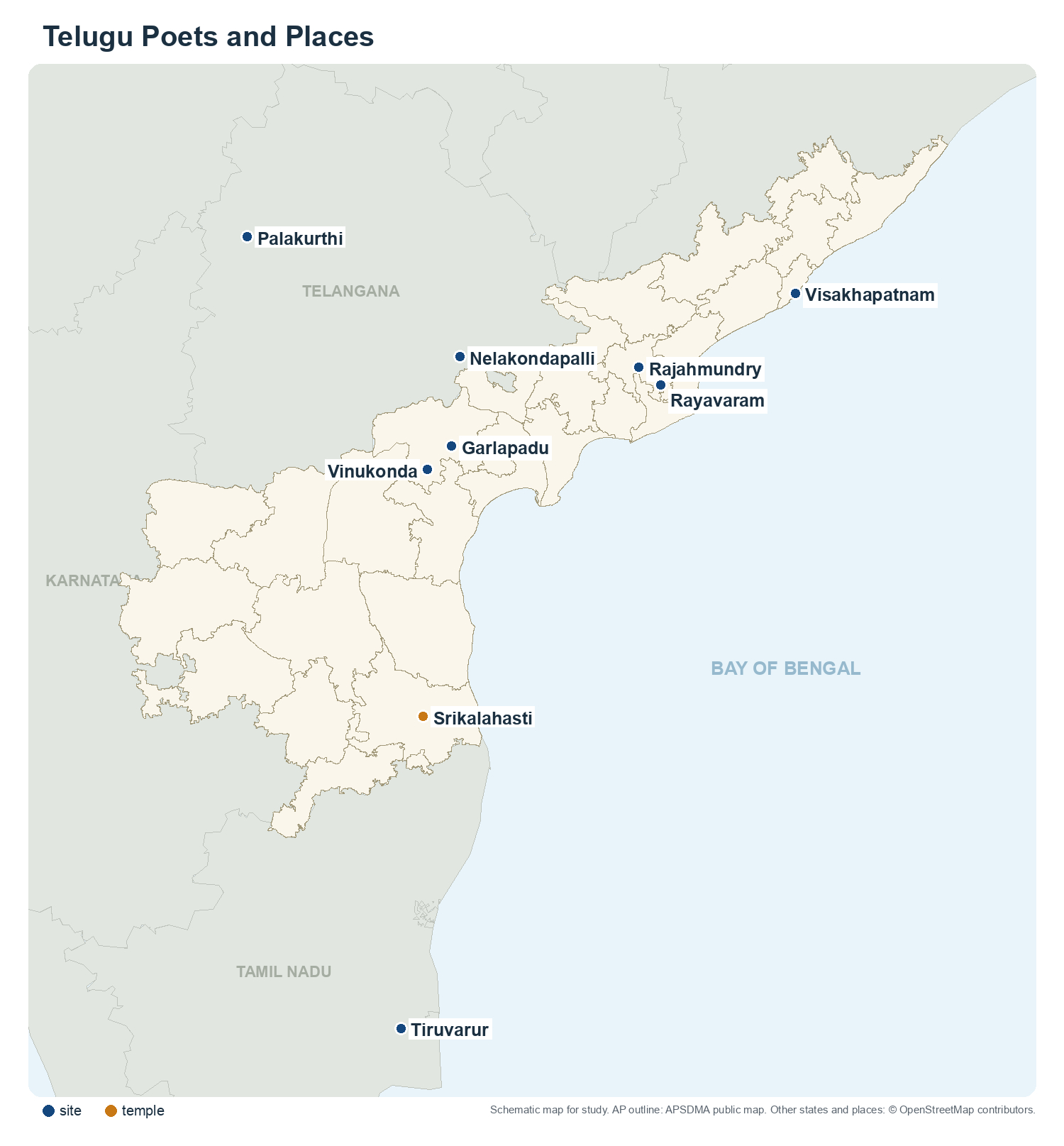
Places connected with this story are: Rajahmundry (Nannaya, Rajaraja Narendra, and Veeresalingam); Kondaveedu (Srinatha's Reddi court); Bammera (Potana's birthplace); Tallapaka (Annamayya's birthplace); Muvva (Kshetrayya); Garlapadu (Tenali Ramakrishna); Vinukonda (Jashuva); Machilipatnam (Krishna Patrika); Visakhapatnam (Eenadu's launch, Sri Sri's birthplace); and Rajahmundry again, where old Andhra Patrika files have been digitised.
How examiners use this chapter
- Patron pairs: Nannaya with Rajaraja Narendra; Tikkana with Manumasiddhi; Errana with Prolaya Vema Reddy; Srinatha with Pedakomati Vema Reddy (honoured by Praudha Deva Raya); Bhattumurti's Vasucharitra with Tirumala Deva Raya; Chemakura with Raghunatha Nayaka; Muddupalani with Pratapasimha.
- Which parts of the Mahabharatam each of the three wrote.
- Form questions: champu, prabandha, dvipada, satakam, dvyarthi kavyam, khandakavya, with examples.
- Newspaper founder and year: Krishna Patrika 1902 comes before Andhra Patrika 1908; Eenadu 1974; Vivekavardhini is a journal, and Hitakarini Samajam (1906) is a society.
- Annamayya and Annamacharya are the same person; his title is Pada Kavita Pitamaha.
- Veeresalingam's firsts: the first novel (1878) and the first widow remarriage organised by him (1881).
- Modern pairs: Gabbilam with Jashuva; Maha Prasthanam with Sri Sri; Krishna Paksham with Devulapalli Krishnasastri; Malapalli with Unnava Lakshminarayana.
- Tyagaraja, Dikshitar and Syama Sastri were born at Tiruvarur, not in an Andhra town.
Worked cases
Case 1: Match the poet to the patron: Tikkana, Errana, Srinatha, Nannaya. Patrons: Prolaya Vema Reddy, Praudha Deva Raya, Rajaraja Narendra, Manumasiddhi.
Reasoning:
- 1. Nannaya is the Adikavi and the first to turn the Mahabharata into Telugu. His patron was Rajaraja Narendra.
- 2. Tikkana's patron was Manumasiddhi.
- 3. Errana's patron was Prolaya Vema Reddy.
- 4. Of these four names, Srinatha goes with Praudha Deva Raya, who honoured him; his main patron was Pedakomati Vema Reddy of Kondaveedu.
- 5. Check the two Kavitrayam poets whose patrons are easy to swap: Tikkana goes with Manumasiddhi and Errana with Prolaya Vema Reddy.
Takeaway: Learn each patron with the poet's work. Errana wrote Harivamsam under Prolaya Vema Reddy.
Case 2: Which parvam is NOT assigned correctly? (a) Adi Parvam, Nannaya. (b) Sabha Parvam, Nannaya. (c) Virata Parvam, Tikkana. (d) Bhishma Parvam, Errana.
Reasoning:
- 1. Nannaya wrote Adi Parvam and Sabha Parvam.
- 2. Tikkana wrote Virata, Udyoga, Bhishma, Santi and Svargarohana Parvams.
- 3. Errana is known for Harivamsam and Nrisimha Puranam, not for Bhishma Parvam.
- 4. So (d) is wrong.
Takeaway: Make a one-line list for each poet. Tikkana has the most parvams in the list.
Case 3: Name the genre of each work: Kanyasulkam, Gabbilam, Bhaskara Ramayanam, Basava Puranam.
Reasoning:
- 1. Kanyasulkam is a play.
- 2. Gabbilam is a Khandakavya.
- 3. Bhaskara Ramayanam is a Champu kavya, in the same form as Andhra Mahabharatam.
- 4. Basava Puranam is a Dwipada kavya, like Ranganatha Ramayanam and Panditaradhya Charitra.
Takeaway: Many Ramayana or Purana titles share names. Learn the form by the work, not by the title.
Case 4: Which came first? Andhra Patrika, Krishna Patrika, Eenadu, Vivekavardhini.
Reasoning:
- 1. Vivekavardhini was a journal of Kandukuri Veeresalingam, in 1874.
- 2. Krishna Patrika came in 1902.
- 3. Andhra Patrika came in 1908, so Krishna Patrika is older.
- 4. Eenadu, founded by Ramoji Rao, is from 1974.
- 5. Order: 1874, 1902, 1908, 1974.
Takeaway: Place each press by its year and keep the 1902 and 1908 pair in the right order.
Compare and contrast
| Name | Type | Founder | Year |
|---|---|---|---|
| Vivekavardhini | Journal | Kandukuri Veeresalingam | 1874 |
| Hitakarini Samajam | Society | Kandukuri Veeresalingam | 1906 |
| Vignana Chandrika Mandali | Society | Komarraju Venkata Lakshmana Rao | 1906 |
| Krishna Patrika | Paper | Konda Venkatappayya and Kowtha Ramamohana Sastry (later edited by Mutnuri Krishna Rao) | 1902 |
| Andhra Patrika | Paper | Kasinathuni Nageswara Rao | 1908 |
| Andhra Prabha | Paper | Ramnath Goenka | not given |
| Poet | Epithet or movement |
|---|---|
| Gurram Jashuva | Kavi Kokila |
| Viswanatha Satyanarayana | Kavisamrat |
| Devulapalli Krishnasastri | Andhra Shelley; Bhava Kavitvam |
| Sri Sri | Abhyudaya Kavitvam; Mahaprasthanam in 1950 |
| Tripuraneni Ramaswamy | Kaviraju |
| Kandukuri Veeresalingam | Gadya Tikkana |
| Gidugu Ramamurthy | Vyavaharika Bhasha Pitamaha |
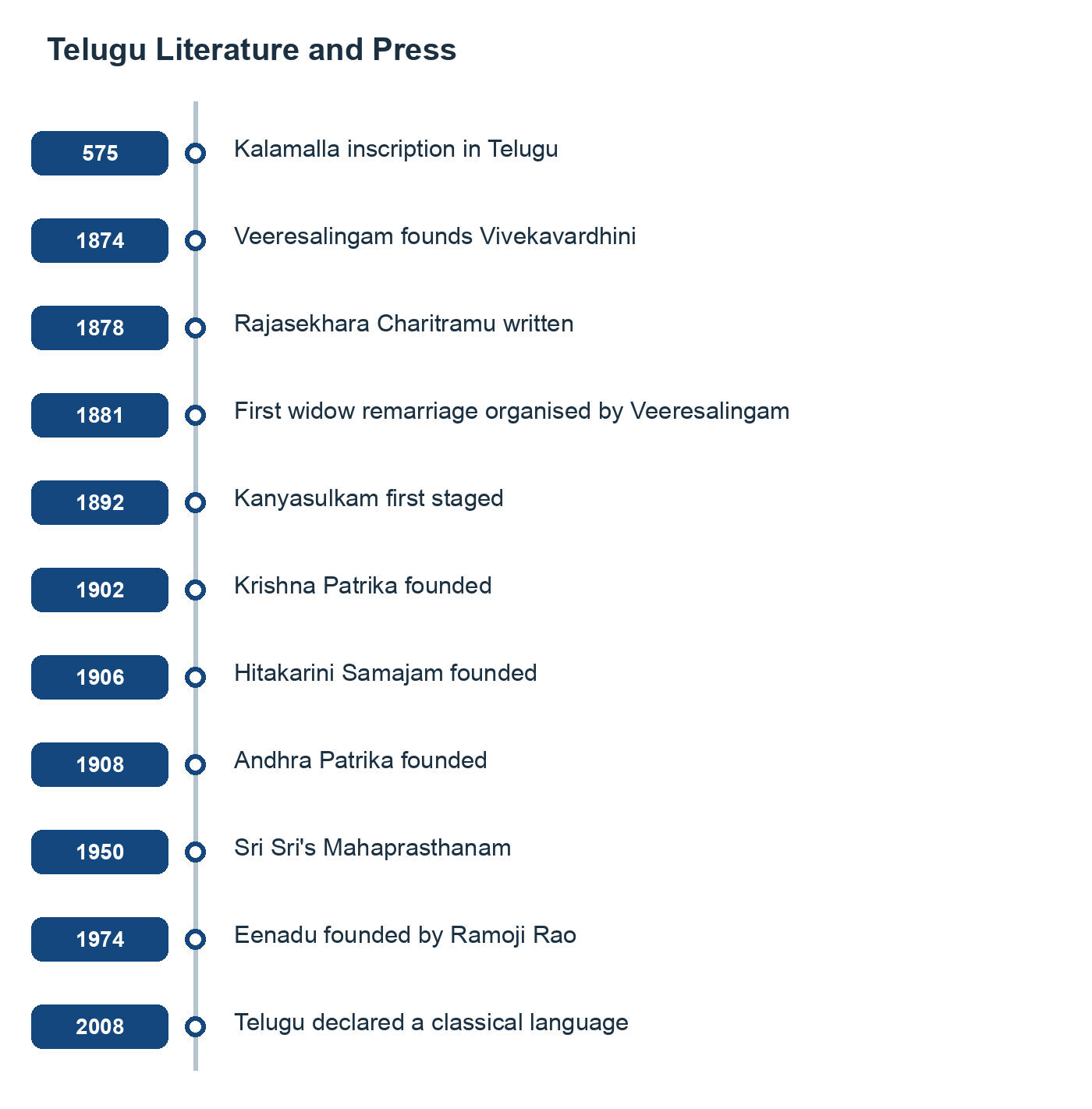
Sequence and timeline
- 1. 575: Kalamalla inscription in Telugu
- 2. Kavitrayam: Nannaya, Tikkana, Errana
- 3. Srinatha, Potana and the Dwipada writers
- 4. Krishnadevaraya and the Ashtadiggajas
- 5. Later poets such as Chemakura Venkata Kavi and Muddupalani
- 6. 1874: Vivekavardhini
- 7. 1878: Rajasekhara Charitramu
- 8. 1881: first widow remarriage organised by Veeresalingam
- 9. 1892: Kanyasulkam first staged (first edition 1897)
- 10. 1902: Krishna Patrika
- 11. 1906: Hitakarini Samajam and Vignana Chandrika Mandali
- 12. 1908: Andhra Patrika
- 13. 1950: Mahaprasthanam
- 14. 1954: Sahitya Akademi
- 15. 1968: Telugu Akademi
- 16. 1974: Eenadu
- 17. 1985: Potti Sriramulu Telugu University
- 18. 2008: Telugu declared a Classical Language
Practice questions
The Hitakarini Samajam, a social reform body in Andhra, was founded by:
- Kandukuri Veeresalingam
- Gurajada Apparao
- Gidugu Ramamurthy
- Tripuraneni Ramaswamy
Answer
A. Kandukuri Veeresalingam
Veeresalingam, the pioneer of widow remarriage in Andhra, established it around 1906.
ఆంధ్రలో సామాజిక సంస్కరణల కోసం పనిచేసిన హితకారిణి సమాజాన్ని స్థాపించింది ఎవరు?
- కందుకూరి వీరేశలింగం
- గురజాడ అప్పారావు
- గిడుగు రామమూర్తి
- త్రిపురనేని రామస్వామి
Which of the following works was written by Ponnaganti Telaganarya?
- Yayati Charitra
- Andhra Mahabharatam first two chapters
- Dwipada Basava Puranam
- Gunahon Ka Devta
Answer
A. Yayati Charitra
పొన్నగంటి తెలగనార్యుడు రచించిన రచన ఏది?
- యయాతి చరిత్ర
- ఆంధ్ర మహాభారతం తొలి రెండు పర్వాలు
- ద్విపద బసవ పురాణం
- గునాహోం కా దేవతా
Which of the following works was written by Madiki Singana?
- Svargarohana Parvam of Andhra Mahabharatam
- Raghavapandaviyam
- Sakalaneeti Sammatam
- Karnata Bharata Katha Manjari
Answer
C. Sakalaneeti Sammatam
మడికి సింగన రచించిన రచన ఏది?
- ఆంధ్ర మహాభారతంలోని స్వర్గారోహణపర్వం
- రాఘవపాండవీయం
- సకలనీతి సమ్మతం
- కర్ణాట భారత కథా మంజరి
By which name or title is Devulapalli Krishnasastri known?
- Andhra Shelley
- Bhakta Ramadasu
- Vyavaharika Bhasha Pitamaha
- Kavibrahma
Answer
A. Andhra Shelley
దేవులపల్లి కృష్ణశాస్త్రి ఏ పేరుతో లేదా బిరుదుతో పిలువబడుతుంది?
- ఆంధ్ర షెల్లీ
- భక్త రామదాసు
- వ్యావహారిక భాషా పితామహుడు
- కవిబ్రహ్మ
Which scholar assisted Nannaya in composing the Andhra Mahabharata under Rajaraja Narendra's patronage?
- Tikkana
- Errana
- Pavuluri Mallana
- Narayana Bhatta
Answer
D. Narayana Bhatta
Narayana Bhatta helped Nannaya and received the Nandampudi grant.
రాజరాజ నరేంద్రుని ఆదరణలో ఆంధ్ర మహాభారత రచనలో నన్నయకు సహకరించిన పండితుడు ఎవరు?
- తిక్కన
- ఎర్రన
- పావులూరి మల్లన
- నారాయణ భట్టు
Which of the following works was written by Tikkana?
- Virabhadra Vijayam
- Virata Parvam of Andhra Mahabharatam
- Harivamsam
- Parashara Madhaviyam
Answer
B. Virata Parvam of Andhra Mahabharatam
తిక్కన రచించిన రచన ఏది?
- వీరభద్ర విజయం
- ఆంధ్ర మహాభారతంలోని విరాటపర్వం
- హరివంశం
- పరాశర మాధవీయం
Who wrote Udyoga Parvam of Andhra Mahabharatam?
- Ayyalaraju Ramabhadrudu
- Tikkana
- Palkuriki Somanatha
- Marana
Answer
B. Tikkana
ఆంధ్ర మహాభారతంలోని ఉద్యోగపర్వం రచయిత ఎవరు?
- అయ్యలరాజు రామభద్రుడు
- తిక్కన
- పాల్కురికి సోమనాథుడు
- మారన
Who wrote Bhaskara Ramayanam?
- Ponnaganti Telaganarya
- Hulakki Bhaskara
- Kandukuri Veeresalingam
- Panuganti Lakshmi Narasimha Rao
Answer
B. Hulakki Bhaskara
భాస్కర రామాయణం రచయిత ఎవరు?
- పొన్నగంటి తెలగనార్యుడు
- హుళక్కి భాస్కరుడు
- కందుకూరి వీరేశలింగం
- పానుగంటి లక్ష్మీనరసింహారావు
Who wrote Yayati Charitra?
- Ayyalaraju Ramabhadrudu
- Ponnaganti Telaganarya
- Potana
- Kancherla Gopanna
Answer
B. Ponnaganti Telaganarya
యయాతి చరిత్ర రచయిత ఎవరు?
- అయ్యలరాజు రామభద్రుడు
- పొన్నగంటి తెలగనార్యుడు
- పోతన
- కంచర్ల గోపన్న
Which of the following works was written by Prativadi Bhayankaram Annangaracharya?
- Satyavati Charitramu
- Bhagavatam in Telugu
- Sri Venkateswara Suprabhatam
- Vasantarajiyam
Answer
C. Sri Venkateswara Suprabhatam
ప్రతివాది భయంకరం అణ్ణంగరాచార్యుడు రచించిన రచన ఏది?
- సత్యవతీ చరిత్రము
- శ్రీమద్ఆంధ్ర మహాభాగవతం
- శ్రీ వేంకటేశ్వర సుప్రభాతం
- వసంతరాజీయం
Which of the following works was written by Viswanatha Satyanarayana?
- Udyoga Parvam of Andhra Mahabharatam
- Ramayana Kalpavrikshamu
- Shivatattvasaram
- Mohanatarangini
Answer
B. Ramayana Kalpavrikshamu
విశ్వనాథ సత్యనారాయణ రచించిన రచన ఏది?
- ఆంధ్ర మహాభారతంలోని ఉద్యోగపర్వం
- రామాయణ కల్పవృక్షం
- శివతత్త్వసారం
- మోహనతరంగిణి
By which name or title is Gidugu Ramamurthy known?
- Kavibrahma
- Andhra Shelley
- Sahajapandita
- Vyavaharika Bhasha Pitamaha
Answer
D. Vyavaharika Bhasha Pitamaha
గిడుగు రామమూర్తి ఏ పేరుతో లేదా బిరుదుతో పిలువబడుతుంది?
- కవిబ్రహ్మ
- ఆంధ్ర షెల్లీ
- సహజ పండితుడు
- వ్యావహారిక భాషా పితామహుడు
Who led Telugu widow remarriage movement?
- Gidugu Venkata Ramamurthy
- Nana Sahib
- Vinoba Bhave
- Kandukuri Veeresalingam
Answer
D. Kandukuri Veeresalingam
తెలుగు వితంతు పునర్వివాహ ఉద్యమం నాయకుడు ఎవరు?
- గిడుగు వెంకట రామమూర్తి
- నానా సాహెబ్
- వినోబా భావే
- కందుకూరి వీరేశలింగం
Consider the following pairs (Movement – Leader): (i) Sora language literacy work – Gidugu Ramamurthy (ii) Bhava Kavitvam – Devulapalli Krishnasastri (iii) Digambara sect – Bhadrabahu Which of the pairs are correctly matched?
- All of (i), (ii) and (iii)
- Only (i) and (iii)
- Only (i)
- Only (i) and (ii)
Answer
A. All of (i), (ii) and (iii)
ఈ క్రింది జతలను పరిశీలించండి (ఉద్యమం – నాయకుడు): (i) సవర భాషా అక్షరాస్యత కృషి – గిడుగు రామమూర్తి (ii) భావ కవిత్వం – దేవులపల్లి కృష్ణశాస్త్రి (iii) దిగంబర శాఖ – భద్రబాహుడు సరిగ్గా జతపరచబడినవి ఏవి?
- (i), (ii), (iii) అన్నీ
- (i), (iii) మాత్రమే
- (i) మాత్రమే
- (i), (ii) మాత్రమే
Consider the following pairs (Work – Author): (i) Nanaghat inscription – Tikkana (ii) Svargarohana Parvam of Andhra Mahabharatam – Naganika (iii) Mutyala Saralu – Gurajada Apparao Which of the pairs are correctly matched?
- Only (ii)
- None of them
- All of (i), (ii) and (iii)
- Only (iii)
Answer
D. Only (iii)
ఈ క్రింది జతలను పరిశీలించండి (రచన – రచయిత): (i) నానేఘాట్ శాసనం – తిక్కన (ii) ఆంధ్ర మహాభారతంలోని స్వర్గారోహణపర్వం – నాగనిక (iii) ముత్యాల సరాలు – గురజాడ అప్పారావు సరిగ్గా జతపరచబడినవి ఏవి?
- (ii) మాత్రమే
- ఏదీ కాదు
- (i), (ii), (iii) అన్నీ
- (iii) మాత్రమే
Who founded the newspaper 'Andhra Patrika' (1908) and is also remembered as the maker of Amrutanjan balm?
- Gidugu Ramamurthy
- Kandukuri Veeresalingam
- Kasinadhuni Nageswara Rao Pantulu
- Gurajada Apparao
Answer
C. Kasinadhuni Nageswara Rao Pantulu
Nageswara Rao Pantulu, known as Desodharaka, founded Andhra Patrika.
1908లో 'ఆంధ్ర పత్రిక'ను స్థాపించి, అమృతాంజన్ తయారీదారుగా కూడా గుర్తింపు పొందినవారు ఎవరు?
- గిడుగు రామమూర్తి
- కందుకూరి వీరేశలింగం
- కాశీనాథుని నాగేశ్వరరావు పంతులు
- గురజాడ అప్పారావు
The Kavitrayam, the trinity of Telugu Mahabharata poets, consists of Nannaya, Tikkana and:
- Pothana
- Srinatha
- Errana
- Ketana
Answer
C. Errana
Errana completed the epic's gap.
తెలుగు మహాభారత కవిత్రయంలో నన్నయ, తిక్కనతో పాటు ఉన్నవారు ఎవరు?
- పోతన
- శ్రీనాథుడు
- ఎర్రన
- కేతన
Who wrote Sakalaneeti Sammatam?
- Pingali Surana
- Tenali Ramakrishna
- Madiki Singana
- Dhurjati
Answer
C. Madiki Singana
Madiki Singana.
సకలనీతి సమ్మతం రచించినవారు ఎవరు?
- పింగళి సూరన
- తెనాలి రామకృష్ణుడు
- మడికి సింగన
- దూర్జటి
Who translated the fifteen parvas of the Mahabharata from the Virata Parva to the Svargarohana Parva into Telugu?
- Nannaya
- Errana
- Srinatha
- Tikkana
Answer
D. Tikkana
Tikkana rendered the fifteen parvas starting from Virata.
మహాభారతంలో విరాట పర్వం నుండి స్వర్గారోహణ పర్వం వరకు గల పదిహేను పర్వాలను తెలుగులోకి అనువదించినవారు ఎవరు?
- నన్నయ
- ఎర్రన
- శ్రీనాథుడు
- తిక్కన
Which monthly journal did Gidugu run around 1919-20 to propagate the spoken-language movement?
- Andhra Patrika
- Vivekavardhini
- Krishna Patrika
- Telugu
Answer
D. Telugu
He published a monthly named 'Telugu' to argue for everyday language in writing.
వ్యావహారిక భాషోద్యమ ప్రచారం కోసం గిడుగు సుమారు 1919-20 కాలంలో నడిపిన మాసపత్రిక ఏది?
- ఆంధ్ర పత్రిక
- వివేకవర్ధని
- కృష్ణా పత్రిక
- తెలుగు
Which poet wrote 'Yayati Charitra', regarded as the first pure Telugu (achha Telugu) kavya?
- Kandukuri Rudrakavi
- Ponnaganti Telaganarya
- Addanki Gangadhara
- Sarangu Tammaya
Answer
B. Ponnaganti Telaganarya
Ponnaganti Telaganarya wrote it in Ibrahim Qutb Shah's time using almost no Sanskrit words.
తొలి అచ్చ తెలుగు కావ్యంగా పేరుగాంచిన 'యయాతి చరిత్ర'ను రచించిన కవి ఎవరు?
- కందుకూరి రుద్రకవి
- పొన్నగంటి తెలగనార్యుడు
- అద్దంకి గంగాధరకవి
- సారంగు తమ్మయ్య
Who is regarded as the 'Adikavi' of Telugu literature, patronised by Rajaraja Narendra?
- Tikkana
- Errana
- Srinatha
- Nannaya
Answer
D. Nannaya
Nannaya began the Telugu Mahabharata in the 11th century under Rajaraja Narendra.
రాజరాజ నరేంద్రుని ఆస్థానంలో తెలుగు సాహిత్యానికి 'ఆదికవి'గా పరిగణించబడే కవి ఎవరు?
- తిక్కన
- ఎర్రన
- శ్రీనాథుడు
- నన్నయ
Which of the following belongs to Prabandha?
- Krishna Paksham
- Pandurangamahatmyam
- Panditaradhya Charitra
- Ranganatha Ramayanam
Answer
B. Pandurangamahatmyam
ఈ క్రింది వాటిలో 'ప్రబంధం' వర్గానికి చెందినది ఏది?
- కృష్ణపక్షం
- పాండురంగ మహాత్మ్యం
- పండితారాధ్య చరిత్ర
- రంగనాథ రామాయణం
Which of the following belongs to Dwipada kavya?
- Andhra Mahabharatam
- Bhaskara Ramayanam
- Ranganatha Ramayanam
- Gabbilam
Answer
C. Ranganatha Ramayanam
ఈ క్రింది వాటిలో 'ద్విపద కావ్యం' వర్గానికి చెందినది ఏది?
- ఆంధ్ర మహాభారతం
- భాస్కర రామాయణం
- రంగనాథ రామాయణం
- గబ్బిలం
Which of the following belongs to Champu kavya?
- Pandurangamahatmyam
- Panditaradhya Charitra
- Bhaskara Ramayanam
- Kanyasulkam
Answer
C. Bhaskara Ramayanam
ఈ క్రింది వాటిలో 'చంపూ కావ్యం' వర్గానికి చెందినది ఏది?
- పాండురంగ మహాత్మ్యం
- పండితారాధ్య చరిత్ర
- భాస్కర రామాయణం
- కన్యాశుల్కం
Which of the following is NOT correctly paired with Trinity of Carnatic music (Item – Category)?
- Syama Sastri
- Jwalamukhi
- Muthuswami Dikshitar
- Tyagaraja
Answer
B. Jwalamukhi
ఈ క్రింది వాటిలో ఏది 'కర్ణాటక సంగీత త్రిమూర్తులు' అనే అంశానికి సరిగ్గా జతకాదు? (అంశం – వర్గం)
- శ్యామశాస్త్రి
- జ్వాలాముఖి
- ముత్తుస్వామి దీక్షితార్
- త్యాగరాజు
Who wrote Adi Parvam of Andhra Mahabharatam?
- Pingali Surana
- Dharamvir Bharati
- Palkuriki Somanatha
- Nannaya
Answer
D. Nannaya
ఆంధ్ర మహాభారతంలోని ఆదిపర్వం రచయిత ఎవరు?
- పింగళి సూరన
- ధర్మవీర్ భారతి
- పాల్కురికి సోమనాథుడు
- నన్నయ
Which of the following works was written by Nannaya?
- Mahabharata Aranya Parva
- Narasabhupaliyam
- Sumati Satakam
- Adi Parvam of Andhra Mahabharatam
Answer
D. Adi Parvam of Andhra Mahabharatam
నన్నయ రచించిన రచన ఏది?
- మహాభారత అరణ్య పర్వం
- నరసభూపాలీయం
- సుమతీ శతకం
- ఆంధ్ర మహాభారతంలోని ఆదిపర్వం
Who wrote Virata Parvam of Andhra Mahabharatam?
- Mallikarjuna Panditaradhya
- Tikkana
- Vemana
- Tarigonda Vengamamba
Answer
B. Tikkana
ఆంధ్ర మహాభారతంలోని విరాటపర్వం రచయిత ఎవరు?
- మల్లికార్జున పండితారాధ్యుడు
- తిక్కన
- వేమన
- తరిగొండ వెంగమాంబ
Who wrote Bhishma Parvam of Andhra Mahabharatam?
- Vidyanatha
- Molla
- Palkuriki Somanatha
- Tikkana
Answer
D. Tikkana
ఆంధ్ర మహాభారతంలోని భీష్మపర్వం రచయిత ఎవరు?
- విద్యానాథుడు
- మొల్ల
- పాల్కురికి సోమనాథుడు
- తిక్కన
Who wrote Krishna Leela Tarangini?
- Panuganti Lakshmi Narasimha Rao
- Tikkana
- Sankarambadi Sundarachari
- Narayana Tirtha
Answer
D. Narayana Tirtha
కృష్ణలీలా తరంగిణి రచయిత ఎవరు?
- పానుగంటి లక్ష్మీనరసింహారావు
- తిక్కన
- శంకరంబాడి సుందరాచారి
- నారాయణ తీర్థులు
Who wrote Chivaraku Migiledi?
- Buchibabu
- Mallikarjuna Pandita
- Narayana Tirtha
- Raghunatha Nayaka
Answer
A. Buchibabu
చివరకు మిగిలేది రచయిత ఎవరు?
- బుచ్చిబాబు
- మల్లికార్జున పండితుడు
- నారాయణ తీర్థులు
- రఘునాథ నాయకుడు
Who was the author of Telugu grammar Andhra Sabda Chintamani?
- Sevappa Nayaka
- Thomas Munro
- K. Chandrashekar Rao
- Nannaya
Answer
D. Nannaya
ఆంధ్ర శబ్ద చింతామణి రచయిత ఎవరు?
- సేవప్ప నాయకుడు
- థామస్ మన్రో
- కె. చంద్రశేఖరరావు
- నన్నయ
Which of the following is associated with Rajaraja Narendra?
- Allasani Peddana
- Nannaya
- Pingali Surana
- Errana
Answer
B. Nannaya
ఈ క్రింది వాటిలో 'రాజరాజ నరేంద్రుడు' అనే అంశంతో ముడిపడినది ఏది?
- అల్లసాని పెద్దన
- నన్నయ
- పింగళి సూరన
- ఎర్రన
Which of the following is associated with Prolaya Vema Reddy?
- Nandi Timmana
- Nannaya
- Errana
- Pingali Surana
Answer
C. Errana
ఈ క్రింది వాటిలో 'ప్రోలయ వేమారెడ్డి' అనే అంశంతో ముడిపడినది ఏది?
- నంది తిమ్మన
- నన్నయ
- ఎర్రన
- పింగళి సూరన
Nandi Timmana is associated with which of the following?
- Prolaya Vema Reddy
- Krishnadevaraya
- Manumasiddhi
- Rajaraja Narendra
Answer
B. Krishnadevaraya
నంది తిమ్మన ఈ క్రింది వాటిలో దేనితో ముడిపడి ఉంది?
- ప్రోలయ వేమారెడ్డి
- శ్రీకృష్ణదేవరాయలు
- మనుమసిద్ధి
- రాజరాజ నరేంద్రుడు
Pingali Surana is associated with which of the following?
- Rajaraja Narendra
- Pratapasimha
- Prolaya Vema Reddy
- Krishnadevaraya
Answer
D. Krishnadevaraya
పింగళి సూరన ఈ క్రింది వాటిలో దేనితో ముడిపడి ఉంది?
- రాజరాజ నరేంద్రుడు
- ప్రతాపసింహుడు
- ప్రోలయ వేమారెడ్డి
- శ్రీకృష్ణదేవరాయలు
Chemakura Venkata Kavi is associated with which of the following?
- Rajaraja Narendra
- Pratapasimha
- Raghunatha Nayaka
- Aliya Rama Raya
Answer
C. Raghunatha Nayaka
చేమకూర వేంకట కవి ఈ క్రింది వాటిలో దేనితో ముడిపడి ఉంది?
- రాజరాజ నరేంద్రుడు
- ప్రతాపసింహుడు
- రఘునాథ నాయకుడు
- అళియ రామరాయలు
Which of the following is associated with Raghunatha Nayaka?
- Tenali Ramakrishna
- Tikkana
- Srinatha
- Chemakura Venkata Kavi
Answer
D. Chemakura Venkata Kavi
ఈ క్రింది వాటిలో 'రఘునాథ నాయకుడు' అనే అంశంతో ముడిపడినది ఏది?
- తెనాలి రామకృష్ణుడు
- తిక్కన
- శ్రీనాథుడు
- చేమకూర వేంకట కవి
Which of the following is associated with Pratapasimha?
- Muddupalani
- Nandi Timmana
- Tenali Ramakrishna
- Allasani Peddana
Answer
A. Muddupalani
ఈ క్రింది వాటిలో 'ప్రతాపసింహుడు' అనే అంశంతో ముడిపడినది ఏది?
- ముద్దుపళని
- నంది తిమ్మన
- తెనాలి రామకృష్ణుడు
- అల్లసాని పెద్దన
Which of the following is known by the name or title Kavi Kokila?
- Viswanatha Satyanarayana
- Devulapalli Krishnasastri
- Gurram Jashuva
- Annamayya
Answer
C. Gurram Jashuva
'కవి కోకిల' అనే పేరు లేదా బిరుదుతో పిలువబడేది ఏది?
- విశ్వనాథ సత్యనారాయణ
- దేవులపల్లి కృష్ణశాస్త్రి
- గుర్రం జాషువా
- అన్నమయ్య
Which of the following is known by the name or title Andhra Shelley?
- Tikkana
- Devulapalli Krishnasastri
- Kancherla Gopanna
- Potana
Answer
B. Devulapalli Krishnasastri
'ఆంధ్ర షెల్లీ' అనే పేరు లేదా బిరుదుతో పిలువబడేది ఏది?
- తిక్కన
- దేవులపల్లి కృష్ణశాస్త్రి
- కంచర్ల గోపన్న
- పోతన
By which name or title is Kancherla Gopanna known?
- Prabandhaparameshwara
- Bhakta Ramadasu
- Kavisamrat
- Pada Kavita Pitamaha
Answer
B. Bhakta Ramadasu
కంచర్ల గోపన్న ఏ పేరుతో లేదా బిరుదుతో పిలువబడుతుంది?
- ప్రబంధ పరమేశ్వరుడు
- భక్త రామదాసు
- కవిసామ్రాట్
- పదకవితా పితామహుడు
Consider the following pairs (Work – Author): (i) Udyoga Parvam of Andhra Mahabharatam – Tikkana (ii) Planned Economy for India – M. Visvesvaraya (iii) Viswambhara – C. Narayana Reddy Which of the pairs are correctly matched?
- Only (ii) and (iii)
- All of (i), (ii) and (iii)
- Only (i)
- Only (iii)
Answer
B. All of (i), (ii) and (iii)
ఈ క్రింది జతలను పరిశీలించండి (రచన – రచయిత): (i) ఆంధ్ర మహాభారతంలోని ఉద్యోగపర్వం – తిక్కన (ii) భారతదేశానికి ప్రణాళికా ఆర్థిక వ్యవస్థ – ఎం. విశ్వేశ్వరయ్య (iii) విశ్వంభర – సి. నారాయణ రెడ్డి సరిగ్గా జతపరచబడినవి ఏవి?
- (ii), (iii) మాత్రమే
- (i), (ii), (iii) అన్నీ
- (i) మాత్రమే
- (iii) మాత్రమే
Consider the statements: (i) Kandukuri Veeresalingam organised a widow remarriage in 1881. (ii) He wrote Rajasekhara Charitramu. (iii) He wrote Kanyasulkam. Which are correct?
- Only (i) and (ii)
- Only (ii) and (iii)
- Only (i) and (iii)
- All of (i), (ii) and (iii)
Answer
A. Only (i) and (ii)
Kanyasulkam was written by Gurajada Apparao.
ఈ ప్రకటనలను పరిశీలించండి: (i) కందుకూరి వీరేశలింగం 1881లో వితంతు వివాహం జరిపించారు. (ii) ఆయన రాజశేఖర చరిత్రము రచించారు. (iii) ఆయన కన్యాశుల్కం రచించారు. ఏవి సరైనవి?
- (i), (ii) మాత్రమే
- (ii), (iii) మాత్రమే
- (i), (iii) మాత్రమే
- (i), (ii), (iii) అన్నీ
Practice set 2
Which of the following is NOT one of the Trinity of Carnatic music?
- Annamacharya
- Muthuswami Dikshitar
- Syama Sastri
- Tyagaraja
Answer
A. Annamacharya
The trinity are Tyagaraja, Dikshitar and Syama Sastri.
కింది వారిలో కర్ణాటక సంగీత త్రిమూర్తులలో లేనివారు ఎవరు?
- అన్నమాచార్య
- ముత్తుస్వామి దీక్షితులు
- శ్యామశాస్త్రి
- త్యాగరాజు
Which parvas of the Mahabharata did Nannaya render into Telugu, the last one only in part?
- Santi, Anusasanika and Asvamedhika
- Virata, Udyoga and Bhishma
- Drona, Karna and Shalya
- Adi, Sabha and part of Aranya
Answer
D. Adi, Sabha and part of Aranya
He wrote two parvas and about half of the third.
నన్నయ తెలుగులోకి అనువదించిన మహాభారత పర్వాలు ఏవి (చివరిది కొంతభాగం మాత్రమే)?
- శాంతి, అనుశాసనిక, అశ్వమేధ పర్వాలు
- విరాట, ఉద్యోగ, భీష్మ పర్వాలు
- ద్రోణ, కర్ణ, శల్య పర్వాలు
- ఆది, సభా పర్వాలు, అరణ్య పర్వంలో కొంతభాగం
The Telugu poet Srinatha, honoured at the court of Praudha Devaraya, held which title?
- Kavisarvabhauma
- Andhra Kavita Pitamaha
- Muddupalka
- Andhra Bhoja
Answer
A. Kavisarvabhauma
Srinatha was known as Kavisarvabhauma.
ప్రౌఢ దేవరాయల ఆస్థానంలో గౌరవం పొందిన తెలుగు కవి శ్రీనాథునికి ఉన్న బిరుదు ఏది?
- కవిసార్వభౌముడు
- ఆంధ్ర కవితా పితామహుడు
- ముద్దుపలుకు
- ఆంధ్ర భోజుడు
Who first wrote a Sanskrit drama as Telugu kavya?
- Potana
- Tikkana
- Nandi Mallaya, Ghanta Singaya
- Errana
Answer
C. Nandi Mallaya, Ghanta Singaya
They did.
సంస్కృత నాటకాన్ని తెలుగు కావ్యంగా మొదటిగా రచించినవారు ఎవరు?
- పోతన
- తిక్కన
- నంది మల్లయ్య, ఘంట సింగయ్య
- ఎర్రన
Which is the first padya sankalana (anthology) work in Telugu?
- Kalapurnodayam
- Manucharitra
- Rajasekhara Charitra
- Sakalaneeti Sammatam
Answer
D. Sakalaneeti Sammatam
Madiki Singana's Sakalaneeti Sammatam.
తెలుగులో మొదటి పద్య సంకలన గ్రంథం ఏది?
- కళాపూర్ణోదయం
- మనుచరిత్ర
- రాజశేఖర చరిత్ర
- సకలనీతి సమ్మతం
In which language is Varadambika Parinayam, a champu kavya, written?
- Telugu
- Tamil
- Sanskrit
- Kannada
Answer
C. Sanskrit
A Sanskrit champu kavya.
వరదాంబికా పరిణయం ఏ భాషలో రచించిన చంపూ కావ్యం?
- తెలుగు
- తమిళం
- సంస్కృతం
- కన్నడం
Which was the first library in Telangana and Andhra regions?
- Sri Krishnadevaraya Andhra Bhasha Nilayam
- Andhra Saraswata Parishattu
- Vignana Chandrika Mandali
- Andhra Sodara Samajam
Answer
A. Sri Krishnadevaraya Andhra Bhasha Nilayam
This library was the first.
తెలంగాణ & ఆంధ్ర ప్రాంతాల్లో మొదటి గ్రంథాలయం ఏది?
- శ్రీ కృష్ణదేవరాయాంధ్ర భాషా నిలయం
- ఆంధ్ర సారస్వత పరిషత్తు
- విజ్ఞాన చంద్రిక మండలి
- ఆంధ్ర సోదర సమాజం
Who received the title 'Andhra Shelley'?
- Raghupati Venkata Ratnam Naidu
- Devulapalli Krishna Sastri
- Jonnavithula Seshagiri Rao
- Kandukuri Veeresalingam
Answer
B. Devulapalli Krishna Sastri
Devulapalli Krishna Sastri was known as Andhra Shelley.
'ఆంధ్ర షెల్లీ' బిరుదు పొందినవారు ఎవరు?
- రఘుపతి వెంకట రత్నం నాయుడు
- దేవులపల్లి కృష్ణశాస్త్రి
- జొన్నవిత్తుల శేషగిరిరావు
- కందుకూరి వీరేశలింగం
Tikkana, the second poet of the Telugu Kavitrayam, served at the court of
- Manumasiddhi of Nellore
- Rajaraja Narendra
- Prataparudra
- Krishnadevaraya
Answer
A. Manumasiddhi of Nellore
Tikkana was the poet-minister of the Nellore chief Manumasiddhi, in the 13th century.
తెలుగు కవిత్రయంలో రెండవవాడైన తిక్కన ఎవరి ఆస్థానంలో ఉండేవాడు?
- నెల్లూరు మనుమసిద్ధి
- రాజరాజ నరేంద్రుడు
- ప్రతాపరుద్రుడు
- శ్రీకృష్ణదేవరాయలు
Which Eastern Chalukya king of Rajahmundry patronised the poet Nannaya, who began the Telugu Mahabharata?
- Rajaraja Narendra
- Jata Choda Bhima
- Kubjavishnu
- Chalukya Bhima I
Answer
A. Rajaraja Narendra
తెలుగు మహాభారతాన్ని ప్రారంభించిన కవి నన్నయను ఆదరించిన రాజమహేంద్రవరపు తూర్పు చాళుక్య రాజు ఎవరు?
- రాజరాజ నరేంద్రుడు
- జాటా చోడ భీముడు
- కుబ్జ విష్ణువు
- చాళుక్య భీముడు I
Which of the following belongs to Trinity of Carnatic music?
- Nanduri Subbarao
- Adivi Bapiraju
- Devulapalli Krishna Sastri
- Tyagaraja
Answer
D. Tyagaraja
ఈ క్రింది వాటిలో 'కర్ణాటక సంగీత త్రిమూర్తులు' వర్గానికి చెందినది ఏది?
- నండూరి సుబ్బారావు
- అడివి బాపిరాజు
- దేవులపల్లి కృష్ణశాస్త్రి
- త్యాగరాజు
Which of the following belongs to Dravidian language family?
- Marathi
- Bengali
- Telugu
- Sanskrit
Answer
C. Telugu
ఈ క్రింది వాటిలో 'ద్రావిడ భాషా కుటుంబం' వర్గానికి చెందినది ఏది?
- మరాఠీ
- బెంగాలీ
- తెలుగు
- సంస్కృతం
To which of the following does Hindi belong?
- Indo-Aryan language family
- Trinity of Carnatic music
- Brihatpalayanas
- Northern Circar
Answer
A. Indo-Aryan language family
హిందీ ఈ క్రింది వాటిలో దేనికి చెందినది?
- ఇండో-ఆర్య భాషా కుటుంబం
- కర్ణాటక సంగీత త్రిమూర్తులు
- బృహత్పలాయనులు
- ఉత్తర సర్కార్
To which of the following does Ranganatha Ramayanam belong?
- Prabandha
- Satakam
- Khandakavya
- Dwipada kavya
Answer
D. Dwipada kavya
రంగనాథ రామాయణం ఈ క్రింది వాటిలో దేనికి చెందినది?
- ప్రబంధం
- శతకం
- ఖండకావ్యం
- ద్విపద కావ్యం
To which of the following does Bhaskara Ramayanam belong?
- Prabandha
- Champu kavya
- Dwipada kavya
- Khandakavya
Answer
B. Champu kavya
భాస్కర రామాయణం ఈ క్రింది వాటిలో దేనికి చెందినది?
- ప్రబంధం
- చంపూ కావ్యం
- ద్విపద కావ్యం
- ఖండకావ్యం
Which of the following belongs to Khandakavya?
- Vijayavilasam
- Bhaskara Ramayanam
- Andhra Mahabharatam
- Gabbilam
Answer
D. Gabbilam
ఈ క్రింది వాటిలో 'ఖండకావ్యం' వర్గానికి చెందినది ఏది?
- విజయవిలాసం
- భాస్కర రామాయణం
- ఆంధ్ర మహాభారతం
- గబ్బిలం
To which of the following does Barid Shahi dynasty belong?
- Dravidian language family
- Deccan sultanates
- Trinity of Carnatic music
- Khandakavya
Answer
B. Deccan sultanates
బరీద్ షాహీ వంశం ఈ క్రింది వాటిలో దేనికి చెందినది?
- ద్రావిడ భాషా కుటుంబం
- దక్కన్ సుల్తానేట్లు
- కర్ణాటక సంగీత త్రిమూర్తులు
- ఖండకావ్యం
Which of the following works was written by Bhattumurti?
- Vasucharitra
- Andhra Mahabhagavatamu
- Vemana Satakam
- Sumati Shatakam
Answer
A. Vasucharitra
భట్టుమూర్తి రచించిన రచన ఏది?
- వసుచరిత్ర
- ఆంధ్ర మహాభాగవతము
- వేమన శతకం
- సుమతీ శతకం
Who wrote Kalahastiswara Satakam?
- Nannaya
- Bhaskara
- Mallikarjuna Panditaradhya
- Dhurjati
Answer
D. Dhurjati
కాళహస్తీశ్వర శతకం రచయిత ఎవరు?
- నన్నయ
- భాస్కరుడు
- మల్లికార్జున పండితారాధ్యుడు
- ధూర్జటి
Which of the following works was written by Seshappa?
- Kanyasulkam
- Narasabhupaliyam
- Virabhadra Vijayam
- Narasimha Satakam
Answer
D. Narasimha Satakam
శేషప్ప రచించిన రచన ఏది?
- కన్యాశుల్కం
- నరసభూపాలీయం
- వీరభద్ర విజయం
- నరసింహ శతకం
Which of the following works was written by Narayana Tirtha?
- Krishna Leela Tarangini
- Sakalakathasara Sangrahamu
- Achyutarayabhyudayam
- Maa Telugu Talliki
Answer
A. Krishna Leela Tarangini
నారాయణ తీర్థులు రచించిన రచన ఏది?
- కృష్ణలీలా తరంగిణి
- సకలకథాసార సంగ్రహము
- అచ్యుతరాయాభ్యుదయం
- మా తెలుగు తల్లికి
Consider the following pairs (Work – Author): (i) Santi Parvam of Andhra Mahabharatam – Tikkana (ii) Gayatri Mantra – Vishwamitra (iii) Kasi Khandam – Srinatha Which of the pairs are correctly matched?
- None of them
- Only (i) and (ii)
- All of (i), (ii) and (iii)
- Only (ii) and (iii)
Answer
C. All of (i), (ii) and (iii)
ఈ క్రింది జతలను పరిశీలించండి (రచన – రచయిత): (i) ఆంధ్ర మహాభారతంలోని శాంతిపర్వం – తిక్కన (ii) గాయత్రీ మంత్రం – విశ్వామిత్రుడు (iii) కాశీఖండం – శ్రీనాథుడు సరిగ్గా జతపరచబడినవి ఏవి?
- ఏదీ కాదు
- (i), (ii) మాత్రమే
- (i), (ii), (iii) అన్నీ
- (ii), (iii) మాత్రమే
Nannaya is associated with which of the following?
- Praudha Deva Raya
- Rajaraja Narendra
- Manumasiddhi
- Raghunatha Nayaka
Answer
B. Rajaraja Narendra
నన్నయ ఈ క్రింది వాటిలో దేనితో ముడిపడి ఉంది?
- ప్రౌఢ దేవరాయలు
- రాజరాజ నరేంద్రుడు
- మనుమసిద్ధి
- రఘునాథ నాయకుడు
Which of the following is associated with Manumasiddhi?
- Muddupalani
- Tenali Ramakrishna
- Tikkana
- Pingali Surana
Answer
C. Tikkana
ఈ క్రింది వాటిలో 'మనుమసిద్ధి' అనే అంశంతో ముడిపడినది ఏది?
- ముద్దుపళని
- తెనాలి రామకృష్ణుడు
- తిక్కన
- పింగళి సూరన
Errana is associated with which of the following?
- Pratapasimha
- Praudha Deva Raya
- Raghunatha Nayaka
- Prolaya Vema Reddy
Answer
D. Prolaya Vema Reddy
ఎర్రన ఈ క్రింది వాటిలో దేనితో ముడిపడి ఉంది?
- ప్రతాపసింహుడు
- ప్రౌఢ దేవరాయలు
- రఘునాథ నాయకుడు
- ప్రోలయ వేమారెడ్డి
Srinatha is associated with which of the following?
- Prolaya Vema Reddy
- Manumasiddhi
- Praudha Deva Raya
- Raghunatha Nayaka
Answer
C. Praudha Deva Raya
శ్రీనాథుడు ఈ క్రింది వాటిలో దేనితో ముడిపడి ఉంది?
- ప్రోలయ వేమారెడ్డి
- మనుమసిద్ధి
- ప్రౌఢ దేవరాయలు
- రఘునాథ నాయకుడు
Allasani Peddana is associated with which of the following?
- Pratapasimha
- Krishnadevaraya
- Rajaraja Narendra
- Aliya Rama Raya
Answer
B. Krishnadevaraya
అల్లసాని పెద్దన ఈ క్రింది వాటిలో దేనితో ముడిపడి ఉంది?
- ప్రతాపసింహుడు
- శ్రీకృష్ణదేవరాయలు
- రాజరాజ నరేంద్రుడు
- అళియ రామరాయలు
Tenali Ramakrishna is associated with which of the following?
- Prolaya Vema Reddy
- Pratapasimha
- Krishnadevaraya
- Manumasiddhi
Answer
C. Krishnadevaraya
తెనాలి రామకృష్ణుడు ఈ క్రింది వాటిలో దేనితో ముడిపడి ఉంది?
- ప్రోలయ వేమారెడ్డి
- ప్రతాపసింహుడు
- శ్రీకృష్ణదేవరాయలు
- మనుమసిద్ధి
Which of the following is associated with Aliya Rama Raya?
- Chemakura Venkata Kavi
- Allasani Peddana
- Nannaya
- Bhattumurti
Answer
D. Bhattumurti
ఈ క్రింది వాటిలో 'అళియ రామరాయలు' అనే అంశంతో ముడిపడినది ఏది?
- చేమకూర వేంకట కవి
- అల్లసాని పెద్దన
- నన్నయ
- భట్టుమూర్తి
Which of the following is known by the name or title Pada Kavita Pitamaha?
- Annamayya
- Tikkana
- Gidugu Ramamurthy
- Potana
Answer
A. Annamayya
'పదకవితా పితామహుడు' అనే పేరు లేదా బిరుదుతో పిలువబడేది ఏది?
- అన్నమయ్య
- తిక్కన
- గిడుగు రామమూర్తి
- పోతన
By which name or title is Gurram Jashuva known?
- Sahajapandita
- Kavi Kokila
- Kavisamrat
- Bhakta Ramadasu
Answer
B. Kavi Kokila
గుర్రం జాషువా ఏ పేరుతో లేదా బిరుదుతో పిలువబడుతుంది?
- సహజ పండితుడు
- కవి కోకిల
- కవిసామ్రాట్
- భక్త రామదాసు
By which name or title is Tripuraneni Ramaswamy known?
- Kaviraju
- Kavisamrat
- Kavibrahma
- Bhakta Ramadasu
Answer
A. Kaviraju
త్రిపురనేని రామస్వామి ఏ పేరుతో లేదా బిరుదుతో పిలువబడుతుంది?
- కవిరాజు
- కవిసామ్రాట్
- కవిబ్రహ్మ
- భక్త రామదాసు
Which of the following is known by the name or title Kaviraju?
- Tikkana
- Tripuraneni Ramaswamy
- Annamayya
- Gurram Jashuva
Answer
B. Tripuraneni Ramaswamy
'కవిరాజు' అనే పేరు లేదా బిరుదుతో పిలువబడేది ఏది?
- తిక్కన
- త్రిపురనేని రామస్వామి
- అన్నమయ్య
- గుర్రం జాషువా
Which of the following is known by the name or title Bhakta Ramadasu?
- Annamayya
- Tikkana
- Kancherla Gopanna
- Potana
Answer
C. Kancherla Gopanna
'భక్త రామదాసు' అనే పేరు లేదా బిరుదుతో పిలువబడేది ఏది?
- అన్నమయ్య
- తిక్కన
- కంచర్ల గోపన్న
- పోతన
Who led Vyavaharika Bhasha Udyamam?
- Kunwar Singh
- Gidugu Ramamurthy
- Devulapalli Krishnasastri
- Sri Sri
Answer
B. Gidugu Ramamurthy
వ్యావహారిక భాషా ఉద్యమం నాయకుడు ఎవరు?
- కున్వర్ సింగ్
- గిడుగు రామమూర్తి
- దేవులపల్లి కృష్ణశాస్త్రి
- శ్రీశ్రీ
Who wrote the poetry collection Mahaprasthanam?
- Gurram Jashuva
- Sri Sri
- Gurajada Apparao
- Kandukuri Veeresalingam
Answer
B. Sri Sri
Srirangam Srinivasa Rao wrote it in the modern idiom.
మహాప్రస్థానం కవితా సంపుటి రచయిత ఎవరు?
- గుర్రం జాషువా
- శ్రీశ్రీ
- గురజాడ అప్పారావు
- కందుకూరి వీరేశలింగం
Which of the following is NOT one of the Kavitrayam (the three poets of the Telugu Mahabharata)?
- Tikkana
- Nannaya
- Errana
- Srinatha
Answer
D. Srinatha
The Kavitrayam are Nannaya, Tikkana and Errana.
కింది వారిలో తెలుగు మహాభారతం కవిత్రయంలో లేనివారు ఎవరు?
- తిక్కన
- నన్నయ
- ఎర్రన
- శ్రీనాథుడు
Nannaya started the Telugu Mahabharata at the instance of which Eastern Chalukya king of Rajahmundry?
- Rajaraja Narendra
- Prataparudra
- Krishnadevaraya
- Kulottunga Chola
Answer
A. Rajaraja Narendra
Rajaraja Narendra patronised Nannaya.
రాజమహేంద్రవరానికి చెందిన ఏ తూర్పు చాళుక్య రాజు కోరికపై నన్నయ తెలుగు మహాభారతాన్ని ప్రారంభించాడు?
- రాజరాజ నరేంద్రుడు
- ప్రతాపరుద్రుడు
- శ్రీకృష్ణదేవరాయలు
- కులోత్తుంగ చోళుడు
The poet Srinatha, author of Srungara Naishadham, was patronised by:
- Prataparudra
- Krishnadevaraya
- Pedakomati Vema Reddy
- Rajaraja Narendra
Answer
C. Pedakomati Vema Reddy
He served the Kondaveedu Reddy court.
శృంగార నైషధ కర్త శ్రీనాథుని ఆదరించినవారు ఎవరు?
- ప్రతాపరుద్రుడు
- కృష్ణదేవరాయలు
- పెదకోమటి వేమారెడ్డి
- రాజరాజ నరేంద్రుడు
Nannaya, the Adikavi of Telugu, began the Andhra Mahabharatam under which Eastern Chalukya king?
- Saktivarman I
- Vimaladitya
- Kulottunga I
- Rajaraja Narendra
Answer
D. Rajaraja Narendra
Nannaya was the court poet of Rajaraja Narendra at Rajahmundry.
తెలుగు ఆదికవి నన్నయ ఆంధ్ర మహాభారతాన్ని ఏ తూర్పు చాళుక్య రాజు ఆదరణలో ప్రారంభించాడు?
- మొదటి శక్తివర్మ
- విమలాదిత్యుడు
- మొదటి కులోత్తుంగుడు
- రాజరాజ నరేంద్రుడు
Which book did Ketana write on Telugu grammar?
- Kavi Janashrayam
- Appakaviyam
- Andhra Bhasha Bhushanam
- Andhra Shabda Chintamani
Answer
C. Andhra Bhasha Bhushanam
Ketana wrote Andhra Bhasha Bhushanam.
కేతన తెలుగు వ్యాకరణంపై రచించిన గ్రంథం ఏది?
- కవి జనాశ్రయం
- అప్పకవీయం
- ఆంధ్ర భాషా భూషణం
- ఆంధ్ర శబ్ద చింతామణి
Who wrote Sumati Satakam?
- Nannechodudu
- Gona Buddha Reddy
- Madiki Singana
- Baddena
Answer
D. Baddena
Baddena wrote Sumati Satakam.
సుమతీ శతకం రచించినవారు ఎవరు?
- నన్నెచోడుడు
- గోన బుద్ధారెడ్డి
- మడికి సింగన
- బద్దెన
Which is NOT a work of Bammera Potana?
- Bhogini Dandakam
- Madana Vijayam
- Andhra Maha Bhagavatam
- Veerabhadra Vijayam
Answer
B. Madana Vijayam
Madana Vijayam is by Ravipati Tripurantaka.
బమ్మెర పోతన రచనలలో లేనిది ఏది?
- భోగిని దండకం
- మదన విజయం
- ఆంధ్ర మహాభాగవతం
- వీరభద్ర విజయం
Who were the twin poets in Narasa Nayaka's court?
- Nandi Mallayya and Ghanta Singana
- Timmana and Peddana
- Bhattumurti and Timmana
- Pingali and Katuri
Answer
A. Nandi Mallayya and Ghanta Singana
The twin poets wrote Varaha Puranam.
నరసనాయకుని ఆస్థానంలో జంట కవులు ఎవరు?
- నంది మల్లయ్య, ఘంట సింగన
- తిమ్మన, పెద్దన
- భట్టుమూర్తి, తిమ్మన
- పింగళి, కాటూరి
Who is regarded as the Pitamaha (father) of Carnatic music?
- Tyagaraja
- Shyama Sastri
- Muthuswami Dikshitar
- Purandaradas
Answer
D. Purandaradas
Purandaradas is the Carnatic music Pitamaha.
కర్ణాటక సంగీత పితామహుడు ఎవరు?
- త్యాగరాజు
- శ్యామశాస్త్రి
- ముత్తుస్వామి దీక్షితులు
- పురందరదాస్