Telangana: Land, Awakening and Statehood
What to remember
- Hyderabad State under the Nizams (capital Hyderabad) joined the Indian Union in 1948 through Operation Polo; the Telangana Armed Struggle began in 1946.
- Awakening: Osmania University 1918, Andhra Mahasabha 1930 (Madapati Hanumantha Rao, Suravaram Pratap Reddy), Hyderabad State Congress 1938 (Swami Ramananda Tirtha).
- Statehood path: Gentlemen's Agreement 1956, Jai Telangana 1969, Telangana Praja Samithi, TRS 2001, Srikrishna Committee 2010, Telangana State 2014.
Land and early rule
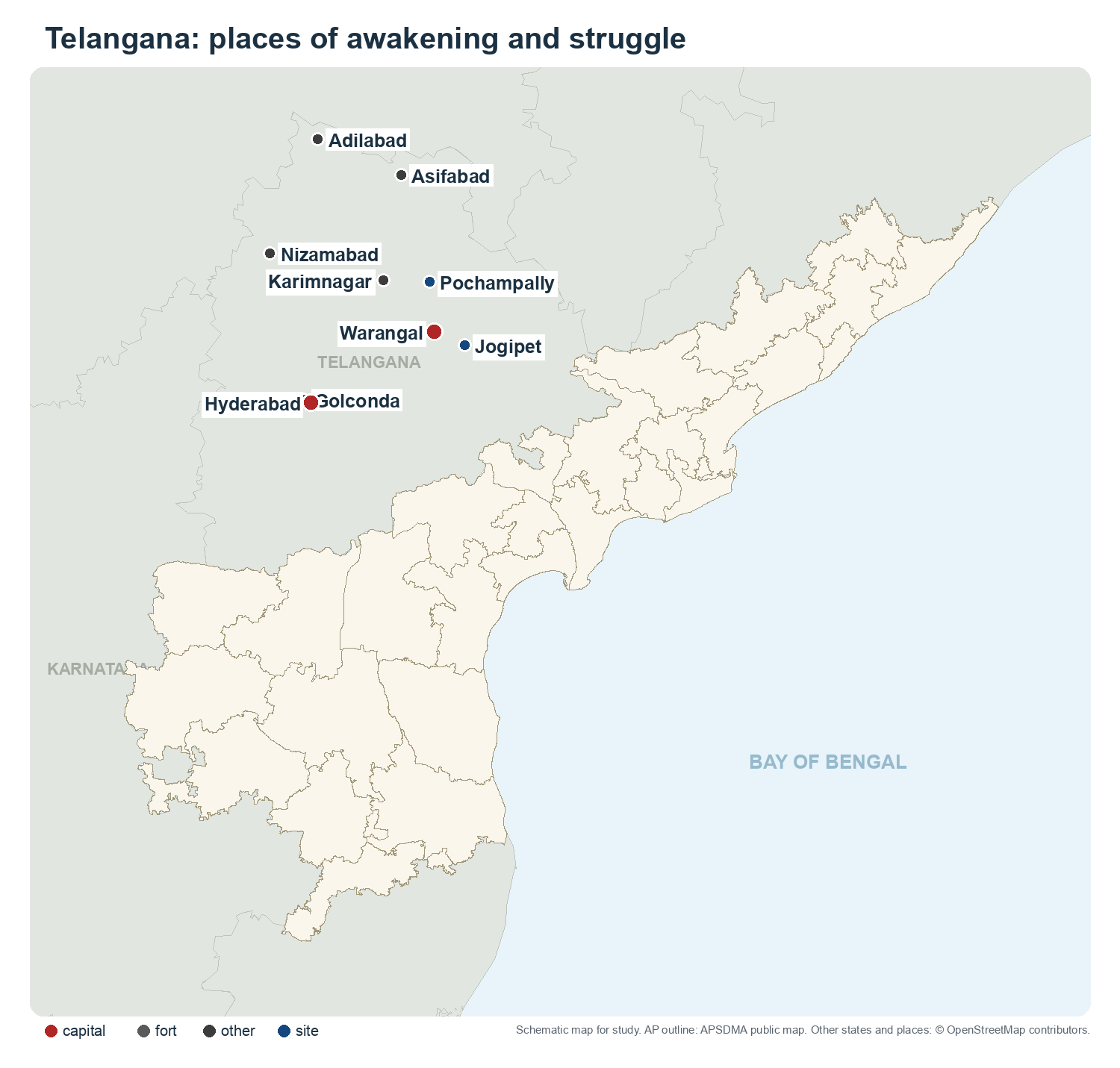
Telangana is the northern Telugu region. Major centres are Hyderabad, Warangal, Nizamabad, Karimnagar, Adilabad and Golconda. Earlier chapters showed that Warangal was the capital of the Kakatiya dynasty. Golconda was the fort-capital of the Qutb Shahis, and Hyderabad became the capital of Hyderabad State under the Nizams. The Nizam was a princely ruler under British paramountcy.
Cultural awakening under the Nizam
Under princely rule, Telugu language and culture had little official support. A cultural awakening grew through reading rooms, schools and societies.
| Year | Institution / event |
|---|---|
| 1913 | First Andhra conference at Bapatla (Andhra side) |
| 1918 | Osmania University founded at Hyderabad |
| 1930 | Andhra Mahasabha founded; first session at Jogipet under Suravaram Pratap Reddy |
| 1938 | Hyderabad State Congress formed |
| 1946 | Beginning of the Telangana Armed Struggle |
| 1948 | Operation Polo; Hyderabad State merges with the Union |
| 1952 | Hyderabad Legislative Assembly |
Madapati Hanumantha Rao, called Andhra Pitamaha, led the Andhra Mahasabha in Telangana. Suravaram Pratap Reddy presided at its first session. Swami Ramananda Tirtha led the Hyderabad State Congress. Sarojini Naidu, called the Nightingale of India, was born at Hyderabad.
Tribal and peasant resistance
The Gond tribal revolt of Adilabad was led by Komaram Bheem. It is a famous Telangana tribal uprising. The Gonds of Adilabad lived in forest areas, and the revolt stood for rights over land and forest. The Telangana Armed Struggle (from 1946) was a peasant struggle against landlords and the feudal order. Do not mix it with the Rampa Rebellion (1922), which was in the Eastern Ghats under Alluri Sitarama Raju.
Hyderabad joins India
India became independent in 1947. Hyderabad State did not join at once. Operation Polo, in 1948, merged Hyderabad State into the Indian Union. Burgula Ramakrishna Rao, born at Padakal, became the first elected Chief Minister of Hyderabad State in 1952. In 1948 the Dhar Commission and the JVP Committee studied linguistic states.
The Bhoodan Movement of Vinoba Bhave began in 1951 at Pochampally, a village in Telangana.
Merger with Andhra, 1956
The States Reorganisation Commission, chaired by Fazl Ali, reported in 1955. The States Reorganisation Act of 1956 created Andhra Pradesh, with Hyderabad as capital. The Gentlemen's Agreement of 1956 gave safeguards to Telangana. Telangana leaders had some doubts about the merger, and the safeguards were meant to ease them.
The statehood movement
| Year | Event |
|---|---|
| 1969 | Jai Telangana Movement; Telangana Praja Samithi (founder M. Chenna Reddy) |
| 1972 | Jai Andhra Movement in reply |
| 1973 | Six Point Formula; Thirty-second Constitutional Amendment |
| 1976 | Kakatiya University at Warangal |
| 2001 | Telangana Rashtra Samithi founded by K. Chandrashekar Rao |
| 2010 | Srikrishna Committee, chaired by B. N. Srikrishna |
| 2014 | Andhra Pradesh Reorganisation Act; Telangana State formed |
Article 371D deals with public employment in Andhra Pradesh. Under Article 3 Parliament can form new states; Article 2 covers admission of new states. K. Chandrashekar Rao became the first Chief Minister of Telangana, with Hyderabad as capital.
Timeline in one view
| Phase | Years | Key point |
|---|---|---|
| Kakatiya age | Medieval | Warangal capital |
| Qutb Shahi age | Medieval | Golconda and Hyderabad |
| Nizam's State | Until 1948 | Capital Hyderabad |
| Merger into India | 1948 | Operation Polo |
| Hyderabad State | 1948-56 | Burgula Ramakrishna Rao first CM; Assembly in 1952 |
| Andhra Pradesh | 1956-2014 | Hyderabad as capital |
| Telangana State | 2014 | Hyderabad as capital |
Why the demand for a separate state arose
After 1956 many Telangana people felt that jobs, educational seats, land and funds were not being shared fairly. The Gentlemen's Agreement had promised safeguards, and complaints about them led to the Jai Telangana Movement in 1969. The Telangana Praja Samithi, founded by M. Chenna Reddy, was its political face. The Jai Andhra Movement of 1972 was a counter-protest from the other regions. The Six Point Formula of 1973 and the Thirty-second Constitutional Amendment tried to settle the matter through rules for public employment, which the Thirty-second Amendment placed in the Constitution as Article 371D.
Parties and leaders linked with the story:
| Party / person | Link |
|---|---|
| Telugu Desam Party (1982) | Founded by N. T. Rama Rao |
| Telangana Praja Samithi (1969) | M. Chenna Reddy |
| Telangana Rashtra Samithi (2001) | K. Chandrashekar Rao |
| Srikrishna Committee (2010) | B. N. Srikrishna |
| Hyderabad State Congress (1938) | Swami Ramananda Tirtha |
| Andhra Mahasabha (1930) | Madapati Hanumantha Rao, Suravaram Pratap Reddy |
Two-way links with Andhra regions
The 1956 merger joined three regions: Coastal Andhra, Rayalaseema and Telangana. Each had a separate history. Coastal Andhra was under the Madras Presidency, Rayalaseema was in the Ceded Districts handed to the British by the Nizam in 1800, and Telangana was under the Nizam. This explains why the Sri Bagh Pact (for Rayalaseema, 1937) and the Gentlemen's Agreement (for Telangana, 1956) were needed.
Hyderabad and the wider freedom story
In 1857 Turrebaz Khan led an attack on the British Residency at Hyderabad. This was Hyderabad's link with the First War of Independence. The Nizam ceded the Ceded Districts to the British in 1800, and the Northern Circars passed to the British in 1765. During the national movement, leaders from Hyderabad took part too: Sarojini Naidu became the first Indian woman President of the Indian National Congress (Kanpur, 1925). The Bhoodan Movement, which asked landlords to gift land to the landless, began at Pochampally in 1951, soon after the Telangana struggle, and showed the same concern for land.
Universities and symbols of Telangana
Osmania University (Hyderabad) is from 1918. Kakatiya University (Warangal) and Nagarjuna University (Guntur) were both founded in 1976, but only Kakatiya is in Telangana. Warangal and Golconda recall the Kakatiya and Qutb Shahi past. Telugu literature of the period is also remembered: Tikkana (Ubhayakavimitra), Nannaya (Adi Parvam) and Errana (Aranya Parvam) completed the Andhra Mahabharatam, and Krishnadevaraya is called Andhra Bhoja.
Remember the order of the big steps: awakening (1918-1938), struggle (1946), merger (1948), Assembly (1952), Andhra Pradesh (1956), movements (1969-1973), party politics (2001), committee (2010), statehood (2014). Questions often ask which came first, so learn the chain, not single dates.
Exam traps
- Telangana Armed Struggle began in 1946; Operation Polo was 1948.
- Andhra Mahasabha (1930) is not the same as Hyderabad State Congress (1938).
- Madapati Hanumantha Rao is Andhra Pitamaha; Suravaram Pratap Reddy chaired the first session.
- Komaram Bheem led the Gonds of Adilabad; Alluri Sitarama Raju led the Rampa Rebellion.
- Sri Bagh Pact (1937) is for Rayalaseema; Gentlemen's Agreement (1956) is for Telangana.
- Jai Telangana (1969) comes before Jai Andhra (1972).
- TRS (2001) and TDP (1982) are different parties.
- Telangana State was formed in 2014, not in 1956.
One-liners
- 1. Capital of Hyderabad State: Hyderabad.
- 2. Operation Polo: 1948.
- 3. Telangana Armed Struggle began: 1946.
- 4. Osmania University: 1918.
- 5. Andhra Mahasabha: 1930.
- 6. Hyderabad State Congress: 1938.
- 7. Burgula Ramakrishna Rao was the first CM of Hyderabad State.
- 8. Telangana Praja Samithi (1969) was founded by M. Chenna Reddy.
- 9. Telangana Rashtra Samithi: 2001, K. Chandrashekar Rao.
- 10. Telangana State: 2014; Hyderabad is its capital.
Background and context
Telangana is the northern Telugu-speaking region of the Deccan. For centuries it was ruled from its own centres. Warangal was the Kakatiya capital. Golconda was the fort-capital of the Qutb Shahis. The city of Hyderabad grew out of that Qutb Shahi world and later became the capital of the Nizams.
The Nizam dynasty began with Asaf Jah I in 1724. Its seventh and last ruler, Mir Osman Ali Khan, held the throne from 1911 to 1948. The Nizam was a princely ruler under British paramountcy. This means the British controlled his defence and foreign affairs, while he ruled the inside of his state. Power in the state was absolute. The Nizam made the laws and could appoint or dismiss his ministers. A Legislative Council came in 1893 and an Executive Council in 1919, yet neither put any limit on him, and the assembly of later years only gave advice, with few seats for Hindus and other minorities. Even so, the state ran its own coin, railway, bank and coal mines.
This state was not Telugu in character. People who spoke Telugu, Marathi and Kannada lived under the same rule, and the Telugu speakers felt that their language had little place in higher education and public life. This is the root of the "awakening" that this chapter follows.
Remember also that Telangana's past was different from that of Coastal Andhra and Rayalaseema. Coastal Andhra came under the Madras Presidency. The Northern Circars passed to the British in 1765. Rayalaseema, the Ceded Districts, was handed to the British by the Nizam in 1800. Telangana stayed under the Nizam until 1948. This is why the 1956 merger of the three regions needed written safeguards.
Political history: from awakening to the merger
Causes of the awakening. There were three main causes. First, Telugu speakers had little place in official life. In November 1921, at a social conference in Hyderabad, a speaker who began in Telugu was shouted down. Young people then formed a Telugu association, the Andhra Jana Sangham, to protect their language. Second, Urdu was favoured in higher education. Osmania University, founded in 1918 after a firman of 1917, was the first university in Hyderabad. It taught through Urdu, with English as a compulsory subject. Telugu students therefore found the university closed to their mother tongue. Third, the national movement and the Andhra movement in the Madras side of Telugu country gave new ideas and new hope.
The Andhra Mahasabha (1930). The Andhra Jana Sangham grew into the Andhra Mahasabha. Madapati Hanumantha Rao, called Andhra Pitamaha, was its guiding figure. Its first formal conference was held at Jogipet in 1930 under the chair of Suravaram Pratapa Reddy. Thirteen such conferences took place up to 1945. They passed resolutions on social matters such as child marriage and widow remarriage. They also made ordinary people aware of how they were ruled. In its early years the body was a cultural and social body, not a party. Later, communist workers took over much of its work among the peasants. Do not mix it with the Hyderabad State Congress.
The Hyderabad State Congress (1938). This was a political body for responsible government in the Nizam's state. Swami Ramananda Tirtha was its best-known leader. The Nizam's government restricted it. Its members often faced bans and arrests, and the leaders took part in satyagraha for civil rights. Ramananda Tirtha is also linked with the later Telangana story because he supported the peasant cause.
Tribal revolt under Komaram Bheem. The forest peoples fought a separate fight from the Mahasabha's educated leaders, and Komaram Bheem became the great hero of the Gonds of Adilabad. He was born in 1901 into the Gond community near Asifabad, among a people who were losing land to landlords, paying tax for their old ways of farming and facing trouble from forest guards. His father is said to have been killed by forest officials. In 1928 he began a guerrilla struggle based at Jodeghat, and he is credited with the slogan "Jal, Jangal, Zameen" (water, forest, land). Police killed him in an encounter in October 1940. Do not confuse him with Alluri Sitarama Raju, who led the Rampa Rebellion of 1922 in the Eastern Ghats on the Madras side.
The Telangana Armed Struggle (1946-1951). This was the largest peasant rising of the region. Its causes were economic. Large landlords, called doras, held huge estates. They forced the poor to give free labour (vetti) and kept families in debt bondage. Crop prices, the shift to cash crops and the hard years after the world depression made things worse. The Communist Party worked among the peasants through the Andhra Mahasabha platform. On 4 July 1946 the landlord's men fired on a procession of peasants at Kadavendi in the Warangal area. The communist organiser Doddi Komarayya was killed. The peasants burned the landlord's house, and the rising spread. The rebels formed village councils called gram rajyams. They took land and shared it, and they tried to reduce caste divisions.
Independence and the Nizam's choice. India became independent in 1947. The Nizam did not join India or Pakistan. He wanted to remain independent. He also refused to send members to the Constituent Assembly. A standstill agreement was signed with India for a time. During these months a private force called the Razakars, led by Kasim Razvi, supported the Nizam and attacked villagers. The rebels fought against this force as well as against landlords. The Nizam took the matter to the United Nations Security Council in August 1948.
Operation Polo (September 1948). On 13 September 1948 the Indian Army moved into Hyderabad from several sides. The Nizam's forces gave up on 17 September. This action is called Operation Polo, and also "police action" in older books. Major General J. N. Chaudhuri then ran the state for a time under military rule. The Nizam accepted the Constitution of India by a firman on 24 November 1949. He became the Rajpramukh (head of the state) on 26 January 1950, when the Constitution came into force. The Indian Army later moved against the village councils, and the Communist Party ended the armed struggle with a call on 21 October 1951. Note the order: the struggle began in 1946, before Operation Polo, and ended in 1951, after it.
Hyderabad State, 1948-56. The people elected the Hyderabad Legislative Assembly in 1952. Burgula Ramakrishna Rao, who was born at Padakal, became the first elected Chief Minister. In these years a new quarrel started. Officials from outside, brought in from Madras and Bombay states, held many posts. Telangana people asked that the old Mulki rules be applied. These rules, in force since 1919, reserved jobs for natives of the state. At the same time, Vinoba Bhave began the Bhoodan Movement at Pochampally in 1951. It asked landlords to give land to the landless, and it reflected the same land hunger that had driven the struggle.
Reorganisation, 1953-56. The States Reorganisation Commission, headed by Fazl Ali, was appointed in December 1953 and reported in 1955. It did not ask for an immediate merger of Telangana with Andhra. It suggested a separate Telangana state, with a chance to unite after the general elections of 1961-62, if the Telangana assembly passed the proposal by a two-thirds vote. Leaders of both regions instead agreed to the Gentlemen's Agreement of 1956. It offered safeguards such as a Regional Council for Telangana's development. Hyderabad State was then split, and its Telugu-speaking part joined Andhra State on 1 November 1956 to form Andhra Pradesh, with Hyderabad as capital.
Administration and economy
The Nizam's state mixed modern features with an old feudal order. The modern side included a railway opened in 1875 (the Nizam's Guaranteed State Railway), the Singareni coal mines (1920), Deccan Airways (1945), a state bank and its own rupee. State income grew strongly in the early twentieth century, and the Nizam was often called one of the richest men in the world.
On the land side, the system gave power to big landlords and village headmen with tax rights. The poor farmers paid heavy dues, and the landlords took free labour. These conditions explain why Telangana had a deeper peasant revolt than most regions. The causes were economic first. The language question came second.
After 1956 the economy became part of the political argument. Telangana lies across the middle course of both the Krishna and the Godavari, whose upper catchments are in Maharashtra and Karnataka. Telangana leaders said that the coastal districts used more of the irrigation water and that Telangana students and workers lost seats and jobs. These complaints were repeated in many later reports. Treat them as the arguments of the movement, not as settled facts.
Society, religion and culture
Hyderabad was a city of mixed cultures, with Urdu in the university and Telugu in the villages. Osmania University pioneered the use of Urdu in higher teaching in India. The city also gave India a famous woman leader. Sarojini Naidu, called the Nightingale of India, was born at Hyderabad. She became the first Indian woman President of the Indian National Congress at Kanpur in 1925.
Reading rooms, libraries and societies were the base of the awakening. The Andhra Mahasabha used Telugu for its meetings and resolutions. The Telugu literary memory of Warangal and Golconda gave pride to the movement. Earlier chapters on the Kakatiyas and the Qutb Shahis tell that story. The Bhoodan Movement of 1951 added a moral strand to the story of land reform.
Two points should be kept clear. First, the Mahasabha and the Hyderabad State Congress served different aims. The first was about culture, language and social change; the second was about political rights. Second, the tribal fights of the Gonds, the peasant struggle of the 1940s and the Congress movement ran side by side. They did not form one single movement under one leader.
Decline, legacy and sites to know
The movement for a separate state. After 1956, safeguards in the Gentlemen's Agreement were not accepted by many Telangana people as fully kept. The Jai Telangana Movement began in 1969. M. Chenna Reddy led the Telangana Praja Samithi (founded 1969 by Madan Mohan), which won 10 of the 14 Telangana Lok Sabha seats in May 1971. P. V. Narasimha Rao became Chief Minister in September 1971 to calm the situation. In 1972 the Supreme Court upheld the Mulki rules. People of the coastal districts felt this was unfair to them and began the Jai Andhra Movement. The Six Point Formula of 1973 tried to settle both sides. The Thirty-second Constitutional Amendment gave it a place in the Constitution as Article 371D, which deals with public employment and education in Andhra Pradesh. In 1985 a government order, G.O. 610, tried to correct recruitment.
Statehood. K. Chandrashekar Rao founded the Telangana Rashtra Samithi in April 2001. A fast-unto-death by him in 2009 raised the demand again. The Centre set up the Srikrishna Committee, headed by Justice B. N. Srikrishna, in February 2010. The Telangana Bill passed the Lok Sabha on 18 February 2014 and the Rajya Sabha on 20 February 2014. Telangana State came into being on 2 June 2014 under the Andhra Pradesh Reorganisation Act. K. Chandrashekar Rao became the first Chief Minister. Under Article 3, Parliament may form a new state by law.
Rulers and bodies (reference table).
| Body or ruler | Year | Link |
|---|---|---|
| Asaf Jah I | 1724 | Founder of the Nizam dynasty |
| Mir Osman Ali Khan | 1911-1948 | Last Nizam |
| Osmania University | 1918 | First university in Hyderabad; Urdu medium |
| Andhra Mahasabha | 1930 | First conference at Jogipet, Suravaram Pratapa Reddy presiding |
| Hyderabad State Congress | 1938 | Swami Ramananda Tirtha |
| Komaram Bheem killed | 1940 | Gond leader of Jodeghat |
| Telangana Armed Struggle | 1946-1951 | Began at Kadavendi, 4 July 1946 |
| Operation Polo | 13-17 Sept 1948 | Hyderabad merged into India |
| Legislative Assembly | 1952 | Burgula Ramakrishna Rao first elected CM |
| Andhra Pradesh formed | 1956 | Gentlemen's Agreement |
| Telangana Rashtra Samithi | 2001 | K. Chandrashekar Rao |
| Telangana State | 2014 | Hyderabad capital |
Places and what each recalls.
| Place | What it recalls |
|---|---|
| Hyderabad | Nizam's capital; Osmania University; capital of Telangana |
| Warangal | Kakatiya capital; seat of Kakatiya University (1976) |
| Golconda | Qutb Shahi fort-capital |
| Jogipet | First Andhra Mahasabha conference (1930) |
| Jodeghat | Base of Komaram Bheem |
| Kadavendi | Start of the armed struggle (1946) |
| Pochampally | Start of the Bhoodan Movement (1951) |
| Padakal | Birthplace of Burgula Ramakrishna Rao |
Legacy. The story of Telangana shows how language, land and local pride can shape a state. Its history also links to national events: Hyderabad's merger completed the political integration of India in the south, the Bhoodan Movement became a national land-gift campaign, and the demand for Telangana was settled through the process of Article 3 of the Constitution.
How examiners use this chapter
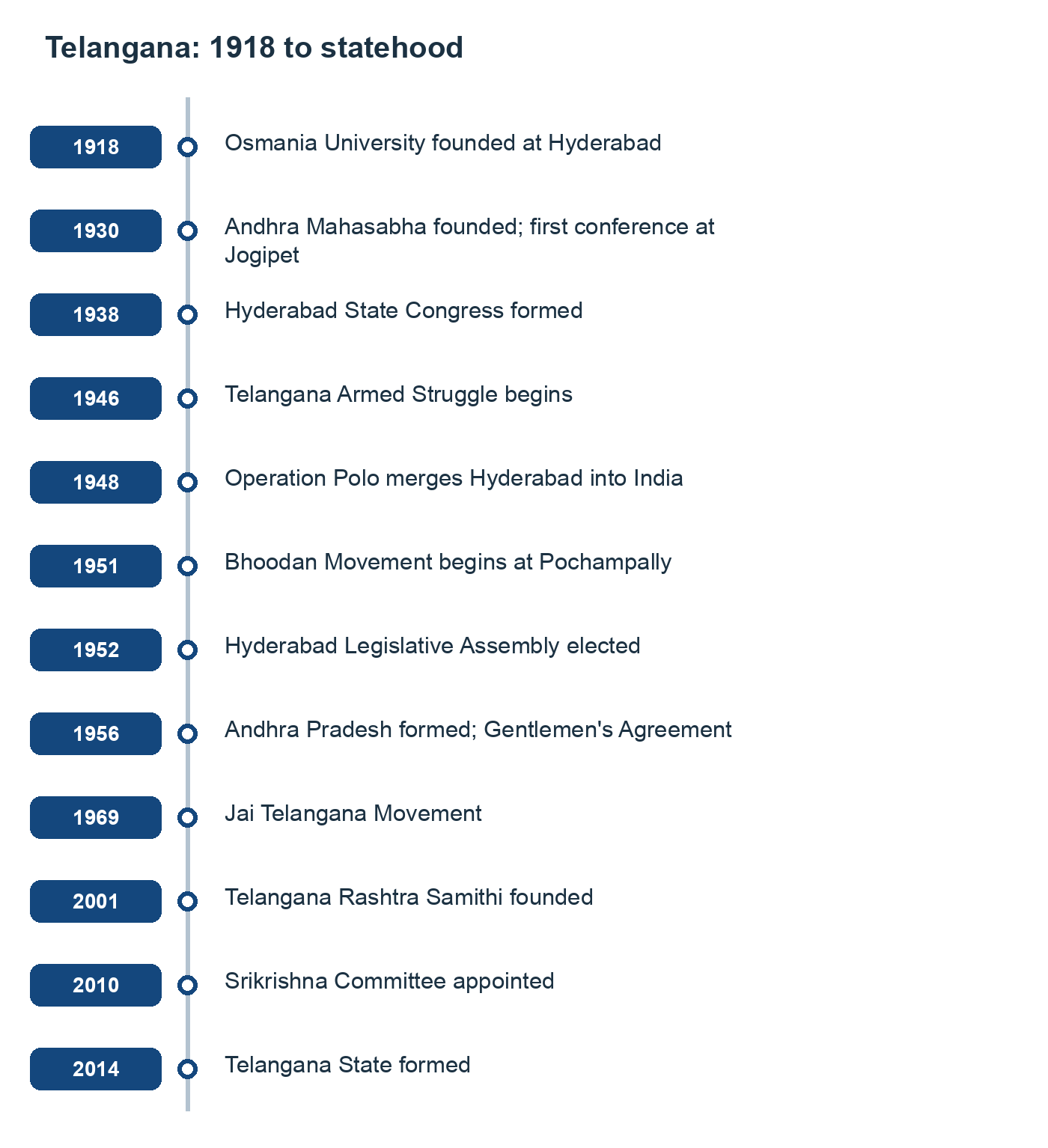
- Order of events. Osmania University (1918), Andhra Mahasabha (1930), Hyderabad State Congress (1938), the Armed Struggle (1946), Operation Polo (1948), Assembly (1952), Andhra Pradesh (1956), Jai Telangana (1969), TRS (2001), Srikrishna Committee (2010), Telangana (2014). Learn the whole chain.
- Pairs of look-alike bodies. Andhra Mahasabha (Madapati Hanumantha Rao, first conference chaired by Suravaram Pratapa Reddy) against Hyderabad State Congress (Swami Ramananda Tirtha).
- Two tribal leaders. Komaram Bheem (Gonds, Adilabad, "Jal, Jangal, Zameen") and Alluri Sitarama Raju (Rampa, 1922).
- Two pacts. Sri Bagh Pact (1937, Rayalaseema) and Gentlemen's Agreement (1956, Telangana).
- Places with firsts. Jogipet (first Mahasabha conference), Pochampally (Bhoodan), Kadavendi (start of the 1946 rising).
- Posts and people. Burgula Ramakrishna Rao was the first elected Chief Minister of Hyderabad State. K. Chandrashekar Rao was the first Chief Minister of Telangana.
- Constitution links. Article 371D (public employment, from the Six Point Formula and the 32nd Amendment) and Article 3 (formation of states).
- Universities. Osmania (Hyderabad, 1918) against Kakatiya (Warangal, 1976) and Nagarjuna (Guntur, 1976). When years are equal, the place decides.
Worked cases
Case 1: Arrange in order: Operation Polo; Hyderabad Legislative Assembly; beginning of the Telangana Armed Struggle; Osmania University founded.
Reasoning:
- 1. Osmania University is the oldest step, founded in 1918 at Hyderabad.
- 2. The Telangana Armed Struggle began in 1946.
- 3. Operation Polo merged Hyderabad State with the Union in 1948. Independence (1947) came between the struggle and the merger.
- 4. The Hyderabad Legislative Assembly came after the merger, in 1952.
- 5. Order: 1918, 1946, 1948, 1952.
Takeaway: Struggle first, merger next, elected assembly last. Do not put Polo before the struggle.
Case 2: Match the leader to the movement: Komaram Bheem; Alluri Sitarama Raju; Swami Ramananda Tirtha; Madapati Hanumantha Rao.
Reasoning:
- 1. Find the tribal revolts. Komaram Bheem led the Gonds of Adilabad, which is in Telangana. Alluri Sitarama Raju led the Rampa Rebellion of 1922 in the Eastern Ghats.
- 2. Find the two groups under the Nizam. Swami Ramananda Tirtha led the Hyderabad State Congress (1938).
- 3. Madapati Hanumantha Rao, called Andhra Pitamaha, led the Andhra Mahasabha (1930) in Telangana.
- 4. The two tribal leaders and the two Telangana organisers do not swap.
Takeaway: Sort names by region and type (tribal revolt or political body) before you match.
Case 3: Which of these is NOT a Telangana institution? Osmania University, Kakatiya University, Nagarjuna University.
Reasoning:
- 1. Osmania University is at Hyderabad and dates from 1918.
- 2. Kakatiya University is at Warangal. Warangal was the Kakatiya capital.
- 3. Nagarjuna University is at Guntur in Coastal Andhra.
- 4. Both Kakatiya and Nagarjuna universities date from 1976, so the year does not help. Use place.
Takeaway: When two items share a year, the place decides the answer.
Case 4: Why were both the Sri Bagh Pact and the Gentlemen's Agreement needed? Pick the best reason.
Reasoning:
- 1. The 1956 merger joined three regions with different pasts.
- 2. Coastal Andhra was in the Madras Presidency. Rayalaseema came from the Ceded Districts, given to the British by the Nizam in 1800. Telangana was under the Nizam.
- 3. Each region feared that the larger coastal region would dominate.
- 4. So one pact protected Rayalaseema (1937) and the other protected Telangana (1956).
Takeaway: A "why" question about safeguards points to regional fear and different history.
Compare and contrast
| Point | Andhra Mahasabha | Hyderabad State Congress |
|---|---|---|
| Year | 1930 | 1938 |
| Leaders named | Madapati Hanumantha Rao; Suravaram Pratap Reddy | Swami Ramananda Tirtha |
| Nature | Cultural and social awakening under the Nizam | Political body of the Congress in Hyderabad State |
| Quick memory | First session at Jogipet | Led before the 1948 merger |
| Point | 1946 | 1948 | 1952 |
|---|---|---|---|
| Event | Telangana Armed Struggle begins | Operation Polo; merger; Dhar and JVP | Hyderabad Legislative Assembly |
| Type | Peasant struggle against landlords | Military and political merger | Elected body |
| Person | Not a single leader | Hyderabad State merges with the Union | Burgula Ramakrishna Rao, first elected Chief Minister |
Sequence and timeline
- 1. 1765: Northern Circars passed to the British
- 2. 1800: Nizam ceded the Ceded Districts to the British
- 3. 1857: Turrebaz Khan attacked the British Residency at Hyderabad
- 4. 1918: Osmania University
- 5. 1930: Andhra Mahasabha
- 6. 1938: Hyderabad State Congress
- 7. 1946: Telangana Armed Struggle begins
- 8. 1947: India independent
- 9. 1948: Operation Polo
- 10. 1951: Bhoodan Movement begins at Pochampally
- 11. 1952: Hyderabad Legislative Assembly
- 12. 1955: SRC report
- 13. 1956: Andhra Pradesh; Gentlemen's Agreement
- 14. 1969: Jai Telangana and Telangana Praja Samithi
- 15. 1973: Six Point Formula; Thirty-second Amendment
- 16. 2001: Telangana Rashtra Samithi
- 17. 2010: Srikrishna Committee
- 18. 2014: Telangana State
More one-liners
- 1. Article 356 deals with President's rule in states.
- 2. Article 352 deals with national emergency.
- 3. Article 360 deals with financial emergency.
- 4. Article 368 deals with amendment of the Constitution.
- 5. Provincial Constitution Committee chair: Vallabhbhai Patel.
- 6. Fundamental Rights Committee chair: J. B. Kripalani.
- 7. Constitution adopted in 1949 and in force in 1950.
- 8. First meeting of the Constituent Assembly: 1946.
- 9. Planning Commission and Election Commission: 1950.
- 10. Finance Commission: 1951.
- 11. Maharashtra and Gujarat were formed in 1960; Punjab and Haryana in 1966.
- 12. Chhattisgarh, Uttarakhand and Jharkhand were formed in 2000.
- 13. Hitakarini Samajam: 1906.
- 14. Jaipur session of the Indian National Congress was chaired by Bhogaraju Pattabhi Sitaramayya.
- 15. Madras Presidency capital: Madras.
Practice questions
Arrange the following in chronological order: (1) Six-Point Formula (2) Srikrishna Committee report (3) Gentlemen's Agreement (4) Formation of Telangana State
- 3, 2, 1, 4
- 1, 3, 4, 2
- 3, 1, 4, 2
- 3, 1, 2, 4
Answer
D. 3, 1, 2, 4
The order is Gentlemen's Agreement (1956), Six-Point Formula (1973), Srikrishna report (2010), Telangana formation (2014).
కింది వాటిని కాలక్రమానుసారంగా అమర్చండి: (1) ఆరు సూత్రాల పథకం (2) శ్రీకృష్ణ కమిటీ నివేదిక (3) పెద్దమనుషుల ఒప్పందం (4) తెలంగాణ రాష్ట్ర ఏర్పాటు
- 3, 2, 1, 4
- 1, 3, 4, 2
- 3, 1, 4, 2
- 3, 1, 2, 4
Who was the first Vice-Chancellor of Andhra University?
- C. R. Reddy
- Bhogaraju Pattabhi Sitaramayya
- K. Chandrashekar Rao
- C. M. Trivedi
Answer
A. C. R. Reddy
ఆంధ్ర విశ్వవిద్యాలయం మొదటి ఉపకులపతి ఎవరు?
- సి. ఆర్. రెడ్డి
- భోగరాజు పట్టాభి సీతారామయ్య
- కె. చంద్రశేఖరరావు
- సి. ఎం. త్రివేది
Who was the first Chief Minister of Telangana?
- K. Chandrashekar Rao
- C. M. Trivedi
- Bhogaraju Pattabhi Sitaramayya
- C. R. Reddy
Answer
A. K. Chandrashekar Rao
తెలంగాణ మొదటి ముఖ్యమంత్రి ఎవరు?
- కె. చంద్రశేఖరరావు
- సి. ఎం. త్రివేది
- భోగరాజు పట్టాభి సీతారామయ్య
- సి. ఆర్. రెడ్డి
Consider the following pairs (Office – Person): (i) first elected Chief Minister of Hyderabad State – Burgula Ramakrishna Rao (ii) first Chief Justice of the Telangana High Court – T. B. Radhakrishnan (iii) first Indian space observatory – Astrosat Which of the pairs are correctly matched?
- Only (i) and (iii)
- Only (ii)
- All of (i), (ii) and (iii)
- Only (ii) and (iii)
Answer
C. All of (i), (ii) and (iii)
ఈ క్రింది జతలను పరిశీలించండి (పదవి – వ్యక్తి): (i) హైదరాబాద్ రాష్ట్ర మొదటి ఎన్నికైన ముఖ్యమంత్రి – బూర్గుల రామకృష్ణారావు (ii) తెలంగాణ హైకోర్టు మొదటి ప్రధాన న్యాయమూర్తి – టి. బి. రాధాకృష్ణన్ (iii) తొలి భారత అంతరిక్ష అబ్జర్వేటరీ – ఆస్ట్రోశాట్ సరిగ్గా జతపరచబడినవి ఏవి?
- (i), (iii) మాత్రమే
- (ii) మాత్రమే
- (i), (ii), (iii) అన్నీ
- (ii), (iii) మాత్రమే
Who led the 1922-24 Rampa rebellion?
- Duggirala Gopala Krishnaiah
- Tanguturi Prakasam
- Pingali Venkayya
- Alluri Sitarama Raju
Answer
D. Alluri Sitarama Raju
Alluri led the Rampa/Manyam struggle in the Agency forest region.
1922-24 రంప తిరుగుబాటుకు నాయకత్వం వహించినవారు ఎవరు?
- దుగ్గిరాల గోపాలకృష్ణయ్య
- టంగుటూరి ప్రకాశం
- పింగళి వెంకయ్య
- అల్లూరి సీతారామరాజు
Which Telangana leader is known as 'Andhra Pitamaha'?
- Madapati Hanumantha Rao
- Tanguturi Prakasam
- Burgula Ramakrishna Rao
- Suravaram Pratapa Reddy
Answer
A. Madapati Hanumantha Rao
Madapati Hanumantha Rao, a pioneer of the Andhra movement in Hyderabad, bears this title.
'ఆంధ్ర పితామహ' అని పిలువబడే తెలంగాణ నాయకుడు ఎవరు?
- మాడపాటి హనుమంతరావు
- టంగుటూరి ప్రకాశం
- బూర్గుల రామకృష్ణారావు
- సురవరం ప్రతాపరెడ్డి
Before becoming Prime Minister, P.V. Narasimha Rao served as Chief Minister of:
- Andhra Pradesh
- Maharashtra
- Karnataka
- Tamil Nadu
Answer
A. Andhra Pradesh
He was Chief Minister of Andhra Pradesh from 1971 to 1973.
ప్రధానమంత్రి కాకముందు పి.వి. నరసింహారావు ఏ రాష్ట్ర ముఖ్యమంత్రిగా పనిచేశారు?
- ఆంధ్రప్రదేశ్
- మహారాష్ట్ర
- కర్ణాటక
- తమిళనాడు
In the 1983 Assembly election, the Telugu Desam Party ended the long rule of which party in the state?
- Communist Party of India
- Bharatiya Janata Party
- Janata Party
- Indian National Congress
Answer
D. Indian National Congress
Congress had governed the state since its formation.
1983 అసెంబ్లీ ఎన్నికల్లో తెలుగుదేశం పార్టీ రాష్ట్రంలో ఏ పార్టీ సుదీర్ఘ పాలనను ముగించింది?
- భారత కమ్యూనిస్టు పార్టీ
- భారతీయ జనతా పార్టీ
- జనతా పార్టీ
- భారత జాతీయ కాంగ్రెస్
With communist support, who became first CM of Andhra State?
- Tanguturi Prakasam
- Bezawada Gopala Reddy
- N.G. Ranga
- Neelam Sanjiva Reddy
Answer
A. Tanguturi Prakasam
Prakasam became CM.
కమ్యూనిస్టుల మద్దతుతో ఆంధ్ర రాష్ట్ర మొదటి ముఖ్యమంత్రి ఎవరు?
- టంగుటూరి ప్రకాశం
- బెజవాడ గోపాలరెడ్డి
- ఎన్.జి. రంగా
- నీలం సంజీవరెడ్డి
Who was president of the Jaipur Congress session of that time?
- Nehru
- Patel
- Bhogaraju Pattabhi Sitaramayya
- Prakasam
Answer
C. Bhogaraju Pattabhi Sitaramayya
Pattabhi was the Congress president.
JVP కమిటీ సమావేశానికి అధ్యక్షత వహించిన వారు ఎవరు?
- నెహ్రూ
- పటేల్
- భోగరాజు పట్టాభి సీతారామయ్య
- ప్రకాశం
Which districts were in Zone 3?
- Kadapa, Kurnool, Chittoor, Anantapur
- Guntur, Prakasam, Nellore
- Warangal, Adilabad, Karimnagar
- Hyderabad, Medak
Answer
B. Guntur, Prakasam, Nellore
Zone 3: Guntur, Prakasam, Nellore.
3వ జోన్లో ఏ జిల్లాలు ఉన్నాయి?
- కడప, కర్నూలు, చిత్తూరు, అనంతపురం
- గుంటూరు, ప్రకాశం, నెల్లూరు
- వరంగల్, ఆదిలాబాద్, కరీంనగర్
- హైదరాబాద్, మెదక్
Arrange the following in chronological order (earliest first): (i) Dutch Factory at Masulipatnam (ii) Telangana Praja Samithi (iii) Telugu Desam Party (iv) Sri Venkateswara University
- (ii), (iii), (i), (iv)
- (iv), (ii), (iii), (i)
- (i), (iv), (ii), (iii)
- (iii), (iv), (ii), (i)
Answer
C. (i), (iv), (ii), (iii)
ఈ క్రింది వాటిని కాలక్రమానుసారం (పూర్వం నుండి తరువాతి వరకు) అమర్చండి: (i) మచిలీపట్నంలో డచ్ ఫ్యాక్టరీ (ii) తెలంగాణ ప్రజా సమితి (iii) తెలుగుదేశం పార్టీ (iv) శ్రీ వేంకటేశ్వర విశ్వవిద్యాలయం
- (ii), (iii), (i), (iv)
- (iv), (ii), (iii), (i)
- (i), (iv), (ii), (iii)
- (iii), (iv), (ii), (i)
Arrange the following in chronological order (earliest first): (i) Hyderabad State Congress (ii) Nagarjuna University (iii) Thanjavur Nayak dynasty (iv) Madras Mahajana Sabha
- (i), (iii), (ii), (iv)
- (iv), (iii), (i), (ii)
- (iii), (iv), (i), (ii)
- (i), (iii), (iv), (ii)
Answer
C. (iii), (iv), (i), (ii)
ఈ క్రింది వాటిని కాలక్రమానుసారం (పూర్వం నుండి తరువాతి వరకు) అమర్చండి: (i) హైదరాబాద్ స్టేట్ కాంగ్రెస్ (ii) నాగార్జున విశ్వవిద్యాలయం (iii) తంజావూరు నాయక వంశం (iv) మద్రాస్ మహాజన సభ
- (i), (iii), (ii), (iv)
- (iv), (iii), (i), (ii)
- (iii), (iv), (i), (ii)
- (i), (iii), (iv), (ii)
Under the Andhra Pradesh Reorganisation Act, 2014, the cash balances of the undivided State’s treasuries and banks are shared between the two successor States by
- Physically moving cash from one treasury to the other
- Payment in instalments over five years
- Allocation through the Finance Commission
- Adjusting the credit balances of the two States in the books of the Reserve Bank of India
Answer
D. Adjusting the credit balances of the two States in the books of the Reserve Bank of India
The Act provides for adjustment of the States’ credit balances in the RBI’s books rather than moving physical cash.
ఆంధ్రప్రదేశ్ పునర్వ్యవస్థీకరణ చట్టం, 2014 ప్రకారం ఉమ్మడి రాష్ట్ర ఖజానా, బ్యాంకు నిల్వలను రెండు రాష్ట్రాల మధ్య ఎలా పంపిణీ చేస్తారు?
- ఒక ఖజానా నుండి మరొక ఖజానాకు నగదును భౌతికంగా బదిలీ చేయడం
- ఐదేళ్లపాటు విడతల వారీగా చెల్లించడం
- ఆర్థిక సంఘం ద్వారా కేటాయించడం
- భారతీయ రిజర్వ్ బ్యాంకు పుస్తకాలలో రెండు రాష్ట్రాల జమ నిల్వలను సర్దుబాటు చేయడం
The Gentlemen's Agreement of 1956 was reached between leaders of:
- Rayalaseema and Coastal Andhra
- Andhra and Telangana
- Madras and Andhra
- Hyderabad and Maharashtra
Answer
B. Andhra and Telangana
It was signed in February 1956 by Andhra and Telangana leaders, setting safeguards for Telangana before the merger into Andhra Pradesh.
1956 నాటి పెద్దమనుషుల ఒప్పందం ఏ ప్రాంతాల నాయకుల మధ్య కుదిరింది?
- రాయలసీమ, కోస్తాంధ్ర
- ఆంధ్ర, తెలంగాణ
- మద్రాసు, ఆంధ్ర
- హైదరాబాద్, మహారాష్ట్ర
Which regions of Andhra Pradesh did the Act earmark for a special development package from the Centre?
- Krishna-Guntur delta
- Godavari delta
- Rayalaseema and north coastal Andhra
- Nellore and Prakasam only
Answer
C. Rayalaseema and north coastal Andhra
Section 46 provides for special development packages for the backward districts of Rayalaseema and north coastal Andhra.
కేంద్రం నుంచి ప్రత్యేక అభివృద్ధి ప్యాకేజీ ఇవ్వాల్సిన ఆంధ్రప్రదేశ్ ప్రాంతాలుగా చట్టం ఏవి పేర్కొంది?
- కృష్ణా-గుంటూరు డెల్టా
- గోదావరి డెల్టా
- రాయలసీమ, ఉత్తర కోస్తాంధ్ర
- నెల్లూరు, ప్రకాశం మాత్రమే
Who was the president of the National College set up at Machilipatnam in 1910?
- Konda Venkatappayya
- Kasinathuni Nageswara Rao
- Duggirala Gopalakrishnayya
- Kaleswara Rao
Answer
A. Konda Venkatappayya
Konda Venkatappayya presided over the Machilipatnam National College.
1910లో మచిలీపట్నంలో ప్రారంభమైన జాతీయ కళాశాలకు అధ్యక్షుడు ఎవరు?
- కొండా వెంకటప్పయ్య
- కాశీనాథుని నాగేశ్వరరావు
- దుగ్గిరాల గోపాలకృష్ణయ్య
- కాళేశ్వరరావు
Which became the first state of independent India formed on a linguistic basis (1953)?
- Andhra State
- Kerala
- Mysore
- Maharashtra
Answer
A. Andhra State
Andhra State was carved out of Madras State on 1 October 1953 for Telugu speakers.
స్వతంత్ర భారతదేశంలో భాషా ప్రాతిపదికన 1953లో ఏర్పడిన మొదటి రాష్ట్రం ఏది?
- ఆంధ్ర రాష్ట్రం
- కేరళ
- మైసూరు
- మహారాష్ట్ర
Which Act provided for a bicameral Legislative Council and Legislative Assembly in the Madras Presidency?
- Madras Removal of Civil Disabilities Act
- Government of India Act 1935
- Government of India Act 1919
- Untouchability (Offences) Act
Answer
B. Government of India Act 1935
మద్రాసు ప్రెసిడెన్సీలో ద్విసభా శాసన మండలి, శాసనసభను ఏర్పాటు చేసిన చట్టం ఏది?
- మద్రాసు పౌర అనర్హతల తొలగింపు చట్టం
- భారత ప్రభుత్వ చట్టం 1935
- భారత ప్రభుత్వ చట్టం 1919
- అంటరానితనం (నేరాలు) చట్టం
Which leader from Anantapur district became Chief Minister after the formation of Andhra Pradesh in 1956?
- T. Prakasam
- N. Sanjeeva Reddy
- B. Gopala Reddy
- K. N. Anantaraman
Answer
B. N. Sanjeeva Reddy
1956లో ఆంధ్రప్రదేశ్ ఏర్పడిన తరువాత ముఖ్యమంత్రి అయిన అనంతపురం జిల్లా నాయకుడు ఎవరు?
- టి. ప్రకాశం
- ఎన్. సంజీవరెడ్డి
- బి. గోపాలరెడ్డి
- కె. ఎన్. అనంతరామన్
Kasinathuni Nageswara Rao was the founder of which of the following?
- Ramakrishna Mission
- Andhra Patrika
- Tata Group
- Telugu Desam Party
Answer
B. Andhra Patrika
కాశీనాథుని నాగేశ్వరరావు ఈ క్రింది వాటిలో దేనికి స్థాపకుడు?
- రామకృష్ణ మిషన్
- ఆంధ్ర పత్రిక
- టాటా గ్రూప్
- తెలుగుదేశం పార్టీ
Consider the following pairs (Dynasty/Organisation – Founder): (i) Telangana Rashtra Samithi – K. Chandrashekar Rao (ii) Anandagotrika dynasty – Kandara (iii) Andhra Bank – Bhogaraju Pattabhi Sitaramayya Which of the pairs are correctly matched?
- Only (iii)
- Only (ii) and (iii)
- None of them
- All of (i), (ii) and (iii)
Answer
D. All of (i), (ii) and (iii)
ఈ క్రింది జతలను పరిశీలించండి (రాజవంశం/సంస్థ – స్థాపకుడు): (i) తెలంగాణ రాష్ట్ర సమితి – కె. చంద్రశేఖరరావు (ii) ఆనందగోత్రిక వంశం – కందరుడు (iii) ఆంధ్రా బ్యాంక్ – భోగరాజు పట్టాభి సీతారామయ్య సరిగ్గా జతపరచబడినవి ఏవి?
- (iii) మాత్రమే
- (ii), (iii) మాత్రమే
- ఏదీ కాదు
- (i), (ii), (iii) అన్నీ
Who was the first elected Chief Minister of Hyderabad State?
- J. N. Chaudhuri
- M. K. Vellodi
- Burgula Ramakrishna Rao
- Swami Ramanand Tirtha
Answer
C. Burgula Ramakrishna Rao
హైదరాబాద్ రాష్ట్ర మొదటి ఎన్నికైన ముఖ్యమంత్రి ఎవరు?
- జె. ఎన్. చౌదరి
- ఎం. కె. వెల్లోడి
- బూర్గుల రామకృష్ణారావు
- స్వామి రామానంద తీర్థ
Which of the following correctly describes Burgula Ramakrishna Rao?
- first Rajpramukh of Hyderabad State
- first Agent-General of India in Hyderabad
- first elected Chief Minister of Hyderabad State
- first Chief Minister of Hyderabad State
Answer
C. first elected Chief Minister of Hyderabad State
'బూర్గుల రామకృష్ణారావు' గురించిన సరైన వివరణ ఈ క్రింది వాటిలో ఏది?
- హైదరాబాద్ రాష్ట్ర మొదటి రాజ్ ప్రముఖ్
- హైదరాబాద్లో భారత మొదటి ఏజెంట్ జనరల్
- హైదరాబాద్ రాష్ట్ర మొదటి ఎన్నికైన ముఖ్యమంత్రి
- హైదరాబాద్ రాష్ట్ర మొదటి ముఖ్యమంత్రి
Who was the first president of the Hyderabad State Congress?
- M. K. Vellodi
- Burgula Ramakrishna Rao
- Swami Ramanand Tirtha
- J. N. Chaudhuri
Answer
C. Swami Ramanand Tirtha
హైదరాబాద్ స్టేట్ కాంగ్రెస్ మొదటి అధ్యక్షుడు ఎవరు?
- ఎం. కె. వెల్లోడి
- బూర్గుల రామకృష్ణారావు
- స్వామి రామానంద తీర్థ
- జె. ఎన్. చౌదరి
Consider the following pairs (Office – Person): (i) first Indian state to accept the Subsidiary Alliance – Hyderabad (ii) first Chief Information Commissioner of India – Wajahat Habibullah (iii) first President of the International Olympic Committee – Demetrios Vikelas Which of the pairs are correctly matched?
- Only (iii)
- All of (i), (ii) and (iii)
- Only (i)
- None of them
Answer
B. All of (i), (ii) and (iii)
ఈ క్రింది జతలను పరిశీలించండి (పదవి – వ్యక్తి): (i) సైన్య సహాయ ఒప్పందాన్ని అంగీకరించిన మొదటి రాజ్యం – హైదరాబాద్ (ii) భారత మొదటి ప్రధాన సమాచార కమిషనర్ – వజాహత్ హబీబుల్లా (iii) ఇంటర్నేషనల్ ఒలింపిక్ కమిటీ తొలి అధ్యక్షుడు – డెమెట్రియస్ వికెలాస్ సరిగ్గా జతపరచబడినవి ఏవి?
- (iii) మాత్రమే
- (i), (ii), (iii) అన్నీ
- (i) మాత్రమే
- ఏదీ కాదు
Consider the following pairs (Event – Year): (i) Appointment of the States Reorganisation Commission – 1953 (ii) Establishment of Madras University – 1857 (iii) Enactment of Andhra Pradesh Land Reforms Ceiling on Agricultural Holdings Act – 1973 Which of the pairs are correctly matched?
- Only (i) and (ii)
- Only (ii)
- All of (i), (ii) and (iii)
- Only (ii) and (iii)
Answer
C. All of (i), (ii) and (iii)
ఈ క్రింది జతలను పరిశీలించండి (సంఘటన – సంవత్సరం): (i) రాష్ట్రాల పునర్వ్యవస్థీకరణ సంఘం నియామకం – 1953 (ii) మద్రాసు విశ్వవిద్యాలయ స్థాపన – 1857 (iii) ఆంధ్రప్రదేశ్ భూ సంస్కరణల వ్యవసాయ భూ గరిష్ఠ పరిమితి చట్టం రూపకల్పన – 1973 సరిగ్గా జతపరచబడినవి ఏవి?
- (i), (ii) మాత్రమే
- (ii) మాత్రమే
- (i), (ii), (iii) అన్నీ
- (ii), (iii) మాత్రమే
Which of the following is NOT correctly paired with 1973 (Event – Year)?
- President's Rule in Andhra Pradesh during the Jai Andhra movement
- Announcement of the Six Point Formula
- Six Point Formula
- Withdrawal of the Telangana armed struggle
Answer
D. Withdrawal of the Telangana armed struggle
ఈ క్రింది వాటిలో ఏది '1973' అనే అంశానికి సరిగ్గా జతకాదు? (సంఘటన – సంవత్సరం)
- జై ఆంధ్ర ఉద్యమ సమయంలో ఆంధ్రప్రదేశ్లో రాష్ట్రపతి పాలన
- ఆరు సూత్రాల పథకం ప్రకటన
- ఆరు సూత్రాల పథకం
- తెలంగాణ సాయుధ పోరాట విరమణ
Who led Telangana Praja Samithi?
- Bal Gangadhar Tilak
- M. Chenna Reddy
- Subhas Chandra Bose
- Mao Zedong
Answer
B. M. Chenna Reddy
తెలంగాణ ప్రజా సమితి నాయకుడు ఎవరు?
- బాల గంగాధర తిలక్
- ఎం. చెన్నారెడ్డి
- సుభాష్ చంద్రబోస్
- మావో జెడాంగ్
Arrange the following in chronological order (earliest first): (i) Fall of the Kakatiya dynasty (ii) Battle of Ambur (iii) Shifting of the Asaf Jahi capital from Aurangabad to Hyderabad (iv) Beginning of Telangana Armed Struggle
- (ii), (iii), (iv), (i)
- (i), (ii), (iii), (iv)
- (i), (iv), (ii), (iii)
- (iii), (iv), (i), (ii)
Answer
B. (i), (ii), (iii), (iv)
ఈ క్రింది వాటిని కాలక్రమానుసారం (పూర్వం నుండి తరువాతి వరకు) అమర్చండి: (i) కాకతీయ వంశ పతనం (ii) ఆంబూర్ యుద్ధం (iii) అసఫ్ జాహీ రాజధానిని ఔరంగాబాద్ నుంచి హైదరాబాద్కు మార్చడం (iv) తెలంగాణ సాయుధ పోరాట ప్రారంభం
- (ii), (iii), (iv), (i)
- (i), (ii), (iii), (iv)
- (i), (iv), (ii), (iii)
- (iii), (iv), (i), (ii)
Arrange the following in chronological order (earliest first): (i) Withdrawal of the Telangana armed struggle (ii) Salt Satyagraha in Andhra (iii) Standstill Agreement between Hyderabad and India (iv) Completion of Dowleswaram Anicut
- (iii), (iv), (i), (ii)
- (iv), (ii), (iii), (i)
- (i), (ii), (iii), (iv)
- (i), (iv), (ii), (iii)
Answer
B. (iv), (ii), (iii), (i)
ఈ క్రింది వాటిని కాలక్రమానుసారం (పూర్వం నుండి తరువాతి వరకు) అమర్చండి: (i) తెలంగాణ సాయుధ పోరాట విరమణ (ii) ఆంధ్రలో ఉప్పు సత్యాగ్రహం (iii) హైదరాబాద్, భారత్ మధ్య యథాతథ ఒప్పందం (iv) ధవళేశ్వరం ఆనకట్ట పూర్తి
- (iii), (iv), (i), (ii)
- (iv), (ii), (iii), (i)
- (i), (ii), (iii), (iv)
- (i), (iv), (ii), (iii)
Arrange the following in chronological order (earliest first): (i) Rampa Rebellion led by Alluri Sitarama Raju (ii) Shifting of the Asaf Jahi capital from Aurangabad to Hyderabad (iii) First Andhra Conference at Bapatla (iv) Accession of Sadasiva Raya
- (ii), (i), (iv), (iii)
- (ii), (iii), (i), (iv)
- (i), (iii), (iv), (ii)
- (iv), (ii), (iii), (i)
Answer
D. (iv), (ii), (iii), (i)
ఈ క్రింది వాటిని కాలక్రమానుసారం (పూర్వం నుండి తరువాతి వరకు) అమర్చండి: (i) అల్లూరి సీతారామరాజు నాయకత్వంలో రంపా తిరుగుబాటు (ii) అసఫ్ జాహీ రాజధానిని ఔరంగాబాద్ నుంచి హైదరాబాద్కు మార్చడం (iii) బాపట్లలో మొదటి ఆంధ్ర మహాసభ (iv) సదాశివరాయల పట్టాభిషేకం
- (ii), (i), (iv), (iii)
- (ii), (iii), (i), (iv)
- (i), (iii), (iv), (ii)
- (iv), (ii), (iii), (i)
Arrange the following in chronological order (earliest first): (i) Jai Telangana Movement (ii) Police Action to merge Hyderabad State into India (iii) Beginning of Telangana Armed Struggle (iv) Tagore translating Jana Gana Mana at Madanapalle
- (i), (iv), (iii), (ii)
- (ii), (iv), (iii), (i)
- (iv), (iii), (ii), (i)
- (ii), (i), (iii), (iv)
Answer
C. (iv), (iii), (ii), (i)
ఈ క్రింది వాటిని కాలక్రమానుసారం (పూర్వం నుండి తరువాతి వరకు) అమర్చండి: (i) జై తెలంగాణ ఉద్యమం (ii) హైదరాబాద్ సంస్థానం విలీనానికి పోలీసు చర్య (iii) తెలంగాణ సాయుధ పోరాట ప్రారంభం (iv) మదనపల్లెలో జన గణ మన అనువాదం
- (i), (iv), (iii), (ii)
- (ii), (iv), (iii), (i)
- (iv), (iii), (ii), (i)
- (ii), (i), (iii), (iv)
The Telangana peasant armed struggle of 1946-51 was led mainly by which party?
- Praja Socialist Party
- Communist Party of India
- Swatantra Party
- Indian National Congress
Answer
B. Communist Party of India
The CPI led peasants against the Nizam's feudal order.
1946-51 నాటి తెలంగాణ రైతాంగ సాయుధ పోరాటానికి ప్రధానంగా నాయకత్వం వహించిన పార్టీ ఏది?
- ప్రజా సోషలిస్టు పార్టీ
- భారత కమ్యూనిస్టు పార్టీ
- స్వతంత్ర పార్టీ
- భారత జాతీయ కాంగ్రెస్
Who became the second Chief Minister of Andhra State in 1955?
- K. Brahmananda Reddy
- N. Sanjiva Reddy
- D. Sanjivayya
- Bezawada Gopala Reddy
Answer
D. Bezawada Gopala Reddy
Bezawada Gopala Reddy led the government after the 1955 mid-term elections.
1955లో ఆంధ్ర రాష్ట్ర రెండవ ముఖ్యమంత్రి అయినవారు ఎవరు?
- కె. బ్రహ్మానందరెడ్డి
- ఎన్. సంజీవరెడ్డి
- డి. సంజీవయ్య
- బెజవాడ గోపాలరెడ్డి
Consider the statements. (i) Prakasam was the first Chief Minister of Andhra State. (ii) Kurnool was the capital of Andhra State. (iii) Hyderabad became the capital of Andhra Pradesh in 1956. Which of the statements is/are correct?
- (i), (ii) and (iii)
- (i) and (ii) only
- (ii) and (iii) only
- (i) and (iii) only
Answer
A. (i), (ii) and (iii)
All three statements are true.
ఈ క్రింది వాక్యాలను పరిశీలించండి. (i) ఆంధ్ర రాష్ట్ర మొదటి ముఖ్యమంత్రి ప్రకాశం. (ii) ఆంధ్ర రాష్ట్ర రాజధాని కర్నూలు. (iii) 1956లో ఆంధ్రప్రదేశ్ రాజధాని హైదరాబాద్ అయింది. ఏ వాక్యం/వాక్యాలు సరైనవి?
- (i), (ii), (iii)
- (i), (ii) మాత్రమే
- (ii), (iii) మాత్రమే
- (i), (iii) మాత్రమే
Which former Chief Minister of Andhra Pradesh later became Prime Minister of India?
- Jalagam Vengala Rao
- N. Sanjiva Reddy
- K. Brahmananda Reddy
- P. V. Narasimha Rao
Answer
D. P. V. Narasimha Rao
P. V. Narasimha Rao was CM from 1971 to 1973 and PM from 1991 to 1996.
ఆంధ్రప్రదేశ్ మాజీ ముఖ్యమంత్రిగా ఉండి తరువాత భారత ప్రధానమంత్రి అయినవారు ఎవరు?
- జలగం వెంగళరావు
- ఎన్. సంజీవరెడ్డి
- కె. బ్రహ్మానందరెడ్డి
- పి.వి. నరసింహారావు
The Jai Andhra agitation of 1972 was triggered by which event?
- Supreme Court verdict upholding the Mulki rules
- Hyderabad police action
- Formation of Telangana Praja Samithi
- Death of a Chief Minister
Answer
A. Supreme Court verdict upholding the Mulki rules
The Supreme Court upheld the Mulki rules in 1972, provoking the agitation.
1972 జై ఆంధ్ర ఉద్యమానికి కారణమైన సంఘటన ఏది?
- ముల్కీ నిబంధనలను సమర్థించిన సుప్రీంకోర్టు తీర్పు
- హైదరాబాద్ పోలీసు చర్య
- తెలంగాణ ప్రజా సమితి ఏర్పాటు
- ఒక ముఖ్యమంత్రి మరణం
Alluri Sitarama Raju is known as:
- Andhra Kesari
- Gadya Tikkana
- Manyam Veerudu
- Deshabhakta
Answer
C. Manyam Veerudu
Manyam Veerudu means hero of the hill tracts.
అల్లూరి సీతారామరాజును ఇలా పిలుస్తారు:
- ఆంధ్రకేసరి
- గద్య తిక్కన
- మన్యం వీరుడు
- దేశభక్త
Which Telugu leader served as Lok Sabha Speaker before later becoming President of India?
- N. Sanjiva Reddy
- P.V. Narasimha Rao
- Sarvepalli Radhakrishnan
- V.V. Giri
Answer
A. N. Sanjiva Reddy
Sanjiva Reddy was Speaker of the fourth Lok Sabha and again in 1977.
లోక్సభ స్పీకర్గా పనిచేసి తరువాత రాష్ట్రపతి అయిన తెలుగు నాయకుడు ఎవరు?
- ఎన్. సంజీవరెడ్డి
- పి.వి. నరసింహారావు
- సర్వేపల్లి రాధాకృష్ణన్
- వి.వి. గిరి
Krishna Patrika, a nationalist Telugu weekly begun in 1902 at Machilipatnam, was founded by:
- Mutnuri Krishna Rao
- Kasinadhuni Nageswara Rao
- Pattabhi Sitaramayya
- Tanguturi Prakasam
Answer
A. Mutnuri Krishna Rao
Mutnuri Krishna Rao edited Krishna Patrika and made it a voice of Andhra nationalism.
1902లో మచిలీపట్నంలో ప్రారంభమైన జాతీయవాద తెలుగు వారపత్రిక 'కృష్ణా పత్రిక' స్థాపకులు:
- ముట్నూరి కృష్ణారావు
- కాశీనాథుని నాగేశ్వరరావు
- భోగరాజు పట్టాభి సీతారామయ్య
- టంగుటూరి ప్రకాశం
Consider the statements on Pattabhi Sitaramayya: (i) He founded Andhra Bank in 1923. (ii) He presided over the Congress session of 1948. (iii) He was the first Chief Minister of Andhra State. Which is/are correct?
- Only (i)
- Only (ii)
- Only (i) and (ii)
- (i), (ii) and (iii)
Answer
C. Only (i) and (ii)
The first Chief Minister of Andhra State was Prakasam, not Pattabhi.
పట్టాభి సీతారామయ్య గురించి ఈ ప్రకటనలను పరిశీలించండి: (i) ఆయన 1923లో ఆంధ్రా బ్యాంకును స్థాపించారు. (ii) ఆయన 1948 కాంగ్రెస్ సమావేశానికి అధ్యక్షత వహించారు. (iii) ఆయన ఆంధ్ర రాష్ట్ర మొదటి ముఖ్యమంత్రి. ఏవి సరైనవి?
- (i) మాత్రమే
- (ii) మాత్రమే
- (i), (ii) మాత్రమే
- (i), (ii), (iii) అన్నీ
Veeresalingam's reform ideas were influenced by which Brahmo leader?
- Dayananda Saraswati
- Keshub Chandra Sen
- Swami Vivekananda
- Annie Besant
Answer
B. Keshub Chandra Sen
Brahmo thought shaped his campaign for widow remarriage and women's education.
వీరేశలింగం సంస్కరణ భావాలను ఏ బ్రహ్మసమాజ నాయకుడు ప్రభావితం చేశాడు?
- దయానంద సరస్వతి
- కేశబ్ చంద్ర సేన్
- స్వామి వివేకానంద
- అనీ బెసెంట్
Who became Chief Minister of Madras Province in 1937?
- Rajagopalachari
- V.V. Giri
- Bezawada Gopala Reddy
- Tanguturi Prakasam
Answer
A. Rajagopalachari
C. Rajagopalachari headed the INC ministry.
మద్రాస్ ప్రావిన్స్ ముఖ్యమంత్రి ఎవరు?
- రాజగోపాలాచారి
- V.V. గిరి
- బెజవాడ గోపాలరెడ్డి
- టంగుటూరి ప్రకాశం
Who were members of the JVP Committee?
- Nehru, Rajaji, Pattabhi
- Jawaharlal Nehru, Vallabhbhai Patel, Pattabhi Sitaramayya
- Patel, Prakasam, Ranga
- Nehru, Gandhi, Patel
Answer
B. Jawaharlal Nehru, Vallabhbhai Patel, Pattabhi Sitaramayya
J-V-P stands for Jawaharlal, Vallabhbhai, Pattabhi.
JVP కమిటీలో సభ్యులు ఎవరు?
- నెహ్రూ, రాజాజీ, పట్టాభి
- జవహర్లాల్ నెహ్రూ, వల్లభాయ్ పటేల్, పట్టాభి సీతారామయ్య
- పటేల్, ప్రకాశం, రంగా
- నెహ్రూ, గాంధీ, పటేల్
Practice set 2
What did the Andhra Congress committee accept/request?
- Abolish language states
- Giving up Madras
- Study conditions for Andhra state formation
- Merger with Telangana
Answer
C. Study conditions for Andhra state formation
Andhra Congress sought Andhra state formation.
ఆంధ్ర కాంగ్రెస్ కమిటీ కోరిన విషయం ఏమిటి?
- భాషా రాష్ట్రాల రద్దు
- మద్రాసు వదులుకోవడం
- ఆంధ్ర రాష్ట్ర ఏర్పాటుకు పరిస్థితుల అధ్యయనం
- తెలంగాణతో విలీనం
Which last CM of Andhra formed the Patascar Committee?
- Neelam Sanjiva Reddy
- Bezawada Gopala Reddy
- Tanguturi Prakasam
- Kamaraj
Answer
B. Bezawada Gopala Reddy
Gopala Reddy was the last CM of Andhra State.
పటాస్కర్ కమిటీని ఏర్పాటు చేసిన ఆంధ్ర చివరి సి.ఎం. ఎవరు?
- నీలం సంజీవరెడ్డి
- బెజవాడ గోపాలరెడ్డి
- టంగుటూరి ప్రకాశం
- కామరాజ్
Which districts were in Zone 5?
- Hyderabad, Medak, Nizamabad
- Guntur, Prakasam
- Srikakulam, Visakhapatnam
- Warangal, Adilabad, Karimnagar, Khammam
Answer
D. Warangal, Adilabad, Karimnagar, Khammam
Zone 5 in Telangana.
5వ జోన్లో ఏ జిల్లాలు ఉన్నాయి?
- హైదరాబాద్, మెదక్, నిజామాబాద్
- గుంటూరు, ప్రకాశం
- శ్రీకాకుళం, విశాఖ
- వరంగల్, ఆదిలాబాద్, కరీంనగర్, ఖమ్మం
Assertion (A): At the time of its merger into the Indian Union, Telangana was educationally behind coastal Andhra. Reason (R): Urdu was the sole medium of instruction in Hyderabad State, and schooling had spread less widely there. Choose the correct option.
- Both A and R are true and R explains A
- Both A and R are true but R does not explain A
- A is true but R is false
- A is false but R is true
Answer
A. Both A and R are true and R explains A
Limited spread of schooling and an Urdu-only medium of instruction explain the lag in education.
వాదన (A): భారత యూనియన్లో విలీనమయ్యే నాటికి తెలంగాణ విద్యలో కోస్తాంధ్ర కంటే వెనుకబడి ఉంది. కారణం (R): హైదరాబాద్ రాష్ట్రంలో ఉర్దూ ఏకైక బోధనా మాధ్యమంగా ఉండేది, పాఠశాల విద్య తక్కువగా విస్తరించింది. సరైన ఎంపికను ఎంచుకోండి.
- A, R రెండూ సరైనవి, A కు R సరైన వివరణ
- A, R రెండూ సరైనవి, కానీ A కు R వివరణ కాదు
- A సరైనది, R తప్పు
- A తప్పు, R సరైనది
Which Andhra leader founded the Rythu Coolie Sangham in Guntur district in 1923?
- Tanguturi Prakasam
- N. G. Ranga
- Duggirala Gopalakrishnayya
- Konda Venkatappayya
Answer
B. N. G. Ranga
N. G. Ranga organised the peasants and labourers of Guntur, an effort that spread to the Krishna and Godavari districts.
1923లో గుంటూరు జిల్లాలో రైతు కూలీ సంఘాన్ని స్థాపించిన ఆంధ్ర నాయకుడు ఎవరు?
- టంగుటూరి ప్రకాశం
- ఎన్.జి. రంగా
- దుగ్గిరాల గోపాలకృష్ణయ్య
- కొండా వెంకటప్పయ్య
Kandukuri Veeresalingam was the founder of which of the following?
- Hitakarini Samajam
- Maurya Empire
- Indian National Congress
- Zoroastrianism
Answer
A. Hitakarini Samajam
కందుకూరి వీరేశలింగం ఈ క్రింది వాటిలో దేనికి స్థాపకుడు?
- హితకారిణి సమాజం
- మౌర్య సామ్రాజ్యం
- భారత జాతీయ కాంగ్రెస్
- జొరాస్ట్రియన్ మతం
Which of the following is NOT correctly paired with 1951 (Event – Year)?
- Shankari Prasad case judgment
- First imposition of President's Rule in a State
- Launch of the First Five Year Plan
- Formation of Chhattisgarh, Uttarakhand and Jharkhand
Answer
D. Formation of Chhattisgarh, Uttarakhand and Jharkhand
ఈ క్రింది వాటిలో ఏది '1951' అనే అంశానికి సరిగ్గా జతకాదు? (సంఘటన – సంవత్సరం)
- శంకరీ ప్రసాద్ కేసు తీర్పు
- ఒక రాష్ట్రంలో మొదటిసారి రాష్ట్రపతి పాలన విధింపు
- మొదటి పంచవర్ష ప్రణాళిక ప్రారంభం
- ఛత్తీస్గఢ్, ఉత్తరాఖండ్, జార్ఖండ్ ఏర్పాటు
Which of the following is NOT correctly paired with 1926 (Institution/Act – Year)?
- International Table Tennis Federation
- Public Service Commission in India
- Hindu Mahasabha
- Andhra University
Answer
C. Hindu Mahasabha
ఈ క్రింది వాటిలో ఏది '1926' అనే అంశానికి సరిగ్గా జతకాదు? (సంస్థ/చట్టం – సంవత్సరం)
- ఇంటర్నేషనల్ టేబుల్ టెన్నిస్ ఫెడరేషన్
- భారతదేశంలో ప్రజా సేవా కమిషన్
- హిందూ మహాసభ
- ఆంధ్ర విశ్వవిద్యాలయం
M. Chenna Reddy led which of the following?
- Madras Home Rule League
- Abhyudaya Kavitvam
- Munda rebellion
- Telangana Praja Samithi
Answer
D. Telangana Praja Samithi
ఎం. చెన్నారెడ్డి నాయకత్వం వహించినది ఏది?
- మద్రాస్ హోమ్ రూల్ లీగ్
- అభ్యుదయ కవిత్వం
- ముండా తిరుగుబాటు
- తెలంగాణ ప్రజా సమితి
Who led Hyderabad State Congress?
- Ali brothers
- Duggirala Gopalakrishnayya
- Swami Ramananda Tirtha
- Lenin
Answer
C. Swami Ramananda Tirtha
హైదరాబాద్ స్టేట్ కాంగ్రెస్ నాయకుడు ఎవరు?
- అలీ సోదరులు
- దుగ్గిరాల గోపాలకృష్ణయ్య
- స్వామి రామానంద తీర్థ
- లెనిన్
Consider the following pairs (Event – Year): (i) Six Point Formula – 1973 (ii) Adoption of the Kigali Amendment – 2016 (iii) National Emergency declared under Article 352 by Indira Gandhi – 1975 Which of the pairs are correctly matched?
- All of (i), (ii) and (iii)
- Only (ii) and (iii)
- Only (ii)
- Only (iii)
Answer
A. All of (i), (ii) and (iii)
ఈ క్రింది జతలను పరిశీలించండి (సంఘటన – సంవత్సరం): (i) ఆరు సూత్రాల పథకం – 1973 (ii) కిగాలీ సవరణ ఆమోదం – 2016 (iii) ఇందిరా గాంధీ ఆర్టికల్ 352 కింద జాతీయ అత్యవసర పరిస్థితి ప్రకటన – 1975 సరిగ్గా జతపరచబడినవి ఏవి?
- (i), (ii), (iii) అన్నీ
- (ii), (iii) మాత్రమే
- (ii) మాత్రమే
- (iii) మాత్రమే
Consider the following pairs (Event – Year): (i) Founding of Andhra Mahila Sabha – 2015 (ii) India's first Test victory at Madras against England – 1952 (iii) Laying of the foundation stone of Amaravati – 1937 Which of the pairs are correctly matched?
- Only (i) and (ii)
- Only (ii)
- None of them
- All of (i), (ii) and (iii)
Answer
B. Only (ii)
ఈ క్రింది జతలను పరిశీలించండి (సంఘటన – సంవత్సరం): (i) ఆంధ్ర మహిళా సభ స్థాపన – 2015 (ii) మద్రాస్లో ఇంగ్లాండ్పై భారత్ తొలి టెస్టు విజయం – 1952 (iii) అమరావతి శంకుస్థాపన – 1937 సరిగ్గా జతపరచబడినవి ఏవి?
- (i), (ii) మాత్రమే
- (ii) మాత్రమే
- ఏదీ కాదు
- (i), (ii), (iii) అన్నీ
Consider the following pairs (Institution/Act – Year): (i) Suryavamsi Gajapati dynasty – 1993 (ii) Andhra Pradesh Reorganisation Act – 2014 (iii) National Human Rights Commission of India – 1435 Which of the pairs are correctly matched?
- Only (ii)
- Only (i) and (ii)
- All of (i), (ii) and (iii)
- Only (i)
Answer
A. Only (ii)
ఈ క్రింది జతలను పరిశీలించండి (సంస్థ/చట్టం – సంవత్సరం): (i) సూర్యవంశ గజపతి వంశం – 1993 (ii) ఆంధ్రప్రదేశ్ పునర్వ్యవస్థీకరణ చట్టం – 2014 (iii) జాతీయ మానవ హక్కుల కమిషన్ – 1435 సరిగ్గా జతపరచబడినవి ఏవి?
- (ii) మాత్రమే
- (i), (ii) మాత్రమే
- (i), (ii), (iii) అన్నీ
- (i) మాత్రమే
Potti Sriramulu's final fast is most directly linked with which formation?
- Telangana in 2014
- Andhra State in 1953
- Madras Presidency in 1801
- A new district in 2025
Answer
B. Andhra State in 1953
His final fast became a catalyst for the separate Andhra State.
పొట్టి శ్రీరాములు చివరి నిరాహార దీక్ష నేరుగా ఏ ఏర్పాటుతో ముడిపడి ఉంది?
- 2014లో తెలంగాణ
- 1953లో ఆంధ్ర రాష్ట్రం
- 1801లో మద్రాస్ ప్రెసిడెన్సీ
- 2025లో కొత్త జిల్లా
Which person is strongly linked with women's education and Rajahmundry reform?
- Pingali Venkayya
- Tikkana
- Kandukuri Veeresalingam
- Alluri
Answer
C. Kandukuri Veeresalingam
Veeresalingam used writing and public institutions for social reform.
మహిళా విద్య మరియు రాజమహేంద్రవరం సంస్కరణతో బలంగా ముడిపడిన వ్యక్తి ఎవరు?
- పింగళి వెంకయ్య
- తిక్కన
- కందుకూరి వీరేశలింగం
- అల్లూరి
Where was the first Andhra Conference (Andhra Mahasabha) of 1913 held?
- Rajahmundry
- Bapatla
- Vijayawada
- Guntur
Answer
B. Bapatla
The first Andhra Conference met at Bapatla in 1913 to voice Telugu aspirations.
1913లో మొదటి ఆంధ్ర మహాసభ ఎక్కడ జరిగింది?
- రాజమండ్రి
- బాపట్ల
- విజయవాడ
- గుంటూరు
What did the SRC primarily recommend regarding the Telangana region?
- Merger with Maharashtra
- A separate Hyderabad State with a possible later merger
- Making it a Union Territory
- Immediate merger with Andhra State
Answer
B. A separate Hyderabad State with a possible later merger
The SRC advised a separate Hyderabad State for some years before any merger.
తెలంగాణ ప్రాంతం విషయంలో ఎస్.ఆర్.సి. ప్రధానంగా ఏమి సిఫారసు చేసింది?
- మహారాష్ట్రలో విలీనం
- భవిష్యత్తులో విలీనానికి అవకాశంతో ప్రత్యేక హైదరాబాద్ రాష్ట్రం
- కేంద్రపాలిత ప్రాంతంగా మార్చడం
- ఆంధ్ర రాష్ట్రంలో తక్షణ విలీనం
Which Telangana leader was among those who took part in the Gentlemen's Agreement talks?
- T. Prakasam
- Kala Venkata Rao
- Burgula Ramakrishna Rao
- Pattabhi Sitaramayya
Answer
C. Burgula Ramakrishna Rao
Burgula Ramakrishna Rao represented Telangana in the negotiations.
పెద్దమనుషుల ఒప్పంద చర్చల్లో పాల్గొన్న తెలంగాణ నాయకుడు ఎవరు?
- టంగుటూరి ప్రకాశం
- కళా వెంకటరావు
- బూర్గుల రామకృష్ణారావు
- పట్టాభి సీతారామయ్య
Which state received the Kannada-speaking districts of Hyderabad State such as Gulbarga and Raichur in 1956?
- Mysore State
- Madras State
- Andhra Pradesh
- Bombay State
Answer
A. Mysore State
These districts were merged into Mysore State.
1956లో హైదరాబాద్ రాష్ట్రంలోని గుల్బర్గా, రాయచూరు వంటి కన్నడ జిల్లాలు ఏ రాష్ట్రానికి కలిపారు?
- మైసూరు రాష్ట్రం
- మద్రాసు రాష్ట్రం
- ఆంధ్రప్రదేశ్
- బొంబాయి రాష్ట్రం
With which party was the Telangana Praja Samithi merged in 1971?
- Indian National Congress
- Communist Party of India
- Jan Sangh
- Swatantra Party
Answer
A. Indian National Congress
Chenna Reddy merged the Samithi into the Congress in 1971.
1971లో తెలంగాణ ప్రజా సమితి ఏ పార్టీలో విలీనమైంది?
- భారత జాతీయ కాంగ్రెస్
- భారత కమ్యూనిస్టు పార్టీ
- జనసంఘ్
- స్వతంత్ర పార్టీ
Sarvepalli Radhakrishnan was India's:
- First Prime Minister
- Second President
- First President
- Third President
Answer
B. Second President
He served as President from 1962 to 1967.
సర్వేపల్లి రాధాకృష్ణన్ భారతదేశపు:
- మొదటి ప్రధానమంత్రి
- రెండవ రాష్ట్రపతి
- మొదటి రాష్ట్రపతి
- మూడవ రాష్ట్రపతి
Who served as Vice-Chancellor of Andhra University from 1931 to 1936?
- N. Sanjiva Reddy
- V.V. Giri
- Tanguturi Prakasam
- Sarvepalli Radhakrishnan
Answer
D. Sarvepalli Radhakrishnan
Radhakrishnan led the university in the 1930s.
1931 నుండి 1936 వరకు ఆంధ్ర విశ్వవిద్యాలయ ఉపకులపతిగా పనిచేసినవారు ఎవరు?
- ఎన్. సంజీవరెడ్డి
- వి.వి. గిరి
- తంగుటూరి ప్రకాశం
- సర్వేపల్లి రాధాకృష్ణన్
Andhra Bank was founded in 1923 at which place by Bhogaraju Pattabhi Sitaramayya?
- Rajahmundry
- Machilipatnam
- Vijayawada
- Guntur
Answer
B. Machilipatnam
The bank began operations in Machilipatnam.
భోగరాజు పట్టాభి సీతారామయ్య 1923లో ఆంధ్రా బ్యాంకును ఎక్కడ స్థాపించారు?
- రాజమండ్రి
- మచిలీపట్నం
- విజయవాడ
- గుంటూరు
Which philosopher served as Vice-Chancellor of Andhra University from 1931 to 1936 and later became President of India?
- Zakir Husain
- V. V. Giri
- S. Radhakrishnan
- Rajendra Prasad
Answer
C. S. Radhakrishnan
Radhakrishnan led Andhra University before moving to Oxford and later becoming President.
1931 నుంచి 1936 వరకు ఆంధ్ర విశ్వవిద్యాలయ ఉపకులపతిగా పనిచేసి, తరువాత భారత రాష్ట్రపతి అయిన తత్వవేత్త ఎవరు?
- జాకీర్ హుసేన్
- వి. వి. గిరి
- ఎస్. రాధాకృష్ణన్
- రాజేంద్ర ప్రసాద్
The first Andhra Conference (Andhra Mahasabha) in 1913 was held at:
- Kurnool
- Rajahmundry
- Bapatla
- Vijayawada
Answer
C. Bapatla
The conference voiced demands for a separate Andhra province.
1913లో మొదటి ఆంధ్ర మహాసభ ఎక్కడ జరిగింది?
- కర్నూలు
- రాజమహేంద్రవరం
- బాపట్ల
- విజయవాడ
Who was the first Andhra to be Vice-Chancellor of Madras University?
- Kandukuri Veeresalingam
- Gurazada
- Raghupati Venkataratnam
- Desiraju Peda Bapayya
Answer
C. Raghupati Venkataratnam
Raghupati Venkataratnam.
మద్రాస్ విశ్వవిద్యాలయానికి వైస్ ఛాన్సలర్గా పనిచేసిన మొదటి ఆంధ్రుడు ఎవరు?
- కందుకూరి వీరేశలింగం
- గురజాడ
- రఘుపతి వెంకటరత్నం
- దేశిరాజు పెద బాపయ్య
Who organised the total bandh when the Simon Commission came to Guntur?
- Konda Venkatappayya
- Tanguturi Prakasam
- Bulusu Sambamurthy
- Nadimpalli Narasimha Rao
Answer
D. Nadimpalli Narasimha Rao
Nadimpalli Narasimha Rao organised the bandh.
సైమన్ కమిషన్ గుంటూరుకు వచ్చినపుడు సంపూర్ణ బంద్ నిర్వహించింది ఎవరు?
- కొండా వెంకటప్పయ్య
- టంగుటూరి ప్రకాశం
- బులుసు సాంబమూర్తి
- నడింపల్లి నరసింహారావు
Who was chairman of the Congress campaign committee in Andhra for 1937 elections?
- Bezawada Gopala Reddy
- Rajaji
- Bulusu Sambamurthy
- Tanguturi Prakasam Pantulu
Answer
D. Tanguturi Prakasam Pantulu
Prakasam was president; Bulusu Sambamurthy was secretary.
1937 ఎన్నికల్లో ఆంధ్రలో కాంగ్రెస్ ప్రచార కమిటీ అధ్యక్షుడు ఎవరు?
- బెజవాడ గోపాలరెడ్డి
- రాజాజీ
- బులుసు సాంబమూర్తి
- టంగుటూరి ప్రకాశం పంతులు
Which Andhra minister held the revenue portfolio in Rajaji's cabinet?
- V.V. Giri
- Tanguturi Prakasam
- Bezawada Gopala Reddy
- Bulusu Sambamurthy
Answer
B. Tanguturi Prakasam
Prakasam was revenue minister.
రాజాజీ మంత్రివర్గంలోని ఆంధ్ర మంత్రుల్లో రెవెన్యూ మంత్రి ఎవరు?
- V.V. గిరి
- టంగుటూరి ప్రకాశం
- బెజవాడ గోపాలరెడ్డి
- బులుసు సాంబమూర్తి
Which Andhra towns did Japan bomb during the Cripps visit?
- Visakhapatnam and Kakinada
- Kurnool and Kadapa
- Nellore and Tirupati
- Guntur and Vijayawada
Answer
A. Visakhapatnam and Kakinada
Japanese planes bombed Visakhapatnam and Kakinada.
క్రిప్స్ రాయబారం సమయంలో జపాన్ బాంబులు వేసిన ఆంధ్ర పట్టణాలు ఏవి?
- విశాఖపట్నం, కాకినాడ
- కర్నూలు, కడప
- నెల్లూరు, తిరుపతి
- గుంటూరు, విజయవాడ
Who was elected Chief Minister of Madras in 1947?
- Kamaraj
- Tanguturi Prakasam
- Rajaji
- Bezawada Gopala Reddy
Answer
B. Tanguturi Prakasam
Prakasam became the CM of Madras.
1947లో మద్రాసు ముఖ్యమంత్రిగా ఎన్నికైనవారు ఎవరు?
- కామరాజ్
- టంగుటూరి ప్రకాశం
- రాజాజీ
- బెజవాడ గోపాలరెడ్డి
At which meeting was the Andhra University proposal first made?
- Kadapa 1918
- Vijayawada 1914
- Nellore 1917
- First Andhra conference, Bapatla 1913
Answer
D. First Andhra conference, Bapatla 1913
It was proposed at Bapatla in 1913.
ఆంధ్ర విశ్వవిద్యాలయ ప్రతిపాదన మొదట ఏ సమావేశంలో వచ్చింది?
- 1918 కడప
- 1914 విజయవాడ
- 1917 నెల్లూరు
- 1913 బాపట్ల మొదటి ఆంధ్ర సమావేశం
Who was the Revenue Minister in Rajagopalachari's cabinet?
- Tanguturi Prakasam
- Bezawada Gopala Reddy
- V.V. Giri
- Bulusu Sambamurthy
Answer
A. Tanguturi Prakasam
Prakasam held Revenue.
రాజగోపాలాచారి మంత్రివర్గంలో రెవెన్యూ మంత్రి ఎవరు?
- టంగుటూరి ప్రకాశం
- బెజవాడ గోపాలరెడ్డి
- వి.వి. గిరి
- బులుసు సాంబమూర్తి
Bayya Narasimheswara Sarma was first president of which meeting?
- 1941 Visakhapatnam
- 1928 Nandyal
- 1913 Bapatla Andhra Mahasabha
- 1938 Madras
Answer
C. 1913 Bapatla Andhra Mahasabha
First Andhra Mahasabha at Bapatla 1913.
బయ్యా నరసింహేశ్వర శర్మ ఏ సభకు మొదటి అధ్యక్షుడు?
- 1941 విశాఖ
- 1928 నంద్యాల
- 1913 బాపట్ల ఆంధ్రమహాసభ
- 1938 మద్రాసు
Which Telangana leaders supported Visalandhra at second session?
- Hayagreevachari
- Marri Chenna Reddy
- Burgula Ramakrishna Rao and Pandit Narendraji
- Konda Venkata Ranga Reddy
Answer
C. Burgula Ramakrishna Rao and Pandit Narendraji
Burgula and Narendraji.
విశాలాంధ్రను సమర్థించిన తెలంగాణ నాయకులలో ఎవరు ఉన్నారు?
- హయగ్రీవాచారి
- మర్రి చెన్నారెడ్డి
- బూర్గుల రామకృష్ణారావు, పండిత్ నరేంద్రజీ
- కొండా వెంకట రంగారెడ్డి
Which districts were in Zone 6?
- Hyderabad, Medak, Nizamabad, Mahbubnagar, Nalgonda
- Warangal, Adilabad, Karimnagar, Khammam
- Kadapa, Kurnool
- Guntur, Nellore
Answer
A. Hyderabad, Medak, Nizamabad, Mahbubnagar, Nalgonda
Zone 6 in Telangana.
6వ జోన్లో ఏ జిల్లాలు ఉన్నాయి?
- హైదరాబాద్, మెదక్, నిజామాబాద్, మహబూబ్నగర్, నల్గొండ
- వరంగల్, ఆదిలాబాద్, కరీంనగర్, ఖమ్మం
- కడప, కర్నూలు
- గుంటూరు, నెల్లూరు
Who received the title 'Manyam Veerudu'?
- Kandukuri Veeresalingam
- Komarraju Lakshmana Rao
- Alluri Sitarama Raju
- Madapati Hanumantha Rao
Answer
C. Alluri Sitarama Raju
Alluri Sitarama Raju was known as Manyam Veerudu.
'మన్యం వీరుడు' బిరుదు పొందినవారు ఎవరు?
- కందుకూరి వీరేశలింగం
- కోమర్రాజు లక్ష్మణరావు
- అల్లూరి సీతారామరాజు
- మాడపాటి హనుమంతరావు
Consider the statements about the Telugu Mahabharata: (i) Nannaya translated the Adi and Sabha parvas and part of the Aranya Parva. (ii) Tikkana translated fifteen parvas starting with the Virata Parva. (iii) Errana translated the Virata Parva. Which is/are correct?
- Only (i) and (ii)
- Only (ii) and (iii)
- Only (i) and (iii)
- (i), (ii) and (iii)
Answer
A. Only (i) and (ii)
Virata Parva was Tikkana's work, so statement (iii) is wrong.
తెలుగు మహాభారతం గురించి క్రింది ప్రకటనలను పరిశీలించండి: (i) నన్నయ ఆది, సభా పర్వాలను, ఆరణ్య పర్వంలో కొంత భాగాన్ని అనువదించాడు. (ii) తిక్కన విరాట పర్వంతో ప్రారంభించి పదిహేను పర్వాలను అనువదించాడు. (iii) ఎర్రన విరాట పర్వాన్ని అనువదించాడు. ఏది/ఏవి సరైనవి?
- (i), (ii) మాత్రమే
- (ii), (iii) మాత్రమే
- (i), (iii) మాత్రమే
- (i), (ii), (iii)
Who led the tax-refusal campaign at Pedanandipadu in Guntur district around 1921?
- Duggirala Gopalakrishnayya
- Tanguturi Prakasam
- Parvataneni Veeraiah Chowdary
- Alluri Sitarama Raju
Answer
C. Parvataneni Veeraiah Chowdary
Parvataneni Veeraiah Chowdary led the villagers in refusing to pay land revenue.
1921 ప్రాంతంలో గుంటూరు జిల్లా పెదనందిపాడులో పన్ను నిరాకరణ ఉద్యమానికి నాయకత్వం వహించింది ఎవరు?
- దుగ్గిరాల గోపాలకృష్ణయ్య
- టంగుటూరి ప్రకాశం
- పర్వతనేని వీరయ్య చౌదరి
- అల్లూరి సీతారామరాజు
In which city was the first World Telugu Conference held in 1975?
- Vijayawada
- Hyderabad
- Tirupati
- Visakhapatnam
Answer
B. Hyderabad
The first World Telugu Conference was held at Hyderabad in 1975.
1975లో మొదటి ప్రపంచ తెలుగు మహాసభలు ఏ నగరంలో జరిగాయి?
- విజయవాడ
- హైదరాబాద్
- తిరుపతి
- విశాఖపట్నం
Which 1871 Act of the Madras Presidency set up Local Fund Boards for roads, education, public health and sanitation?
- Andhra Pradesh Municipalities Act of 1965
- Madras Local Funds Act
- Madras Local Boards (Amendment) Act of 1930
- India Act XXVI of 1850
Answer
B. Madras Local Funds Act
రోడ్లు, విద్య, ప్రజారోగ్యం, పారిశుద్ధ్యం కోసం స్థానిక నిధి బోర్డులను ఏర్పాటు చేసిన మద్రాసు ప్రెసిడెన్సీకి చెందిన 1871 నాటి చట్టం ఏది?
- 1965 ఆంధ్రప్రదేశ్ మున్సిపాలిటీల చట్టం
- మద్రాసు స్థానిక నిధుల చట్టం
- 1930 మద్రాసు స్థానిక బోర్డుల (సవరణ) చట్టం
- 1850 నాటి ఇండియా చట్టం XXVI
Which university, founded in 1964, took over the Sri Venkateswara Agricultural College and the veterinary college at Tirupati as constituent colleges?
- Madras University
- Andhra Pradesh Agricultural University
- Sri Venkateswara University
- Andhra University
Answer
B. Andhra Pradesh Agricultural University
1964లో స్థాపించబడి, తిరుపతిలోని శ్రీ వేంకటేశ్వర వ్యవసాయ కళాశాల, పశువైద్య కళాశాలలను అనుబంధ కళాశాలలుగా స్వీకరించిన విశ్వవిద్యాలయం ఏది?
- మద్రాసు విశ్వవిద్యాలయం
- ఆంధ్రప్రదేశ్ వ్యవసాయ విశ్వవిద్యాలయం
- శ్రీ వేంకటేశ్వర విశ్వవిద్యాలయం
- ఆంధ్ర విశ్వవిద్యాలయం
Which university located at Tirupati has constituent colleges of arts and engineering?
- Andhra Pradesh Agricultural University
- Madras University
- Andhra University
- Sri Venkateswara University
Answer
D. Sri Venkateswara University
కళలు మరియు ఇంజనీరింగ్ అనుబంధ కళాశాలలు ఉన్న, తిరుపతిలోని విశ్వవిద్యాలయం ఏది?
- ఆంధ్రప్రదేశ్ వ్యవసాయ విశ్వవిద్యాలయం
- మద్రాసు విశ్వవిద్యాలయం
- ఆంధ్ర విశ్వవిద్యాలయం
- శ్రీ వేంకటేశ్వర విశ్వవిద్యాలయం
Which 1965 integrated Act applies to municipalities in both the Andhra and Telangana areas of the state?
- Madras Local Boards (Amendment) Act of 1930
- Andhra Pradesh Municipalities Act
- Madras Local Boards Act of 1884
- India Act XXVI of 1850
Answer
B. Andhra Pradesh Municipalities Act
రాష్ట్రంలోని ఆంధ్ర, తెలంగాణ ప్రాంతాలలోని పురపాలక సంఘాలకు వర్తించే 1965 నాటి సమీకృత చట్టం ఏది?
- 1930 నాటి మద్రాసు స్థానిక బోర్డుల (సవరణ) చట్టం
- ఆంధ్రప్రదేశ్ పురపాలక సంఘాల చట్టం
- 1884 నాటి మద్రాసు స్థానిక బోర్డుల చట్టం
- 1850 నాటి భారత చట్టం XXVI
Who was the founder of Telangana Praja Samithi?
- M. Chenna Reddy
- Kasinathuni Nageswara Rao
- Beta I
- C. R. Das
Answer
A. M. Chenna Reddy
తెలంగాణ ప్రజా సమితి స్థాపకుడు ఎవరు?
- ఎం. చెన్నారెడ్డి
- కాశీనాథుని నాగేశ్వరరావు
- మొదటి బేతరాజు
- సి. ఆర్. దాస్