Telugu Language and Early Literature
> What to remember
> - Telugu is a Dravidian language; the Kalamalla inscription (575) is the earliest Telugu inscription; Telugu became a Classical Language in 2008.
> - Nannaya is the Adikavi; the Kavitrayam (Nannaya, Tikkana, Errana) wrote the Andhra Mahabharatam.
> - Krishnadevaraya's court had the Ashtadiggajas; the first Telugu novel is Rajasekhara Charitramu (1878).
The language and its family
Telugu belongs to the Dravidian family. Tamil, Kannada, Malayalam and Tulu are in the same family. Hindi, Marathi and Odia belong to the Indo-Aryan family. The Kalamalla inscription is in Kadapa district. It dates to 575 and is the earliest Telugu inscription. Telugu was declared a Classical Language in 2008. Hala's Gathasaptashati belongs to Prakrit literature.
Institutions: Sahitya Akademi was established in 1954 (headquarters New Delhi). Telugu Akademi was established in 1968 (headquarters Hyderabad). Telugu University was established in 1985 (headquarters Hyderabad).
The Kavitrayam and early poets
Nannaya was the first poet of Telugu. He is called Adikavi. He wrote Andhra Sabda Chintamani. Tikkana is called Kavi Brahma. He wrote the Nirvachanottara Ramayanam. Errana is called Prabandha Parameswara and also Sambhudasa. He wrote Harivamsam and Narasimha Puranam.
| Poet | Epithet | Main works |
|---|---|---|
| Nannaya | Adikavi | Andhra Sabda Chintamani |
| Tikkana | Kavi Brahma | Nirvachanottara Ramayanam |
| Errana | Prabandha Parameswara | Harivamsam, Narasimha Puranam |
| Srinatha | Kavi Sarvabhauma | Sringara Naishadham, Kasikhandam, Bhimakhandam, Haravilasam, Palanati Veera Charitra, Salivahana Saptasati |
| Potana | Sahaja Pandita | Andhra Mahabhagavatam, Bhogini Dandakam, Veerabhadra Vijayam |
Fathers: Potana was son of Kesana; Tikkana of Kommana; Srinatha of Marayya; Palkuriki Somanatha of Vishnuramadeva.
Shaiva and other early writers
Palkuriki Somanatha was born at Palakurthi. He wrote Basava Puranam, Panditaradhya Charitra, Anubhavasaram and Vrishadhipa Satakam. Basava Puranam is in Dvipada form. Nanne Choda wrote Kumara Sambhavam. Mallikarjuna Pandita wrote Sivatattvasaram. Gona Budda Reddy wrote the Ranganatha Ramayanam (Dvipada). Molla wrote the Molla Ramayanam. Nachana Somana wrote Uttara Harivamsam. Ketana wrote Dasakumara Charitra and Andhra Bhasha Bhushanam. Malliya Rechana wrote Kavijanasrayam. Paravastu Chinnayasuri wrote Bala Vyakaranam.
The age of Krishnadevaraya
Krishnadevaraya was called Andhra Bhoja. He wrote Amuktamalyada. He was a son of Tuluva Narasa Nayaka. His court had eight poets, the Ashtadiggajas.
| Poet | Work |
|---|---|
| Allasani Peddana (Andhra Kavita Pitamaha) | Manucharitra |
| Nandi Timmana (Mukku Timmana) | Parijatapaharanam |
| Ramarajabhushanudu (Bhattumurthy) | Vasucharitra |
| Pingali Surana | Kalapurnodayam, Raghava Pandaviyam, Prabhavati Pradyumnam |
| Tenali Ramakrishna (Vikata Kavi) | Panduranga Mahatmyam, Udbhataradhya Charitra |
| Dhurjati | Srikalahasti Mahatmyam, Sri Kalahasteeswara Satakam |
| Madayyagari Mallana | Rajasekhara Charitram |
| Ayyalaraju Ramabhadrudu | Ramabhyudayam, Sakalakathasara Sangraham |
Tenali Ramakrishna was born at Garlapadu (Guntur district). Raghava Pandaviyam is a Dvyarthi kavyam, meaning a poem with two meanings. Manucharitra, Vasucharitra, Parijatapaharanam, Amuktamalyada and Kalapurnodayam are Prabandha works.
Later literature and music
Kasula Purushottama Kavi wrote the Andhra Nayaka Satakam. Muddupalani wrote Radhika Santwanam. Chemakura Venkata Kavi wrote Vijayavilasam. Tallapaka Tirumalamma wrote Subhadra Kalyanam. Jayapa Senani wrote Nritta Ratnavali. Vidyanatha wrote Prataparudra Yashobhushanam. Kancherla Gopanna (Bhadrachala Ramadasu) wrote the Dasarathi Satakam. Annamacharya, born at Tallapaka (Kadapa district), is Pada Kavita Pitamaha; his father was Narayana Suri. Kshetrayya, born at Muvva, is known for his padams. Vemana (Yogi Vemana) wrote the Vemana Satakam. Baddena wrote the Sumati Satakam.
| Form | Examples |
|---|---|
| Prabandha | Manucharitra, Vasucharitra, Amuktamalyada |
| Dvipada | Basava Puranam, Ranganatha Ramayanam |
| Satakam | Sumati, Vemana, Dasarathi, Sri Kalahasteeswara, Andhra Nayaka |
| Champu | Andhra Mahabharatam |
| Dvyarthi kavyam | Raghava Pandaviyam |
Modern Telugu literature
| Writer | Work or role |
|---|---|
| Kandukuri Veeresalingam (Gadya Tikkana) | Rajasekhara Charitramu, first Telugu novel, 1878 |
| Gurajada Apparao | Kanyasulkam, first staged 1892 (first edition 1897) |
| Gurram Jashuva | Gabbilam |
| Sri Sri | Maha Prasthanam |
| Viswanatha Satyanarayana (Kavi Samrat) | Ramayana Kalpavrukshamu, Veyipadagalu |
| C. Narayana Reddy | Viswambhara |
| Devulapalli Krishnasastri | Krishna Paksham |
| Unnava Lakshminarayana | Malapalli |
| Rayaprolu Subbarao | Trinakankanam |
| Chilakamarti Lakshminarasimham | Gayopakhyanam |
| C. P. Brown | Telugu-English Dictionary |
Viswanatha Satyanarayana was the first Telugu writer to receive the Jnanpith Award (1970). C. Narayana Reddy received it in 1988. Gidugu Venkata Ramamurthy led the Vyavaharika Bhasha Movement, for writing in everyday spoken Telugu. Veeresalingam was born at Rajahmundry. Gurram Jashuva was born at Vinukonda. Sri Sri was born at Visakhapatnam. Viswanatha Satyanarayana was born at Nandamuru.
Who wrote what: quick table by form
| Work | Author | Form or note |
|---|---|---|
| Andhra Mahabharatam | Nannaya, Tikkana and Errana | Champu kavyam |
| Basava Puranam | Palkuriki Somanatha | Dvipada |
| Ranganatha Ramayanam | Gona Budda Reddy | Dvipada |
| Amuktamalyada | Krishnadevaraya | Prabandha |
| Manucharitra | Allasani Peddana | Prabandha |
| Vasucharitra | Ramarajabhushanudu | Prabandha |
| Kalapurnodayam | Pingali Surana | Prabandha |
| Raghava Pandaviyam | Pingali Surana | Dvyarthi kavyam |
| Gathasaptashati | Hala | Prakrit literature |
| Dasakumara Charitra | Ketana | early work |
| Kavijanasrayam | Malliya Rechana | early work |
Places linked with poets
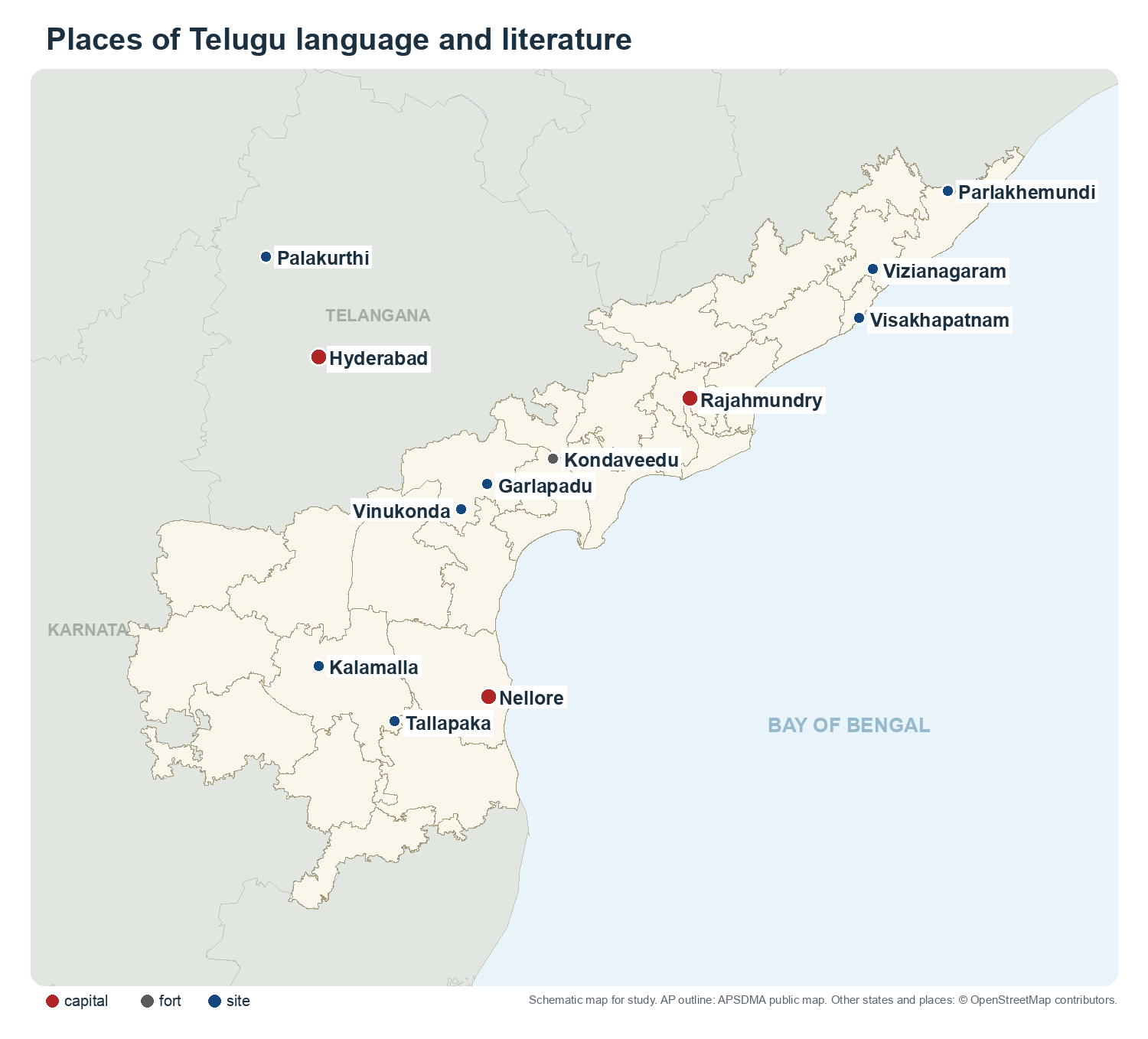
Many Telugu poets can be placed on the map of Andhra. Annamacharya was born at Tallapaka, which is in Kadapa district, the same district that holds the Kalamalla inscription. Kshetrayya was born at Muvva. Tenali Ramakrishna was born at Garlapadu in Guntur district. Gurram Jashuva was born at Vinukonda in Palnadu district. Palkuriki Somanatha was born at Palakurthi. Veeresalingam was born at Rajahmundry. Sri Sri was born at Visakhapatnam. Viswanatha Satyanarayana was born at Nandamuru. Remember these in pairs, since exam questions often ask "born at" or "belongs to which district".
Literary movements and ideas
- Early Telugu writing follows Sanskrit models. Nannaya started the Telugu Mahabharata and wrote the first grammar, Andhra Sabda Chintamani.
- The Prabandha form is a long story poem with a fixed style. It rose strongly in the age of Krishnadevaraya.
- The Satakam is a poem of one hundred verses, usually with a moral or devotional message. Sumati Satakam, Vemana Satakam and Dasarathi Satakam are the standard examples.
- The Dvipada form uses couplets. It was used for Basava Puranam and the Ranganatha Ramayanam, which were meant to be simple for common readers.
- Modern writing moved from verse to the novel, the play and free verse. Veeresalingam, Gurajada and Sri Sri mark the three steps.
- The Vyavaharika Bhasha Movement, led by Gidugu Venkata Ramamurthy, asked writers to use the spoken language in books and schools.
Revision checklist
Know three things for each poet: epithet, main work, birthplace or father. For Kavitrayam, learn who wrote which part. For Ashtadiggajas, learn eight names and one work each. For modern writers, learn the work and the year where given: 1878 for the first novel, 1892 for Kanyasulkam, 1970 and 1988 for the Jnanpith Awards.
Exam traps
- Nannaya is Adikavi; Tikkana is Kavi Brahma; do not swap the epithets.
- Kavitrayam (three poets) and Ashtadiggajas (eight poets) are different groups.
- Errana has two epithets: Prabandha Parameswara and Sambhudasa.
- Nandi Timmana is Mukku Timmana; Ramarajabhushanudu is Bhattumurthy.
- Pingali Surana wrote Raghava Pandaviyam, a poem with two meanings.
- Kandukuri Veeresalingam wrote the first novel; Gurajada Apparao wrote Kanyasulkam.
- Sahitya Akademi (1954, New Delhi) is not Telugu Akademi (1968, Hyderabad).
- Dasarathi Satakam is by Kancherla Gopanna, not by Baddena (Sumati Satakam).
One-liners
- 1. Kalamalla inscription: 575.
- 2. Telugu is a Classical Language since 2008.
- 3. First Telugu poet: Nannaya.
- 4. Amuktamalyada was written by Krishnadevaraya.
- 5. Manucharitra was written by Allasani Peddana.
- 6. Rajasekhara Charitramu (1878) is the first Telugu novel.
- 7. Kanyasulkam first staged: 1892 (first printed 1897).
- 8. Viswanatha Satyanarayana got the Jnanpith in 1970.
- 9. Telugu University was established in 1985.
- 10. Basava Puranam is by Palkuriki Somanatha.
Background and context
Telugu is spoken by tens of millions of people, and it has one of the longest written histories among Indian languages. It belongs to the Dravidian family. Linguists place it in the South-Central branch of that family. Tamil, Kannada, Malayalam and Tulu are its relatives. Hindi, Marathi and Odia belong to a different family, the Indo-Aryan, but Telugu borrowed a very large number of words from Sanskrit and Prakrit. This borrowing shaped its poetry from the first books onward.
Spoken Telugu has regional forms. Four broad types are usually described: northern (Telangana), southern (Rayalaseema), central (the coastal belt) and eastern (the north-eastern coast). Written Telugu, for most of its history, was a different matter. Poets wrote in a polished literary style that was far from the speech of farmers and traders. This gap between the book language and the spoken language is the background to the language movement of the early twentieth century, described later in this chapter.
The script grew out of the older Telugu-Kannada alphabet. In the medieval centuries the two scripts slowly separated and Telugu took its own rounded shape.
How early Telugu appears in the record
Before there were books, there were inscriptions. Telugu words appear first inside records written mainly in other languages. A very short label in Telugu, found in the Telangana region and dated to about the fourth to fifth century, is reported as the earliest known short Telugu writing. It comes from the time of the Vishnukundinas.
The first long record fully in Telugu is the Kalamalla inscription, dated to 575. It was issued under a Renati Chola ruler, Dhananjaya (his name is spelled in several ways). Because the whole text is in Telugu, it is treated as the earliest Telugu inscription of real length. Remember the number 575 and the name Kalamalla; both are asked often. The later Eastern Chalukya rulers of Vengi continued to issue records that mix Telugu with Sanskrit, and this is the setting in which written Telugu literature was born.
Telugu was recognised as a Classical Language by the Government of India on 31 October 2008, together with Kannada. A committee of language experts, working under the Sahitya Akademi, had set the rules a few years earlier. The main tests were an ancient written record of about 1,500 to 2,000 years, a body of old literature that speakers value, and a tradition that grew on its own and was not borrowed from another language. Telugu was judged to meet them.
The first great poem: Nannaya and the Mahabharata
Literature in the full sense begins in the eleventh century, at Rajahmundry (Rajamahendravaram), the capital of the Eastern Chalukya king Rajaraja Narendra. He ruled in the middle of the eleventh century; the commonly given years are 1022 to 1063. The king wanted the epic story of the Mahabharata to reach people in their own language. He asked a learned Brahmin, Nannaya Bhatta, to put it into Telugu.
Nannaya wrote in the champu style, which mixes verse and prose. He finished the first two books (the Adi and Sabha Parvas) and part of the third, the Aranya Parva, and then the work stopped. He worked in the eleventh century, during his patron's reign; the date 1100-60 found in one reference work does not fit Rajaraja Narendra's reign. The start of the work is often put around 1025. Because he handled the champu form with such skill, scholars infer that Telugu writing existed before him, even though those older works are lost. He is called Adikavi, the first poet, because his is the earliest surviving Telugu literary work. His Telugu is full of Sanskrit words and long compounds.
A grammar called Andhra Sabda Chintamani is traditionally credited to him. Some scholars doubt this tradition and think the text was composed much later. A careful student should therefore say "traditionally credited" when the question allows it. Examination books, however, simply treat him as its author.
Finishing the epic: Tikkana and Errana
The Mahabharata lay unfinished for about two centuries. The task was taken up in the thirteenth century by Tikkana Somayajulu (1205 to 1288). He lived in the Kakatiya period but served as a minister of the Nellore Chola ruler Manumasiddhi. According to a historical account, when Manumasiddhi lost his throne in a revolt around 1248, the Kakatiya king Ganapati Deva helped to restore him. Tikkana wrote the last fifteen books of the epic, beginning with the Virata Parva. His language is simpler and more Telugu than Nannaya's, because he used ordinary Telugu words even for difficult ideas. He also wrote the Nirvachanottara Ramayanam, the Uttara Ramayana told entirely in verse without any prose, and he is remembered for trying to bring Shaivites and Vaishnavites closer together.
The gap in the middle, part of the Aranya Parva, was filled in the fourteenth century by Errana (Yerrapragada). He belonged to the court of the Reddi king Prolaya Vema Reddy, whose rule is placed at about 1325 to 1353. Errana came from Gudlur in the old Pakanadu area (Gudluru mandal is now in Prakasam district) and settled at Chadalavada. He also wrote the Harivamsam and the Narasimha Puranam. He has two titles: Prabandha Parameswara and Sambhudasa. The three poets together are the Kavitrayam, and their joint work is the Andhra Mahabharatam. It is a champu work.
| Poet | Approximate time | Patron or ruler | Part of the Mahabharata |
|---|---|---|---|
| Nannaya | 11th century | Rajaraja Narendra (Eastern Chalukya) | Adi, Sabha and part of Aranya |
| Tikkana | 13th century | Manumasiddhi of Nellore; Kakatiyas | Virata to Svargarohana (last 15 books) |
| Errana | 14th century | Prolaya Vema Reddy (Reddi) | Remaining part of Aranya |
Devotion in common language: the Shaiva writers
While the Kavitrayam wrote for courts, another current of writing came from religious reform. Palkuriki Somanatha is its best known poet. He wrote in Telugu, Kannada and Sanskrit, and he followed the Virashaiva teaching of Basavanna, which rejected caste hierarchy and ritual show. His Basava Puranam uses the dvipada (couplet) form, easy for common listeners to follow, and his other works include Panditaradhya Charitra. Little about the man is settled. His birthplace is uncertain, and he is said to have lived his last years at Kalya, now in Karnataka. His date is argued: one view puts him in the twelfth century under the Kakatiya king Prataparudra I, another in the late thirteenth or early fourteenth century. The safest line is therefore "Kakatiya period."
Other early writers fit around this line. Nanne Choda wrote Kumara Sambhavam. Mallikarjuna Pandita wrote Sivatattvasaram. Ketana wrote Dasakumara Charitra and Andhra Bhasha Bhushanam. Malliya Rechana wrote Kavijanasrayam. Gona Budda Reddy wrote the Ranganatha Ramayanam in dvipada. Molla, a woman poet, wrote the Molla Ramayanam in simple language.
The fifteenth century: Srinatha and Potana
The next stage is the age of the prabandha, a long story poem in a tight metre that blends invention with classical tales. Srinatha (about 1355 to 1441) made this form popular, and his works include Sringara Naishadham, Kasikhandam, Haravilasam and Palanati Veera Charitra. His patron was Pedakomati Vema Reddy at the Reddi court of Kondaveedu, and the title Kavi Sarvabhauma was his. The Vijayanagara king Praudha Deva Raya is also said to have honoured him. Reports say that he grew poor near the end of his life, after his Reddi patrons lost power.
Potana (Bammera Potana, about 1400 to 1475, though some books give later dates) was a scholar and also a farmer. He translated the Bhagavata Purana as the Andhra Maha Bhagavatam. According to tradition, a king asked him to dedicate the work to him, and he refused, because he felt that a work on God should be given to God. He also wrote the Bhogini Dandakam and Veerabhadra Vijayam. His devotion and sweet language made the Bhagavatam the most quoted Telugu text, especially its stories of Gajendra and Prahlada.
Administration and economy: the court as the pay-master of literature
Poetry was not a hobby. The poet lived on a gift of land, an annual grant, or gold. Rajahmundry in the eleventh century, Nellore and Kondaveedu in the thirteenth to fifteenth centuries, and Vijayanagara in the sixteenth century were the paying centres. This explains why the works of this period carry a dedication to a king. It also explains the exceptions: Potana's refusal and Palkuriki Somanatha's preference for the common listener were choices against the court style.
The spread of Telugu into court records and royal poems also tells us about politics. When the Eastern Chalukyas, Kakatiyas, Reddis and Vijayanagara kings asked for Telugu works, they were speaking to the people of the Andhra region and building a shared identity. Krishnadevaraya said, in a line often repeated, that Telugu is the best of the country's languages. A legend says Vishnu told him this in a dream.
Society, religion and culture: Krishnadevaraya and the golden age
In the sixteenth century the Vijayanagara emperor Krishnadevaraya (1509 to 1529) made Telugu literature flourish. He is called Andhra Bhoja. He wrote the Amuktamalyada, a prabandha in Telugu composed in the years after his coronation. It tells how the Vaishnava saint Andal (Godadevi) was married to the god Ranganatha of Srirangam. It is also a guide to kingship and administration, and for that reason historians use it as a source for the age.
His court is known as Bhuvana Vijayam, and eight famous poets sat in it. They are the Ashtadiggajas, named after the eight elephants that guard the directions. Many of them came from Rayalaseema, and Tenali Ramakrishna was from the Guntur region.
| Poet | Best-known work |
|---|---|
| Allasani Peddana (Andhra Kavita Pitamaha) | Manucharitra |
| Nandi Timmana (Mukku Timmana) | Parijatapaharanam |
| Madayyagari Mallana | Rajasekhara Charitra |
| Dhurjati | Srikalahasti Mahatmyam |
| Ayyalaraju Ramabhadrudu | Ramabhyudayam |
| Pingali Surana | Raghava Pandaviyam (a poem with two meanings), Kalapurnodayam |
| Ramarajabhushanudu (Bhattumurti) | Vasucharitra |
| Tenali Ramakrishna (Vikata Kavi) | Panduranga Mahatmyam |
The Satakam, a poem of a hundred verses with a moral or devotional message, grew alongside these long poems. Baddena's Sumati Satakam, Vemana's verses and Kancherla Gopanna's Dasarathi Satakam are the standard examples. Annamayya (Annamacharya) composed thousands of devotional songs for Lord Venkateswara and is called Pada Kavita Pitamaha. Kshetrayya is known for his padams.
Decline, legacy and sites to know
After the fall of Vijayanagara, patronage moved to the Nayaka courts of the south. Poets such as Chemakura Venkata Kavi (Vijayavilasam) and Muddupalani (Radhika Santwanam) wrote there. Ideas and forms changed more slowly until the nineteenth century, when the printing press, colleges and the British language survey work arrived. C. P. Brown, a British official, compiled a Telugu-English dictionary and edited old texts, and he saved many of them from being lost.
The modern period begins with Kandukuri Veeresalingam (1848 to 1919). He wrote Rajasekhara Charitramu, regarded as the first Telugu novel; it came out as a serial in 1878 and as a book later (1880 is often given). He also arranged the first Telugu widow remarriage in 1881, and he is called Gadya Tikkana for his prose. Gurajada Apparao wrote Kanyasulkam, a play against the practice of bride-price, first staged at Vizianagaram in 1892 and first printed in 1897 (a revised version followed in 1909). He wrote it in the speech of ordinary people.
Gidugu Venkata Ramamurthy (1863 to 1940), a teacher at Parlakhemundi, argued for writing in spoken Telugu instead of the old book style. He also made a script and word lists for the Sora (Savara) language. By the 1920s and 1930s his view had won, and spoken Telugu became the language of schools and universities. His birthday, 29 August, is celebrated as Telugu Language Day.
Other modern names to know: Gurram Jashuva (1895 to 1971), who wrote Gabbilam in 1941 on the pain of untouchability; Sri Sri, whose Maha Prasthanam is the best known free-verse book; Devulapalli Krishnasastri (Krishna Paksham); Unnava Lakshminarayana (Malapalli); Viswanatha Satyanarayana, the first Telugu writer to get the Jnanpith Award (1970); and C. Narayana Reddy, who received it in 1988.
| Place | Link |
|---|---|
| Rajahmundry | Nannaya's city; Veeresalingam's birthplace |
| Kalamalla (Kadapa region) | Earliest long Telugu inscription |
| Bammera | Potana's birthplace |
| Garlapadu | Tenali Ramakrishna |
| Vinukonda | Gurram Jashuva |
| Parlakhemundi | Gidugu Ramamurthy's workplace |
How examiners use this chapter
- Epithets are asked in pairs. Nannaya is Adikavi, Tikkana is Kavi Brahma, Errana is Prabandha Parameswara and Sambhudasa, Srinatha is Kavi Sarvabhauma, Potana is Sahaja Pandita.
- Kavitrayam has three poets and wrote the Andhra Mahabharatam; Ashtadiggajas have eight poets and belong to Krishnadevaraya.
- Work-to-author pairs: Manucharitra with Peddana, Parijatapaharanam with Timmana, Vasucharitra with Ramarajabhushanudu, Raghava Pandaviyam with Pingali Surana, Amuktamalyada with Krishnadevaraya, Basava Puranam with Palkuriki Somanatha.
- Dates: 575 for Kalamalla, 1878 for the first novel, 1892 for Kanyasulkam, 1970 and 1988 for the Jnanpith Awards, 2008 for the Classical Language status.
- The first poet and first novel are different people: Nannaya and Veeresalingam.
- Forms: Dvipada for Basava Puranam and Ranganatha Ramayanam; Satakam for Sumati and Vemana; Prabandha for Manucharitra; Champu for the Mahabharatam.
- Institutions: Sahitya Akademi 1954 (Delhi), Telugu Akademi 1968 (Hyderabad), Telugu University 1985 (Hyderabad).
- Language movement: Gidugu Ramamurthy and the spoken-language (Vyavaharika) movement; the opposing book-style (Grandhika) camp.
For the poets' patrons, the newspapers and the reform movement, see the next chapter.
Worked cases
Case 1: Match the epithet to the poet: Adikavi, Kavi Brahma, Kavi Sarvabhauma, Sahaja Pandita.
Reasoning:
- 1. Adikavi means first poet. The first Telugu poet is Nannaya.
- 2. Kavi Brahma goes with Tikkana, who wrote Nirvachanottara Ramayanam.
- 3. Kavi Sarvabhauma goes with Srinatha, author of Sringara Naishadham.
- 4. Sahaja Pandita goes with Potana, author of Andhra Mahabhagavatam.
- 5. Errana is the poet who carries two titles, Prabandha Parameswara and Sambhudasa.
Takeaway: Use the meaning of the epithet. "Adi" means first, so it is the first poet.
Case 2: Which is NOT a member of the Ashtadiggajas? Allasani Peddana, Dhurjati, Tikkana, Pingali Surana.
Reasoning:
- 1. The Ashtadiggajas are the eight poets of Krishnadevaraya's court. Allasani Peddana, Dhurjati and Pingali Surana are in this group.
- 2. Tikkana is one of the Kavitrayam, with Nannaya and Errana. The Kavitrayam wrote the Andhra Mahabharatam.
- 3. The Kavitrayam has three poets. The Ashtadiggajas have eight.
- 4. So Tikkana is the odd one.
Takeaway: Count the group. Three poets means Kavitrayam, eight means Ashtadiggajas.
Case 3: Who wrote Raghava Pandaviyam, and what is special about it?
Reasoning:
- 1. Pingali Surana wrote Raghava Pandaviyam. He also wrote Kalapurnodayam and Prabhavati Pradyumnam.
- 2. Raghava Pandaviyam is a Dvyarthi kavyam. It is a poem with two meanings.
- 3. Kalapurnodayam is a Prabandha work.
- 4. So one poet can appear under two different forms.
Takeaway: Tie each form to a work: Prabandha for Kalapurnodayam, Dvyarthi for Raghava Pandaviyam.
Case 4: Arrange by year: first Telugu novel; Telugu as Classical Language; Kalamalla inscription; Jnanpith to Viswanatha Satyanarayana.
Reasoning:
- 1. The Kalamalla inscription is the earliest full-length Telugu inscription, 575.
- 2. The first Telugu novel, Rajasekhara Charitramu, is 1878.
- 3. Viswanatha Satyanarayana got the Jnanpith Award in 1970.
- 4. Telugu became a Classical Language in 2008.
- 5. Order: 575, 1878, 1970, 2008.
Takeaway: Ancient inscription first, then the modern writers, then the official honour.
Compare and contrast
| Work | Author | Form |
|---|---|---|
| Ranganatha Ramayanam | Gona Budda Reddy | Dvipada |
| Molla Ramayanam | Molla | Ramayana by Molla |
| Nirvachanottara Ramayanam | Tikkana | Ramayana by a Kavitrayam poet |
| Ramayana Kalpavrukshamu | Viswanatha Satyanarayana | Modern work |
| Name | Link |
|---|---|
| Sahitya Akademi | 1954, New Delhi |
| Telugu Akademi | 1968, Hyderabad |
| Telugu University | 1985, Hyderabad |
| Gadya Tikkana | Kandukuri Veeresalingam, first novel, 1878 |
| Kavi Samrat | Viswanatha Satyanarayana, first Telugu Jnanpith winner |
| Vikata Kavi | Tenali Ramakrishna |
Sequence and timeline
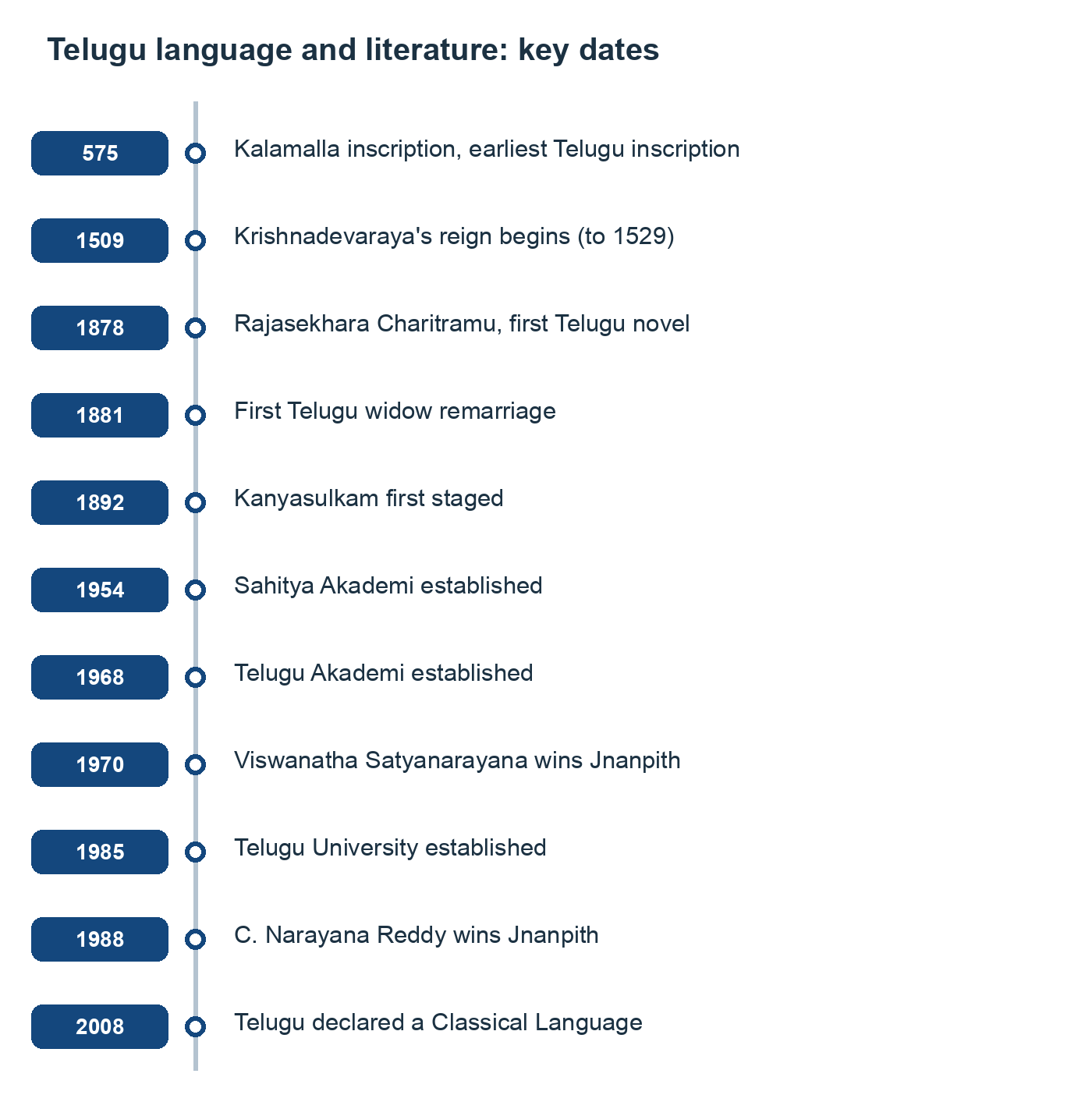
- 1. 575: Kalamalla inscription, earliest Telugu inscription
- 2. Early period: Nannaya, then Tikkana and Errana, who wrote the Andhra Mahabharatam
- 3. Later medieval period: Srinatha and Potana (Palkuriki Somanatha, the Dvipada poet, belongs earlier, to the Kakatiya age)
- 4. Age of Krishnadevaraya: Amuktamalyada and the Ashtadiggajas
- 5. Later period: satakam writers and the saint-poets Annamacharya and Kshetrayya
- 6. 1878: Rajasekhara Charitramu, the first Telugu novel
- 7. 1892: Kanyasulkam first staged (first printed edition 1897)
- 8. 1954: Sahitya Akademi
- 9. 1968: Telugu Akademi
- 10. 1970: Jnanpith Award to Viswanatha Satyanarayana
- 11. 1985: Telugu University
- 12. 1988: Jnanpith Award to C. Narayana Reddy
- 13. 2008: Telugu declared a Classical Language
More one-liners
- 1. Telugu, Tamil, Kannada, Malayalam and Tulu belong to the Dravidian family.
- 2. Hindi, Marathi and Odia belong to the Indo-Aryan family.
- 3. Hala wrote the Gathasaptashati, a Prakrit work.
- 4. The Kalamalla inscription is in Kadapa district.
- 5. Gurram Jashuva was born at Vinukonda and wrote Gabbilam.
- 6. C. P. Brown compiled a Telugu-English Dictionary.
- 7. Gidugu Venkata Ramamurthy led the Vyavaharika Bhasha Movement.
- 8. The Vyavaharika Bhasha Movement asked writers to use spoken Telugu.
Practice questions
Who is the father of the spoken-language (vaduka bhasha) movement?
- Kandukuri Veeresalingam
- Gurajada Apparao
- Viswanatha Satyanarayana
- Gidugu Venkata Ramamurthy
Answer
D. Gidugu Venkata Ramamurthy
Gidugu Venkata Ramamurthy.
వాడుక భాషోద్యమ పితామహుడు ఎవరు?
- కందుకూరి వీరేశలింగం
- గురజాడ అప్పారావు
- విశ్వనాథ సత్యనారాయణ
- గిడుగు వెంకట రామమూర్తి
Who received the first Jnanpith award in Telugu literature?
- Sri Rangam Srinivasa Rao
- Gurram Jashuva
- Viswanatha Satyanarayana
- Gidugu Venkata Ramamurthy
Answer
C. Viswanatha Satyanarayana
Viswanatha Satyanarayana.
తెలుగు సాహిత్యంలో మొదటి జ్ఞానపీఠ్ పురస్కారం పొందినవారు ఎవరు?
- శ్రీ రంగం శ్రీనివాసరావు
- గుర్రం జాషువా
- విశ్వనాథ సత్యనారాయణ
- గిడుగు వెంకట రామమూర్తి
Which poet-dramatist, a fellow student of Gidugu at Vizianagaram, joined him in the spoken-language movement?
- Kandukuri Veeresalingam
- Gurajada Apparao
- Chilakamarti Lakshminarasimham
- Unnava Lakshminarayana
Answer
B. Gurajada Apparao
Gurajada Apparao, author of Kanyasulkam, supported the use of modern spoken Telugu in literature.
విజయనగరంలో గిడుగు సహాధ్యాయి అయి, వ్యావహారిక భాషోద్యమంలో ఆయనతో కలిసి పనిచేసిన కవి-నాటక రచయిత ఎవరు?
- కందుకూరి వీరేశలింగం
- గురజాడ అప్పారావు
- చిలకమర్తి లక్ష్మీనరసింహం
- ఉన్నవ లక్ష్మీనారాయణ
Who wrote the Telugu novel 'Malapalli' dealing with the uplift of Dalits?
- Gurajada Apparao
- Chilakamarti Lakshminarasimham
- Viswanatha Satyanarayana
- Unnava Lakshminarayana
Answer
D. Unnava Lakshminarayana
Malapalli is the best-known novel of Unnava Lakshminarayana.
దళితుల అభ్యున్నతిని ఇతివృత్తంగా చేసుకున్న 'మాలపల్లి' నవల రచయిత ఎవరు?
- గురజాడ అప్పారావు
- చిలకమర్తి లక్ష్మీనరసింహం
- విశ్వనాథ సత్యనారాయణ
- ఉన్నవ లక్ష్మీనారాయణ
Which of the following is known by the name or title Vyavaharika Bhasha Pitamaha?
- Devulapalli Krishnasastri
- Gurram Jashuva
- Kancherla Gopanna
- Gidugu Ramamurthy
Answer
D. Gidugu Ramamurthy
'వ్యావహారిక భాషా పితామహుడు' అనే పేరు లేదా బిరుదుతో పిలువబడేది ఏది?
- దేవులపల్లి కృష్ణశాస్త్రి
- గుర్రం జాషువా
- కంచర్ల గోపన్న
- గిడుగు రామమూర్తి
Which is the first Dvipada kavya in Telugu literature?
- Harivamsam
- Bhogini Dandakam
- Ranganatha Ramayanam
- Kumara Sambhavam
Answer
C. Ranganatha Ramayanam
Ranganatha Ramayanam.
తెలుగు సాహిత్యంలో మొదటి ద్విపద కావ్యం ఏది?
- హరివంశం
- భోగినీ దండకం
- రంగనాథ రామాయణం
- కుమార సంభవం
Match the persons with their titles: (1) Annamayya (2) Allasani Peddana (3) Adibhatla Narayana Dasu (4) Gidugu Ramamurthy (a) Harikatha Pitamaha (b) Pada Kavita Pitamaha (c) Andhra Kavita Pitamaha (d) Vyavaharika Bhasha Pitamaha
- 1-c, 2-b, 3-a, 4-d
- 1-b, 2-c, 3-a, 4-d
- 1-b, 2-a, 3-c, 4-d
- 1-a, 2-b, 3-d, 4-c
Answer
B. 1-b, 2-c, 3-a, 4-d
Annamayya is Pada Kavita Pitamaha, Peddana Andhra Kavita Pitamaha, Narayana Dasu Harikatha Pitamaha and Gidugu Vyavaharika Bhasha Pitamaha.
వ్యక్తులను వారి బిరుదులతో జతపరచండి: (1) అన్నమయ్య (2) అల్లసాని పెద్దన (3) ఆదిభట్ల నారాయణదాసు (4) గిడుగు రామ్మూర్తి (a) హరికథా పితామహుడు (b) పద కవితా పితామహుడు (c) ఆంధ్ర కవితా పితామహుడు (d) వ్యవహారిక భాషా పితామహుడు
- 1-c, 2-b, 3-a, 4-d
- 1-b, 2-c, 3-a, 4-d
- 1-b, 2-a, 3-c, 4-d
- 1-a, 2-b, 3-d, 4-c
Consider the following pairs (Office – Person): (i) first Bahmani capital – Gulbarga (ii) second Telugu writer to win the Jnanpith Award – C. Narayana Reddy (iii) first Telugu poet to receive the Jnanpith Award – Viswanatha Satyanarayana Which of the pairs are correctly matched?
- Only (ii)
- None of them
- All of (i), (ii) and (iii)
- Only (i)
Answer
C. All of (i), (ii) and (iii)
ఈ క్రింది జతలను పరిశీలించండి (పదవి – వ్యక్తి): (i) బహమనీ మొదటి రాజధాని – గుల్బర్గా (ii) జ్ఞానపీఠ్ పొందిన రెండవ తెలుగు రచయిత – సి. నారాయణ రెడ్డి (iii) జ్ఞానపీఠ్ పురస్కారం పొందిన మొదటి తెలుగు కవి – విశ్వనాథ సత్యనారాయణ సరిగ్గా జతపరచబడినవి ఏవి?
- (ii) మాత్రమే
- ఏదీ కాదు
- (i), (ii), (iii) అన్నీ
- (i) మాత్రమే
Consider the following pairs (Office – Person): (i) author of Telugu grammar Andhra Sabda Chintamani – Nannaya (ii) third Telugu writer to win the Jnanpith Award – Robert Brown (iii) discoverer of the nucleus in the cell – Ravuri Bharadhwaja Which of the pairs are correctly matched?
- None of them
- Only (ii)
- Only (i) and (ii)
- Only (i)
Answer
D. Only (i)
ఈ క్రింది జతలను పరిశీలించండి (పదవి – వ్యక్తి): (i) ఆంధ్ర శబ్ద చింతామణి రచయిత – నన్నయ (ii) జ్ఞానపీఠ్ పొందిన మూడవ తెలుగు రచయిత – రాబర్ట్ బ్రౌన్ (iii) కణంలో కేంద్రకం ఆవిష్కర్త – రావూరి భరద్వాజ సరిగ్గా జతపరచబడినవి ఏవి?
- ఏదీ కాదు
- (ii) మాత్రమే
- (i), (ii) మాత్రమే
- (i) మాత్రమే
Which work by Kandukuri Veeresalingam is regarded as the first Telugu novel?
- Malapalli
- Rajasekhara Charitramu
- Kanyasulkam
- Ramabhyudayam
Answer
B. Rajasekhara Charitramu
Rajasekhara Charitramu was written in the 1870s.
కందుకూరి వీరేశలింగం రచించిన ఏ రచనను తొలి తెలుగు నవలగా పరిగణిస్తారు?
- మాలపల్లి
- రాజశేఖర చరిత్రము
- కన్యాశుల్కం
- రామాభ్యుదయం
Which poet composed Raghava Pandaviyam, a work telling the Ramayana and Mahabharata stories together?
- Tenali Ramakrishna
- Ramarajabhushanudu
- Nandi Timmana
- Pingali Surana
Answer
D. Pingali Surana
Pingali Surana wrote this double-meaning poem.
రామాయణ, మహాభారత కథలను కలిపి చెప్పే రాఘవ పాండవీయాన్ని రచించిన కవి ఎవరు?
- తెనాలి రామకృష్ణుడు
- రామరాజభూషణుడు
- నంది తిమ్మన
- పింగళి సూరన
Who was the first Telugu poet to publish national movement poetry?
- Gurajada Apparao
- Rayaprolu Subbarao
- Gurram Jashuva
- Chilakamarti Lakshmi Narasimham
Answer
D. Chilakamarti Lakshmi Narasimham
Chilakamarti.
జాతి ఉద్యమ కవితను వెలువరించిన మొదటి తెలుగు కవి ఎవరు?
- గురజాడ అప్పారావు
- రాయప్రోలు సుబ్బారావు
- గుర్రం జాషువా
- చిలకమర్తి లక్ష్మీ నరసింహం
Telugu Language Day is celebrated on whose birth anniversary?
- Gurajada Apparao
- Rayaprolu Subbarao
- Gidugu Venkata Ramamurthy
- Chilakamarti Lakshmi Narasimham
Answer
C. Gidugu Venkata Ramamurthy
Gidugu's birthday.
తెలుగు భాషా దినోత్సవాన్ని ఎవరి జయంతి రోజున జరుపుతారు?
- గురజాడ అప్పారావు
- రాయప్రోలు సుబ్బారావు
- గిడుగు వెంకట రామమూర్తి
- చిలకమర్తి లక్ష్మీ నరసింహం
Which set is the conventional Kavi Trayam for Telugu Mahabharata?
- Gurajada-Gidugu-Kandukuri
- Sri Sri-Jashuva-Viswanatha
- Nannaya-Tikkana-Errana
- Alluri-Prakasam-Duggirala
Answer
C. Nannaya-Tikkana-Errana
The poet trinity is Nannaya, Tikkana and Errana.
తెలుగు మహాభారతానికి సంప్రదాయ కవిత్రయ సమూహం ఏది?
- గురజాడ-గిడుగు-కందుకూరి
- శ్రీశ్రీ-జాషువా-విశ్వనాథ
- నన్నయ-తిక్కన-ఎర్రన
- అల్లూరి-ప్రకాశం-దుగ్గిరాల
Who is the author of the Jnanpith-winning work Viswambhara?
- C. Narayana Reddy
- Gurram Jashuva
- Sri Sri
- Viswanatha Satyanarayana
Answer
A. C. Narayana Reddy
C. Narayana Reddy won the Jnanpith in 1988.
జ్ఞానపీఠ్ గెలిచిన విశ్వంభర రచయిత ఎవరు?
- సి. నారాయణరెడ్డి
- గుర్రం జాషువా
- శ్రీశ్రీ
- విశ్వనాథ సత్యనారాయణ
Who wrote the Telugu novel Veyipadagalu?
- Sri Sri
- Viswanatha Satyanarayana
- Gurram Jashuva
- Gurajada Apparao
Answer
B. Viswanatha Satyanarayana
It is a landmark novel by Viswanatha Satyanarayana.
తెలుగు నవల వేయిపడగలు రచయిత ఎవరు?
- శ్రీశ్రీ
- విశ్వనాథ సత్యనారాయణ
- గుర్రం జాషువా
- గురజాడ అప్పారావు
The Telugu novel 'Malapalli', reflecting Gandhian ideals, was written by:
- Unnava Lakshminarayana
- Gurajada Apparao
- Chalam
- Viswanatha Satyanarayana
Answer
A. Unnava Lakshminarayana
Unnava Lakshminarayana, a Guntur Gandhian, published Malapalli in 1922.
గాంధీ ఆదర్శాలను ప్రతిబింబించే తెలుగు నవల 'మాలపల్లి' రచయిత:
- ఉన్నవ లక్ష్మీనారాయణ
- గురజాడ అప్పారావు
- చలం
- విశ్వనాథ సత్యనారాయణ
Which is Nannaya's first Telugu grammar work?
- Andhra Sabda Chintamani
- Indra Vijayam
- Chamundika Vilasam
- Kumara Sambhavam
Answer
A. Andhra Sabda Chintamani
Andhra Shabda Chintamani is the first Telugu grammar.
నన్నయ రచించిన తొలి తెలుగు వ్యాకరణ గ్రంథం ఏది?
- ఆంధ్ర శబ్ద చింతామణి
- ఇంద్ర విజయం
- చాముండికా విలాసం
- కుమార సంభవం
Work of Pavuluri Mallana?
- Kumara Sambhavam
- Ganita Sara Sangraham
- Andhra Sabda Chintamani
- Basava Puranam
Answer
B. Ganita Sara Sangraham
First Telugu mathematics work.
పావులూరి మల్లన రచించిన గ్రంథం?
- కుమార సంభవం
- గణిత సార సంగ్రహం
- ఆంధ్ర శబ్ద చింతామణి
- బసవ పురాణం
Which is the first story-kavya (katha kavyam) in Telugu?
- Dasakumara Charitra
- Vijnaneshwaram
- Andhra Bhasha Bhushanam
- Markandeya Puranam
Answer
A. Dasakumara Charitra
Dasakumara Charitra is the first Telugu katha kavyam.
తెలుగులో తొలి కథా కావ్యం ఏది?
- దశకుమార చరిత్ర
- విజ్ఞానేశ్వరము
- ఆంధ్ర భాషా భూషణం
- మార్కండేయ పురాణం
Who wrote Rajasekhara Charitra?
- Kandukuri Veeresalingam
- Chilakamarti Lakshmi Narasimham
- Gurajada Apparao
- Rayaprolu Subbarao
Answer
A. Kandukuri Veeresalingam
Veeresalingam wrote it.
రాజశేఖర చరిత్ర రచయిత ఎవరు?
- కందుకూరి వీరేశలింగం
- చిలకమర్తి లక్ష్మీ నరసింహం
- గురజాడ అప్పారావు
- రాయప్రోలు సుబ్బారావు
Who held the title 'Viswakavi Samrat'?
- Gurram Jashuva
- Gurajada Apparao
- Rayaprolu Subbarao
- Viswanatha Satyanarayana
Answer
A. Gurram Jashuva
Gurram Jashuva.
'విశ్వకవి సామ్రాట్' బిరుదు ఎవరిది?
- గుర్రం జాషువా
- గురజాడ అప్పారావు
- రాయప్రోలు సుబ్బారావు
- విశ్వనాథ సత్యనారాయణ
Consider the following pairs (Work – Author): (i) Virata Parvam of Andhra Mahabharatam – Tikkana (ii) Molla Ramayanam – Molla (iii) Harikathasaramu – Allasani Peddana Which of the pairs are correctly matched?
- Only (i) and (iii)
- Only (i)
- All of (i), (ii) and (iii)
- Only (i) and (ii)
Answer
C. All of (i), (ii) and (iii)
ఈ క్రింది జతలను పరిశీలించండి (రచన – రచయిత): (i) ఆంధ్ర మహాభారతంలోని విరాటపర్వం – తిక్కన (ii) మొల్ల రామాయణం – మొల్ల (iii) హరికథాసారము – అల్లసాని పెద్దన సరిగ్గా జతపరచబడినవి ఏవి?
- (i), (iii) మాత్రమే
- (i) మాత్రమే
- (i), (ii), (iii) అన్నీ
- (i), (ii) మాత్రమే
Consider the following pairs (Work – Author): (i) Radhika Santvanam – Muddupalani (ii) Panditaradhya Charitra – Palkuriki Somanatha (iii) Sri Ramayana Darshanam – Kuvempu Which of the pairs are correctly matched?
- Only (i) and (ii)
- Only (i)
- Only (ii)
- All of (i), (ii) and (iii)
Answer
D. All of (i), (ii) and (iii)
ఈ క్రింది జతలను పరిశీలించండి (రచన – రచయిత): (i) రాధికా సాంత్వనం – ముద్దుపళని (ii) పండితారాధ్య చరిత్ర – పాల్కురికి సోమనాథుడు (iii) శ్రీ రామాయణ దర్శనం – కువెంపు సరిగ్గా జతపరచబడినవి ఏవి?
- (i), (ii) మాత్రమే
- (i) మాత్రమే
- (ii) మాత్రమే
- (i), (ii), (iii) అన్నీ
Which of the following is NOT correctly paired with Nannaya (Office – Person)?
- first poet of the Telugu language
- first Indian to win an individual Olympic gold
- author of Telugu grammar Andhra Sabda Chintamani
- translator of Mahabharata into Telugu
Answer
B. first Indian to win an individual Olympic gold
ఈ క్రింది వాటిలో ఏది 'నన్నయ' అనే అంశానికి సరిగ్గా జతకాదు? (పదవి – వ్యక్తి)
- తెలుగు భాష తొలి కవి
- ఒలింపిక్స్లో వ్యక్తిగత స్వర్ణం గెలిచిన మొదటి భారతీయుడు
- ఆంధ్ర శబ్ద చింతామణి రచయిత
- మహాభారతాన్ని తెలుగులోకి అనువదించిన తొలి కవి
Which of the following is NOT correctly paired with Krishnadevaraya (Item – Region)?
- Allasani Peddana
- Tenali Ramakrishna
- Nannaya
- Pingali Surana
Answer
C. Nannaya
ఈ క్రింది వాటిలో ఏది 'శ్రీకృష్ణదేవరాయలు' అనే అంశానికి సరిగ్గా జతకాదు? (అంశం – ప్రాంతం)
- అల్లసాని పెద్దన
- తెనాలి రామకృష్ణుడు
- నన్నయ
- పింగళి సూరన
Who wrote the Telugu play Kanyasulkam?
- Sri Sri
- Gurram Jashuva
- Viswanatha Satyanarayana
- Gurajada Apparao
Answer
D. Gurajada Apparao
Gurajada's play critiques harmful marriage-related practices.
తెలుగు నాటకం కన్యాశుల్కాన్ని రచించినవారు ఎవరు?
- శ్రీశ్రీ
- గుర్రం జాషువా
- విశ్వనాథ సత్యనారాయణ
- గురజాడ అప్పారావు
Who wrote the famous Telugu play Kanyasulkam?
- Sri Sri
- Kandukuri Veeresalingam
- Gurram Jashuva
- Gurajada Apparao
Answer
D. Gurajada Apparao
Gurajada's play attacks the bride-price custom.
ప్రసిద్ధ తెలుగు నాటకం కన్యాశుల్కం రచయిత ఎవరు?
- శ్రీశ్రీ
- కందుకూరి వీరేశలింగం
- గుర్రం జాషువా
- గురజాడ అప్పారావు
For which work did Viswanatha Satyanarayana receive the Jnanpith Award in 1970?
- Ramayana Kalpavruksham
- Mahaprasthanam
- Kanyasulkam
- Veyipadagalu
Answer
A. Ramayana Kalpavruksham
The epic Ramayana Kalpavruksham earned him the award.
1970లో విశ్వనాథ సత్యనారాయణకు జ్ఞానపీఠ్ పురస్కారం ఏ రచనకు లభించింది?
- రామాయణ కల్పవృక్షం
- మహాప్రస్థానం
- కన్యాశుల్కం
- వేయిపడగలు
Who wrote the famous Telugu poem Gabbilam?
- Gurajada Apparao
- Gurram Jashuva
- C. Narayana Reddy
- Sri Sri
Answer
B. Gurram Jashuva
Jashuva's Gabbilam voices the pain of the oppressed.
ప్రసిద్ధ తెలుగు కావ్యం గబ్బిలం రచయిత ఎవరు?
- గురజాడ అప్పారావు
- గుర్రం జాషువా
- సి. నారాయణరెడ్డి
- శ్రీశ్రీ
Dasakumara Charitra in Telugu was written by Ketana, a disciple of:
- Srinatha
- Errana
- Nannaya
- Tikkana
Answer
D. Tikkana
Ketana dedicated his works to his master Tikkana.
తెలుగు దశకుమార చరిత్ర రచయిత కేతన ఎవరి శిష్యుడు?
- శ్రీనాథుడు
- ఎర్రన
- నన్నయ
- తిక్కన
Which work by Veeresalingam, published in 1878, is regarded as the first Telugu novel?
- Kanyasulkam
- Chintamani
- Rajasekhara Charitramu
- Satya Harischandra
Answer
C. Rajasekhara Charitramu
It was adapted from Goldsmith's Vicar of Wakefield.
1878లో ప్రచురితమైన, తొలి తెలుగు నవలగా పరిగణించే వీరేశలింగం రచన ఏది?
- కన్యాశుల్కం
- చింతామణి
- రాజశేఖర చరిత్రము
- సత్య హరిశ్చంద్ర
Gidugu Venkata Ramamurthy is best known for leading the movement for:
- Abolition of zamindaris
- Founding Andhra University
- Temple entry for Dalits
- Using spoken (vyavaharika) Telugu in writing and education
Answer
D. Using spoken (vyavaharika) Telugu in writing and education
He opposed the exclusive use of archaic literary Telugu.
గిడుగు వెంకట రామమూర్తి ఏ ఉద్యమానికి నాయకత్వం వహించడంలో ప్రసిద్ధి?
- జమీందారీ రద్దు
- ఆంధ్ర విశ్వవిద్యాలయ స్థాపన
- దళితుల ఆలయ ప్రవేశం
- రచనలో, విద్యలో వ్యావహారిక తెలుగు వాడకం
Who wrote the prabandha Vasucharitra?
- Pingali Surana
- Ramarajabhushanudu (Bhattumurti)
- Dhurjati
- Allasani Peddana
Answer
B. Ramarajabhushanudu (Bhattumurti)
Ramarajabhushanudu, also called Bhattumurti, composed it.
వసుచరిత్ర ప్రబంధాన్ని రచించినది ఎవరు?
- పింగళి సూరన
- రామరాజభూషణుడు (భట్టుమూర్తి)
- ధూర్జటి
- అల్లసాని పెద్దన
Which is the first Telugu grammar work?
- Vijnaneswariyam
- Dasakumara Charitra
- Andhra Bhasha Bhushanam
- Sarveswara Satakam
Answer
C. Andhra Bhasha Bhushanam
Ketana wrote Andhra Bhasha Bhushanam.
తెలుగులో మొదటి వ్యాకరణ గ్రంథం ఏది?
- విజ్ఞానేశ్వరీయం
- దశకుమార చరిత్ర
- ఆంధ్ర భాషా భూషణం
- సర్వేశ్వర శతకం
Work of Madayyagari Mallana?
- Rajasekhara Charitra
- Ramabhyudayam
- Subhadra Kalyanam
- Manucharitra
Answer
A. Rajasekhara Charitra
Rajasekhara Charitra.
మాదయ్యగారి మల్లన రచన ఏది?
- రాజశేఖర చరిత్ర
- రామాభ్యుదయం
- సుభద్రా కళ్యాణం
- మనుచరిత్ర
Which is the first Dharmashastra work in Telugu?
- Vijnaneshwaram
- Dasakumara Charitra
- Andhra Bhasha Bhushanam
- Nrisimha Puranam
Answer
A. Vijnaneshwaram
Vijnaneshwaram by Ketana.
తెలుగులో తొలి ధర్మశాస్త్ర గ్రంథం ఏది?
- విజ్ఞానేశ్వరము
- దశకుమార చరిత్ర
- ఆంధ్ర భాషా భూషణం
- నృసింహ పురాణం
Which is the first Prabandha in Telugu literature?
- Parijatapaharanam
- Manucharitra
- Kalapurnodayam
- Vasucharitra
Answer
B. Manucharitra
Manucharitra by Allasani Peddana.
తెలుగు సాహిత్యంలో మొదటి ప్రబంధం ఏది?
- పారిజాతాపహరణం
- మను చరిత్ర
- కళాపూర్ణోదయం
- వసుచరిత్ర
Who wrote Sri Kalahasteeswara Mahatyam?
- Nandi Timmana
- Dhurjati
- Tenali Ramakrishna
- Allasani Peddana
Answer
B. Dhurjati
Dhurjati.
శ్రీ కాళహస్తీశ్వర మహాత్మ్యం రచించినవారు ఎవరు?
- నంది తిమ్మన
- ధూర్జటి
- తెనాలి రామకృష్ణుడు
- అల్లసాని పెద్దన
Who is the author of Rajasekhara Charitra?
- Madayyagari Mallana
- Dhurjati
- Ayyalaraju Ramabhadrudu
- Ramaraja Bhushanudu
Answer
A. Madayyagari Mallana
Madayyagari Mallana.
రాజశేఖర చరిత్ర రచయిత ఎవరు?
- మాదయ్యగారి మల్లన
- దూర్జటి
- అయ్యలరాజు రామభద్రుడు
- రామరాజ భూషణుడు
Which is NOT a work of Pingali Surana?
- Raghava Pandaviyam
- Girija Kalyanam
- Vasucharitra
- Prabhavati Pradyumnam
Answer
C. Vasucharitra
Vasucharitra is by Ramaraja Bhushanudu.
పింగళి సూరన రచన కానిది ఏది?
- రాఘవ పాండవీయం
- గిరిజా కళ్యాణం
- వసుచరిత్ర
- ప్రభావతీ ప్రద్యుమ్నం
Whose title was 'Vikata Kavi'?
- Allasani Peddana
- Dhurjati
- Pingali Surana
- Tenali Ramakrishna
Answer
D. Tenali Ramakrishna
Tenali Ramakrishna.
'వికట కవి' బిరుదు ఎవరిది?
- అల్లసాని పెద్దన
- దూర్జటి
- పింగళి సూరన
- తెనాలి రామకృష్ణుడు
Who held the title 'Andhra Scott'?
- Kandukuri Veeresalingam
- Gurram Jashuva
- Rayaprolu Subbarao
- Chilakamarti Lakshmi Narasimham
Answer
D. Chilakamarti Lakshmi Narasimham
Chilakamarti.
'ఆంధ్ర స్కాట్' బిరుదు ఎవరిది?
- కందుకూరి వీరేశలింగం
- గుర్రం జాషువా
- రాయప్రోలు సుబ్బారావు
- చిలకమర్తి లక్ష్మీ నరసింహం
Who wrote the song 'Ye Desamegina Endu Kalidina'?
- Gurajada Apparao
- Gurram Jashuva
- Viswanatha Satyanarayana
- Rayaprolu Subbarao
Answer
D. Rayaprolu Subbarao
Rayaprolu Subbarao.
'ఏ దేశమేగినా ఎందుకాలిడినా' గీతం రచయిత ఎవరు?
- గురజాడ అప్పారావు
- గుర్రం జాషువా
- విశ్వనాథ సత్యనారాయణ
- రాయప్రోలు సుబ్బారావు
Who holds the title 'Gadya Vangmaya Brahma'?
- Kandukuri Veeresalingam
- Gidugu Ramamurthy
- Viswanatha Satyanarayana
- Chilakamarthi
Answer
A. Kandukuri Veeresalingam
Title of Veeresalingam.
'గద్య వాఙ్మయ బ్రహ్మ' అనే బిరుదు ఎవరిది?
- కందుకూరి వీరేశలింగం
- గిడుగు రామమూర్తి
- విశ్వనాథ సత్యనారాయణ
- చిలకమర్తి
Practice set 2
Arrange these Telugu poets in chronological order, earliest first: (1) Tikkana (2) Nannaya (3) Srinatha (4) Errana
- (1), (2), (4), (3)
- (2), (4), (1), (3)
- (2), (1), (4), (3)
- (2), (1), (3), (4)
Answer
C. (2), (1), (4), (3)
Nannaya (11th c.), Tikkana (13th), Errana (14th), Srinatha (15th).
ఈ తెలుగు కవులను కాలక్రమంలో (మొదటివారు ముందుగా) అమర్చండి: (1) తిక్కన (2) నన్నయ (3) శ్రీనాథుడు (4) ఎర్రన
- (1), (2), (4), (3)
- (2), (4), (1), (3)
- (2), (1), (4), (3)
- (2), (1), (3), (4)
Who wrote the Kasiyatra, an early Telugu travel account?
- Kandukuri Veeresalingam
- Enugula Veeraswami
- Gurajada Apparao
- Chilakamarti Lakshminarasimham
Answer
B. Enugula Veeraswami
Enugula Veeraswami recorded his pilgrimage to Kashi in the Kasiyatra.
తెలుగులో తొలి యాత్రా రచనలలో ఒకటైన కాశీయాత్రను రచించినవారు ఎవరు?
- కందుకూరి వీరేశలింగం
- ఏనుగుల వీరాస్వామి
- గురజాడ అప్పారావు
- చిలకమర్తి లక్ష్మీనరసింహం
Which Telugu poet, regarded as one of the Ashtadiggajas of Krishnadevaraya, composed the Vasucharitra while staying at Penukonda?
- Nannayabhattu
- Palkuriki Somanatha
- Vemana
- Ramaraja Bhushana
Answer
D. Ramaraja Bhushana
కృష్ణదేవరాయల అష్టదిగ్గజాలలో ఒకరిగా పరిగణించబడే, పెనుకొండలో ఉన్నప్పుడు వసుచరిత్ర రచించిన తెలుగు కవి ఎవరు?
- నన్నయభట్టు
- పాల్కురికి సోమనాథుడు
- వేమన
- రామరాజభూషణుడు
By which name or title is Gidugu Venkata Ramamurthy known?
- Vyavaharika Bhasha Pitamaha
- Ubhaya Kavi Mitra
- Padakavi
- Sahaji Pandita
Answer
A. Vyavaharika Bhasha Pitamaha
గిడుగు వెంకట రామమూర్తి ఏ పేరుతో లేదా బిరుదుతో పిలువబడుతుంది?
- వ్యావహారిక భాషా పితామహుడు
- ఉభయ కవి మిత్రుడు
- పదకవి
- సహజ పండితుడు
Which of the following is known by the name or title Sahaji Pandita?
- Tikkana
- Gidugu Venkata Ramamurthy
- Kshetrayya
- Bammera Potana
Answer
D. Bammera Potana
'సహజ పండితుడు' అనే పేరు లేదా బిరుదుతో పిలువబడేది ఏది?
- తిక్కన
- గిడుగు వెంకట రామమూర్తి
- క్షేత్రయ్య
- బమ్మెర పోతన
Consider the following pairs (Event – Year): (i) First Andhra Conference at Bapatla – 1913 (ii) Declaration of Telugu as a Classical Language – 2008 (iii) Publication of Discovery of India – 1946 Which of the pairs are correctly matched?
- Only (ii) and (iii)
- Only (iii)
- Only (i) and (iii)
- All of (i), (ii) and (iii)
Answer
D. All of (i), (ii) and (iii)
ఈ క్రింది జతలను పరిశీలించండి (సంఘటన – సంవత్సరం): (i) బాపట్లలో మొదటి ఆంధ్ర మహాసభ – 1913 (ii) తెలుగుకు ప్రాచీన భాష హోదా – 2008 (iii) డిస్కవరీ ఆఫ్ ఇండియా ప్రచురణ – 1946 సరిగ్గా జతపరచబడినవి ఏవి?
- (ii), (iii) మాత్రమే
- (iii) మాత్రమే
- (i), (iii) మాత్రమే
- (i), (ii), (iii) అన్నీ
Consider the following pairs (Event – Year): (i) Founding of Hyderabad city – 1591 (ii) Publication of Rajasekhara Charitramu, the first Telugu novel – 1878 (iii) Start of Eleventh Five-Year Plan – 2007 Which of the pairs are correctly matched?
- All of (i), (ii) and (iii)
- Only (i) and (iii)
- Only (ii)
- None of them
Answer
A. All of (i), (ii) and (iii)
ఈ క్రింది జతలను పరిశీలించండి (సంఘటన – సంవత్సరం): (i) హైదరాబాద్ నగర స్థాపన – 1591 (ii) రాజశేఖర చరిత్రము ప్రచురణ – 1878 (iii) పదకొండవ పంచవర్ష ప్రణాళిక ప్రారంభం – 2007 సరిగ్గా జతపరచబడినవి ఏవి?
- (i), (ii), (iii) అన్నీ
- (i), (iii) మాత్రమే
- (ii) మాత్రమే
- ఏదీ కాదు
Srungara Naishadham, a Telugu prabandha, is the work of:
- Srinatha
- Ketana
- Nannaya
- Tikkana
Answer
A. Srinatha
Srinatha adapted Sriharsha's Naishadha.
తెలుగు ప్రబంధం శృంగార నైషధం రచయిత ఎవరు?
- శ్రీనాథుడు
- కేతన
- నన్నయ
- తిక్కన
Which title is given to Tallapaka Annamacharya?
- Pada Kavita Pitamaha
- Andhra Kavita Pitamaha
- Adikavi
- Kavi Sarvabhauma
Answer
A. Pada Kavita Pitamaha
He is regarded as the grandfather of Telugu song-poetry.
తాళ్లపాక అన్నమాచార్యకు ఇచ్చిన బిరుదు ఏది?
- పదకవితా పితామహ
- ఆంధ్ర కవితా పితామహ
- ఆదికవి
- కవి సార్వభౌమ
Who composed the Telugu epic Amuktamalyada?
- Nannaya
- Krishnadevaraya
- Allasani Peddana
- Tikkana
Answer
B. Krishnadevaraya
Emperor Krishnadevaraya himself wrote it.
తెలుగు కావ్యం ఆముక్తమాల్యద రచయిత ఎవరు?
- నన్నయ
- శ్రీకృష్ణదేవరాయలు
- అల్లసాని పెద్దన
- తిక్కన
Which poet of the Kavitrayam composed the Harivamsam in Telugu?
- Nannaya
- Tikkana
- Errana
- Srinatha
Answer
C. Errana
Errana wrote the Harivamsam.
కవిత్రయంలో తెలుగులో హరివంశాన్ని రచించిన కవి ఎవరు?
- నన్నయ
- తిక్కన
- ఎర్రన
- శ్రీనాథుడు
Who began the Telugu Mahabharatam under the patronage of the Eastern Chalukya king Rajaraja Narendra?
- Tikkana
- Nannaya
- Srinatha
- Errana
Answer
B. Nannaya
Nannaya wrote the first parvas, hence Adikavi.
తూర్పు చాళుక్య రాజు రాజరాజ నరేంద్రుని ఆదరణలో తెలుగు మహాభారత రచనను ప్రారంభించినవారు ఎవరు?
- తిక్కన
- నన్నయ
- శ్రీనాథుడు
- ఎర్రన
Which title is associated with Krishnadevaraya for his patronage of Telugu literature?
- Andhra Bhoja
- Kavisarvabhauma
- Gajabetekara
- Andhra Kavita Pitamaha
Answer
A. Andhra Bhoja
He was hailed as Andhra Bhoja after the poet-king Bhoja.
తెలుగు సాహిత్యాన్ని ఆదరించినందుకు శ్రీకృష్ణదేవరాయలకు ఉన్న బిరుదు ఏది?
- ఆంధ్ర భోజుడు
- కవిసార్వభౌముడు
- గజబెంటెకారుడు
- ఆంధ్ర కవితా పితామహుడు
Which work did Pavuluri Mallana write?
- Ganita Sara Sangraham
- Kumara Sambhavam
- Andhra Sabda Chintamani
- Shivatatvasaram
Answer
A. Ganita Sara Sangraham
Mallana wrote Ganita Sara Sangraham.
పావులూరి మల్లన రచించిన గ్రంథం ఏది?
- గణిత సార సంగ్రహం
- కుమార సంభవం
- ఆంధ్ర శబ్ద చింతామణి
- శివతత్వసారం
Which work was written by Mulugu Veerabhadra Kavi?
- Basava Puranam
- Palnati Veera Charitra
- Palnati Veera Bhagavatam
- Kumara Sambhavam
Answer
C. Palnati Veera Bhagavatam
He wrote Palnati Veera Bhagavatam, a padya kavya.
మూలుగు వీరభద్ర కవి రచించిన గ్రంథం ఏది?
- బసవ పురాణం
- పల్నాటి వీర చరిత్ర
- పల్నాటి వీర భాగవతం
- కుమార సంభవం
Which work did Tikkana dedicate to Manumasiddi?
- Bhagavatam
- Nirvachanottara Ramayanam
- Kumara Sambhavam
- Dasakumara Charitra
Answer
B. Nirvachanottara Ramayanam
He wrote Nirvachanottara Ramayanam for Manumasiddi.
తిక్కన మనుమసిద్ధికి అంకితమిచ్చిన గ్రంథం ఏది?
- భాగవతం
- నిర్వచనోత్తర రామాయణం
- కుమార సంభవం
- దశకుమార చరిత్ర
Which is the first Telugu Dharmashastra work?
- Vijnaneswariyam
- Andhra Bhasha Bhushanam
- Keyura Bahu Charitra
- Markandeya Puranam
Answer
A. Vijnaneswariyam
Vijnaneswariyam was the first Telugu dharma shastra.
తెలుగులో మొదటి ధర్మ శాస్త్ర గ్రంథం ఏది?
- విజ్ఞానేశ్వరీయం
- ఆంధ్ర భాషా భూషణం
- కేయూర బాహు చరిత్ర
- మార్కండేయ పురాణం
Which work was written by Ketana?
- Sarveswara Satakam
- Dasakumara Charitra
- Basava Puranam
- Sumati Satakam
Answer
B. Dasakumara Charitra
Ketana wrote Dasakumara Charitra.
కేతన రచించిన గ్రంథం ఏది?
- సర్వేశ్వర శతకం
- దశకుమార చరిత్ర
- బసవ పురాణం
- సుమతీ శతకం
Which work did Mallikarjuna Pandita write?
- Basava Puranam
- Sivatattvasaram
- Kumara Sambhavam
- Sakala Neeti Sammatam
Answer
B. Sivatattvasaram
He wrote Sivatattvasaram.
మల్లికార్జున పండితుడు రచించిన గ్రంథం ఏది?
- బసవ పురాణం
- శివతత్త్వసారం
- కుమార సంభవం
- సకల నీతి సమ్మతం
Which works were written by Errana?
- Kumara Rajiyamu
- Kasikhandam and Bhimakhandam
- Rasarnava Sudhakaram
- Harivamsam and Narasimha Puranam
Answer
D. Harivamsam and Narasimha Puranam
Errana wrote Harivamsam and Narasimha Puranam.
ఎర్రన రచించిన గ్రంథాలు ఏవి?
- కుమార రాజీయము
- కాశీఖండం, భీమఖండం
- రసార్ణవ సుధాకరం
- హరివంశం, నృసింహ పురాణం
Which Telugu work was written by Krishnadevaraya?
- Amuktamalyada
- Manucharitra
- Vasucharitra
- Panduranga Mahatmyam
Answer
A. Amuktamalyada
Amuktamalyada is among the five Telugu epics.
కృష్ణదేవరాయలు తెలుగులో రచించిన గ్రంథం ఏది?
- అముక్తమాల్యద
- మనుచరిత్ర
- వసుచరిత్ర
- పాండురంగ మహాత్మ్యం
Telugu work of Krishnadevaraya?
- Manucharitra
- Panduranga Mahatmyam
- Amuktamalyada
- Vasucharitra
Answer
C. Amuktamalyada
Amuktamalyada.
కృష్ణదేవరాయలు తెలుగులో రచించిన గ్రంథం ఏది?
- మనుచరిత్ర
- పాండురంగ మహాత్మ్యం
- ఆముక్తమాల్యద
- వసుచరిత్ర
Work of Nannechodudu?
- Kumara Sambhavam
- Basava Puranam
- Panditaradhya Charitra
- Sivatattvasaram
Answer
A. Kumara Sambhavam
Kumara Sambhavam.
నన్నెచోడుడు రచించిన గ్రంథం?
- కుమార సంభవం
- బసవ పురాణం
- పండితారాధ్య చరిత్ర
- శివతత్త్వసారం
Dvipada work by Somanatha?
- Kumara Sambhavam
- Panditaradhya
- Rajaniti
- Basava Puranam
Answer
D. Basava Puranam
Basava Puranam.
సోమనాథుడు రచించిన ద్విపద కావ్యం?
- కుమార సంభవం
- పండితారాధ్య
- రాజనీతి
- బసవ పురాణం
Which is NOT a work of Srinatha?
- Sivaratri Mahatyam
- Palnati Veera Charitra
- Salivahana Saptasati
- Bhogini Dandakam
Answer
D. Bhogini Dandakam
Bhogini Dandakam is Potana's.
కింది వాటిలో శ్రీనాథుని రచన కానిది ఏది?
- శివరాత్రి మాహాత్మ్యం
- పల్నాటి వీర చరిత్ర
- శాలివాహన సప్తశతి
- భోగినీ దండకం
Which pair is described as twin poets (janta kavulu)?
- Allasani Peddana - Nandi Timmana
- Tikkana - Errana
- Nandi Mallayya - Ghanta Singana
- Marana - Ketana
Answer
C. Nandi Mallayya - Ghanta Singana
Nandi Mallayya and Ghanta Singana.
'వీరు జంట కవులు' అని పేర్కొనబడినవారు ఎవరు?
- అల్లసాని పెద్దన - నంది తిమ్మన
- తిక్కన - ఎర్రన
- నంది మల్లయ్య - ఘంట సింగన
- మారన - కేతన
Who wrote the song 'Deshamunu Preminchumanna'?
- Rayaprolu Subbarao
- Gurram Jashuva
- Gurajada Apparao
- Chilakamarti Lakshmi Narasimham
Answer
C. Gurajada Apparao
Gurajada Apparao.
'దేశమును ప్రేమించుమన్నా' గేయం ఎవరు రచించారు?
- రాయప్రోలు సుబ్బారావు
- గుర్రం జాషువా
- గురజాడ అప్పారావు
- చిలకమర్తి లక్ష్మీ నరసింహం
Who wrote Gabbilam?
- Gurram Jashuva
- Gurajada Apparao
- Rayaprolu Subbarao
- Dharmavaram Ramakrishnamacharyulu
Answer
A. Gurram Jashuva
Gurram Jashuva.
గబ్బిలం రచయిత ఎవరు?
- గుర్రం జాషువా
- గురజాడ అప్పారావు
- రాయప్రోలు సుబ్బారావు
- ధర్మవరం రామకృష్ణమాచార్యులు
Who held the title 'Kavi Samrat'?
- Sri Rangam Srinivasa Rao
- Gurram Jashuva
- Rayaprolu Subbarao
- Viswanatha Satyanarayana
Answer
D. Viswanatha Satyanarayana
Viswanatha Satyanarayana.
'కవి సమ్రాట్' బిరుదు ఎవరిది?
- శ్రీ రంగం శ్రీనివాసరావు
- గుర్రం జాషువా
- రాయప్రోలు సుబ్బారావు
- విశ్వనాథ సత్యనారాయణ
Which award did Jashuva's 'Kristu Charitra' receive in 1964?
- Kendra Sahitya Akademi Award
- Jnanpith
- Padma Shri
- Bharat Ratna
Answer
A. Kendra Sahitya Akademi Award
Kendra Sahitya Akademi in 1964.
జాషువా రచన 'క్రీస్తు చరిత్ర'కు 1964లో లభించిన పురస్కారం ఏది?
- కేంద్ర సాహిత్య అకాడమీ అవార్డు
- జ్ఞానపీఠ్
- పద్మశ్రీ
- భారతరత్న
Which award did Bapiraju get for the novel 'Narayana Rao'?
- Sahitya Akademi
- Jnanpith
- Andhra Viswakala Parishat award
- Padma Shri
Answer
C. Andhra Viswakala Parishat award
Narayana Rao won the Andhra Viswakala Parishat award.
'నారాయణరావు' నవలకు బాపిరాజు ఏ అవార్డు పొందారు?
- సాహిత్య అకాడమీ
- జ్ఞానపీఠ్
- ఆంధ్ర విశ్వకళా పరిషత్ అవార్డు
- పద్మశ్రీ
Who wrote the first Telugu novel 'Sriranga Raju Charitra'?
- Narahari Setty Gopalakrishna Setty
- Kandukuri Veeresalingam
- Gurajada
- Chilakamarthi
Answer
A. Narahari Setty Gopalakrishna Setty
Gopalakrishna Setty wrote it.
తెలుగులో మొదటి నవల 'శ్రీరంగ రాజు చరిత్ర' రచయిత ఎవరు?
- నరహరిశెట్టి గోపాలకృష్ణ శెట్టి
- కందుకూరి వీరేశలింగం
- గురజాడ
- చిలకమర్తి
Who received the title 'Andhra Bhishma'?
- Nyapati Subba Rao
- Devulapalli Krishna Sastri
- Chilakamarti Lakshminarasimham
- Kandukuri Veeresalingam
Answer
A. Nyapati Subba Rao
Nyapati Subba Rao was known as Andhra Bhishma.
'ఆంధ్ర భీష్మ' బిరుదు పొందినవారు ఎవరు?
- న్యాయపతి సుబ్బారావు
- దేవులపల్లి కృష్ణశాస్త్రి
- చిలకమర్తి లక్ష్మీనరసింహం
- కందుకూరి వీరేశలింగం
Arrange these Telugu poets in chronological order, earliest first: (1) Pothana (2) Nannaya (3) Errana (4) Tikkana
- 2, 3, 4, 1
- 4, 2, 3, 1
- 2, 4, 3, 1
- 2, 4, 1, 3
Answer
C. 2, 4, 3, 1
Nannaya (11th century) came first, then Tikkana (13th), Errana (14th) and Pothana (15th).
ఈ తెలుగు కవులను కాలక్రమంలో (ముందుది మొదట) అమర్చండి: (1) పోతన (2) నన్నయ (3) ఎర్రన (4) తిక్కన
- 2, 3, 4, 1
- 4, 2, 3, 1
- 2, 4, 3, 1
- 2, 4, 1, 3
Gidugu Venkata Ramamurthy was born in 1863 at Parvathalapeta, near Mukhalingam, in which present AP district?
- Visakhapatnam
- East Godavari
- Srikakulam
- Krishna
Answer
C. Srikakulam
Parvathalapeta is in the Srikakulam region, close to the Mukhalingam temples.
గిడుగు వెంకట రామమూర్తి 1863లో ముఖలింగం సమీపంలోని పర్వతాలపేటలో జన్మించారు. ఈ ప్రాంతం ప్రస్తుతం ఏ జిల్లాలో ఉంది?
- విశాఖపట్నం
- తూర్పు గోదావరి
- శ్రీకాకుళం
- కృష్ణా
In which poetic form did Palkuriki Somanatha compose his Panditaradhya Charitra?
- Dvipada
- Champu
- Sataka
- Prose only
Answer
A. Dvipada
Both his Basava Puranam and Panditaradhya Charitra are in the dvipada metre.
పాల్కురికి సోమనాథుడు తన పండితారాధ్య చరిత్రను ఏ రచనా రూపంలో రాశాడు?
- ద్విపద
- చంపూ
- శతకం
- కేవలం వచనం
Who is known as the 'Adikavi' of Telugu literature?
- Tikkana
- Errana
- Pothana
- Nannaya
Answer
D. Nannaya
Nannaya began the Telugu Mahabharata in the court of the Eastern Chalukya king Rajaraja Narendra and is honoured as the first poet.
తెలుగు సాహిత్యంలో 'ఆదికవి' అని ఎవరిని పిలుస్తారు?
- తిక్కన
- ఎర్రన
- పోతన
- నన్నయ
Who is regarded as the Adikavi, the first poet, of Telugu literature?
- Praudhakavi Mallana
- Salabat Jung
- Rabindranath Tagore
- Nannaya
Answer
D. Nannaya
తెలుగు సాహిత్యానికి ఆదికవి, తొలి కవిగా పరిగణించబడేవారు ఎవరు?
- ప్రౌఢకవి మల్లన
- సలాబత్ జంగ్
- రవీంద్రనాథ్ ఠాగూర్
- నన్నయ
To which of the following does Telugu belong?
- Kakatiya dynasty
- Dravidian language family
- Ceded District
- Prabandha
Answer
B. Dravidian language family
తెలుగు ఈ క్రింది వాటిలో దేనికి చెందినది?
- కాకతీయ వంశం
- ద్రావిడ భాషా కుటుంబం
- సీడెడ్ జిల్లా
- ప్రబంధం
To which of the following does Tamil belong?
- Indo-Aryan language family
- Dravidian language family
- Thanjavur Nayak dynasty
- Ceded District
Answer
B. Dravidian language family
తమిళం ఈ క్రింది వాటిలో దేనికి చెందినది?
- ఇండో-ఆర్య భాషా కుటుంబం
- ద్రావిడ భాషా కుటుంబం
- తంజావూరు నాయక వంశం
- సీడెడ్ జిల్లా
Which of the following belongs to Play?
- Basava Puranam
- Bhaskara Ramayanam
- Kanyasulkam
- Panditaradhya Charitra
Answer
C. Kanyasulkam
ఈ క్రింది వాటిలో 'నాటకం' వర్గానికి చెందినది ఏది?
- బసవ పురాణం
- భాస్కర రామాయణం
- కన్యాశుల్కం
- పండితారాధ్య చరిత్ర
Who wrote Nrisimha Puranam?
- Gurazada Apparao
- Errana
- Tikkana
- Tallapaka Tirumalamma
Answer
B. Errana
నృసింహ పురాణం రచయిత ఎవరు?
- గురజాడ అప్పారావు
- ఎర్రన
- తిక్కన
- తాళ్లపాక తిరుమలమ్మ
Who wrote Virabhadra Vijayam?
- Potana
- Mallikarjuna Pandita
- Gangadevi
- Jayapa Senani
Answer
A. Potana
వీరభద్ర విజయం రచయిత ఎవరు?
- పోతన
- మల్లికార్జున పండితుడు
- గంగాదేవి
- జాయప సేనాని
Who wrote Ramayana Kalpavrikshamu?
- Mallikarjuna Panditaradhya
- A. P. J. Abdul Kalam
- Gurazada Apparao
- Viswanatha Satyanarayana
Answer
D. Viswanatha Satyanarayana
రామాయణ కల్పవృక్షం రచయిత ఎవరు?
- మల్లికార్జున పండితారాధ్యుడు
- ఎ. పి. జె. అబ్దుల్ కలాం
- గురజాడ అప్పారావు
- విశ్వనాథ సత్యనారాయణ
Consider the following pairs (Work – Author): (i) Andhra Mahabharatam – Nannaya, Tikkana and Errana (ii) Principles of Political Economy and Taxation – David Ricardo (iii) Shahnama – Firdausi Which of the pairs are correctly matched?
- Only (i)
- All of (i), (ii) and (iii)
- Only (iii)
- Only (ii)
Answer
B. All of (i), (ii) and (iii)
ఈ క్రింది జతలను పరిశీలించండి (రచన – రచయిత): (i) ఆంధ్ర మహాభారతం – నన్నయ్య, తిక్కన, ఎర్రన (ii) ప్రిన్సిపుల్స్ ఆఫ్ పొలిటికల్ ఎకానమీ అండ్ టాక్సేషన్ – డేవిడ్ రికార్డో (iii) షానామా – ఫిరదౌసీ సరిగ్గా జతపరచబడినవి ఏవి?
- (i) మాత్రమే
- (i), (ii), (iii) అన్నీ
- (iii) మాత్రమే
- (ii) మాత్రమే