Buddhism, Jainism and Religion in Andhra
> What to remember
> - Buddhist sites of Andhra (Amaravati, Nagarjunakonda, Bavikonda, Thotlakonda, Salihundam, Bhattiprolu) lie mostly on the Krishna and the northern coast.
> - Councils: Buddhist at Rajagriha, Vaishali, Pataliputra, Kundalavana; Jain at Pataliputra and Valabhi.
> - Sects: Shaiva, Vaishnava, Advaita, Vishishtadvaita, Dvaita; remember each founder and text.
Buddhism and its sites
Gautama Buddha was also called Siddhartha. He was born at Lumbini. He was enlightened at Bodh Gaya. He gave his first sermon at Sarnath. He died at Kushinagar. Ashoka was known as Devanampiya Piyadasi. Ashoka built the Sanchi Stupa.
The Buddhist schools and sects in the notes are Mahayana, Hinayana, Theravada and Vajrayana. Nagarjuna founded the Madhyamaka school. Asanga founded the Yogachara school. The Jataka tales and the Dhammapada belong to the Sutta Pitaka.
| Council | Place | President |
|---|---|---|
| First Buddhist Council | Rajagriha | Mahakassapa |
| Second | Vaishali | Sabakami |
| Third | Pataliputra | Moggaliputta Tissa |
| Fourth | Kundalavana | Vasumitra |
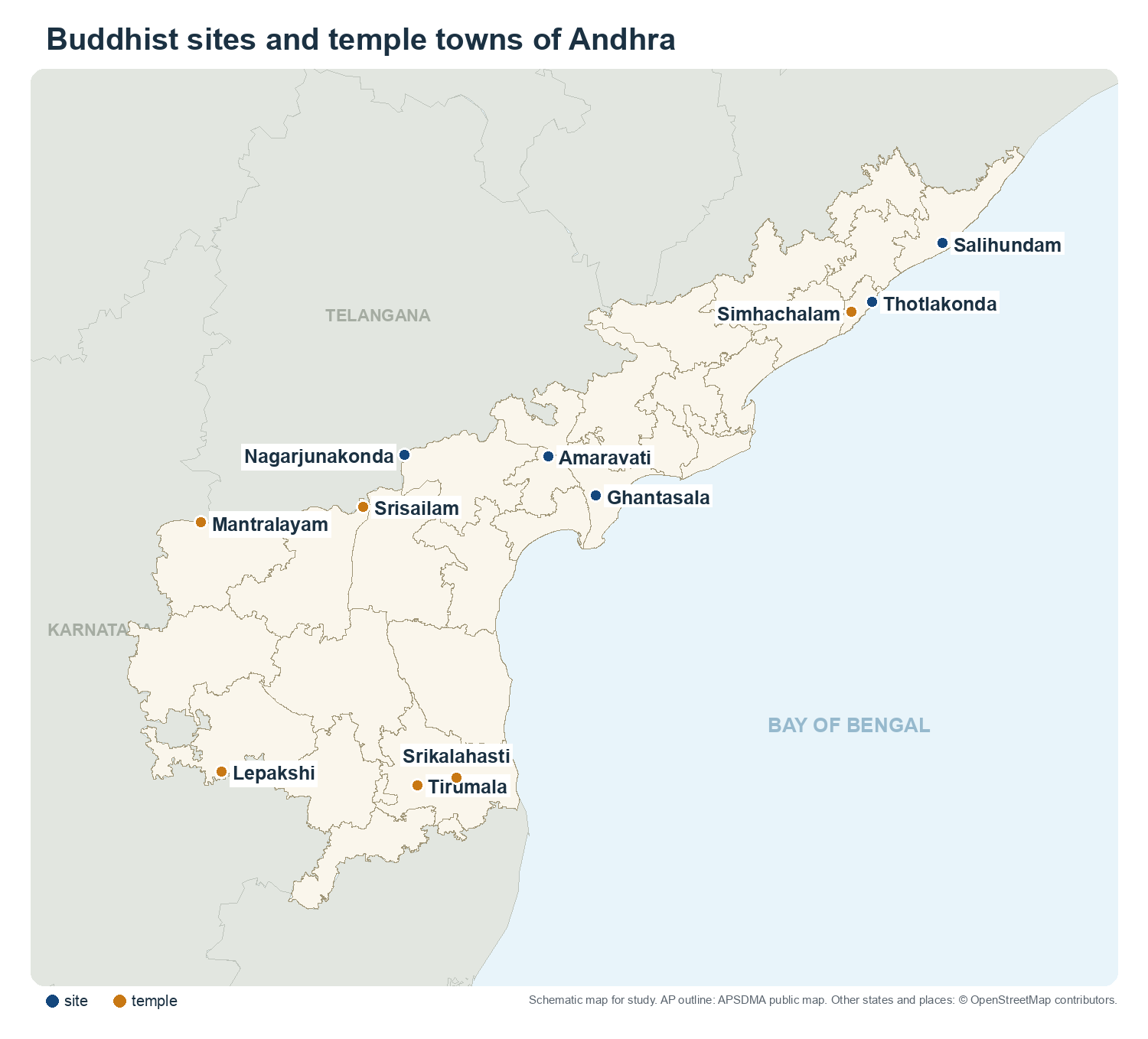
Buddhist sites in Andhra: Amaravati, Nagarjunakonda, Bavikonda, Thotlakonda, Salihundam, Bhattiprolu, Ghantasala, Guntupalli, Pavuralakonda, Bojjannakonda and Gummadidurru.
| Site | District or river |
|---|---|
| Amaravati Mahastupa | on the Krishna |
| Nagarjunakonda | on the Krishna |
| Thotlakonda, Bavikonda | Visakhapatnam |
| Salihundam | Srikakulam; on the Vamsadhara |
| Ghantasala stupa | Krishna district |
Colin Mackenzie discovered the Amaravati Stupa in 1797. Nagarjunakonda remains were discovered in 1926. The Nagarjuna Sagar Dam foundation stone was laid in 1955. Nagarjuna's Buddhist university is linked with Nagarjunakonda. Nagarjuna is also associated with Srisailam.
Buddhist writers
| Work | Author |
|---|---|
| Mulamadhyamakakarika, Suhrllekha, Ratnavali | Nagarjuna |
| Buddhacharita, Saundarananda | Ashvaghosha |
| Abhidharmakosha | Vasubandhu |
| Visuddhimagga | Buddhaghosa |
| Pramanasamuccaya | Dignaga |
| Chatuhshataka | Aryadeva |
Jainism
Mahavira was also called Vardhamana. He was born at Kundagrama. He was the twenty-fourth Tirthankara. Rishabhanatha was the first Tirthankara. Parshvanatha was the twenty-third. The Jain sects are Digambara and Svetambara. Anekantavada and Syadvada are Jain ideas.
| Jain Council | Place | President |
|---|---|---|
| First | Pataliputra | Sthulabhadra |
| Second | Valabhi | Devardhi Kshamashramana |
Jain texts: Tattvartha Sutra by Umaswati; Kalpa Sutra by Bhadrabahu; Samayasara and Pravachanasara by Kundakunda; Adi Purana by Jinasena. Kundakunda was born at Konakondla. Malliya Rechana wrote Kavijanashraya.
Shaivism and Vaishnavism
Shaiva groups: Pashupata (founder Lakulisha), Kapalika, Kalamukha, Nayanars and Lingayatism. Basaveswara founded Lingayatism. He was born at Basavana Bagevadi. Palkuriki Somanatha wrote the Basava Puranam and Panditaradhya Charitra. He is called Shiva Kavi.
Vaishnava groups: Alvars, Pancharatra, Vaikhanasa, Bhagavata and Ramanandi. Andal composed the Tiruppavai. Yamunacharya was also called Alavandar.
| Philosophy | Founder | Birthplace |
|---|---|---|
| Advaita Vedanta | Adi Shankaracharya | Kaladi |
| Vishishtadvaita | Ramanujacharya | Sriperumbudur |
| Dvaita | Madhvacharya (Anandatirtha) | Pajaka |
| Shuddhadvaita / Pushtimarg | Vallabhacharya | not given |
| Dvaitadvaita | Nimbarkacharya | not given |
| Gaudiya Vaishnavism | Chaitanya Mahaprabhu | Nabadwip |
Shankaracharya wrote the Brahma Sutra Bhashya, Bhaja Govindam and Soundarya Lahari. Ramanujacharya wrote the Sri Bhashya and Vedartha Sangraha.
Temples and deities
| Temple | Deity |
|---|---|
| Tirumala | Venkateswara |
| Srisailam | Mallikarjuna |
| Simhachalam | Varaha Lakshmi Narasimha |
| Annavaram | Satyanarayana Swamy |
| Kanipakam | Vinayaka |
| Ahobilam | Lakshmi Narasimha |
| Yaganti | Uma Maheswara |
| Mahanandi | Mahanandeeswara |
| Lepakshi | Veerabhadra |
| Srikalahasti | Kalahastiswara |
| Indrakeeladri | Kanaka Durga |
| Srikurmam | Kurmanatha |
| Mangalagiri | Panakala Narasimha |
| Vontimitta | Kodandarama |
| Arasavalli | Surya Narayana |
The Pancharama temples: Draksharamam (Bhimeswara), Amararama (Amareswara), Somarama (Someswara), Ksheerarama (Ramalingeswara), Kumararama (Kumara Bhimeswara). Lepakshi temple was built by Virupanna. Tirumala Tirupati Devasthanams was established in 1933. Brahmotsavam and Annamacharya sankirtanas are linked with Tirumala. Mantralayam is in Kurnool, on the Tungabhadra.
Dynasties, capitals and founders
| Dynasty | Founder | Capital |
|---|---|---|
| Satavahanas | Simuka | not given |
| Ikshvakus of Vijayapuri | Vasishthiputra Chamtamula | Vijayapuri |
| Eastern Chalukyas | Kubja Vishnuvardhana | Vengi |
| Salankayanas | not given | Vengi |
| Mauryan Empire | Chandragupta Maurya | Pataliputra |
| Kushan Empire | Kujula Kadphises | Purushapura |
| Reddy kingdom of Kondavidu | Prolaya Vema Reddy | Kondavidu |
| Vijayanagara Empire (1336) | Harihara I | Hampi |
Chandragupta Maurya was followed by Bindusara, then Ashoka. Simuka was followed by Kanha. The Ikshvaku line ran Vasishthiputra Chamtamula, Virapurushadatta, Ehuvula Chamtamula. Gautamiputra Satakarni was followed by Vasishthiputra Pulumavi.
Modern reform groups: Brahmo Samaj (Raja Ram Mohan Roy, 1828), Prarthana Samaj (Atmaram Pandurang, 1867), Arya Samaj (Dayananda Saraswati, 1875), Ramakrishna Mission (Swami Vivekananda, 1897).
Saint-poets, birthplaces and epithets
| Person | Link |
|---|---|
| Annamacharya | born at Tallapaka; called Pada Kavita Pitamaha |
| Kshetrayya | born at Muvva |
| Kancherla Gopanna | born at Nelakondapalli; called Bhadrachala Ramadasu |
| Tyagaraja | born at Tiruvarur |
| Srinatha | Kavi Sarvabhauma |
| Potana | Sahaja Pandita |
| Nannaya | Adi Kavi |
| Tikkana | Ubhayakavi Mitra |
| Errana | Prabandha Parameshwara |
| Allasani Peddana | Andhra Kavita Pitamaha |
| Krishnadevaraya | Andhra Bhoja |
| Tenali Ramakrishna | Vikatakavi |
Basic poets and works: Andhra Mahabhagavatam (Potana), Nirvachanottara Ramayanam (Tikkana), Amuktamalyada (Krishnadevaraya), Manucharitra (Allasani Peddana), Parijatapaharanam (Nandi Timmana), Pandurangamahatmyam (Tenali Ramakrishna), Ranganatha Ramayanam (Gona Budda Reddy), Molla Ramayanam (Molla), Venkatachala Mahatyam (Tarigonda Vengamamba), Subhadra Kalyanam (Tallapaka Tirumalamma). Satakas: Dasarathi Satakam (Kancherla Gopanna), Sumati Satakam (Baddena), Vemana Satakam (Vemana). Hala wrote the Gatha Saptashati; Gunadhya wrote the Brihatkatha; Vatsyayana wrote the Kamasutra.
Rivers, barrages and dams of Andhra
| Structure or town | River |
|---|---|
| Nagarjuna Sagar Dam, Srisailam Dam | Krishna |
| Prakasam Barrage | Krishna |
| Dowleswaram Barrage | Godavari |
| Somasila Dam | Penna |
| Tungabhadra Dam | Tungabhadra |
| Gotta Barrage | Vamsadhara |
| Narayanapuram Anicut | Nagavali |
| Dharanikota, Indrakeeladri | Krishna |
| Rajahmundry, Kovvur | Godavari |
| Nellore | Penna |
| Hampi | Tungabhadra |
Forts and places: Gandikota and Vontimitta are in Kadapa; Chandragiri Fort, Kanipakam and Srikalahasti are in Chittoor; Penukonda Fort is in Anantapur; Ramatheertham is in Vizianagaram; Mukhalingam and Kalingapatnam are in Srikakulam.
Crafts and cultural links
- Kuchipudi dance is associated with Kuchipudi.
- Kondapalli and Etikoppaka are known for toys.
- Mangalagiri, Venkatagiri, Uppada (Jamdani) and Dharmavaram (silk) are known for sarees.
- Bobbili is known for the veena; Ponduru for khadi; Budithi for brass ware; Banaganapalle for mango.
- Kalamkari is associated with Srikalahasti.
Dates to place alongside
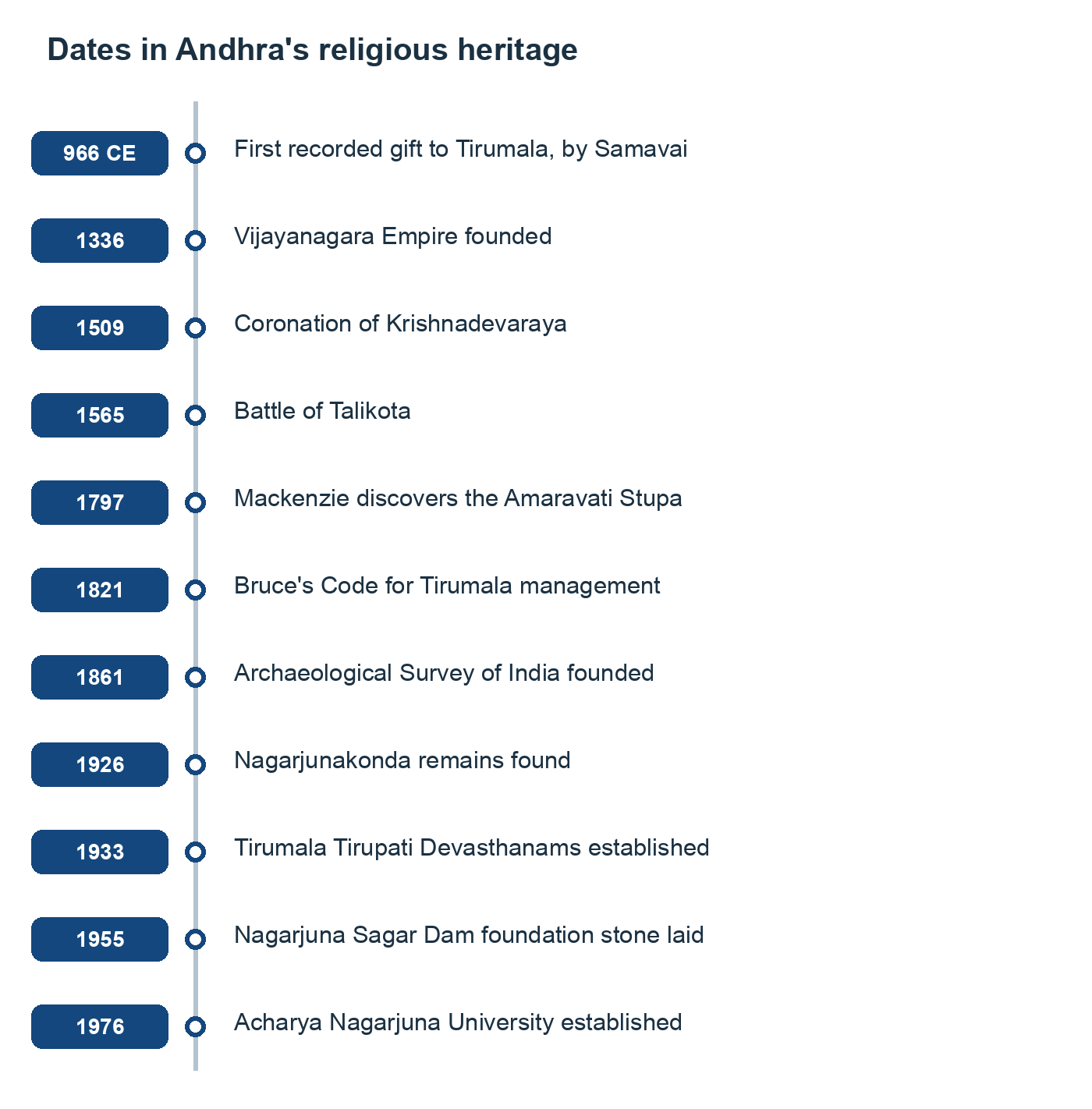
Universities and bodies: Archaeological Survey of India 1861; Asiatic Society 1784; Andhra University 1926; Sri Venkateswara University 1954; Acharya Nagarjuna University 1976. Other fixed points: Coronation of Krishnadevaraya 1509; Battle of Talikota 1565; Formation of Andhra State 1953.
Exam traps
- Nagarjuna (Madhyamaka, Buddhist) is not Nagarjuna Sagar; the Dam is on the Krishna.
- Third Buddhist Council was at Pataliputra; the Jain First Council was also at Pataliputra.
- Ashvaghosha wrote Buddhacharita; Buddhaghosa wrote Visuddhimagga.
- Vallabhacharya founded both Shuddhadvaita and Pushtimarg.
- Mahavira was the 24th Tirthankara; Parshvanatha the 23rd.
- Thotlakonda and Bavikonda are in Visakhapatnam; Salihundam is in Srikakulam.
- Simhachalam (Varaha Lakshmi Narasimha) differs from Ahobilam (Lakshmi Narasimha).
- Venkateswara is the deity at both Tirumala and Dwaraka Tirumala.
One-liners
- 1. Buddha's first sermon was at Sarnath.
- 2. Buddha was enlightened at Bodh Gaya.
- 3. The fourth Buddhist Council was held at Kundalavana.
- 4. Amaravati Stupa was discovered in 1797.
- 5. Nagarjunakonda remains were found in 1926.
- 6. Shankaracharya founded Advaita.
- 7. Ramanujacharya founded Vishishtadvaita.
- 8. Madhvacharya's other name is Anandatirtha.
- 9. Srisailam's deity is Mallikarjuna.
- 10. Satavahanas' first king was Simuka.
Background and context
Andhra was a meeting place of faiths for more than two thousand years. The rivers Krishna, Godavari and Vamsadhara carried trade, and trade carried ideas. Merchants, monks and rulers all paid for religious buildings. The early rulers of the region, the Satavahanas and then the Ikshvakus, gave money to Buddhist monasteries and also performed Vedic rites. Later, kings of the Pallava, Chalukya, Kakatiya and Vijayanagara families built great temples. So the religious map of Andhra has layers: first the Buddhist and Jain centres, then the Shaiva and Vaishnava movements, then the temple towns that still draw pilgrims.
The dynasties are covered in the earlier chapters. This chapter asks one question: what did each faith build, who supported it, and what survives?
A short reminder of the Buddhist and Jain background helps. Gautama Buddha (Siddhartha) was born at Lumbini, was enlightened at Bodh Gaya, preached his first sermon at Sarnath and died at Kushinagar. Four Buddhist councils are listed: Rajagriha, Vaishali, Pataliputra and Kundalavana. The Jain tradition counts Rishabhanatha as the first Tirthankara and Parshvanatha as the twenty-third. Mahavira (Vardhamana), born at Kundagrama, was the twenty-fourth. The Jains list two councils, at Pataliputra and Valabhi. Pataliputra appears in both lists, and this is a common trap.
Major sites and what each shows
The sites below are best learned as a set. Each shows a different period or school.
Amaravati. This is the greatest Buddhist monument of Andhra. Its Mahachaitya, the great stupa, stood on the Krishna. The date of its first foundation is not certain. It may go back to the time of Ashoka in the third century BCE, but there is no firm proof. The earliest remains that scholars can date belong to about the second century BCE, with a simple granite railing. A second, richer phase of rebuilding ran from about 50 BCE to about 250 CE, with limestone slabs carved with scenes. The Satavahanas are traditionally given credit for the work. Later kings of the Ikshvaku, Chalukya, Pallava, Salankayana, Vishnukundin and Kakatiya lines also showed respect to the stupa. The size is reported differently in different books, so remember the idea and not a number: it was among the largest stupas in the Buddhist world.
Colin Mackenzie first described the ruins in 1797. When he came back in 1816, local digging for building stone had already harmed much of the structure. His plans and drawings became the base for later study. Many carved marble slabs are now in the Government Museum at Chennai and in the British Museum, where they are called the Amaravati Marbles. The Amaravati style is known for tall, slim figures and flowing movement. Its art reached Sri Lanka and Southeast Asia through sea trade. The nearby village of Dharanikota is linked with the old city. Excavations in the twentieth century were done by A. H. Longhurst and M. H. Quraishi (1924-31) and by T. N. Ramachandran in 1938.
Nagarjunakonda. This site belongs to the Ikshvaku age of the third century CE. It was known in ancient times as Vijayapuri. The ruler Vasishthiputra Chamtamula made it a capital. Queens of the family were generous donors, and more than thirty monasteries are reported at its height. Students came from far places. The remains were found in 1926 by A. R. Saraswati of the Archaeological Survey of India, after a local schoolteacher's report. A. H. Longhurst dug there from 1927 to 1931, and R. Subrahmanyam from 1954 to 1960. They found Buddhist stupas and monasteries, and also Hindu temples. This shows that both faiths grew together under the same kings. Roman gold coins and a coin of the Roman emperor Antoninus Pius point to links with the western trade.
When the Nagarjuna Sagar Dam was built on the Krishna (the foundation stone was laid in 1955), the valley was going to be flooded. The main monuments were moved to a hilltop that became an island in the lake. A museum opened there in 1966. Do not mix three names. Nagarjuna was the Buddhist teacher of the Madhyamaka school. Nagarjunakonda is the site named after him in local memory. Nagarjuna Sagar is the dam.
Thotlakonda and Bavikonda. Both sites lie near the coast around Visakhapatnam. An aerial survey made for a naval base first revealed Thotlakonda, a hilltop monastery about fifteen kilometres from the city, above the sea. Its busiest time ran from the second century BCE to the second century CE. The state archaeology department dug there in 1988-93 and found a Hinayana (Nikaya) complex, where worshippers honoured the Buddha through symbols such as footprints, not images. Satavahana lead coins, Roman silver coins and about a dozen inscriptions tie it to sea trade. The name probably means "hill of tanks", since rock-cut cisterns were carved into the stone.
Salihundam. The remains here run from about the second to the twelfth century CE and show the Hinayana (Theravada), Mahayana and Vajrayana stages in one place, which makes this the best case for tracing change in Buddhism. The site lies on the south bank of the Vamsadhara, a few kilometres from Kalingapatnam, in the old Kalinga country. Gidugu Venkata Rama Murthy first noticed it in 1919, and diggers found four stupas, relic caskets and shrines. Its old name, Salipetaka, is said to mean "rice market".
Other Buddhist sites. Bhattiprolu, Ghantasala, Guntupalli, Pavuralakonda, Bojjannakonda and Gummadidurru are also covered earlier in this chapter. Ghantasala is linked with the Krishna coast. Learn them by river or by coast.
Learned writers. Buddhist scholars of the Andhra tradition and nearby regions are asked in pairs. Nagarjuna wrote the Mulamadhyamakakarika, the Suhrllekha and the Ratnavali. Ashvaghosha wrote the Buddhacharita and the Saundarananda. Buddhaghosa wrote the Visuddhimagga. Vasubandhu wrote the Abhidharmakosha. Dignaga wrote the Pramanasamuccaya, and Aryadeva the Chatuhshataka. Learn each name with one book.
Administration and economy
Religious sites were rich institutions. They received land, villages and money, and they held property. Four things stand out.
First, the donors. At Nagarjunakonda the royal women gave the monasteries. At Amaravati the stupa was honoured by kings of many dynasties over a long time. Gifts of this kind are the usual way such monuments were kept up.
Second, the trade link. Both Thotlakonda and Nagarjunakonda yielded Roman coins. The monasteries sat on or near trade routes, the coast and the Krishna valley, and they gave shelter to travelling merchants. Money flowed back to the monasteries as gifts.
Third, the temple economy. Great Hindu temples drew land and gold from kings, and Tirumala shows how. Copper plates with songs of the composer Tallapaka Annamacharya are kept there. The first recorded gift, jewels and land for festivals, came in 966 CE from a Pallava queen named Samavai. Chola, Pandya and Vijayanagara kings gave generously after her, and Krishnadevaraya placed his own statue at the shrine on 2 January 1517, with gold and jewels for the roof of the inner sanctum. Management changed in the early 1800s, when the East India Company took over. A code of rules followed in 1821, known as Bruce's Code, and the Tirumala Tirupati Devasthanams became the governing body in 1933.
Fourth, the shift of support. In later centuries kings gave more to Shaiva and Vaishnava temples, and the Buddhist sites lost their place in public life.
Society, religion and culture
Jainism. Mahavira's teaching rests on non-violence and on two ideas: Anekantavada (truth has many sides) and Syadvada (statements are true in some way). The two sects are the Digambara and the Svetambara. Jain texts to know are the Tattvartha Sutra of Umaswati, the Kalpa Sutra of Bhadrabahu, the Samayasara and Pravachanasara of Kundakunda, and the Adi Purana of Jinasena. Kundakunda is linked with Konakondla in Andhra. Jain councils met at Pataliputra (president Sthulabhadra) and Valabhi (Devardhi Kshamashramana). In later centuries the Shaiva movements grew strong, and the Jain following became smaller in the Telugu country. The poet Malliya Rechana, author of Kavijanashraya, is a Telugu writer linked with the Jain world in the notes of this book.
Shaiva movements. Several Shaiva groups are listed: Pashupata (founder Lakulisha), Kapalika, Kalamukha, the Tamil Nayanars, and Lingayatism (Veerashaivism). Basaveswara founded Lingayatism and was born at Basavana Bagevadi. In Andhra the movement was carried by a group of poets. Palkuriki Somanatha is the best known. He wrote the Basava Puranam in Telugu and the Panditaradhya Charitra, and he is called Shiva Kavi. He was a follower of Basava and wrote in Telugu, Kannada and Sanskrit. His exact date is disputed. Some scholars put him in the twelfth century, and others in the late thirteenth or early fourteenth. For that reason use "medieval" in a general answer. His work stayed popular through the Vijayanagara age.
Vaishnava movements. The main Vaishnava streams are the Alvars, Pancharatra, Vaikhanasa, Bhagavata and Ramanandi. Andal, one of the Alvars, composed the Tiruppavai. Yamunacharya is also called Alavandar.
Vedanta schools. Each school has a founder, a birthplace and a work. This is a favourite exam area.
| School | Founder | Birthplace | Work |
|---|---|---|---|
| Advaita | Adi Shankaracharya | Kaladi | Brahma Sutra Bhashya, Bhaja Govindam |
| Vishishtadvaita | Ramanujacharya | Sriperumbudur | Sri Bhashya, Vedartha Sangraha |
| Dvaita | Madhvacharya (Anandatirtha) | Pajaka | not stated |
| Shuddhadvaita | Vallabhacharya | Champaran (near Raipur) | Anubhashya; founded the Pushtimarg path |
| Dvaitadvaita | Nimbarkacharya | not stated | not stated |
Poet-saints and devotion. Annamacharya, born at Tallapaka, composed songs for Venkateswara and is called Pada Kavita Pitamaha. Kshetrayya was born at Muvva. Kancherla Gopanna, known as Bhadrachala Ramadasu, was born at Nelakondapalli. Tyagaraja was born at Tiruvarur. The Telugu literary heroes are linked with religion as well. Nannaya is Adi Kavi, Tikkana is Ubhayakavimitra, and Errana is Prabandha Parameshwara. Potana wrote the Andhra Mahabhagavatam. Krishnadevaraya wrote the Amuktamalyada.
Decline, legacy and sites to know
The Buddhist centres slowly lost support in the later centuries. Nagarjunakonda flourished under the Ikshvakus in the third century CE and then its great age ended. Amaravati stayed in use for many centuries more, as the list of royal visitors shows. Salihundam carried the faith into the twelfth century in its Vajrayana form. After that, the stupas fell into ruin. Local people used the stone, and the sites were forgotten until Mackenzie and later archaeologists recorded them. The Archaeological Survey of India (founded 1861) and the state archaeology department have since cared for them.
Hindu temple culture took over the role of the monastery. The temple towns below are the main ones, with the deity of each.
| Temple | Deity |
|---|---|
| Tirumala | Venkateswara |
| Srisailam | Mallikarjuna |
| Simhachalam | Varaha Lakshmi Narasimha |
| Ahobilam | Lakshmi Narasimha |
| Mangalagiri | Panakala Narasimha |
| Annavaram | Satyanarayana Swamy |
| Kanipakam | Vinayaka |
| Srikalahasti | Kalahastiswara |
| Lepakshi | Veerabhadra |
| Indrakeeladri | Kanaka Durga |
| Vontimitta | Kodandarama |
| Arasavalli | Surya Narayana |
| Srikurmam | Kurmanatha |
Srisailam is both a Jyotirlinga and a Shakta pitha. Its temple shows Dravidian and Vijayanagara styles. The Pancharama shrines are Draksharamam, Amararama, Somarama, Ksheerarama and Kumararama. The Lepakshi temple was built by Virupanna in the Vijayanagara age. Mantralayam stands on the Tungabhadra.
The legacy of this history is double. First, the remains of Amaravati and Nagarjunakonda show Andhra as a centre of Buddhist art with links across the sea. Second, the living temples show how devotion grew from the Alvars, Nayanars and the Telugu poet-saints into the present pilgrim culture.
How examiners use this chapter
- Council pairs. Buddhist: Rajagriha, Vaishali, Pataliputra, Kundalavana. Jain: Pataliputra, Valabhi. Pataliputra is in both lists; Vaishali is not Valabhi.
- Look-alike names. Ashvaghosha (Buddhacharita) against Buddhaghosa (Visuddhimagga). Nagarjuna (teacher), Nagarjunakonda (site), Nagarjuna Sagar (dam on the Krishna) and Acharya Nagarjuna University (1976).
- Site and place. Amaravati and Nagarjunakonda are on the Krishna. Thotlakonda and Bavikonda are near Visakhapatnam. Salihundam is on the Vamsadhara near Kalingapatnam.
- Dates for discovery. Mackenzie at Amaravati, 1797. Nagarjunakonda reported in 1926. Dam foundation stone, 1955.
- Founder, birthplace, work. Shankaracharya (Kaladi), Ramanujacharya (Sriperumbudur), Madhvacharya (Pajaka); remember Vallabhacharya founded Shuddhadvaita and Pushtimarg.
- Temple and deity pairs. Simhachalam (Varaha Lakshmi Narasimha) against Ahobilam (Lakshmi Narasimha) and Mangalagiri (Panakala Narasimha); Srisailam (Mallikarjuna); Srikalahasti (Kalahastiswara).
- Tirumala management. Tirumala Tirupati Devasthanams, 1933; earlier Bruce's Code, 1821.
- Epithets. Annamacharya is Pada Kavita Pitamaha; Palkuriki Somanatha is Shiva Kavi; Kancherla Gopanna is Bhadrachala Ramadasu.
Worked cases
Case 1: Which statement is NOT correct? (a) Third Buddhist Council, Pataliputra. (b) First Jain Council, Pataliputra. (c) Fourth Buddhist Council, Kundalavana. (d) Second Buddhist Council, Valabhi.
Reasoning:
- 1. List the Buddhist council places in order: Rajagriha, Vaishali, Pataliputra, Kundalavana.
- 2. So the second Buddhist council was at Vaishali, not Valabhi.
- 3. Valabhi belongs to the second Jain Council. The first Jain Council was at Pataliputra.
- 4. Options (a), (b) and (c) are all true. Option (d) mixes a Buddhist council with a Jain place.
Takeaway: Keep two lists, Buddhist and Jain. A place that appears in both lists (Pataliputra) is the usual trap.
Case 2: Who wrote Buddhacharita and who wrote Visuddhimagga? The names look alike.
Reasoning:
- 1. Ashvaghosha wrote Buddhacharita and Saundarananda.
- 2. Buddhaghosa wrote Visuddhimagga.
- 3. Vasubandhu wrote Abhidharmakosha, Dignaga wrote Pramanasamuccaya, and Aryadeva wrote Chatuhshataka.
- 4. Nagarjuna wrote Mulamadhyamakakarika, Suhrllekha and Ratnavali, and founded the Madhyamaka school.
Takeaway: For look-alike names, learn each one with one work. "Ashva" goes with Buddhacharita.
Case 3: Match philosophy, founder and birthplace: Advaita, Vishishtadvaita, Dvaita.
Reasoning:
- 1. Advaita Vedanta: Adi Shankaracharya, born at Kaladi. He wrote Brahma Sutra Bhashya and Bhaja Govindam.
- 2. Vishishtadvaita: Ramanujacharya, born at Sriperumbudur. He wrote Sri Bhashya.
- 3. Dvaita: Madhvacharya, also called Anandatirtha, born at Pajaka.
- 4. Vallabhacharya founded Shuddhadvaita and Pushtimarg. This is one person with two names for his teaching.
Takeaway: Each philosophy has one founder, one birthplace and at least one text. Learn them as a row.
Case 4: A student places Thotlakonda in Srikakulam and Salihundam in Visakhapatnam. Correct this.
Reasoning:
- 1. Thotlakonda and Bavikonda are Buddhist sites at Visakhapatnam.
- 2. Salihundam is a Buddhist site at Srikakulam, on the Vamsadhara river.
- 3. Amaravati and Nagarjunakonda lie on the Krishna.
- 4. Ghantasala stupa is linked with the Krishna district.
Takeaway: Tie each Buddhist site to a river or a district, and the pairs do not swap.
Compare and contrast
| Name | What it is |
|---|---|
| Nagarjuna | Buddhist scholar; founder of the Madhyamaka school; linked with Srisailam |
| Nagarjunakonda | Buddhist site on the Krishna; remains found in 1926; linked with Nagarjuna's Buddhist university |
| Nagarjuna Sagar Dam | Dam on the Krishna; foundation stone 1955 |
| Acharya Nagarjuna University | University, established 1976 |
| Temple | Deity |
|---|---|
| Simhachalam | Varaha Lakshmi Narasimha |
| Ahobilam | Lakshmi Narasimha |
| Mangalagiri | Panakala Narasimha |
| Tirumala | Venkateswara |
| Dwaraka Tirumala | Venkateswara |
| Srisailam | Mallikarjuna |
| Srikalahasti | Kalahastiswara |
Sequence and timeline
- 1. 1336: Vijayanagara Empire founded
- 2. 1509: coronation of Krishnadevaraya
- 3. 1565: Battle of Talikota
- 4. 1784: Asiatic Society
- 5. 1797: Colin Mackenzie discovers the Amaravati Stupa
- 6. 1828: Brahmo Samaj
- 7. 1861: Archaeological Survey of India
- 8. 1867: Prarthana Samaj
- 9. 1875: Arya Samaj and Theosophical Society
- 10. 1897: Ramakrishna Mission
- 11. 1926: Nagarjunakonda remains found; Andhra University
- 12. 1933: Tirumala Tirupati Devasthanams
- 13. 1953: Andhra State
- 14. 1954: Sri Venkateswara University
- 15. 1955: Nagarjuna Sagar Dam foundation stone
- 16. 1976: Acharya Nagarjuna University
More one-liners
- 1. Gupta dynasty founder: Sri Gupta; capital Pataliputra.
- 2. Nanda dynasty founder: Mahapadma Nanda.
- 3. Shunga dynasty founder: Pushyamitra Shunga; he was followed by Agnimitra.
- 4. Kanva dynasty founder: Vasudeva Kanva.
- 5. Pala dynasty founder: Gopala.
- 6. Musunuri Nayaks founder: Prolaya Nayaka.
- 7. Kanishka was followed by Vasishka.
- 8. Sikhism founder: Guru Nanak.
- 9. Pallava capital: Kanchipuram. Pandya capital: Madurai. Chola capital: Thanjavur.
- 10. Konark temple was built by Narasimhadeva I.
- 11. Brihadeeswara temple at Thanjavur was built by Rajaraja I.
- 12. Kailasa temple at Ellora was built by Krishna I.
- 13. Shore Temple at Mahabalipuram was built by Narasimhavarman II.
- 14. Kondavidu Fort was built by Prolaya Vema Reddy.
- 15. Venkateswara Suprabhatam was written by Prativadi Bhayankaram Annangaracharya.
Practice questions
Kubja Vishnuvardhana was the founder of which of the following?
- Kushan Empire
- Eastern Chalukyas
- Archaeological Survey of India
- Vakataka dynasty
Answer
B. Eastern Chalukyas
కుబ్జ విష్ణువర్ధనుడు ఈ క్రింది వాటిలో దేనికి స్థాపకుడు?
- కుషాణ సామ్రాజ్యం
- తూర్పు చాళుక్యులు
- భారత పురావస్తు సర్వే సంస్థ
- వాకాటక వంశం
Tallapaka Annamacharya is known for composing sankirtanas in praise of:
- Lord Simhachalam Narasimha
- Lord Srikurmam
- Lord Venkateswara of Tirumala
- Lord Mallikarjuna of Srisailam
Answer
C. Lord Venkateswara of Tirumala
He composed thousands of devotional songs on Venkateswara.
తాళ్ళపాక అన్నమాచార్యుడు ఎవరిని కీర్తిస్తూ సంకీర్తనలు రచించాడు?
- సింహాచల నరసింహుడు
- శ్రీకూర్మనాథుడు
- తిరుమల వేంకటేశ్వరుడు
- శ్రీశైల మల్లికార్జునుడు
The Amaravati school of Buddhist sculpture, known for its stupa reliefs, developed on the banks of which river in Andhra?
- Godavari
- Krishna
- Penna
- Tungabhadra
Answer
B. Krishna
Amaravati art flourished in the Krishna valley under the Satavahanas and their successors.
స్తూప శిల్పాలకు పేరొందిన అమరావతి బౌద్ధ శిల్పకళా శైలి ఆంధ్రలో ఏ నది ఒడ్డున అభివృద్ధి చెందింది?
- గోదావరి
- కృష్ణా
- పెన్నా
- తుంగభద్ర
Consider the following pairs (Dynasty/Organisation – Founder): (i) Ikshvakus of Vijayapuri – Vasishthiputra Chamtamula (ii) Dasholi Gram Swarajya Sangh – Chandi Prasad Bhatt (iii) Reddy kingdom of Kondavidu – Prolaya Vema Reddy Which of the pairs are correctly matched?
- Only (i)
- Only (ii)
- All of (i), (ii) and (iii)
- Only (ii) and (iii)
Answer
C. All of (i), (ii) and (iii)
ఈ క్రింది జతలను పరిశీలించండి (రాజవంశం/సంస్థ – స్థాపకుడు): (i) విజయపురి ఇక్ష్వాకులు – వాసిష్ఠీపుత్ర శాంతమూలుడు (ii) దశోలీ గ్రామ స్వరాజ్య సంఘ్ – చండీ ప్రసాద్ భట్ (iii) కొండవీడు రెడ్డి రాజ్యం – ప్రోలయ వేమారెడ్డి సరిగ్గా జతపరచబడినవి ఏవి?
- (i) మాత్రమే
- (ii) మాత్రమే
- (i), (ii), (iii) అన్నీ
- (ii), (iii) మాత్రమే
Consider the following pairs (Office – Person): (i) first ruler of the Vijayanagara Empire – Harihara I (ii) first Tirthankara of Jainism – Rishabhanatha (iii) first Indian interplanetary mission – Mars Orbiter Mission Which of the pairs are correctly matched?
- All of (i), (ii) and (iii)
- Only (iii)
- Only (i) and (iii)
- Only (i)
Answer
A. All of (i), (ii) and (iii)
ఈ క్రింది జతలను పరిశీలించండి (పదవి – వ్యక్తి): (i) విజయనగర సామ్రాజ్య తొలి పాలకుడు – హరిహర I (ii) జైనమతపు మొదటి తీర్థంకరుడు – ఋషభనాథుడు (iii) తొలి భారత గ్రహాంతర యాత్ర – మార్స్ ఆర్బిటర్ మిషన్ సరిగ్గా జతపరచబడినవి ఏవి?
- (i), (ii), (iii) అన్నీ
- (iii) మాత్రమే
- (i), (iii) మాత్రమే
- (i) మాత్రమే
Which of the following is associated with Nagarjunakonda?
- Budithi brass ware
- Etikoppaka toys
- Venkatagiri sarees
- Nagarjuna's Buddhist university
Answer
D. Nagarjuna's Buddhist university
ఈ క్రింది వాటిలో 'నాగార్జునకొండ' అనే అంశంతో ముడిపడినది ఏది?
- బుడితి ఇత్తడి వస్తువులు
- ఏటికొప్పాక బొమ్మలు
- వెంకటగిరి చీరలు
- నాగార్జునుని బౌద్ధ విశ్వవిద్యాలయం
The presiding deity of the Simhachalam temple near Visakhapatnam is:
- Mallikarjuna
- Venkateswara
- Bhimeswara
- Varaha Lakshmi Narasimha
Answer
D. Varaha Lakshmi Narasimha
The deity appears covered in sandal paste.
విశాఖపట్నం సమీపంలోని సింహాచల ఆలయ మూలవిరాట్ ఎవరు?
- మల్లికార్జునుడు
- వేంకటేశ్వరుడు
- భీమేశ్వరుడు
- వరాహ లక్ష్మీ నరసింహుడు
Who wrote the Telugu prabandha Amuktamalyada?
- Tenali Ramakrishna
- Krishnadevaraya
- Srinatha
- Allasani Peddana
Answer
B. Krishnadevaraya
The emperor Krishnadevaraya himself composed it.
తెలుగు ప్రబంధం ఆముక్తమాల్యదను రచించినది ఎవరు?
- తెనాలి రామకృష్ణుడు
- శ్రీకృష్ణదేవరాయలు
- శ్రీనాథుడు
- అల్లసాని పెద్దన
The Amaravati Mahastupa, a major Buddhist monument of the Satavahana age, stands on the banks of which river?
- Godavari
- Penna
- Tungabhadra
- Krishna
Answer
D. Krishna
Amaravati (ancient Dhanyakataka) lies on the Krishna river in the present Guntur region.
శాతవాహన కాలపు ప్రధాన బౌద్ధ కట్టడమైన అమరావతి మహాస్తూపం ఏ నది ఒడ్డున ఉంది?
- గోదావరి
- పెన్నా
- తుంగభద్ర
- కృష్ణా
Which pair of Buddhist centres in Andhra is associated with Satavahana-era patronage?
- Ajanta and Ellora
- Hampi and Badami
- Amaravati and Nagarjunakonda
- Konark and Puri
Answer
C. Amaravati and Nagarjunakonda
Amaravati and Nagarjunakonda are major Buddhist sites in the Krishna valley.
శాతవాహన కాలపు పోషణతో సంబంధం ఉన్న ఆంధ్రలోని బౌద్ధ కేంద్రాల జత ఏది?
- అజంతా, ఎల్లోరా
- హంపి, బాదామి
- అమరావతి, నాగార్జునకొండ
- కోణార్క్, పూరి
Sringara Naishadham is a work of which Telugu poet?
- Nannechoda
- Tikkana
- Srinatha
- Gona Budda Reddy
Answer
C. Srinatha
Srinatha translated Sriharsha's Naishadha as Sringara Naishadham.
శృంగార నైషధం ఏ తెలుగు కవి రచన?
- నన్నెచోడుడు
- తిక్కన
- శ్రీనాథుడు
- గోన బుద్ధారెడ్డి
Which dynasty of Nellore acknowledged Chola overlordship and made gifts to the Srikalahasti temple?
- Reddis of Kondavidu
- Bahmani
- Chalukyas of Kalyani
- Telugu Cholas
Answer
D. Telugu Cholas
చోళుల ఆధిపత్యాన్ని అంగీకరించి శ్రీకాళహస్తి ఆలయానికి దానాలు ఇచ్చిన నెల్లూరు వంశం ఏది?
- కొండవీటి రెడ్డిరాజులు
- బహమనీ
- కల్యాణి చాళుక్యులు
- తెలుగు చోళులు
Which medieval Telugu dynasty of Warangal is listed among the rulers of West Godavari?
- Reddis of Kondavidu
- Kakatiyas
- Qutb Shahis
- Eastern Chalukyas
Answer
B. Kakatiyas
పశ్చిమ గోదావరిని పాలించినవారిలో పేర్కొనబడిన వరంగల్కు చెందిన మధ్యయుగ తెలుగు వంశం ఏది?
- కొండవీటి రెడ్డిలు
- కాకతీయులు
- కుతుబ్ షాహీలు
- తూర్పు చాళుక్యులు
Consider the following pairs (Dynasty/Organisation – Founder): (i) Reddi kingdom – Prolaya Vema Reddy (ii) Satavahana dynasty – Vasudeva Kanva (iii) Kanva dynasty – Simuka Which of the pairs are correctly matched?
- Only (i)
- Only (i) and (iii)
- Only (ii)
- None of them
Answer
A. Only (i)
ఈ క్రింది జతలను పరిశీలించండి (రాజవంశం/సంస్థ – స్థాపకుడు): (i) రెడ్డి రాజ్యం – ప్రోలయ వేమారెడ్డి (ii) శాతవాహన వంశం – వసుదేవ కణ్వుడు (iii) కణ్వ వంశం – సిముకుడు సరిగ్గా జతపరచబడినవి ఏవి?
- (i) మాత్రమే
- (i), (iii) మాత్రమే
- (ii) మాత్రమే
- ఏదీ కాదు
Which of the following is NOT correctly paired with Dwipada kavya (Item – Category)?
- Kalahastiswara Satakam
- Ranganatha Ramayanam
- Panditaradhya Charitra
- Basava Puranam
Answer
A. Kalahastiswara Satakam
ఈ క్రింది వాటిలో ఏది 'ద్విపద కావ్యం' అనే అంశానికి సరిగ్గా జతకాదు? (అంశం – వర్గం)
- కాళహస్తీశ్వర శతకం
- రంగనాథ రామాయణం
- పండితారాధ్య చరిత్ర
- బసవ పురాణం
Who wrote Sri Venkateswara Suprabhatam?
- Kandukuri Veeresalingam
- Prativadi Bhayankaram Annangaracharya
- Tallapaka Tirumalamma
- Errana
Answer
B. Prativadi Bhayankaram Annangaracharya
శ్రీ వేంకటేశ్వర సుప్రభాతం రచయిత ఎవరు?
- కందుకూరి వీరేశలింగం
- ప్రతివాది భయంకరం అణ్ణంగరాచార్యుడు
- తాళ్లపాక తిరుమలమ్మ
- ఎర్రన
Consider the following pairs (Work – Author): (i) Sri Ranga Raja Charitra – Narahari Gopala Krishnamacharyulu (ii) Sumati Satakam – Baddena (iii) Parijatapaharanam – Nandi Timmana Which of the pairs are correctly matched?
- Only (iii)
- None of them
- Only (i)
- All of (i), (ii) and (iii)
Answer
D. All of (i), (ii) and (iii)
ఈ క్రింది జతలను పరిశీలించండి (రచన – రచయిత): (i) శ్రీరంగరాజ చరిత్ర – నరహరి గోపాలకృష్ణమాచార్యులు (ii) సుమతీ శతకం – బద్దెన (iii) పారిజాతాపహరణం – నంది తిమ్మన సరిగ్గా జతపరచబడినవి ఏవి?
- (iii) మాత్రమే
- ఏదీ కాదు
- (i) మాత్రమే
- (i), (ii), (iii) అన్నీ
Which of the following is associated with Srisailam?
- Kondapalli toys
- Uppada Jamdani sarees
- Nagarjuna
- Annamacharya sankirtanas
Answer
C. Nagarjuna
ఈ క్రింది వాటిలో 'శ్రీశైలం' అనే అంశంతో ముడిపడినది ఏది?
- కొండపల్లి బొమ్మలు
- ఉప్పాడ జాందానీ చీరలు
- నాగార్జునుడు
- అన్నమాచార్య సంకీర్తనలు
Consider the following pairs (Monument – Builder): (i) Grand Anicut – Kancherla Gopanna (ii) Bhadrachalam Temple – Karikala Chola (iii) Kailasa Temple Ellora – Krishna I Which of the pairs are correctly matched?
- None of them
- All of (i), (ii) and (iii)
- Only (i)
- Only (iii)
Answer
D. Only (iii)
ఈ క్రింది జతలను పరిశీలించండి (కట్టడం – నిర్మాత): (i) గ్రాండ్ అనికట్ – కంచర్ల గోపన్న (ii) భద్రాచలం ఆలయం – కరికాల చోళుడు (iii) ఎల్లోరా కైలాస ఆలయం – మొదటి కృష్ణుడు సరిగ్గా జతపరచబడినవి ఏవి?
- ఏదీ కాదు
- (i), (ii), (iii) అన్నీ
- (i) మాత్రమే
- (iii) మాత్రమే
Consider the following pairs (Monument – Builder): (i) Veerabhadra Temple at Lepakshi – Virupanna and Viranna (ii) Pancha Rathas – Narasimhavarman I (iii) Sanchi Stupa – Ashoka Which of the pairs are correctly matched?
- Only (iii)
- Only (i) and (iii)
- All of (i), (ii) and (iii)
- Only (i)
Answer
C. All of (i), (ii) and (iii)
ఈ క్రింది జతలను పరిశీలించండి (కట్టడం – నిర్మాత): (i) లేపాక్షిలోని వీరభద్ర ఆలయం – విరూపన్న మరియు వీరన్న (ii) పంచ రథాలు – మొదటి నరసింహవర్మ (iii) సాంచీ స్తూపం – అశోకుడు సరిగ్గా జతపరచబడినవి ఏవి?
- (iii) మాత్రమే
- (i), (iii) మాత్రమే
- (i), (ii), (iii) అన్నీ
- (i) మాత్రమే
Consider the following pairs (Work – Author): (i) Sri Venkateswara Suprabhatam – Nandi Timmana (ii) The God of Small Things – Arundhati Roy (iii) Parijatapaharanam – Prativadi Bhayankaram Annangaracharya Which of the pairs are correctly matched?
- Only (i)
- Only (i) and (ii)
- Only (ii)
- All of (i), (ii) and (iii)
Answer
C. Only (ii)
ఈ క్రింది జతలను పరిశీలించండి (రచన – రచయిత): (i) శ్రీ వేంకటేశ్వర సుప్రభాతం – నంది తిమ్మన (ii) ది గాడ్ ఆఫ్ స్మాల్ థింగ్స్ – అరుంధతీ రాయ్ (iii) పారిజాతాపహరణం – ప్రతివాది భయంకరం అణ్ణంగరాచార్యుడు సరిగ్గా జతపరచబడినవి ఏవి?
- (i) మాత్రమే
- (i), (ii) మాత్రమే
- (ii) మాత్రమే
- (i), (ii), (iii) అన్నీ
Consider the following pairs (Temple – Deity): (i) Vijayawada Kanaka Durga Temple – Kanaka Durga (ii) Kailasanatha Temple, Kanchipuram – Shiva (iii) Govindaraja Swamy Temple Tirupati – Govindaraja Swamy Which of the pairs are correctly matched?
- All of (i), (ii) and (iii)
- Only (i)
- Only (i) and (iii)
- Only (iii)
Answer
A. All of (i), (ii) and (iii)
ఈ క్రింది జతలను పరిశీలించండి (ఆలయం – దైవం): (i) విజయవాడ కనకదుర్గ ఆలయం – కనకదుర్గ (ii) కాంచీపురం కైలాసనాథ ఆలయం – శివుడు (iii) తిరుపతి గోవిందరాజస్వామి ఆలయం – గోవిందరాజస్వామి సరిగ్గా జతపరచబడినవి ఏవి?
- (i), (ii), (iii) అన్నీ
- (i) మాత్రమే
- (i), (iii) మాత్రమే
- (iii) మాత్రమే
Thotlakonda and Bavikonda near Visakhapatnam belong mainly to which Buddhist tradition?
- Hinayana (Theravada)
- Vajrayana
- Zen
- Mahayana
Answer
A. Hinayana (Theravada)
These hilltop monasteries date mainly from the Hinayana phase.
విశాఖపట్నం సమీపంలోని తొట్లకొండ, బావికొండ ప్రధానంగా ఏ బౌద్ధ సంప్రదాయానికి చెందినవి?
- హీనయానం (థేరవాదం)
- వజ్రయానం
- జెన్
- మహాయానం
Which Telugu poet popularised Virasaivism through works such as the Basava Purana?
- Srinatha
- Tikkana
- Nannechoda
- Palkuriki Somanatha
Answer
D. Palkuriki Somanatha
Somanatha wrote in simple native Telugu metres.
బసవ పురాణం వంటి రచనల ద్వారా వీరశైవాన్ని తెలుగులో ప్రచారం చేసిన కవి ఎవరు?
- శ్రీనాథుడు
- తిక్కన
- నన్నెచోడుడు
- పాల్కురికి సోమనాథుడు
The Kavitrayam (poetic trinity) who translated the Mahabharata into Telugu are:
- Nannaya, Tikkana and Errana
- Errana, Srinatha and Timmana
- Nannaya, Potana and Srinatha
- Tikkana, Peddana and Dhurjati
Answer
A. Nannaya, Tikkana and Errana
The three completed the epic across three centuries.
మహాభారతాన్ని తెలుగులోకి అనువదించిన కవిత్రయం ఎవరు?
- నన్నయ, తిక్కన, ఎర్రన
- ఎర్రన, శ్రీనాథుడు, తిమ్మన
- నన్నయ, పోతన, శ్రీనాథుడు
- తిక్కన, పెద్దన, ధూర్జటి
In which present district of Andhra Pradesh is the Tirumala Venkateswara temple located?
- Kurnool
- Nellore
- Tirupati
- Kadapa
Answer
C. Tirupati
Tirumala is in Tirupati district.
తిరుమల వేంకటేశ్వర ఆలయం ప్రస్తుత ఆంధ్రప్రదేశ్లోని ఏ జిల్లాలో ఉంది?
- కర్నూలు
- నెల్లూరు
- తిరుపతి
- కడప
Which saint-poet composed thousands of sankirtanas on Lord Venkateswara of Tirumala?
- Annamacharya
- Kshetrayya
- Bhadrachala Ramadasu
- Tyagaraja
Answer
A. Annamacharya
Tallapaka Annamacharya is the great Venkateswara sankirtana composer.
తిరుమల వేంకటేశ్వరునిపై వేలాది సంకీర్తనలు రచించిన వాగ్గేయకారుడు ఎవరు?
- అన్నమాచార్యుడు
- క్షేత్రయ్య
- భద్రాచల రామదాసు
- త్యాగరాజు
Which are Buddhist structures in Andhra?
- Annavaram
- Lepakshi
- Srisailam
- Amaravati, Nagarjunakonda, Bhattiprolu
Answer
D. Amaravati, Nagarjunakonda, Bhattiprolu
Buddhist sites.
బౌద్ధ నిర్మాణాలు ఏవి?
- అన్నవరం
- లేపాక్షి
- శ్రీశైలం
- అమరావతి, నాగార్జునకొండ, భట్టిప్రోలు
First twin poets in Telugu?
- Nandi Mallaiah, Ghanta Singaiah
- Tenali
- Tikkana, Errana
- Peddana, Timmana
Answer
A. Nandi Mallaiah, Ghanta Singaiah
Nandi Mallaya-Ghanta Singaya.
తెలుగులో మొదటి జంట కవులు ఎవరు?
- నంది మల్లయ్య, ఘంట సింగయ్య
- తెనాలి
- తిక్కన, ఎర్రన
- పెద్దన, తిమ్మన
Match the authors with their works: (1) Nannaya (2) Tikkana (3) Pavuluri Mallana (4) Gunadhya (a) Saara Sangraha Ganitamu (b) Brihatkatha (c) Nirvachanottara Ramayanamu (d) Andhra Mahabharatamu (Adi and Sabha parvas)
- 1-b, 2-c, 3-a, 4-d
- 1-d, 2-a, 3-c, 4-b
- 1-d, 2-c, 3-a, 4-b
- 1-c, 2-d, 3-b, 4-a
Answer
C. 1-d, 2-c, 3-a, 4-b
Nannaya wrote the early Mahabharata parvas, Tikkana the Nirvachanottara Ramayanamu, Mallana the maths text and Gunadhya the Brihatkatha.
రచయితలను వారి రచనలతో జతపరచండి: (1) నన్నయ (2) తిక్కన (3) పావులూరి మల్లన (4) గుణాఢ్యుడు (a) సార సంగ్రహ గణితము (b) బృహత్కథ (c) నిర్వచనోత్తర రామాయణము (d) ఆంధ్ర మహాభారతము (ఆది, సభా పర్వాలు)
- 1-b, 2-c, 3-a, 4-d
- 1-d, 2-a, 3-c, 4-b
- 1-d, 2-c, 3-a, 4-b
- 1-c, 2-d, 3-b, 4-a
Match the Andhra Pradesh towns with their GI-tagged crafts: (1) Bobbili (2) Kondapalli (3) Etikoppaka (4) Mangalagiri (a) Lacquered wooden toys (b) Veena (c) Handloom sarees and fabrics (d) Painted softwood toys
- 1-b, 2-d, 3-a, 4-c
- 1-d, 2-b, 3-a, 4-c
- 1-b, 2-a, 3-d, 4-c
- 1-c, 2-d, 3-a, 4-b
Answer
A. 1-b, 2-d, 3-a, 4-c
Bobbili makes veenas, Kondapalli painted toys, Etikoppaka lacquer toys, and Mangalagiri handloom cloth.
ఆంధ్రప్రదేశ్ పట్టణాలను వాటి GI గుర్తింపు పొందిన కళా ఉత్పత్తులతో జతపరచండి: (1) బొబ్బిలి (2) కొండపల్లి (3) ఏటికొప్పాక (4) మంగళగిరి (a) లక్క పూత చెక్క బొమ్మలు (b) వీణ (c) చేనేత చీరలు, వస్త్రాలు (d) రంగులు వేసిన మెత్తటి చెక్క బొమ్మలు
- 1-b, 2-d, 3-a, 4-c
- 1-d, 2-b, 3-a, 4-c
- 1-b, 2-a, 3-d, 4-c
- 1-c, 2-d, 3-a, 4-b
The Telugu Ramayana in dvipada metre, popularly called the Ranganatha Ramayanam, was composed by:
- Molla
- Bhaskara
- Tikkana
- Gona Budda Reddy
Answer
D. Gona Budda Reddy
Gona Budda Reddy wrote it as the first Telugu Ramayana in dvipada.
రంగనాథ రామాయణంగా ప్రసిద్ధమైన ద్విపద తెలుగు రామాయణాన్ని రచించినవారు:
- మొల్ల
- భాస్కరుడు
- తిక్కన
- గోన బుద్ధారెడ్డి
Which pair of rivers flows through the Srikakulam region into the Bay of Bengal?
- Pennar and Swarnamukhi
- Nagavali and Vamsadhara
- Krishna and Tungabhadra
- Godavari and Sabari
Answer
B. Nagavali and Vamsadhara
The Nagavali and Vamsadhara are the main rivers of the far north-eastern coast of Andhra.
శ్రీకాకుళం ప్రాంతం మీదుగా ప్రవహించి బంగాళాఖాతంలో కలిసే నదుల జత ఏది?
- పెన్నా మరియు స్వర్ణముఖి
- నాగావళి మరియు వంశధార
- కృష్ణా మరియు తుంగభద్ర
- గోదావరి మరియు శబరి
The Salankayanas began as feudatories of which earlier Andhra dynasty?
- Satavahanas
- Ikshvakus
- Eastern Chalukyas
- Vishnukundins
Answer
B. Ikshvakus
The Salankayanas first served the Ikshvakus and became independent after Ikshvaku power declined.
శాలంకాయనులు తొలుత ఏ ప్రాచీన ఆంధ్ర రాజవంశానికి సామంతులుగా ఉన్నారు?
- శాతవాహనులు
- ఇక్ష్వాకులు
- తూర్పు చాళుక్యులు
- విష్ణుకుండినులు
Which early Telugu poet composed the Kumarasambhavam?
- Nannaya
- Nannechoda
- Tikkana
- Palkuriki Somanatha
Answer
B. Nannechoda
Nannechoda is the author of the Telugu Kumarasambhavam.
కుమారసంభవం అనే కావ్యాన్ని రచించిన తొలి తెలుగు కవి ఎవరు?
- నన్నయ
- నన్నెచోడుడు
- తిక్కన
- పాల్కురికి సోమనాథుడు
Arrange these Andhra dynasties in chronological order of rule, earliest first: (1) Ikshvakus (2) Eastern Chalukyas of Vengi (3) Satavahanas
- 1, 3, 2
- 3, 2, 1
- 1, 2, 3
- 3, 1, 2
Answer
D. 3, 1, 2
The Satavahanas came first, the Ikshvakus followed in the 3rd century CE, and the Eastern Chalukyas rose in the 7th century.
ఈ ఆంధ్ర రాజవంశాలను పాలనా కాలక్రమం (ముందుది మొదట) ప్రకారం అమర్చండి: (1) ఇక్ష్వాకులు (2) వేంగి తూర్పు చాళుక్యులు (3) శాతవాహనులు
- 1, 3, 2
- 3, 2, 1
- 1, 2, 3
- 3, 1, 2
Who wrote the Basava Puranam in Telugu?
- Srinatha
- Pothana
- Palkuriki Somanatha
- Tikkana
Answer
C. Palkuriki Somanatha
Basava Puranam is a Veerashaiva work by Palkuriki Somanatha.
తెలుగులో బసవపురాణాన్ని రచించినవారు ఎవరు?
- శ్రీనాథుడు
- పోతన
- పాల్కురికి సోమనాథుడు
- తిక్కన
Which Vijayanagara emperor visited the Venkatesvara temple at Tirumala seven times and venerated the deity as his chosen god?
- Kulottunga I
- Mallikarjuna Pandita
- Krishnadevaraya
- Vijayaditya VII
Answer
C. Krishnadevaraya
తిరుమలలోని వేంకటేశ్వర ఆలయాన్ని ఏడుసార్లు దర్శించి ఆ దైవాన్ని తన ఇష్టదైవంగా ఆరాధించిన విజయనగర చక్రవర్తి ఎవరు?
- కులోత్తుంగ I
- మల్లికార్జున పండితుడు
- కృష్ణదేవరాయ
- విజయాదిత్య VII
Which dynasty founded by Mahapadma was overthrown by Chandragupta Maurya?
- Eastern Gangas
- Eastern Chalukyas
- Qutb Shahi
- Nanda
Answer
D. Nanda
మహాపద్మునిచే స్థాపించబడి, చంద్రగుప్త మౌర్యునిచే పడగొట్టబడిన రాజవంశం ఏది?
- తూర్పు గంగులు
- తూర్పు చాళుక్యులు
- కుతుబ్ షాహీలు
- నందులు
Who was the last king of the Eastern Chalukya dynasty, after whose death in 1075 Vengi merged into the Chola empire?
- Rajaraja Narendra
- Vijayaditya VII
- Kubjavishnu
- Jata Choda Bhima
Answer
B. Vijayaditya VII
1075లో ఎవరి మరణం తర్వాత వేంగి చోళ సామ్రాజ్యంలో విలీనమైందో ఆ తూర్పు చాళుక్య రాజవంశపు చివరి రాజు ఎవరు?
- రాజరాజ నరేంద్రుడు
- ఏడవ విజయాదిత్యుడు
- కుబ్జవిష్ణువు
- జటా చోడ భీముడు
Who was the founder of the Nanda dynasty, whose empire reached the Deccan including the Godavari region?
- Mahapadma Nanda
- Kumara Kampana
- Bhavaraju Venkata Krishna Rao
- W. W. Stephenson
Answer
A. Mahapadma Nanda
గోదావరి ప్రాంతంతో సహా దక్కన్ వరకు సామ్రాజ్యాన్ని విస్తరించిన నంద వంశ స్థాపకుడు ఎవరు?
- మహాపద్మ నందుడు
- కుమార కంపన
- భావరాజు వెంకట కృష్ణారావు
- డబ్ల్యు. డబ్ల్యు. స్టీఫెన్సన్
Which dynasty ruled the East Godavari region after the break-up of the Mauryan empire?
- Kakatiyas
- Musunuri chiefs
- Satavahanas
- Salankayana
Answer
C. Satavahanas
మౌర్య సామ్రాజ్యం విచ్ఛిన్నమైన తరువాత తూర్పు గోదావరి ప్రాంతాన్ని పాలించిన వంశం ఏది?
- కాకతీయులు
- ముసునూరి నాయకులు
- శాతవాహనులు
- శాలంకాయన
Which dynasty ruled from Warangal and extended its power to the Godavari delta?
- Salankayanas
- Eastern Chalukyas
- Kakatiyas
- Haihayas of Kona
Answer
C. Kakatiyas
ఓరుగల్లు నుండి పాలిస్తూ గోదావరి డెల్టా వరకు తన అధికారాన్ని విస్తరించిన రాజవంశం ఏది?
- సాలంకాయనులు
- తూర్పు చాళుక్యులు
- కాకతీయులు
- కోన హైహయులు
Which dynasty, seated at Kondavidu, ruled parts of West Godavari after the Musunuri chiefs?
- Kakatiyas
- Eastern Chalukyas
- Qutb Shahis
- Reddis of Kondavidu
Answer
D. Reddis of Kondavidu
ముసునూరి నాయకుల తర్వాత పశ్చిమ గోదావరిలోని కొన్ని ప్రాంతాలను పాలించిన, కొండవీడు కేంద్రంగా ఉన్న వంశం ఏది?
- కాకతీయులు
- తూర్పు చాళుక్యులు
- కుతుబ్ షాహీలు
- కొండవీటి రెడ్డిలు
Which dynasty that succeeded the Salankayanas ruled parts of the Godavari region in the 5th and 6th centuries?
- Reddis of Kondavidu
- Vishnukundins
- Eastern Chalukyas of Pithapuram
- Satavahanas
Answer
B. Vishnukundins
శాలంకాయనుల తరువాత వచ్చి 5, 6 శతాబ్దాలలో గోదావరి ప్రాంతంలోని కొన్ని భాగాలను పాలించిన వంశం ఏది?
- కొండవీటి రెడ్డిలు
- విష్ణుకుండినులు
- పిఠాపురం తూర్పు చాళుక్యులు
- శాతవాహనులు
Practice set 2
Who was the founder of Ikshvakus of Vijayapuri?
- Malik Ahmad Nizam Shah
- Vasishthiputra Chamtamula
- Bahlul Lodi
- Musunuri Prolaya Nayaka
Answer
B. Vasishthiputra Chamtamula
విజయపురి ఇక్ష్వాకులు స్థాపకుడు ఎవరు?
- మాలిక్ అహ్మద్ నిజాం షా
- వాసిష్ఠీపుత్ర శాంతమూలుడు
- బహ్లోల్ లోడీ
- ముసునూరి ప్రోలయ నాయకుడు
Vasishthiputra Chamtamula was the founder of which of the following?
- Ikshvakus of Vijayapuri
- Saluva dynasty
- Gupta Empire
- Chandela dynasty
Answer
A. Ikshvakus of Vijayapuri
వాసిష్ఠీపుత్ర శాంతమూలుడు ఈ క్రింది వాటిలో దేనికి స్థాపకుడు?
- విజయపురి ఇక్ష్వాకులు
- సాళువ వంశం
- గుప్త సామ్రాజ్యం
- చందేల వంశం
Consider the following pairs (Dynasty/Organisation – Founder): (i) Musunuri Nayaks – Prolaya Nayaka (ii) Scindia dynasty – Ranoji Scindia (iii) Indian National Social Conference – Mahadev Govind Ranade Which of the pairs are correctly matched?
- All of (i), (ii) and (iii)
- Only (ii) and (iii)
- Only (i)
- Only (i) and (ii)
Answer
A. All of (i), (ii) and (iii)
ఈ క్రింది జతలను పరిశీలించండి (రాజవంశం/సంస్థ – స్థాపకుడు): (i) ముసునూరి నాయకులు – ప్రోలయ నాయకుడు (ii) సింధియా వంశం – రణోజీ సింధియా (iii) భారత జాతీయ సామాజిక సదస్సు – మహదేవ్ గోవింద్ రనడే సరిగ్గా జతపరచబడినవి ఏవి?
- (i), (ii), (iii) అన్నీ
- (ii), (iii) మాత్రమే
- (i) మాత్రమే
- (i), (ii) మాత్రమే
Arrange the following in chronological order (earliest first): (i) Foundation stone of Nagarjuna Sagar Dam (ii) Construction of Osman Sagar (iii) Battle of Seringapatam and death of Tipu Sultan (iv) Palnadu Forest Satyagraha
- (i), (iv), (iii), (ii)
- (iii), (i), (ii), (iv)
- (iii), (ii), (iv), (i)
- (iv), (i), (ii), (iii)
Answer
C. (iii), (ii), (iv), (i)
ఈ క్రింది వాటిని కాలక్రమానుసారం (పూర్వం నుండి తరువాతి వరకు) అమర్చండి: (i) నాగార్జున సాగర్ ఆనకట్ట శంకుస్థాపన (ii) ఉస్మాన్ సాగర్ నిర్మాణం (iii) శ్రీరంగపట్టణ యుద్ధం టిప్పు మరణం (iv) పల్నాడు అటవీ సత్యాగ్రహం
- (i), (iv), (iii), (ii)
- (iii), (i), (ii), (iv)
- (iii), (ii), (iv), (i)
- (iv), (i), (ii), (iii)
Salihundam, a Buddhist site in the Srikakulam region, stands on the bank of which river?
- Krishna
- Penna
- Vamsadhara
- Godavari
Answer
C. Vamsadhara
Salihundam lies on the Vamsadhara river.
శ్రీకాకుళం ప్రాంతంలోని బౌద్ధ క్షేత్రం సాలిహుండం ఏ నది ఒడ్డున ఉంది?
- కృష్ణా
- పెన్నా
- వంశధార
- గోదావరి
The Tirumala temple, patronised by the Vijayanagara kings, is dedicated to:
- Veerabhadra
- Ranganatha
- Venkateswara
- Narasimha
Answer
C. Venkateswara
The presiding deity is Lord Venkateswara.
విజయనగర రాజుల ఆదరణ పొందిన తిరుమల ఆలయం ఏ దేవునికి అంకితం చేయబడింది?
- వీరభద్రుడు
- రంగనాథుడు
- వేంకటేశ్వరుడు
- నరసింహుడు
The Srikalahasti temple, enriched by Krishnadevaraya's Raya Gopuram, is in which present district?
- Tirupati
- Kadapa
- Chittoor
- Nellore
Answer
A. Tirupati
Srikalahasti is in Tirupati district.
శ్రీకృష్ణదేవరాయల రాయ గోపురంతో శోభించే శ్రీకాళహస్తి ఆలయం ప్రస్తుతం ఏ జిల్లాలో ఉంది?
- తిరుపతి
- కడప
- చిత్తూరు
- నెల్లూరు
Antarvedi Lakshmi Narasimha temple is on the bank of which river?
- Godavari
- Penna
- Tungabhadra
- Krishna
Answer
A. Godavari
Antarvedi is on the Godavari.
అంతర్వేది లక్ష్మీ నరసింహస్వామి ఆలయం ఏ నది ఒడ్డున ఉంది?
- గోదావరి
- పెన్నా
- తుంగభద్ర
- కృష్ణా
On which hill is the Kanaka Durga temple?
- Indrakeeladri
- Simhachalam
- Mangalagiri
- Annavaram
Answer
A. Indrakeeladri
Kanaka Durga is on Indrakeeladri on the Krishna bank.
కనక దుర్గ ఆలయం ఏ పర్వతంపై ఉంది?
- ఇంద్రకీలాద్రి
- సింహాచలం
- మంగళగిరి
- అన్నవరం
Where did Krishnadevaraya begin writing Amuktamalyada?
- Ahobilam
- Hampi
- Tirupati
- Srikakulam (Krishna dist.)
Answer
D. Srikakulam (Krishna dist.)
He began it at Srikakulam, Krishna district.
శ్రీకృష్ణదేవరాయలు ఆముక్తమాల్యద రచన ప్రారంభించిన ప్రదేశం ఏది?
- అహోబిలం
- హంపి
- తిరుపతి
- శ్రీకాకుళం (కృష్ణా)
Panakala Narasimha temple is on which hill?
- Indrakeeladri
- Mangalagiri
- Ahobilam
- Simhachalam
Answer
B. Mangalagiri
Panakala Narasimha is at Mangalagiri, Guntur.
పానకాల నరసింహ దేవాలయం ఏ కొండపై ఉంది?
- ఇంద్రకీలాద్రి
- మంగళగిరి
- అహోబిలం
- సింహాచలం
Dolmens are mainly seen in which areas?
- Kadapa, Kurnool
- Visakhapatnam
- Anantapur
- Godavari, Krishna, Chittoor
Answer
D. Godavari, Krishna, Chittoor
Godavari, Krishna, Chittoor.
డాల్మెన్స్ ఎక్కువగా ఏ ప్రాంతాల్లో ఉన్నాయి?
- కడప, కర్నూలు
- విశాఖ
- అనంతపురం
- గోదావరి, కృష్ణా, చిత్తూరు జిల్లాలు
Who were Tikkana's disciples?
- Nannaya and Errana
- Srinatha and Potana
- Bhoja and Gopala
- Ketana and Marana
Answer
D. Ketana and Marana
Ketana and Marana were his disciples.
తిక్కన శిష్యులు ఎవరు?
- నన్నయ, ఎర్రన
- శ్రీనాథ, పోతన
- భోజుడు, గోపాలుడు
- కేతన, మారన
Whose images are in the Thousand Pillar temple?
- Brahma, Vishnu, Shiva
- Ganapati, Kartikeya, Shiva
- Durga, Lakshmi, Saraswati
- Shiva, Vishnu and Surya
Answer
D. Shiva, Vishnu and Surya
Idols of Shiva, Vishnu, Surya.
వేయి స్తంభాల గుడిలో ఏ దేవతల ప్రతిమలు ఉన్నాయి?
- బ్రహ్మ, విష్ణు, శివ
- గణపతి, కార్తికేయ, శివ
- దుర్గ, లక్ష్మి, సరస్వతి
- శివ, విష్ణు, సూర్య
Deity worshipped by Kshetrayya?
- Muvva Gopala Krishna
- Ranganatha
- Shiva
- Venkateswara
Answer
A. Muvva Gopala Krishna
Muvva Gopala.
క్షేత్రయ్య పూజించే దైవం ఎవరు?
- మువ్వగోపాల కృష్ణుడు
- రంగనాథ
- శివుడు
- వేంకటేశ్వర
In which temple is the biggest Nandi in Andhra?
- Lepakshi
- Srisailam
- Hampi
- Ahobilam
Answer
A. Lepakshi
Lepakshi has the largest Nandi.
ఆంధ్రదేశంలో అతిపెద్ద నంది ఏ ఆలయంలో ఉంది?
- లేపాక్షి
- శ్రీశైలం
- హంపి
- అహోబిలం
Trilinga name from which three shrines?
- Tirupati, Srikalahasti, Ahobilam
- Bhadrachalam, Vemulawada, Yadagiri
- Amaravati, Kanchi, Madurai
- Srisailam, Kaleswaram, Draksharamam
Answer
D. Srisailam, Kaleswaram, Draksharamam
Three Shiva lingas.
త్రిలింగ దేశం పేరు ఏ మూడు క్షేత్రాల నుండి వచ్చింది?
- తిరుపతి, శ్రీకాళహస్తి, అహోబిలం
- భద్రాచలం, వేములవాడ, యాదగిరి
- అమరావతి, కాంచీపురం, మధుర
- శ్రీశైలం, కాళేశ్వరం, ద్రాక్షారామం
Tallapaka Timmakka was the wife of whom?
- Tallapaka Annamacharya
- Krishnadevaraya
- Tenali Ramakrishna
- Allasani Peddana
Answer
A. Tallapaka Annamacharya
Wife of Annamacharya.
తాళ్ళపాక తిమ్మక్క ఎవరి భార్య?
- తాళ్ళపాక అన్నమాచార్యుడు
- కృష్ణదేవరాయలు
- తెనాలి రామకృష్ణుడు
- అల్లసాని పెద్దన
Who wrote the Venkateswara Shatakam, as per the shataka list?
- Kancherla Gopanna
- Baddena
- Tallapaka Peda Tirumalacharyulu
- Palkuriki Somanatha
Answer
C. Tallapaka Peda Tirumalacharyulu
Tallapaka Peda Tirumalacharyulu.
వెంకటేశ్వర శతకం రచించినవారెవరు (శతక సాహిత్య జాబితా ప్రకారం)?
- కంచర్ల గోపన్న
- బద్దెన
- తాళ్ళపాక పెద తిరుమలాచార్యులు
- పాల్కురికి సోమనాథుడు
The 1912 Nidadavolu meeting was a joint meeting of which districts?
- Nellore, Chittoor
- Visakha, Srikakulam
- Kurnool, Kadapa
- Godavari, Krishna, Guntur
Answer
D. Godavari, Krishna, Guntur
It was a joint meeting of those three.
1912లో నిడదవోలు సభ ఏ జిల్లాల సంయుక్త సమావేశం?
- నెల్లూరు, చిత్తూరు
- విశాఖ, శ్రీకాకుళం
- కర్నూలు, కడప
- గోదావరి, కృష్ణా, గుంటూరు
For Harijan entry into which Nellore temple did Sriramulu fast in 1946?
- Annavaram
- Moolapet Venugopala Swami temple
- Srikalahasti
- Tirumala
Answer
B. Moolapet Venugopala Swami temple
Moolapet temple in Nellore.
1946లో నెల్లూరులో శ్రీరాములు ఏ ఆలయంలో హరిజన ప్రవేశం కోసం నిరాహార దీక్ష చేసి విజయం సాధించారు?
- అన్నవరం
- మూలపేట వేణుగోపాలస్వామి ఆలయం
- శ్రీకాళహస్తి
- తిరుమల
Which Jain acharya, whose name is linked with Kondakunda in the Anantapur region, is known for works such as Samayasara?
- Kundakunda
- Bhadrabahu
- Umaswati
- Hemachandra
Answer
A. Kundakunda
Kundakunda is among the most revered Digambara Jain teachers and is traditionally associated with Andhra's Kondakunda.
అనంతపురం ప్రాంతంలోని కొండకుందతో ముడిపడిన, సమయసారం వంటి గ్రంథాలు రచించిన జైన ఆచార్యుడు ఎవరు?
- కుందకుందాచార్యుడు
- భద్రబాహు
- ఉమాస్వాతి
- హేమచంద్రుడు
Nagarjunakonda, the site of Ikshvaku-era Buddhist remains, lies on the bank of which river?
- Godavari
- Pennar
- Tungabhadra
- Krishna
Answer
D. Krishna
Nagarjunakonda stands in the Krishna valley; much of it is now an island in the Nagarjuna Sagar reservoir.
ఇక్ష్వాకుల కాలం నాటి బౌద్ధ అవశేషాలున్న నాగార్జునకొండ ఏ నది ఒడ్డున ఉంది?
- గోదావరి
- పెన్నా
- తుంగభద్ర
- కృష్ణా
Which was the first dynasty of the Vijayanagara empire, founded by Harihara I in A.D. 1336?
- Sangama
- Gajapatis of Orissa
- Qutb Shahis
- Reddis of Kondavidu
Answer
A. Sangama
క్రీ.శ. 1336లో హరిహర I స్థాపించిన విజయనగర సామ్రాజ్యపు మొదటి వంశం ఏది?
- సంగమ
- ఒరిస్సా గజపతులు
- కుతుబ్ షాహీలు
- కొండవీటి రెడ్డిరాజులు
Which chief of Chandragiri extended his power over Chittoor, North Arcot and Kolar and founded the Saluva dynasty?
- Saluva Narasimha
- Devaraya II
- Mallikarjuna
- Narasa Nayaka
Answer
A. Saluva Narasimha
చిత్తూరు, ఉత్తర ఆర్కాట్, కోలార్లపై తన అధికారాన్ని విస్తరించి సాళువ వంశాన్ని స్థాపించిన చంద్రగిరి నాయకుడు ఎవరు?
- సాళువ నరసింహ
- దేవరాయ II
- మల్లికార్జున
- నరస నాయక
Who was the founder of Reddi kingdom?
- Tirumala Raya
- Jayavarman
- Prolaya Vema Reddy
- Kubja Vishnuvardhana
Answer
C. Prolaya Vema Reddy
రెడ్డి రాజ్యం స్థాపకుడు ఎవరు?
- తిరుమల రాయలు
- జయవర్మ
- ప్రోలయ వేమారెడ్డి
- కుబ్జ విష్ణువర్ధనుడు
Consider the following pairs (Dynasty/State – Capital): (i) Thanjavur Nayak kingdom – Bobbili (ii) Bobbili Estate – Thanjavur (iii) Ikshvakus of Vijayapuri – Vijayapuri Which of the pairs are correctly matched?
- Only (ii) and (iii)
- Only (ii)
- Only (i) and (iii)
- Only (iii)
Answer
D. Only (iii)
ఈ క్రింది జతలను పరిశీలించండి (రాజవంశం/రాష్ట్రం – రాజధాని): (i) తంజావూరు నాయక రాజ్యం – బొబ్బిలి (ii) బొబ్బిలి సంస్థానం – తంజావూరు (iii) విజయపురి ఇక్ష్వాకులు – విజయపురి సరిగ్గా జతపరచబడినవి ఏవి?
- (ii), (iii) మాత్రమే
- (ii) మాత్రమే
- (i), (iii) మాత్రమే
- (iii) మాత్రమే
Which of the following works was written by Mallikarjuna Panditaradhya?
- Nrityaratnavali
- Venkatachala Mahatyam
- Sivatattvasaram
- Narasimha Satakam
Answer
C. Sivatattvasaram
మల్లికార్జున పండితారాధ్యుడు రచించిన రచన ఏది?
- నృత్తరత్నావళి
- వేంకటాచల మహాత్మ్యం
- శివతత్త్వసారం
- నరసింహ శతకం
Consider the following pairs (Work – Author): (i) Gatha Saptashati – Palkuriki Somanatha (ii) Basava Purana – Hala (iii) Kumarasambhava – Kalidasa Which of the pairs are correctly matched?
- Only (ii) and (iii)
- All of (i), (ii) and (iii)
- Only (i)
- Only (iii)
Answer
D. Only (iii)
ఈ క్రింది జతలను పరిశీలించండి (రచన – రచయిత): (i) గాథాసప్తశతి – పాల్కురికి సోమనాథుడు (ii) బసవపురాణం – హాలుడు (iii) కుమారసంభవం – కాళిదాసు సరిగ్గా జతపరచబడినవి ఏవి?
- (ii), (iii) మాత్రమే
- (i), (ii), (iii) అన్నీ
- (i) మాత్రమే
- (iii) మాత్రమే
Who was the first Musunuri Nayaka king?
- Shishunaga
- Vasishthiputra Chantamula
- Simuka
- Musunuri Prolaya Nayaka
Answer
D. Musunuri Prolaya Nayaka
ముసునూరి తొలి నాయక రాజు ఎవరు?
- శిశునాగుడు
- వాశిష్ఠీపుత్ర చాంతమూలుడు
- సిముకుడు
- ముసునూరి ప్రోలయ నాయకుడు
Amaravati Stupa is associated with which of the following?
- Buddhism
- Krishna valley
- Madurai Nayaks
- Rajaraja Narendra
Answer
A. Buddhism
అమరావతి స్తూపం ఈ క్రింది వాటిలో దేనితో ముడిపడి ఉంది?
- బౌద్ధమతం
- కృష్ణా లోయ
- మదురై నాయకులు
- రాజరాజ నరేంద్రుడు
Nagarjuna's Buddhist university is associated with which of the following?
- Mangalagiri
- Nagarjunakonda
- Kondapalli
- Tirumala
Answer
B. Nagarjunakonda
నాగార్జునుని బౌద్ధ విశ్వవిద్యాలయం ఈ క్రింది వాటిలో దేనితో ముడిపడి ఉంది?
- మంగళగిరి
- నాగార్జునకొండ
- కొండపల్లి
- తిరుమల
Consider the following pairs (Item – Region): (i) Amaravati school of art – Krishna valley (ii) Enlightenment of Gautama Buddha – Bodh Gaya (iii) Dutch Cemetery – Pulicat Which of the pairs are correctly matched?
- None of them
- Only (i) and (ii)
- All of (i), (ii) and (iii)
- Only (ii)
Answer
C. All of (i), (ii) and (iii)
ఈ క్రింది జతలను పరిశీలించండి (అంశం – ప్రాంతం): (i) అమరావతి శిల్పకళా శైలి – కృష్ణా లోయ (ii) గౌతమ బుద్ధునికి జ్ఞానోదయం – బోధ్ గయ (iii) డచ్ శ్మశానవాటిక – పులికాట్ సరిగ్గా జతపరచబడినవి ఏవి?
- ఏదీ కాదు
- (i), (ii) మాత్రమే
- (i), (ii), (iii) అన్నీ
- (ii) మాత్రమే
Consider the following pairs (Event – Year): (i) Establishment of Vijayanagara Empire – 1336 (ii) Death of Ashoka – 232 BCE (iii) Resignation of Congress ministries – 1939 Which of the pairs are correctly matched?
- Only (ii) and (iii)
- Only (ii)
- All of (i), (ii) and (iii)
- Only (iii)
Answer
C. All of (i), (ii) and (iii)
ఈ క్రింది జతలను పరిశీలించండి (సంఘటన – సంవత్సరం): (i) విజయనగర సామ్రాజ్య స్థాపన – 1336 (ii) అశోకుని మరణం – క్రీ.పూ. 232 (iii) కాంగ్రెస్ మంత్రివర్గాల రాజీనామా – 1939 సరిగ్గా జతపరచబడినవి ఏవి?
- (ii), (iii) మాత్రమే
- (ii) మాత్రమే
- (i), (ii), (iii) అన్నీ
- (iii) మాత్రమే
Consider the following pairs (Movement – Leader): (i) Andhra State agitation fast unto death – Aurangzeb (ii) Maratha resistance against the Mughals – Shivaji (iii) Mughal conquest of Bijapur – Potti Sriramulu Which of the pairs are correctly matched?
- All of (i), (ii) and (iii)
- Only (ii)
- Only (i) and (iii)
- None of them
Answer
B. Only (ii)
ఈ క్రింది జతలను పరిశీలించండి (ఉద్యమం – నాయకుడు): (i) ఆంధ్ర రాష్ట్ర సాధన నిరాహార దీక్ష – ఔరంగజేబు (ii) మొఘలులపై మరాఠా ప్రతిఘటన – శివాజీ (iii) బీజాపూర్ను మొఘలులు జయించడం – పొట్టి శ్రీరాములు సరిగ్గా జతపరచబడినవి ఏవి?
- (i), (ii), (iii) అన్నీ
- (ii) మాత్రమే
- (i), (iii) మాత్రమే
- ఏదీ కాదు
Which of the following is NOT correctly paired with Potti Sriramulu (Movement – Leader)?
- Fast unto death for a separate Andhra State
- Total Revolution Movement
- Fast for Andhra State in 1952
- Andhra State agitation fast unto death
Answer
B. Total Revolution Movement
ఈ క్రింది వాటిలో ఏది 'పొట్టి శ్రీరాములు' అనే అంశానికి సరిగ్గా జతకాదు? (ఉద్యమం – నాయకుడు)
- ప్రత్యేక ఆంధ్ర రాష్ట్రం కోసం ఆమరణ నిరాహార దీక్ష
- సంపూర్ణ విప్లవ ఉద్యమం
- 1952లో ఆంధ్ర రాష్ట్ర దీక్ష
- ఆంధ్ర రాష్ట్ర సాధన నిరాహార దీక్ష
Which of the following was built by Krishnadevaraya?
- Tomb of Sher Shah at Sasaram
- Kailasa Temple
- Krishna Temple at Hampi
- Madurai Meenakshi Temple Gopurams
Answer
C. Krishna Temple at Hampi
శ్రీకృష్ణదేవరాయలు నిర్మించినది ఏది?
- సాసారాం షేర్ షా సమాధి
- కైలాస ఆలయం
- హంపిలోని కృష్ణ ఆలయం
- మదురై మీనాక్షి ఆలయ గోపురాలు
Kanaka Durga is the presiding deity of which of the following temples?
- Vijayawada Kanaka Durga Temple
- Arasavalli temple
- Vittala Temple at Hampi
- Mangalagiri temple
Answer
A. Vijayawada Kanaka Durga Temple
కనకదుర్గ ప్రధాన దైవంగా గల ఆలయం ఏది?
- విజయవాడ కనకదుర్గ ఆలయం
- అరసవల్లి ఆలయం
- హంపిలోని విఠల ఆలయం
- మంగళగిరి ఆలయం
Kalahastiswara is the presiding deity of which of the following temples?
- Veerabhadra Temple at Lepakshi
- Kashi Vishwanath Temple
- Kalahasti Temple
- Guruvayur Temple
Answer
C. Kalahasti Temple
కాళహస్తీశ్వరుడు ప్రధాన దైవంగా గల ఆలయం ఏది?
- లేపాక్షిలోని వీరభద్ర ఆలయం
- కాశీ విశ్వనాథ ఆలయం
- కాళహస్తి ఆలయం
- గురువాయూర్ ఆలయం
Which of the following is NOT correctly paired with Y. S. R. Kadapa (Place – Location)?
- Vontimitta
- Gandikota
- Acharya Nagarjuna University
- Mylavaram Dam
Answer
C. Acharya Nagarjuna University
ఈ క్రింది వాటిలో ఏది 'వైఎస్సార్ కడప' అనే అంశానికి సరిగ్గా జతకాదు? (ప్రదేశం – ఉన్న చోటు)
- ఒంటిమిట్ట
- గండికోట
- ఆచార్య నాగార్జున విశ్వవిద్యాలయం
- మైలవరం ఆనకట్ట
Consider the following pairs (Temple – Deity): (i) Padmakshi Temple – Padmakshi (ii) Somarama temple – Kanaka Durga (iii) Indrakeeladri temple – Someswara Which of the pairs are correctly matched?
- Only (ii) and (iii)
- Only (i) and (ii)
- Only (i) and (iii)
- Only (i)
Answer
D. Only (i)
ఈ క్రింది జతలను పరిశీలించండి (ఆలయం – దైవం): (i) పద్మాక్షి దేవాలయం – పద్మాక్షి (ii) సోమారామం ఆలయం – కనకదుర్గ (iii) ఇంద్రకీలాద్రి ఆలయం – సోమేశ్వరుడు సరిగ్గా జతపరచబడినవి ఏవి?
- (ii), (iii) మాత్రమే
- (i), (ii) మాత్రమే
- (i), (iii) మాత్రమే
- (i) మాత్రమే
Consider the following pairs (Event – Year): (i) Formation of Hyderabad State Congress – 1938 (ii) Godavari Pushkaralu at Rajahmundry – 2015 (iii) Publication of first edition of Kanyasulkam – 1892 Which of the pairs are correctly matched?
- Only (i) and (ii)
- Only (i)
- All of (i), (ii) and (iii)
- None of them
Answer
C. All of (i), (ii) and (iii)
ఈ క్రింది జతలను పరిశీలించండి (సంఘటన – సంవత్సరం): (i) హైదరాబాద్ స్టేట్ కాంగ్రెస్ ఏర్పాటు – 1938 (ii) రాజమహేంద్రవరంలో గోదావరి పుష్కరాలు – 2015 (iii) కన్యాశుల్కం మొదటి ముద్రణ – 1892 సరిగ్గా జతపరచబడినవి ఏవి?
- (i), (ii) మాత్రమే
- (i) మాత్రమే
- (i), (ii), (iii) అన్నీ
- ఏదీ కాదు
Consider the following pairs (Dynasty/State – Capital): (i) Reddy kingdom of Rajahmundry – Rajahmundry (ii) Harsha's Empire – Kannauj (iii) Brihatpalayanas – Kudura Which of the pairs are correctly matched?
- None of them
- Only (i) and (ii)
- All of (i), (ii) and (iii)
- Only (i) and (iii)
Answer
C. All of (i), (ii) and (iii)
ఈ క్రింది జతలను పరిశీలించండి (రాజవంశం/రాష్ట్రం – రాజధాని): (i) రాజమహేంద్రవరం రెడ్డి రాజ్యం – రాజమహేంద్రవరం (ii) హర్షుని సామ్రాజ్యం – కనౌజ్ (iii) బృహత్పలాయనులు – కూడూరు సరిగ్గా జతపరచబడినవి ఏవి?
- ఏదీ కాదు
- (i), (ii) మాత్రమే
- (i), (ii), (iii) అన్నీ
- (i), (iii) మాత్రమే
Arrange the following in chronological order (earliest first): (i) Discovery of Nagarjunakonda remains (ii) Assassination of Quli Qutb Mulk (iii) Establishment of Madras University (iv) Founding of the Bahmani Sultanate
- (iii), (i), (ii), (iv)
- (iii), (i), (iv), (ii)
- (iv), (ii), (iii), (i)
- (ii), (iv), (i), (iii)
Answer
C. (iv), (ii), (iii), (i)
ఈ క్రింది వాటిని కాలక్రమానుసారం (పూర్వం నుండి తరువాతి వరకు) అమర్చండి: (i) నాగార్జునకొండ అవశేషాల ఆవిష్కరణ (ii) కులీ కుతుబ్ ముల్క్ హత్య (iii) మద్రాసు విశ్వవిద్యాలయ స్థాపన (iv) బహమనీ సుల్తానేట్ స్థాపన
- (iii), (i), (ii), (iv)
- (iii), (i), (iv), (ii)
- (iv), (ii), (iii), (i)
- (ii), (iv), (i), (iii)
Many monuments of Nagarjunakonda were moved to an island museum because of the construction of:
- Nagarjuna Sagar Dam
- Prakasam Barrage
- Srisailam Dam
- Polavaram Project
Answer
A. Nagarjuna Sagar Dam
The Nagarjuna Sagar reservoir submerged the valley, so monuments were relocated.
నాగార్జునకొండలోని అనేక కట్టడాలను ద్వీప మ్యూజియంకు తరలించడానికి కారణమైన నిర్మాణం ఏది?
- నాగార్జునసాగర్ ఆనకట్ట
- ప్రకాశం బ్యారేజీ
- శ్రీశైలం ఆనకట్ట
- పోలవరం ప్రాజెక్టు