Andhra movement to Andhra Pradesh
What to remember
- Path: Andhra conference at Bapatla 1913 - Sri Bagh Pact 1937 - Potti Sriramulu's fast and death 1952 - Andhra State 1953 (capital Kurnool) - Andhra Pradesh 1956 (capital Hyderabad).
- Commissions: Dhar and JVP 1948, Fazl Ali (States Reorganisation Commission) 1953, report 1955, States Reorganisation Act 1956.
- Later strains: Gentlemen's Agreement 1956, Jai Telangana 1969, Jai Andhra 1972, Six Point Formula 1973, Article 371D, Telangana State 2014.
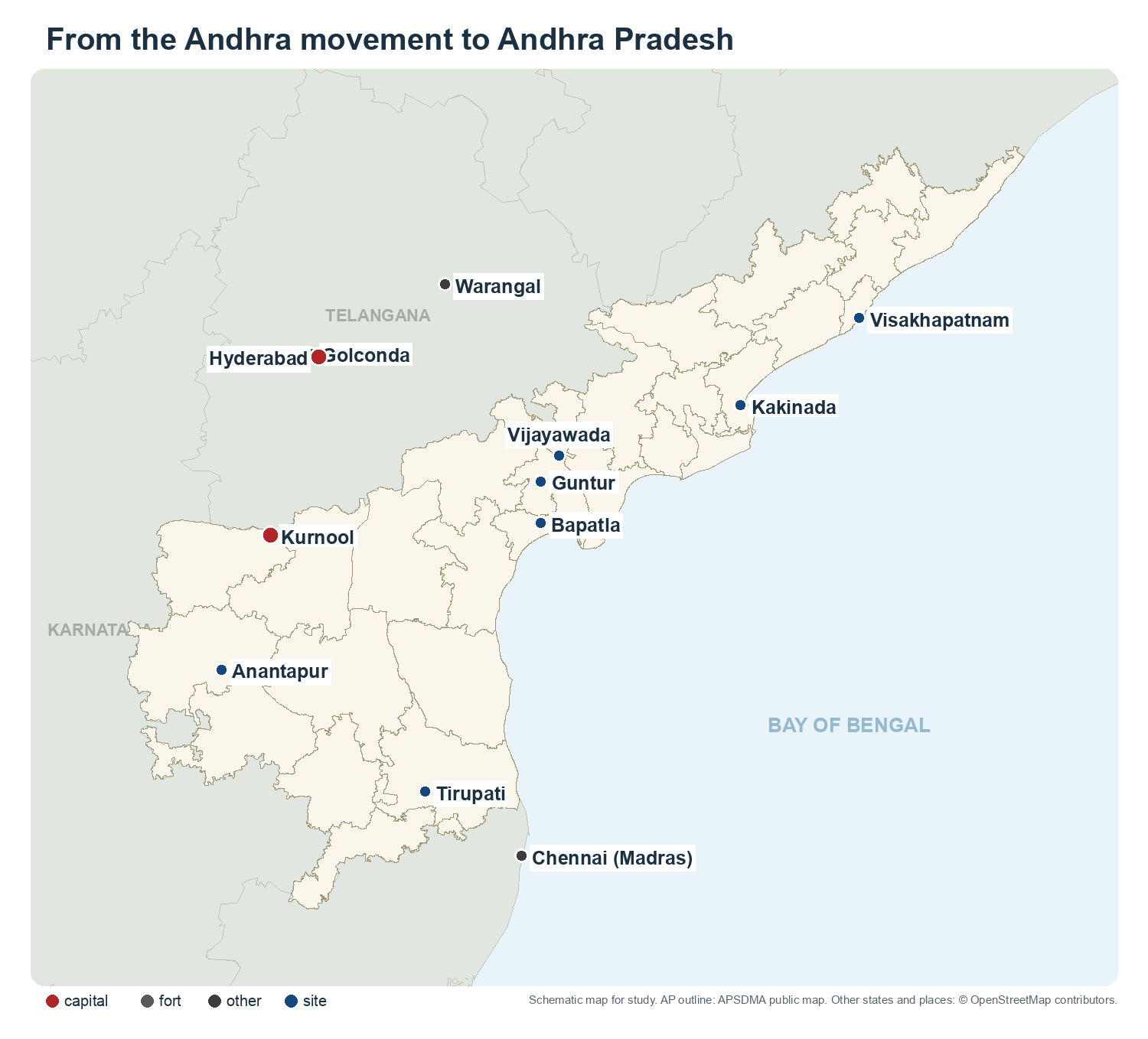
The idea of a Telugu state
Telugu speakers lived in the Madras Presidency, in the princely State of Hyderabad, and in smaller areas. Leaders felt that a state built on language would protect Telugu culture, education and jobs. The idea grew with the national movement. Congress had promised linguistic provinces, and Andhra leaders kept the demand alive.
Early steps in the Andhra movement:
| Year | Step |
|---|---|
| 1913 | First Andhra conference at Bapatla |
| 1923 | Andhra Bank founded (Pattabhi Sitaramayya) |
| 1926 | Andhra University established |
| 1930 | Andhra Mahasabha founded |
| 1937 | Sri Bagh Pact (safeguards for Rayalaseema) |
| 1937 | Andhra Mahila Sabha (Durgabai Deshmukh) |
Madapati Hanumantha Rao is called Andhra Pitamaha for his role in the Andhra Mahasabha in Telangana. Andhra University at Visakhapatnam, Sri Venkateswara University at Tirupati (1954) and Sri Krishnadevaraya University at Anantapur came to serve the regions.
Poets also carried the message of Telugu pride. Sankarambadi Sundarachari wrote Maa Telugu Talliki Mallepoodanda, which became a state song. Gurajada Apparao wrote Desamunu Preminchumanna, and Sri Sri wrote Mahaprasthanam. The Kakatiyas of Warangal and the Vijayanagara ruler Krishnadevaraya (Andhra Bhoja) were remembered as symbols of Telugu glory.
Sri Bagh Pact, 1937
The pact dealt with safeguards for Rayalaseema, the region of Kurnool, Anantapur, Kadapa and Chittoor, within a future Andhra state. Rayalaseema leaders feared that the coastal districts would dominate. Remember Sri Bagh as the Rayalaseema pact and the Gentlemen's Agreement as the Telangana pact.
The States Reorganisation debate
| Body | Year | Chair / note |
|---|---|---|
| Dhar Commission (Linguistic Provinces Commission) | 1948 | S. K. Dhar; looked at linguistic reorganisation |
| JVP Committee | 1948 | Report in 1949 |
| Fazl Ali Commission (SRC) | 1953 | Report submitted 1955 |
| States Reorganisation Act | 1956 | Passed after the report |
Constitution links: Article 3 deals with formation of new states; Article 2 with admission of new states; Article 1 with the Union and its territory. The Seventh Amendment Act dealt with reorganisation of states.
Potti Sriramulu and the fast of 1952
Potti Sriramulu, called Amarajeevi, was born at Madras. He took up a fast unto death demanding a separate Andhra State. He died in 1952. His death led to protests, and the central government agreed to form Andhra State. Remember: the fast was in 1952 and Andhra State came in 1953.
Andhra State, 1953
Andhra State was formed in 1953 under the Andhra State Act. Its capital was Kurnool. Tanguturi Prakasam, called Andhra Kesari, was its first Chief Minister. The first Governor was Chandulal Madhavlal Trivedi (also written C. M. Trivedi). Andhra State was carved out of the Madras Presidency's Telugu areas.
Andhra Pradesh, 1956
After the SRC report, the States Reorganisation Act of 1956 merged Andhra State with the Telugu-speaking areas of Hyderabad State. Andhra Pradesh was formed in 1956, with its capital at Hyderabad. Neelam Sanjiva Reddy, born at Illur, was the first Chief Minister. He later became President of India (1977), elected unopposed.
The Gentlemen's Agreement of 1956 gave safeguards to Telangana.
New institutions followed:
| Institution | Year |
|---|---|
| Andhra Pradesh Public Service Commission | 1956 |
| Andhra Pradesh Legislative Council | 1958 |
| Andhra Pradesh State Road Transport Corporation | 1958 |
| Nagarjuna University (Guntur) | 1976 |
The same wave of language-based changes continued elsewhere: Maharashtra and Gujarat were formed in 1960, and Punjab and Haryana in 1966.
Later movements and settlements
| Year | Event |
|---|---|
| 1969 | Jai Telangana Movement; Telangana Praja Samithi (M. Chenna Reddy) |
| 1972 | Jai Andhra Movement |
| 1973 | Six Point Formula; Thirty-second Constitutional Amendment |
| 1982 | Telugu Desam Party founded by N. T. Rama Rao |
| 2001 | Telangana Rashtra Samithi (K. Chandrashekar Rao) |
| 2010 | Srikrishna Committee (B. N. Srikrishna) |
| 2014 | Andhra Pradesh Reorganisation Act; Telangana State formed |
Article 371D deals with public employment in Andhra Pradesh and was linked to the settlement of 1973. K. Chandrashekar Rao became the first Chief Minister of Telangana.
People and titles linked with the movement
| Person | Title / link |
|---|---|
| Tanguturi Prakasam | Andhra Kesari; born at Vinodarayunipalem |
| Potti Sriramulu | Amarajeevi |
| Bhogaraju Pattabhi Sitaramayya | Founder of Andhra Bank; born at Gundugolanu |
| Madapati Hanumantha Rao | Andhra Pitamaha |
| Duggirala Gopalakrishnayya | Andhra Ratna |
| Konda Venkatappayya | Deshabhakta |
| Swami Ramananda Tirtha | Leader of Hyderabad State Congress |
| Burgula Ramakrishna Rao | Born at Padakal; first elected CM of Hyderabad State (1952) |
| Bezawada Gopala Reddy | Born at Buchireddypalem |
How the pieces fit together
Hyderabad State had its own Legislative Assembly from 1952, and its capital was Hyderabad. The Telugu-speaking part of it was joined with Andhra State in 1956. Telangana leaders worried about jobs, land and educational chances, so the Gentlemen's Agreement set out safeguards. Later disputes over those safeguards led to the 1969 and 1972 movements, and the settlements of 1973 followed. The Thirty-second Amendment and Article 371D created special rules for public employment. The long debate ended with the Reorganisation Act of 2014.
The Union Constitution Committee was chaired by Nehru and the Drafting Committee by B. R. Ambedkar. The Constituent Assembly was chaired by Rajendra Prasad. The Constitution came into force in 1950.
Regions of the state
- Coastal Andhra: Guntur, Vijayawada, Visakhapatnam, Rajahmundry, Srikakulam, Machilipatnam.
- Rayalaseema: Kurnool, Anantapur, Kadapa, Chittoor, Srisailam.
- Telangana: Hyderabad, Warangal, Nizamabad, Karimnagar, Adilabad, Golconda.
Firsts to remember
| Post | Person |
|---|---|
| First CM of Andhra State | Tanguturi Prakasam |
| First CM of Andhra Pradesh | Neelam Sanjiva Reddy |
| First Governor of Andhra State | C. M. Trivedi |
| First Vice-Chancellor of Andhra University | Cattamanchi Ramalinga Reddy |
| First elected Chief Minister of Hyderabad State | Burgula Ramakrishna Rao |
| First Telugu Prime Minister of India | P. V. Narasimha Rao |
| First Telugu President of the Indian National Congress | P. Ananda Charlu (1891) |
| First Speaker of the AP Legislative Assembly | Ayyadevara Kaleswara Rao |
Exam traps
- Fast and death: 1952. Andhra State: 1953. Andhra Pradesh: 1956.
- Andhra State capital was Kurnool; Andhra Pradesh capital was Hyderabad.
- Sri Bagh Pact (1937) is for Rayalaseema; Gentlemen's Agreement (1956) is for Telangana.
- Dhar Commission and JVP Committee were both 1948; the SRC began in 1953.
- Fazl Ali chaired the SRC; Srikrishna chaired the 2010 committee.
- Prakasam is the first CM of Andhra State; Neelam Sanjiva Reddy is the first CM of Andhra Pradesh.
- Jai Telangana is 1969 and Jai Andhra is 1972.
- TDP is 1982 and TRS is 2001.
One-liners
- 1. Andhra State: 1953, capital Kurnool.
- 2. Andhra Pradesh: 1956, capital Hyderabad.
- 3. Potti Sriramulu died in 1952 after his fast.
- 4. First Andhra conference: Bapatla, 1913.
- 5. Fazl Ali chaired the States Reorganisation Commission.
- 6. States Reorganisation Act: 1956.
- 7. Six Point Formula: 1973.
- 8. Srikrishna Committee: 2010.
- 9. Telangana State: 2014.
- 10. Article 371D is about public employment in Andhra Pradesh.
Background and context
Telugu speakers were never gathered in one political unit in modern times. Most lived in the Madras Presidency, where they formed one language group among Tamil, Malayalam and Kannada speakers. A large block lived in the princely state of Hyderabad, in the region called Telangana. Smaller groups lived in other areas.
For the Telugu people of the Madras Presidency, language was not only about culture. It was about schools, jobs and the way government funds were spent. Leaders felt that a state built on language would protect the Telugu literary tradition and give Telugu people a stronger voice. The national Congress had spoken in favour of linguistic provinces, so Andhra leaders had a promise to remind it of. Their demand grew slowly, over four decades, and ended with the death of a Gandhian in 1952.
The memory of earlier Telugu glory fed the movement. The Kakatiyas of Warangal and Krishnadevaraya of Vijayanagara were recalled as examples of a united Telugu people. Poets carried the same message. Sankarambadi Sundarachari wrote the song Maa Telugu Talliki Mallepoodanda, and Gurajada Apparao wrote Desamunu Preminchumanna.
Political history: the long road to a Telugu state
#### Organising the demand, 1913-1937
The first step was an assembly of Andhra leaders at Bapatla in 1913. (Some lists call it the first Andhra conference and others the first Andhra Mahasabha session; the name is uncertain, the year and place are not.) After that the movement built institutions of its own. Andhra Bank was founded in 1923 by Bhogaraju Pattabhi Sitaramayya. Andhra University was established in 1926; it opened first at Bezwada and later moved to Waltair. The Andhra Mahasabha was founded in 1930 in the Telangana area, where Madapati Hanumantha Rao, remembered as Andhra Pitamaha, played a major part. The Andhra Mahila Sabha was set up in 1937 by Durgabai Deshmukh.
An internal problem had to be solved first. Rayalaseema, the dry region of the south and west, feared that the prosperous coastal districts would control a future Andhra state. The Sri Bagh Pact of 1937 was the answer. It gave safeguards to Rayalaseema inside the planned state. Remember it as the Rayalaseema pact. The same worry about being outnumbered would later be voiced in Telangana, which is why safeguards became the main theme of Telugu politics. It showed a pattern that returned later: a Telugu region joins a larger unit only if it is promised protection.
#### Independence and the question of Madras
After 1947 the question was no longer whether linguistic states would come but when. In 1948 two bodies looked at the idea. The Dhar Commission, chaired by S. K. Dhar, studied linguistic provinces, and the JVP Committee, which reported in 1949, studied them again. They did not give the Andhra leaders what they wanted at once.
The sharpest dispute was over the city of Madras. The Andhra leaders wished to keep it as the capital of their new state. Potti Sriramulu's fast of 1952 was held with the demand that Madras should be the capital of the Telugu state, and the dispute over the city shaped the new state.
#### The fast of 1952
The title Amarajeevi ("the immortal") belongs to Potti Sriramulu, a follower of Gandhi. His birthplace is uncertain: accounts say either Madras or a village in the Nellore area. Before public life he trained as a sanitary engineer and worked for a railway. He joined the Salt Satyagraha of 1930 and went to jail more than once. At Nellore he undertook three fasts between 1946 and 1948, all for the right of Dalits to enter a temple.
His last fast began on 19 October 1952, for a separate Telugu state. It lasted 58 days and ended with his death on 15 December 1952. Riots and protests broke out across the Telugu areas, and four days later, on 19 December 1952, Prime Minister Nehru announced that a separate Andhra State would be formed. Remember the chain: fast and death, 1952; announcement, December 1952; state, 1953.
#### Andhra State, 1953
The Andhra State Act received the assent of the President on 14 September 1953. The state came into being on 1 October 1953. It was the first state in independent India to be formed on a language basis. Its capital was Kurnool. C. M. Trivedi was its Governor throughout its short life. Tanguturi Prakasam, known as Andhra Kesari, was the first Chief Minister, serving 1953-54. Bezawada Gopala Reddy led the government in 1955-56.
The state was formed from Telugu-speaking areas of Madras State and was made up of two regions: the coastal districts and Rayalaseema. Three taluks of Bellary (Alur, Adoni and Rayadurg) were added.
#### The States Reorganisation Commission and Vishalandhra
A national commission followed. The States Reorganisation Commission (SRC), chaired by Fazl Ali, was appointed in December 1953 and submitted its report in 1955. On Telangana the Commission did not recommend an immediate merger. As quoted from its report, it wished Telangana to form a separate state, with the chance of joining Andhra after the general elections expected around 1961. Telangana leaders feared for jobs, land and educational chances if they were joined at once. Leaders in Andhra pressed for a united Telugu state (Vishalandhra).
The parties reached a compromise. The Gentlemen's Agreement of 1956 gave safeguards to Telangana. The States Reorganisation Act of 1956 took effect on 1 November 1956: Andhra State was merged with the Telugu-speaking districts of Hyderabad State, and Andhra Pradesh was born with Hyderabad as its capital. Neelam Sanjiva Reddy, born at Illur, was its first Chief Minister. He was later elected President of India, without a contest, in 1977.
#### The national movement and the Telugu cause
The Andhra demand grew together with the freedom struggle. Gandhi had first visited Andhra (Bezwada) in 1919 and came again in 1921 for the AICC meeting at Bezwada. In 1921 Pingali Venkayya, born at Bhatlapenumarru, put forward the design of the tricolour flag at Vijayawada. The year 1921 also saw the Palnadu forest satyagraha and the Chirala-Perala movement. In 1923 the Indian National Congress held its session at Kakinada, chaired by Maulana Mohammad Ali. Congress workers in the Telugu country thus learned to organise, raise money and run newspapers, and the same skills served the language movement. Pattabhi Sitaramayya, who founded Andhra Bank, became Congress president in 1948; the first Telugu president was P. Ananda Charlu (Nagpur, 1891).
#### The other Telugu region: Hyderabad State
Telangana had a different history. It lay in the princely state of Hyderabad, whose capital was Hyderabad. Its leaders worked through bodies such as the Hyderabad State Congress, led by Swami Ramananda Tirtha. Burgula Ramakrishna Rao, born at Padakal, became the first elected Chief Minister of Hyderabad State in 1952 (M. K. Vellodi, a civil servant, had been Chief Minister from 1950). The state had its own Legislative Assembly from 1952. The Telugu-speaking part of this state, with places such as Warangal, Golconda and the city of Hyderabad itself, was the part that joined Andhra in 1956. Madapati Hanumantha Rao and the Andhra Mahasabha carried Telugu pride within the princely state before this merger.
When we look at the three regions that joined in 1956, we can set them side by side.
| Region | Places to know |
|---|---|
| Coastal Andhra | Guntur, Vijayawada, Visakhapatnam, Rajahmundry, Srikakulam, Machilipatnam |
| Rayalaseema | Kurnool, Anantapur, Kadapa, Chittoor, Srisailam |
| Telangana | Hyderabad, Warangal, Nizamabad, Karimnagar, Adilabad, Golconda |
The table names towns and places only. District boundaries in all three regions have changed since 2022, so do not rely on old district maps for the exam; learn the place and the region.
Administration and economy
The new state needed institutions at once. The Andhra Pradesh Public Service Commission began in 1956. The Legislative Council was created in 1958, and the State Road Transport Corporation in the same year. Education was part of the same effort: Sri Venkateswara University at Tirupati came in 1954 and Nagarjuna University at Guntur in 1976. The state combined three differently developed regions: the irrigated coast, the dry Rayalaseema and the former princely Telangana.
Constitutional provisions held the arrangement together. Articles 1, 2 and 3 of the Constitution deal with the Union and its territory, the admission of states and the formation of new ones. After the settlement of 1973, Article 371D was added to deal with public employment in the state. The Thirty-second Amendment of the Constitution belongs to the same settlement.
Society, religion and culture
The Andhra movement was also a cultural movement. Newspapers, schools and songs spread the idea to villages, not only to the cities. Writers, journalists and teachers built a feeling of one Telugu people. Kasinadhuni Nageswara Rao, titled Desoddharaka, founded the newspaper Andhra Patrika in 1908. Tanguturi Prakasam started the daily Swarajya. Duggirala Gopalakrishnayya, titled Andhra Ratna, led the Chirala-Perala movement of 1921. Konda Venkatappayya was called Deshabhakta. Sri Sri's poem Mahaprasthanam spoke for a new, modern Telugu voice.
The titles in this chapter are tied to people, and exam questions rely on that:
| Person | Title or link |
|---|---|
| Tanguturi Prakasam | Andhra Kesari; first Chief Minister of Andhra State |
| Potti Sriramulu | Amarajeevi; fast of 1952 |
| Madapati Hanumantha Rao | Andhra Pitamaha |
| Duggirala Gopalakrishnayya | Andhra Ratna |
| Konda Venkatappayya | Deshabhakta |
| Bhogaraju Pattabhi Sitaramayya | Founder of Andhra Bank |
| Burgula Ramakrishna Rao | First elected Chief Minister of Hyderabad State (1952) |
| Neelam Sanjiva Reddy | First Chief Minister of Andhra Pradesh |
Firsts and the constitutional frame
The Constitution came into force in 1950. It was drafted by a committee chaired by B. R. Ambedkar, and the Constituent Assembly was chaired by Rajendra Prasad. Within this frame, Article 3 gave Parliament the power to form new states, and the Seventh Amendment of 1956 adjusted the Constitution to the new map. This is why a state could be made by an ordinary Act of Parliament, as happened in 1953, 1956 and 2014.
Many examination questions ask for "firsts" linked to the movement. The main ones are these:
| Post | Person |
|---|---|
| First Governor of Andhra State | C. M. Trivedi |
| First Vice-Chancellor of Andhra University | Cattamanchi Ramalinga Reddy |
| First Speaker of the Andhra Pradesh Legislative Assembly | Ayyadevara Kaleswara Rao |
| First Telugu President of the Indian National Congress | P. Ananda Charlu (1891) |
| First Telugu Prime Minister of India | P. V. Narasimha Rao |
The wave of language-based change continued across the country. Maharashtra and Gujarat were formed in 1960, and Punjab and Haryana in 1966. Andhra thus began a trend that reshaped the whole map of India.
Decline of the settlement, later movements and legacy
The compromise of 1956 did not last without strain. People of Telangana felt that the promised safeguards were not carried out. In 1969 a student hunger strike demanding those safeguards grew into the Jai Telangana movement, and a party called the Telangana Praja Samithi, led by M. Chenna Reddy, took part. In 1972 the Jai Andhra movement arose in the coastal and Rayalaseema regions in reply. A political settlement, the Six Point Formula, was reached in 1973.
The Telugu Desam Party was founded in 1982 by N. T. Rama Rao. The Telangana Rashtra Samithi was set up in 2001 under K. Chandrashekar Rao. A committee under B. N. Srikrishna was appointed in 2010. Finally, the Andhra Pradesh Reorganisation Act was passed, and Telangana State was formed on 2 June 2014 with K. Chandrashekar Rao as its first Chief Minister.
The table below sets the three states side by side.
| Point | Andhra State | Andhra Pradesh (1956) | Telangana |
|---|---|---|---|
| Year formed | 1953 | 1956 | 2014 |
| Capital | Kurnool | Hyderabad | Hyderabad |
| First Chief Minister | Tanguturi Prakasam | Neelam Sanjiva Reddy | K. Chandrashekar Rao |
| Law behind it | Andhra State Act | States Reorganisation Act | Andhra Pradesh Reorganisation Act |
Dates, laws and places to keep in order:
| Year | Event |
|---|---|
| 1913 | Bapatla meeting |
| 1937 | Sri Bagh Pact |
| 1948 | Dhar Commission and JVP Committee |
| 1952 | Fast and death of Potti Sriramulu |
| 1953 | Andhra State, 1 October |
| 1955 | SRC report |
| 1956 | Andhra Pradesh, 1 November |
| 1969 / 1972 | Jai Telangana / Jai Andhra |
| 1973 | Six Point Formula |
| 2014 | Telangana State, 2 June |
How examiners use this chapter
- The chain of years. Death of Potti Sriramulu 1952, Andhra State 1953, Andhra Pradesh 1956. A cause always comes before its result.
- Capitals. Andhra State: Kurnool. Andhra Pradesh: Hyderabad. Students often swap them.
- Two pacts. Sri Bagh Pact (1937) is for Rayalaseema. Gentlemen's Agreement (1956) is for Telangana. Match region and year as a pair.
- First Chief Ministers. Prakasam for Andhra State, Neelam Sanjiva Reddy for Andhra Pradesh, K. Chandrashekar Rao for Telangana.
- Commissions and chairs. Dhar (1948), JVP (1948), Fazl Ali for the SRC (appointed 1953, report 1955), Srikrishna (2010).
- Titles. Amarajeevi, Andhra Kesari, Andhra Pitamaha, Andhra Ratna, Deshabhakta, Desoddharaka. Match each with the right person.
- Movements. Jai Telangana 1969 and Jai Andhra 1972; TDP 1982 and TRS 2001.
- First on language. Andhra State was the first state formed on a linguistic basis in independent India.
Worked cases
Case 1: Put these four events in order: Andhra State formed; Potti Sriramulu dies after his fast; Andhra Pradesh formed; first Andhra conference at Bapatla.
Reasoning:
- 1. Start with the earliest. The Bapatla conference is 1913, long before independence.
- 2. The fast ended with the death of Potti Sriramulu in 1952.
- 3. The government agreed to a separate state after the protests that followed his death. So Andhra State comes after 1952, in 1953.
- 4. Andhra Pradesh joined Andhra State with Telugu areas of Hyderabad State, after the SRC report. That is 1956.
- 5. Order: 1913, 1952, 1953, 1956.
Takeaway: In a cause and effect chain, the cause (death) always comes one step before the result (state).
Case 2: Which statement is NOT correct? (a) Sri Bagh Pact, 1937, Rayalaseema safeguards. (b) Gentlemen's Agreement, 1956, Telangana safeguards. (c) Sri Bagh Pact, 1956, Telangana safeguards. (d) Gentlemen's Agreement was made when Andhra Pradesh was formed.
Reasoning:
- 1. Link each pact to a region first. Sri Bagh goes with Rayalaseema. The Gentlemen's Agreement goes with Telangana.
- 2. Check the years. Sri Bagh is 1937, in the Andhra movement. The Gentlemen's Agreement is 1956, the year of Andhra Pradesh.
- 3. Option (c) mixes the year of one pact with the region of the other.
- 4. So (c) is wrong.
Takeaway: When two pacts look alike, match region and year as a pair, and reject any option that mixes them.
Case 3: A question asks for the capital and first Chief Minister of Andhra State. A student writes Hyderabad and Neelam Sanjiva Reddy. Find the errors.
Reasoning:
- 1. Andhra State was formed in 1953 and its capital was Kurnool.
- 2. Hyderabad became capital only when Andhra Pradesh was formed in 1956.
- 3. The first Chief Minister of Andhra State was Tanguturi Prakasam, called Andhra Kesari.
- 4. Neelam Sanjiva Reddy was the first Chief Minister of Andhra Pradesh, in 1956.
- 5. Both answers belong to the next state, not to Andhra State.
Takeaway: Every "first" question has two possible states. Fix the state and the year before you pick the name.
Case 4: Which commission or committee was chaired by the person named? Options: Dhar Commission, Fazl Ali, Srikrishna.
Reasoning:
- 1. The 1948 body on linguistic provinces was chaired by S. K. Dhar. The JVP Committee was also 1948, so do not give 1953 to either.
- 2. The States Reorganisation Commission began in 1953 under Fazl Ali. Its report came in 1955 and the Act in 1956.
- 3. Srikrishna is the name tied to the 2010 committee for Telangana.
- 4. If an option gives Fazl Ali with 2010, the year and the chair do not match, so it is wrong.
Takeaway: Pair each chairperson with one year and one purpose, then test every option against both.
Compare and contrast
| Point | Andhra State | Andhra Pradesh (1956) | Telangana State |
|---|---|---|---|
| Year formed | 1953 | 1956 | 2014 |
| Capital | Kurnool | Hyderabad | Hyderabad |
| First Chief Minister | Tanguturi Prakasam | Neelam Sanjiva Reddy | K. Chandrashekar Rao |
| Law or step behind it | Andhra State Act | States Reorganisation Act | Andhra Pradesh Reorganisation Act |
| Title | Person | Extra link |
|---|---|---|
| Andhra Kesari | Tanguturi Prakasam | Born at Vinodarayunipalem; founder of the Swarajya daily |
| Amarajeevi | Potti Sriramulu | Fast unto death, 1952 |
| Andhra Pitamaha | Madapati Hanumantha Rao | Andhra Mahasabha in Telangana |
| Andhra Ratna | Duggirala Gopalakrishnayya | Led the Chirala-Perala movement |
| Deshabhakta | Konda Venkatappayya | Freedom fighter title |
| Desoddharaka | Kasinadhuni Nageswara Rao | Founder of Andhra Patrika |
| Brahmarshi | Raghupathi Venkataratnam Naidu | Brahmo social reformer, anti-nautch campaigner |
| Manyam Veerudu | Alluri Sitarama Raju | Rampa Rebellion |
Sequence and timeline
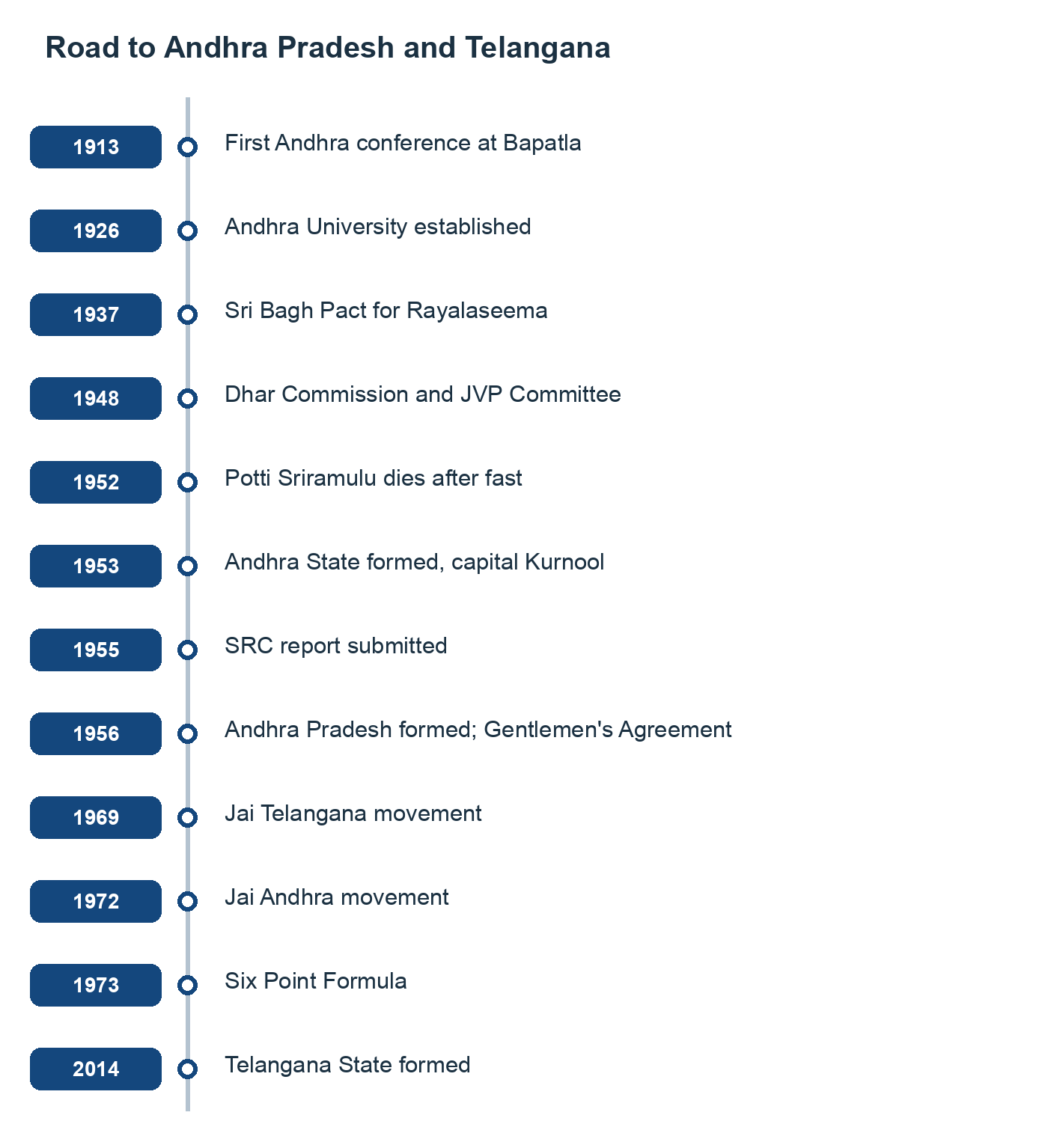
- 1. 1913: first Andhra conference at Bapatla
- 2. 1923: Andhra Bank founded; Kakinada session of the Indian National Congress
- 3. 1926: Andhra University established
- 4. 1930: Andhra Mahasabha founded
- 5. 1937: Sri Bagh Pact; Andhra Mahila Sabha
- 6. 1948: Dhar Commission and JVP Committee
- 7. 1952: death of Potti Sriramulu
- 8. 1953: Andhra State; States Reorganisation Commission appointed
- 9. 1955: SRC report
- 10. 1956: States Reorganisation Act, Andhra Pradesh, Gentlemen's Agreement
- 11. 1969: Jai Telangana
- 12. 1972: Jai Andhra
- 13. 1973: Six Point Formula and Thirty-second Amendment
- 14. 1982: Telugu Desam Party
- 15. 2001: Telangana Rashtra Samithi
- 16. 2010: Srikrishna Committee
- 17. 2014: Telangana State
More one-liners
- 1. Kakinada session of the Indian National Congress: 1923, chaired by Maulana Mohammad Ali.
- 2. Gandhi first visited Andhra (Bezwada) in 1919; he came again for the AICC meeting at Bezwada in 1921.
- 3. Pingali Venkayya presented his flag design to Gandhi at Vijayawada in 1921.
- 4. Palnadu Forest Satyagraha: 1921.
- 5. Chirala-Perala movement: 1921 (the town was vacated in April 1921).
- 6. Uyyalawada Narasimha Reddy revolted against the British in 1846.
- 7. Uyyalawada Narasimha Reddy was born at Rupanagudi.
- 8. Alluri Sitarama Raju was born at Pandrangi and died in 1924.
- 9. Chintapalli police station attack: 1922.
- 10. Andhra Patrika was founded in 1908 by Kasinadhuni Nageswara Rao.
- 11. Madras Mahajana Sabha: 1884.
- 12. Durgabai Deshmukh was born at Rajahmundry.
- 13. Pingali Venkayya was born at Bhatlapenumarru.
- 14. First Telugu Prime Minister of India: P. V. Narasimha Rao.
- 15. First Speaker of the Andhra Pradesh Legislative Assembly: Ayyadevara Kaleswara Rao.
Practice questions
Consider the following pairs (Event – Year): (i) Adoption of the Indian tricolour design by Pingali Venkayya at Vijayawada – 1921 (ii) First sitting of the Lok Sabha – 1952 (iii) First meeting of the Constituent Assembly of India – 1946 Which of the pairs are correctly matched?
- Only (i)
- Only (ii)
- All of (i), (ii) and (iii)
- Only (iii)
Answer
C. All of (i), (ii) and (iii)
ఈ క్రింది జతలను పరిశీలించండి (సంఘటన – సంవత్సరం): (i) విజయవాడలో పింగళి వెంకయ్య రూపొందించిన జెండా సమర్పణ – 1921 (ii) లోక్సభ మొదటి సమావేశం – 1952 (iii) భారత రాజ్యాంగ పరిషత్ మొదటి సమావేశం – 1946 సరిగ్గా జతపరచబడినవి ఏవి?
- (i) మాత్రమే
- (ii) మాత్రమే
- (i), (ii), (iii) అన్నీ
- (iii) మాత్రమే
Who composed the song 'Vande Mataram', the slogan of the Swadeshi movement?
- Muhammad Iqbal
- Sarojini Naidu
- Bankim Chandra Chatterjee
- Rabindranath Tagore
Answer
C. Bankim Chandra Chatterjee
Bankim Chandra Chatterjee wrote it and included it in his novel Anandamath.
స్వదేశీ ఉద్యమ నినాదమైన 'వందేమాతరం' గీతాన్ని రచించినవారు ఎవరు?
- మహమ్మద్ ఇక్బాల్
- సరోజినీ నాయుడు
- బంకిం చంద్ర ఛటర్జీ
- రవీంద్రనాథ్ ఠాగూర్
Which of the following is known by the name or title Andhra Kesari?
- Madapati Hanumantha Rao
- Raghupathi Venkataratnam Naidu
- Tanguturi Prakasam
- Potti Sriramulu
Answer
C. Tanguturi Prakasam
'ఆంధ్ర కేసరి' అనే పేరు లేదా బిరుదుతో పిలువబడేది ఏది?
- మాడపాటి హనుమంతరావు
- రఘుపతి వెంకటరత్నం నాయుడు
- టంగుటూరి ప్రకాశం
- పొట్టి శ్రీరాములు
Which of the following is known by the name or title Brahmarshi?
- Mohandas Karamchand Gandhi
- Vallabhbhai Patel
- Raghupathi Venkataratnam Naidu
- Dadabhai Naoroji
Answer
C. Raghupathi Venkataratnam Naidu
'బ్రహ్మర్షి' అనే పేరు లేదా బిరుదుతో పిలువబడేది ఏది?
- మోహన్దాస్ కరమ్చంద్ గాంధీ
- వల్లభభాయ్ పటేల్
- రఘుపతి వెంకటరత్నం నాయుడు
- దాదాభాయ్ నౌరోజీ
Arrange the following in chronological order (earliest first): (i) Appointment of Salar Jung I as Prime Minister of Hyderabad (ii) Founding of Vijayanagara Empire (iii) Founding of Andhra Mahila Sabha (iv) Revolt of Uyyalawada Narasimha Reddy
- (iii), (i), (ii), (iv)
- (i), (ii), (iv), (iii)
- (iv), (iii), (i), (ii)
- (ii), (iv), (i), (iii)
Answer
D. (ii), (iv), (i), (iii)
ఈ క్రింది వాటిని కాలక్రమానుసారం (పూర్వం నుండి తరువాతి వరకు) అమర్చండి: (i) సాలార్ జంగ్ I హైదరాబాద్ ప్రధానమంత్రిగా నియామకం (ii) విజయనగర సామ్రాజ్య స్థాపన (iii) ఆంధ్ర మహిళా సభ స్థాపన (iv) ఉయ్యాలవాడ నరసింహారెడ్డి తిరుగుబాటు
- (iii), (i), (ii), (iv)
- (i), (ii), (iv), (iii)
- (iv), (iii), (i), (ii)
- (ii), (iv), (i), (iii)
Prakasam earned the title Andhra Kesari for bravely facing police firing in Madras during the protest against:
- Rowlatt Act
- Simon Commission
- Partition of Bengal
- Salt tax
Answer
B. Simon Commission
The 1928 protest against the Simon Commission made him famous.
ప్రకాశం మద్రాసులో పోలీసు కాల్పులకు ఎదురొడ్డి నిలిచి ఏ నిరసనలో ఆంధ్రకేసరి బిరుదు పొందారు?
- రౌలట్ చట్టం
- సైమన్ కమిషన్
- బెంగాల్ విభజన
- ఉప్పు పన్ను
In the 1939 Congress presidential election, Gandhi's candidate Pattabhi Sitaramayya was defeated by:
- Rajendra Prasad
- Maulana Azad
- Jawaharlal Nehru
- Subhas Chandra Bose
Answer
D. Subhas Chandra Bose
Bose won the contest and was re-elected President.
1939 కాంగ్రెస్ అధ్యక్ష ఎన్నికలో గాంధీ బలపరిచిన పట్టాభి సీతారామయ్యను ఓడించినవారు:
- రాజేంద్ర ప్రసాద్
- మౌలానా ఆజాద్
- జవహర్లాల్ నెహ్రూ
- సుభాష్ చంద్రబోస్
Who was the first Chief Minister of Andhra Pradesh?
- Annie Besant
- N. Sanjiva Reddy
- G. V. Mavalankar
- H. J. Kania
Answer
B. N. Sanjiva Reddy
ఆంధ్రప్రదేశ్ మొదటి ముఖ్యమంత్రి ఎవరు?
- అనీ బెసెంట్
- నీలం సంజీవరెడ్డి
- జి. వి. మావలాంకర్
- హెచ్. జె. కనియా
Consider the following pairs (Office – Person): (i) first Nizam Shahi ruler – Malik Ahmad (ii) inventor of the spinning jenny – Bhogaraju Pattabhi Sitaramayya (iii) first Telugu President of Indian National Congress – James Hargreaves Which of the pairs are correctly matched?
- None of them
- Only (ii) and (iii)
- Only (i)
- Only (i) and (iii)
Answer
C. Only (i)
ఈ క్రింది జతలను పరిశీలించండి (పదవి – వ్యక్తి): (i) మొదటి నిజాం షాహీ పాలకుడు – మాలిక్ అహ్మద్ (ii) స్పిన్నింగ్ జెన్నీ ఆవిష్కర్త – భోగరాజు పట్టాభి సీతారామయ్య (iii) భారత జాతీయ కాంగ్రెస్ మొదటి తెలుగు అధ్యక్షుడు – జేమ్స్ హార్గ్రీవ్స్ సరిగ్గా జతపరచబడినవి ఏవి?
- ఏదీ కాదు
- (ii), (iii) మాత్రమే
- (i) మాత్రమే
- (i), (iii) మాత్రమే
Which of the following is known by the name or title Manyam Veerudu?
- Rajendra Prasad
- Dadabhai Naoroji
- Alluri Sitarama Raju
- Tanguturi Prakasam
Answer
C. Alluri Sitarama Raju
'మన్యం వీరుడు' అనే పేరు లేదా బిరుదుతో పిలువబడేది ఏది?
- రాజేంద్ర ప్రసాద్
- దాదాభాయ్ నౌరోజీ
- అల్లూరి సీతారామరాజు
- టంగుటూరి ప్రకాశం
Who led Rampa Rebellion?
- Vallabhbhai Patel
- Alluri Sitarama Raju
- Sir Syed Ahmad Khan
- Uyyalawada Narasimha Reddy
Answer
B. Alluri Sitarama Raju
రంపా తిరుగుబాటు నాయకుడు ఎవరు?
- వల్లభభాయ్ పటేల్
- అల్లూరి సీతారామరాజు
- సర్ సయ్యద్ అహ్మద్ ఖాన్
- ఉయ్యాలవాడ నరసింహారెడ్డి
The 1905 Bengal partition helped prompt which movement in Telugu areas?
- Rampa rebellion
- Swadeshi/Vande Mataram
- Andhra State ministry
- 2014 bifurcation
Answer
B. Swadeshi/Vande Mataram
The partition stimulated Swadeshi and Vande Mataram activity in Andhra.
1905 బెంగాల్ విభజన తెలుగు ప్రాంతాల్లో ఏ ఉద్యమానికి దోహదం చేసింది?
- రంప తిరుగుబాటు
- స్వదేశీ/వందేమాతరం
- ఆంధ్ర రాష్ట్ర మంత్రివర్గం
- 2014 విభజన
Which pairing of honorifics is correct?
- Prakasam-Andhra Ratna; Duggirala-Andhra Kesari
- Prakasam-Andhra Kesari; Duggirala-Andhra Ratna
- Alluri-Andhra Bhishma; Nyapati-Manyam Veerudu
- Gurajada-Andhra Kesari; Pingali-Andhra Ratna
Answer
B. Prakasam-Andhra Kesari; Duggirala-Andhra Ratna
These two nationalist honorifics are often swapped in wrong options.
బిరుదుల ఏ జత సరైనది?
- ప్రకాశం-ఆంధ్ర రత్న; దుగ్గిరాల-ఆంధ్ర కేసరి
- ప్రకాశం-ఆంధ్ర కేసరి; దుగ్గిరాల-ఆంధ్ర రత్న
- అల్లూరి-ఆంధ్ర భీష్మ; న్యాపతి-మన్యం వీరుడు
- గురజాడ-ఆంధ్ర కేసరి; పింగళి-ఆంధ్ర రత్న
Who presided over the first Andhra Mahasabha session of Hyderabad State held at Jogipet in 1930?
- Madapati Hanumantha Rao
- Suravaram Pratapa Reddy
- Burgula Ramakrishna Rao
- Ravi Narayana Reddy
Answer
B. Suravaram Pratapa Reddy
Suravaram Pratapa Reddy was the president of the 1930 Jogipet session.
1930లో జోగిపేటలో జరిగిన హైదరాబాద్ రాష్ట్ర మొదటి ఆంధ్ర మహాసభకు అధ్యక్షత వహించినవారు ఎవరు?
- మాడపాటి హనుమంతరావు
- సురవరం ప్రతాపరెడ్డి
- బూర్గుల రామకృష్ణారావు
- రావి నారాయణరెడ్డి
Which first Chief Minister of Andhra Pradesh later became President of India?
- P. V. Narasimha Rao
- K. Brahmananda Reddy
- D. Sanjivayya
- N. Sanjiva Reddy
Answer
D. N. Sanjiva Reddy
Neelam Sanjiva Reddy was President of India from 1977 to 1982.
ఆంధ్రప్రదేశ్ మొదటి ముఖ్యమంత్రిగా ఉండి తరువాత భారత రాష్ట్రపతి అయినవారు ఎవరు?
- పి.వి. నరసింహారావు
- కె. బ్రహ్మానందరెడ్డి
- డి. సంజీవయ్య
- ఎన్. సంజీవరెడ్డి
Who became the first Chief Minister of Andhra State formed in 1953?
- Bezawada Gopala Reddy
- Damodaram Sanjivayya
- Tanguturi Prakasam
- Neelam Sanjiva Reddy
Answer
C. Tanguturi Prakasam
Prakasam headed the first government of Andhra State.
1953లో ఏర్పడిన ఆంధ్ర రాష్ట్ర తొలి ముఖ్యమంత్రి ఎవరు?
- బెజవాడ గోపాలరెడ్డి
- దామోదరం సంజీవయ్య
- తంగుటూరి ప్రకాశం
- నీలం సంజీవరెడ్డి
Who became the first Chief Minister of Andhra Pradesh when it was formed on 1 November 1956?
- Kasu Brahmananda Reddy
- Bezawada Gopala Reddy
- Tanguturi Prakasam
- Neelam Sanjiva Reddy
Answer
D. Neelam Sanjiva Reddy
Sanjiva Reddy led the first government of united Andhra Pradesh.
1956 నవంబర్ 1న ఏర్పడిన ఆంధ్రప్రదేశ్ తొలి ముఖ్యమంత్రి ఎవరు?
- కాసు బ్రహ్మానందరెడ్డి
- బెజవాడ గోపాలరెడ్డి
- తంగుటూరి ప్రకాశం
- నీలం సంజీవరెడ్డి
Durgabai Deshmukh was a member of which body that framed India's Constitution?
- Simon Commission
- Cabinet Mission
- Round Table Conference
- Constituent Assembly
Answer
D. Constituent Assembly
She was one of the women members of the Constituent Assembly.
భారత రాజ్యాంగాన్ని రూపొందించిన ఏ సభలో దుర్గాబాయి దేశ్ముఖ్ సభ్యురాలు?
- సైమన్ కమిషన్
- క్యాబినెట్ మిషన్
- రౌండ్ టేబుల్ సమావేశం
- రాజ్యాంగ పరిషత్
Which book on the Indian National Congress was written by Pattabhi Sitaramayya?
- The Discovery of India
- Gandhi and Anarchy
- The History of the Congress
- India Wins Freedom
Answer
C. The History of the Congress
His history of the Congress is a standard work.
భారత జాతీయ కాంగ్రెస్పై పట్టాభి సీతారామయ్య రచించిన గ్రంథం ఏది?
- ది డిస్కవరీ ఆఫ్ ఇండియా
- గాంధీ అండ్ అనార్కీ
- ది హిస్టరీ ఆఫ్ ది కాంగ్రెస్
- ఇండియా విన్స్ ఫ్రీడమ్
Who became the first Dalit Chief Minister of any Indian state, leading Andhra Pradesh in 1960?
- Neelam Sanjiva Reddy
- Kasu Brahmananda Reddy
- Bezawada Gopala Reddy
- Damodaram Sanjivayya
Answer
D. Damodaram Sanjivayya
Sanjivayya was Chief Minister from 1960 to 1962.
1960లో ఆంధ్రప్రదేశ్ను నడిపిన, ఏ భారత రాష్ట్రానికైనా తొలి దళిత ముఖ్యమంత్రి ఎవరు?
- నీలం సంజీవరెడ్డి
- కాసు బ్రహ్మానందరెడ్డి
- బెజవాడ గోపాలరెడ్డి
- దామోదరం సంజీవయ్య
Duggirala Gopalakrishnayya, leader of the Chirala-Perala movement, is known by the title:
- Andhra Ratna
- Andhra Kesari
- Andhra Pitamaha
- Deshabhakta
Answer
A. Andhra Ratna
He is honoured as Andhra Ratna.
చీరాల-పేరాల ఉద్యమ నాయకుడు దుగ్గిరాల గోపాలకృష్ణయ్య ఏ బిరుదుతో ప్రసిద్ధుడు?
- ఆంధ్ర రత్న
- ఆంధ్ర కేసరి
- ఆంధ్ర పితామహ
- దేశభక్త
The Civil Disobedience Movement was suspended in March 1931 by the:
- Cripps proposals
- Poona Pact
- Lucknow Pact
- Gandhi-Irwin Pact
Answer
D. Gandhi-Irwin Pact
Gandhi and Viceroy Irwin agreed to pause the movement for talks.
1931 మార్చిలో శాసనోల్లంఘన ఉద్యమాన్ని నిలిపివేసిన ఒప్పందం:
- క్రిప్స్ ప్రతిపాదనలు
- పూనా ఒప్పందం
- లక్నో ఒప్పందం
- గాంధీ-ఇర్విన్ ఒప్పందం
Madapati Hanumantha Rao, a pioneer of the Andhra Mahasabha in the Nizam's Hyderabad state, is known as:
- Andhra Pitamaha
- Deshabhakta
- Andhra Kesari
- Andhra Ratna
Answer
A. Andhra Pitamaha
He is honoured as Andhra Pitamaha for guiding Telugu awakening in Hyderabad state.
నిజాం హైదరాబాద్ రాష్ట్రంలో ఆంధ్ర మహాసభకు మార్గదర్శకుడైన మాడపాటి హనుమంతరావు ఏ బిరుదుతో పిలువబడ్డారు?
- ఆంధ్ర పితామహ
- దేశభక్త
- ఆంధ్ర కేసరి
- ఆంధ్ర రత్న
Match the leader with the title: (i) Tanguturi Prakasam (ii) Konda Venkatappayya (iii) Duggirala Gopalakrishnayya
- (i) Andhra Kesari, (ii) Deshabhakta, (iii) Andhra Ratna
- (i) Deshabhakta, (ii) Andhra Kesari, (iii) Andhra Ratna
- (i) Andhra Ratna, (ii) Andhra Kesari, (iii) Deshabhakta
- (i) Andhra Kesari, (ii) Andhra Ratna, (iii) Deshabhakta
Answer
A. (i) Andhra Kesari, (ii) Deshabhakta, (iii) Andhra Ratna
Prakasam is Andhra Kesari, Venkatappayya Deshabhakta and Duggirala Andhra Ratna.
నాయకుడిని బిరుదుతో జతపరచండి: (i) టంగుటూరి ప్రకాశం (ii) కొండా వెంకటప్పయ్య (iii) దుగ్గిరాల గోపాలకృష్ణయ్య
- (i) ఆంధ్ర కేసరి, (ii) దేశభక్త, (iii) ఆంధ్ర రత్న
- (i) దేశభక్త, (ii) ఆంధ్ర కేసరి, (iii) ఆంధ్ర రత్న
- (i) ఆంధ్ర రత్న, (ii) ఆంధ్ర కేసరి, (iii) దేశభక్త
- (i) ఆంధ్ర కేసరి, (ii) ఆంధ్ర రత్న, (iii) దేశభక్త
Consider the statements on Tanguturi Prakasam: (i) He was Chief Minister of the Madras Presidency in 1946-47. (ii) He headed the first ministry of Andhra State in 1953. (iii) He launched the daily 'Swarajya' in 1921. Which is/are correct?
- Only (i)
- Only (i) and (ii)
- Only (ii) and (iii)
- (i), (ii) and (iii)
Answer
D. (i), (ii) and (iii)
All three describe documented milestones of Prakasam's career.
టంగుటూరి ప్రకాశం గురించి ఈ ప్రకటనలను పరిశీలించండి: (i) ఆయన 1946-47లో మద్రాసు ప్రెసిడెన్సీ ముఖ్యమంత్రిగా ఉన్నారు. (ii) ఆయన 1953లో ఆంధ్ర రాష్ట్ర తొలి మంత్రివర్గానికి నాయకత్వం వహించారు. (iii) ఆయన 1921లో 'స్వరాజ్య' దినపత్రికను ప్రారంభించారు. ఏవి సరైనవి?
- (i) మాత్రమే
- (i), (ii) మాత్రమే
- (ii), (iii) మాత్రమే
- (i), (ii), (iii) అన్నీ
Who presided over the 1906 INC session at Calcutta?
- Dadabhai Naoroji
- Bal Gangadhar Tilak
- Lala Lajpat Rai
- Gopal Krishna Gokhale
Answer
A. Dadabhai Naoroji
Dadabhai Naoroji presided; swaraj, swadeshi, boycott and national education were declared.
1906లో కలకత్తాలో జరిగిన INC సమావేశానికి అధ్యక్షత వహించినవారు ఎవరు?
- దాదాభాయ్ నౌరోజీ
- బాలగంగాధర్ తిలక్
- లాలా లజపతిరాయ్
- గోపాలకృష్ణ గోఖలే
Which towns did the Simon Commission visit in Andhra?
- Tenali, Guntur, Vijayawada, Ongole
- Tenali, Guntur, Vijayawada, Bangalore
- Kakinada, Rajahmundry, Visakhapatnam
- Kurnool, Kadapa, Anantapur
Answer
A. Tenali, Guntur, Vijayawada, Ongole
The listed towns were Tenali, Guntur, Vijayawada, Ongole.
సైమన్ కమిషన్ ఆంధ్రలో ఏ పట్టణాలను సందర్శించింది?
- తెనాలి, గుంటూరు, విజయవాడ, ఒంగోలు
- తెనాలి, గుంటూరు, విజయవాడ, బెంగుళూరు
- కాకినాడ, రాజమండ్రి, విశాఖ
- కర్నూలు, కడప, అనంతపురం
The death of Potti Sriramulu after a fast in 1952 hastened the creation of which state, the first formed on a linguistic basis after independence?
- Karnataka
- Kerala
- Andhra State
- Maharashtra
Answer
C. Andhra State
His death on 15 December 1952 led to the formation of Andhra State on 1 October 1953.
1952లో నిరాహార దీక్ష తర్వాత పొట్టి శ్రీరాములు మరణం, స్వాతంత్ర్యానంతరం భాషా ప్రాతిపదికన ఏర్పడిన తొలి రాష్ట్రమైన ఏ రాష్ట్ర ఏర్పాటును వేగవంతం చేసింది?
- కర్ణాటక
- కేరళ
- ఆంధ్ర రాష్ట్రం
- మహారాష్ట్ర
Which Act created the Council of State and the Legislative Assembly at the Centre and provided for district-wise representation in provincial councils?
- Madras Prohibition Act
- Two-member Constituencies (Abolition) Act
- Untouchability (Offences) Act
- Government of India Act 1919
Answer
D. Government of India Act 1919
కేంద్రంలో కౌన్సిల్ ఆఫ్ స్టేట్, లెజిస్లేటివ్ అసెంబ్లీలను సృష్టించి, ప్రాంతీయ కౌన్సిళ్లలో జిల్లాల వారీగా ప్రాతినిధ్యాన్ని కల్పించిన చట్టం ఏది?
- మద్రాసు మద్యపాన నిషేధ చట్టం
- ద్విసభ్య నియోజకవర్గాల (రద్దు) చట్టం
- అంటరానితనం (నేరాలు) చట్టం
- భారత ప్రభుత్వ చట్టం 1919
Which of the following correctly describes J. N. Chaudhuri?
- first Military Governor of Hyderabad
- first Rajpramukh of Hyderabad State
- first president of the Hyderabad State Congress
- first Chief Minister of Andhra State
Answer
A. first Military Governor of Hyderabad
'జె. ఎన్. చౌదరి' గురించిన సరైన వివరణ ఈ క్రింది వాటిలో ఏది?
- హైదరాబాద్ మొదటి సైనిక గవర్నర్
- హైదరాబాద్ రాష్ట్ర మొదటి రాజ్ ప్రముఖ్
- హైదరాబాద్ స్టేట్ కాంగ్రెస్ మొదటి అధ్యక్షుడు
- ఆంధ్ర రాష్ట్ర మొదటి ముఖ్యమంత్రి
Which of the following is known by the name or title Deshabhakta?
- Konda Venkatappayya
- Lala Lajpat Rai
- Raghupathi Venkataratnam Naidu
- Subhas Chandra Bose
Answer
A. Konda Venkatappayya
'దేశభక్త' అనే పేరు లేదా బిరుదుతో పిలువబడేది ఏది?
- కొండా వెంకటప్పయ్య
- లాలా లజపతి రాయ్
- రఘుపతి వెంకటరత్నం నాయుడు
- సుభాష్ చంద్రబోస్
Which of the following is known by the name or title Amarajeevi?
- Potti Sriramulu
- Subhas Chandra Bose
- Madapati Hanumantha Rao
- Konda Venkatappayya
Answer
A. Potti Sriramulu
'అమరజీవి' అనే పేరు లేదా బిరుదుతో పిలువబడేది ఏది?
- పొట్టి శ్రీరాములు
- సుభాష్ చంద్రబోస్
- మాడపాటి హనుమంతరావు
- కొండా వెంకటప్పయ్య
Which of the following is known by the name or title Andhra Ratna?
- Kasinadhuni Nageswara Rao
- Duggirala Gopalakrishnayya
- Bal Gangadhar Tilak
- Chittaranjan Das
Answer
B. Duggirala Gopalakrishnayya
'ఆంధ్ర రత్న' అనే పేరు లేదా బిరుదుతో పిలువబడేది ఏది?
- కాశీనాథుని నాగేశ్వరరావు
- దుగ్గిరాల గోపాలకృష్ణయ్య
- బాల గంగాధర తిలక్
- చిత్తరంజన్ దాస్
Which of the following is known by the name or title Andhra Pitamaha?
- Abdul Ghaffar Khan
- Madapati Hanumantha Rao
- Subhas Chandra Bose
- Chittaranjan Das
Answer
B. Madapati Hanumantha Rao
'ఆంధ్ర పితామహ' అనే పేరు లేదా బిరుదుతో పిలువబడేది ఏది?
- అబ్దుల్ గఫార్ ఖాన్
- మాడపాటి హనుమంతరావు
- సుభాష్ చంద్రబోస్
- చిత్తరంజన్ దాస్
Which of the following is known by the name or title Desoddharaka?
- Duggirala Gopalakrishnayya
- Sarojini Naidu
- Subhas Chandra Bose
- Kasinadhuni Nageswara Rao
Answer
D. Kasinadhuni Nageswara Rao
'దేశోద్ధారక' అనే పేరు లేదా బిరుదుతో పిలువబడేది ఏది?
- దుగ్గిరాల గోపాలకృష్ణయ్య
- సరోజినీ నాయుడు
- సుభాష్ చంద్రబోస్
- కాశీనాథుని నాగేశ్వరరావు
Consider the following pairs (Event – Year): (i) Attack on the Chintapalli police station by Alluri Sitarama Raju – 1922 (ii) Annexation of Jhansi – 1920 (iii) Beginning of the Non-Cooperation Movement – 1853 Which of the pairs are correctly matched?
- Only (ii) and (iii)
- Only (i)
- Only (i) and (iii)
- Only (iii)
Answer
B. Only (i)
ఈ క్రింది జతలను పరిశీలించండి (సంఘటన – సంవత్సరం): (i) అల్లూరి సీతారామరాజు చింతపల్లి పోలీసు స్టేషన్ దాడి – 1922 (ii) ఝాన్సీ విలీనం – 1920 (iii) సహాయ నిరాకరణోద్యమ ప్రారంభం – 1853 సరిగ్గా జతపరచబడినవి ఏవి?
- (ii), (iii) మాత్రమే
- (i) మాత్రమే
- (i), (iii) మాత్రమే
- (iii) మాత్రమే
Consider the following pairs (Event – Year): (i) Dar Commission report on linguistic provinces – 1948 (ii) Neelam Sanjiva Reddy becoming President of India – 1977 (iii) Booker Prize to Kiran Desai for The Inheritance of Loss – 2006 Which of the pairs are correctly matched?
- Only (i)
- Only (ii) and (iii)
- All of (i), (ii) and (iii)
- Only (i) and (iii)
Answer
C. All of (i), (ii) and (iii)
ఈ క్రింది జతలను పరిశీలించండి (సంఘటన – సంవత్సరం): (i) భాషా రాష్ట్రాలపై ధర్ కమిషన్ నివేదిక – 1948 (ii) నీలం సంజీవరెడ్డి భారత రాష్ట్రపతి కావడం – 1977 (iii) ది ఇన్హెరిటెన్స్ ఆఫ్ లాస్కు కిరణ్ దేశాయ్కి బుకర్ బహుమతి – 2006 సరిగ్గా జతపరచబడినవి ఏవి?
- (i) మాత్రమే
- (ii), (iii) మాత్రమే
- (i), (ii), (iii) అన్నీ
- (i), (iii) మాత్రమే
Consider the following pairs (Event – Year): (i) Chintapalli police station attack – 1922 (ii) Government of India Act – 1935 (iii) Formation of World Trade Organization – 1995 Which of the pairs are correctly matched?
- Only (ii) and (iii)
- All of (i), (ii) and (iii)
- Only (i) and (ii)
- Only (i)
Answer
B. All of (i), (ii) and (iii)
ఈ క్రింది జతలను పరిశీలించండి (సంఘటన – సంవత్సరం): (i) చింతపల్లి పోలీస్ స్టేషన్ దాడి – 1922 (ii) భారత ప్రభుత్వ చట్టం – 1935 (iii) ప్రపంచ వాణిజ్య సంస్థ ఏర్పాటు – 1995 సరిగ్గా జతపరచబడినవి ఏవి?
- (ii), (iii) మాత్రమే
- (i), (ii), (iii) అన్నీ
- (i), (ii) మాత్రమే
- (i) మాత్రమే
Who led Chirala-Perala movement?
- Duggirala Gopalakrishnayya
- Baba Ram Singh
- Annie Besant
- Swami Ramananda Tirtha
Answer
A. Duggirala Gopalakrishnayya
చీరాల-పేరాల ఉద్యమం నాయకుడు ఎవరు?
- దుగ్గిరాల గోపాలకృష్ణయ్య
- బాబా రామ్ సింగ్
- అనీ బెసెంట్
- స్వామి రామానంద తీర్థ
Which of the following is NOT correctly paired with Uyyalawada Narasimha Reddy (Movement – Leader)?
- Uyyalawada revolt
- Revolt of 1846 in Kurnool
- Rebellion of the Kurnool Palegars
- Bardoli Satyagraha
Answer
D. Bardoli Satyagraha
ఈ క్రింది వాటిలో ఏది 'ఉయ్యాలవాడ నరసింహారెడ్డి' అనే అంశానికి సరిగ్గా జతకాదు? (ఉద్యమం – నాయకుడు)
- ఉయ్యాలవాడ తిరుగుబాటు
- 1846 కర్నూలు తిరుగుబాటు
- కర్నూలు పాలెగాళ్ల తిరుగుబాటు
- బర్దోలీ సత్యాగ్రహం
Suravaram Pratapa Reddy chaired which of the following?
- First Backward Classes Commission
- Congress session of 1905 at Banaras
- first Andhra Mahasabha session
- Royal Commission on Agriculture
Answer
C. first Andhra Mahasabha session
సురవరం ప్రతాపరెడ్డి అధ్యక్షత వహించినది ఏది?
- మొదటి వెనుకబడిన తరగతుల కమిషన్
- 1905 బెనారస్ కాంగ్రెస్ సమావేశం
- మొదటి ఆంధ్ర మహాసభ సమావేశం
- వ్యవసాయంపై రాయల్ కమిషన్
Arrange the following in chronological order (earliest first): (i) First Andhra Mahasabha session at Bapatla (ii) Establishment of Keladi Nayak rule (iii) First attack on Warangal by Ulugh Khan (iv) Operation Polo merging Hyderabad State with India
- (i), (iii), (iv), (ii)
- (iii), (ii), (i), (iv)
- (iii), (ii), (iv), (i)
- (iv), (iii), (ii), (i)
Answer
B. (iii), (ii), (i), (iv)
ఈ క్రింది వాటిని కాలక్రమానుసారం (పూర్వం నుండి తరువాతి వరకు) అమర్చండి: (i) బాపట్లలో మొదటి ఆంధ్ర మహాసభ సమావేశం (ii) కేళడి నాయక పాలన స్థాపన (iii) ఉలుఘ్ ఖాన్ తొలి వరంగల్ దాడి (iv) హైదరాబాద్ సంస్థానాన్ని భారత్లో కలిపిన ఆపరేషన్ పోలో
- (i), (iii), (iv), (ii)
- (iii), (ii), (i), (iv)
- (iii), (ii), (iv), (i)
- (iv), (iii), (ii), (i)
Consider the following pairs (Event – Year): (i) President's Rule in Andhra Pradesh during the Jai Andhra movement – 1973 (ii) Rampa Rebellion led by Alluri Sitarama Raju – 1939 (iii) Outbreak of the Second World War – 1922 Which of the pairs are correctly matched?
- Only (i)
- Only (ii)
- Only (i) and (ii)
- Only (i) and (iii)
Answer
A. Only (i)
ఈ క్రింది జతలను పరిశీలించండి (సంఘటన – సంవత్సరం): (i) జై ఆంధ్ర ఉద్యమ సమయంలో ఆంధ్రప్రదేశ్లో రాష్ట్రపతి పాలన – 1973 (ii) అల్లూరి సీతారామరాజు నాయకత్వంలో రంపా తిరుగుబాటు – 1939 (iii) రెండవ ప్రపంచ యుద్ధం ప్రారంభం – 1922 సరిగ్గా జతపరచబడినవి ఏవి?
- (i) మాత్రమే
- (ii) మాత్రమే
- (i), (ii) మాత్రమే
- (i), (iii) మాత్రమే
Consider the following pairs (Event – Year): (i) Death of Potti Sriramulu after fast for Andhra State – 1952 (ii) Bharat Ratna to Morarji Desai – 1991 (iii) Introduction of provincial autonomy under 1935 Act – 1937 Which of the pairs are correctly matched?
- Only (i)
- All of (i), (ii) and (iii)
- Only (ii)
- Only (iii)
Answer
B. All of (i), (ii) and (iii)
ఈ క్రింది జతలను పరిశీలించండి (సంఘటన – సంవత్సరం): (i) ఆంధ్ర రాష్ట్రం కోసం దీక్షలో పొట్టి శ్రీరాములు మరణం – 1952 (ii) మొరార్జీ దేశాయ్కు భారతరత్న – 1991 (iii) 1935 చట్టం కింద రాష్ట్రాల స్వయంప్రతిపత్తి ప్రారంభం – 1937 సరిగ్గా జతపరచబడినవి ఏవి?
- (i) మాత్రమే
- (i), (ii), (iii) అన్నీ
- (ii) మాత్రమే
- (iii) మాత్రమే
Arrange the following in chronological order (earliest first): (i) English East India Company (ii) Madras Mahajana Sabha (iii) Krishna Patrika (iv) Prakasam district
- (iv), (i), (iii), (ii)
- (i), (ii), (iii), (iv)
- (ii), (iv), (i), (iii)
- (i), (iv), (ii), (iii)
Answer
B. (i), (ii), (iii), (iv)
ఈ క్రింది వాటిని కాలక్రమానుసారం (పూర్వం నుండి తరువాతి వరకు) అమర్చండి: (i) ఇంగ్లీష్ ఈస్ట్ ఇండియా కంపెనీ (ii) మద్రాస్ మహాజన సభ (iii) కృష్ణా పత్రిక (iv) ప్రకాశం జిల్లా
- (iv), (i), (iii), (ii)
- (i), (ii), (iii), (iv)
- (ii), (iv), (i), (iii)
- (i), (iv), (ii), (iii)
Practice set 2
Prakasam became famous for facing police guns in Madras in 1928 during protests against which body?
- Lee Commission
- Simon Commission
- Cabinet Mission
- Cripps Mission
Answer
B. Simon Commission
He bared his chest before the police during the anti-Simon Commission protest.
1928లో మద్రాసులో ఏ సంఘానికి వ్యతిరేకంగా జరిగిన నిరసనలో ప్రకాశం పోలీసు తుపాకులకు ఎదురొడ్డి నిలిచారు?
- లీ కమిషన్
- సైమన్ కమిషన్
- కేబినెట్ మిషన్
- క్రిప్స్ రాయబారం
Which Andhra leader was a member of the JVP Committee of 1948 on linguistic provinces?
- Kala Venkata Rao
- N. Sanjiva Reddy
- T. Prakasam
- Pattabhi Sitaramayya
Answer
D. Pattabhi Sitaramayya
The committee consisted of Jawaharlal Nehru, Vallabhbhai Patel and Pattabhi Sitaramayya.
భాషా ప్రాంతాలపై 1948లో ఏర్పడిన జె.వి.పి. కమిటీలో సభ్యుడైన ఆంధ్ర నాయకుడు ఎవరు?
- కళా వెంకటరావు
- నీలం సంజీవరెడ్డి
- టంగుటూరి ప్రకాశం
- పట్టాభి సీతారామయ్య
Who presided over the Indian National Congress session held at Kakinada in 1923?
- Mohammad Ali Jauhar
- Abul Kalam Azad
- Motilal Nehru
- C. R. Das
Answer
A. Mohammad Ali Jauhar
Maulana Mohammad Ali Jauhar was the president at Kakinada.
1923లో కాకినాడలో జరిగిన భారత జాతీయ కాంగ్రెస్ సమావేశానికి అధ్యక్షత వహించినవారు:
- మహమ్మద్ అలీ జౌహర్
- అబుల్ కలాం ఆజాద్
- మోతీలాల్ నెహ్రూ
- సి. ఆర్. దాస్
In February 1928 Prakasam bared his chest before police in Madras during a protest against:
- the Simon Commission
- the Partition of Bengal
- the Rowlatt Act
- the salt tax
Answer
A. the Simon Commission
The Simon Commission boycott in Madras saw Prakasam defy police firing.
1928 ఫిబ్రవరిలో మద్రాసులో పోలీసుల ఎదుట ప్రకాశం తన ఛాతీని చూపించిన నిరసన దేనికి వ్యతిరేకంగా జరిగింది?
- సైమన్ కమిషన్
- బెంగాల్ విభజన
- రౌలట్ చట్టం
- ఉప్పు పన్ను
Which of these freedom fighters was NOT from the Andhra region?
- Duggirala Gopalakrishnayya
- Pingali Venkayya
- C. Rajagopalachari
- Konda Venkatappayya
Answer
C. C. Rajagopalachari
Rajagopalachari belonged to Tamil Nadu.
కింది స్వాతంత్ర్య సమరయోధులలో ఆంధ్ర ప్రాంతానికి చెందనివారు ఎవరు?
- దుగ్గిరాల గోపాలకృష్ణయ్య
- పింగళి వెంకయ్య
- సి. రాజగోపాలాచారి
- కొండా వెంకటప్పయ్య
Pingali Venkayya, designer of the national flag, presented his tricolour at which Congress session in 1921?
- Bezwada (Vijayawada)
- Nagpur
- Gaya
- Calcutta
Answer
A. Bezwada (Vijayawada)
Gandhi encouraged him to add the spinning wheel.
జాతీయ పతాక రూపకర్త పింగళి వెంకయ్య 1921లో ఏ కాంగ్రెస్ సమావేశంలో తన త్రివర్ణ పతాకాన్ని సమర్పించారు?
- బెజవాడ (విజయవాడ)
- నాగ్పూర్
- గయ
- కలకత్తా
Which body did the Swaraj Party enter after the 1923 elections?
- Central Legislative Assembly
- Simon Commission
- Madras Municipality
- Rajya Sabha
Answer
A. Central Legislative Assembly
Swaraj Party entered the Central Legislative Assembly.
1923 ఎన్నికల్లో స్వరాజ్య పార్టీ ఏ సభలో ప్రవేశించింది?
- కేంద్ర శాసన సభ
- సైమన్ కమిషన్
- మద్రాస్ మున్సిపాలిటీ
- రాజ్యసభ
Which Vijayawada municipal chairman boycotted the Simon Commission?
- Pingali Venkayya
- Konda Venkatappayya
- Gadicherla
- Ayyadevara Kaleswara Rao
Answer
D. Ayyadevara Kaleswara Rao
Ayyadevara Kaleswara Rao gave a black flag to the Commission.
విజయవాడ మున్సిపల్ చైర్మన్గా సైమన్ కమిషన్ను బహిష్కరించిన వ్యక్తి ఎవరు?
- పింగళి వెంకయ్య
- కొండా వెంకటప్పయ్య
- గాడిచర్ల
- అయ్యదేవర కాళేశ్వరరావు
Who chaired the reception committee of the Vijayawada Andhra meeting after Montagu's declaration?
- C.V.S. Narasimha Raju
- Nyapati Subbarao
- Konda Venkatappayya
- Ayyadevara Kaleswara Rao
Answer
D. Ayyadevara Kaleswara Rao
Ayyadevara chaired the reception committee.
మాంటేగు ప్రకటన తరువాత విజయవాడలో ఆంధ్ర మహాసభ స్వాగత సంఘ అధ్యక్షుడు ఎవరు?
- సి.వి.ఎస్. నరసింహరాజు
- న్యాపతి సుబ్బారావు
- కొండా వెంకటప్పయ్య
- అయ్యదేవర కాళేశ్వరరావు
Whom did Pattabhi lose to in the 1939 Tripuri Congress election?
- Patel
- Nehru
- Rajendra Prasad
- Subhas Chandra Bose
Answer
D. Subhas Chandra Bose
Lost to Subhas Chandra Bose.
1939 త్రిపురి INC సమావేశంలో పట్టాభి ఎవరి చేతిలో ఓడిపోయారు?
- పటేల్
- నెహ్రూ
- రాజేంద్రప్రసాద్
- సుభాష్ చంద్రబోస్
Who translated Gandhi's speeches into Telugu at 1919 Vijayawada session?
- Ayyadevara Kaleswara Rao
- Pattabhi
- Konda
- Prakasam
Answer
A. Ayyadevara Kaleswara Rao
Ayyadevara.
1919లో విజయవాడ మహాసభలో గాంధీ ఉపన్యాసాలను తెలుగులోకి అనువదించినవారు ఎవరు?
- అయ్యదేవర కాళేశ్వరరావు
- పట్టాభి
- కొండా
- ప్రకాశం
Arrange in chronological order: (1) Indian Independence Act receives Royal Assent (2) Cabinet Mission Plan (3) Constituent Assembly adopts the Constitution (4) Constitution comes into force
- (1), (2), (3), (4)
- (2), (1), (3), (4)
- (2), (3), (1), (4)
- (2), (1), (4), (3)
Answer
B. (2), (1), (3), (4)
The order is 1946, July 1947, November 1949 and January 1950.
కాలక్రమంలో అమర్చండి: (1) భారత స్వాతంత్ర్య చట్టానికి రాజముద్ర లభించడం (2) క్యాబినెట్ మిషన్ ప్రణాళిక (3) రాజ్యాంగ సభ రాజ్యాంగాన్ని ఆమోదించడం (4) రాజ్యాంగం అమలులోకి రావడం
- (1), (2), (3), (4)
- (2), (1), (3), (4)
- (2), (3), (1), (4)
- (2), (1), (4), (3)
The 1923 Congress annual session at Kakinada in Andhra was presided over by:
- C. R. Das
- Hakim Ajmal Khan
- Motilal Nehru
- Maulana Muhammad Ali
Answer
D. Maulana Muhammad Ali
Muhammad Ali Jauhar presided at Kakinada, the first annual Congress session held in the Telugu region.
ఆంధ్రలోని కాకినాడలో జరిగిన 1923 కాంగ్రెస్ వార్షిక సమావేశానికి అధ్యక్షత వహించినవారు:
- సి.ఆర్. దాస్
- హకీం అజ్మల్ ఖాన్
- మోతీలాల్ నెహ్రూ
- మౌలానా మహమ్మద్ అలీ
Who founded the Prarthana Samaj in Andhra at Rajahmundry in 1878?
- Raghupati Venkataratnam Naidu
- Chilakamarthi Lakshmi Narasimham
- Rayaprolu Subba Rao
- Kandukuri Veeresalingam
Answer
D. Kandukuri Veeresalingam
Veeresalingam, the pioneer of widow remarriage, set up the Samaj in Rajahmundry.
1878లో రాజమండ్రిలో ఆంధ్రలో ప్రార్థనా సమాజాన్ని స్థాపించినవారు ఎవరు?
- రఘుపతి వెంకటరత్నం నాయుడు
- చిలకమర్తి లక్ష్మీనరసింహం
- రాయప్రోలు సుబ్బారావు
- కందుకూరి వీరేశలింగం
Potti Sriramulu, who fasted for a separate Andhra State, is called:
- Andhra Kesari
- Andhra Pitamaha
- Amarajeevi
- Desabhakta
Answer
C. Amarajeevi
He fasted unto death in 1952 and is remembered as Amarajeevi.
ప్రత్యేక ఆంధ్ర రాష్ట్రం కోసం నిరాహార దీక్ష చేసిన పొట్టి శ్రీరాములును ఏమని పిలుస్తారు?
- ఆంధ్ర కేసరి
- ఆంధ్ర పితామహుడు
- అమరజీవి
- దేశభక్త
Which movement, launched in 1930 with the Dandi march, was a major phase of the freedom struggle?
- Quit India Movement
- Civil Disobedience Movement
- Home Rule Movement
- Non-Co-operation Movement
Answer
B. Civil Disobedience Movement
1930లో దండి యాత్రతో ప్రారంభమై స్వాతంత్ర్య పోరాటంలో ప్రధాన దశగా నిలిచిన ఉద్యమం ఏది?
- క్విట్ ఇండియా ఉద్యమం
- శాసనోల్లంఘన ఉద్యమం
- హోమ్ రూల్ ఉద్యమం
- సహాయ నిరాకరణ ఉద్యమం
Which Act of British Parliament first earmarked an annual sum of one lakh of rupees from Indian revenues for educating Indians?
- Local Funds Act of 1871
- Government of India Act 1935
- Charter Act of 1813
- Madras Education Act of 1863
Answer
C. Charter Act of 1813
భారతీయుల విద్య కోసం భారత ఆదాయం నుండి ఏటా ఒక లక్ష రూపాయల మొత్తాన్ని మొదటిసారిగా కేటాయించిన బ్రిటిష్ పార్లమెంటు చట్టం ఏది?
- 1871 స్థానిక నిధుల చట్టం
- 1935 భారత ప్రభుత్వ చట్టం
- 1813 చార్టర్ చట్టం
- 1863 మద్రాసు విద్యా చట్టం
Which Act, bringing provincial autonomy, facilitated the growth of elementary education before the Congress Ministries of 1937?
- Government of India Act 1935
- Charter Act of 1813
- Madras Education Act of 1863
- Local Funds Act of 1871
Answer
A. Government of India Act 1935
1937 కాంగ్రెస్ మంత్రివర్గాలకు ముందు ప్రాథమిక విద్య వృద్ధికి దోహదం చేసిన, ప్రాంతీయ స్వయం ప్రతిపత్తిని తెచ్చిన చట్టం ఏది?
- 1935 భారత ప్రభుత్వ చట్టం
- 1813 చార్టర్ చట్టం
- 1863 మద్రాసు విద్యా చట్టం
- 1871 స్థానిక నిధుల చట్టం
Which movement launched by Annie Besant and Tilak demanded self-government during World War I?
- Bhoodan movement
- Home Rule Movement
- Swadeshi Movement
- Quit India Movement
Answer
B. Home Rule Movement
మొదటి ప్రపంచ యుద్ధ కాలంలో స్వపరిపాలనను డిమాండ్ చేస్తూ అనీ బెసెంట్, తిలక్ ప్రారంభించిన ఉద్యమం ఏది?
- భూదాన ఉద్యమం
- హోమ్ రూల్ ఉద్యమం
- స్వదేశీ ఉద్యమం
- క్విట్ ఇండియా ఉద్యమం
In which year did Mahatma Gandhi undertake the epic fast at Poona against separate electorates for the depressed classes?
- 1929
- 1931
- 1932
- 1930
Answer
C. 1932
అణగారిన వర్గాలకు ప్రత్యేక నియోజకవర్గాలను వ్యతిరేకిస్తూ మహాత్మా గాంధీ పూనాలో చారిత్రక నిరాహార దీక్ష ఏ సంవత్సరంలో చేపట్టారు?
- 1929
- 1931
- 1932
- 1930
Who was the founder of Andhra Patrika?
- Kasinadhuni Nageswara Rao
- Jyotirao Phule
- Benito Mussolini
- Madapati Hanumantha Rao
Answer
A. Kasinadhuni Nageswara Rao
ఆంధ్ర పత్రిక స్థాపకుడు ఎవరు?
- కాశీనాథుని నాగేశ్వరరావు
- జ్యోతిరావు ఫూలే
- బెనిటో ముస్సోలినీ
- మాడపాటి హనుమంతరావు
Madapati Hanumantha Rao was the founder of which of the following?
- Indian Premier League
- Andhra Patrika
- Nizam Rashtra Andhra Jana Sangham
- Satyashodhak Samaj
Answer
C. Nizam Rashtra Andhra Jana Sangham
మాడపాటి హనుమంతరావు ఈ క్రింది వాటిలో దేనికి స్థాపకుడు?
- ఇండియన్ ప్రీమియర్ లీగ్
- ఆంధ్ర పత్రిక
- నిజాం రాష్ట్ర ఆంధ్ర జనసంఘం
- సత్యశోధక్ సమాజ్
Consider the following pairs (Dynasty/Organisation – Founder): (i) Andhra Bank – Bhogaraju Pattabhi Sitaramayya (ii) Viveka Vardhini – Kandukuri Veeresalingam (iii) Ahmadiyya Movement – Mirza Ghulam Ahmad Which of the pairs are correctly matched?
- All of (i), (ii) and (iii)
- Only (i)
- Only (i) and (iii)
- None of them
Answer
A. All of (i), (ii) and (iii)
ఈ క్రింది జతలను పరిశీలించండి (రాజవంశం/సంస్థ – స్థాపకుడు): (i) ఆంధ్రా బ్యాంక్ – భోగరాజు పట్టాభి సీతారామయ్య (ii) వివేకవర్ధని – కందుకూరి వీరేశలింగం (iii) అహ్మదీయ ఉద్యమం – మీర్జా గులాం అహ్మద్ సరిగ్గా జతపరచబడినవి ఏవి?
- (i), (ii), (iii) అన్నీ
- (i) మాత్రమే
- (i), (iii) మాత్రమే
- ఏదీ కాదు
By which name or title is Madapati Hanumantha Rao known?
- Netaji
- Frontier Gandhi
- Deshabhakta
- Andhra Pitamaha
Answer
D. Andhra Pitamaha
మాడపాటి హనుమంతరావు ఏ పేరుతో లేదా బిరుదుతో పిలువబడుతుంది?
- నేతాజీ
- సరిహద్దు గాంధీ
- దేశభక్త
- ఆంధ్ర పితామహ
By which name or title is Kasinadhuni Nageswara Rao known?
- Desoddharaka
- Deshabhakta
- Andhra Pitamaha
- Frontier Gandhi
Answer
A. Desoddharaka
కాశీనాథుని నాగేశ్వరరావు ఏ పేరుతో లేదా బిరుదుతో పిలువబడుతుంది?
- దేశోద్ధారక
- దేశభక్త
- ఆంధ్ర పితామహ
- సరిహద్దు గాంధీ
By which name or title is Raghupathi Venkataratnam Naidu known?
- Frontier Gandhi
- Deshbandhu
- Amarajeevi
- Brahmarshi
Answer
D. Brahmarshi
రఘుపతి వెంకటరత్నం నాయుడు ఏ పేరుతో లేదా బిరుదుతో పిలువబడుతుంది?
- సరిహద్దు గాంధీ
- దేశబంధు
- అమరజీవి
- బ్రహ్మర్షి
Consider the following pairs (Personality – Title): (i) Uyyalawada Narasimha Reddy – alloy of aluminium, copper, magnesium and manganese (ii) Duralumin – First Freedom Fighter of Andhra (iii) Kasinathuni Nageswara Rao – Desoddharaka Which of the pairs are correctly matched?
- All of (i), (ii) and (iii)
- Only (iii)
- Only (i)
- Only (i) and (iii)
Answer
B. Only (iii)
ఈ క్రింది జతలను పరిశీలించండి (వ్యక్తి – బిరుదు): (i) ఉయ్యాలవాడ నరసింహారెడ్డి – అల్యూమినియం, రాగి, మెగ్నీషియం, మాంగనీస్ మిశ్రమ లోహం (ii) డ్యూరాల్యుమిన్ – ఆంధ్ర తొలి స్వాతంత్ర్య సమరయోధుడు (iii) కాశీనాథుని నాగేశ్వరరావు – దేశోద్ధారక సరిగ్గా జతపరచబడినవి ఏవి?
- (i), (ii), (iii) అన్నీ
- (iii) మాత్రమే
- (i) మాత్రమే
- (i), (iii) మాత్రమే
Which of the following is NOT correctly paired with Rajahmundry (Personality – Birthplace)?
- Durgabai Deshmukh
- K. Subba Rao
- Kandukuri Veeresalingam
- Mohandas Karamchand Gandhi
Answer
D. Mohandas Karamchand Gandhi
ఈ క్రింది వాటిలో ఏది 'రాజమహేంద్రవరం' అనే అంశానికి సరిగ్గా జతకాదు? (వ్యక్తి – జన్మస్థలం)
- దుర్గాబాయి దేశ్ముఖ్
- కె. సుబ్బారావు
- కందుకూరి వీరేశలింగం
- మోహన్దాస్ కరమ్చంద్ గాంధీ
Which of the following is NOT correctly paired with 1952 (Event – Year)?
- Death of Potti Sriramulu after fasting
- India's first Test victory at Madras against England
- K. D. Jadhav's Olympic wrestling bronze
- Pokhran-I nuclear test
Answer
D. Pokhran-I nuclear test
ఈ క్రింది వాటిలో ఏది '1952' అనే అంశానికి సరిగ్గా జతకాదు? (సంఘటన – సంవత్సరం)
- నిరాహార దీక్ష తర్వాత పొట్టి శ్రీరాములు మరణం
- మద్రాస్లో ఇంగ్లాండ్పై భారత్ తొలి టెస్టు విజయం
- కె. డి. జాదవ్ ఒలింపిక్ రెజ్లింగ్ కాంస్యం
- పోఖ్రాన్-1 అణు పరీక్ష
Potti Sriramulu led which of the following?
- Vyavaharika Bhasha Movement
- Fast unto death for Andhra State
- Uyyalawada revolt
- Indigo Revolt
Answer
B. Fast unto death for Andhra State
పొట్టి శ్రీరాములు నాయకత్వం వహించినది ఏది?
- వ్యావహారిక భాషోద్యమం
- ఆంధ్ర రాష్ట్రం కోసం ఆమరణ నిరాహార దీక్ష
- ఉయ్యాలవాడ తిరుగుబాటు
- నీలిమందు తిరుగుబాటు
Who led Fast for Andhra State in 1952?
- Potti Sriramulu
- Vallabhbhai Patel
- Kunwar Singh
- Gidugu Venkata Ramamurthy
Answer
A. Potti Sriramulu
1952లో ఆంధ్ర రాష్ట్ర దీక్ష నాయకుడు ఎవరు?
- పొట్టి శ్రీరాములు
- వల్లభభాయ్ పటేల్
- కున్వర్ సింగ్
- గిడుగు వెంకట రామమూర్తి
Who led Andhra State agitation fast unto death?
- Uyyalawada Narasimha Reddy
- Sri Sri
- Verghese Kurien
- Potti Sriramulu
Answer
D. Potti Sriramulu
ఆంధ్ర రాష్ట్ర సాధన నిరాహార దీక్ష నాయకుడు ఎవరు?
- ఉయ్యాలవాడ నరసింహారెడ్డి
- శ్రీశ్రీ
- వర్గీస్ కురియన్
- పొట్టి శ్రీరాములు
Andhra State was created through which enactment?
- Government of India Act, 1935
- States Reorganisation Act, 1956
- Indian Councils Act, 1909
- Andhra State Act, 1953
Answer
D. Andhra State Act, 1953
Parliament passed the Andhra State Act in 1953 to separate the Telugu districts from Madras State.
ఆంధ్ర రాష్ట్రం ఏ చట్టం ద్వారా ఏర్పడింది?
- భారత ప్రభుత్వ చట్టం, 1935
- రాష్ట్రాల పునర్వ్యవస్థీకరణ చట్టం, 1956
- భారత కౌన్సిళ్ల చట్టం, 1909
- ఆంధ్ర రాష్ట్ర చట్టం, 1953
At which place did Pingali Venkayya present his flag design to Gandhi in 1921?
- Lahore
- Vijayawada
- Nagpur
- Calcutta
Answer
B. Vijayawada
The design was shown during the Congress meeting at Bezwada.
1921లో పింగళి వెంకయ్య తన పతాక రూపకల్పనను గాంధీజీకి ఎక్కడ అందజేశారు?
- లాహోర్
- విజయవాడ
- నాగపూర్
- కలకత్తా
Consider the statements: (i) The Vandemataram movement in Andhra began only after Gandhi's return to India in 1915. (ii) Bipin Chandra Pal's 1907 tour stirred the Andhra districts. (iii) Students at Rajahmundry defied a ban on Vandemataram slogans. Which is/are correct?
- Only (i)
- Only (ii) and (iii)
- Only (i) and (iii)
- (i), (ii) and (iii)
Answer
B. Only (ii) and (iii)
The movement began in 1905-07, a decade before Gandhi's return.
ఈ ప్రకటనలను పరిశీలించండి: (i) 1915లో గాంధీ భారతదేశానికి తిరిగి వచ్చిన తరువాతే ఆంధ్రలో వందేమాతరం ఉద్యమం ప్రారంభమైంది. (ii) 1907లో బిపిన్ చంద్ర పాల్ పర్యటన ఆంధ్ర జిల్లాలను కదిలించింది. (iii) రాజమండ్రిలో విద్యార్థులు వందేమాతరం నినాదాల నిషేధాన్ని ఉల్లంఘించారు. ఏవి సరైనవి?
- (i) మాత్రమే
- (ii), (iii) మాత్రమే
- (i), (iii) మాత్రమే
- (i), (ii), (iii) అన్నీ
Bal Gangadhar Tilak launched his Indian Home Rule League in April 1916 at:
- Belgaum
- Bombay
- Poona
- Nagpur
Answer
A. Belgaum
Tilak started his league at Belgaum, covering Maharashtra, Karnataka and the Central Provinces.
1916 ఏప్రిల్లో బాలగంగాధర తిలక్ తన ఇండియన్ హోమ్ రూల్ లీగ్ను ప్రారంభించిన ప్రదేశం:
- బెల్గాం
- బొంబాయి
- పూనా
- నాగపూర్
Pingali Venkayya presented his flag design to Gandhi at the 1921 Congress meeting held at:
- Nagpur
- Bezwada
- Madras
- Kakinada
Answer
B. Bezwada
The AICC met at Bezwada in 1921, where the flag was shown to Gandhi.
1921 కాంగ్రెస్ సమావేశంలో పింగళి వెంకయ్య తన పతాక రూపాన్ని గాంధీకి సమర్పించిన ప్రదేశం:
- నాగపూర్
- బెజవాడ
- మద్రాసు
- కాకినాడ
Assertion (A): Andhra State was formed in 1953 by separating Telugu-speaking areas from Madras State. Reason (R): The death of Potti Sriramulu after a fast in December 1952 triggered a violent agitation for it.
- Both A and R are true and R is the correct explanation of A
- Both A and R are true but R is not the correct explanation of A
- A is true but R is false
- A is false but R is true
Answer
A. Both A and R are true and R is the correct explanation of A
Public anger after Sriramulu's death forced the Centre to concede the state.
వాదన (A): మద్రాసు రాష్ట్రం నుంచి తెలుగు మాట్లాడే ప్రాంతాలను వేరు చేసి 1953లో ఆంధ్ర రాష్ట్రం ఏర్పడింది. కారణం (R): 1952 డిసెంబరులో దీక్ష తరువాత పొట్టి శ్రీరాములు మరణించడం దాని కోసం హింసాత్మక ఉద్యమానికి దారితీసింది.
- A, R రెండూ నిజం, R అనేది A కు సరైన వివరణ
- A, R రెండూ నిజం, కానీ R అనేది A కు సరైన వివరణ కాదు
- A నిజం, R తప్పు
- A తప్పు, R నిజం
In which 1906 session did Komarraju take part in the freedom movement?
- Bombay Congress
- Madras Congress
- Calcutta Congress session
- Lahore Congress
Answer
C. Calcutta Congress session
Calcutta Congress, 1906.
కొమర్రాజు స్వాతంత్ర్య ఉద్యమంలో 1906లో ఏ సభలో పాల్గొన్నారు?
- బొంబాయి కాంగ్రెస్
- మద్రాస్ కాంగ్రెస్
- కలకత్తా కాంగ్రెస్ మహాసభ
- లాహోర్ కాంగ్రెస్
What did the Madras government set up in 1906 regarding depressed classes?
- Industries committee
- Education commission
- Simon Commission
- Commission on depressed classes
Answer
D. Commission on depressed classes
A commission on lower castes.
1906లో మద్రాస్ ప్రభుత్వం దళితుల విషయంలో ఏమి నియమించింది?
- పరిశ్రమల కమిటీ
- విద్యా సంఘం
- సైమన్ కమిషన్
- నిమ్న జాతుల కమిషన్
Who was the advocate in the Kakinada incident case?
- Pingali Venkayya
- Kasinadhuni Nageswara Rao
- Tanguturi Prakasam
- Nyapati Subba Rao
Answer
D. Nyapati Subba Rao
Nyapati Subba Rao defended and was the lawyer involved.
కాకినాడ సంఘటనలో న్యాయవాదిగా వాదించినవారు ఎవరు?
- పింగళి వెంకయ్య
- కాశీనాథుని నాగేశ్వరరావు
- టంగుటూరి ప్రకాశం
- న్యాయపతి సుబ్బారావు
Under which law were Chirala-Perala declared a municipality in 1920?
- Indian Councils Act
- Vernacular Press Act
- Rowlatt Act
- Madras Municipalities Act 1919
Answer
D. Madras Municipalities Act 1919
The 1919 Madras Municipality Act enabled the declaration.
1920లో చీరాల-పేరాలను మున్సిపాలిటీగా ప్రకటించడానికి ఆధారం ఏ చట్టం?
- ఇండియన్ కౌన్సిల్స్ చట్టం
- వెర్నాక్యులర్ ప్రెస్ చట్టం
- రౌలట్ చట్టం
- 1919 మద్రాస్ మున్సిపాలిటీ చట్టం
Who founded the youth/student association in Guntur during the anti-Simon movement?
- Pingali
- Jonnalagadda Ramalingayya and Yadavalli Krishna Rao
- Konda Venkatappayya
- Kasinadhuni
Answer
B. Jonnalagadda Ramalingayya and Yadavalli Krishna Rao
They founded the Guntur Youth and Students Association.
గుంటూరులో సైమన్ వ్యతిరేక ఉద్యమంలో విద్యార్థి సంఘాన్ని స్థాపించినవారు ఎవరు?
- పింగళి
- జొన్నలగడ్డ రామలింగయ్య, యడవల్లి కృష్ణారావు
- కొండా వెంకటప్పయ్య
- కాశీనాథుని
Which women joined the Dandi March midway?
- Kasturba and Vijayalakshmi
- Sarojini Naidu and Durgabai Deshmukh
- Aruna Asaf Ali and Sucheta
- Annie Besant and Sarojini
Answer
B. Sarojini Naidu and Durgabai Deshmukh
Sarojini Naidu and Durgabai joined midway.
దండి యాత్ర మార్గమధ్యంలో పాల్గొన్న మహిళలు ఎవరు?
- కస్తూరిబా, విజయలక్ష్మి
- సరోజినీ నాయుడు, దుర్గాబాయి దేశ్ముఖ్
- అరుణా ఆసఫ్ అలీ, సుచేత
- అనిబిసెంట్, సరోజినీ
Who was the dictator of the Civil Disobedience Movement in Andhra?
- Tanguturi Prakasam
- Bulusu Sambamurthy
- Gadicherla
- Konda Venkatappayya
Answer
D. Konda Venkatappayya
Konda Venkatappayya was the dictator.
ఆంధ్రలో శాసనోల్లంఘన ఉద్యమ డిక్టేటర్ ఎవరు?
- టంగుటూరి ప్రకాశం
- బులుసు సాంబమూర్తి
- గాడిచర్ల
- కొండా వెంకటప్పయ్య