Satavahanas & early Andhra dynasties
What to remember
- Satavahanas: founder Simuka, capital Pratishthana (in Maharashtra); greatest king Gautamiputra Satakarni, known as Trisamudratoyapitavahana.
- Other early Andhra dynasties: Ikshvakus (Vijayapuri), Salankayanas (Vengi), Anandagotrikas (Kandarapura), Brihatpalayanas (Kodur).
- Culture: Gatha Saptashati (Hala, Prakrit), Brihatkatha (Gunadhya, Paisachi), Nagarjuna (Madhyamaka), Buddhist sites at Amaravati, Nagarjunakonda and Thotlakonda.
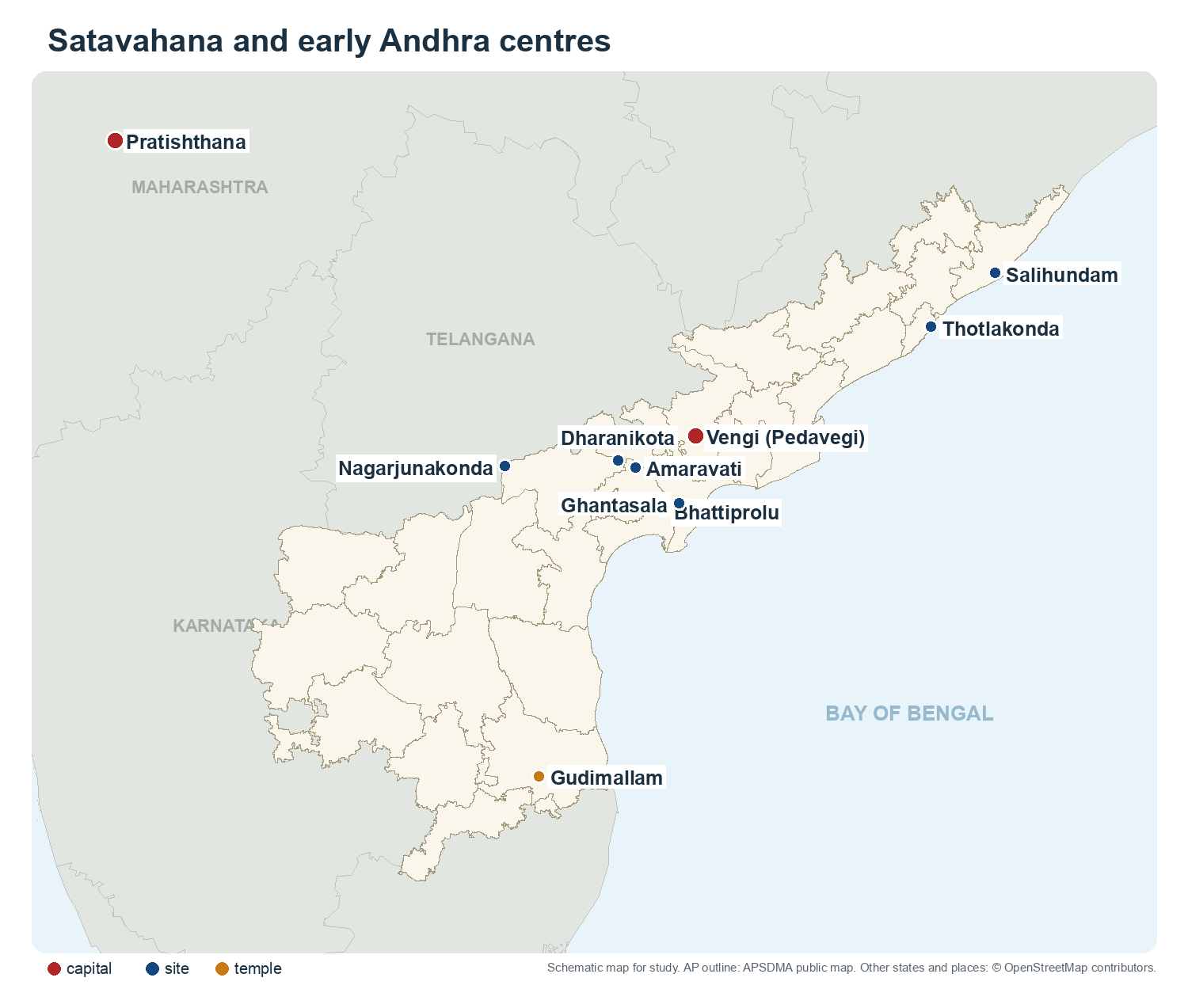
The early dynasties at a glance
Early Andhra history is a list of five dynasties. Each has a founder, a capital and a few famous kings. Exams ask these as matching questions, so learn the table first.
| Dynasty | Founder | Capital | Note |
|---|---|---|---|
| Satavahana | Simuka | Pratishthana | Capital lies in Maharashtra, not in AP |
| Ikshvaku | Vasishthiputra Chantamula (Chantamula I) | Vijayapuri | Vijayapuri is in today's Palnadu district |
| Salankayana | Vijayadevavarman | Vengi | Vengi (Pedavegi) is in Eluru district |
| Anandagotrika | Kandara | Kandarapura | Named after its founder |
| Brihatpalayana | Jayavarman | Kodur (also spelt Kudura) | Kodur is in Krishna district |
Simuka is called the first king of the Satavahana line. Chantamula I is the first king of the Ikshvaku line.
Satavahanas
The Satavahanas ruled from Pratishthana. Simuka founded the dynasty. After Simuka the next king is Kanha. The best known names are Hala, Gautamiputra Satakarni, Vasishthiputra Pulumavi and Yajna Sri Satakarni.
Gautamiputra Satakarni was the greatest ruler. His title Trisamudratoyapitavahana means one whose horses drank the water of three seas. His son Vasishthiputra Pulumavi came after him. Remember the pattern: Gautamiputra is the father, Pulumavi is the son.
Yajna Sri Satakarni is linked with ship-type coins. These coins were found at Chinnaganjam. They show that the Satavahanas took part in sea trade.
The Satavahanas faced the Western Kshatrapas. Nahapana belonged to the Kshaharata line, and Chashtana and Rudradaman belonged to the Western Kshatrapas, whose capital was Ujjain. Rudradaman's Girnar inscription is in Sanskrit. It is at Junagadh.
The Nasik Prasasti was issued by Gautami Balasri, the mother of Gautamiputra. It is in Prakrit. The Nanaghat inscription was issued by Naganika. Nanaghat is in Maharashtra.
Ikshvakus
The Ikshvakus ruled from Vijayapuri. This place is also called Nagarjunakonda in the Krishna valley. The order of kings is:
| Order | King |
|---|---|
| 1 | Vasishthiputra Chantamula |
| 2 | Virapurushadatta |
| 3 | Ehuvula Chantamula |
| 4 | Rudrapurushadatta |
Each king was the son of the one before him. Virapurushadatta was the son of Chantamula I. Ehuvula Chantamula was the son of Virapurushadatta. Rudrapurushadatta came last in this list.
Nagarjunakonda is a Buddhist site. Many monuments from the Ikshvaku age were found there.
Salankayanas, Anandagotrikas, Brihatpalayanas
- Salankayanas: founder Vijayadevavarman, capital Vengi. Two kings named are Hastivarman and Nandivarman. Hastivarman came first and Nandivarman followed.
- Anandagotrikas: founder Kandara, capital Kandarapura. Two later kings are Attivarman and Damodaravarman. Attivarman came before Damodaravarman.
- Brihatpalayanas: founder Jayavarman, capital Kodur. This is a short-lived small dynasty.
Vengi later became the capital of the Chalukyas of Vengi. Their founder was Kubja Vishnuvardhana. So Vengi appears twice in exams: Salankayanas first, Eastern Chalukyas later.
Literature and thinkers
| Work | Author | Language / school |
|---|---|---|
| Gatha Saptashati | Hala | Prakrit |
| Brihatkatha | Gunadhya | Paisachi |
| Katantra grammar | Sarvavarman | Sanskrit |
| Lilavati Parinaya | Kutuhala | Prakrit poem on Hala's marriage (written c. 8th century) |
| Ratnavali | Nagarjuna | Work credited to Nagarjuna |
| Suhrllekha | Nagarjuna | Sanskrit |
| Madhyamaka Karika | Nagarjuna | Madhyamika school |
| Chatuhsataka | Aryadeva | Madhyamika school |
Nagarjuna and his pupil Aryadeva belong to the Madhyamika school of Buddhism. Do not confuse Nagarjuna the philosopher with Nagarjunakonda, the place. The place carries his name, and it lies in the Palnadu district.
Important sites in AP and Telangana
| Site | Present district / region | Link |
|---|---|---|
| Amaravati Stupa | Palnadu | Buddhism |
| Nagarjunakonda | Palnadu | Buddhism |
| Dharanikota | Palnadu | Buddhist and early town site |
| Ghantasala | Krishna | Buddhist site |
| Jaggayyapeta | NTR district | Buddhist site |
| Bhattiprolu | Bapatla | Buddhist stupa |
| Chandavaram | Prakasam | Buddhist site |
| Salihundam | Srikakulam | Buddhist site |
| Thotlakonda, Bavikonda, Pavurallakonda | Visakhapatnam | Thotlakonda is Buddhist |
| Sankaram | Anakapalli | Buddhist site |
| Ramatirtham | Vizianagaram | Buddhist site |
| Guntupalli | Eluru | Buddhist site |
| Gudimallam | Tirupati | Shaivism (Parasurameswara Temple, early Shiva linga) |
| Myakadoni inscription | Kurnool | Inscription site |
| Kotilingala, Dhulikatta | Karimnagar / Jagtial area | Early coins and remains |
Amaravati school of art is linked with the Krishna valley. Do not mix it with Gandhara school (Peshawar valley) or Mathura school (Mathura).
Religion and language map
Religion and language questions are easy marks if you keep one line for each item.
| Item | Religion / language |
|---|---|
| Amaravati Stupa | Buddhism |
| Nagarjunakonda | Buddhism |
| Thotlakonda | Buddhism |
| Gudimallam | Shaivism |
| Gatha Saptashati | Prakrit |
| Brihatkatha | Paisachi |
| Katantra grammar | Sanskrit |
| Nagarjuna | Madhyamaka (Madhyamika) school |
Notice the pattern. Almost every large stupa site of the Krishna and Guntur belt is Buddhist. The Satavahana kings used Prakrit for most records, while Sanskrit was used for grammar and for some later inscriptions. Gudimallam is the odd one out because it is a Shaivite site.
How to memorise the dynasties
Use the first letter of each capital and link it to the founder.
- Satavahana: Simuka, Pratishthana.
- Ikshvaku: Chantamula, Vijayapuri.
- Salankayana: Vijayadevavarman, Vengi (both start with V).
- Anandagotrika: Kandara, Kandarapura (founder and capital share the same name).
- Brihatpalayana: Jayavarman, Kodur.
Another useful rule: the Anandagotrika capital Kandarapura is simply the town of Kandara. The Salankayana capital and founder both begin with V. These small links stop most mix-ups.
Also learn the order of succession in each line:
- Satavahana: Simuka, then Kanha. Later Gautamiputra Satakarni, then Vasishthiputra Pulumavi.
- Ikshvaku: Chantamula, Virapurushadatta, Ehuvula Chantamula, Rudrapurushadatta.
- Salankayana: Hastivarman, then Nandivarman.
- Anandagotrika: Kandara, then Attivarman, then Damodaravarman.
Exam traps
- Pratishthana is in Maharashtra. It is the Satavahana capital, but it is not an Andhra town.
- Vijayapuri (Ikshvaku) is not Vengi (Salankayana).
- Gautamiputra Satakarni is the father; Vasishthiputra Pulumavi is the son. Students often reverse them.
- Chantamula I, Vasishthiputra Chantamula and Chantamula the first are the same king. Ehuvula Chantamula is a different, later king.
- Nagarjuna (philosopher) is not the same as Nagarjunakonda (place).
- Hala wrote Gatha Saptashati in Prakrit. Gunadhya wrote Brihatkatha in Paisachi.
- Sarvavarman wrote Katantra grammar in Sanskrit. Do not link it with Prakrit.
- Girnar inscription (Rudradaman) is in Sanskrit; Nasik Prasasti and Hathigumpha are in Prakrit.
One-liners
- 1. Founder of the Satavahanas: Simuka.
- 2. Satavahana capital: Pratishthana.
- 3. Founder of the Ikshvakus: Vasishthiputra Chantamula; capital Vijayapuri.
- 4. Founder of the Salankayanas: Vijayadevavarman; capital Vengi.
- 5. Founder of the Anandagotrikas: Kandara; capital Kandarapura.
- 6. Founder of the Brihatpalayanas: Jayavarman; capital Kodur.
- 7. Gatha Saptashati was written by Hala.
- 8. Brihatkatha was written by Gunadhya in Paisachi.
- 9. Nagarjuna wrote Suhrllekha and Madhyamaka Karika.
- 10. Gudimallam is a Shaivite site in Tirupati district.
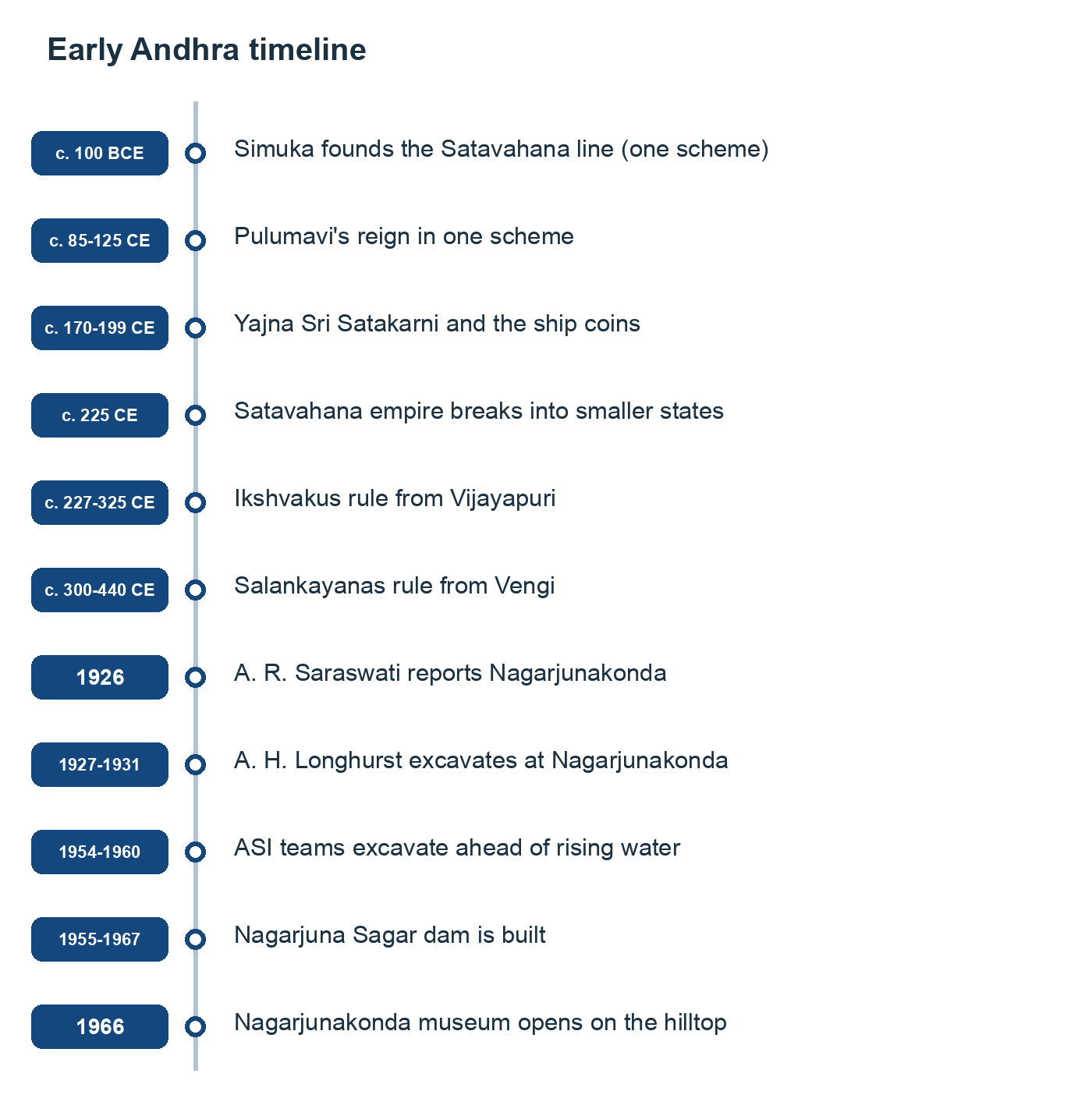
Background and context
Before the Satavahanas, the land between the Godavari and the Krishna already had towns, Buddhist communities and traders. The Mauryan empire had touched this region, and Buddhist monks had settled along the Krishna valley. When Mauryan power weakened, local rulers found room to rise. The Satavahanas were the first of these to build a large state that lasted for centuries.
The name of the family is explained in more than one way. One view links it with a word that means "driven by seven", a picture of the sun god's chariot. Another view links it with swift horses. Later Puranas call these kings "Andhras". The kings themselves never used that word in their own records. This is why you will see both names in books.
Their records are mostly short. We learn about them from coins, cave and stupa inscriptions, grants of villages and foreign travel accounts. Because of this, historians still argue about exact reign years. Scholars have placed the founder anywhere from the third century BCE to the first century BCE. Most now prefer the later second century BCE to c. 100 BCE. A stone inscription found at Kanaganahalli has been used to support a date near 110 BCE for the first king. Treat all Satavahana years as approximate. For exams, the order of rulers matters more than the year.
Political history
The rise. Simuka is named as the founder. Later lists place Kanha (also spelt Krishna) after him. The family first held parts of the western Deccan. Pratishthana, near modern Paithan in Maharashtra, was one early capital. In later periods the royal seat or main centre shifted, and the Krishna valley with Amaravati became very important. So the Satavahana story is not only an Andhra story. It stretches across the Deccan.
Conflict with the Shakas. The great enemy was a line of foreign rulers in the west. Nahapana belonged to the Kshaharata family. Chashtana and Rudradaman ruled as Western Kshatrapas from Ujjain. They held ports and lands in Gujarat and Malwa, which the Satavahanas also wanted. Wars over these lands went on for generations. Rudradaman's Girnar inscription at Junagadh is in Sanskrit.
Gautamiputra Satakarni. He is remembered as the greatest king of the family. The main source for him is the Nasik inscription of his mother, Gautami Balasri. It is in Prakrit. He carried the title Trisamudratoyapitavahana, which means one whose horses drank the water of three seas. Scholars place his reign in different decades. Some place him in the first century CE, others in the early second century CE. Say "c." when you give a date.
Pulumavi and the later kings. Vasishthiputra Pulumavi was the son of Gautamiputra. He kept the empire together and is reported to have ruled from c. 85 to 125 CE in one scheme of dates. Other schemes move him later. After a number of kings, Yajna Sri Satakarni came to the throne, c. 170-199 CE by one reckoning. His time is the last strong period. His coins show a ship with two masts. They were found at Chinnaganjam and other east-coast places. This shows that the family had by then become a sea-trading power on the Bay of Bengal as well as on the Arabian Sea.
The fall. The king's hold ended soon after Yajna Sri, when governors and chiefs stopped obeying him. By about 225 CE the empire had split. For Andhra the two successors that counted were the Pallavas in the south-east and the Ikshvakus in the Krishna valley, and the Ikshvakus became the main power there. Elsewhere the Abhiras rose in the west, the Chutus in the south-west, and a northern Satavahana branch continued.
Administration and economy
Real authority in the Satavahana state was spread out. Hereditary lords called *maharathis* and army chiefs called *mahasenapatis* held power on the ground. Royal princes went out as viceroys to far provinces. The land itself was cut into large districts, the *aharas*, many named after a governor or a town, with *janapadas* as smaller units. Local lords therefore had much power, and this became a weakness when the centre grew poor.
Farming grew by clearing forest and by tank and canal work. The more important change was trade. The family controlled long stretches of the west coast with ports like Sopara, Kalyan and Bharuch, and the east coast with the Krishna and Godavari mouths. The kingdom took a large part in trade with the Roman world. A Greek sailing guide written in the first century CE names Pratishthana and Tagara as busy inland markets. The ship coins tell the same story. Trade made towns rich, and rich towns gave money for stupas and monasteries.
The Satavahana kings gave gifts to monasteries, and later families in this chapter made grants to Brahmins and temples.
Society, religion and culture
The kings were Hindu in worship and also gave freely to Buddhism. They performed Vedic rites such as the horse sacrifice. At the same time royal families, ministers and merchants paid for Buddhist caves, pillars and railings. This mixed support is the key to understanding the age. A king did not have to pick one faith.
Buddhist centres. The great stupa at Amaravati, on the Krishna, became a great Buddhist centre in this period. Its art is known as the Amaravati school, which is different from the Gandhara school of the Peshawar valley and the Mathura school. Other Satavahana-period Buddhist places in Andhra include Bhattiprolu, Ghantasala, Jaggayyapeta, Salihundam and, near the coast of Visakhapatnam, Thotlakonda. Gudimallam is a Shaiva site with a famous early linga. Do not mix its religion with the Buddhist list.
Language and books. Prakrit was the court language for most records. *Gatha Saptashati* is a collection of love poems in Prakrit and is credited to Hala. Gunadhya's *Brihatkatha* was written in Paisachi. Sarvavarman is credited with the Katantra grammar. Kutuhala's *Lilavati Parinaya* is a Prakrit poem about Hala's marriage, but it was written much later, around the eighth century.
Nagarjuna. The Buddhist thinker Nagarjuna belonged to the Madhyamika school. He is linked with the Satavahana age in tradition and is credited with the *Madhyamaka Karika* and a verse letter to a king, the *Suhrllekha*. His pupil Aryadeva wrote the *Chatuhsataka*. Do not take the place name as proof that he lived there. Nagarjunakonda is named after him, but nothing found at the site shows his presence, and the name was probably given in the medieval period.
The successor dynasties of the Krishna and coastal Andhra
Ikshvakus. After the Satavahanas the Ikshvakus of Andhra held the Krishna valley. They ruled from Vijayapuri, the ancient name of the Nagarjunakonda site. A usual scheme of dates is c. 227 to 325 CE, with four kings in order:
| Order | King | Approximate years (one scheme) |
|---|---|---|
| 1 | Vasishthiputra Chantamula | c. 227-250 |
| 2 | Virapurushadatta | c. 250-275 |
| 3 | Ehuvula Chantamula | c. 275-300 |
| 4 | Rudrapurushadatta | c. 300-325 |
The first king revived Vedic rites, including the horse sacrifice. Yet the women of the house are better known for Buddhist gifts. A royal woman named Chamtasri paid for a large shrine, and a queen named Kodabalisiri had a monastery built for monks of the Mahishasaka school. Virapurushadatta married a daughter of a Western Kshatrapa ruler of Ujjain. So the old enemies of the Satavahanas became in-laws of the Ikshvakus. By the middle of the fourth century the rising Pallavas had taken Ikshvaku lands, and the family became weak.
Salankayanas. This family ruled from Vengi, a place identified with Pedavegi near Eluru. Their dates are given as c. 300 to 440 CE. Lists name kings such as Devavarman, Hastivarman and Nandivarman. Their early records use a Prakrit, and later ones use Sanskrit. Most of their known records are copper plates granting land to Brahmins or temples. They share a few features with the early Pallavas, such as the bull as the seal. The Vishnukundins pushed them out around the middle or late fifth century.
Anandagotrikas and Brihatpalayanas. These are small families. The Anandagotrikas ruled from Kandarapura; the founder was Kandara. The Brihatpalayanas had their seat at Kodur (also written Kudura) and are known mainly from a few copper plates. Do not spend time on years for these two. Learn founder, capital and the neighbours.
Decline, legacy and sites to know
The Satavahana age left three lasting things. First, a Prakrit literature that fed later Sanskrit and regional writing. Second, a pattern of trade, towns and religious gifts that later dynasties copied. Third, the Amaravati school of art.
The Nagarjunakonda museum stands on a hilltop for a reason. The Nagarjuna Sagar dam (built 1955-1967) was going to drown the valley below. The site was already known: A. R. Saraswati of the ASI had first reported it in 1926, and A. H. Longhurst dug there from 1927 to 1931. Then, ahead of the rising water, ASI teams worked mainly in 1954-1960. They uncovered more than thirty monasteries and many stupas. A number of monuments were taken apart, rebuilt on higher ground, and shown in a museum that opened in 1966.
| Site | What it shows |
|---|---|
| Amaravati | Great stupa, Amaravati school of sculpture |
| Nagarjunakonda | Ikshvaku capital Vijayapuri, Buddhist monasteries |
| Dharanikota | Early town and later temples nearby |
| Bhattiprolu, Ghantasala, Jaggayyapeta | Buddhist stupa and relic sites |
| Salihundam, Thotlakonda, Ramatirtham, Sankaram | Buddhist hill sites on the east coast |
| Gudimallam | Early Shaiva linga |
| Pratishthana (Paithan), Nanaghat | Capital and cave record in Maharashtra |
Why the Satavahana empire broke up
It helps to see the fall as a chain of causes, because examiners like cause questions.
- 1. Power sat with local lords. The *maharathis* and the governors of *aharas* held land and men. A strong king could control them. A weak king could not.
- 2. Border wars were costly. The long struggle with the Western Kshatrapas drained men and money in the west, where the richest ports lay.
- 3. Princes ruled far provinces. When royal princes or governors saw the king grow weak, they could set up as independent rulers.
- 4. New families rose at the edges. In the Krishna valley the Ikshvakus appeared. In the south-east the Pallavas grew strong. Some scholars think the early Pallavas began as officers or feudatories under the Satavahanas in Andhra, while others think they came from the Kanchi region. The early Pallava records are in Prakrit, which looks like the Satavahana style of writing. Treat the origin as a debate.
A simple timeline to carry
| Approximate period | What happens |
|---|---|
| c. 100 BCE (one scheme) | Simuka founds the Satavahana line |
| Early centuries CE | Wars with Nahapana and the Western Kshatrapas; Gautamiputra Satakarni, then Pulumavi |
| c. 170-199 CE (one scheme) | Yajna Sri Satakarni and the ship coins |
| c. 225 CE | Empire breaks into smaller states |
| c. 227-325 CE | Ikshvakus at Vijayapuri |
| c. 300-440 CE | Salankayanas at Vengi |
| Mid-5th century | Vishnukundins push out the Salankayanas |
Every year in this table is a scholar's estimate. If an option gives an exact year for a Satavahana king, read it twice.
Points where students go wrong
- Capital confusion. Pratishthana is in Maharashtra. Dhanyakataka, the Amaravati area, is the Andhra centre of the same empire. Both belong to the story, so do not call Pratishthana an Andhra town.
- Two Chantamulas. Vasishthiputra Chantamula is the first king. Ehuvula Chantamula is the third. Learn them with the order number.
- Succession by religion. The Ikshvaku kings did Vedic sacrifices, but their queens built Buddhist monuments. A question may ask who built the Buddhist structures. The answer is often the royal women.
- Language mix. Nasik and the Satavahana records are in Prakrit. The Girnar record of Rudradaman is in Sanskrit. A later Salankayana record also moves from Prakrit to Sanskrit. The slow move from Prakrit to Sanskrit in royal records is a trend you can use to place a record in time.
- Dates for books. The *Lilavati Parinaya* tells of Hala's marriage, but it was written about the eighth century, so it is not a Satavahana-age book.
How examiners use this chapter
- Founder and capital pairs: Simuka and Pratishthana; Chantamula and Vijayapuri; Vijayadevavarman (as listed in school books) and Vengi; Kandara and Kandarapura; Jayavarman and Kodur.
- Father and son: Gautamiputra is the father and Pulumavi the son. Many wrong options reverse this.
- Order in the Ikshvaku line: Chantamula, Virapurushadatta, Ehuvula Chantamula, Rudrapurushadatta.
- Inscriptions and who issued them: Nasik by Gautami Balasri (Prakrit); Nanaghat by Naganika; Girnar by Rudradaman (Sanskrit).
- Author and book pairs: Hala and Gatha Saptashati; Gunadhya and Brihatkatha; Sarvavarman and Katantra; Nagarjuna and Suhrllekha; Aryadeva and Chatuhsataka.
- Place or person: Nagarjuna is the thinker, Nagarjunakonda is the place.
- Religion of a site: Amaravati, Nagarjunakonda and Thotlakonda are Buddhist, Gudimallam is Shaiva.
- Vengi is the capital of two lines, first the Salankayanas and later the Eastern Chalukyas.
- Ship coins of Yajna Sri Satakarni and Chinnaganjam: the usual proof of sea trade.
- Nagarjuna Sagar dam and the relocated monuments: the reason the Nagarjunakonda museum stands on a hilltop.
- Western Kshatrapas: Chashtana and Rudradaman, capital Ujjain; Nahapana is of the Kshaharata line.
- Who came before or after: the Vishnukundins followed the Salankayanas at Vengi, and the Eastern Chalukyas came later still.
Worked cases
Case 1: Match the dynasty with its capital. (A) Ikshvaku (B) Salankayana (C) Anandagotrika (D) Brihatpalayana. Capitals: Vengi, Kodur, Vijayapuri, Kandarapura.
Reasoning:
- 1. Start with the capital that is easy to spot. Kandarapura is the town of Kandara. Kandara is the founder of the Anandagotrikas. So C matches Kandarapura.
- 2. Kodur (also spelt Kudura) is the small dynasty's capital. The founder is Jayavarman. So D matches Kodur.
- 3. Two remain: Vijayapuri and Vengi. Vijayapuri is also called Nagarjunakonda and has Buddhist remains. That is the Ikshvaku capital.
- 4. The left-over pair is Salankayana and Vengi. Check: the founder Vijayadevavarman and Vengi both start with V.
Takeaway: In matching questions, lock the sure pairs first and let the last pair fall in place.
Case 2: "Which of the following is NOT correctly paired?" (1) Gatha Saptashati – Hala – Prakrit (2) Brihatkatha – Gunadhya – Paisachi (3) Katantra grammar – Sarvavarman – Prakrit (4) Suhrllekha – Nagarjuna – Sanskrit.
Reasoning:
- 1. Check each pair against one line you know well. Hala wrote in Prakrit, so option 1 is right.
- 2. Gunadhya and Paisachi go together, so option 2 is right.
- 3. Katantra grammar is a Sanskrit grammar. Option 3 gives Prakrit, so it looks wrong.
- 4. Suhrllekha is a Sanskrit work of Nagarjuna, so option 4 is right.
Takeaway: For "NOT" questions, test every option and pick the one that breaks the rule.
Case 3: A question gives four names: Nagarjuna, Aryadeva, Nagarjunakonda, Amaravati. "Which one is a place and which is a Madhyamika thinker?"
Reasoning:
- 1. Nagarjuna and Aryadeva both belong to the Madhyamika school of Buddhism.
- 2. Aryadeva wrote Chatuhsataka. Nagarjuna wrote Madhyamaka Karika.
- 3. Nagarjunakonda and Amaravati are Buddhist sites. Nagarjunakonda is only named after the philosopher.
- 4. If an option says "Nagarjunakonda wrote Suhrllekha", it mixes a place with a person, so reject it.
Takeaway: When a place carries a person's name, ask whether the question wants the person or the place.
Case 4: Find the odd one out: Amaravati, Nagarjunakonda, Thotlakonda, Gudimallam.
Reasoning:
- 1. Amaravati is a Buddhist stupa site.
- 2. Nagarjunakonda is also Buddhist.
- 3. Thotlakonda is Buddhist too.
- 4. Gudimallam is linked with Shaivism. It has the Parasurameswara Temple with an early Shiva linga.
Takeaway: Group items by religion first. The one that does not fit is the answer.
Compare and contrast
| Look-alike pair | Item A | Item B |
|---|---|---|
| Vijayapuri and Vengi | Vijayapuri: Ikshvaku capital, also called Nagarjunakonda | Vengi: Salankayana capital, later the Eastern Chalukya capital |
| Kandara and Kandarapura | Kandara is the founder | Kandarapura is the capital of the Anandagotrikas |
| Chantamula I and Ehuvula Chantamula | Vasishthiputra Chantamula is the founder and the first king | Ehuvula Chantamula is the third king in the list |
| Kodur and Kudura | Two spellings of one town | The capital of the Brihatpalayanas |
| Inscription or record | Issued by | Language / place |
|---|---|---|
| Nasik Prasasti | Gautami Balasri | Prakrit |
| Nanaghat inscription | Naganika | Found in Maharashtra |
| Girnar inscription | Rudradaman | Sanskrit, at Junagadh |
| Hathigumpha inscription | Kharavela | Prakrit |
Memory tip for these pairs. When two names look alike, ask one question: is it a person or a place? Kandara is a person and Kandarapura is a town. Vijayapuri is a town and Vijayadevavarman is a king. A second question helps too: which religion or language is linked? Amaravati, Nagarjunakonda and Thotlakonda point to Buddhism. Gudimallam points to Shaivism. Hala points to Prakrit, Gunadhya to Paisachi and Sarvavarman to Sanskrit. In the exam hall, write the pair in the margin and test each option against it.
Sequence and timeline
Use the order of kings in each line. No years are given for these kings, so learn the order only.
| Line | Order of rulers |
|---|---|
| Ikshvaku | 1. Vasishthiputra Chantamula; 2. Virapurushadatta; 3. Ehuvula Chantamula; 4. Rudrapurushadatta |
| Salankayana | Hastivarman, then Nandivarman |
| Anandagotrika | Kandara, then Attivarman, then Damodaravarman |
| Satavahana | Simuka, then Kanha. Gautamiputra Satakarni, then Vasishthiputra Pulumavi |
| Vengi (capital) | Salankayanas first, Eastern Chalukyas later |
How to use this order in the exam. Questions often ask "who came after" or "who came before". Write the chain on paper and read both neighbours. In the Ikshvaku line, Rudrapurushadatta is the last name in the chain, so it can never be the answer to "who came before Ehuvula Chantamula". In the Anandagotrika line, Attivarman sits between Kandara and Damodaravarman. In the Salankayana line, Hastivarman comes first and Nandivarman follows. Do not try to add years to these lists. If an option gives a year for these kings, treat it with care and go by the order.
Capitals are a second chain to learn: Pratishthana, Vijayapuri, Vengi, Kandarapura, Kodur. Pratishthana lies in Maharashtra, while the others are linked with the Andhra country. Remember that Vengi is the only one of these capitals that was used again by a later dynasty, the Chalukyas of Vengi.
More one-liners
- 1. Yajna Sri Satakarni is linked with ship-type coins found at Chinnaganjam.
- 2. Nahapana belonged to the Kshaharata line.
- 3. Chashtana and Rudradaman belonged to the Western Kshatrapas.
- 4. Kutuhala wrote Lilavati Parinaya, a Prakrit poem.
- 5. Aryadeva wrote Chatuhsataka.
- 6. Dharanikota is a Buddhist and early town site.
- 7. Ghantasala is a Buddhist site.
- 8. Jaggayyapeta is a Buddhist site.
- 9. Bhattiprolu is a Buddhist stupa site.
- 10. Salihundam is a Buddhist site.
Practice questions
Who is traditionally regarded as the first ruler of the Satavahana dynasty?
- Simuka
- Hala
- Gautamiputra Satakarni
- Vasishthiputra Pulumavi
Answer
A. Simuka
Dynastic lists name Simuka as the founder of the line that went on to rule large parts of the Deccan.
శాతవాహన వంశంలో మొదటి రాజుగా సాంప్రదాయకంగా ఎవరిని పరిగణిస్తారు?
- సిముకుడు
- హాలుడు
- గౌతమీపుత్ర శాతకర్ణి
- వాసిష్ఠీపుత్ర పులుమావి
The Satavahana dynasty was founded by:
- Gautamiputra Satakarni
- Simuka
- Vasishthiputra Pulumavi
- Yajna Sri Satakarni
Answer
B. Simuka
Simuka (c. first century BC) founded the dynasty; Gautamiputra Satakarni was among its greatest later rulers.
శాతవాహన వంశ స్థాపకుడు ఎవరు?
- గౌతమీపుత్ర శాతకర్ణి
- సిముకుడు
- వాసిష్ఠీపుత్ర పులుమావి
- యజ్ఞశ్రీ శాతకర్ణి
Which of the following belongs to Ikshvaku dynasty?
- Vasishthiputra Chantamula
- Damodaravarman
- Hastivarman
- Gautamiputra Satakarni
Answer
A. Vasishthiputra Chantamula
ఈ క్రింది వాటిలో 'ఇక్ష్వాకు వంశం' వర్గానికి చెందినది ఏది?
- వాశిష్ఠీపుత్ర చాంతమూలుడు
- దామోదరవర్మ
- హస్తివర్మ
- గౌతమీపుత్ర శాతకర్ణి
Gautamiputra Satakarni was the father of which of the following?
- Rudrapurushadatta
- Vasishthiputra Pulumavi
- Virapurushadatta
- Ehuvula Chantamula
Answer
B. Vasishthiputra Pulumavi
గౌతమీపుత్ర శాతకర్ణి ఈ క్రింది వారిలో ఎవరికి తండ్రి?
- రుద్రపురుషదత్తుడు
- వాశిష్ఠీపుత్ర పులుమావి
- వీరపురుషదత్తుడు
- ఎహువుల చాంతమూలుడు
Who was the founder of the Ikshvaku dynasty of Vijayapuri (Nagarjunakonda)?
- Vasishthiputra Chamtamula (Santamula I)
- Rudrapurushadatta
- Ehuvula Chamtamula
- Virapurushadatta
Answer
A. Vasishthiputra Chamtamula (Santamula I)
Santamula I began the line and performed Vedic sacrifices.
విజయపురి (నాగార్జునకొండ) ఇక్ష్వాకు వంశ స్థాపకుడు ఎవరు?
- వాసిష్ఠీపుత్ర చాంతమూలుడు (శాంతమూలుడు I)
- రుద్రపురుషదత్తుడు
- ఎహువుల చాంతమూలుడు
- వీరపురుషదత్తుడు
Which Satavahana ruler is described in the Nashik inscription as 'Eka Bamhana' (a unique Brahmana) who checked the mixing of the varnas?
- Hala
- Gautamiputra Satakarni
- Vasishthiputra Pulumavi
- Yajna Sri Satakarni
Answer
B. Gautamiputra Satakarni
His mother Gautami Balasri's inscription praises him in these terms, showing his concern for the social order.
నాసిక్ శాసనంలో 'ఏక బమ్హన' (అద్వితీయ బ్రాహ్మణుడు)గా, వర్ణసంకరాన్ని నిరోధించినవాడిగా వర్ణించబడిన శాతవాహన రాజు ఎవరు?
- హాలుడు
- గౌతమీపుత్ర శాతకర్ణి
- వాసిష్ఠీపుత్ర పులుమావి
- యజ్ఞశ్రీ శాతకర్ణి
Which Satavahana ruler is credited with the Prakrit verse anthology 'Gathasaptasati'?
- Simuka
- Gautamiputra Satakarni
- Hala
- Vasishthiputra Pulumavi
Answer
C. Hala
King Hala is traditionally credited with compiling the seven hundred Prakrit verses.
ప్రాకృత కవితా సంకలనం 'గాథాసప్తశతి' ఏ శాతవాహన రాజుకు ఆపాదించబడింది?
- సిముకుడు
- గౌతమీపుత్ర శాతకర్ణి
- హాలుడు
- వాసిష్ఠీపుత్ర పులుమావి
The Gurzala inscription was issued by which Ikshvaku ruler?
- Vasishthiputra Chantamula
- Virapurushadatta
- Ehuvula Chantamula
- Rudrapurushadatta
Answer
D. Rudrapurushadatta
The Gurzala inscription is a record of Rudrapurushadatta, the last Ikshvaku king.
గురజాల శాసనాన్ని వేయించిన ఇక్ష్వాకు రాజు ఎవరు?
- వాసిష్ఠీపుత్ర శాంతమూలుడు
- వీరపురుషదత్తుడు
- ఎహువుల శాంతమూలుడు
- రుద్రపురుషదత్తుడు
The Prakrit anthology Gatha Saptasati of 700 verses is attributed to which Satavahana king?
- Simuka
- Hala
- Gautamiputra Satakarni
- Yajna Sri Satakarni
Answer
B. Hala
Hala is credited with compiling the Gatha Saptasati.
700 గాథలతో కూడిన ప్రాకృత సంకలనం గాథాసప్తశతి ఏ శాతవాహన రాజుకు ఆపాదించబడింది?
- సిముకుడు
- హాలుడు
- గౌతమీపుత్ర శాతకర్ణి
- యజ్ఞశ్రీ శాతకర్ణి
Which of the following belongs to Satavahana dynasty?
- Simuka
- Damodaravarman
- Ehuvula Chantamula
- Nandivarman
Answer
A. Simuka
ఈ క్రింది వాటిలో 'శాతవాహన వంశం' వర్గానికి చెందినది ఏది?
- సిముకుడు
- దామోదరవర్మ
- ఎహువుల చాంతమూలుడు
- నందివర్మ
To which of the following does Gautamiputra Satakarni belong?
- Anandagotrika dynasty
- Salankayana dynasty
- Satavahana dynasty
- Ikshvaku dynasty
Answer
C. Satavahana dynasty
గౌతమీపుత్ర శాతకర్ణి ఈ క్రింది వాటిలో దేనికి చెందినది?
- ఆనందగోత్రిక వంశం
- శాలంకాయన వంశం
- శాతవాహన వంశం
- ఇక్ష్వాకు వంశం
To which of the following does Vasishthiputra Pulumavi belong?
- Satavahana dynasty
- Anandagotrika dynasty
- Salankayana dynasty
- Ikshvaku dynasty
Answer
A. Satavahana dynasty
వాశిష్ఠీపుత్ర పులుమావి ఈ క్రింది వాటిలో దేనికి చెందినది?
- శాతవాహన వంశం
- ఆనందగోత్రిక వంశం
- శాలంకాయన వంశం
- ఇక్ష్వాకు వంశం
To which of the following does Yajna Sri Satakarni belong?
- Satavahana dynasty
- Ikshvaku dynasty
- Anandagotrika dynasty
- Salankayana dynasty
Answer
A. Satavahana dynasty
యజ్ఞశ్రీ శాతకర్ణి ఈ క్రింది వాటిలో దేనికి చెందినది?
- శాతవాహన వంశం
- ఇక్ష్వాకు వంశం
- ఆనందగోత్రిక వంశం
- శాలంకాయన వంశం
To which of the following does Vasishthiputra Chantamula belong?
- Anandagotrika dynasty
- Satavahana dynasty
- Ikshvaku dynasty
- Salankayana dynasty
Answer
C. Ikshvaku dynasty
వాశిష్ఠీపుత్ర చాంతమూలుడు ఈ క్రింది వాటిలో దేనికి చెందినది?
- ఆనందగోత్రిక వంశం
- శాతవాహన వంశం
- ఇక్ష్వాకు వంశం
- శాలంకాయన వంశం
To which of the following does Ehuvula Chantamula belong?
- Anandagotrika dynasty
- Ikshvaku dynasty
- Satavahana dynasty
- Salankayana dynasty
Answer
B. Ikshvaku dynasty
ఎహువుల చాంతమూలుడు ఈ క్రింది వాటిలో దేనికి చెందినది?
- ఆనందగోత్రిక వంశం
- ఇక్ష్వాకు వంశం
- శాతవాహన వంశం
- శాలంకాయన వంశం
Who succeeded Gautamiputra Satakarni?
- Vasishthiputra Pulumavi
- Rudrapurushadatta
- Attivarman
- Nandivarman
Answer
A. Vasishthiputra Pulumavi
గౌతమీపుత్ర శాతకర్ణి తర్వాత ఆ స్థానంలోకి వచ్చినవారు ఎవరు?
- వాశిష్ఠీపుత్ర పులుమావి
- రుద్రపురుషదత్తుడు
- అత్తివర్మ
- నందివర్మ
Vasishthiputra Pulumavi succeeded which of the following?
- Attivarman
- Ehuvula Chantamula
- Chantamula I
- Gautamiputra Satakarni
Answer
D. Gautamiputra Satakarni
'వాశిష్ఠీపుత్ర పులుమావి' ఎవరి తర్వాత ఆ స్థానంలోకి వచ్చారు?
- అత్తివర్మ
- ఎహువుల చాంతమూలుడు
- మొదటి శాంతమూలుడు
- గౌతమీపుత్ర శాతకర్ణి
Virapurushadatta succeeded which of the following?
- Gautamiputra Satakarni
- Ehuvula Chantamula
- Simuka
- Vasishthiputra Chantamula
Answer
D. Vasishthiputra Chantamula
'వీరపురుషదత్తుడు' ఎవరి తర్వాత ఆ స్థానంలోకి వచ్చారు?
- గౌతమీపుత్ర శాతకర్ణి
- ఎహువుల చాంతమూలుడు
- సిముకుడు
- వాశిష్ఠీపుత్ర చాంతమూలుడు
Who succeeded Virapurushadatta?
- Ehuvula Chantamula
- Vasishthiputra Pulumavi
- Kanha
- Nandivarman I
Answer
A. Ehuvula Chantamula
వీరపురుషదత్తుడు తర్వాత ఆ స్థానంలోకి వచ్చినవారు ఎవరు?
- ఎహువుల చాంతమూలుడు
- వాశిష్ఠీపుత్ర పులుమావి
- కన్హుడు
- మొదటి నందివర్మ
Who succeeded Hastivarman?
- Ehuvula Chantamula
- Nandivarman
- Virapurushadatta
- Vasishthiputra Pulumavi
Answer
B. Nandivarman
హస్తివర్మ తర్వాత ఆ స్థానంలోకి వచ్చినవారు ఎవరు?
- ఎహువుల చాంతమూలుడు
- నందివర్మ
- వీరపురుషదత్తుడు
- వాశిష్ఠీపుత్ర పులుమావి
Nandivarman I succeeded which of the following?
- Hastivarman
- Gautamiputra Satakarni
- Virapurushadatta
- Ehuvula Chantamula
Answer
A. Hastivarman
'మొదటి నందివర్మ' ఎవరి తర్వాత ఆ స్థానంలోకి వచ్చారు?
- హస్తివర్మ
- గౌతమీపుత్ర శాతకర్ణి
- వీరపురుషదత్తుడు
- ఎహువుల చాంతమూలుడు
Who was the father of Rudrapurushadatta?
- Virapurushadatta
- Gautamiputra Satakarni
- Vasishthiputra Chantamula
- Ehuvula Chantamula
Answer
D. Ehuvula Chantamula
రుద్రపురుషదత్తుడు తండ్రి ఎవరు?
- వీరపురుషదత్తుడు
- గౌతమీపుత్ర శాతకర్ణి
- వాశిష్ఠీపుత్ర చాంతమూలుడు
- ఎహువుల చాంతమూలుడు
Who was the father of Vasishthiputra Pulumavi?
- Vasishthiputra Chantamula
- Gautamiputra Satakarni
- Ehuvula Chantamula
- Virapurushadatta
Answer
B. Gautamiputra Satakarni
వాశిష్ఠీపుత్ర పులుమావి తండ్రి ఎవరు?
- వాశిష్ఠీపుత్ర చాంతమూలుడు
- గౌతమీపుత్ర శాతకర్ణి
- ఎహువుల చాంతమూలుడు
- వీరపురుషదత్తుడు
Which of the following is located in the Kurnool area?
- Amaravati Stupa
- Myakadoni inscription
- Dharanikota
- Ghantasala
Answer
B. Myakadoni inscription
ఈ క్రింది వాటిలో ఏది కర్నూలు ప్రాంతంలో ఉంది?
- అమరావతి స్తూపం
- మ్యాకదోని శాసనం
- ధరణికోట
- ఘంటసాల
Gunadhya's Brihatkatha, linked by tradition with the Satavahana court, was composed in which language?
- Pali
- Maharashtri Prakrit
- Sanskrit
- Paisachi
Answer
D. Paisachi
Brihatkatha was written in the Paisachi dialect.
సంప్రదాయం ప్రకారం శాతవాహన ఆస్థానంతో ముడిపడిన గుణాఢ్యుని బృహత్కథ ఏ భాషలో రాయబడింది?
- పాళీ
- మహారాష్ట్రీ ప్రాకృతం
- సంస్కృతం
- పైశాచి
Which Satavahana ruler is associated with the 2nd-century CE enlargement and embellishment of the Amaravati stupa?
- Simuka
- Vasishthiputra Pulumavi
- Hala
- Kanha
Answer
B. Vasishthiputra Pulumavi
Vasishthiputra Pulumavi's reign saw major additions at Amaravati.
క్రీ.శ. 2వ శతాబ్దంలో అమరావతి స్తూపం విస్తరణ, అలంకరణతో సంబంధం ఉన్న శాతవాహన పాలకుడు ఎవరు?
- సిముఖుడు
- వాసిష్ఠీపుత్ర పులుమావి
- హాలుడు
- కన్హుడు
The Nanaghat inscription, issued by Queen Nayanika, records Vedic sacrifices including the Ashvamedha performed by which Satavahana king?
- Simuka
- Hala
- Satakarni I
- Gautamiputra Satakarni
Answer
C. Satakarni I
Nayanika, queen of Satakarni I, recorded his Ashvamedha and other sacrifices at Nanaghat.
నాయనిక రాణి వేయించిన నానేఘాట్ శాసనం అశ్వమేధంతో సహా వైదిక యజ్ఞాలను చేసినట్లు పేర్కొనే శాతవాహన రాజు ఎవరు?
- సిముకుడు
- హాలుడు
- మొదటి శాతకర్ణి
- గౌతమీపుత్ర శాతకర్ణి
The Brihatkatha, a lost classic of Satavahana times, was composed in Paisachi by
- Sarvavarman
- Hala
- Gunadhya
- Nagarjuna
Answer
C. Gunadhya
Gunadhya, a court poet, wrote the Brihatkatha in Paisachi; later Sanskrit story collections drew on it.
శాతవాహన కాలం నాటి లభించని ప్రాచీన గ్రంథం బృహత్కథను పైశాచీ భాషలో రచించినవారు ఎవరు?
- శర్వవర్మ
- హాలుడు
- గుణాఢ్యుడు
- నాగార్జునుడు
Which Satavahana ruler defeated the Western Kshatrapa (Saka) king Nahapana?
- Satakarni I
- Vasishthiputra Pulumavi
- Yajna Sri Satakarni
- Gautamiputra Satakarni
Answer
D. Gautamiputra Satakarni
Gautamiputra Satakarni crushed Nahapana and restored Satavahana power, as recorded in his mother Gautami Balasri's Nasik inscription.
పశ్చిమ క్షత్రప (శక) రాజు నహపాణుని ఓడించిన శాతవాహన రాజు ఎవరు?
- మొదటి శాతకర్ణి
- వాశిష్ఠీపుత్ర పులమావి
- యజ్ఞశ్రీ శాతకర్ణి
- గౌతమీపుత్ర శాతకర్ణి
The Kodavali inscription is attributed to which Satavahana ruler?
- Gautamiputra Satakarni
- Chanda Satakarni
- Vasishthiputra Pulumavi
- Hala
Answer
B. Chanda Satakarni
The Kodavali record is linked with the Satavahana king Chanda Satakarni.
కోడవలి శాసనం ఏ శాతవాహన రాజుకు చెందినది?
- గౌతమీపుత్ర శాతకర్ణి
- చంద శాతకర్ణి
- వాసిష్ఠీపుత్ర పులుమావి
- హాలుడు
The Gathasaptasati, an anthology of 700 Prakrit verses, is traditionally attributed to which Satavahana king?
- Simuka
- Gautamiputra Satakarni
- Hala
- Yajna Sri Satakarni
Answer
C. Hala
Hala is credited with the Prakrit verse collection Gathasaptasati, which reflects everyday life in the Deccan.
700 ప్రాకృత గాథల సంకలనమైన 'గాథాసప్తశతి'ని సంప్రదాయంగా ఏ శాతవాహన రాజుకు ఆపాదిస్తారు?
- సిముకుడు
- గౌతమీపుత్ర శాతకర్ణి
- హాలుడు
- యజ్ఞశ్రీ శాతకర్ణి
Who is regarded as the founder of the Satavahana dynasty?
- Gautamiputra Satakarni
- Simuka
- Hala
- Yajna Sri Satakarni
Answer
B. Simuka
The Puranic dynastic lists begin with Simuka, who established Satavahana rule in the Deccan around the 1st century BCE.
శాతవాహన వంశ స్థాపకుడిగా ఎవరిని పరిగణిస్తారు?
- గౌతమీపుత్ర శాతకర్ణి
- సిముకుడు
- హాలుడు
- యజ్ఞశ్రీ శాతకర్ణి
To which of the following does Simuka belong?
- Anandagotrika dynasty
- Salankayana dynasty
- Satavahana dynasty
- Ikshvaku dynasty
Answer
C. Satavahana dynasty
సిముకుడు ఈ క్రింది వాటిలో దేనికి చెందినది?
- ఆనందగోత్రిక వంశం
- శాలంకాయన వంశం
- శాతవాహన వంశం
- ఇక్ష్వాకు వంశం
To which of the following does Kanha belong?
- Salankayana dynasty
- Ikshvaku dynasty
- Anandagotrika dynasty
- Satavahana dynasty
Answer
D. Satavahana dynasty
కన్హుడు ఈ క్రింది వాటిలో దేనికి చెందినది?
- శాలంకాయన వంశం
- ఇక్ష్వాకు వంశం
- ఆనందగోత్రిక వంశం
- శాతవాహన వంశం
To which of the following does Virapurushadatta belong?
- Ikshvaku dynasty
- Anandagotrika dynasty
- Salankayana dynasty
- Satavahana dynasty
Answer
A. Ikshvaku dynasty
వీరపురుషదత్తుడు ఈ క్రింది వాటిలో దేనికి చెందినది?
- ఇక్ష్వాకు వంశం
- ఆనందగోత్రిక వంశం
- శాలంకాయన వంశం
- శాతవాహన వంశం
To which of the following does Rudrapurushadatta belong?
- Anandagotrika dynasty
- Salankayana dynasty
- Ikshvaku dynasty
- Satavahana dynasty
Answer
C. Ikshvaku dynasty
రుద్రపురుషదత్తుడు ఈ క్రింది వాటిలో దేనికి చెందినది?
- ఆనందగోత్రిక వంశం
- శాలంకాయన వంశం
- ఇక్ష్వాకు వంశం
- శాతవాహన వంశం
To which of the following does Hastivarman belong?
- Ikshvaku dynasty
- Satavahana dynasty
- Salankayana dynasty
- Anandagotrika dynasty
Answer
C. Salankayana dynasty
హస్తివర్మ ఈ క్రింది వాటిలో దేనికి చెందినది?
- ఇక్ష్వాకు వంశం
- శాతవాహన వంశం
- శాలంకాయన వంశం
- ఆనందగోత్రిక వంశం
Which of the following belongs to Salankayana dynasty?
- Hastivarman
- Simuka
- Damodaravarman
- Rudrapurushadatta
Answer
A. Hastivarman
ఈ క్రింది వాటిలో 'శాలంకాయన వంశం' వర్గానికి చెందినది ఏది?
- హస్తివర్మ
- సిముకుడు
- దామోదరవర్మ
- రుద్రపురుషదత్తుడు
To which of the following does Nandivarman belong?
- Anandagotrika dynasty
- Ikshvaku dynasty
- Salankayana dynasty
- Satavahana dynasty
Answer
C. Salankayana dynasty
నందివర్మ ఈ క్రింది వాటిలో దేనికి చెందినది?
- ఆనందగోత్రిక వంశం
- ఇక్ష్వాకు వంశం
- శాలంకాయన వంశం
- శాతవాహన వంశం
To which of the following does Attivarman belong?
- Satavahana dynasty
- Anandagotrika dynasty
- Ikshvaku dynasty
- Salankayana dynasty
Answer
B. Anandagotrika dynasty
అత్తివర్మ ఈ క్రింది వాటిలో దేనికి చెందినది?
- శాతవాహన వంశం
- ఆనందగోత్రిక వంశం
- ఇక్ష్వాకు వంశం
- శాలంకాయన వంశం
Which of the following belongs to Anandagotrika dynasty?
- Hala
- Attivarman
- Rudrapurushadatta
- Ehuvula Chantamula
Answer
B. Attivarman
ఈ క్రింది వాటిలో 'ఆనందగోత్రిక వంశం' వర్గానికి చెందినది ఏది?
- హాలుడు
- అత్తివర్మ
- రుద్రపురుషదత్తుడు
- ఎహువుల చాంతమూలుడు
To which of the following does Damodaravarman belong?
- Ikshvaku dynasty
- Salankayana dynasty
- Anandagotrika dynasty
- Satavahana dynasty
Answer
C. Anandagotrika dynasty
దామోదరవర్మ ఈ క్రింది వాటిలో దేనికి చెందినది?
- ఇక్ష్వాకు వంశం
- శాలంకాయన వంశం
- ఆనందగోత్రిక వంశం
- శాతవాహన వంశం
Which of the following is NOT correctly paired with Satavahana dynasty (Item – Category)?
- Simuka
- Damodaravarman
- Hala
- Gautamiputra Satakarni
Answer
B. Damodaravarman
ఈ క్రింది వాటిలో ఏది 'శాతవాహన వంశం' అనే అంశానికి సరిగ్గా జతకాదు? (అంశం – వర్గం)
- సిముకుడు
- దామోదరవర్మ
- హాలుడు
- గౌతమీపుత్ర శాతకర్ణి
Who succeeded Ehuvula Chantamula?
- Kanha
- Rudrapurushadatta
- Attivarman
- Virapurushadatta
Answer
B. Rudrapurushadatta
ఎహువుల చాంతమూలుడు తర్వాత ఆ స్థానంలోకి వచ్చినవారు ఎవరు?
- కన్హుడు
- రుద్రపురుషదత్తుడు
- అత్తివర్మ
- వీరపురుషదత్తుడు
Who succeeded Vasishthiputra Chantamula?
- Damodaravarman
- Virapurushadatta
- Nandivarman I
- Ehuvula Chantamula
Answer
B. Virapurushadatta
వాశిష్ఠీపుత్ర చాంతమూలుడు తర్వాత ఆ స్థానంలోకి వచ్చినవారు ఎవరు?
- దామోదరవర్మ
- వీరపురుషదత్తుడు
- మొదటి నందివర్మ
- ఎహువుల చాంతమూలుడు
Practice set 2
Ehuvula Chantamula succeeded which of the following?
- Gautamiputra Satakarni
- Chantamula I
- Vasishthiputra Chantamula
- Virapurushadatta
Answer
D. Virapurushadatta
'ఎహువుల చాంతమూలుడు' ఎవరి తర్వాత ఆ స్థానంలోకి వచ్చారు?
- గౌతమీపుత్ర శాతకర్ణి
- మొదటి శాంతమూలుడు
- వాశిష్ఠీపుత్ర చాంతమూలుడు
- వీరపురుషదత్తుడు
Rudrapurushadatta succeeded which of the following?
- Chantamula I
- Gautamiputra Satakarni
- Attivarman
- Ehuvula Chantamula
Answer
D. Ehuvula Chantamula
'రుద్రపురుషదత్తుడు' ఎవరి తర్వాత ఆ స్థానంలోకి వచ్చారు?
- మొదటి శాంతమూలుడు
- గౌతమీపుత్ర శాతకర్ణి
- అత్తివర్మ
- ఎహువుల చాంతమూలుడు
Who succeeded Kandara?
- Nandivarman
- Ehuvula Chantamula
- Attivarman
- Rudrapurushadatta
Answer
C. Attivarman
కందరుడు తర్వాత ఆ స్థానంలోకి వచ్చినవారు ఎవరు?
- నందివర్మ
- ఎహువుల చాంతమూలుడు
- అత్తివర్మ
- రుద్రపురుషదత్తుడు
Attivarman succeeded which of the following?
- Chantamula I
- Kandara
- Gautamiputra Satakarni
- Hastivarman
Answer
B. Kandara
'అత్తివర్మ' ఎవరి తర్వాత ఆ స్థానంలోకి వచ్చారు?
- మొదటి శాంతమూలుడు
- కందరుడు
- గౌతమీపుత్ర శాతకర్ణి
- హస్తివర్మ
Damodaravarman succeeded which of the following?
- Chantamula I
- Virapurushadatta
- Attivarman
- Gautamiputra Satakarni
Answer
C. Attivarman
'దామోదరవర్మ' ఎవరి తర్వాత ఆ స్థానంలోకి వచ్చారు?
- మొదటి శాంతమూలుడు
- వీరపురుషదత్తుడు
- అత్తివర్మ
- గౌతమీపుత్ర శాతకర్ణి
Who succeeded Chantamula I?
- Virapurushadatta
- Vasishthiputra Pulumavi
- Nandivarman
- Kanha
Answer
A. Virapurushadatta
మొదటి శాంతమూలుడు తర్వాత ఆ స్థానంలోకి వచ్చినవారు ఎవరు?
- వీరపురుషదత్తుడు
- వాశిష్ఠీపుత్ర పులుమావి
- నందివర్మ
- కన్హుడు
Who was the father of Virapurushadatta?
- Gautamiputra Satakarni
- Ehuvula Chantamula
- Virapurushadatta
- Vasishthiputra Chantamula
Answer
D. Vasishthiputra Chantamula
వీరపురుషదత్తుడు తండ్రి ఎవరు?
- గౌతమీపుత్ర శాతకర్ణి
- ఎహువుల చాంతమూలుడు
- వీరపురుషదత్తుడు
- వాశిష్ఠీపుత్ర చాంతమూలుడు
Vasishthiputra Chantamula was the father of which of the following?
- Ehuvula Chantamula
- Virapurushadatta
- Rudrapurushadatta
- Vasishthiputra Pulumavi
Answer
B. Virapurushadatta
వాశిష్ఠీపుత్ర చాంతమూలుడు ఈ క్రింది వారిలో ఎవరికి తండ్రి?
- ఎహువుల చాంతమూలుడు
- వీరపురుషదత్తుడు
- రుద్రపురుషదత్తుడు
- వాశిష్ఠీపుత్ర పులుమావి
Who was the father of Ehuvula Chantamula?
- Gautamiputra Satakarni
- Ehuvula Chantamula
- Virapurushadatta
- Vasishthiputra Chantamula
Answer
C. Virapurushadatta
ఎహువుల చాంతమూలుడు తండ్రి ఎవరు?
- గౌతమీపుత్ర శాతకర్ణి
- ఎహువుల చాంతమూలుడు
- వీరపురుషదత్తుడు
- వాశిష్ఠీపుత్ర చాంతమూలుడు
Virapurushadatta was the father of which of the following?
- Rudrapurushadatta
- Virapurushadatta
- Vasishthiputra Pulumavi
- Ehuvula Chantamula
Answer
D. Ehuvula Chantamula
వీరపురుషదత్తుడు ఈ క్రింది వారిలో ఎవరికి తండ్రి?
- రుద్రపురుషదత్తుడు
- వీరపురుషదత్తుడు
- వాశిష్ఠీపుత్ర పులుమావి
- ఎహువుల చాంతమూలుడు
Ehuvula Chantamula was the father of which of the following?
- Rudrapurushadatta
- Virapurushadatta
- Ehuvula Chantamula
- Vasishthiputra Pulumavi
Answer
A. Rudrapurushadatta
ఎహువుల చాంతమూలుడు ఈ క్రింది వారిలో ఎవరికి తండ్రి?
- రుద్రపురుషదత్తుడు
- వీరపురుషదత్తుడు
- ఎహువుల చాంతమూలుడు
- వాశిష్ఠీపుత్ర పులుమావి
Which of the following works was written by Nagarjuna?
- Charaka Samhita
- Gatha Saptashati
- Katantra grammar
- Suhrllekha
Answer
D. Suhrllekha
నాగార్జునుడు రచించిన రచన ఏది?
- చరక సంహిత
- గాథాసప్తశతి
- కాతంత్ర వ్యాకరణం
- సుహృల్లేఖ
Which of the following works was written by Hala?
- Gatha Saptashati
- Madhyamaka Karika
- Katantra grammar
- Ramayana
Answer
A. Gatha Saptashati
హాలుడు రచించిన రచన ఏది?
- గాథాసప్తశతి
- మాధ్యమిక కారిక
- కాతంత్ర వ్యాకరణం
- రామాయణం
Which of the following is associated with Shaivism?
- Nagarjunakonda
- Amaravati Stupa
- Thotlakonda
- Gudimallam
Answer
D. Gudimallam
ఈ క్రింది వాటిలో 'శైవమతం' అనే అంశంతో ముడిపడినది ఏది?
- నాగార్జునకొండ
- అమరావతి స్తూపం
- తొట్లకొండ
- గుడిమల్లం
Which of the following is NOT correctly paired with Buddhism (Item – Region)?
- Amaravati Stupa
- Gudimallam
- Nagarjunakonda
- Thotlakonda
Answer
B. Gudimallam
ఈ క్రింది వాటిలో ఏది 'బౌద్ధమతం' అనే అంశానికి సరిగ్గా జతకాదు? (అంశం – ప్రాంతం)
- అమరావతి స్తూపం
- గుడిమల్లం
- నాగార్జునకొండ
- తొట్లకొండ
Dharanikota, an ancient fortified site on the Krishna, is identified with which Satavahana-era city?
- Vijayapuri
- Kotilingala
- Pratishthana
- Dhanyakataka
Answer
D. Dhanyakataka
Dharanikota is widely identified with ancient Dhanyakataka.
కృష్ణా నది ఒడ్డున ఉన్న ప్రాచీన కోట ప్రాంతం ధరణికోట శాతవాహనుల కాలం నాటి ఏ నగరంతో గుర్తించబడింది?
- విజయపురి
- కోటిలింగాల
- ప్రతిష్ఠానపురం
- ధాన్యకటకం
Who was the last known ruler of the Ikshvaku dynasty?
- Rudrapurushadatta
- Vasishthiputra Chamtamula
- Virapurushadatta
- Ehuvula Chamtamula
Answer
A. Rudrapurushadatta
Rudrapurushadatta is the last Ikshvaku king known from inscriptions.
ఇక్ష్వాకు వంశంలో చివరిగా తెలిసిన పాలకుడు ఎవరు?
- రుద్రపురుషదత్తుడు
- వాసిష్ఠీపుత్ర చాంతమూలుడు
- వీరపురుషదత్తుడు
- ఎహువుల చాంతమూలుడు
Match the site with its feature: (1) Amaravati (2) Bhattiprolu (3) Salihundam (4) Jaggayyapeta (a) Relic caskets with inscriptions (b) Ikshvaku inscription and Chakravartin panel (c) Mahachaitya of Dhanyakataka (d) Complex on the Vamsadhara bank
- 1-c, 2-a, 3-b, 4-d
- 1-c, 2-d, 3-a, 4-b
- 1-c, 2-a, 3-d, 4-b
- 1-a, 2-c, 3-d, 4-b
Answer
C. 1-c, 2-a, 3-d, 4-b
Each site is matched with its best-known feature.
ప్రదేశాలను వాటి విశేషాలతో జతపరచండి: (1) అమరావతి (2) భట్టిప్రోలు (3) సాలిహుండం (4) జగ్గయ్యపేట (a) శాసనాలున్న ధాతు పేటికలు (b) ఇక్ష్వాకు శాసనం, చక్రవర్తి శిల్పఫలకం (c) ధాన్యకటక మహాచైత్యం (d) వంశధార ఒడ్డున ఉన్న సముదాయం
- 1-c, 2-a, 3-b, 4-d
- 1-c, 2-d, 3-a, 4-b
- 1-c, 2-a, 3-d, 4-b
- 1-a, 2-c, 3-d, 4-b
The Buddhist remains at Salihundam are located in which present district?
- Srikakulam
- Visakhapatnam
- Prakasam
- Krishna
Answer
A. Srikakulam
Salihundam overlooks the Vamsadhara in Srikakulam.
సాలిహుండం బౌద్ధ అవశేషాలు ఏ జిల్లాలో ఉన్నాయి?
- శ్రీకాకుళం
- విశాఖపట్నం
- ప్రకాశం
- కృష్ణా
Who issued the Amaravati inscription?
- Vasishthiputra Pulumavi
- Yajnasri
- Hala
- Gautamiputra Satakarni
Answer
A. Vasishthiputra Pulumavi
Pulumavi.
అమరావతి శాసనం ఎవరు వేయించారు?
- వాసిష్ఠ పుత్ర పులుమావి
- యజ్ఞశ్రీ
- హాలుడు
- గౌతమీపుత్ర శాతకర్ణి
What inscription was found on coins unearthed from the mint at Kondapur (Medak district)?
- Siri Chimula Sasata
- Siri Yajna Satakarni
- Gautamiputra Siri
- Siri Satavahana
Answer
A. Siri Chimula Sasata
Kondapur coins bear the legend Siri Chimula Sasata.
కొండాపూర్ (మెదక్ జిల్లా) టంకశాలలో బయటపడిన నాణేలపై ఏ శాసనం ఉంది?
- సిరి చిముల శాసత
- సిరి యజ్ఞ శాతకర్ణి
- గౌతమీపుత్ర సిరి
- సిరి సాతవాహన
In which language did Gunadhya compose the Brihatkatha?
- Prakrit
- Sanskrit
- Paisachi language
- Pali
Answer
C. Paisachi language
Gunadhya wrote it in Paisachi.
బృహత్కథను ఏ భాషలో గుణాఢ్యుడు రచించాడు?
- ప్రాకృతం
- సంస్కృతం
- పైశాచిక భాష
- పాళీ
Which Satavahana kings used metronymics?
- Gautamiputra Satakarni and Vasishthiputra Pulomavi
- Hala and Simuka
- Krishna and Sivasvati
- Yajnasri and Vijayasri
Answer
A. Gautamiputra Satakarni and Vasishthiputra Pulomavi
Gautamiputra Satakarni and Vasishthiputra Pulomavi is correct per the page.
మాతృ నామాలను వాడిన శాతవాహన రాజులు ఎవరు?
- గౌతమీపుత్ర శాతకర్ణి, వాశిష్ఠీపుత్ర పులోమావి
- హాలుడు, సిముఖుడు
- కృష్ణుడు, శివస్వాతి
- యజ్ఞశ్రీ, విజయశ్రీ
Which Ikshvaku king first used Sanskrit in inscriptions?
- Virapurushadatta
- Santamula I
- Ehuvula Santamula
- Rudrapurushadatta
Answer
C. Ehuvula Santamula
Ehuvula Santamula is correct per the page.
శాసనాలలో సంస్కృతాన్ని వాడిన మొదటి ఇక్ష్వాకు రాజు ఎవరు?
- వీరపురుషదత్తుడు
- శాంతమూలుడు I
- ఎహువుల శాంతమూలుడు
- రుద్రపురుషదత్తుడు
Where was the first Telugu word found?
- Nagarjunakonda
- Bhattiprolu
- Salihundam
- Amaravati stupa
Answer
D. Amaravati stupa
Nagabu on Amaravati stupa.
మొదటి తెలుగు పదం ఎక్కడ లభించింది?
- నాగార్జునకొండ
- భట్టిప్రోలు
- శాలిహుండం
- అమరావతి స్తూపం
Late Satavahana coins bearing a two-masted ship, showing the importance of overseas trade, are associated with which ruler?
- Hala
- Gautamiputra Satakarni
- Yajna Sri Satakarni
- Simuka
Answer
C. Yajna Sri Satakarni
Yajna Sri Satakarni's ship-type coins, found along the east coast, point to flourishing maritime commerce.
సముద్ర వాణిజ్య ప్రాముఖ్యాన్ని సూచించే రెండు తెరచాపల ఓడ గుర్తున్న ఆలస్య శాతవాహన నాణేలు ఏ రాజుతో ముడిపడి ఉన్నాయి?
- హాలుడు
- గౌతమీపుత్ర శాతకర్ణి
- యజ్ఞశ్రీ శాతకర్ణి
- సిముకుడు
In which language was the Kondamudi copper plate grant of the Brihatpalayana king Jayavarman issued?
- Sanskrit
- Telugu
- Prakrit
- Pali
Answer
C. Prakrit
The Kondamudi plates, the main source for this dynasty, are written in Prakrit.
బృహత్పలాయన రాజు జయవర్మ జారీ చేసిన కొండముడి రాగి శాసనం ఏ భాషలో ఉంది?
- సంస్కృతం
- తెలుగు
- ప్రాకృతం
- పాళీ
Which founder of the Ikshvaku line performed Vedic sacrifices such as the Ashvamedha and Vajapeya?
- Virapurushadatta
- Ehuvula Santamula
- Rudrapurushadatta
- Vasishthiputra Santamula (Santamula I)
Answer
D. Vasishthiputra Santamula (Santamula I)
Santamula I revived Brahmanical rites, which is why Nagarjunakonda also preserves an Ashvamedha altar.
అశ్వమేధ, వాజపేయ వంటి వైదిక యాగాలు చేసిన ఇక్ష్వాకు వంశ స్థాపకుడు ఎవరు?
- వీరపురుషదత్తుడు
- ఎహువుల శాంతమూలుడు
- రుద్రపురుషదత్తుడు
- వాసిష్ఠీపుత్ర శాంతమూలుడు (మొదటి శాంతమూలుడు)
Vijayapuri, the capital of the Ikshvakus, is today identified with which site?
- Nagarjunakonda
- Amaravati
- Bhattiprolu
- Dharanikota
Answer
A. Nagarjunakonda
Vijayapuri lay in the Nagarjunakonda valley on the Krishna.
ఇక్ష్వాకుల రాజధాని విజయపురి ప్రస్తుతం ఏ ప్రదేశంగా గుర్తించబడింది?
- నాగార్జునకొండ
- అమరావతి
- భట్టిప్రోలు
- ధరణికోట
Jayavarman of the Brihatpalayana dynasty described himself as a devotee of Maheswara. Which religion did he follow?
- Jainism
- Buddhism
- Vaishnavism
- Shaivism
Answer
D. Shaivism
Maheswara is a name of Shiva, so Jayavarman was a Shaiva.
బృహత్పలాయన వంశానికి చెందిన జయవర్మ తనను మహేశ్వర భక్తునిగా చెప్పుకున్నాడు. అతడు అనుసరించిన మతం ఏది?
- జైనం
- బౌద్ధం
- వైష్ణవం
- శైవం
Which city, near present-day Eluru, served as the capital of the Salankayana rulers?
- Dhanyakataka
- Pratishthana
- Kotilingala
- Vengi
Answer
D. Vengi
The Salankayanas ruled from Vengi (Pedavegi near Eluru) between about the 4th and 5th centuries CE.
శాలంకాయన పాలకుల రాజధానిగా ఉండి, ప్రస్తుత ఏలూరు సమీపంలో ఉన్న నగరం ఏది?
- ధాన్యకటకం
- ప్రతిష్ఠానం
- కోటిలింగాల
- వేంగి
Which dynasty, with kings such as Hastivarman and Nandivarman, ruled from Vengi in the 4th-5th centuries?
- Haihayas of Kona
- Gajapatis of Orissa
- Reddis of Kondavidu
- Salankayana
Answer
D. Salankayana
హస్తివర్మ, నందివర్మ వంటి రాజులతో 4-5 శతాబ్దాల్లో వేంగి నుంచి పాలించిన వంశం ఏది?
- కోనకు చెందిన హైహయులు
- ఒరిస్సా గజపతులు
- కొండవీటి రెడ్లు
- సాలంకాయనులు
Who was the founder of Satavahana dynasty?
- Simuka
- Vijayadevavarman
- Kandara
- Nagabhata I
Answer
A. Simuka
శాతవాహన వంశం స్థాపకుడు ఎవరు?
- సిముకుడు
- విజయదేవవర్మ
- కందరుడు
- మొదటి నాగభట్టు
Who was the founder of Ikshvaku dynasty?
- Makkhali Gosala
- Tirumala Raya
- Vasishthiputra Chantamula
- Simuka
Answer
C. Vasishthiputra Chantamula
ఇక్ష్వాకు వంశం స్థాపకుడు ఎవరు?
- మక్కలి గోశాల
- తిరుమల రాయలు
- వాశిష్ఠీపుత్ర చాంతమూలుడు
- సిముకుడు
Vasishthiputra Chantamula was the founder of which of the following?
- Hoysala dynasty
- Maitraka dynasty
- Salankayana dynasty
- Ikshvaku dynasty
Answer
D. Ikshvaku dynasty
వాశిష్ఠీపుత్ర చాంతమూలుడు ఈ క్రింది వాటిలో దేనికి స్థాపకుడు?
- హొయసల రాజవంశం
- మైత్రక వంశం
- శాలంకాయన వంశం
- ఇక్ష్వాకు వంశం
To which of the following does Hala belong?
- Satavahana dynasty
- Salankayana dynasty
- Ikshvaku dynasty
- Anandagotrika dynasty
Answer
A. Satavahana dynasty
హాలుడు ఈ క్రింది వాటిలో దేనికి చెందినది?
- శాతవాహన వంశం
- శాలంకాయన వంశం
- ఇక్ష్వాకు వంశం
- ఆనందగోత్రిక వంశం
Consider the following pairs (Item – Category): (i) Kandara – Anandagotrikas (ii) Nal Sarovar – Satavahana dynasty (iii) Vasishthiputra Pulumavi – freshwater lake Which of the pairs are correctly matched?
- Only (iii)
- Only (i) and (iii)
- Only (i)
- Only (ii) and (iii)
Answer
C. Only (i)
ఈ క్రింది జతలను పరిశీలించండి (అంశం – వర్గం): (i) కందరుడు – ఆనందగోత్రికులు (ii) నల్ సరోవర్ – శాతవాహన వంశం (iii) వాశిష్ఠీపుత్ర పులుమావి – మంచినీటి సరస్సు సరిగ్గా జతపరచబడినవి ఏవి?
- (iii) మాత్రమే
- (i), (iii) మాత్రమే
- (i) మాత్రమే
- (ii), (iii) మాత్రమే
Which of the following is NOT correctly paired with Ikshvaku dynasty (Item – Category)?
- Chantamula I
- Virapurushadatta
- Hala
- Rudrapurushadatta
Answer
C. Hala
ఈ క్రింది వాటిలో ఏది 'ఇక్ష్వాకు వంశం' అనే అంశానికి సరిగ్గా జతకాదు? (అంశం – వర్గం)
- మొదటి శాంతమూలుడు
- వీరపురుషదత్తుడు
- హాలుడు
- రుద్రపురుషదత్తుడు
Which of the following works was written by Sarvavarman?
- Katantra grammar
- Gatha Saptashati
- Manusmriti
- Vinaya Pitaka
Answer
A. Katantra grammar
శర్వవర్మ రచించిన రచన ఏది?
- కాతంత్ర వ్యాకరణం
- గాథాసప్తశతి
- మనుస్మృతి
- వినయ పిటకం
Kanha succeeded which of the following?
- Hastivarman
- Ehuvula Chantamula
- Simuka
- Chantamula I
Answer
C. Simuka
'కన్హుడు' ఎవరి తర్వాత ఆ స్థానంలోకి వచ్చారు?
- హస్తివర్మ
- ఎహువుల చాంతమూలుడు
- సిముకుడు
- మొదటి శాంతమూలుడు
Who succeeded Attivarman?
- Attivarman
- Vasishthiputra Pulumavi
- Damodaravarman
- Virapurushadatta
Answer
C. Damodaravarman
అత్తివర్మ తర్వాత ఆ స్థానంలోకి వచ్చినవారు ఎవరు?
- అత్తివర్మ
- వాశిష్ఠీపుత్ర పులుమావి
- దామోదరవర్మ
- వీరపురుషదత్తుడు
Nandivarman succeeded which of the following?
- Chantamula I
- Attivarman
- Hastivarman
- Ehuvula Chantamula
Answer
C. Hastivarman
'నందివర్మ' ఎవరి తర్వాత ఆ స్థానంలోకి వచ్చారు?
- మొదటి శాంతమూలుడు
- అత్తివర్మ
- హస్తివర్మ
- ఎహువుల చాంతమూలుడు
Consider the following pairs (Ruler – Successor): (i) Gautamiputra Satakarni – Vasishthiputra Pulumavi (ii) Dantidurga – Krishna I (iii) R. N. Malhotra – S. Venkitaramanan Which of the pairs are correctly matched?
- Only (i) and (ii)
- Only (i)
- All of (i), (ii) and (iii)
- Only (ii)
Answer
C. All of (i), (ii) and (iii)
ఈ క్రింది జతలను పరిశీలించండి (పాలకుడు – వారసుడు): (i) గౌతమీపుత్ర శాతకర్ణి – వాశిష్ఠీపుత్ర పులుమావి (ii) దంతిదుర్గుడు – మొదటి కృష్ణుడు (iii) ఆర్. ఎన్. మల్హోత్రా – ఎస్. వెంకటరమణన్ సరిగ్గా జతపరచబడినవి ఏవి?
- (i), (ii) మాత్రమే
- (i) మాత్రమే
- (i), (ii), (iii) అన్నీ
- (ii) మాత్రమే
Which of the following works was written by Aryadeva?
- Gayatri Mantra
- Chatuhsataka
- Suhrllekha
- Katantra grammar
Answer
B. Chatuhsataka
ఆర్యదేవుడు రచించిన రచన ఏది?
- గాయత్రీ మంత్రం
- చతుఃశతకం
- సుహృల్లేఖ
- కాతంత్ర వ్యాకరణం
Consider the following pairs (Work – Author): (i) Riyaz-ul-Insha – Mahmud Gawan (ii) Katantra grammar – Sarvavarman (iii) Suhrllekha – Nagarjuna Which of the pairs are correctly matched?
- Only (i) and (iii)
- Only (i) and (ii)
- None of them
- All of (i), (ii) and (iii)
Answer
D. All of (i), (ii) and (iii)
ఈ క్రింది జతలను పరిశీలించండి (రచన – రచయిత): (i) రియాజ్-ఉల్-ఇన్షా – మహమూద్ గవాన్ (ii) కాతంత్ర వ్యాకరణం – శర్వవర్మ (iii) సుహృల్లేఖ – నాగార్జునుడు సరిగ్గా జతపరచబడినవి ఏవి?
- (i), (iii) మాత్రమే
- (i), (ii) మాత్రమే
- ఏదీ కాదు
- (i), (ii), (iii) అన్నీ