Vijayanagara Empire
> What to remember
> - Founded in 1336 by Harihara I (Sangama dynasty); four dynasties ruled: Sangama, Saluva (1485), Tuluva (1505), Aravidu (1570). Capital Hampi.
> - Krishnadevaraya (crowned 1509, died 1529) was the greatest king: Andhra Bhoja, author of Amuktamalyada, patron of the Ashtadiggajas.
> - The Battle of Talikota (1565) broke the empire; the capital moved to Penukonda.
1. Rise of the empire
The Vijayanagara Empire was founded in 1336. The same period saw the Bahmani Kingdom founded in 1347 by Alauddin Bahman Shah, whose early capital was Gulbarga. The two powers fought for the lands between the Krishna and Tungabhadra rivers.
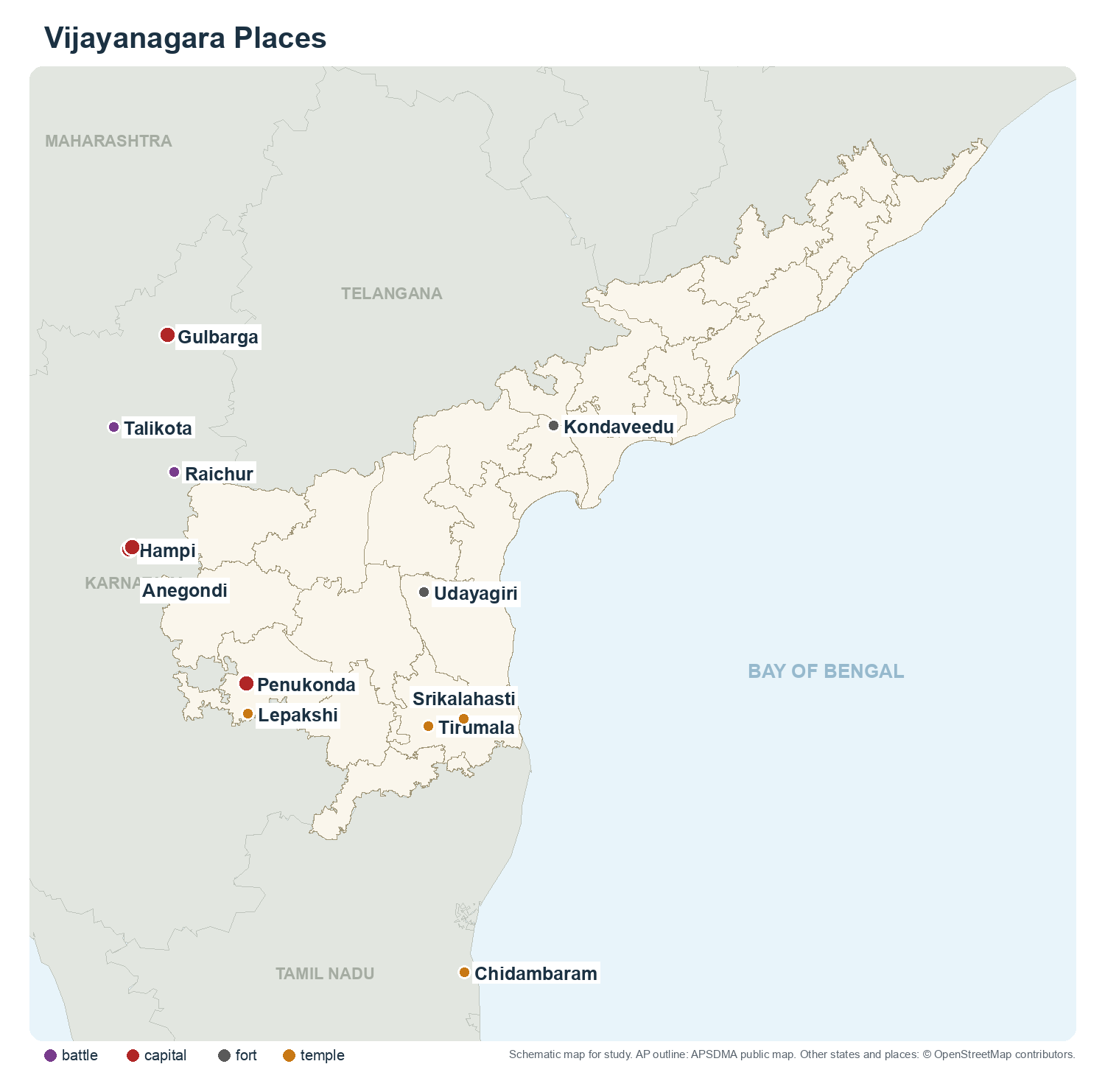
The early capital was Anegondi, and the later capital was Hampi, both in Karnataka. Hampi was listed as a World Heritage Site in 1986. The Tungabhadra River flows by the city.
Two systems of rule are named:
- Nayankara system: military land grants to chiefs.
- Ayagar system: village administration.
2. The four dynasties
| Dynasty | Founder | Starts |
|---|---|---|
| Sangama | Harihara I | 1336 |
| Saluva | Saluva Narasimha | 1485 |
| Tuluva | Vira Narasimha | 1505 |
| Aravidu | Tirumala Raya | 1570 |
Sangama rulers. Harihara I was followed by Bukka Raya I. Bukka Raya I was followed by Harihara II. Deva Raya II came to the throne in 1424. His epithet was Gajabetekara (the elephant hunter). He was followed by Mallikarjuna Raya.
Tuluva rulers. Vira Narasimha was followed by Krishnadevaraya. Krishnadevaraya was followed by Achyuta Raya in 1529. Sadasiva Raya took the throne in 1542.
Aravidu rulers. Tirumala Raya was followed by Sriranga I. Then came Venkata II, followed by Sriranga II.
3. Krishnadevaraya (1509-1529)
He was crowned in 1509. His epithets are Andhra Bhoja and Kannada Rajya Rama Ramana. His father is Tuluva Narasa Nayaka (of the Tuluva line).
| Year | Event |
|---|---|
| 1509 | Coronation |
| 1510 | Portuguese capture Goa under Albuquerque (the same period) |
| 1514 | Capture of Udayagiri |
| 1515 | Capture of Kondaveedu |
| 1520 | Battle of Raichur |
| 1529 | Death; accession of Achyuta Raya |
Works and buildings.
- He wrote Amuktamalyada, a Prabandha on the life of Andal. He also wrote *Jambavati Kalyanam*.
- He built the Krishna Temple and Vittala Temple at Hampi, the Mahanavami Dibba, and the town of Nagalapuram.
- The Vittala Temple deity is Vishnu. The Stone Chariot at Hampi is linked with this temple area.
- Achyuta Raya built the Tiruvengalanatha Temple at Hampi.
- Virupanna and Viranna built the Veerabhadra Temple at Lepakshi (Anantapur area).
4. Fall of the empire
The Battle of Talikota was fought in 1565. Talikota is in Karnataka. The Vijayanagara army was led by Rama Raya, against the combined Deccan sultanates. The empire broke up after this defeat. The capital shifted to Penukonda (Andhra Pradesh).
The Aravidu dynasty was set up in 1570 under Tirumala Raya. The English received a grant of land at Madras in 1639, during the late Vijayanagara period.
5. Literature and the Ashtadiggajas
The court of Krishnadevaraya had eight great poets, the Ashtadiggajas.
| Poet | Work | Subject or form |
|---|---|---|
| Allasani Peddana | Manucharitra; Harikathasara Sudhanidhi | Story of Pravarakhya (Prabandha) |
| Nandi Timmana | Parijatapaharanam | Theft of the Parijata tree |
| Ramaraja Bhushana | Vasucharitra; Narasabhupaliyam | Story of King Vasu |
| Tenali Ramakrishna | Panduranga Mahatmyam | Glory of Pandharpur Vittala |
| Pingali Surana | Kalapurnodayam; Raghava Pandaviyam; Prabhavati Pradyumnam | Raghava Pandaviyam is a Dvyarthi kavya |
| Madayyagari Mallana | Rajasekhara Charitra | - |
| Dhurjati | Srikalahasti Mahatmyam | - |
| Ayyalaraju Ramabhadrudu | Ramabhyudayam; Sakalakathasara Sangrahamu | - |
Titles. Peddana: Andhra Kavita Pitamaha. Nandi Timmana: Mukku Timmana. Ramaraja Bhushana: Bhattumurthy. Tenali Ramakrishna: Vikatakavi. Annamacharya: Pada Kavita Pitamaha.
Other writers. *Varadambika Parinayam* by Tirumalamba deals with the marriage of Achyuta Raya. *Achyutarayabhyudayam* is by Rajanatha Dindima. *Madhura Vijayam* is by Gangadevi. Sayana wrote *Vedartha Prakasha*. Madhavacharya, known as Vidyaranya, wrote *Parashara Madhaviyam* and *Jivanmuktiviveka*. In Kannada, Kumara Vyasa wrote *Karnata Bharata Katha Manjari*, and Kanakadasa wrote *Mohanatarangini* and *Ramadhanya Charite*. Purandaradasa is called Karnataka Sangeeta Pitamaha.
Earlier Telugu poets also appear in this list: Srinatha (*Kasikhandam*, *Bhimakhandam*, *Sringara Naishadham*, *Palnati Veeracharitra*) and Bammera Potana (*Andhra Maha Bhagavatam*).
Do not mix these with Akbar's Navaratnas (Tansen, Birbal, Todar Mal, Abul Fazl, Faizi, Raja Man Singh). That is a different court and a different time.
6. Foreign travellers
| Traveller | Nationality | Year or note |
|---|---|---|
| Abdur Razzak | Persian | Visited in 1443 |
| Nicolo de Conti | Italian | - |
| Afanasy Nikitin | Russian | Visited the Bahmani kingdom (1469-72), not Vijayanagara |
| Domingo Paes | Portuguese | - |
| Fernao Nuniz | Portuguese | - |
| Duarte Barbosa | Portuguese | - |
7. Temples and places
| Place or temple | Deity or feature | State |
|---|---|---|
| Virupaksha Temple, Hampi | Shiva | Karnataka |
| Vittala Temple, Hampi | Vishnu | Karnataka |
| Hazara Rama Temple, Hampi | Rama | Karnataka |
| Lepakshi (Veerabhadra) | Hanging Pillar; Monolithic Nandi | Andhra Pradesh |
| Tirumala | Venkateswara | Andhra Pradesh |
| Srikalahasti | Kalahasteeswara | Andhra Pradesh |
| Ahobilam | Narasimha | Andhra Pradesh |
| Srisailam | Mallikarjuna | Andhra Pradesh |
| Chidambaram | Nataraja | Tamil Nadu |
| Rameswaram | Ramanathaswamy | Tamil Nadu |
Hampi also has the Lotus Mahal, the Elephant Stables, and Musical Pillars. The Mahanavami festival is linked with Vijayanagara.
Andhra forts and sites of the empire: Penukonda, Gooty, Chandragiri, Kondaveedu, Udayagiri, Tadipatri, Lepakshi. Raichur Fort is in Karnataka. Vellore and Gingee forts are in Tamil Nadu.
Exam traps
- 1. Founding 1336 (Vijayanagara) is not 1347 (Bahmani).
- 2. Founders: Sangama - Harihara I; Saluva - Saluva Narasimha; Tuluva - Vira Narasimha; Aravidu - Tirumala Raya.
- 3. Hampi is in Karnataka. Lepakshi and Penukonda are in Andhra Pradesh.
- 4. Udayagiri 1514, Kondaveedu 1515. Do not reverse.
- 5. Raichur 1520 and Talikota 1565 are different battles.
- 6. Peddana is Andhra Kavita Pitamaha. Annamacharya is Pada Kavita Pitamaha. Purandaradasa is Karnataka Sangeeta Pitamaha.
- 7. Deva Raya II is Gajabetekara; Krishnadevaraya is Andhra Bhoja.
- 8. Ashtadiggajas belong to Krishnadevaraya. Navaratnas belong to Akbar.
One-liners
- 1. Vijayanagara was founded in 1336 by Harihara I.
- 2. Anegondi was the early capital, Hampi the main capital, Penukonda the capital after Talikota.
- 3. Krishnadevaraya was crowned in 1509 and died in 1529.
- 4. He wrote Amuktamalyada, on the life of Andal.
- 5. Abdur Razzak, a Persian, visited in 1443.
- 6. Achyuta Raya built the Tiruvengalanatha Temple at Hampi.
- 7. Virupanna and Viranna built the Veerabhadra Temple at Lepakshi.
- 8. Allasani Peddana wrote Manucharitra.
- 9. Madhavacharya is also known as Vidyaranya.
- 10. The Aravidu dynasty began in 1570 with Tirumala Raya.
Background and context
The Vijayanagara Empire rose in the south of India in the 1330s. At that time the old kingdoms of the south were weak. The Hoysalas were in decline. The Kakatiyas had lost their power in the Telugu country. Raids from the north had shaken the region. In this gap, two brothers, Harihara I and Bukka Raya I, built a new state on the banks of the Tungabhadra river in 1336.
Historians do not agree on where the brothers came from. Some scholars hold that they were Kannada officers of the Hoysala army, stationed in the Tungabhadra region. Others hold that they were Telugu people from Kakatiya service who took control when the Hoysalas fell. Tradition links them with the saint Vidyaranya of the Sringeri monastery, who is said to have inspired them. How big his real role was remains uncertain. Treat the origin of the founders as a disputed point.
The early centre was Anegondi. Later the city of Vijayanagara, today called Hampi, became the main capital. It stands beside the Tungabhadra in Karnataka. Its ruins are now a World Heritage Site.
The empire had two big rivals. The first was the Bahmani Sultanate, founded in 1347, which later broke into five sultanates (Bijapur, Golconda, Ahmednagar, Bidar and Berar). The second was the Gajapati kingdom of Odisha, which pressed into the Telugu coast. Much of Vijayanagara history is the story of wars against these two powers and of the fight for the rich lands between the Krishna and the Tungabhadra, and for the Raichur doab.
Political history
The Sangama dynasty (1336-1485). Harihara I ruled from 1336 to about 1356. His brother Bukka Raya I followed, to about 1377. Then came Harihara II, Deva Raya I and, from 1424, Deva Raya II.
Deva Raya II was probably the most successful Sangama ruler. He put down rebel chiefs and strengthened the army. By about 1436 he had brought the Kondaveedu region and the Velama chiefs under control. His title Gajabetekara means "elephant hunter". After him the Sangama kings, Mallikarjuna Raya and Virupaksha Raya II, grew weak. Chiefs became restless and enemies raided the borders.
The Saluva dynasty (1485-1505). Virupaksha Raya II died in 1485, and his general Saluva Narasimha seized the throne, becoming the first of the Saluva line. He worked to recover territory the sultans had taken, and he kept hold of key ports and coastal districts. After his death in about 1491, the real power passed to his general Tuluva Narasa Nayaka. Narasa Nayaka ruled as regent for the young sons of Saluva Narasimha. He defended the empire against the Gajapati king and the Bahmani sultan, and he put down rebellious chiefs in the far south.
The Tuluva dynasty (1505-1570). The Tuluva line is dated from 1505 in the usual exam scheme. Vira Narasimha, son of Narasa Nayaka, ruled until 1509.
Krishnadevaraya (1509-1529). Krishnadevaraya was the half-brother of Vira Narasimha. His father was Tuluva Narasa Nayaka and his mother was Nagala Devi. He became king in 1509. His formal coronation took place in early 1510. Many books give 1509 as the coronation year, so be ready for both.
His first test came from the Deccan, where the Bahmani Sultan Mahmud Shah II and his nobles invaded and were beaten at Diwani in 1509. His next target was the Gajapatis. Udayagiri held out through a long siege and fell in 1514. The first assault on Kondaveedu did not succeed. In 1515 the fort fell, because his minister Timmarusu located a gate with few guards and the army entered through it in a night attack. He pushed on into Kalinga and forced the Gajapati king Prataparudra to make peace. The Krishna river became the frontier. Krishnadevaraya married a daughter of Prataparudra as part of the settlement.
His greatest Deccan success was the capture of Raichur fort, after a hard siege, on 19 May 1520, over Ismail Adil Shah of Bijapur. Afterwards the king advanced towards Bijapur and Gulbarga. Not every fight went his way: around 1513 he met a setback against Golconda at Pangal. From 1510 he also stayed on good terms with the Portuguese in Goa, who supplied horses and guns, and their engineers helped build water works.
In 1524 his young son and heir died, and the king suspected his minister Timmarusu. The minister was blinded. This is one of the sad events of the reign. Krishnadevaraya died on 17 October 1529, while preparing a campaign against Belgaum. The Mughal founder Babur wrote that the Vijayanagara raja was the most powerful of the Hindu rulers of India in territory and army.
After Krishnadevaraya. His brother Achyuta Raya took the throne in 1529. Sadasiva Raya became king in 1542, but he was a puppet. Power was held by Rama Raya, a leader of the Aravidu family. Rama Raya played the five Deccan sultanates against each other for about twenty years. His hard dealings with Kalyan and his insulting treatment of the sultans pushed them together. They made marriage alliances and formed a league.
Talikota (1565). The armies met on 23 January 1565 near Talikota, close to the Krishna river, in present Karnataka. The battle went well for Vijayanagara at first. Then two Muslim commanders in the Vijayanagara army changed sides. Rama Raya was captured and killed. His army broke and ran. The sultans' army entered Hampi and plundered it for months. The royal centre was never rebuilt.
The Aravidu dynasty (1570). Tirumala, a brother of Rama Raya, escaped with what was left of the army and treasure. He moved the seat of government to Penukonda. The Aravidu line is counted from 1570. Penukonda was the capital from 1565 to about 1592. Then the capital moved to Chandragiri (to about 1604) and later to Vellore. Sriranga I and Venkata II followed Tirumala. The empire shrank steadily under attacks from Bijapur and Golconda and from its own rebellious governors. The last remains of the empire ended in about 1646.
#### Rulers at a glance
| Dynasty | Ruler | Approximate reign |
|---|---|---|
| Sangama | Harihara I | 1336-1356 |
| Sangama | Bukka Raya I | 1356-1377 |
| Sangama | Deva Raya II | 1424-1446 |
| Saluva | Saluva Narasimha | 1485-1491 |
| Tuluva | Tuluva Narasa Nayaka (regent) | 1491-1503 |
| Tuluva | Vira Narasimha | 1503-1509 |
| Tuluva | Krishnadevaraya | 1509-1529 |
| Tuluva | Achyuta Raya | 1529-1542 |
| Tuluva | Sadasiva Raya | 1542-1570 |
| Aravidu | Tirumala | 1565-1572 |
| Aravidu | Sriranga I | 1572-1586 |
| Aravidu | Venkata II | 1586-1614 |
Reign years differ a little between books. Exams usually ask for the dynasty start years (1336, 1485, 1505, 1570) and not for every reign.
Administration and economy
Government. The king was the head of the state. A council of ministers, led by a chief minister, helped him. The empire was divided into large provinces. Each was under a governor, often a prince or a trusted general. Below them were local officers. At the village level, rich landholders oversaw the accountants and watchmen. The palace itself had many departments.
The Nayankara system. The empire gave military chiefs, called Nayakas, the right to the revenue of a piece of land. This grant was called a nayankara. In return the Nayaka kept soldiers ready for the king and paid tribute. This was a strong way to raise an army without paying every soldier from the treasury. It also had a weakness. The Nayakas commanded their own troops, collected revenue and in time held their lands by heredity. After 1565 several of them became independent. Famous examples are the Nayakas of Madurai, Thanjavur and Gingee in Tamil Nadu and of Keladi in Karnataka.
Ayagar system. In the village, a group of hereditary village servants ran daily affairs, paid from a share of the village produce. This is the Ayagar system. Remember it as village administration.
Land and farming. Farming was the base of the economy. Cotton, sorghum, pulses, rice and sugarcane were grown. Betel leaf, areca nut and coconut were key cash crops. Spices such as pepper, cardamom and ginger came from the hills of the west. Rulers dug tanks and canals and built dams to bring new land under the plough. Krishnadevaraya made a large water system near the capital, with help from Portuguese skills.
Taxes. Land was taxed, and rates differed by use. Many small taxes existed, such as fees for cattle grazing, house taxes and fees paid at temples. Krishnadevaraya is said to have removed some harsh taxes, including a tax on marriage.
Trade. The empire had many ports on both coasts. These included Mangalore, Honavar, Bhatkal, Cannanore and, on the east coast, Machilipatnam. Ships from Arabia, Africa, China and Bengal came to them. Pepper, spices, cotton cloth and precious stones were sent out. Horses from Persia and Arabia were a major import because the kings needed cavalry. Control of horse trade explains why friendship with the Portuguese mattered.
Society, religion and culture
Religion. The kings supported many sects. The early rulers were devotees of Shiva, yet they gave grants to Vishnu temples. The boar (Varaha) of Vishnu was the royal emblem. Kings used the title that means protector of cows and Brahmins. Foreign visitors wrote that people of many faiths lived freely in the empire.
Temples. The Vijayanagara style joined different southern and central Indian temple traditions. It is known for tall gateways (gopuras), pillared halls and carved pillars. Krishnadevaraya rebuilt parts of the Virupaksha Temple at Hampi and built the Krishna and Vittala temples there. Achyuta Raya built the Tiruvengalanatha Temple at Hampi. The Hazara Rama Temple is another Hampi landmark. Krishnadevaraya greatly honoured the Venkateswara Temple at Tirumala. He is said to have visited it several times and gave rich gifts. Many inscriptions of his time record these gifts. He also gave land to Srisailam, Ahobilam, Chidambaram and other shrines.
Telugu literature. Krishnadevaraya was himself a scholar who knew Telugu, Kannada, Sanskrit and Tamil. His Telugu work Amuktamalyada tells the story of the Alvar saint Andal and her marriage to Vishnu at Srirangam. It also carries advice on government. It says that a king must rule with dharma in mind and look after farming and trade. He also wrote in Sanskrit.
His court is known for the Ashtadiggajas, "eight elephants" of poetry.
| Poet | Well-known work |
|---|---|
| Allasani Peddana | Manucharitra |
| Nandi Timmana | Parijatapaharanam |
| Madayyagari Mallana | Rajasekhara Charitra |
| Dhurjati | Srikalahasti Mahatmyam |
| Ayyalaraju Ramabhadrudu | Ramabhyudayam |
| Pingali Surana | Raghava Pandaviyam, Kalapurnodayam |
| Tenali Ramakrishna | Panduranga Mahatmyam |
| Ramarajabhushana | Vasucharitra |
Peddana is called Andhra Kavita Pitamaha. Nandi Timmana is Mukku Timmana. Ramarajabhushana is also called Bhattumurthy. Women also wrote: Molla made her own Telugu Ramayana, and Tirumalamba, a queen of Achyuta Raya, wrote Varadambika Parinayam.
Other languages. Kannada writers such as Kumara Vyasa and the saint-poet Kanakadasa flourished. Purandaradasa, a singer-saint who lived in Hampi in his last years, is called the father of Carnatic music. Vyasatirtha was a famous scholar and the royal guru. Sayana, who wrote on the Vedas, and Vidyaranya are linked with the early empire.
Visitors. Writers from abroad described the capital and the empire. They include Nicolo de Conti of Italy, Abdur Razzak of Persia (1443), Domingo Paes and Fernao Nuniz of Portugal, and Duarte Barbosa. They praised the wealth of the capital, its markets and the order kept by the king.
Decline, legacy and sites to know
The causes of decline were several. The kings depended on powerful Nayakas who became independent. The sultanates were united by Rama Raya's own actions. Gunpowder and artillery used by the sultans gave them an edge. The loss at Talikota, and the death of the commander, broke the army's confidence. After 1565 the empire became a smaller state in the south with its capital at Penukonda, Chandragiri and Vellore.
The legacy is long. Nayaka rulers of the south carried the style of Vijayanagara temples for another two centuries. The Telugu literary tradition of the age of Krishnadevaraya is called the golden age of Telugu poetry. The temple art and the ruins of Hampi remain a world heritage.
Sites in Andhra Pradesh.
| Site | What to know | Current district |
|---|---|---|
| Penukonda | Capital after Talikota until about 1592; old fort; also a Jain site | Sri Sathya Sai |
| Lepakshi | Veerabhadra Temple, one of the best Vijayanagara temples; large mural paintings; Hanging Pillar | Sri Sathya Sai |
| Udayagiri | Fort captured in 1514 | name the place only |
| Kondaveedu | Fort captured in 1515 | name the place only |
| Chandragiri | Capital of the late Aravidu period | name the place only |
| Tirumala | Venkateswara Temple, honoured by Krishnadevaraya | name the place only |
Hampi, Talikota and Raichur are in Karnataka, not in Andhra Pradesh. Lepakshi temple is traditionally credited to two brothers, Virupanna and Viranna, who served under the Vijayanagara kings.
How examiners use this chapter
- Dates in order. 1336 (Vijayanagara), 1347 (Bahmani), 1485 (Saluva), 1505 (Tuluva), 1509 (Krishnadevaraya), 1565 (Talikota), 1570 (Aravidu). Questions ask for an order or the "odd one out".
- Founders. Harihara I and Bukka, Saluva Narasimha, Vira Narasimha (Narasa Nayaka's family), Tirumala. The look-alike names Narasimha and Harihara cause errors.
- Krishnadevaraya pairs. Udayagiri 1514, Kondaveedu 1515, Raichur 1520. Epithet Andhra Bhoja. Work Amuktamalyada. Subject Andal. Raichur and Talikota are different battles.
- Ashtadiggajas and works. Match poet to work, and poet to title (Peddana and Andhra Kavita Pitamaha). Do not mix with Akbar's Navaratnas.
- Capitals. Anegondi, then Hampi, then Penukonda after Talikota. Hampi is in Karnataka, Penukonda in Andhra Pradesh.
- Administration terms. Nayankara means land grant for military service. Ayagar means village servants.
- Temples and builders. Achyuta Raya built the Tiruvengalanatha Temple at Hampi. Virupanna and Viranna are linked with Lepakshi. Do not confuse the Virupaksha Temple (Shiva, Hampi) with the name Virupanna.
- Travellers. Abdur Razzak (Persia, 1443), Paes and Nuniz (Portugal), Conti (Italy).
Worked cases
Case 1: Arrange the four dynasties of Vijayanagara in the order in which they began: Tuluva, Aravidu, Sangama, Saluva.
Reasoning:
- 1. Start with the founding of the empire itself. That is 1336, and the first dynasty is the one founded by Harihara I, the Sangama.
- 2. The remaining three have years 1485 (Saluva), 1505 (Tuluva) and 1570 (Aravidu).
- 3. Put the numbers in a line: 1336, 1485, 1505, 1570.
- 4. So the order is Sangama, Saluva, Tuluva, Aravidu.
Takeaway: When an option list gives dynasties, convert each to its start year and sort the numbers.
Case 2: Which of these is NOT one of the Ashtadiggajas: Pingali Surana, Dhurjati, Srinatha, Tenali Ramakrishna?
Reasoning:
- 1. Recall the eight: Peddana, Nandi Timmana, Ramaraja Bhushana, Tenali Ramakrishna, Pingali Surana, Madayyagari Mallana, Dhurjati and Ayyalaraju Ramabhadrudu.
- 2. Pingali Surana, Dhurjati and Tenali Ramakrishna are all in this list.
- 3. Srinatha wrote Kasikhandam, Bhimakhandam and Sringara Naishadham. He is an earlier Telugu poet, not one of the eight.
- 4. Eliminate the three that appear in the list.
Takeaway: In a "which is NOT" question, check each name against the full group and remove the ones that belong.
Case 3: Which of these places is NOT in Andhra Pradesh: Penukonda, Lepakshi, Talikota, Gooty Fort?
Reasoning:
- 1. Penukonda became the capital after Talikota, and it is in Andhra Pradesh.
- 2. Lepakshi, with its Veerabhadra Temple and Hanging Pillar, is in Andhra Pradesh.
- 3. Gooty Fort is also in Andhra Pradesh.
- 4. Talikota is in Karnataka. It is the place where the 1565 battle was fought.
Takeaway: Learn the battle site and the capital separately, because one is in Karnataka and the other is in Andhra Pradesh.
Case 4: Which event took place AFTER the death of Krishnadevaraya: Battle of Raichur, capture of Udayagiri, Battle of Talikota, capture of Kondaveedu?
Reasoning:
- 1. Krishnadevaraya died in 1529.
- 2. Udayagiri was captured in 1514 and Kondaveedu in 1515, so both are during his reign.
- 3. The Battle of Raichur was in 1520, also in his reign.
- 4. The Battle of Talikota was in 1565, many years later.
Takeaway: Fix the king's death year first, then compare every event year with it.
Compare and contrast
| Point | Vijayanagara Empire | Bahmani Kingdom | Gajapati dynasty | Reddi Kingdom |
|---|---|---|---|---|
| Founder | Harihara I | Alauddin Bahman Shah | Kapilendra Deva | Prolaya Vema Reddy |
| Capital | Hampi (early: Anegondi) | Gulbarga (early) | Cuttack | Addanki (later Kondaveedu) |
| Year given | 1336 | 1347 | - | - |
| Temple | Place | Deity or builder |
|---|---|---|
| Virupaksha Temple | Hampi | Deity Shiva |
| Vittala Temple | Hampi | Deity Vishnu; built by Krishnadevaraya |
| Hazara Rama Temple | Hampi | Deity Rama |
| Tiruvengalanatha Temple | Hampi | Built by Achyuta Raya |
| Veerabhadra Temple | Lepakshi | Built by Virupanna and Viranna |
Do not mix Virupaksha (a temple of Shiva) with Virupanna (a builder at Lepakshi).
How to use these tables: in an exam, first find the one fact you are sure of, such as a founder, a capital or a deity. Then remove every option that gives a different founder, capital or deity. Look-alike names are the usual trap. Harihara I and Harihara II share a name, and so do Vira Narasimha and Saluva Narasimha. Always attach the dynasty to the name. Also remember that the Vijayanagara capital Hampi and the Bahmani capital Gulbarga are both in Karnataka, but Penukonda, the later capital, is in Andhra Pradesh.
Sequence and timeline
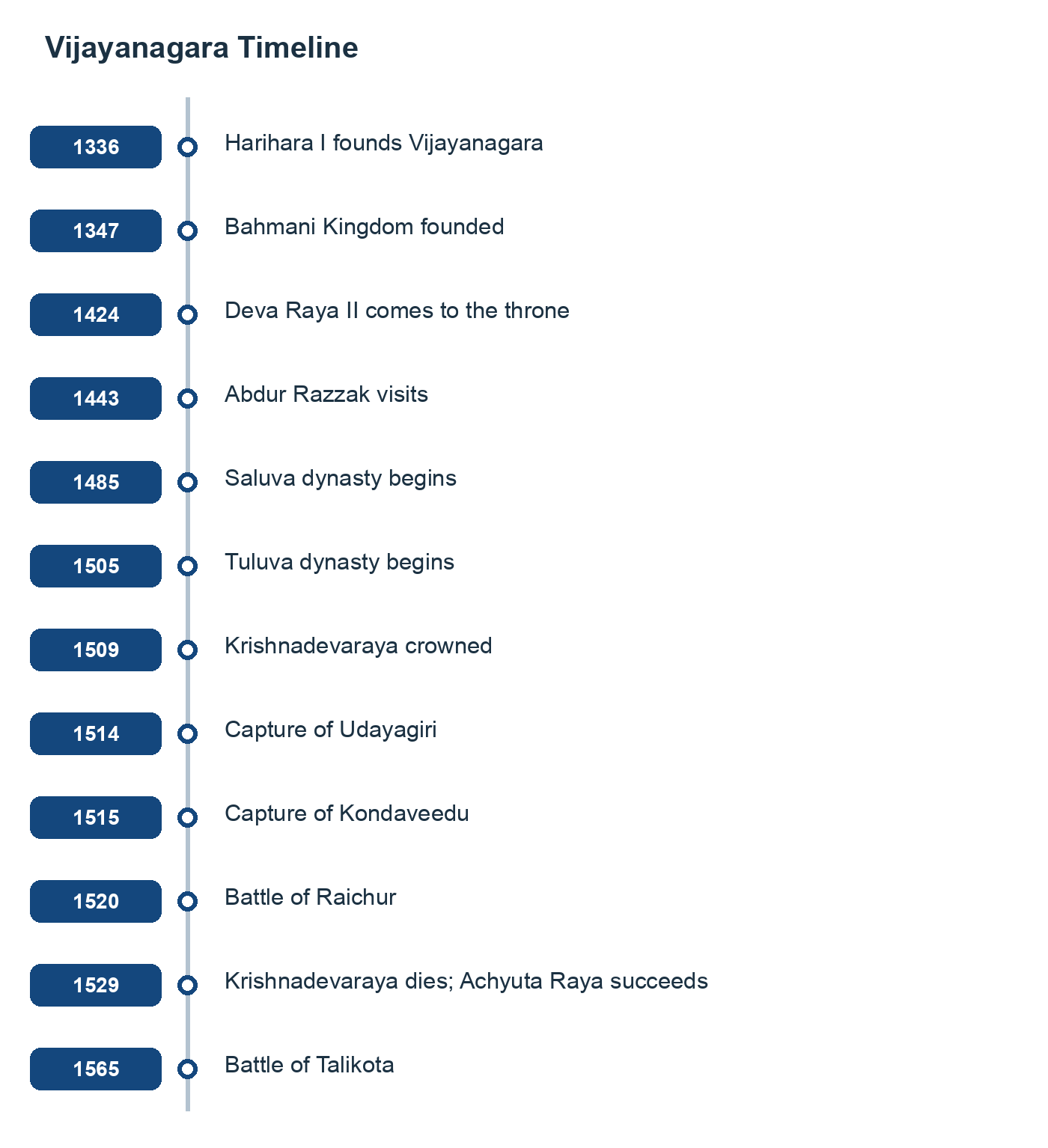
- 1. 1336 - Vijayanagara Empire founded.
- 2. 1347 - Bahmani Kingdom founded.
- 3. 1424 - Deva Raya II comes to the throne.
- 4. 1443 - Abdur Razzak visits.
- 5. 1485 - Saluva dynasty begins.
- 6. 1505 - Tuluva dynasty begins.
- 7. 1509 - Krishnadevaraya is crowned.
- 8. 1510 - Portuguese capture Goa.
- 9. 1514 - Udayagiri captured.
- 10. 1515 - Kondaveedu captured.
- 11. 1520 - Battle of Raichur.
- 12. 1529 - Krishnadevaraya dies; Achyuta Raya comes to the throne.
- 13. 1542 - Sadasiva Raya takes the throne.
- 14. 1565 - Battle of Talikota.
- 15. 1570 - Aravidu dynasty begins.
- 16. 1639 - English receive land at Madras.
More one-liners
- 1. The Adil Shahi sultanate of Bijapur was started in 1490.
- 2. The Nizam Shahi sultanate of Ahmednagar is also dated 1490.
- 3. The Qutb Shahi sultanate of Golconda was started in 1518.
- 4. Yusuf Adil Shah founded the Adil Shahi dynasty, with its capital at Bijapur.
- 5. Quli Qutb Shah founded the Qutb Shahi dynasty, with its capital at Golconda.
- 6. Malik Ahmad Nizam Shah founded the Nizam Shahi dynasty, with its capital at Ahmednagar.
- 7. Qasim Barid founded the Barid Shahi dynasty, with its capital at Bidar.
- 8. Kapilendra Deva founded the Gajapati dynasty of Odisha, with its capital at Cuttack.
- 9. Prolaya Vema Reddy founded the Reddi Kingdom, with its first capital at Addanki (later moved to Kondaveedu).
- 10. Srinatha is known as Kavi Sarvabhouma.
- 11. Bammera Potana is known as Sahaja Pandita.
- 12. Thanjavur, Madurai, Kanchipuram and Srirangam are in Tamil Nadu.
- 13. The Varadaraja Temple at Kanchipuram is a temple of Vishnu.
- 14. The Tungabhadra Dam is on the Tungabhadra River.
- 15. Almatti Dam and Srisailam Dam are both on the Krishna River.
Practice questions
Which brothers, officials under the Vijayanagara king, are credited with building the Lepakshi temple?
- Narasa Nayaka and Vira Narasimha
- Peddana and Timmana
- Harihara and Bukka
- Virupanna and Viranna
Answer
D. Virupanna and Viranna
Virupanna and Viranna built it in the Achyutadevaraya period.
లేపాక్షి ఆలయాన్ని నిర్మించినట్లు విజయనగర రాజు కొలువులోని ఏ సోదరులను చెబుతారు?
- నరస నాయకుడు, వీర నరసింహుడు
- పెద్దన, తిమ్మన
- హరిహర, బుక్కరాయలు
- విరూపన్న, వీరన్న
Who was the first ruler of the Vijayanagara Empire?
- Harihara I
- Alauddin Bahman Shah
- Malik Ahmad Nizam Shah
- Francisco de Almeida
Answer
A. Harihara I
విజయనగర సామ్రాజ్య తొలి పాలకుడు ఎవరు?
- హరిహర I
- అల్లావుద్దీన్ బహమన్ షా
- మాలిక్ అహ్మద్ నిజాం షా
- ఫ్రాన్సిస్కో డి అల్మీడా
Ayagar system deals with which of the following?
- village administration
- military land grants to chiefs
- glory of Pandharpur Vittala
- story of King Vasu
Answer
A. village administration
ఆయగార్ వ్యవస్థ దేనికి సంబంధించినది?
- గ్రామ పరిపాలన
- సేనానులకు భూమి మంజూరు
- పండరీపుర విఠలుని మహిమ
- వసురాజు కథ
Who is the author of Manucharitra, called Andhra Kavita Pitamaha?
- Dhurjati
- Nandi Timmana
- Tenali Ramakrishna
- Allasani Peddana
Answer
D. Allasani Peddana
Peddana wrote Manucharitra in Krishnadevaraya's court.
ఆంధ్ర కవితా పితామహుడిగా పిలిచే మనుచరిత్ర కర్త ఎవరు?
- ధూర్జటి
- నంది తిమ్మన
- తెనాలి రామకృష్ణుడు
- అల్లసాని పెద్దన
Which poet of Krishnadevaraya's court is called Andhra Kavita Pitamaha?
- Tenali Ramakrishna
- Allasani Peddana
- Dhurjati
- Nandi Timmana
Answer
B. Allasani Peddana
Peddana holds this title.
శ్రీకృష్ణదేవరాయల ఆస్థానంలో ఆంధ్ర కవితా పితామహుడు అని పిలిచే కవి ఎవరు?
- తెనాలి రామకృష్ణుడు
- అల్లసాని పెద్దన
- ధూర్జటి
- నంది తిమ్మన
Who bore the title Andhra Kavita Pitamaha and wrote Manucharitra?
- Allasani Peddana
- Nandi Timmana
- Dhurjati
- Tenali Ramakrishna
Answer
A. Allasani Peddana
Peddana was Krishnadevaraya's foremost court poet.
ఆంధ్ర కవితా పితామహుడు అనే బిరుదు పొందిన, మనుచరిత్ర రచించినవారు ఎవరు?
- అల్లసాని పెద్దన
- నంది తిమ్మన
- ధూర్జటి
- తెనాలి రామకృష్ణుడు
Which of the following correctly describes Harihara I?
- first Sultan of Ahmednagar
- first ruler of the Aravidu dynasty
- first Sultan of Golconda
- first ruler of the Vijayanagara Empire
Answer
D. first ruler of the Vijayanagara Empire
'హరిహర I' గురించిన సరైన వివరణ ఈ క్రింది వాటిలో ఏది?
- అహ్మద్నగర్ తొలి సుల్తాన్
- ఆరవీటి వంశ తొలి పాలకుడు
- గోల్కొండ తొలి సుల్తాన్
- విజయనగర సామ్రాజ్య తొలి పాలకుడు
Which of the following correctly describes Saluva Narasimha?
- first ruler of the Vijayanagara Empire
- first Sultan of Ahmednagar
- first ruler of the Saluva dynasty
- first Sultan of Bijapur
Answer
C. first ruler of the Saluva dynasty
'సాళువ నరసింహ' గురించిన సరైన వివరణ ఈ క్రింది వాటిలో ఏది?
- విజయనగర సామ్రాజ్య తొలి పాలకుడు
- అహ్మద్నగర్ తొలి సుల్తాన్
- సాళువ వంశ తొలి పాలకుడు
- బీజాపూర్ తొలి సుల్తాన్
Which of the following correctly describes Tirumala Raya?
- first ruler of the Aravidu dynasty
- first Sultan of the Bahmani Kingdom
- first Sultan of Golconda
- first Sultan of Bijapur
Answer
A. first ruler of the Aravidu dynasty
'తిరుమల రాయలు' గురించిన సరైన వివరణ ఈ క్రింది వాటిలో ఏది?
- ఆరవీటి వంశ తొలి పాలకుడు
- బహమనీ రాజ్య తొలి సుల్తాన్
- గోల్కొండ తొలి సుల్తాన్
- బీజాపూర్ తొలి సుల్తాన్
Nayankara system deals with which of the following?
- story of King Vasu
- life of Andal
- glory of Pandharpur Vittala
- military land grants to chiefs
Answer
D. military land grants to chiefs
నాయంకర వ్యవస్థ దేనికి సంబంధించినది?
- వసురాజు కథ
- ఆండాళ్ జీవితం
- పండరీపుర విఠలుని మహిమ
- సేనానులకు భూమి మంజూరు
Match the dynasty with its founder: (1) Sangama (2) Saluva (3) Tuluva (4) Aravidu (a) Tirumala Raya (b) Harihara I (c) Narasa Nayaka (d) Saluva Narasimha
- 1-b, 2-d, 3-a, 4-c
- 1-b, 2-d, 3-c, 4-a
- 1-d, 2-b, 3-c, 4-a
- 1-b, 2-c, 3-d, 4-a
Answer
B. 1-b, 2-d, 3-c, 4-a
Harihara I, Saluva Narasimha, Narasa Nayaka and Tirumala Raya founded the four dynasties in order.
వంశాన్ని దాని స్థాపకుడితో జతపరచండి: (1) సంగమ (2) సాళువ (3) తుళువ (4) అరవీటి (a) తిరుమలరాయలు (b) మొదటి హరిహరరాయలు (c) నరస నాయకుడు (d) సాళువ నరసింహుడు
- 1-b, 2-d, 3-a, 4-c
- 1-b, 2-d, 3-c, 4-a
- 1-d, 2-b, 3-c, 4-a
- 1-b, 2-c, 3-d, 4-a
The Vijayanagara Empire, founded in 1336, was established by:
- Krishnadevaraya and Achyutaraya
- Deva Raya I and Deva Raya II
- Narasimha Saluva and Tuluva Narasa
- Harihara I and Bukka I
Answer
D. Harihara I and Bukka I
The brothers Harihara and Bukka of the Sangama family founded the empire on the Tungabhadra.
1336లో స్థాపించబడిన విజయనగర సామ్రాజ్య స్థాపకులు ఎవరు?
- కృష్ణదేవరాయలు, అచ్యుతరాయలు
- మొదటి దేవరాయలు, రెండవ దేవరాయలు
- సాళువ నరసింహుడు, తుళువ నరస నాయకుడు
- మొదటి హరిహరుడు, మొదటి బుక్కరాయలు
Who is the author of the Telugu prabandha Amuktamalyada?
- Allasani Peddana
- Tenali Ramakrishna
- Nandi Timmana
- Krishnadevaraya
Answer
D. Krishnadevaraya
Krishnadevaraya himself composed Amuktamalyada.
ఆముక్తమాల్యద అనే తెలుగు ప్రబంధాన్ని రచించినవారు ఎవరు?
- అల్లసాని పెద్దన
- తెనాలి రామకృష్ణుడు
- నంది తిమ్మన
- శ్రీకృష్ణదేవరాయలు
Which of the following correctly describes Alauddin Bahman Shah?
- first Sultan of the Bahmani Sultanate
- first Muslim ruler to compile a Urdu Diwan in the Deccan
- first Indian state to accept the Subsidiary Alliance
- first Nizam Shahi ruler
Answer
A. first Sultan of the Bahmani Sultanate
'అల్లావుద్దీన్ బహమన్ షా' గురించిన సరైన వివరణ ఈ క్రింది వాటిలో ఏది?
- బహమనీ సుల్తానేట్ మొదటి సుల్తాన్
- దక్కన్లో ఉర్దూ దివాన్ రచించిన మొదటి సుల్తాన్
- సైన్య సహాయ ఒప్పందాన్ని అంగీకరించిన మొదటి రాజ్యం
- మొదటి నిజాం షాహీ పాలకుడు
Who was the first Nizam Shahi ruler?
- Muhammad Quli Qutb Shah
- Malik Ahmad
- Yusuf Adil Shah
- Alauddin Bahman Shah
Answer
B. Malik Ahmad
మొదటి నిజాం షాహీ పాలకుడు ఎవరు?
- ముహమ్మద్ కులీ కుతుబ్ షా
- మాలిక్ అహ్మద్
- యూసుఫ్ ఆదిల్ షా
- అల్లావుద్దీన్ బహమన్ షా
Which provision deals with military land grants to chiefs?
- Nayankara system
- Parijatapaharanam
- Varadambika Parinayam
- Ayagar system
Answer
A. Nayankara system
సేనానులకు భూమి మంజూరు గురించి తెలిపే నిబంధన ఏది?
- నాయంకర వ్యవస్థ
- పారిజాతాపహరణం
- వరదాంబికా పరిణయం
- ఆయగార్ వ్యవస్థ
Who composed the Telugu poem Panduranga Mahatmyam?
- Nandi Timmana
- Dhurjati
- Allasani Peddana
- Tenali Ramakrishna
Answer
D. Tenali Ramakrishna
Tenali Ramakrishna wrote it in the Vijayanagara period.
తెలుగు కావ్యం పాండురంగ మాహాత్మ్యం రచయిత ఎవరు?
- నంది తిమ్మన
- ధూర్జటి
- అల్లసాని పెద్దన
- తెనాలి రామకృష్ణుడు
Who among the Ashtadiggajas wrote Parijatapaharanam?
- Madayyagari Mallana
- Nandi Timmana
- Dhurjati
- Ayyalaraju Ramabhadrudu
Answer
B. Nandi Timmana
Nandi Timmana composed Parijatapaharanam.
అష్టదిగ్గజాలలో పారిజాతాపహరణాన్ని రచించినవారు ఎవరు?
- మాదయగారి మల్లన
- నంది తిమ్మన
- ధూర్జటి
- అయ్యలరాజు రామభద్రుడు
Which Ashtadiggaja wrote Rajasekhara Charitra?
- Nandi Timmana
- Dhurjati
- Pingali Surana
- Madayyagari Mallana
Answer
D. Madayyagari Mallana
Madayyagari Mallana is its author.
రాజశేఖర చరిత్రను రచించిన అష్టదిగ్గజ కవి ఎవరు?
- నంది తిమ్మన
- ధూర్జటి
- పింగళి సూరన
- మాదయగారి మల్లన
Which Hampi monument is famed for its musical pillars?
- Lotus Mahal
- Hazara Rama temple
- Vittala temple
- Virupaksha temple
Answer
C. Vittala temple
The Vittala temple's pillars produce musical notes.
సంగీత స్తంభాలకు ప్రసిద్ధి చెందిన హంపిలోని కట్టడం ఏది?
- లోటస్ మహల్
- హజార రామాలయం
- విఠల ఆలయం
- విరూపాక్ష ఆలయం
Which Ashtadiggaja wrote Kalapurnodayam, a noted original Telugu kavya?
- Pingali Surana
- Tenali Ramakrishna
- Nandi Timmana
- Dhurjati
Answer
A. Pingali Surana
Pingali Surana composed Kalapurnodayam.
ప్రముఖ స్వతంత్ర తెలుగు కావ్యమైన కళాపూర్ణోదయాన్ని రచించిన అష్టదిగ్గజ కవి ఎవరు?
- పింగళి సూరన
- తెనాలి రామకృష్ణుడు
- నంది తిమ్మన
- ధూర్జటి
Panduranga Mahatmyam, one of the notable Telugu kavyas of the Vijayanagara age, was composed by:
- Tenali Ramakrishna
- Dhurjati
- Pingali Surana
- Ramarajabhushanudu
Answer
A. Tenali Ramakrishna
Tenali Ramakrishna wrote Panduranga Mahatmyam.
విజయనగర యుగపు ప్రసిద్ధ తెలుగు కావ్యాలలో ఒకటైన పాండురంగ మాహాత్మ్యాన్ని రచించినవారు:
- తెనాలి రామకృష్ణుడు
- ధూర్జటి
- పింగళి సూరన
- రామరాజభూషణుడు
Which Vijayanagara king, freed by Krishnadevaraya from Chandragiri prison, had his coronation first at Tirupati in A.D. 1530?
- Achyuta Raya
- Sriranga II
- Harihara I
- Devaraya I
Answer
A. Achyuta Raya
కృష్ణదేవరాయలు చంద్రగిరి కారాగారం నుంచి విడిపించగా, క్రీ.శ. 1530లో తిరుపతిలో మొదటగా పట్టాభిషేకం జరుపుకున్న విజయనగర రాజు ఎవరు?
- అచ్యుత రాయ
- శ్రీరంగ II
- హరిహర I
- దేవరాయ I
Which Vijayanagara emperor invaded the Gajapati kingdom in 1513 and brought Rajahmundry under subjection?
- Krishnadevaraya
- Harihara II
- Virupaksha II
- Sadasiva
Answer
A. Krishnadevaraya
1513లో గజపతి రాజ్యంపై దండెత్తి రాజమండ్రిని తన అధీనంలోకి తెచ్చుకున్న విజయనగర చక్రవర్తి ఎవరు?
- శ్రీకృష్ణదేవరాయలు
- రెండవ హరిహరరాయలు
- రెండవ విరూపాక్షుడు
- సదాశివరాయలు
Which Sangama ruler, formerly governor of Penukonda for several years, succeeded Mallikarjuna in AD 1465?
- Virupaksha II
- Krishnadevaraya
- Vira Narasimha
- Harihara I
Answer
A. Virupaksha II
చాలా సంవత్సరాలు పెనుగొండ గవర్నర్గా ఉండి, క్రీ.శ. 1465లో మల్లికార్జునుని తరువాత సింహాసనమెక్కిన సంగమ పాలకుడు ఎవరు?
- రెండవ విరూపాక్షుడు
- శ్రీకృష్ణదేవరాయలు
- వీర నరసింహుడు
- మొదటి హరిహరరాయలు
Which son of Tirumala became ruler of the Telugu area with Penukonda as headquarters and later retreated to Chandragiri?
- Sadasiva
- Venkata II
- Sriranga I
- Achyuta Raya
Answer
C. Sriranga I
పెనుకొండను ప్రధాన కేంద్రంగా చేసుకుని తెలుగు ప్రాంతానికి పాలకుడై, తరువాత చంద్రగిరికి వెనుదిరిగిన తిరుమల కుమారుడు ఎవరు?
- సదాశివుడు
- రెండవ వెంకటుడు
- మొదటి శ్రీరంగుడు
- అచ్యుత రాయలు
Penukonda was the capital of which of the following?
- Rajendra I
- Malwa Sultanate
- Vijayanagara Empire after Talikota
- Suryavamsi Gajapati kingdom
Answer
C. Vijayanagara Empire after Talikota
పెనుకొండ ఈ క్రింది వాటిలో దేనికి రాజధాని?
- మొదటి రాజేంద్ర చోళుడు
- మాల్వా సుల్తానేట్
- తళ్లికోట తర్వాత విజయనగర సామ్రాజ్యం
- సూర్యవంశ గజపతి రాజ్యం
Consider the following pairs (Dynasty/State – Capital): (i) Brihatpalayanas – Kudura (ii) Early Bahmani Kingdom – Bidar (iii) Barid Shahi dynasty – Gulbarga Which of the pairs are correctly matched?
- Only (i)
- None of them
- Only (i) and (ii)
- Only (i) and (iii)
Answer
A. Only (i)
ఈ క్రింది జతలను పరిశీలించండి (రాజవంశం/రాష్ట్రం – రాజధాని): (i) బృహత్పలాయనులు – కూడూరు (ii) తొలి బహమనీ రాజ్యం – బీదర్ (iii) బరీద్ షాహీ వంశం – గుల్బర్గా సరిగ్గా జతపరచబడినవి ఏవి?
- (i) మాత్రమే
- ఏదీ కాదు
- (i), (ii) మాత్రమే
- (i), (iii) మాత్రమే
Which of the following works was written by Madayyagari Mallana?
- Rajasekhara Charitra
- Jivanmuktiviveka
- Andhra Mahabhagavatamu
- Varadambika Parinayam
Answer
A. Rajasekhara Charitra
మాదయ్యగారి మల్లన రచించిన రచన ఏది?
- రాజశేఖర చరిత్ర
- జీవన్ముక్తి వివేకం
- ఆంధ్ర మహాభాగవతము
- వరదాంబికా పరిణయం
Who was the first ruler of the Saluva dynasty?
- Yusuf Adil Shah
- Quli Qutb Shah
- Saluva Narasimha
- Francisco de Almeida
Answer
C. Saluva Narasimha
సాళువ వంశ తొలి పాలకుడు ఎవరు?
- యూసుఫ్ ఆదిల్ షా
- కులీ కుతుబ్ షా
- సాళువ నరసింహ
- ఫ్రాన్సిస్కో డి అల్మీడా
Who was the first ruler of the Aravidu dynasty?
- Saluva Narasimha
- Harihara I
- Tirumala Raya
- Quli Qutb Shah
Answer
C. Tirumala Raya
ఆరవీటి వంశ తొలి పాలకుడు ఎవరు?
- సాళువ నరసింహ
- హరిహర I
- తిరుమల రాయలు
- కులీ కుతుబ్ షా
Who was the first Sultan of the Bahmani Sultanate?
- Alauddin Bahman Shah
- Gulbarga
- Yusuf Adil Shah
- Quli Qutb Mulk
Answer
A. Alauddin Bahman Shah
బహమనీ సుల్తానేట్ మొదటి సుల్తాన్ ఎవరు?
- అల్లావుద్దీన్ బహమన్ షా
- గుల్బర్గా
- యూసుఫ్ ఆదిల్ షా
- కులీ కుతుబ్ ముల్క్
Which provision deals with village administration?
- Manucharitra
- Vasucharitra
- Varadambika Parinayam
- Ayagar system
Answer
D. Ayagar system
గ్రామ పరిపాలన గురించి తెలిపే నిబంధన ఏది?
- మనుచరిత్ర
- వసుచరిత్ర
- వరదాంబికా పరిణయం
- ఆయగార్ వ్యవస్థ
Arrange the following in chronological order (earliest first): (i) Subsidiary Alliance between the Nizam and the British (ii) Founding of the Bahmani Sultanate (iii) First widow remarriage in Andhra at Rajahmundry (iv) Mughal grant of the Northern Circars to the English
- (iii), (i), (iv), (ii)
- (ii), (iv), (i), (iii)
- (iii), (i), (ii), (iv)
- (iv), (ii), (i), (iii)
Answer
B. (ii), (iv), (i), (iii)
ఈ క్రింది వాటిని కాలక్రమానుసారం (పూర్వం నుండి తరువాతి వరకు) అమర్చండి: (i) నిజాం, బ్రిటిష్ వారి మధ్య సైన్య సహాయ ఒప్పందం (ii) బహమనీ సుల్తానేట్ స్థాపన (iii) రాజమహేంద్రవరంలో ఆంధ్రలో మొదటి వితంతు వివాహం (iv) ఉత్తర సర్కార్లను ఆంగ్లేయులకు మొఘల్ ఫర్మానా
- (iii), (i), (iv), (ii)
- (ii), (iv), (i), (iii)
- (iii), (i), (ii), (iv)
- (iv), (ii), (i), (iii)
Arrange the following in chronological order (earliest first): (i) Palnadu Forest Satyagraha (ii) Accession of Rudrama Devi (iii) Grant of land at Madras to the British (iv) Founding of the Bahmani Sultanate
- (ii), (i), (iv), (iii)
- (ii), (iv), (iii), (i)
- (i), (iii), (iv), (ii)
- (ii), (iii), (iv), (i)
Answer
B. (ii), (iv), (iii), (i)
ఈ క్రింది వాటిని కాలక్రమానుసారం (పూర్వం నుండి తరువాతి వరకు) అమర్చండి: (i) పల్నాడు అటవీ సత్యాగ్రహం (ii) రుద్రమదేవి పట్టాభిషేకం (iii) మద్రాసులో బ్రిటిష్ వారికి భూమి మంజూరు (iv) బహమనీ సుల్తానేట్ స్థాపన
- (ii), (i), (iv), (iii)
- (ii), (iv), (iii), (i)
- (i), (iii), (iv), (ii)
- (ii), (iii), (iv), (i)
Consider the following pairs (Monument – Builder): (i) Gulbarga Fort – Alauddin Bahman Shah (ii) Gangaikondacholapuram Temple – Rajendra I (iii) Veerabhadra Temple at Lepakshi – Virupanna and Viranna Which of the pairs are correctly matched?
- Only (i) and (iii)
- All of (i), (ii) and (iii)
- Only (ii) and (iii)
- Only (i) and (ii)
Answer
B. All of (i), (ii) and (iii)
ఈ క్రింది జతలను పరిశీలించండి (కట్టడం – నిర్మాత): (i) గుల్బర్గా కోట – అల్లావుద్దీన్ బహమన్ షా (ii) గంగైకొండచోళపురం ఆలయం – మొదటి రాజేంద్ర చోళుడు (iii) లేపాక్షిలోని వీరభద్ర ఆలయం – విరూపన్న మరియు వీరన్న సరిగ్గా జతపరచబడినవి ఏవి?
- (i), (iii) మాత్రమే
- (i), (ii), (iii) అన్నీ
- (ii), (iii) మాత్రమే
- (i), (ii) మాత్రమే
Arrange the following in chronological order (earliest first): (i) Founding of the Vijayanagara Empire (ii) Tagore translating Jana Gana Mana at Madanapalle (iii) Construction of Ramappa Temple (iv) Establishment of the Saluva dynasty
- (iii), (iv), (ii), (i)
- (iv), (iii), (i), (ii)
- (iii), (ii), (i), (iv)
- (iii), (i), (iv), (ii)
Answer
D. (iii), (i), (iv), (ii)
ఈ క్రింది వాటిని కాలక్రమానుసారం (పూర్వం నుండి తరువాతి వరకు) అమర్చండి: (i) విజయనగర సామ్రాజ్య స్థాపన (ii) మదనపల్లెలో జన గణ మన అనువాదం (iii) రామప్ప దేవాలయ నిర్మాణం (iv) సాళువ వంశ స్థాపన
- (iii), (iv), (ii), (i)
- (iv), (iii), (i), (ii)
- (iii), (ii), (i), (iv)
- (iii), (i), (iv), (ii)
Which poet is NOT counted among the Ashtadiggajas of Krishnadevaraya's court?
- Madayyagari Mallana
- Potana
- Nandi Timmana
- Dhurjati
Answer
B. Potana
Potana belonged to an earlier century.
కృష్ణదేవరాయల ఆస్థానంలోని అష్టదిగ్గజాలలో లేని కవి ఎవరు?
- మాదయ్యగారి మల్లన
- పోతన
- నంది తిమ్మన
- ధూర్జటి
Who authored the prabandha Parijatapaharanam?
- Pingali Surana
- Ramarajabhushanudu
- Ayyalaraju Ramabhadrudu
- Nandi Timmana
Answer
D. Nandi Timmana
Timmana is known as Mukku Timmana.
పారిజాతాపహరణం ప్రబంధాన్ని రచించినవారు ఎవరు?
- పింగళి సూరన
- రామరాజభూషణుడు
- అయ్యలరాజు రామభద్రుడు
- నంది తిమ్మన
The Veerabhadra temple at Lepakshi was built in the reign of Achyutaraya by the brothers:
- Virupanna and Viranna
- Gopanna and Akkanna
- Timmarusu and Mallana
- Peddana and Timmana
Answer
A. Virupanna and Viranna
The temple is known for its hanging pillar.
అచ్యుతరాయల కాలంలో లేపాక్షి వీరభద్ర ఆలయాన్ని నిర్మించిన సోదరులు ఎవరు?
- విరూపన్న, వీరన్న
- గోపన్న, అక్కన్న
- తిమ్మరుసు, మల్లన
- పెద్దన, తిమ్మన
Gulbarga and Bidar, the Bahmani capitals, are in which present-day state?
- Maharashtra
- Andhra Pradesh
- Karnataka
- Telangana
Answer
C. Karnataka
Both cities lie in northern Karnataka.
బహమనీ రాజధానులు గుల్బర్గా, బీదర్ ప్రస్తుత ఏ రాష్ట్రంలో ఉన్నాయి?
- మహారాష్ట్ర
- ఆంధ్రప్రదేశ్
- కర్ణాటక
- తెలంగాణ
Who founded the Vijayanagara Empire in 1336?
- Tirumala Raya
- Harihara I and Bukka I
- Saluva Narasimha
- Krishnadevaraya
Answer
B. Harihara I and Bukka I
The brothers Harihara I and Bukka I established the empire in 1336.
1336లో విజయనగర సామ్రాజ్యాన్ని స్థాపించినవారు ఎవరు?
- తిరుమలరాయలు
- మొదటి హరిహరరాయలు, మొదటి బుక్కరాయలు
- సాళువ నరసింహుడు
- శ్రీకృష్ణదేవరాయలు
Which was the first dynasty to rule the Vijayanagara Empire?
- Tuluva
- Saluva
- Aravidu
- Sangama
Answer
D. Sangama
The Sangama dynasty of Harihara and Bukka ruled first.
విజయనగర సామ్రాజ్యాన్ని మొదట పాలించిన వంశం ఏది?
- తుళువ
- సాళువ
- అరవీటి
- సంగమ
Which title is associated with Praudha Devaraya (Devaraya II) of the Sangama dynasty?
- Andhra Kavita Pitamaha
- Sahiti Samarangana Sarvabhouma
- Gajabetekara
- Andhra Bhoja
Answer
C. Gajabetekara
Devaraya II was known as Gajabetekara, the elephant hunter.
సంగమ వంశానికి చెందిన ప్రౌఢ దేవరాయలు (రెండవ దేవరాయలు)తో ముడిపడిన బిరుదు ఏది?
- ఆంధ్ర కవితా పితామహుడు
- సాహితీ సమరాంగణ సార్వభౌముడు
- గజబెంటెకారుడు
- ఆంధ్ర భోజుడు
The Sangama dynasty is named after Sangama, who was the:
- Commander at Talikota
- Court poet of Krishnadevaraya
- Father of Harihara I and Bukka I
- Confluence of rivers near Hampi
Answer
C. Father of Harihara I and Bukka I
Sangama was the father of the founding brothers.
సంగమ వంశానికి పేరు తెచ్చిన సంగముడు ఎవరు?
- తళ్ళికోట వద్ద సేనాని
- శ్రీకృష్ణదేవరాయల ఆస్థాన కవి
- మొదటి హరిహరరాయలు, బుక్కరాయల తండ్రి
- హంపి సమీపంలోని నదుల సంగమం
Practice set 2
Which one is NOT a Vijayanagara-period monument?
- Veerabhadra temple, Lepakshi
- Thousand Pillar Temple, Hanamkonda
- Virupaksha temple, Hampi
- Vittala temple, Hampi
Answer
B. Thousand Pillar Temple, Hanamkonda
The Thousand Pillar Temple is a Kakatiya work.
వీటిలో విజయనగర కాలపు కట్టడం కానిది ఏది?
- వీరభద్ర ఆలయం, లేపాక్షి
- వేయి స్తంభాల గుడి, హన్మకొండ
- విరూపాక్ష ఆలయం, హంపి
- విఠల ఆలయం, హంపి
After Talikota, the Aravidu rulers first shifted their capital from Hampi to:
- Vellore
- Anegondi
- Penugonda
- Chandragiri
Answer
C. Penugonda
Penugonda became the new capital.
తళ్ళికోట తర్వాత అరవీటి రాజులు రాజధానిని హంపి నుండి మొదట ఎక్కడికి మార్చారు?
- వేలూరు
- ఆనెగొంది
- పెనుగొండ
- చంద్రగిరి
Which kingdoms emerged in the Tamil country from former Vijayanagara governors (Nayaks)?
- Madurai, Thanjavur and Gingee
- Bijapur, Golconda and Ahmednagar
- Kalinga, Vengi and Kondapalli
- Kadamba, Hoysala and Yadava
Answer
A. Madurai, Thanjavur and Gingee
Nayaks of Madurai, Thanjavur and Gingee became independent.
విజయనగర పూర్వ పాలకులైన నాయకుల నుండి తమిళ ప్రాంతంలో ఏర్పడిన రాజ్యాలు ఏవి?
- మధుర, తంజావూరు, జింజి
- బీజాపూర్, గోల్కొండ, అహ్మద్నగర్
- కళింగ, వేంగి, కొండపల్లి
- కదంబ, హొయసల, యాదవ
Who was the first foreign traveller to visit Vijayanagara during Harihara I's time?
- Nicolo Conti
- Abdur Razzaq
- Ibn Battuta
- Domingo Paes
Answer
C. Ibn Battuta
Ibn Battuta of Morocco visited.
1వ హరిహరరాయల కాలంలో విజయనగరాన్ని సందర్శించిన తొలి విదేశీయాత్రికుడు ఎవరు?
- నికోలో కంటి
- అబ్దుల్ రజాక్
- ఇబన్ బటూటా
- డొమింగో పేస్
Which kingdom was established after the founding of Vijayanagara?
- Bahmani kingdom
- Golconda kingdom
- Ahmednagar
- Bijapur
Answer
A. Bahmani kingdom
Bahmani kingdom arose after Vijayanagara.
విజయనగర స్థాపన తరువాత ఏ రాజ్యం స్థాపించబడింది?
- బహమనీ రాజ్యం
- గోల్కొండ రాజ్యం
- అహ్మద్నగర్
- బీజాపూర్
A giant monolithic Nandi from the Vijayanagara period stands at which place?
- Penukonda
- Gooty
- Lepakshi
- Chandragiri
Answer
C. Lepakshi
The huge Nandi near the Veerabhadra temple is at Lepakshi.
విజయనగర కాలానికి చెందిన భారీ ఏకశిలా నంది విగ్రహం ఎక్కడ ఉంది?
- పెనుకొండ
- గుత్తి
- లేపాక్షి
- చంద్రగిరి
Which was the fourth dynasty of the Vijayanagara empire, which began with Tirumala?
- Tuluva dynasty
- Gajapatis
- Aravidu
- Saluva dynasty
Answer
C. Aravidu
తిరుమలతో ప్రారంభమైన విజయనగర సామ్రాజ్యపు నాల్గవ వంశం ఏది?
- తుళువ వంశం
- గజపతులు
- ఆరవీడు
- సాళువ వంశం
Which was the first dynasty of the Vijayanagar empire?
- Aravidu
- Saluva
- Tuluva
- Sangama dynasty
Answer
D. Sangama dynasty
విజయనగర సామ్రాజ్యంలో మొదటి రాజవంశం ఏది?
- అరవీడు
- సాళువ
- తుళువ
- సంగమ వంశం
Consider the following pairs (Dynasty/State – Capital): (i) Western Chalukyas of Kalyani – Kalyani (ii) Barid Shahi dynasty – Bidar (iii) Gajapati dynasty of Odisha – Cuttack Which of the pairs are correctly matched?
- Only (i) and (iii)
- All of (i), (ii) and (iii)
- Only (ii) and (iii)
- Only (iii)
Answer
B. All of (i), (ii) and (iii)
ఈ క్రింది జతలను పరిశీలించండి (రాజవంశం/రాష్ట్రం – రాజధాని): (i) కళ్యాణి పశ్చిమ చాళుక్యులు – కళ్యాణి (ii) బరీద్ షాహీ వంశం – బీదర్ (iii) ఒడిశా గజపతి వంశం – కటక్ సరిగ్గా జతపరచబడినవి ఏవి?
- (i), (iii) మాత్రమే
- (i), (ii), (iii) అన్నీ
- (ii), (iii) మాత్రమే
- (iii) మాత్రమే
Consider the following pairs (Work – Author): (i) Yayati Charitra – Ponnaganti Telaganarya (ii) Karnata Bharata Katha Manjari – Kumara Vyasa (iii) The Tragedy of the Commons – Garrett Hardin Which of the pairs are correctly matched?
- Only (iii)
- Only (i) and (iii)
- Only (ii)
- All of (i), (ii) and (iii)
Answer
D. All of (i), (ii) and (iii)
ఈ క్రింది జతలను పరిశీలించండి (రచన – రచయిత): (i) యయాతి చరిత్ర – పొన్నగంటి తెలగనార్యుడు (ii) కర్ణాట భారత కథా మంజరి – కుమార వ్యాసుడు (iii) ద ట్రాజెడీ ఆఫ్ ద కామన్స్ – గారెట్ హార్డిన్ సరిగ్గా జతపరచబడినవి ఏవి?
- (iii) మాత్రమే
- (i), (iii) మాత్రమే
- (ii) మాత్రమే
- (i), (ii), (iii) అన్నీ
Which of the following correctly describes Yusuf Adil Shah?
- first Sultan of the Bahmani Sultanate
- first Qutb Shahi ruler
- first Bahmani capital
- first Adil Shahi ruler
Answer
D. first Adil Shahi ruler
'యూసుఫ్ ఆదిల్ షా' గురించిన సరైన వివరణ ఈ క్రింది వాటిలో ఏది?
- బహమనీ సుల్తానేట్ మొదటి సుల్తాన్
- మొదటి కుతుబ్ షాహీ పాలకుడు
- బహమనీ మొదటి రాజధాని
- మొదటి ఆదిల్ షాహీ పాలకుడు
Which of the following correctly describes Gulbarga?
- first Bahmani capital
- first Adil Shahi ruler
- first Sultan of the Bahmani Sultanate
- first Qutb Shahi ruler
Answer
A. first Bahmani capital
'గుల్బర్గా' గురించిన సరైన వివరణ ఈ క్రింది వాటిలో ఏది?
- బహమనీ మొదటి రాజధాని
- మొదటి ఆదిల్ షాహీ పాలకుడు
- బహమనీ సుల్తానేట్ మొదటి సుల్తాన్
- మొదటి కుతుబ్ షాహీ పాలకుడు
Consider the following pairs (Event – Year): (i) Death of Krishnadevaraya – 1529 (ii) Establishment of the Reddi kingdom – 1325 (iii) Abolition of the Legislative Council in Andhra Pradesh – 1985 Which of the pairs are correctly matched?
- Only (i) and (iii)
- Only (ii)
- All of (i), (ii) and (iii)
- None of them
Answer
C. All of (i), (ii) and (iii)
ఈ క్రింది జతలను పరిశీలించండి (సంఘటన – సంవత్సరం): (i) కృష్ణదేవరాయల మరణం – 1529 (ii) రెడ్డి రాజ్య స్థాపన – 1325 (iii) ఆంధ్రప్రదేశ్లో శాసనమండలి రద్దు – 1985 సరిగ్గా జతపరచబడినవి ఏవి?
- (i), (iii) మాత్రమే
- (ii) మాత్రమే
- (i), (ii), (iii) అన్నీ
- ఏదీ కాదు
Who built Krishna Temple at Hampi?
- Baji Rao I
- Achyuta Raya
- Krishnadevaraya
- Virupanna and Viranna
Answer
C. Krishnadevaraya
హంపిలోని కృష్ణ ఆలయం నిర్మాత ఎవరు?
- మొదటి బాజీరావు
- అచ్యుత రాయలు
- శ్రీకృష్ణదేవరాయలు
- విరూపన్న మరియు వీరన్న
Which of the following was built by Achyuta Raya?
- Kailasa Temple
- Madurai Meenakshi Temple Gopurams
- Veerabhadra Temple at Lepakshi
- Tiruvengalanatha Temple at Hampi
Answer
D. Tiruvengalanatha Temple at Hampi
అచ్యుత రాయలు నిర్మించినది ఏది?
- కైలాస ఆలయం
- మదురై మీనాక్షి ఆలయ గోపురాలు
- లేపాక్షిలోని వీరభద్ర ఆలయం
- హంపిలోని తిరువేంగళనాథ ఆలయం
Who built Veerabhadra Temple at Lepakshi?
- Virupanna and Viranna
- Anapota Reddy
- Shah Jahan
- Krishna I
Answer
A. Virupanna and Viranna
లేపాక్షిలోని వీరభద్ర ఆలయం నిర్మాత ఎవరు?
- విరూపన్న మరియు వీరన్న
- అనపోతా రెడ్డి
- షాజహాన్
- మొదటి కృష్ణుడు
Consider the following pairs (Monument – Builder): (i) Krishna Temple at Hampi – Krishnadevaraya (ii) Gulbarga Fort – Qutb ud-din Aibak (iii) Adhai Din Ka Jhonpra – Alauddin Bahman Shah Which of the pairs are correctly matched?
- Only (i)
- Only (ii) and (iii)
- None of them
- Only (ii)
Answer
A. Only (i)
ఈ క్రింది జతలను పరిశీలించండి (కట్టడం – నిర్మాత): (i) హంపిలోని కృష్ణ ఆలయం – శ్రీకృష్ణదేవరాయలు (ii) గుల్బర్గా కోట – కుతుబుద్దీన్ ఐబక్ (iii) అఢాయ్ దిన్ కా ఝోంప్రా – అల్లావుద్దీన్ బహమన్ షా సరిగ్గా జతపరచబడినవి ఏవి?
- (i) మాత్రమే
- (ii), (iii) మాత్రమే
- ఏదీ కాదు
- (ii) మాత్రమే
Arrange the following in chronological order (earliest first): (i) Visit of Abdur Razzak to Vijayanagara (ii) Formation of Andhra Jana Sangham (iii) Liberation of Warangal by the Musunuri Nayakas (iv) Treaty of Mangalore
- (ii), (iii), (i), (iv)
- (iv), (ii), (i), (iii)
- (iii), (i), (iv), (ii)
- (i), (iv), (iii), (ii)
Answer
C. (iii), (i), (iv), (ii)
ఈ క్రింది వాటిని కాలక్రమానుసారం (పూర్వం నుండి తరువాతి వరకు) అమర్చండి: (i) అబ్దుర్ రజాక్ విజయనగర సందర్శన (ii) ఆంధ్ర జన సంఘం ఏర్పాటు (iii) ముసునూరి నాయకులచే వరంగల్ విముక్తి (iv) మంగళూరు ఒప్పందం
- (ii), (iii), (i), (iv)
- (iv), (ii), (i), (iii)
- (iii), (i), (iv), (ii)
- (i), (iv), (iii), (ii)
Consider the following pairs (Monument – Builder): (i) Veerabhadra Temple, Lepakshi – Narasimhavarman II (ii) Nagalapuram town – Krishnadevaraya (iii) Kailasanatha Temple, Kanchipuram – Virupanna Which of the pairs are correctly matched?
- Only (ii) and (iii)
- Only (i) and (ii)
- Only (i)
- Only (ii)
Answer
D. Only (ii)
ఈ క్రింది జతలను పరిశీలించండి (కట్టడం – నిర్మాత): (i) వీరభద్ర ఆలయం, లేపాక్షి – రెండవ నరసింహవర్మ (ii) నాగలాపురం పట్టణం – శ్రీకృష్ణదేవరాయలు (iii) కాంచీపురం కైలాసనాథ ఆలయం – విరూపన్న సరిగ్గా జతపరచబడినవి ఏవి?
- (ii), (iii) మాత్రమే
- (i), (ii) మాత్రమే
- (i) మాత్రమే
- (ii) మాత్రమే
Mahmud Gawan, the great minister of the Bahmani kingdom, served under which sultan?
- Muhammad Shah III
- Ahmad Shah I
- Alauddin Bahman Shah
- Firoz Shah
Answer
A. Muhammad Shah III
Gawan was a Persian noble who rose to prime minister.
బహమనీ రాజ్య గొప్ప మంత్రి మహమూద్ గవాన్ ఏ సుల్తాన్ క్రింద పనిచేశాడు?
- మూడో మహమ్మద్ షా
- మొదటి అహ్మద్ షా
- అలావుద్దీన్ బహమన్ షా
- ఫిరోజ్ షా
Consider the statements: (i) Krishnadevaraya captured Raichur in 1520. (ii) He conquered the forts of Udayagiri and Kondaveedu. (iii) He led the Vijayanagara army at the battle of Talikota. Which of the statements is/are correct?
- Only (i)
- (i) and (ii) only
- (ii) and (iii) only
- All (i), (ii) and (iii)
Answer
B. (i) and (ii) only
Talikota was fought in 1565, decades after he died in 1529.
కింది ప్రకటనలను పరిశీలించండి: (i) శ్రీకృష్ణదేవరాయలు 1520లో రాయచూరును జయించాడు. (ii) అతడు ఉదయగిరి, కొండవీడు కోటలను జయించాడు. (iii) అతడు తళ్ళికోట యుద్ధంలో విజయనగర సేనకు నాయకత్వం వహించాడు. ఈ ప్రకటనలలో సరైనది/సరైనవి ఏవి?
- (i) మాత్రమే
- (i), (ii) మాత్రమే
- (ii), (iii) మాత్రమే
- (i), (ii), (iii) అన్నీ
Who wrote the Sanskrit poem Madhura Vijayam describing the conquest of Madurai by Kumara Kampana?
- Varadambika
- Tirumalamba
- Gangadevi
- Tallapaka Tirumalamma
Answer
C. Gangadevi
Gangadevi, wife of Kumara Kampana, composed it.
కుమార కంపణుడు మధుర జయించిన వృత్తాంతాన్ని వర్ణించే సంస్కృత కావ్యం మధురా విజయాన్ని రచించినది ఎవరు?
- వరదాంబిక
- తిరుమలాంబ
- గంగాదేవి
- తాళ్ళపాక తిరుమలమ్మ
Which Ashtadiggaja authored Rama Abhyudayam?
- Nandi Timmana
- Dhurjati
- Ayyalaraju Ramabhadrudu
- Pingali Surana
Answer
C. Ayyalaraju Ramabhadrudu
Ayyalaraju Ramabhadrudu wrote this Rama-themed kavya.
రామాభ్యుదయం రచించిన అష్టదిగ్గజ కవి ఎవరు?
- నంది తిమ్మన
- ధూర్జటి
- అయ్యలరాజు రామభద్రుడు
- పింగళి సూరన
Who among the following was NOT one of the Ashtadiggajas?
- Srinatha
- Dhurjati
- Nandi Timmana
- Pingali Surana
Answer
A. Srinatha
Srinatha lived earlier, in the Devaraya II period.
కింది వారిలో అష్టదిగ్గజాలలో లేని కవి ఎవరు?
- శ్రీనాథుడు
- ధూర్జటి
- నంది తిమ్మన
- పింగళి సూరన
Which Vijayanagara ruler built the tall Raya Gopuram of the Srikalahasti temple?
- Harihara I
- Devaraya II
- Krishnadevaraya
- Sadasiva Raya
Answer
C. Krishnadevaraya
Krishnadevaraya built the gopuram around 1516.
శ్రీకాళహస్తి ఆలయంలోని ఎత్తైన రాయ గోపురాన్ని నిర్మించిన విజయనగర రాజు ఎవరు?
- మొదటి హరిహరరాయలు
- రెండవ దేవరాయలు
- శ్రీకృష్ణదేవరాయలు
- సదాశివరాయలు
Tenali Ramakrishna of Krishnadevaraya's court was known as:
- Muddupalka
- Andhra Kavita Pitamaha
- Vikatakavi
- Kavisarvabhauma
Answer
C. Vikatakavi
He was famed as the witty Vikatakavi.
శ్రీకృష్ణదేవరాయల ఆస్థానంలోని తెనాలి రామకృష్ణుడు ఏ పేరుతో ప్రసిద్ధుడు?
- ముద్దుపలుకు
- ఆంధ్ర కవితా పితామహుడు
- వికటకవి
- కవిసార్వభౌముడు
The Aravidu dynasty came to power after which battle?
- Talikota
- Kondaveedu
- Raichur
- Panipat
Answer
A. Talikota
Aravidu rule followed the defeat at Talikota.
అరవీటి వంశం ఏ యుద్ధం తర్వాత అధికారంలోకి వచ్చింది?
- తళ్ళికోట
- కొండవీడు
- రాయచూరు
- పానిపట్టు
In 1639 Francis Day obtained the grant of the Madras site from the Vijayanagara successor ruler at which fort?
- Chandragiri
- Penugonda
- Hampi
- Kondaveedu
Answer
A. Chandragiri
The grant came from the Chandragiri ruler, enabling Fort St George.
1639లో ఫ్రాన్సిస్ డే మద్రాసు స్థల అనుమతిని విజయనగర వారసుడైన రాజు నుండి ఏ కోట వద్ద పొందాడు?
- చంద్రగిరి
- పెనుగొండ
- హంపి
- కొండవీడు
Which traveller did NOT visit the Vijayanagara Empire?
- Marco Polo
- Domingo Paes
- Abdur Razzaq
- Fernao Nuniz
Answer
A. Marco Polo
Marco Polo travelled in the 13th century, before Vijayanagara existed.
వీరిలో విజయనగర సామ్రాజ్యాన్ని సందర్శించని యాత్రికుడు ఎవరు?
- మార్కో పోలో
- డొమింగో పేస్
- అబ్దుర్ రజాక్
- ఫెర్నావో నునీజ్
Which two later Vijayanagara capitals lie in present Andhra Pradesh?
- Penugonda and Chandragiri
- Hampi and Penugonda
- Hampi and Anegondi
- Vellore and Chandragiri
Answer
A. Penugonda and Chandragiri
Both Penugonda and Chandragiri are in Andhra Pradesh.
ప్రస్తుత ఆంధ్రప్రదేశ్లో ఉన్న విజయనగర తరువాతి రాజధానులు ఏవి?
- పెనుగొండ, చంద్రగిరి
- హంపి, పెనుగొండ
- హంపి, ఆనెగొంది
- వేలూరు, చంద్రగిరి
Talikota, linked to the 1565 battle, is in which present state?
- Karnataka
- Andhra Pradesh
- Telangana
- Maharashtra
Answer
A. Karnataka
Talikota lies in northern Karnataka.
1565 యుద్ధంతో ముడిపడిన తళ్ళికోట ప్రస్తుతం ఏ రాష్ట్రంలో ఉంది?
- కర్ణాటక
- ఆంధ్రప్రదేశ్
- తెలంగాణ
- మహారాష్ట్ర
After Kondaveedu's fall, whose patronage did Srinatha take?
- Allada Reddy
- Kapilendra Gajapati
- Mallareddy
- Veerabhadra Reddy
Answer
D. Veerabhadra Reddy
He turned to Rajahmundry's Veerabhadra Reddy.
కొండవీడు పతనం తరువాత శ్రీనాథుడు ఎవరిని ఆశ్రయించాడు?
- అల్లాడ రెడ్డి
- కపిలేంద్ర గజపతి
- మల్లారెడ్డి
- వీరభద్రారెడ్డి
As an envoy of which ruler did Abdur Razzaq visit Vijayanagara?
- Persian ruler Shahrukh
- Sultan of Morocco
- King of Portugal
- Bahmani Sultan
Answer
A. Persian ruler Shahrukh
He came as envoy of Persian ruler Shah Rukh.
అబ్దుల్ రజాక్ ఏ రాజ్య రాయబారిగా విజయనగరాన్ని సందర్శించాడు?
- పర్షియా షారూఖ్
- మొరాకో సుల్తాన్
- పోర్చుగల్ రాజు
- బహమనీ సుల్తాన్
Of which region was Saluva Narasimha a feudatory under Virupaksha II?
- Chandragiri
- Penugonda
- Udayagiri
- Kondaveedu
Answer
A. Chandragiri
He was feudatory of Chandragiri.
2వ విరూపాక్షరాయల కాలంలో సాళువ నరసింహుడు ఏ ప్రాంతానికి సామంతునిగా ఉన్నాడు?
- చంద్రగిరి
- పెనుగొండ
- ఉదయగిరి
- కొండవీడు
Who wrote Jaimini Bharatam and Sringara Shakuntalam?
- Pillalamarri Pinaveerabhadrudu
- Rajanatha Dindima
- Nandi Timmana
- Allasani Peddana
Answer
A. Pillalamarri Pinaveerabhadrudu
Pinaveerabhadrudu wrote both.
జైమినీ భారతం, శృంగార శాకుంతలం రచించిన కవి ఎవరు?
- పిల్లలమర్రి పినవీరభద్రుడు
- రాజనాథ డిండిమ
- నంది తిమ్మన
- అల్లసాని పెద్దన
Who composed Varaha Puranam?
- Nandi Mallayya and Ghanta Singayya
- Timmana and Peddana
- Rajanatha and Tirumalamba
- Srinatha and Potana
Answer
A. Nandi Mallayya and Ghanta Singayya
Nandi Mallayya and Ghanta Singayya.
'వరాహ పురాణం' రచించిన కవులు ఎవరు?
- నంది మల్లయ్య, ఘంట సింగయ్య
- తిమ్మన, పెద్దన
- రాజనాథుడు, తిరుమలాంబ
- శ్రీనాథుడు, పోతన
From whom did Albuquerque capture Goa in 1510?
- Bijapur Sultan Adil Shah
- Gajapati
- Bahmani
- Golconda
Answer
A. Bijapur Sultan Adil Shah
Albuquerque defeated Adil Shah and took Goa.
గోవాను 1510లో ఎవరి నుండి ఆక్రమించారు?
- బీజాపూర్ సుల్తాన్ ఆదిల్ షా
- గజపతి
- బహమనీ
- గోల్కొండ
Who was the ruler of Golconda among the Bahmani successor states?
- Quli Qutb-ul-Mulk
- Ahmad Nizam Shah
- Yusuf Adil Shah
- Ali Barid
Answer
A. Quli Qutb-ul-Mulk
Qutb-ul-Mulk of Golconda.
గోల్కొండ సుల్తాన్ ఎవరు (బహమనీ రాజ్యశకలాలు)?
- కులీ కుతుబ్ ఉల్ ముల్క్
- అహ్మద్ నిజాం షా
- యూసఫ్ ఆదిల్ షా
- అలీ బరీద్
Who wrote Parasara Madhaviyam?
- Sayana
- Nicolo Conti
- Allasani Peddana
- Madhavacharya
Answer
D. Madhavacharya
Madhavacharya.
పరాశర మాధవీయాన్ని ఎవరు రచించారు?
- సాయణుడు
- నికోలో కాంటి
- అల్లసాని పెద్దన
- మాధవాచార్యులు
Who first abolished marriage tax in some regions?
- Tuluva Narasimha Raya
- Achyuta Raya
- Sri Krishnadevaraya
- Sadasiva Raya
Answer
A. Tuluva Narasimha Raya
Tuluva Narasimha Raya.
రాజ్యంలో వివాహ పన్నును కొన్ని ప్రాంతాలలో మొదటిగా రద్దు చేసినవారు ఎవరు?
- తుళువ నరసింహరాయలు
- అచ్యుతరాయలు
- శ్రీకృష్ణదేవరాయలు
- సదాశివరాయలు
Which dynasty ruled Vijayanagara first?
- Tuluva
- Aravidu
- Sangama
- Saluva
Answer
C. Sangama
Sangama.
విజయనగరాన్ని మొదటిగా పాలించిన వంశం ఏది?
- తుళువ
- అరవీటి
- సంగమ వంశం
- సాళువ
Author of Sringara Naishadham?
- Srinatha
- Tenali Ramalingadu
- Allasani Peddana
- Ramaraja Bhushanudu
Answer
A. Srinatha
Srinatha.
శృంగార నైషధం రచయిత ఎవరు?
- శ్రీనాథుడు
- తెనాలి రామలింగడు
- అల్లసాని పెద్దన
- రామరాజ భూషణుడు
Author of Panduranga Mahatmyam?
- Tenali Ramakrishna
- Ramaraja Bhushanudu
- Peddana
- Srinatha
Answer
A. Tenali Ramakrishna
Tenali Ramakrishna.
పాండురంగ మహాత్మ్యం రచయిత ఎవరు?
- తెనాలి రామకృష్ణుడు
- రామరాజ భూషణుడు
- పెద్దన
- శ్రీనాథుడు
First dvyarthi kavya in Telugu?
- Vasucharitra
- Raghava Pandaviyam
- Harischandra Nalopakhyanam
- Manucharitra
Answer
B. Raghava Pandaviyam
Raghava Pandaviyam by Suranna.
తెలుగులో మొదటి ద్వర్థి కావ్యం ఏది?
- వసుచరిత్ర
- రాఘవ పాండవీయం
- హరిశ్చంద్ర నలోపాఖ్యానం
- మనుచరిత్ర
Titles of Tenali Ramakrishna?
- Sarvajna
- Vikatakavi, Kumara Bharati
- Andhra Kavita Pitamaha
- Sankirtanacharya
Answer
B. Vikatakavi, Kumara Bharati
Vikatakavi and Kumara Bharati.
తెనాలి రామకృష్ణుని బిరుదులు ఏవి?
- సర్వజ్ఞ
- వికటకవి, కుమార భారతి
- ఆంధ్రకవితా పితామహ
- సంకీర్తనాచార్య