Deccan Sultanates, Qutb Shahis, Mughals and the Nizams
> What to remember
> - Bahmani Sultanate (1347, Gulbarga) split into five: Adil Shahi, Qutb Shahi (1518, Golconda), Nizam Shahi, Barid Shahi, Imad Shahi.
> - Hyderabad was founded in 1591 by Muhammad Quli Qutb Shah (Charminar, 1591); Aurangzeb took Bijapur (1686) and Golconda (1687).
> - Asaf Jahi Nizams ruled from 1724; Subsidiary Alliance 1798; Operation Polo and merger with India in 1948.
1. The Bahmani Sultanate and its break-up
The Bahmani Sultanate was founded in 1347 by Alauddin Bahman Shah, also known as Hasan Gangu. Its first capital was Gulbarga, where he built the Gulbarga Fort. Later Bidar Fort was built by Ahmad Shah I Wali.
Order of Bahmani sultans: Alauddin Bahman Shah, Muhammad Shah I, Mujahid Shah, Daud Shah I, Muhammad Shah II, Ghiyasuddin Tahmatan, Shamsuddin Daud, Firuz Shah Bahmani, Ahmad Shah I Wali, Ahmad Shah II, Humayun Shah, Nizam Shah, Muhammad Shah III, Mahmud Shah Bahmani.
Mahmud Gawan, known as Khwaja-i-Jahan, was a great minister, born at Gilan. He built the Mahmud Gawan Madrasa at Bidar and wrote Riyaz-ul-Insha, a work of letters and prose. He was executed in 1481.
The empire broke into five Deccan sultanates.
| Sultanate | Founder | Capital | Started |
|---|---|---|---|
| Adil Shahi | Yusuf Adil Shah | Bijapur | 1490 |
| Nizam Shahi | Malik Ahmad | Ahmadnagar | 1490 (as listed) |
| Qutb Shahi | Quli Qutb Mulk | Golconda | 1518 |
| Barid Shahi | Qasim Barid | Bidar | not given |
| Imad Shahi | Fathullah Imad-ul-Mulk | Ellichpur | not given |
The Berar Sultanate is also listed among the Deccan sultanates. Malik Ahmad was the first Nizam Shahi ruler.
2. The Qutb Shahis of Golconda
Quli Qutb Mulk was born at Hamadan. He was the first Qutb Shahi ruler. He was killed in 1543.
| Order | Ruler |
|---|---|
| 1 | Quli Qutb Mulk |
| 2 | Jamsheed Quli Qutb Shah |
| 3 | Subhan Quli Qutb Shah |
| 4 | Ibrahim Quli Qutb Shah |
| 5 | Muhammad Quli Qutb Shah |
| 6 | Muhammad Qutb Shah |
| 7 | Abdullah Qutb Shah |
| 8 | Abul Hasan Tana Shah |
- Ibrahim Quli Qutb Shah is called Malki Bharama. He built Hussain Sagar (1562) and Purana Pul on the Musi river.
- Muhammad Quli Qutb Shah founded Hyderabad in 1591 and built the Charminar in the same year. The Mecca Masjid was begun later (1617) by Muhammad Qutb Shah and completed under Aurangzeb. Muhammad Quli Qutb Shah was the first Muslim ruler to compile an Urdu Diwan in the Deccan (Kulliyat).
- Abul Hasan is known as Tana Shah. He was the last Qutb Shahi ruler.
- The poet Kancherla Gopanna, called Bhakta Ramadasu, was born at Nelakondapalli. He built the Bhadrachalam Temple (deity Rama) and wrote *Dasarathi Satakam*.
- Mulla Wajhi wrote *Sab Ras* and *Qutb Mushtari*. Nusrati, a Bijapur (Adil Shahi) court poet, wrote *Gulshan-e-Ishq* and *Ali Nama*.
- Golconda produced diamonds. The Kohinoor is linked with Kollur (Guntur district).
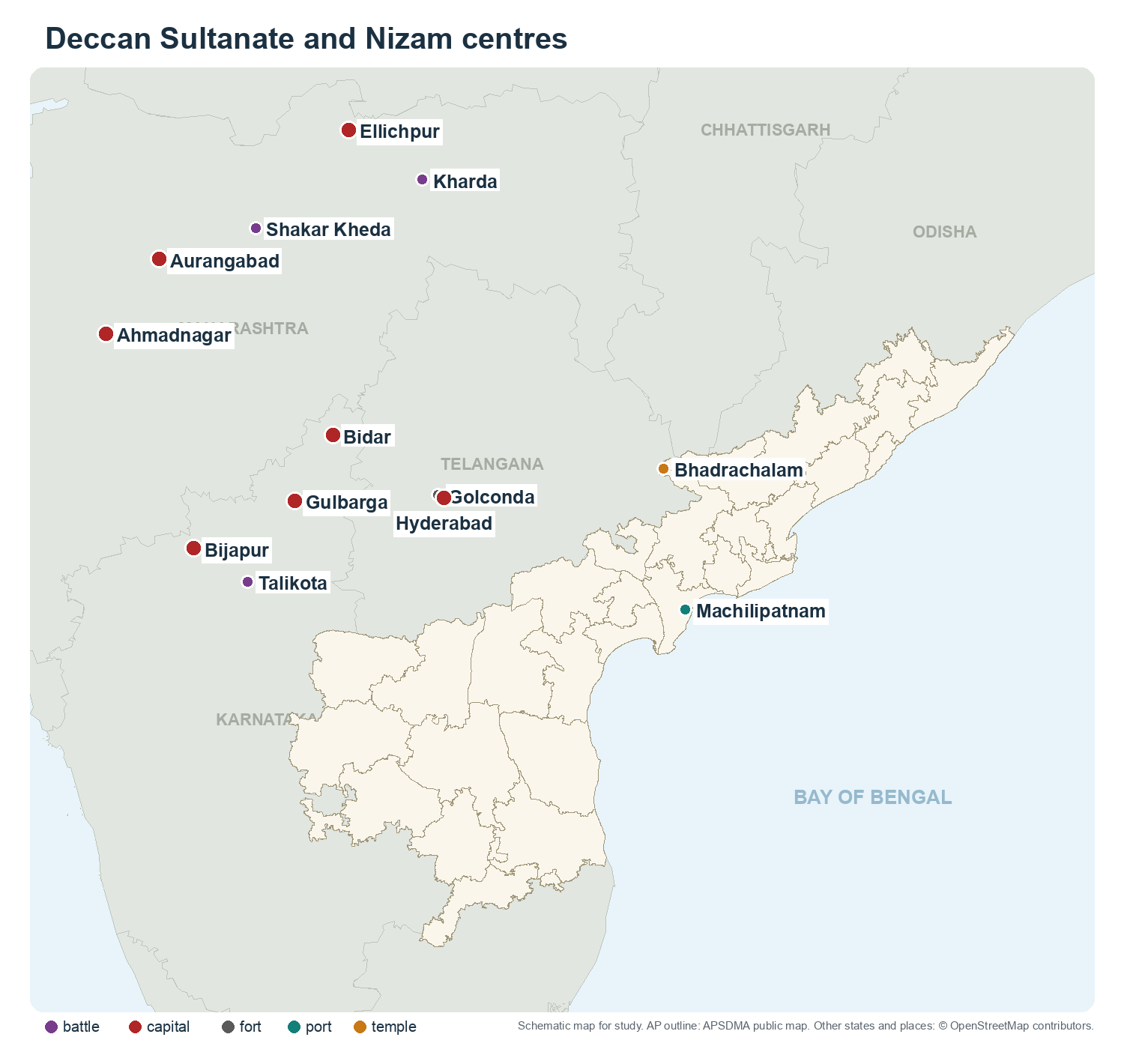
The Battle of Talikota (1565) was fought by the sultanates against Vijayanagara. The Vijayanagara army was led by Rama Raya.
3. Adil Shahis and Nizam Shahis
Adil Shahi order: Yusuf Adil Shah, Ismail Adil Shah, Mallu Adil Shah, Ibrahim Adil Shah I, Ali Adil Shah I, Ibrahim Adil Shah II, Muhammad Adil Shah, Ali Adil Shah II, Sikandar Adil Shah.
- Ibrahim Adil Shah II is Jagadguru Badshah. He wrote Kitab-i-Nauras (poems on music) and built the Ibrahim Rauza at Bijapur.
- Muhammad Adil Shah built the Gol Gumbaz at Bijapur. Its Whispering Gallery is famous.
- Ali Adil Shah I built the Jama Masjid of Bijapur.
- Firishta wrote *Tarikh-i-Firishta*.
Nizam Shahi. Chand Bibi led the defence in the Siege of Ahmadnagar in 1595. Malik Ambar led the Nizam Shahi regency at Ahmadnagar. The Mughals annexed Ahmadnagar in 1636.
4. The Mughal conquest
Aurangzeb, born at Dahod, led both conquests.
| Year | Event |
|---|---|
| 1636 | Mughal annexation of Ahmadnagar |
| 1686 | Mughal conquest of Bijapur |
| 1687 | Mughal conquest of Golconda |
After the conquest of Golconda, Mughal governors ruled the Deccan. In 1724, the Battle of Shakar Kheda led to the founding of Asaf Jahi rule.
5. The Asaf Jahi Nizams
The Asaf Jahi dynasty began in 1724. Asaf Jah I was the first Nizam of Hyderabad. His title was Nizam-ul-Mulk (he is Mir Qamaruddin Khan). The capital was first Aurangabad; Nizam Ali Khan moved it to Hyderabad (1763).
Order: Asaf Jah I, Nasir Jung, ... Nizam Ali Khan, Sikandar Jah, Nasir-ud-Daula, Afzal-ud-Daula, Mahboob Ali Khan, Mir Osman Ali Khan.
| Year | Event |
|---|---|
| 1724 | Asaf Jahi dynasty founded; Battle of Shakar Kheda |
| 1795 | Battle of Kharda |
| 1798 | Subsidiary Alliance (Treaty of Hyderabad of 1798) |
| 1918 | Osmania University established |
| 1921 | Andhra Jana Sangham formed by Madapati Hanumantha Rao |
| 1947 | Standstill Agreement between the Nizam and India |
| 1948 | Operation Polo; merger of Hyderabad State into India |
- Hyderabad was the first state to accept the Subsidiary Alliance. Under it, British troops were stationed in the state and the ruler gave British protection a price.
- The Standstill Agreement kept the status quo with Hyderabad State.
- Operation Polo was the Hyderabad police action, led by General J. N. Chaudhuri.
- The Razakars were led by Qasim Razvi. The Hyderabad State Congress was led by Swami Ramananda Tirtha.
- Falaknuma Palace was built by Nawab Vicar-ul-Umra. Nizam Sagar (on the Manjira) was built by Nawab Ali Nawaz Jung. Osman Sagar is on the Musi and Himayat Sagar on the Esi.
- Salar Jung Museum (Hyderabad) was established in 1951.
6. Crafts, products and rivers
| Item | Place |
|---|---|
| Bidriware | Bidar |
| Kalamkari | Machilipatnam |
| Nirmal paintings; wooden toys | Nirmal |
| Pochampally Ikat | Pochampally |
| Silver filigree | Karimnagar |
| Hyderabadi pearls | Hyderabad |
| Diamonds | Golconda, Kollur |
Rivers. Musi flows through Hyderabad; Manjira through Medak district; Bhima through Gulbarga; Krishna through Vijayawada; Godavari through Rajahmundry; Tungabhadra through Kurnool. Nagarjuna Sagar and Srisailam are on the Krishna; Sriram Sagar is on the Godavari.
Exam traps
- 1. Bahmani 1347 versus Vijayanagara 1336. Different empires, different founders.
- 2. Adil Shahi capital is Bijapur; Qutb Shahi is Golconda; Nizam Shahi is Ahmadnagar; Barid Shahi is Bidar.
- 3. Charminar and Hyderabad both date to 1591.
- 4. Gol Gumbaz (Muhammad Adil Shah) and Ibrahim Rauza (Ibrahim Adil Shah II) are both in Bijapur. Charminar is in Hyderabad.
- 5. Bijapur 1686, Golconda 1687. Do not swap.
- 6. Hasan Gangu and Alauddin Bahman Shah are the same person.
- 7. Subsidiary Alliance 1798 versus Standstill 1947 versus Operation Polo 1948.
- 8. Kancherla Gopanna built the Bhadrachalam Temple; he is Bhakta Ramadasu.
One-liners
- 1. Alauddin Bahman Shah founded the Bahmani Sultanate in 1347 at Gulbarga.
- 2. Mahmud Gawan was executed in 1481.
- 3. The Qutb Shahi dynasty started in 1518.
- 4. Hussain Sagar was built in 1562 by Ibrahim Quli Qutb Shah.
- 5. Hyderabad and the Charminar date to 1591.
- 6. Chand Bibi led the Ahmadnagar siege of 1595.
- 7. Aurangzeb conquered Golconda in 1687.
- 8. Asaf Jah I founded the Asaf Jahi dynasty in 1724.
- 9. Hyderabad was the first state to accept the Subsidiary Alliance.
- 10. Hyderabad State merged into India in 1948.
Background and context
By the middle of the 14th century the Delhi Sultanate was too large to control. Its officers in the Deccan, far from the capital, grew restless. In 1347 a group of these Deccan nobles rebelled, and one of their commanders, Zafar Khan, took the title Alauddin Bahman Shah. This is how the Bahmani Sultanate began. He is also called Hasan Gangu; the two names belong to one man. The new state was a break from Delhi, and it set the pattern for the next four centuries: a Persian-speaking ruling class in the Deccan, governing a mostly Telugu, Kannada and Marathi countryside.
This chapter follows one long story. First comes a large Bahmani state. Then it splits into five smaller sultanates. One of them, the Qutb Shahis of Golconda, ruled most of the Telugu country. The Mughals then swallowed all of these states. Finally a Mughal governor, Asaf Jah, turned his post into a hereditary kingdom, the state of the Nizams. The story ends with the merger of Hyderabad State into India in 1948. The wars of the Europeans on the coast, which were happening at the same time, are told in the next chapter.
Political history
The Bahmanis (1347 to the early 1500s). The first capital was Gulbarga. Around 1425 the capital moved to Bidar where Ahmad Shah I Wali built the fort. The kingdom was cut into provinces called tarafs, each under a tarafdar, who answered to the sultan.
Mahmud Gawan, born at Gilan, was a scholar who became chief minister in 1466 and is the best-known officer of the state. The kingdom reached its largest size under his guidance. He cut the old four provinces into eight so that no single governor became too strong, built a madrasa at Bidar, and left a book of letters, the *Riyaz-ul-Insha*. The court, however, had two camps: the "Dakhanis", local-born Muslims, and the "Afaqis" (outsiders), recent arrivals from Iran and beyond. Gawan was an outsider and stood between them. Rivals convinced the sultan that he was a traitor, and he was executed in 1481. With him went the one man who could hold the nobles together.
Five sultanates from one. After 1481 the governors of the provinces made themselves independent one by one, between about 1490 and 1518. The Bahmani line formally ended in 1527. The successor states were:
| Sultanate | Founder | Capital | Usual date |
|---|---|---|---|
| Adil Shahi | Yusuf Adil Shah | Bijapur | 1490 |
| Nizam Shahi | Malik Ahmad | Ahmadnagar | 1490 |
| Imad Shahi (Berar) | Fathullah Imad-ul-Mulk | Ellichpur | late 15th century |
| Barid Shahi | Qasim Barid | Bidar | early 16th century |
| Qutb Shahi | Quli Qutb Mulk | Golconda | 1518 |
Dates for the foundation of each state differ between works, because each governor first acted as a ruler and only later took the royal title. For the Qutb Shahis, 1518 is the date usually given; an older reference work gives 1512. Learn the capital and founder with the dynasty name.
The Qutb Shahis of Golconda. The founder, Quli Qutb Mulk, was born at Hamadan in Iran and was a Bahmani officer who made himself ruler. He was killed in 1543, and the next two rulers had short reigns. Under Ibrahim Quli Qutb Shah the state became stable. He is called Malki Bharama in Telugu. He dug the Hussain Sagar lake in 1562 and built the Purana Pul bridge over the Musi. In 1565 the sultanates joined together and beat Vijayanagara at Talikota; the Qutb Shahi army took part in that campaign (the battle itself belongs to the Vijayanagara chapter).
The most famous ruler is Muhammad Quli Qutb Shah. The capital had been Golconda until then. In 1591 he founded a new city, Hyderabad, and built the Charminar in its centre at the same time. He was also a poet and compiled the first complete Urdu diwan, the *Kulliyat*. His successor Muhammad Qutb Shah began the Mecca Masjid in 1617, and it was finished only under Aurangzeb. The list of the eight rulers is in the table below.
| Order | Ruler | Remembered for |
|---|---|---|
| 1 | Quli Qutb Mulk | Founder; killed 1543 |
| 2 | Jamsheed Quli Qutb Shah | Short rule |
| 3 | Subhan Quli Qutb Shah | Very short rule |
| 4 | Ibrahim Quli Qutb Shah | Malki Bharama; Hussain Sagar, Purana Pul |
| 5 | Muhammad Quli Qutb Shah | Hyderabad and Charminar, 1591; Urdu poet |
| 6 | Muhammad Qutb Shah | Mecca Masjid begun, 1617 |
| 7 | Abdullah Qutb Shah | Pre-Mughal peak and slide |
| 8 | Abul Hasan Tana Shah | Last ruler |
The other sultanates. At Bijapur, Ibrahim Adil Shah II (Jagadguru Badshah) was a patron of music and wrote the *Kitab-i-Nauras*; his tomb is the Ibrahim Rauza. Muhammad Adil Shah built the Gol Gumbaz, whose Whispering Gallery is known to every visitor. Ali Adil Shah I built the Jama Masjid. At Ahmadnagar, the queen Chand Bibi led the defence against a Mughal army in 1595, and the general-minister Malik Ambar later held the state together for the Nizam Shahis. The Mughals annexed Ahmadnagar in 1636.
The Mughal conquest. The Deccan was too rich for the Mughals to ignore. Aurangzeb led the final conquest in the 1680s. Bijapur fell in 1686. Golconda held out through a long siege and fell in 1687; its last ruler, Abul Hasan, was taken prisoner and spent his remaining years in a Mughal fort. Mughal officers now ran the former Qutb Shahi lands. Note the order: Ahmadnagar 1636, Bijapur 1686, Golconda 1687.
The Asaf Jahis. Mir Qamaruddin Khan was a senior Mughal noble. He took the title Nizam-ul-Mulk and later Asaf Jah. In 1724 he defeated a rival at Shakar Kheda and set himself up in the Deccan with his seat at Aurangabad. The Mughal emperor was too weak to remove him. By the end of his life he was an independent king in all but name, and this is the start of the Asaf Jahi dynasty. His son Nizam Ali Khan moved the capital to Hyderabad in 1763.
The 18th century was hard for the Nizams. The Marathas pressed from the west. The Nizam lost at Kharda in 1795 and had to pay a heavy sum. At the same time Tipu Sultan of Mysore was a danger on the south. Nizam Ali Khan turned to the British for protection and in 1798 signed the Subsidiary Alliance, so becoming the first Indian ruler to accept it. British troops were kept in his state and paid for by him. In 1800 he gave up the territory now called the Ceded Districts to pay for them (see the next chapter).
Why the Bahmani state broke. Three causes work together. First, the tarafs gave each governor an army and a revenue base, so a governor who felt unsafe at court could simply refuse to obey. Second, the quarrel between Dakhanis and Afaqis meant the nobles never acted as one body. Third, the execution of Mahmud Gawan in 1481 showed every governor that loyal service could end in death. It is not a surprise that independence began within a decade of his death.
Why the sultanates fell to the Mughals. The five states fought each other as often as they fought outsiders. The joint action at Talikota in 1565 was the exception. Without a shared army, each could be taken one at a time. Ahmadnagar went first (1636), then Bijapur and Golconda in two successive years. The siege of Golconda was long, which shows how strong the fort was.
Why the Nizam sought the British. Asaf Jah's successors were short of money and soldiers, and enemies stood on two sides: the Marathas and Mysore. The defeat at Kharda in 1795 showed the danger. The Subsidiary Alliance gave the Nizam safety, but at the price of his freedom in foreign affairs. This is the same bargain that other Indian rulers were later forced to accept.
Administration and economy
The Bahmani state was run by the sultan with a chief minister (vakil or vizier), and by the governors of the tarafs. Mahmud Gawan's reform, which raised the number of provinces from four to eight, was meant to keep any one governor from growing too strong.
Two trades made the Qutb Shahi state wealthy. Cotton cloth was one. Painted and printed cloth, the chintz, left the east-coast port of Masulipatnam for Persia, South-East Asia and Europe, and customs paid there filled the treasury. Diamonds were the other. They came from several mines in the kingdom rather than from Golconda itself, but the city was the marketplace and lent its name to the trade. The kingdom is reported to have been most prosperous in the 1620s and 1630s. Dutch and English merchants bought cloth here; the Golconda ruler's grant to the English in 1632 is covered in the next chapter.
Telugu officials worked in the revenue offices and Telugu land-holders were part of the system. Telugu was widely used beside Persian in revenue records and in some royal orders.
Hyderabad under the Nizams was a princely state with its own army, currency and railways. Under Mir Osman Ali Khan it also had its own bank, and Osmania University was founded in 1918. In the 1880s Urdu replaced Persian as the official language. The great Musi flood of 1908 led to the building of the Osman Sagar and Himayat Sagar lakes, meant to protect Hyderabad.
Society, religion and culture
Hyderabad itself shows how the culture mixed. The city was laid out with the Charminar at its centre, and the Musi river was crossed by the Purana Pul. The Telugu country, with its own old literary tradition from the Kakatiya and Vijayanagara times, lay inside the Qutb Shahi border, and Telugu writers and officers worked at court. Under the Nizams, Urdu became the language of government. The Andhra Jana Sangham was formed in 1921 under Madapati Hanumantha Rao to speak for Telugu people in the Nizam's state.
The Bahmani court was Persian in language and style. Bidar was known for Bidriware, a metal craft in which silver is inlaid in black alloy, and that craft still carries the town's name. The Qutb Shahi rulers were Shia Muslims, but their court was open to the local culture. Poets wrote in Persian, Dakhni Urdu and Telugu. Mulla Wajhi wrote *Sab Ras* and *Qutb Mushtari*. (Nusrati, who wrote *Gulshan-e-Ishq*, belonged to the Adil Shahi court of Bijapur.) Muhammad Quli's own poems are in the *Kulliyat*.
Kancherla Gopanna, better known as Bhakta Ramadasu, was born at Nelakondapalli. He built the temple at Bhadrachalam for Rama. He wrote the *Dasarathi Satakam*.
Crafts of the Deccan are a favourite exam topic: Bidriware at Bidar; Kalamkari at Machilipatnam; Nirmal paintings and wooden toys at Nirmal; Ikat weaving at Pochampally; silver filigree at Karimnagar; pearls in Hyderabad.
Decline, legacy and sites to know
After Aurangzeb's conquest the Mughals could not hold the Deccan for long, which is why Asaf Jah could rise. The Nizam's state outlasted the Mughal empire, and in 1947 its ruler wished to stay apart from India. A Standstill Agreement with India kept the old position for a time. The Razakars, led by Qasim Razvi, were an armed force on the Nizam's side, while the Hyderabad State Congress under Swami Ramananda Tirtha pressed for joining India. On 13 September 1948 the Indian army began Operation Polo, led by General J. N. Chaudhuri. The Nizam's forces surrendered on 17 September. The Nizam signed the Instrument of Accession on 25 January 1950 and became Rajpramukh the next day. The state was broken up on language lines in 1956.
| Site | Place | What it shows |
|---|---|---|
| Gulbarga Fort | Gulbarga | First Bahmani capital |
| Bidar Fort; Mahmud Gawan Madrasa | Bidar | Later Bahmani capital; Gawan's school |
| Gol Gumbaz; Ibrahim Rauza | Bijapur | Adil Shahi monuments |
| Golconda Fort; Qutb Shahi Tombs | near Hyderabad | Qutb Shahi capital and royal tombs |
| Charminar; Mecca Masjid | Hyderabad | 1591 city; 1617 mosque begun |
| Hussain Sagar; Purana Pul | Hyderabad | Ibrahim Quli's works |
| Falaknuma Palace; Salar Jung Museum | Hyderabad | Nizam-era palace and museum (1951) |
| Nizam Sagar | on the Manjira | Nizam-era irrigation work |
How examiners use this chapter
- Capital and dynasty pairs: Bijapur with Adil Shahi, Golconda with Qutb Shahi, Ahmadnagar with Nizam Shahi, Bidar with Barid Shahi, Ellichpur with Imad Shahi.
- Builder and monument pairs: Gol Gumbaz with Muhammad Adil Shah; Ibrahim Rauza with Ibrahim Adil Shah II; Charminar with Muhammad Quli Qutb Shah; Hussain Sagar with Ibrahim Quli Qutb Shah.
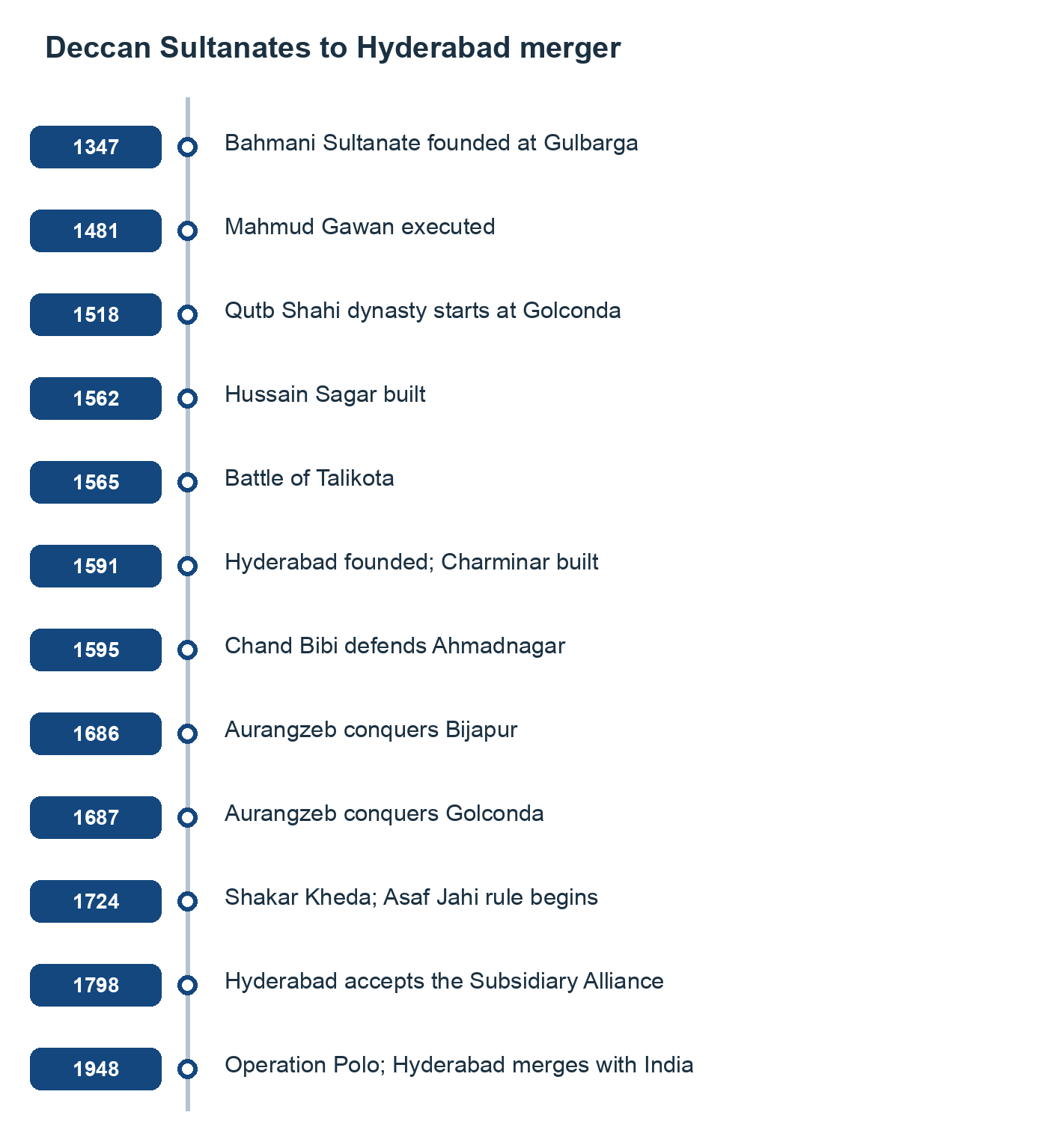
- Order of dates: Bahmani 1347, Qutb Shahi 1518, Hussain Sagar 1562, Hyderabad 1591, Ahmadnagar siege 1595, Bijapur 1686, Golconda 1687, Asaf Jahi 1724.
- Person pairs: Hasan Gangu is Alauddin Bahman Shah; Gopanna is Bhakta Ramadasu; Mahmud Gawan is Khwaja-i-Jahan; Malki Bharama is Ibrahim Quli.
- Sequence of Nizam-British events: Subsidiary Alliance 1798, Ceded Districts 1800, Standstill 1947, Operation Polo 1948.
- Crafts matched with places (Bidri, Kalamkari, Ikat, filigree).
- Traps: Vijayanagara (1336) versus Bahmani (1347); Bijapur and Golconda dates are one year apart; Charminar is not at Bijapur.
Worked cases
Case 1: Arrange in time order: Charminar built, Battle of Talikota, Hussain Sagar built, Siege of Ahmadnagar led by Chand Bibi.
Reasoning:
- 1. Hussain Sagar was built in 1562 by Ibrahim Quli Qutb Shah.
- 2. The Battle of Talikota was fought in 1565.
- 3. The Charminar and the city of Hyderabad date to 1591.
- 4. Chand Bibi led the defence of Ahmadnagar in 1595.
- 5. The order is Hussain Sagar, Talikota, Charminar, Ahmadnagar siege.
Takeaway: Write the year beside each item before choosing an option.
Case 2: Which of these is NOT in Hyderabad: Charminar, Salar Jung Museum, Gol Gumbaz, Falaknuma Palace?
Reasoning:
- 1. Charminar was built in Hyderabad by Muhammad Quli Qutb Shah.
- 2. Salar Jung Museum and Falaknuma Palace are both in Hyderabad.
- 3. Gol Gumbaz was built by Muhammad Adil Shah, an Adil Shahi ruler, and the Adil Shahi capital was Bijapur.
- 4. So Gol Gumbaz, with its Whispering Gallery, is the answer.
Takeaway: Link each monument to its dynasty, and then to the dynasty's capital.
Case 3: Match correctly: (a) Subsidiary Alliance, (b) Standstill Agreement, (c) Operation Polo, with 1947, 1948, 1798.
Reasoning:
- 1. The Subsidiary Alliance is the oldest. It was accepted by the Nizam in 1798, and Hyderabad was the first state to accept it.
- 2. The Standstill Agreement kept the status quo with Hyderabad State. It was signed in 1947.
- 3. Operation Polo was the police action in 1948, and the state merged into India in the same year.
- 4. Result: (a) 1798, (b) 1947, (c) 1948.
Takeaway: Think "alliance with the British, then agreement with India, then action".
Case 4: Which statement is correct: (a) Golconda fell in 1686 and Bijapur in 1687; (b) Bijapur fell in 1686 and Golconda in 1687?
Reasoning:
- 1. Aurangzeb led both conquests.
- 2. Ahmadnagar was annexed first, in 1636.
- 3. Bijapur was conquered in 1686.
- 4. Golconda was conquered in 1687. This makes (b) correct.
Takeaway: The two conquests are one year apart; Bijapur comes first.
Compare and contrast
| Ruler | Link to look-alike name | Remembered for |
|---|---|---|
| Ibrahim Quli Qutb Shah | Qutb Shahi | Malki Bharama; Hussain Sagar; Purana Pul |
| Muhammad Quli Qutb Shah | Qutb Shahi | Hyderabad and Charminar (1591); Kulliyat |
| Ibrahim Adil Shah II | Adil Shahi | Jagadguru Badshah; Kitab-i-Nauras; Ibrahim Rauza |
| Muhammad Adil Shah | Adil Shahi | Gol Gumbaz |
| Ali Adil Shah I | Adil Shahi | Jama Masjid of Bijapur |
| Place | Things located there |
|---|---|
| Bijapur | Gol Gumbaz, Ibrahim Rauza, Malik-e-Maidan |
| Bidar | Bidar Fort, Mahmud Gawan Madrasa, Bidriware |
| Gulbarga | Gulbarga Fort; the Bhima flows through it |
| Hyderabad | Charminar, Golconda Fort, Qutb Shahi Tombs, Mecca Masjid, Salar Jung Museum, Osmania University |
How to use these tables: many names repeat across the sultanates, such as Ibrahim, Muhammad and Ali. Do not learn the first name alone. Learn the dynasty word with it, such as Qutb Shah or Adil Shah. A Qutb Shahi ruler is linked to Golconda and Hyderabad, an Adil Shahi ruler is linked to Bijapur, and a Barid Shahi ruler is linked to Bidar. When a question names a monument, find its city first, then the dynasty of that city, then the builder. The Bahmani capital Gulbarga came first, and the Bahmani fort at Bidar was built by Ahmad Shah I Wali. The Berar Sultanate is also counted among the Deccan sultanates, and Imad Shahi has its capital at Ellichpur.
Other quick checks: Hasan Gangu and Alauddin Bahman Shah are one person. Mahmud Gawan was born at Gilan, Quli Qutb Mulk was born at Hamadan, and Aurangzeb was born at Dahod. Kancherla Gopanna, born at Nelakondapalli, is Bhakta Ramadasu. Qasim Razvi led the Razakars, and Swami Ramananda Tirtha led the Hyderabad State Congress.
Sequence and timeline
- 1. 1347 - Bahmani Sultanate founded.
- 2. 1481 - Mahmud Gawan executed.
- 3. 1490 - Adil Shahi and Nizam Shahi start (as listed).
- 4. 1518 - Qutb Shahi dynasty starts.
- 5. 1543 - Quli Qutb Mulk killed.
- 6. 1562 - Hussain Sagar built.
- 7. 1565 - Battle of Talikota.
- 8. 1591 - Hyderabad founded; Charminar built.
- 9. 1595 - Siege of Ahmadnagar.
- 10. 1636 - Mughals annex Ahmadnagar.
- 11. 1686 - Bijapur conquered.
- 12. 1687 - Golconda conquered.
- 13. 1724 - Battle of Shakar Kheda; Asaf Jahi rule begins.
- 14. 1795 - Battle of Kharda.
- 15. 1798 - Subsidiary Alliance.
- 16. 1918 - Osmania University established.
- 17. 1921 - Andhra Jana Sangham formed.
- 18. 1947 - Standstill Agreement.
- 19. 1948 - Operation Polo and merger.
- 20. 1951 - Salar Jung Museum established.
More one-liners
- 1. Malik-e-Maidan is in Bijapur.
- 2. Golconda Fort and the Qutb Shahi Tombs are in Hyderabad.
- 3. Osmania University is in Hyderabad.
- 4. Ahmad Shah I is known as Wali.
- 5. Singur Project is on the Manjira, like Nizam Sagar.
- 6. Falaknuma Palace is in Hyderabad.
Practice questions
Which of the following correctly describes Muhammad Quli Qutb Shah?
- first Nizam Shahi ruler
- first Bahmani capital
- first Muslim ruler to compile a Urdu Diwan in the Deccan
- first Indian state to accept the Subsidiary Alliance
Answer
C. first Muslim ruler to compile a Urdu Diwan in the Deccan
'ముహమ్మద్ కులీ కుతుబ్ షా' గురించిన సరైన వివరణ ఈ క్రింది వాటిలో ఏది?
- మొదటి నిజాం షాహీ పాలకుడు
- బహమనీ మొదటి రాజధాని
- దక్కన్లో ఉర్దూ దివాన్ రచించిన మొదటి సుల్తాన్
- సైన్య సహాయ ఒప్పందాన్ని అంగీకరించిన మొదటి రాజ్యం
Which of the following correctly describes Hyderabad?
- first Sultan of the Bahmani Sultanate
- first Muslim ruler to compile a Urdu Diwan in the Deccan
- first Adil Shahi ruler
- first Indian state to accept the Subsidiary Alliance
Answer
D. first Indian state to accept the Subsidiary Alliance
'హైదరాబాద్' గురించిన సరైన వివరణ ఈ క్రింది వాటిలో ఏది?
- బహమనీ సుల్తానేట్ మొదటి సుల్తాన్
- దక్కన్లో ఉర్దూ దివాన్ రచించిన మొదటి సుల్తాన్
- మొదటి ఆదిల్ షాహీ పాలకుడు
- సైన్య సహాయ ఒప్పందాన్ని అంగీకరించిన మొదటి రాజ్యం
Which of the following correctly describes Quli Qutb Mulk?
- first Qutb Shahi ruler
- first Indian state to accept the Subsidiary Alliance
- first Nizam Shahi ruler
- first Muslim ruler to compile a Urdu Diwan in the Deccan
Answer
A. first Qutb Shahi ruler
'కులీ కుతుబ్ ముల్క్' గురించిన సరైన వివరణ ఈ క్రింది వాటిలో ఏది?
- మొదటి కుతుబ్ షాహీ పాలకుడు
- సైన్య సహాయ ఒప్పందాన్ని అంగీకరించిన మొదటి రాజ్యం
- మొదటి నిజాం షాహీ పాలకుడు
- దక్కన్లో ఉర్దూ దివాన్ రచించిన మొదటి సుల్తాన్
Which of the following is located in the Bhadradri Kothagudem district area?
- Bhadrachalam Temple
- Falaknuma Palace
- Ibrahim Rauza
- Mahmud Gawan Madrasa
Answer
A. Bhadrachalam Temple
ఈ క్రింది వాటిలో ఏది భద్రాద్రి కొత్తగూడెం జిల్లా ప్రాంతంలో ఉంది?
- భద్రాచలం ఆలయం
- ఫలక్నుమా ప్యాలెస్
- ఇబ్రహీం రౌజా
- మహమూద్ గవాన్ మదరసా
General J. N. Chaudhuri led which of the following?
- Vijayanagara army at Talikota
- Nizam Shahi regency at Ahmadnagar
- Operation Polo
- Mughal conquest of Bijapur
Answer
C. Operation Polo
జనరల్ జె. ఎన్. చౌధురి నాయకత్వం వహించినది ఏది?
- తళ్లికోట వద్ద విజయనగర సైన్యం
- అహ్మద్నగర్ నిజాం షాహీ రీజెన్సీ
- ఆపరేషన్ పోలో
- బీజాపూర్ను మొఘలులు జయించడం
Operation Polo deals with which of the following?
- Hyderabad police action
- Subsidiary Alliance
- British protection and stationing of troops
- poems on music
Answer
A. Hyderabad police action
ఆపరేషన్ పోలో దేనికి సంబంధించినది?
- హైదరాబాద్ పోలీస్ చర్య
- సైన్య సహకార ఒప్పందం
- బ్రిటిష్ రక్షణ మరియు సైన్య నియామకం
- సంగీతంపై కవిత్వం
Arrange the following in chronological order (earliest first): (i) Battle of Shakar Kheda (ii) Mughal conquest of Bijapur (iii) Foundation stone of Nagarjuna Sagar Dam (iv) Ban on the Hyderabad State Congress
- (ii), (i), (iv), (iii)
- (iii), (i), (ii), (iv)
- (iv), (i), (ii), (iii)
- (ii), (iv), (iii), (i)
Answer
A. (ii), (i), (iv), (iii)
ఈ క్రింది వాటిని కాలక్రమానుసారం (పూర్వం నుండి తరువాతి వరకు) అమర్చండి: (i) షకర్ ఖేడా యుద్ధం (ii) బీజాపూర్ను మొఘలులు జయించడం (iii) నాగార్జున సాగర్ ఆనకట్ట శంకుస్థాపన (iv) హైదరాబాద్ స్టేట్ కాంగ్రెస్ నిషేధం
- (ii), (i), (iv), (iii)
- (iii), (i), (ii), (iv)
- (iv), (i), (ii), (iii)
- (ii), (iv), (iii), (i)
Arrange the following in chronological order (earliest first): (i) Standstill Agreement between the Nizam and India (ii) Execution of Mahmud Gawan (iii) Hyderabad State merged into Indian Union (iv) Tagore translating Jana Gana Mana at Madanapalle
- (ii), (iv), (i), (iii)
- (ii), (iii), (iv), (i)
- (iii), (iv), (ii), (i)
- (iv), (ii), (i), (iii)
Answer
A. (ii), (iv), (i), (iii)
ఈ క్రింది వాటిని కాలక్రమానుసారం (పూర్వం నుండి తరువాతి వరకు) అమర్చండి: (i) నిజాం, భారత్ మధ్య యథాతథ స్థితి ఒప్పందం (ii) మహమూద్ గవాన్ మరణశిక్ష (iii) హైదరాబాద్ రాష్ట్రం భారత సమాఖ్యలో విలీనం (iv) మదనపల్లెలో జన గణ మన అనువాదం
- (ii), (iv), (i), (iii)
- (ii), (iii), (iv), (i)
- (iii), (iv), (ii), (i)
- (iv), (ii), (i), (iii)
Who was the first Muslim ruler to compile a Urdu Diwan in the Deccan?
- Muhammad Quli Qutb Shah
- Alauddin Bahman Shah
- Hyderabad
- Gulbarga
Answer
A. Muhammad Quli Qutb Shah
దక్కన్లో ఉర్దూ దివాన్ రచించిన మొదటి సుల్తాన్ ఎవరు?
- ముహమ్మద్ కులీ కుతుబ్ షా
- అల్లావుద్దీన్ బహమన్ షా
- హైదరాబాద్
- గుల్బర్గా
Who was the first Indian state to accept the Subsidiary Alliance?
- Muhammad Quli Qutb Shah
- Gulbarga
- Hyderabad
- Alauddin Bahman Shah
Answer
C. Hyderabad
సైన్య సహాయ ఒప్పందాన్ని అంగీకరించిన మొదటి రాజ్యం ఎవరు?
- ముహమ్మద్ కులీ కుతుబ్ షా
- గుల్బర్గా
- హైదరాబాద్
- అల్లావుద్దీన్ బహమన్ షా
Which of the following correctly describes Malik Ahmad?
- first Nizam Shahi ruler
- first Indian state to accept the Subsidiary Alliance
- first Qutb Shahi ruler
- first Adil Shahi ruler
Answer
A. first Nizam Shahi ruler
'మాలిక్ అహ్మద్' గురించిన సరైన వివరణ ఈ క్రింది వాటిలో ఏది?
- మొదటి నిజాం షాహీ పాలకుడు
- సైన్య సహాయ ఒప్పందాన్ని అంగీకరించిన మొదటి రాజ్యం
- మొదటి కుతుబ్ షాహీ పాలకుడు
- మొదటి ఆదిల్ షాహీ పాలకుడు
Which of the following is located in the Bidar area?
- Mahmud Gawan Madrasa
- Ibrahim Rauza
- Falaknuma Palace
- Mecca Masjid of Hyderabad
Answer
A. Mahmud Gawan Madrasa
ఈ క్రింది వాటిలో ఏది బీదర్ ప్రాంతంలో ఉంది?
- మహమూద్ గవాన్ మదరసా
- ఇబ్రహీం రౌజా
- ఫలక్నుమా ప్యాలెస్
- హైదరాబాద్ మక్కా మసీదు
Chand Bibi led which of the following?
- Nizam Shahi regency at Ahmadnagar
- Siege of Ahmadnagar 1595
- Vijayanagara army at Talikota
- Mughal conquest of Bijapur
Answer
B. Siege of Ahmadnagar 1595
చాంద్ బీబీ నాయకత్వం వహించినది ఏది?
- అహ్మద్నగర్ నిజాం షాహీ రీజెన్సీ
- 1595 అహ్మద్నగర్ ముట్టడి
- తళ్లికోట వద్ద విజయనగర సైన్యం
- బీజాపూర్ను మొఘలులు జయించడం
Aurangzeb led which of the following?
- Mughal conquest of Golconda
- Vijayanagara army at Talikota
- Nizam Shahi regency at Ahmadnagar
- Operation Polo
Answer
A. Mughal conquest of Golconda
ఔరంగజేబు నాయకత్వం వహించినది ఏది?
- గోల్కొండను మొఘలులు జయించడం
- తళ్లికోట వద్ద విజయనగర సైన్యం
- అహ్మద్నగర్ నిజాం షాహీ రీజెన్సీ
- ఆపరేషన్ పోలో
Malik Ambar led which of the following?
- Nizam Shahi regency at Ahmadnagar
- Siege of Ahmadnagar 1595
- Mughal conquest of Bijapur
- Operation Polo
Answer
A. Nizam Shahi regency at Ahmadnagar
మాలిక్ అంబర్ నాయకత్వం వహించినది ఏది?
- అహ్మద్నగర్ నిజాం షాహీ రీజెన్సీ
- 1595 అహ్మద్నగర్ ముట్టడి
- బీజాపూర్ను మొఘలులు జయించడం
- ఆపరేషన్ పోలో
Riyaz-ul-Insha deals with which of the following?
- poems on music
- letters and prose
- status quo with Hyderabad State
- Hyderabad police action
Answer
B. letters and prose
రియాజ్-ఉల్-ఇన్షా దేనికి సంబంధించినది?
- సంగీతంపై కవిత్వం
- లేఖలు మరియు గద్య రచన
- హైదరాబాద్ రాష్ట్రంతో యథాతథ స్థితి
- హైదరాబాద్ పోలీస్ చర్య
Kitab-i-Nauras deals with which of the following?
- letters and prose
- Subsidiary Alliance
- poems on music
- Hyderabad police action
Answer
C. poems on music
కితాబ్-ఇ-నౌరస్ దేనికి సంబంధించినది?
- లేఖలు మరియు గద్య రచన
- సైన్య సహకార ఒప్పందం
- సంగీతంపై కవిత్వం
- హైదరాబాద్ పోలీస్ చర్య
Kancherla Gopanna (Bhakta Ramadasu) was the tahsildar of Bhadrachalam under which Qutb Shahi ruler?
- Abdullah Qutb Shah
- Abul Hasan Tana Shah
- Muhammad Quli
- Ibrahim Qutb Shah
Answer
B. Abul Hasan Tana Shah
He was jailed at Golconda for spending revenue on the temple.
కంచర్ల గోపన్న (భక్త రామదాసు) ఏ కుతుబ్ షాహీ పాలకుని కింద భద్రాచలం తహసీల్దార్గా ఉన్నాడు?
- అబ్దుల్లా కుతుబ్ షా
- అబుల్ హసన్ తానీషా
- మహమ్మద్ కులీ
- ఇబ్రహీం కుతుబ్ షా
Kancherla Gopanna, famed as Bhakta Ramadasu, was a contemporary of which Golconda ruler?
- Ibrahim Qutb Shah
- Muhammad Quli Qutb Shah
- Abdullah Qutb Shah
- Abul Hasan Tana Shah
Answer
D. Abul Hasan Tana Shah
Gopanna was a tax officer at Bhadrachalam under Tana Shah, the last Qutb Shahi king.
భక్త రామదాసుగా ప్రసిద్ధి చెందిన కంచర్ల గోపన్న ఏ గోల్కొండ పాలకుడి సమకాలికుడు?
- ఇబ్రహీం కుతుబ్షా
- మహమ్మద్ కులీ కుతుబ్షా
- అబ్దుల్లా కుతుబ్షా
- అబుల్ హసన్ తానీషా
Rama Raya led which of the following?
- Mughal conquest of Bijapur
- Vijayanagara army at Talikota
- Nizam Shahi regency at Ahmadnagar
- Mughal conquest of Golconda
Answer
B. Vijayanagara army at Talikota
రామరాయలు నాయకత్వం వహించినది ఏది?
- బీజాపూర్ను మొఘలులు జయించడం
- తళ్లికోట వద్ద విజయనగర సైన్యం
- అహ్మద్నగర్ నిజాం షాహీ రీజెన్సీ
- గోల్కొండను మొఘలులు జయించడం
Which provision deals with status quo with Hyderabad State?
- Subsidiary Alliance
- Operation Polo
- Standstill Agreement
- Kitab-i-Nauras
Answer
C. Standstill Agreement
హైదరాబాద్ రాష్ట్రంతో యథాతథ స్థితి గురించి తెలిపే నిబంధన ఏది?
- సైన్య సహకార ఒప్పందం
- ఆపరేషన్ పోలో
- యథాతథ ఒప్పందం
- కితాబ్-ఇ-నౌరస్
Which provision deals with letters and prose?
- Kitab-i-Nauras
- Riyaz-ul-Insha
- Standstill Agreement
- Treaty of Hyderabad of 1798
Answer
B. Riyaz-ul-Insha
లేఖలు మరియు గద్య రచన గురించి తెలిపే నిబంధన ఏది?
- కితాబ్-ఇ-నౌరస్
- రియాజ్-ఉల్-ఇన్షా
- యథాతథ ఒప్పందం
- 1798 హైదరాబాద్ ఒప్పందం
Treaty of Hyderabad of 1798 deals with which of the following?
- letters and prose
- poems on music
- status quo with Hyderabad State
- Subsidiary Alliance
Answer
D. Subsidiary Alliance
1798 హైదరాబాద్ ఒప్పందం దేనికి సంబంధించినది?
- లేఖలు మరియు గద్య రచన
- సంగీతంపై కవిత్వం
- హైదరాబాద్ రాష్ట్రంతో యథాతథ స్థితి
- సైన్య సహకార ఒప్పందం
Which provision deals with Subsidiary Alliance?
- Kitab-i-Nauras
- Treaty of Hyderabad of 1798
- Standstill Agreement
- Riyaz-ul-Insha
Answer
B. Treaty of Hyderabad of 1798
సైన్య సహకార ఒప్పందం గురించి తెలిపే నిబంధన ఏది?
- కితాబ్-ఇ-నౌరస్
- 1798 హైదరాబాద్ ఒప్పందం
- యథాతథ ఒప్పందం
- రియాజ్-ఉల్-ఇన్షా
Which of the following was built by Nawab Ali Nawaz Jung?
- Bidar Fort
- Mecca Masjid of Hyderabad
- Nizam Sagar
- Falaknuma Palace
Answer
C. Nizam Sagar
నవాబ్ అలీ నవాజ్ జంగ్ నిర్మించినది ఏది?
- బీదర్ కోట
- హైదరాబాద్ మక్కా మసీదు
- నిజాం సాగర్
- ఫలక్నుమా ప్యాలెస్
Arrange the following in chronological order (earliest first): (i) Construction of Charminar (ii) Government of India Act transferring power to the Crown (iii) Subsidiary Alliance between the Nizam and the British (iv) Treaty of Paris ending the Seven Years War
- (iv), (ii), (iii), (i)
- (i), (ii), (iv), (iii)
- (i), (iv), (iii), (ii)
- (ii), (iv), (i), (iii)
Answer
C. (i), (iv), (iii), (ii)
ఈ క్రింది వాటిని కాలక్రమానుసారం (పూర్వం నుండి తరువాతి వరకు) అమర్చండి: (i) చార్మినార్ నిర్మాణం (ii) అధికారాన్ని కిరీటానికి బదిలీ చేసిన భారత ప్రభుత్వ చట్టం (iii) నిజాం, బ్రిటిష్ వారి మధ్య సైన్య సహాయ ఒప్పందం (iv) పారిస్ ఒప్పందం
- (iv), (ii), (iii), (i)
- (i), (ii), (iv), (iii)
- (i), (iv), (iii), (ii)
- (ii), (iv), (i), (iii)
Arrange the following in chronological order (earliest first): (i) Attack on the British Residency at Hyderabad (ii) Subsidiary Alliance of Hyderabad (iii) Mughal annexation of Ahmadnagar (iv) Construction of Charminar
- (ii), (iii), (i), (iv)
- (iii), (ii), (iv), (i)
- (iv), (iii), (ii), (i)
- (i), (iii), (iv), (ii)
Answer
C. (iv), (iii), (ii), (i)
ఈ క్రింది వాటిని కాలక్రమానుసారం (పూర్వం నుండి తరువాతి వరకు) అమర్చండి: (i) హైదరాబాద్ బ్రిటిష్ రెసిడెన్సీపై దాడి (ii) హైదరాబాద్ సైన్య సహకార ఒప్పందం (iii) అహ్మద్నగర్ను మొఘలులు కలుపుకోవడం (iv) చార్మినార్ నిర్మాణం
- (ii), (iii), (i), (iv)
- (iii), (ii), (iv), (i)
- (iv), (iii), (ii), (i)
- (i), (iii), (iv), (ii)
Arrange the following in chronological order (earliest first): (i) Independence of Golconda under Sultan Quli Qutb-ul-Mulk (ii) Formation of Telangana State (iii) Police Action to merge Hyderabad State into India (iv) Founding of Hyderabad city
- (i), (iv), (iii), (ii)
- (iv), (i), (iii), (ii)
- (ii), (iii), (i), (iv)
- (ii), (iv), (i), (iii)
Answer
A. (i), (iv), (iii), (ii)
ఈ క్రింది వాటిని కాలక్రమానుసారం (పూర్వం నుండి తరువాతి వరకు) అమర్చండి: (i) సుల్తాన్ కులీ కుతుబ్-ఉల్-ముల్క్ ఆధ్వర్యంలో గోల్కొండ స్వతంత్రం (ii) తెలంగాణ రాష్ట్ర ఏర్పాటు (iii) హైదరాబాద్ సంస్థానం విలీనానికి పోలీసు చర్య (iv) హైదరాబాద్ నగర స్థాపన
- (i), (iv), (iii), (ii)
- (iv), (i), (iii), (ii)
- (ii), (iii), (i), (iv)
- (ii), (iv), (i), (iii)
Arrange the following in chronological order (earliest first): (i) Formation of Andhra Jana Sangham (ii) Execution of Mahmud Gawan (iii) Founding of the Rajahmundry Social Reform Association (iv) Battle of Padmanabham
- (iii), (i), (iv), (ii)
- (ii), (iv), (iii), (i)
- (iii), (i), (ii), (iv)
- (iv), (ii), (i), (iii)
Answer
B. (ii), (iv), (iii), (i)
ఈ క్రింది వాటిని కాలక్రమానుసారం (పూర్వం నుండి తరువాతి వరకు) అమర్చండి: (i) ఆంధ్ర జన సంఘం ఏర్పాటు (ii) మహమూద్ గవాన్ మరణశిక్ష (iii) రాజమహేంద్రవరం సంఘ సంస్కరణ సంఘం స్థాపన (iv) పద్మనాభం యుద్ధం
- (iii), (i), (iv), (ii)
- (ii), (iv), (iii), (i)
- (iii), (i), (ii), (iv)
- (iv), (ii), (i), (iii)
Arrange the following in chronological order (earliest first): (i) Cession of the Ceded Districts by the Nizam (ii) Foundation stone of Nagarjuna Sagar Dam (iii) Operation Polo merging Hyderabad State with India (iv) Formation of Hyderabad State Congress
- (iv), (i), (ii), (iii)
- (i), (iv), (iii), (ii)
- (ii), (iii), (i), (iv)
- (iii), (i), (iv), (ii)
Answer
B. (i), (iv), (iii), (ii)
ఈ క్రింది వాటిని కాలక్రమానుసారం (పూర్వం నుండి తరువాతి వరకు) అమర్చండి: (i) నిజాం సీడెడ్ జిల్లాల అప్పగింత (ii) నాగార్జున సాగర్ ఆనకట్ట శంకుస్థాపన (iii) హైదరాబాద్ సంస్థానాన్ని భారత్లో కలిపిన ఆపరేషన్ పోలో (iv) హైదరాబాద్ స్టేట్ కాంగ్రెస్ ఏర్పాటు
- (iv), (i), (ii), (iii)
- (i), (iv), (iii), (ii)
- (ii), (iii), (i), (iv)
- (iii), (i), (iv), (ii)
Which Qutb Shahi ruler was a member of the Deccan sultanate alliance that defeated Rama Raya at Talikota in 1565?
- Abdullah Qutb Shah
- Abul Hasan Tana Shah
- Muhammad Quli Qutb Shah
- Ibrahim Quli Qutb Shah
Answer
D. Ibrahim Quli Qutb Shah
Golconda joined Bijapur, Ahmednagar and Bidar.
1565 తళ్ళికోట యుద్ధంలో రామరాయలను ఓడించిన దక్కన్ సుల్తానుల కూటమిలో ఉన్న కుతుబ్షాహీ పాలకుడు ఎవరు?
- అబ్దుల్లా కుతుబ్ షా
- అబుల్ హసన్ తానీషా
- మహమ్మద్ కులీ కుతుబ్ షా
- ఇబ్రహీం కులీ కుతుబ్ షా
Match the ruler with the feat: (1) Sultan Quli Qutb-ul-Mulk (2) Ibrahim Qutb Shah (3) Muhammad Quli Qutb Shah (4) Abul Hasan Tana Shah (a) Founded Hyderabad (b) Last Qutb Shahi ruler (c) Founded the dynasty (d) Built Hussain Sagar
- 1-c, 2-d, 3-b, 4-a
- 1-c, 2-d, 3-a, 4-b
- 1-a, 2-d, 3-c, 4-b
- 1-d, 2-c, 3-a, 4-b
Answer
B. 1-c, 2-d, 3-a, 4-b
Each ruler is matched with his well-known act.
పాలకుడిని ఘనతతో జతచేయండి: (1) సుల్తాన్ కులీ కుతుబ్ ఉల్ ముల్క్ (2) ఇబ్రహీం కుతుబ్ షా (3) మహమ్మద్ కులీ కుతుబ్ షా (4) అబుల్ హసన్ తానీషా (a) హైదరాబాద్ స్థాపన (b) చివరి కుతుబ్ షాహీ పాలకుడు (c) వంశ స్థాపన (d) హుస్సేన్ సాగర్ నిర్మాణం
- 1-c, 2-d, 3-b, 4-a
- 1-c, 2-d, 3-a, 4-b
- 1-a, 2-d, 3-c, 4-b
- 1-d, 2-c, 3-a, 4-b
The Qutb Shahi tombs near Golconda house almost all the sultans of the dynasty. Which sultan is the exception?
- Abul Hasan Tana Shah
- Ibrahim Quli Qutb Shah
- Muhammad Quli Qutb Shah
- Abdullah Qutb Shah
Answer
A. Abul Hasan Tana Shah
Abul Hasan Tana Shah, the last Qutb Shahi sultan, was captured by Aurangzeb in 1687 and is not buried in this complex.
గోల్కొండ సమీపంలోని కుతుబ్ షాహీ సమాధుల్లో వంశంలోని దాదాపు అందరు సుల్తానుల సమాధులు ఉన్నాయి. దీనికి మినహాయింపు ఎవరు?
- అబుల్ హసన్ తానీషా
- ఇబ్రహీం కులీ కుతుబ్ షా
- మహమ్మద్ కులీ కుతుబ్ షా
- అబ్దుల్లా కుతుబ్ షా
Who founded the Qutb Shahi dynasty of Golconda after breaking away from the Bahmani Sultanate?
- Ibrahim Quli Qutb Shah
- Muhammad Quli Qutb Shah
- Abdullah Qutb Shah
- Sultan Quli Qutb-ul-Mulk
Answer
D. Sultan Quli Qutb-ul-Mulk
Sultan Quli, a Bahmani governor of Telangana, declared independence around 1518.
బహమనీ సుల్తానేట్ నుంచి విడిపోయి గోల్కొండ కుతుబ్ షాహీ వంశాన్ని స్థాపించినవారు ఎవరు?
- ఇబ్రహీం కులీ కుతుబ్ షా
- మహమ్మద్ కులీ కుతుబ్ షా
- అబ్దుల్లా కుతుబ్ షా
- సుల్తాన్ కులీ కుతుబ్-ఉల్-ముల్క్
By which name or title is Ibrahim Adil Shah II known?
- Jagadguru Badshah
- Malki Bharama
- Alauddin Bahman Shah
- Khwaja-i-Jahan
Answer
A. Jagadguru Badshah
ఇబ్రహీం ఆదిల్ షా రెండవ ఏ పేరుతో లేదా బిరుదుతో పిలువబడుతుంది?
- జగద్గురు బాదుషా
- మల్కిభరాముడు
- అల్లావుద్దీన్ బహమన్ షా
- ఖ్వాజా-ఇ-జహాన్
Who led Nizam Shahi regency at Ahmadnagar?
- General J. N. Chaudhuri
- Malik Ambar
- Rama Raya
- Aurangzeb
Answer
B. Malik Ambar
అహ్మద్నగర్ నిజాం షాహీ రీజెన్సీ నాయకుడు ఎవరు?
- జనరల్ జె. ఎన్. చౌధురి
- మాలిక్ అంబర్
- రామరాయలు
- ఔరంగజేబు
Which provision deals with Hyderabad police action?
- Subsidiary Alliance
- Treaty of Hyderabad of 1798
- Operation Polo
- Standstill Agreement
Answer
C. Operation Polo
హైదరాబాద్ పోలీస్ చర్య గురించి తెలిపే నిబంధన ఏది?
- సైన్య సహకార ఒప్పందం
- 1798 హైదరాబాద్ ఒప్పందం
- ఆపరేషన్ పోలో
- యథాతథ ఒప్పందం
Which provision deals with poems on music?
- Kitab-i-Nauras
- Operation Polo
- Standstill Agreement
- Riyaz-ul-Insha
Answer
A. Kitab-i-Nauras
సంగీతంపై కవిత్వం గురించి తెలిపే నిబంధన ఏది?
- కితాబ్-ఇ-నౌరస్
- ఆపరేషన్ పోలో
- యథాతథ ఒప్పందం
- రియాజ్-ఉల్-ఇన్షా
Which of the following was built by Nawab Vicar-ul-Umra?
- Purana Pul
- Falaknuma Palace
- Jama Masjid of Bijapur
- Nizam Sagar
Answer
B. Falaknuma Palace
నవాబ్ వికార్-ఉల్-ఉమ్రా నిర్మించినది ఏది?
- పురానా పూల్
- ఫలక్నుమా ప్యాలెస్
- బీజాపూర్ జామా మసీదు
- నిజాం సాగర్
Arrange the following in chronological order (earliest first): (i) President's Rule in Andhra Pradesh during the Jai Andhra movement (ii) Death of Rudrama Devi (iii) Founding of the Rajahmundry Social Reform Association (iv) Subsidiary Alliance between the Nizam and the British
- (iv), (i), (ii), (iii)
- (ii), (iv), (iii), (i)
- (iii), (ii), (iv), (i)
- (ii), (i), (iii), (iv)
Answer
B. (ii), (iv), (iii), (i)
ఈ క్రింది వాటిని కాలక్రమానుసారం (పూర్వం నుండి తరువాతి వరకు) అమర్చండి: (i) జై ఆంధ్ర ఉద్యమ సమయంలో ఆంధ్రప్రదేశ్లో రాష్ట్రపతి పాలన (ii) రుద్రమదేవి మరణం (iii) రాజమహేంద్రవరం సంఘ సంస్కరణ సంఘం స్థాపన (iv) నిజాం, బ్రిటిష్ వారి మధ్య సైన్య సహాయ ఒప్పందం
- (iv), (i), (ii), (iii)
- (ii), (iv), (iii), (i)
- (iii), (ii), (iv), (i)
- (ii), (i), (iii), (iv)
Arrange the following in chronological order (earliest first): (i) Guntur Circar passing to the British (ii) Establishment of the Saluva dynasty (iii) Gentlemen's Agreement on Telangana and Andhra (iv) Construction of Osman Sagar
- (iv), (ii), (iii), (i)
- (ii), (i), (iv), (iii)
- (ii), (iv), (iii), (i)
- (i), (iv), (ii), (iii)
Answer
B. (ii), (i), (iv), (iii)
ఈ క్రింది వాటిని కాలక్రమానుసారం (పూర్వం నుండి తరువాతి వరకు) అమర్చండి: (i) గుంటూరు సర్కారు బ్రిటిష్ వారికి చేరడం (ii) సాళువ వంశ స్థాపన (iii) తెలంగాణ ఆంధ్ర పెద్దమనుషుల ఒప్పందం (iv) ఉస్మాన్ సాగర్ నిర్మాణం
- (iv), (ii), (iii), (i)
- (ii), (i), (iv), (iii)
- (ii), (iv), (iii), (i)
- (i), (iv), (ii), (iii)
Arrange the following in chronological order (earliest first): (i) Mughal annexation of Ahmadnagar (ii) Standstill Agreement between Hyderabad and India (iii) Establishment of the Reddi kingdom (iv) Regulating Act
- (iii), (ii), (iv), (i)
- (iv), (i), (iii), (ii)
- (iii), (iv), (ii), (i)
- (iii), (i), (iv), (ii)
Answer
D. (iii), (i), (iv), (ii)
ఈ క్రింది వాటిని కాలక్రమానుసారం (పూర్వం నుండి తరువాతి వరకు) అమర్చండి: (i) అహ్మద్నగర్ను మొఘలులు కలుపుకోవడం (ii) హైదరాబాద్, భారత్ మధ్య యథాతథ ఒప్పందం (iii) రెడ్డి రాజ్య స్థాపన (iv) రెగ్యులేటింగ్ చట్టం
- (iii), (ii), (iv), (i)
- (iv), (i), (iii), (ii)
- (iii), (iv), (ii), (i)
- (iii), (i), (iv), (ii)
Arrange the following in chronological order (earliest first): (i) Police Action to merge Hyderabad State into India (ii) Formation of Andhra Pradesh (iii) Chintapalli police station attack (iv) Completion of Godavari Anicut at Dowleswaram
- (iv), (iii), (i), (ii)
- (ii), (i), (iii), (iv)
- (i), (iv), (iii), (ii)
- (i), (ii), (iv), (iii)
Answer
A. (iv), (iii), (i), (ii)
ఈ క్రింది వాటిని కాలక్రమానుసారం (పూర్వం నుండి తరువాతి వరకు) అమర్చండి: (i) హైదరాబాద్ సంస్థానం విలీనానికి పోలీసు చర్య (ii) ఆంధ్రప్రదేశ్ ఏర్పాటు (iii) చింతపల్లి పోలీస్ స్టేషన్ దాడి (iv) ధవళేశ్వరం వద్ద గోదావరి అనికట్ పూర్తి
- (iv), (iii), (i), (ii)
- (ii), (i), (iii), (iv)
- (i), (iv), (iii), (ii)
- (i), (ii), (iv), (iii)
To which Bahmani Sultan did the Musunuri ruler Kapaya Nayaka cede Golconda in 1363?
- Mahmud Gawan
- Alauddin Bahman Shah
- Muhammad Shah I
- Firoz Shah
Answer
C. Muhammad Shah I
The cession, with a turquoise throne, followed a Bahmani victory.
1363లో ముసునూరి కాపయ నాయకుడు గోల్కొండను ఏ బహమనీ సుల్తాన్కు సమర్పించాడు?
- మహమూద్ గవాన్
- అలావుద్దీన్ బహమన్ షా
- మొదటి మహమ్మద్ షా
- ఫిరోజ్ షా
Who was the last ruler of the Qutb Shahi dynasty of Golconda?
- Abul Hasan Tana Shah
- Sultan Quli Qutb-ul-Mulk
- Abdullah Qutb Shah
- Ibrahim Qutb Shah
Answer
A. Abul Hasan Tana Shah
గోల్కొండ కుతుబ్ షాహీ వంశపు చివరి పాలకుడు ఎవరు?
- అబుల్ హసన్ తానా షా
- సుల్తాన్ కులీ కుతుబ్-ఉల్-ముల్క్
- అబ్దుల్లా కుతుబ్ షా
- ఇబ్రహీం కుతుబ్ షా
Practice set 2
Who wrote Kitab-i-Nauras?
- Muhammad Quli Qutb Shah
- Mulla Wajhi
- Ibrahim Adil Shah II
- Mahmud Gawan
Answer
C. Ibrahim Adil Shah II
కితాబ్-ఇ-నౌరస్ రచయిత ఎవరు?
- ముహమ్మద్ కులీ కుతుబ్ షా
- ములా వజ్హీ
- ఇబ్రహీం ఆదిల్ షా రెండవ
- మహమూద్ గవాన్
Who wrote Riyaz-ul-Insha?
- Ibrahim Adil Shah II
- Mahmud Gawan
- Mulla Wajhi
- Nusrati
Answer
B. Mahmud Gawan
రియాజ్-ఉల్-ఇన్షా రచయిత ఎవరు?
- ఇబ్రహీం ఆదిల్ షా రెండవ
- మహమూద్ గవాన్
- ములా వజ్హీ
- నుస్రతి
Which of the following is located in the Bijapur area?
- Hussain Sagar
- Bidar Fort
- Bhadrachalam Temple
- Ibrahim Rauza
Answer
D. Ibrahim Rauza
ఈ క్రింది వాటిలో ఏది బీజాపూర్ ప్రాంతంలో ఉంది?
- హుస్సేన్ సాగర్
- బీదర్ కోట
- భద్రాచలం ఆలయం
- ఇబ్రహీం రౌజా
In which district or place is Malik-e-Maidan located?
- Gulbarga
- Hyderabad
- Bhadradri Kothagudem district
- Bijapur
Answer
D. Bijapur
మాలిక్-ఎ-మైదాన్ ఏ జిల్లా/ప్రాంతంలో ఉంది?
- గుల్బర్గా
- హైదరాబాద్
- భద్రాద్రి కొత్తగూడెం జిల్లా
- బీజాపూర్
In which district or place is Mahmud Gawan Madrasa located?
- Bijapur
- Bidar
- Gulbarga
- Hyderabad
Answer
B. Bidar
మహమూద్ గవాన్ మదరసా ఏ జిల్లా/ప్రాంతంలో ఉంది?
- బీజాపూర్
- బీదర్
- గుల్బర్గా
- హైదరాబాద్
In which district or place is Falaknuma Palace located?
- Gulbarga
- Hyderabad
- Bidar
- Bhadradri Kothagudem district
Answer
B. Hyderabad
ఫలక్నుమా ప్యాలెస్ ఏ జిల్లా/ప్రాంతంలో ఉంది?
- గుల్బర్గా
- హైదరాబాద్
- బీదర్
- భద్రాద్రి కొత్తగూడెం జిల్లా
In which district or place is Hussain Sagar located?
- Bijapur
- Hyderabad
- Bidar
- Bhadradri Kothagudem district
Answer
B. Hyderabad
హుస్సేన్ సాగర్ ఏ జిల్లా/ప్రాంతంలో ఉంది?
- బీజాపూర్
- హైదరాబాద్
- బీదర్
- భద్రాద్రి కొత్తగూడెం జిల్లా
In which district or place is Bhadrachalam Temple located?
- Bhadradri Kothagudem district
- Gulbarga
- Bijapur
- Hyderabad
Answer
A. Bhadradri Kothagudem district
భద్రాచలం ఆలయం ఏ జిల్లా/ప్రాంతంలో ఉంది?
- భద్రాద్రి కొత్తగూడెం జిల్లా
- గుల్బర్గా
- బీజాపూర్
- హైదరాబాద్
By which name or title is Mahmud Gawan known?
- Jagadguru Badshah
- Alauddin Bahman Shah
- Wali
- Khwaja-i-Jahan
Answer
D. Khwaja-i-Jahan
మహమూద్ గవాన్ ఏ పేరుతో లేదా బిరుదుతో పిలువబడుతుంది?
- జగద్గురు బాదుషా
- అల్లావుద్దీన్ బహమన్ షా
- వలీ
- ఖ్వాజా-ఇ-జహాన్
Which of the following was built by Ahmad Shah I Wali?
- Jama Masjid of Bijapur
- Bidar Fort
- Falaknuma Palace
- Mecca Masjid of Hyderabad
Answer
B. Bidar Fort
అహ్మద్ షా మొదటి వలీ నిర్మించినది ఏది?
- బీజాపూర్ జామా మసీదు
- బీదర్ కోట
- ఫలక్నుమా ప్యాలెస్
- హైదరాబాద్ మక్కా మసీదు
Arrange the following in chronological order (earliest first): (i) Mughal conquest of Bijapur (ii) First Carnatic War begins (iii) Establishment of Keladi Nayak rule (iv) Annexation of Hyderabad State into the Indian Union
- (iii), (i), (iv), (ii)
- (i), (iv), (ii), (iii)
- (iv), (iii), (ii), (i)
- (iii), (i), (ii), (iv)
Answer
D. (iii), (i), (ii), (iv)
ఈ క్రింది వాటిని కాలక్రమానుసారం (పూర్వం నుండి తరువాతి వరకు) అమర్చండి: (i) బీజాపూర్ను మొఘలులు జయించడం (ii) మొదటి కర్ణాటక యుద్ధం ప్రారంభం (iii) కేళడి నాయక పాలన స్థాపన (iv) హైదరాబాద్ రాష్ట్రం భారత సమాఖ్యలో విలీనం
- (iii), (i), (iv), (ii)
- (i), (iv), (ii), (iii)
- (iv), (iii), (ii), (i)
- (iii), (i), (ii), (iv)
Kurnool, the first capital of Andhra State, lies on the banks of which river?
- Pennar
- Godavari
- Tungabhadra
- Krishna
Answer
C. Tungabhadra
Kurnool is situated on the Tungabhadra river.
ఆంధ్ర రాష్ట్ర తొలి రాజధాని కర్నూలు ఏ నది ఒడ్డున ఉంది?
- పెన్నా
- గోదావరి
- తుంగభద్ర
- కృష్ణా
Which Qutb Shahi ruler, remembered as a patron of Telugu poets such as Addanki Gangadhara and Ponnaganti Telaganarya, was called Malki Bharama?
- Abul Hasan Tana Shah
- Ibrahim Quli Qutb Shah
- Muhammad Quli Qutb Shah
- Sultan Quli
Answer
B. Ibrahim Quli Qutb Shah
Ibrahim, once exiled in Vijayanagara, fostered Telugu literature.
అద్దంకి గంగాధరుడు, పొన్నగంటి తెలగనార్యుడు వంటి తెలుగు కవులను ఆదరించి 'మల్కి భరామ'గా ప్రసిద్ధుడైన కుతుబ్షాహీ పాలకుడు ఎవరు?
- అబుల్ హసన్ తానీషా
- ఇబ్రహీం కులీ కుతుబ్ షా
- మహమ్మద్ కులీ కుతుబ్ షా
- సుల్తాన్ కులీ
Kancherla Gopanna (Bhadrachala Ramadasu) was a revenue officer under which ruler, who imprisoned him in Golconda?
- Krishnadevaraya
- Aurangzeb
- Ibrahim Quli Qutb Shah
- Abul Hasan Tana Shah
Answer
D. Abul Hasan Tana Shah
Gopanna used temple funds for Bhadrachalam and was jailed.
కంచర్ల గోపన్న (భద్రాచల రామదాసు) ఏ పాలకుని కింద తహసీల్దార్గా పనిచేసి, ఆయన చేత గోల్కొండలో ఖైదు చేయబడ్డాడు?
- కృష్ణదేవరాయలు
- ఔరంగజేబు
- ఇబ్రహీం కులీ కుతుబ్ షా
- అబుల్ హసన్ తానీషా
Arrange in chronological order: (1) Founding of Hyderabad (2) Founding of the Qutb Shahi dynasty (3) Battle of Talikota (4) Fall of Golconda to Aurangzeb
- 2-1-3-4
- 2-3-1-4
- 2-3-4-1
- 3-2-1-4
Answer
B. 2-3-1-4
1518, 1565, 1591 and 1687 respectively.
కాలక్రమంలో అమర్చండి: (1) హైదరాబాద్ నిర్మాణం (2) కుతుబ్షాహీ వంశ స్థాపన (3) తళ్ళికోట యుద్ధం (4) ఔరంగజేబు చేతిలో గోల్కొండ పతనం
- 2-1-3-4
- 2-3-1-4
- 2-3-4-1
- 3-2-1-4
Arrange these Qutb Shahi constructions in chronological order: (1) Charminar (2) Purana Pul (3) Hussain Sagar (4) Mecca Masjid
- (2), (3), (1), (4)
- (3), (2), (1), (4)
- (3), (1), (2), (4)
- (1), (3), (2), (4)
Answer
B. (3), (2), (1), (4)
Hussain Sagar (c.1562), Purana Pul (1578), Charminar (1591), Mecca Masjid (begun 1617).
ఈ కుతుబ్ షాహీ నిర్మాణాలను కాలక్రమంలో అమర్చండి: (1) చార్మినార్ (2) పురానాపూల్ (3) హుస్సేన్ సాగర్ (4) మక్కా మసీదు
- (2), (3), (1), (4)
- (3), (2), (1), (4)
- (3), (1), (2), (4)
- (1), (3), (2), (4)
Which Qutb Shahi ruler was affectionately known among the people as 'Malki Bharama'?
- Quli Qutb Shah
- Muhammad Quli Qutb Shah
- Ibrahim Qutb Shah
- Abul Hasan Tana Shah
Answer
C. Ibrahim Qutb Shah
Ibrahim Qutb Shah patronised Telugu poets and was popularly called Malki Bharama.
ప్రజలు 'మల్కీభరాముడు' అని ఆప్యాయంగా పిలిచిన కుతుబ్షాహీ పాలకుడు ఎవరు?
- కులీ కుతుబ్షా
- మహమ్మద్ కులీ కుతుబ్షా
- ఇబ్రహీం కుతుబ్షా
- అబుల్ హసన్ తానీషా
Who was the last Qutb Shahi ruler of Golkonda, whose kingdom fell to Aurangzeb in 1687?
- Sultan Quli Qutb Shah
- Abul Hasan Tana Shah
- Muhammad-Quli Qutb Shah
- Ibrahim Qutb Shah
Answer
B. Abul Hasan Tana Shah
1687లో ఔరంగజేబు చేతిలో రాజ్యం పతనమైన గోల్కొండ చివరి కుతుబ్ షాహీ పాలకుడు ఎవరు?
- సుల్తాన్ కులీ కుతుబ్ షా
- అబుల్ హసన్ తానా షా
- ముహమ్మద్-కులీ కుతుబ్ షా
- ఇబ్రహీం కుతుబ్ షా
Which Golconda ruler invaded the coastal region, took Rajahmundry and was murdered in 1543?
- Ibrahim Qutb Shah
- Sultan Quli Qutb Shah
- Muhammad-Quli Qutb Shah
- Abul Hasan Tana Shah
Answer
B. Sultan Quli Qutb Shah
తీరప్రాంతంపై దండెత్తి రాజమండ్రిని ఆక్రమించి 1543లో హత్యకు గురైన గోల్కొండ పాలకుడు ఎవరు?
- ఇబ్రహీం కుతుబ్ షా
- సుల్తాన్ కులీ కుతుబ్ షా
- ముహమ్మద్-కులీ కుతుబ్ షా
- అబుల్ హసన్ తానా షా
Which Bijapur Sultan married Chand Bibi, the daughter of Husain Nizam Shah of Ahmadnagar?
- Sultan Muhammad Qutb Shah
- Muhammad Adil Shah
- Ali Adil Shah
- Ibrahim Adil Shah II
Answer
C. Ali Adil Shah
అహ్మద్నగర్ హుసేన్ నిజాం షా కుమార్తె చాంద్ బీబీని వివాహం చేసుకున్న బీజాపూర్ సుల్తాన్ ఎవరు?
- సుల్తాన్ మహమ్మద్ కుతుబ్ షా
- మహమ్మద్ ఆదిల్ షా
- అలీ ఆదిల్ షా
- రెండవ ఇబ్రహీం ఆదిల్ షా
Which dynasty ruled the Bahmani successor state centred at Bidar?
- Barid Shahi
- Nizam Shahi
- Qutb Shahi
- Adil Shahi
Answer
A. Barid Shahi
బీదర్ కేంద్రంగా ఉన్న బహమనీ వారసత్వ రాజ్యాన్ని పాలించిన వంశం ఏది?
- బరీద్ షాహీ
- నిజాం షాహీ
- కుతుబ్ షాహీ
- ఆదిల్ షాహీ
Which dynasty ruled the Bahmani successor state of Ahmadnagar?
- Nizam Shahi
- Barid Shahi
- Qutb Shahi
- Adil Shahi
Answer
A. Nizam Shahi
బహమనీ వారసత్వ రాజ్యమైన అహ్మద్నగర్ను పాలించిన వంశం ఏది?
- నిజాం షాహీ
- బరీద్ షాహీ
- కుతుబ్ షాహీ
- ఆదిల్ షాహీ
Which Bijapur sultan wrote the Kitab-i-Nauras in Hindi in the Persian script?
- Ibrahim Adil Shah II
- Yusuf Adil Khan
- Muhammad Adil Shah
- Ibrahim Adil Khan
Answer
A. Ibrahim Adil Shah II
హిందీ భాషలో పర్షియన్ లిపిలో కితాబ్-ఇ-నౌరస్ రచించిన బీజాపూర్ సుల్తాన్ ఎవరు?
- రెండవ ఇబ్రహీం ఆదిల్ షా
- యూసుఫ్ ఆదిల్ ఖాన్
- మహమ్మద్ ఆదిల్ షా
- ఇబ్రహీం ఆదిల్ ఖాన్
Who founded the Qutb Shahi dynasty of Golconda?
- Ibrahim Qutb Shah
- Sultan Quli Qutb-ul-Mulk
- Muhammad Quli Qutb Shah
- Abul Hasan Tana Shah
Answer
B. Sultan Quli Qutb-ul-Mulk
గోల్కొండ కుతుబ్ షాహీ వంశాన్ని స్థాపించినవారు ఎవరు?
- ఇబ్రహీం కుతుబ్ షా
- సుల్తాన్ కులీ కుతుబ్-ఉల్-ముల్క్
- మహమ్మద్ కులీ కుతుబ్ షా
- అబుల్ హసన్ తానా షా
Which Qutb Shahi ruler had lived as an honoured guest at the court of Ramaraya of Vijayanagar before becoming Sultan of Golconda?
- Muhammad Quli Qutb Shah
- Sultan Quli Qutb-ul-Mulk
- Abul Hasan Tana Shah
- Ibrahim Qutb Shah
Answer
D. Ibrahim Qutb Shah
గోల్కొండ సుల్తాన్ కాకముందు విజయనగర రామరాయల ఆస్థానంలో గౌరవ అతిథిగా జీవించిన కుతుబ్ షాహీ పాలకుడు ఎవరు?
- మహమ్మద్ కులీ కుతుబ్ షా
- సుల్తాన్ కులీ కుతుబ్-ఉల్-ముల్క్
- అబుల్ హసన్ తానా షా
- ఇబ్రహీం కుతుబ్ షా
Which Golconda ruler was affectionately called Malki Bharama by his Telugu subjects?
- Muhammad Quli Qutb Shah
- Ibrahim Qutb Shah
- Abul Hasan Tana Shah
- Abdullah Qutb Shah
Answer
B. Ibrahim Qutb Shah
తెలుగు ప్రజలచే మల్కీ భరామ అని ప్రేమగా పిలువబడిన గోల్కొండ పాలకుడు ఎవరు?
- మహమ్మద్ కులీ కుతుబ్ షా
- ఇబ్రహీం కుతుబ్ షా
- అబుల్ హసన్ తానా షా
- అబ్దుల్లా కుతుబ్ షా
A 1681-82 inscription at the Lepakshi temple records a toll grant during the reign of which Golconda ruler?
- Ibrahim Adil Shah II
- Sultan Quli Qutb Shah
- Abul Hasan Tana Shah
- Muhammad Adil Shah
Answer
C. Abul Hasan Tana Shah
లేపాక్షి దేవాలయంలోని 1681-82 నాటి శాసనం ఏ గోల్కొండ పాలకుని కాలంలో సుంకం దానాన్ని నమోదు చేస్తుంది?
- రెండవ ఇబ్రాహీం ఆదిల్ షా
- సుల్తాన్ కులీ కుతుబ్ షా
- అబుల్ హసన్ తానా షా
- మహమ్మద్ ఆదిల్ షా
Who was the last Qutb Shahi ruler of Golconda, overthrown by Aurangzeb?
- Abul Hasan Tana Shah
- Ibrahim Adil Shah II
- Sultan Quli Qutb Shah
- Abdullah Qutb Shah
Answer
A. Abul Hasan Tana Shah
ఔరంగజేబుచే పదవీచ్యుతుడైన గోల్కొండ చివరి కుతుబ్ షాహీ పాలకుడు ఎవరు?
- అబుల్ హసన్ తానా షా
- రెండవ ఇబ్రహీం ఆదిల్ షా
- సుల్తాన్ కులీ కుతుబ్ షా
- అబ్దుల్లా కుతుబ్ షా
Which of the following works was written by Mahmud Gawan?
- Ali Nama
- Qutb Mushtari
- Kitab-i-Nauras
- Riyaz-ul-Insha
Answer
D. Riyaz-ul-Insha
మహమూద్ గవాన్ రచించిన రచన ఏది?
- అలీ నామా
- కుతుబ్ ముష్తరి
- కితాబ్-ఇ-నౌరస్
- రియాజ్-ఉల్-ఇన్షా
Who was the first Bahmani capital?
- Gulbarga
- Yusuf Adil Shah
- Muhammad Quli Qutb Shah
- Hyderabad
Answer
A. Gulbarga
బహమనీ మొదటి రాజధాని ఎవరు?
- గుల్బర్గా
- యూసుఫ్ ఆదిల్ షా
- ముహమ్మద్ కులీ కుతుబ్ షా
- హైదరాబాద్
Who was the first Qutb Shahi ruler?
- Yusuf Adil Shah
- Quli Qutb Mulk
- Malik Ahmad
- Hyderabad
Answer
B. Quli Qutb Mulk
మొదటి కుతుబ్ షాహీ పాలకుడు ఎవరు?
- యూసుఫ్ ఆదిల్ షా
- కులీ కుతుబ్ ముల్క్
- మాలిక్ అహ్మద్
- హైదరాబాద్
Who was the first Adil Shahi ruler?
- Muhammad Quli Qutb Shah
- Yusuf Adil Shah
- Hyderabad
- Gulbarga
Answer
B. Yusuf Adil Shah
మొదటి ఆదిల్ షాహీ పాలకుడు ఎవరు?
- ముహమ్మద్ కులీ కుతుబ్ షా
- యూసుఫ్ ఆదిల్ షా
- హైదరాబాద్
- గుల్బర్గా
Consider the following pairs (Office – Person): (i) first Sultan of the Bahmani Sultanate – Alauddin Bahman Shah (ii) first Sultan of Delhi – Qutb-ud-din Aibak (iii) first Indian woman to win an individual Olympic medal – Karnam Malleswari Which of the pairs are correctly matched?
- Only (iii)
- All of (i), (ii) and (iii)
- Only (ii) and (iii)
- None of them
Answer
B. All of (i), (ii) and (iii)
ఈ క్రింది జతలను పరిశీలించండి (పదవి – వ్యక్తి): (i) బహమనీ సుల్తానేట్ మొదటి సుల్తాన్ – అల్లావుద్దీన్ బహమన్ షా (ii) ఢిల్లీ మొదటి సుల్తాన్ – కుతుబుద్దీన్ ఐబక్ (iii) ఒలింపిక్స్లో వ్యక్తిగత పతకం గెలిచిన మొదటి భారతీయ మహిళ – కరణం మల్లేశ్వరి సరిగ్గా జతపరచబడినవి ఏవి?
- (iii) మాత్రమే
- (i), (ii), (iii) అన్నీ
- (ii), (iii) మాత్రమే
- ఏదీ కాదు
In which district or place is Ibrahim Rauza located?
- Bidar
- Gulbarga
- Bijapur
- Hyderabad
Answer
C. Bijapur
ఇబ్రహీం రౌజా ఏ జిల్లా/ప్రాంతంలో ఉంది?
- బీదర్
- గుల్బర్గా
- బీజాపూర్
- హైదరాబాద్
Which of the following is located in the Gulbarga area?
- Bhadrachalam Temple
- Gulbarga Fort
- Hussain Sagar
- Ibrahim Rauza
Answer
B. Gulbarga Fort
ఈ క్రింది వాటిలో ఏది గుల్బర్గా ప్రాంతంలో ఉంది?
- భద్రాచలం ఆలయం
- గుల్బర్గా కోట
- హుస్సేన్ సాగర్
- ఇబ్రహీం రౌజా
In which district or place is Mecca Masjid of Hyderabad located?
- Bijapur
- Hyderabad
- Gulbarga
- Bidar
Answer
B. Hyderabad
హైదరాబాద్ మక్కా మసీదు ఏ జిల్లా/ప్రాంతంలో ఉంది?
- బీజాపూర్
- హైదరాబాద్
- గుల్బర్గా
- బీదర్
By which name or title is Ibrahim Quli Qutb Shah known?
- Khwaja-i-Jahan
- Malki Bharama
- Tana Shah
- Alauddin Bahman Shah
Answer
B. Malki Bharama
ఇబ్రహీం కులీ కుతుబ్ షా ఏ పేరుతో లేదా బిరుదుతో పిలువబడుతుంది?
- ఖ్వాజా-ఇ-జహాన్
- మల్కిభరాముడు
- తానీషా
- అల్లావుద్దీన్ బహమన్ షా
Which of the following is known by the name or title Khwaja-i-Jahan?
- Hasan Gangu
- Ibrahim Adil Shah II
- Ibrahim Quli Qutb Shah
- Mahmud Gawan
Answer
D. Mahmud Gawan
'ఖ్వాజా-ఇ-జహాన్' అనే పేరు లేదా బిరుదుతో పిలువబడేది ఏది?
- హసన్ గంగూ
- ఇబ్రహీం ఆదిల్ షా రెండవ
- ఇబ్రహీం కులీ కుతుబ్ షా
- మహమూద్ గవాన్
Which of the following is known by the name or title Alauddin Bahman Shah?
- Ahmad Shah I
- Abul Hasan
- Mahmud Gawan
- Hasan Gangu
Answer
D. Hasan Gangu
'అల్లావుద్దీన్ బహమన్ షా' అనే పేరు లేదా బిరుదుతో పిలువబడేది ఏది?
- అహ్మద్ షా మొదటి
- అబుల్ హసన్
- మహమూద్ గవాన్
- హసన్ గంగూ
Which of the following is NOT correctly paired with 1687 (Event – Year)?
- Fall of Golconda to Aurangzeb
- Publication of Newton's Principia
- First widow remarriage in Andhra at Rajahmundry
- Mughal conquest of Golconda
Answer
C. First widow remarriage in Andhra at Rajahmundry
ఈ క్రింది వాటిలో ఏది '1687' అనే అంశానికి సరిగ్గా జతకాదు? (సంఘటన – సంవత్సరం)
- గోల్కొండ పతనం
- న్యూటన్ ప్రిన్సిపియా ప్రచురణ
- రాజమహేంద్రవరంలో ఆంధ్రలో మొదటి వితంతు వివాహం
- గోల్కొండను మొఘలులు జయించడం
Who led Siege of Ahmadnagar 1595?
- General J. N. Chaudhuri
- Chand Bibi
- Malik Ambar
- Rama Raya
Answer
B. Chand Bibi
1595 అహ్మద్నగర్ ముట్టడి నాయకుడు ఎవరు?
- జనరల్ జె. ఎన్. చౌధురి
- చాంద్ బీబీ
- మాలిక్ అంబర్
- రామరాయలు
Who led Mughal conquest of Golconda?
- Aurangzeb
- Chand Bibi
- Rama Raya
- General J. N. Chaudhuri
Answer
A. Aurangzeb
గోల్కొండను మొఘలులు జయించడం నాయకుడు ఎవరు?
- ఔరంగజేబు
- చాంద్ బీబీ
- రామరాయలు
- జనరల్ జె. ఎన్. చౌధురి
Who led Mughal conquest of Bijapur?
- Chand Bibi
- Aurangzeb
- Rama Raya
- Malik Ambar
Answer
B. Aurangzeb
బీజాపూర్ను మొఘలులు జయించడం నాయకుడు ఎవరు?
- చాంద్ బీబీ
- ఔరంగజేబు
- రామరాయలు
- మాలిక్ అంబర్
Which of the following was built by Alauddin Bahman Shah?
- Falaknuma Palace
- Purana Pul
- Gulbarga Fort
- Bidar Fort
Answer
C. Gulbarga Fort
అల్లావుద్దీన్ బహమన్ షా నిర్మించినది ఏది?
- ఫలక్నుమా ప్యాలెస్
- పురానా పూల్
- గుల్బర్గా కోట
- బీదర్ కోట
Who built Mecca Masjid of Hyderabad?
- Ahmad Shah I Wali
- Nawab Vicar-ul-Umra
- Muhammad Quli Qutb Shah
- Ali Adil Shah I
Answer
C. Muhammad Quli Qutb Shah
హైదరాబాద్ మక్కా మసీదు నిర్మాత ఎవరు?
- అహ్మద్ షా మొదటి వలీ
- నవాబ్ వికార్-ఉల్-ఉమ్రా
- ముహమ్మద్ కులీ కుతుబ్ షా
- అలీ ఆదిల్ షా మొదటి