Delhi's Attacks, the Musunuri Nayaks and the Kakatiya Legacy
What to remember
- The Kakatiya kingdom fell in 1323. The Musunuri Nayaks, led first by Prolaya Nayaka, rose against the Delhi Sultanate; his successor Kapaya Nayaka recaptured Warangal in 1336.
- Early Kakatiya capital: Hanamkonda. Later capital: Warangal. Ganapati Deva moved the capital; Rudrama Devi and Prataparudra ruled after him.
- Kakatiya art and letters passed to the later Telugu powers: temples at Palampet and Hanamkonda, and poets such as Tikkana and Gona Buddha Reddy.
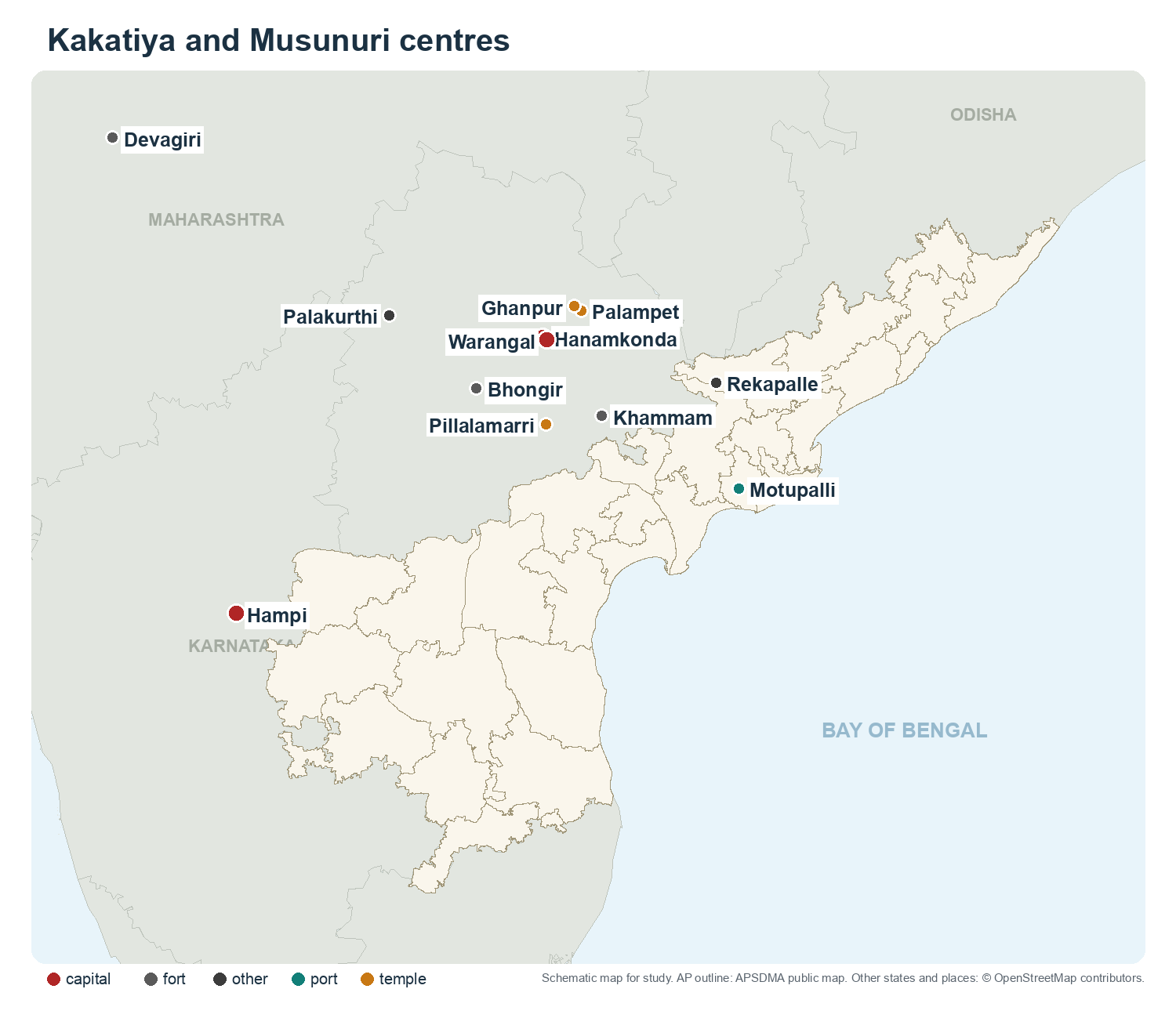
Where this chapter fits
After the Kakatiyas, the Telugu country was ruled by many smaller houses. Reddis, Velamas, Musunuris, Gajapatis and Nayakas are the names in the chapter title. These families took over regions that the Kakatiyas had once held. Many of them kept the Kakatiya temples, forts and literary ideas alive.
To understand them, you must first be sure of the Kakatiya base. That is why the key Kakatiya facts are repeated here in a compact form. Then the Musunuri Nayaks, the first group to rise after the fall, are covered in detail.
The Kakatiya background in short
The Kakatiya line ruled from Hanamkonda in early years and from Warangal later. The order of kings was Beta I, Prola I, Beta II, Prola II, Rudra Deva, Mahadeva, Ganapati Deva, Rudrama Devi and Prataparudra.
| Point | Fact |
|---|---|
| First independent ruler | Prola II |
| First woman ruler | Rudrama Devi |
| King who shifted the capital to Warangal | Ganapati Deva |
| Name used by Rudrama Devi | Rudradeva |
| Last ruler | Prataparudra |
| Fall of the dynasty | 1323 |
Fall and Delhi's attacks
Warangal was attacked by Delhi armies more than once.
| Event | Year |
|---|---|
| Siege of Warangal by Malik Kafur | 1309 or 1310 |
| First attack by Ulugh Khan | 1321 |
| Second siege by Ulugh Khan; fall of the Kakatiyas | 1323 |
| Recapture of Warangal by the Musunuri Nayaks | 1336 |
Ulugh Khan acted for the Tughlaq line. The Tughlaq dynasty was founded by Ghiyasuddin Tughlaq. Before it, the Khalji dynasty had been founded by Jalaluddin Khalji. Malik Kafur's attack came in the Khalji period. This helps you place each attack in the right Delhi dynasty.
Musunuri Nayaks
The Musunuri Nayaks rose against Delhi's rule after the Kakatiya fall. Their founder was Prolaya Nayaka, who is also called Musunuri Prolaya Nayaka. He led the revolt against the Delhi Sultanate. After him came Kapaya Nayaka. Prolaya Nayaka worked from Rekapalle; the Musunuris made Warangal their capital after Kapaya Nayaka recaptured it in 1336, the key date.
| Item | Detail |
|---|---|
| Dynasty | Musunuri Nayaks |
| Founder | Prolaya Nayaka |
| Next leader | Kapaya Nayaka |
| Capital | Warangal (from 1336; Prolaya at Rekapalle) |
| Key event | Recapture of Warangal, 1336 |
| Rebellion against | Delhi Sultanate |
Neighbouring powers of the same age
Questions also place the Musunuris beside other dynasties of the period.
| Dynasty | Founder | Capital |
|---|---|---|
| Musunuri Nayaks | Prolaya Nayaka | Warangal |
| Vijayanagara Empire | Harihara I | Hampi |
| Hoysalas | Sala | Dwarasamudra |
| Yadavas of Devagiri | (not given) | Devagiri |
| Pandyas | (not given) | Madurai |
Vijayanagara rose at the same time as the Musunuris. Hampi was its capital. Its best-known king, Krishnadevaraya, is called Andhra Bhoja. He is a later ruler, so do not mix him with the early Nayaks.
Kakatiya monuments that later rulers inherited
| Monument | Place | Builder / deity |
|---|---|---|
| Thousand Pillar Temple | Hanamkonda | Built 1163 by Rudra Deva; deity Rudreshwara |
| Ramappa Temple | Palampet | Built 1213 by Recherla Rudra; deity Ramalingeshwara; UNESCO 2021 |
| Warangal Fort | Warangal | Ganapati Deva |
| Pakhal Lake | Warangal district | Ganapati Deva |
| Padmakshi Temple | Hanamkonda | Deity Padmakshi |
| Bhadrakali Temple | Warangal / Hanamkonda | Deity Bhadrakali |
| Kakatiya Kala Thoranam | Warangal | Gateway of the old fort |
| Kota Gullu | Ghanpur | Temple group |
| Khammam Fort | Khammam | Fort |
| Bhongir Fort | Yadadri Bhuvanagiri district | Fort |
The Ramappa Temple is known for its floating bricks. The Recherla chiefs also built the temples at Pillalamarri (Suryapet district).
Literature and poet titles
| Work | Author |
|---|---|
| Nirvachanottara Ramayanam | Tikkana |
| Ranganatha Ramayanam | Gona Buddha Reddy |
| Basava Puranam | Palkuriki Somanatha |
| Panditaradhya Charitra | Palkuriki Somanatha |
| Shivatattvasaram | Mallikarjuna Pandita |
| Pratapa Rudra Yashobhushanam | Vidyanatha |
| Nritta Ratnavali | Jayapa Senani |
| Kridabhiramam | Vinukonda Vallabharaya |
| Sumati Shatakam | Baddena |
| Dashakumara Charitram | Ketana |
| Markandeya Purana | Marana |
Gona Buddha Reddy was a Kakatiya-era feudatory; do not place him in the later Reddi kingdom. Titles you must know:
| Poet | Title |
|---|---|
| Nannaya | Adi Kavi |
| Tikkana | Kavi Brahma |
| Errana | Prabandha Parameshwara |
| Srinatha | Kavi Sarvabhauma |
| Allasani Peddana | Andhra Kavita Pitamaha |
| Krishnadevaraya | Andhra Bhoja |
Timeline to memorise
Put the dates in one line. 1163 Thousand Pillar Temple; 1199 accession of Ganapati Deva; 1213 Ramappa Temple; 1244 Motupalli Abhaya Shasanam; 1262 accession of Rudrama Devi; 1289 accession of Prataparudra and the death of Rudrama Devi; 1309 or 1310 Malik Kafur at Warangal; 1321 first attack of Ulugh Khan; 1323 fall of the Kakatiyas; 1336 Musunuri recapture of Warangal; 2021 UNESCO recognition for the Ramappa Temple.
Trade and policy
The Motupalli Abhaya Shasanam of 1244 dealt with the protection of overseas traders. It is a famous example of a ruler's trade policy. Motupalli was also visited by Marco Polo around 1293, soon after Rudrama Devi's reign. Later Telugu powers kept using the coast for trade, so this edict is the base for questions on early maritime trade.
Places linked to this period
- Warangal: fort, Kala Thoranam, Bhadrakali Temple, Kakatiya University (1976) and carpets.
- Hanamkonda: Thousand Pillar Temple and Padmakshi Temple.
- Palampet in Mulugu district: Ramappa Temple, with Laknavaram Lake in the same district.
- Palakurthi: birthplace of Palkuriki Somanatha.
Exam traps
- Hanamkonda is the early Kakatiya capital; Warangal the later one, and also the Musunuri capital.
- Malik Kafur belongs to the Khalji period; Ulugh Khan acted under the Tughlaqs.
- The Kakatiyas fell in 1323; the Musunuris recaptured Warangal in 1336. Do not swap them.
- Prolaya Nayaka led the revolt; Kapaya Nayaka followed him.
- Recherla Rudra built the Ramappa Temple, not Rudra Deva. Rudra Deva built the Thousand Pillar Temple.
- Tikkana is Kavi Brahma; Errana is Prabandha Parameshwara. These two are often swapped.
- Krishnadevaraya (Andhra Bhoja) is a Vijayanagara king, not a Musunuri.
- Palkuriki Somanatha wrote Basava Puranam and Panditaradhya Charitra, not Gona Buddha Reddy.
One-liners
- 1. Founder of the Musunuri Nayaks: Prolaya Nayaka.
- 2. Prolaya Nayaka's successor: Kapaya Nayaka.
- 3. Warangal was recaptured in 1336.
- 4. Kakatiya rule ended in 1323.
- 5. Harihara I founded the Vijayanagara Empire.
- 6. Hampi was the capital of Vijayanagara.
- 7. Ganapati Deva moved the capital to Warangal.
- 8. Tikkana is Kavi Brahma.
- 9. Errana is Prabandha Parameshwara.
- 10. Nannaya is Adi Kavi.
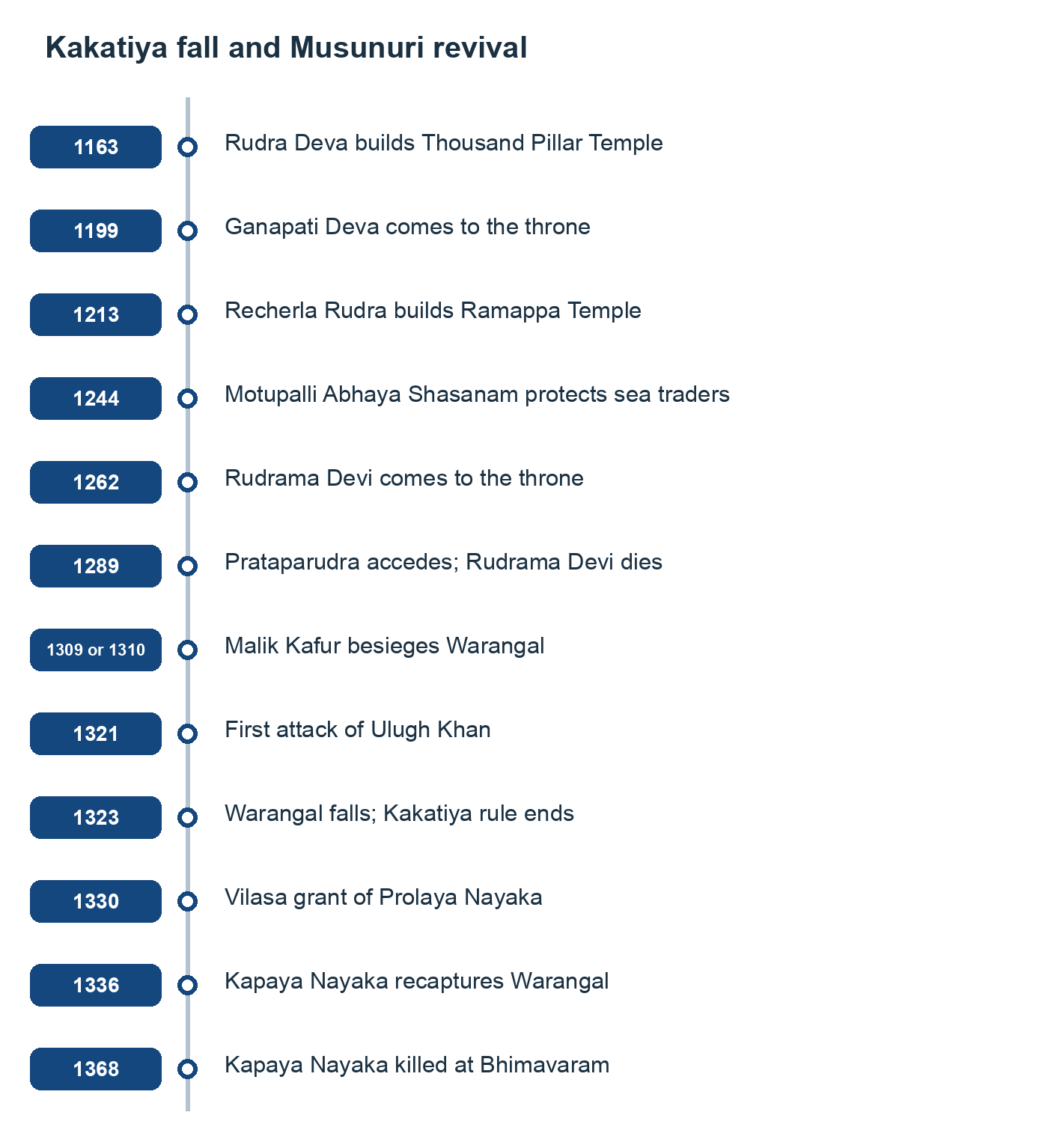
Background and context
By about 1300 the Kakatiya kingdom was the strongest power in the Telugu country. Its rulers had begun as small chiefs who served bigger kings. Over time they gathered the dry upland of Telangana and the rich river delta of the east under one crown. Warangal, the later capital, stood between these two regions. This position made the kingdom wealthy. It also made it a tempting target.
At the same time, the Sultanate of Delhi was growing fast. Under the Khalji rulers it began to send armies deep into the Deccan, far from its home in the north. The aim was money and tribute, and later control. A kingdom with rich farms, a busy sea trade and old treasure was an obvious goal. The Kakatiyas were first made to pay, and only later were they swallowed up.
This chapter follows three linked stories. The first is how Delhi's pressure broke Kakatiya rule. The second is how a group of Telugu war leaders, the Musunuri Nayaks, took Warangal back. The third is what the Kakatiyas left behind that later kingdoms used. The later Reddi, Velama, Gajapati and southern Nayaka houses are told in the next chapter.
Political history
Delhi comes south (1309-1310). The Khalji ruler Alauddin sent his general Malik Kafur to the Deccan. Warangal was besieged. Prataparudra, the Kakatiya king, did not fight to the end. He agreed to pay a heavy tribute and to send gifts of great value, including a famous diamond that is said to have reached Delhi. The date of this siege is given as 1309 by some writers and 1310 by others. So it is safer to say "1309-10" if a question gives no choice. At this stage Warangal was made a tribute-payer, but it was not yet annexed.
Delhi weakens, Warangal tests its freedom (1320). In 1320 the Khalji line was overthrown in Delhi and the Tughlaq family took the throne under Ghiyasuddin Tughlaq. Prataparudra used the confusion to stop paying tribute. In effect he declared that Warangal was free again. This is the direct cause of the final attacks. The new rulers could not accept a rich southern kingdom that refused to pay.
The attacks of the Tughlaq prince (1321-1323). The Tughlaq ruler sent his son, known at that time as Ulugh Khan (he later became Muhammad bin Tughluq). The exam lists an attack in 1321 and the final siege in 1323. The first attempt collapsed from within. Word went round the army that the old Sultan had died, a mutiny followed, and Ulugh Khan fell back to Devagiri. He came again with fresh troops. This time he cleared the small forts along the road before he laid siege to Warangal, whose outer and inner walls held for months. A friendly king of Odisha helped Prataparudra, but not enough, and Prataparudra surrendered in 1323.
The end of Prataparudra. The king was sent towards Delhi as a prisoner. Reports say he ended his own life on the way, near the river Narmada. This is a reported account, so write it with care. Rule from Warangal ended. The region was brought directly under Delhi and was governed by officers sent from the north.
Why the Kakatiyas lost. Four causes can be named. First, the Sultanate had a larger army and more money. Second, Warangal's great walls were strong but the kingdom had no second line of defence once they were surrounded. Third, the Kakatiyas had no strong ally close by. Fourth, many local war leaders under the king were loyal to their own land and honour, not to the capital, and the old structure broke when the king fell.
The people who rose after the fall. Direct rule from far away did not work. Taxes were heavy and the officers did not know the land. Many Telugu war leaders, called Nayakas, were angry. The Kakatiya system had made such leaders, and they now had no king. They joined together under one chief from the Musunuri family. The family was little known before this time, and later claims about its caste are disputed.
Prolaya Nayaka (c. 1330-1333). A copper-plate record of 1330, the Vilasa grant, shows him presenting himself as the person who restored order after the suffering caused by foreign armies. He is named as the first leader and is said to have worked from the forested hills near the Godavari. He left no son, and a cousin took his place.
Kapaya Nayaka (1333-1368). He is the main figure of this chapter. In 1336 he drove the Tughlaq garrison out of Warangal, having first gathered the Telugu chiefs, and the Hoysala king Veera Ballala III was among those who helped from outside. Warangal became his capital. He took a Persian-style title, which can be rendered "Sultan of the Andhra country", and it shows that the Telugu chiefs now spoke the language of power that the Sultanate had made normal. Remember that his rise ran alongside two events told in other chapters: the founding of the Vijayanagara kingdom and the rise of the Bahmani Sultanate in the Deccan.
Struggle with the Bahmanis and the end of the line. Pressure came from the west, where the Bahmani rulers took important places from the Musunuris, among them the fort of Golconda. Then in 1368 Kapaya was killed in a battle at Bhimavaram, reported to have been fought against the Recherla Nayakas, who were also Telugu war leaders. Musunuri power ended there, and the Recherla chiefs became the strongest family in the region for the next decades.
| Year | Event | Remark |
|---|---|---|
| 1309-10 | Malik Kafur besieges Warangal | Khalji period; tribute taken |
| 1320 | Khalji line ends in Delhi | Prataparudra stops paying |
| 1321 | First attack by Ulugh Khan | Listed in the exam; ended in retreat |
| 1323 | Fall of Warangal | Kakatiya rule ends |
| 1330 | Vilasa grant of Prolaya Nayaka | Founder's record |
| 1336 | Warangal recovered | Led by Kapaya Nayaka |
| 1368 | Death of Kapaya Nayaka | Musunuri line ends |
Administration and economy
What the Kakatiyas built. The Kakatiya kings did not rule only by the sword. They made a new type of society in which a warrior leader, called a Nayaka, could rise from any birth. A man who served well in war could be given the Nayaka title and a share of land and income. This opened the army to farmers and others who would not earlier have had a place there. The same idea later passed to the Musunuri chiefs and, in a larger form, to the Vijayanagara kings and the southern Nayaka houses.
Water and farming. The Kakatiya kings and their chiefs dug a very large number of tanks in the dry upland. Pakhal, made in the time of Ganapati Deva, is the best known. These tanks turned thin soil into farmland and caused villages to grow. Many are still in use today. This is the quiet side of the dynasty, and it is a good example of how a state could win loyalty by helping farmers.
Fort and city. Ganapati Deva made Warangal a strong capital. Its walls were built in granite, with bastions, and the ruined gateways of the old fort are a reminder of the plan. His successor Rudrama Devi, who ruled from 1262 to 1289, raised the walls further and added defences. She is one of the few women rulers in Indian history, and the traveller Marco Polo, who passed along this coast around 1292-93, spoke well of her rule.
Trade. Ganapati Deva gave merchants an easier life. He removed all the small taxes and kept one fixed duty, and he protected traders who made long journeys. The coastal port of Motupalli was the gateway for this trade. The edict of 1244 from the exam list, known as the Abhaya Shasanam, is the written form of this promise to sea traders. Marco Polo's visit to this port, c. 1292-93, shows that the trade was still active after the queen's time.
Musunuri government. The Musunuris did not have a long time or great resources. Their government was a union of war leaders around one head. Land grants and honours were used to bind chiefs to the leader. When the leader died or lost a battle, the union could easily weaken. This is the main reason why the Musunuri state was short.
Society, religion and culture
Temples. Kakatiya temples are among the finest in the Deccan. Rudra Deva built the Thousand Pillar Temple at Hanamkonda in 1163, dedicated to Rudreshwara. The Ramappa Temple at Palampet was built in 1213 by Recherla Rudra, a general of Ganapati Deva, for the god Ramalingeshwara. It is known for its elegant sculpture and for light bricks that are said to float. UNESCO listed it in 2021. Other places to know are the Padmakshi Temple and Bhadrakali Temple at Hanamkonda and Warangal, the Kota Gullu group at Ghanpur, the Kakatiya Kala Thoranam at Warangal, and the old forts of Khammam and Bhongir. The temple builders were not only kings. Generals such as Recherla Rudra paid for large works, which shows how widely power was shared.
Religion. Early Kakatiya rulers gave support to Jain places as well, but under later kings Shaiva faith grew strong. Shaiva teachers were given land and honour, and large temples were built for Shiva. Local deities and the worship of the goddess remained important.
Language and letters. In the early inscriptions the Kakatiyas wrote in Kannada. Over time Telugu took its place in records. This shift helped to make Telugu a language of rule. Writers worked in both Telugu and Sanskrit. Vidyanatha wrote Pratapa Rudra Yashobhushanam, a work on poetics that honours Prataparudra. Jayapa Senani, a military officer and writer, wrote Nritta Ratnavali on dance and was known by the epithet Gajasahini. Palkuriki Somanatha of Palakurthi wrote Basava Puranam and Panditaradhya Charitra. Mallikarjuna Pandita wrote Shivatattvasaram. Tikkana wrote Nirvachanottara Ramayanam. Gona Buddha Reddy was a local chief of the Kakatiya age who wrote Ranganatha Ramayanam. Baddena, Ketana and Marana are the writers of Sumati Shatakam, Dashakumara Charitram and Markandeya Purana. Keep each work tied to one name.
Poet titles. Nannaya is Adi Kavi. Tikkana is Kavi Brahma in this chapter's lists. Errana is Prabandha Parameshwara. Srinatha is Kavi Sarvabhauma. Allasani Peddana is Andhra Kavita Pitamaha. Krishnadevaraya is Andhra Bhoja, a king and not a poet of the Kakatiya age.
Dance and art. Perini Shivatandavam, a vigorous dance for Shiva, is linked with Telangana and with the temple carving of the Kakatiya age. Jayapa Senani's book on dance is the written side of the same tradition.
Decline, legacy and sites to know
The Kakatiya state broke in 1323, but what the Kakatiyas made did not break. Telugu became a language of government. The Nayaka system spread. The water tanks went on feeding villages. The idea that upland and delta could be joined under one Telugu king was remembered. The Musunuri leaders took this memory as their claim to rule. Later the Vijayanagara kings used a similar system of Nayaka commanders, which is why the Kakatiya story is a base for the next four centuries.
| Place | What to remember |
|---|---|
| Hanamkonda | Early capital; Thousand Pillar Temple (1163, Rudra Deva); Padmakshi Temple |
| Warangal | Later capital; fort with granite walls; Kakatiya Kala Thoranam; Bhadrakali Temple; Musunuri capital after 1336 |
| Palampet | Ramappa Temple (1213, Recherla Rudra); UNESCO 2021 |
| Pakhal | Lake of Ganapati Deva |
| Ghanpur | Kota Gullu temple group |
| Pillalamarri | Temples built by the Recherla chiefs |
| Khammam and Bhongir | Old forts |
| Motupalli | Port; the edict of 1244; Marco Polo c. 1292-93 |
Warangal today still carries the name of the old kingdom. A university set up there in 1976 uses the Kakatiya name, and a medical college set up in 1959 does the same.
How examiners use this chapter
- Date pairs. The fall is 1323 and the Musunuri recovery of Warangal is 1336. Options often swap them. A fall must come before a recovery.
- Two Delhi dynasties. Malik Kafur belongs to the Khalji age; Ulugh Khan belongs to the Tughlaq age. Jalaluddin founded the Khaljis and Ghiyasuddin the Tughlaqs.
- Two Musunuri names. Prolaya Nayaka is the founder; Kapaya Nayaka is the one who recovered Warangal. Do not use the name Prolaya Vema Reddy here, because he is the Reddi founder.
- Capitals. Hanamkonda was early and Warangal later. Do not confuse them with Hampi (Vijayanagara) or Dwarasamudra (Hoysala).
- Builders. Rudra Deva built the Thousand Pillar Temple. Recherla Rudra built the Ramappa Temple. Ganapati Deva is linked with Pakhal and the fort walls.
- Works and authors. Basava Puranam: Palkuriki Somanatha. Ranganatha Ramayanam: Gona Buddha Reddy. Nirvachanottara Ramayanam: Tikkana. Pratapa Rudra Yashobhushanam: Vidyanatha.
- Poet titles. Tikkana and Errana are swapped most often. A king's title such as Andhra Bhoja is often placed among poets' titles as a trap.
- Trade. Motupalli with the 1244 edict and the Marco Polo visit (c. 1292-93) is the standard example of Kakatiya sea-trade policy.
Worked cases
Case 1: Which pair of dates is correct? (1) Fall of the Kakatiyas 1336; Musunuri recapture 1323 (2) Fall of the Kakatiyas 1323; Musunuri recapture 1336 (3) Both in 1323 (4) Both in 1336.
Reasoning:
- 1. Ulugh Khan's second siege ended Kakatiya rule in 1323.
- 2. The Musunuri Nayaks took Warangal back later, in 1336.
- 3. A fall must come before a recapture. So 1323 comes first.
- 4. Only option 2 keeps this order.
Takeaway: When two dates are swapped in the options, use cause and effect to fix the order.
Case 2: "Malik Kafur attacked Warangal under the Tughlaqs." Is this right?
Reasoning:
- 1. Jalaluddin Khalji founded the Khalji dynasty.
- 2. Ghiyasuddin Tughlaq founded the Tughlaq dynasty, which came after the Khaljis.
- 3. Malik Kafur's attack (1309 or 1310) belongs to the Khalji period.
- 4. Ulugh Khan's attacks (1321 and 1323) belong to the Tughlaq period. So the statement is wrong.
Takeaway: Place each attacker in the right Delhi dynasty by its date.
Case 3: Who led the revolt against the Delhi Sultanate, and who came after him? Options: (1) Kapaya Nayaka, then Prolaya Nayaka (2) Prolaya Nayaka, then Kapaya Nayaka (3) Harihara I, then Prolaya Nayaka (4) Sala, then Kapaya Nayaka.
Reasoning:
- 1. Prolaya Nayaka (Musunuri Prolaya Nayaka) founded the Musunuri Nayaks and led the revolt.
- 2. Kapaya Nayaka followed him.
- 3. Harihara I founded Vijayanagara. Sala founded the Hoysalas. Both are different dynasties.
- 4. Only option 2 is correct.
Takeaway: Remove options that bring in founders of other dynasties.
Case 4: Find the odd one out among the poet titles: Adi Kavi, Kavi Brahma, Prabandha Parameshwara, Andhra Bhoja.
Reasoning:
- 1. Nannaya is Adi Kavi.
- 2. Tikkana is Kavi Brahma.
- 3. Errana is Prabandha Parameshwara.
- 4. Andhra Bhoja is the title of Krishnadevaraya, a Vijayanagara king and not a Kakatiya-age poet.
Takeaway: A king's title can hide among poets' titles. Check who the title belongs to.
Compare and contrast
| Look-alike pair | Detail A | Detail B |
|---|---|---|
| Musunuri and Vijayanagara | Musunuri Nayaks: founder Prolaya Nayaka, capital Warangal | Vijayanagara Empire: founder Harihara I, capital Hampi |
| Hoysala and Kakatiya capitals | Hoysalas: Dwarasamudra | Kakatiyas: Hanamkonda early, Warangal later |
| Palampet and Hanamkonda | Palampet: Ramappa Temple, deity Ramalingeshwara | Hanamkonda: Thousand Pillar Temple (deity Rudreshwara) and Padmakshi Temple |
| Ganapati Deva and Recherla Rudra | King: Warangal Fort and Pakhal Lake | General: Ramappa Temple (the Pillalamarri temples were built by other Recherla family members) |
| Work | Author | Not to be mixed with |
|---|---|---|
| Basava Puranam | Palkuriki Somanatha | Gona Buddha Reddy |
| Ranganatha Ramayanam | Gona Buddha Reddy | Tikkana |
| Nirvachanottara Ramayanam | Tikkana | Errana |
| Pratapa Rudra Yashobhushanam | Vidyanatha | Jayapa Senani |
Memory tip for these pairs. Ask who, where and when for every item. Who: Prolaya Nayaka or Harihara I. Where: Warangal or Hampi. When: 1336 for the Musunuri recapture. For builders, remember that the king and the general are different people: Rudra Deva and Ganapati Deva were kings, and Recherla Rudra was a general. For poets, link each work with one name and one title, and then cross out any option that gives the same work to two poets.
Sequence and timeline
| Step | Event |
|---|---|
| 1 | Early Kakatiyas rule from Hanamkonda |
| 2 | Ganapati Deva shifts the capital to Warangal (he came to the throne in 1199) |
| 3 | Rudrama Devi comes to the throne, 1262 |
| 4 | Prataparudra comes to the throne, 1289 |
| 5 | Malik Kafur at Warangal, 1309 or 1310 |
| 6 | First attack of Ulugh Khan, 1321 |
| 7 | Second siege and fall of the Kakatiyas, 1323 |
| 8 | Musunuri Nayaks recapture Warangal, 1336 |
Later, in 2021, the Ramappa Temple was recognised by UNESCO.
How to use this timeline in the exam. Separate the Kakatiya events from the Musunuri events. Everything up to 1323 belongs to the Kakatiyas. The recapture of Warangal in 1336 belongs to the Musunuris. A question that says "after the fall of the Kakatiyas" points to Prolaya Nayaka and then Kapaya Nayaka.
Keep the two Delhi dynasties in order as well. The Khalji dynasty was founded by Jalaluddin Khalji. The Tughlaq dynasty was founded by Ghiyasuddin Tughlaq. Malik Kafur is placed in the Khalji period and Ulugh Khan in the Tughlaq period. If an option puts Ulugh Khan before Malik Kafur, it is wrong on the dates alone.
More one-liners
- 1. Kakatiya Medical College was set up in 1959.
- 2. Kakatiya University at Warangal was set up in 1976.
- 3. Jayapa Senani had the epithet Gajasahini.
- 4. Jayapa Senani wrote Nrityaratnavali and Gita Ratnavali.
- 5. Padmakshi Temple at Hanamkonda has the deity Padmakshi.
- 6. Bhadrakali Temple at Warangal has the deity Bhadrakali.
- 7. Kota Gullu is at Ghanpur.
- 8. Kakatiya Kala Thoranam is at Warangal.
- 9. Perini Shivatandavam is associated with Telangana.
- 10. Palakurthi is the birthplace of Palkuriki Somanatha.
- 11. Ketana wrote Dashakumara Charitram.
- 12. Marana wrote Markandeya Purana.
- 13. Baddena wrote Sumati Shatakam.
- 14. Mallikarjuna Pandita wrote Shivatattvasaram.
- 15. Vidyanatha wrote Pratapa Rudra Yashobhushanam.
Practice questions
Who was the first Kakatiya ruler to shift the capital from Hanamkonda to Warangal?
- Nannaya
- Muhammad Quli Qutb Shah
- Ganapati Deva
- C. R. Reddy
Answer
C. Ganapati Deva
రాజధానిని హనుమకొండ నుండి వరంగల్కు మార్చిన తొలి కాకతీయ పాలకుడు ఎవరు?
- నన్నయ
- ముహమ్మద్ కులీ కుతుబ్ షా
- గణపతిదేవుడు
- సి. ఆర్. రెడ్డి
Rudrama Devi, the Kakatiya woman ruler, was the daughter of:
- Rudra Deva
- Ganapati Deva
- Prataparudra
- Mahadeva
Answer
B. Ganapati Deva
Ganapati Deva had no son and named her successor.
కాకతీయ మహిళా పాలకురాలు రుద్రమదేవి ఎవరి కుమార్తె?
- రుద్రదేవుడు
- గణపతిదేవుడు
- ప్రతాపరుద్రుడు
- మహాదేవుడు
Who was the last ruler of the Kakatiya dynasty?
- Prataparudra
- Ganapati Deva
- Rudrama Devi
- Prola II
Answer
A. Prataparudra
Prataparudra was the last Kakatiya king, defeated in 1323.
కాకతీయ వంశపు చివరి పాలకుడు ఎవరు?
- ప్రతాపరుద్రుడు
- గణపతిదేవుడు
- రుద్రమదేవి
- రెండవ ప్రోలరాజు
Which Kakatiya ruler was a woman?
- Ganapati Deva
- Prataparudra
- Rudrama Devi
- Prola II
Answer
C. Rudrama Devi
Rudrama Devi ruled after her father Ganapati Deva.
కాకతీయ పాలకులలో మహిళా పాలకురాలు ఎవరు?
- గణపతిదేవుడు
- ప్రతాపరుద్రుడు
- రుద్రమదేవి
- రెండవ ప్రోలరాజు
Hanamkonda was the capital of which of the following?
- Kingdom of Mysore under Tipu Sultan
- Early Kakatiya dynasty
- Musunuri Nayaka kingdom
- Keladi Nayak kingdom
Answer
B. Early Kakatiya dynasty
హనుమకొండ ఈ క్రింది వాటిలో దేనికి రాజధాని?
- టిప్పు సుల్తాన్ మైసూరు రాజ్యం
- తొలి కాకతీయ వంశం
- ముసునూరి నాయక రాజ్యం
- కేళడి నాయక రాజ్యం
Who was the first independent ruler of the Kakatiya dynasty?
- Prola II
- Fort St George
- K. Chandrashekar Rao
- N. Sanjiva Reddy
Answer
A. Prola II
కాకతీయ వంశపు తొలి స్వతంత్ర పాలకుడు ఎవరు?
- రెండవ ప్రోలరాజు
- ఫోర్ట్ సెయింట్ జార్జ్
- కె. చంద్రశేఖరరావు
- నీలం సంజీవరెడ్డి
Who was the first woman ruler of the Kakatiya dynasty?
- Muhammad Quli Qutb Shah
- Rudrama Devi
- Colin Mackenzie
- C. R. Reddy
Answer
B. Rudrama Devi
కాకతీయ వంశపు తొలి మహిళా పాలకురాలు ఎవరు?
- ముహమ్మద్ కులీ కుతుబ్ షా
- రుద్రమదేవి
- కాలిన్ మెకంజీ
- సి. ఆర్. రెడ్డి
Which of the following is located in the Ghanpur area?
- Padmakshi Temple
- Bhadrakali Temple
- Kota Gullu
- Kakatiya Kala Thoranam
Answer
C. Kota Gullu
ఈ క్రింది వాటిలో ఏది ఘనపూర్ ప్రాంతంలో ఉంది?
- పద్మాక్షి దేవాలయం
- భద్రకాళి దేవాలయం
- కోటగుళ్లు
- కాకతీయ కళాతోరణం
Which of the following is NOT correctly paired with Warangal (Place – Location)?
- Thousand Pillar temple
- Kakatiya Kala Thoranam
- Salar Jung Museum
- Kakatiya University
Answer
C. Salar Jung Museum
ఈ క్రింది వాటిలో ఏది 'వరంగల్' అనే అంశానికి సరిగ్గా జతకాదు? (ప్రదేశం – ఉన్న చోటు)
- వేయి స్తంభాల గుడి
- కాకతీయ కళాతోరణం
- సాలార్ జంగ్ మ్యూజియం
- కాకతీయ విశ్వవిద్యాలయం
Who is regarded as the greatest ruler of the Kakatiya dynasty?
- Mahadeva
- Prola I
- Rudra Deva
- Ganapati Deva
Answer
D. Ganapati Deva
He ruled for over sixty years and united the Telugu country.
కాకతీయ వంశంలో గొప్ప పాలకుడిగా భావించబడేది ఎవరు?
- మహాదేవుడు
- మొదటి ప్రోలరాజు
- రుద్రదేవుడు
- గణపతిదేవుడు
Prataparudra Yashobhushanam, a Sanskrit work on poetics, was written by:
- Tikkana
- Jayapa Senani
- Ketana
- Vidyanatha
Answer
D. Vidyanatha
Vidyanatha named it in honour of the king.
సంస్కృత అలంకార శాస్త్ర గ్రంథం ప్రతాపరుద్ర యశోభూషణం రచయిత ఎవరు?
- తిక్కన
- జాయప సేనాని
- కేతన
- విద్యానాథుడు
Who wrote Ranganatha Ramayanam?
- Tikkana
- Gona Buddha Reddy
- Marana
- Baddena
Answer
B. Gona Buddha Reddy
Gona Buddha Reddy wrote it.
రంగనాథ రామాయణాన్ని రచించింది ఎవరు?
- తిక్కన
- గోన బుద్ధారెడ్డి
- మారన
- బద్దెన
Who wrote the Nirvachanottara Ramayanam?
- Ketana
- Gona Buddha Reddy
- Tikkana
- Marana
Answer
C. Tikkana
Tikkana.
నిర్వచనోత్తర రామాయణం రచయిత ఎవరు?
- కేతన
- గోన బుద్ధారెడ్డి
- తిక్కన
- మారన
The Ramappa Temple at Palampet was built in the reign of Ganapatideva under the supervision of his general:
- Recherla Rudra
- Gona Ganna Reddy
- Malyala Chaunda
- Gannamanayudu
Answer
A. Recherla Rudra
Recherla Rudra, a commander of Ganapatideva, built the Ramalingeswara (Ramappa) temple around 1213 CE.
పాలంపేటలోని రామప్ప దేవాలయాన్ని గణపతిదేవుని కాలంలో ఆయన సేనాని ఎవరి ఆధ్వర్యంలో నిర్మించారు?
- రేచర్ల రుద్రుడు
- గోన గన్నారెడ్డి
- మాల్యాల చౌండ
- గన్నమనాయుడు
Which dynasty with capital at Warangal under Rudra and Ganapati fought for the Godavari delta?
- Vijayanagar
- Eastern Chalukyas
- Barid Shahi
- Kakatiya
Answer
D. Kakatiya
రుద్రుడు మరియు గణపతి ఆధ్వర్యంలో వరంగల్ను రాజధానిగా చేసుకుని గోదావరి డెల్టా కోసం పోరాడిన రాజవంశం ఏది?
- విజయనగర
- తూర్పు చాళుక్యులు
- బరీద్ షాహీ
- కాకతీయ
Venkatagiri was the capital of which of the following?
- Reddy kingdom of Kondavidu
- Venkatagiri Estate
- Later Kakatiya dynasty
- Telangana
Answer
B. Venkatagiri Estate
వెంకటగిరి ఈ క్రింది వాటిలో దేనికి రాజధాని?
- కొండవీడు రెడ్డి రాజ్యం
- వెంకటగిరి సంస్థానం
- తరువాతి కాకతీయ వంశం
- తెలంగాణ
Which of the following is located in the Palampet area?
- Bhadrakali Temple
- Padmakshi Temple
- Kota Gullu
- Ramappa Temple
Answer
D. Ramappa Temple
ఈ క్రింది వాటిలో ఏది పాలంపేట ప్రాంతంలో ఉంది?
- భద్రకాళి దేవాలయం
- పద్మాక్షి దేవాలయం
- కోటగుళ్లు
- రామప్ప దేవాలయం
In which district or place is Padmakshi Temple located?
- Palampet
- Ghanpur
- Warangal
- Hanamkonda
Answer
D. Hanamkonda
పద్మాక్షి దేవాలయం ఏ జిల్లా/ప్రాంతంలో ఉంది?
- పాలంపేట
- ఘనపూర్
- వరంగల్
- హనుమకొండ
In which year did this event take place: Recognition of Ramappa Temple as a UNESCO World Heritage Site?
- 2024
- 2023
- 2021
- 2020
Answer
C. 2021
ఈ సంఘటన ఏ సంవత్సరంలో జరిగింది: రామప్ప దేవాలయానికి యునెస్కో ప్రపంచ వారసత్వ గుర్తింపు?
- 2024
- 2023
- 2021
- 2020
Consider the following pairs (Event – Year): (i) Recognition of Ramappa Temple as a UNESCO World Heritage Site – 2021 (ii) Lahore Resolution of the Muslim League – 1940 (iii) Commonwealth Games in Gold Coast – 2018 Which of the pairs are correctly matched?
- All of (i), (ii) and (iii)
- Only (i) and (ii)
- Only (i) and (iii)
- Only (i)
Answer
A. All of (i), (ii) and (iii)
ఈ క్రింది జతలను పరిశీలించండి (సంఘటన – సంవత్సరం): (i) రామప్ప దేవాలయానికి యునెస్కో ప్రపంచ వారసత్వ గుర్తింపు – 2021 (ii) ముస్లిం లీగ్ లాహోర్ తీర్మానం – 1940 (iii) గోల్డ్ కోస్ట్ కామన్వెల్త్ క్రీడలు – 2018 సరిగ్గా జతపరచబడినవి ఏవి?
- (i), (ii), (iii) అన్నీ
- (i), (ii) మాత్రమే
- (i), (iii) మాత్రమే
- (i) మాత్రమే
Komaram Bheem led which of the following?
- Operation Polo
- Attack on the British Residency at Hyderabad
- Musunuri revolt against the Delhi Sultanate
- Gond rebellion of Adilabad
Answer
D. Gond rebellion of Adilabad
కొమురం భీం నాయకత్వం వహించినది ఏది?
- ఆపరేషన్ పోలో
- హైదరాబాద్ బ్రిటిష్ రెసిడెన్సీపై దాడి
- ఢిల్లీ సుల్తానులపై ముసునూరి తిరుగుబాటు
- ఆదిలాబాద్ గోండు తిరుగుబాటు
Turrebaz Khan led which of the following?
- Gond rebellion of Adilabad
- Musunuri revolt against the Delhi Sultanate
- Attack on the British Residency at Hyderabad
- Rebellion of Nirmal
Answer
C. Attack on the British Residency at Hyderabad
తుర్రేబాజ్ ఖాన్ నాయకత్వం వహించినది ఏది?
- ఆదిలాబాద్ గోండు తిరుగుబాటు
- ఢిల్లీ సుల్తానులపై ముసునూరి తిరుగుబాటు
- హైదరాబాద్ బ్రిటిష్ రెసిడెన్సీపై దాడి
- నిర్మల్ తిరుగుబాటు
Who built Ramappa Temple?
- Thirumala Nayaka
- Anapota Reddy
- Mir Osman Ali Khan
- Recherla Rudra
Answer
D. Recherla Rudra
రామప్ప దేవాలయం నిర్మాత ఎవరు?
- తిరుమల నాయకుడు
- అనపోతా రెడ్డి
- మీర్ ఉస్మాన్ అలీ ఖాన్
- రేచర్ల రుద్రుడు
Arrange the following in chronological order (earliest first): (i) Permanent Settlement in the Northern Circars (ii) Subsidiary Alliance with the Nizam (iii) Revolt of the Nawab of Kurnool (iv) Construction of Thousand Pillar Temple
- (iv), (ii), (i), (iii)
- (i), (iv), (iii), (ii)
- (iii), (iv), (ii), (i)
- (iii), (i), (iv), (ii)
Answer
A. (iv), (ii), (i), (iii)
ఈ క్రింది వాటిని కాలక్రమానుసారం (పూర్వం నుండి తరువాతి వరకు) అమర్చండి: (i) ఉత్తర సర్కార్లలో శాశ్వత శిస్తు నిర్ణయం (ii) నిజాంతో సహాయక సంధి (iii) కర్నూలు నవాబు తిరుగుబాటు (iv) వేయి స్తంభాల గుడి నిర్మాణం
- (iv), (ii), (i), (iii)
- (i), (iv), (iii), (ii)
- (iii), (iv), (ii), (i)
- (iii), (i), (iv), (ii)
Consider the statements: (i) Rudrama Devi ruled the Kakatiya kingdom as a woman sovereign. (ii) Prataparudra, the last Kakatiya king, lost to a Delhi Sultanate army in 1323. Which of the statements is/are correct?
- Only (i)
- Only (ii)
- Neither (i) nor (ii)
- Both (i) and (ii)
Answer
D. Both (i) and (ii)
Both facts hold true.
ఈ ప్రవచనాలను పరిశీలించండి: (i) రుద్రమదేవి కాకతీయ రాజ్యాన్ని మహిళా పాలకురాలిగా పరిపాలించింది. (ii) చివరి కాకతీయ రాజు ప్రతాపరుద్రుడు 1323లో ఢిల్లీ సుల్తానేట్ సైన్యం చేతిలో ఓడిపోయాడు. ఏ ప్రవచనం/ప్రవచనాలు సరైనవి?
- (i) మాత్రమే
- (ii) మాత్రమే
- (i), (ii) రెండూ కావు
- (i), (ii) రెండూ
Consider the statements: (i) Ganapati Deva shifted the capital from Hanamkonda to Orugallu. (ii) Rudramadevi was the successor of Prataparudra II. (iii) Prataparudra II was the last Kakatiya ruler. Which is/are correct?
- Only (i)
- Only (ii)
- Both (i) and (iii)
- All of (i), (ii), (iii)
Answer
C. Both (i) and (iii)
Rudramadevi came before Prataparudra II, so (ii) is wrong.
ఈ ప్రకటనలను పరిశీలించండి: (i) గణపతిదేవుడు రాజధానిని హనుమకొండ నుండి ఓరుగల్లుకు మార్చాడు. (ii) రుద్రమదేవి రెండో ప్రతాపరుద్రుని వారసురాలు. (iii) రెండో ప్రతాపరుద్రుడు చివరి కాకతీయ పాలకుడు. ఏది/ఏవి సరైనవి?
- (i) మాత్రమే
- (ii) మాత్రమే
- (i), (iii) రెండూ
- (i), (ii), (iii) అన్నీ
Who composed the Ranganatha Ramayanam, the first Telugu Ramayana in dwipada metre?
- Pothana
- Tikkana
- Gona Buddha Reddy
- Errana
Answer
C. Gona Buddha Reddy
Gona Buddha Reddy, a chief of the Kakatiya age, wrote it.
ద్విపద ఛందస్సులో తొలి తెలుగు రామాయణమైన రంగనాథ రామాయణాన్ని రచించినవారు ఎవరు?
- పోతన
- తిక్కన
- గోన బుద్ధారెడ్డి
- ఎర్రన
In which town is the Thousand Pillar (Rudreshwara) Temple of the Kakatiya period located?
- Kondaveedu
- Srisailam
- Draksharamam
- Hanamkonda
Answer
D. Hanamkonda
It stands at Hanamkonda beside Warangal.
కాకతీయుల కాలపు వేయి స్తంభాల (రుద్రేశ్వర) గుడి ఏ పట్టణంలో ఉంది?
- కొండవీడు
- శ్రీశైలం
- ద్రాక్షారామం
- హనుమకొండ
Who wrote Shivatatvasaram, the first independent Telugu kavya?
- Palkuriki Somanatha
- Panditaradhya Mallikarjuna
- Manchana
- Nannechoda
Answer
B. Panditaradhya Mallikarjuna
Mallikarjuna Pandita authored it.
తెలుగులో మొదటి స్వతంత్ర కావ్యం శివతత్వసారం రచించినవారు ఎవరు?
- పాల్కురికి సోమనాథుడు
- పండితారాధ్య మల్లికార్జునుడు
- మంచన
- నన్నెచోడుడు
Which is NOT a work of Palkuriki Somanatha?
- Panditaradhya Charitra
- Keyurabahu Charitra
- Vrishadhipa Shatakam
- Basava Puranam
Answer
B. Keyurabahu Charitra
Keyurabahu Charitra is Manchana's.
పాల్కురికి సోమనాథుని రచన కానిది ఏది?
- పండితారాధ్య చరిత్ర
- కేయూరబాహు చరిత్ర
- వృషాధిప శతకం
- బసవ పురాణం
Which work did Ketana compose?
- Dasakumara Charitra
- Markandeya Purana
- Nirvachanottara Ramayanam
- Kumara Sambhavam
Answer
A. Dasakumara Charitra
Ketana wrote Dasakumara Charitra.
కేతన రచించిన గ్రంథం ఏది?
- దశకుమార చరిత్ర
- మార్కండేయ పురాణం
- నిర్వచనోత్తర రామాయణం
- కుమార సంభవం
Which work did Marana compose?
- Dasakumara Charitra
- Nirvachanottara Ramayanam
- Harivamsam
- Markandeya Purana
Answer
D. Markandeya Purana
Marana wrote Markandeya Purana.
మారన రచించిన గ్రంథం ఏది?
- దశకుమార చరిత్ర
- నిర్వచనోత్తర రామాయణం
- హరివంశం
- మార్కండేయ పురాణం
Jayapa Senani was the elephant force chief (gajasahini) of whom?
- Ganapatideva
- Prataparudra
- Rudradeva
- Mahadeva
Answer
A. Ganapatideva
He was Ganapatideva's gajasahini.
జాయప సేనాని ఎవరి గజసాహిని?
- గణపతిదేవుడు
- ప్రతాపరుద్రుడు
- రుద్రదేవుడు
- మహాదేవుడు
Who wrote Panditaradhya Charitra?
- Baddena
- Ekamranatha
- Palkuriki Somanatha
- Jayapa
Answer
C. Palkuriki Somanatha
Somanatha wrote it in Telugu.
పండితారాధ్య చరిత్ర రచయిత ఎవరు?
- బద్దెన
- ఏకామ్రనాథుడు
- పాల్కురికి సోమనాథుడు
- జాయప
Which Kakatiya commanders defeated the Muslim army in the first attack?
- Recherla Rudra and Jayapa
- Revella Sena and Potuganti Maili
- Gona Gannareddy and Bommireddy
- Kota Betaraju and Gangaya
Answer
B. Revella Sena and Potuganti Maili
Two commanders defeated them.
మొదటి దాడిలో ముస్లిం సైన్యాన్ని ఓడించిన కాకతీయ సేనాపతులు ఎవరు?
- రేచర్ల రుద్ర, జాయప
- రేవెళ్ల సేనా, పోతుగంటి మైలి
- గోనగన్నారెడ్డి, బొమ్మిరెడ్డి
- కోట బేతరాజు, గంగయ
Who built the Ramappa temple at Palampet?
- Ganapatideva
- Recherla Rudra
- Prola Raja
- Betaraja
Answer
B. Recherla Rudra
Recherla Rudra built the Ramappa temple.
పాలంపేటలోని రామప్ప దేవాలయాన్ని నిర్మించింది ఎవరు?
- గణపతిదేవుడు
- రేచర్ల రుద్రుడు
- ప్రోలరాజు
- బేతరాజు
Who wrote Nritta Ratnavali?
- Vidyanatha
- Jayapa Senani
- Ketana
- Marana
Answer
B. Jayapa Senani
Jayapa Senani wrote Nritta Ratnavali.
నృత్త రత్నావళి గ్రంథ రచయిత ఎవరు?
- విద్యానాథుడు
- జాయప సేనాని
- కేతన
- మారన
Which work was composed by Gona Buddha Reddy?
- Ranganatha Ramayanam
- Nirvachanottara Ramayanam
- Markandeya Puranam
- Simhagiri Narahari Vachanam
Answer
A. Ranganatha Ramayanam
Ranganatha Ramayanam.
గోన బుద్ధారెడ్డి రచించిన గ్రంథం ఏది?
- రంగనాథ రామాయణం
- నిర్వచనోత్తర రామాయణం
- మార్కండేయ పురాణం
- సింహగిరి నరహరి వచనం
Who completed the remaining part of the Ranganatha Ramayanam?
- His sons Kachavibhu and Vitthalanatha
- Tikkana
- Gannaya Nayaka
- Gona Ganapati Reddy
Answer
A. His sons Kachavibhu and Vitthalanatha
Sons Kachavibhu and Vitthalanatha completed it.
రంగనాథ రామాయణంలో మిగిలిన భాగాన్ని పూర్తి చేసినవారు ఎవరు?
- అతని కుమారులు కాచవిభుడు, విఠలనాథుడు
- తిక్కన
- గన్నయ నాయకుడు
- గోన గణపతిరెడ్డి
Who wrote the Ranganatha Ramayanam?
- Molla
- Gona Buddha Reddy
- Tikkana
- Marana
Answer
B. Gona Buddha Reddy
Gona Buddha Reddy.
రంగనాథ రామాయణం రచయిత ఎవరు?
- మొల్ల
- గోన బుద్ధారెడ్డి
- తిక్కన
- మారన
Arrange the following in chronological order (earliest first): (i) Kakatiya Medical College (ii) Telangana Regional Committee (iii) Golkonda Patrika (iv) Fazl Ali Commission
- (iv), (iii), (i), (ii)
- (iii), (i), (iv), (ii)
- (iii), (iv), (ii), (i)
- (i), (iii), (ii), (iv)
Answer
C. (iii), (iv), (ii), (i)
ఈ క్రింది వాటిని కాలక్రమానుసారం (పూర్వం నుండి తరువాతి వరకు) అమర్చండి: (i) కాకతీయ వైద్య కళాశాల (ii) తెలంగాణ ప్రాంతీయ సంఘం (iii) గోల్కొండ పత్రిక (iv) ఫజల్ అలీ కమిషన్
- (iv), (iii), (i), (ii)
- (iii), (i), (iv), (ii)
- (iii), (iv), (ii), (i)
- (i), (iii), (ii), (iv)
Arrange the following in chronological order (earliest first): (i) Nizam College (ii) Telangana Regional Committee (iii) Hitakarini Samaj (iv) Kakatiya Medical College
- (i), (iii), (ii), (iv)
- (ii), (iii), (iv), (i)
- (i), (iv), (ii), (iii)
- (ii), (i), (iv), (iii)
Answer
A. (i), (iii), (ii), (iv)
ఈ క్రింది వాటిని కాలక్రమానుసారం (పూర్వం నుండి తరువాతి వరకు) అమర్చండి: (i) నిజాం కళాశాల (ii) తెలంగాణ ప్రాంతీయ సంఘం (iii) హితకారిణీ సమాజం (iv) కాకతీయ వైద్య కళాశాల
- (i), (iii), (ii), (iv)
- (ii), (iii), (iv), (i)
- (i), (iv), (ii), (iii)
- (ii), (i), (iv), (iii)
Arrange the Kakatiya rulers in order of reign, earliest first: (1) Prataparudra (2) Ganapati Deva (3) Rudrama Devi
- (2), (3), (1)
- (3), (2), (1)
- (1), (2), (3)
- (2), (1), (3)
Answer
A. (2), (3), (1)
Ganapati Deva was succeeded by his daughter Rudrama Devi and then Prataparudra.
కాకతీయ పాలకులను పాలనా క్రమంలో (మొదటివారు ముందుగా) అమర్చండి: (1) ప్రతాపరుద్రుడు (2) గణపతిదేవుడు (3) రుద్రమదేవి
- (2), (3), (1)
- (3), (2), (1)
- (1), (2), (3)
- (2), (1), (3)
The Kakatiya queen Rudrama Devi was the daughter of:
- Rudradeva
- Mahadeva
- Ganapatideva
- Prataparudra
Answer
C. Ganapatideva
Ganapatideva had no son and nominated his daughter Rudrama as his successor.
కాకతీయ రాణి రుద్రమదేవి ఎవరి కుమార్తె?
- రుద్రదేవుడు
- మహాదేవుడు
- గణపతిదేవుడు
- ప్రతాపరుద్రుడు
Tikkana Somayaji, author of the Telugu Mahabharata's later parvas, was associated with the court of which Nellore ruler?
- Ganapati Deva
- Manumasiddhi
- Prataparudra
- Rajaraja Narendra
Answer
B. Manumasiddhi
Tikkana served the Telugu Choda king Manumasiddhi of Nellore.
ఆంధ్ర మహాభారతంలోని తరువాతి పర్వాల రచయిత తిక్కన సోమయాజి నెల్లూరులోని ఏ రాజు ఆస్థానంతో సంబంధం కలవాడు?
- గణపతిదేవుడు
- మనుమసిద్ధి
- ప్రతాపరుద్రుడు
- రాజరాజ నరేంద్రుడు
Practice set 2
Which prince, later known as Muhammad-bin-Tughluq, defeated Kakatiya Prataparudra at Warangal in 1323?
- Neknam Khan
- Mustafa Khan
- Mubariz Khan
- Ulugh Khan
Answer
D. Ulugh Khan
1323లో వరంగల్ వద్ద కాకతీయ ప్రతాపరుద్రుని ఓడించిన, తరువాత ముహమ్మద్-బిన్-తుగ్లక్గా పేరుపొందిన యువరాజు ఎవరు?
- నెక్నమ్ ఖాన్
- ముస్తఫా ఖాన్
- ముబారిజ్ ఖాన్
- ఉలుగ్ ఖాన్
Which early Kakatiya ruler invaded Vengi about 1150 AD and is believed to have died opposing the Haihayas of Kona?
- Prola II
- Rudramba
- Ganapati
- Taila II
Answer
A. Prola II
సుమారు క్రీ.శ. 1150లో వేంగిపై దండెత్తి, కోన హైహయులను ఎదిరిస్తూ మరణించి ఉంటాడని భావించే తొలి కాకతీయ పాలకుడు ఎవరు?
- రెండవ ప్రోలుడు
- రుద్రమ్మ
- గణపతి
- రెండవ తైలపుడు
Kondaveedu was the capital of which of the following?
- Tughlaq dynasty
- Rajendra I
- Reddy kingdom of Kondaveedu
- Bahmani Sultanate in its later phase
Answer
C. Reddy kingdom of Kondaveedu
కొండవీడు ఈ క్రింది వాటిలో దేనికి రాజధాని?
- తుగ్లక్ వంశం
- మొదటి రాజేంద్ర చోళుడు
- కొండవీడు రెడ్డి రాజ్యం
- చివరి దశలో బహమనీ సుల్తానేట్
What was the capital of Early Kakatiya dynasty?
- Thanjavur
- Hanamkonda
- Pulicat
- Lahore
Answer
B. Hanamkonda
తొలి కాకతీయ వంశం యొక్క రాజధాని ఏది?
- తంజావూరు
- హనుమకొండ
- పులికాట్
- లాహోర్
What was the capital of Later Kakatiya dynasty?
- Warangal
- Rachakonda
- Hampi
- Vanji
Answer
A. Warangal
తరువాతి కాకతీయ వంశం యొక్క రాజధాని ఏది?
- వరంగల్
- రాచకొండ
- హంపి
- వంజి
Consider the following pairs (Dynasty/State – Capital): (i) Reddy kingdom of Kondaveedu – Kondaveedu (ii) Ghana – Delhi (iii) Delhi Sultanate – Accra Which of the pairs are correctly matched?
- None of them
- All of (i), (ii) and (iii)
- Only (i)
- Only (i) and (ii)
Answer
C. Only (i)
ఈ క్రింది జతలను పరిశీలించండి (రాజవంశం/రాష్ట్రం – రాజధాని): (i) కొండవీడు రెడ్డి రాజ్యం – కొండవీడు (ii) ఘనా – ఢిల్లీ (iii) ఢిల్లీ సుల్తానేట్ – అక్రా సరిగ్గా జతపరచబడినవి ఏవి?
- ఏదీ కాదు
- (i), (ii), (iii) అన్నీ
- (i) మాత్రమే
- (i), (ii) మాత్రమే
Consider the following pairs (Dynasty/State – Capital): (i) Early Kakatiya dynasty – Hanamkonda (ii) Imperial Chola dynasty – Thanjavur (iii) Shunga dynasty – Pataliputra Which of the pairs are correctly matched?
- None of them
- Only (i) and (ii)
- All of (i), (ii) and (iii)
- Only (i) and (iii)
Answer
C. All of (i), (ii) and (iii)
ఈ క్రింది జతలను పరిశీలించండి (రాజవంశం/రాష్ట్రం – రాజధాని): (i) తొలి కాకతీయ వంశం – హనుమకొండ (ii) చోళ వంశం – తంజావూరు (iii) శుంగ వంశం – పాటలీపుత్రం సరిగ్గా జతపరచబడినవి ఏవి?
- ఏదీ కాదు
- (i), (ii) మాత్రమే
- (i), (ii), (iii) అన్నీ
- (i), (iii) మాత్రమే
Consider the following pairs (Dynasty/State – Capital): (i) Musunuri Nayaka kingdom – Accra (ii) Gurjara-Pratihara dynasty – Kannauj (iii) Ghana – Warangal Which of the pairs are correctly matched?
- Only (i)
- All of (i), (ii) and (iii)
- Only (ii)
- Only (i) and (iii)
Answer
C. Only (ii)
ఈ క్రింది జతలను పరిశీలించండి (రాజవంశం/రాష్ట్రం – రాజధాని): (i) ముసునూరి నాయక రాజ్యం – అక్రా (ii) గుర్జర ప్రతీహార వంశం – కనౌజ్ (iii) ఘనా – వరంగల్ సరిగ్గా జతపరచబడినవి ఏవి?
- (i) మాత్రమే
- (i), (ii), (iii) అన్నీ
- (ii) మాత్రమే
- (i), (iii) మాత్రమే
Which of the following is NOT correctly paired with Kakatiya dynasty (Item – Category)?
- Rudra Deva
- Ganapati Deva
- Beta I
- Prataparudra Deva
Answer
D. Prataparudra Deva
ఈ క్రింది వాటిలో ఏది 'కాకతీయ వంశం' అనే అంశానికి సరిగ్గా జతకాదు? (అంశం – వర్గం)
- రుద్రదేవుడు
- గణపతిదేవుడు
- మొదటి బేతరాజు
- ప్రతాపరుద్ర దేవుడు
Who wrote Dashakumara Charitram?
- Mallikarjuna Pandita
- Bhogaraju Pattabhi Sitaramayya
- Nannaya
- Ketana
Answer
D. Ketana
దశకుమార చరిత్ర రచయిత ఎవరు?
- మల్లికార్జున పండితుడు
- భోగరాజు పట్టాభి సీతారామయ్య
- నన్నయ
- కేతన
Which of the following works was written by Ketana?
- Dashakumara Charitram
- Sri Ranganatha Ramayanam
- Venkateswara Suprabhatam
- Amuktamalyada
Answer
A. Dashakumara Charitram
కేతన రచించిన రచన ఏది?
- దశకుమార చరిత్ర
- శ్రీ రంగనాథ రామాయణం
- వేంకటేశ్వర సుప్రభాతం
- ఆముక్తమాల్యద
Which of the following correctly describes Musunuri Prolaya Nayaka?
- first Musunuri Nayaka king
- first king of the Shishunaga dynasty
- first king of the Ikshvaku dynasty
- first king of the Satavahana dynasty
Answer
A. first Musunuri Nayaka king
'ముసునూరి ప్రోలయ నాయకుడు' గురించిన సరైన వివరణ ఈ క్రింది వాటిలో ఏది?
- ముసునూరి తొలి నాయక రాజు
- శిశునాగ వంశ మొదటి రాజు
- ఇక్ష్వాకు వంశ మొదటి రాజు
- శాతవాహన వంశ మొదటి రాజు
Who was the first Fort of the English on Indian Coast?
- Prola II
- Quli Qutb Mulk
- Fort St George
- Musunuri Prolaya Nayaka
Answer
C. Fort St George
భారత తీరంలో ఆంగ్లేయుల మొదటి కోట ఎవరు?
- రెండవ ప్రోలరాజు
- కులీ కుతుబ్ ముల్క్
- ఫోర్ట్ సెయింట్ జార్జ్
- ముసునూరి ప్రోలయ నాయకుడు
Which of the following is located in the Hanamkonda area?
- Lam Farm Agricultural Research Station
- Thousand Pillar Temple
- Warangal Fort
- Roland Garros Stadium
Answer
B. Thousand Pillar Temple
ఈ క్రింది వాటిలో ఏది హనుమకొండ ప్రాంతంలో ఉంది?
- లాం వ్యవసాయ పరిశోధన కేంద్రం
- వేయి స్తంభాల గుడి
- వరంగల్ కోట
- రోలాండ్ గారోస్ స్టేడియం
In which district or place is Kota Gullu located?
- Ghanpur
- Palampet
- Hanamkonda
- Warangal
Answer
A. Ghanpur
కోటగుళ్లు ఏ జిల్లా/ప్రాంతంలో ఉంది?
- ఘనపూర్
- పాలంపేట
- హనుమకొండ
- వరంగల్
J. N. Chaudhuri led which of the following?
- Gond rebellion of Adilabad
- Musunuri revolt against the Delhi Sultanate
- Razakars
- Operation Polo
Answer
D. Operation Polo
జె. ఎన్. చౌదరి నాయకత్వం వహించినది ఏది?
- ఆదిలాబాద్ గోండు తిరుగుబాటు
- ఢిల్లీ సుల్తానులపై ముసునూరి తిరుగుబాటు
- రజాకార్లు
- ఆపరేషన్ పోలో
Who built Thousand Pillar Temple?
- Ganapati Deva
- Ibrahim Quli Qutb Shah
- Rudra Deva
- Mir Osman Ali Khan
Answer
C. Rudra Deva
వేయి స్తంభాల గుడి నిర్మాత ఎవరు?
- గణపతిదేవుడు
- ఇబ్రహీం కులీ కుతుబ్ షా
- రుద్రదేవుడు
- మీర్ ఉస్మాన్ అలీ ఖాన్
Who is the presiding deity of Thousand Pillar Temple?
- Mallikarjuna
- Rudreshwara
- Amareswara
- Vithoba
Answer
B. Rudreshwara
వేయి స్తంభాల గుడి ప్రధాన దైవం ఎవరు?
- మల్లికార్జునుడు
- రుద్రేశ్వరుడు
- అమరేశ్వరుడు
- విఠోబా
Consider the following pairs (Event – Year): (i) Beginning of Telangana Armed Struggle – 1946 (ii) Accession of Prataparudra II – 1289 (iii) First Union Budget of independent India – 1947 Which of the pairs are correctly matched?
- Only (ii)
- Only (iii)
- All of (i), (ii) and (iii)
- Only (ii) and (iii)
Answer
C. All of (i), (ii) and (iii)
ఈ క్రింది జతలను పరిశీలించండి (సంఘటన – సంవత్సరం): (i) తెలంగాణ సాయుధ పోరాట ప్రారంభం – 1946 (ii) ప్రతాపరుద్రుడు II పట్టాభిషేకం – 1289 (iii) స్వతంత్ర భారతదేశ మొదటి కేంద్ర బడ్జెట్ – 1947 సరిగ్గా జతపరచబడినవి ఏవి?
- (ii) మాత్రమే
- (iii) మాత్రమే
- (i), (ii), (iii) అన్నీ
- (ii), (iii) మాత్రమే
Tikkana served as minister and court poet of which Telugu Choda ruler of Nellore?
- Prataparudra II
- Pedakomati Vema Reddy
- Manumasiddhi
- Ganapati Deva
Answer
C. Manumasiddhi
Tikkana was a minister of Manumasiddhi before turning to the Mahabharata.
తిక్కన నెల్లూరు తెలుగు చోడ రాజు ఎవరి మంత్రిగా, ఆస్థాన కవిగా ఉన్నాడు?
- రెండో ప్రతాపరుద్రుడు
- పెదకోమటి వేమారెడ్డి
- మనుమసిద్ధి
- గణపతిదేవుడు
Palnati Veeracharitra, a narrative poem on the Palnadu war, is attributed to:
- Palkuriki Somanatha
- Ketana
- Gona Buddha Reddy
- Srinatha
Answer
D. Srinatha
It is traditionally credited to Srinatha.
పల్నాటి యుద్ధంపై కథాకావ్యం పల్నాటి వీరచరిత్ర ఎవరికి ఆపాదించబడింది?
- పాల్కురికి సోమనాథుడు
- కేతన
- గోన బుద్ధారెడ్డి
- శ్రీనాథుడు
Rachakonda was a capital of which dynasty?
- Gajapatis
- Reddy kings
- Musunuri Nayaks
- Recherla Nayaks
Answer
D. Recherla Nayaks
The Recherla Nayaks ruled from Rachakonda and Devarakonda.
రాచకొండ ఏ రాజవంశానికి రాజధాని?
- గజపతులు
- రెడ్డి రాజులు
- ముసునూరి నాయకులు
- రేచర్ల నాయకులు
Consider the statements: (i) The Recherla Nayaks ruled from Rachakonda and Devarakonda. (ii) The Musunuri Nayaks freed Warangal from Delhi's rule. (iii) Kondaveedu was the capital of the Kakatiyas. Which is/are correct?
- Only (i)
- Only (iii)
- Both (ii) and (iii)
- Both (i) and (ii)
Answer
D. Both (i) and (ii)
Kondaveedu was a Reddy capital, so (iii) is wrong.
ఈ ప్రకటనలను పరిశీలించండి: (i) రేచర్ల నాయకులు రాచకొండ, దేవరకొండల నుండి పాలించారు. (ii) ముసునూరి నాయకులు వరంగల్ను ఢిల్లీ పాలన నుండి విముక్తి చేశారు. (iii) కొండవీడు కాకతీయుల రాజధాని. ఏది/ఏవి సరైనవి?
- (i) మాత్రమే
- (iii) మాత్రమే
- (ii), (iii) రెండూ
- (i), (ii) రెండూ
Who composed Prataparudra Charitra?
- Ekamranatha
- Vallabharayudu
- Jayapa Senani
- Baddena
Answer
A. Ekamranatha
Ekamranatha wrote it in Telugu.
ప్రతాప చరిత్ర గ్రంథాన్ని రచించినది ఎవరు?
- ఏకామ్రనాథుడు
- వల్లభరాయుడు
- జాయప సేనాని
- బద్దెన
Who wrote Prataparudra Yashobhushanam?
- Ekamranatha
- Baddena
- Somanatha
- Vidyanatha
Answer
D. Vidyanatha
Vidyanatha wrote it in Sanskrit.
ప్రతాపరుద్ర యశోభూషణం గ్రంథ రచయిత ఎవరు?
- ఏకామ్రనాథుడు
- బద్దెన
- సోమనాథుడు
- విద్యానాథుడు
Who wrote Nritya Ratnavali?
- Vidyanatha
- Baddena
- Vallabharayudu
- Jayapa Senani
Answer
D. Jayapa Senani
Jayapa Senani wrote it.
నృత్య రత్నావళి గ్రంథ రచయిత ఎవరు?
- విద్యానాథుడు
- బద్దెన
- వల్లభరాయుడు
- జాయప సేనాని
During whose rule did Marco Polo visit the Kakatiya kingdom?
- Prataparudra
- Ganapatideva
- Mahadeva
- Rudramadevi
Answer
D. Rudramadevi
He visited in Rudramadevi's reign.
మార్కోపోలో ఏ కాలంలో కాకతీయ రాజ్యాన్ని సందర్శించాడు?
- ప్రతాపరుద్రుడు
- గణపతిదేవుడు
- మహాదేవుడు
- రుద్రమదేవి
Which temples did Prola II build at Orugallu?
- Padmakshi, Siddeswara, Swayambhu temples
- Ramappa, Thousand Pillar
- Betesvara, Proleswara
- Kesava, Rudreswara
Answer
A. Padmakshi, Siddeswara, Swayambhu temples
Three temples at Orugallu.
రెండో ప్రోలరాజు ఓరుగల్లులో నిర్మించిన ఆలయాలు ఏవి?
- పద్మాక్షి, సిద్ధేశ్వర, స్వయంభూ దేవాలయం
- రామప్ప, వేయిస్తంభాల గుడి
- బేతేశ్వర, ప్రోలేశ్వర
- కేశవ, రుద్రేశ్వర
What is the other name of Rudradeva?
- Prataparudra II
- Prataparudra I
- Rudrama
- Rudra Reddy
Answer
B. Prataparudra I
He is also called Prataparudra I.
రుద్రదేవునికి ఉన్న మరొక పేరు ఏమిటి?
- రెండో ప్రతాపరుద్రుడు
- మొదటి ప్రతాపరుద్రుడు
- రుద్రమదేవి
- రుద్రారెడ్డి
Who were the independent Kakatiya rulers in order?
- Rudradeva, Mahadeva, Ganapatideva, Rudramadevi, Prataparudra
- Mahadeva, Rudradeva, Ganapatideva, Prataparudra, Rudramadevi
- Ganapatideva, Rudradeva, Rudramadevi, Mahadeva, Prataparudra
- Rudradeva, Ganapatideva, Mahadeva, Rudramadevi, Prataparudra
Answer
A. Rudradeva, Mahadeva, Ganapatideva, Rudramadevi, Prataparudra
Order of independent Kakatiyas.
స్వతంత్ర కాకతీయ రాజ్యాన్ని పరిపాలించిన వారి వరుస ఏది?
- రుద్రదేవుడు, మహాదేవుడు, గణపతిదేవుడు, రుద్రమదేవి, ప్రతాపరుద్రుడు
- మహాదేవుడు, రుద్రదేవుడు, గణపతిదేవుడు, ప్రతాపరుద్రుడు, రుద్రమదేవి
- గణపతిదేవుడు, రుద్రదేవుడు, రుద్రమదేవి, మహాదేవుడు, ప్రతాపరుద్రుడు
- రుద్రదేవుడు, గణపతిదేవుడు, మహాదేవుడు, రుద్రమదేవి, ప్రతాపరుద్రుడు
Who built the Ramappa temple during Ganapatideva's time?
- Jayapa
- Recherla Rudra
- Visvesvara Desika
- Gangadhara
Answer
B. Recherla Rudra
Recherla Rudra built the Ramappa temple.
గణపతిదేవుని కాలంలో రామప్ప దేవాలయం నిర్మించినది ఎవరు?
- జాయప
- రేచర్ల రుద్రుడు
- విశ్వేశ్వర దేశికుడు
- గంగాధరుడు
Under what male name was Rudrama made co-ruler from 1259?
- Rudradevi
- Prataparudra
- Rudradeva Maharaju
- Ganapati
Answer
C. Rudradeva Maharaju
She was known as Rudradeva Maharaju.
గణపతిదేవునికి కుమారులు లేకపోవడంతో రుద్రమదేవికి ఏ పేరుతో పాలనలో భాగస్వామ్యం ఇచ్చాడు?
- రుద్రదేవి
- ప్రతాపరుద్ర
- రుద్రదేవ మహారాజు
- గణపతి
Who was Maha Pradhani under Ganapatideva?
- Malyala Hemadri Reddy
- Muppidi Nayaka
- Recherla Rudra
- Jayapa
Answer
A. Malyala Hemadri Reddy
Malyala Hemadri Reddy.
గణపతిదేవుని కాలంలో మహా ప్రధాని ఎవరు?
- మల్యాల హేమాద్రి రెడ్డి
- ముప్పిడి నాయకుడు
- రేచర్ల రుద్రుడు
- జాయప
Who was Maha Pradhani under Prataparudra?
- Malyala Hemadri Reddy
- Muppidi Nayaka
- Recherla Rudra
- Gangadhara
Answer
B. Muppidi Nayaka
Muppidi Nayaka.
ప్రతాపరుద్రుని కాలంలో మహా ప్రధాని ఎవరు?
- మల్యాల హేమాద్రి రెడ్డి
- ముప్పిడి నాయకుడు
- రేచర్ల రుద్రుడు
- గంగాధరుడు
Which Kakatiya ruler issued the Motupalli Abhaya Sasanam?
- Rudramadevi
- Prataparudra
- Ganapatideva
- Rudradeva
Answer
C. Ganapatideva
Ganapatideva issued the Abhaya Sasanam for foreign merchants.
మోటుపల్లి అభయ శాసనాన్ని వేయించిన కాకతీయ రాజు ఎవరు?
- రుద్రమదేవి
- ప్రతాపరుద్రుడు
- గణపతిదేవుడు
- రుద్రదేవుడు
Who wrote works such as Geeta Ratnavali and Vadya Ratnavali?
- Jayapa Senani
- Palkuriki
- Madiki Singana
- Baddena
Answer
A. Jayapa Senani
Jayapa Senani composed these on music and dance.
గీత రత్నావళి, వాద్య రత్నావళి వంటి గ్రంథాలను రచించినవారు ఎవరు?
- జాయప సేనాని
- పాల్కురికి
- మడికి సింగన
- బద్దెన
Who was NOT among the participants in the uprising?
- Recherla Singa Nayaka
- Hasan Gangu
- Musunuri Kapaya Nayaka
- Prolaya Vema Reddy
Answer
B. Hasan Gangu
Hasan Gangu was not among them.
తిరుగుబాటులో పాల్గొన్నవారిలో లేనివారు ఎవరు?
- రేచర్ల సింగ నాయకుడు
- హసన్ గంగూ
- ముసునూరి కాపయ నాయకుడు
- ప్రోలయ వేమారెడ్డి
First Shaiva poet in Telugu?
- Palkuriki Somanatha
- Mallikarjuna Pandita
- Nannechodudu
- Sripati
Answer
C. Nannechodudu
Nannechodudu.
తెలుగులో మొదటి శైవ కవి?
- పాల్కురికి సోమనాథుడు
- మల్లికార్జున పండితుడు
- నన్నెచోడుడు
- శ్రీపతి
Which was the first work written by Tikkana?
- Andhra Mahabharatam
- Krishna Shatakam
- Kavisarvabhouma Chandassu
- Nirvachanottara Ramayanam
Answer
D. Nirvachanottara Ramayanam
Nirvachanottara Ramayanam was his first work.
తిక్కన మొదటగా రచించిన గ్రంథం ఏది?
- ఆంధ్ర మహాభారతం
- కృష్ణ శతకం
- కవిసార్వభౌమ ఛందస్సు
- నిర్వచనోత్తర రామాయణం
Which of the following is NOT a work of Tikkana?
- Krishna Shatakam
- Kavisarvabhouma Chandassu
- Nirvachanottara Ramayanam
- Dasakumara Charitra
Answer
D. Dasakumara Charitra
Dasakumara Charitra is by Ketana.
కింది వాటిలో తిక్కన రచన కానిది ఏది?
- కృష్ణ శతకం
- కవిసార్వభౌమ ఛందస్సు
- నిర్వచనోత్తర రామాయణం
- దశకుమార చరిత్ర
Who held the title 'Kavikalpataruvu'?
- Tikkana
- Marana
- Gona Buddha Reddy
- Ketana
Answer
C. Gona Buddha Reddy
Gona Buddha Reddy's title.
'కవికల్పతరువు' బిరుదు పొందినవారు ఎవరు?
- తిక్కన
- మారన
- గోన బుద్ధారెడ్డి
- కేతన
Prolaya Nayaka of the Musunuri family resisted the Sultanate from a base at which place near Bhadrachalam?
- Orugallu
- Rekapalli
- Kondavidu
- Rajamahendravaram
Answer
B. Rekapalli
Prolaya Nayaka made Rekapalli his capital after the fall of the Kakatiyas.
ముసునూరి వంశానికి చెందిన ప్రోలయ నాయకుడు సుల్తానేట్తో పోరాడేందుకు భద్రాచలం సమీపంలోని ఏ ప్రదేశాన్ని స్థావరంగా చేసుకున్నాడు?
- ఓరుగల్లు
- రేఖపల్లి
- కొండవీడు
- రాజమహేంద్రవరం
Which Kakatiya ruler was defeated by the Pandya king Jatavarman Sundara Pandya around 1263?
- Ganapatideva
- Rudramadevi
- Prataparudra
- Rudradeva
Answer
A. Ganapatideva
Sundara Pandya's campaign overcame Ganapatideva about 1263.
సుమారు 1263లో పాండ్య రాజు జటావర్మ సుందర పాండ్యుని చేతిలో ఓడిన కాకతీయ రాజు ఎవరు?
- గణపతిదేవుడు
- రుద్రమదేవి
- ప్రతాపరుద్రుడు
- రుద్రదేవుడు
Which Venetian traveller praised the Kakatiya queen Rudrama Devi after visiting the port of Motupalli?
- Abdur Razzak
- Domingo Paes
- Marco Polo
- Fa-Hien
Answer
C. Marco Polo
Marco Polo's account from about 1292 records the well-governed Kakatiya kingdom and its port.
మోటుపల్లి రేవును సందర్శించి కాకతీయ రాణి రుద్రమదేవిని ప్రశంసించిన వెనిస్ యాత్రికుడు ఎవరు?
- అబ్దుర్ రజాక్
- డొమింగో పేస్
- మార్కోపోలో
- ఫాహియాన్
Before Orugallu became the capital, early Kakatiya rulers governed from which town?
- Kondapalli
- Vemulawada
- Hanamkonda
- Bhadrachalam
Answer
C. Hanamkonda
Hanamkonda was the early seat before the move to Orugallu.
ఓరుగల్లు రాజధాని కాకముందు తొలి కాకతీయ రాజులు ఏ పట్టణం నుండి పాలించారు?
- కొండపల్లి
- వేములవాడ
- హనుమకొండ
- భద్రాచలం